Where There’s a Will, There’s No Want of Foolish Ways – Two Tales
February 22, 2026 Leave a comment
The Ass and His Driver
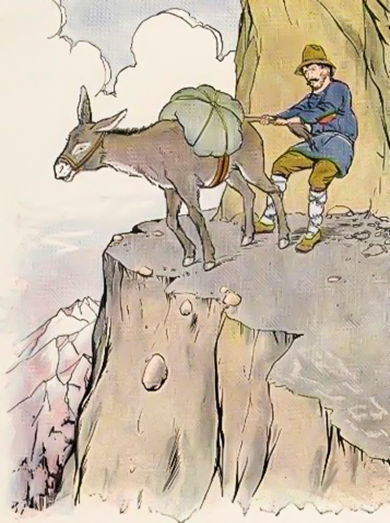
An Ass was being driven down a mountain road by his master. As they made their way, the Ass suddenly stopped and looked down the steep slope. He could see his stall at the foot of the mountain and thought, “That way is much quicker!”
Without listening to his master’s calls, the Ass stubbornly turned aside and headed straight for the edge of the cliff. His master, seeing the danger, grabbed the Ass by the tail and tried to pull him back. But the Ass would not listen and pulled with all his might.
“Very well,” said the master, letting go, “go your way, you willful beast, and see where it leads you.”
The foolish Ass tumbled head over heels down the mountainside.
Stubborn fools are difficult to teach or reason with. They refuse to dialog and listen to any contrary voice that would pull them back from the edge of their foolish decision. Wisdom pleads with them to go a safe and sound way. But willful beasts, lacking any wonder about possibilities and fixed on the certainty and infallibility of their impulsive choice, fall headlong into ruin.
Stubborn fools dismiss wisdom as conventional and not progressive, not reactive, not quick enough to achieve what they want. Stubborn fools rush into ruin.
Stubborn fools, aka useful idiots, love their ideological isms –socialism, communism, globalism, Progressivism– for the ism and those who promote it do their thinking for them. Everything thought and done is reduced to the certainty their ism holds for them –their stall at the foot of the mountain. Stubborn fools do not expand their personal bandwidth to see beyond the ism. They refuse the wisdom of the ages that would reveal to them the ruinous outcomes of their isms. The “warmth of collectivism” murdered millions last century.
Ideology—that is what gives evildoing its long-sought justification and gives the evildoer the necessary steadfastness and determination. That is the social theory which helps to make his acts seem good instead of bad in his own and others’ eyes, so that he won’t hear reproaches and curses but will receive praise and honors. … Thanks to ideology, the twentieth century was fated to experience evildoing at a scale calculated in the millions. ― Aleksandr Solzhenitsyn, The Gulag Archipelago
Revolutionaries are stubborn fools, certain of the ism-ends they want to achieve. They use Direct Action, believing that the ends justify the means and any means necessary must be used to forcefully pull away from wisdom. They react impulsively and go headlong over the cliff to their certain end bringing many with them.
Consider what has happened and continues to happen on the streets of Minnesota. One stubborn fool, armed with a Honda Pilot SUV, drove into an ICE officer and another brought a military-grade handgun to a protest. Instead of remaining calm and standing back to protest they came armed and ready to fight the criminal-removing ICE agents. Both stubborn fools fell headlong into ruin. As they say, FAFO.
Proverbs 14:12 – “There is a way that seems right to a person, but its end is the way to death.”
Proverbs 14:15 – “The simple believes everything, but the prudent gives thought to his steps.”
Proverbs 22:3 – “The prudent sees danger and hides himself, but the simple go on and suffer for it.”
Here’s another tale:
The Wolf and the Kid
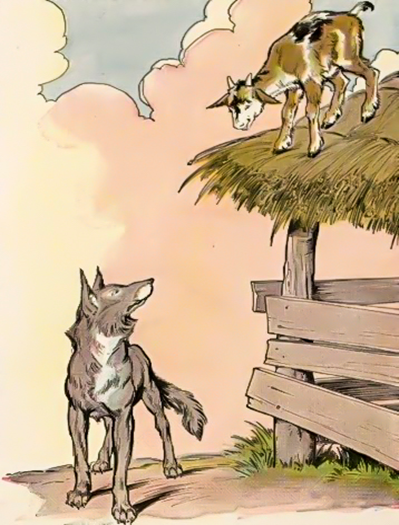
A frisky young Kid had been left by the herdsman on the thatched roof of a sheep shelter to keep him out of harm’s way. The Kid was browsing near the edge of the roof, when he spied a Wolf and began to jeer at him, making faces and abusing him to his heart’s content.
“I hear you,” said the Wolf, “and I haven’t the least grudge against you for what you say or do. When you are up there it is the roof that’s talking, not you.”
The lively young Kid taunted the wolf, not out of bravery, but out of circumstance – being placed on the roof out of harm’s way.
Mocking fools don’t speak truth to power. They don’t even see the truth of their own situation. They deceive themselves. It was the roof that was talking, not the Kid.
Mocking fools on social media ridicule others from the ‘safe distance’ of anonymity.
Mob mentality and social media provide a false sense of security for Mocking fools.
The provocation of Mocking fools is meant to cause conflict and chaos.
We have seen mocking fools on the streets of Minnesota taunting and badgering ICE agents who are removing illegal migrant criminals from the city.
Proverbs 18:2 – “A fool takes no pleasure in understanding, but only in expressing his opinion.”
Proverbs 29:8 – “Scoffers set a city aflame, but the wise turn away wrath.”
~~~
Where There is Wisdom Life Thrives
Before the 13.8 billion years of our cosmic history that have been utterly dependent on the four fundamental forces of nature -gravitational, electromagnetic, strong and weak nuclear- to make matter and life possible (anthropic principle), there was Wisdom.
“The Lord created me at the beginning of his work,
the first of his acts of long ago.
Ages ago I was set up,
at the first, before the beginning of the earth. . .
“I was beside him, like a master worker, and I was daily his delight,
playing before him always,
playing in his inhabited world
and delighting in the human race.” Prov. 8:22-31
Wisdom’s finely-tuned masterwork of a space-time cosmos and our own habitable zone called Earth makes it possible for everyone, including a variety of fools, to exist and test reality.
~~~
The Great Stage of Fools
“When we are born, we cry that we are come to this great stage of fools.” ― William Shakespeare, King Lear
Simple fools are the naïve, gullible, seducible, easily persuaded. They might be open to wisdom or to folly.
Wisdom calls to them:
Proverbs 1:22 – How long, O simple ones, will you love being simple? How long will scoffers delight in their scoffing and fools hate knowledge?
Proverbs 7:7 – And I have seen among the simple, I have perceived among the youths, a young man lacking sense.
~~
Stubborn fools are stupid fellows, dullards, arrogant ones. They are foolhardy, stupid, silly, and insolent.
They are simpletons who hate knowledge (Prov. 1:22).
Stubborn fools take no pleasure in understanding, but only in expressing personal opinion (Prov. 18:2).
Stubborn fools delight in mischief, in doing wrong (Prov. 10:23).
Out of the mouth of a stubborn fool comes folly (Prov. 15:2).
Stubborn fools feed on folly (Prov. 15: 14).
~~
Mocking fools are the scoffers, jokers and clowns. They rain down ridicule out of their lofty arrogance. They enjoy stirring up people. They have contempt for wisdom, good judgement, and harmony.
Scoffers cannot find wisdom (Prov. 14:6).
Scoffers are an abomination to everyone (Prov. 24:9).
When scoffers are driven out, strife, quarreling and abuse cease (Prov. 22:10).
Avoid the presence of scoffers (Ps. 1:1).
~~
Sensual fools indulge in evil and depravity. Their senses are alive but their conscience has been seared closed. They are crude and ignoble and don’t care. They are self-destructive, morally blind, volatile, and rash. They know the truth but disregard it.
The way of sensual fools is right in their own eyes (Prov. 12:15).
Holding a sensual fool accountable, one receives ranting and ridicule without relief (Prov. 29:9).
~~
Hardened fools are stupid wicked people. Morally bankrupt, they are willfully ungodly. They live as if God doesn’t exist. They are fully committed to folly and total depravity. They are vile.
The hardened fool says in his heart, ‘There is no God.’ They are corrupt, they do abominable deeds; there is no one who does good (Ps. 14:1)
~~~
Some Thoughts
-From the first tales we learned that the foolish ass had an end in sight and a way to that end that seemed right. But by taking that way, he became gravity’s free-falling object.
-The lively young Kid, so sure of itself atop a roof, poured down insults on the wolf. But the Kid didn’t consider the gravity of the situation. He would soon be placed back on the ground.
“For there is no folly of the beast of the earth which is not infinitely outdone by the madness of men”- Ishmael in Moby Dick by Herman Melville
-The foolish have false appraisals about themselves and about reality. Because of this they act recklessly.
BREAKING | 39 Democrats (and Don Lemon) now face criminal charges for storming church in Minnesota.
-“Fools rush in where angels fear to tread.” -Alexander Pope’s 1711 poem An Essay on Criticism
-Fools are repeat fools: “Like a dog that returns to its vomit is a fool who reverts to his folly.” Prov. 26:11
Need an example of the so stubborn fool-minded they are no earthly good?
From Do Democrat Cities and States Love Rolling in Their Own Filth?:
Were Democrats raised in a barn? It’s far worse – they were raised in places like San Francisco where sanitation standards are not far from street poop capitals like India.
There’s just something about left wing government that attracts a stench. Maybe it’s the laziness and the entitlement of socialism. Maybe it’s the inevitable economic malaise beating people down until they no longer care about the state of their surroundings. Maybe leftists simply revel in decay, like pigs in their own filth.
Examples of this lackadaisical gutter dweller mindset are rampant. Wherever Democrats are in control, crime and a river of putrescence follows. . .
The bottom line is, there are better ways to manage US cities and their infrastructure. Conservative states and cities show this on a daily basis. Democrats simply do not want to listen. For whatever reason, they love the smell of their own farts. (Emphasis mine.)
-Fools revel in Bad Bunny vulgarity. America’s future looks vulgar
-Isn’t much of the rottenness, suffering, and evil in the world caused by fools. One such depicted fool is Fyodor Pavlovich Karamazov in The Brothers Karamazov by Fyodor Dostoevsky.
Some became fools through their rebellious ways
and suffered affliction because of their iniquities. –Psalm 107:17
“We all enjoy evil, or why would there be so much of it? Most derives from people like us. Thinking of it as superhuman or alien allows us to persist in it.”
― Gary Saul Morson, Wonder Confronts Certainty: Russian Writers on the Timeless Questions and Why Their Answers Matter
-Fools love to rant about “oppressors” but fail to see that they oppress themselves and others with their foolish and often destructive responses to “oppression” (Democratic Socialism, Open Borders, and DEI).
-We should learn to evaluate our world not in terms of Left and Right but in terms of Folly and Wisdom.
-Fools self-deceive and find ways to explain and exculpate their behavior. They have alibis:
“This is the excellent foppery of the world, that when we are sick in fortune (often the surfeits of our own behavior) we make guilty of our disasters the sun, the moon, and stars, as if we were villains on necessity; fools by heavenly compulsion; knaves, thieves, and treachers by spherical predominance; drunkards, liars, and adulterers by an enforced obedience of planetary influence; and all that we are evil in, by a divine thrusting on. An admirable evasion of whoremaster man, to lay his goatish disposition on the charge of a star! My father compounded with my mother under the Dragon’s tail, and my nativity was under Ursa Major, so that it follows I am rough and lecherous. I should have been that I am, had the maidenliest star in the firmament twinkled on my bastardizing.” (Emphasis mine.) ― William Shakespeare, King Lear
“There are two ways to be fooled. One is to believe what isn’t true; the other is to refuse to believe what is true.” ― Soren Kierkegaard
– “A learned fool is more a fool than an ignorant fool.” ― Moliere
-One can gain wisdom about what it means to be human from reading (not viewing) children’s books such as Pinocchio, The Velveteen Rabbit, The Little Mermaid, Charlotte’s Web, The Chronicles of Narnia, and with stories such as Hans Christian Anderson’s Ugly Duckling and Grimm’s Cinderella. These stories will impact the moral imagination more than any Christian “how-to” books and sermons with cajoling platitudes. See Tending the Heart of Virtue: How Classic Stories Awaken a Child’s Imagination by Vigen Guroian for what is conveyed in these and other stories.
-Spanish Jesuit priest named Baltasar Gracián wrote The Art of Worldly Wisdom in 1647. Gracián elevates prudence above all other virtues. As Gracián defines it, prudence is the ability to see clearly, think ahead, and act deliberately rather than reactively. “It is far easier to prevent than to rectify,” he writes. (Emphasis mine.)
-Thomistic philosopher Josef Pieper, in his classic work The Four Cardinal Virtues, sums up the virtues in this way: “Prudence looks to all existent reality; justice to the fellow man; the man of fortitude relinquishes, in self-forgetfulness, his own possessions and life. Temperance… aims at each man himself.”
-Some talk of pan-psychism – a view that everything in the physical universe has a relational consciousness and that consciousness is the basic ingredient of reality.
I believe Wisdom is the consciousness in all matter, for wisdom has been around from before the beginning of the world. Wisdom ordered and finely-tuned the universe for our existence. Wisdom holds everything to together.
Wisdom calls us to the wonder and order of the universe, to the relational consciousness in all things, and to an understanding of where it comes from and what it means for our lives.
Wisdom calls for us to receive the wisdom she offers. For, Where There’s a Will, There’s No Want of Foolish Ways.
Wisdom cries out in the street;
in the squares she raises her voice.
At the busiest corner she cries out;
at the entrance of the city gates she speaks:
“How long, O simple ones, will you love being simple?
How long will scoffers delight in their scoffing
and fools hate knowledge?
Give heed to my reproof;
I will pour out my thoughts to you;
I will make my words known to you. – Prov. 1:20-23
Over two-thousand years ago, Wisdom walked the streets of Galilee calling to us in the same way.
The apostle Paul tells us in his letter to the Corinthian church that Jesus is “the power and wisdom of God” (1 Cor. 1:24).
To the church in Colossae, Paul wrote (Col. 1:16-17)
For in him all things were created,
In the heavens and here on earth.
Things we can see and things we cannot-
Thrones and lordships and rulers and power-
All things were created both through him and for him.
And he is ahead, prior to all else,
And in him all things hold together;
-I am well aware of folly. Earlier in life I acted foolishly at times and went over the cliff with my desires. My folly affected both myself and those around me. Later, I put away childish things and grew out of foolishness.
~~~~~
Have we become so left-brain oriented that we only focus on one thing and go for it ignoring the right-brain’s grasp of the whole situation and warning us away from impulsivity?
Why Contemplation & Wonder Are Essential for the Future of Humanity
“The very, very last thing we need now is more power. What we need is more wisdom. And if we had sufficient wisdom, then more power would be useful. But if we had more power but not the wisdom required to know how to use it, we cannot help but destroy ourselves and the world.” -Dr. Iain McGilchrist
“The stakes of our time are no less than power vs. life.”- Nate Hagens
How can spiritually healthy and aware individuals lead the way towards societal change rooted in wisdom? How can focusing on the well-being of our closest communities create ripple-effects of emergence for broader humanity? Finally, how can embracing wonder and humility throughout our lives – in the face of our scariest challenges – guide us towards a more interconnected and sentient humanity?
Podcast here:
Dr. Iain McGilchrist is a Quondam Fellow of All Souls College, Oxford, an Associate Fellow of Green Templeton College, Oxford, a Fellow of the Royal College of Psychiatrists, a Fellow of the Royal Society of Arts, and former Consultant Psychiatrist and Clinical Director at the Bethlem Royal & Maudsley Hospital, London
Iain is the author of a number of books, but is best-known for The Master and his Emissary: The Divided Brain and the Making of the Western World (2009); and his book on neuroscience, epistemology, and ontology called The Matter with Things: Our Brains, Our Delusions and the Unmaking of the World (2021).
~~~~~





Does Eustace eventually shed his arrogance and self-centered behavior?








 Cindy Wity