Musical Chairs

The calls come when I’m in the shower or in a dream. Tonight, a call interrupted someone with a buzzsaw chasing me down a dark alley.

“Roy, if you pick that up it stops making noise.”

“Huh? I love you, too, Laci. Put the buzzsaw down.”

“Roy, pick up that hum-buzzing thing.”

“Huh . . . Oh . . .Hello?”

My sister-in-law Diane was on the phone. She was in a state.

“Roy, it’s Dutch.”

“What’s happened?”

“Dutch hasn’t come home from yesterday’s rehearsal,” her voice broke. “I called and called and when he finally picked up, he sounded drunk, incoherent.”

“Where is he now?”

“I don’t . . .wait . . .he’s walking in the door right now . . . Oh no! I see why he sounded like that. You should see for yourself.”

I told her I would come right over.

“Roy, what is it?”

“Diane says something happened to Dutch.”

I kiss Laci, get dressed, and head over to my brother’s place.

My older brother Dutch plays trumpet for Center City Symphony Orchestra. He auditioned for the group fifteen years ago and was appointed Principal Trumpet chair. I went in a different musical direction. I blow the whistle on the bad guys as lead detective for Center City.

I arrive at my brother’s house and go inside. Diane, teary eyed, runs up to me.

“Look what they did to him, Roy.”

“Who?” I walk into the living room.

“Someone . . .  someone did this to him.”

Dutch was sitting in an arm chair holding an ice pack on his face. His eyes were glazed over. I ask to look at the damage.

His nose and mouth were bloodied. He had a fat lip and two front teeth had been knocked out. Not good for someone who makes a living with serious chops.

“You won’t need stitches, Dutch, but you’ll a need couple of teeth.

“And, he’ll need months to recover his embouchure!” Diane sobbed.

Dutch coughed spitting out blood. “I wasssupposed to play the Haydn Trumpet Concerto homorrow night.”

“Who did this to you, Dutch?”

“Hats just it,” Dutch moaned, “I dunnooo. I wasss backssstage with my horn and sssomeone called my name. I turned and whhaamm ha stage curtain hit me. I fell back and hit my hhhead.”

“Stage curtain?”

“Like a cannonbawll.”

“Did anyone see what happened?”

“I dunnooo,” he gulped. “Whhhen I came to my hhhead hurrd my mouth hurrd and my trumpet bell was smashed.

Diane brought another bag of ice and a shot of bourbon.

“Roy, they took him to the emergency room and kept him there for observation. They were worried about a concussion. Dutch said that the orchestra manager was there fretting about him not being able to play and the Center manager was there fretting about liability. I should have been there fretting over Dutch.”

I told them that I would go to the Arts Center later that morning to investigate. Before I left, I almost told Dutch to keep a stiff upper lip. But he was in no mood for kidding.

“Roy, find out wahhappened. Will ya?”

I promised I would.

 ~~~

After a couple of hours of sleep and a cup of black coffee with my best girl, I drive over to Central City Performing Arts Center to meet with the orchestra manager. It looked to be a long wet Friday. I needed something to offset the feeling I had in my gut. I stop and buy a couple of boxes of Good and Plenty.

Over at the Center, I introduce myself to the bowtied Mr. Caldecott. I ask about yesterday’s rehearsal.

“Well Detective, I arrived at noon yesterday to set up the chairs, stands, and music for the afternoon rehearsal. But the stage curtain was still down from the previous theater performance, so nothing could be placed. I went and asked the Center’s custodian to raise the curtain. An hour later the curtain was raised and then someone told me that our Principal Trumpet had been injured.”

“When exactly did the curtain go up?”

“The curtain didn’t go up until two. So, rehearsal started at three-thirty, not the usual three.”

“When do the orchestra members show up”

“Usually, it’s an hour before rehearsal begins. They warm up and review the music.”

Mr. Caldecott then informed me that only the sound technician and the custodian were around when he arrived yesterday. He walked me over to the sound booth at the back of the auditorium.

The sound tech said that he had been waiting for the stage curtain to go up and the chairs and stands to be in place so he could set up the microphones for the rehearsal. He said he spent his time waiting in the sound booth and was too far away to see anything going on off stage.

Mr. Caldecott then walked me backstage so I could talk to the custodian.

The custodian was a short bald-headed old guy with a pasty face, red nose, and scraps of hair for a mustache. His uniform name patch said “Charlie.”

“Charlie, I’m a detective investigating what happened yesterday before rehearsal.” I didn’t mention my name. I didn’t want my relationship with Dutch brought into the matter.

“A detective, heh? Say, don’t you guys wear trench coats and fedoras?”

“Yeah, when we’re playing a part. But I’m not playing anything right now. Someone received a serious blow to the face.”

I ask them to show me where it happened.” I follow them to stage left.

“Mr. Caldecott said the curtain was down yesterday. He asked you to raise it. He also said that it took an hour before it was raised. Isn’t that right Mr. Caldecott?”

“Yes, detective.”

“Well, Charlie, what took so long?”

“The curtain was down and that pulley you’re looking at had broken loose from the floor boards. So, I had to bolt it down to lift the curtain for the rehearsal. You can see the new bolts.”

I tell Mr. Caldecott that I need the curtain lowered to inspect it. He goes to move some things on stage before the curtain can be lowered.

The stage curtain down, I find graze marks in the fabric. And specks of blood. On the other side of the location of the scuff marks are more scuff marks. Directly below is the remounted curtain pulley.

“Was the pulley loose when the guy got clobbered?”

“Yes, detective.”

“So, anyone could have come along and swung it into Mr. Winder’s face?”

“I suppose that’s possible.”

“Don’t touch the pulley.”

I call the station and ask Ted to come right over. I want him to dust the pulley for fingerprints and to swab the blood on the curtain.

“Where were you when the trumpet player got clobbered?”

“Well, let’s see . . . I . . . I was looking for wood screws to tie down the pulley. Is that all detective?”

“Yeah, for now.” There were some loose ends that needed tying up.

“Mr. Caldecott, you said someone came and told you what had happened to the Principal Trumpet. Who was that?”

He gives me Nelia Swan’s phone number and address. I call her and tell her that I’m on my way over to talk.

I arrive at Ms. Swan’s flat and she invites me in. She offers me some Mariage Frères tea. I tell her a cup of café noir would be great.

“What?”

“A cup of joe.”

“Sorry detective. I don’t have coffee.”

“I’ll live.”

I move the cat from the arm chair and sit down.

I ask Nelia about what happened at the rehearsal.

“Dutch and I arrived early. We were off stage warming up. We were waiting for the stage curtain to go up so chairs could be set up on the stage.”

“Where was Dutch?”

“Dutch was standing near the stage entrance playing intervals.”

“Where were you?”

“I was further off stage warming up.”

“Did you see what happened?”

“One minute Dutch was standing there and the next he was on the floor. I didn’t see him get hit in the mouth. I don’t know how that could happen.”

“Did you see anyone behind the curtain? Did you hear someone call his name?”

“No. I put my horn down to help Dutch.”

“Is there anyone who has a grudge against Dutch?”

“No. I can’t think of anyone. He’s liked by everyone.”

“He was hit right in the kisser. Anyone want him out as Principal Trumpet?”

“We’re all professionals here, detective. If a person wanted to move up in the orchestra, he or she would have to audition for that spot, but only if it is vacated by a musician who leaves the orchestra.”

“So, if Dutch was out another trumpet player could audition for his spot?”

“Yes.”

“Who is second chair trumpet?’

“His name is Mark . . . Mark Jacobson.”

I thank Nelia and make my way back to the station to do some paperwork and call the orchestra manager. I ask for Mark Jacobson’s phone number. I need to talk to him.

I call Mr. Jacobson and ask him to come to the station. He was more than a little flustered. He was practicing for the Haydn and didn’t want be bothered. I told him I’d come over.

I drove over to Jacobson’s place.

“Mr. Jacobson, I’m a detective investigating what happened yesterday before rehearsal.”

“What the hell! I shouldn’t be bothered right now. I have to play the Haydn tomorrow night!”

I reminded him why he was playing the Haydn. He softened a bit. “That’s too bad. Dutch didn’t deserve that.” Then, he whiplashed back. “I deserve a chance to be Principal Trumpet. Tomorrow is my chance. If it goes well, I’ll be the Principal Trumpet of the Center City Symphony!”

“Where were you when Dutch was assaulted, Mr. Jacobson?”

“Assaulted? What? How do you figure?”

“I figure that stage curtains don’t attack people.”

“The man had a habit of annoying people.”

“That’s not what I heard.”

“Well, you didn’t sit next to him for ten years.”

“Dutch is my brother. He annoyed me alright and I annoyed him back. That’s what brothers do. Did Dutch annoy you and you wanted to punch him in the face?”

“C’mon. I’m a professional. I need to get back to my performance.”

“Where were you when Dutch was assaulted, Mr. Jacobson?”

“I was on my way to the rehearsal.”

I left Mr. Jacobson to his Haydn.

Driving back to the station I thought about our conversation. Mr. Jacobson was certainly annoyed by me. He had a short fuse. Was it due to stress about playing the Haydn? Did he have anger issues? Did he resent Dutch being Principal Trumpet and decide to take the chair out from under him?

I would question him again, after his performance. In the meantime, I would check on Dutch.

Diane met me at the door.

“He’s sleeping now, Roy. He’s scheduled for dental implants next week. The conductor was here about an hour ago. He said he would tell the subscribers that Dutch had taken ill and needed some time off.”

I asked Diane if she knew the second trumpet Mr. Jacobson.

“I know Mark. He was in the high school band and orchestra with me and Dutch.”

“The three of you have known each other since high school?”

“Yes. And after high school the three of us played in the civic orchestra before being accepted in the symphony orchestra.”

“If I recall, you played the French horn?”

“Yes. But with three kids I had to leave the orchestra and stay home.”

“Did Mark have any issues with Dutch back then?

“Dutch was first chair trumpet during high school. Mark challenged him a few times for the chair. But he was never able to get it. Dutch was too good.”

“Challenged?”

“In high school band and orchestra, a player could challenge a higher ranked player for their chair. The director would set up a music test, listen to both and decide who gets what chair. That doesn’t happen in professional orchestras. You audition when you first come in and then sit where you are told to sit.”

“So, Mark might have resented Dutch’s ability?

“He really wanted first chair. But then he became first chair trumpet when Dutch and I had to leave high school. I became pregnant with Celeste.”

“I see. Anything else about Mr. Jacobson?”

“I was told at the time that Mark had a crush on me. Maybe he thought I was looking at him when I was looking over at Dutch. Do you think Mark did this to Dutch?

“I think I need to have another conversation with Mr. Jacobson.”

~~~

Sunday morning, around nine, I drive over to Mr. Jacobson’s place.

He invites me in. I ask about the Haydn.

“It went very well. My improvised cadenza would have been better if I had more time to prepare, but the audience liked my performance.”

“Say, Mr. Jacobson. How badly do you want first chair?”

“I don’t like your manner.”

“Yeah. I get that a lot in this business. Listen Mr. Jacobson, I know you were in competition with Dutch in high school.”

“Yeah. So what. I have ambition like the next guy.”

“I’ve been a copper long enough to see ambition and improvisation go together like Bonnie & Clyde.”

“Oh, c’mon. Sure. I was a bit jealous of Dutch, his talent, but I would never harm him. I wanted the chair honestly. I have another performance this afternoon, so I really must ask you to leave.”

I left Mr. Jacobson to his Haydn. I didn’t tell him that I had attended Saturday night’s performance.

As I sat in the balcony waiting for the conductor to walk on stage, I read the program notes. I learned about concertos.

A concerto, the program said, features a soloist engaged in an elaborate conversation with an orchestra. A solo instrument is set off against an orchestral ensemble by alternation, competition, and combination. Concertos typically contain three movements, the first and last of which are usually quick-paced, with a slower tempo for the middle movement.

This case has the elements of a concerto. Someone was set off against the orchestral ensemble that included Dutch as Principal Trumpet. The case has moved past the first movement – Allegro – when Dutch was clobbered to the second movement – Andante – which now is slowly unwinding the whodunnit. I’m looking forward to the final movement – Allegro – when everything comes rushing together and I blow the whistle on someone.

After the Saturday evening performance, I learned even more.

I stuck around to see Mark and Nelia get very chummy. They left the Arts Center together. I followed them to a wine bar over on Third Street. They shared some drinks, kissed, and talked for two hours. They left around eleven and drove to Nelia’s place. Mark stayed overnight and left around eight in the morning.

I didn’t press Mr. Jacobson on his relationship with Ms. Swan this morning. I wanted to talk to Ms. Swan first.

After leaving Jacobson’s place, I drove over to Ms. Swan’s flat. I knocked and she invited me in.

“Oh, detective. If I knew you were coming I would’ve bought some coffee. I was just making some tea.”

“You might need something stronger.” I cleared my throat.

“Huh?”

“No thanks on the tea.”

I walk into her living room, move the cat out of the chair, and sit down. On the lamp table was a framed photo.

“Say, this photo wasn’t here yesterday.”

“Mark gave it to me last night. That was taken in the Bahamas last summer. That’s where Mark proposed to me.” She showed me the engagement ring.

“You didn’t mention your relationship with Mark the last time I was here. Why?”

“I didn’t think it had anything to do with what happened to Dutch. Besides, Mark wouldn’t hurt a flea.”

“He comes across as a bit on edge.”

“Yeah, lately he’s been pushing himself. Trying out with different orchestra for the Principal Trumpet chair. He wants to make more so we have enough to pay for a traditional wedding. My parents are divorced and they don’t have money and we’re both still paying off student loans.”

I got up to look at the photos on the side table.

“This guy looks familiar.”

“That’s my father.”

“Isn’t he the custodian at the arts center?”

“Yes.”

The third movement was about to begin. I left Ms. Swan and drove over to the Arts Center to have a talk with the custodian. No doubt his fingerprints are all over that pulley.

~~~

Over at the Arts Center I meet with the building’s manager Mr. Fairmont. I have him show me to the custodian’s office.

Inside the cramped room is a small desk with chair, two file cabinets, a bulletin board with the orchestra’s schedule, a sleeping bag, a hotplate, cans of soup and baked beans, a bag of tools, and a duffel bag stuffed with clothes.

A bottle of Mad Dog is in the top drawer of the file cabinet with some Dime Detective Magazines and a dog-eared copy of Mickey Spillane’s Kiss Me, Deadly.

On the desk is a photo of Mr. Swan and his daughter Nelia.

“What’s all this?” The custodian came in.

“Well, look what crawled out from behind the curtain.”

“Hey, this is for employees only, detective.”

“I am employed, Charlie. Have a seat.”

“Now Mr. Swan, I want you to help me sort out a few things.”

“Yes. How can I help?”

“The day of the attack on Mr. Winder, the pulley was loose from the floor, wasn’t it Mr. Swan?”

“Attack? Why do you say he was attacked? Who would do such a thing?”

“Someone playing musical chairs.”

“What? The pulley had come loose from the floor boards. I had to get the curtain raised.”

“Your daughter is planning on marrying Mr. Mark Jacobson, is that correct?”

“Yes.”

“Are you all in on that marriage.”

“Why yes, I am. Where you going with all this?”

“I did some digging and found out that the pay scale is the same for all section players and that principals make more. Stands to reason that with Principal Trumpet Mr. Winder out of the way, your daughter’s fiancé would get the chair, get more pay, and then marry your daughter”

“If you say so.”

“I do and so does the logic.”

“I did some more digging and found out that you like to drink and gamble and that’s how you lost your wife and your house. You are now living here. Isn’t that so, Mr. Swan?”

I looked over at the manager of the Arts Center.

“I had no idea that you were living here, Charlie.”

“I . . . I. “

“Did you daughter know that you lost your house and were living here?”

“No. No. No. I don’t want her to find out and worry about me. She doesn’t know about the house. We see each other here every time the orchestra plays.”

“With Mr. Jacobson coming into more pay and your daughter’s marriage you planned on living with them. Didn’t you Mr. Swan? You knew you couldn’t keep living here. Someone would find out.”

“Are you suggesting that I attacked Mr. Winder? Look. There were plenty of people around who could have socked the guy.”

“You had motive and opportunity. You were working on the pulley when this happened.”

“Oh, c’mon detective. I’m just an old guy down on my luck trying to get by.”

“I had a conversation with another old guy down on his so-called luck. You see, I lead AA meetings at a church two blocks from here. One of the men at the meeting told the group that he messed up and went back to his old hangout – Blake’s tavern a couple of blocks from here. He had a few with some old friends. One old friend, he told the group, was pounding drinks and talking crazy, saying that sometimes you have to take matters into your own hands and eliminate the competition to improve your situation. The guy saying all this to the group is your bar mate Sam.”

“Sam?”

“I talked to Sam this morning, Charlie. He agreed to tell the judge what you said, nothing more and nothing less. And, I talked to my forensics tech. He said that there is only one set of fingerprints on the pulley. If their yours, well . . .”

“Alright. Alright. I . . .I just wanted to sideline the guy for a bit to give Mark a chance in the spotlight. I thought the curtain would cushion the impact. And I figured the guy had disability insurance to cushion his income.”

You had all this figured out, didn’t you Mr. Swan?”

“I figured I was helping my daughter.”

“By swinging a pulley into some guy’s mouth, busting his chops and taking the chair out from under his livelihood to leverage a better living situation for yourself? Does your daughter know that you . . . pulleyed this off?

“No. No. No. She doesn’t and I don’t want her to know.”

“Too late for that Mr. Swan. It’s curtains for you. Come with me down to the station. I’m booking you for aggravated assault on Mr. Winder. You can call your daughter to have her bail you out.”

  ~~~

After Mr. Swan was booked into custody, I went over to see Dutch and Diane.

Dutch’s mug looked like he’d been in a hockey fight. I told them that it was the custodian Mr. Swan who swung the pulley. No one else was involved. I told them Swan’s motive. They were both shocked by the account.

Then I told Dutch what the orchestra manager told me: they’re passing the hat around so you can buy a new trumpet and some new teeth. I give Dutch a box of Good and Plenty and he gives me a smile that hurt both of us. I tell them that I have to take off.

“There’s a blue-eyed blond waiting for me with a steak covered in onions and Farewell, My Lovely.”

~~

©J.A. Johnson, Kingdom Venturers, 2026, All Rights Reserved

Now I Lay Me Down

My name is Roy Winder. I’m a homicide detective. I investigate suspicious deaths, collect evidence, and work to solve cases. My job is putting two and two together. But two and two don’t always add up to a solve a mystery, as in my last case.

When the call came, I drove over to Grace church on Fourth street. The minister led me to the body lying face up at the bottom of the baptismal tank. My first impression: foul play wasn’t involved. I didn’t see any blood or signs of a fight or an instrument of death. I saw repose. The large man in a large tub laid there with his large hands across his chest like he was finally at rest.

I asked the minister if he knew the man. He said he didn’t.

The guy didn’t look street homeless. He had a few days growth of beard but didn’t look dirty and haggard. The man at the bottom of the tank looked like he had enough to eat.

He had on a wet blue mechanics coverall jumpsuit. Above a chest pocket holding a tire pressure gauge was a red-bordered oval name patch with the name “Sam.”

Twenty years on the force – I’ve seen all kinds of things. And I have smelled the unwashed and the dead. And “Sam”, unwashed or not, was certainly dead. The flies knew it too. We shewed them away and covered our noses.

The minister said that a small group of people stayed overnight in the church during the Maundy Thursday Vigil. They smelled something awful and called him.

I asked about the vigil.

“The Maundy Thursday service extends into an all-night prayer vigil. Some folks sign up to stay every hour of the night to commemorate Jesus’ request that his disciples stay up praying with him in the Garden of Gethsemane before his arrest. Anyway, when I got here this morning at 7 AM I went looking for the smell and found this poor soul in our baptistry.”

I asked for the names of those who were there overnight. But they might not have seen the man. The smell and the bloated body told me that “this poor soul” likely died at least forty-eight hours ago. Had he been in the tank since Tuesday?

I asked the pastor about any recent baptisms. He said there would be baptisms this Easter Sunday.

“Maybe “this poor soul” couldn’t wait till Sunday.”

“Well, the thing is,” the minister explained, “we are an Anglican church. Baptisms are done with sprinkled water and not dunking. We rent this building. It had been a Baptist church but that congregation moved on to another building. The baptistry had been closed off and never used.”

I asked how he got in.

“The church is typically left open to access the office and parishioners can come into the sanctuary to pray.”

After the three-hundred-pound body was lifted out of the tank and put on a stretcher, I searched the body for an ID and phone. I found a wallet but no phone on Samuel J. Muckle, age 63. There was black residue on the grooves and cracks of his hands, almost like fingerprint dust. Sam was then taken to the morgue for an autopsy.

I wanted to know the cause of death. I wanted to know why he was in the church’s baptismal tank. I needed to find out who would be missing him. I began my inquiry back at the station.

I searched through the missing person’s database. With no matching descriptions and no missing person calls of late, I gave a copy of Sam’s driver’s license photo to a local news station. Someone had to know him.

When the autopsy report came to my desk the next day, there was no fingerprint match to anyone in our system. He wasn’t wanted by the law. DNA matching would take a bit longer.

The coroner’s report said that there were no signs of violence. Sam died of natural causes. A pulmonary embolism likely brought on by obesity did him in. The coroner thought that he may have gone into the tank and then tried to lift himself out and that struggle may have caused cardiac arrest. A large contusion on the back of the head suggested that Sam may have fallen backward, hit his head and laid there trying to recover. Time of death was estimated around 8 o’clock Tuesday evening.

Sam’s photo on TV last night produced results. The first to recognize him was a coworker named Jake. He came into the station and I interviewed him.

According to Jake, Sam hadn’t shown up for work the last few days. They work together as auto mechanics. That explained the oil-stained hands. Jake asked about Sam and I told him the sorry truth. He was shaken.

Jake worked with Sam for several years. When Sam needed a smaller pair of hands to reach something in a tight space under the hood, he asked Jake. When Jake needed help with a truck’s transmission, he asked Sam.

I asked him where Sam lived and for a phone number. He told me where Sam lived and that when he called the number, the phone rang in Sam’s locker at the shop.

“Was Sam married?”

“Sam was married but he never spoke about his wife Midge. He only talked about his kids and sport cars.”

“Was Sam a church-going man?”

Jake said that he’d been invited to Sam’s daughter’s wedding several years ago but that’s the only time he saw Sam in church.

“Where was the wedding?”

“Some Baptist church over on fourth street.”

I walked Jake out and told him that I’d come over to shop to go through Sam’s locker and pick up the phone. Mr. Muckle’s daughter Kerri was in the lobby waiting to talk to me. She looked up at me with the watery searching eyes that every homicide detective has seen.

Kerri said that her ex-husband had called her when he saw her father on the news. She was frantic. She wanted to know if her father was OK.

I brought her to an interview room for a private conversation. I told her that her father had passed. She burst into tears so I put a box of tissues in front of her. I told her that her father was found in the baptismal tank of the church over on fourth street. This had her asking me why. I had no answer only that there didn’t seem to any foul play involved.

“Where is your mother? Is she home? Did you call her?”

“Yes. I called her. She’s been staying with my two aunts. They’re investigating a pastor about some allegations of misconduct and abuse.”

“Investigating a pastor?”

“My aunts call themselves the “snoop sisters.” They like to dig up dirt on people they call “holy rollers.”

“Is she coming home? I need to talk to her.”

“She’ll be here this afternoon.”

“Did your father and mother get along?”

“They didn’t fight. But they didn’t talk much either. Mom cooked, did laundry, and managed us kids. Dad ate, went to work, fixed things, and watched stock car races and old westerns on TV. After us kids moved out, they had separate bedrooms. Maybe they made things work because of us kids. They were married but not so much. Know what I mean? “

I didn’t know what she meant. I’m happily married to my best girl, a blue-eyed blond who likes a man who serves and protects.

“The coroner thinks that your father may have died from a pulmonary embolism caused by the effects of obesity.”

“My mother called him ‘Chub.’”

“Chub?”

“Yeah. That’s the nickname she gave him. Dinner’s ready “Chub,” she’d say. “Chub” get Todd to mow the law. “Chub” my car needs fixing. “Chub” this and that.

“Was your father depressed?”

“I don’t think so. He was a quiet gentle soul. He let things bounce off of him. But maybe not. He did overeat.”

“Do you know why your father would want to be in the baptistry?”

“No. I mean. I attended there. I was married there and that is the only link to my father and that church.”

Your father wasn’t a church going man?

“Only for weddings.”

“What about baptisms? Sprinklings?”

“Yeah, and those times too.”

“Is there anything else I should know about your father?”

“I don’t think so.”

“I’m sorry for your loss. I’ll walk you out.”

Alan, Kerri’s ex-husband and Sam’s former son-in law, was in the lobby waiting to talk to me. Kerri walked past him without a word. I brought him to an interview room.

Alan said that he recognized the photo and wanted to know about his former father-in-law – if he was missing, if there was any foul play. I gave him the sorry news and told him where I found the body.

“I figured obesity would take him but in a baptistry?”

I asked Alan how long he had known his father-in-law.

“I’d been married to Kerri for seven years. I was around my father-in-law at a few get togethers.

I asked Alan if he thought Sam was depressed.

“I would be if I lived with that woman.”

Alan described his mother-in-law as disagreeable and without an ounce of grace. She had a habit of calling her husband “chub.” He didn’t know if this was a term of endearment or a belittling remark that his father-in-law just accepted.

“She didn’t find things amusing except when she found fault with someone. There was one family gathering where she and her sisters where gossiping about someone and the situation they talked about resolved itself in a funny unexpected way. I said God must have a sense of humor. She snapped back at me saying that God had no sense of humor.”

Could a disagreeable woman without a sense of humor cause a man to eat himself to death and end up in a baptistry?

That afternoon Sam’s wife Midge showed up at the station. She wanted to see the body, so I drove her over to the morgue. She looked at Sam’s face and said “That’s Him. That’s Chub.”

Driving back to the station, I asked Midge if things were OK back at home.

 “Things were as they always were.”

“He was found in a baptistry. Do you know why?”

“Maybe he thought it was a spa. I don’t know.”

“You investigate people.”

“I find out people’s secrets and put them in their place. Isn’t that what you cops do?”

“We investigate who put them in their place, as in baptistries. You don’t wonder why your husband was found dead in a baptistry?”

“Why should I? There was no funny business was there?”

“Not that I could see.”

“Well, then.”

I wasn’t getting much out of Midge. She volunteered nothing. Her investigation into her husband’s death had ended.

On Sunday, a day off without a homicide call, I went to Grace church over on Fourth street. It was Easter Sunday with talk of resurrection -the other side of death that homicide detectives don’t get calls for.

On my way out after the service, rector Philbee greeted me.

“Sam’s daughter contacted me. The family will have the funeral service here this week. You are invited. Did you find out why Sam came here?”

“I interviewed the family and nothing adds up.”

“Well, detective, as you know, people do all kinds of violence to get what they want. And there are some who desperately want the kingdom of God and do violence to themselves to get ahold of it. I wonder if that was what was going on with Sam.”

On Monday I closed the case. What did I have? Sam’s was no suspicious death. But it was a mystery of location, location, location.

Putting two and two together, I had a husband, father and friend who died of natural causes in an unused baptistry. And, I had no clear motive for Sam going out of his way to be in that exact place. I had no idea of what he hoped to find there. Maybe the padre was right.

The funeral for Samuel J. Muckle was held a few days after Easter Sunday at Grace church. I attended and sat in the back row. I wanted to see “this poor soul” laid to rest. Around the casket were dozens of white trumpet-looking lilies. They gave off a sweet and fragrant scent.

~~

©J.A. Johnson, Kingdom Venturers, 2026, All Rights Reserved

Cosplay Christians Are at it Again

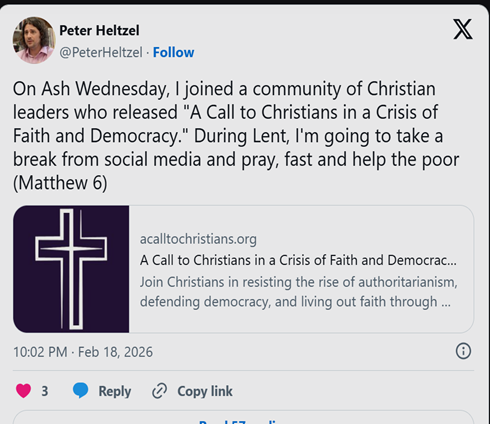
In the “Anything Goes” Gnostic dream world of Progressive Christianity, one can dress up their politics to pose as a Christian persona for emotive performance art . . .

Woke Christian Leaders Issue Letter Against Rise of ‘White Christian Nationalism’

Michael Austin at Gateway Pundit writes:

A coalition of left-leaning evangelical Christians issued a new open letter against the Trump administration and what they claimed is a rising tide of “white Christian nationalism.”

In recent years, legacy media outlets and Democratic leaders have linked a rise in distinctly Christian conservative political engagement to “Christian nationalism,” denouncing the notion that America is an historically Christian people and country.

The “open letter”, with its condemnations and call to resistance expressed in Christian-speak, is an implicit denunciation of ICE, the Trump administration, and any notion of Christianity that hasn’t bowed the knee to the many flags of Progressivism. It comes with an appeal to join the troupe of Cosplay Christianity. You can add your name to a list of those who have bowed the knee.

The website: A Call to Christians in a Crisis of Faith and Democracy | Stand for Justice & Faith — Act Now

From the coalition’s Why We Write:

We are facing a cruel and oppressive government; citizens and immigrants being demonized, disappeared, and even killed; the erosion of hard-won rights and freedoms; and a calculated effort to reverse America’s growing racial and ethnic diversity– all of which are pushing us toward authoritarian and imperial rule.

What confronts us is not only an endangered democracy and the rise of tyranny. It is also a Christian faith corrupted by the heretical ideology of white Christian nationalism, and a church that has often failed to equip its members to model Jesus’s teachings and fulfill its prophetic calling as a humanitarian, compassionate, and moral compass for society.

Therefore, as Christians in the United States, representing the breadth of Christian traditions and one part of our nation’s religiously plural society, we are compelled to speak out more boldly at this time.

~~~

I am compelled to boldly reply. So I’ll start by addressing reality and what these posers have willfully ignored: what has been cruel and oppressive:

Millions of foreign invaders have entered our country illegally. They have been allowed to do so under the globalist open borders Biden Regime. They have been allowed to enter without vetting, vaccines, health monitoring, and financial means of support. U.S. citizens – our neighbors – have been forced to bear the brunt of this invasion. This, while there has been a legal means to enter the country especially if you needed political asylum from persecution, e.g., white South African refugees.

The effects of the mass invasion of opportunists, per Matthew Dickerson, Director of Budget Policy:

“This surge has imposed a significant human cost, with communities across the United States grappling with the consequences of human and drug trafficking.

“A substantial financial price has also been paid by American taxpayers. Many illegal aliens become eligible for taxpayer-funded welfare programs, costing billions of dollars annually.”

Is the Cloward-Piven strategy being used to overthrow the system?

In 1966, sociologists Richard Cloward and Frances Fox Piven developed a political strategy aimed at creating a crisis in the welfare system by encouraging mass enrollment. The manufactured emergency sought to overload welfare agencies, crash the system and trigger a crisis that would expose its inadequacies and force the U.S. government to implement guaranteed income and create a more “equitable” society.

Most of the invaders are on taxpayer-funded welfare. Because of this and other free stuff, Democrats expect them to vote for Democrat candidates and more Big Government dependency. The Democrat’s corporate donors expect cheap labor.

This is the coalition’s inversion of the Good Samaritan story. Rescue 20+ million invaders from ICE and then have them pay you back with votes and cheap labor. Of course, the coalition doesn’t want you to know this. They want focus to be on big bad ICE and on Christians who say “Stop.” The coalition’s list of cosplayer signatories shows who approves of such.

Minnesota Elections Official Finally Admits What We All Knew About Illegals Voting

What has been cruel and oppressive for our neighbors has been the invasion of M.S.13 affiliated narco-gangs that are selling drugs and recruiting new members. Fentanyl deaths and overdoses have followed in the wake of the invasion. Our vulnerable children are being trafficked, pimped, and killed. The coalition would have us focus our compassion, our “Christian” empathy, on the “stranger in our midst” and not on what the “stranger in our midst” is doing to our children.

What has been cruel and oppressive for our vulnerable neighbors: the “strangers in our midst” have committed fraud, robbery, sexual assault, exploitation of a minor, aggravated assault, manslaughter, rape, and murder.

Recently reported:

Illegal alien Israel Flores Ortiz, 19, is facing nine counts of assault and battery for groping girls at a Fairfax County high school he was attending. Victims and parents have alleged that Ortiz approached about 12 girls from behind in crowded hallways, grabbed them between the legs and groped their private areas, . . .

I doubt that you will hear or read anything bad about the foreign invaders via MS NOW, CNN, NYT, WaPo, The Atlantic, and legacy media. The propagandists want you to believe that the foreign invaders are victims of “cruel and oppressive” law and order deportations. The “vulnerable”, the coalition implies, are the foreign invaders and not our U.S. neighbors who are being demonized, disappeared, and even killed by the foreign invaders.

Here’s a reality check for the cosplayer Christian: Arrested: Worst of the Worst

What has been cruel and oppressive are the non-citizen truck drivers who don’t speak the language and don’t know the rules of the road and are on the highway maiming and killing our vulnerable neighbors.

Another Illegal Alien Trucker Leaves a U.S. Citizen in Critical Condition.

What has been cruel and oppressive: those who have been radicalized by anti-ICE indoctrination biting the dust. Renée Good and Alex Pretti died putting up resistance to ICE that so many on the Left and the coalition of cosplay Christians have advocated for.

Good, armed with a Honda Pilot SUV and main character syndrome, drove into an ICE officer. Pretti brought a military-grade handgun to a protest. Instead of remaining calm and standing back to protest, they came armed and ready to fight the criminal-removing ICE agents. 

~~~

Let’s move on to another of the coalition’s absurd claims:

What confronts us is not only an endangered democracy and the rise of tyranny. It is also a Christian faith corrupted by the heretical ideology of white Christian nationalism.”

Progressive Christianity is heretical. Even AI knows this:

“Progressive Christianity is a modern movement within Christianity that emphasizes social justice, inclusivity, and a re-interpretation of traditional doctrines. It seeks to align Christian beliefs with contemporary values and often draws from various theological perspectives, including feminist and liberation theologies.” (Emphasis mine.) AI left out gender theology, eco-theology, and prosperity theology.

Progressive Christianity, a mix of theo-ideologies under the cover of Christianity, seeks political power to “overcome” any form of Christianity that says “Stop!” Its methodology is not much different than the religion of Islam.

Islam uses fear as a motivator to bring about submission to Islam. The Gnostic religion of Progressivism uses fear to bring about submission to woke social issues and a never-ending desire for top-down change.

Fearmongering is essential to Progressivism’s conversion therapy. Deconstructionist sermonizers use “cruel and oppressive” “endangered democracy and the rise of tyranny” “white Christian nationalism” “extremist” and “right-wing” to scare those (diagnosed as) Trump obsessed and deranged. They soon take possession of them and keep their boot, the administrative state, on their neck. The Biden/Harris regime gave us insight into that tyrannical rule. And so did the days of COVID.

See the pattern of manufactured threats to produce doomsday frenzy leading to submission:

How could we forget the constant scare tactics during COVID? The media dashboards of COVID cases, hospitalizations, and deaths? How could we forget the cruel and oppressive authoritarian rule accompanying the propaganda that mandated masks, lockdowns, social distancing, church closures, and vaccines? How could we forget the consequences if we didn’t bend the knee to “the science”?

Pandemic politics was used as a test to see if people would submit to the tyranny of Progressivism’s one rule scientism. Progressives Anthony Fauci, Francis Collins, and Rochelle Walensky were the primary mouth pieces for COVID scientism (and of so much deceit about mitigation, natural immunity, Ivermectin, and COVID origins).

With the likes of charlatans and false prophets with climate models, we have been subjected to doomism and the pressure to submit to the narrative (and the globalist wealth transfer schemes required to ‘mitigate’ warming and bring every country under one imperial globalist rule)?

MS Now and CNN voiced 24/7 “Democracy!” alarmism during Trump’s presidential campaigns. The talking heads wanted their viewers to be scared out of their minds about Trump. The talking heads now want their viewers to be scared out of their minds about ICE and Christian Nationalism and people looking into the 2020 election fraud and any law that would stop Progressives from taking over and telling us what to do.

NBC News reports Progressives’ latest attack on basic common sense:

“The SAVE Act is nothing more than Jim Crow 2.0. It could disenfranchise millions of American citizens,” Senate Minority Leader Chuck Schumer, D-N.Y., said last week.

This, while the Save Act’s “Support now includes 71% of self-identified Democrats, 83% of independents and 76% of Black voters.”

Pattern recognition tells us that The Call to Christians in a Crisis of Faith and Democracy is more of Progressives’ histrionics – this time dressed up in the cloaking of Christianity. The call is meant to persuade people to see the moral world as inverted – law and order bad; lawlessness, ad hoc justice, lawfare, chaos, and “Anything Goes” Christianity as good. Ergo, people are to hate Trump, his administration, ICE, and Christians who are not Progressive.

There are dark forces at work to deconstruct the U.S. by diluting its historically Christian history and people with invaders and to colonize Americans under One World globalism. The deep state, CIA, George Soros and others – know how to dress up deception for their purposes.

~~~

My replies to the coalition’s (in bold) “points”:

The government-sponsored cruelty and violence we are witnessing stands in total opposition to the teachings of Jesus.

First of all, notice how the coalition wants the focus to be on deportation efforts and not on the government-sponsored cruelty and violence we are witnessing that came about with the invasion of millions of foreign invaders under their Joe Biden. (MS NOW, CNN and the rest of liberal media do not report what the invaders are doing to people, so cosplayer Christians never hear about it.)

The religious leader’s statement above is meant to stir up an angry mob just as what happened when an angry mob shouted for Pontious Pilate to arrest and crucify Jesus because of his growing influence – his cruelty to the religious leader’s narrative. Jesus was a threat to the power of the influencers. He was doing violence to their lock on truth and practice.

Did you ever hear Jesus tell his disciples to rise up against Roman authority? No. Did you ever hear Jesus tell his disciples to rise up against Pax Romana? No. Did you ever hear the apostle Paul tell Christians to rise up? No. They spoke of spiritual warfare and cautioned about false teaching. (And, so will I.)

Pax Romana (27 BCE to roughly 180 CE) established a stable government, reformed the military, and created a system of laws that maintained order across the empire. Military power was used to suppress revolts and ensure loyalty among the provinces, promoting peace through strength. Rome’s power created a political and cultural order in which people could trade, travel, and thrive in relative safety. But contentious Jews did rise up. They did not want Roman authority over them in any form.

The Jews’ Great Revolt against Rome in 66 CE led to one of the greatest catastrophes in Jewish life. During the summer of 70 AD, the second temple was destroyed. It is estimated that as many as one million Jews died in the Great Revolt against Rome. Jesus and Paul had taught that the kingdom of God is not brought about by political power but by the gospel’s power to transform lives.

Now we find cosplayer Christian zealots inciting revolt against ICE and the Trump administration that are responding to the voter mandates of restoring law and order and safety to American citizens. Both are working to clean up the disastrous, chaotic, and dangerous mess the Biden regime created. They are working to bring stability to our country. Why won’t these religious leaders work with them? Because they did not want any authority over them except their own.

What good are the coalition’s intentions if the real effects that they have will be considered moral in their Gnostic dream world have an entirely different effect on people’s lives?

Why didn’t the coalition talk about government-sponsored cruelty and violence when Biden acted like a petulant child and undid President Donald Trump’s immigration policies from his first term? Biden opened the border and flooded the country with illegal invaders, many of whom kill, maim, rape, and drug to death our neighbors? Arrested: Worst of the Worst

During 2022, the huge spike in inflation created during the Biden regime, mostly by federal spending, caused many to suffer. Would Jesus approve of placing such a burden on the poor and vulnerable? Did the coalition speak out then? No. Taxpayer money was supporting “Anything Goes” Progressivism around the world.

Freedoms and rights once assumed to be secure are being stripped away, redefined, or selectively applied.

They say that “Decades-old civil rights protections are being dismantled.” You mean your invention of “the constitutional right to abortion” being dismantled? You mean Obergefell v. Hodges being over turned? You mean the right to define reality, e.g., gender?

This same coalition, under the banner of “Anything Goes” love, no doubt supports abortion on demand, gender ideology, LGBT-ism, critical race theory, George Floyd-worship, crisis environmentalism– every Woke issue their deep state CIA masters tell them to empathetically support.

They say that “Governance is being hollowed out and replaced with corruption, intimidation, and the normalization of lawlessness.” Look to Democrat run states and cities for corruption. Look to Democrat-appointed AGs and judges for loyalty tests, intimidation, and the normalization of lawlessness. Look to rogue judges who work to usurp the executive branch and the will of the people. They accrue power unto themselves. I would have no doubt the coalition’s cosplayer Christians are OK with these abuses of power. Political power is their end game and that end justifies their means.

They say that “The architecture of democracy and the rights secured by the separation of powers are being eroded from within, while we are told to accept it as “law”, “order,” or “God’s will.”

See the above response. “God’s will”? It’s the U.S. Constitution’s and the people’s will.

Foreign invaders do not have U.S. citizen rights, so they can’t be taken away.

Foreign invaders can leave on their own with dignity or we can deport them with dignity, as CBS News reports:

The federal government is now paying $2,600 to undocumented immigrants to self-deport if they use the Customs and Border Protection Home App. That’s up from $1,000 when the initiative started a year ago. On top of that stipend is a free flight to their home country.

Freedom and rights are being stripped away from legal citizens when laws are selectively applied to favor the foreign invader and not our citizen neighbors.

Freedom and rights are being stripped away when laws are selectively applied to favor the criminal and the not victim. Is the coalition OK with ad hoc justice, i.e., justice that sidesteps the law to achieve a certain supposed ideal outcome (equality, say) for the criminal? Is the coalition OK with ad hoc justice that releases criminals back into society to commit heinous crimes? Will the “ideal outcome” cause others to suffer?

This preventable horror is the direct result of a revolving-door justice system that treats violent repeat offenders like minor nuisances. 

The same deadly pattern has repeated across blue cities and states. In Chicago, a man fresh out of jail threatened to kill white people with hammers on a CTA train, ranting racial threats just two days after release.

When Will This Sh*t Stop? | ZeroHedge

Economist Thomas Sowell, in his book A Conflict of Visions, writes about the “unconstrained vision.”

This is the belief, based on the Rousseauian Theory of “Natural Goodness” that human nature is essentially good and that ideal solutions exist for every problem. Proponents of this vision have a distrust of traditional institutions and advocate for significant changes to achieve a perfect society. Compromise is viewed as unacceptable.

Judges of the “unconstrained vision” believing that human nature is essentially good and that ideal solutions exist for societal problems will use direct ad hoc individual decision making to seek an ideal outcome regarding a criminal or illegal migrant person before them. Their perspective often results in a disregard for the complexities and trade-offs involved in human nature and the cost to society at large

Is the coalition OK when judges release repeat criminals to go free so they can commit more harm to the vulnerable?

As reported:

DHS Acting Assistant Secretary Lauren Bis stated, “This activist, Obama-appointed judge RELEASED Carlos Antonio Flores-Miguel, a criminal illegal alien from El Salvador and MS-13 gang member, from ICE custody.”

And

Family goes after Soros-backed prosecutor for allowing illegal to murder their daughter…

Obama Judge Orders Release of Four-Time Deported Illegal Alien MS-13 Gang Member with History of Rape | The Gateway Pundit | by Cristina Laila

No doubt, the coalition is OK with the massive lawfare campaign waged against Trump and his administration because they are working to deconstruct their avenues of political power in the deep state. When the don’t get their way, Progressives lash out. But WWJD?

Their statement says that they oppose unjust laws. But does the coalition oppose the unjust application of laws and the two-tier justice system of the last several years meant to persecute political opponents?

Sadly, the crisis is not only political—it is one driven by a moral and spiritual collapse showing up in alarming levels of polarization. Our faith is being tested. Christians cannot pretend otherwise and must make a decision to act.

Polarization? Faith being tested? The majority of Americans not having faith in your Gnostic dream world? If you had faith in God you would go to your knees and pray for those in authority, and make supplications, prayers, intercessions, and thanksgivings for all people, for kings and all who are in high positions, that we may lead a peaceful and quiet life, godly and dignified in every way. Instead, you rise up.

Act? You mean by any means necessary?  You mean throw away your lives like Renée Good and Alex Pretti?

We choose to resist, calling forth the righteous demands of our faith rooted in the teachings of Jesus.

“Righteous demands”? When you call people and laws “cruel and oppressive”, “extremist” and “right-wing”, you shut down discussion. Jesus (and Charlie Kirk) discussed. You demand.

You mean a faith rooted in the obtuse morality of Progressivism, don’t you?

You mean a faith rooted in your liturgy of resistance and Rules for Radicals by Saul Alinsky, don’t you?

You mean a faith in “a comprehensive national civic uprising”, the communist revolution that NYT op-ed columnist and Christian cosplayer David Brooks alludes to?

As Christians, we must never preach nationalism as discipleship, confuse American and Christian identity with whiteness, or mistake allegiance to modern-day Caesars for faithfulness to Christ.

No one but you, cosplayer Christians, think this way. No one but you, cosplayer Christians, confuse Christian identity with whiteness. No one but you, Christian cosplayers, disciple people for allegiance to DEI.

Their statement is interesting given the fact that white Christian nationalists developed the Constitution, the Declaration of Independence, and settled this country. Is Progressivism to be the new ultra-nationalism?

A Christian loving their country, their home, and their rootedness is not wrong. Why speak of “a good and spacious land, a land flowing with milk and honey?” Read Leviticus 20:24 and Exodus 3:8.

Therefore, we commit to: Protect and Stand with Vulnerable People

Will you protect the vulnerable who are now afflicted by illegal invaders committing horrendous crimes? There is no mention of that in your cosplay performance.

Will you protect the vulnerable who are hurt by those released with no bail or jail time? No. There is no mention of that in your cosplay performance.

Or, are you, who are dressed up as ‘principled’ Christians, protecting your own vulnerable political power? You see your political power endangered by the current administration. You saw what happened in the 2024 election. You see the current administration looking into the corrupt voting practices that occurred during the 2020 election. The 20+ million invaders represent to you a ready-made voting base.

Catherine Salgado, at PJ Media:

House Minority Leader Hakeem Jeffries basically admitted that the Democrats’ disgusting shutdown theatrics are all about fury over Immigration and Customs Enforcement (ICE) preventing illegal aliens from taking American jobs and blocking them from voting in our elections.

 . . . Illegal immigration sure looks like the [Democrat Party’s] solution to Republicans taking away their slaves. And illegal immigration is their solution to having no policies that appeal to American voters.

(Emphasis mine.)

Democrats, of course, are fear-mongering about the Save America Act so they can continue to defraud and disenfranchise their American neighbors with non-citizen votes.

Top Democrat Accidentally Reveals What Her Party Really Fears in the SAVE Act – PJ Media

Americans support SAVE America Act’s photo ID requirement, but Democrats reject it

It wasn’t that long ago that these same Democrats wanted everyone to wear a mask, to stand six feet apart in a line, to stay out of a church, to be isolated in COVID camps, and to get a vaccine passport. Now, they do not want voters to have to ID themselves as American citizens. We know why.

~~~

“We will always stand in solidarity with those who are most vulnerable among us.”

I wonder. Did any of these cosplayers denounce the assassination attempts on President Trump or the assassination of Charlie Kirk. Were they silent? Are they selective in their compassion and mercy?

I wonder. Do they stand with those who have been hurt by the foreign invaders?

I wonder why London Buses Must Now Be Equipped With Stab-Kits | ZeroHedge. Who are the vulnerable?

~~~

Another cosplayer Chrisian, this time dressed as a Catholic Cardinal – Illinois’ Cardinal Blase Cupich, archbishop of Chicago – presided over an outdoor Ash Wednesday mass and a community procession.

His performance, acknowledged by the Left’s narrative monger MS NOW, was done “in solidarity with the immigrant communities being ruthlessly targeted by the Trump administration.”

“God does not need papers to know who or where you are,” Cupich told attendees. “The world may look at your legal status, but God looks at your heart.”

I wonder. Did Cardinal Cupich one day decide to be a Catholic Cardinal or was there a process that made him a cardinal? Was there a process to become Catholic?

Jesus knew what was in man’s heart. He said that what comes out of the heart are evil intentions—murder, adultery, sexual immorality, theft, false testimony, slander. So, the Cardinal’s “heart” statement is a call to be sentimental about the foreign invaders, some of whom are now living out their evil intentions.

I wonder. Would Cardinal Cupich consider Jesus ruthless when he separates the sheep and the goats and separates the wheat and the chaff? Have some people made themselves vulnerable on the last day?

~~~

More Catholic cosplayers: U.S. Conference of Catholic Bishops (USCCB) 

 S.A. McCarthy at the American Spectator: The Bishops’ Misplaced Priorities: Immigration eclipsed abortion as the central political concern of America’s Catholic leadership.

A U.S. Conference of Catholic Bishops (USCCB) spokeswoman cited by [The Atlantic’s Francis X.] Rocca stated that “human dignity and national security are not in conflict.” That’s true. Stringent immigration enforcement is in line with the perennial teachings of the Catholic Church and is, in fact, in accord with the virtue of justice. The arrest and detention of those who have violated the law (in this case, federal immigration law) is not a violation of human dignity, nor is returning foreigners who have abused U.S. hospitality and services to their home countries. In fact, it’s something of a merciful move.

Regarding the foreign invaders – the wolves, McCarthy writes

Shepherds ought to protect their flocks from wolves. Instead, we find them demanding that the wolves share our pastures. (Emphasis mine.)

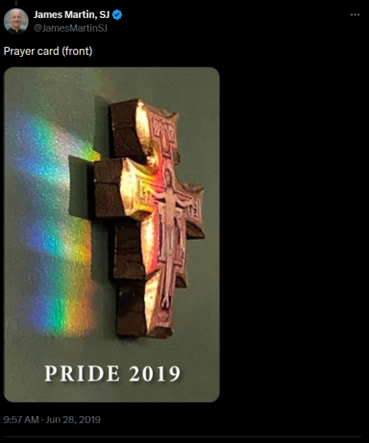
I’ve heard the “human dignity” defense used to approve of all kinds of unholy things. See S.J. James Martin.

~~~

This coalition of Progressive cosplayers want you to think they are above politics with their holier-than-MAGA posturing. But they are not apolitical. Their version of Christianity is “Anything Goes” with a will to political power. They want to be Caesar.

We were warned about them and their antics by Jude, a servant of Jesus Christ and brother of James:

For certain intruders have stolen in among you, people who long ago were designated for this condemnation as ungodly, who pervert the grace of our God into debauchery and deny our only Master and Lord, Jesus Christ. . . these dreamers also defile the flesh, reject authority, and slander the glorious ones.

This coalition of Christian cosplayers subordinate the claims of Scripture to the values of secular progressivism (DEI) and call the result “faith rooted in the teachings of Jesus.”

I am reminded of the Pharisees when they, in the same hyper-spiritual way, added a set of rules (values) about the washing of hands before eating above scripture. Their focus was on the exterior performance of ritual and not on the evil intentions coming out of the interior.

This outward manifestation of ritual purity, enforced by the Pharisees, allowed someone to focus on the practice and not on the evil intentions lurking inside. Jesus denounced them, calling them hypocrites, for focusing on the pretense of spirituality and abandoning God’s word which would expose their intentions. Mark 7: 1-23

This coalition of cosplayer Christians is beating the academic world ‘s drum of globalism, cosmopolitanism, postcolonialism, DEI, and open borders advocacy. Their deconstructionist formulations declare all hierarchies unjust save their own which is they see as required to self-righteously denounce all authority but their own.

This coalition of Progressive cosplayers de-centers scripture to have people focus on “the poor little foreigner in our midst.” They subordinate the claims of Scripture to the moral machinations of secular progressivism (DEI) and call the result ‘the gospel.’

Isaiah: They honor God with their (virtue signaling) lips but their hearts are from Him. All in vain they seek to Worship God. All they teach is human commands.

This coalition of cosplayer Christians focuses not on the laws that have been broken and the invasion of millions of unvetted people who do not share our values, who will not assimilate, and who will use America for their own benefit. They focus on a platitude-contrived issue.

Isn’t it something how this coalition is very concerned about Christian Nationalism and authoritarianism but not at all concerned about theocratic and authoritarian Islam taking over areas of our country and creating no-go zones in our land.

Christopher Hitchins Barely Touched Upon Islam’s Predations – American Thinker

See how women are treated in Iran and Afghanistan under Islam. 

The MSM and the press have spent years talking about “Christian Nationalism,” often using the phrase to target Christians who are Trump supporters. But the same media runs cover for Islamic attacks, the latest being a man who yelled “Allahu Akbar” and threw bombs into a crowd of anti-Islamic protesters outside Gracie mansion. The protestors were protesting against what they described as the “Islamic takeover of New York City.” 

This cosplay Christian performance is one of projection. They accuse some Christians of wanting to destroy democracy with Christian nationalism. They blast deportation as unchristian. But they want to do away with democracy by keeping millions of non-citizens around to vote so as to establish their authoritarian government run by elites.

I wonder . . .

Do these cosplay Christians, who so care about others, willing to denounce Zohran Mamdani’s wife, Rama Duwaji, for liking posts on Instagram that supported Hamas’s attack on Israel on Oct. 7? Do they support Jihadi socialism?

Is declaring the rising tide of “white Christian nationalism” just another application of the victim -oppressor power dynamic narrative that so many seem to accept as a given?

Are the signatories also people who would see the Minnesota Somalis fraudsters as vulnerable and in need of billions of taxpayer money. Do they think that laws and the system are unjust so being fraudulent is necessary? Is stealing taxpayer money just a given these days because there are unfair things in the life? Is it really OK to steal from taxpayers by allowing in 20+ million invaders who mooch off the system and send money back to the country of origin? Isn’t such wealth transfer back door socialism?

Is this coalition against remigration – immigrants returning to their home country? The members could pray over them and send them back home with their blessing. Would these who pose as “principled Christians” let that happen?  Would they claim the concept of encouraging people to go back home is somehow based in right-wing extremism so as to keep their imported voters and low-cost workers here for their use?

Don’t be duped. Naïve Christians will eat up Christian sounding words and phrases. But this ploy is meant to induce hatred toward Trump and the majority of Americans who want the invaders to go back home.

~~~

It’s no secret. Progressives love to dress up and show the world they care.

It is of no matter to these performance artists that Jesus said “Beware of practicing your righteousness before others in order to be seen by them, for then you have no reward from your Father in heaven” and “when you give alms, do not let your left hand know what your right hand is doing, so that your alms may be done in secret, and your Father who sees in secret will reward you.” (Matt. 6: 1-6)

~~~

~~~

Another Christian Cosplayer: Texas’s Democrat senatorial candidate James Talarico

Stephen Soukup, writing at American Greatness, asks Is James Talarico Really a Christian X-Ray?:

David French’s praise for a progressive Christian candidate reveals a deeper problem in modern moral thinking: feelings and intentions now outweigh doctrine, truth, and the consequences of policy.

In the article . . .

Consider, for example, French’s declaration that Talarico is a good man and a good candidate for public office because “he acts like a Christian.” He has “his heart right,” spreads “hope,” and says that he’s tired of “being pitted against” and being “told to hate” his neighbor. That, apparently, makes Talarico a good—or at least properly acting—Christian. . .

 . . .French declares that Talarico “acts like a Christian,” he never explains how, never provides any examples of his Christian behavior, or explains how they might be more “Christian” than the good deeds of his Republican opponents. French thinks Talarico is a good and decent man, not because of any acts he can relay to us, but because of a feeling he has. French likes Talarico. French feels good about him and his religious expression, which again makes Talarico the real Christian in American politics.

(Emphasis mine.)

From Even in Texas, Democrats Can’t Leave Woke Behind: James Talarico is too woke for conservatives and too white for liberals.

Because of his religious acting credentials, David French endorses Talarico:

“Talarico is one of the few openly Christian politicians in the United States who acts like a Christian, and by acting like a Christian he reveals a profound contrast with so many members of the MAGA Christian movement that’s dominated American political life for 10 years,” Never Trumper David French fawningly wrote in the New York Times.

Such statements—which depict Talarico as a normal, middle of the road “Moses”—contrast sharply with his beliefs from just a few years ago.

On race, Talarico sounded exactly like a white Ibram X. Kendi.

Richard Kirk at Townhall: Talarico, With His Left Hand on the Bible: Calling Texas’s Democrat senatorial candidate James Talarico, even derisively, a “bible-banger” is a disservice to bible-bangers. 

Talarico’s forays into theology are prime examples of Nietzsche’s atheistic critique, “The text has disappeared under the interpretation.”

Talarico clearly criticizes Christians (smeared as Christian Nationalists) more than any other group. The state rep even vilified this largely conservative cohort for using the bible (plus, I would add, common sense and reliable science) to oppose sex changes for minors. Those who did so in the state capital, he thundered, not only harmed children, they also dishonored scripture for the sake of a “hateful amendment.” Stated without leftist distortion, Talarico believes Christians harm children if they oppose their mutilation. Instead, he embraces the faux science of propagandists who inundated our culture with the bizarre notion that even pre-teens are capable of evaluating the lifelong medical and psychological consequences of transition decisions. In short, Talarico inverts biblical teaching and slanders Christians who seek to protect “little ones” from the ravages of a mass delusion.

Joseph Chalfant at Townhall writes in his article James Talarico Quietly Deletes Endorsement Page Showcasing His Most Radical Supporters

An archived version of Talarico’s site showed that he was proudly backed by groups like Houston LGBTQ+ Political Caucus, the 134 PAC, Stonewall Democrats, and Mothers Against Greg Abbott. . .

The groups who have backed Talarico have espoused a radical, pro-transgender agenda for children as young as seven-years-old, promote “drag queen story hours” for kids (which are subject to prosecution in Texas), and have pushed Diversity, Equity, and Inclusion policies on Texans. Another group fighting for Talarico, the Stonewall Democrats, set out on an agenda of “holding candidates accountable” should they not toe the line of far-left transgender ideology.

The Waco chapter of Indivisible has also backed Talarico, which has called ICE operations to remove dangerous criminals from American communities a “Terror Machine” and labeled the Minneapolis surge as an “invasion.” 

~~~

I never use the term “Social Justice.” Justice is always social. Modifying “justice” with “social” is a contrivance of Progressivism to have you focus on their designated woke issues and not on what is going on behind the scenes to negate democracy.

If you are an enabler of progressivism’s values, an SJW, and a virtue signaler, then you serve a purpose for Progressivism. Otherwise, you are just a “right-wing extremist.”

~~~

Added 3-28-2026:

Dr. Malone warns there’s a dangerous ‘mole’ working inside the CDC… – Revolver News

Where There’s a Will, There’s No Want of Foolish Ways – Two Tales

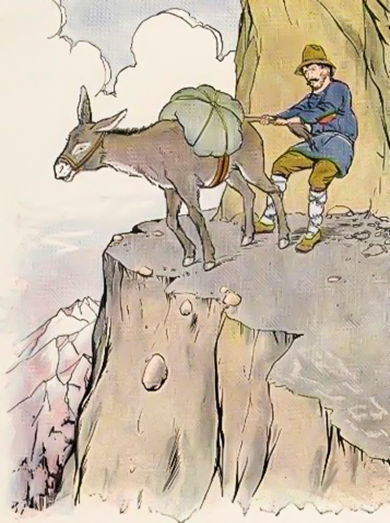
The Ass and His Driver

Milo Winter -1919

An Ass was being driven down a mountain road by his master. As they made their way, the Ass suddenly stopped and looked down the steep slope. He could see his stall at the foot of the mountain and thought, “That way is much quicker!”

Without listening to his master’s calls, the Ass stubbornly turned aside and headed straight for the edge of the cliff. His master, seeing the danger, grabbed the Ass by the tail and tried to pull him back. But the Ass would not listen and pulled with all his might.

“Very well,” said the master, letting go, “go your way, you willful beast, and see where it leads you.”

The foolish Ass tumbled head over heels down the mountainside.

The Ass and His driver

Stubborn fools are difficult to teach or reason with. They refuse to dialog and listen to any contrary voice that would pull them back from the edge of their foolish decision. Wisdom pleads with them to go a safe and sound way. But willful beasts, lacking any wonder about possibilities and fixed on the certainty and infallibility of their impulsive choice, fall headlong into ruin.

Stubborn fools dismiss wisdom as conventional and not progressive, not reactive, not quick enough to achieve what they want. Stubborn fools rush into ruin.

Stubborn fools, aka useful idiots, love their ideological isms –socialism, communism, globalism, Progressivism– for the ism and those who promote it do their thinking for them. Everything thought and done is reduced to the certainty their ism holds for them –their stall at the foot of the mountain. Stubborn fools do not expand their personal bandwidth to see beyond the ism. They refuse the wisdom of the ages that would reveal to them the ruinous outcomes of their isms. The “warmth of collectivism” murdered millions last century.

Ideology—that is what gives evildoing its long-sought justification and gives the evildoer the necessary steadfastness and determination. That is the social theory which helps to make his acts seem good instead of bad in his own and others’ eyes, so that he won’t hear reproaches and curses but will receive praise and honors. … Thanks to ideology, the twentieth century was fated to experience evildoing at a scale calculated in the millions.  ― Aleksandr Solzhenitsyn, The Gulag Archipelago

Revolutionaries are stubborn fools, certain of the ism-ends they want to achieve. They use Direct Action, believing that the ends justify the means and any means necessary must be used to forcefully pull away from wisdom. They react impulsively and go headlong over the cliff to their certain end bringing many with them.

Consider what has happened and continues to happen on the streets of Minnesota. One stubborn fool, armed with a Honda Pilot SUV, drove into an ICE officer and another brought a military-grade handgun to a protest. Instead of remaining calm and standing back to protest they came armed and ready to fight the criminal-removing ICE agents. Both stubborn fools fell headlong into ruin. As they say, FAFO.

Proverbs 14:12 – “There is a way that seems right to a person, but its end is the way to death.”

Proverbs 14:15 – “The simple believes everything, but the prudent gives thought to his steps.”

Proverbs 22:3 – “The prudent sees danger and hides himself, but the simple go on and suffer for it.”

Here’s another tale:

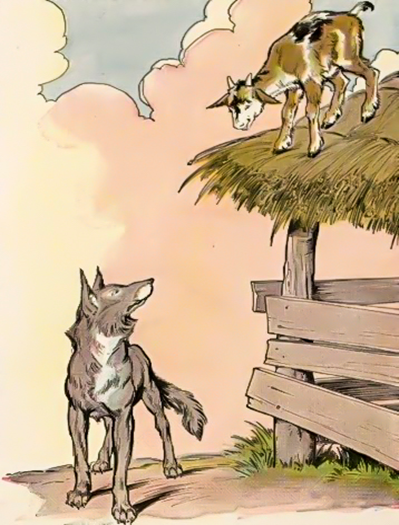
The Wolf and the Kid

Milo Winter – 1919

A frisky young Kid had been left by the herdsman on the thatched roof of a sheep shelter to keep him out of harm’s way. The Kid was browsing near the edge of the roof, when he spied a Wolf and began to jeer at him, making faces and abusing him to his heart’s content.

“I hear you,” said the Wolf, “and I haven’t the least grudge against you for what you say or do. When you are up there it is the roof that’s talking, not you.”

The Wolf and the Kid

The lively young Kid taunted the wolf, not out of bravery, but out of circumstance – being placed on the roof out of harm’s way.

Mocking fools don’t speak truth to power. They don’t even see the truth of their own situation. They deceive themselves. It was the roof that was talking, not the Kid.

Mocking fools on social media ridicule others from the ‘safe distance’ of anonymity.

Mob mentality and social media provide a false sense of security for Mocking fools.

The provocation of Mocking fools is meant to cause conflict and chaos.

We have seen mocking fools on the streets of Minnesota taunting and badgering ICE agents who are removing illegal migrant criminals from the city.

Proverbs 18:2 – “A fool takes no pleasure in understanding, but only in expressing his opinion.”

Proverbs 29:8 – “Scoffers set a city aflame, but the wise turn away wrath.”

~~~

Where There is Wisdom Life Thrives

Before the 13.8 billion years of our cosmic history that have been utterly dependent on the four fundamental forces of nature -gravitational, electromagnetic, strong and weak nuclear- to make matter and life possible (anthropic principle), there was Wisdom.

“The Lord created me at the beginning of his work,
    the first of his acts of long ago.
Ages ago I was set up,
    at the first, before the beginning of the earth. . .

“I was beside him, like a master worker, and I was daily his delight,
    playing before him always,
playing in his inhabited world
    and delighting in the human race.” Prov. 8:22-31

Wisdom’s finely-tuned masterwork of a space-time cosmos and our own habitable zone called Earth makes it possible for everyone, including a variety of fools, to exist and test reality.

~~~

The Great Stage of Fools

“When we are born, we cry that we are come to this great stage of fools.” ― William Shakespeare, King Lear

Simple fools are the naïve, gullible, seducible, easily persuaded. They might be open to wisdom or to folly.

Wisdom calls to them:

Proverbs 1:22 – How long, O simple ones, will you love being simple? How long will scoffers delight in their scoffing and fools hate knowledge?

Proverbs 7:7 – And I have seen among the simple, I have perceived among the youths, a young man lacking sense.

~~

Stubborn fools are stupid fellows, dullards, arrogant ones. They are foolhardy, stupid, silly, and insolent.

They are simpletons who hate knowledge (Prov. 1:22).

Stubborn fools take no pleasure in understanding, but only in expressing personal opinion (Prov. 18:2).

Stubborn fools delight in mischief, in doing wrong (Prov. 10:23).

Out of the mouth of a stubborn fool comes folly (Prov. 15:2).

Stubborn fools feed on folly (Prov. 15: 14).

~~

Mocking fools are the scoffers, jokers and clowns. They rain down ridicule out of their lofty arrogance. They enjoy stirring up people. They have contempt for wisdom, good judgement, and harmony.

Scoffers cannot find wisdom (Prov. 14:6).

Scoffers are an abomination to everyone (Prov. 24:9).

When scoffers are driven out, strife, quarreling and abuse cease (Prov. 22:10).

Avoid the presence of scoffers (Ps. 1:1).

~~

Sensual fools indulge in evil and depravity. Their senses are alive but their conscience has been seared closed. They are crude and ignoble and don’t care. They are self-destructive, morally blind, volatile, and rash. They know the truth but disregard it.

The way of sensual fools is right in their own eyes (Prov. 12:15).

Holding a sensual fool accountable, one receives ranting and ridicule without relief (Prov. 29:9).

~~

Hardened fools are stupid wicked people. Morally bankrupt, they are willfully ungodly. They live as if God doesn’t exist. They are fully committed to folly and total depravity. They are vile.

The hardened fool says in his heart, ‘There is no God.’ They are corrupt, they do abominable deeds; there is no one who does good (Ps. 14:1)

~~~

Some Thoughts

-From the first tales we learned that the foolish ass had an end in sight and a way to that end that seemed right. But by taking that way, he became gravity’s free-falling object.

-The lively young Kid, so sure of itself atop a roof, poured down insults on the wolf. But the Kid didn’t consider the gravity of the situation. He would soon be placed back on the ground.

“For there is no folly of the beast of the earth which is not infinitely outdone by the madness of men”- Ishmael in Moby Dick by Herman Melville

-The foolish have false appraisals about themselves and about reality. Because of this they act recklessly.

BREAKING | 39 Democrats (and Don Lemon) now face criminal charges for storming church in Minnesota.

-“Fools rush in where angels fear to tread.” -Alexander Pope’s 1711 poem An Essay on Criticism

-Fools are repeat fools: “Like a dog that returns to its vomit is a fool who reverts to his folly.” Prov. 26:11

Need an example of the so stubborn fool-minded they are no earthly good?

From Do Democrat Cities and States Love Rolling in Their Own Filth?:

Were Democrats raised in a barn?  It’s far worse – they were raised in places like San Francisco where sanitation standards are not far from street poop capitals like India.

There’s just something about left wing government that attracts a stench.  Maybe it’s the laziness and the entitlement of socialism.  Maybe it’s the inevitable economic malaise beating people down until they no longer care about the state of their surroundings.  Maybe leftists simply revel in decay, like pigs in their own filth.  

Examples of this lackadaisical gutter dweller mindset are rampant.  Wherever Democrats are in control, crime and a river of putrescence follows. . .

The bottom line is, there are better ways to manage US cities and their infrastructure.  Conservative states and cities show this on a daily basis.  Democrats simply do not want to listen.  For whatever reason, they love the smell of their own farts. (Emphasis mine.)

-Fools revel in Bad Bunny vulgarity. America’s future looks vulgar

-Isn’t much of the rottenness, suffering, and evil in the world caused by fools. One such depicted fool is Fyodor Pavlovich Karamazov in The Brothers Karamazov by Fyodor Dostoevsky.

Some became fools through their rebellious ways
    and suffered affliction because of their iniquities. –Psalm 107:17

“We all enjoy evil, or why would there be so much of it? Most derives from people like us. Thinking of it as superhuman or alien allows us to persist in it.”
― Gary Saul Morson, Wonder Confronts Certainty: Russian Writers on the Timeless Questions and Why Their Answers Matter

-Fools love to rant about “oppressors” but fail to see that they oppress themselves and others with their foolish and often destructive responses to “oppression” (Democratic Socialism, Open Borders, and DEI).

-We should learn to evaluate our world not in terms of Left and Right but in terms of Folly and Wisdom.

-Fools self-deceive and find ways to explain and exculpate their behavior. They have alibis:

“This is the excellent foppery of the world, that when we are sick in fortune (often the surfeits of our own behavior) we make guilty of our disasters the sun, the moon, and stars, as if we were villains on necessity; fools by heavenly compulsion; knaves, thieves, and treachers by spherical predominance; drunkards, liars, and adulterers by an enforced obedience of planetary influence; and all that we are evil in, by a divine thrusting on. An admirable evasion of whoremaster man, to lay his goatish disposition on the charge of a star! My father compounded with my mother under the Dragon’s tail, and my nativity was under Ursa Major, so that it follows I am rough and lecherous. I should have been that I am, had the maidenliest star in the firmament twinkled on my bastardizing.” (Emphasis mine.)  ― William Shakespeare, King Lear

“There are two ways to be fooled. One is to believe what isn’t true; the other is to refuse to believe what is true.” ― Soren Kierkegaard

– “A learned fool is more a fool than an ignorant fool.” ― Moliere

-One can gain wisdom about what it means to be human from reading (not viewing) children’s books such as Pinocchio, The Velveteen Rabbit, The Little Mermaid, Charlotte’s Web, The Chronicles of Narnia, and with stories such as Hans Christian Anderson’s Ugly Duckling and Grimm’s Cinderella. These stories will impact the moral imagination more than any Christian “how-to” books and sermons with cajoling platitudes. See Tending the Heart of Virtue: How Classic Stories Awaken a Child’s Imagination by Vigen Guroian for what is conveyed in these and other stories.

-Spanish Jesuit priest named Baltasar Gracián wrote The Art of Worldly Wisdom in 1647. Gracián elevates prudence above all other virtues. As Gracián defines it, prudence is the ability to see clearly, think ahead, and act deliberately rather than reactively. “It is far easier to prevent than to rectify,” he writes. (Emphasis mine.)

-Thomistic philosopher Josef Pieper, in his classic work The Four Cardinal Virtues, sums up the virtues in this way: “Prudence looks to all existent reality; justice to the fellow man; the man of fortitude relinquishes, in self-forgetfulness, his own possessions and life. Temperance… aims at each man himself.”

-Some talk of pan-psychism – a view that everything in the physical universe has a relational consciousness and that consciousness is the basic ingredient of reality.

I believe Wisdom is the consciousness in all matter, for wisdom has been around from before the beginning of the world. Wisdom ordered and finely-tuned the universe for our existence. Wisdom holds everything to together.

Wisdom calls us to the wonder and order of the universe, to the relational consciousness in all things, and to an understanding of where it comes from and what it means for our lives.

Wisdom calls for us to receive the wisdom she offers. For, Where There’s a Will, There’s No Want of Foolish Ways.

Wisdom cries out in the street;
    in the squares she raises her voice.
At the busiest corner she cries out;
    at the entrance of the city gates she speaks:
“How long, O simple ones, will you love being simple?
How long will scoffers delight in their scoffing
    and fools hate knowledge?
 Give heed to my reproof;
I will pour out my thoughts to you;
    I will make my words known to you. – Prov. 1:20-23

Over two-thousand years ago, Wisdom walked the streets of Galilee calling to us in the same way.

The apostle Paul tells us in his letter to the Corinthian church that Jesus is “the power and wisdom of God” (1 Cor. 1:24).

To the church in Colossae, Paul wrote (Col. 1:16-17)

For in him all things were created,

In the heavens and here on earth.

Things we can see and things we cannot-

Thrones and lordships and rulers and power-

All things were created both through him and for him.

And he is ahead, prior to all else,

And in him all things hold together;

-I am well aware of folly. Earlier in life I acted foolishly at times and went over the cliff with my desires. My folly affected both myself and those around me. Later, I put away childish things and grew out of foolishness.

~~~~~

Have we become so left-brain oriented that we only focus on one thing and go for it ignoring the right-brain’s grasp of the whole situation and warning us away from impulsivity?

Why Contemplation & Wonder Are Essential for the Future of Humanity

“The very, very last thing we need now is more power. What we need is more wisdom. And if we had sufficient wisdom, then more power would be useful. But if we had more power but not the wisdom required to know how to use it, we cannot help but destroy ourselves and the world.” -Dr. Iain McGilchrist

“The stakes of our time are no less than power vs. life.”- Nate Hagens

How can spiritually healthy and aware individuals lead the way towards societal change rooted in wisdom? How can focusing on the well-being of our closest communities create ripple-effects of emergence for broader humanity? Finally, how can embracing wonder and humility throughout our lives – in the face of our scariest challenges – guide us towards a more interconnected and sentient humanity?

Podcast here:

Dr. Iain McGilchrist is a Quondam Fellow of All Souls College, Oxford, an Associate Fellow of Green Templeton College, Oxford, a Fellow of the Royal College of Psychiatrists, a Fellow of the Royal Society of Arts, and former Consultant Psychiatrist and Clinical Director at the Bethlem Royal & Maudsley Hospital, London

Iain is the author of a number of books, but is best-known for The Master and his Emissary: The Divided Brain and the Making of the Western World (2009); and his book on neuroscience, epistemology, and ontology called The Matter with Things: Our Brains, Our Delusions and the Unmaking of the World (2021).

~~~~~

Does Eustace eventually shed his arrogance and self-centered behavior?

The Inside Story

I heard about him. A man who healed a man with a horrible skin disease. The healed man went and told everyone. So much so that the healer had to go out to the open country because of the crowds. But now people are saying that the healer has returned to Capernaum.

I’m in a bad way, you see. A bad way. I am a stiff ruin of a man. I constantly need the help of others. I move when others move me. I live only as others take care of me. I dress, eat, go to the bathroom, seek alms – all with the help of others. I am paralyzed.

I heard that my neighbors are being healed. I needed help, transport, to get to the healer. Four friends are carrying me to him.

But the crowd! Oh, the crowd outside the door where he is! We can’t get through to him! I plead with my friends and they improvise. They carry my stretcher to the roof over where the healer is. They’re digging a hole right over him.

As they dig, pieces of the roof and clay dust fall down into the room below, landing on heads and beards.

A group of us, legal experts in the Law of Moses and in Jewish traditions and practices, came here today to hear what this Jesus guy is saying. He’s gotten a lot of attention lately. We’ve heard all kinds of rumors about this carpenter that some are calling a prophet. We must keep an eye him. We don’t want false prophets and would-be messiahs running around stirring up the people. And, we sure don’t want a Roman Legion coming down on us.

There is a large crowd standing outside. Inside, the room is full. Dust is flying everywhere making it hard to breathe. People are coughing. While we are sitting here, some crazy people are up on the roof breaking through it to gain access to this guy. Why destroy a roof? What is this all about? Hush, we tell people, so we can hear.

Now a stretcher is being lowered through the roof. On the stretcher is man who looks almost dead. He must have sinned or his parents must have. Isn’t that how these things happen?

Jesus looks up at the four people looking down through the hole in the roof and then he looks down at the paralyzed man and says “Child, your sins are forgiven!”

The nerve! How dare that guy talk like that! “It’s blasphemy!” we mutter to ourselves. “Who can forgive sins except God?”

The carpenter must have sensed that we were protesting him going too far. He turned to us and asked “Why do your hearts tell you to think that?” Well, we knew why. Then he says . . .

“Answer me this. Is it easier to say to this cripple ‘Your sins are forgiven,’ or to say, ‘’Get up, pick up your stretcher, and walk’?

Perplexed, the legal experts stroked their dusty beards and remained silent.

You won’t believe what happened next. But you should. The healer asked the experts “You want to know that the son of man has authority on earth to forgive sins?” He looked down at me and said “I tell you, get up, pick up your stretcher, and go home.” And just like that I was able to get up, pick up my stretcher in a flash and go out before them all.

When everyone saw me bounce off the stretcher, grab it and run out, they were utterly astounded. They began praising God saying, “We’ve never seen anything like this!”

~~~

Astounding things occur in (this amplified retelling of) Mark’s gospel account (2:1-12). No doubt, the newly-called-to-follow Simon (Peter) was in the room when these things occurred and that he later related them to Mark for the gospel account. And that is how we have the inside story about a man imprisoned in body and soul paralysis being released by forgiveness and healing.

Forgiveness, as used by Mark in this account – (αφεωνται)- recognizes that a debt exists. Forgiveness here is not a demand for rightful retribution. It is not an expunging of a fault. It is a reaction to a fault, not for payback, but to cause growth away from that which generated the fault. I understand this forgiveness as a response to one’s metanoia (turning around) from that which created the debt and wanting to operate differently. In other words: “We both see where things went wrong and I forgive you. Now go forward in a new direction.”

This was the case for the cripple. Transformed, the forgiven and healed paralytic can walk back to family and community restored in body and soul. Knowing forgiveness and healing, he can now impart the same to others and seek reconciliation with those he wronged.

Before these astounding things occur in the account above, Mark writes at the beginning of his gospel of a foretold messenger who will clear the way for the arrival of Good News – of Jesus, the Messiah, the son of God.

John the Baptizer appeared in the desert announcing a baptism of repentance, of metanoia, for the forgiveness of sins. The voice of one calling in the wilderness, ‘Make straight the way for the Lord’ drew a lot of attention. All of Judea and everyone living in Jerusalem came out to him.

Those baptized by John decided to metanoia (turn around). They decided to confess their sins, to be plunged beneath the water of the river Jordan as a sign of repentance and forgiveness, and to be lifted back up.

I wonder. Did the paralytic hear about John the Baptizer? Did he want to go out to him and be baptized but couldn’t? Did he hear what John said about Jesus: “See! The Lamb of God Who takes away the sin of the world!?

Did the paralytic hear about Jesus saying “The time is fulfilled! God’s kingdom is arriving! Turn back and believe the good news!”? (Mk. 1:14)

What we do know is that the cripple is brought to Jesus, lowered down into a room into the presence of Jesus and is then raised up forgiven and healed.

Forgiveness spoken by John and by Jesus is a present-tense action of something that has been completed and has effect now as opposed to a situation that might be or is wished for, or is commanded to be. That should encourage everyone to come to Jesus.

~~~

The way of the Lord is the way of forgiveness. It is the way of lifting off a burden, the way of lifting up from a state of stagnation and morbidity.

One of the primary Hebrew terms translated as “forgive” is ‘nasaʾ which means “to carry, lift up, or to bear away.”  That is what occurs in the above account, first in the actions of four determined people showing what it means to bear another’s burden and then with the proclamation of forgiveness.

The four, bearing the weight of the paralytic across town, lift him up to a roof top and then down through a hole to a place of healing. With utter resolve they bring the paralytic to Jesus. Jesus recognizes the sureness of their trust in him to lift the man’s burdens and proclaims “Child, your sins are forgiven.” The burden you carry, the burden others carried on your behalf, has been lifted away. Get up and walk a new way.

~~~

Another utterly astonishing thing occurs but its context is not immediately apparent. Remember the Tower of Babel, the ziggurat built for someone to be able to climb up to the heavens and access God? In the above account, people climb up to a roof top to lower a stretcher into a room where God is on ground level.

These Things Happen

The Victorian style houses on Rosy Hill Street, adorned earlier in the year with roses, hydrangeas, and ornamental grasses, were now festooned with glowing Christmas light bulbs. Passers-by would also behold Santas, reindeer, snowmen, candy canes, nutcrackers, candles, and festive garlands and wreaths. Looking inside, they could catch a glimpse of the stir of Christmas morning. Except at the Arts and Crafts Victorian house near the top of Rosy Hill Street. The Healey family – Tom, Cheri and their two young children, Alan and Angeline – was five hundred miles away at the bedside of Donna, Tom’s sister.

Two days before Christmas Tom received a call from Haven Hospice Care in Brent telling him that his sister was near death. This was a shock to Tom. He didn’t know that his sister had been ill. He knew her to be an independent sort. She lived alone and said little about herself when asked.

The day before Christmas, the Healey family arrived at the hospice. Tom’s sister was unresponsive to his voice and the presence of anyone in the room. Tom asked the attending nurse about his sister and was told that her condition had been decreasing rapidly. The doctor had ordered tests. He would be there in the morning and would have the details.

That night, at the motel, Tom called Roger to ask about Foster. Before making the trip, Tom asked his neighbor Roger Graybill if he would take their dog Foster out for walk and feed him while they were away. Roger agreed. Tom said he didn’t know how long he would be gone. He would call.

“Hi neighbor. How did it go today with Foster?” Roger said he and Foster went for a couple of walks and Foster was fed. Roger asked about Donna.

“It looks like she has rapidly progressive dementia. They’re telling me she doesn’t have much time left. I’ll talk to the doctor tomorrow.”

Christmas morning Tom drove over to Haven Hospice. Cheri stayed at the motel with the kids. They wanted to go swimming and have hot chocolate in their room and some vending machine candy.

Tom met with the doctor who told him how it happened that Donna was brought to the hospice.

“A neighbor had seen Donna walking down the sidewalk in her nightgown and cursing. The neighbor walked Donna back to her house, found her robe and purse, and then brought her to the hospital. Donna’s ID bracelet had your phone number. That’s how we knew to call you.”

“When I met her, her muscles were twitching and she was having trouble with coordination. Her health and her nervous system were swiftly deteriorating. We had no medical history on her but we did run seDonnal tests. EEG, MRI, a spinal tap to check the level of proteins in the spinal fluid, and a new test that detects abnormal proteins, known as prions, that damage the brain, that cause CJD.”

“CJD?” Tom asked.

“Donna has a rare neurodegenerative disorder called Creutzfeldt-Jakob disease or CJD. That’s why we brought her to hospice care.” The doctor then asked Tom if he had noticed any memory loss, confusion, personality shifts and coordination issues with Donna.

“I live five-hundred miles away. She never mentioned anything in her occasional emails. I didn’t receive a reply to my last email.”

“It is likely,” the doctor replied, “that she wasn’t able to respond.”

Tom was stunned by the report. Donna lay before him as if asleep. She occasionally moaned and when she opened her eyes for a few moments she stared at the ceiling and didn’t notice Tom in the room.

He stayed seDonnal hours at his sister’s bedside holding her hand and hoping for a response. He later returned to motel and told Cheri all that he had learned as they sat on the edge of bed together.

“The hospice will call if anything changes.”

“What do we do?” Cheri asked. “Do we wait there?”

“We wait for now. Tomorrow, I’ll go over to her house and see what’s what.”

~~~

The next day Tom went over to Donna’s house. A neighbor woman came out and called to Tom when she saw him at the door. After Tom explained who he was, she explained that she was the one who found Allsion walking down the street.

“I walked Donna back home, grabbed her purse and the house keys and a robe, locked the door and took her to the hospital.” She handed Tom the house keys.

“These things happen you know,” Janice began. “My father has the same thing going on. He’s at a memory care center with dementia.”

Tom said that he had no idea that his sister was living like this. “She never said anything and I live so far away from her. How could I know?”

“I checked on her a couple of times,” Janice said. “I could see mail piling up. I’d knock and she’d come to the door and I’d ask how she was and if she needed help and she’d look at me as if I was from another planet like my father does. She never said anything when I handed her the mail and that was that until a couple of days ago.”

Tom thanked Janice for helping Donna. He gave her a hug and she returned home.

Before going in, Tom grabbed all of the mail in the box and on the step. Many were past due notices.

Inside, he found disorder and a need to clean but nothing terrible. Books were the only that thing Donna hoarded.

He threw out old food, cleaned, did laundry and put the house in order. He went to work sorting out all of the financials his sister hadn’t been able to handle. He called the mortgage company and all her creditors, told them situation, and said that he will settle what she owes. He asked each for more time. That night he returned to the motel to be with his family.

After spending three nights at the motel – staying there so the kids could go swimming as a Christmas gift – Tom moved the family to Donna’s house. From there he would go see Donna during the day.

The first night in the new place, Alan and Angeline were tucked into their new sleeping bags. Tom read from Hans Christian Andersen’s Fairy Tales. He found the book on the over stacked bookshelf.

After reading The Steadfast Tin Soldier, Tom thought the kids were asleep. But four-year-old Alan sat up in his sleeping bag, rubbed his eyes, looked all around and asked his father if they were in a story like the Tin Soldier. His father thought for a moment and said “We are in a story, alright. In a story where curious things can happen. We must be like the Steadfast Tin Soldier no matter what.”

Tom continued to sit with Donna each day. He would take her hand and squeeze it. She would gasp and then return to her dormant state. The nurse continued to monitor her vitals. There was no sign of what was next, of what to do.

Tom called Roger. Roger said that all was well with Foster. “He’ll stay with us until you return.” And, “to not worry about things here. I’ll collect the mail and give it to you when you return.” Tom thanked Roger. He had forgotten about the mail. And he told him that Donna’s condition hadn’t changed.

~~~

New Years Eve, Roger and his wife went out for brunch with some friends. Jack, their sixteen-year-old son, was asked to feed and walk Foster while they were gone.

After his parents left, Jack finagled the lock on the liquor cabinet and was able to get in. He poured some Vodka into a plastic cup, grabbed a pack of cigarettes from the carton and a lighter, and closed the cabinet. He wanted to sneak a smoke before walking the dog. So, he grabbed the key to Healy’s garage.

Outside, the wind was stiff and icy cold. He turned up his jacket collar and walked over to the one car garage holding the cup of Vodka. He unlocked the door and stood inside, out of the wind, to smoke a cigarette. He didn’t want anyone, especially his parents, to see him.

He downed the Vodka and it burned his throat. He tossed the cup into a can by the garage door, lit the cigarette, and grumbled to himself about having to deal with the little beast. After one last long drag on the cigarette, he flicked the butt into the can, locked the garage door, and headed back to his house. He leashed Foster and went out for a long walk down the block looking at Christmas lights.

Twenty minutes into his walk, Jack came up to a man with his dog. Jack said hello and the man pointed behind Jack and said “Look! There’s a smoke over there. I don’t think it’s fireplace smoke. It is black.” Jack turned around and saw smoke billowing above the Healy garage. He hurried back up the street and froze when he saw flames shooting up around the garage door.

He didn’t know what to do and he knew what he had to do. He didn’t want anyone to find out that he was the one that caused the fire and he didn’t want the Healy’s garage and house to burn down. He knew about the wooden trellis connecting the detached garage with the house. He passed through it earlier.

Neighbors were gathering on the sidewalk and cars began to stop. A man was knocking on the Healy front door. Someone must have called 911. He heard sirens off in the distance. He wouldn’t dare go near the house now.

He wondered what the neighbors were thinking when they saw him with Foster. Would it look like he wasn’t around when the fire started. He wondered what his father would think. Would he believe that the fire could have started on its own? Don’t things just happen to catch fire because of some spark? These things happen, don’t they? Standing in his driveway, he rehearsed his cover story.

The fire was now engulfing half of the old garage and half of the trellis. And he had a terrible thought. What if the fire came was blown over to his house. Fire trucks pulled up.

He ran behind his house, took the cigarettes and lighter out of his pocket, and buried them in the trash can by the back door.

~~~

Roger and his wife came home and saw fire trucks in front of their neighbor’s house. Roger parked down the street and he and his wife rushed up as close as they could to see. They saw that the garage, Tom’s reupholster and furniture repair workshop, was burning to the ground. Firemen were shooting water across what was left of it and spraying the side of the house. The wind had swept the fire across to the house.

The painted facade of sage green and reddish-brown, the decorative gables, the wide, welcoming front porch on the east side of the house was being eaten away by the fire. In the front yard, the small nativity scene that Tom set out before Christmas – the manger, the straw, baby Jesus, Mary, Joseph, the shepherds and angels – had been knocked over. Hosed down, the figures began to ice over.

People were wondering if anyone was at home. Roger told a fireman that the family was out of town dealing with something else that happened. He was going to find out about the dog.

He went inside. Foster was waiting for him at the door. “Jack! Jack! are you here!”

Jack came out of the kitchen. “Isn’t horrible what happened next door. Something must have set off that fire. Maybe some Christmas lights. Things like that happen all the time.”

“Jack, tell me you didn’t start that fire.”

“How could I dad?”

“You were over there, weren’t you?”

“I walked Foster. Down the street.”

“You didn’t start the fire somehow?”

Jack looked away and shook his head.

“You are lying. I can tell.”

“You don’t know me.”

“I know you are lying, so fess up.”

“Something in the garage must’ve sparked.”

Roger called Tom and told him the awful news. Tom received the call as he was sitting at Donna’s bedside.

Hearing that his garage workshop and half the house was burning down, Tom tried to gather his thoughts for a response. But they raced everywhere. After a minute of looking out the window, he said that he would fly back home. He didn’t know when he would be there. He then asked about Foster. Roger assured Tom that Foster was with them and OK.

When the call ended Tom looked over at Donna and wished for her numb state of mind. He clutched her hand, squeezed it, kissed her forehead, and then got up and began pacing the hospice hallway. He called his wife and told her the bad news. She was crushed.

They talked about what to do next. Tom said that he would fly home to assess the damage and speak to the fire marshal and the insurance adjuster. He would pick up Foster. The family would stay at Donna’s house for now. The kids were home schooled so they didn’t need to register at a new school. But all their school materials were likely lost in the fire. Tom would talk to his boss and tell him what had happened.

The next morning Tom flew home and drove to Rosy Hill Street. He parked in front of his house and gasped when he saw the charred remains. Roger saw him and came out. Jack came out behind him with Foster.

Roger didn’t know what to do and he knew what he had to do. But before he said anything, he waited for Tom to say something.

When Tom got out of the car, Foster ran up to him wagging his tail wildly. Tom bent down, picked up Foster and gave him some loving. Tom’s expression of joy changed to one of reluctant acceptance. He took in a long deep breath and sighed “Apparently, these things happen. . .” Jack began nodding “Yes.”

Tom looked over at Jack. “These things happen. . . somehow.” Jack bit his lip and turned to look down the block as if the cause of the fire was somewhere out there.

“Let me know, Tom,” Roger looked over at Jack, “what the fire inspector and the insurance adjuster say. We need to know for certain what caused the fire . . . especially with all the old Victorian houses on this street.”

The fire marshal pulled up in front of the Healy house. As Tom walked over to meet him, he whispered to Foster “One thing is certain, Foster. It’s not easy being steadfast in the curious story we’ve been cast into.”

~~

©J.A. Johnson, Kingdom Venturers, 2025, All Rights Reserved
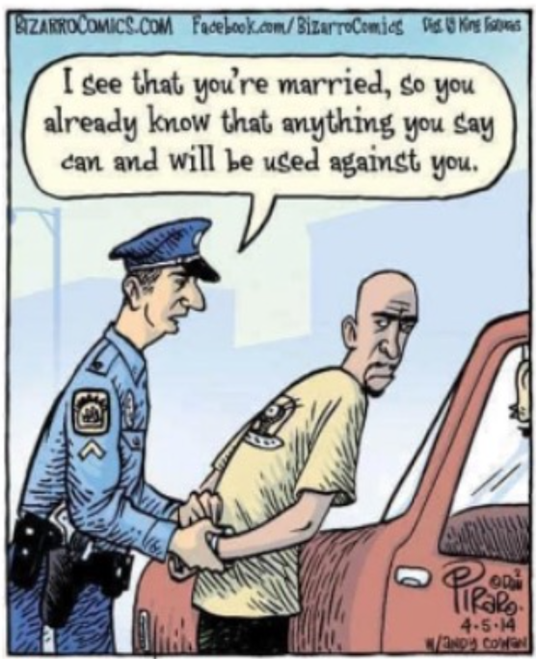
~~~

“The Steadfast Tin Soldier” by Hans Christian Andersen was published in 1838 and is in the public domain, meaning it is no longer under copyright protection.

https://andersen.sdu.dk/vaerk/hersholt/TheSteadfastTinSoldier_e.html

Visitations

Brooke was not one to go looking for treasure among the trash, but the sight of a huge yard sale where unwanted items were offered for a second or third chance at redemption, she could not pass up. She parked her car and joined the dozen or so couples walking among the array of tables each presenting a collage of things once valued, then set aside, then remembered and revalued, and now priced for sale. The once attached were up for adoption.

Photo by Greg Ruffing

Atop one table sat a black 1926 electric singer sewing machine. Beneath it, against the leg of the table leaned a B & W photograph – a coastal landscape. Brooke bent down to look at it. The seller, an eighty-something woman got up from her chair and leaned across the table.

“You see something, don’t you dearie? Hang it where you will see it every night.”

The woman went on to say that she was selling her things because her son was putting her in a home “where memories walk the halls.”

A tall man with winsome blue eyes and a half smile walked up to her side. “Mom, that’s not so.” He spoke with a voice that, for some reason, reminded Brooke of a vanilla latte.

The woman grabbed his arm. “This is my son Chet.”

Brooke was curious. “Chet? I’ve not . . .”

“My father liked Chet Baker, you know, the jazz trumpeter and vocalist.” He showed her the Chet Baker Sings and Plays LP also for sale.

“Here,” proposed Chet, “this LP and this book of poetry go with the photograph.” He placed them in front of her.

Brooke held up the framed photograph. Unable to read any signature in the lower right-hand corner, she asked the woman who the photographer was.

“My late husband. Henry took up photography after he retired. He was a romantic soul with a wanderlust about him. He loved to drive back roads to new places and take pictures. This was taken when we were along the coast in northeast England.”

“It has a certain charm to it,” Brooke remarked.

“It has charmed me for years. Looking at it, I hear his sweet husky voice. But you don’t need to know all that. See for yourself.”

This last comment seemed odd to Brooke but it did lend to the photograph a certain mystical attraction. After imagining the photo hanging in her new studio apartment in the city, Brooke paid the woman and brought the three items home.

That afternoon she measured, nailed, and hung the framed 24 X 36 framed photograph in the middle of a white wall that held nothing else. She stood back to look at it.

The shoreline divided the sea on the left and cliff terrain on the right. Above the water, clouds blotted out the sun but rays of light streaked down from their edges. On the beach stood a woman. She was not looking at the water but back toward the land. What she sees is not in view. Her shadow is stretched out before her.

Brooke’s studio apartment was on the fifth floor, above the street lights. At night, the glow of the city, manufactured moonlight, immersed the small studio and the futon where she slept.

~~~

The next weekend, Brooke’s boyfriend Alex arrived to take her to dinner. He sat down on the futon to wait for her as she finished getting ready. On the side table was a book with a worn cover. He picked it up and thumbed through it and put it down.

“You reading poetry now?”

“I got it a yard sale last weekend. I bought the photo on the wall and the woman who sold it to me gave me the book.”

Alex looked over at the photo. “It’s kinda bleak. You know they make color photos these days, don’t you? And what is that woman looking at?”

Alex picked up the book again and turned to one of the dog-eared pages.

“Let’s see what Lord Byron says . . .”

“There is a pleasure in the pathless woods,
There is a rapture on the lonely shore,
There is society where none intrudes,
By the deep Sea, and music in its roar:


“I love not Man the less, but Nature more,
From these our interviews, in which I steal
From all I may be, or have been before,
To mingle with the Universe, and feel
What I can ne’er express, yet cannot all conceal.”

“Brooke, did I tell you that I wrote limericks when I was a kid?”

No, you didn’t,” Brooke responded from the bathroom.

“There once was a man from Tijuana

Who had a pet Iguana,

He played the trumpet

And so did his pet,

But don’t ask me if I wanna.”

“Want to hear another?

“If you must.”

“There once was a man named Paul

Whose name he couldn’t recall,

When the time came to sign on the old dotted line

The old man just had to stall.”

“Brooke, did I tell you that I’m reading a novel?”

“Oh yeah, which one?” Brooke walked into the living room.

“A Tom Clancy novel.”

 “I’m ready. Let’s go.”

That night they dined at Cooper’s Tap, a pub that served beer and sarnies and big screen soccer. Brooke ordered a smoked gouda and apple melt sandwich and Alex a rosemary roast beef and brie sandwich.

During their weekend outings to Cooper’s, Alex, after a few pints, would be outgoing to the point of talking to everyone at the bar. He’d slap a guy on the back and place his hand on the back of the woman next to him, as if old friends. Brooke saw something endearing about that aspect of Alex but also something needy.

The evening ended as it had the last six months of dating – at the door. Brooke was not going to make any overnight commitment until she felt something substantial to hang her heart on.

With the futon opened and the bed made, Brooke nestled in for the night. She grabbed the book from the side table and looked for a poem. She settled on A Daughter of Eve by Christina Rossetti and read it aloud.

“A fool I was to sleep at noon,

  And wake when night is chilly

Beneath the comfortless cold moon;

A fool to pluck my rose too soon,

  A fool to snap my lily.

“My garden-plot I have not kept;

  Faded and all-forsaken,

I weep as I have never wept:

Oh it was summer when I slept,

  It’s winter now I waken.

“Talk what you please of future spring

  And sun-warm’d sweet to-morrow:—

Stripp’d bare of hope and everything,

No more to laugh, no more to sing,

  I sit alone with sorrow.”

She put the book down and looked over at the photograph before turning out the light.

~~~

In the coming weeks her father, mother and sister would each make separate visits to see her new apartment, ask about her new job and meet Alex. Her father was the first to visit.

When Roland arrived, he stood in the middle of the 500 square foot studio apartment scratching his head over the amount of rent his daughter paid for such a small place. “You don’t even have room to have people over for a meal.”

Brooke said it was what she could afford and the apartment was just a few blocks from her job. She didn’t have a car payment.

Her father sat down on the futon and asked about her job.

“I’m an ER charge nurse now in the Level 1 trauma center. I oversee 15 nurses. We see about 35 patients a shift.”

“Do you like your job? Are you OK seeing all that gore?” her father asked.

“Well, I never ever get used to seeing someone without a face or massive amounts of hemorrhaging or exposed brain matter. Burns – especially severe ones- are gruesome. But I do what I have to do knowing that those brought in need patching up.”

“What about this Alex guy? You like him?

“He’s nice. He’s kinda like Joey, the guy I was dating in high school. He makes me laugh. But he is a bit too much, dad, so, I dunno. Maybe that will change over time change. You’ll meet him tonight.”

That evening Brooke and her father met up with Alex at Cooper’s. After a few pints and a couple games of darts, the two men wandered around the pub talking up those sitting at the bar. Alex introduced Roland to his bar-mates.

Brooke watched her father in his element. He could read a room and invite himself into it. As a sales rep, he wined and dined many clients. Tonight at Cooper’s, he was her father and someone’s sales rep and his everyman self.

It was her father’s out-of-town trips that were behind Brooke’s mother divorcing her father ten years before. That and the affair she had with Douglas while her father was not around. This, Brooke felt, left her father bitter and anxious to regain what he lost – a major customer.

When the evening ended, Brooke and her father said goodnight to Alex. On the way to the apartment Brooke asked her father what he thought about Alex.

“He’s a good egg. Fun to be around.” He paused. “Is your mother still seeing that creepy sweater-wearing guy?”

“Yes, dad.”

Brooke offered her father the futon for the night. He protested and said the air mattress he brought with would do. He spent a half-hour blowing into it, his face turning beet red. With a sheet, a pillow, and some blankets, he made his bed and settled in.

“Nite Brookes.”

“Nite dad.” Brooke turned off the light. The room took on the city’s silver glow.

“You can sleep with this garish light?”

“Garish? I’ve never heard you use that word before.”

“Janinne used it.”

“Who is Jannine?”

“I met her tonight. She’s a high school English teacher. She gave me her number.”

The next morning, Brooke awoke to find her father sitting in a chair taking antacid pills. His heartburn was bothering him again.

Brooke wanted to sleep longer as her father was up several times to the bathroom and when he was asleep he snored. But she got up to make some coffee for herself and toast for her father.

“I had a dream last night,” her father began. “I saw Janinne on the beach. She was looking for me.”

Brooke pointed to the photograph.

“Yeah, that’s what I saw.” He walked up and looked it over. “That’s what I saw. That is Janinne.”

“C’mon.”

“That’s her.”

“You only met her last night. And how could she be in a photo taken by some guy on a trip to the northern coast of England?”

“That’s her. She told me to come to her on the beach.”

Brooke smiled. “Are you taking anything else besides those antacid tablets?”

“Kismet. I’m taking kismet,” her father replied.

“Is that another word she taught you?”

“Yeah. She knows a lot of fancy words.”

That day Brooke took her father to the hospital where she worked. She introduced him to the RNs on her staff. Later they ate a sandwich at a bistro and then took in a movie her father wanted to see: “a shoot-em-up with car chases and women who liked bad boys.”

That night they returned to Cooper’s. Her father was hoping to see Janinne. He called her earlier that day but had to leave a voice mail. Father and daughter played several games of darts and went home early.

Back at the apartment, Roland sat in the chair feeding himself antacid tablets and looking at the photograph. He called Janinne’s number again and left a message again asking if everything was OK and if she had ever been to England’s northern coast.

“How about a poem dad?”

“Huh? A poem? Do I look like I need a poem?”

“This is Love Sonnet XI by Pablo Neruda.”

“Oh, boy.”

“I crave your mouth, your voice, your hair.

Silent and starving, I prowl through the streets.

Bread does not nourish me, dawn disrupts me, all day

I hunt for the liquid measure of your steps.

“I hunger for your sleek laugh,

your hands the color of a savage harvest,

hunger for the pale stones of your fingernails,

I want to eat your skin like a whole almond.

“I want to eat the sunbeam flaring in your lovely body,

the sovereign nose of your arrogant face,

I want to eat the fleeting shade of your lashes,

“and I pace around hungry, sniffing the twilight,

hunting for you, for your hot heart,

like a puma in the barrens of Quitratue.”

“That’s what Kismet does to a person. Makes their stomach ache.”

When Brook turned off the light, the cool reflected light of the city filled the room. Her father complained again about the light and then slept and snored and got up three times. In the morning, he kissed his daughter on the forehead as she lay in the bed and said goodbye.

~~~

Two months later, Brooke’s mother Shirley arrived for the weekend. Douglas stayed home.

Her mother, an interior designer, brought potted chrysanthemums and a bowl of oranges to “feng shui up” the apartment. “The flowers,” she said, “would bring positive energy and the oranges would enhance the level of energy and promote peace, luck, wealth, and prosperity.”

Looking over the studio apartment, Brooke’s mother commented that she liked the space and what her daughter had done with it. She loved the photograph. Brooke told her how she came by it.

“You can find such interesting things at yard sales,” her mother said. “That’s where I met Doug. He was looking for vintage wine glasses.”

In the evening, the pair went to the Hope and Cheese Wine Bar. Shirley talked about Doug’s palate for wine tasting, his love for pinot noir, and his recent divorce. Then she talked about her yoga classes and the clients she meets there. Brooke talked about her job.

“Is your father still belting down the beers and taking those Rolaids?”

“Yes, mom.”

Shirley swirled the wine in her glass, then picked it up and sniffed the aroma. “This wine reminds me of chocolate chip cookies baking.”

When they returned to the apartment, Brooke set up the futon for the night. Her mother would share the bed with her. Before turning out the lights, Brooke showed her mother the book of poems.

“Poems. Oh, how charming.”

“Listen to this, Annabel Lee by Edgar Allen Poe . . .

“For the moon never beams,

without bringing me dreams

of the beautiful Annabel Lee;

And the stars never rise,

but I feel the bright eyes

of the beautiful Annabel Lee;

And so, all the night-tide,

I lie down by the side of my darling — my darling —

my life and my bride,

in her sepulchre there by the sea —

in her tomb by the sounding sea.”

“Lovely dear. Please turn off the light.” Her mother turned over and Brooke turned off the light.

That night, rain pelted the large street window. Each droplet became a small rivulet that with the city lights gave the room an animated other world feel.

In the morning, Brooke awoke to find her mother sitting in the chair holding up her phone.

“Listen to this poem Doug sent me . . .

“How can I keep my soul in me, so that
it doesn’t touch your soul? How can I raise
it high enough, past you, to other things?
I would like to shelter it, among remote
lost objects, in some dark and silent place
that doesn’t resonate when your depths resound.
Yet everything that touches us, me and you,
takes us together like a violin’s bow,
which draws *one* voice out of two separate strings.
Upon what instrument are we two spanned?
And what musician holds us in his hand?
Oh sweetest song.”

“Who wrote that?”

“Ah,” she scrolled down, “Rilke. Rainer Maria Rilke.”

“I talked to Doug this morning. I told him about your apartment and the wine bar. He said he thought of me last night as he sat drinking a glass of pinot noir. He imagined me standing on a beach waiting for him. Can you believe it. I didn’t even tell him about your photograph. Isn’t that coincidence or karma or whatever they call it?

“Kismet.”

“Yeah. Kissssmet. Dougie made reservations for the two of us at Do Tell Inn. It’s right on the Do Tell Vineyard in California. We will spend the week tasting wines.”

“How nice. I was planning to go to church today. Wanna come?”

“You go to church now?

“Yeah, ever since I moved here. I . . .”

“You need a good man in your life, Brooke. And church. Isn’t that for old folks on their way out. I was hoping to go see that furniture store on fourth avenue.”

“How about we go to church together, then go to the furniture store if it is open on Sunday, then to Hope and Cheese and then later you can meet Alex and booze it up with him.

“Brooke! That’s not me!” she huffed. “Alright, I’ll go to church with you and we’ll do the rest.”

They went to church. The priest gave a sermon about the hope for new creation and hope requiring imagination to see beyond one’s immediate circumstances. He ended by reading a poem.

After the service, Brooke and her mother found the furniture store to be closed so they headed over to Hope and Cheese.

With two Chardonnays poured and a plate of cheese, Brooke asked her mother what she thought about church.

“He’s hot. I love his sweet husky voice.”

Brooke looked at her. “What? You mean the priest?”

“Yeah. Is he married? You should find out.”

“I meant about what was said.”

“Yeah, well, your father could use some of that down-to-earth stuff. Who knows what planet he’s on.”

With that Brooke decided to end that conversation and let her mom go back to talking about Doug. Later, after a nap, the two met Alex for dinner at Cooper’s.

The evening began with introductory conversation and several pints for Alex. Shirley didn’t like the house wine so she began drinking pints with Alex when he showed her how to play darts. Brooke watched Alex and her mother having a good time and couldn’t picture her father and mother ever having fun together.

Later that night back at the apartment, Brooke asked her mother about this.

“Oh yes, we had some good times, but things, things, well, you know, things change. He treated me like equal friends when we began our marriage. I loved that but after I had you and Bailey, I realized that I had different needs. I was taking care of you and your sister and pursuing my interior design business and your father needed to be on the road to sell. Then I met Doug at the 2020 Interior Design Expo and I couldn’t see myself the same way. Things change, Brooke. One day you’re a soccer mom in a van driving kids to activities and the next, kisskarma, someone sees you as a creative artist and drives you to wine tastings.”

The next morning, they got up early, hugged, and said their goodbyes. Brooke had to go to work and her mother had to catch a train.

~~~

A month later, Brooke’s younger sister Bailey arrived at the airport. Before heading to Brooke’s apartment, they drove over to Sense of Bean for coffee.

There, Bailey talked about her job as an HR manager and asked Brooke how it went seeing mom and dad.

“Ah, well, you know them. The same as always. Dad starts conversations with everyone he meets and mom finishes everyone’s conversations. It’s weird seeing them with someone else.” Brooke went on to talk about the time spent with them.

“Are you still seeing Alex?” Balley asked.

“Yeah, we still going out. But . . .”

“Why?”

“I dunno. He’s likable, but . . .”

“Have the two of you . . .?”

“No. I want to see who he is without it.”

 After coffee, they walked down the street to Off the Hook clothing resale shop. Bailey bought a plaid flannel shirt and Brooke, a paisley sherpa jacket and a vintage coral bracelet. They headed to the apartment with their purchases.

Inside, Bailey gave the studio a quick look. “It’s small but you don’t need much.” She went over to the large window. “Buildings everywhere you look. And grey everywhere you look.” As she stepped back from the window, a bird glanced off the glass. 

“Mom would say that is a sign,” said Bailey. “Some force in the universe is trying to get in touch with you about your future, your romantic future.”

“I think the bird took it as a sign to not fly into a solid wall of glass in the future,” replied Brooke.

Bailey turned and saw the photograph. “That photo. Is that you?” She walked up for a closer look.

“That’s . . . I bought it at a yard sale.  Chet . . .”

“Chet? Who’s Chet?”

“He was at the yard sale helping his elderly mother sell her things. He offered me this book of poetry,” she held up the book, “and an LP along with the photograph.” Brooked pulled the LP out from the closet and showed Bailey.

“Is Chet the guy on the album?” Bailey asked.

“No, his father named him Chet after,” she looked at the record jacket, “Chet Baker.”

“Don’t know him or his music.”

“I have no way of playing this.” Brooke replied. “Alex doesn’t either.”

That evening Brooke and Bailey went over to Cooper’s so Bailey could meet “dentist Alex.”

Inside, pints were clinking and conversations thrummed. Alex was standing at a small table talking to someone at the next table. When Brooke and Bailey walked up, he broke off his conversation.

“This must be Bailey.”

“It is,” Brooke replied. “She’s here for the weekend.”

The bar maid walked up, handed them menus and took their drink order.

“So, you’re a dentist Alex,” Bailey asked.

“Yes, I am,” Alex replied. “I help people put their money where their mouth is.”

“How’s that working out for you?” Bailey asked.

“Good. I have a lot of word-of-mouth referrals.” Alex flashed a smile. “Brooke says you are an HR manager. Will you be doing a performance review of me tonight?”

Bailey laughed. “I didn’t bring the forms. And, anyway, before I’d hire you, I would need three references and they can’t be from your mother, your cat or your dental hygienist.”

Alex flashed another smile. “I heard that Victor Frankenstein used human resources. Is that true?”

“He found what he needed on Monster.com,” Bailey shot back.

The back and forth between Alex and Bailey went on all evening. Brooke had never seen this side of either of them before tonight.

Later that night, back at the apartment, Brooke asked Bailey what she thought of Alex.

“Well, he’s kinda nice kinda screwball.”

“Help me make up the futon bed.”

Before turning off the light, Brooke asked, “Are you ready for some poetry?”

“Bring it on,” replied Bailey. 

“This is Wild Nights—Wild Nights! by Emily Dickinson

Wild Nights – Wild Nights!
Were I with thee
Wild Nights should be
Our luxury!

Futile – the winds –
To a heart in port –
Done with the compass –
Done with the chart!

Rowing in Eden –
Ah, the sea!
Might I moor – Tonight –
In thee!”

Bailey responded “Ooh la la!”

“Here is some Lord Byron . . . She Walks in Beauty:

She walks in beauty, like the night
Of cloudless climes and starry skies;
And all that’s best of dark and bright
Meet in her aspect and her eyes”

“Oh boy! He’s so dramatic!” remarked Bailey.

“That photograph, that’s you, isn’t it?”

“How so?”

“You are standing alone on a beach, a vast ocean behind you, and you are looking or waiting for someone on shore.”

“Maybe that’s why I bought it. That and . . .”

“He made an impression on you, didn’t he?

“There was something . . . “

“A book of poems, a Chet LP, and thou beside me is the vibe I’m sensing,” Bailey teased.

“He probably wanted to help his mom get rid of stuff.”

“He probably thought you walk in beauty, like the night. How does the rest of it go?”

“The rest is goodnight, Bailey.” Brooke turned off the light.

~~~

The next day, Saturday, Brooke and Baily returned to Sense of Bean for coffee and a scone. After coffee, the two headed down the street to Bound to Be Bookstore.

After browsing and finding nothing of interest, Bailey asked, “What should I read?”

Pride and Prejudice by Jane Austen,” Brooke replied. “You’ll meet Mr. Darcy and Mr. and Mrs. Bennet, and Elizabeth and her sisters Jane, Mary, Kitty, and Lydia.

Bailey flipped through the pages. “I don’t know. Too stuffy.”

Anna Karenina. You’ll meet Anna, Stiva, Levin, and Dolly. “

“It’s too long and those Russian names.” Bailey left the bookstore with Book Lovers by Emily Henry.

In the early evening, Brooke and Bailey went to Hope and Cheese Wine Bar. The atmosphere was chatty with cool jazz playing in the background. They sat at the counter and ordered chardonnays and a plate of cheese to share.

The wine server talked up the wine, its origin, and its flavor notes. The ladies liked the attention.

At one point, Bailey asked, “Do you know who Chet Baker is? My sister here was given an LP of his music but she doesn’t have any way to play it.”

The server, a short mustachioed man in his sixties, said, “Yes. You’re in luck.” He went behind the wine bar. Moments later, a male voice began singing in a sensual half-whispered way.

“You don’t know what love is
‘Til you’ve learned the meaning of the blues
Until you’ve loved a love you’ve had to lose
You don’t know what love is . . .”

The man returned from behind the wine bar. “That’s Chet. You’ll hear his horn in this recording, too. He was part of the West Coast cool jazz sound in the early 1950s. How is your chardonnay, ladies?

“It’s a bit too fruity, “Bailey replied. Brooke nodded.

“I’ll pour you an oak-barreled chard.” He proceeded to pour two glasses. “This has notes of vanilla and butterscotch and a buttery smoothness.”

Brooke, having watched her mother, swirled the wine in her glass, picked up the glass, held it to her nose for a few seconds, took a sip, and said “There was a picture postcard that fell out of the record jacket.” She reached into her purse, pulled it out and handed it to Bailey.

“The postcard is addressed to Chet from his parents in England.” Bailey turned the card over and read the inscription on the B & W photo, “Captain Cook Monument, Whitby.”

“Chet would like his postcard back,” teased Bailey. “It’s destiny. You should go back to the yard sale and hand it to him and find out if he is married.”

Brooke hemmed her response: “The yard sale is every Saturday May through August, but I doubt he’s still there.”

“Go to his house. You have his address. He’s waiting for you to come back. Look, you live the big city by yourself and mister smiley boyfriend – find out what love is.”

Bailey took another sip of wine. “Yum. You could ask Chet about your photograph. You could ask him about Captain Cook.”

Bailey then asked the server for another pour of wine and if he knew who Captain Cook was.

“Is this Trivia night? I . . . I couldn’t guess.”

A man sitting at the bar heard the question. “He was a British naval captain, navigator, and explorer who sailed the Pacific Ocean and expanded the horizons of the known world. How’s that for an answer?”

“You win,” replied Baily. She turned to Brooke. “Expand your horizons, girl.”

At the end of the evening, Brooke and Bailey returned to the apartment and went right to bed. It was planned that early the next morning Brooke would drive Bailey to the airport and hopefully arrive back in time for church.

~~~

On the way to the airport the next morning, Bailey talked about what her husband and two boys were up to. And she talked up Chet. Brooke listened until the last few minutes before arriving. She had hesitated to say anything to her younger sister about the traumatic nature of her job. She didn’t know what Bailey would do with the information. But in the last few moments she felt compelled to say something about her reality.

“Just the other day a woman arrived in the ER with severe burns all over her body. A verbal argument between the woman and a 45-year-old man escalated and the man poured flammable liquid on her and set her on fire. She’s in critical condition at a hospital.”

“Every day EMS brings in patients transfigured by what people do to each other and to themselves. My compassion is wearing thin. I need a life-line of my own. That is why I’m going to church. To find that.”

As the car pulled up to the curb Bailey put away her phone and pulled a plane ticket out of her purse. “Smiley not doing it for you? Call me. I’m having the family over for Thanksgiving. Bring Chet. Thanks.” She got out and headed to check-in.

Driving back from the airport, Brooke had time to reflect: managing life-or-death situations in the ER had become second nature and so did the ritual of going to places like Cooper’s or Hope and Cheese or Sense of Bean. But what was also becoming second nature was accepting that there was nothing more to this life.

If there was more than what she saw every day in the ER – the cruelty and sadness of life, the suffering, and random casualties, what was it? If there was more than what she saw every time in the diversions of city life, what was it? Her full-but-empty life was one-dimensional and lonely. Being alone in the big city didn’t bother her. Being alone in the universe did.

She wondered if the ritual of going to church and connecting with God would add depth to her life and to help her see things differently or would it become another routine. Would that connection help her deal with the impact of her job?

She reflected on the fact that this was her fourth time attending church, beside going with her mother one Sunday and attending a friend’s wedding many years before. During childhood her family never bothered to attend. On Sundays, her father wanted to be home after traveling all week and her mother was busy with friends and interior decorating clients.

Brooke made it to church that morning. She followed the printed liturgy. Someone read scripture about knowing the love of Jesus that no one could begin to fully comprehend and someone read about a shepherd looking for a lost sheep. The priest gave a sermon about the lost sheep that was once attached to the flock being found by the shepherd and brought back into the fold.

After the service, Brooke went over to the flower shop on the main floor of the hospital and bought a Golden Days Basket of fresh cut fall flowers arranged in a wicker basket. She placed the arrangement of sunflowers and asiatic lilies, red roses, gold and burgundy chrysanthemums, solidaster, and brown copper beech on the lamp table next to the futon.

Before turning off the light that night, Brooke thought about the yard sale and Chet and Thanksgiving dinner with mom and Doug and dad and whoever and Bailey and her husband and kids and whether Alex should come with her and tomorrow morning in the ER.

She remembered the insert that came with the church worship guide the day she attended with her mother. It contained a poem by Luci Shaw, The “O” in Hope. She read it.

“Hope has this lovely vowel at its throat.
Think how we cry “Oh!” as the sun’s circle
clears the ridge above us on the hill.
O is the shape of a mouth singing, and of
a cherry as it lends its sweetness
to the tongue. “Oh!” say the open eyes at
unexpected beauty and then, “Wow!”
O is endless as a wedding ring, a round
pool, the shape of a drop’s widening on
the water’s surface. O is the center of love,
and O was in the invention of the wheel.
It multiplies in the zoo, doubles in a door
that opens, grows in the heart of a green wood,
in the moon, and in the endless looping
circuit of the planets. Mood carries it,
and books and holy fools, cotton, a useful tool
and knitting wool. I love the doubled O
in good and cosmos, and how O revolves,
solves, is in itself complete, unbroken,
a circle enclosing us, holding us all together,
every thing both in center and circumference
zeroing in on the Omega that finds
its ultimate center in the name of God.”

When she turned off the light, windowlight illuminated the room. The B & W photograph stood out in relief on the white wall. And there was the woman on the beach standing alone and looking at something outside the frame. And Brooke said “Oh!”

©J.A. Johnson, Kingdom Venturers, 2025, All Rights Reserved

This Mortal Coil

As was often his habit, Arthur Gilbert listened to a recording of his last stage performance from forty years ago. He listened to the lines and the life in his voice, the intensification of vocal tones and articulation. He would also listen to audio books. The susurrant stream of words lulled him to sleep each time. And today. But the sound of a distinct thud roused him and he remembered what brought him into another state of flux – a dream

“Waking up this morning,” Arthur told his best friend, “I had a dream. I was in a large passenger plane that was crashing in slow motion. When it finally landed nose first, I walked out of the cockpit window.”

Hearing this, his friend and fellow actor told Arthur that he saw a ghost of a man just last night on the ramparts. He wanted Arthur to see for himself. Arthur balked at the idea that an image could tell him anything. But his friend convinced him and Arthur said that he would go see “this poor ghost while memory holds a seat in this distracted globe.”

So that night his friend accompanied Arthur to the “parapet.” There, Arthur was beckoned by a voice to follow it to an enclosed space. Once inside, Arthur heard his bulwark being bombarded thud shudder thud. “Sling n arrows outrageous!”

“Are you OK Arthur?”

“To sleep, perchance to dream. I’m shuffling off . . .”

With acoustic script murmuring and a hovering thumping and whirring around his head, Arthur closed his eyes. After some time, he became aware that he was in a dream.

He left his apartment in east central Indiana and was driving to his home town in Illinois for a funeral. Call me when you get there, his friend told him.

Heading west on I-70 dark-bottomed clouds appeared. He heard packing paper being crunched. He became angry. He didn’t like driving in the rain or at night or to funeral. He didn’t like being cooped up for long rides.

His demeanor softened when he saw distant silos along the way. Memories of friends. His demeanor saddened as he drove further away from them.

Restaurant signs began to appear.

Good’s Family Restaurant

It’s All Good at Bob and Martha Good’s

~

A Good Breakfast is not hard to find – Exit ½ Mile

Good’s Family Restaurant

~

One Good Turn Deserves Another-Turn Left After Exit

Good’s Family Restaurant

He took the exit for Good’s Family Restaurant. He saw and heard what happened next.

He entered Good’s. He found a booth next to a window. Across from him sat a plump 30-ish woman with fuchsia streaks of hair, tattoos down both arms, and a face mask. She was wiping the table and menu with disinfectant wipes. The squeaking sound annoyed him.

He looked around the room wondering if there was another pandemic that turned everyone into Karens. He saw no one else wearing a mask. To each their own pandemic he said.

A waitress walked up with a pot of coffee.

Mornin’ Coffee?

Yes ma’am.

She turned over a cup and poured the coffee.

Where you headed?

He took a sip. To a funeral.

Someone close?

An ex.

I’m sorry.

She wasn’t.

Did she know Jesus as her personal savior?

He put the coffee down.

You’d have to ask her.

What about you? Do you know Jesus as your personal savior?

Ma’am my relationship with a personal savior began when I came into God’s good creation seventy-five years ago and when I realized that the fires of creation and apocalypse were inside me, I set out to find out what that meant.

He continued. Say, you remind me of Altar-call Jake with his tracts and the folk gospel road that I’d been on. That road reduced the cosmos to four spiritual laws and a personal tow-truck service ready to remove you from life on earth. Those on that road had a strangely-dim view of the things of earth.

He became unsettled. Doesn’t that machine noise bother you?

The waitress stood looking at him with a hand on her hip. Alrighty then. Do you know what you want to eat apocalypse man?

Yes ma’am. Two eggs over easy with hashbrowns and a side of bacon. He looked up from the menu. Are you Martha, Martha Good?

Yes, and I’m with Bob, the man that’s working the kitchen. She pointed to the opening above the counter where a head with a sports cap moved back and forth.

Ain’t no good flirting with me, Martha said with a twinkle in her eye.

Well, Martha Good, I wasn’ . . . well you do have qualities you don’t find every day on the menu. I’m sure Bob is a lucky man. You bring a lot to the table. He looked over at the woman across from him.

He hit the jackpot with me, Martha teased.

Bonanza Bob? he played along.

Is that your final answer?

Yes ma’am.

Martha finished writing the check. You win the million-dollar breakfast. She grabbed the menu and walked off.

After breakfast he walked to the cash register, told Martha that breakfast was satisfying in a Good’s way and she smiled and said Y’all come back after your funeral.

He was back in the car with the whirring thumping.

The wet putty looking sky above the interstate released its moisture. The pit-pat of rain drops became a steady thudding as he crossed the state line. Washing machine rain slashed his windows. Wipers whirred and thumped. He pulled off the road to wait. He didn’t want another rear end accident, another concussion. When a semi-trailer truck swooshed by his head throbbed.

The pounding rain stopped and he got back on the road.

He passed Danville then Champaign. He hooked up with I-72. He passed Decatur. He passed a Springfield sign. There was a thumping clanking noise. Car trouble? He pulled over into a cul-de-sac.

He suddenly felt cramped stiff panicky. His hands twitched. He couldn’t remember for the life of him why he was in this suffocating machine. He wanted out. He cursed the incessant banging clicking whirring clanging and beeping going on around him. Where was he going anyway?

He turned the car around in the cul-de-sac to retrace his way.

He passed the Decatur sign. The Champaign sign. I-74. He passed the Danville sign and looked for the Indiana sign. He saw a familiar sign.

Your Lookin’ Good at the Next Exit

Good’s Family Restaurant

 For Breakfast Lunch and Dinner

He drove to Good’s.

The waitress saw him come through the door, grabbed a menu, and said Welcome back. How was your funeral?

Who died?

No one here.

I can see that. The clanging of dishes and the overhead whirring of the fan bothered him.

The waitress showed him to a booth and handed him the menu.

Coffee?

Yes, and a grilled cheese sandwich and tomato soup.

She wrote the order, grabbed the menu and walked away staring at him.

An ancient scrawny-looking man in a flannel shirt jeans and a Peterbilt hat walked up to the booth across from him. It was the same pipe smoking guy who came out of the rig parked outside his window. It was his Cavendish tobacco father.

The trucker threw down a book on the table with a thud.

What are you reading?

This. The trucker held up the book and then sat down.

The waitress brought coffee, filled his cup and turned to the trucker.

Morning ma’am, the trucker said.

Morning. What y’all reading? She poured him coffee.

The trucker showed her the book.

The Road. Cormac McCarthy. Don’t know it. Is it about trucking?

Well, yeah, in a keep on truckin’ kinda way after an apocalypse with who or what remains.

The waitress looked over at him. You read that, too?

He nodded and said Cannibalism.

Cannibalism? What on earth! The waitress scrunched her face. We don’t serve that here.

What’s left to eat is eaten, the trucker said.

To be eaten or not to be eaten that is the question! Right dad?

The waitress pointed the coffee pot in the trucker’s direction. How about you, fella? Do you know Jesus as your personal savior?

The trucker looked over at him and then at her. Ma’am, I’ve been on the road with him my whole life. But you see this Formula World is in a road race to end things to get on with the next big thing. Escaping the road and getting everyone to heaven before the next big thing, that is one formulation I don’t need. I’m a biker not a passenger in a car being towed off the road.

Uh huh. Just checking your GPS.

I had to break up with my GPS. She kept telling me to take a U-turn in my life!

Some of us need more than one U-turn. The waitress took his lunch order and headed to the kitchen.

What ya hauling?

Motorcycles, parts, manuals.

Where you headed?

Cross country. To the coast. How about you?

Home.

Where’s home?

If I knew that I wouldn’t be here.

What happened, son?

I am being eaten alive on this road. I live by words. I am made of words. And now words are being taken from me.

The trucker leaned over into the aisle Do you know your way home?

I’m seventy-five. I know my way home. What is that high-pitched beeping?

Where is home, Arthur?

Right where I left it.

The waitress brought his soup and sandwich.

Did I order this?

Yes, you did. The waitress put her hands on her hips. It’s not cannibalism but it’ll do.

Then I’ll eat it he snapped back.

The waitress looked over at the trucker and he nodded.

She turned back Everything OK?

Right as rain he replied.

The waitress looked over again at the trucker and then went to the kitchen to retrieve his order.

The trucker leaned over. Arthur, do you have family?

Yes, of course I have family . . . ah, ah . . .  ah daughter.

What’s her name?

What’s her name?

Yes.

If I knew that I wouldn’t be here.

Should you call her?

I did. She told me I had an appointment today.

Did you make it to the appointment?

Damn, that whirring is so annoying.

The trucker got up and put a hand on his shoulder.

He looked up. Are we going to be OK?

You’ll be OK. You’re one of the good guys, Arthur. You’re carrying the fire. Swear that you will carry the fire.

I swear.

Come with me.

Where?

He felt himself being pulled from the booth.

“Arthur, the MRI is done. Let’s take off these acoustic tubes.”

Arthur blinked a reset and looked all around.

“There are more things in heaven and earth, Horatio, than are dreamt of in your philosophy.”

~

©J.A. Johnson, Kingdom Venturers, 2025, All Rights Reserved

~~~

America Reflagged

A short story . . .

Tom stood watching at the front room window. Moments before, his father was sitting on the couch reading the Chicago Tribune. But then his father put the paper down, got up, walked through the kitchen and down into the basement and then came back upstairs and went out the back door.

Tom put the funnies down, got up off the floor and went to the picture window. His father, in a white tank tee shirt, tan Bermuda shorts, black socks and black street shoes, was in the front yard unfurling the American flag. Then he put the flag’s pole in its holder on the front of the house and took a couple of steps back to look at the flag and at his flagstone-bordered landscaping beneath it.

Tom knew when he woke up that morning that it was Fourth of July. The Ben Franklin store, where he bought his candy, comic books, and baseball cards, had been selling snakes, snaps, and sparklers. And last night neighbors shot off fountains, rockets, and loud firecrackers. He fell asleep with a rotten egg smell coming in through the bedroom window next to his bed.

Tom wanted to see if anyone else was up on the Fourth of July. He ran outside and grabbed his banana bike from the patio. Riding up and down the street he saw no one and no other flags. No one had a flag. Not the Schroeders, not the Selders, not the Millers, not the Capellos, not the Romanos, not the Majewskis, not the Dubickis, not the Ruiz, not the Martínez, not the Clemons. Not anyone. He rode his bike home.

Tom ate the pancakes his father made for breakfast and drank some Tang. He cleared his plate, made his bed, and then raced off on his bike to find a place to watch the Fourth of July parade. He had to hurry. He saw people carrying lawn chairs and blankets.

Tom found a grassy space near a street light. Just in time. The Good Humor truck was passing by. He bought a Creamsicle with his allowance. Not long after, down the street came sirens and drums and beeping clowns in little cars. There were floats, horses, cheerleaders, military units, and marching bands. There were people as far as he could see. When the parade was over Tom rode back home with sticky hands and orange lips.

Tom folded his hands and bowed his head as his mother gave thanks for the dinner father prepared to give mom a break. He finally decided to eat the creamed chipped beef on toast, except for the peas, and one small bite of his mom’s Jello-salad that didn’t contain carrots. Mom said there was watermelon for dessert.

Tom helped his mother with the dinner dishes and then he helped his father carry lawn chairs to the car. His father then drove the family over to Commons Park for the annual Fourth of the July Fireworks Spectacle. Hundreds of people were already there.

Tom asked his father ten times when it would start. His father said, “Be patient, Tom. It needs to be darker.” When Tom asked the eleventh time, a single whistling flare shot up into the sky. Then nothing. Then KA-BOOM! Babies started crying. Tom said “Cool!”

Tom heard a swoosh-swoosh-swoosh. Then nothing. Then KA-BOOM! KA-BOOM! KA-BA-BOOM! The sky lit up with red, white and blue sparkles. Then more swooshes. One colorful burst after another filled the sky. Instant stars twinkled and fluttered down. Some stars trailed off making a loud sizzling noise as they fell to earth, some fanned out like spider legs, some like flowers, and some like waterfalls. Roman candles shot out multi-colored stars, spinners, and comets. Fountain fireworks shot off showers of sparks like a fountain of light.

Tom stared at all this with mouth and eyes wide open. Then things got quiet and Tom asked why. His father said, “I think it’s time for the finale. You’ll know when they shoot off the aerial salutes.” Tom asked about the salutes. His father said “They are shells that contain a large quantity of flash powder. They create a loud bang and a bright flash.” And that’s what happened next.

Tom felt his insides shake when the three salutes announced the finale. Babies cried. Dogs yelped and cowered. Earth and sky were filled with explosions of light and color for the next five minutes. When the Spectacle Finale ended people applauded and headed for their cars.

Tom rubbed his eyes all the way home. The fireworks display had filled them with ash. But when the car pulled into the driveway, he stopped rubbing his eyes to see the flag in the front yard. He tugged on his father’s shirt and said “Dad, we’re the only ones on the street with a flag. I guess some people like parades and the Spectacle but flags not so much.” His father said, “Should we leave the flag out tonight?” Tom replied “Yes.” “Then,” his father said, “help me shine a light on it.” And that’s what Tom did.

Tom lay in bed that night thinking that there should be more days just like this one. He soon fell asleep to the sound of the neighbor’s firecrackers and the smell of rotten eggs coming in his bedroom window.

©Lena Johnson, Kingdom Venturers, 2025, All Rights Reserved

~~~~~

Watch This Before July 4 | Office Hours, Ep. 16

~~~~~

Thirteen Novels Every Conservative Should Read

Host Scot Bertram talks with Ronald J. Pestritto, professor of politics and Charles and Lucia Shipley Chair in the American Constitution at Hillsdale College, about Hillsdale’s new online course, “The Federalist.” 

(@23:19) Christopher Scalia, senior fellow at the American Enterprise Institute, gives a defense of fiction and discusses his new book 13 Novels Conservatives Will Love (but Probably Haven’t Read).

Thirteen Novels Every Conservative Should Read

Thirteen Novels Every Conservative Should Read – The Radio Free Hillsdale Hour – Omny.fm

~~~~~

Preface (to Mark Twain’s Tom Sawyer)

Most of the adventures recorded in this book really occurred; one or two were experiences of my own, the rest those of boys who were schoolmates of mine. Huck Finn is drawn from life; Tom Sawyer also, but not from an individual⁠—he is a combination of the characteristics of three boys whom I knew, and therefore belongs to the composite order of architecture.

The odd superstitions touched upon were all prevalent among children and slaves in the West at the period of this story⁠—that is to say, thirty or forty years ago.

Although my book is intended mainly for the entertainment of boys and girls, I hope it will not be shunned by men and women on that account, for part of my plan has been to try to pleasantly remind adults of what they once were themselves, and of how they felt and thought and talked, and what queer enterprises they sometimes engaged in.

The Author.

Hartford, 1876.

~~~~~

“Who knows, he may grow up to be President someday, unless they hang him first!”
Aunt Polly about Tom Sawyer”
― Samuel Clemmons, The Adventures of Tom Sawyer

The Adventures of Tom Sawyer (Full Audiobook) by Mark Twain

One famous quote from “The Adventures of Tom Sawyer” is: “Right is right, and wrong is wrong, and a body ain’t got no business doing wrong when he ain’t ignorant and knows better.”

~~~~~

Emanuel Leutze, Washington Crossing the Delaware, 1851, Oil on canvas, The Metropolitan Museum of Art, New York

Birding

Thanksgiving morning Toby woke up to noise and smells. He got out of bed and went downstairs in his PJs. The noise and smells were coming from the kitchen. His mother, aunt Susie and grandma Evans were talking and cooking. His seven-year-old sister Tilly was sitting on the counter singing one of her happy songs.

In the family room, Uncle Kevin and his father were sitting at a card table. Grandpa was sitting in the big chair reading a book. Toby went over to the card table.

“Hey Tob,” said Uncle Kevin.

“What are you doing?” Toby asked.

“We’re playing Risk,” replied his father.

“Can I play?” Toby asked.

“I think this game is a bit too hard for you,” his father replied. “We’ll play a different game later.”

Grandpa called Toby to come over and sit on his lap. Five-year old Toby did just that. He wanted to know what grandpa was looking at.

“It’s A Year-Round Guide to Indiana Bird Watching,” grandpa told him.

“Why you reading that grandpa?

 “I like birds, Tobias. Do you?”

“Uh-huh.” Toby rubbed his eyes and lifted the book to see the pictures. “What’s that?’ He pointed to the page.

“That’s a Dark-eyed Junco,” grandpa replied. “It says here that they like to eat seeds, insects and berries.”

“Huh. His name is Junco?”

“Yes. If you were a bird, I’d call you a Blue-eyed Tobias.” Grandpa smiled.

Toby turned the page. “Why do you like birds, grandpa?”

“Birds are special creatures. They seem to be wherever we are, as if God wanted to make sure we notice them. They are free and at the same time totally dependent on God and His created order.

“And there are so many kinds of birds, Tobias.” Grandpa flipped through the pages. “They bring color and sound to our lives. Seeing them and hearing them is proof that nature is healthy. I try to spot a bird by its coloring and by its songs and calls.”

“Birds have songs?”

“They sure do. Male birds sing to attract female birds. They also sing to scare off other birds from their territory and to bond with mates and young’uns. You want to hear a Mourning Dove Song?”

“Yeah.”  

Grandpa took a deep breath, formed his mouth and went “coo-AH-oo coo-coo”. He waited and then again “coo-AH-oo coo-coo.”

“The Mourning Dove keeps repeating this song until a female is attracted. That’s how I met your grandmother.” Toby’s eyes lit up when he saw grandma smile.

“Bird experts can tell the species of a bird by just listening to its song. Each species has its own song.”

“What’s speecheese?”

“A species is a way to name animals that are alike and have babies like them. Let’s see,” he found the page. “It says here that the Dark-eyed Junco is a species of Junco, a group of small, grayish sparrows.”

“It also says that Male Dark-eyed Juncos sing a sweet, high-pitched trill that sounds similar to the songs of the Chipping Sparrow and Pine Warbler. And during the winter, Juncos come to backyard feeders for millet and bird seed. I saw one at my bird feeder this morning.”

Toby looked over at the kitchen. “Let’s see if your mother has something for you to eat.” Grandpa moved Toby to his feet, got up, and the two of them went into the kitchen.

Toby was given a yogurt by his mother. Eating it, he watched Grandpa put his finger into the cranberry sauce, taste it and pucker his lips. Then grandpa put his finger into the mashed sweet potatoes, tasted it and said “Yum!” And then he put his finger into the pumpkin pie mix, tasted it and said “mm-mmm.”

When he reached for the stuffing, Grandma, hands on her hips, said, “Shoo you two. Come back when we’re ready to eat, in about two hours.”

“Let’s go for a walk Toby,” Grandpa said. “Get dressed in warm clothes. We’re going birding.”

A voice in the next room said, “Dad, the weather man said that central Indiana is 30 degrees and cloudy.”

Before Toby left the kitchen his mother said, “Go make your bed first and then put on your corduroy pants and blue sweater and then comb your hair.”

Toby shot upstairs and came back down two minutes later. His mother looked him over and then had grandpa put on his winter coat, his gloves, and the knitted hat that grandma made for him.

Outside, grandpa went over to his car and took out a pair of binoculars. He showed Toby and said “Maybe we will see a cardinal today.”

As they walked down two blocks past houses, they saw no birds. But then Grandpa spotted a Mourning Dove on a roof. He handed Toby the binoculars after adjusting the focus. “Let’s wait here and listen.”

When the dove began its song, Toby was transfixed until the dove flew out of sight.

They walked to the end of the street and came to a T-intersection. On the other side of the crossroad was open farmland. Wind whistled through the field of corn stalk stumps. Grandpa tied the ear flaps of Toby’s knitted hat below his chin.

To their left and down the road about forty yards was a small group of trees and undergrowth. “Let’s head there,” Grandpa told Toby.

As they walked along on the farm side of the road, Toby found a corn cob. Holding the smooth kernelled end, Toby showed grandpa the half-eaten end.

Grandpa looked it over and said, “Probably some squirrel started eating it. Or may be a goose.”

As they neared the trees, grandpa stopped and brought the binoculars to his eyes. He then handed them to Toby. “What do you see in that tree?” Grandpa pointed.

Toby looked and said, “The birds keep moving so I can’t see them.”

“They might be getting ready for winter,” Grandpa replied. They’re probably in a hurry to get out of the wind and get things settled for winter.”

Then Grandpa spotted a falcon perched on top of a utility pole that was about thirty yards down the road. He adjusted the focus of the binoculars and handed them to Toby. “Look up there. Can you see that falcon, Tobias?” He pointed to the electric pole.

Toby looked and said, “That is a falcon?”

Grandpa looked again. “Yes. A falcon known as the American Kestrel. I can tell by dark gray head, the rust-colored back and tail, the white cheeks and throat and blue-black bill. It’s the smallest of falcons. Some call it a “Sparrow Hawk”.”

“They like open areas without dense cover. He’s sitting up there to view the whole area for food. He’s scanning for prey on the ground. He’ll sit and wait. He’ll only attack when he’s sure that he will succeed. When he has prey in sight, he will either catch it on the ground or in flight. 

“In the summer months he’ll hunt and eat dragonflies, cicadas, beetles, grasshoppers, butterflies and moths, scorpions, and spiders. He’ll hover and capture insects in the air.

“In winter weather, like right now, he’ll hunt small mammals like mice, voles, shrews, and bats. And he’ll hunt small birds . . . like that little sparrow that just flew into the field. He pointed to it.

Grandpa let Toby use the binoculars to observe the falcon. “Let’s see what happens,” he said. “I wonder if that falcon noticed that small bird.”

A moment later, the falcon swooped down, grabbed the bird with his claws, and flew back to his high perch.

“Did you see that grandpa?” Toby asked.

“I sure did. He’s going back to his perch to eat it. Take another look.”

“Do birds eat other birds, grandpa?”

“They sure do. Birds of prey, like this falcon, have evolved to catch diverse things like insects, small mammals, and birds.

“I just remembered something. When I was a boy, Tobias, my father took me birding. One day he said “Frankie, there are so many birds but you never see dead birds. He told me that dead birds vanish because predators and scavengers come along and eat them. That’s why most bird bodies disappear. Creatures like foxes, badgers, ants, and birds of prey scavenge dead birds. The value of the bird’s life is returned to nature. Nature, he said, provides food for itself. Live birds and dead birds contribute to the lifecycle of our ecosystem.”

The sun never came out. The icy wind blowing across the open field made Toby’s nose and cheeks red. Grandpa said it was time for them to head back.

When they arrived home and opened the door, they were met with a rush of warm air, laughter, and savory smells. They saw the dining room table was set and the food ready to come out.

“Go wash your hands you two,” mom said. “We are ready to eat.”

When everyone had found their place at the table, mom asked grandpa to pray the blessing.

We give you thanks, most gracious God, for the beauty of
earth and sky and sea; for the richness of mountains, plains,
and rivers; for the songs of birds and the loveliness of flowers.
We praise you for these good gifts, and pray that we may
safeguard them for our posterity. Grant that we may continue
to grow in our grateful enjoyment of your abundant creation.
And now we ask Your blessing on this food we are about to eat. Amen.

A loud “AMEN!” followed.

Toby’s mother then handed Toby’s father a knife and said, “Carve the bird.” Toby gulped when he heard that. He looked over at grandpa.

“Tom turkey has been well fed. Now, he feeds us. Tobias, do you know which bird is at every meal?”

“No.”

“A swallow. Do you know which birds go to church a lot?

“No.”

“Birds of prey. What do you call a mean turkey?”

“I dunno.”

“A jerk-ey. What do you give a sick bird?”

“I dunno.”

“Tweetment! Did you hear about the owl with no friends?

“No.”

“He was owl by himself.”

The adults groaned. Toby wanted more.

After plates were filled and people were busy eating, Uncle Kevin asked Toby to tell everyone what he saw birding with grandpa.

“I saw a falcon. It came down and got a bird and ate it,” Toby exclaimed.

“Ewwwww!” Tilly didn’t like the thought.

Toby forked a piece a turkey, held it up, looked at his sister and said “Now I am a falcon!” and gobbled it down.

©Lena Johnson, Kingdom Venturers, 2024, All Rights Reserved

~~~~~

American Kestrel

American Kestral – Call of the Male

Dark-eyed Junco

Dark-Eyed Junco

Dark-eyed Junco Sounds, All About Birds, Cornell Lab of Ornithology

Bird Sounds and Songs of the Dark-eyed Junco | The Old Farmer’s Almanac

Dark-eyed Junco | Audubon Field Guide

Easter Morning Central Indiana Bird Song

Easter Morning Central Indiana Bird Song

~~~~~

American Kestrel – Photo by John Mariani

Vermilion Flycatcher at Cattail Marsh in Beaumont, TX – Photo by John Mariani

Eastern Phoebe at Anahuac National Wildlife Refuge, TX – Photo by John Mariani

American Tree Sparrow, Northwest Ohio – Photo by American_Phoenix

The quirky nature humor of  https://rosemarymosco.com/

Northern Shrike, new cartoon by Rosemary Mosco.

~~~~~

The presence of birds in our lives brings good health. Indeed research shows that the richer and more various the birds in a neighborhood, the higher people’s satisfaction with life. Birdsong is the natural sound linked most strongly to reducing stress and promoting restoration, particularly when it is more diverse and people are prompted to notice it. Birds bring joy.

Five curious health benefits of dark midwinter, according to science | The Independent

~~~~~

Imagination sees a parallel universe.