Seeing in New Light
June 8, 2025 Leave a comment
“Till this moment I never knew myself.”
Recently, I picked up a Penguin Classics copy of Jane Austen’s Pride and Prejudice, a popular novel in the Austen canon. I read it to distance myself from the senseless present en route to WWIII and to thicken my temporal bandwidth. The reason for the latter is in my post The Lines of Others.
“To interact with people from different cultures and to gain a deeper appreciation of their values, beliefs, and customs. To become more empathetic and understanding toward others, even those who are very different from me. To gain a better understanding of the diverse world we live in and develop a more open-minded perspective.”
With Austen as guide I visited rural England at the turn of the 19th century. I found an ordered world governed by rules of etiquette. Tension between social expectations and personal feelings is often concealed behind formal politeness. Austen critiques social conventions regarding class distinctions, gender roles, and marriage through the use of irony, hyperbole, and witty rejoinders.
Her narrator’s opening lines set the viewpoint of the characters:
It is a truth universally acknowledged, that a single man in possession of a good fortune, must be in want of a wife.
However little known the feelings or views of such a man may be on his first entering a neighbourhood, this truth is so well fixed in the minds of the surrounding families, that he is considered the rightful property of some one or other of their daughters.
Enter the Bennet family with its five daughters: Jane, Elizabeth, Mary, Lydia, and Kitty.
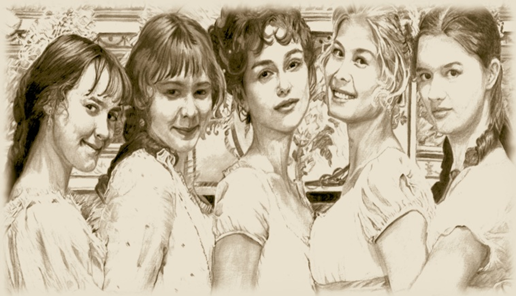
Mr. Bennet is fond of books and is known for his sarcastic wit. Along with his favorite daughter “Lizzy,” he shares a distaste for the conventional views of wealth and rank. He also enjoys criticizing and teasing his youngest daughters Kitty and Lydia.
To his wife he says that they are “uncommonly foolish” and “two of the silliest girls in the country.” But his inability to step in and correct their behavior fosters his youngest daughters’ foolishness. Lydia will eventually be involved in a scandal that disrupts the social order and brings shame upon the family.
Mrs. Bennet is obsessed with finding suitable husbands for her daughters. The opening indicated this fixation but not the reasoning behind it. It has to do with a legal restriction on inheritance – an entail.
If Mr. Bennet passed, his estate, Longbourn, is entailed (transferred) to the closest male relative – his cousin, Mr. Collins. Mrs. Bennet saw no guarantee of Mr. Collin’s charity if that happened. She, justifiably so, knowing that acceptable employment opportunities were extremely limited for women in their social class, wanted her daughters to marry advantageously or she and they will be destitute and fall into social disgrace.
Mrs. Bennet’s favorite daughter, the one with “high animal spirits” is 15-year-old Lydia. Lydia is obsessed with men, especially the officers of her militia regiment. The flirtatious Lydia will become involved in a sexual scandal with a certain Mr. Wickham.
Mrs. Bennet is characterized as “a woman of mean understanding, little information, and uncertain temper.” She becomes fretful when her plans go awry. To ally her worries, she visits neighbors and gossips.
Elizabeth would later reflect on her father’s judgmental sarcasm, the flirtations of her wild youngest sisters Kitty and Lydia, and the unwillingness of her father and mother to control their behavior.
“They were hopeless of remedy. Her father, contented with laughing at them, would never exert himself to restrain the wild giddiness of his youngest daughters; and her mother, with manners so far from right herself, was entirely insensible of the evil.”
Beside the Bennet family, there are 20 characters in the novel. Some are charming (Charles Bingley). Some are annoying (Mrs. Bennett, Mr. Collins, Lady Catherine de Bourgh). Others, self-willed and careless (Lydia), rakish (Mr. Wickham), proud and stilted (Mr. Darcy). And one starts out very sure of herself (Elizabeth).
The characters meet at various gatherings. The Bennet sisters looked forward to every ball as dancing was a very important part of the courtship ritual. There, the daughters mingle with husband prospects and impressions are formed. At one ball, Bingley takes an immediate interest in the beautiful and shy Jane and Elizabeth danced with George Wickham.
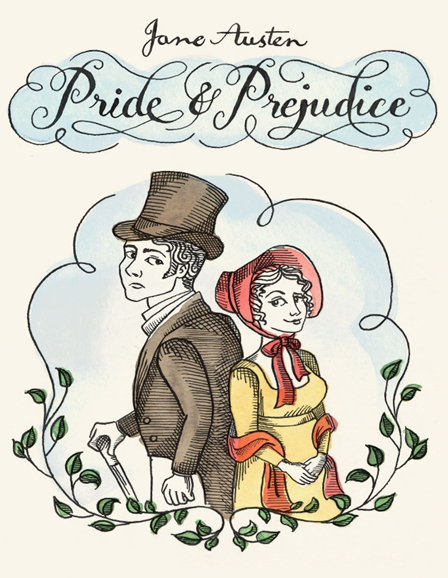
The Elizabeth and Fitzwilliam Darcy encounter is reserved but intriguing for both. Their relationship is where the pride and prejudice of the title comes in. It begins with class distinction: Elizabeth is the daughter of a country gentleman. Darcy is a rich aristocratic landowner.
Darcy, holding a common belief in the natural superiority of the wealthy landed gentry, walks around with the pride of rank and fortune and prejudice against the social inferiority of Elizabeth’s family. He comes off as distant. Elizabeth, equally aloof, wears her pride as independence of mind.
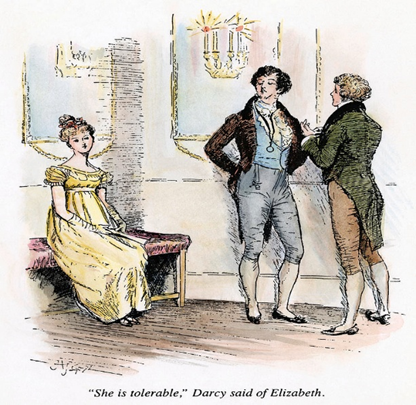
Elizabeth also noticed that Wickham and Darcy don’t get along. She begins to hold a grudge against Darcy based on his superior ways and on the self-serving words of Wickham that belittle him.
But she later sees Darcy anew when he involves himself in ‘fixing’ Lydia’s mess and restoring social order. She later sees herself anew.
~~~
Note: It is not my purpose with this post to summarize Pride and Prejudice. There are plenty of websites that do so. My purpose here is to bring to the foreground a character who learns to see differently. And to encourage everyone to thicken their personal bandwidth by reading great literature from the past. As you’ll see by reading Pride and Prejudice, wisdom and much more comes in doing so. Don’t judge a book by its cover.
~~~
The novel was more than I expected from a so-called “romance novel.” I came across personal growth in a character who humbled herself and let go of a grudge based on social pretensions and misjudgments. She was able to open her mind and her heart to new information and begin to see things differently. I came across Elizabeth Bennet and her Anagnorisis.
Anagnorisis is a literary device used in Greek tragedies and in many plots since. It is the moment of recognition. The main character, typically, transitions from ignorance to knowledge. This seeing anew is a turning point in the story, after which things concerning the main character are not viewed the same way again.
Elizabeths’ shift in perception comes after a revelatory letter from Darcy that discloses the opposite of what she had supposed about Wickham and himself. Darcy had thought it beneath him as a gentleman to speak of Wickham’s deceitful squandering behavior.
She spends time alone thinking things through. She questions her own discernment. The outcome of her interiority is summed in her words above. Elizabeth finally learns the truth about someone she accepted at face value (Wickham) and about someone that she judged harshly (Darcy). The prejudice in the title was not the latter’s but hers. She realizes she was greatly mistaken.
Elizabeth began as a rebel. She thought she was above society’s games. She’s witty but judgmental and arrogant when fixating on flaws. Her own pride mirrored that of the one she viewed as proud. But after spending time alone with the letter and hearing confirming reports, she confronts her own snobbery. Realizing how wrong she was she is humbled.
She grew absolutely ashamed of herself. Of neither Darcy nor Wickham could she think without feeling that she had been blind, partial, prejudiced, absurd.
“How despicably have I acted!” she cried; “I, who have prided myself on my discernment! I, who have valued myself on my abilities! who have often disdained the generous candour of my sister, and gratified my vanity in useless or blameable mistrust! How humiliating is this discovery! Yet, how just a humiliation! Had I been in love, I could not have been more wretchedly blind! But vanity, not love, has been my folly. Pleased with the preference of one, and offended by the neglect of the other, on the very beginning of our acquaintance, I have courted prepossession and ignorance, and driven reason away, where either were concerned. Till this moment I never knew myself.”
Pride and Prejudice. Chastened realism. Seeing anew. Wisdom born of humility. Wit and wisdom.
~~~
Evie Magazine, in 5 Women From Classic Literature Who Don’t Need A Sword To Be Strong, attributes Lizzy’s change of mind to her strength of character:
“When Darcy begins to show signs of being something more than what originally met the eye, Elizabeth is able to open her mind and her heart to him and discover the truth behind his distance and disdain. Her ability to do that — instead of holding a grudge — allows her to find, in Darcy, a true equal.”
~~~~~~
“Angry people are not always wise.”
― Jane Austen, Pride and Prejudice
“There is a stubbornness about me that never can bear to be frightened at the will of others. My courage always rises at every attempt to intimidate me.”
― Jane Austen, Pride and Prejudice
“From the very beginning— from the first moment, I may almost say— of my acquaintance with you, your manners, impressing me with the fullest belief of your arrogance, your conceit, and your selfish disdain of the feelings of others, were such as to form the groundwork of disapprobation on which succeeding events have built so immovable a dislike; and I had not known you a month before I felt that you were the last man in the world whom I could ever be prevailed on to marry.”
― Jane Austen, Pride and Prejudice
~~~~~
Simone Weil once said:
“There is something else which has the power to awaken us to the truth. It is the works of writers of genius. They give us, in the guise of fiction, something equivalent to the actual density of the real, that density which life offers us every day but which we are unable to grasp because we are amusing ourselves with lies.”
~~~~~
Rosamund Pike talks about narrating Pride & Prejudice
~~~~~
Forming the Imagination Through Literature
Joshua Villarreal, Teacher Support Lead for Hillsdale College K-12, delivers a lecture on how literature forms a student’s moral imagination.
This lecture was given at the Hoogland Center for Teacher Excellence seminar, “The Art of Teaching: Upper School Literature” in February 2025. The Hoogland Center for Teacher Excellence, an outreach of the Hillsdale College K-12 Education Office, offers educators the opportunity to deepen their content knowledge and refine their skills in the classroom.
~~~~~

If you are not content to read and need a screen, well there’s this:
Pride and Prejudice and Zombies
Five sisters in 19th century England must cope with the pressures to marry while protecting themselves from a growing population of zombies.


 Cindy Wity