Scaffolding
November 5, 2023 Leave a comment
I sat down with a close friend the other day. I asked him about his early church experience, as I am interested in church dynamics.
Here’s what Dan (not his real name) said during the interview:
“My parents attended a Baptist church in Chicago before moving to the suburbs. I was a kid and just remember old buildings with a fusty smell and pictures to color. After the move, we started attending a Bible church. I was eight years old.
“I don’t remember a single sermon. But I do remember the church sanctuary. I sat there Sunday mornings and evenings for maybe twenty years.
“There was a plaque on the back wall above the choir loft. It said “God is in His holy temple. Let all the earth keep silent. Hab. 2:20.
“Front and center was a large wing pulpit. Three large minister chairs were behind it along the choir loft. A piano on the left and an organ on the right flanked the platform.
“On the main floor in front of the pulpit was the oak communion table. “This Do In Remembrance of Me” was carved on the front. The table held the offering plates and a flower arrangement.
“To the right of the platform and behind a large rectangular hole in the wall was the baptistry. A landscape was painted on the walls surrounding the water tank.
“Opposite the platform, sixteen rows back, was the entrance to the sanctuary. A clock was centered above the double doors to let the minister know when to end the service.
“Rows of blond wood pews filled the space between the front and back with an aisle down the center and along each end.
“The side walls were painted-beige cinder block. Each wall had three windows of tinted-amber bubble glass. Forest green curtains bordered two sides of each window.
“The walls around the windows were bare except for a wooden rack near the organ. It held the numbers in attendance at the service and at Sunday school the week before. An usher counted attendance every Sunday.
“That’s a twenty-five-year snapshot. I don’t recall that room ever changing.”
I asked him about the service.
“Prelude. Hymns. Lots of choruses about leaving earth and flying away. Sermon. Calls for salvation and rededication of your life. Postlude. Every Sunday.”
I asked him about memories that stick out.
“Let’s see. There was the leader of the boy’s club. He let us run around and be crazy one night each week. One time he took us to a construction site to show us what he was working on. He was a carpenter.
“There was an adult Sunday School teacher who visited a nursing home once a month. He had me come with him on those Saturdays. I’d play a hymn with my trumpet. Afterward he would give a short devotional.
“And there was this interim minister – there were lots of them – who got me my first job as a clerk in a Camera/Photo store. One time – I was twelve or thirteen – he had me come with him downtown to Pacific Garden Mission. I played my trumpet and he spoke to those who had come off the streets of Chicago.”
I told Dan that he only mentioned certain men as memories that stick out. Then I asked if anyone had mentored him.
“No one from church. Only my trumpet teachers did.”
I asked him to explain.
“I started playing the trumpet in third grade. My uncle gave me a beat-up Conn trumpet that he longer wanted to play. In the Junior High School, the band director wasn’t crazy about the look or the sound of my horn. So, he switched me to French horn for two years. But my heart was with the trumpet. I asked my parents for private lessons.
“Before I started lessons – this was during eighth grade – my father and I went to an instrument store. He bought me a brand-new Bach Stradivarius b-flat trumpet. The horn was a beautiful and expensive gift. I felt affirmed.
“My first trumpet teacher was a high school principal who also played trumpet in big bands. The first question he asked me: What trumpet players did I listen to? I told him Herb Albert. He just shook his head.
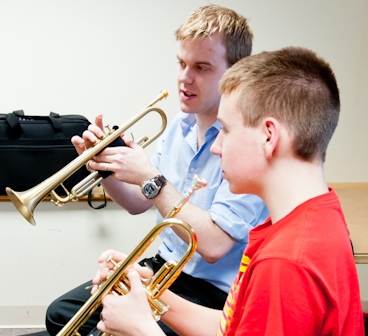
“He told me who I should listen to and to what pieces of music. He began giving me exercises to practice. Major and minor scales. Tonguing exercises. I’d have to play them for him the following week.
“The summer before high school I took what he taught me and practiced like crazy. The high school concert band director had sent out the requirements for entering the band. Those included playing major and minor scales and site reading.
“A month before my freshman year began, I was called in to audition for the band director. I played all the scales and sight read what he put in front of me. He was pleased. I was in the concert band – first trumpet section right behind the first chair trumpet, a sophomore.
“My junior year of high school the band director Mr. Gies became my second trumpet teacher. He also played the trumpet semi-professionally.
“What happened was this: the guy who sat first chair was a stellar trumpeter but he needed to be replaced. During the summer the first chair French horn player became pregnant. Both would soon be leaving the school. So, the band director began one-on-one time with me.
“Over several months Mr. Gies and I met in the school auditorium during an open period for both of us. Playing the trumpet in that auditorium, that sanctuary, was like no other experience. With those unstifled acoustics I could open up and project a nice broad sound.
“Mr. Gies asked me how I practiced. I shared with him the Carmine Caruso method for building chops. I learned the method from my first trumpet teacher, Mr. Lichti.
“I told him that the method involves interval training, articulation, range and produces endurance. With it, I had developed an extensive range -double high C to over an octave below the treble staff. The method had formed my sound to that point.
“Sitting together offstage, Mr. Gies and I worked through the Caruso method along with the Clarks – Clark Technical Studies – which are exercises used for the development of fingering technique.
“I cherished that time alone with the band director. In between playing an exercise we talked about anything and everything. And sometimes we were silent and it felt comfortable.
“We practiced together the rest of my junior year. I was ready for the first chair trumpet position when the other guy left.
“My third trumpet teacher was at a Bible school. After high school I entered a Christian Ed/Music program. The Christian Ed program was a bust but the music program was a blessing.
“I took private lessons from the concert band director, Mr. Edmonds. Unlike the other teachers, he was an established pianist with perfect pitch. He had a different take, a different sound in mind, for my horn – a precise centered pitch. He was also a composer. He adapted classical music for our concert band to play.
“In between playing my practiced exercises and being critiqued, the director and I would talk about anything. I shared with him the challenges I was facing. My practice time was limited because of my studies and the time spent listening to classical music for music appreciation class. And I had a part time job. He prayed for me at the end of each lesson.
“Like back in high school, I sat first trumpet second seat behind a sophomore in the concert band. But at an outdoor band concert, Mr. Edmonds had me solo the opening trumpet lines of Rimsky-Korsakov’s “Procession of the Nobles”. And when The Gaither Trio – Bill, Gloria, and Danny – came to town for a couple of concerts and needed some horns for the finales, Mr. Edmonds offered his two first chair trumpet players. The private lessons and my practice gave me opportunities to play.
“Looking back . . . sitting next to a trumpet teacher week after week, I learned from those who knew what to listen for and who to listen to. Mr. Lichti, for example, helped me realize that I had “deaf spots” in my listening. To develop my “ear”, I began to listen to Adolph “Bud” Herseth, principal trumpet in the Chicago Symphony Orchestra. I wanted to emulate his bel canto sound and his musical acumen.
“To accomplish this, I had to take a risk. You see, with one-on-one instruction you cannot hide, you can’t fake or pretend. You play your horn and the truth comes out. Sloppy practicing is immediately revealed and so is the need for discipline. You need another’s knowledgeable perspective to grow as a musician. Words or notes alone are not enough.
“The three trumpet teachers I mentioned invited me into their musical realm, which was both affirming and daunting, as I was made me accountable to them. In the role of apprentice, they imparted to me trumpet knowledge, technical ability, and a love for the craft.
“And now that I think about it, I take it back. The man who took me and others to his construction site and the man who took me with him to the rest home and the man who took me with to the Chicago mission and got me my first job were mentors. They influenced me just like the trumpet teachers advanced the formation of my horn playing.
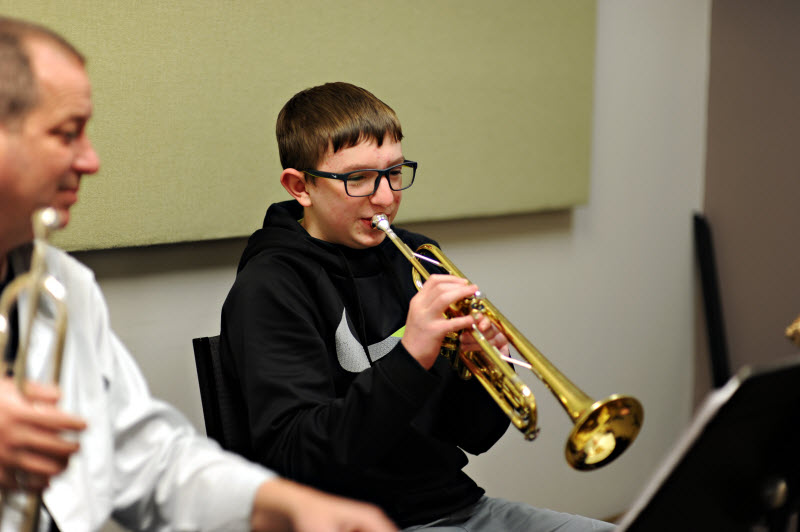
“You asked about my early church experience. I’d say that there was lots of scaffolding but no formation. For me, there was really nothing life changing about going to church and sitting in silence listening to someone standing behind a pulpit. But there was with people I spent time with.”
End of interview.
~~~~~
Church culture: “Tragically, in recent years, Christians have gotten used to revelations of abuses of many kinds in our most respected churches–from Willow Creek to Harvest, from Southern Baptist pastors to Sovereign Grace churches. Respected author and theologian Scot McKnight and former Willow Creek member Laura Barringer wrote this book to paint a pathway forward for the church.”
In this podcast, theologian Scot McKnight and his daughter, Laura Barringer, join Julie Roys to discuss their latest book, A Church Called Tov: Forming a Goodness Culture That Resists Abuses of Power and Promotes Healing.
While their first book explained the characteristics of a “tov,” or good, culture, their latest book tackles the next challenge—transforming ingrained toxic cultures into tov ones.
Pivoting Your Church From Toxic to Healthy | The Roys Report (julieroys.com)
~~~~~
Bud Herseth’s Final Concert on NPR – YouTube
Adolph Herseth Interview – YouTube
~~~~~


 Cindy Wity