There are many subjects I’d like to post about. As an autodidact I have a wide variety of interests coupled to a driving impulse to look outside the box marked “that’s all you need to know”. Art, music, literature, economics, business, research on Scripture, and science have been touched on in my posts. But because of the threat of tyranny on the horizon, I have been posting about matters crucial to life on this planet.
The situation on the ground is not looking up. This post, a break from my current posts, takes a look up with the help of the James Webb Space Telescope and astronomy.
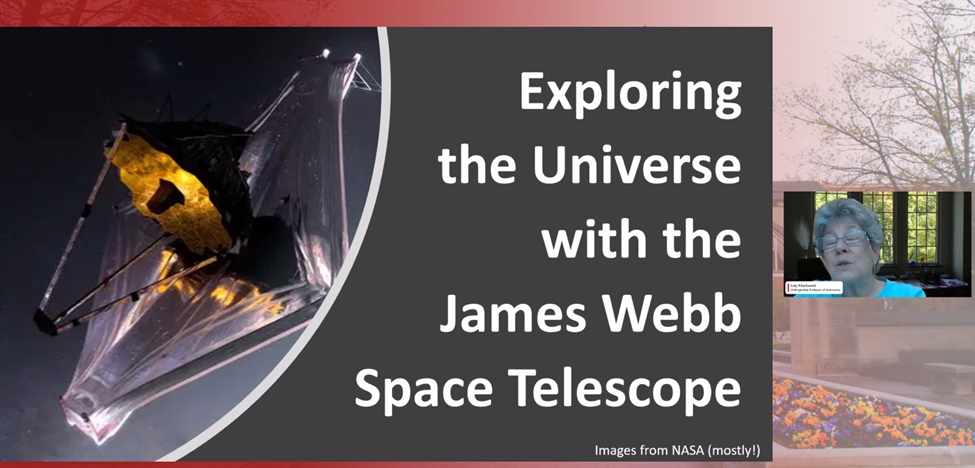
After retiring at the end of last year I joined the Indiana Astronomical Society to learn astronomy. Through IAS I attended the following livestream: Exploring the Universe with the James Webb Space Telescope with Caty Pilachowski, Ph.D.
Caty Pilachowski is an observational astronomer, using large telescopes in Hawaii, Arizona, and Chile to study the chemical evolution of stars, specifically how the compositions of different populations of stars differ from each other due to different histories of star formation. She studies rainbows of starlight to identify and measure the signatures of different chemical elements to determine how much of those elements each star contains. Before joining the faculty at IU in 2001, Caty worked at the national observatory in Tucson, where she helped to build the 3.5 meter WIYN telescope that IU astronomers use for their research.
Indiana University 107 S. Indiana Ave. Bloomington, IN 47405
IU has restricted use of the video. So do the following to view the video:
Copy to clipboard Food for Thought | Exploring Our Universe with the James Webb Space Telescope
Go to YouTube. Paste clipboard into YouTube Search to access IU video.
~~~~~
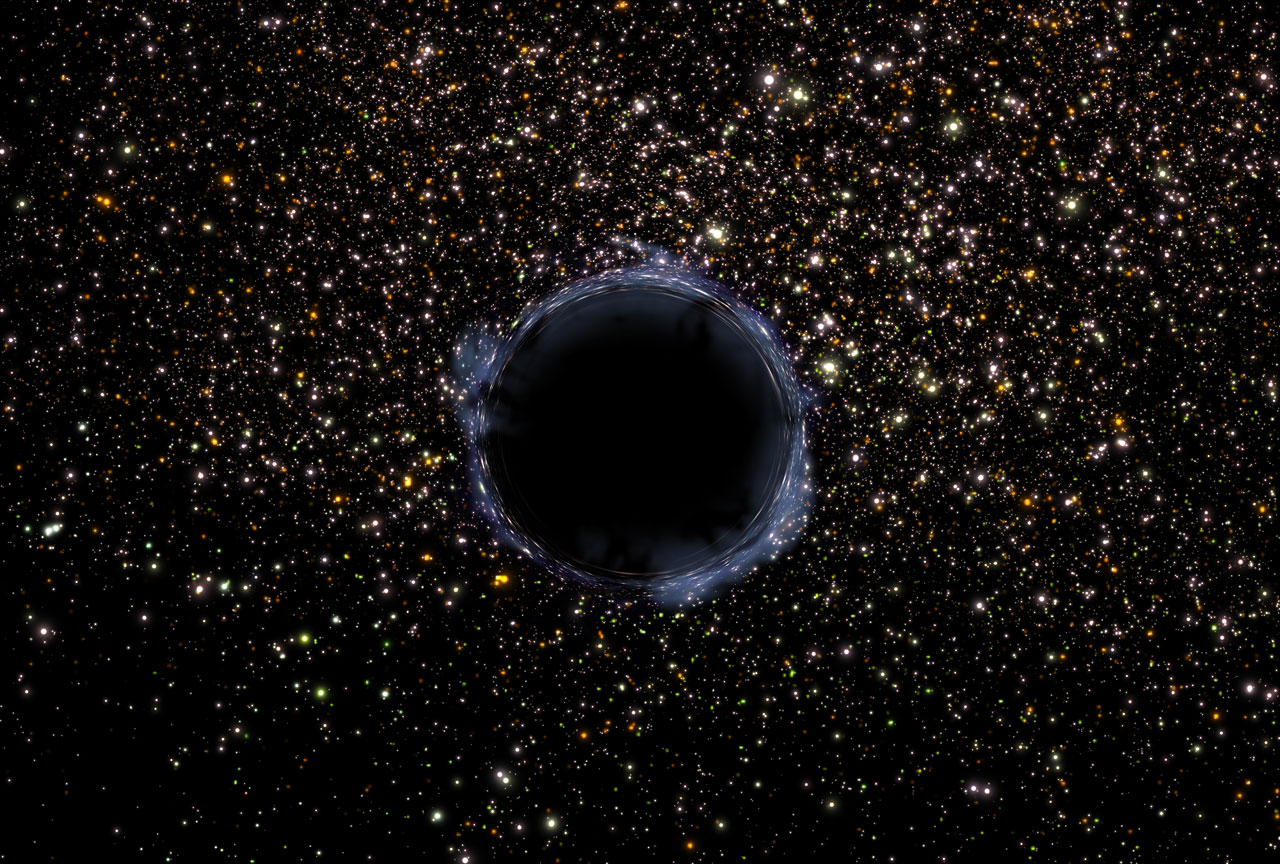
Is our Solar system currently safe? Are there any hidden dangers we might expect in the future?
The universe is a dynamic environment where collisions and close encounters play a significant role. Some were responsible for the birth of our planet Earth and life itself, and some nearly destroyed it.
Take a look: “Doomsday Dynamical Scenarios” Václav Pavlík, Ph.D. Postdoctoral Fellow, Ph.D. in Theoretical physics, astronomy and astrophysics, Indiana University
Added Aug. 24th, 2023, India’s moon landing, @44 min.:
“Abandon the urge to simplify everything, to look for formulas and easy answers, and to begin to think multidimensionally, to glory in the mystery and paradoxes of life, not to be dismayed by the multitude of causes and consequences that are inherent in each experience — to appreciate the fact that life is complex.” ― M. Scott Peck
“For the first time, people knew with certainty that there was more to the natural world than meets the eye.” [i]
The development of optical devices – telescopes, microscopes, and camera obscuras – enabled the curious in 17th century Europe to see beyond the boundaries of the naked eye. With enhanced vision, natural philosophers and artists were learning to see beyond what one was accustomed to seeing and beyond strongly held beliefs and theories of how things were. Acceptance that the world was very different than it seemed followed.
A patent for the “looker”, an instrument “for seeing things far away as if they were nearby“, was filed by a Dutch master lens grinder and spectacle maker Hans Lippershey in 1608. A backstory goes that children were playing with lenses in his spectacle shop. The kids noticed that a nearby weather vane looked larger when a pair of lenses were stacked. Lippershey’s patent was turned down on the grounds that the device was so simple that anyone could build one. Indeed, three Dutchmen had applied for the patent at the same time.
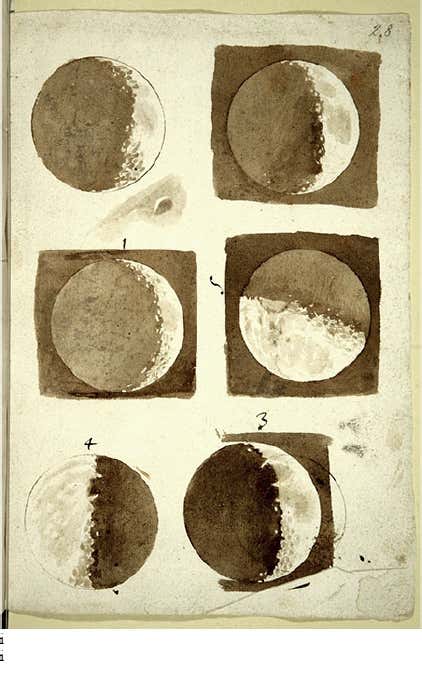
A year later, Italian natural philosopher, astronomer, and mathematician Galileo adapted his own “looker” to view the heavens. By grinding and polishing lenses and adding aperture stops, he improved the magnification up to about thirty times. With the modified spy glass, Galileo was looking for observational evidence to prove that the earth was going around the sun and not vice versa. He started his observations with the moon and found that it wasn’t a smooth uncorrupted surface as people were led to believe by the Catholic church. The Galilean moon had crater spots and irregular terrain.
“The prevailing astronomical tradition had long taught that the heavens were perfect and unchanging, in contrast to the earth, which seemed in constant upheaval. This claim derived from the simple observation that change was almost never observed in the heavens. Christian theology, inspired by this pagan Greek idea, had interpreted the consistency of the night sky in terms of sin and the fall.”[ii]
Galileo developed the scientific method and in so doing natural philosophy began to change from prevailing tradition accounts to experiment-justified and mathematically explained accounts. His revolutionary telescopic discoveries furthered the acceptance of the Copernican heliocentric system and eventually an unwanted acceptance into the Inquisition process. The crime: seeing what was there all along and not seeing what he was told to see.
Spectacle lens stacking was also behind the invention of the compound microscope about 1590. Three Dutch opticians or spectacle makers—Hans Jansen, his son Zacharias Jansen and Hans Lippershey are credit with credited with the invention. The curious would use the microscope to explore new unseen worlds. One such inquisitor was Dutch civil servant Antonie van Leeuwenhoek.
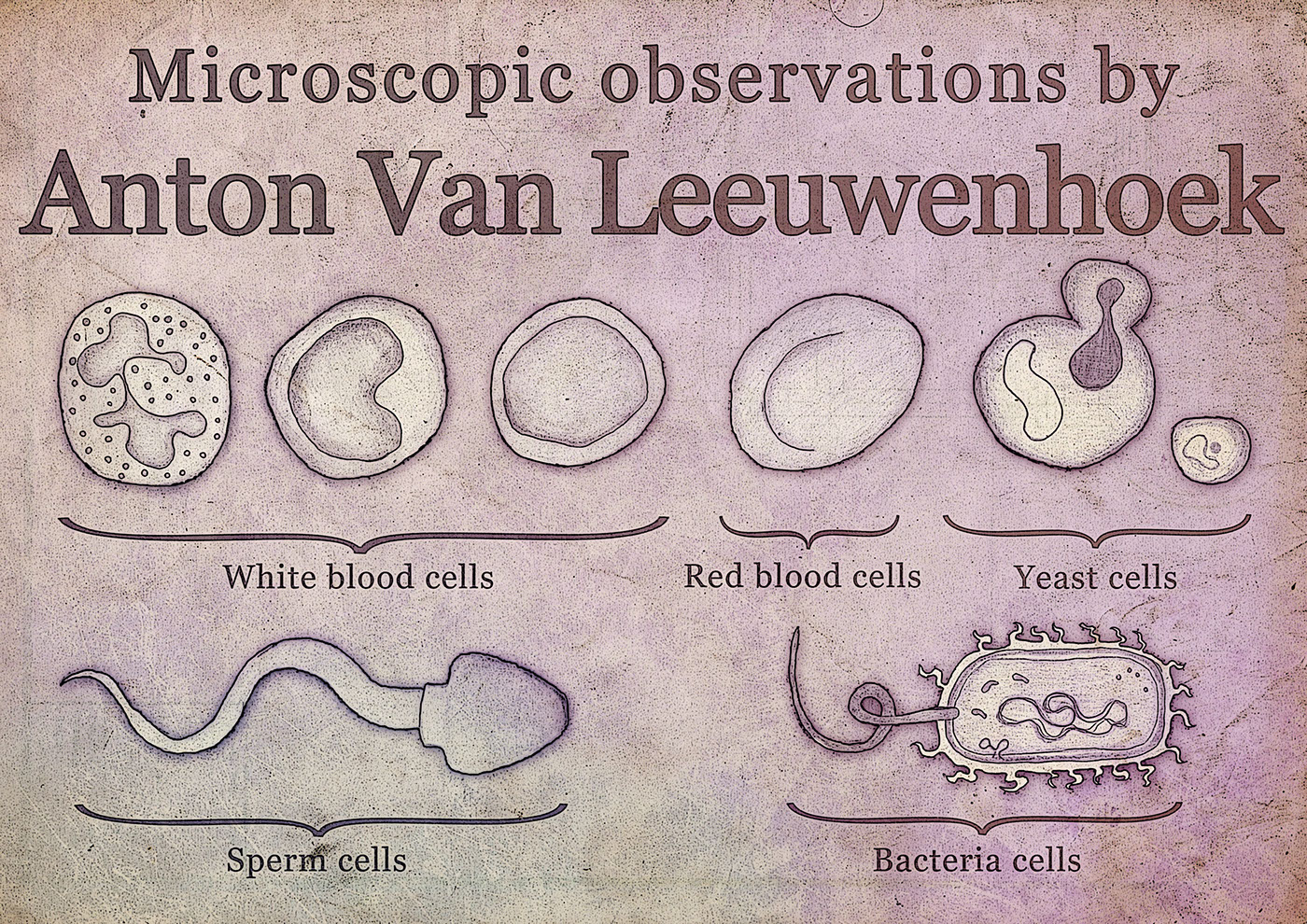
Leeuwenhoek, grinding and polishing his own lenses, began his pioneering observations of freshwater microorganisms in the 1670s. He effectively launched microbiology in 1674 as the first to observe bacteria and protozoa, thereby laying the foundations for the sciences of bacteriology and protozoology. His researches on lower animals refuted the doctrine of spontaneous generation.
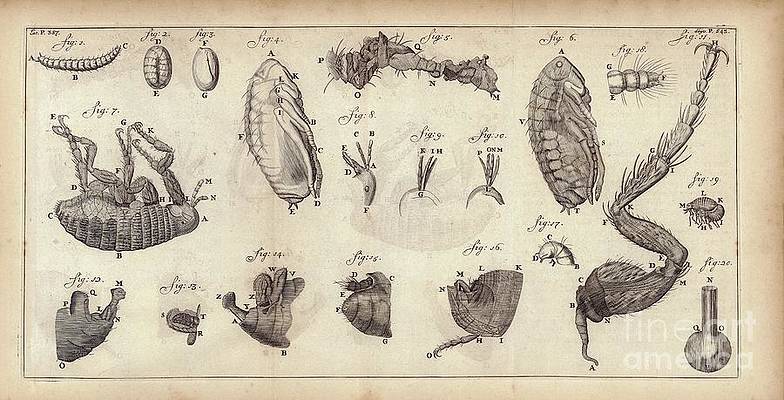
(I find it so interesting that Leeuwenhoek started doing his microbiology work on his own, without grants and schooling in optics and biology. He examined a vast range of specimens -insects, canal water, cow’s eyes and dragonfly’s eyes, human body parts, and much more. He was determined to see beneath the surface and what was there all along. With the help of local drafters who drew the microscopic images, Leeuwenhoek passed his observations on to the Royal Society of London where they caused quite a stir.
Thecamera obscuraoptical device had been around for a long time – long before it was named. In his 1611 book Dioptrice, German astronomer Johannes Kepler coined the term camera obscura which means ‘dark chamber’ in Latin.
The instrument, up until the 16th century, typically took the form of a closed room with windows shuttered and a small hole in a blind or door. Light entered the room through the hole and cast an image onto a screen or onto the wall opposite the door. This type of dark room camera obscura was used by astronomers to make solar observations without damaging their eyes.
The ‘pinhole’ was later (mid-16th century) replaced with a convex glass lens, used in spectacles since the 13th century. The updated camera obscura made it possible to accurately draw the camera image by tracing outlines onto a paper screen. Through the lens and a light-controlling aperture diaphragm the projected image, smaller than actual size, was clear and bright with a concentration of color and a noticeable effect on color in deep shadow. Because this device provided a more accurate representation of the likeness of things and things not seen by the naked eye, it was of interest to surveyors, cartographers, topographers and painters, including Johannes Vermeer.
Small world. Born the same week of October 1632 as microscopist Antoine van Leewenhoek, Vermeer lived near Leewenhoek. The two Dutchmen lived on streets across from the small Delft Market Square. They may have known each other, but that is only conjecture as there is no evidence to support their relationship. They lived during the Dutch Golden Age, a time in Holland of economic, cultural, and scientific knowledge expansion. It was time of freedom from intellectual inquisitions.
(I recommend Laura J. Snyder’s Eye of the Beholder: Johannes Vermeer, Antoni van Leeuwenhoek, and the Reinvention of Seeing for more on the life and times and work of Vermeer and van Leewenhoek and the optical instruments behind the Scientific Revolution that made it possible to see “that there was more to the natural world than meets the eye.”)
Many artists at this time, wanting to depict more realistic images, were experimenting with optical devices such as mirrors and the camera obscuras. It Is not known that Vermeer used the camera obscura. Perhaps, based on the camera’s projected image, Vermeer created a shadowy image outlining the scene before painting. Artists at that time were keen on keeping their methods secret.
We can only guess at the use of a double-convex lens or the camera obscura for The Cavalier and the Young Woman. The scene is a wide-angle lens view. Note that the man is much larger than the woman which reflects an accurate depiction tending toward a photo realistic quality. Many artists at that time would paint both the man and the woman the same size based not on sight but on how things should be perceived.
Many Dutch homes, at the time of Vermeer, were filled with paintings depicting everyday life. Vermeer both collected and sold such paintings while running an inn that operated in the lower part of the family home. He painted up in the loft. At one point Vermeer and his wife Catherina had eleven children to support.
Vermeer is well-known for his depiction of individual women in quiet domestic scenes, most notably the mysterious Girl with The Pearl Earring. Was this Vermeer’s daughter?
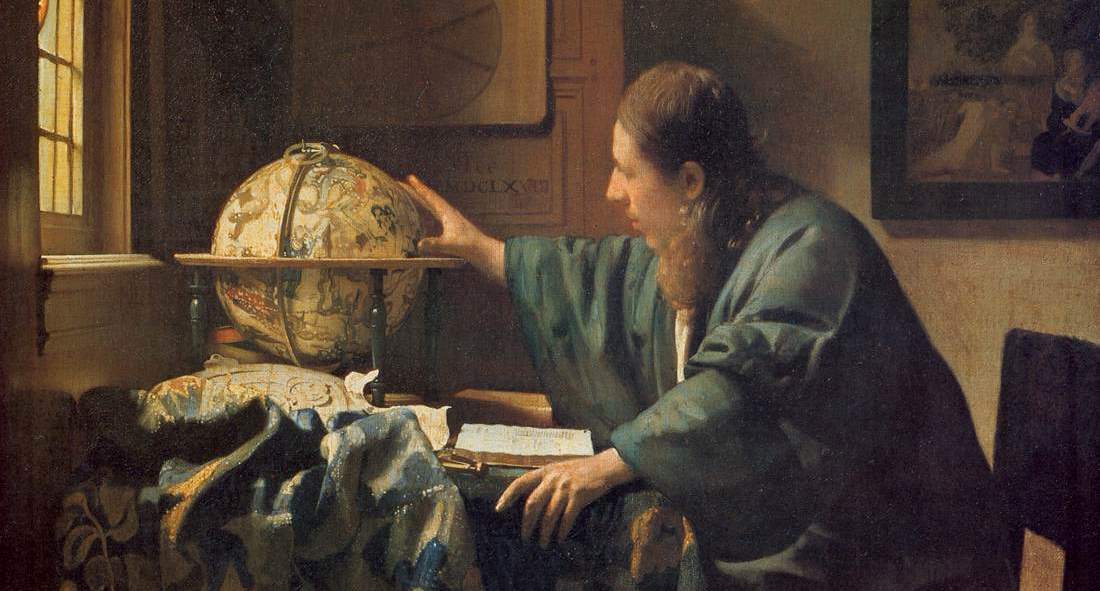
Vermeer also captured the times. Natural philosophers were studying heaven and earth and Vermeer captured this in The Astronomer and The Geographer. Optical devices are required for both disciplines.
Vermeer’s interest in the natural world can be seen in his obsession with maps – depicted in nine of his paintings. See The Cavalier and the Young Woman for one example.
Vermeer began and ended his painting career with paintings of religious iconography: Christ in the House of Mary and Martha (1654-55) and Allegory of Catholic Faith (1670-74).
What were the natural philosophers thinking during this period? A couple of examples might reveal the range of thought.
“I think therefore I am” René Descartes believed that everything he knew, or believed he knew, came from his senses and sensory experience and was therefore suspect. Descartes “espoused an epistemology, or method of knowledge acquisition, that expressed mistrust in the senses, and placed primary value on reasoning from ideas found in the mind rather than from observations of nature.”[iii]
Francis Bacon defended the empirical study of nature and wanted to avoid bringing preconceived notions and prejudices into the findings. He argued for a cooperative and methodical procedure to keep knowledge from being subjected to the four idols of the mind that skewed findings off in a certain direction. He “rejected the claims of those who thought that all knowledge, even knowledge of the physical world, came primarily through human reason and not the senses.”[iv]
Natural philosophers like Descartes and Bacon investigated the natural world with an understanding of God as the Creator. They had views of spiritual reality and wanted views of physical reality. With the new optical devices they were able to see beyond the religious symbolism found in art, architecture, and the simplistic and even disparaging views of nature. Their investigations did not lead them to reject God. Instead, they saw science as a way of learning more about God.
Here’s Francis Bacon’s motivation for aggressively studying both God’s word and God’s world:
To conclude, therefore, let no man upon a weak conceit of sobriety or an ill-applied moderation think or maintain that a man can search too far, or be too well studied in the book of God’s word, or the book of God’s works, divinity or philosophy; but rather let men endeavor an endless progress or proficiency in both; only let men beware that they apply both to charity, and not to swelling; to use, and not to ostentation; and again, that they do not unwisely mingle or confound these learnings together.
Francis Bacon (1824). “The Works of Francis Bacon: Baron of Verulam, Viscount St. Albans, and Lord High Chancellor of England”, p.11
Bacon also said A little science estranges a man from God; a lot of science brings him back. A lot of science took place in the 17th century.
“At the moment, the scientific world was in the midst of a revolution. The so-called Scientific Revolution, today associated with Copernicus, Kepler, Bacon, Harvey, Galileo, and Newton was brought about in part by a new emphasis on empirical methods – making careful observations of the natural world – as opposed to the nonempirical, logical methods preferred by many medieval followers of Aristotle. No longer would the reliance on ancient texts, or armchair philosophizing about the world from a scholar’s study, be considered adequate. The clarion call of natural philosophers (for they were not yet called “scientists”) became “See for yourself”. [v]
With the aid of telescopes, microscopes, and camera obscuras the evidence of things not as yet seen – millions of stars, microbes, the color of shadows and much more of the natural world – came into view for natural philosophers and painters. They dared to see for themselves what was there before ancient texts and religious dogmas came out with authoritative views of the natural world. They saw what was there all along.
We have the Large Hadron Collider which “boosts particles, such as protons, which form all the matter we know. Accelerated to a speed close to that of light, they collide with other protons. These collisions
produce massive particles, such as the Higgs boson or the top quark. By measuring their properties, scientists increase our understanding of matter and of the origins of the Universe.”
We have positron emission tomography scan (PET scan), radiographic technique to examine the metabolic activity in various tissues especially in the brain.
We have functional magnetic resonance imaging (fMRI) which measures the small changes in blood flow that occur with brain activity.
There are two microscopes that can zoom in to a resolution of less than an angstrom (one ten-millionth of a millimeter)
X-ray examination: “X-ray use has become a common practice among art authenticators. Not only does it unlock secrets underneath paintings, but it helps to establish authenticity.”
Disney+ has unveiled a German original about a teenager who falls in love with the devil from the team behind Netflix’s How to Sell Drugs Online (Fast).
“Any power that government takes from the people, it will never return voluntarily. Every power that government takes, it will ultimately be abused to the maximum extent possible. Nobody ever complied their way out of totalitarianism. The only thing we can do is resist.” Robert F. Kennedy, Jr. at Hillsdale College
*****
The Left destroys whatever it touches:
[i] Laura J. Snyder, Eye of the Beholder: Johannes Vermeer, Antoni van Leeuwenhoek, and the Reinvention of Seeing, New York W.W. Norton & Company, Inc., 2015, p.319
[ii] Karl W. Giberson, The Wonder of the Universe: Hints of God in Our Fine-Tuned World, InterVarstiy Press, 2012, p. 49
. . . when the fullness of time arrived, God sent His Son . . .
You and I, remnants of dying stars, have recently arrived on a habitable zone planet within an incredibly old cosmos . . .
American astronomer Edwin Hubble (1889-1953) discovered, through analyzing the distance and redshift effect of two dozen galaxies, that galaxies are receding from us at a velocity that is proportional to their distance from us. A clear straight-line relationship of recession velocity to distance exists and is called Hubble’s constant (H0).
From his discovery we learned that the universe is not static. It is expanding at a constant rate. And, that we are able to estimate the age of the universe based on the relationship of objects in space that were at one time tightly compacted together.
If we assume that the expansion’s apparent velocity (that is, how fast the galaxies appear to be moving apart) has been constant over the history of the universe, we can calculate how long ago the galaxies began their separation. This should tell us the time that the expansion began, which should give us an estimate of the age of the universe.
The approximate age of the universe can be derived using Hubble’s law: v = H0d where (d) is the distance between two galaxies, (v) their apparent separation velocity, (H0) the expanding universe (Hubble’s) constant. The velocity of the galaxy, aka, redshift, is directly proportional to its distance.
. . . advances in our understanding of the stars has led us to refine the ages of the stars in globular clusters, and we now estimate them to be about 13 billion years old. This means, though, that the stars in the globular clusters must have formed within the first several hundred million years of the universe’s existence!
An explanation of the age calculation and the source of the two quotes above are found here:
In addition to calculated estimates based on distance and velocity, an imaging spectrograph such as the one outfitted on the Hubble space telescope provides a detailed stellar history, in light wavelength format, of the cosmos.
A star’s spectral light provides its life story. From it we learn of the star’s distance from us, its size, its mass, its composition, its pressure, its magnetism, its solar system connection and where it is in its life cycle.
Deborah Haarsma, astronomer and president of BioLogos, provides further perspective of our cosmic setting:
With a telescope and spectrograph, we learn of the history and makeup of our physical world. We learn that matter-energy, space-time, and the laws of physics existed well before 6-8000 years, as some would have it. Most important, such observations could only happen in a universe designed to support a developing intelligent life.
With a cover-to-cover reading of scripture we learn of the history and structure of reality. That reality involves causal relationships in both the physical and metaphysical realms. John Polkinghorne (1930-2021), theoretical physicist, theologian, and Anglican priest, offers insight into the interactions of human agency and the divine:
You and I, remnants of dying stars, have recently arrived on a habitable zone planet within an incredibly old cosmos . . . and so did Abraham, Joseph, Moses, Deborah, Samson,Hannah, David, Elijah, Daniel, Ruth, Esther, Elizabeth and Mary, Peter, James, Mary of Clopas, John the elder, Saul/Paul, and Joanna the apostle. These and many others were born during pivotal times per biblical accounts. Their interaction with God made a difference to the world we live in. Their stories are told today.
The apostle Paul, who over time had come to understand the significance of all that had come before after the Damascus Road encounter with Jesus (Col. 1: 1523), had to remind the Jewish Christians in Galatia (Gal. 4) that, like him, they were born into this world as heirs. But before they encountered the living Lord they were slaves to the “elements of the world”. The heir/slaves had been kept under guardians and stewards until a time set by God:
When the fulness of time arrived, God sent out his son, born of a woman, born under the law, so that we might he might redeem those under the law, so that we may receive adoptions as sons.
So, you and I, remnants of dying stars are to inherit all that God has created in this incredibly old cosmos.
Why you and me here and now in this ancient universe? Why this place and time? What’s our telos? Let’s space it. It’s time to get our heads out of cyberspace and ponder something greater than, say, the Twitterverse. The fulness of time has come for us, the heirs of redemption.
Lift up your eyes on high and see: Who created these? He who brings out their host and numbers them, calling them all by name; because he is great in strength, mighty in power, not one is missing. – Isaiah 40:26
*****
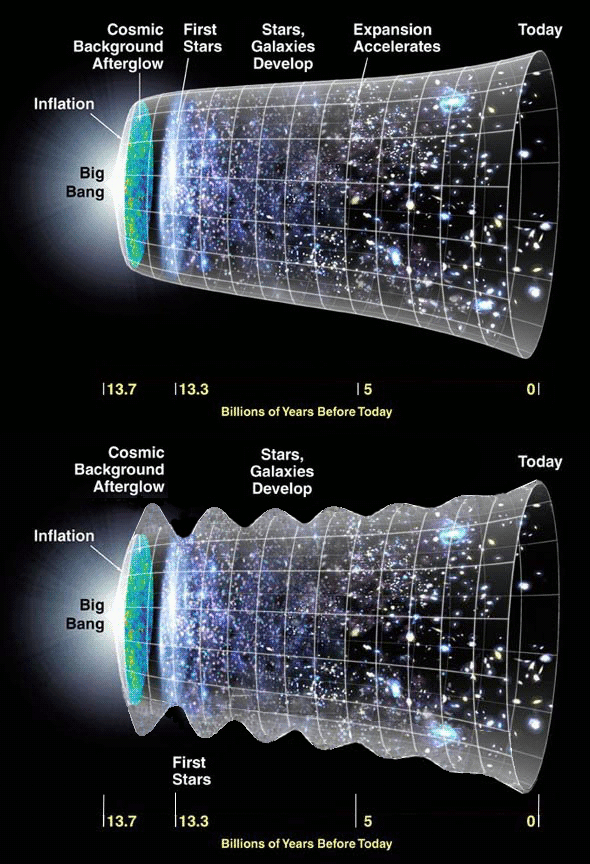
“In February 2003, the WMAP project released an all-sky map of the radiation emitted before there were any stars. This cosmic microwave background radiation (CMB) is the remnant heat from the Big-Bang and was predicted already in 1946 by George Gamow and Robert Dicke.”
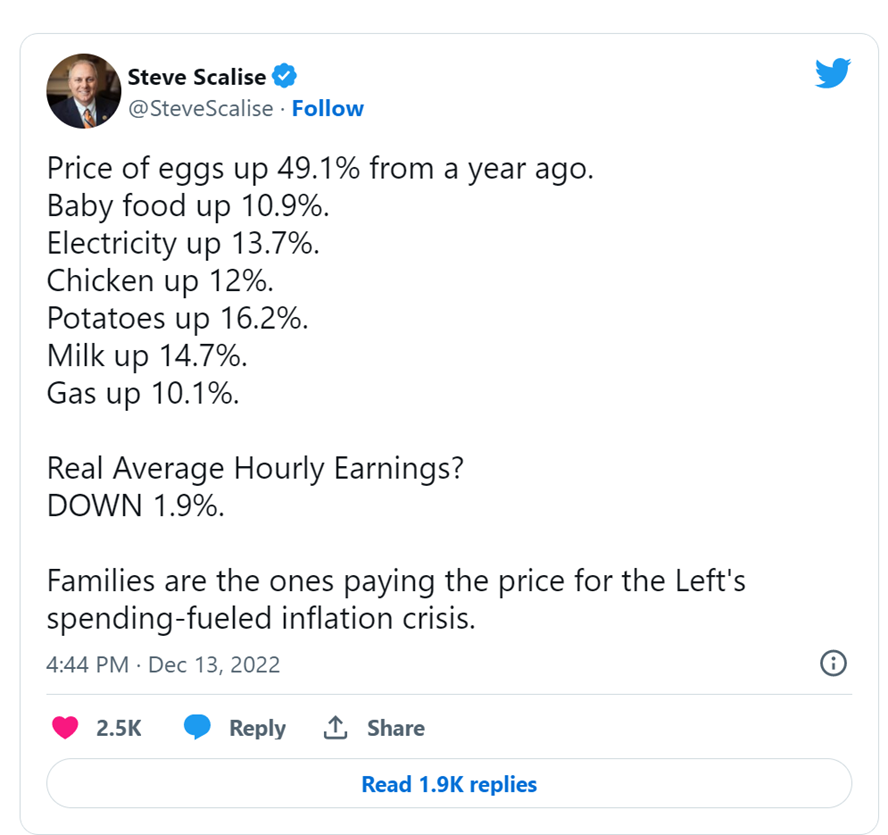
As I have mentioned before, inflation is another tax . . .
Inflationary pressures and rising wages continue to benefit State tax revenues. Revenue drivers are personal income tax payments, much of which are forwarded through paycheck deductions, and sales tax payments, which are charged as percentages of the price of the goods sold. Inflation increases these prices and pay rates, thus increasing income and sales tax revenues.
“For almost a century, the Universe has been known to be expanding as a consequence of the Big Bang about 14 billion years ago. However, the discovery that this expansion is accelerating is astounding. If the expansion will continue to speed up, the Universe will end in ice.” Saul Perlmutter, astrophysicist
~~~
I find it interesting that light tells us where we have been. Astrophysicist and Nobel winner Saul Perlmutter and his team of astronomers at Lawrence Berkley National Laboratory focused the most advanced telescopes on 80 super luminous Type 1a supernova. Using red shift (a Doppler-like effect, the wave lengths of light rays increase towards the red end of the spectrum when the source recedes from the viewer) to determine the speed of recession of distant galaxies, Perlmutter concluded from the data that the universe was accelerating its expansion-the universe was expanding faster and faster.
And since the known universe has only about 20% of the mass density needed to affect a slowdown and then a stop and a re-Bang, Perlmutter concluded that the universe must be infinite.
Guess who stands at each end of infinite?
Guess what Light has no red shift or shadow of turning?
Guess which Cosmological Constant is greater than the one once proposed and later rescinded by Einstein and is now back on the table after scientists learned about Perlmutter’s findings?
Sound trumpets. Now tympani. Start your crescendo all instruments of praise…
“I am the Alpha and the Omega…” Revelation 1:8
“I am the first and the last…” Revelation 1:17
“Then he said to me, “It is done! I am the Alpha and the Omega, the beginning and the end.” Revelation 21:6
“I am the Alpha and Omega, the first and last, the beginning and the end.” Revelation 22:13
Guess Who will meet you at every level of your existence and at any time during your existence and at every question you have during your existence?
Guess Who you will meet when you study biology, chemistry, anthropology, origins, genetics, physics, astronomy, philosophy, medicine and engineering?
Guess Who you will meet when you think science and faith are acting incompatible and seem to be accelerating in opposite directions based on cultural shift readings?
See the above. The audacious claims that Jesus makes in Revelation mean that…at the beginning of any sequence and at the end of any sequence is the Person Jesus. In the middle of the sequence is the Person Jesus.
At every level of study, in every field of science, in every atom, quark, super-quark and boson, if you go to infinity and beyond…you will encounter Jesus. The Hound of Heaven is looking for you there.
Let’s get personal for a moment, as did the Psalm writer.
Where can I go from your Spirit?
Where can I flee from your presence?
If I go up to the heavens, you are there;
if I make my bed in the depths, you are there.
If I rise on the wings of the dawn,
if I settle on the far side of the sea,
even there your hand will guide me,
your right hand will hold me fast.
If I say, “Surely the darkness will hide me
and the light become night around me,”
even the darkness will not be dark to you;
the night will shine like the day,
for darkness is as light to you. Psalm 139: 7-12
Perfect love casts out fear, so start here:
“Search me, God, and know my heart;
test me and know my anxious thoughts” 139: 23
~~~
You wonder if God is silent. You watch a movie about God’s supposed Silence based on a novel written in 1966 by the same name. Like the main characters, you may even stand on the face of Jesus and commit apostasy because you think that God doesn’t hear and doesn’t see what is going on in your space and time. You behave as you think God should behave in that situation. Your perception of God, as observed through the prevalent Epicurean/Deist worldview, is reaffirmed: God must be off somewhere in the cosmos and not involved in man’s day to day life; God won’t save his own; we are our own salvation and other’s salvation; God is silent, therefore we must act.
You watch a sci-fi movie about the Arrival of aliens. The main character must learn the language of the aliens to gain the alien’s purpose for coming and to learn whether or not a threat to earth is imminent. Near the end of the movie the main character has a salvific vision. In the vision, time is shuffled as a language and an understanding barrier are overcome, vertically and horizontally. A world saving decision is made. Then, at the end of the movie, a personal choice is made, the ends of which are reconnected to the beginning of the movie.
Two movies. The one reveals a lack of personal knowledge about the Alpha and Omega. This accounts for a lack of faith and for actions done out of fear. The second movie attempts to show that a personal encounter with another that is completely other. The main character seeks to understand the other’s language. Full understanding comes from a personal encounter with the alien. The acquired personal knowledge brings about saving transformation for everyone involved.
Now imagine the personal knowledge that you would gain from this lesson: you are the bride at your wedding. Your head server tells you that you are out of wine just when the party is ready to get on the floor and dance. At that moment the Beginning and the End does a work of transubstantiation: Jesus turns the physical properties of water into wine.
For your personal knowledge, here is a poem about the centrality and supremacy of Jesus, from Paul’s letter to the Colossian church:
He is the image of God, the invisible one,
The first born of all creation
For in him all things were created,
In the heavens and here on earth.
Things which we can see and things we cannot-
Thrones and lordships and rulers and powers-
All things were created both through him and for him.
And he is ahead, prior to all else,
And in him all things hold together;
And he himself is supreme, the head
Over the body, the church.
He is the start of it all,
First born from the realms of the dead;
So in in all things he might be the chief.
For in him all the Fullness was glad to dwell
And through him to reconcile all to himself,
Making peace though the blood of his cross,
Through him-yes, things on earth,
And also the things in heaven.
Colossians 1: 15-20
Now, one may read this and say, “this passage is all about Jesus and not about me and my worries”. I say to them, “Read the passage again, but this time see that “all things” includes you and your worries.” ”And in him all things hold together…”. Wherever you are broken, confused or lost Jesus is there to heal and make whole.
Fear often paralyzes us. Then, as we sit in the dark unknown biting our nails and thinking that God is uncommunicative, we act. In so doing, we deny the Alpha and the Omega an encounter with the beginning and the end of our fears. We also deny ourselves a personal knowledge that will sustain going forward. Consider Peter walking on the water until fear kicks his legs out from under him.
Perhaps your universe is expanding faster than you can keep up with it. When there is change and accelerating change, remember that God was there when it began and God is there when it ends. If God can hold all things together in the cosmos, why not hold onto God-The Ultimate Theory of Everything– for the ride of your life?
Praise Him, sun and moon; Praise Him, all stars of light!
Psalm 148:3
Did you wake up today wondering why the planets and moons are round? For some reason, I wondered this while working out on the elliptical machine at the health club this AM.
OK. So, you didn’t wake up and wonder why all the planets and moons in billions of galaxies are round.But I’m going to tell you anyway.
Better, I will let Tega Jessa explain. From Jessa’s web article, “Why Are Planets Round”:
You may have wondered why are planets round. I mean why aren’t the cubes or pyramids? The answers can be found in how gravity works and the formation of our solar system. Our solar system was formed like many other star systems from a nebula. A nebula is a concentrated area of gases and cosmic dust in what is the called the ISM or Interstellar Medium. These gases and dust are spread through space and when enough of it gathers it gains suitable gravity to establish a gravitational field. This clumping creates nebulas and started the process for star formation.
The next step in a star’s birth would be the rotation of the nebula. As matter is drawn in and organized by the nebulas increasing gravitational field it start to gain angular momentum and start to rotate. This is just like how an ice skater spins faster when they pull in their arms. As the matter is pulled into the nebula’s center of mass, it spins faster making it easier for more matter to be pulled in. This process will happen until under the increasing gravity until the gases go under nuclear fusion and a star is born.
After the birth of a star there are now two sources of gravity whose tides fight over the remaining gases and dust. The first gravitational field is that of the nebula and the other is the gravity of the new star. The tidal forces of these two fields bunch the remaining gases and dust together. Heavier element will clump together faster to make the beginnings of rocky planets. It is important to note that gas giants are planets that were close to becoming stars but did not reach critical mass for fusion. In the end, even as these planets are forming they still carry over the angular momentum and spin as well drawing more matter.
This process works like a carpenter’s lath. The new gravitational field pulls matter towards the center of the planet’s mass. The rotation helps to round out the rough edges. As time passes and the planet cools the planet settles into its final shape depending on its own rotation and the gravitic influence of its star. This is what makes a planet round.
OK. Now we both know why planets and moons are round. Next question:
The Big Bang or the time of the Great Annihilation, when Matter and Antimatter clashed and cosmic sparks went flying, the progeny of majorons provided the universe with an asymmetric mix of neutrinos and anti-neutrinos, more quarks than anti-quarks. And, that’s what Mattered the most.
It was in That Beginning that Time and his twin-brother Space were born. Since that day, they sprawl the universe with their feet up and their hands behind their head. Under a contractual agreement, though, they will have to return – from whence they came.
Time, the patient caregiver, the healer of all wounds, or, as has been seen, the brutal tormentor of the long-sufferer, always takes his time. He’s been known to say, “A day is like a thousand years, and a thousand years are like a day.”
Space, a distance runner, hopes to place in the next inter-galactic marathon.
Space and Time or Space-Time as they are often called spend most of their time-space wrestling in gelatin with friends and neighbors. They tell me that this adds dimension to their lives. They listen to string-theory music while wrestling.
Miss Universe, a stellar beauty, is curvy. The brothers also spend their time following her around.
Speed-of-Light, the brothers’ close friend, always beats them to the remote whenever something special is broadcast.
My family, the Atoms family, spends its time playing king-of-the-hill and marbles. We do like knock-knock jokes. Little Hydrogen gets pushed around a lot, though.
The Nebulae Family members, known for their starry eyes, are nomadic. They spend their time gazing at Space-Time from a point of departure somewhere in the galaxy.
The favorite saying of the Planet households is “What goes around comes around.” Their favorite hangout is the Milky Way. They own several tanning salons.
I guess that if Time were to be no more and if Space was pigeonholed and if Speed-of-light was somehow surpassed and if Family Nebulae no longer roamed and if the Planet households split up then, God knows, you and I are no longer relative.
“Where were you when I laid the earth’s foundation?
Tell me, if you understand.
Who marked off its dimensions? Surely you know!
Who stretched a measuring line across it?
On what were its footings set,
or who laid its cornerstone—
while the morning stars sang together
and all the angels shouted for joy? Job 38:4-7
*****
“We don’t allow faster-than-light neutrinos in here,” says the bartender.
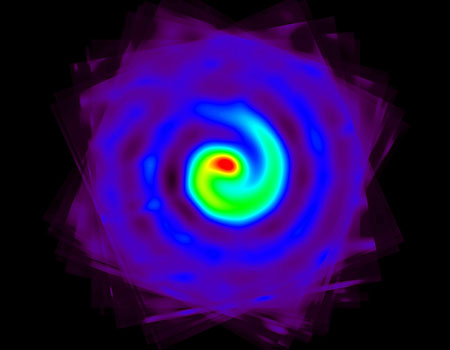
WR104 is the name of a Wolf-Rayet Star that was discovered in 2010 by a team of Australian astronomers. WR104 is near the end of its life, when it will explode in a violent supernova. It is positioned such that Earth may be in danger when it explodes.
“If such a gamma-ray burst happens, we really do not want Earth to be in the way,” he said. “I used to appreciate this spiral just for its beautiful form, but now I can’t help a twinge of feeling that it is uncannily like looking down a rifle barrel.” Peter Tuthill in a recent magazine article .
“We have entered, as I see it, a spiritual limbo. Our educational institutions are no longer the bearers of high culture, and public life has been deliberately moronised. But here and there, sheltered from the noise and glare of the media, the old spiritual forces are at work” Roger Scruton
*****
“When a common culture declines, the ethical life can be sustained and renewed only by a work of the imagination.”-Roger Scruton
*****
“Jesus prayed, “This is eternal life, that they may know You . . .” (John 17:3). The real meaning of eternal life is a life that can face anything it has to face without wavering. If we will take this view, life will become one great romance— a glorious opportunity of seeing wonderful things all the time. God is disciplining us to get us into this central place of power.” Oswald Chambers
*****
“No power on earth or in hell can conquer the Spirit of God in a human spirit, it is an inner unconquerableness.” Oswald Chambers
*****
To those who have had no agony Jesus says, “I have nothing for you; stand on your own feet, square your own shoulders. I have come for the man who knows he has a bigger handful than he can cope with, who knows there are forces he cannot touch; I will do everything for him if he will let Me. Only let a man grant he needs it, and I will do it for him.” The Shadow of an Agony,Oswald Chambers
*****
“If we wish to erect new structures, we must have a definite knowledge of the old foundations.” John Calvin Coolidge
*****
Atheism is a post-Christian phenomenon.
*****
If social justice looks like your hand in someone else’s pocket then you are stealing.
*****
“In Sweden, giving to charity, absurdly, came to be considered a lack of solidarity, since it undermined the need for the welfare state.” – Roland Martinsson
*****
“…to love democracy well, it is necessary to love it moderately.” Alexis de Tocqueville
*****
Capitalism seeks to help others through a servce or product it provides. Free Market Capitalism is the most moral and fair economic system available to man. Capitalism augments personal growth, responsibility and ownership. Charity flourishes under capitalism. Charity dies under subjective “fair share” government confiscatory policies. Socialism redistributes ambivalence and greed.
*****
“We are to regard existence as a raid or great adventure; it is to be judged, therefore, not by what calamities it encounters, but by what flag it follows and what high town it assaults. The most dangerous thing in the world is to be alive; one is always in danger of one’s life. But anyone who shrinks from that is a traitor to the great scheme and experiment of being.” G.K. Chesterton
*****
Any intelligent fool can make things bigger, more complex, and more violent.
It takes a touch of genius – and a lot of courage – to move in the opposite direction. Albert Einstein
*****
“You shall know the truth and the truth shall make you odd.” Flannery O’Connor
*****
“There is but one good; that is God. Everything else is good when it looks to Him and bad when it turns from Him.” C.S. Lewis, The Great Divorce
*****
“Though He slay me, yet will I trust Him” (Job 13:15).
*****
God’s grace is not about the allowance for sin. God’s grace is about the conversation God allows regarding sin.
*****
From the book of Proverbs: We are not to favor the rich or the poor. We are to pursue justice.
*****
“Always keep in contact with those books and those people that enlarge your horizon and make it possible for you to stretch yourself mentally.” Oswald Chambers
*****
One goldfish says to another, “If there is no God who keeps changing the water?”
*****
“The truth is always there in the morning.”
From Cat On A Hot Tin Roof script – playwright Tennessee Williams
*****
God blesses those who hunger and thirst for justice, for they will be satisfied.
*****
“America’s greatness has been the greatness of a free people who shared certain moral commitments. Freedom without moral commitment is aimless and promptly self-destructive.” John W. Gardner
**
“Men of integrity, by their very existence, rekindle the belief that as a people we can live above the level of moral squalor. We need that belief; a cynical community is a corrupt community.” John W. Gardner
*****
“In the world it is called Tolerance, but in hell it is called Despair, the sin that believes in nothing, cares for nothing, seeks to know nothing, interferes with nothing, enjoys nothing, hates nothing, finds purpose in nothing, lives for nothing, and remains alive because there is nothing for which it will die.” Dorothy L. Sayers
*****
“Art, like morality, consists of drawing the line somewhere.”
G. K. Chesterton
*****
“The battle line between good and evil runs through the heart of every man.” Alexander Solzhenitsyn
*****
This is what the LORD says:
“Stand at the crossroads and look;
ask for the ancient paths,
ask where the good way is, and walk in it,
and you will find rest for your souls.
But you said, ‘We will not walk in it.’
-The prophet Jeremiah, 6:16
*****
“…our common task is not so much discovering a truth hiding among contrary viewpoints as it is coming to possess a selfhood that no longer evades and eludes the truth with which it is importunately confronted.” James McClendon, Ethics: Systematic Theology, Vol. 1
*****
























 Cindy Wity