Image Bearers in the Age of Images

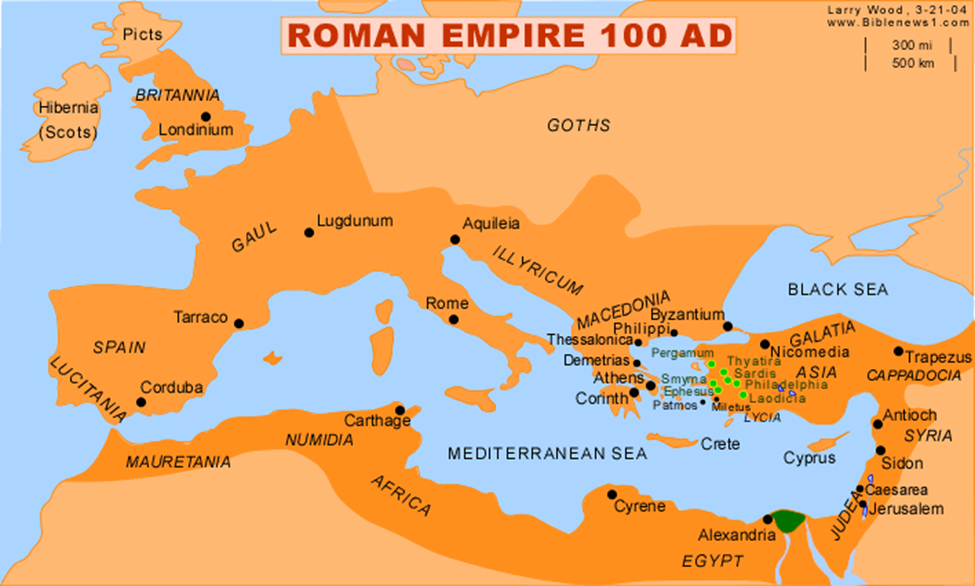
Ephesus, a major seaport on the eastern Mediterranean and the capital of a Roman province in Asia, was a vibrant hub of commerce, and a center of Roman rule and the Roman imperial cult.

Centuries before becoming a political capital, Ephesus was a center of religious activity. Communities of Jesus-followers living in the Greek city of Ephesus at the end of the first century AD would be confronted daily with political and cultic imagery. The city was renowned for its devotion to various gods and goddesses.
Artemis

Christians in that Greco-Roman setting would be well aware of one of the most prominent goddesses: Artemis. Her temple was famous for its great size and for the magnificent works of art that adorned it (See video below.)

The Greek goddess Artemis was worshipped as the goddess of hunting, wild animals, and fertility. Her Roman counterpart was Diana. Goddess Diana shared similar aspects of deity with Artemis. She was worshipped as a benefactress of the countryside and nature, hunters, wildlife, childbirth, crossroads, the night, and the Moon (See video below.)

During his second missionary journey to Ephesus, the Apostle Paul caused a big stir with the Artemis image industry (c. A.D. 52) (Acts 18:19).
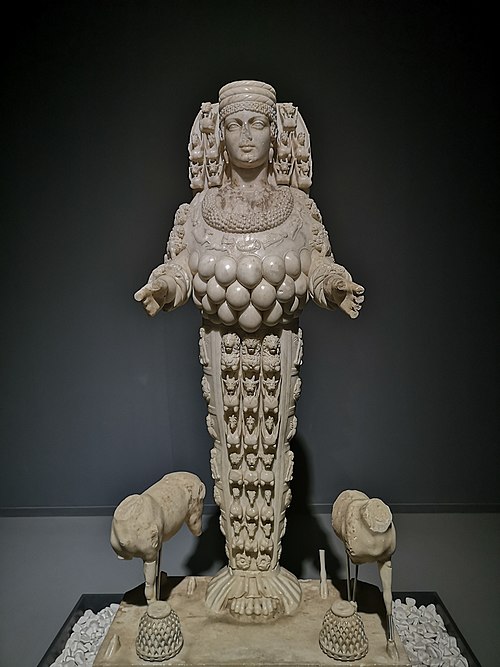
The Lady of Ephesus no 718 1st century AD Ephesus Archaeological Museum

“Around that time there was a major disturbance because of the Way. There was a silversmith called Demetrius who made silver statues of Artemis, which brought the workmen a tidy income. He got them all together, along with other workers in the same business.

“Gentlemen,” he began. “You know that the reason we are doing rather well for ourselves is quite simply this business of ours. And now you see, and hear, that this fellow Paul is going around not only Ephesus but pretty well the whole of Asia, persuading the masses to change their way of life, telling them that gods made with hands are not gods after all! This not only threatens to bring our business into disrepute, but it looks as if it might make people disregard the temple of the great goddess Artemis. Then she – and, after all, the whole of Asia, indeed the whole world worships her! – she might lose her great majesty.” (Acts 19:23-28)

The temple of Artemis was one of the wonders of the world. Its great size and lavish decorations were a major attraction for the many pilgrims and tourists who came to Ephesus. Their Artemis image purchases provided the guild of silversmiths the coin to produce more images and to sustain their livelihoods. After listening to Demetrius, “the whole city was filled with uproar” and people shouted “Great is Ephesian Artemis!”

We read in Acts 19 that the town clerk quieted the crowd. A riot would bring the Roman army down on them. He said, “Citizens of Ephesus, who is there who does not know that the city of the Ephesians is the temple keeper of the great Artemis and of the statue that fell from heaven?”

Nike

Jesus-followers living in Ephesus would also be conscious of ubiquitous images of Nike, a Greek goddess who personified Victory. That Muse website has more about Nike:

“. . .she was almost always represented in Greek art as a beautiful, winged woman. Her main role in life was to fly around battlefields, rewarding victors. The winning soldiers received a wreath of laurel leaves, symbolizing fame and glory. But she also visited and crowned outstanding athletes and heroes.”

In Roman mythology Nike is called Victoria. She is depicted as holding a palm leaf with her right hand while carrying a laurel wreath on the other. She was worshipped by the Roman army as personifying speed, strength, and victory.

Polytheism

The citizens of cosmopolitan Ephesus were polytheistic. It was common for them to add new gods to their personal pantheon. Like with Artemis (Diana) and Nike (Victoria), different gods had different roles.

Polytheism was not a religion with written scriptures. People knew the multiplicity of Greco-Roman deities by their images and myths – their form of theology. Seeing their gods was a way to believe and to practice their contractual religion (do ut des, “I give that you might give”). Offerings and sacrifices were offered to the gods in return for certain favors.

Contrary to the explicit polytheism all around them – pagan temples, pagan priests, pagan priestesses, pagan worshippers and pagan idols – Christians, along with the Jews, were monotheistic. Ephesians tolerated Christians who worshipped a new and different god (except as noted above with Paul) as there were many gods divided up among many peoples. And it seems, at that time, that the Roman government did not yet have a policy of persecution of the Christians; official action was based on the need to maintain good order, not on religious hostility. 

Political and Cultic Imagery

Citizens of this capital of the Roman Empire in Asia Minor would also celebrate and worship deified Emperors who claimed being a divine son of god. Julius Caesar, Augustus, Tiberius, and subsequent Roman emperors were regularly referred to as “son of god” (divi filius). Coins were struck with the imperial image on one side and “son of god” on the other.

The Roman Empire, claiming divine authority on earth, spread its political influence in religious terms using monuments, iconography, myths, and Imperial cult rituals.

Symbolizing victory, Victoria’s (nike’s) image was vital to the Roman military. Her likeness, with crowns, laurel wreaths, or palm branches as victory emblems, was seen on coins, sculptures, and architectural reliefs, triumphal arches, and monuments.

Worship of Victoria was also thought to bring good fortune and help with politics, business, and personal undertakings.

The goddess Artemis had been worshiped for centuries. Her great temple in Ephesus (one of the seven wonders of the world) and the cult of Ephesian Artemis was vitally important to the citizens, as notes N.L. Gill in his post The Cult Statue of Artemis of Ephesus:

“The Ephesians’ goddess was their protector, a goddess of the polis (‘political’), and more. The Ephesians’ history and fate were intertwined with hers, so they raised the funds needed to rebuild their temple and replace their statue of the Ephesian Artemis.”

The Dispatch

Into this political and cultic context at the end of the first century AD, a circular letter was sent around to Jesus-follower communities in and around Ephesus.

1 John is a pastoral letter that presents a no-nonsense counter-cultural narrative. It is full of contrasts: those born of the world and those born of the father, light vs. darkness, truth vs. falsehood, righteousness vs. sin, love of the Father vs. love of the world, and the Spirit of God vs. the spirit of the Antichrist. 

The letter was penned by an eyewitness of gospel events and one who had seen way beyond the images and idols and imperial power of Rome. 1 John is a rebuke to the claims of the Antimessiahs and to the appeal of a pagan culture. It also provided spiritual reinforcement for the letter’s recipients.

1 John was most likely written by John the Elder (and not John the son of Zebedee and one of the Twelve; more below) around 90 AD during the reign of Domitian (81-96 A.D.). (Domitian believed in the divine nature of his rule, aligning himself with the lineage of the first Roman emperor Augustus. He saw himself as an absolute ruler and took pride in being called master or god: “dominus et deus.”)

John opens his letter, not with the typical (“grace and peace”) greeting, but with an authoritative “we” reassurance of his and other’s experience of Jesus, the son of God. He speaks in terms of visual, aural, and physical contact with the Messiah. This is crucial for what he writes against the “Antimessiahs”.

“That which was from the beginning, which we have heard, which we have seen with our eyes, which we have gazed at, and our hands have handled – concerning the Word of Life!” That life was displayed, and we have seen it, and bear witness, and we announce to you the life of God’s coming age, which was with the father and was displayed to us. That which we have seen and heard we announce to you too, so that you also may have fellowship with us. And our fellowship is with the father, and with his son Jesus the Messiah. We are writing these things so that our joy may be complete.” (1 John 1: 1-4)

John the Elder closes the circle of the fellowship of the joy bound by linking those (“we”) who were physically present with the Messiah with the Ephesian Christians who heard the gospel message and believed that Jesus is the Messiah, so that “our joy may be complete.”

(NB: The “joy” talked about here is not the DNC slogan “Joy”– a cover for the Harris cackle. Rather, John’s “our joy” completed would be the satisfaction of a deep yearning by the “we” for the readers to believe that Jesus is the son of God and the Messiah and for them to be included in the dancing embrace of the father, son and spirit.)

John then writes in terms of the associative “we” about what it means for followers of Jesus to have fellowship with him: we are not to deceive ourselves about our sin, we keep the Lord’s commandments and we show rightly ordered love. (1 John 1: 6 – 2:11).

Conflict Within and Without

The letter’s opening brings to the fore one of the main purposes of the letter: to reaffirm that Jesus, the son of God and the Christ, (mentioned some 24 times in the letter) did have a real body and not, as some were saying, that Jesus only seemed to be human, and that his human form was an illusion (Docetism). This thinking had come into Ephesian churches.

Stephen Bedard writes at the History of Christianity:

“Docetism was a doctrine in the early years of the Christian church that claimed that Jesus didn’t have a physical body. The name comes from the Greek dókēsis which means “to seem.” It refers to the belief that Jesus only seemed to have a physical body. . .

“It was understood that mind/spirit was good and body was bad. Since Jesus is good, he must be all spirit and not body at all. In modern language, Jesus was almost a hologram. He looked perfectly human but underneath the image, there was no muscle or bone.”

Those worshipping images would not believe that a god would come down and dwell in the flesh. They believed the gods stayed up and away from humans and did their own thing. Intellectual sorts, who were anti-incarnation, unethical, and loveless Gnostics, were deceiving Ephesian Christians (1 John 2:26).

John presented truth tests to discern whether they were false teachers. Anyone who denied that Jesus is the Messiah was not from God (1 John 4:2-3). They were a “liar” and an “Antimessiah” (1 John 2:22).

He writes about “the spirit of truth” and the spirit of error (1 John 4:6). And, that “many false prophets have gone out into the world” (1 John 4:1). “They went out from among us, but they were not really of our number” (1 John 2:19)

Denying that Jesus was the Messiah, the Antimessiahs split off from the church community. They didn’t accept Scripture’s references about Jesus or the testimony of eyewitnesses. (They were revisionist historians who, like many in Progressive churches today, homed in on his sayings. They think of Jesus in terms of being a fellow traveler who imparted esoteric truths.) Whatever love or joy the Antimessiahs had went with them when they left the church.

In his second letter, John echoes this warning: “Many deceivers, you see, have gone out into the world. These are people who do not admit that Jesus is the Messiah has come in the flesh. Such a person is the Deceiver – the Antimessiah!” (2 John 2:7)

(Ongoing conflict: Earlier (c. A.D. 52), Priscilla and Aquila, who had come to Ephesus with Paul, instructed a Jew named Apollos in the way of the Lord. Apollos then “vigorously refuted his Jewish opponents in public debate, proving from the Scriptures that Jesus was the Messiah. (Acts 18:28))

Beside the conflict within the local churches, there was the ever-present Roman Empire that expected worship of the emperor. John writing over and over that Jesus is the son of God (and not the emperor) put the Christians in direct opposition to Rome. But it seems that, at that time, Rome was somewhat lax about forcing the Jews and Christians to burn incense for the emperor. If these two groups did disturb Rome’s Pax Romana, they would be dealt with.

 (Calling Jesus “Lord” and having a “kingdom of God” message also conflicted with the Roman empire’s ‘divine’ prerogatives.)

Living as a Conquering Contradiction

As mentioned above, imperial Rome spread political propaganda through religion. And throughout Ephesus there would be visual representations of Roman conquest and power: grand architecture and monuments, centurions and soldiers all around, and the conquering, overcoming, prevailing, subduing, obtaining victory, Nike/Victoria images around the city and on coins.

Perhaps, with all of these images in mind, John the Elder writes:

“. . . everything fathered by God conquers the world. This is the victory (nike, νίκη) that conquers the world: our faith. (1 John 5:4):

Conquering Attitude

We, the “fathered by God” no longer continue sinning (1 John 3: 9; 5:18).

Because we are “fathered by God” we understand that we are God’s children (1 John 3: 1) and that loving one another is a character trait of all who know the father (1 John 4:7).

And because we are “fathered by God” and “God is love” (1 John 4:7-12), we as his children need not live in fear like the pagans who look to capricious gods and superstitious practices and the Roman state for understanding and favor. (Sounds like Progressives today.)

We understand that “the one in you is greater than the one who is in the world” (the Antimessiah) (1 John 4:4).

We believe that Jesus the Messiah has been fathered by God (1 John 5: 1), (The center of Christianity is the Incarnation of Jesus, God becoming flesh and dwelling among humanity. John railed against the Antimessiahs because he and others had witnessed the flesh and blood presence and power of the true Messiah. Jesus wasn’t some esoteric figure floating in the air. He wasn’t a statue or icon of a god. Jesus, son of God, Messiah, was “displayed” to John and others as a new way of being human.)

We understand that “we are from God, and the whole world is under the power of evil one” (1 John 5:19) (As Paul wrote to the Ephesian church some 30-40 years before:

“For our struggle is not against flesh and blood, but against the rulers, against the authorities, against the powers of this dark world and against the spiritual forces of evil in the heavenly realms.” – Ephesians 6:12)

As the letter comes to a close, John reemphasizes his message:

We know that the son of God has come and given us understanding so that we know the truth. And we are in the truth, in his son Jesus the Messiah. This is the true God; this is the life of the age to come. (1 John 5:20-21).

The letter of 1 John ends with a succinct pastoral exhortation based on what was said at the beginning of the letter about the reality of what John and others had witnessed: “keep yourself from idols.”

Christians are not to get involved with unreality. They are not to collude with evil. Early Christians believed that idol worship in its various forms was used by demonic forces. The Apostle Paul in 1 Corinthians 10:21–22:

“You cannot drink the cup of the Lord and the cup of demons. You cannot partake of the table of the Lord and the table of demons. Or are we provoking the Lord to jealousy? Are we stronger than he?”

Those of us born of the father live in the tension of contrasts: light vs. dark, truth vs. falsehood, righteousness vs. sin, love of the Father vs. love of the world, and the Spirit of God vs. the spirit of the Antimessiahs. We are to overcome that tension with the reality of Jesus, son of God and Messiah.

I see tremendous forces (DEI, ESG, LGBTQ, Critical Race theory, WEF, WHO, Globalism, etc.) at work to conform everyone into a monolithic unity of enforced pluralism subject to one Satanic Beast. Those who confess loyalty to the Beast will find it easier to get a job, move up, gain tenure and more. Those who don’t will be called “weird” and sacrificed to the Beast.

In the milieu of this sociocultural pluralism, it would be quite easy to glide into a religious pluralism and end up worshipping the vaunted images of the world and rage against those who don’t – “Great is Ephesian Artemis!”

And, with the multiplicity of political and cultic images generated daily to influence behavior, it would be quite easy to glide into a religious pluralism so as to be accepted, to have “likes” and clicks and to avoid the pressure being applied by the culture. One would thus end up having a form of godliness (virtue signaling) but denying its power (2 Timothy 3:5). Neither John the Elder nor I want anything to do with such people.

For those who question the uniqueness or claims of Christian faith, John’s letter with truth tests would be in order.

Not longer just image bearers of the One True God, we are more: overcoming image bearers of Jesus, the son of God, Messiah, and Lord.

~~~~

This circular pastoral letter was most likely written by John the Elder and not John the son of Zebedee, one of the Twelve. John was from an aristocratic family in Jerusalem and a member of the High Priest’s family.

According to Polycrates, bishop of Ephesus late in the second century, John (the Elder), “who leaned back on the Lord’s breast,” was a (Jewish high) “priest” (who had officiated in the Jerusalem temple early in his life), a “witness”, and a “teacher” (Eusebius, Hist. Eccl. 5.24.2-7). (cf. Acts 4:6 & John 18:15, John’s record of Jesus’ high priestly intercessory prayer in John 17, and his courtyard access John 18:15).

John the Elder was most likely the Beloved disciple who was mentioned in John 21: 20-23. Because of his proximity to Jesus, John the Elder was an eyewitness of the events of gospel history. He was at Jesus’ crucifixion and given charge over Mary. He eventually brought her with him to Ephesus.

“When Jesus saw his mother there, and the disciple whom he loved standing nearby, he said to her, ‘Woman, here is your son,’ and to the disciple, ‘Here is your mother.’ From that time on, this disciple took her into his home.” (John 19:26-27)

Several years younger than the Twelve Apostles, John the Elder survived most of them. It seems that he lived into the reign of Trajan (AD 98-117) as prominent Christian teacher in Asia. (We don’t know why he is called John the Elder. “Elder” may refer to John’s old age (Likely 80-90 years old at the end of the first century) more than an honorific. He writes to his “little children” in his letters.

John the Elder most likely wrote the Gospel of John and the three Johannine letters – 1, 2 & 3 John.

~~~~~

What would Ancient Ephesus have looked like? (city that once housed an ancient wonder of the world) (youtube.com)

Temple of Artemis at Ephesus – Sanctuary of the Ephesian Diana (learning-history.com)

Greek Mythology Explained | Artemis: Goddess of the Hunt | Miscellaneous Myths (youtube.com)

~~~~~

Within days, global elitists will try to put world government on steroids. The perpetrators don’t want us to know it, but that’s the purpose of the upcoming “Summit of the Future” and the accord it is supposed to adopt, dubbed the “Pact for the Future.”

Rather than openly doing so by voting to revise the United Nations Charter, the idea is to launch a “process” to be conducted largely behind closed doors. The UN’s Secretary-General and former president of the Socialist International, Antonio Guterres, however, has let slip that process’ goal – namely, granting him authority unilaterally to declare and dictate the responses to emergencies caused by any of a number of so-called “complex global shocks.”

Read the UN document here>>>> “Pact for the Future” – The Socialist Manifesto (malone.news)

Contact your representatives!!

Take action here>>> THE U.N. IS NOT A WORLD GOVERNMENT – KEEP IT THAT WAY! | AlignAct

9-11-2024:

HOUSE TO VOTE TO ENSURE SENATE VOTES ON W.H.O. TYRANNY; IT MUST DO THE SAME ON THE U.N.’S NEXT (substack.com)

Globalist Ambitions at the U.N.’s Summit of the Future (rumble.com)

BRIEFING: Globalist Ambitions at the U.N.’s Summit of the Future – Sovereignty Coalition

~~~~~

My sister sent me this video. I agree with Hamrick:

Church, Unite for the Soul of America! | Ezekiel 33:1-5 | Gary Hamrick (youtube.com)

I get the sense that there are Christians who want to hurry off to heaven. They believe that there will be a rapture and they will be taken away from the trouble on earth and therefore voting doesn’t matter. Understand, there will be NO rapture. That is a misinterpretation of Scripture. Go vote!!

~~~~~

Nicole Shanahan on X: “Who really are the MAGA People? https://t.co/Zk6rvijCge” / X

~~~~~~

In late August officials [of China’s Communist Party] published regulations for dealing with them [the corrupt, criminal and disloyal], too. The aim is to reform or expel people who show a “lack of revolutionary spirit” . . .

Religious members are seen as another problem. Newbies must swear that they are atheist. But many still harbour beliefs in the supernatural. . . According to the regulations, religious folk should be given a chance to renounce their beliefs—and kicked out if they do not.

How to get kicked out of China’s Communist Party (archive.is)

~~~~~

Contentious Culture Wars in a Polarized Political Age: A Conversation with Sociologist James Davison Hunter

Contentious Culture Wars in a Political Age: A Conversation with Sociologist James Davison Hunter (youtube.com)

Contentious Culture Wars in a Polarized Political Age

Contentious Culture Wars in a Polarized Political Age: A Conversation with Sociologist James Davison Hunter – AlbertMohler.com

~~~~~


[i] Bauckham, R. (1993/2018). The theology of the Book of Revelation. PP 88-89

https://doi.org/10.1017/cbo9780511819858

Astonished and Afraid and the Hand of God

There are many who say, “O that we might see some good!
    Let the light of your face shine on us, O Lord!” Psalm 4: 6

The day came when Jesus arrived at a synagogue in Capernaum with a small group of swarthy fishermen. The leader of the synagogue asked the newcomer to speak to the gathered. The reaction of those assembled is recorded in the gospel according to Mark (1: 22).

They were astonished at his teaching. He wasn’t like the legal teachers; he said things on his own authority.

The hearers were εξεπλησσοντο – astounded, amazed, struck out of their wits, and were being knocked out. No second or third-hand hearsay accounts from Jesus.

Continuing the valid data stream (ευαγγελιου: Mk.1:1) begun of Peter’s eyewitness account of Jesus the Messiah, God’s son, Mark reports (Mk. 1:23-26):

All at once, in their synagogue, there was a man with an unclean spirit.

(You will read in Mark’s gospel account that the presence of Truth, very Truth, causes vile things to come crawling out of the woodwork and be exposed for what they are.)

All at once . . .” What business have you got with us, Jesus of Nazareth?” he yelled. “Have you come to destroy us? I know who you are: you’re God’s Holy One!”

“Be quiet!” ordered Jesus. “And come out of him!”

The unclean spirit convulsed the man, gave a great shout, and came out of him. Everyone was astonished.

Those in attendance were awe-struck not just by word but also by deed – the exorcism.

“What’s this?” they started to say to each other. “New teaching – with real authority! He even tells the unclean spirits what to do, and they do it!”

In chapter two of Mark’s narration (Mk. 2: 3-12) Mark reports the reaction of another gathered group to the healing of a paralyzed man. You know the story?

After ministering to people in the open country – the crowds were becoming massive – Jesus returned to Capernaum. When word got around that Jesus was at home, a large crowd gathered once more with the result that people couldn’t even get near the door as he was telling them the message – God’s kingdom was arriving.

Four people arrive carrying a paralytic on a stretcher. They can’t get near Jesus because of the crowd. So, with know-how and dogged determination to bring about the restoration of one of their community, the four neighbors create Plan B: open up the roof and lower the stretcher. (NB: The men didn’t lower their expectations. Their faith finds a way to place their ‘concern’ into the hands of God.)

Jesus saw their faith, and said to the paralyzed man, “Child, your sins are forgiven!”

Legal experts, who were among those gathered in the house, were likely there to investigate “mis-information”. Notice their reaction in the presence of True Authority.

“Who does this guy think he is. It’s blasphemy! Who can forgive sins except God?”

Jesus, knowing in his spirit that thoughts like this were in the air, poses a question to everyone’s Who does this guy think he is question.

“Is it easier to say to this cripple ‘Your sins are forgiven,’ or to say, ‘Get up, pick up your stretcher, and walk’?

“You want to know that the son of man has authority on earth to forgive sins?”

Not just by the word of forgiveness but also by deed, Jesus turns to the paralytic and tells him to Get up, take up your stretcher, and go home.

The man got up, picked up his stretcher in a flash and went out before all of them.

Everyone was astonished, and they praised God. “We’ve never seen anything like this!” they said.

The authority by which Jesus forgave the man’s sins and then raised him up to new life amazed the people who witnessed it all. They had never visualized that this would happen – We never saw it on this fashion. They were so filled with awe, in fact, that they began to glorify (δοξάζειν, doxa) God, reimagining what it meant for God to dwell with man in his temple on earth. Themes of redemption, restoration, and resurrection were invoked that day when the hand of God reached from Scripture into their lives:

Bless the Lord, O my soul,
    and do not forget all his benefits—
 who forgives all your iniquity,
    who heals all your diseases,
 who redeems your life from the Pit,
    who crowns you with steadfast love and mercy,
 who satisfies you with good as long as you live
[a]
    so that your youth is renewed like the eagle’s.

Not everyone’s reaction, though, was recorded by Mark. That reporting would take up volumes. No doubt, though, that the four men who carried the stretcher were relieved of their burden and went back to their community to rejoice with the healed man.

Let’s go on to reactions of fear, as recorded in Mark (chapters 4 & 5).

In chapter four we read about Jesus teaching a massive crowd as he stands on a boat just off shore. The evening of that same day, Jesus and the disciples sail over the sea to the land of the Gerasene’s.

Chapter five records Jesus encountering a man with an unclean spirit – a “Legion” of unclean spirits. The man’s brutish behavior undoubtedly frightened the people living in that area. They tried to restrain him but without luck.

Well, in between the off-shore teaching and reaching the far shore where the untethered demon-possessed man lived, a big wind storm blew up. The boats that Jesus and his followers sailed in began to fill with water. Jesus, according to Mark’s/Peter’s account (Mk. 4:38), was asleep on a cushion in the stern. (I would have no doubt that standing in the hot sun on a boat projecting your voice for hours would exhaust anyone.) They wake him up.

He got up, scolded the wind, and said to the sea, “Silence! Shut up!”

The wind died and there was a flat calm. Then he said to them, “Why are you scared? Don’t you believe yet?”

Great fear stole over them. “Who is this?” they said to each other. “Even the wind and the sea do what he says!”

Terror gripped the disciples. They were in the presence of . . . who? It appears that their reaction indicates a petrifying reimagining of Jesus as God with us.

The disciples certainly had been taught in synagogue to fear God (Deut. 10: 12-13). It appears that their reaction also indicates a reimagining of what it means to fear God – not just holding ultimate respect for God but also holding onto the reality of his sovereign power over all creation. They undoubtedly knew of God holding back the Red Sea so Israel could cross over and escape the Egyptian army. Now this! Right in front of their eyes!

Their fear would become a proper φοβος (phobos) or phobia and not an irrational phobia, of say, pagans. The disciples had seen God and lived to tell.

Fear abounds in Mark chapter five when Jesus does what no one had the ability to do: tie up the “strong man” and plunder his house (Mk. 3: 27). Jesus exorcises the man with the “legion” and commands the unclean spirits to enter a herd of pigs per the request of the spirits. The spirits didn’t want to leave the country. (My guess: the unclean spirits were given territory to control by the Satan.)

The herd of about two-thousand pigs rushing into the sea and drowning caused a panic.

The herdsman fled. They told it in the town, they told it in the countryside, and people came to see what had happened. They came to Jesus: and there they saw the man who had been demon-possessed, who had the “legion,” seated, clothed and stone-cold sober. They were afraid. The people who had seen it all told them what had happened to the man – and to the pigs. And they began to beg Jesus to leave their district.

The unknown and uncontrollable had happened. Folks were awe-struck, gob-smacked, and beside themselves with fear.

We then read that Jesus got back into the boat and the recovered soul asked to go with him. Jesus wouldn’t let him.

Go back home,” he said, “Go to your people and tell them what the Lord has done for you. Tell them how he had pity on you.”

He went off and began to announce in the Ten Towns what Jesus had done for him. Everyone was astonished.

All men did marvel. And it could be said – as taken from the Greek wording – that people in the brief accounts mentioned were astounded, amazed, awe struck, put out of place, knocked out and beside themselves with fear. The hand of God will do that.

****

Tell me. What blows you away? Announcement of a new iPhone? A blockbuster sale? A blockbuster movie? Is it the computer-generated imagery (CGI) that Hollywood keeps cranking out? CGI has never block-busted me, not even fantastical sci-fi smash hits. I don’t marvel at Marvel comics on the big-screen. What’s to believe about what it offers? People in funny costumes role playing about saving the earth from made up monsters? (It unsettles me when I hear grown men talking about Star Wars and Spiderman movies. Ant Man?!)

What causes you to be afraid? It could be any number of things.

The hand of God may astonish you and make you wondrously afraid. Any fear should not be to the point of begging Jesus to leave, as the account above details. One of scripture’s most repeated commands is “Fear not”.

Ask Jesus to heal your imagination so that you will see the hand of God at work in your life. Then let the hand of God astonish you and make you reverently afraid. You will come to REAL-ize that you are I am fearfully and wonderfully made.

*****

Personal note: Shane (1953) is my favorite western. No CGI used. No PC. No soy boys involved. Just homesteaders in Wyoming territory defending their homes and farms against a bully named Ryker.

Ryker claims ownership and rights to the range. He ultimately brings in a hired gun to deal with the homesteaders and the mysterious Shane, a hired hand on a homestead.

The parallels to the abuse of power today are striking.

*****

*****

Special request: Congress members, including Nancy Pelosi and Lindsey Graham, should be made to take sobriety tests before they deliberate, pass laws and speak to the public in their capacity as congressional representatives.

*****

One can pretty much tell what the media wants you to focus on by the changing yards signs of the virtue signalers in your neighborhood. Around me the signs have changed from . . .

TO

Informed dissent:

Dr. Malone describes ‘pattern of unusual Covid cancers’… – CITIZEN FREE PRESS

Dr. Malone describes ‘pattern of unusual Covid cancers’… – CITIZEN FREE PRESS

(READ) Pilots sue CDC to block mask mandates on federal transportation | Sharyl Attkisson

45,500 Rapid COVID Tests Recalled – “High Number Of False Positive Reports” (thegatewaypundit.com)

What the Left brings to bear:

National Center for Missing and Exploited Children Reports 35 Percent Increase in Child Pornography From 2020 to 2021 (thegatewaypundit.com)

Power is in Tearing Human Minds to Pieces (substack.com)

Reflections on Separate and Not Equal


 For although they knew God, they neither glorified him as God nor gave thanks to him, but their thinking became futile and their foolish hearts were darkened.  Although they claimed to be wise, they became fools  and exchanged the glory of the immortal God for images made to look like a mortal human being and birds and animals and reptiles. Romans 1: 21-23


How do you view God? One’s view of God is critical to one’s image-bearing reflection of God. Holding and acting on a proper pan-Scriptural view of God one can reflect the nature and glory of God in one’s humanity. Holding and acting on a low or inadequate view of God will result in a reflection of a baser, beastly, and barbarous nature. There are plenty of examples of the latter.

If a person says there is no god, then that downward blank stare is reflected back as a life devoid of the transcendent. This person’s life lacks meaning and purpose that God has provided (Col. 1:16). This person’s life is full of questions and no answers. This person’s life demands control of outcomes. This person may become suicidal.

If a person says God is a female, then what is reflected back is a person’s belief that God’s self-revelation to us as Father, Son and Spirit is male privileged and not ‘inclusive’. Therefore, God must be ‘repackaged’ as humanized, feminized, and popularized for the masses. Those with this view of God have determined that God must not be separate and must be on par with us. These Gnostics ‘know’ what’s best.

If a person says God is many, then that person reflects back a dilution of truth in the form of pluralism. Such a person is open to all kinds of error and deception to maintain their ‘inclusive’ view.

If a person says God is distant and not available for comment, then that person reflects back an ‘On the Road’ life: avoiding pain, seeking pleasure, and surrounding themselves with like-minded friends.

These few examples, of course, represent only a sample of the effects of a false image of God. A false, replaced or non-existent image of God will always result in a false, replaced and non-existent humanity. As a comprehensive study of history reveals, a people with dysfunctional views of God can result in barbaric societies. Focusing on these corrupt images means that one cannot reflect back the image of God. And, a false, replaced or non-existent image of God will always result in an egregious beastly rule over oneself and creation. Time will reveal the same truth.

Then God said, “Let us make mankind in our image, in our likeness, so that they may rule over the fish in the sea and the birds in the sky, over the livestock and all the wild animals, and over all the creatures that move along the ground. Genesis 1:26

God let it be known from the start that Idolatry and its images, whether material or projected, is perilous to one’s image bearing reflection of God. The reason: we become like that we worship. Idolatry is worship of a lie. Living out worship of a lie results in a life that is a lie. Idolatry also dehumanizes, since it is a reflection of less than God likeness. Much less. Again, there are myriad examples of this in history and surrounding us today.

Idolatry reduces God to His creation, either as a creature or to an element such as gold. For the idolater, reducing God to a creature or to an element means that God can now be controlled and molded into the image that works for him or her. But it is God who is the Image Grantor and Generator. To make an indelible impression on us, God took created elements – tables of stone – and wrote out, “Thou shalt not make unto thee any graven image“.

Over and over again in Scripture we read that God made it very clear that all focus was to be on Him the Creator. To remove that focus was to bring down His wrath. God is a jealous God.

for the LORD your God, who is among you, is a jealous God and his anger will burn against you, and he will destroy you from the face of the land. Deuteronomy 6:15

Exodus tells the story of Israel’s God removing His people from the false Egyptian gods. And in the desert God lays down the law to tell His people how to be image bearers. As noted above, the Lord God is to be their focus and not idols. And throughout the history of Israel, the Lord reminds His people of the consequences when they change their focus. Later, Israel asked God for a king because their focus was set on other nations. Their first king, Saul, was an ego-centric control freak who turned mad.

Much later, the prophet Isaiah spoke the rebuking words of the Lord to those who took the focus off of Him and focused on themselves:

Woe to those who quarrel with their Maker, those who are nothing but potsherds among the potsherds on the ground. Does the clay say to the potter, ‘What are you making?’ Does your work say, ‘The potter has no hands’? Isaiah 45:9

We become what we worship. I see examples of it every day at the fitness club. Often at the club, two Kim clones work their bodies to create a Kim-sized booty. To paraphrase a bumper sticker, “You can’t take your booty with you”.

Since we are created in God’s image and likeness to have dominion over creation, it is easy for us to assume a self-important stance before God. We are prone to see ourselves as the center of life itself and the Son revolving around us. And, as shown over and over again in the history of mankind, some men and women will convert their ego-centrism into a form of self-divination. These will expect and perhaps demand that others recognize them and even worship them as transcendent or divine. I am talking about those who see themselves as exalted based on power or status or one’s physical appearance. Examples would include Pharaohs, Assyrian Kings, Roman emperors, rulers of nations, heads of state, celebrities, politicians, and superheroes (you worship them with your time and dollars).

What image of God did three exiles have to be able to say “No” to a powerful King? (And, who taught them about a sovereign unseen God who is able to deliver? Who taught them that no other God shall be worshipped?)

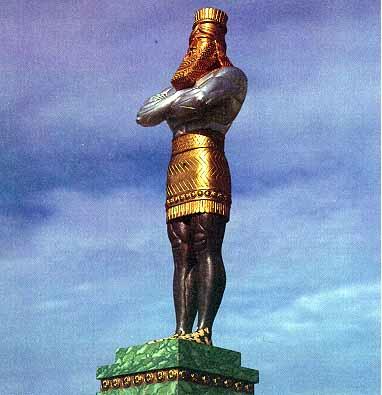
King Nebuchadnezzar made an image of gold, sixty cubits high and six cubits wide, and set it up on the plain of Dura in the province of Babylon. …the herald loudly proclaimed, “Nations and peoples of every language, this is what you are commanded to do:  As soon as you hear the sound of the horn, flute, zither, lyre, harp, pipe and all kinds of music, you must fall down and worship the image of gold that King Nebuchadnezzar has set up.  Whoever does not fall down and worship will immediately be thrown into a blazing furnace.” …you must fall down and worship the image of gold that King Nebuchadnezzar has set up.

But…there are some Jews whom you have set over the affairs of the province of Babylon—Shadrach, Meshach and Abednego—who pay no attention to you, Your Majesty. They neither serve your gods nor worship the image of gold you have set up. Daniel 3

By their continued resistance (The exiles had already made their stance known to the king and to his men), the three exiles made it very clear to king Nebuchadnezzar that their focus was always going to be on the one true God and not on their fate tied to idol worship. What the three exiles said next would have made the King very hot under the collar. The NIV does not translate their words in the Daniel 3:17 text well, especially as it pertains to the King’s earlier glowing acceptance of Daniel’s god after Daniel interpreted the king’s dream (Daniel 2:24). The revised text is in italics:

Shadrach, Meshach and Abednego replied to him, “King Nebuchadnezzar, we do not need to defend ourselves before you in this matter. If our God whom we serve exists he is able to deliver us from the burning fiery furnace and from your hand he will but if not then be it known to you we will not serve your gods anyway. Daniel 3:16-18

The three exiles were not doubting God’s existence. Just the opposite. They were adding fuel to the fire. They made sure that there would be no shadow of doubt in their reflection of the existence of the One True God. Their words turned up the heat. And once their God-reflecting humanity was miraculously delivered unsinged from the beastly hot furnace, the King was left without excuse and with plenty to think about. He could easily imagine his giant golden image melting like wax before the separate and not equal God.


And Hezekiah prayed to the Lord: “Lord, the God of Israel, enthroned between the cherubim, you alone are God over all the kingdoms of the earth. You have made heaven and earth. Give ear, Lord, and hear; open your eyes, Lord, and see; listen to the words Sennacherib has sent to ridicule the living God.

“It is true, Lord, that the Assyrian kings have laid waste these nations and their lands.  They have thrown their gods into the fire and destroyed them, for they were not gods but only wood and stone, fashioned by human hands. Now, Lord our God, deliver us from his hand, so that all the kingdoms of the earth may know that you alone, Lord, are God.” 2 Kings 19 (emphasis mine)

More Than Meets the Ear

“Music exists when rhythmic, melodic or harmonic order is deliberately created, and consciously listened to, and it is only language-using, self-conscious creatures … who are capable of organizing sounds in this way, either when uttering them or when perceiving them. We can hear music in the song of the nightingale, but it is music that no nightingale has heard.” Philosopher Roger Scruton

~~~

Did you know that…

The Kingdom of God is about re-creation?

God can turn our mistakes into passing notes?

Improvisation is the exploration of an occasion?

Jazz is the interplay of order and non-order, of tradition and innovation?

Music reshapes our lives?

Music teaches us delayed gratification?

Hope lives in the midst of delay?

Music has a lot to teach us?

Music can increase empathy?

You can’t demonize those you just made music with?

As a musician for most of my life, I learned about and embraced many of these aspects and applications of music. From the videos below I learned that the Kingdom of God employs music to instruct our souls. Here are three short videos, the first two by Jeremy Begbie. The last video demonstrates the reality of the last question above.

These videos are from a musical point of view. But high culture (good literature, good drama, good art, etc.) can also provide us with many of the same benefits.

Jeremy Begbie is a theologian and professionally trained pianist. Here he demonstrates how music can help unlock the truths of the Christian gospel. Begbie is the Thomas A. Langford Research Professor of Theology at Duke Divinity School.

First, the intersection of theology and music:

Next, Unexpected Intersections:

Last, well, you had better watch…


Wake up, you sleeper!


“So, you should be imitators of God, like dear children. Conduct yourselves in love, just as the Messiah Jesus loved us and gave himself for us, as a sweet-smelling offering and sacrifice to God…

So, don’t get involved in the works of darkness., which all come to nothing. Instead, expose them! The things they do in secret, you see, are shameful even to talk about. But everything becomes visible when it’s exposed to light, since everything is visible in light. That’s why it says:

Wake up, you sleeper!

Rise up from the dead!

The Messiah will shine on you!


-from the Apostle Paul’s circular letter to Laodicea, called The Letter to the Ephesians


https://youtu.be/GYfZbD1_MH4