America Reflagged

A short story . . .

Tom stood watching at the front room window. Moments before, his father was sitting on the couch reading the Chicago Tribune. But then his father put the paper down, got up, walked through the kitchen and down into the basement and then came back upstairs and went out the back door.

Tom put the funnies down, got up off the floor and went to the picture window. His father, in a white tank tee shirt, tan Bermuda shorts, black socks and black street shoes, was in the front yard unfurling the American flag. Then he put the flag’s pole in its holder on the front of the house and took a couple of steps back to look at the flag and at his flagstone-bordered landscaping beneath it.

Tom knew when he woke up that morning that it was Fourth of July. The Ben Franklin store, where he bought his candy, comic books, and baseball cards, had been selling snakes, snaps, and sparklers. And last night neighbors shot off fountains, rockets, and loud firecrackers. He fell asleep with a rotten egg smell coming in through the bedroom window next to his bed.

Tom wanted to see if anyone else was up on the Fourth of July. He ran outside and grabbed his banana bike from the patio. Riding up and down the street he saw no one and no other flags. No one had a flag. Not the Schroeders, not the Selders, not the Millers, not the Capellos, not the Romanos, not the Majewskis, not the Dubickis, not the Ruiz, not the Martínez, not the Clemons. Not anyone. He rode his bike home.

Tom ate the pancakes his father made for breakfast and drank some Tang. He cleared his plate, made his bed, and then raced off on his bike to find a place to watch the Fourth of July parade. He had to hurry. He saw people carrying lawn chairs and blankets.

Tom found a grassy space near a street light. Just in time. The Good Humor truck was passing by. He bought a Creamsicle with his allowance. Not long after, down the street came sirens and drums and beeping clowns in little cars. There were floats, horses, cheerleaders, military units, and marching bands. There were people as far as he could see. When the parade was over Tom rode back home with sticky hands and orange lips.

Tom folded his hands and bowed his head as his mother gave thanks for the dinner father prepared to give mom a break. He finally decided to eat the creamed chipped beef on toast, except for the peas, and one small bite of his mom’s Jello-salad that didn’t contain carrots. Mom said there was watermelon for dessert.

Tom helped his mother with the dinner dishes and then he helped his father carry lawn chairs to the car. His father then drove the family over to Commons Park for the annual Fourth of the July Fireworks Spectacle. Hundreds of people were already there.

Tom asked his father ten times when it would start. His father said, “Be patient, Tom. It needs to be darker.” When Tom asked the eleventh time, a single whistling flare shot up into the sky. Then nothing. Then KA-BOOM! Babies started crying. Tom said “Cool!”

Tom heard a swoosh-swoosh-swoosh. Then nothing. Then KA-BOOM! KA-BOOM! KA-BA-BOOM! The sky lit up with red, white and blue sparkles. Then more swooshes. One colorful burst after another filled the sky. Instant stars twinkled and fluttered down. Some stars trailed off making a loud sizzling noise as they fell to earth, some fanned out like spider legs, some like flowers, and some like waterfalls. Roman candles shot out multi-colored stars, spinners, and comets. Fountain fireworks shot off showers of sparks like a fountain of light.

Tom stared at all this with mouth and eyes wide open. Then things got quiet and Tom asked why. His father said, “I think it’s time for the finale. You’ll know when they shoot off the aerial salutes.” Tom asked about the salutes. His father said “They are shells that contain a large quantity of flash powder. They create a loud bang and a bright flash.” And that’s what happened next.

Tom felt his insides shake when the three salutes announced the finale. Babies cried. Dogs yelped and cowered. Earth and sky were filled with explosions of light and color for the next five minutes. When the Spectacle Finale ended people applauded and headed for their cars.

Tom rubbed his eyes all the way home. The fireworks display had filled them with ash. But when the car pulled into the driveway, he stopped rubbing his eyes to see the flag in the front yard. He tugged on his father’s shirt and said “Dad, we’re the only ones on the street with a flag. I guess some people like parades and the Spectacle but flags not so much.” His father said, “Should we leave the flag out tonight?” Tom replied “Yes.” “Then,” his father said, “help me shine a light on it.” And that’s what Tom did.

Tom lay in bed that night thinking that there should be more days just like this one. He soon fell asleep to the sound of the neighbor’s firecrackers and the smell of rotten eggs coming in his bedroom window.

©Lena Johnson, Kingdom Venturers, 2025, All Rights Reserved

~~~~~

Watch This Before July 4 | Office Hours, Ep. 16

~~~~~

Thirteen Novels Every Conservative Should Read

Host Scot Bertram talks with Ronald J. Pestritto, professor of politics and Charles and Lucia Shipley Chair in the American Constitution at Hillsdale College, about Hillsdale’s new online course, “The Federalist.” 

(@23:19) Christopher Scalia, senior fellow at the American Enterprise Institute, gives a defense of fiction and discusses his new book 13 Novels Conservatives Will Love (but Probably Haven’t Read).

Thirteen Novels Every Conservative Should Read

Thirteen Novels Every Conservative Should Read – The Radio Free Hillsdale Hour – Omny.fm

~~~~~

Preface (to Mark Twain’s Tom Sawyer)

Most of the adventures recorded in this book really occurred; one or two were experiences of my own, the rest those of boys who were schoolmates of mine. Huck Finn is drawn from life; Tom Sawyer also, but not from an individual⁠—he is a combination of the characteristics of three boys whom I knew, and therefore belongs to the composite order of architecture.

The odd superstitions touched upon were all prevalent among children and slaves in the West at the period of this story⁠—that is to say, thirty or forty years ago.

Although my book is intended mainly for the entertainment of boys and girls, I hope it will not be shunned by men and women on that account, for part of my plan has been to try to pleasantly remind adults of what they once were themselves, and of how they felt and thought and talked, and what queer enterprises they sometimes engaged in.

The Author.

Hartford, 1876.

~~~~~

“Who knows, he may grow up to be President someday, unless they hang him first!”
Aunt Polly about Tom Sawyer”
― Samuel Clemmons, The Adventures of Tom Sawyer

The Adventures of Tom Sawyer (Full Audiobook) by Mark Twain

One famous quote from “The Adventures of Tom Sawyer” is: “Right is right, and wrong is wrong, and a body ain’t got no business doing wrong when he ain’t ignorant and knows better.”

~~~~~
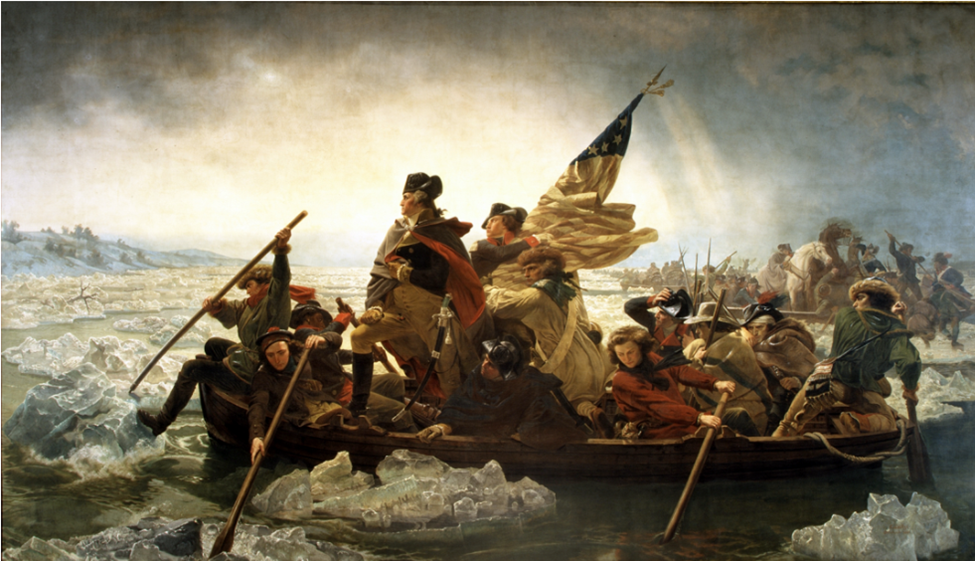
Emanuel Leutze, Washington Crossing the Delaware, 1851, Oil on canvas, The Metropolitan Museum of Art, New York

One Nation Under Children

No, this post isn’t about the current self-aggrandizing, blame shifting, egotistic, inept and jejune regime. But, this post just might lend some insight into the domino effect of immaturity that toppled its way into the White House in 2008. In any case, the topic affects us all…

 In his recent essay “The Kindergarchy: Every Child a Dauphin” Joseph Epstein, observes our current parenting culture through his 70 plus years of perspective as a son, later as parent and also as a teacher at Northwestern University:

  In America we are currently living in a Kindergarchy, under rule by children…For the past thirty years at least, we have been lavishing vast expense and anxiety on our children in ways that are unprecedented in American and perhaps in perhaps any other national life. Such has been the weight of all this concern about children that it has exercised a subtle but pervasive tyranny of its own. This is what I call Kindergarchy: dreary, boring, sadly misguided Kindergarchy.

With its full-court-press attention on children, the Kinderarchy is a radical departure from the ways parents and children viewed on another in earlier days….

 Parents didn’t generally didn’t feel under any obligation to put heavy pressure on their children. Nor, except in odd neurotic cases, did they feel any need to micromanage their lives. My father once told me that he felt his responsibilities extended to caring for the physical well-being of my brother and me, paying for our education, teaching right from wrong, and giving us some general idea about how a man ought to live, but that was pretty much it. Most fathers during this time, my guess is, must have felt the same.”

 One of the direct results of the 1960s was that the culture put a new premium on youthfulness; adulthood, as it had hitherto been perceived, was on the way out, beginning with clothes and ending with personal conduct. Everyone, even people with children and other adult responsibilities, wanted to continue to think of himself as still young, often well into his forties and fifties. One of the consequences of this was that one shied away from the old parental role of authority figure, dealing out rewards and punishments and passing on knowledge, somewhat distant, carefully rationing out intimacy, establishing one’s solidarity and strength. Suddenly parents wanted their children to think of themselves as, if not exactly contemporaries, then as friends, pals, fun people.”  (emphasis mine)

 “On visits to homes of small children, one finds their toys strewn everywhere, their drawings on the refrigerator, television sets turned to their shows. Parents in this context seem less than secondary, little more than indentured servants. Under Kindergarchy, all arrangements are centered on children: their schooling, their lessons, their predilections, their care and feeding and general high maintenance-children are the name of the game.

 No other generation of kids have been so curried and cultivated, so pampered and primed, though primed for what is a bit unclear.


Epstein goes on to note, “The craze of attentiveness hits its most passionate note with schooling, and schooling starts now younger and younger.”… (emphasis mine)

 He also mentions the obsession of child naming and the hesitation or neglect, as I see it, of punishment for bad behavior. Spare the rod and you produce morally meandering Millennials.

 As I have observed and Epstein cites examples in his essay, our current culture is child-centric. It is Disneyland ad infinitum. The altar of childhood is now venerated with sappy-saccharine-syrupy feelings oriented animated movies. And the child-centric unicorn circling dance does not stop with the kids. The parents are on the same carousel standing next to their child.

 The parent’s toys are adult-‘proof’ but they still toys. The movies are just as inane as the children’s movies. They lack maturity and provide no food for thought, no intelligent repast. The “cloud,” the miasma where adult minds linger, offers nothing that is clearly discernable other than adults being totally distracted. Little eyes and ears take notice and also abstract away reality.

 As mentioned above, Epstein brings up child punishment, spanking and time outs. He notes that today’s parents tend to balk at child discipline wanting rather to make each experience a “learning experience.”

 To dote or not to dote, that becomes the question.  As a parent of four children (three are adults), I view today’s parenting as passing through our morally relativistic culture sieve:  the parent would rather not deal with the issue of bad behavior. The parent does not want to bother delineating good and bad behavior; he or she does not want to set boundaries. Instead, they would rather smooth things over, synthesize. They do so in order, I guess, to keep from being judgmental and to stay in the child’s good graces. And, then there is the matter of feelings.

 The child’s ‘delicate’ feelings, feelings most likely viewed through a parent’s projected sentimentality, those feelings would never be questioned by such a partisan parent.  

There are some who would have us believe that the child is always right; a child’s feelings, whether or not his or her motives are, are always pure, clean and off-limits. The questions a parent should ask him or herself are “Are the child’s emotions matching reality?” and “Does my child know what is truly essential, the gravitas of his or her actions and reactions?

“So often in my literature classes students told me what they felt about a novel, or a particular character in a novel. I tried, ever so gently, to tell them that no one cared what they felt; the trick was to discover not one’s feelings but what the author had put into the book, its moral weight and its resultant power….I knew where they came by their sense of their own deep significance and that this sense was utterly false to any conceivable reality. Despite what parents had been telling them from the very outset of their lives, they were not significant. Significance has to be earned, and it is earned only through achievement. Besides, one of the first things that people who really are significant seem to know is that, in the grander scheme, they are themselves really quite insignificant.

Growing up with only minimal attention sharpened this sense of one’s insignificance…”

 The consequences of so many years of endlessly attentive childrearing in young people can also be witnessed in many among them who act as if certain that they are deserving of the interest of the rest of us; they come off as very knowing. Lots of conversations turns out to be chiefly about themselves, and much of it feels as if it formulated to impress some dean of admissions with how very extraordinary they are..” (emphasis mine)

 The essay is found in Joseph Epstein’s collection of essays titled “A Literary Education and Other Essays.”

 There is a lot to be gleaned from Epstein’s observations, much of which is too obvious to spell out here. But, I will spell M-i-l-l-e-n-n-i-a-l-s.


Wisdom is known by her offspring, a tree by its fruit.

You Make Me Feel Like I’m Living a Parent’s Worst Nightmare

The other day I was shopping at a Barnes and Noble Bookstore.  Over in the Music/DVD section I was purchasing the Howard’s End DVD.  As the sale rang up I could hear the high-pitched sound of a young girl’s voice singing behind me. I turned and saw a pre-teen sitting at a music display.  She was wearing headphones and singing quite loudly, oblivious to the people around her.

 My first thought was “I remember doing that. How neat.” But my quickly heart sank when I realized that she was singing the words to Katy Perry’s Teenage Dream:

“Let’s go all the way tonight,

No regrets, just love,

We can dance until we die,

You and I we’ll be young forever.”…


‘We drove to Cali and got drunk on the beach

Got a motel and made a fort out of sheets

I finally found you, my missing puzzle piece

I’m complete…


I’ma get your heart racing in my skin tight jeans

Be your teenage dream tonight

Let you put your hands on me in my skin tight jeans

Be your teenage dream tonight..


You make me feel like I’m living a teenage dream

The way you turn me on, I can’t sleep…

 How does this situation make you feel? Are you outraged or would you just laugh it off?

Have you seen the music video? Do you realize that young children are watching Glee and hearing these words?

 I won’t display the Katy Perry music video.  Here is Darren Criss (Blaine) along with “The Dalton Academy Warblers” singing  all of “Teenage Dream” in Season 2, Episode 6 of Glee titled “Never Been Kissed”.

 http://www.youtube.com/watch?v=wrYRIFjosr4

 The TV program Glee is a type of peer pressure inviting our kids to emulate what is presented each week is it not?  Children want to be in sync with their peers. It is very troubling to see the gift of human sexuality being talked about so cavalierly. I see it portrayed as an extension of the Disney ‘fluff fantasy” characterization of childhood and not as a sacred endowment from a holy God.

 Kids have enough to deal with without the constant barrage of sexual promiscuity and depravity that is promoted by the media.  Letting your child come in contact with this type of overreaching influence is comparable to sexual abuse of a minor. 

 Where are this girl’s parents? Maybe they are in the café drinking coffee, hoping to stave off the night of the teenage dream.