Days of Waiting, Watching, and Waning?
April 4, 2025 Leave a comment
We, a community of those who confess the lordship of Jesus Christ, met on the Lord’s Day to hear again about the Day of the Lord. For us and for Rome, religion and politics are one. Under Roman rule we live with conflicting sovereignties. We met to hear about the ruler of the kings of earth returning to put things right.
We are a house church in Ephesus, a major seaport and capital city in the Roman province of Asia. The city stands at the entrance of a valley that reaches far into the province with highways to other important cities in the region. As a major trade route, Ephesus connects east and west. It also connects travelers with gods and goddesses.
Our city is renowned for the Greek temple devoted to the goddess of fertility Artemis or Diana. Images of Diana, crafted by local artisans and sold in the market place, are a big business. Likenesses of Nike, the Greek goddess of victory, are seen on coins, sculptures, and architectural reliefs, triumphal arches, and monuments. Nike or Victoria is important to the Roman military. She represents speed, strength, and victory – characteristics of Rome’s overwhelming force.
As I said, our city is governed by Rome. Symbols of Roman power are everywhere you turn: statues, iconography, rituals, festivals. Several cohorts of Roman soldiers are stationed here. Our city is a center for the imperial cult.
There are two temples in the city devoted to the worship of the emperor. Images of the emperor, declaring him to be the “son of god”, are on the coins we trade with. Citizens are obligated to pay homage and offer worship to the ‘divine’ emperor. We do not do this, as there is only one divine Lord and ruler of us all. This defiance puts us in constant tension with our overseers.
Our community in Ephesus began when the apostle Paul passed through on his way to Jerusalem. He left with us Aquila and Priscilla, a couple of Jewish tentmakers he worked with and taught in Corinth. They were to teach us the Way of Jesus. Paul promised to come back if he could.
While Paul was away, a Jew named Apollos came to Ephesus. He was a learned man, with a thorough knowledge of the Scriptures. He spoke with great fervor about Jesus and began to speak boldly in the synagogue. He vigorously refuted his Jewish opponents in public debate, proving from the Scriptures that Jesus was the Messiah.
When Priscilla and Aquila heard Apollos speak, they learned that he only knew of the baptism of John. So, they invited him to their home and explained to him the way of God more adequately.
When Paul returned, he asked if we had been baptized in the Holy Spirit. We said no. We hadn’t heard about the Holy Spirit. He then asked into what we were baptized. We told him John’s baptism. He explained that John baptized with the baptism of repentance, telling the people to believe in the one who was to come after him, that is, in Jesus.
We were then baptized in the name of the Lord Jesus. Then Paul had laid his hands on us and the Holy Spirit came upon us. We spoke in tongues and prophesied. Our hearts were filled with love, joy and peace. We shared the Way of Jesus with the Ephesians.
For three months, Paul preached in the synagogues. He spent three months speaking to the established Jewish community. But the Jews were not willing to accept gentiles into their church community. In spite of that resistance, over the next two years Paul baptized Hellenized Jews and gentile converts.
During his stay in Ephesus, Paul performed many miracles and exorcisms. Many in our city renounced their idolatrous ways. They rid themselves of images of Diana. This caused a riot with the craftsmen who made a steady profit from selling them.
The apostle later wrote a letter to our church. He wrote it from a prison in Rome, as Tychicus told us when he delivered the letter and read it to us.
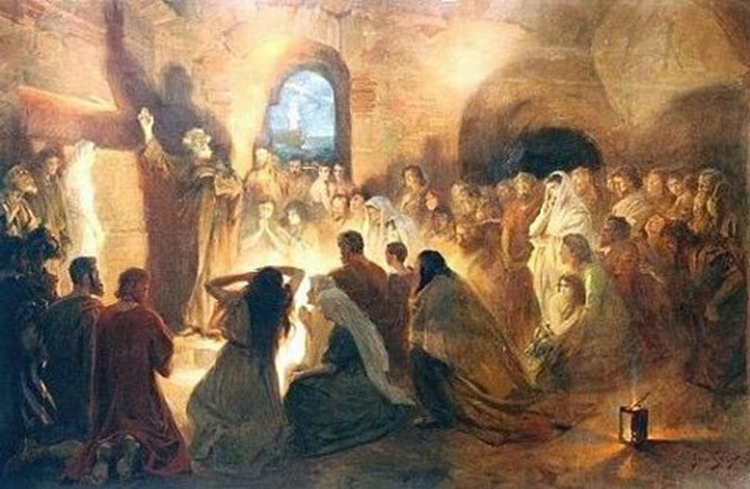
Paul wrote about our redemption and prayed that we would see the hope that we were called to. God, he said, has made known to us the secret of his purpose just as he wanted to be. It was set it forward in Jesus as a blueprint for when the time was ripe. The plan was to sum up the whole cosmos in King Jesus – everything in heaven and earth.
Not long ago we received a letter from John the Elder. John had been a Jewish high priest” who had officiated in the Jerusalem temple early in his life. Because of his proximity to Jesus, John the Elder was an eyewitness of the events surrounding Jesus – his teaching, his miracles, his death, and his resurrection. John was at Jesus’ crucifixion and given charge over Mary. He eventually brought her with him to Ephesus.
In his pastoral letter for the churches in the province, John contrasted those born of the world and those born of the father, light versus darkness, truth versus falsehood, righteousness versus sin, love of the Father versus love of the world, and the Spirit of God versus the spirit of the antichrist
John warned us about antichrists in our community. He said to test the spirits to see if they are from God as many false prophets have gone out into the world. The test: “every spirit that agrees that Jesus the Messiah has come in the flesh is from God, and every spirit that does not confess Jesus is not from God.” These last, he said, are the spirit of the antichrist. We heard that it was coming, and now it is in our midst.
~~~
As is our habit when we meet and share the Lord’s table, we sing psalms and listen to the teachings of Jesus from the elders. We reread pastoral letters sent to us. We hang on every word, as we are a small community surrounded by every kind of darkness.
We also hear the prophets read. As the Jewish believers have told us, the Day of the Lord that brings judgement on the tyrannical rulers and salvation from tyrannical rule has been in the hearts and minds of God’s people for hundreds of years.
And how could it not be when Joel the prophet wrote “Alas for that day! For the day of the Lord is near; it will come like destruction from the Almighty.”
And Amos the prophet wrote “Woe to you who long for the day of the Lord! Why do you long for the day of the Lord? That day will be darkness, not light.”
And Isaiah the prophet wrote “Enter into the rock and hide in the dust from the terror of the Lord, and from the glory of his majesty. The haughty eyes of people shall be brought low, and the pride of everyone shall be humbled; and the Lord alone will be exalted on that day.”
~~~
Recently, I, Dionysius, an elder in our church, received a long letter from the island of Patmos. It was written by John- not John the Elder but John the prophet. John is a common name. I introduced the letter to those gathered:
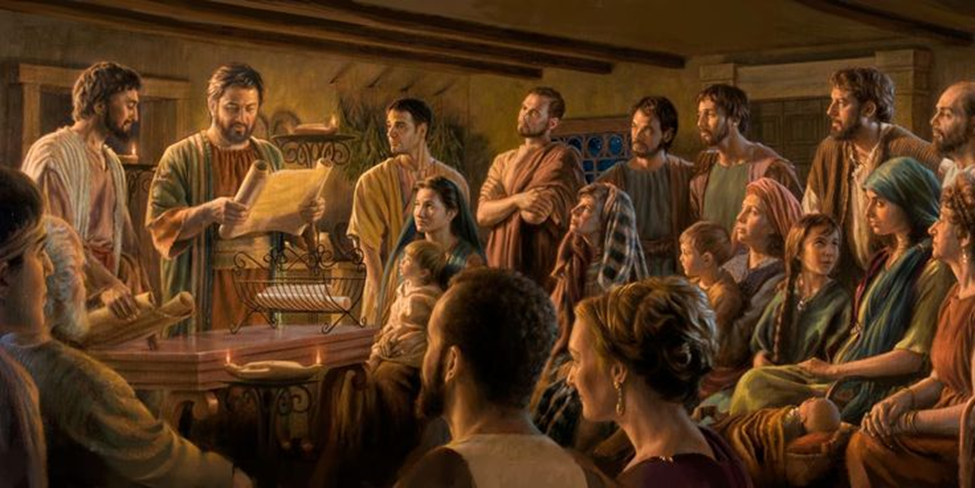
“This letter is sent from John, a brother and partner in our suffering. He received a message from He Who Is and Who Was and Who Is to Come – Jesus, the Messiah, the faithful witness, the firstborn from the dead, and ruler of the kings of the earth. It is addressed to the seven churches in Asia.
“Here is the message to our church here in Ephesus:
“These are the words of the one who holds the seven stars in his right hand, and who walks in among the seven golden lampstands. I know what you have done, your hard labor and patience. I know that you cannot tolerate evil people, and that you have tested those who pass themselves off as apostles, but are not, and you have demonstrated them to be frauds. You have patience, and you have put up with a great deal because of my name, and you haven’t grown weary. I do, however, have one thing against you: you have abandoned the love you showed at the beginning. So remember the place from which you have fallen. Repent, and do the works you did at the beginning. If not – if you don’t repent – I will come and remove your lampstand out of its place. You do, though, have this in your favor: you hate what the Nicolaitans are doing, and I hate it too. Let anyone who has an ear listen to what the spirit is saying to the churches. The tree of life stands in God’s paradise, and I will give to anyone who conquers the right to eat from it.”
This word affected us greatly. Our work and endurance of hope in our Lord Jesus Christ was recognized by him. We did as John the Elder said. We tested and then purged from our midst false prophets and antichrists. We took a stand against the Nicolaitans, idolatrous enemies of God.
But our love, born out of the love with which Christ first loved us and gave himself for us, had become a joyless sense of order. We were going through the motions, like those who worship idols. Over time, the truth worth dying for was not going out to the people Christ died for.
When Paul laid hands on us and we received the holy spirit, we were passionate about the love that brought us in, making us sons and daughters of God. We were passionate about sharing this love with the Ephesians.
I reminded everyone that the apostle Paul had ended his letter to us with “Grace be with all who love our Lord, King Jesus, with a love that never dies!”
Had our waiting and watching, and wanting a reckoning of those who claim ultimate power over us turned us inward and away from the love of Christ for the world?
We needed to reorient our hearts, minds, soul, desires, actions, and pursuits toward our first love, a love not defined by our circumstances but by the love that gave itself up for the world on the cross. If we don’t, our lampstand, our witness, will be removed and we will be like all the other religious practices around us.
As I continued to read the letter, Jewish believers in our community spoke of Daniel’s apocalypse and the coming of “one like the son of man.” Here, John wrote of “one like the son of man” standing in the middle of the seven lampstands and speaking to him.
The letter went on to reveal, as prophecy and apocalypse, a cosmic vision of “what soon must take place.”
With mythical imagery, things on earth – things well known to us – and things in heaven were interacting. What happened on earth affected things in heaven. What happened in heaven affected things on earth.
Imaginations took off as we recognized forces fighting against the true God and his kingdom on earth.
The dragon or serpent we understood as the primeval, supernatural source of all opposition to God. The beast or sea-monster was a deified Roman Emperor using military and political power for tyranny and economic exploitation. The second beast or earth-monster was the promoter of the imperial cult. It set up the image of the emperor to be worshipped and enforced its worship.
Babylon is the city of Rome exploiting the world for economic prosperity. The woman giving birth is Israel. The number of Nero’s name was 666.
The letter also provided counter-images to what we see daily in Ephesus.
God’s holiness is depicted with flashes of lightening, rumbling, peals of thunder, a violent earthquake, huge hailstones, and glory beyond all glory. There are scenes of a tree of life, a glassy sea, new creation, and the New Jerusalem.
Before the return of Christ and the final establishment of His eternal kingdom on earth, the long-prophesied Day of the Lord will bring judgements upon those -the living and the dead -who’ve turned away from God to worship the Beast.
With Seven seals, Seven trumpets, and Seven bowls, God’s wrath is revealed against all those in heaven and on earth who will not acknowledge him as the Sovereign God.
The letter began with Seven golden lampstands. They are the seven churches in Asia – bearers of light in our dark world.
Our prophetic mission here in Ephesus is to witness to the Ephesians and to the world that passes through our city before the terrible Day of the Lord, before “what soon must take place.”
Our witness is to bring about repentance and the conversion of all nations to the worship of the true God. So, we must endure all hardship and persevere to give witness to the truth worth dying for with the same love with which Christ loved us and gave himself up for us as a fragrant offering and sacrifice to God. We must not turn inward.
~~~~~
Eternal Father, strong to save
Eternal Father, strong to save,
whose arm hath bound the restless wave,
who bidd’st the mighty ocean deep
its own appointed limits keep:
O hear us when we cry to thee
for those in peril on the sea.
O Christ, whose voice the waters heard
and hushed their raging at thy word,
who walkedst on the foaming deep,
and calm amid the storm didst sleep;
O hear us when we cry to thee
for those in peril on the sea.
Most Holy Spirit, who didst brood
upon the chaos dark and rude,
and bid its angry tumult cease,
and give, for wild confusion, peace:
O hear us when we cry to thee
for those in peril on the sea.
O Trinity of love and power,
our brethren shield in danger’s hour;
from rock and tempest, fire and foe,
protect them wheresoe’er they go;
thus evermore shall rise to thee
glad hymns of praise from land and sea.
~~~~~
Marxism, Socialism, and Communism: Cultural Marxism
On this episode of The Hillsdale College Online Courses Podcast, Jeremiah and Juan discuss Communism’s transformation into a popular political position in the United States.
In “Marxism, Socialism, and Communism,” professors of history, politics, and economics look at Marx’s life and writings, the misery and brutality in the Soviet Union, the atrocities of communist China, and the proliferation of Cultural Marxism in America. They explore how many ideas animating American politics today are rooted in Marxism, and yet how they differ from Marx’s thought. By taking Marx, Lenin, Stalin, Mao, and the Frankfurt School seriously, we can see the injustice and evil inherent in all strands of Marxism. We also better understand the critiques of communism made by Mises, Hayek, and Solzhenitsyn. We are, therefore, better equipped to defeat it.
Marxism, Socialism, and Communism: Cultural Marxism – Hillsdale College Podcast Network
~~~~~
The Culture of Convenience and Comfort:
What has happened to our ability to sit in discomfort? What has happened to our stamina for life, especially life when it gets hard?
As an employer of more than 350 people over the past decade, I’ve seen a shift in the younger generation. Many don’t seem to know how to tolerate even mild discomfort. There’s a deep urge to escape anything that doesn’t feel good—whether through substances, screens, sugar, or distractions. And I can’t help but trace this trend back to childhood: when we hand kids a screen so we can finish dinner in peace, when we give them sugar to soothe a meltdown, when we teach them—without ever saying it out loud—that the goal is to feel good all the time.
We’ve created a culture that treats discomfort like a pathology. If something is hard, we assume it must be wrong. But that’s not how life works.
Pain, struggle, and uncertainty are baked into the human experience. Maybe it’s not discomfort that’s the problem—but our inability to face it.
Yes, we should limit screen time. Yes, we should cut back on sugar. But more importantly, we need to stop teaching our children that discomfort is something to be avoided at all costs. It’s okay to be bored. It’s okay to be hot, or tired, or challenged. Just because something feels bad doesn’t mean it is bad. Most worthwhile things—motherhood, entrepreneurship, marriage, community, growth—will feel hard at some point. That’s not a flaw. That’s the path.
Are we raising a generation of escape artists, or are we raising people who can stay present through difficulty, learn from it, and grow?
The Epidemic Beneath The Surface: Disconnection, Discomfort, & The Death Of Resilience | ZeroHedge
~~~~~
Brain Rot: What Screens Are Doing to Our Minds (2)
In this second podcast Dr. Karyne Messina, a psychologist, psychoanalyst, author and NBN host discusses the problems the emerge when children watch screens and digital devices too much. Dr. Messina talked about this topic with Dr. Harry Gill, a well-known psychiatrist who also has a PhD. in neuroscience. In this episode the focus was on Erik Eriksson’s 5th stage of development, Industry versus Inferiority. They discussed one of the greatest difficulties they see in their young patients who contend with way too much screen time.
Brain Rot: What Screens Are Doing to Our Minds (2) – New Books Network
~~~~~
The top picture reminds me of the playground I had as a kid:





 Cindy Wity