Rooted and Grounded in Love and Math
October 8, 2023 Leave a comment
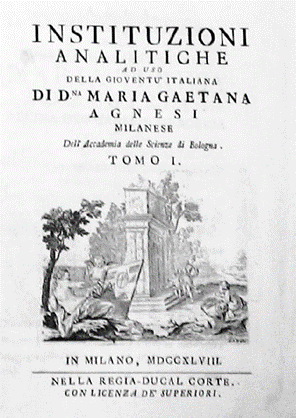
“For if at any time there can be an excuse for the rashness of a Woman who ventures to aspire to the subtleties of a science, which knows no bounds, not even those of infinity itself, it certainly should be at this glorious period, in which a Woman reigns…”—Marian Gaetana Agnesi’s dedication of her book “Analytical Institutions” to Maria Theresa, empress of the Austrian empire, in 1748.
I’m curious. Have you ever come across this woman in all of your school work?
When you studied the “Enlightenment” did you ever hear about this renowned symbol of female intellectual achievement who is considered to be the first woman in the Western world to have achieved a reputation in mathematics?
Have you heard of the first woman to write a mathematics handbook – Analytical Institutions for the Use of Italian Youth – and also the second woman awarded a professorship in mathematics and physics at the University of Bologna after publishing her calculus textbook?
Have you heard of the woman who entertained Holy Roman Emperor Charles VI?
When you studied mathematics was her name mentioned? Did you study the mathematical curve called “The Witch of Agnesi?
Have you heard of this STEM-for-women trailblazer?
Did you ever hear of the pious prodigy known as the “angel of consolation”? Did you ever hear about this devout self-sacrificing Catholic in a sermon or a Sunday School lesson?
Have you heard of this passionate advocate for the education of women and the poor, a woman who believed that the natural sciences and math should play an important role in an educational curriculum and that scientific and mathematical studies be viewed in the larger context of God’s plan for creation?
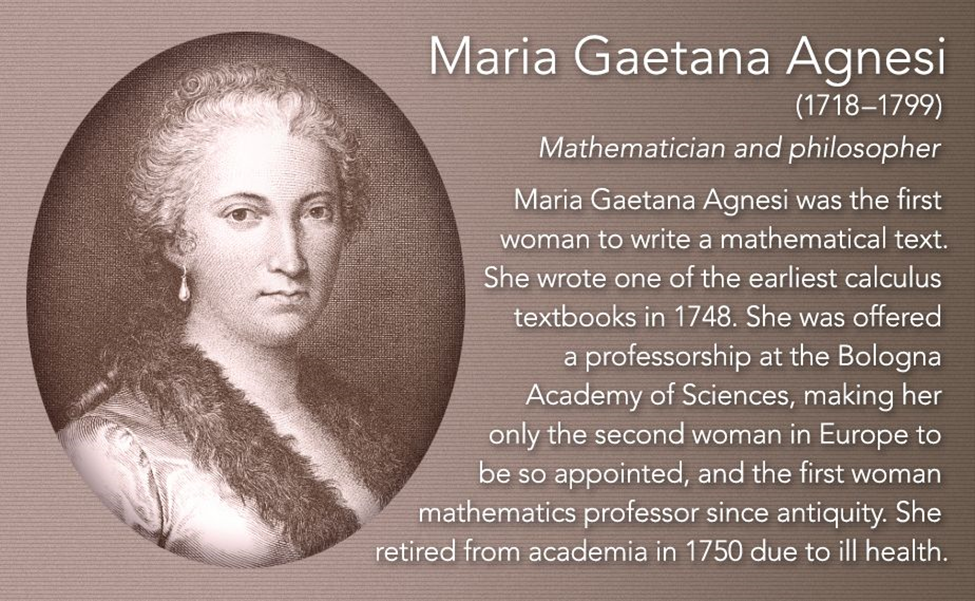
The mathematician and philosopher Maria Gaetana Agnesi was born May 16, 1718 in Milan.
Maria was the eldest child of a wealthy silk merchant and professor of mathematics at the University of Bologna. Her family was recognized as one of the wealthiest in Milan. To encourage his daughter’s interest in scientific matters, her father provided Maria with distinguished professors as her tutors.
An extremely gifted child, at five years of age Maria could speak Italian and French. By her eleventh birthday she had learned Greek, Hebrew, Spanish, German, and Latin. She wasn’t the vaunted and routine “Proverbs 31” woman, a role envisioned by many in the church.
When Agnesi was 9, she recited from memory a Latin oration, likely composed by one of her tutors. The oration decried the widespread prejudice against educating women in the arts and sciences, which had been grounded in the view that a life of managing a household would require no such learning. Agnesi presented a clear and convincing argument that women should be free to pursue any kind of knowledge available to men.
Maria Agnesi, the greatest female mathematician you’ve never heard of (theconversation.com)
Maria’s father Pietro, to elevate his family’s social status, hosted salon gatherings in his home. There the “Seven-Tongued Orator” could display her knowledge of mathematics, philosophy, history, and music in multiple languages. And, her musical prodigy sister Maria Teresa performed for guests, often playing her own compositions. Pietro used his talented daughters to make his house an important stop in Milanese social circles.
Palazzo Agnesi was a cultural salon where Maria could present theses on a variety of subjects and then defend them in academic disputations with leading scholars. Some said “She spoke like an angel.”
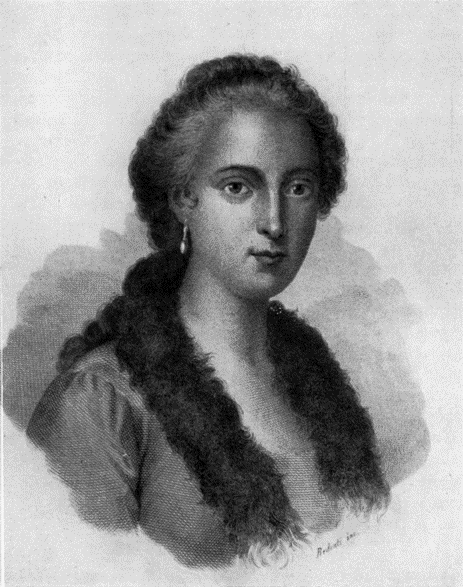
The disputations were conducted in Latin, but during the subsequent discussions a foreigner would usually address Maria in his native tongue and would be answered in that language. The topics on which she presented theses covered a wide range—logic, ontology, mechanics, hydromechanics, elasticity, celestial mechanics and universal gravitation, chemistry, botany, zoology, and mineralogy, among others. Some 190 of the theses she defended appear in the Propositiones philosophicae (1738), her second published work.
Maria Gaetana Agnesi | Encyclopedia.com
Massimo Mazzotti, in his book The World of Maria Gaetana Agnesi, Mathematician of God, calls the salon gatherings a strategy “of fashioning and controlling this phenomenon of the learned woman.”
The shy and introverted Maria, who wanted to be left alone to read books, performed for astonished audiences. But she did so at the expense of her own physical and emotional health, as she had more than performances to care about.
Maria’s mother died in childbirth in 1732. When her father’s second wife died Maria’s public performances were scaled back. At the age of twenty she assumed the management of the household and the education of her many younger siblings (she was the eldest of 21 children, including her half-siblings; her father remarried three times). She also spent time bolstering her own education. Women at that time could not attend school outside the home.
Seven years later Maria told her father that she didn’t want to be a public academic. She wanted to become a nun. Studying theology, she had become strong in her faith and wanted to live it out in a life of service. She desired to live in a semi-convent-like state at home avoiding all secular socializing and devoting herself entirely to the study of mathematics. She wanted to attend church whenever she chose and dress simply.
Her father, not willing to let his child prodigy become a nun, agreed to let Maria live in such a manner studying theology if she were to also continue her research into mathematics. She would be permitted to do all the charity work she wanted. This would be in addition to her performances and lessons, and her responsibility to homeschool her siblings – she wrote curriculum for them.
1740. Maria studies differential and integral calculus with Olivetan monk Ramiro Rampinelli.
In 1748 Maria she publishes a mathematical treatise, Analytical Institutions for the Use of Italian Youth. It is so impressive – regarded by those in the field as the best introduction extant to the works of Euler – that it earns her a professorship in mathematics and physics at the University of Bologna; she becomes only the second woman ever to be awarded such a position.
At the height of her fame, which includes entertaining Holy Roman Emperor Charles VI, Maria becomes physically depleted and severely ill. The relentless schedule of study and public appearances has worn her out.
In 1751, she became ill again and was told not to study by her doctors. After the death of her father in 1752 she carried out a long-cherished purpose by giving herself to the study of theology, and especially of the Fathers and devoted herself to the poor, homeless, and sick, giving away the gifts she had received and begging for money to continue her work with the poor. In 1783, she founded and became the director of the Opera Pia Trivulzio, a home for Milan’s elderly, where she lived as the nuns of the institution did. On 9 January 1799, Maria Agnesi died poor and was buried in a mass grave for the poor with fifteen other bodies.
Maria Gaetana Agnesi – Wikipedia
There is so much that could be said about this amazing woman, a woman of intellect and passion, of science and faith. So, I recommend reading Massimo Mazzotti’s biography: The World of Maria Gaetana Agnesi, Mathematician of God. This would be a good homeschooling text.
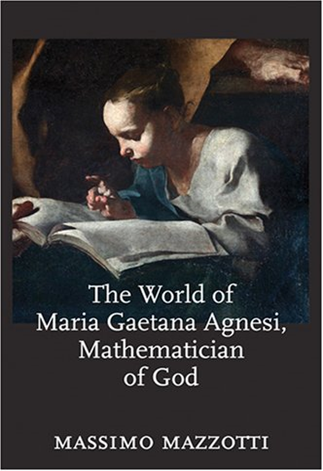
Her attitude, says [Massimo] Mazzotti, was that “intellect was necessary for being a good Christian. If you work on strengthening your intellect, you’re doing a good thing for your spiritual life as well.” In later life, her religious writing turned mystical, but when she was most active in mathematics, her approach to religion was more intellectual and rational. Even as her religious practice became more mystical, however, she still saw intellect and passion as two complementary parts of religious life. “The human mind contemplates [the virtues of Christ] with marvel,” she wrote in an unpublished mystical essay, “the heart imitates them with love.
The 18th-Century Lady Mathematician Who Loved Calculus and God | Science| Smithsonian Magazine
Maria never entered a convent. She never married or had children. With Christ at home in her heart by faith and Maria at home with the “sublime sciences” she was rooted and grounded in both love and math. The desire and direction of her life was in learning and serving. Her brilliant mathematical work seized the world’s attention. And then she gave it all up for a half-century of self-sacrifice.
In her view, human beings are capable of both knowing and loving, and while it is important for the mind to marvel at many truths, it’s ultimately even more important for the heart to be moved by love.
“Man always acts to achieve goals; the goal of the Christian is the glory of God,” she wrote. “I hope my studies have brought glory to God, as there were useful to others, and derived from obedience, because that was my father’s will. Now I have found better ways and means to serve God, and to be useful to others.”
Maria Agnesi, the greatest female mathematician you’ve never heard of (theconversation.com)
~~~~~
A brief intro to Maria Agnesi and the curve called “Witch of Agnesi”:

And a composition of her sister, harpsichordist Maria Teresa Agnesi (1720-1795) – Concerto per il cembalo:
Maria Teresa Agnesi (1720-1795) – Concerto per il cembalo – YouTube
~~~~~
Article References and further reading on Agnesi:
Maria Agnesi, the Greatest Female Mathematician You’ve Never Heard of – Scientific American
Maria Agnesi, the greatest female mathematician you’ve never heard of (theconversation.com)
Agnesi, Maria Gaetana (1718–1799) | Encyclopedia.com
Maria Gaetana Agnesi | Mathematician, Philosopher, Educator | Britannica
Maria Agnesi: Mathematician and Philosopher (thoughtco.com)
The 18th-Century Lady Mathematician Who Loved Calculus and God | Science| Smithsonian Magazine
The Secret Life Of Maria Gaetana Agnesi | NOVA | PBS
The Witch of Agnesi | The Engines of Our Ingenuity (uh.edu)
~~~~~
Women of Faith in Science
“Katey Walter Anthony has done much of her research deep in the arctic, studying the methane bubbles that are released in thawed permafrost lakes. What she has learned helps us to better understand the complexity of earth’s climate and how it might change in the future. But alongside the exciting story of her scientific journey is a story about how she has come to understand God’s place in it all.”
Katey Walter Anthony | Science, Faith & Thermokarst Lakes
Note: “Climate change” messaging is being framed to fit just about everything, including fear. King Charles III even launched a catastrophe countdown clock. “Man-made Climate change” is being attached to all kinds of phenomena.
As you will hear, “Climate change” is brought up by those involved in earth science during the podcast interviews offered by BioLogos, a faith and science foundation.
Science, any science, is on a journey. No one has all the information and facts.
Climate science is NOT settled science. And, anthropogenic global warming is a theory, no matter how many times “consensus” is mentioned to “prove” it to be otherwise. Remember, “consensus” doesn’t mean something is true. It means that some people agree, for whatever reason, on some idea.
In this podcast, it appears that Katey received funding and grants related to finding earth issues that generate “climate change”. Questions to keep in mind: when a person receives funding related to a specific issue, what do you think they will find and write about? And, to receive more funding to continue one’s scientific pursuits, what do you think they will find and write about?
At the end of the interview, Katey offers wisdom: we should use a circumspect approach to dealing and living with the earth and of learning to adapt in our approach to our own lives.
Become informed. Don’t rely on media for knowledge of anything. There are scientific counter-narratives to the inescapable “Climate Change” narrative as there were for the COVID narrative:
Podcasts>>>>Environment and Climate News Podcast on Apple Podcasts
Climate Etc. (judithcurry.com)
Watts Up With That? • The world’s most viewed site on global warming and climate change
~~~~~


 Cindy Wity