Afternoon Aliens

Any exhaustive research into my childhood would reveal several close encounters with aliens.

 You would learn that these encounters occurred primarily on Sunday afternoons but also sometimes on Saturday nights.  You would read that the aliens would slowly pull up in front of my parent’s home and then park right smack in the center of our view, a view framed by our front room picture window. (I wanted to say “frontroom” because it’s the Chicago way.)

 For our family Sunday mornings meant going to church – the hell-fire-and-brimstone-preaching-shouted-from-revved up lungs-quivering jowls-and-leaps and-bounds-of-a-Baptist-minister-kind of church.  Such a fire-breathing monster would let us know in no uncertain terms that redemption came only by turning from our sins and by walking down the aisle or raising our hand. I did wonder why he didn’t sell exercise videos out in the foyer – “Pilate Your Way Out of Purgatory:  Fit and Fundamental Workouts.”

 Now my mom and dad are God-fearing people who have always been very hospitable. Often, after a Sunday morning service or an evening service, my folks would invite friends, speakers, missionaries or relatives over for a meal.  As I said, this happened a lot.

 There were also a few Sundays when my parents decided to have an afternoon home alone with the kids. On those days we would come home from church to the salivating smell of pot roast.  The roast would cook while we sat in church pondering our short comings and our eternities.  The record will show that I had aromatic visions of pot roast as I turned from sin, walked down the aisle and raised my hand. 

 Back at home my mother would take the pot roast out of the oven and cover it with aluminum foil. Apparently the fat needed to rejoin the roast in a final cattle roundup. Mom and dad would then prepare the sides – all kid friendly: corn, mashed potatoes and gravy, rolls.  And, upon occasion my mother would make butterscotch pudding for dessert.  As a devotee of such fine cuisine I sat in the basement far out-of-the-way of the chefs. Down there I watched Warner Oland play Charlie Chan on our B & W TV:  “So sorry.”

 Besides being wafted to Kid Heaven by the smells I knew that my parents were not just making a scrumptious Sunday meal.  They were not going to take any chances with me going far from the straight and narrow.  They knew that the way to tether a kid’s soul and keep him close to home was with pot roast and butterscotch pudding.

 Well, on one of those blissful Sundays when my tummy was ballooned to its fullest pot roast-iest extent I lay on the floor rolling and reading the funny papers.  Nancy and Sluggo. Dick Tracy and Flattop. Brenda Starr and…my brother. 

 Daryl ever the antagonist always wanted to read the same few square inches of the comics that I was reading. I swear.  He would daily invent ways to aggravate me.  That day his pointed elbow to my side almost burst me.  In retaliation I poked him back and then he poked back harder.  This went on for ten minutes until my father said, “You two cut it out or no butterscotch pudding for you.” That settled things for the next five minutes. The thought of Butterscotch pudding had a calming effect on me. An added dollop of whipped cream would also keep me in check – for at least a half-hour.

 It was within the cautious serenity of those five minutes that I saw my father suddenly leap up out of his swivel rocker.  The Chicago Tribune fell to the floor splayed open.  My dad turned to my mother who was sitting on the couch half asleep.  With a look of petrified horror he said, “The Gephardts are here!” That was the day I would have my first sighting of aliens in our own front yard.

 Absolutely beside himself, my dad thought for a moment:  perhaps we could make it look like we weren’t at home.  But then he saw the visitors looking at him through the picture window.  The alien father on the front lawn was yelling “Hi Bob.”   My dad then looked down at his two young children, children who just came home from re-dedicating their lives to Jesus and to pot roast looking up at him.   Instantly changing his mind my dad scrambled in two directions at once.  In the same step he first bolted toward the kitchen but then turned and flew to the back of the house.  Things were put away, hidden from view.  Rooms were “straightened.” Food stowed deep in the refrigerator. Our Schnauzer Bobbie took the cue and hid under my bed whimpering. My brother and I hid all of our toys.  The quiet afternoon had morphed into the afternoon of the living Gephardts.

 Now the Gephardts were good people my folks said, “They’re just a little different.” Yeah, as different as earth and mars I would soon find out.

 After greeting the family of five, my dad said he had to get “some things” at the grocery store.  An hour later my mother looked concerned, abandoned concerned, angry concerned.  As the time crept, my mother sat patiently listening to Mrs. G. wonder out loud if her little “Ronnie was really over the chicken pox.” (I kid, (scratch, scratch) you not.)

My brother and I stood across from the three alien kids, two boys and a girl, and wondered what to do. Mom suggested that we go to a nearby field and play baseball until the FBI had located our father. So off we went.

 I can not recall whether it was my brother or whether it was me who was hit in the head with a baseball bat by a Gephardt boy. It must have been me who received the carom because great a swath of my memory has been forever displaced. The oldest kid swung right though an imaginary fast ball which was in fact my head.  Let the record show that silly remained intact though.  (I have had three concussions in my life:  one from a right-handed batter on sugar, one from a concrete wall that halted my fifty yard dash at 55 yards and one as an adult when a humongous lead pipe-carrying truck used my car as a brake – my head bounced around like a pin ball in a Dukes of Hazzard pinball game. Three concussions may explain my David Lynch-like persona, my dream-state reality and my stuttering posts.)

 At some point my dad came back from the store with a pie, a cherry pie and a can of whipped cream.  He offered to heat it, slice it and even remake it -anything so as to not have to talk to Mr. G who I now know was dead ringer for Randy Quaid.  Mr. G sat in our front room – greasy tee shirt, flys buzzing and all.  The three G kids all could have walked off a page of the Addam’s Family comic strip.  It’s all a blur.  On purpose.

 Mr. G was a junk collector by trade.  He collected “fine” items no longer of use to their owners. He resold his JIT inventory on Maxwell Street. Did we have anything that we didn’t want any more?  I imagined that my father wanted to say “Yes, you here.”  But my dad, a generous and good man, kept to his busy ways and went looking for a ‘fine item” that would spur Mr. G into immediate sales activity.   My dad “sacrificially” retreated to the basement where after a half hour of searching everywhere including a Walter Cronkite newscast he found a lamp on its last light bulb and handed it to Mr. G. who was pleased with his salable good but continued to eye my mom’s china cabinet.  My mother seeing Mr. G’s honed gaze locked onto the china cabinet stood up between Mr. G and the cabinet as she continued to talk to Mrs. G.  The “over-my-dead-body” look must have told Mr. G all he needed to know.  He backed down.

 After some warmed cherry pie and coffee and a shake down of each the kids to see if they had taken anything from our rooms we said goodbye to the G’s and to the afternoon. It was now evening.  Exhausted we all fell back into the couch to watch a “really big shew.”  We had seen the Outer Limits.

 Over time the Gs would show up again and again unannounced.  Somehow we were ever on their radar though my parents only slightly knew them as neighbors at a previous address in Chicago. But finally these afternoon aliens did stop showing up.

 I suspect they stopped coming when our house looked eerily uninhabited:  with all the curtains pulled my dad started taking long Sunday afternoon naps on the couch in the dark, cool basement of our house.  My mom who loved our dad took us three (by now) perturbing kids for a long drive in the country – all of us far from afternoon aliens.

(Any truth in this account, real or perceived, is totally up to you.)

© Sally Paradise, 2012, All Rights Reserved

Crooked Letters Come to Terms Among the Kudzu

Normally I don’t read popular novels but then again I am not normal. I’m usually off on some quirky tangent, perhaps pouncing on the findings of the Higg’s Boson or pondering The Closing of the American Mind (Allan Bloom) or simply playing the role of suburban scofflaw.  But a recent novel’s cover appeared in the periphery of my imagination as I sauntered by a Barnes & Noble’ book table.

 I have long been drawn to the droll humor and sardonic wit of southern writers such as Wendell Berry, Flannery O’Connor, William Gay, Barry Hannah…there are too many to name here.  So it was the name of the author, “Tom Franklin” that pulled me over to the curb, so to speak. 

Tom is a contributor to the Oxford American Magazine, The Southern Magazine of Good Writing to which I subscribe. It was from the In the Best of The South 2012 issue of that same magazine that I learned about Tom Franklin’s “notoriety.”  There, columnist Jack Pendarvis penned “I Don’t Hate it!  Kickin’ it with Kelly Hogan.  In his own tongue-in-cheek jaded way Pendarvis starts:

 “1)  Tom Franklin. Tom Franklin. Tom Franklin. Tom Franklin.  I have three items worthy of the “Best of the South,” and the greatest of these is novelist Tom Franklin.  Really, all of them are Tom Franklin.  As has been pointed out to me by Tom Franklin, Tom Franklin has been present at almost all the events described in this space since the inception of my column.  For example, his wife Beth Ann Fennelly may make a witty quip while Tom stands at some distance away, nodding encouragingly.  It’s true that I mention Beth Ann frequently here, yet never Tom, nor his superlative nodding.  The occasion that seems to bother him most grievously is the time he was driving the car while Beth Ann and I were exchanging our famous witty quips and he was just nodding away to beat the band and nobody cared.”

2)      Testicles. …This guy Andrew Zimmerman blew through town a little while back…I had some yogurt that evening and said to my wife, “Sweetie, you know what this needs?  Testicles!”

“I’ll tell you who else has testicles:  Tom Franklin.”

3)      “…Kelly Hogan…has been a musician most of her life, and her best music is characterized by that mix of sparkle and danger.”


“Crooked Letter, Crooked Letter” is the title of the book I read by Tom Franklin. The story resides mostly around the hamlet of Chabot, Mississippi (are you seeing it?).

 I’m not going to give out a lot of the story. In fact, I’ll just give a line about the characters. I’ll not tell you the ending. You’ll have to read the whodunit yourself.

 Main characters:  Two boys grow up in parallel worlds:  “Scary” Larry Ott (a lover of Stephen King stories, the Night Shift collection in particular) and Silas, later to be known as “Constable” or “32.”

The story delves into friendship, murder and mystery, all offered up with plenty of sensate details doing their Siren’s work – luring the readers into the story and holding them to the end. Here’s one evocative excerpt from Chapter Eight:

“Angie ignored her but started on the food, opening the mustard packets and squeezing them onto her plate for her French fries, chewing her hamburger slowly, sipping her Diet Coke through her straw as Silas told how, at first, he’d been shocked how quiet the woods seemed compared to Chicago, no crowds, car horns, sirens, no el trains clacking by.  But in the woods, if you stopped, if you grew still, you’d hear a whole set of sounds, wind rasping though silhouetted leaves and the cries and chatter of blue jays and brown thrashers and redbirds and sparrows, the calling of crows and hawks, squirrels barking, frogs burping, the far baying of dogs, armadillos snorkeling though dead leaves and dozens of other noises he slowly learned to identify.  He found he’d never seen real darkness, not in the city, but how, if you stood peeing off the cabin porch on a moonless night, or took a walk though the woods where the treetops stitched out the stars, you could almost forget you were there, you felt invisible.  Country dark, his mother called it.”

 Let me know what you think about the book with your comments.

 (A personal note:  Though I liked the intertwining stories of the two boys and the southern fabric of this woven tale – the crooked letters find redemption among the kudzu – I am again saddened by the way fathers are depicted:  alcoholic, abusive, absent. There are so many good men in the world and yet the same old broken antagonists are used to generate sympathy for the characters. Enough already.)

Ray Bradbury (August 22, 1920 – June 5, 2012): Igniting Our Imaginations

Ray Bradbury (August 22, 1920 – June 5, 2012) 

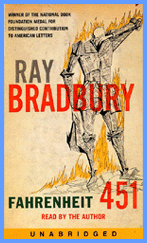
 As a high school student in the 1960s I was required to read several of Ray Bradbury’s works. Included were his novels Fahrenheit 451 and Something Wicked This Way Comes and a short story The Wonderful Ice Cream Suit

 Bradbury’s writings were my introduction to the world of science fiction and fantasy.  Written at the right psychic temperature, his writings set the kindling of my imagination aflame, burning holes in my scripted life prior to graduation. 

 It was during this time in high school that my off and on desire to write became an imperative. And with it came the urgency to feed those necessary flames with countless books. Logocentric, I was enthralled with the written and spoken word and their power to create, inform and inspire. Since those days I continue to fan those flames as I am ever fireside.

  In honor of Ray Bradbury, below are plentiful excerpts from a June 8th, 2012 article by Bruce Walker of the American Thinker website titled “The Conservative Legacy of Ray Bradbury.”

 Ray Bradbury is dead.  His literary career spanned an incredible 73 years, and his influence was felt across the broad spectrum of American thought.  Bradbury was very conscious of the fact that he grew up in almost a pre-technological society; “[w]hen I was born in 1920,” he told The New York Times Magazine in 2000, “the auto was only 20 years old. Radio didn’t exist. TV didn’t exist. I was born at just the right time to write about all of these things.

Although he eschewed squabbling over the political issues of the day, Bradbury embraced the idea that there are grand and common themes to the human condition — and nowhere more piercingly than in his Fahrenheit 451.

 Fahrenheit 451 focuses on a single, salient aspect of human life: the written word.  Bradbury’s dystopia is fantastically simple.  Firemen exist to burn books: the final immolation of all the collected writings of men will liberate us from our past and from the long heritage of civilization.  Mass communication and particularly mass amusement have replaced the solitary acts of reading and of writing.  What Bradbury saw, of course, is the world we live in today, and what he was defending was, in the purest sense of the word, conservatism. (emphasis mine)

It is a fact of modern history that conservatism is inextricably connected with the written word.  The Torah and the Christian Bible, preserved so deliberately by believers over many centuries, are touchstones to conservatism.  Documents like our Declaration of Independence and the Constitution prescribe the purposes and limits of government and void the ambitions of power-hungry leftists.

The solemn beauty of Chambers’ Witness or Koestler’s Darkness at Noon or Solzhenitsyn’s Gulag Archipelago lay open the ghastliness of souls sold to Marx’s nightmare.  The flawless spiritual rhetoric of C.S. Lewis’ Mere Christianity, the brilliant theories in Hayek’s Road to Serfdom and Thomas Sowell’s Vision of the Anointed, and the passionate indictment of collectivism in Ayn Rand’s Atlas Shrugged use simple words to make truth clear. 


The left lives on emotions and images.  There is no leftist counterpart to Thomas Sowell or C.S. Lewis or Ayn Rand or Alexander Solzhenitsyn.  Bradbury grasped the unique vitality of the written word.  Bradbury once said, “Libraries raised me.  I don’t believe in colleges and universities.
(emphasis mine)

Ray Bradbury:

Libraries raised me. I don’t believe in colleges and universities. I believe in libraries because most students don’t have any money. When I graduated from high school, it was during the Depression and we had no money. I couldn’t go to college, so I went to the library three days a week for 10 years. (emphasis mine)

Bradbury on Bradbury:

 In writing the short novel Fahrenheit 451 I thought I was describing a world that might evolve in four or five decades. But only a few weeks ago, in Beverly Hills one night, a husband and wife passed me, walking their dog. I stood staring after them, absolutely stunned. The woman held in one hand a small cigarette-package-sized radio, its antenna quivering. From this sprang tiny copper wires which ended in a dainty cone plugged into her right ear. There she was, oblivious to man and dog, listening to far winds and whispers and soap opera cries, sleep walking, helped up and down curbs by a husband who might just as well not have been there. This was not fiction.

From Wikipedia:

Bradbury was a strong supporter of public library systems, and helped to raise money to prevent the closure of several in California due to budgetary cuts. He iterated from his past that “libraries raised me”, and shunned colleges and universities, comparing his own lack of funds during the Depression with poor contemporary students. He exhibited skepticism with regard to modern technology by resisting the conversion of his work into e-books and stating that “We have too many cellphones. We’ve got too many internets. We have got to get rid of those machines. We have too many machines now.” (emphasis mine)

 Ray, I agree. And thanks for igniting our imaginations.

****

Bradbury quotes sourced from Wikipedia.

Ray Bradbury website

Hinterland of Youth

Hinterland of Youth

 On that rapidly growing dark afternoon of November 23rd, 1972, two friends called on me. They came to take me to Mauston, Wisconsin, a nether-land up north.  The trip would be a get-away weekend of exposed anima with just the guys. We were headed to a hunter’s cabin on loan to us from a local town alderman. The three of us, Jack Kerouac, Bill Caulfield and me, Tom Merton said goodbye to my parents.  We then hit the road and headed north on I-90, leaning forward into the “next crazy venture beneath the skies.” So Jack began the scroll of our trip.

Just across the Illinois-Wisconsin border and somewhere on an isolated back road Bill had Jack stop the car. Bill got out and went around to the trunk.  I watched him not knowing what he was doing. He pulled out a small insulated lunch bag.  Apparently Bill hid the bag in the spare tire cove of the trunk.  He returned to the front seat, opened the bag and handed me my first cold beer – a Pabst Blue Ribbon. I figured then that Bill had made off with a six pack from his father’s beer refrigerator in his family’s basement.

I tasted my first beer in the backseat of Jack’s ’69 Ford Galaxie.  I slurped it slowly thinking it smelled strangely familiar, something in the order of wet wheat-germ or chilled sweat. I dug its mystic cold smarminess.

As we drove north drinking beer we listened to Bill’s eight track tapes.  The eclectic collection included Woodstock, Jethro Tull’s Hard as a Brick, The Beatles’ Rubber Soul, the Beach Boys, Jimmy Hendrix and many others.  I had to beg Bill and Jack to get them to listen to my Chicago CTA album and to my Simon and Garfunkel Parsley, Sage, Rosemary and Thyme album. When I did get to play them, I do so with the Marantz turntable sitting next to me on the back seat. The road yielded to the beat.

After three hours and thirty-one minutes of driving and several “Nature’s calling” stops we arrived at the cabin, about ten miles outside of Mauston. It was around 10:30 pm. The cabin was dank and cold. We found the thermostat and switched on the furnace.  There was a small hutch filled with firewood and so we started a fire going in the brick fireplace. Not long after that we hit the bunk beds strained from the day’s massive carb-loading and the red-eyed myopia of night driving.

The weekend at the cabin gave me new insights into what the body can and cannot handle. Drinking alcohol for the first time in my life and without reservation had me revisiting the first seventeen years of my life from the inside out. My stomach doesn’t suffer fools well. In the morning my brain pummeled me with its version of smashing clay pots filled with forget-me-nots on my head.

It was during this next morning that I came up with a throbbing new insight:  I told Bill and Jack that we should buy milk shakes to coat our stomachs before drinking again that night.  They mumbled an agreement and we drove to Dairy Queen that afternoon. We drank large vanilla milk shakes in hopes of staving off the stomach sucking creatures of the night. The ultimate effect, though, was thorough expurgation. I was to find out later that a more prudent trade-off was to not drink so much that one would up running around in twenty degree weather in their underwear howling at the moon.

One of the more sober highlights of our weekend was using a .38 special to shoot at beer cans and bottles lined up on a fence behind the cabin.  The gun belonged to Bill’s father. His father was a Brink’s truck guard. As I learned Bill had secretly taken the gun and some ammo from his father’s bedroom. We used the gun to shoot at bull’s eye targets nailed to unsuspecting trees. The exhilarating effect of shooting a handgun though quickly wore off. I wanted more and more fire power. I eagerly wanted to shoot a shotgun or a bazooka or a cannon or an ICBM – anything that provided a flesh-shaking ear-deafening “KER-POW!!!!”

This was the first time I had ever shot a gun. In my hand the cold hard steel loaded with more cold hard steel sent a hot rush of testosterone through my extremities. I had to pull the trigger to release the pressure or I felt that I would have exploded.

The cabin, being a hunter’s paradise, was filled with Playboys – Playboys which included Marilyn Monroe and Jane Mansfield. This was not the first time I had been exposed to these magazines. Men seemed to keep them in places where boys would find them. All I needed besides the Playboys was a smoking jacket and a pipe. Instead of those Hugh Hefner type accoutrements Jack supplied me with Tiparillos. A blanket would be my smoking jacket.

At night Bill and I looked at the collection of Playboys by the light of the glowing fireplace. Reading the ‘articles’ warmed our sensibilities and the centerfold’s siren call would make drooling cave men of us all. Well not all of us.  I found out a year later that Jack was gay. I realized then why he would want two guys alone with him up at the cabin. I do remember being especially thankful at the time for Marilyn’s company and being curious about Jack’s ambivalence toward the women who were stapled down for our viewing pleasure.

The weekend in Wisconsin with the guys worked out all of my unexercised stupidity. And it all happened under the gauzy star-filled night pointed at by thousands of towering conifers just outside of Mauston, Wisconsin.  Fire-in-the-belly embers would burn through the fabric of my being leaving my satin youth singed.  The weekend was a rite of passage of sorts which thankfully didn’t regress into a Lord of the Flies sequel.

If I had a time machine I would not go back to Mauston and the cabin. I might, though, go back to that Thanksgiving dinner, say “Thank you” to my parents, push away from the table and go take a long nap, not waking up until November 24th, 2011. I wouldn’t miss the self-obsessed oblivion of those in-between detached days.

The Boy in the Tent

Last night I found myself in a van, my ex driving us to a familiar campground in the next state.  We wanted to get there as fast as we could.  We urgently wanted to get to our seven year-old son.

 We drove through the darkness panting and leaning forward in our seats. Just before sunrise we entered the campground.  We drove over to the campsite where we had camped many times before. There in the middle of a grassy opening surrounded by oak trees was a lone pup tent.

 I jumped out of the van and ran over to the tent. Down on my knees I lifted the tent flap and looked into the dimly lit tent.  My son was sitting in the middle of the otherwise empty tent.  He was facing the other way.

 There was nothing in front of him. He sat dead still.

 I crawled over to him.  As I did so he turned his head to look at me. He then got up, jumped into my arms and hugged me tightly.

 After a while we released our hug and I put him down.  He returned to sit in the same place in the tent. He sat down facing away from me.

 I went out of the tent.  My ex had been yelling from the car that we had to leave.

 I called back to my son and told him that we were going, that he must come along. There was no reply.

 ****

 I opened my eyes and winced them shut again.  The pit of my stomach felt as if it had been carved out of me while I slept.  When the silent sobbing began I tried to cover the wound.

© Sally Paradise, 2011, All Rights Reserved

Nobel Prize in Literature 2010: Mario Vargas Llosa

“We would be worse than we are without the good books we read, more conformist, not as restless, more submissive, and the critical spirit, the engine of progress, would not even exist.  Like writing, reading is a protest against the insufficiencies of life.  When we look in fiction for what is missing in life, we are saying, with no need to say it or even to know it, that life as it is does not satisfy our thirst for the absolute – the foundation of the human condition – and should be better.  We invent fictions in order to live somehow the many lives we would like to lead when we barely have one at our disposal.” [emphasis mine]

Quote from:

Mario Vargas Llosa’s Nobel Lecture, given December 7th, 2010.