Present But Not Accounted For

The death, burial, and resurrection of Jesus– who did the evangelists turn to for their record of these events? They relied on the testimony of several women – supporters and disciples – who had been with Jesus from the earliest days of his Galilean ministry and followed him to Jerusalem. The women were authoritative apostolic witnesses of these events in the early Christian community. Their telling and retelling of these events shaped the Gospel tradition.

The four gospel accounts variously record the women’s eyewitness testimony of the exceptional events in spite of what is alleged about a first century woman’s testimony not considered credible in a court run by men.

The gospel writers, as did other ancient historiographers, set great store in the role of eyewitnesses.[1] First-hand accounts of what was seen and heard and its interpretation were the most reliable. As a matter of record and for a connection to the sources, the identities of the women who witnessed the events of the Passion and resurrection are clearly identified by the gospel writers (see Women as Eyewitnesses below). The women were present and accounted for in the gospels.

The-Three-Marys-Henry Ossawa Tanner

Across the four gospel accounts, two or three women are noted to be at the cross, at the burial and at the empty tomb. This would fulfill Torah’s requirement (Deut. 19:15) for two or three witnesses for evidence to be substantiated.

We can be thankful that the women’s eyewitness testimonies, even if rejected by a first century court of men, provides for us today the historical reality of the extraordinary events. Those who have not seen the risen Lord are dependent on those who have such as Mary Magdalene, an apostle to the apostles, who said “I have seen the Lord!”

The women’s testimony, even if rejected by men, certainly didn’t preclude women in the community from accepting it. The women’s firsthand account of the events spread throughout the Christian community, where as many women as men, and likely more, were drawn to early Christianity. And where the role of the women as benefactors and disciples of Jesus was already well-known.[2] That a woman was commissioned by Jesus to be his “go and tell” witness – this was no surprise. The resurrection was the “Do you know what this means!” surprise.

For the women involved, it wasn’t a matter of passive observation. It involved active understanding, as Richard Bauckham, in Gospel Women: Studies of the Named Women in the Gospels writes [3]:

“It would be a mistake to envisage the women’s role of eyewitnesses as a passive one. As participants in events that radically changed their own lives, the women, in telling and retelling the stories of the events of the passion and resurrection, were also interpreting the significance of the events.”

It would also be a mistake to assume that what the women were relating had to reinterpreted and retold by men.

Again, Richard Bauckham[4] :

“I conclude that there is no evidence to suggest that the role of women in the resurrection stories has been depreciated or limited in the Gospel narratives of Matthew, Luke, and John. Where male prejudice against the credibility is explicitly evoked (Luke 24:11), this is so that it may be decisively overturned.

“Where readers may bring such prejudice to the texts, even though the texts give no pretext for doing so, again the effect of the narratives will be to refute and to reverse assumptions of male priority and female unreliability.

“. . . it suggests that within the Christian communities themselves the role of women as witnesses was highly respected. There seems to be no evidence that it became less so over time. It is one of a variety of striking aspects of early Christianity that belong to the countercultural nature of the Christian communities as societies in which God’s eschatological overturning of social privilege was taken very seriously.” (Emphasis mine.)

Present but not accounted for: women, apostolic traditioners and eyewitness guarantors of not only the Passion and resurrection events but also of the incarnation, are not included in the kerygmatic summaries of Peter and Paul.

(Kerygmatic summaries can be thought of as basically sermon outlines open to improvisation and amplification from gospel tradition influences.)

Kerygmatic summaries in sermons (Acts 2:14-36, 3:12-36, 10:34-43, 13:16-41) and in Paul’s resurrection discussion (1 Cor. 15) do not mention the role of women. That they are not mentioned doesn’t disavow the women’s roles as apostolic traditioners and eyewitness guarantors of the gospel tradition. The sermons are an overview of the gospel story meant for a crowd not aware of it.

(Did Peter and Paul have concerns about mentioning the role of women to a patriarchal assembly? Where they concerned that their message would be rejected by male listeners? It’s a real possibility.)

What may be seen as a snub, though, is not being accounted for in Paul’s resurrection appearance list (1 Cor. 15:3-7).

Here ‘s Richard Bauckham’s take on that [5]:

“. . . we should notice that the women are not in fact, as so often assumed, absent from 1 Corinthians 15:3-7. Paul distinguishes between an appearance to the twelve and one to all the apostles, since, unlike Luke, he does not confine the term “apostle” to the twelve. At this appearance, he would have assumed that other apostles he knew, such as Barnabas, Sylvanus, and James the Lord’s brother, were present along with the twelve. Now that it is generally recognized that Paul knew and had a great respect for at least one woman apostle, Junia (Rom 16:7), we must certainly also conclude that he would have taken for granted that women were included in an appearance to “all the apostles.”

(The apostle Paul calls Andronicus and Junia (Rom 16:7) “apostles”, likely meaning that they had been present at a resurrection appearance of Jesus. The name Junia was probably the Latin name of Jesus’s disciple Joanna (Luke 8:3; 24:10).) Andronicus (Junia’s husband Chuza?) and Junia (Joanna), Palestinian Jews, were likely members of the Jerusalem church before going to Rome.

Present today but not accounted for: Women as apostolic traditioners and eyewitness guarantors of the gospel traditions in today’s sermons AND women of the same caliber and devotion to the Lord in our pulpits.

We need more women traditioners, like those who followed and supported Jesus from the earliest days of his Galilean ministry and then followed him to Jerusalem and to the cross, the burial, and the empty tomb. We need more women traditioners like those who sat at Jesus’s feet and were discipled by him: “[Martha’s] sister, Mary, sat at the Lord’s feet, listening to what he taught.” (Luke 10:39). But women today have been “roled” into submission with the weight of out of context scripture verses.

The apostle Paul, in 1 Timothy 2:14, alludes to women being deceived and about divine order needing to be observed. Does anyone think that the women supporters and disciples of Jesus were deceived and out of order? Does anyone think that women were deceived in the tomb garden as Eve had been deceived in Eden’s Garden? What I see in scripture is a reversal of status – from women easily deceived to women rightfully believed.

Paul wrote to Timothy alluding to the female only cult of Artemis (Diana) in Ephesus. The women of the cult had been deceived. The women of the cult subordinated men. Paul didn’t want that deception and disorder brought into the church community at Ephesus. Ephesus and the Diana cult were the context for “I do not permit a woman to teach or to assume authority over a man; she must be quiet.” (1 Tim. 2:12). Paul’s words to Timothy were of a parochial concern, intending to make Timothy be aware of what’s around him and how he could confront it.

Paul’s words to Timothy were not a universal injunction against women believing them to be unreliable in discerning what is true and good and thereby disqualified as an authoritative voice in the church. If Paul thought that, then the female apostolic traditioners and eyewitness guarantors of the birth, death, burial, and resurrection of Jesus would also be suspect. That would fly in the face of reality.

Consider that throughout scripture we find that God used lowly salvation agents to bring about a reversal of status, not just for the agents e.g., Hannah and Mary, but also for Israel and the world. And, as mentioned, women – Mary and Elizabeth – were also apostolic traditioners and eyewitness guarantors of the incarnation. (Read Luke chapter 1 where events are related from a gynocentric perspective, rather than the typical androcentric perspective. Quite a pulpit!)

The narrative of women communicating the word of God is so clear in the New Testament. Women were present and accounted for in the Gospels, in the epistles and in extrabiblical sources. Today, women are being accounted for in a role, a designated role, a pre- “countercultural nature of the Christian communities as societies in which God’s eschatological overturning of social privilege was taken very seriously” role.

*****


[1] See Richard Bauckham’s Jesus and the Eyewitnesses: The Gospels as Eyewitness Testimony (William B. Eerdmans Pub. Co., Grand Rapids, MI, 2017) for the role of testimony in ancient historiography and in the gospels.

[2] See chapter 5, Joanna the Apostle, in Richard Bauckham’s Gospel Women: Studies of the Named Women in the Gospels (William B. Eerdmans Pub. Co., Grand Rapids, MI, 2002) for the background behind the financial support given Jesus by Joanna, the wife of Herod’s steward Chuza (Luke 8:3) and for background of women in the first century being in possession of independent financial resources.

[3] Richard Bauckham, Gospel Women: Studies of the Named Women in the Gospels (William B. Eerdmans Pub. Co., Grand Rapids, MI, 2002) 302

[4] Ibid, 285-286

[5] Ibid, 310

*****

Why women should be church leaders and preachers // Ask NT Wright anything – YouTube

*****

N.T. Wright on the Dangers of Neglecting the History of the New Testament by The Stetzer ChurchLeaders Podcast (soundcloud.com)

How Not to Read the Bible

How (Not) to Read the Bible: Making Sense of the Anti-women, Anti-scie – FaithGateway Store

How (Not) To Read the Bible (bibleproject.com)

*****

There are sermons and books on the roles for men and women. There are sermons and books about male-female hierarchy. There are sermons and books explaining gender roles in egalitarian or complementarian terms. “Roles!” “Roles!” “Roles!”  There are voices so contentious and acrimonious demanding “Roles” that schisms result. The apostle Paul would be a-Pauled!

Southern Baptists vote to expel two churches led by female pastors (nbcnews.com)

“Sarah Clatworthy, a member of Lifepoint Baptist Church in San Angelo, Texas, who has called on the SBC “to shut the door to feminism and liberalism,” said she supported the ban on female pastors.

“We should leave no room for our daughters and granddaughters in the generations ahead to have confusion on where the SBC stands,” she said. “Let them know Scripture is our authority and not the culture.”’

Southern Baptist Convention votes to uphold removal of Saddleback Church over women pastors after appeal by Rick Warren | CNN

The first century women were not feminists or liberals, though it would look that way to the legalists. They saw and reported what they had witnessed and learned. They were active in the “countercultural nature of the Christian communities as societies in which God’s eschatological nature overturning of social privilege was taken very seriously”.

Many think of Scripture and the church in androcentric terms. How could they not when they see men on a platform expounding, in male voices, what the scripture says. Have these interpreters rightly divided the word of God regarding men and women in the Kingdom of God? Have they wrongly divided men and women in the Kingdom of God into superficial roles?

I’ve read inferences and assumptions as to how things are to be: The Role of Women in the Church | Articles | Moody Church Media (moodymedia.org) and Dispensational Theology | Articles | Moody Church Media (moodymedia.org). The latter includes nonsense about a “rapture” occurring – a misinterpretation of scripture which leads one to doubt the former’s “Role of Women” interpretation.

And, I’ve read even-handed accounts:  Can Women be Pastors and Preachers? What the Bible Really Says (biblestudytools.com) and Complementarianism vs Egalitarianism – Do Christians Have Gender Roles Wrong? (crosswalk.com)

Remember Genesis 2? Adam (‘adam, a generic term meaning “human person”) was split in two and Eve was formed from one half of Adam. We read that this was done to form an equal partnership that would work to bring form and function to creation, a work God started and handed over to mankind. I find this partnership emphasis continued in the apostle Paul’s writing.

As I read Paul’s letters to the individual Christian communities, as I read his explanations and guidance of how to think and relate as new creations where they’re at, I hear his admonitions: “Get your act together! The world has its way of thinking! The world has its own form and function! But you are of different stock! Think and act like it! Work together for the sake of the gospel!”

The Spirit of God has been released into the world. The Spirit of God will go where it will. Did you really think that anyone could domesticate the Holy Spirit with theology and dispensationalism and policies of roles? Sure, those things tend to make one feel safe and secure, like you have a handle on things. But as we have seen with Jesus and now with the Holy Spirit, neither one “plays” by our rules.

Finally, note that Paul wrote to the Corinthian “brothers and sisters” that God gives His gifts as He determines (1 Cor. 12:1, 11). No further distinction is made regarding their allotment.

*****

Women as Eyewitnesses

In the gospel narratives of the Passion, burial and resurrection of Jesus, there are five named eyewitnesses and two unnamed but specified eyewitnesses: Mary Magdalene, Mary the mother of James and Joses, Salome, Joanna, and Mary of Clopas, the mother of the sons of Zebedee, and the mother of Jesus. Each evangelist mentions the women significant to their readers.

These had active roles as eyewitnesses. You see, they were there in person at the cross, at the burial, and at the empty tomb, as we learn in Matthew’s gospel account:

“There were several women there [at the cross], watching from a distance. They had followed Jesus from Galilee, helping to look after his needs. They included Mary Magdalene, Mary the mother of James and Joseph, and the mother of Zebedee’s sons.” (Matt 27: 55-56).

Mary Magdalene and the other Mary [the mother of James and Joseph] had watched the burial of Jesus. They had been sitting opposite the tomb (Matt. 27:61). They returned on the first day of the week to look at the tomb. (Matt: 28:1). There, they encounter an earthquake and an angel. They receive divine revelation: “He is not here; he has risen, just as he said.” (Matt. 28: 5-6). The women then receive a command to proclaim (“Go and tell”) the Lord’s resurrection to the disciples (Matt. 28: 7). As they start running to herald the news, they are suddenly met by Jesus who says “Hello!” and “Don’t be afraid” and “Go and tell my brothers that they should go to Galilee. Tell them they’ll see me there.”

The gospel of John, chapter 20, records that Mary Magdalene, after seeing the stone rolled away from the Jesus’ tomb, runs off to tell Peter and John, the one closest to Jesus, that the body was missing. Peter and John run to the tomb and check it out. Mary Magdalene must have shown them the way because she – not them – had watched the burial.

Back at the empty tomb, Mary begins crying as she looks inside. She then sees two angels who ask her why she is crying. Mary then turns and sees a figure standing nearby. She thinks it’s the gardener. The figure asks why she is crying. She explains and then Jesus reveals himself to her. Jesus then tells her “Go to my brothers and say to them, ‘I’m going up to my father and your father – to my God and your God.”

Mary Magdalene, an apostle to the apostles, went and told the disciples, “I’ve seen the Lord!” and that he said these things to her. Later, when the disciples see the Lord, they corporately say what Mary said: “We’ve seen the Lord!” Seeing is followed by belief.

Jesus told the group “God’s blessings on people who don’t see, and yet believe!”

Notice in the following synoptic gospel texts how “women” and seeing verbs are emphasized.

Matthew 27:55-56

Many women were there, watching from a distance. They had followed Jesus from Galilee to care for his needs. Among them were Mary Magdalene, Mary the mother of James and Joseph, and the mother of Zebedee’s sons.

Mark 15:40-41

 Some women were watching from a distance. Among them were Mary Magdalene, Mary the mother of James the younger and of Joseph, and Salome.  In Galilee these women had followed him and cared for his needs. Many other women who had come up with him to Jerusalem were also there.

Luke 23: 49

But all those who knew him, including the women who had followed him from Galilee, stood at a distance, watching these things.

*****

Informed Dissent:

A Nurses’ POV on COVID and Healthcare (substack.com)

“Atrazine [a herbicide] is an endocrine disrupter, which is able both demasculinize (chemically castrate) and completely feminize adult male frogs as well as other aquatic life. It has been documented to affect murine (mouse) reproductive systems.

“. . . common foods which are endocrine disruptors can cause feminization in adult human males:

“. . . Secondary hypogonadism caused by the excessive intake of isoflavones in soy milk was diagnosed. In men, an excessive intake of isoflavones may cause feminization and secondary hypogonadism.”

Kennedy is right – Atrazine and Gender Fluidity (substack.com)

Dr. Ben Hu, Patient Zero? New FOIA Documents Released Reveal a ‘Smoking Gun’: COVID Was Created at Wuhan Lab, Escaped From ‘Gain of Function’ Research – And Was Financed by US Taxpayer Money! | The Gateway Pundit | by Paul Serran | 176

Here we go. Swedes are moving in the right direction:

Sweden adopts ‘100% fossil-free’ energy target, easing way for nuclear – EURACTIV.com

Even Sweden Doesn’t Want Migrants Anymore (foreignpolicy.com)

Oh, swell!

Convalescing Pope Francis Slips Right Back Into Old Habits: Meets With Socialists, Climate Alarmists – Globalist Pontiff Pushing Document in Favor of LGBTQ+ Acceptance by the Church | The Gateway Pundit | by Paul Serran | 176

Child trafficking:

Discord servers used in child abductions, crime rings, sextortion (nbcnews.com)

End Child Trafficking | Operation Underground Railroad (ourrescue.org)

*****

*****

Why Weren’t We Allowed To Question The Covid Vaccines? – YouTube

A Mighty Host [Lyric Video] – YouTube

A Mighty Host — Brian Sauvé: For the New Christendom (briansauve.com)

Bryson Gray – Reclaim The Rainbow (w/ @JimmyLevy & Shemeka Michelle) [MUSIC VIDEO] – YouTube

What’s Up with God?

“What’s up with God?” This question has been posed in various forms throughout history, often in the context of the problem of evil. And often with God’s existence being made contingent upon man’s assessment of God in relation to evil, as was posited by Greek philosopher Epicurus in what has become known as the “Epicurean paradox”:

If God is willing to prevent evil, but is not able to

Then He is not omnipotent.

If He is able, but not willing

Then He is malevolent.

If He is both able and willing

Then whence cometh evil.

If He is neither able nor willing

Then why call Him God?

What’s up with theodicy? Ivan Fyodorovich Karamazov, one of The Brothers Karamazov in Dostoyevsky’s masterful novel, is a sullen and withdrawn 24-year-old rationalist afflicted with great inner conflict. He rejects the world as it is because it doesn’t line up with the moral reasoning of his “Euclidean mind, an earthly mind”:

Ivan Fyodorovich Karamazov

“I accept God […] It’s not God that I do not accept, you understand, it is this world of God’s […] that I do not accept and cannot agree to accept.”- Ivan, The Brothers Karamazov, Part 2: Book 5, Chapter 3

Where is the vindication of God’s goodness and justice and the idea of a loving God in the horror of unjust human suffering—particularly the suffering of children?

Going further than Ivan, professional God-denying atheist Richard Dawkins thinks he knows what’s up with God. He’s done a “1619 Project” on God:

“The God of the Old Testament is arguably the most unpleasant character in all fiction: jealous and proud of it; a petty, unjust, unforgiving control-freak; a vindictive, bloodthirsty ethnic cleanser; a misogynistic, homophobic, racist, infanticidal, genocidal, filicidal, pestilential, megalomaniacal, sadomasochistic, capriciously malevolent bully.” Richard Dawkins, THE GOD DELUSION P.31.

It’s not just philosophers and characters in novels and atheists who question “What’s up with God?” Those who have walked in God’s presence have also thought that God as God should act in certain ways.

Job and his friends had strong inclinations as to how God should act. Their back-and-forth dialogues disclose that they thought that God should act with the retribution principle: the righteous prosper and the wicked suffer. Do your due diligence, bring offerings and sacrifices and God will return the favor. If you suffer misfortune, it is because you have made God unhappy and you are not as righteous as you thought you were.

Quid pro quo religious rituals were common throughout ancient Near Eastern history. Ancients interested in attaining a god’s favor offered sacrifices in order to receive it. Sacrifice as a form of bribery was also common during the Greek and Roman times when there were many gods to feed and take care of. The religious practitioners thought of the gods as being like them – needy. Now let’s go back in time to the first What’s up with God? situation recorded in Scripture.

As you read Genesis chapter 4 you find that the narrator, without adding any moral qualification of his own, wants the reader to assess what is said and done. Note: this Mother’s Day story doesn’t end well.

The setting: just outside the garden of Eden.

We read that brothers Cain and Abel offer the fruits of their labor to God as a sacrifice. They may have placed the offerings outside the flaming sword-protected gate of the garden. Abel offers the best cuts from the mature firstlings of his flock. Cain offers portions of what’s been growing. They both offer yields from God’s good creation, but there is an issue with one of the offerings. The narrator doesn’t give us the motives behind the offerings but we do get Cain’s reaction and God’s response.

When his offering is not considered by God, Cain became hot with anger. His face became downcast. What’s behind Cain’s response? Likely two very human attitudes: “Why was Abel’s offering accepted and not mine – No fair! Inequality! I am the oldest! What about my rights?!” and “God isn’t supposed to act this way when I give him something. What’s up with God?!”

Cain likely felt that he had rights by placing God in debt to him with his offering. He did what he felt was required and now God must do what is required and return the favor. He had made a deal with his offering perhaps thinking “If I feed God then I get a return on my investment”. As noted above, this was a typical Near Eastern attitude of brokering with the gods for favor (I am not assuming that there are only four humans on earth at this time.)

Then the Lord said to Cain, “Why are you angry? Why is your face downcast? If you do what is right, will you not be accepted? But if you do not do what is right, sin is crouching at your door; it desires to have you, but you must rule over it.” Genesis 4: 6-7

God gives Cain a free-will choice. I read it as “Do you want to be accepted or are you just looking to get your conditional ritual brokering accepted? If you want to be accepted, then do what is right with regard to me and you’ll be accepted. You doing right is infinitely more acceptable than a plateful of greens.”

Or, “Cain, you can continue going you own way. Just be ready to be pounced on and be overtaken by more of the same “What’s up with God?” behavior that overcame and killed your brother Abel. You would then live like a wild animal. Isn’t that how you imagine yourself now –as one of them, free to roam and ready to pounce? I told your parents to continue what I began – bring order to the as-yet-to-be-ordered world, to subdue and rule. Will you choose to be disorder and the sower of suffering for yourself and others?

Cain made his free-will choice. It appears that he decided that God was petty and unfair. So, he weaponized his anger toward God and destroyed his image. He brought Abel to a field and murdered him. But what happens on the field does not stay on the field. Abel’s split blood cried out to God and the “petty and unfair” God came looking for murderously unfair Cain.

“Then the Lord said to Cain, “Where is your brother Abel?” He said, “I do not know; am I my brother’s keeper?” And the Lord said, “What have you done? Listen, your brother’s blood is crying out to me from the ground!”

Cain admits no culpability. As a consequence of Cain’s attitude and actions, God curses Cain. The curse in Genesis 4 is very similar to the one in Genesis 3, except that it’s not just the ground that is cursed it is a human being that is also cursed.

“And now you are cursed from the ground, which has opened its mouth to receive your brother’s blood from your hand. When you till the ground, it will no longer yield to you its strength; you will be a fugitive and a wanderer on the earth.”

It seems that the punishment God gave Cain was Cain’s heart’s desire: to be his own man and to go his own way. But Cain balks, perhaps realizing that what goes around comes around. And so, for protection, Cain’s implied plea is for God to act like a “brother’s keeper”.

“Cain said to the Lord, “My punishment is greater than I can bear! Today you have driven me away from the soil, and I shall be hidden from your face; I shall be a fugitive and a wanderer on the earth, and anyone who meets me may kill me.” Then the Lord said to him, “Not so! Whoever kills Cain will suffer a sevenfold vengeance.” And the Lord put a mark on Cain, so that no one who came upon him would kill him. 

The Lord shows undeserved goodwill toward Cain, favor that Cain had once assumed should be automatic with his offering. The Lord treats Cain as Cain should have treated his brother Abel.

Cain should have received the death penalty. (Did Richard Dawkins ever read Genesis 4?), but instead is banished from living near the garden and the Lord’s presence. The mark placed on Cain by God means that God promises to look after Cain in exile, so that no one who came upon him would kill him. The Lord promises Cain justice in avenging his split blood.

These are very sad words: “Then Cain went away from the presence of the Lord and settled in the land of Nod, east of Eden.” (“Nod” = “wandering”)

In the land of wandering, Cain has a chance to repent and return to God. But . . .  the willful Cain goes his own way. Instead of wandering, Cain defies God and builds a city. The city for him equals protection, security, being surround by allies, and a lack of trust in God’s character.

When God didn’t respond to Cain’s offering, Cain could have asked “Why” to gain understanding but his attitude kept him from doing so. He had decided about how God should act. If Cain had asked God “Why?”, would God have answered “Just because I chose your younger brother’s offering this time doesn’t make me petty and unfair? It doesn’t mean that I don’t accept you. You don’t know me. Three dimensions cannot contain me. The fourth dimension of time allows for your understanding of me. And Cain, you assumed something about me with your petty conditional thinking. Had you asked you would have found out what I am like and what I desire. My lack of response was meant as a challenge. I wanted you to respond with questioning humility and to patiently wait for my response.”

What does the Genesis 4 narrator want to us understand? That we must begin our understanding of God with the acknowledgement of and respect for God as God? That God is Other than us? That because God has made himself present to us never means that one is on equal terms with God? That we must not try to domesticate God with our assumptions about him? That Cain thought that God would be as needy as he was for attention and that was the motive for his offering?

God prescribed a “fugitive and a wanderer on the earth” life for Cain. Exile to the land of exclusion was done, I believe, as a means for Cain to take time to reflect on his attitude and on what he had done and to come to the point of repentance and to returning to the presence of God. But self-reliant Cains hunkers down and builds a city for protection. As we shall see in a future post, cities magnify what is in the human heart.

In the Cain and Abel account, the question of “What’s up with God?” is met with “What have you done?”

*****

“The suffering and evil of the world are not due to weakness, oversight, or callousness on God’s part. But rather, are the inescapable costs of a creation allowed to be other than God.” – John Polkinghorne

*****

*****

“The cross of popular evangelicalism is not the cross of the New Testament. It is, rather, a new bright ornament upon the bosom of a self-assured and carnal Christianity whose hands are indeed the hands of Abel, but whose voice is the voice of Cain. The old cross slew men; the new cross entertains them. The old cross condemned; the new cross amuses. The old cross destroyed confidence in the flesh; the new cross encourages it. The old cross brought tears and blood; the new cross brings laughter. The flesh, smiling and confident, preaches and sings about the cross; before the cross it bows and toward the cross it points with carefully staged histrionics but upon that cross it will not die, and the reproach of that cross it stubbornly refuses to bear.” — A.W. Tozer

*****

Informed Dissent:

Vaccine Atrocities

Former Pfizer VP Dr. Michael Yeadon

Large study finds people who received COVID jab have higher risk of visual impairment – LifeSite (lifesitenews.com)

SARS-CoV-2 Spike Protein Accumulation in the Skull-Meninges-Brain Axis: Potential Implications for Long-Term Neurological Complications in post-COVID-19 | bioRxiv

Rand Paul says ‘no more,’ urges Americans to ‘resist’ lockdowns and mask mandates | The Post Millennial | thepostmillennial.com

US Military Doctor Testifies She Was Ordered to ‘Cover Up’ Vaccine Injuries | Principia Scientific Intl. (principia-scientific.com)

FOIA Reveals Troubling Relationship between HHS/CDC & the American College of Obstetricians and Gynecologists – America Out Loud

How to Save Your Life and Those You Love When Hospitalized – LewRockwell

Patient Documents | OurPatientRights.com (protocolkills.com)

The American Sovereignty Declaration: It’s Time for America to Exit the W.H.O.” – Dr. Robert Malone


“ . . . in the course of the COVID-19 pandemic, the WHO lied about the natureorigins and effective responses to the Wuhan Virus. The “China Model” of lockdownsmasks and vaccine mandates and digital enforcement mechanisms was endorsed. And the WHO approved the use of expensive and inadequately tested gene therapies as “vaccinations” and the suppression of readily available, effective and inexpensive treatments. Thanks in part to such misconduct, the pandemic has resulted in the deaths of over a million Americans and many more elsewhere around the world, an untold number of whom perished needlessly.

Given the WHO’s appalling record, it is outrageous that the Biden administration is working to give the WHO and its Director-General more power over sovereign nations, including the United States. Yet, U.S. government officials are actively negotiating amendments to existing International Health Regulations and a new treaty governing future pandemics. These accords would effectively repose in Dr. Tedros the authority unilaterally to dictate what constitutes an actual or potential Public Health Emergency of International Concern (PHEIC) and to order how affected nations must respond.” (Emphasis mine.)

The American Sovereignty Declaration (substack.com)

The American Sovereignty Declaration: It’s Time for America to Exit the W.H.O.
Sign at this link>>  Sovereignty Coalition

News Release: New ‘Sovereignty Coalition’ Campaign to Prevent the Surrender of American Freedom – Sovereignty Coalition

*****

How Disney Comes Up With New Movie Ideas – YouTube

World, Do You Know Your Creator?

The natural and the supernatural, separated into categories of science and faith since the times of Enlightenment, were not split apart in the ancient Near East worldview. Ancients believed that the gods were always active in the world in countless and often undetectable ways. The apostle Paul brought this into his dialogue with stoic and Epicurean philosophers at the Areopagus (Acts 17:22-31):

“In him we live and move and have our being,” (from Cretica, Epimenides, Creton poet, ca .600 BC)

“[It is with Zeus that every way has to do,] for we are also his offspring.” (from Phainomena, Aratus, Cilcian poet, 315-240 BC)

Psalm 104, a Hebrew Hymn of Creation with Parallels in Pharaoh Akhenaten’s Hymn, depicts ancient Israel’s cosmology. It may have been written during the times of David and Solomon. Its author is unknown, so let’s call him Naturalist Observer.

Naturalist Observer looked around at the known world at that time and ascribed its ordered functioning to God. He did so, apparently, with background knowledge of Genesis.

Linocut Print by Mark Hearld

The psalm celebrates God’s creative function giving and care taking of the natural world. God is praised for creating a habitable world that continues day after day. Nature has a home to come home to, as God had promised.

As long as the earth endures, seedtime and harvest, cold and heat, summer and winter, day and night shall not cease. Gen. 8:22

Naturalist Observer has taken note of “the waters”, “the deep”, “springs”, “streams”, “the sea”. Water is contained and directed by God to function in support of life.

Water pours from the sky (vs.13) producing sustenance (vs. 14-16) within habitats of forest, valley and mountains (vs. 16-18)

Note: water is mentioned some 700 times in the Bible – from Genesis 1:2 (the earth was complete chaos, and darkness covered the face of the deep, while a wind from God swept over the face of the waters) to The Revelation of John 21:1 (no longer any sea, i.e., no more chaos, no more scary deep, no more fear of the unknown)

Verses 19-23 are about time. (For Jews, each 28-day lunar month started with a new moon. Each new day started at 6 o’clock each evening when the sun goes down.)

Naturalist Observer reflects with awe at the breadth of God’s works (vs, 24-26).

Naturalist Observer records (vs. 27-30) God’s involvement in the cycle of life. The breath of every living thing depends on God (vs. 29-30). (Note: death before the Fall.)

Naturalist Observer ends his mediation (vs. 31-35) by recounting some of the means God has used to have humankind focus on the purpose of His creation – a sacred place where God dwells with man.

Earthquakes and volcanoes (vs. 32), speak of God’s awesome power to disrupt things and thereby get people’s attention (Ps. 97:4). And once God has their attention, He gives them his terrifying-but-mediated presence and the means to live in his presence (Ex.19:18).  God, who touches the mountains and they smoke, is petitioned (Ps. 144:5-6) to come down, show His power, and put fear into the enemies of his people.

Consider that several ancient Near East accounts of a devastating flood were understood as a god using force to reset order in the world. See Genesis 6-9 for the theological interpretation of the mythic flood. (See also Genesis and the Flood: Understanding the Biblical Story – Article – BioLogos)

The wicked, as they ignore God and live according to their own ways – exchanging the natural for the unnatural (Rom. 1;18-32), bring disorder to what God called good or functioning as purposed. Naturalist Observer, having taken account of God’s ordered creation and knowing from history the disruption man’s wickedness brings to it, intreats God (vs. 35):

Let sinners be consumed from the earth,
    and let the wicked be no more

Here, Naturalist Observer appears to be thinking of Elijah, the prophets of Baal, and fire from heaven (1 Kings 18).

We would do well, as Naturalist Observer has done, to spend time observing our sacred bio-space and meditating on the work of God’s hands. I do this while walking.

Above all, do not lose your desire to walk. Every day, I walk myself into a state of well-being & walk away from every illness. I have walked myself into my best thoughts. – Søren Kierkegaard

We would do well not to polarize science and faith and make them adversarial, as both function in God’s ordered realm. At certain points, one may view science and faith in conflict. But that’s why study, reflection, and meditation are required – you don’t have all the information. Denying one and accepting the other says that you don’t think God has set up an ordered and functioning cosmos.

There are two ways to be fooled. One is to believe what isn’t true; the other is to refuse to believe what is true. – Soren Kierkegaard

“I have loved the stars too fondly to be fearful of the night.”
― Sarah Williams, Twilight Hours: A Legacy Of Verse

*****

Psalm 104

Bless the Lord, O my soul.
    O Lord my God, you are very great.
You are clothed with honor and majesty,
    wrapped in light as with a garment.
You stretch out the heavens like a tent;
    you set the beams of your chambers on the waters;
you make the clouds your chariot;
    you ride on the wings of the wind;
you make the winds your messengers,
    fire and flame your ministers.

You set the earth on its foundations,
    so that it shall never be shaken.
You cover it with the deep as with a garment;
    the waters stood above the mountains.
At your rebuke they flee;
    at the sound of your thunder they take to flight.
They rose up to the mountains, ran down to the valleys,
    to the place that you appointed for them.
You set a boundary that they may not pass,
    so that they might not again cover the earth.

10 You make springs gush forth in the valleys;
    they flow between the hills,
11 giving drink to every wild animal;
    the wild asses quench their thirst.
12 By the streams the birds of the air have their habitation;
    they sing among the branches.
13 From your lofty abode you water the mountains;
    the earth is satisfied with the fruit of your work.

14 You cause the grass to grow for the cattle
    and plants for people to cultivate,
to bring forth food from the earth
15     and wine to gladden the human heart,
oil to make the face shine
    and bread to strengthen the human heart.
16 The trees of the field are watered abundantly,
    the cedars of Lebanon that he planted.
17 In them the birds build their nests;
    the stork has its home in the fir trees.
18 The high mountains are for the wild goats;
    the rocks are a refuge for the coneys.
19 You have made the moon to mark the seasons;
    the sun knows its time for setting.
20 You make darkness, and it is night,
    when all the animals of the forest come creeping out.
21 The young lions roar for their prey,
    seeking their food from God.
22 When the sun rises, they withdraw
    and lie down in their dens.
23 People go out to their work
    and to their labor until the evening.

24 O Lord, how manifold are your works!
    In wisdom you have made them all;
    the earth is full of your creatures.
25 There is the sea, great and wide;
    creeping things innumerable are there,
    living things both small and great.
26 There go the ships
    and Leviathan that you formed to sport in it.

27 These all look to you
    to give them their food in due season;
28 when you give to them, they gather it up;
    when you open your hand, they are filled with good things.
29 When you hide your face, they are dismayed;
    when you take away their breath, they die
    and return to their dust.
30 When you send forth your spirit, they are created,
    and you renew the face of the ground.

31 May the glory of the Lord endure forever;
    may the Lord rejoice in his works—
32 who looks on the earth and it trembles,
    who touches the mountains and they smoke.
33 I will sing to the Lord as long as I live;
    I will sing praise to my God while I have being.
34 May my meditation be pleasing to him,
    for I rejoice in the Lord.
35 Let sinners be consumed from the earth,
    and let the wicked be no more.
Bless the Lord, O my soul.
Praise the Lord!

*****

Brothers, above the starry canopy
There must dwell a loving father.
Do you fall in worship, you millions?
World, do you know your creator?
Seek Him in the heavens;
Above the stars must he dwell.

Ode to Joy (1785) by Johann Christoph Friedrich von Schiller, as adapted in the final movement of Beethoven’s Ninth Symphony

*****

Below are three short videos from a series of Oxford Conversations with Oxford Professor Andy Gosler.

Professor Andrew Gosler | Department of Biology (ox.ac.uk)

Professor Andrew | Mansfield College (ox.ac.uk)

The Ethno-ornithology World Atlas | people • birds • place (ewatlas.net)

*****

Green Energy, Digital Technology = Eco-adverse:

“As rare metals have become ubiquitous in green and digital technologies, the exceedingly toxic sludge they produce has been contaminating water, soil, the atmosphere, and the flames of blast furnaces.”

“Mining requires the extraction of solid ores, often after removing vast amounts of overlying rock. Then the ore must be processed, creating an enormous quantity of waste – about 100 billion tonnes a year, more than any other human-made waste stream.

Purifying a single tonne of rare earths requires using at least 200 cubic meters of water, which then becomes polluted with acids and heavy metals. On top of that, imagine the destruction and energy required to obtain these essential metals:

  • 18,740 pounds of purified rock to produce 2.2 pounds of vanadium
  • 35,275 pounds of ore for 2.2 pounds of cerium
  • 110,230 pounds of rock for 2.2 pounds of gallium
  • 2,645,550 pounds of ore to get 2.2 pounds of lutecium
  • Also staggering amounts of ore are needed for other metals.”

‘Renewables’ Reality Check: Exposing Filthy Truth About Our Wind & Solar Powered ‘Nirvana’ – STOP THESE THINGS

*****

*****

Climate Activism Has a Cult Problem (thefp.com)

*****

This is what digital technology is leading to – for your “safety” (a la COVID digital tracking):

CHILLING: World Economic Forum Showcases Technology That Would Allow The Government To Punish Your Thoughts And Big Business To Spy On Your Brains (VIDEO) (thegatewaypundit.com)

*****

We are under attack. You need to read this . . .

Fifth Generation Warfare:

“. . . the war I’m talking about is an even broader war. A war that is taking place everywhere on the globe, even as I write, and that involves virtually everyone on the planet, young and old, male and female, military and civilian. It is the war of every government against its own population and every international institution against free humanity. . ..

We have a choice. Either we continue going into this technological, corporate matrix—which involves even things like buying the next generation of iPhone, which they’re already saying is going to have its own fingerprint scanning technology, and all of these corporate, military, Big Brother elements to it that we’re willingly signing up to every day of our lives, and actually paying money for—or we start to create alternative structures which don’t rely on that system. It’s a choice that we have to make in our lives, I would say more quickly than has been apparent at any other time in human history. . ..”

what I am proposing here: the creation of a parallel society. 

Your Guide to Fifth-Generation Warfare (substack.com)

*****

In sum, we are living in anarchy, as institutions themselves have become nihilistic and weapons of the revolution. The Left, in viral fashion, took over the DNA of America’s institutions, and used them to help destroy their creators.

If we are bewildered why Harvard law-graduate prosecutors let out violent criminals just hours after their arrests; or why hyper-rich, pampered athletes who live in near-apartheid enclaves insult the flag, ignore the National Anthem, and sloganeer woke platitudes, it is because they were taught to undermine the status quo by fundamentally becoming it. 

Anarchy, American-Style › American Greatness (amgreatness.com)

*****

Informed Dissent:

URGENT/BREAKING: UPDATED SUMMATION: The Spike Protein of SARS-CoV-2 is “Delivered” to All Organs via the Endothelium and Induces Systemic Nonsense mRNA Translations Resulting in Hyperaccelerated Aging (substack.com)

Ending the USG COVID-19 Public Health Emergency (substack.com)

*****

The reason Left Behind: Separating Fact from Fiction is being reprinted is because the Left Behind film franchise was renewed in 2023. Kevin Sorbo stars in “Left Behind: Rise of The Antichrist” with the tagline, “What Happens After the Rapture?” “I think it’s perfect for the time we are living in right now. You see the craziness of what governments are doing around the world right now. The fear, the pandemic, the anger, the hate, the cancel-culture and wokeness,” Sorbo stated in an interview. “If the rapture hasn’t already happened, it feels like it’s on the way.” How many times have we heard that the “rapture” is “on the way”? It was the tagline for most of the 20th century. It’s been more than 50 years since Hal Lindsey’s prophecy blockbuster The Late Great Planet Earth was published and intimated that the “rapture” would take place before 1988. A lot has happened since that false prediction has long been forgotten. I suspect that most people who will watch the new Left Behind film have no idea how inaccurate the prophetic speculators of a previous generation were. . . .

The promised false hope is that Christians will miraculously escape this soon coming “Great Tribulation” that the latest reiteration of the Left Behind film franchise depicts. Watch it, the tagline tells us, so you won’t have to experience the horrors of the Great Tribulation and possibly go to hell! But what if the entire Left Behind approach to Bible prophecy is more fiction than fact? That’s what this book is about.

Separating Fact from Fiction – The American Vision

You’ll Never Be the Same


Daybreak. The village of Bethsaida. The air is hot and dry and still. And something is astir. Jesus has come to the “house of fishing”.

You hurry down to the shore of the Sea of Galilee. Your husband and his brother have been fishing long before daybreak. You carry with you a clay jar full of water and a cloth.

Along the shore are baskets of fish. The village women and merchants have come to purchase the salted tilapia. You know that your husband will reserve some for his family and for the widows. And though there over two hundred boats on the water, you spot your husband’s and his brother’s boat.

At the edge of the water you hear “The time is fulfilled! God’s Kingdom is arriving! Turn back and believe the good news!” Jesus, walking along the shore, is coming toward you.

Trying to get your husband’s attention, you wave. He and his brother are busy casting nets. You shout. “Look! Jesus is coming this way!” Your husband finally hears your voice and turns toward you.

Jesus walks up to you. From the same vantage point he calls out to your husband and his brother, “Follow me! I’ll have you fishing for people!”

At once, your husband and his brother let go of their nets and bring the boat to shore. At once, they begin to follow Jesus along the shoreline. You follow them, two steps to their one, with the clay jar of water. You soak the cloth in the water. With it your husband proceeds to wipe his brow and then his beard to remove the crusted salt – sweat from his brow. You hand him the clay jar. Dehydrated, he gulps half the water down and then hands the jar to his brother.

Further down Jesus calls “Follow me!” to two men mending their nets. You know them – James and John, the sons of Zebedee. The brothers leave their boat and their father and the hired servants behind.

At this point, you’ve run out of breath and are not able to keep up. You call to your husband, “I’m going home. My mother is not feeling well.” Your husband acknowledges but goes on, determined to keep his eyes on Jesus.

As you watch him and the fellowship of fishermen continue down the shore, you remember the words of the prophet Isaiah that were read in the synagogue last Shabbat:

The Lord God helps me;
therefore I have not been disgraced;
therefore I have set my face like flint,
and I know that I shall not be put to shame

Zebedee calls to you. “I will have my hired hands take care of your boat. I will sell the fish you husband caught and bring you fish for you and the widows.” You thank him. Carrying the clay jar and the cloth you head home pondering all that has happened. Every woman in Bethsaida knew what Mary had said about Jesus. Something begins to stir in your heart.

An hour or so later your husband and his brother are at the door. They tell you that they are going to Capernaum with Jesus and are not sure when they will return. You give them some bread to take with. Before your husband takes off, you stop him at the door. “Could he be the one? He’s talking about a kingdom. I don’t want you getting killed. What’s his plan?”

Your husband responds. “Woman, there is only one way to find out.”

Sweat runs down his temples to his beard. The midday sun is blazing. You hand him his mantle, which he throws over his shoulder. He races off with his brother Andrew. He calls to John and James who are already fifty paces ahead of them and Jesus is ten paces ahead of them. He wants them to wait up. Your husband is a big man with a big heart and is impulsive to a fault. He takes strides in all directions. And today, you wonder what will become of him and the fishing business as he takes off in a new direction.

On your way home you stop and give the widows the salted fish and to hear rumors. You learn that many were repenting and were being baptized in the River Jordan by John the Baptist, Jesus among them. And that when he came out of the water there was a dove and a large booming voice that said “You are my son! You are the one I love! You make me very glad!” There is so much more for you to ponder.

At home you prepare for Shabbat which begins just before nightfall. You sweep and clean your home from top to bottom. You cover the sales money so it is out of sight. You make sure there is oil in the two lamps.

The night settles in. You eat food prepared earlier. You care for your mother who now has a fever. As you wipe her head with a damp cloth you talk with her about Jesus until you can’t stop yawning. You go to your bed. You are glad that you and your husband sleep in separate rooms, for when your husband sleeps, he snores – a nightly ritual even on Shabbat. Tonight, there will be the moaning of your delirious mother.

As you fall asleep you imagine your husband walking to Capernaum. He would walk two hours in the hot sun. Did he have water? Maybe the journey would take less time with the strides Jesus takes. When will he return …?


Your husband and his brother and James and John return the next day. They are all at the door with Jesus. He had been told about your mother and her illness. Jesus goes in, takes your mother by the hand, and raises her up. At once, her fever is gone and she was well enough to feed them. How is this possible, you ask yourself? But there is no time to wonder as you want to feed them all. Your heart is brimming with thanksgiving.

Outside your home there is large crowd – people from all over Galilee have followed Jesus. Jesus goes out to them. People with all kinds of diseases are brought to him and he heals them. Inside, the four fishermen sit down on the floor. You place bread and fish and water before them. As you do you ask them for details of what happened in Capernaum. They all begin to talk at the same time, but your husband has the loudest voice and so the rest wait their turn:

“We went into the synagogue and Jesus began teaching from the scrolls….’

“None of us had heard anything like this teaching before. He has his own authority, “John interjected. The other three agreed. Your husband continues.

“We are sitting there looking at each other astonished by what he is saying. You see that crowd out there. There was a large crowd around the synagogue. The people were pressing in from all sides trying to hear him. Anyway, we are sitting there when all of a sudden this guy starts shrieking “What business have you got with us, Jesus of Nazareth? Have you come to destroy us? I know who you are: you’re God’s Holy One!”

“He had an unclean spirit living in him,” James tells you. As he says this they hear another shriek outside. And another. Andrew got up to see what was happening. “Jesus is casting out those spirits right outside our door!” Your husband continues.

“You know what he said to that unclean spirit in the synagogue?” Wide-eyed, you ask, “What?”

“He says, ‘Be quiet! And come out of him! The man jerked and writhed like a snake and then screamed and then the unclean spirit came right out of him!”

“We were all shocked, “John continued. “Jesus not only speaks with authority, he even tells unclean spirits what to do, and they do it! The demons talk like they know who he is. He tells them to shut up.”

“We know who the unclean spirits are, where they come from,” Andrew added. “They are from Belial, the kingdom of Belial.”

Noticing two centurions keeping an eye on the crowd, your husband asks, “Do you think that the coming kingdom Jesus talks about will rid us of the tyranny of the Roman dogs?

James is quick to respond, “I hope so. Right now, he appears to be overthrowing the kingdom of Belial.”

“I’m good with that!” John chimes in. “Look around. Those spirits wreak havoc on everyone and everything. The Essenes at Qumran have been battling them for years.”

Nodding in the direction of the two centurions, James wondered out loud, “If Jesus has power over the kingdom of Belial, shouldn’t the Romans be shaking in their caligae?”

Your mother, upon hearing this, went out and offered the two centurions water from the clay jar, which they guardedly accepted. She then offered Jesus some and invited him in for a meal and a place to sleep for the night. He accepted.

Very early – the middle of the night, actually – Jesus got up and went out. You woke your husband and he roused Andrew and James and John. They went looking for Jesus. When they found him praying, they said, “Everyone is looking for you!”

“Let’s go off to the other towns around here,” Jesus replied, “so that I can tell the news to people there too. That’s why I came out.”


The next morning you hurry down to the shore of the Sea of Galilee. Men have been fishing long before daybreak. You carry with you a clay jar full of water and a cloth. You want to do what you can to prepare the way of the Lord.


Adapted from Mark Chapter 1

Words That Never Pass Away Except in Some Forums


Imagine a chemist or an engineer or doctor thinking that what came before in his field, the accumulated wealth of knowledge and of best practices, is no longer of value and foundational for what he does now…


One major modern-day theological misconception comes from assuming that the Pharisees, one Jewish sect of many in Jesus’ day, represented the opposite of Jesus’s teachings.  Assumptive preaching, directly or indirectly, seeks to make a contrast between the Law keepers and Jesus. The Law, presented as antiquated, and the Jews, presented as Law fixated, are projected in a negative light. Jesus and his followers, presented in humanistic fashion, in a positive light. In so doing, the Pharisees and the Law have become stereotyped in the minds of many and with it, Jesus has become stereotyped. With mischaracterization comes misapplication of the gospel.

What is juxtaposed in the gospel are the encounters Jesus has with those of his day and the prevailing opinions about the Law and about the Messiah. Jesus speaks to Pharisees, scribes, religious leaders, prostitutes, tax collectors, Samaritans, fishermen, the blind, the lame, the sick, the rich, the poor and to political power – Pontius Pilate – and to a massive crowd. These occurrences reveal Jesus’ dealing with misunderstandings of the Torah. Jesus’ countering their perceptions of the Law caught many off guard and troubled the righteous who lived by the Law. To ward off their concerns and not willing to destroy one iota of the Law, Jesus says to the Sermon on the Mount crowd “Don’t suppose that I came to destroy the law or the prophets. I didn’t come to destroy them; I came to fulfill them!” Not one iota of the Torah will pass away until all is fulfilled with the New Creation (Matt. 24:35).

With his Sermon on the Mount Jesus offered the big picture truth – the Law of Love should be the arbiter of our intents and actions as the fulfillment of the Law. This is God’s intentions for his created beings (Matt. 7:12). The Law basically said “Don’t do this and if you do…” Jesus, in the his sermon, explains his interpretation of the Torah to the Jewish crowd (Matt: 5:17-20). He counters each of their “You heard it said…” understandings by telling them to look at the Torah his way. He summarizes the Torah and the Jewish understanding of the righteous being admitted into the New Creation with “Well, then: you must be perfect, just as your heavenly father is perfect.” (Matt. 5:48)

One important consideration to keep in mind with regard to framing a picture of the law is that the gospel writers did not intend to paint an across-the-board history of the time of Jesus. This context was provided by the intertestamental scribes. The Jewish community and the gospel writers knew their writings. The gospel writers stated purpose (John 20:31) was to write an account of the One they called the Messiah. This is the focus of the gospels, not “Law bad, Jesus good”. None of their accounts diminish or denigrate the Law or the Law keepers. Their accounts tell us of Jesus’ juxtaposed encounters and ways of thinking about the Law and life in a Jewish contemporary context. Matthew’s gospel account in particular addresses issues of concern for second temple Jews including matters of the Torah and righteousness which is mentioned over and over again in his account.

Another basis for the assumption that the Law had been negated and done away with is the fact that Christians are not obligated to follow the Law. For one thing, animal sacrifices were no longer required. Jesus – the Lamb of God – sacrificed himself for us. The righteous were to do the same. The assumption that the law, with its instructions and blessings and curses was done away with is a misunderstanding of the sending of the spirit at Pentecost upon those who believed in Jesus as Messiah. In fact, Pentecost confirms the words of the Law and the prophets: “the “word is very near you, in your mouth and in your heart, that you may observe it.” (Deut. 30:14)

And I will give them one heart, and a new spirit I will put within them. I will remove the heart of stone from their flesh and give them a heart of flesh ,… Ezekiel 11:19

 And I will give you a new heart, and a new spirit I will put within you. And I will remove the heart of stone from your flesh and give you a heart of flesh. Ezekiel 36:26

For this is the covenant that I will make with the house of Israel after those days, declares the Lord: I will put my law within them, and I will write it on their hearts. And I will be their God, and they shall be my people. Jeremiah 31;33

There are some who draw many parallels between the giving of the Torah and the giving of the spirit at Pentecost: The Many Parallels of Sinai and Pentecost. Others line up the dates: The Giving of The Ten Commandments was on Pentecost.

The Torah, the instructions, never went away. In fact, it is right in front of you. Here’s Moses telling the children of Israel this very thing:

For this commandment which I command you today is not too difficult for you, nor is it out of reach. “It is not in heaven, that you should say, ‘Who will go up to heaven for us to get it for us and make us hear it, that we may observe it?’ “Nor is it beyond the sea, that you should say, ‘Who will cross the sea for us to get it for us and make us hear it, that we may observe it?’ “But the word is very near you, in your mouth and in your heart, that you may observe it. Deut. 30: 11-14 (emphasis mine)

The English word “law” is a translation of the Greek word nomos. And, nomos is a translation of the Hebrew word “Torah”. Deuteronomy, as quoted from above, is a restating of the nomos – the law, the Torah. And, as stated above, one cannot presume that a Moses needs to be dragged off mountain top to restate the law. The law is a by-your-side tutor. So, one is without excuse regarding the knowledge of God and his Torah (restated by Paul in Romans1:18-32).

The Torah is teaching, instruction, and “best practices” to point the Jews the way to walk, to learn to be holy as God is holy. The Torah contains blessings for those who obey the Torah and curses for the those who choose not to obey. The Torah life is not a life of bondage. Rather, it is a life with boundaries. (Boundaries are conflated with bondage these days). The Torah for the Jews and especially for the Qumran community was not a religion but a way of life.

The wisdom literature of the Scripture speaks about observing the law – the Torah – to become wise. This includes home schooling one’s children in the Torah.

Listen, my son, to your father’s instruction and do not forsake your mother’s teaching (torah). Prov. 1:8

The Apostle Paul, the chosen emissary of Jesus to the Gentiles, would speak also speak to the Messianic Jews regarding how to understand Jesus in relation to the Torah, especially in light of the fact that Paul did not require the Gentiles to follow the Torah. Many today assume that meant Paul disposed of the law for Christians. The trained as a Pharisee and law observant Paul taught a different approach to the Torah in accordance with the resurrection of Jesus and his kingdom on earth (Gal. 3: 19-20). The thinking that the law was made irrelevant by Jesus was countered early on by Paul as he taught that the Messiah delivered on his covenant faithfulness:

The Messiah, you see, is the goal of the law, so that covenant membership may be available for all who believe. Rom. 10:4

Like Jesus, Paul didn’t dismiss the law. And, like Jesus Paul made it known that obeying specific laws was secondary to one’s intent and love for the One who redeemed them to walk in love. Perspective, God’s perspective is what mattered most and not man’s attempt to practice the Law.

Circumcision is nothing; uncircumcision Is nothing: what matters is keeping God’s laws. 1 Cor. 7: 19

This perspective, as taught by Jesus (“Except your righteousness exceed that of…”) and later by Paul to the Jews who wanted to be declared “righteous” to be accepted in the age to come, also made clear that the law brought God’s people only so far.

We are Jews by birth, not Gentile “sinners.” But we know that a person is not declared “righteous” by works of the Jewish law, but through the faithfulness of Jesus the Messiah.

That is why we too believed in the Messiah, Jesus: so that we might be declared “righteous” on the basis of the Messiah’s faithfulness, and not on the basis of works of the Jewish law. On that basis, you see, no creature will be declared “righteous.” Gal. 2: 15-16

It would be hard to imagine a chemist or an engineer or doctor thinking that what came before in his field, what works and what doesn’t work, is no longer of value and foundational and to declare a new way. But, it is easy for social engineers to discard what came before, including the law, to invoke a societal tolerance of all manner of license against perceived authoritarianism.

The gospel as dispensed today in many churches leaves out the historical context of the Law (and of Jesus) and coaxes out stereotypes. The Jews of Jesus’ day are presented as under the heavy yoke of the Law and obsessive about rules and regulations and keeping the law. Jesus is presented as chastising them for bothering with the law and not being more human. Some preaching will go so far as to say that the law was a failed attempt by God to make his people righteous and that Jesus came to discard it and to try a new way.

Jesus is presented as setting people free from the Law and therefore accountability so that they can be their own person. And, erroneously, the Jews are presented as caring about the Law and Jesus caring about people. I have seen Jesus presented as enlightened man of peace and love. Often on social media I have seen Jesus hailed as a Progressive along with Che Guevara and other radicals. Others on social media have stated that Jesus is OK with homosexuality based on the thinking that God made them that way and the law Do not practice homosexuality, having sex with another man as with a woman. It is a detestable sin. is pre-Jesus and therefore invalid (Jesus as social-justice warrior).

Others, including a well-known Jesuit priest on social media, have implied that the Law is authoritarian and “conservative values” and therefore must be vilified as uncaring and Jesus as humanistic “Progressive values” to be embraced. These pagans worship their gods and follow their laws even sacrificing children to them in the name of Jesus the Progressive.

The effects of suppressing the truth about the Law is seen in our culture and individually, as accountability is thrown out the door with the law. Lawlessness abounds, anarchy follows and in-your-face mocking of the righteous. “Law bad, Jesus good”.

Moses and the Ten Commandments – Gustave Doré

Imagine listening to a singer’s performance and the singer and musicians didn’t care about tonality, meter and pitch. Imagine that they didn’t care about what came before musically and what worked to harmonize their performance. The sounds they make are jarring to the ears but you listen because it is promoted as avant-garde, unheard of and en vogue. You leave the performance feeling unsettled because the music didn’t resolve – there were no tonic chords only an establishment mocking dissonance. The ‘music’ was unconstrained and lacked direction and meaning. Yet, you feel proud of yourself that you were involved in something unconventional and iconoclastic. Later, at dinner with your companions, you rave about the performance. You want to come off sounding, liberal, broad-minded and, …Progressive, and not like so many others who are so conventional and lacking your insight. There is preaching today just like that today. “They declare themselves wise, but in fact became foolish.” (Rom. 1: 22)

Finally, there are three Psalms in which the Lord’s instruction is central to understanding life before God: Psalm 1, Psalm 19 and Psalm 119. The writers show a strong desire to know God and His ways. The Psalmists want God’s instruction more than life itself. We would do well to do likewise, since man does not live by bread alone.


~~~~~~

There is so much more that could be said about Jesus and the law, so I commend the following:

Required reading: the chapter Did Jesus Abolish the Law of Moses?  Mind the Gap: How the Jewish Writings Between the Old and New Testament Help Us Understand Jesus by Matthias Henze


Rejection and Revenge, A Breath Apart

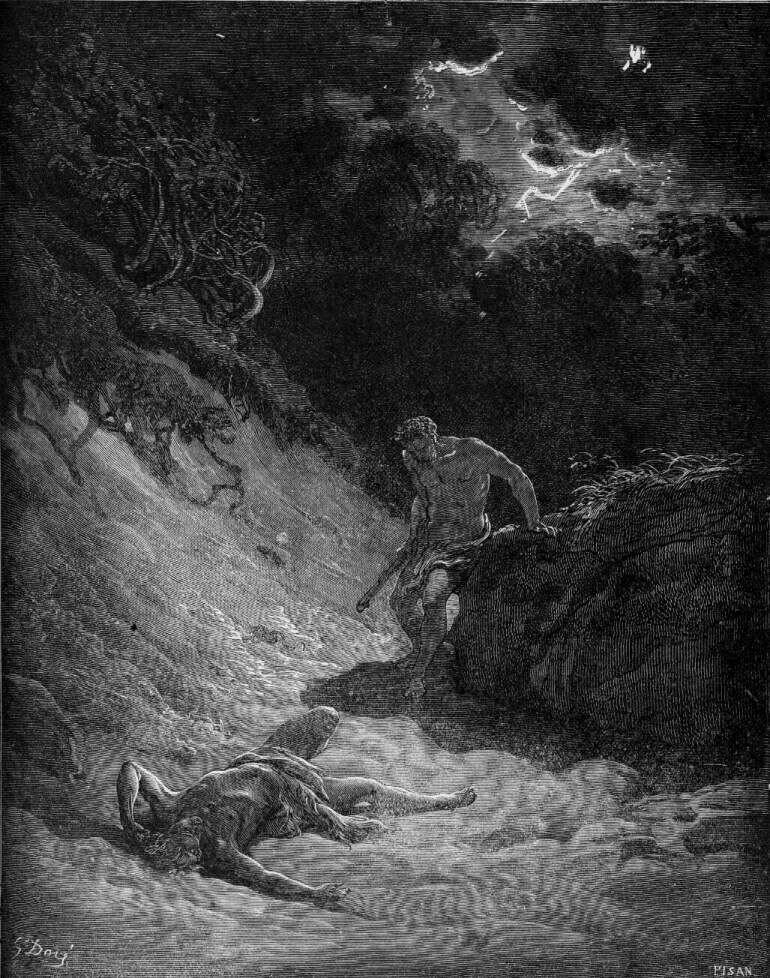
The Murder of Abel – Gustave Dore

There is a well-known account in Scripture (Gen. 4) that on its face seems simple and straightforward. Yet, the Hebrew writer presents a scenario with enormous ramifications. We must dig deep to understand its meaning for us.

Now Adam had sexual relations with his wife, Eve, and she became pregnant. When she gave birth to Cain, she said, “I have acquired a man with God’s help!”  Later she gave birth to his brother and named him Abel.

When they grew up, Abel became a shepherd, while Cain cultivated the ground.  When it was time for the harvest, Cain presented some of his crops as a gift to the Lord. Abel also brought a gift—the best portions of the firstborn lambs from his flock. The Lord accepted Abel and his gift, but he did not accept Cain and his gift. This made Cain very angry, and he looked dejected.

 “Why are you so angry?” the Lord asked Cain. “Why do you look so dejected?  You will be accepted if you do what is right. But if you refuse to do what is right, then watch out! Sin is crouching at the door, eager to control you. But you must subdue it and be its master.”

Early in Hebrew Scripture we learn of pairs and contrast: light and dark, human and animals, Adam and Eve and Cain and Abel. The pairings and contrast are meant to be instructive, as are the names of Cain and Abel.

Although Cain’s name has the primary meaning of “acquire,” the word that his name comes from (קָנָה kanah) also means “to erect, to found,” and “to create.” In Genesis 14:19 we see various translations describe God as either the “Possessor of heaven and earth” (King James Bible, New American Standard Bible, Webster‘s Bible Translation), or “Creator of heaven and earth (New Living Translation, New International Version). Both words “Possessor” and “Creator” are translations of the same word קֹנֵה konay, a cognate of Cain’s name Kayin. What’s In A Name: A Secret About Cain and Abel

In the context of contrasting the brothers Cain and Abel, “Cain!”, an exclamation from mom and the name for her son, connotes “Possessor” and “Creator”. It’s possible that Eve’s new found God-likeness had gone to her head, perhaps claiming co-creation with God. The name signals Eve’s bending in toward self-divination and for her son to project himself in the same way – as self-sufficient creator and possessor of all before him – in contrast to the “Creator and Possessor of heaven and earth”. The pairing of the two names – Cain and Abel – tends toward this interpretation.

Abel as noun הבל (hebel) means vapor, breath, or something very close to nothing. Abel could have been nicknamed Whiff.

I wonder. Did Eve feel exhausted and out of breath chasing after little Cain? Naming her second son Abel implies a here-one-minute-gone-the-next tracking of a little life. Abel’s name is further contexed in Ecclesiastes: Everything is breath (not “vanity”, a current mistranslation). And, in Ps. 39:5, 144:4; Prov. 31:30.

We get the impression from their names that Cain is a rooted of-the-earth man and that Abel is a reed in the winds of heaven. Their vocations tell us more about them..

We learn from the narrative that both brothers are fulfilling the human vocation given earlier in Genesis: dominion and care of animals and the land. They are doing so successfully under God’s blessing and in communion with God. At the end of the year, harvest time, the brothers bring an offering to God. Cain brought only some of the fruits of the soil. Abel brought the fat portions from the firstborn of his flock.

God makes a distinction between the two offerings. God looks with favor on Abel’s offering – the best of what he has. And, God rejects Cain’s token offering. The prophet Malachi gives us some understanding as to what offering the “Possessor of heaven and earth” – the Landowner – desires:

“When you bring injured, lame or diseased animals and offer them as sacrifices, should I accept them from your hands?” says the Lord. “Cursed is the cheat who has an acceptable male in his flock and vows to give it, but then sacrifices a blemished animal to the Lord. For I am a great king,” says the Lord Almighty, “and my name is to be feared among the nations.

-Malachi 1:13-14

God’s response does not go over well with Cain. Farmer Cain, “Possessor” and “Creator” of his own domain, grows an attitude. God notices and issues a warning.

 “Why are you so angry?” the Lord asked Cain. “Why do you look so dejected?  You will be accepted if you do what is right. But if you refuse to do what is right, then watch out! Sin is crouching at the door, eager to control you. But you must subdue it and be its master.”

God gives Cain a choice. He could repent and do right. Then his fallen countenance would be lifted up. He would know joy. Or, if he refuses to what is right sin will have dominion over him. His fallen countenance will remain. Sin’s chaos will rule his life and the lives of his descendants. We learn that Cain, his own man, chooses pathway number two which takes him away from home and out of God’s sight (does he think this?):

Cain said to Abel his brother, “Let us go out to the field.” And when they were in the field, Cain rose up against his brother Abel, and killed him. -Gen. 4:8

The advent of civilization (Gen. 4:17-26) is stained by a wrong choice, one made out of anger and of a desire for revenge. The horrific ramifications of the wrong choice are the pollution of the land, blood guilt and curses (as opposed to God’s blessing). The Land Owner had warned the tenant and now asks Cain the same question posed to Adam (Gen. 3: 9):

 Then the Lord said to Cain, “Where is Abel your brother?” He said, “I do not know; am I my brother’s keeper?” And the Lord said, “What have you done? The voice of your brother’s blood is crying to me from the ground. And now you are cursed from the ground, which has opened its mouth to receive your brother’s blood from your hand. When you till the ground, it shall no longer yield to you its strength; you shall be a fugitive and a wanderer on the earth.” Cain said to the Lord, “My punishment is greater than I can bear. Behold, thou hast driven me this day away from the ground; and from thy face I shall be hidden; and I shall be a fugitive and a wanderer on the earth, and whoever finds me will slay me.” Then the Lord said to him, “Not so! If anyone slays Cain, vengeance shall be taken on him sevenfold.” And the Lord put a mark on Cain, lest any who came upon him should kill him. Then Cain went away from the presence of the Lord, and dwelt in the land of Nod, east of Eden. -Gen. 4:9-16

 Cain lies and evades responsibility for his actions. The sin in his heart is growing rapidly. It is taking dominion over him, the self-made dominionist. Cain’s domain, his farm land, is now working against him and Cain has become more cursed than the land. The once solid self-defined man is to become a wanderer through life– fleeting, ephemeral, mortal, transient, without strength, a passing wind, …a breath.

Cain, beginning to feel the weight of his actions, balks at his punishment. But murder is no small thing. Murder brings about a greater punishment, as we learn in Numbers 35:33:

Do not pollute the land where you are. Bloodshed pollutes the land, and atonement cannot be made for the land on which blood has been shed, except by the blood of the one who shed it.

But in the Cain and Abel account God does not take a life for a life. Rather, as an act of mercy, God exiles Cain from his home, from others and from the land, his source of strength. Cain is removed from out of the context of God’s blessing. Exiled, Cain still has a chance to repent and return to the Land Owner.

As Cain finds out, man’s sin affects the land that we are to have dominion over. Hosea wrote about it (Hos. 4: 2-3):

There is only cursing, lying and murder,
stealing and adultery;
they break all bounds,
and bloodshed follows bloodshed.
Because of this the land dries up,
and all who live in it waste away;
the beasts of the field, the birds in the sky
and the fish in the sea are swept away


 This early account in Scripture is a study of contrasts. It reveals two ways of being and two distinct personalities. There are the Abels who acknowledge the transient and dependent nature of their being, as in the words of the Psalmist (39:5)

You have made my days a mere handbreadth;
    the span of my years is as nothing before you.
Everyone is but a breath,
    even those who seem secure.

And, there are the Cains who deem themselves god-like Creators and Possessors and thereby mocking the One True Creator and Possessor, as described in Prov. 21:24:

The proud and arrogant person— “Mocker” is his name—
    behaves with insolent fury.

There is an offering of the best portion and there is an offering of a token. Clearly from this account and from many more, our offerings reveal what we think about God. Do we view God as Creator and Possessor? Do we view God as the Land Owner under Whom we work as faithful stewards and return the best of our stewardship? Or, do we see God as an obligation that needs to be dealt with on our terms?  (See the Parable of the Ten Talents, Matt. 25: 14-30) (See also the account of Ananias’ and Sapphira’s token offering in Acts chapter 5. It doesn’t end well!)

The Cain and Abel account reveals that there is God’s view of things and man’s. God’s warning to Cain makes His view clear beyond a doubt. And though a victim is entitled to revenge in the Old testament God does not take revenge. Rather, God lets Cain live with the consequences of his actions. “You want to live outside my blessing – Go for it!”

 This account reveals that Biblical ethics are not the same as Biblical Law. God does not take a life for a life. God does not seek monetary compensation (2 Sam. 21). The Law should be read in a larger context. Jesus tried to get the Scribes and Pharisees to understand the bigger context, the Big Picture, of His work of Redemption.

One final contrast. Abel – “breath” or “breeze” – dies in accordance with the transient nature of human existence. Cain, who saw himself as the rooted “Creator” and “Possessor” is to wander the earth like a breeze. As a fugitive he has to keep moving. He’s not tied to the land (a symbol of his strength) as he once was. What Cain had refused to accept of God and of his brother Whiff he now has to accept as his existence “east of Eden”.

Deliver Us from Evil

Evil and its enforcer, power, has been around long before man employed both to consolidate empires. Cain killed Abel to gain power over the living reminder of his own disobedience. Joseph’s brothers sold Joseph into slavery to gain power over the living reminder of their supposed unfair treatment and over their father’s love and estate. Evil and its enforcer, power, have always worked together with ruthless abandon to take truth hostage.

 “Violence finds its only refuge in falsehood, falsehood its only support in violence.”

-Aleksandr Solzhenitsyn

An astute student of world history would discern that seeking and holding absolute power is valued as far superior to seeking and holding absolute truth. Those who hold power believe they can generate a ‘regime of truth’ by virtue of their position: “truth is what I say it is.”. Anyone attuned to current world affairs can readily see that culture and politics, including our democratic Republic in the U.S., revolve around who holds what power and therefore controls what is and what has been. For, as Winston repeated over and over in George Orwell’s 1984, “who controls the past, controls the future: who controls the present controls the past.” A student of Scripture will see that the regimes of power and truth, beastly kingdoms, are made subject to Absolute Power and Absolute Truth.

It has been said that the gospel crafted by Mark, an ace narrator, was written to a Roman audience. Certainly, there is a “just then” immediacy to his gospel. A sense of action is invoked which would peek a centurion’s ‘man of action’ curiosity. Of more importance to a Roman though, and to any earthly authority and to those under authority, is the theme of who holds power. On earth, regimes of power control regimes of truth. The spiritual world of unclean spirits requires a human habitation to control truth incarnate (Rom. 1:21). Mark’s gospel is the proclamation of a new regime of power and has nothing to do with a justice league of super-heroes with super powers.

In terms similar to announcing a new emperor who claimed to be a son of god, Mark begins his gospel by proclaiming Jesus’ title:

“This is where the good news starts – the good news of Jesus the Messiah, God’s son.”

With this proclamation a new regime is declared. The title acknowledges Jesus’ authority and connotes his power. The title announces what Israel had so hoped for — a Messiah, one who is anointed by God and therefore God’s representative. The Hebrew scriptures chronicled anointed kings, priests and prophets who represented God to Israel. The book of Daniel and writings between the Testaments, in particular the Messianic Apocalypse and the Son of God text from the Dead Sea Scrolls, record Jewish Messianic beliefs in ancient Judaism. In these texts, “Son of Man” is the title given to the one who will reign and hold dominion over all things and offer blessings to those under him.

The new regime, anticipated in Psalm 146 and the Messianic Apocalypse, comes with four blessings:

-The hungry are fed

-the prisoner is set free

-the blind receive their sight

– all things are put right.

Mark’s opening statement declares Jesus to be the anointed One of God. And, of vast more import to the Jews and to the regimes of power and truth, Jesus is declared to be not just another mere mortal claiming to be a son of god, but the One God’s own Son. Human and spirit and citizen and centurion encounter Jesus in Mark’s account. They soon come to this realization.

In the first paragraphs of Mark, Jesus’ baptism by John the Baptist is recorded. Here is the anointing of Jesus by water, by the spirit and by The Voice from the realm of heaven: “You are my son! You are the one I love! You make me very glad!”

Next, Jesus is tested by the Satan. The temptation is for Jesus to accept the realm of power and authority that the Satan offers to him.

A few paragraphs later we read of Jesus and his new disciples going to Capernaum. There Jesus encounters a force from the realm of darkness, the same realm offered to him by the Satan:

They went to Capernaum. At once, on the sabbath, Jesus went into the synagogue and taught. They were astonished at his teaching. He wasn’t like the legal teachers; he said things on his own authority.

All at once, in the synagogue, there was a man with an unclean spirit.

“What business have you got with us, Jesus of Nazareth?” he yelled. “Have you come to destroy us? I know who you are: you’re God’s Holy One!”

“Be quiet!” ordered Jesus “And come out of him!”

The unclean spirt convulsed the man, gave a great shout, and came out of him. Everyone was astonished.

“What’s this?” they started to say to each other. “New teaching – with real authority! He even tells unclean spirits what to do, and they do it!”

Mark’s gospel account goes on to detail events which show the authority and power of Jesus. Over and over we read of Jesus’ power over demons, the unclean spirits which roam the earth seeking whom they may inhabit. Realms of power are juxtaposed – heaven’s and the dark forces of the Satan which control men. They are shown in direct conflict. And note above: the unclean spirt knows who Jesus is and by whose authority he works before anyone else in the story. But why does Jesus stop the demon from declaring his identity? Mark’s beginning narrative imposes a tension that is resolved at the end of his gospel.

Before the end of the gospel we read of exorcisms. The realms of darkness are dealt with in these passages:

Mark 1:21-28 – shown above

Mark 5:1-20 – a wild untamed man with inhuman strength is possessed by an unclean spirit. He lives in a graveyard. We read that “No one had the strength to tame him”. This demon possessed man sees Jesus and throws himself in front of Jesus and shouts at the top of his voice…

“Why you and me, Jesus?”  “Why you and me, son of the High God?” By God stop torturing me!”  this last, because Jesus was saying to him “Unclean spirit, come out of him!”

Jesus cast The Legion of demons into a herd of pigs. The pigs then rush to the sea where they drowned. (The unclean spirits leave the dead pigs and go on searching for someone to inhabit.)

Mark 7:24-30 – a Greek woman throws herself at Jesus’ feet. She pleads with Jesus to cast an unclean spirit out of her daughter. After hearing the gentile woman’s “even the dogs under the table eat the crumbs that the children drop” Jesus affirms her words and sends her on her way. Her demon-possessed daughter back at home was rid of the unclean spirit.

Mark 9:14-29 – a father brings his demon possessed son to Jesus. The disciples could not cast out the demon. Jesus is notably angry at the unbelief in the power of God, especially when the father hedges, “…if you can do anything…” Jesus reprimands the father. “What do you mean, ‘If you can?” “Everything is possible to someone who believes.” The father shouts “I do believe! “Help me in my unbelief!” Jesus commands the unclean spirit to come out of the boy. The boy convulses and the unclean spirit comes out. The disciples go to question why they were ineffective. Jesus responds, “This sort can only be cast out by prayer.”

In Mark 3:15, 6:7 & 13 and 9:38-39 Jesus gives his followers the authority to cast out unclean spirits.

Mark is an excellent story-teller. As you read above, tension was imposed by Mark in the beginning paragraphs – the silence imposed on the unclean spirit who disclosed Jesus’ identity. This was done to pique the reader’s curiosity. Mark wanted the reader to discover for themselves who Jesus is. Like those involved with Jesus, the reader would question “Is Jesus really the Messiah?” and “Is Jesus really God’s son?” Each encounter and event would provoke questioning and amazement in the reader: “What’s this?”; “New teaching – with real authority! “He even tells unclean spirits what to do, and they do it!” And then the crucifixion appears to give the regime in power – the Romans- the final word about Jesus. But Mark gives us the final word through the mouth of a centurion:

When the centurion who was standing facing him saw that he died in this way, he said, “This fellow really was God’s son.”

The tension is resolved by an onlooker.


Lest anyone think that Jesus’ sole purpose on earth was to promote social justice and to have his words later passed on as “all you need is love” sixties-style bromides, Mark’s gospel declares to us that Jesus came to deal with evil and its enforcer, power, and with the agents of corruption possessing a will.

Mark declares that there is a new Lord in power, one with all authority in heaven and on earth. As shown by Mark, no power-enforced “regime of truth” on earth or under the earth can take Jesus’ truth hostage. Truth is what Jesus says it is and his truth can set a person free from power-and will-enforced bondage. No regime of power on earth or under the earth can keep his creation hostage. The world of men is to be set free and blessed by his reign. He chose his followers to make that happen.

Jesus has conferred his authority and power to his followers so that the blind will receive their sight and the hungry are fed and the prisoners are set free and unclean spirits are cast out. The world is to be put right under his Lordship.

To sum Mark’s gospel into today’s media parlance, Jesus slammed, crushed and owned the enemy of our souls. To sum Mark’s gospel in Scriptural phrasing…

The kingdom of the world has become the kingdom of our LORD and of his Messiah, and he will reign for ever and ever. -The Revelation of Jesus Christ 11:15

Leech or Lizard?


 When you think of Thanksgiving you of think family, food and football. Let me suggest a fourth focus: creature features.


The Book of Proverbs, found in the wisdom literature of the Bible, offers insight into the human condition. From my youth on I have asked God for wisdom, knowledge and a good understanding. I have not always used the wisdom, knowledge and understanding given me. Much of my younger life can attest to Proverb’s description of fools and folly.

Proverbs contrasts fools and folly with those who gain wisdom and avoid imprudence. Proverbs gives us examples of what one should not be like and what one should be like. Leeches and lizards are among the examples. Let’s start with leeches.

The leech has two daughters. ‘Give! Give!’ they cry. Prov. 3:15 

How would you characterize a leech? The picture that first comes to mind is that of a bloodsucker that extracts what it wants and then goes on to the next source to extract again. Personified as above, do you see them as never satisfied? As never contented? As always craving more?  Are they greedy and covetous? Are they insatiable in their appetite? Do they see themselves as deserving and therefore warranted in entering your space and presenting their unending demands? What about another space intruder, the lizard?

a lizard can be caught with the hand, yet it is found in kings’ palaces. Prov. 30:28

Lizards, the proverb says, can be easily controlled but they show up in highly respectable places, places like lavish Caribbean hotels. Lizards like to come indoors for a meal. They are attracted by an insect infestation. Due to their small size, tiny gaps or cracks around doors and windows can be enough for geckos to let themselves in. Some owners may allow a few innocuous lizards to come and take care of the greater insect problem. And, insects are not as ‘cute’ as Geckos. The GEICO commercials invite us to let them into our lives to solve insurance problems.

The creeping and crawling Lizards can be held in check but they show up anyway in king’s palaces looking for insects hiding in dark places and likely feasting on the crumbs dropped from the royal table.

The Gospels provide with us with human examples of these creature’s features:

A recent review of a first century survey (Luke 17) found that nine out ten lepers do not give thanks. Apparently, nine lepers saw Jesus, latched on to his presence and demanded ‘Give! Give! And one leper, the out of place Samaritan, saw Jesus, creeped up slowly and waited for the crumbs to fall from the Master’s table. When Jesus healed all ten of the lepers, the nine leeches went on their way feeling they got what they deserved. But the once dried, scaling, atrophic, depigmented-skinned lizard returned and gave thanks for being allowed into the royal court and receiving a new skin on life.

As we learned, one can live their life as a leech: show up, latch on, cry ‘Give! Give!’, take and feel deserving and ungrateful. Or, one can live life as the lowly out of place lizard who shows up in our King’s palace looking for the means to go on.  The latter provides us with a prime example of grace – that easily controlled lowly lizards like us are even allowed a notice and a few bread crumbs that fall from the King’s table. Thanks be to God.


Marginalizing Truth…


…to Fit Around One’s Agenda

Below, a recent Tweet by the same Jesuit priest referred to in my previous post. James Martin, as he often does, redefines the Gospel so as to frame the #LGBT as “intersectional” (I’m using a popular SJW word) with those who may be on the fringe of society – in other words, those deemed as being over-looked and under-loved. The LGBT’s one-of-a-kind “trials”, he posits, must be considered independently and also, curiously, in relation to others who have suffered some…thing.

Martin is seeking to brand himself as the patron saint of gays. He may well succeed with his populist mission in the venue of the Catholic church. Know that he will be held accountable for his use of the Gospel as a means to an end.

Here are my replies to his Tweet:

And…

1/Jesus’ encounter w/Zacchaeus (whose name means “pure”; a chief tax-collector) reveals the POWER OF GOD to redeem a man’s life…

2/3-Zacchaeus completely repents: he finds that the Kingdom of God is worth more to him than riches & power. Read the full account: (Luke 19:1-10)

https://www.biblegateway.com/passage/?search=Luke+19:1-10&version=NIV

3/3-Jesus’ encounter w/Paul on the Damascus road is another example of the life changing POWER OF GOD affecting those who have power over others

 Added 10-8-2017:

As I have said, the LGBT are self-marginalizing: (Caution vulgar and repulsive language)

As recorded in the four Gospels and also in the Book of Acts, Jesus and his Apostles encounter those in power and those under the influence of power. Jesus and his Apostles redefine power in every instance.  In so doing they proclaim the Lordship of Jesus the Christ and introduce them to the Kingdom of God on earth. More about this in a subsequent post.

Haman and Hate (and Hamas by Proxy?) meet the Hangman, Conclusion

Part One: A Feast for the Eyes

Part Two: Persia Meets Reality and Esther

Part Three: Haman and A Star is Worn


Mordecai sitting at the King's Gate-all ears and eyes

Mordecai sitting at the King’s Gate-all ears and eyes


Haman is booked

Haman is booked


Part Four, Conclusion: Who Remains Silent in Times Like These?

 “The entire story of Israel, on one level at least, is the story of how Israel’s God is taking on the arrogant tyrants of the world, overthrowing their power, and rescuing his people from under its cruel weight.” N.T. Wright, “How God Became King”

 As we have learned so far, Persian King Xerxes and his right hand man Haman have issued decrees, edicts and proclamations. At the urging of Haman a death warrant for the Jews was sent throughout Xerxes’ vast kingdom.

 The edict, that genocide of the Jews was to occur on a certain day, is shouted from the citadel in the capital city of Susa. The targeted Jew’s days are numbered: on the thirteenth day of the twelfth month, the month of Adar the Jews are to be annihilated, their property plundered.

 This horrifying declaration is soon answered by the Jewish population. The people mourn and fast. They put on sackcloth and ashes as signs of their distress. Xerxes and Haman, on the other hand, party on.

 But then banqueting tables are turned and the Jew’s great sadness is turned to rejoicing. Moving quickly though the events we’ll see how.

 Before we go on you should know this Resurrection Day that…The days of evil are numbered and the Day of Final Deliverance from Death is at hand. The empty tomb is the proclamation of our deliverance from both evil and death, on a certain future day. The Purim celebration would become a foretaste of deliverance. Resurrection day is the foretaste of the Day of Deliverance.

 From Chapter One of The Book of Esther: King Xerxes, in response to Queen Vashti’s no-show at the royal bacchanalia deposes Queen Vasti and sends out a decree to everyone in his kingdom, a decree proclaiming that every man should be ruler over his own household.

From Chapter Two: Esther is fast-tracked by the head eunuch to become Xerxes new queen. The king then gives a great banquet, “Esther’s Banquet” to show off his queen to all his nobles and officials. Xerxes proclaims a holiday throughout the provinces and distributed gifts with liberality. Mordecai’s salvation of Xerxes from an assignation attempt is recorded in the king’s record books.

 From Chapter Three: Xerxes honors Haman, making him his right-hand man. Haman is paraded about and is honored by all except a particular Jew-Mordecai. Haman’s ego is crushed. His anger turns to hate. Haman chooses to become anti-Semitic. Haman complains to Xerxes about a “certain people”.

 Xerxes to Haman regarding the Jews, “do with the people as you please.” A genocidal Death Warrant is issued after the king’s authority via his signet ring is handed over to Haman. A copy of the text of the edict is to be issued as law in every province and made known to the people of every nationality so they would be ready for that day.  …couriers went out, spurred on by the king’s command, and the edict was issued.”

Chapter 4: Mordecai, Esther’s uncle, hears about the edit. It is shouted from the citadel in the capital city of Susa. Mordecai is stunned. With sackcloth and ashes Mordecai let’s the world know, and more importantly, let’s God ‘know’ that he is mourning the loss of his family and his people the Jews. (Notice how Mordecai’s protest (like Job’s) is personal and self-effacing and not riotous, vulgar, angry and destructive like today’s demonstrations?)

Important to our understanding of The Book of Esther wherein there is no mention of God is the fact that God had promised Abraham in a covenant (see Genesis 15) that “a) Abraham’s seed would become as numerous as the stars of heaven, b) his family would be exiles in a foreign land and eventually be brought out, and c) his family would inherit the land of Canaan.” (N.T. Wright, “Justification”.)

Mordecai’s great distress is based, I believe, on his understanding of God’s promises to Abraham and his understanding of God righteousness–God keeping his promises-and the declared challenge to God’s faithfulness by an earthly tyrant. Sackcloth and ashes are man’s quiet submission to God: man is dust and will return to dust and that salvation alone comes from God. Let’s see what happens next.

Esther quickly learned about Mordecai’s distress. She sends him new clothes to put on, to comfort him. She did not know about the edict.

Mordecai responds to the eunuch sent by Esther. He hands him the edict to give to Esther. Mordecai tells the eunuch that Esther must approach the king and get him to rescind this edict. Esther receives the news with great dread. She replies to Mordecai that people who just show up at court uninvited are put to death. And, “…thirty days have passed since I was called to go to the king.”

When Esther’s words were reported to Mordecai, he sent back this answer: “Do not think that because you are in the king’s house you alone of all the Jews will escape. For if you remain silent at this time, relief and deliverance for the Jews will arise from another place, but you and your father’s family will perish. And who knows but that you have come to your royal position for such a time as this?”(emphasis mine)

 Then Esther sent this reply to Mordecai:  “Go, gather together all the Jews who are in Susa, and fast for me. Do not eat or drink for three days, night or day. I and my attendants will fast as you do. When this is done, I will go to the king, even though it is against the law. And if I perish, I perish.”

So Mordecai went and carried out all of Esther’s instructions. The Jews in every corner of the kingdom fasted for three days.

Submission takes the high road.

Maybe you have noticed by now that submission plays a big role in this and other Biblical narratives. Putting on sackcloth and ashes and fasting are forms of submission. Replying, “If I perish, I perish” is another. Recall Mary’s submission to the angel regarding her being impregnated by the Holy Spirit? “I am the Lord’s servant,” Mary answered, May it be to me as you have said.” And, we must recall our Lord’s submission to the Father’s divine purpose: “Father, if you are willing, take this cup from me; yet not my will, but yours be done.”

 The act of submission to a sovereign God even when God’s presence and His direct intervention are not evident is described for us in a ‘genealogy of faith found in Hebrews chapter 11. There we read of the “By faith…” accounts of individuals who submitted themselves to God. That submission is faith in the righteousness of God. It is saying God keeps His promises and that He does so no matter what men do to affect them, even up annihilation of those promises personified in God’s people the Jews.

 Submission to a scepter

After three days of fasting Esther puts on her royal robes and presents herself to the King. She appears in the hallway within direct view of the king. She anxiously awaits his invitation. Xerxes scepter is offered to her. Esther touches the tip of scepter showing respect and submission to his authority.

Civil disobedience and submission

Civil disobedience and submission

 Now imagine for a moment being Queen Esther. Xerxes, the King of his household had, had by proxy decree allowed for the annihilation of her people the Jews without giving it second thought. Queen Esther no doubt felt that her life hung in the balance, one side of the scale weighted against her. But then the finger God was upholding her.

 The king asked Esther “What is your request? Even up to half the kingdom, it will be given you.”

Esther’s response is not direct. She invites Xerxes and Haman to a banquet that same day. The banquet happens, the wine is poured and again the king asks Esther what her petition is. And again, Esther, faltering in courage, suggests another banquet the next day and “Then I will answer the king’s question.” On to banquet number two and a swelling ego.

 With banquet number one under his belt and banquet number two written into his day planner Haman is pretty impressed with himself. He brags to his wife and friends that it was only the King and himself who were invitees to the Queens banquets. Haman boasts of his great connections and vast wealth. Yet, there was something sticking in his craw-that Mordecai who is mourning everyday at the gate in sack cloth and ashes.

 Haman’s wife, knowing that Mordecai was the decreed king of his household offered a solution to Haman’s hangdog demeanor.

“Have a gallows built, seventy-five feet high, and ask the king in the morning to have Mordecai hanged on it. Then go with the king to the dinner and be happy.” In other words, “Don’t Worry. Be Happy!” Haman liked the idea and had the gallows built. Problem solved.

 Sleepless in Susa

That same night the king couldn’t sleep. This was due to too much wine at the banquet or perhaps God’s purpose was the pea under the mattress. Whatever the reason the king ordered his favorite book to be brought in-the king’s chronicles. These books were records all of the king’s doings, perfect for nights like these.

The king ordered his favorite book to brought in-the king’s chronicles. These books were records all of the king’s doings, perfect for nights like these.

 Lo and behold, what was long ago forgotten was still in black and white on the parchment- Mordecai had saved the king by exposing an assassination plot. The king then asked his attendants what had been done for Mordecai. Such an act of respect for the king’s life should be honored. His attendants answered, “nada” (I don’t know Persian for “nothing.”) The king wanted to settle up with Mordecai immediately so he asked his servants, “Who is in the court?”

 Lo and behold, Haman, the proud, is, at that very moment, standing in the outer court hoping to get permission from the king to have Mordecai hanged. Haman, too, wanted to settle up quickly as possible.

 Haman enters the king’s presence and immediately the king asks Haman “What should be done for the man the king delights to honor?”

 Haman, already full of Haman, thinks the king is, of course, talking about whom else but Haman. Haman, with great flare, then details a litany of delights that the king should lavish on such a man.

 The king commands Haman, “Go at once.” “Get the robe and horse and do just as you have suggested for Mordecai the Jew, who sits at the king’s gate. Do not neglect anything you have recommended.” Oh, the irony.

 Haman did as the king commanded. He paraded Mordecai through the city streets proclaiming as he went, “This is what is to be done for the man the king delights to honor!”

Carpe the irony:  Haman is leading Mordecai through Susa

Carpe the irony: Haman is leading Mordecai through Susa

 Afterward Mordecai returned to the king’s gate (nothing had changed; a curious ride through the city on horseback does not a decree rescind). Haman returned to his wife and friends and gave them the low down.

 Zeresh, Haman’s wife, taking the reins away from Haman decides, like many others had in recorded history, that it is time to stop messing with the Jewish people. In her mind the Jews’ God defends them. He is real. Enough already, Haman, your pride is plaguing us. Be done with this man and his people.

 While she is talking Haman is whisked away to banquet Number Two

 No Fear (well maybe some)

 King Xerxes and Haman, knees knocking I’m guessing, dine with Queen Esther a second time. And, a second time the king asks Esther, “What is your request? Even up to half the kingdom, it will be given you.”

 “Then Queen Esther answered, “If I have found favor with you, O king, and if it pleases your majesty, grant me my life-this is my petition. And spare my people-this is my request. For I and my people have been sold for destruction and slaughter and annihilation.”

 Well, king Xerxes is greatly troubled by such a statement. He wonders out loud who would do such a thing “Who is he?” ”Where is the man who would dare do such a thing?”

 “Esther said, “The adversary and enemy is this vile Haman.” 

Esther points out the evil.

Esther points out the evil.

In a rage, knowing that he had been used by Haman, Xerxes got up from the dinner and went into the palace garden. In the mean time, Haman knowing that his life is over throws himself at Esther’s feet and begs for his life. The king returns and finds Haman now clawing at Esther. His rage grows.

As it is written, one of the eunuchs attending the king, Harbona, pointed in the direction of Haman’s house. He told the king that Haman had erected a seventy-five foot high gallows on which to hang Mordecai, “the same Mordecai who helped my lord.”

 The king didn’t ponder this at all. “Hang Haman on that same gallows”. Then his fury subsided. Problem solved. Seventy-five feet: my how the mighty have fallen! 

Evil begs for mercy and finds none.

Evil begs for mercy and finds none.

The tables are turned

 That same day King Xerxes gave Queen Esther the estate of Haman. Esther told the King of her uncle and how he adopted her after her parents had died. The king took off his signet ring and put it on Mordecai’s finger. Mordecai was appointed the head of Haman’s vast estate by Esther. But, a decree was still out there and could not be rescinded. Something had to be done before the day of annihilation.

 Déjà vu all over again but this time Sovereignty steps in.

 Esther once again approached the king weeping and pleading for the life of her people. She asked for a counter decree to be issued. King Xerxes answered both Esther and Mordecai, “Write another decree in the king’s name in behalf of the Jews as seems best to you.”

 So, all the same secretaries who were summoned once before to write out the Jew’s death warrant were summoned again. Mordecai’s counter decree would allow the Jews to defend themselves from all enemies and to take their plunder. The edict was dispatched via multiple couriers to the 127 provinces of king Xerxes.

 “The couriers, riding the royal horses, raced out, spurred on by the king’s command. And the edict was also issued in the citadel of Susa.” The response is celebration in each Jewish community.

 “In every province and in every city, where ever the edict of the king went, there was joy and gladness among the Jews, with feasting and celebrating. And many people of other nationalities became Jews because fear of the Jews had seized them.”(emphasis mine)

 Hate has its day in the People’s Court

Haman’s day of holocaust, the thirteenth day of the twelfth month of Adar, finally arrived. But the Jews had prepared to defend themselves. Mordecai’s edict gave them the power to stand against their enemies and take their plunder. And so the attempt at genocide began throughout the kingdom.

 It is written about the Jews, “No one could stand against them, because the people of all other nationalities were afraid of them. And all nobles of the provinces, the satraps, the governors and the king’s administrators helped the Jews because fear of Mordecai had seized them….The Jews struck down all their enemies with the sword, killing and destroying them, and they did what they pleased to those who hated them…But they did not lay hands on the plunder.”

 In summary, the last two Chapters of The Book of Esther detail the extent of the Jews self-defense against hatred. Various numbers of deaths occur in different places within the 127 provinces. In one verse (16 of Chapter 9) it is written that seventy-five thousand enemies of the Jews were killed. That is seventy-five times one thousand deaths or one thousand deaths for each foot of height of the “Haman Gallows”

 Speaking of justice by extrapolation, Haman’s ten sons, the ten acorns that don’t fall far from the tree are hanged on their father’s gallows. The Jews understood that evil is passed down from generation to generation. The sins of the father, in this case anti-Semitism, would continue to manifest its ugly hatred if not nipped in the neck. 

Haman meets the end of his rope.

Haman meets the end of his rope.

After all of the fighting had stopped and the Jews enemies vanquished, Mordecai sent letters to all the Jews in every province of King Xerxes. He declared these days of Adar to become an annual celebration, “as the time when the Jews got relief from their enemies, and as the month when their sorrow was turned to joy.” These days would become known as The Feast of Purim, “For Haman son of Hammedatha, the Agagite, the enemy of all the Jews, had plotted against the Jews to destroy them and had cast pur (that is, the lot) for their ruin and destruction.”

 The balance of The Book of Esther tells us that all of the prior events were recorded for posterity in the king’s books. Mordecai was held in high esteem by all who knew his name.


 Something to think about this Resurrection Day

You may cast your lot with those who hate the Jews but the outcome will be the same as those enemies of the Jews in the Kingdom of the Media and Persia. This historically proven pronouncement includes Hamas, the anti-Semitic Boycott-Divest & Sanction (BDS) groups, Iran-The Islamic Republic, ISIS, anti-Semitic Europeans and all those who hate the Jews. So all such, you are forewarned. And, nuclear bombs are no threat to the God who created the vast universe, the infinitesimal atom, a particle’s chirality and also allowed man to find quantum mechanics among the mysteries of life. God knows the number hairs on your head. Did you think that he doesn’t notice the hatred raging in your head?

If you cast your faith on God’s sovereignty you will find that God is faithful to his covenant promises. Make a stand with God and you find God standing with you (read about Shadrach, Meshach, and Abednego in the book of Daniel). Esther’s life is an exemplary illustration of submission to God’s sovereignty.

 Esther, in an act of civil disobedience came before King Xerxes and spoke truth to power. It took Esther a couple of banquets to ramp up the courage but Esther made a stand for herself and for the people of God.

Esther is also an example of one life given as a ransom for many (see the Gospel of mark, chapter 10, vs. 45 regarding these words spoken about Jeshua, Jesus).

 It has been said that the degree of anti-Semitism in a society is an indicator of its health. Look at Europe to see where the U.S. is heading.

 Finally, Orthodox Christian theologian Charles Malik who was also a Lebanese diplomat, political theorist, philosopher and president (1958) of the U.N.’s General Assembly wrote a book titled “Christ and Crisis” (1962).

 Malik’s definition of crisis: “the crisis is simply the fact that Jesus Christ is the Lord and is judging.”

 Malik warned that “The greatest weakness of Western strategy is its relative neglect of the intellectual and spiritual dimension.”(emphasis mine)

 When facing a crisis at any level, in any context we must confront it with courage and the cross.

 In 1962 Malik wrote,

“There are three unpardonable sins today, to be flippant or superficial in the analysis of the world situation, to live and act as though halfhearted measures would avail; and to lack the moral courage to rise to the historic occasion.”

 Esther understood “crisis” and acted with sober courage to avert a holocaust that was decreed with hatred within the shadow of a gallows. (See also the life of Dietrich Bonheoffer.) 

Who Remains Silent in Times Like These? 

***

For current information regarding the increasing anti-Semitism in our world bookmark this website: LegalInsurrection

 Here is a sample post: Vienna, “Free, Free Palestine” chant becomes “Kill, Kill the Jews”