Gustave Dore
August 4, 2010 Leave a comment
The Destruction of Sodom by Gustave Dore
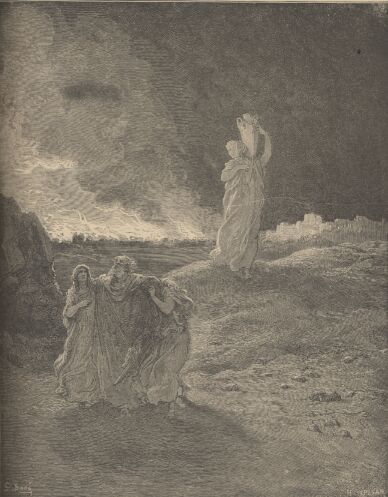
Walking around on Resurrection ground
August 4, 2010 Leave a comment
A.W. Tozer, quotes:
“To be right with God has often meant to be in trouble with men.”
“In almost everything that touches our everyday life on earth, God is pleased when we’re pleased. He wills that we be as free as birds to soar and sing our maker’s praise without anxiety.”
“What comes into our minds when we think about God is the most important thing about us.”

“It will be a new day for us when we put away false notions and foolish fears and allow the Holy Spirit to fellowship with us as intimately as He wants to do, to talk to us as Christ talked to His disciples by the sea of Galilee. After that there can be no more loneliness, only the glory of the never-failing Presence.”
July 25, 2010 Leave a comment
By faith:
-Abel offered God a better sacrifice
Abel was commended as a righteous man;
Abel still speaks, even though he is dead.
-Enoch was taken from this life, so that he did not experience death.
-Noah built an ark to save his family; Noah condemned the world and became heir of the righteousness that comes by faith.
-Abraham obeyed and went; he made his home in the promised land. Abraham, even though he was past age—and Sarah herself was barren—was enabled to become a father.
(Now all these people were still living by faith when they died. They did not receive the things promised)
Abraham, when God tested him, offered Isaac as a sacrifice.
-Isaac blessed Jacob and Esau in regard to their future.
-Jacob, when he was dying, blessed each of Joseph’s sons.
-Joseph, when his end was near, spoke about the exodus of the Israelites from Egypt.
-Moses’ parents …were not afraid of the king’s edict. Moses, when he had grown up, refused to be known as the son of Pharaoh’s daughter. Moses chose to be mistreated. Moses regarded disgrace for the sake of Christ as of greater value than the treasures of Egypt. Moses left Egypt; he persevered because he saw Him who is invisible. Moses kept the Passover.
-The people passed through the Red Sea.
-The walls of Jericho fell.
-The prostitute Rahab, because she welcomed the spies, was not killed with those who were disobedient.
-Gideon, Barak, Samson, Jephthah, David, Samuel and the prophets, who through faith conquered kingdoms, administered justice, and gained what was promised;
-There are those who shut the mouths of lions, quenched the fury of the flames, and escaped the edge of the sword; Their weakness was turned to strength; and who became powerful in battle and routed foreign armies.
-Women received back their dead, raised to life again.
-Others were tortured and refused to be released, so that they might gain a better resurrection.
-Some faced jeers and flogging, while still others were chained and put in prison.
-They were stoned;
-They were sawed in two;
-They were put to death by the sword.
-They went about in sheepskins and goatskins, destitute, persecuted and mistreated— the world was not worthy of them.
-They wandered in deserts and mountains, and in caves and holes in the ground.
These were all commended for their faith, yet none of them received what had been promised.
God had planned something better for us so that only together with us would they be made perfect.
Faith is a time machine…I am a time traveler. There is a great cloud of witnesses to these facts.
July 22, 2010 Leave a comment
“One of the tendencies of this age is to use the suffering of children to discredit the goodness of God, and once you have discredited his goodness, you are done with him. The *Alymers whom (Nathaniel) Hawthorne saw as a menace have multiplied. Busy cutting down human imperfection, they are making headway also on the raw material of good. Ivan Karamazov cannot believe, as long as one child is in torment; Camus’ hero cannot accept the divinity of Christ, because of the massacre of innocents. In this popular pity, we mark our gain with sensibility and our loss in vision. If other ages felt less, they saw more, even though they saw with the blind, prophetical, unsentimental eye of acceptance, which is to say, of faith. In the absence of this faith now, we govern by tenderness. It is a tenderness which, long since cut off from the person of Christ, is wrapped in theory. When tenderness is detached from the source of tenderness, its logical outcome is terror. It ends in forced labor camps and in the fumes of the gas chamber.” Flannery O’Connor, Introduction to A Memoir of Mary Ann, 1961
*The Alymers is a generic reference to the husband/scientist in a short story by Nathaniel Hawthorne, The Birthmark.
July 1, 2010 Leave a comment

Have you ever been in a close relationship with someone and they apologized to you in this manner: “I’m sorry I said ‘this’. I said ‘this’ because of what you did.” The apology is based on the premise that the apologizer is only just responding to your bad behavior. The apologizer’s behavior was deemed OK by the apologizer but their response wasn’t. According to them, their ‘bad’ response is just a ‘natural’ reaction to your ‘bad’ behavior. Consequently, every bad thing that happened in the relationship at that time was your fault, according to their sham apology. The apologizer takes no responsibility for his or her own actions. And, they may not even be aware of their contribution to the problem at hand.
This type of bogus apology tells me that I am in relationship with someone who does not love me. The apologizer only sees that they have been ‘wronged’. They do not want to be reconciled. They do not want the relationship to be repaired and righted. They desire only to protect their self-image and keep their reputation ‘clean’.
With these types of apologies, your relationship is like the game of Sorry: your opponent ‘lands’ on you and sends you back to Start – so close and so far from Home.
“Never ruin an apology with an excuse.” ~Kimberly Johnson
“A bend in the road is not the end of the road… unless you fail to make the turn.”
Unknown Author
“We are so accustomed to disguise ourselves to others that in the end we become disguised to ourselves.”
François Duc de La Rochefoucauld (I want a name like this!)
June 25, 2010 Leave a comment
“As a saint of God, my attitude toward sorrow and difficulty should not be to ask that they be prevented, but to ask that God protect me so that I may remain what He created me to be, in spite of all my fires of sorrow. Our Lord received Himself, accepting His position and realizing His purpose, in the midst of the fire of sorrow. He was saved not from the hour, but out of the hour.
We say that there ought to be no sorrow, but there is sorrow, and we have to accept and receive ourselves in its fires. If we try to evade sorrow, refusing to deal with it, we are foolish. Sorrow is one of the biggest facts in life, and there is no use in saying it should not be. Sin, sorrow, and suffering are, and it is not for us to say that God has made a mistake in allowing them.
Sorrow removes a great deal of a person’s shallowness, but it does not always make that person better. Suffering either gives me to myself or it destroys me. You cannot find or receive yourself through success, because you lose your head over pride. And you cannot receive yourself through the monotony of your daily life, because you give in to complaining. The only way to find yourself is in the fires of sorrow. Why it should be this way is immaterial. The fact is that it is true in the Scriptures and in human experience. You can always recognize who has been through the fires of sorrow and received himself, and you know that you can go to him in your moment of trouble and find that he has plenty of time for you. But if a person has not been through the fires of sorrow, he is apt to be contemptuous, having no respect or time for you, only turning you away. If you will receive yourself in the fires of sorrow, God will make you nourishment for other people.”
Oswald Chambers, from this website, June 25, 2010 reading:
June 24, 2010 Leave a comment
Flannery O’Connor’s short story, “A Temple of the Holy Ghost” is a comical story filled with Christian symbolism. There is a “freak”, a hermaphrodite, in the story. The story reveals to us how God regards His creation. Below is a quote from the story. A little twelve-year old girl has just gone to bed after hearing about the freak from two visiting girls. The girls had just returned from the carnival:
“She lay in bed trying to picture the tent with the freak walking from side to side…She could hear the freak saying, “God made me thisaway and I don’t dispute hit,” and the people saying “Amen. Amen””
Some commentary about the story:
“O’Connor used the hermaphrodite to illustrate that The Holy Ghost or love of God dwells in each of us, whether pretty, ugly, rich, poor or anywhere in between. Even in the body of the hermaphrodite, a grotesque symbol of the unity of man and woman, a temple of God is a holy thing. The hermaphrodite knew that because God dwells in us, we are all reverent beings, and we should mutually treat each other with care, love and respect.”
Commentary f rom:
rom:
June 24, 2010 Leave a comment
Here is a quote from Flannery O’Connor’s story, “A Good Man Is Hard To Find”:

Alone with The Misfit, the grandmother found that she had lost her voice. There was not a cloud in the sky nor any sun. There was nothing around her but woods. She wanted to tell him that he must pray. She opened and closed her mouth several times before anything came out. Finally she found herself saying, “Jesus. Jesus,” meaning, Jesus will help you, but the way she was saying it, it sounded as if she might be cursing.
“Yes’m, The Misfit said as if he agreed. “Jesus thown everything off balance. It was the same case with Him as with me except He hadn’t committed any crime and they could prove I had committed one because they had the papers on me. Of course,” he said, “they never shown me my papers. That’s why I sign myself now. I said long ago, you get you a signature and sign everything you do and keep a copy of it. Then you’ll know what you done and you can hold up the crime to the punishment and see do they match and in the end you’ll have something to prove you ain’t been treated right. I call myself The Misfit,” he said, “because I can’t make what all I done wrong fit what all I gone through in punishment.”
March 17, 2010
The person who seeks justice but rejects the truth is really “wicked.” … the words of Goethe: “All laws and rules of conduct may ultimately be reduced to a single one: to truth.”