At The Still Point

Scientific, philosophical, and theological inquiries have their limits. Each pursuit provides head knowledge, but the interior life requires more – to understand with the heart spiritual reality beyond the habitual binary thinking that feels safe but limits our ability to see the truth of things in the wholeness of reality.

The continual practice of prayerful contemplation at a still point will support the interior life. A passionate pursuit of the Real will involve our imagination which is more important than knowledge. For, our imagination can take us on a journey beyond the pedantic to places of mystery, wonder, suffering, truth, and beauty.

Do you want a faith that sees beyond terrible reality? A faith that takes on a Giant named Despair[i]? Practice prayerful contemplation continually.

Poetry can help us contemplate the Passion of Christ – what I call, using T.S. Eliot’s words, “the still point of the turning world”[ii]

 The Agony by George Herbert invites us to a garden and then a cross to fathom the depths of sin and of love.

The Agony

Philosophers have measur’d mountains,
Fathom’d the depths of the seas, of states, and kings,
Walk’d with a staff to heav’n, and traced fountains:
But there are two vast, spacious things,
The which to measure it doth more behove:
Yet few there are that sound them; Sin and Love.

Who would know Sin, let him repair
Unto mount Olivet; there shall he see
A man so wrung with pains, that all his hair,
His skin, his garments bloody be.
Sin is that press and vice, which forceth pain
To hunt his cruel food through ev’ry vein.

Who knows not Love, let him assay
And taste that juice, which on the cross a pike
Did set again abroach, then let him say
If ever he did taste the like.
Love is that liquor sweet and most divine,
Which my God feels as blood; but I, as wine.
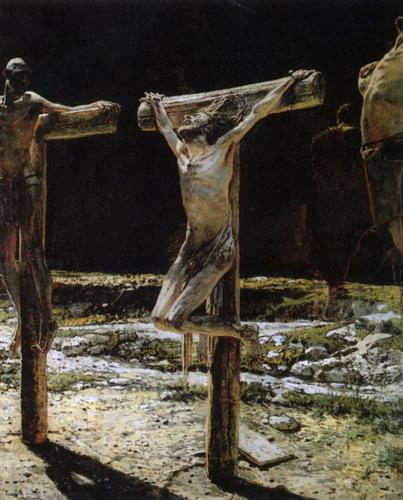
Crucifixion – Nicolai Ge

[i] The Pilgrim’s Progress: Part 1: Giant Despair and Doubting Castle

[ii]  “At the still point of the turning world, there the dance is… Except for the point, the still point, there would be no dance, and there is only the dance.” – T. S. Eliot (Burnt Norton). https://www.themarginalian.org/2015/11/18/t-s-eliot-reads-burnt-norton/


~~~~~

A selection from the chapter Gethsemane, in the “The Lord” by Romano Guardini:

After saying these things, Jesus went forth with his disciples beyond the torrent of Cedron, where there was a garden…” (John 18:1) “According to his custom” adds Luke.

And they came to a place called Gethsemane, and he said to his disciples, ‘Sit here, while I pray.’ And he took with him Peter James and John, and began to feel dread and to be exceedingly troubled. And he said to them, ‘My soul is sad, even unto death. Wait here and watch.’ . . .

Jesus’ consciousness of the world’s corruption is not grounded in the world and therefore the prisoner of existence. It springs from above, from God, and enfolds the whole globe, seeing as God sees: around existence, through existence, outwards from existence.  Moreover, Jesus’ divine consciousness, before which everything is stripped and lucid, is not extrinsic, but intrinsic, realized in his living self.  He knows with his human intellect, feels the world’s forlornness with his human heart. And, the sorrow of it, incapable of ripping the eternal God from his bliss, becomes in Christ’s human soul unutterable agony. From this knowledge comes a terrible and unrelenting earnestness, knowledge that underlies every word he speaks and everything he does. It pulses through his whole being and proclaims itself in the least detail of his fate. Here lies the root of Christ’s inapproachable loneliness. What human understanding and sympathy could possibly reach into this realm in which the Savior shoulders alone the yoke of the world? From this point of view Jesus was always a sufferer, and would have been one even if men had accepted his message of faith and love; even if salvation had been accomplished and the kingdom established alone by proclamation and acceptance, sparing him the bitter way of the cross. Even then, his whole life would have been inconceivably painful, for he would have been constantly aware of the world sin in the sight of a God he knew to be holy and all love; and he would have borne this terrible and inaccessible knowledge alone. In the hour of Gethsemane its ever-present pain swells to a paroxysm.

*****

Do you have Empathy for Real Victims? Or, has your “empathy” become toxic – aligned with the lawlessness and ‘anything goes’ morality of Progressivism? Are your loves disordered? Are lesser things loved above greater things (e.g., strangers over kin), leading to personal and societal decay?

The mother of Rachel Morin, the Maryland mom of five brutally raped and murdered by an illegal alien in August of 2023, on Wednesday joined a White House briefing to urge the media to share her daughter’s story.

“Tell the truth,” Patty Morin said. “Tell like how violent it really is.”

Press Secretary Karoline Leavitt Briefs Members of the Media with a Special Guest, Apr. 16, 2025

‘Tell the truth’: Mother of Maryland woman slain by illegal alien urges media to share her story

~~~

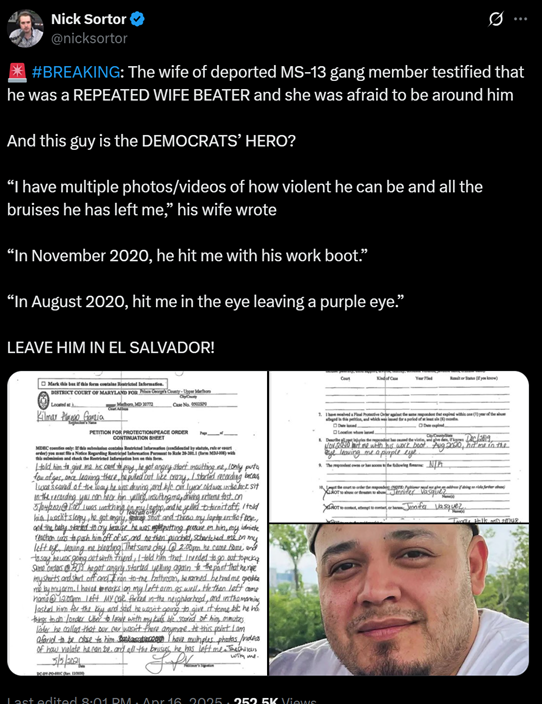
As Democrats work themselves into hysterics over Kilmar Abrego Garcia, a now-deported El Salvadoran man (aka, ‘Maryland Man’) at the center of an intense court battle, several new details about ‘St. Abrego’ have surfaced in the last several days – most recently that the Biden administration flagged him as a ‘suspect alien’ who was potentially involved in “human smuggling/trafficking” following a traffic stop hundreds of miles away from his Maryland home, according to DHS records reviewed by Just the News.

Human Trafficking Too? Biden Admin Flagged Deported El Salvadoran As ‘Suspect Alien’ | ZeroHedge

What deep state media (MSNBC, CNN, NYT, WaPo, The Atlantic, et al) won’t tell you:

Wife of Abrego Garcia in court documents — My husband beat me many times.

Violent restraining order filed against Garcia.

Suppression

If you had lived in the Roman-occupied Holy Land in 4 BC, you would have known about the Roman general Varus who crushed a Jewish revolt against the Roman authority. The causes of that revolt and later revolts stemmed from several factors: the cruelty and corruption of the Roman leaders, Jewish religious nationalism, the impoverishment of the Jewish peasantry, and the corrupt priesthood class.

Varus sent a part of his army into the country, against those that had been the authors of this commotion, and as they caught great numbers of them, those that appeared to have been the least concerned in these tumults he put into custody, but such as were the most guilty he crucified; these were in number about two thousand. War 2.66-79, Josephus (Emphasis mine.)

Mass crucifixions continued in the first century.

“. . . given that crucifixion was seen as an extremely shameful way to die, Rome tended not to crucify its own citizens. Instead, slaves, disgraced soldiers, Christians, foreigners, and — in particular — political activists often lost their lives in this way.”

Jesus wasn’t the only man to be crucified. Here’s the history behind this brutal practice. | Live Science

4 BC is a time of violent suppression under an unyielding Roman rule. If you said something and acted against that rule, you were crucified to keep order under Roman rule. If you said nothing and lived with the oppression then you were quick to point fingers to keep order for yourselves under Roman rule.

“the citizens received [Jarus] and cleared themselves of having any hand in this revolt, and said that they had raised no commotions, but had only been forced to admit the multitude, because of the festival, and that they were rather besieged together with the Romans, than assisted those that had revolted.”  War 2.73, Josephus

We don’t know the exact year of Jesus’ birth. Most scholars go with 4 BC.

*****

Mark’s gospel account opens with John the Baptist clearing the way for Jesus with baptisms of repentance for the forgiveness of sins. The account immediately turns to Jesus and the start of his ministry. We then read of a growing following and of eye-witnessed accounts about unclean spirts being cast out, the sick being healed, and a dead twelve-year old girl being raised to life. And, we learn of Jesus’ words and their impact on local communities as they were heard in the synagogue.

Jesus’s teaching was met with astonishment (Mk. 1:22): “he wasn’t like the legal teachers; he says things on his own authority”.

Later, when Jesus returned to his home region for a time and on the sabbath taught in the synagogue, his words were again met with astonishment (Mk. 6:2). And also, with consternation.

“Where does he get it all from?” they said. “What’s this wisdom he’s been given? How does he get this kind of power in his hands? Isn’t he the handyman, Mary’s son? Isn’t he the brother of James, Joses, Judah and Simon? And aren’t his sisters here with us?” They took offense at him. (Mk. 6:1-3)

Then we read that Jesus “couldn’t do any remarkable thing there, except he laid hands on a few sick people and cured them. Their unbelief dumbfounded him”. (Mk. 6: 5-6)

Earlier in the gospel account, Jesus’ relatives, hearing about the growing crowds and excitement surrounding Jesus, came to restrain him. “He’s out of his mind,” they said (Mk. 3:21). Experts from Jerusalem also showed up and tried to discredit him, labeling the source of Jesus’ power as demonic. Jesus dealt with them in no uncertain terms (Mk.3: 22-27).

In these accounts we see the attempted suppression of Jesus by his family, his community and by religious authorities. His family dubs him crazy and tries to rein him in from bringing more unwanted attention to them. His hometown community takes offense, perhaps thinking “You are uppity talking like that, saying things on your own authority. You’re one of us. Get with the program. Don’t make waves. Fit in and makes us happy that we can be around you.” The religious authorities started a smear campaign.

Undoubtedly, the locals feared antagonizing Roman authorities which could then lead to arrest and possible crucifixion. And just as undoubtedly, the religious leaders from Jerusalem, mediators between Rome and the Jewish population, wanted to keep the peace and their positions. They feared a newcomer, extraordinary in word and deed, upsetting their apple cart. They began a program of misinformation about Jesus.

The push to silence and discredit Jesus and his astonishing words and deeds led to unbelief that conformed to the world around. And that led to the suppression of the remarkable in Jesus’ local community.

*****

Right after this, in Mark chapter 6, we read that Jesus goes around to villages teaching. Suppression tactics do not stop his kingdom work. Jesus sends out the Twelve in pairs to expand his ministry. The twelve were chosen for this reason (Mk. 3:13-14).

“They went off and announced that people should repent. They cast out several demons; and they anointed many sick people with oil, and cured them.” (Mk. 6:12-13).

And then we read that Jesus’ name became well know and reached the ears of the King (Mk.6: 14).

(This king, Herod Antipas, tetrarch of Galilee, was the son and a successor of Herod the Great the Roman client king of Judea until his death in 4 BC. And though Herod the Great had a religion of Second Temple Judaism, he lived with extreme paranoia that resulted in terror:

Herod the Great was a brutal man who killed his father-in-law, several of his ten wives, and two of his sons. He ignored the laws of God to suit himself and chose the favor of Rome over his own people. Herod’s heavy taxes to pay for lavish projects forced an unfair burden on the Jewish citizens.)

When Herod Antipas heard about Jesus he said “It’s John the Baptist, risen from the dead! That’s why these powers are at work in him.” (Mk. 6:14).

Mark goes on to relate what happened to John the Baptist:

“Herod had married Herodias, his brother Philip’s wife. John regularly told Herod it wasn’t right for him to take his brother’s wife; so, Herod gave the word, arrested him, and tied him up in prison.” (Mk.6:17-18).

Herodias, not at all happy with John saying these things, wanted him dead, but Herod wouldn’t let that happen. Herod was afraid of John because he considered John “a just and holy man”. And, Herod would come down to John’s cell and listen to him talk. “What he heard disturbed him greatly, and yet he enjoyed listening to him” (Mk.6: 20).

Now, you know the story of Herod’s birthday and the great party attended by his supporters, military officers and the great and good of Galilee. Herodias’s daughter dances and wows the crowd and the birthday boy. What Herod saw moved him greatly. He enjoyed watching her dance. So, he offers to give the girl a gift to match the wow of her dance.

When Herod hears the girl’s gift request, he becomes panic-stricken, perhaps thinking “This is a holy man. You don’t mess with that. People like him you keep around and under control . . . and there goes the one voice that moved me to distraction.

Herod had made oaths to give her a wow gift in front of his guests. And, “He hadn’t the guts to refuse her” (Mk.6:26). So, John was beheaded.

In this account we read of suppression of John the Baptist on account of what he was saying in public. He was locked up to control the PR surrounding Herod’s immoral marriage to his brother’s wife Herodias. In jail, John didn’t remain silent. And Herod, whose father Herod the Great was into Second Temple Judaism, thought the abrasive John a curious figure to be observed, perhaps like a woman’s sensual dance.

Herod hears about Jesus doing astonishing things and that he’s a just and holy man. He reckons John the Baptist has been resurrected.  (Now what have I done?”)

*****

“Two particular details about Roman crucifixion are of special interest to us in this book. First, it would not be much of an exaggeration to say that Jesus of Nazareth grew up under the shadow of the cross…The Galilee of Jesus’ boyhood, then, all knew about Roman crosses (Antiquities 17.286-98; War 2.66-79)…When he told his followers to pick up their crosses and follow him, they would not have heard this as a metaphor…The second point of special interest for us is the way in which the Romans sometimes used crucifixion as a way of mocking a victim with social or political pretensions. “You want to be high and lifted up?” they said in effect. “All right, we’ll give you ‘high and lifted up.’” Crucifixion thus meant not only killing by slow torture, not only shaming, not only issuing a warning, but also parodying the ambitions of the uppity rebels. They wanted to be move up the social scale?  Let them be lifted up above the common herd…”

-from the chapter The Cross in Its First-Century Setting, N.T. Wright’s The Day the Revolution

*****

Psychology defines suppression as pushing unwanted thoughts, emotions, memories, fantasies, and more out of conscious awareness so that you’re not thinking of these things anymore.

In 4 BC terms, suppression would include dealing with people who are seen as a threat to the system and who annoy and make certain people feel uncomfortable. Such people were mocked, scourged, and put on display for the public’s conscious awareness.

Forms of suppression from 4 BC to the present have included public derision, impalement, death by burning, crucifixion, labeling, canceling, shadow banning, blocking, misinformation campaigns, repeating lies, criminalizing dissent, fines, gag orders, persecution, false charges, arrest, and imprisonment.

What makes the world godless and by what means?

Suppressing the existing facts of reality and the established facts of truth makes the world godless.

In your search for truth . . .

Does your theology suppress science so you don’t have to deal with thinking about science?

Does your science suppress any thought of God so you don’t have to deal with messy, uncomfortable thoughts and emotions?

Does your political view suppress facts as long as there are enough people going along with lies and half-truths?

Is crucifixion the ultimate suppression?

No. See the empty tomb. Unbelief is the ultimate suppression.

*****

*****

*****

This Easter Please Remember The Jan 6ers and Their Families Who Have Been Severely Abused by Federal Judges in Washington DC | The Gateway Pundit | by Joe Hoft

The Easter Please Remember Mathew Perna and All of the Men and Women Persecuted by the Biden DOJ from Jan 6 | The Gateway Pundit | by Joe Hoft

El Salvador’s President . . .

*****

“Obedient even to death . . . yes, even the death of the cross”


“…I’m telling you the solemn truth: unless a grain of wheat falls into the earth and dies, it remains all by itself. If it dies, though, it will produce lots of fruit…

…Now my heart is troubled,” Jesus went on. “What am I going to say? ‘Father, save me from this moment’? No, it was for this very reason I came to this hour.”


Crucifixion Nikolai Ge