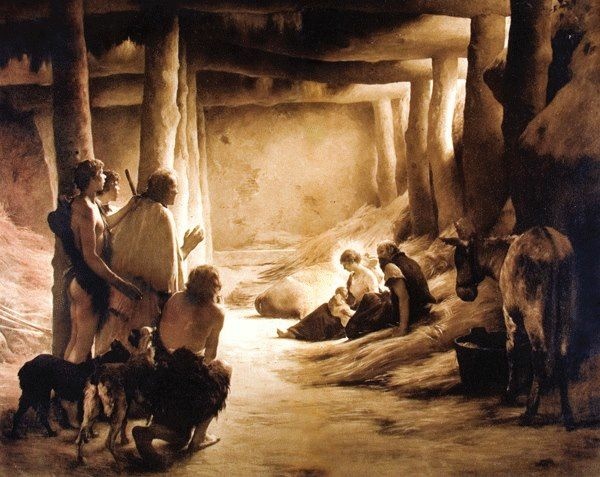
One time of the year the new-born child is everywhere, planted in madonnas’ arms hay mows, stables in palaces or farms, or quaintly, under snowed gables, gothic angular or baroque plump, naked or elaborately swathed, encircled by Della Robia wreaths, garnished with whimsical partridges and pears, drummers and drums, lit by oversize stars, partnered with lambs, peace doves, sugar plums, bells, plastic camels in sets of three as if these were what we need for eternity.
But Jesus the Man is not to be seen. We are too wary, these days, of beards and sandalled feet.
Yet if we celebrate, let it be that he has invaded our lives with purpose, striding over our picturesque traditions, our shallow sentiment, overturning our cash registers, wielding his peace like a sword, rescuing us into reality demanding much more than the milk and the softness and the mothers warmth of the baby in the storefront creche, (only the Man would ask all, of each of us) reaching out always, urgently, with strong effective love (only the Man would give his life and live again for love of us).
Oh come, let us adore him- Christ–the Lord.
~~~
Kenosis
In sleep his infant mouth works in and out. He is so new, his silk skin has not yet been roughed by plane and wooden beam nor, so far, has he had to deal with human doubt.
He is in a dream of nipple found, of blue-white milk, of curving skin and, pulsing in his ear, the inner throb of a warm heart’s repeated sound.
His only memories float from fluid space. So new he has not pounded nails, hung a door, broken bread, felt rebuff, bent to the lash, wept for the sad heart of the human race.
~~~
Mary’s Song
Blue homespun and the bend of my breast keep warm this small hot naked star fallen to my arms. (Rest… you who have had so far to come.) Now nearness satisfies the body of God sweetly. Quiet he lies whose vigor hurled a universe. He sleeps whose eyelids have not closed before.
His breath (so slight it seems no breath at all) once ruffled the dark deeps to sprout a world. Charmed by dove’s voices, the whisper of straw, he dreams, hearing no music from his other spheres. Breath, mouth, ears, eyes he is curtailed who overflowed all skies, all years. Older than eternity, now he is new. Now native to earth as I am, nailed to my poor planet, caught that I might be free, blind in my womb to know my darkness ended, brought to this birth for me to be new-born, and for him to see me mended I must see him torn.
“I’m not implying that I’ve already received “resurrection,” or that I’ve already become complete and mature! No: I’m hurrying on, eager to overtake it, because King Jesus has overtaken me. My dear family, I don’t reckon that I have yet over taken it. But this is my one aim: to forget everything that’s behind, and to strain every nerve to go after what’s ahead. I mean to chase on toward the finishing post, where the prize waiting for me is the upward call of God in King Jesus.” -the Apostle Paul, Philippians 3: 12-14
~~~
“What did I forget?” I’ve asked myself this dozens of times. The question comes up in the grocery store and when I am cooking a meal for the family and when I am getting into the car ready to pull out of the driveway. I have asked this when I am finishing a project at work. “What did I forget?”
In each situation there is something in the back of my head telling me that I am forgetting something. As I mentioned, this happens often. But, thinking about what I need to forget didn’t occur until this past week. I read the above verses in my study of Paul’s letter to the Philippian church.
Oh, yes. I’ve read those verses many times before. And when I did, I glossed over the words as if it made sense at a prosaic level. This time the words nudged me and maybe because I am older now.
During this past week I worked out on the elliptical machine at the local fitness club. There is a TV screen above the machine. I typically watch the business programs which include stock futures (I’m an early bird). When the business program goes to commercial I surf the channels.
That morning there were two other programs that caught my interest. The first was a show about a select group of marines going through extensive training to become recon marines. The second show, What Not to Wear, includes us in a fashion makeover. Typically, a reluctant twenty-something is confronted with her wardrobe and her appearance. Both shows seemed to me to be reality checks before the participants moved on.
The Marine recon show depicted the guys going through intense physical training beyond anything they ever knew they could endure. During the exercise the men ‘forgot’ what they knew and pressed on for the upward call to become recon Marines. Not all of the fifty men who entered the program finished.
As typical for What Not to Wear, the hosts had their ‘client’ try on what she usually wore and then critiqued the outfit with her as all three stand in front several mirrors. During the next step in the fashion transformation, the hosts pull the client’s brought-to-the-program clothes off the rack and throw them into a garbage can before her. They want her to forget about them and move on. Without saying as much, they want her to become mature in her view of herself and how she appears to others. Many of the young women wore sloppy attire or clothes a teenager would wear. The hosts prompt their ‘client’ to take herself and her appearance seriously. They want her to dress age and life situation appropriately.
During the next step, the hosts show their TV ‘client’ a manikin dressed in clothes they consider she would look suitable in. After detailing “why” the clothes would befit her, they send her shopping for a new look. I would say, a “resurrected” look.
Forgetting what you know is not easy. Several marines stopped short of recon transformation. On What Not to Wear, many a ‘client’ grimaced and some wept as their habit-formed clothes were tossed in the can. Not wanting to forget makes going forward even harder.
Forgetting. Where do I start?
As I read Paul’s letter to the Philippians, I was reminded that I have done things which are not at all within God’s good graces. I have sinned in God-defying sinful ways. I’m sure I must have gotten God’s attention. And, more than once. But, as with the Pauls’ own admission of not having achieved sinless maturity, I press on. My own recognition and then confession of sin, like Paul’s, moves me forward to the goal of the upward call of God – resurrection, new life, in Him – the Alpha and Omega, the No-beginning and No-end, the Mercy that follows me all the days of my life.
The words of I john 1:9 are critically important to anyone who wants to remove sin’s dead weight and “to strain every nerve to go after what’s ahead”. What John, an eyewitness of Jesus, records is critically important to pressing on and forgetting.
“If we confess our sins, he is faithful and just, and will forgive us our sins, and cleanse us from all unrighteousness.” The First Letter of John, 1:9
The wonder of advent reminds us of Jesus’ first coming and of his second coming. The Kingdom of God on earth began when Jesus inaugurated it during his first coming. Yet, “sins and sorrows grow” and “thorns infest the ground”. There is much injustice, strife, and wickedness taking place. The Kingdom of God is not mature. It is a work in process. On every groaning level of creation there exists a huge amount of tension between the first coming and the second coming.
The same tension applies to the individual who confesses and renounces their sin and seeks to go on to maturity in Christ. This tension will either makes us or break us.
What do I need to forget? Three encumbrances come to mind: status, sentimentality and sin.
Let’s start with status. The world we live in favors world status. Paul reminds the Christian in Philippians 3: 20, “We are citizens of heaven…” Prior to that, at the opening of Philippians 3, Paul warns the church about those who trust in the flesh-the bad works people. Then Paul writes, “Mind you, I have good reason to trust in the flesh…” Paul reminds the readers of his background, a Hebrew of the Hebrews background. He writes, in effect, that his status does not bring him closer to the prize – gaining Jesus. Before stating his forgetting of his status, he reminds us of Someone who ‘forgot’ his status.
In Philippians 2 Paul records an early Christian poem, which contains the words…
Who, though in God’s form, did not
Regard his equality with God
As something to exploit
Instead, he emptied himself,
And received the form of a slave,
Being born in the likeness of humans.
Sentimentality. The desire–the toxic craving–to relive the past, to re-feel. Ugh. You can’t run a race when you are standing in a tar pit. Paul doesn’t go there, even though his memories were astounding: “…my one aim: to forget everything that’s behind, and to strain every nerve to go after what’s ahead.”
Sin. Let’s forget the sin which has so easily beset us. Like the Psalmist, I cry out…
“If you, LORD, kept a record of sins, Lord, who could stand?” Psalm 130.:3
“Do not remember the sins of my youth and my rebellious ways; according to your love remember me, for you, LORD, are good.” Psalm 25:7
Record keeping. The Evil One and those in sync with him will tell you that are unqualified to run and win any race because you failed before. They will say, “You will never be mature because you were immature before”.
Yes, there are those who keep a record of my sins, for ‘safe keeping’. They believe that by standing on a record of my sins they place themselves on higher ground. It doesn’t. Side line opinions are air and hold no weight unless you give them weight. As far as the east is from the west so far has God removed self-serving opinions from us. Don’t go back to the trash and dig them out.
“What am I not forgetting?” is a most important question.
One last word: Consider, that often a lack of forgetting is coupled to a lack of forgiveness. A lack of forgiveness leads to unresolved anger- a root of bitterness. Perhaps a root of bitterness has a grip on both your legs and you are not able to “chase on toward the finishing post, where the prize waiting for me is the upward call of God in King Jesus” let alone stand.
“We have entered, as I see it, a spiritual limbo. Our educational institutions are no longer the bearers of high culture, and public life has been deliberately moronised. But here and there, sheltered from the noise and glare of the media, the old spiritual forces are at work” Roger Scruton
*****
“When a common culture declines, the ethical life can be sustained and renewed only by a work of the imagination.”-Roger Scruton
*****
“Jesus prayed, “This is eternal life, that they may know You . . .” (John 17:3). The real meaning of eternal life is a life that can face anything it has to face without wavering. If we will take this view, life will become one great romance— a glorious opportunity of seeing wonderful things all the time. God is disciplining us to get us into this central place of power.” Oswald Chambers
*****
“No power on earth or in hell can conquer the Spirit of God in a human spirit, it is an inner unconquerableness.” Oswald Chambers
*****
To those who have had no agony Jesus says, “I have nothing for you; stand on your own feet, square your own shoulders. I have come for the man who knows he has a bigger handful than he can cope with, who knows there are forces he cannot touch; I will do everything for him if he will let Me. Only let a man grant he needs it, and I will do it for him.” The Shadow of an Agony,Oswald Chambers
*****
“If we wish to erect new structures, we must have a definite knowledge of the old foundations.” John Calvin Coolidge
*****
Atheism is a post-Christian phenomenon.
*****
If social justice looks like your hand in someone else’s pocket then you are stealing.
*****
“In Sweden, giving to charity, absurdly, came to be considered a lack of solidarity, since it undermined the need for the welfare state.” – Roland Martinsson
*****
“…to love democracy well, it is necessary to love it moderately.” Alexis de Tocqueville
*****
Capitalism seeks to help others through a servce or product it provides. Free Market Capitalism is the most moral and fair economic system available to man. Capitalism augments personal growth, responsibility and ownership. Charity flourishes under capitalism. Charity dies under subjective “fair share” government confiscatory policies. Socialism redistributes ambivalence and greed.
*****
“We are to regard existence as a raid or great adventure; it is to be judged, therefore, not by what calamities it encounters, but by what flag it follows and what high town it assaults. The most dangerous thing in the world is to be alive; one is always in danger of one’s life. But anyone who shrinks from that is a traitor to the great scheme and experiment of being.” G.K. Chesterton
*****
Any intelligent fool can make things bigger, more complex, and more violent.
It takes a touch of genius – and a lot of courage – to move in the opposite direction. Albert Einstein
*****
“You shall know the truth and the truth shall make you odd.” Flannery O’Connor
*****
“There is but one good; that is God. Everything else is good when it looks to Him and bad when it turns from Him.” C.S. Lewis, The Great Divorce
*****
“Though He slay me, yet will I trust Him” (Job 13:15).
*****
God’s grace is not about the allowance for sin. God’s grace is about the conversation God allows regarding sin.
*****
From the book of Proverbs: We are not to favor the rich or the poor. We are to pursue justice.
*****
“Always keep in contact with those books and those people that enlarge your horizon and make it possible for you to stretch yourself mentally.” Oswald Chambers
*****
One goldfish says to another, “If there is no God who keeps changing the water?”
*****
“The truth is always there in the morning.”
From Cat On A Hot Tin Roof script – playwright Tennessee Williams
*****
God blesses those who hunger and thirst for justice, for they will be satisfied.
*****
“America’s greatness has been the greatness of a free people who shared certain moral commitments. Freedom without moral commitment is aimless and promptly self-destructive.” John W. Gardner
**
“Men of integrity, by their very existence, rekindle the belief that as a people we can live above the level of moral squalor. We need that belief; a cynical community is a corrupt community.” John W. Gardner
*****
“In the world it is called Tolerance, but in hell it is called Despair, the sin that believes in nothing, cares for nothing, seeks to know nothing, interferes with nothing, enjoys nothing, hates nothing, finds purpose in nothing, lives for nothing, and remains alive because there is nothing for which it will die.” Dorothy L. Sayers
*****
“Art, like morality, consists of drawing the line somewhere.”
G. K. Chesterton
*****
“The battle line between good and evil runs through the heart of every man.” Alexander Solzhenitsyn
*****
This is what the LORD says:
“Stand at the crossroads and look;
ask for the ancient paths,
ask where the good way is, and walk in it,
and you will find rest for your souls.
But you said, ‘We will not walk in it.’
-The prophet Jeremiah, 6:16
*****
“…our common task is not so much discovering a truth hiding among contrary viewpoints as it is coming to possess a selfhood that no longer evades and eludes the truth with which it is importunately confronted.” James McClendon, Ethics: Systematic Theology, Vol. 1
*****




 Cindy Wity