The Inside Story
January 18, 2026 Leave a comment
I heard about him. A man who healed a man with a horrible skin disease. The healed man went and told everyone. So much so that the healer had to go out to the open country because of the crowds. But now people are saying that the healer has returned to Capernaum.
I’m in a bad way, you see. A bad way. I am a stiff ruin of a man. I constantly need the help of others. I move when others move me. I live only as others take care of me. I dress, eat, go to the bathroom, seek alms – all with the help of others. I am paralyzed.
I heard that my neighbors are being healed. I needed help, transport, to get to the healer. Four friends are carrying me to him.
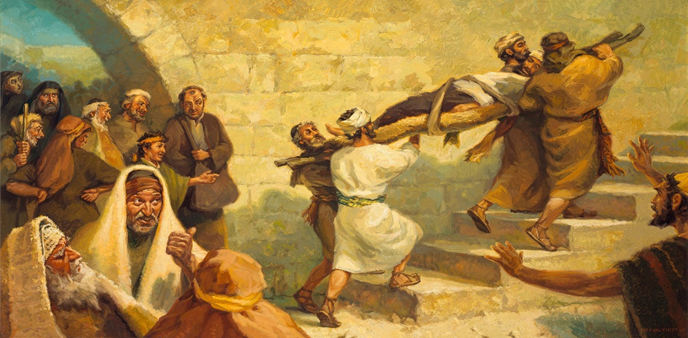
But the crowd! Oh, the crowd outside the door where he is! We can’t get through to him! I plead with my friends and they improvise. They carry my stretcher to the roof over where the healer is. They’re digging a hole right over him.
As they dig, pieces of the roof and clay dust fall down into the room below, landing on heads and beards.
A group of us, legal experts in the Law of Moses and in Jewish traditions and practices, came here today to hear what this Jesus guy is saying. He’s gotten a lot of attention lately. We’ve heard all kinds of rumors about this carpenter that some are calling a prophet. We must keep an eye him. We don’t want false prophets and would-be messiahs running around stirring up the people. And, we sure don’t want a Roman Legion coming down on us.
There is a large crowd standing outside. Inside, the room is full. Dust is flying everywhere making it hard to breathe. People are coughing. While we are sitting here, some crazy people are up on the roof breaking through it to gain access to this guy. Why destroy a roof? What is this all about? Hush, we tell people, so we can hear.
Now a stretcher is being lowered through the roof. On the stretcher is man who looks almost dead. He must have sinned or his parents must have. Isn’t that how these things happen?
Jesus looks up at the four people looking down through the hole in the roof and then he looks down at the paralyzed man and says “Child, your sins are forgiven!”
The nerve! How dare that guy talk like that! “It’s blasphemy!” we mutter to ourselves. “Who can forgive sins except God?”
The carpenter must have sensed that we were protesting him going too far. He turned to us and asked “Why do your hearts tell you to think that?” Well, we knew why. Then he says . . .
“Answer me this. Is it easier to say to this cripple ‘Your sins are forgiven,’ or to say, ‘’Get up, pick up your stretcher, and walk’?
Perplexed, the legal experts stroked their dusty beards and remained silent.
You won’t believe what happened next. But you should. The healer asked the experts “You want to know that the son of man has authority on earth to forgive sins?” He looked down at me and said “I tell you, get up, pick up your stretcher, and go home.” And just like that I was able to get up, pick up my stretcher in a flash and go out before them all.
When everyone saw me bounce off the stretcher, grab it and run out, they were utterly astounded. They began praising God saying, “We’ve never seen anything like this!”
~~~
Astounding things occur in (this amplified retelling of) Mark’s gospel account (2:1-12). No doubt, the newly-called-to-follow Simon (Peter) was in the room when these things occurred and that he later related them to Mark for the gospel account. And that is how we have the inside story about a man imprisoned in body and soul paralysis being released by forgiveness and healing.
Forgiveness, as used by Mark in this account – (αφεωνται)- recognizes that a debt exists. Forgiveness here is not a demand for rightful retribution. It is not an expunging of a fault. It is a reaction to a fault, not for payback, but to cause growth away from that which generated the fault. I understand this forgiveness as a response to one’s metanoia (turning around) from that which created the debt and wanting to operate differently. In other words: “We both see where things went wrong and I forgive you. Now go forward in a new direction.”
This was the case for the cripple. Transformed, the forgiven and healed paralytic can walk back to family and community restored in body and soul. Knowing forgiveness and healing, he can now impart the same to others and seek reconciliation with those he wronged.
Before these astounding things occur in the account above, Mark writes at the beginning of his gospel of a foretold messenger who will clear the way for the arrival of Good News – of Jesus, the Messiah, the son of God.
John the Baptizer appeared in the desert announcing a baptism of repentance, of metanoia, for the forgiveness of sins. The voice of one calling in the wilderness, ‘Make straight the way for the Lord’ drew a lot of attention. All of Judea and everyone living in Jerusalem came out to him.
Those baptized by John decided to metanoia (turn around). They decided to confess their sins, to be plunged beneath the water of the river Jordan as a sign of repentance and forgiveness, and to be lifted back up.
I wonder. Did the paralytic hear about John the Baptizer? Did he want to go out to him and be baptized but couldn’t? Did he hear what John said about Jesus: “See! The Lamb of God Who takes away the sin of the world!?
Did the paralytic hear about Jesus saying “The time is fulfilled! God’s kingdom is arriving! Turn back and believe the good news!”? (Mk. 1:14)
What we do know is that the cripple is brought to Jesus, lowered down into a room into the presence of Jesus and is then raised up forgiven and healed.
Forgiveness spoken by John and by Jesus is a present-tense action of something that has been completed and has effect now as opposed to a situation that might be or is wished for, or is commanded to be. That should encourage everyone to come to Jesus.
~~~
The way of the Lord is the way of forgiveness. It is the way of lifting off a burden, the way of lifting up from a state of stagnation and morbidity.
One of the primary Hebrew terms translated as “forgive” is ‘nasaʾ which means “to carry, lift up, or to bear away.” That is what occurs in the above account, first in the actions of four determined people showing what it means to bear another’s burden and then with the proclamation of forgiveness.
The four, bearing the weight of the paralytic across town, lift him up to a roof top and then down through a hole to a place of healing. With utter resolve they bring the paralytic to Jesus. Jesus recognizes the sureness of their trust in him to lift the man’s burdens and proclaims “Child, your sins are forgiven.” The burden you carry, the burden others carried on your behalf, has been lifted away. Get up and walk a new way.
~~~
Another utterly astonishing thing occurs but its context is not immediately apparent. Remember the Tower of Babel, the ziggurat built for someone to be able to climb up to the heavens and access God? In the above account, people climb up to a roof top to lower a stretcher into a room where God is on ground level.


















 Cindy Wity