The End is Year

2025. Those of us striving to maintain the good, the true, the beautiful, and our precious homeland felt a hard-to-name force displacing us from the “past, people, place, and prayer” (Kingsnorth).

That force, soon to be coupled to Deterministic AI, is moving us in the direction of History deemed as an evolutionary process called Progress, as if later was better. Paul Kingsnorth, in his book Against the Machine, calls the force “The Machine.”

This year, The Machine’s red in tooth and gear displacement process included Charlie Kirk being shot in the neck and killed in front of the whole country in daylight. Kirk, as everyone knows, was a Christian and spoke in terms of the “past, people, place, and prayer.” Since the murder, the growing response is the rejection of what The Machine did to Kirk and is doing to them – the Process of Dehumanization.

People want the values Kirk spoke about and represented. They want to invest in precious lasting values – the good, the true and the beautiful – and they no longer want a modern Machine culture that generates everything the way central banks generate money: fiat morality, fiat identity, fiat community, fiat justice, fiat politics.

It is no surprise that in 2025, people and countries, sensing a constant state of flux, uncertainty, and manipulation in the fiat USD, were buying precious metals. The go-to values of physical commodities such as gold or silver increased in 2025.

At the beginning of 2025, gold was $2,640/oz. Recently, it was $4,550. Gold will likely hit $10k/oz. in 2026.

Silver, at the beginning of 2025, was $29/oz. Now, it’s over $77/oz.

Going Forward, a Few Recommendations:

The U.S. needs to uncouple from any involvement with the corrupt money-laundering country of Ukraine. We should not provide any security agreements to Ukraine. We should walk away and let Europe deal with Europe. Ukraine can become part of the EU (money-laundering system).

The U.S. needs to uncouple from its involvement with Israel. Israel can go off and do its own thing.

There should not be one-size-fits-all federal AI regulations. Better, keep AI out of our lives.

Big Tech’s Darkest Failure: How an AI Chatbot Manipulated a Child Into Suicide

Americans should resist all attempts in their state to build energy-hoarding data centers and more 5G (spy on us) towers.

At a minimum and no more, the U.S. should establish, by law, one day voting on paper ballots with a secure chain of custody.

Americans should resist all attempts to ID them digitally.

Americans should resist all attempts to go cashless and converting to a digital currency that will track all of purchases and decide who’s in and who’s out.

The U.S. should deport all illegal invaders. They are not refugees. They are economic and criminal opportunists. The open borders “compassion” behind “Welcoming the stranger” is exactly like a judge applying ad hoc justice to multiple offence criminals because they are minorities and because of their “circumstances.”

A Few Obvious Predictions:

Democrats will continue presenting themselves as saving the world while doing everything they can to tear it down using massive fraud, abortion, assisted suicide, anarchy, and more. The Left will continue with its Trump Derangement Syndrome (TDS). The deep-state media tells them what to think about everything.

Globalists will continue to globalize. They will continue to try to amass power over people and make them worker bees with a hive mind. Unless Kingdom Christians say “No More!”

The Islamification of the West will continue its takeover of U.S. communities and states unless Kingdom Christians say “No More!” Why repeat “Thy will be done on earth as it is on heaven” if it has no meaning here and now? Mamdani to use Quran for swearing in ceremony.

Trans-cultists, Islamists and the mentally ill will continue to kill. The media will continue to say that guns kill.

Humans will continue to lose their humanity with associations and applications of things that move them away from the good, the true, and the beautiful in the name of novelty and efficiency.

Literary life:

This year, beside the books shown on the side bar under Goodreads, I read:

The Truth and Beauty: How the Lives and Works of England’s Greatest Poets Point the Way to a Deeper Understanding of the Words of Jesus by Andrew Klaven

Recessional: The Death of Free Speech and the Cost of a Free Lunch by David Mamet

The Silent Corner: A Novel of Suspense by Dean Koontz

The Best American Mystery Stories Of The Century: The Definitive Anthology of 100 Years of Crime, Mystery, and Thriller Short Stories Edited by Tony Hillerman

All the Pretty Horses by Cormac McCarthy

(I encourage everyone to read Paul Kingsnorth’s Against the Machine: On the Unmaking of Humanity at the beginning of 2026. See what Kingsnorth means by The Machine and understand how it affects you. The book is referenced on my blog here Displaced in Place and here The Hound of Hell.)

Want to start a literary life? I recommend this website:

House of Humane Letters – Recover the Lost Intellectual Tradition

Media:

I am not on social media. It is a waste of time and worse. The Machine will use it to distract you while it moves you where it wants you to go.

If I watch TV, I typically watch true crime shows such as The First 48 and Homicide Hunter. The rest on TV is not worth viewing.

Except, I did watch the first episode of Pluribus. The 1st episode was subscription free on Prime. Watching Pluribus, I was reminded of The Invasion of the Body Snatchers. The series looks interesting. For more info, check out this podcast: In “Pluribus” An America Without Division, But At What Price? – New Books Network

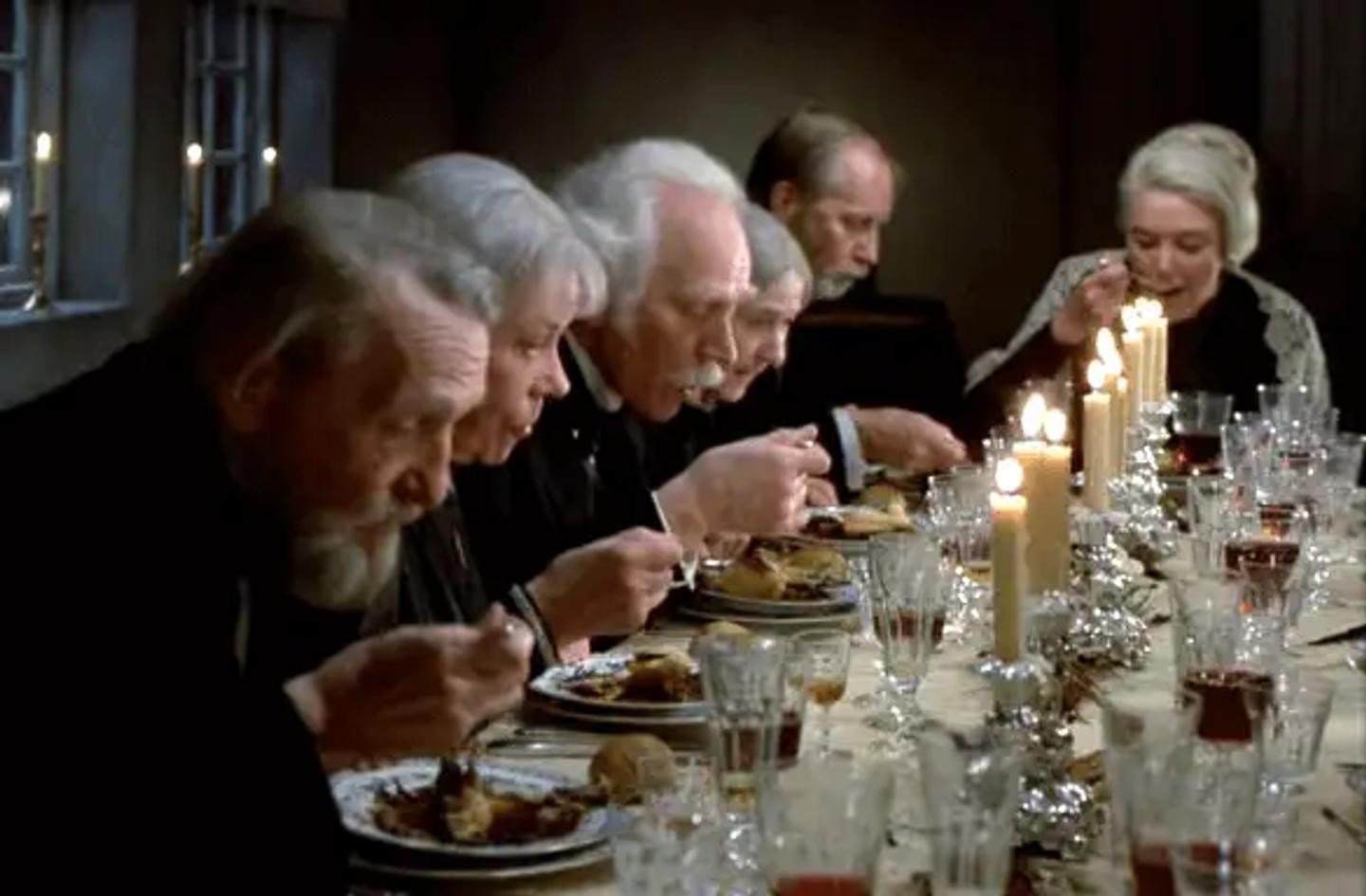
I recently purchased the Criterion Collection DVD of Babette’s Feast. I watched this last weekend. What a blessing!

Babette’s Feast, based on a Karen Blixen story, is a delightful tale of generosity in 19th century Denmark. A lavish feast evokes the transformative power of God’s grace. “Mercy and truth have kissed.”
~~~~

The Right Brain Needs Your Support

Dr Iain McGilchrist is a psychiatrist, neuroscientist, philosopher and literary scholar is the author of The Master and His Emissary and The Matter with Things. His work on the divided brain has helped millions of people find wisdom, meaning, and guidance for living in the modern world.

Iain and Demetri [Kofinas] begin their conversation exploring McGilchrist’s core thesis about the divided brain, how the left and right hemispheres attend to the world in fundamentally different ways, where we see evidence of an increased preponderance in left-brain thinking, and how this has impacted the way we conduct science, reason through problems, use our imagination, and apply wisdom to the world.

Iain believes that our civilization is caught in what some have described as a metacrisis, exacerbated by the encroachment of the left hemisphere onto more and more areas of lived experience. We see it in the procedurally abysmal manner in which modern medicine goes about formulating diagnoses, the ever-increasing obsession with process over outcomes, the commodification of writing, the rise in depression, the policing of language, and the reverence for machine-like efficiency and profit maximization at the expense of almost everything else.

The Metacrisis: Finding Reality & Meaning | Iain McGilchrist

The Metacrisis: Finding Reality & Meaning | Iain McGilchrist

British psychiatrist, neuroscientist, and author Dr. Iain McGilchrist about intelligence, mental illness, and AI.

~~~~~

A New (Year) baby has arrived:
2024: “Don’t You Care?”

What do we talk about when we talk about apocalypse?

Are we talkin’ Steppenwolf and his legions of Parademons attempting to take over the Earth using the combined energies of the three Mother Boxes?

Are we talkin’ nuclear war? World War Z?

Are we talkin’ The Late Great Planet Earth?

Are we talkin’ a supposed climate change catastrophe prophesied as either a meltdown or an ice age?

In popular use, “apocalypse” tags something with the worst possible outcome usually in terms of an end-of-the-world scenario and mankind’s role in events much bigger than himself. But the Greek word apokálypsis, from which “apocalypse” is derived, means an uncovering or revelation.

In terms of scripture, “apocalypse” is a genre in which God reveals His point of view. Such are the books of Isaiah, Jeremiah, Ezekiel, Joel, Zechariah, Daniel and Revelation. The “apocalypse” as an author’s vision of the end times or the end of the age became a distinct literary genre during the Second Temple period and into the Common Era.

Apocalyptic “non-canonical” literature helped pave the way for the Jesus movement in the first century CE. Many in Israel, based on these writings and OT texts (Psalm 146:7-8, Isaiah 61: 1-2), held a belief in a Messianic Apocalypse – the anointed one, a divine messianic agent, revealed at the end time who executes justice for the oppressed, gives food to the hungry, sets prisoners free, opens the eyes of the blind, and lifts up those who are bowed down.

Within this millenarist writing context and using explicit connections to the Old Testament via quotes, and with accounts of eyewitness testimony, the four gospels record God’s revelation in Jesus Christ as the Messianic Apocalypse. And, they record the apocalyptic pronouncements of Jesus, including Matthew 24 (The Destruction of the Temple and Signs of the End Times) and in Matthew 25 (The Sheep and the Goats; Judgement). Jesus’ words and works throughout the four gospels disclose God’s POV.

Near the end of the John’s gospel account we are given the reason why John wrote to reveal Jesus:

“Jesus did many other signs in the presence of his disciples, which are not written in this book. But these are written so that you may believe that the Messiah, the son of God, is none other than Jesus; and that, with this faith, you may have life in his name.” (Jn. 20:31)

The gospel according to Mark, written from a Petrine perspective, recorded what Jesus did and said in the presence of his disciples so that with the centurion standing watch at the cross, we might say “Truly this man was God’s Son!” (Mark 15:39)

Throughout the first six chapters of the gospel according to Mark, chapters I am memorizing, I find Jesus over and over again revealing who he is to the Twelve and the group of disciples around him. Yet, they are not making the connection. They consider him a great prophet and a maybe-Messiah Apocalypse but nothing more.

When Jesus is in the synagogue teaching, the gathered are astonished by his teaching. He speaks with authority. Then a man with an unclean spirit reveals Jesus’s identity:

“What business have you got with us, Jesus of Nazareth?” he yelled. “Have you come to destroy us? I know who you are: you’re God’s Holy One!”

Jesus commands the unclean spirit to be quiet and then casts out the unclean spirit. The buzz begins.

“What’s this?” they started to say to each other. “New teaching – with real authority! He even tells the unclean spirits what to do and they do it!”

Before chapter one ends, Jesus has healed many people suffering from all kinds of diseases and cast out many demons – exactly what Psalm 146 and Isaiah 61 talk about.

I learn from Mark that Jesus won’t let the demons speak. They would reveal his identity. I understand this as Jesus wanting each person to come to grips with who he is on their own.

In chapter two, Jesus heals a paralyzed man. But first he recognizes the faith of those who bring the man to him. He tells the cripple that his sins are forgiven. Upon hearing this the legal experts in the room start grumbling “Its’ blasphemy! Who can forgive sins except God?” They are so ready to pounce that they don’t understand who is standing before them. And why would they?

Who would expect the invisible God to be incarnate, to be physically present? And who would expect a consuming fire (Deut. 4:24) to be in their midst?

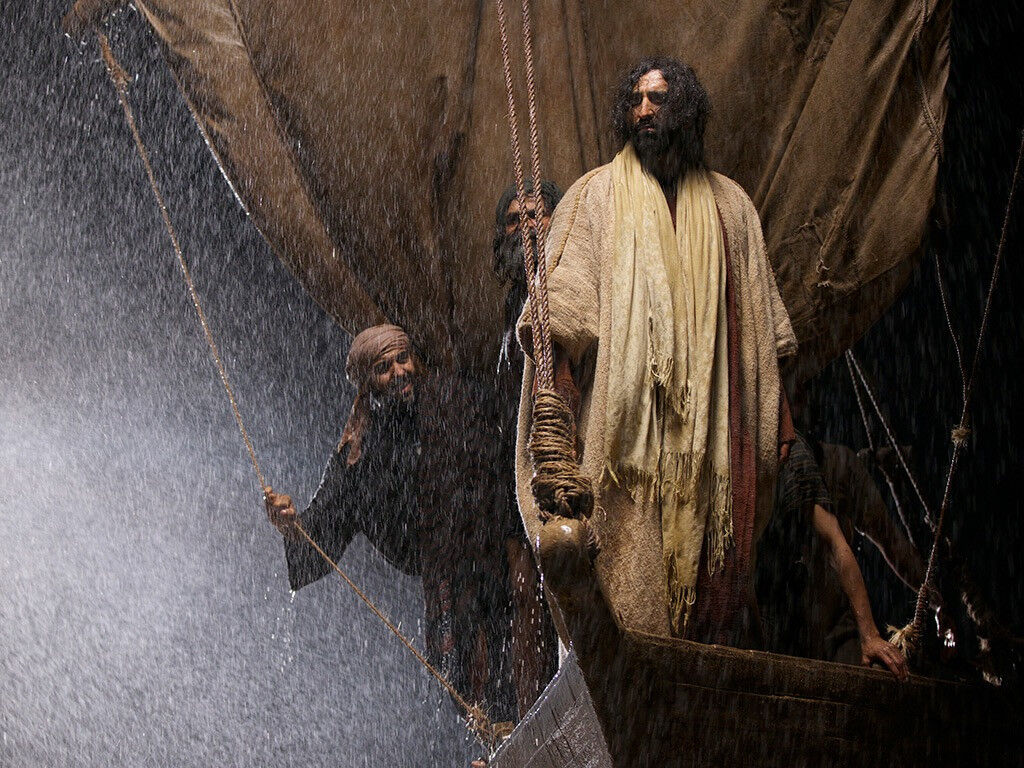
Chapter Four:  After teaching a huge crowd about the kingdom of God, Jesus and the disciples set sail across the sea. A big wind storm comes up. Waves beat against the boat and it quickly begins to fill up. Jesus, however, is asleep on a cushion in the stern. Very anxious disciples wake him up and say “We’re going down. Don’t you care?”

Now, I don’t believe that any of the disciples were thinking that Jesus would get up and end the storm. They were likely thinking that they needed another hand to bail water out of the boat (kind of like my prayers at times).

Jesus gets up. He scolds the wind and says to the sea, “Silence! Shut up!”. Nature calms down but not the sailors. They had been ‘apocalypsed’. Someone in their boat just took control of the cosmic order. Someone in their boat just revealed God-like properties.

Great fear stole over the crew (survivors in the mini-Noah’s arc). “Who is this?” they said to each other. “Even the wind and sea do what he says!”

Jesus had looked at them and said “Why are you scared?” Don’t you believe yet?” That was his response to the disciple’s “Don’t You care?”

Jesus’ response to the disciples was not to shame them. It was to reveal their unbelief in what has been revealed to them: God was walking among them; God was in the boat with them; God’s love as demonstrated would see them through.

“Don’t you care?” is the corporate expression of anxious Israel waiting for Messianic Apocalypse.

“Don’t you care?” is the corporate expression of an anxious world that, with chronic uncertainty, is focused on a coming the-ship-is-going-down apocalypse and not on the certainty of the revelation of Jesus.

What do I talk about when I talk about apocalypse? This: what’s been revealed of Jesus is greater than what could ever possibly be revealed – whether in nature or alien or made-made or imagination-made.

2024: “We’re going down. Don’t you care?”

“Don’t you believe yet?”

~~~~~

Hope in an Age of Anxiety with Curtis Chang and Curt Thompson

We are in an anxious age. By some estimates, a third of all Americans will struggle with anxiety in their lives, and nearly 20% currently suffer from an anxiety disorder. For those suffering the mental distortions of anxiety, life can be difficult, and hope elusive. And for many Christians who have tried and failed to stop their slide into fear and worry by simply “laying down their burdens,” they may feel an added sense of spiritual failure as well.

We’re joined on our podcast by psychiatrist Curt Thopmson and theologian Curtis Chang who help us explore a counterintuitive approach to understanding our anxiety:

Hope in an Age of Anxiety with Curtis Chang and Curt Thompson – the Trinity Forum

Episode 70 | Hope in an Age of Anxiety | The Trinity Forum (ttf.org)

~~~

Beauty from Darkness with Curt Thompson

How do we seek, find and share hope and healing in hard times?

Psychiatrist and author Curt Thompson and Trinity Forum President Cherie Harder discuss healing, grace, and reintegration — both for our individual and spiritual lives, and our shared life together. Together they consider how being known and believing what is true about our stories can transform our perspective and bring hope and healing:

“Shame is the antithesis and is that force that evil wants to use to undermine not only our ability to be known by one another deeply, which we were made for, we were made to be known, but we were also made to be known on the way to creating artifacts of beauty, whether those artifacts are relationships, whether they’re new pieces of music, art, businesses, and so forth.”
– Curt Thompson

Episode 45 | Beauty from Darkness with Curt Thompson | The Trinity Forum (ttf.org)

~~~~~

Must have been all those Venusian women with SUVs . . .