Wayward Christian Empathy
October 12, 2025 Leave a comment
Want to see what Christian empathy tends to look like?
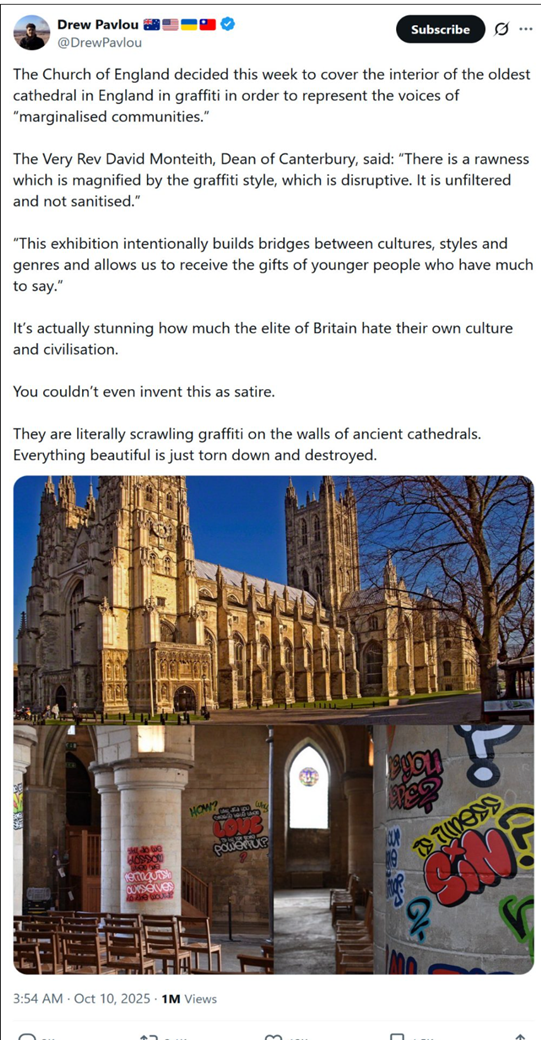
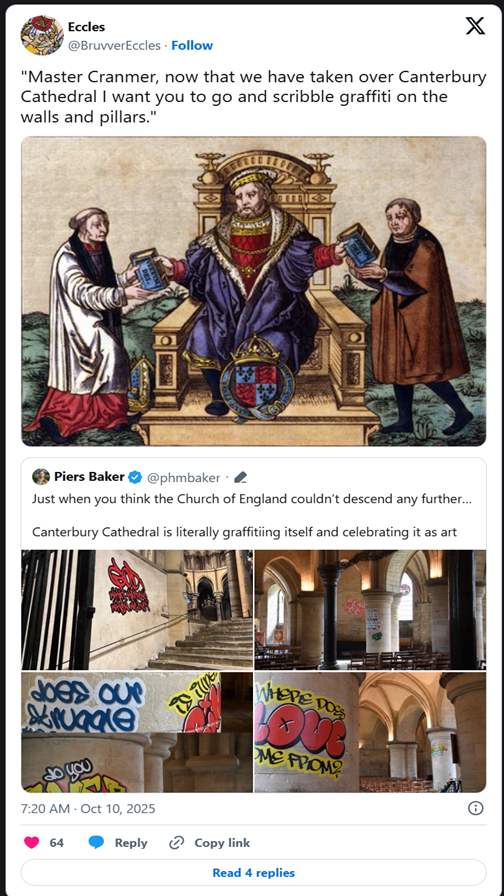
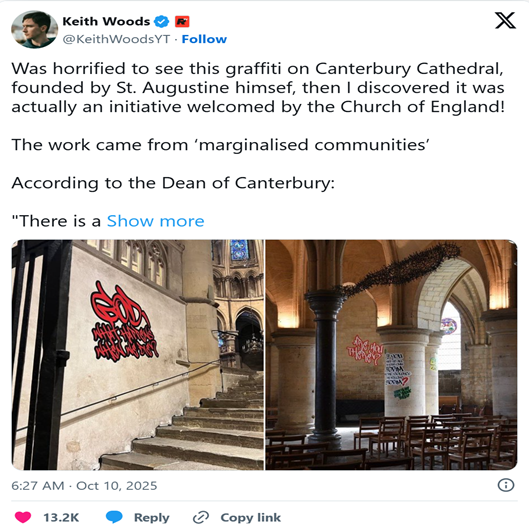
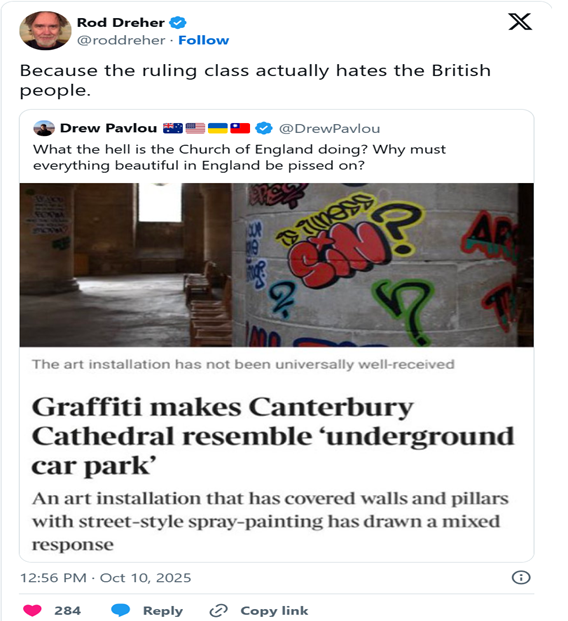
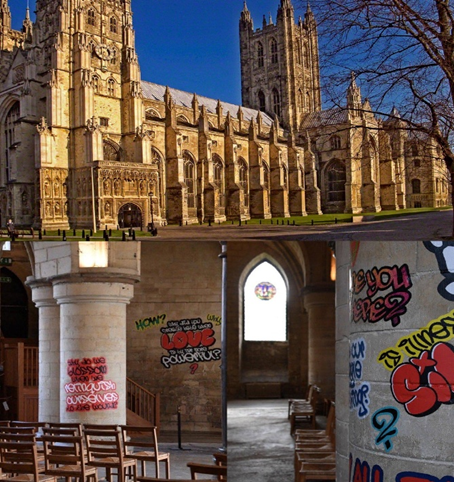
No. This pop-project isn’t satire. The Church of England, so obsessed with its moral performance, really did cover the interior of the oldest cathedral in England in graffiti in order to represent themselves to the world.
As reported by The Independent,
The installation created by poet Alex Vellis is designed to contrast with the ancient, traditional architecture in the church to offer new interpretations of faith and worship.
Per the partnered gay priest and dean of Canterbury, David Monteith, “There is a rawness which is magnified by the graffiti style, which is disruptive. There is also an authenticity in what is said because it is unfiltered and not tidied up or sanitised. Above all, this graffiti makes me wonder why I am not always able to be as candid, not least in my prayers.
“This exhibition intentionally builds bridges between cultures, styles and genres and, in particular, allows us to receive the gifts of younger people who have much to say and from whom we need to hear much.”
“Mr Vellis said the language of the graffiti was “of the unheard”.
He added: “By temporarily graffitiing the inside of Canterbury Cathedral, we join a chorus of the forgotten, the lost, and the wondrous. People who wanted to make their mark, to say ‘I was here’, and to have their etchings carry their voice through the centuries.”
Reading the motivation behind the Church of England’s self-vandalizing approach to empathy, one has to wonder, as with many decisions made in our times, – where are the adults? And what is next on the empathy checklist? Will the CoE leaders, in order build “bridges between cultures, styles and genres” and to “welcome the stranger,” get tattoos and piercings? Hand out drugs and needles? Perform a satanic mass?
The understanding, resonating, and self-differentiating human voices of previous centuries are becoming the “chorus of the forgotten, the lost, and the wondrous,” the voices “of the unheard” in the Church of England, throughout Europe, and the U.S. Those voices are deemed non-empathetic and must be shouted over with graffiti.
Those who, with ancient wisdom, made their mark of truth, beauty, and goodness, must now be overwritten with graffiti.
The desire to look like the world, like walking in another’s shoes, as inclusive and pluralistic, is beneficial for the state and its open borders immigration policies which deface homelands and cultures with graffiti.
Per Olivia Murray at American Thinker,
“Canterbury Cathedral, a sixth-century English church—making it more than 1,400 years old—has gotten a paint job…in graffiti. And as it turns out, this act of vandalism wasn’t an act of street delinquency, it was actually commissioned by the church’s stewards. . ..”
“Call me crazy, but this seems counterproductive. Real Englanders, Brits by blood and spirit, with an undying love for their culture and home, are beyond fed up with what the Dean of Canterbury calls “marginalized communities.” These “marginalized communities” are parasitic, they’re destroying the cohesion of England and the nation’s society, and they’re given preferential treatment by the government, that’s ostensibly, representing the English people.”
Murray continues:
“Progressives really have an extraordinary ability to turn something unbelievably precious and beautiful into utter trash—how can you make Canterbury Cathedral look like a derelict warehouse in an inner city, or resemble a dirty freight train car?”
~~~
Christian empathy tends to be wayward, moving away from truth, beauty and goodness and toward a seamless identity with what those in the world think they need and want – a trait that Jesus never had.
Christian empathy tends toward a desire to be seen as acceptable to the world so that the world would, by virtue of such, respond – a trait that Jesus never had.
As we read the hymn in Philippians 2, we learn that Jesus made himself accessible to the world.
As we read in gospel according to John 2:13-25, we learn of his distinctiveness from the world, from what those in the world thought they needed and wanted.
When the Court of the Gentiles within the temple ground, the place designated for believing Gentiles to pray and worship became cluttered with the clink of coins, the braying of animals, and the sounds of commerce, Jesus, “Making a whip of cords, he drove all of them out of the temple, with the sheep and the cattle. He also poured out the coins of the money changers and overturned their tables. He told those who were selling the doves, “Take these things out of here! Stop making my Father’s house a marketplace!” His disciples remembered that it was written, “Zeal for your house will consume me.
Note in the above accounts of the desecration of the cathedral, the SJW go-to descriptor ‘marginalised communities’. This indicates the current naming convention that paints humans in the Marxist graffiti of “oppressed” and “oppressor” while avoiding terms that speak of repentance and redemption.
~~~
It is easy to snicker in utter disgust at the perversion of an ancient cathedral, but what are Christians doing with what they have been given? Are Christians preserving the good, the true, the beautiful that has been passed down? Are Christians adding or subtracting to what we’ve been given. Are Christians looking at screens all day?
Should Christians continue to build churches that look like commercial buildings? It seems that after the reformation, Protestants decided that beauty wasn’t utilitarian so why bother with it.
Are we composing music that goes beyond the folksy and often cloying church worship music? Are we writing operas, symphonies, fugues, sonatas? Hymns with actual embedded theology?
Are we creating works of art and literature that draw people to them or are we on screens and social media all day looking at and posting pictures? Early Christian art showed the immanence of God—his closeness to us—and his transcendence, his otherness. The Chosen is not art. It is redux sentimentality akin to watching a rerun of a Billy Grahm crusade or using crayons to color a Jesus picture.
Are we writing poetry that examines life – the wounding, the good, the true and the beautiful? Or, is that the purpose of MSM? Knowing God involves both spiritual and sensory engagement. Poetry can express both.
None of the above prompts are utilitarian and instantly beneficial. Hence, some will avoid a second thought about them.
From stained glass to straining for attention, the graffiti installation recognizes the ego in rebellion to the good, the true and the beautiful while virtue signaling empathy. Not only is the installation profane, it is an act of profound laziness. Evil is lazy and does not promote the spiritual growth of another.
The church of England, the dancing daughter of Herodias, offers its beguiling movements to please guests and the reigning authority. This while John the Baptist, who called people from all strata of society including King Herod to repentance, sits tied up in jail, his head to be removed with the axe of “Silence!”

Want to see what Christian empathy tends to look like?
The Brave New World’s Arch-Community Songster of Canterbury
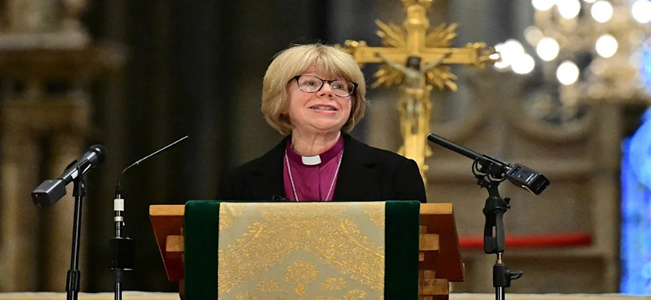
There is an intense irony here that gets to the heart of the self-inflicted problems of the Church of England today. Sarah Mullally has been very clear on the kind of Church she believes in – she’s a supporter of LGBTQ+ rights and activism, she has strongly backed asylum and migration, she is a self-declared feminist, and she is both politically and it seems religiously progressive. As Bishop of London, she boasted about representing a diverse and multicultural city, and put her experience in handling diversity as one of the key qualifications and evidence of positive experience she could bring to being the Archbishop of Canterbury. (Emphasis mine.)
“The Church of England has lost 80 per cent of Anglicans on the planet” « Quotulatiousness
Added 10-18-2025:
Helen Andrews | Overcoming the Feminization of Culture | NatCon 5
Helen [Andrews] argues that the rise of “wokeness” wasn’t born from Marxism, academia, or even Obama-era politics. That in itself had people shocked. Helen theorizes that it actually came from something way simpler… the quiet but steady feminization of America’s most powerful institutions.
Helen Andrews wrote in The Great Feminization | Compact
“Wokeness is not a new ideology, an outgrowth of Marxism, or a result of post-Obama disillusionment. It is simply feminine patterns of behavior applied to institutions where women were few in number until recently . . .
Everything you think of as wokeness involves prioritizing the feminine over the masculine: empathy over rationality, safety over risk, cohesion over competition . . .
“The threat posed by wokeness can be large or small depending on the industry . . . The field that frightens me most is the law. All of us depend on a functioning legal system, and, to be blunt, the rule of law will not survive the legal profession becoming majority female. The rule of law is not just about writing rules down. It means following them even when they yield an outcome that tugs at your heartstrings or runs contrary to your gut sense of which party is more sympathetic.
“The problem is not that women are less talented than men or even that female modes of interaction are inferior in any objective sense. The problem is that female modes of interaction are not well suited to accomplishing the goals of many major institutions.”
~~~~~
“THE EIGHT PRINCIPLES OF UNCIVILISATION
1. We live in a time of social, economic and ecological unravelling. All around us are signs that our whole way of living is already passing into history. We will face this reality honestly and learn how to live with it.
2. We reject the faith which holds that the converging crises of our times can be reduced to a set of ‘problems’ in need of technological or political ‘solutions’.
3. We believe that the roots of these crises lie in the stories we have been telling ourselves. We intend to challenge the stories which underpin our civilisation: the myth of progress, the myth of human centrality, and the myth of our separation from ‘nature’. These myths are more dangerous for the fact that we have forgotten they are myths.
4. We will reassert the role of storytelling as more than mere entertainment. It is through stories that we weave reality.
5. Humans are not the point and purpose of the planet. Our art will begin with the attempt to step outside the human bubble. By careful attention, we will reengage with the non-human world.
6. We will celebrate writing and art which is grounded in a sense of place and of time. Our literature has been dominated for too long by those who inhabit the cosmopolitan citadels.
7. We will not lose ourselves in the elaboration of theories or ideologies. Our words will be elemental. We write with dirt under our fingernails.
8. The end of the world as we know it is not the end of the world full stop. Together, we will find the hope beyond hope, the paths which lead to the unknown world ahead of us.”
― Paul Kingsnorth, Uncivilisation: The Dark Mountain Manifesto
Why I’m Taking Music & Art Lessons – Margarita Mooney Clayton
The Satisfaction of Making Art – Margarita Mooney Clayton
~~~~~
From St. Augustine’s Confessions (Book 10, Chapter 27). St. Augustine reflects back on his own conversion from a life of profligacy to one of love and intimacy with God.
Chapter XXVII.-He Grieves that He Was So Long Without God.
Too late did I love Thee, O Fairness, so ancient, and yet so new! Too late did I love Thee For behold, Thou wert within, and I without, and there did I seek Thee; I, unlovely, rushed heedlessly among the things of beauty Thou madest. Thou wert with me, but I was not with Thee. Those things kept me far from Thee, which, unless they were in Thee, were not. Thou calledst, and criedst aloud, and forcedst open my deafness. Thou didst gleam and shine, and chase away my blindness. Thou didst exhale odours, and I drew in my breath and do pant after Thee. I tasted, and do hunger and thirst. Thou didst touch me, and I burned for Thy peace.
https://orthodoxchurchfathers.com/fathers/npnf101/npnf1027.html#P1660_683954
~~~~~
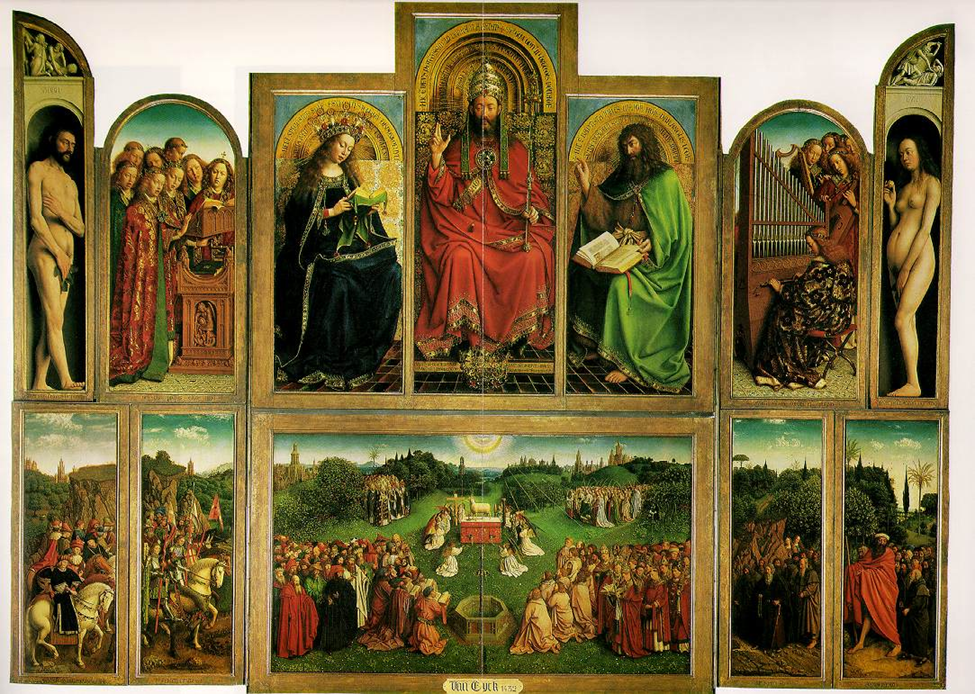
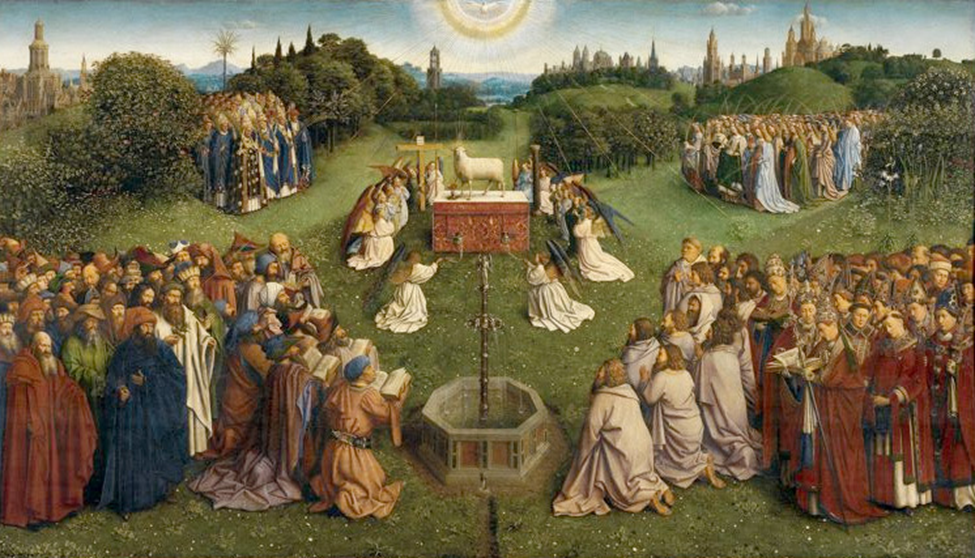
The Ghent Altarpiece (Adoration of the Mystic Lamb) (1432) by Jan van Eyck



 Cindy Wity
Displaced in Place
October 19, 2025 Leave a comment
Monica Sanders, a survivor of Hurricane Katrina, wrote in her August 18, 2025, Oxford American article The Storm that Blew Us Apart recalling Twenty years after Katrina, we’re still living in the space between before and after:
The flood took homes and heirlooms, yes. But it also took the things that don’t have price tags: your grandmother’s pew at St. Peter Claver, the second-line route your cousin danced for the first time, the rhythm of being able to walk next door to ask for a lemon and stay for a two-hour porch talk.
We became refugees in our own country . . .
Some of us never came back.
Those who did found a different city. Not just rebuilt, but rearranged. The neighborhoods we knew—Broadmoor, Gentilly, the Lower Nine—returned with new names, new residents, and new rules. People who knew about noise ordinances but not about king cakes. People who brought nonprofits but not traditions. People who wanted charm but not character. The kind who say “N’Awlins” with a wink, and don’t hear the ghost in that mispronunciation.
Displacement gave way to gentrification. What was affordable became vacation rentals. What was vibrant became boutique. Streets that once held parades now hold pop-ups. We became the entertainment, not the community.
And yet, we remain. . .
All of us carry the “before” with us. . .
We talk about resilience now, but we forget that true resilience is cultural as much as physical. It’s knowing who to call when the lights go out. It’s gathering your neighbors even when there’s no power. Its memory passed like gumbo recipes and Sunday prayers.
~~~
I began with Monica’s reflection on the effects of Hurricane Katrina, for order being swallowed up by non-order, an overwhelming flood, parallels the flood of disorder working to decouple us from people, place and the past and to colonize us for its reorganizing purposes which include efficacy, profitability and efficiency. (Order, non-order and disorder are terms coined by Dr. John Walton to describe cosmology in his Job commentary.)
That storm is blowing us apart. And as was experienced in the aftermath of Hurricane Katrina, we feel a pervasive sense of displacement, of being refugees in our own country, of living in the space before and after the imposed transformation of our culture.
The source of dysphoria about our time and place being out of joint may not be readily recognizable. As with the “frog in boiling water”, we steep in its flood waters not recognizing the stew we are in. Screens constantly distract our attention away from what is happening to our existence.
The source: a flood of ideologically progressive technology and globalization that is wiping out our connections to people, place and the past. Its overwhelming force is our unmooring, our unmaking. Its irresistible force is displacing us in place.
I’ve been aware of the source for many years, starting when I bought a 286 computer in the 70s. The machine had an allure that had me come back to it constantly.
In an October 23, 2022 post Altered States, I quoted Jacques Ellul from his book The Technological Society and wrote the following:
I’m becoming a neo-Luddite of sorts. I have a particular dislike for digital technology as it modifies the means of relating to ourselves, to those around us and to our world. Its dissociative medium detaches us from reality, thereby affecting identity, memory, perception, and truth.
The flood waters are rising around us. Look at what is going on with the tech-bro push for AI and transhumanism, with concerns about rare earth minerals, with chips, chips, and more chips, with 5G towers, energy and water consuming data centers, constant surveillance, mandated digital IDs – why do we need any of it?
‘A Sharp Escalation’: Americans Starting To Revolt Against Data Centers | ZeroHedge
I recently came across an author that uses “the Machine” as the analogy for the inhuman forces at work to enclose all in its path for Progress. What Kingsnorth writes resonates with everything that I’ve read in dystopian novels: 1984, That Hideous Strength, Brave New World, and Darkness at Noon. Here’s Paul Kingsnorth with “Huxley and the Machine”:
Paul Kingsnorth’s, Against the Machine is “an account of the technological-cultural matrix enveloping all of us. The culmination of two decades of my writing and thinking about technology, culture, spirituality and politics, it seeks to offer an insight into how the techno-industrial culture that I call ‘the Machine’ has choked Western civilisation, is destroying the Earth itself, and is reshaping us all in its image.
From the First Industrial Revolution to the rise of artificial intelligence, this book shows how the hollowing out of humanity has been a long game—and how our very soul is now at stake.
Against the Machine is the spiritual manual for dissidents in the technological age.”
~~~~~
Per Lewis Fried, Lewis Mumford, author of The Myth of the Machine, “insisted upon the reality of the Megamachine: the convergence of science, economy, technics and political power as a unified community of interpretation rendering useless and eccentric life-enhancing values. Subversion of this authoritarian kingdom begins with that area of human contact with the world that cannot be successfully repressed – one’s feelings about one’s self. “
Mumford:
The vast material displacements the machine has made in our physical environment are perhaps in the long run less important than its spiritual contributions to our culture.
Technology, instead of introducing us to freedom, has imposed on us the slavery of the machine.
Modern Man is the victim of the very instruments he values most. Every gain in power, every mastery of natural forces, every scientific addition to knowledge, has proved potentially dangerous, because it has not been accompanied by equal gains in self-understanding and self-discipline.
A day spent without the sight or sound of beauty, the contemplation of mystery, or the search of truth or perfection is a poverty-stricken day; and a succession of such days is fatal to human life.
Our national flower is the concrete cloverleaf.
Western culture no longer represents man: it is mainly outside him, and in no small measure hostile to his whole self: he cannot take it in. He is like a patient condemned in the interests of X-ray photography to live upon a diet of barium sulphate…In the end, as Samuel Butler satirically prophesied, man may become just a machine’s contrivance for reproducing another machine.
The great gains that were made in technics during the last few centuries were largely offset by a philosophy that either denied the validity of man’s higher needs or that sought to foster only that limited set of interests which enlarged the power of science and gave scope to a power personality. At a moment when a vast surplus was available for the goods of leisure and culture, the very ideals of leisure and culture were cast into disrepute — except when they could be turned to profit. Here lies the core of the inner crisis that has afflicted our civilization for at least two centuries. In the heyday of expansionism, the middle of the nineteenth century, scarcely a single humane voice could be found to defend either the means or the ideals of a power civilization…Blake, Ruskin, Morris, Arnold, Emerson, Whitman, Thoreau, Melville, Dickens, Howells, Hugo, Zola, Mazzini, Tolstoy, Dostoyevsky, Ibsen…denounced the human results of the whole process of mechanization and physical conquest. As with one voice, they protested against the inhuman sacrifices and brutalizations, the tawdry materialisms, the crass neglect of the human personality.
~~~~~
~~~~~
The truth is, men have lost their belief in the Invisible, and believe, and hope, and work only in the Visible; or, to speak it in other words: This is not a Religious age. Only the material, the immediately practical, not the divine and spiritual, is important to us. The infinite, absolute character of Virtue has passed into a finite, conditional one; it is no longer a worship of the Beautiful and Good; but a calculation of the Profitable. Worship, indeed, in any sense, is not recognised among us, or is mechanically explained into Fear of pain, or Hope of pleasure. Our true Deity is Mechanism. It has subdued external Nature for us, and we think it will do all other things. We are Giants in physical power: in a deeper than metaphorical sense, we are Titans, that strive, by heaping mountain on mountain, to conquer Heaven also.
Thomas Carlyle, from “Signs of the Times“
~~~~~
Against the machine: Digital ID Black Pill Moment? – The Burning Platform
Rate this:
Filed under 2025 Current Events, Culture, Digitalization, social commentary, technology, the Singularity Tagged with Against the Machine, AI, artificial intelligence, chatgpt, digital technology, Paul Kingsnorth, philosophy, Silicon Valley, smartphones, technology, the Singularity