Lip Service

The Observant Observer

Is Israel’s Restoration Project Under Attack?

Tevye Lev, Opinion

Gennesaret. The Pharisees, together with legal experts from Jerusalem, were on the scene to investigate Jesus when they witnessed some of his followers eating with unwashed hands – a brazen breach of a long-held practice of ceremonial washings and ritual purity rules.

The Pharisees, as do all Jews, never eat without first washing their hands. This is to maintain the tradition of the elders, who when they come from the marketplace, never eat without first washing. There are other traditions too: the washing of cups, pot, and bronze dishes.

Known for strict Torah observance by way of oral tradition, the Pharisees consider that being ritually impure is to be morally impure. One rabbi described eating with unwashed hands as no different than lying with a harlot.

As our readers are aware, the Pharisees claim that the Law that God gave to Moses consisted of the written Law and the oral traditions of the Jewish people, the oral law being an interpretation of the Torah according to what they believe to be the spirit of the Law. It consists of a collective body of ordinances that have evolved from the Law to regulate religious observances and the daily life and conduct of the Jewish people. 

Ritual hand washing is seen as an extension of Moses’ directive to Aaron and his sons for them to wash their hands and feet prior to entering the Tabernacle.

A legal expert described the ritual before partaking of a meal: “First you wash your hands to make them clean, and then perform the ritual to make them spiritually clean. You recite a prayer during the ritual washing: ‘Blessed be Thou, O Lord, King of the universe, who sanctified us by the laws and commanded us to wash the hands.’”

 As part of a renewal movement, the Pharisees are working to purify Israel from worldly influence and bring about the conditions for the national restoration of Israel based on the near-at-hand expectations of the prophets.

They instituted synagogues so we could gather locally and not have to travel to the temple and be under literal Torah observance. At the same time, they insist on the binding force of oral tradition and show no mercy towards those that subvert those customs. When Jesus’ followers didn’t wash their hands before eating, they became immediately suspect of breaking oral tradition.

Word here in Jerusalem is that Jesus has been on a whirlwind tour throughout Galilee proclaiming the “good news of the arrival of the kingdom of God.” Religious leaders have taken note and are concerned about anyone claiming to be the revolutionary, as others had failed and have made things worse for the Jews. Pharisees and legal experts went to Gennesaret to look into Jesus.

The Pharisees-from an etching by Friedrich Ludy

When confronted about his disciple’s blatant break with the tradition of the elders (not washing their hands before eating), Jesus clearly took issue with what he considers to be progressive revisionist practices that generate spiritual pretenders. He quoted the words of the prophet Isaiah:

These people make a big show of saying the right thing,
    but their heart isn’t in it.
They act like they’re worshiping me,
    but they don’t mean it.
They just use me as a cover
    for teaching whatever suits their fancy.”

He went on to state that the Pharisees were setting aside God’s commands to preserve human tradition. He provided an example, focusing on what he considered to be another application of their revisionist interpretation of the Law with their use of Korban – something to be offered to God or given to the sacred treasury in the temple.

He began by quoting Moses: “Honor your father and mother” and “Anyone who slanders father and mother should die.”

Jesus contended with the Pharisee’s practice of telling people that in lieu of giving to their parents they could redirect their gift by calling it “Korban,” thereby leaving their parents without the help they need. He seems to be implying that instead of honoring parents and thereby God as the Law would have it, this practice is actually an insult to both.

He went on to say that the result of this revisionist interpretation of the Law that they zealously promote and enforce, and others like it, is to nullify God’s word.

It is reported that Jesus then called the crowd together and said this:

“Listen to me, all of you, and get this straight! What goes into someone from outside does not make them unclean. What makes someone unclean is what comes out of them.”

Is Jesus doing away with ritual purity or is he suggesting something else?

Are the Pharisees hypocrites when they show their piety and devotion to God with hand washing?

Is Jesus undermining the Pharisee’s Israel restoration project that is attempting to force into effect an end of history kingdom of God that they approve of?

Here in Jerusalem, the Pharisees are forming councils to censor and block any attempts to circumvent their restoration agenda which includes oral tradition.

(The above is based on the gospel of Mark 7: 1-23.)

~~~~~

Here’s an inciteful take on Deuteronomy that will revise what you thought you knew.

The Gospel According to Moses

For the renowned scholar, Dr. Daniel Block, Deuteronomy is the “Gospel according to Moses.” Moses’ farewell pastoral addresses call God’s people to remember his grace in salvation, covenant relationship with him, and his revelation of a way of blessing in a lost world.

Daniel I. Block, “The Gospel According to Moses: A Commentary on Deuteronomy”

Daniel I. Block, “The Gospel According to Moses: A Commentary on Deuteronomy” (Inspirata Publishing, 2023) – New Books Network

Remaining Podcasts here:

Daniel I. Block, “Hearing the Gospel According to Moses Volume 2: Chapters 12-23” (Inspirata, 2024) – New Books Network

Daniel I. Block, “Hearing the Gospel According to Moses: Chapters 24-34” (Inspirata, 2024) – New Books Network

~~~~~

Here’s an excellent April 3, 2025 PBS/Frontline documentary of things you won’t hear from MSM including CNN, MSNBC and Fox News. Put away political animus to gain insight. (Some coarse language.)

Trump’s Power & the Rule of Law: Steve Bannon (interview) | FRONTLINE

~~~~~

Osvaldo Golijov’s “Tenebrae”: Melismatic Echoes of Couperin

In Western Christianity, Tenebrae occurs in the final days of the Holy Week, and commemorates the sufferings and death of Christ. It involves the gradual extinguishing of candles, leading to a void of darkness.

Metaphorical darkness, light, and space formed the inspiration for Tenebrae, a 2002 chamber work by Argentine composer, Osvaldo Golijov (b. 1960).

Carnation, Lily, Lily, Rose, 1885 – 1886 – John Singer Sargent

In Deep

One day, Peter sat down with Mark and told him about the challenges of being a disciple of Jesus and what he witnessed.

“Jesus called the twelve of us together, gave us instructions, and sent us out in pairs to several areas in Galilee. We announced that the kingdom of God had arrived, and that people should repent. We cast out unclean spirits. And we anointed many sick people with oil and cured them. We were doing what he had been doing.

“When we returned from our mission, we were anxious to share with him all that we had done and taught. We must have looked tired and hungry. He said we all needed a break. People were constantly coming and going around us. So much so that we didn’t have time to eat.

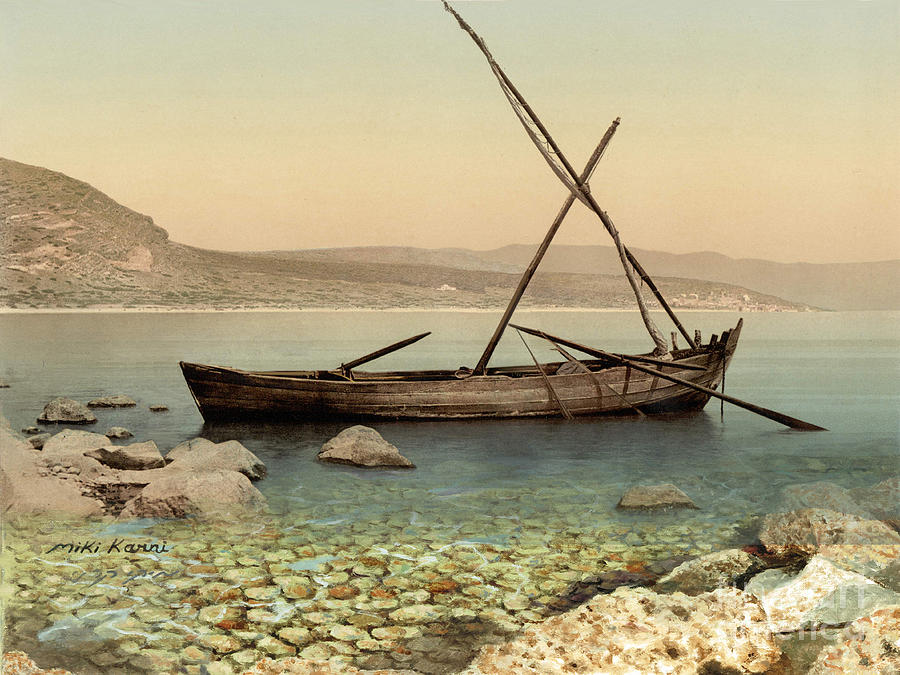
“We got in the boat and sailed to a deserted spot. But the crowd saw us going, realized what was happening and arrived there first. When Jesus got out of the boat and saw the huge crowd, I could tell that he felt deeply sorry for them. He said they were like a flock without a shepherd. So, he began to teach them many things.

“There was nothing to eat at that deserted place and it was getting late in the day. We wanted the Teacher to send the crowd away so they could buy food in the countryside or in the villages. But then he said “We don’t need to send them away. Why don’t you give them something.”

“We looked at each other wondering what in the world he was suggesting. Was he serious? Philip said “It would take more than half a year’s wages to buy enough bread for each one to have a bite!”

“Then he said “Well, how many loaves have you got? Go and see.”

“My brother Andrew found a boy with five small barley loaves and two small fish. But we were standing in front of thousands of people.

“Jesus had us sit everyone down, group by group, on the green grass. So, we made everyone sit in companies of hundreds and fifties. Then Jesus took the five loves and the two fish, looked up to heaven, and blessed the bread. He broke it and gave it to us to give to the crowd. Then he broke the fish into pieces and handed to it to us to give to the crowd. Everyone ate and had their fill including me and the others of our group. Over five thousand people were fed.

“We gathered up the leftovers and there were twelve baskets of broken pieces and of the fish. Everyone was full and tired.

“And then, just like that, Jesus told us to get into the boat and sail toward the opposite shore. He dismissed the crowd and then went off up the mountain to pray.

“Mark, you won’t believe what happened. We had rowed about three or four miles and were in the middle of the sea. It had been hard rowing all night. A stiff wind coming down from the mountains on the eastern shore of the lake was working against us.

“Then, in the dead of night, we all thought we saw a ghost walking on the water. It was about to go past our boat. We were scared out of our wits. We were yelling “Who goes there?!” And then, just like that, we hear “Cheer up! It’s me. Don’t be afraid.” When the figure came closer, we could see that it was Jesus. He was walking on the water!

“I said “if it’s really you, Master, then give me the word and I’ll come to you on the water.” And he said “Come along, then.”

“So, I got out of the boat, and would you believe it Mark, I walked on the water. But then I saw the wind chopping the waves and the chaos at my feet and I began to sink just like that. I called out to the Teacher. He put his hand out and caught me before I went under. He looked at me and said “A fine lot of faith you’ve got! Why did you doubt?” I was shivering and feeling pretty low, so I said nothing as we walked to the boat and climbed in.

“As soon as we got in the boat the wind stopped blowing just like that. And just like that we reached the shore. And just like that we went from being scared out of our minds to being thunderstruck by what had taken place, just like before.

“I told you, Mark, about the last storm we faced on the Sea of Galilee. It came up suddenly from the West. Waves beat against the boat and it quickly began to fill with water. That time Jesus was with us. He was asleep and we woke him up to help us bale out water. He got up, scolded the wind, and said to the sea “Silence! Shut up!” Things went to a dead calm, just like that. Then he said “Why are you scared? Don’t you believe yet?”

We were terrified when we saw this. We looked at each other and said “Who is this? Even the wind and the sea do what he says.”

This time we fell down and worshipped Jesus saying, “You are really God’s son!”

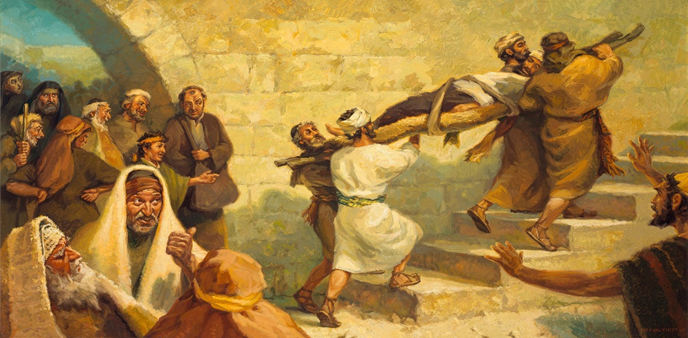
“We made landfall at Gennesaret and tied the boat up. As soon as we landed people recognized Jesus. They began to bring sick people on stretchers to where they heard he was.

“And Mark, wherever Jesus went, in the villages, towns or open country, people brought their sick to the marketplace and begged him to let them touch the edge of his cloak. And whoever touched the hem became well. The healed were getting up from their stretchers and were running around praising God. You should have seen it.”

(The above is an imagined retelling of Mark chapter 6 referencing Matthew chapter 14, Luke chapter 9, and John chapter 6)

~~~

Did Jesus have Peter and the other apostles wade into waters over their heads to remove the scales from their eyes? Did he put them through the wringer to squeeze out unbelief? It would seem so.

The Twelve – fishermen, a tax collector, and other regular guys – are sent to districts of Galilee on a kingdom of God mission well outside the range of their experience. This while earthly kingdoms get word of their kingdom message and of the power at work in them. And this while there is news of the arrest and beheading of John the Baptist by Herod.

When the Twelve return to Jesus, he has the group sail to a deserted area for a break away from the constant flow of people. But upon arriving they are met by an enormous crowd that had figured out where they were going. Then the Twelve are asked to provide food for the thousands listening to Jesus.

Having no resources other than a meager five loaves and two fish, the Twelve are assigned by Jesus to have everyone sit down in groups, to pass out the baskets of bread and fish that he hands them, and to collect the leftovers. Menial labor after a lofty mission and no rest for the Twelve.

That evening, Jesus sends the Twelve rowing across a sea that was known for its challenges. (Nature is no respecter of persons except for Jesus.) And on that sea, in the early morning hours, they encounter a ghost-like figure that scares the beJesus into them.

We don’t always get the inner perspective of the disciple’s thoughts and feelings in the gospel of Mark. But in at least two accounts we learn that the Twelve were “terrified” (Mk. 4:41) and “astounded” (Mk. 6:51) by the Who of “Who is this?” and “Who goes there?”

It is one thing to hear about divine revelation in the synagogue, to hear the words He made known his ways to Moses, his deeds to the people of Israel (Ps. 103:7). It is quite another to encounter God’s ways and deeds in person. And what the “terrified” and “astounded” Twelve experienced was God’s favor, care, and protection for those he chose to be with.

Peter, a fisherman who spent most of his time on the water in a boat, walked on the water with the Son of God right there urging him to do so and ready to catch him. For, faith is more than floating along on what you think you know.

The Twelve, schooled by each unsettling situation the Teacher had them face – strong winds and a sudden storm at sea, a scary specter, a supply shortage, and steady streams of the sick and sheep without a shepherd – discovered God’s power, His presence, His plenty, and His pity.

To their uncertainty, their fears, their inadequacy, and their helplessness, God’s presence was revealed.

“Who is this?” “Who goes there? “

“Cheer up! It is I AM.

~~~

Isaac, Joseph, Moses, Joshua, Gideon, Saul, David, Solomon, Jeroboam, Asa, Jehoshaphat, and Jeremiah were promised the presence of God. The Presence was promised to Jacob:

“Know that I am with you and will keep you wherever you go, and will bring you back to this land; for I will not leave you until I have done what I have promised you.” (Genesis 28:15) (Emphasis mine.)

Jesus made the same promise to his followers before he ascended into heaven:

I am with you, every single day, to the very end of the age.” (Matt. 28:20)

And beyond . . .

And I heard a loud voice from the throne saying, “Look! God’s dwelling place is now among the people, and he will dwell with them. They will be his people, and God himself will be with them and be their God. (Rev. 21:3) (Emphasis mine.)

The Real Presence is with you in the Holy Eucharist. Jesus is literally and wholly present—body and blood, and divinity—in the elements of bread and wine. 

The age-to-age continuum of God’s promise of presence with us, expressing His covenant faithfulness, is the premise of our faith. He will not abandon us. The praxis of knowing that – living by faith – operates within The Presence continuum.

~~~

The time the Twelve spent with Jesus was eye-opening – but not always mind’s eye opening.

After Mark tells us that the apostles were overwhelmed with astonishment (having just watched Jesus walking on the water) he adds a comment (Mk. 6:52): they didn’t understand what Jesus had done with the fishes and loaves – their hearts were hardened.

Mark doesn’t explain this last note. Maybe, when presented with the existential reality of what took place that afternoon, the Twelve chose to ignore it or had no place in their imagination for it. Or maybe, their hearts were hardened by God.

Recall that during the Ten Plagues of Egypt, Pharoah’s heart was hardened by God and remained that way even after Pharoah’s magicians threw in the towel when they couldn’t fabricate further “miracles”:

The magicians said to Pharaoh, “This is God’s doing.” But Pharaoh was stubborn and wouldn’t listen. Just as God had said

Exodus 9:15-16 gives us the reason why Pharoah’s heart was hardened. God tells Moses to confront Pharaoh and tell him the following:

You know that by now I could have struck you and your people with deadly disease and there would be nothing left of you, not a trace. But for one reason only I’ve kept you on your feet: To make you recognize my power so that my reputation spreads in all the Earth. You are still building yourself up at my people’s expense. (Emphasis mine.)

We don’t know why the Twelve couldn’t take in what had happened that afternoon. But I wonder: did they later recollect that experience and understand the multiplication of loaves and fishes in the context of the Exodus? God fed thousands in the wilderness.

Did they later recollect their experiences (walking on water, Jesus intending to pass by the boat, disclosure of God’s presence with them, a healing hem) and understand them in context of the Exodus?

God controlled nature (the Red Sea) so that Israel can walk through/on it.

God passing by Moses (Ex. 33:22)

God revealed Himself to Moses as “I Am” in a physical phenomenon (a burning bush).

Israelites were healed by a physical object – by looking at a snake made of fiery copper (Num.21-4-9),

With the events described by Peter in Mark’s gospel and the events of Israel’s history, Jesus’ kingdom mission for the world is equated with the Exodus mission of rescue and redemption for Israel.

~~~~~

Podcast: Three books by O.T. scholar Iain Proven

The Old Testament is often maligned as an outmoded and even dangerous text. Best-selling authors like Richard Dawkins, Karen Armstrong, and Derrick Jensen are prime examples of those who find the Old Testament to be problematic to modern sensibilities. In his new book Seriously Dangerous Religion: What the Old Testament Really Says and Why It Matters (Baylor UP, 2014), Iain W. Provan counters that such easy and popular readings misunderstand the Old Testament

Discussed in this podcast are three books authored by OT scholar Iain Proven:

A Biblical History of Israel, Second Edition

Convenient Myths: The Axial Age, Dark Green Religion, and the World that Never Was

Seriously Dangerous Religion: What the Old Testament Really Says and Why It Matters

I’ve read Convenient Myths and Seriously Dangerous Religion. I recommend both books.

Iain W. Provan, “Seriously Dangerous Religion

Iain W. Provan, “Seriously Dangerous Religion: What the Old Testament Really Says and Why It Matters” (Baylor UP, 2014) – New Books Network

~~~~~

You’ll Never Be the Same


Daybreak. The village of Bethsaida. The air is hot and dry and still. And something is astir. Jesus has come to the “house of fishing”.

You hurry down to the shore of the Sea of Galilee. Your husband and his brother have been fishing long before daybreak. You carry with you a clay jar full of water and a cloth.

Along the shore are baskets of fish. The village women and merchants have come to purchase the salted tilapia. You know that your husband will reserve some for his family and for the widows. And though there over two hundred boats on the water, you spot your husband’s and his brother’s boat.

At the edge of the water you hear “The time is fulfilled! God’s Kingdom is arriving! Turn back and believe the good news!” Jesus, walking along the shore, is coming toward you.

Trying to get your husband’s attention, you wave. He and his brother are busy casting nets. You shout. “Look! Jesus is coming this way!” Your husband finally hears your voice and turns toward you.

Jesus walks up to you. From the same vantage point he calls out to your husband and his brother, “Follow me! I’ll have you fishing for people!”

At once, your husband and his brother let go of their nets and bring the boat to shore. At once, they begin to follow Jesus along the shoreline. You follow them, two steps to their one, with the clay jar of water. You soak the cloth in the water. With it your husband proceeds to wipe his brow and then his beard to remove the crusted salt – sweat from his brow. You hand him the clay jar. Dehydrated, he gulps half the water down and then hands the jar to his brother.

Further down Jesus calls “Follow me!” to two men mending their nets. You know them – James and John, the sons of Zebedee. The brothers leave their boat and their father and the hired servants behind.

At this point, you’ve run out of breath and are not able to keep up. You call to your husband, “I’m going home. My mother is not feeling well.” Your husband acknowledges but goes on, determined to keep his eyes on Jesus.

As you watch him and the fellowship of fishermen continue down the shore, you remember the words of the prophet Isaiah that were read in the synagogue last Shabbat:

The Lord God helps me;
therefore I have not been disgraced;
therefore I have set my face like flint,
and I know that I shall not be put to shame

Zebedee calls to you. “I will have my hired hands take care of your boat. I will sell the fish you husband caught and bring you fish for you and the widows.” You thank him. Carrying the clay jar and the cloth you head home pondering all that has happened. Every woman in Bethsaida knew what Mary had said about Jesus. Something begins to stir in your heart.

An hour or so later your husband and his brother are at the door. They tell you that they are going to Capernaum with Jesus and are not sure when they will return. You give them some bread to take with. Before your husband takes off, you stop him at the door. “Could he be the one? He’s talking about a kingdom. I don’t want you getting killed. What’s his plan?”

Your husband responds. “Woman, there is only one way to find out.”

Sweat runs down his temples to his beard. The midday sun is blazing. You hand him his mantle, which he throws over his shoulder. He races off with his brother Andrew. He calls to John and James who are already fifty paces ahead of them and Jesus is ten paces ahead of them. He wants them to wait up. Your husband is a big man with a big heart and is impulsive to a fault. He takes strides in all directions. And today, you wonder what will become of him and the fishing business as he takes off in a new direction.

On your way home you stop and give the widows the salted fish and to hear rumors. You learn that many were repenting and were being baptized in the River Jordan by John the Baptist, Jesus among them. And that when he came out of the water there was a dove and a large booming voice that said “You are my son! You are the one I love! You make me very glad!” There is so much more for you to ponder.

At home you prepare for Shabbat which begins just before nightfall. You sweep and clean your home from top to bottom. You cover the sales money so it is out of sight. You make sure there is oil in the two lamps.

The night settles in. You eat food prepared earlier. You care for your mother who now has a fever. As you wipe her head with a damp cloth you talk with her about Jesus until you can’t stop yawning. You go to your bed. You are glad that you and your husband sleep in separate rooms, for when your husband sleeps, he snores – a nightly ritual even on Shabbat. Tonight, there will be the moaning of your delirious mother.

As you fall asleep you imagine your husband walking to Capernaum. He would walk two hours in the hot sun. Did he have water? Maybe the journey would take less time with the strides Jesus takes. When will he return …?


Your husband and his brother and James and John return the next day. They are all at the door with Jesus. He had been told about your mother and her illness. Jesus goes in, takes your mother by the hand, and raises her up. At once, her fever is gone and she was well enough to feed them. How is this possible, you ask yourself? But there is no time to wonder as you want to feed them all. Your heart is brimming with thanksgiving.

Outside your home there is large crowd – people from all over Galilee have followed Jesus. Jesus goes out to them. People with all kinds of diseases are brought to him and he heals them. Inside, the four fishermen sit down on the floor. You place bread and fish and water before them. As you do you ask them for details of what happened in Capernaum. They all begin to talk at the same time, but your husband has the loudest voice and so the rest wait their turn:

“We went into the synagogue and Jesus began teaching from the scrolls….’

“None of us had heard anything like this teaching before. He has his own authority, “John interjected. The other three agreed. Your husband continues.

“We are sitting there looking at each other astonished by what he is saying. You see that crowd out there. There was a large crowd around the synagogue. The people were pressing in from all sides trying to hear him. Anyway, we are sitting there when all of a sudden this guy starts shrieking “What business have you got with us, Jesus of Nazareth? Have you come to destroy us? I know who you are: you’re God’s Holy One!”

“He had an unclean spirit living in him,” James tells you. As he says this they hear another shriek outside. And another. Andrew got up to see what was happening. “Jesus is casting out those spirits right outside our door!” Your husband continues.

“You know what he said to that unclean spirit in the synagogue?” Wide-eyed, you ask, “What?”

“He says, ‘Be quiet! And come out of him! The man jerked and writhed like a snake and then screamed and then the unclean spirit came right out of him!”

“We were all shocked, “John continued. “Jesus not only speaks with authority, he even tells unclean spirits what to do, and they do it! The demons talk like they know who he is. He tells them to shut up.”

“We know who the unclean spirits are, where they come from,” Andrew added. “They are from Belial, the kingdom of Belial.”

Noticing two centurions keeping an eye on the crowd, your husband asks, “Do you think that the coming kingdom Jesus talks about will rid us of the tyranny of the Roman dogs?

James is quick to respond, “I hope so. Right now, he appears to be overthrowing the kingdom of Belial.”

“I’m good with that!” John chimes in. “Look around. Those spirits wreak havoc on everyone and everything. The Essenes at Qumran have been battling them for years.”

Nodding in the direction of the two centurions, James wondered out loud, “If Jesus has power over the kingdom of Belial, shouldn’t the Romans be shaking in their caligae?”

Your mother, upon hearing this, went out and offered the two centurions water from the clay jar, which they guardedly accepted. She then offered Jesus some and invited him in for a meal and a place to sleep for the night. He accepted.

Very early – the middle of the night, actually – Jesus got up and went out. You woke your husband and he roused Andrew and James and John. They went looking for Jesus. When they found him praying, they said, “Everyone is looking for you!”

“Let’s go off to the other towns around here,” Jesus replied, “so that I can tell the news to people there too. That’s why I came out.”


The next morning you hurry down to the shore of the Sea of Galilee. Men have been fishing long before daybreak. You carry with you a clay jar full of water and a cloth. You want to do what you can to prepare the way of the Lord.


Adapted from Mark Chapter 1

Deliver Us from Evil

Evil and its enforcer, power, has been around long before man employed both to consolidate empires. Cain killed Abel to gain power over the living reminder of his own disobedience. Joseph’s brothers sold Joseph into slavery to gain power over the living reminder of their supposed unfair treatment and over their father’s love and estate. Evil and its enforcer, power, have always worked together with ruthless abandon to take truth hostage.

 “Violence finds its only refuge in falsehood, falsehood its only support in violence.”

-Aleksandr Solzhenitsyn

An astute student of world history would discern that seeking and holding absolute power is valued as far superior to seeking and holding absolute truth. Those who hold power believe they can generate a ‘regime of truth’ by virtue of their position: “truth is what I say it is.”. Anyone attuned to current world affairs can readily see that culture and politics, including our democratic Republic in the U.S., revolve around who holds what power and therefore controls what is and what has been. For, as Winston repeated over and over in George Orwell’s 1984, “who controls the past, controls the future: who controls the present controls the past.” A student of Scripture will see that the regimes of power and truth, beastly kingdoms, are made subject to Absolute Power and Absolute Truth.

It has been said that the gospel crafted by Mark, an ace narrator, was written to a Roman audience. Certainly, there is a “just then” immediacy to his gospel. A sense of action is invoked which would peek a centurion’s ‘man of action’ curiosity. Of more importance to a Roman though, and to any earthly authority and to those under authority, is the theme of who holds power. On earth, regimes of power control regimes of truth. The spiritual world of unclean spirits requires a human habitation to control truth incarnate (Rom. 1:21). Mark’s gospel is the proclamation of a new regime of power and has nothing to do with a justice league of super-heroes with super powers.

In terms similar to announcing a new emperor who claimed to be a son of god, Mark begins his gospel by proclaiming Jesus’ title:

“This is where the good news starts – the good news of Jesus the Messiah, God’s son.”

With this proclamation a new regime is declared. The title acknowledges Jesus’ authority and connotes his power. The title announces what Israel had so hoped for — a Messiah, one who is anointed by God and therefore God’s representative. The Hebrew scriptures chronicled anointed kings, priests and prophets who represented God to Israel. The book of Daniel and writings between the Testaments, in particular the Messianic Apocalypse and the Son of God text from the Dead Sea Scrolls, record Jewish Messianic beliefs in ancient Judaism. In these texts, “Son of Man” is the title given to the one who will reign and hold dominion over all things and offer blessings to those under him.

The new regime, anticipated in Psalm 146 and the Messianic Apocalypse, comes with four blessings:

-The hungry are fed

-the prisoner is set free

-the blind receive their sight

– all things are put right.

Mark’s opening statement declares Jesus to be the anointed One of God. And, of vast more import to the Jews and to the regimes of power and truth, Jesus is declared to be not just another mere mortal claiming to be a son of god, but the One God’s own Son. Human and spirit and citizen and centurion encounter Jesus in Mark’s account. They soon come to this realization.

In the first paragraphs of Mark, Jesus’ baptism by John the Baptist is recorded. Here is the anointing of Jesus by water, by the spirit and by The Voice from the realm of heaven: “You are my son! You are the one I love! You make me very glad!”

Next, Jesus is tested by the Satan. The temptation is for Jesus to accept the realm of power and authority that the Satan offers to him.

A few paragraphs later we read of Jesus and his new disciples going to Capernaum. There Jesus encounters a force from the realm of darkness, the same realm offered to him by the Satan:

They went to Capernaum. At once, on the sabbath, Jesus went into the synagogue and taught. They were astonished at his teaching. He wasn’t like the legal teachers; he said things on his own authority.

All at once, in the synagogue, there was a man with an unclean spirit.

“What business have you got with us, Jesus of Nazareth?” he yelled. “Have you come to destroy us? I know who you are: you’re God’s Holy One!”

“Be quiet!” ordered Jesus “And come out of him!”

The unclean spirt convulsed the man, gave a great shout, and came out of him. Everyone was astonished.

“What’s this?” they started to say to each other. “New teaching – with real authority! He even tells unclean spirits what to do, and they do it!”

Mark’s gospel account goes on to detail events which show the authority and power of Jesus. Over and over we read of Jesus’ power over demons, the unclean spirits which roam the earth seeking whom they may inhabit. Realms of power are juxtaposed – heaven’s and the dark forces of the Satan which control men. They are shown in direct conflict. And note above: the unclean spirt knows who Jesus is and by whose authority he works before anyone else in the story. But why does Jesus stop the demon from declaring his identity? Mark’s beginning narrative imposes a tension that is resolved at the end of his gospel.

Before the end of the gospel we read of exorcisms. The realms of darkness are dealt with in these passages:

Mark 1:21-28 – shown above

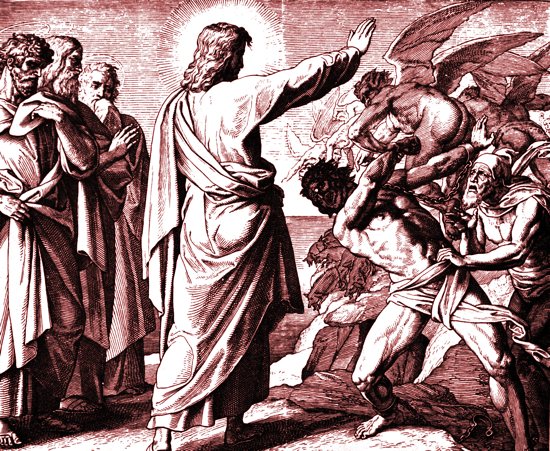
Mark 5:1-20 – a wild untamed man with inhuman strength is possessed by an unclean spirit. He lives in a graveyard. We read that “No one had the strength to tame him”. This demon possessed man sees Jesus and throws himself in front of Jesus and shouts at the top of his voice…

“Why you and me, Jesus?”  “Why you and me, son of the High God?” By God stop torturing me!”  this last, because Jesus was saying to him “Unclean spirit, come out of him!”

Jesus cast The Legion of demons into a herd of pigs. The pigs then rush to the sea where they drowned. (The unclean spirits leave the dead pigs and go on searching for someone to inhabit.)

Mark 7:24-30 – a Greek woman throws herself at Jesus’ feet. She pleads with Jesus to cast an unclean spirit out of her daughter. After hearing the gentile woman’s “even the dogs under the table eat the crumbs that the children drop” Jesus affirms her words and sends her on her way. Her demon-possessed daughter back at home was rid of the unclean spirit.

Mark 9:14-29 – a father brings his demon possessed son to Jesus. The disciples could not cast out the demon. Jesus is notably angry at the unbelief in the power of God, especially when the father hedges, “…if you can do anything…” Jesus reprimands the father. “What do you mean, ‘If you can?” “Everything is possible to someone who believes.” The father shouts “I do believe! “Help me in my unbelief!” Jesus commands the unclean spirit to come out of the boy. The boy convulses and the unclean spirit comes out. The disciples go to question why they were ineffective. Jesus responds, “This sort can only be cast out by prayer.”

In Mark 3:15, 6:7 & 13 and 9:38-39 Jesus gives his followers the authority to cast out unclean spirits.

Mark is an excellent story-teller. As you read above, tension was imposed by Mark in the beginning paragraphs – the silence imposed on the unclean spirit who disclosed Jesus’ identity. This was done to pique the reader’s curiosity. Mark wanted the reader to discover for themselves who Jesus is. Like those involved with Jesus, the reader would question “Is Jesus really the Messiah?” and “Is Jesus really God’s son?” Each encounter and event would provoke questioning and amazement in the reader: “What’s this?”; “New teaching – with real authority! “He even tells unclean spirits what to do, and they do it!” And then the crucifixion appears to give the regime in power – the Romans- the final word about Jesus. But Mark gives us the final word through the mouth of a centurion:

When the centurion who was standing facing him saw that he died in this way, he said, “This fellow really was God’s son.”

The tension is resolved by an onlooker.


Lest anyone think that Jesus’ sole purpose on earth was to promote social justice and to have his words later passed on as “all you need is love” sixties-style bromides, Mark’s gospel declares to us that Jesus came to deal with evil and its enforcer, power, and with the agents of corruption possessing a will.

Mark declares that there is a new Lord in power, one with all authority in heaven and on earth. As shown by Mark, no power-enforced “regime of truth” on earth or under the earth can take Jesus’ truth hostage. Truth is what Jesus says it is and his truth can set a person free from power-and will-enforced bondage. No regime of power on earth or under the earth can keep his creation hostage. The world of men is to be set free and blessed by his reign. He chose his followers to make that happen.

Jesus has conferred his authority and power to his followers so that the blind will receive their sight and the hungry are fed and the prisoners are set free and unclean spirits are cast out. The world is to be put right under his Lordship.

To sum Mark’s gospel into today’s media parlance, Jesus slammed, crushed and owned the enemy of our souls. To sum Mark’s gospel in Scriptural phrasing…

The kingdom of the world has become the kingdom of our LORD and of his Messiah, and he will reign for ever and ever. -The Revelation of Jesus Christ 11:15