What Am I Not Forgetting?
December 10, 2017 Leave a comment
“I’m not implying that I’ve already received “resurrection,” or that I’ve already become complete and mature! No: I’m hurrying on, eager to overtake it, because King Jesus has overtaken me. My dear family, I don’t reckon that I have yet over taken it. But this is my one aim: to forget everything that’s behind, and to strain every nerve to go after what’s ahead. I mean to chase on toward the finishing post, where the prize waiting for me is the upward call of God in King Jesus.” -the Apostle Paul, Philippians 3: 12-14 
~~~
“What did I forget?” I’ve asked myself this dozens of times. The question comes up in the grocery store and when I am cooking a meal for the family and when I am getting into the car ready to pull out of the driveway. I have asked this when I am finishing a project at work. “What did I forget?”
In each situation there is something in the back of my head telling me that I am forgetting something. As I mentioned, this happens often. But, thinking about what I need to forget didn’t occur until this past week. I read the above verses in my study of Paul’s letter to the Philippian church.
Oh, yes. I’ve read those verses many times before. And when I did, I glossed over the words as if it made sense at a prosaic level. This time the words nudged me and maybe because I am older now.
During this past week I worked out on the elliptical machine at the local fitness club. There is a TV screen above the machine. I typically watch the business programs which include stock futures (I’m an early bird). When the business program goes to commercial I surf the channels.
That morning there were two other programs that caught my interest. The first was a show about a select group of marines going through extensive training to become recon marines. The second show, What Not to Wear, includes us in a fashion makeover. Typically, a reluctant twenty-something is confronted with her wardrobe and her appearance. Both shows seemed to me to be reality checks before the participants moved on.
The Marine recon show depicted the guys going through intense physical training beyond anything they ever knew they could endure. During the exercise the men ‘forgot’ what they knew and pressed on for the upward call to become recon Marines. Not all of the fifty men who entered the program finished.
As typical for What Not to Wear, the hosts had their ‘client’ try on what she usually wore and then critiqued the outfit with her as all three stand in front several mirrors. During the next step in the fashion transformation, the hosts pull the client’s brought-to-the-program clothes off the rack and throw them into a garbage can before her. They want her to forget about them and move on. Without saying as much, they want her to become mature in her view of herself and how she appears to others. Many of the young women wore sloppy attire or clothes a teenager would wear. The hosts prompt their ‘client’ to take herself and her appearance seriously. They want her to dress age and life situation appropriately.
During the next step, the hosts show their TV ‘client’ a manikin dressed in clothes they consider she would look suitable in. After detailing “why” the clothes would befit her, they send her shopping for a new look. I would say, a “resurrected” look.
Forgetting what you know is not easy. Several marines stopped short of recon transformation. On What Not to Wear, many a ‘client’ grimaced and some wept as their habit-formed clothes were tossed in the can. Not wanting to forget makes going forward even harder.
Forgetting. Where do I start?
As I read Paul’s letter to the Philippians, I was reminded that I have done things which are not at all within God’s good graces. I have sinned in God-defying sinful ways. I’m sure I must have gotten God’s attention. And, more than once. But, as with the Pauls’ own admission of not having achieved sinless maturity, I press on. My own recognition and then confession of sin, like Paul’s, moves me forward to the goal of the upward call of God – resurrection, new life, in Him – the Alpha and Omega, the No-beginning and No-end, the Mercy that follows me all the days of my life.
The words of I john 1:9 are critically important to anyone who wants to remove sin’s dead weight and “to strain every nerve to go after what’s ahead”. What John, an eyewitness of Jesus, records is critically important to pressing on and forgetting.
“If we confess our sins, he is faithful and just, and will forgive us our sins, and cleanse us from all unrighteousness.” The First Letter of John, 1:9
The wonder of advent reminds us of Jesus’ first coming and of his second coming. The Kingdom of God on earth began when Jesus inaugurated it during his first coming. Yet, “sins and sorrows grow” and “thorns infest the ground”. There is much injustice, strife, and wickedness taking place. The Kingdom of God is not mature. It is a work in process. On every groaning level of creation there exists a huge amount of tension between the first coming and the second coming.
The same tension applies to the individual who confesses and renounces their sin and seeks to go on to maturity in Christ. This tension will either makes us or break us.
What do I need to forget? Three encumbrances come to mind: status, sentimentality and sin.
Let’s start with status. The world we live in favors world status. Paul reminds the Christian in Philippians 3: 20, “We are citizens of heaven…” Prior to that, at the opening of Philippians 3, Paul warns the church about those who trust in the flesh-the bad works people. Then Paul writes, “Mind you, I have good reason to trust in the flesh…” Paul reminds the readers of his background, a Hebrew of the Hebrews background. He writes, in effect, that his status does not bring him closer to the prize – gaining Jesus. Before stating his forgetting of his status, he reminds us of Someone who ‘forgot’ his status.
In Philippians 2 Paul records an early Christian poem, which contains the words…
Who, though in God’s form, did not
Regard his equality with God
As something to exploit
Instead, he emptied himself,
And received the form of a slave,
Being born in the likeness of humans.
Sentimentality. The desire–the toxic craving–to relive the past, to re-feel. Ugh. You can’t run a race when you are standing in a tar pit. Paul doesn’t go there, even though his memories were astounding: “…my one aim: to forget everything that’s behind, and to strain every nerve to go after what’s ahead.”
Sin. Let’s forget the sin which has so easily beset us. Like the Psalmist, I cry out…
“If you, LORD, kept a record of sins, Lord, who could stand?” Psalm 130.:3
“Do not remember the sins of my youth and my rebellious ways; according to your love remember me, for you, LORD, are good.” Psalm 25:7
Record keeping. The Evil One and those in sync with him will tell you that are unqualified to run and win any race because you failed before. They will say, “You will never be mature because you were immature before”.
Yes, there are those who keep a record of my sins, for ‘safe keeping’. They believe that by standing on a record of my sins they place themselves on higher ground. It doesn’t. Side line opinions are air and hold no weight unless you give them weight. As far as the east is from the west so far has God removed self-serving opinions from us. Don’t go back to the trash and dig them out.
“What am I not forgetting?” is a most important question.
One last word: Consider, that often a lack of forgetting is coupled to a lack of forgiveness. A lack of forgiveness leads to unresolved anger- a root of bitterness. Perhaps a root of bitterness has a grip on both your legs and you are not able to “chase on toward the finishing post, where the prize waiting for me is the upward call of God in King Jesus” let alone stand.
Walk On – The Isaacs
In Christ Alone – Brian Litterell

 Science, and certainly engineering, attends to the particularity of things. Both scientists and engineers must understand a thing and how it relates to other things. Imagine if they didn’t. Imagine if geneticists, physicists, biologists, chemists and aeronautical engineers didn’t consider how things relate to each other. Imagine if an electrical engineer didn’t consider that 3000 amps through an aluminum conductor rated for 600 amps would cause heating and the ultimate melting of the conductor. God gave us Scripture so that we could understand God’s nature expressed in the Word (John’s Gospel chapter one). God gave us nature so that we could understand God’s nature as expressed in things.

























 Cindy Wity
And Nothing but the Whole Elephant
October 1, 2017 Leave a comment
Jesus said to them, “If the world hates you, know that it hated me before you. If you were from this world, the world would be fond of its own. But the world hates you for this reason: that you’re not from the world. No: I chose you out of the world.” John’s gospel account 15: 18-19
~~~
From the many conversations I have had on Twitter, the word on the street is that “God is love and is all about love. We love, so we are doing what God accepts.” So, where does the world’s hate come in?
The hate spoken of in John’s gospel is generated by a protection of one’s place in the world against “outsiders”. Over and over again I have had that hatred and vitriol directed at me on Twitter. I cannot show you the Tweet replies. They are vulgar and pernicious. The replies come from a place beneath this world.
The hate-filled replies occur when I say something other than what is considered loving by those protecting their place in the world. Replies are derived from a worldview. And, one’s worldview depends on whether you accept being called out of this world knowing that that those in the world will hate you or if you are in this world for its approbation:
Called-Out Ones worldview: “For God so loved the world, that He gave…”
Social Justice Warrior (SJW) worldview: “For the world so loved me, when I…”
In order to make the world-accepted SJW worldview sustainable, mainstream churches create a Jesus who is palatable, marketable, consumable and renewable. The ministers do this by parsing Scripture into love notes. Their resultant Scripture messages, whether in a sermon or in a blog or on Twitter, remind me of a bag Valentine Sweethearts – candy hearts.
These churches promote “inclusion” because in a consumer-driven society, choice of how you live, choice of what you accept and who you accept, choice of right and wrong-choice becomes the ultimate approbation in this world.
~~~
Coming to a church near you: a populist theology which promotes the acceptance of the gay lifestyle, universal health care and illegal immigration all as works of Christian charity from the pulpits of body-of-Christ-divisive politics (race, gender, class, sexuality, etc.). This populist theology uses the high-sounding term “social justice” so as to neutralize detractor’s objections and to force a consensus, a groupthink around the premise of political correctness redefined as God’s love.
I encounter this populist theology every day now. If you are on Twitter “fighting the good fight”, you may receive the same replies from Catholics that I did. They go something like this:
1. “God is love. I know many committed gay couples who love each other.”
2. “Jesus never talked about sexuality or homosexuality, therefore it is a non-issue. If Jesus was concerned about homosexuality he would have said something.”
3. “Jesus is about loving your neighbor. Jesus is not judgmental. Jesus is fully accepting, inclusive. He’s about loving the homosexual. Who are we to judge?” (from Pope Francis’, “Who am I to judge?”).
4. “Loving your neighbor means universal healthcare. You are not charitable if you are against universal healthcare. You must be a Conservative who hates people.”
5. “Jesus and Paul are not the same. Jesus is love and Paul is rules. Jesus is universal love. Paul, on the other hand, is a picayune fundamentalist and fundamentalists are authoritarians. Jesus would say “Live, love, eat, pray and let live.”
6. “Jesus is social justice. He talked about helping the poor. Dorothy Day is a hero. Many of our heroes are beatified saints, saints who did good deeds while alive. Jesus demands good works from us. “Faith without works is dead”.”
7. “Women are talking in church. Women are being ordained. Scripture is being updated and should be inclusive of homosexuality, as well.”
My first thought when I encountered these replies: “The Catholic church has done great harm to its charges by not teaching the whole of Scripture, the whole council of God.” Scripture has been defined down to a constructed abstraction of Jesus’ words.
One of the main reasons the populist theology has taken root in the Catholic and all (yes, all) of the mainline churches, I believe, is the lack of Scripture knowledge coupled with a deficit of personal faith-history. Deism is pervasive in the church: “God and His Word are far away from reality and not relevant to what I am experiencing”; “You don’t understand same-sex attraction. You can’t change me so, accept me for what I am.”
Post-modernist pop-theologians rightly question history and what has been passed down through millennia but without a sufficient regard for and knowledge of the discipline of the study of history – factual non-repeatable events. Their pick-and-choose history approach leads to utter confusion about who Jesus is, what happened the first century and to whether or not Jesus even existed. I have witnessed such dissociative history making on Twitter. Such groping at history and at Scripture reminds me of the Indian parable of the blind men and the elephant: each of the blind men encounter a different part of the elephant (trunk, tail, etc.) and then return home and proceed to project their ‘understanding’ of the elephant as the elephant while claiming the other five blind men must be mistaken.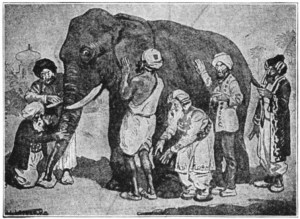
Populist theology also has historical Leftist ties (“Unconstrained vision” is the term used by Economist Thomas Sowell to define the philosophy of the Left). Political philosopher Jean-Jacque Rousseau wrote, “man is born free, but is everywhere in chains.” Another philosopher, Marquis de Condorcet, believed that men in their natural state with a “natural inclination” would seek out the social good. For them, man’s nature was not the problem. Rather, institutions needed to be reformed so that man’s better nature would come out. Hence, pop-theology presses for reforms: the church must be reformed to help men to realize their better nature. “We are so much smarter now,” is the inference.
Enter the church’s “social justice” moment. And the “social justice” proffered is done under the guise of the common good but it is in reality a narrowing of focus down to subjective individual rights and individual happiness, in parallel with what is happening politically in Europe and the U.S. currently. The “common” part of their “common good” are those who share the same self-directed interests. Others must conform to their self-interests for the common good.
My second thought after reading the above replies: “It is time for another reformation – putting the Bible (again) into people’s hands and teaching them how to read it for themselves.”
It would seem that many of the above respondents view Scripture through the lens of a post-modern Epicurean Catholic world view, a worldview which replaces historical narrative (in this case, derived from the “faith once delivered”) with a relevant “social gospel” or populist theology promulgated as authentic Christianity. And with little knowledge of Scripture many Catholics are ‘falling’ for what they have been taught by the top-down government and media of the Catholic church and its social justice-primed priesthood.
When they do (see replies above) they end up with a Jesus who is fantasy blend of Dorothy Day, Ghandi, Mr. Rogers and a Democrat with a Jesus bleeding heart – an ends-justifies-the-means person. In other words, they end up not with a literal historical Jesus, but rather a figurative Jesus and one disposed to making you and your world feel good about doting on yourself. And, if you can get other people to dish out love and charity and “understanding” and, most importantly, cash, then you have done right by pseudo-Jesus.
Every self-designated Catholic I have encountered on Twitter appears to know little or nothing of Scripture. For them, it seems, raw Scripture, ‘unrefined’ by the Catholic priesthood, seems to be tied to evangelicals who are considered fundamentalists and therefore, presumptively, not connected with their Jesus’ all-assuming love. What they know and repeat is what a priest or Jesuit tells them, and their reply is usually about social justice, a catch-all for not being judged but for being loved.
Without making this post too long, here are some of my quick replies to the above points. Feel welcome to add yours in the comment section below.
1. The plea bargaining “God is Love” defense is foiled when you define love, not in terms of codependence and sexuality, but as desiring the ultimate good for another. This of course leads to a definition of what is good. I reply with Jesus’s request of the Father, “Set them apart for yourself in the truth; your word is truth.” (John 17:17)
2. When someone says that Jesus never talked about homosexuality I remind them that Jesus’s mission was to the lost sheep of Israel, the ones who were supposed to be “a light to the Gentiles”. The Israelites knew the law, the Torah. The law forbids homosexuality. This was common knowledge in the first century. Jesus did not need to repeat it. Paul, on the other hand, an apostle to the Gentiles did need to speak about the matter (e.g., Rome, Ephesus, etc. had temples to pagan gods which involved all manner of sexual immorality.)
3. Here we have justification by plea bargain. Jesus prays for his own that they will be sanctified, separate – taken “out of the world” worldview.
4. If you know Scripture then you know that Jesus did not heal everyone in the world during his earthly time. He told us that we can do the same and greater things than he has done when filled with the spirit. Beyond the fact of outright healing, there is the matter of personal healthcare. Universal healthcare replaces a person’s personal responsibility for their health with a non-caring impersonal government bureaucracy. This costly tax-payer bureaucracy will need to control your behavior, your paycheck and the doctor’s practice to control costs. As such, it is loving to not desire socialized coverage.
5. When I hear someone say that Jesus is Gospel and Paul is not relevant I remind them that Jesus met Paul on the road to Damascus. In the fullness of time Jesus encountered Paul. I remind them that Paul right then and there became an eyewitness of Jesus and therefore an apostle. I remind them that Jesus sent Paul to be Jesus to the Gentiles – the heathen, the pagans, the unclean. I tell them that Paul wrote the theology of the newly established Kingdom of God on earth in his letters to the infant churches.
6. I remind them that the gospel is “Jesus is Lord”. All else falls in line and in order under this proviso: salvation, sanctification (called out of the world) and then social gospel (to affect the world under the direction of the Kingdom’s Lord.)
When Jesus tells the rich man “Sell all you have and give it to the poor” we understand the means to the rich man’s salvation: renunciation of his coveting relationship of wealth- a relationship which came between Jesus and the rich man, sanctification (separation from the love of his money and the hold it had on him) and then faith with works – a complete detachment from self-preservation- giving his wealth to the poor, a product of the new Kingdom focus.
7. Women vs. gay acceptance and Scripture: I remind them that there is a difference between culturally defined and morally defined. There is a difference between cultural practice and culturally-imposed taboos and doctrinal principles and God-directed temperantia-God’s ordered structure for the being of man. Paul wrote about the former in his letters to the church at Corinth. Anything perceived as ambiguous was directed back to a person’s Holy-Spirit directed conscious.
It is no secret that the Evil One’s mission from the very beginning is to ask, “Did God really say you couldn’t…?”
Pop-theology proposes to modernize and conform the church to be a welcoming inclusive place for whatever the prevailing winds of PC doctrine bring to the church’s door step. Be it known: the called-out ones – the ecclesia – will remain faithful under the Lordship of Jesus. The churches that wallow in the world will have their candlestick taken away. In the dark their mutual admiration society will be left grappling with elephant parts.
Added 10-4-17:
Rate this:
Filed under Christianity, Homosexuality, LGBT, Political Commentary, The Church Tagged with Catholic Church, Christianity, church, Homosexuality, LGBT, Liberalism, post-modernism