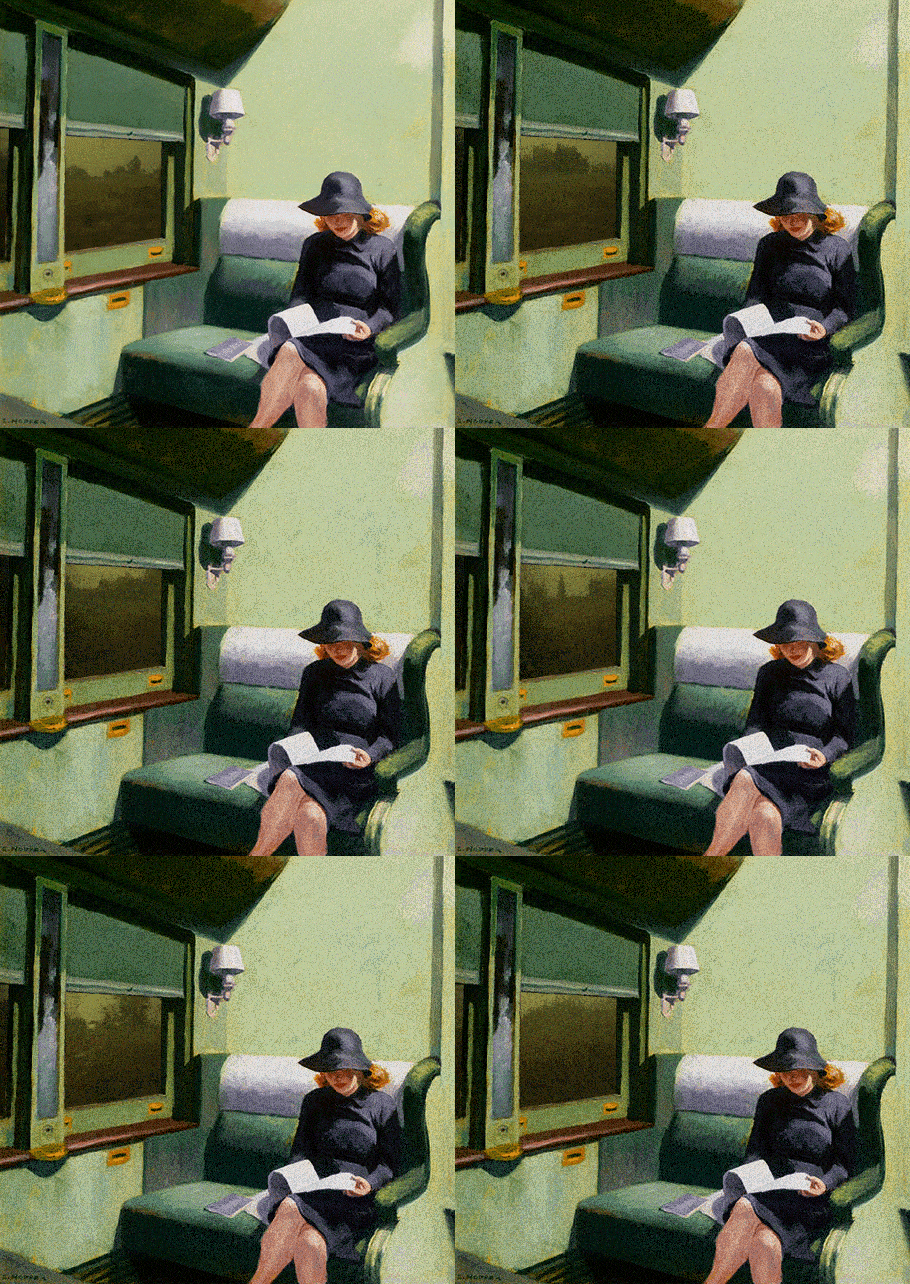
Learning to See

He took the blind man by the hand and led him out of the village, and when he had put saliva on his eyes and laid his hands on him, he asked him, “Can you see anything?” And the man looked up and said, “I can see people, but they look like trees, walking.” Then Jesus laid his hands on his eyes again, and he looked intently, and his sight was restored, and he saw everything clearly. -The gospel of Mark, 8: 23-25

In the account above, Jesus amplified the blind man’s ability to see so that he could view physical reality with clarity. Now seeing, the man could function in the world. He no longer had to sit under the shade of a tree begging for assistance.

After Jesus announced the arrival of the kingdom of God on earth, he sought to increase the depth perception of his followers. He wanted them to be able to observe and perceive what that kingdom was about so that they could, with new insight, function in the kingdom.

Jesus acted and spoke for those with “eyes that see, ears that hear.” Others, conditioned by the world, would not see and hear what was going on. They remained blind and begging.

To amplify understanding, Jesus used allegorical short stories to create vivid pictures of reality as he saw it. He used parables when he taught and when he was tested.

When teaching on the cultivation of the kingdom of God he used the parable of the Sower.

When tested by an expert of religious law, he used the parable of the Good Samaritan. This encounter is recorded in Luke’s gospel account:

A religion scholar stood up with a question to test Jesus.

“Teacher, what do I need to do to get eternal life?”

Jesus responded with a question: “What’s written in God’s Law? How do you interpret it?”

The scholar gave a Torah answer: “Love the Lord your God with all your heart and with all your soul and with all your strength and with all your mind and love your neighbor as yourself.”

“Good answer!” said Jesus. “Do it and you’ll live.”

Looking for a loophole, the scholar then asked “And just how would you define ‘neighbor’?”

Jesus answered by telling the story of the Good Samaritan. He then asked, “What do you think? Which of the three – the priest, the Levite or the Samaritan – became a neighbor to the man attacked by robbers?”

“The one who treated him kindly,” the religion scholar responded.

Jesus said, “Go and do the same.”

In response to the initial test question, Jesus uses the Socratic method. He asked the scholar to give his own response to the eternal life question. Jesus acknowledges the scholar’s correct answer.

But then the scholar wished to justify his “neighbor” position in front of the crowd.

(You don’t do this, of course, unless you hold a well-known exclusionary stance such as associating with fellow Jews but not associating with Samaritans (viewed by Jews as a mixed race who practiced an impure, half-pagan religion), Romans, and other foreigners.)

The scholar’s question revealed what Jewish religious leaders, like those named in Jesus’ parable, thought about those who didn’t see the world like they did – ‘others’ should be excluded from their concern and left to die. This way of ‘seeing’ would lead to Jesus being (so they thought) permanently excluded, i.e., crucified.

Jesus doesn’t answer the scholar’s “neighbor” question. Instead, he exposes the insular blindness of the questioner with a short story.

Jesus shows, not tells, his answer so that the scholar and those listening may experience the answer through actions, words, subtext, thoughts, senses, and feelings rather than through exposition, summarization, and description. Jesus puts the scholar in the room, so to speak, with the Samaritan.

With the parable, Jesus wanted the scholar to see the world as he sees it, that of “God so loves the world” and not just a chosen few.

Note that in his response to the question “Who became a neighbor? the scholar refuses to name the ’other.’ He refuses to say “Samaritan.” He protected his standing in the community and his insular blindness.

Going on his way, the religious scholar now had an image to reflect on. He could see himself like the priest and the Levite and mind his own business and walk off, ignoring the one who is of no value to him. He could abandon the ‘other’ before any claim is made on him.

Or he could see beyond himself and exclusion and be a Samaritan and love his neighbor like himself. That would be kingdom ‘seeing.’

~~~~~

Man’s ability to see is in decline. Those who nowadays concern themselves with culture and education will experience this fact again and again. We do not mean here, of course, the phys­iological sensitivity of the human eye. We mean the spiritual capacity to perceive the visible reality as it truly is.

To be sure, no human being has ever really seen everything that lies visibly in front of his eyes. The world, including its tangible side, is unfathomable. Who would ever have perfectly per­ceived the countless shapes and shades of just one wave swelling and ebbing in the ocean! And yet, there are degrees of perception. Going below a certain bottom line quite obviously will endanger the integrity of man as a spiritual being. It seems that nowadays we have arrived at this bottom line. (Emphasis mine.)
—Josef Pieper, Only the Lover Sings, “Learning How to See Again”

The concept of contemplation also contains this special intensified way of seeing. A twofold meaning is hereby intended: the gift of retaining and preserving in one’s own memory whatever has been visually perceived. How meticulously, how intensively—with the heart, as it were—must a sculptor have gazed on a human face before being able, as is our friend here, to render a portrait, as if by magic, entirely from memory! And this is our second point: to see in contemplation, moreover, is not limited only to the tangible surface of reality; it certainly perceives more than mere appearances. Art flowing from contemplation does not so much attempt to copy reality as rather to capture the archetypes of all that is. Such art does not want to depict what everybody already sees but to make visible what not everybody sees. (Emphasis mine.)
—Josef Pieper, Only the Lover Sings, “Three Talks in a Sculptor’s Studio: Vita Contemplativa”

I first came across the writings of Josef Pieper, a 20th century Catholic German philosopher, reading The Four Cardinal Virtues: Human Agency, Intellectual Traditions, and Responsible Knowledge. About the Author:

“Josef Pieper (1904-1997) was a distinguished twentieth-century Thomist philosopher. Schooled in the Greek classics and in the writings of St. Thomas Aquinas, he studied philosophy, law, and sociology, and taught for many years at the University of Münster, Germany.”

Donald DeMarco writes in Josef Pieper… Truth And Timeliness that

Pieper is most noted for his many books on virtue. In fact, he is commonly known as the “Philosopher of Virtue.” Virtue for Pieper, following Aristotle and Aquinas, is perfective of the person. But the person is real and has an identifiable and intelligible nature. Wherever this nature is denied, totalitarianism gains a foothold. For, if there is no human nature, then there can be no crimes against it.

Pieper wrote while drafted into Germany’s army during World War II and is credited for translating C.S Lewis’s Problem of Pain into German. Because he criticized the Nazis regime, his works were not published until later.

It is said that “While many philosophers in his time focused on politics, Pieper was concerned with the great tradition of Western Culture. He spent his entire life reflecting on the value of culture in modern society and the necessity of the creative arts for the nourishment of the human soul.”

Josef Pieper’s short essay Learning How to See Again begins: “Man’s ability to see is in decline.” Even in the 1950s when he wrote the essay, he suggested that there was too much to see. How much more are we distracted today by screens.

Pieper recommended an artistic vision – visual, musical or literary – as a conduit for the contemplative life. He proposed participating in the arts as a remedy for seeing anew, to see reality as it truly is.

We must learn to see again.

~~~~~

Teaching ‘Tales From Shakespeare’

Benedict Whalen, associate professor of English at Hillsdale College, delivers a lecture on how to teach Tales From Shakespeare by Charles and Mary Lamb to young children. 

This lecture was given at the Hoogland Center for Teacher Excellence seminar, “The Art of Teaching: Children’s Literature” in September 2024. The Hoogland Center for Teacher Excellence, an outreach of the Hillsdale College K-12 Education Office, offers educators the opportunity to deepen their content knowledge and refine their skills in the classroom.

Teaching ‘Tales From Shakespeare’

Teaching ‘Tales From Shakespeare’ – Hillsdale College K-12 Classical Education Podcast – Omny.fm

~~~~~
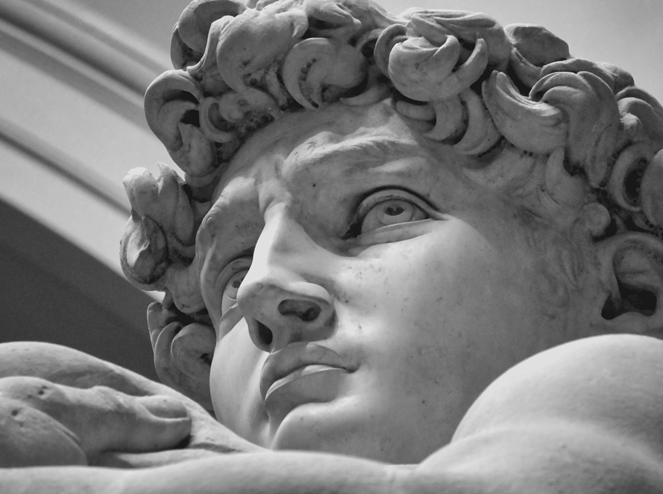
The Approaching Eclipse

Imagine creating something significant and you make it public it and it is well-received. Then, State media (MSNBC and the NYT for example) pans it and you are declared an “enemy of Democracy.” The self-expression born of your life’s work, your name, and your personhood are to be eclipsed – blackened – by an authoritarian enforcement of new cultural norms. You are to be held hostage artistically and, if you do not conform, literally.

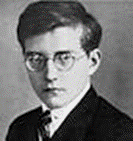
You realize that you can either abandon your life’s work out of fear of crushing reprisals, or you find a subversive way to bring your work to the public, as did one of the greatest composers of the 20th century.

“In January 1936, after Stalin attended a performance of [Dmitri] Shostakovich’s dangerously erotic opera Lady Macbeth of the Mtsensk District, there appeared the notorious Pravda editorial ‘Chaos Instead of Music’, with its threat that things could ‘end badly’ for Soviet musicians – and for Shostakovich in particular. Its unnamed author was David Zaslavsky, a well-connected Soviet journalist and propagandist. No family was left untouched by the purges. The composer’s uncle, sister, brother-in-law and mother-in-law were arrested and when his patron, Marshal Tukhachevsky, was declared an ‘enemy of the people’, it is likely that he himself was interrogated by the NKVD. The musicologist Nikolay Zhilayev, to whom Shostakovich played the second movement in May 1937, had joined the disappeared by the time of the Fifth’s Leningrad premiere on November 21, 1937.” – David Gutman, Shostakovich’s Fifth Symphony: A deep dive into the best recordings | Gramophone

The opera was attacked as “muddle instead of music” in an editorial, probably written by Stalin himself, in the Communist Party newspaper, Pravda. If Shostakovich did not turn away from the “decadent” avant-garde in favor of Soviet Realism, threatened the editorial, “things could end very badly.” The popular opera disappeared from the stage overnight. One of the Soviet Union’s most prominent composers was in danger of becoming a “nonperson” just as he was reaching his artistic prime.Timothy Judd, writing in Shostakovich’s Fifth Symphony: The Unlikely Triumph of Freedom

After the vicious official attack, Shostakovich lived in constant fear. Conductor, composer, music director, and arranger Benjamin Zander, writes

Overnight the 30-year-old composer’s rapidly ascending star plummeted. He came to regard himself, and to be regarded, as a doomed man, waiting with packed bags for the secret police to take him away during the night. In fact, the police never came, but the fear of official reprisals for any displeasure which his music might occasion coloured every moment of his life after that. He was never to know freedom again, except surreptitiously in some of his music.

Knowing that at any moment the authoritarian Soviet State might find fault with his music and then imprison him and his family, Shostakovich looked for a way to continue to work within the overshadowing Stalinist system.

“Shostakovich attempted to restore himself to the good graces of the Soviet critical establishment with “a conscious attempt to create a simplified ‘Socialist realist’ style that could be acceptable both to the Party and to the intelligentsia.” (Source)

And so, knowing that his latest effort would not be accepted (written in 1936, but not publicly performed until 1961) . . .

Shostakovich withdrew the Fourth Symphony from its scheduled performance and began the composition of a fifth which had as its [imposed by the State] subtitle, ‘An artist’s practical answer to just criticism’. His intention was to reinstate himself, through this work, in the eyes of the Politburo. The Fifth Symphony did indeed do that: the first performance was a huge success. It is anything but cheerful: the first movement is dark and foreboding, the second is ironic and brittle, and the third a deep song of sorrow. However, only the message at the end was important to the Soviets, and Shostakovich knew that. The long final movement, as they heard it, climaxed in a triumphant march, a paean of praise to the Soviet State.Benjamin Zander

Was the Fifth Symphony to be understood as essentially Stalinist? There was more to the forced empty pomp of the fourth movement than met the Politburo’s ears.

“In [Solomon Volkov’s 1979] Testimony, Shostakovich fiercely renounces all this, in particular denying that the Fifth’s finale was ever meant as the exultant thing critics took it for: “What exultation could there be? I think it is clear to everyone what happens in the Fifth. The rejoicing is forced, created under threat, as in Boris Godunov. It’s as if someone were beating you with a stick and saying, ‘Your business is rejoicing, your business is rejoicing,’ and you rise, shaky, and go marching off, muttering, ‘Our business is rejoicing, our business is rejoicing.’ What kind of apotheosis is that? You have to be a complete oaf not to hear that.” -Samuel Lipman, writing in Shostakovich decoded? | The New Criterion (Emphasis mine.)

Was the Fifth Symphony a subversive symphonic response to Stalin, one that both mocks the dictator while bowing to him?

In the remarkable finale, Shostakovich achieves one of the greatest coups of his symphonic career: a “victorious” closer that drives home the expected message and at the same time makes an entirely different point — the real one. The resounding march that ends the movement represents the triumph of evil over good. The apparent optimism of the concluding pages is, as one colleague of the composer put it, no more than the forced smile of a torture victim as he is being stretched on the rack. (Source)

Shostakovich publicly described the new work as “a Soviet artist’s reply to just criticism.” Privately, he said (or is said to have said) that the finale was a satirical picture of the dictator, deliberately hollow but dressed up as exuberant adulation. It was well within Shostakovich’s power to present a double message in this way, and it is well beyond our means to establish whether the messages are true or false. The listener must read into this music whatever meaning may be found here; its strength and depth will allow us to revise our impressions at every hearing.  (Source)

Did Shostakovich openly camouflage* a subversive message in the forced celebration of the fourth movement? The finale was not what it seemed.

Mark Pettus, in Pushkin and the Key (?) to Shostakovich’s 5th writes:

“In his official comments on his symphony, Shostakovich said the following:

“”I wanted to show in my symphony how, through a series of tragic conflicts, of great internal spiritual struggle, optimism as a worldview finds its affirmation.”

“The affirmation of “optimism as a worldview” — what a grotesque phrase! Farewell, spiritual struggle! It would seem impossible to accept this account of what the music “means” — and yet this interpretation seems to have been swallowed whole by the establishment; the work was praised, and Shostakovich’s “rebirth” as an ideologically acceptable composer was complete. And, indeed — music being what it is — the symphony seems to offer no objective reason for doubting the official reception. After all, isn’t the triumph of the finale… triumphant?

“. . . if things were so straightforward, then what made Pasternak, who was in the audience at the premiere, supposedly say the following:

“”And to think that he said everything he wanted to, and nothing happened to him!””

Shostakovich, with a motif from his own Four Romances on Poems by Pushkin, Op. 46: I. Rebirth, had inserted a Pushkin reference into the fourth movement. The poem-motif attacked Stalin and his ways and went on to express that over time, his work which had been defaced, will survive even the most brutal oppression and defilement. The reference heralded his own “rebirth”, as an ideologically acceptable composer and as a resurrected artist.

Rebirth (Alexander Pushkin)

A barbarian artist, with his indolent brush,
Blackens the painting of a genius,
And, atop it, he senselessly traces
His lawless drawing.

But, over the years, these alien layers of paint
Are shed like old scales;
Before us, the genius’s creation
Emerges with its former beauty.

Thus do delusions vanish
From my tormented soul,
And in it visions arise
Of primal, pristine days.

In the podcasts below, you’ll hear conductor Joshua Weilerstein explore the four movements of Shostakovich’s 5th Symphony. 

* “Time and again, Tolstoy uses this technique of open camouflage. He does so, I think, so that we learn not to equate noticeability with importance and so that we acquire, bit by tiny bit, the skill of noticing what is right before us.” – Gary Saul Morson, The Moral Urgency of Anna Karenina – Commentary Magazine

~~~~~

Playing the fourth movement (Allegro Non Troppo) of Shostakovich’s 5th in high school concert band, I had no idea of the circumstances under which it had been composed – an artist threatened with suppression and persecution. I had no idea of the Pushkin reference hidden in the work. As first trumpet, all I knew was that it was a brass-forward piece of music. But now, I notice what was right before me and that has expanded my temporal bandwidth enough to see the approaching eclipse.

The barbarian artists of our day – Progressives and the Biden regime – with indolent brushes, blacken any expression, any individual, and any name that will not conform to its strictures and senselessly traces lawless drawings upon the works of truth, beauty, and goodness using the media, the administrative state, the CIA, the DOJ, and Taylor Swift.

Reason doesn’t suit the appetite of most. Artists, writers, playwrights, poets, journalists, composers, and musicians must work to subvert the approaching eclipse of humanity by the State, the WHO, the WEF, AI, transhumanism, and communism.

~~~~~

“This was not the Moral Majority of my father’s era. Rather, this was a subversive, courageous subculture that was resisting the dominant narrative, and the morass of darkness that is our dominant cultural moment.” – Dr. Naomi Wolf: “Letter from CPAC”

~~~~~

Here is the State eclipsing a journalist. . .

And here is State approved writing that blackens individuals . . .

White Rural Rage: The Threat to American Democracy: Schaller, Tom, Waldman, Paul: 9780593729144: Amazon.com: Books

~~~~~

Shostakovich Symphony No. 5, Part 1

Shostakovich’s life and career was so wrapped up with his relationship to the Soviet government that it is sometimes hard to appreciate that, all else aside, he was one of the great 20th century composers. His 5th symphony is the meeting point between Shostakovich’s music and the political web he was often ensnared in, and it is a piece that is still being vociferously debated. This week we’re going to tell the story of the piece’s genesis, and then we’ll explore the movements of the symphony.

Shostakovich Symphony No. 5, Part 1
Shostakovich Symphony No. 5, Part 2

Sticky Notes: The Classical Music Podcast: Shostakovich Symphony No. 5, Part 1 (libsyn.com)

Sticky Notes: The Classical Music Podcast: Shostakovich Symphony No. 5, Part 2 (libsyn.com)

~~~~~

Solar Eclipse – April 8th, 2024

How southern Indiana communities are preparing for the 2024 solar eclipse – Inside INdiana Business

2024 Total Solar Eclipse Planning Toolkit: INDIANA UNIVERSITY CENTER FOR RURAL ENGAGEMENT

2024 eclipse guide: Times, places, states and livestream (astronomy.com)

“Photographing the Eclipse” Rick Galloway, IAS Member Rick gives a presentation on how photograph the eclipse and not miss it by doing so.

IAS February 2024 General Meeting – YouTube

How To Photograph the Solar Eclipse! (youtube.com)

Scaffolding

I sat down with a close friend the other day. I asked him about his early church experience, as I am interested in church dynamics.

Here’s what Dan (not his real name) said during the interview:

“My parents attended a Baptist church in Chicago before moving to the suburbs. I was a kid and just remember old buildings with a fusty smell and pictures to color. After the move, we started attending a Bible church. I was eight years old.

“I don’t remember a single sermon. But I do remember the church sanctuary. I sat there Sunday mornings and evenings for maybe twenty years.

“There was a plaque on the back wall above the choir loft. It said “God is in His holy temple. Let all the earth keep silent. Hab. 2:20.  

“Front and center was a large wing pulpit. Three large minister chairs were behind it along the choir loft. A piano on the left and an organ on the right flanked the platform.

“On the main floor in front of the pulpit was the oak communion table. “This Do In Remembrance of Me” was carved on the front. The table held the offering plates and a flower arrangement.

“To the right of the platform and behind a large rectangular hole in the wall was the baptistry. A landscape was painted on the walls surrounding the water tank.

“Opposite the platform, sixteen rows back, was the entrance to the sanctuary. A clock was centered above the double doors to let the minister know when to end the service.

“Rows of blond wood pews filled the space between the front and back with an aisle down the center and along each end.

“The side walls were painted-beige cinder block. Each wall had three windows of tinted-amber bubble glass. Forest green curtains bordered two sides of each window.

“The walls around the windows were bare except for a wooden rack near the organ. It held the numbers in attendance at the service and at Sunday school the week before. An usher counted attendance every Sunday.

“That’s a twenty-five-year snapshot. I don’t recall that room ever changing.”

I asked him about the service.

“Prelude. Hymns. Lots of choruses about leaving earth and flying away. Sermon. Calls for salvation and rededication of your life. Postlude. Every Sunday.”

I asked him about memories that stick out.

“Let’s see. There was the leader of the boy’s club. He let us run around and be crazy one night each week. One time he took us to a construction site to show us what he was working on. He was a carpenter.

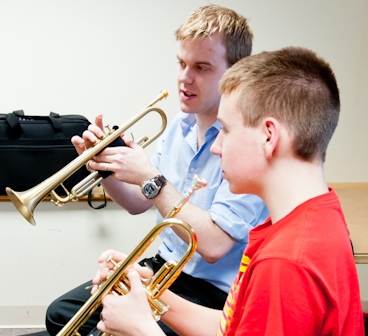
“There was an adult Sunday School teacher who visited a nursing home once a month. He had me come with him on those Saturdays. I’d play a hymn with my trumpet. Afterward he would give a short devotional.

“And there was this interim minister – there were lots of them – who got me my first job as a clerk in a Camera/Photo store. One time – I was twelve or thirteen – he had me come with him downtown to Pacific Garden Mission. I played my trumpet and he spoke to those who had come off the streets of Chicago.”

I told Dan that he only mentioned certain men as memories that stick out. Then I asked if anyone had mentored him.

“No one from church. Only my trumpet teachers did.”

I asked him to explain.

“I started playing the trumpet in third grade. My uncle gave me a beat-up Conn trumpet that he longer wanted to play. In the Junior High School, the band director wasn’t crazy about the look or the sound of my horn. So, he switched me to French horn for two years. But my heart was with the trumpet. I asked my parents for private lessons.

“Before I started lessons – this was during eighth grade  – my father and I went to an instrument store. He bought me a brand-new Bach Stradivarius b-flat trumpet. The horn was a beautiful and expensive gift. I felt affirmed.

“My first trumpet teacher was a high school principal who also played trumpet in big bands. The first question he asked me: What trumpet players did I listen to?  I told him Herb Albert. He just shook his head.

“He told me who I should listen to and to what pieces of music. He began giving me exercises to practice. Major and minor scales. Tonguing exercises. I’d have to play them for him the following week.

“The summer before high school I took what he taught me and practiced like crazy. The high school concert band director had sent out the requirements for entering the band. Those included playing major and minor scales and site reading.

“A month before my freshman year began, I was called in to audition for the band director. I played all the scales and sight read what he put in front of me. He was pleased. I was in the concert band – first trumpet section right behind the first chair trumpet, a sophomore.

“My junior year of high school the band director Mr. Gies became my second trumpet teacher. He also played the trumpet semi-professionally.

“What happened was this: the guy who sat first chair was a stellar trumpeter but he needed to be replaced. During the summer the first chair French horn player became pregnant. Both would soon be leaving the school. So, the band director began one-on-one time with me.

“Over several months Mr. Gies and I met in the school auditorium during an open period for both of us. Playing the trumpet in that auditorium, that sanctuary, was like no other experience. With those unstifled acoustics I could open up and project a nice broad sound.

“Mr. Gies asked me how I practiced. I shared with him the Carmine Caruso method for building chops. I learned the method from my first trumpet teacher, Mr. Lichti.

“I told him that the method involves interval training, articulation, range and produces endurance. With it, I had developed an extensive range -double high C to over an octave below the treble staff. The method had formed my sound to that point.

“Sitting together offstage, Mr. Gies and I worked through the Caruso method along with the Clarks – Clark Technical Studies – which are exercises used for the development of fingering technique.

“I cherished that time alone with the band director. In between playing an exercise we talked about anything and everything. And sometimes we were silent and it felt comfortable.

“We practiced together the rest of my junior year. I was ready for the first chair trumpet position when the other guy left.

“My third trumpet teacher was at a Bible school. After high school I entered a Christian Ed/Music program. The Christian Ed program was a bust but the music program was a blessing.

“I took private lessons from the concert band director, Mr. Edmonds. Unlike the other teachers, he was an established pianist with perfect pitch. He had a different take, a different sound in mind, for my horn – a precise centered pitch. He was also a composer. He adapted classical music for our concert band to play.

“In between playing my practiced exercises and being critiqued, the director and I would talk about anything. I shared with him the challenges I was facing. My practice time was limited because of my studies and the time spent listening to classical music for music appreciation class. And I had a part time job. He prayed for me at the end of each lesson.

“Like back in high school, I sat first trumpet second seat behind a sophomore in the concert band. But at an outdoor band concert, Mr. Edmonds had me solo the opening trumpet lines of Rimsky-Korsakov’s “Procession of the Nobles”. And when The Gaither Trio – Bill, Gloria, and Danny – came to town for a couple of concerts and needed some horns for the finales, Mr. Edmonds offered his two first chair trumpet players. The private lessons and my practice gave me opportunities to play.

“Looking back . . . sitting next to a trumpet teacher week after week, I learned from those who knew what to listen for and who to listen to. Mr. Lichti, for example, helped me realize that I had “deaf spots” in my listening. To develop my “ear”, I began to listen to Adolph “Bud” Herseth, principal trumpet in the Chicago Symphony Orchestra. I wanted to emulate his bel canto sound and his musical acumen.

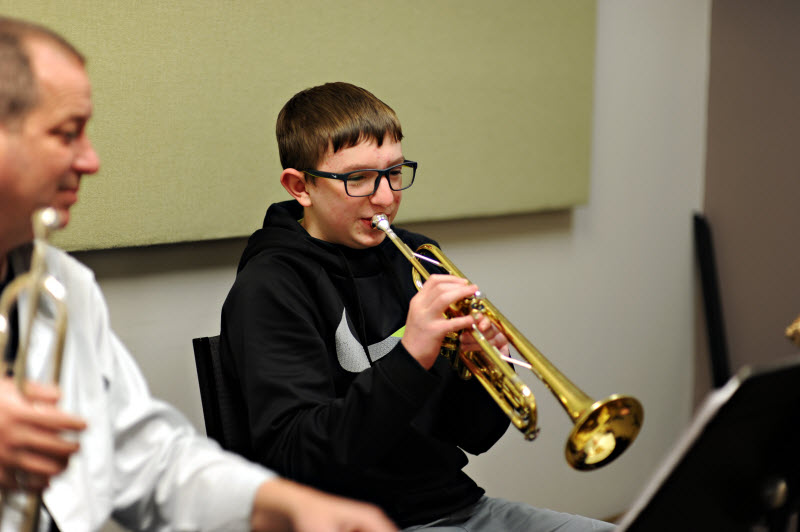
“To accomplish this, I had to take a risk. You see, with one-on-one instruction you cannot hide, you can’t fake or pretend. You play your horn and the truth comes out. Sloppy practicing is immediately revealed and so is the need for discipline. You need another’s knowledgeable perspective to grow as a musician. Words or notes alone are not enough.

“The three trumpet teachers I mentioned invited me into their musical realm, which was both affirming and daunting, as I was made me accountable to them. In the role of apprentice, they imparted to me trumpet knowledge, technical ability, and a love for the craft.

“And now that I think about it, I take it back. The man who took me and others to his construction site and the man who took me with him to the rest home and the man who took me with to the Chicago mission and got me my first job were mentors. They influenced me just like the trumpet teachers advanced the formation of my horn playing.

“You asked about my early church experience. I’d say that there was lots of scaffolding but no formation. For me, there was really nothing life changing about going to church and sitting in silence listening to someone standing behind a pulpit. But there was with people I spent time with.”

End of interview.

~~~~~

Church culture: “Tragically, in recent years, Christians have gotten used to revelations of abuses of many kinds in our most respected churches–from Willow Creek to Harvest, from Southern Baptist pastors to Sovereign Grace churches. Respected author and theologian Scot McKnight and former Willow Creek member Laura Barringer wrote this book to paint a pathway forward for the church.”

A Church Called Tov: Forming a Goodness Culture That Resists Abuses of Power and Promotes Healing by Scot McKnight | Goodreads

In this podcast, theologian Scot McKnight and his daughter, Laura Barringer, join Julie Roys to discuss their latest book, A Church Called Tov: Forming a Goodness Culture That Resists Abuses of Power and Promotes Healing.

While their first book explained the characteristics of a “tov,” or good, culture, their latest book tackles the next challenge—transforming ingrained toxic cultures into tov ones.

Pivoting Your Church from Toxic to Healthy | The Roys Report

Pivoting Your Church From Toxic to Healthy | The Roys Report (julieroys.com)

~~~~~

Bud Herseth’s Final Concert on NPR – YouTube

Adolph Herseth Interview – YouTube

~~~~~

More Than Meets the Ear

“Music exists when rhythmic, melodic or harmonic order is deliberately created, and consciously listened to, and it is only language-using, self-conscious creatures … who are capable of organizing sounds in this way, either when uttering them or when perceiving them. We can hear music in the song of the nightingale, but it is music that no nightingale has heard.” Philosopher Roger Scruton

~~~

Did you know that…

The Kingdom of God is about re-creation?

God can turn our mistakes into passing notes?

Improvisation is the exploration of an occasion?

Jazz is the interplay of order and non-order, of tradition and innovation?

Music reshapes our lives?

Music teaches us delayed gratification?

Hope lives in the midst of delay?

Music has a lot to teach us?

Music can increase empathy?

You can’t demonize those you just made music with?

As a musician for most of my life, I learned about and embraced many of these aspects and applications of music. From the videos below I learned that the Kingdom of God employs music to instruct our souls. Here are three short videos, the first two by Jeremy Begbie. The last video demonstrates the reality of the last question above.

These videos are from a musical point of view. But high culture (good literature, good drama, good art, etc.) can also provide us with many of the same benefits.

Jeremy Begbie is a theologian and professionally trained pianist. Here he demonstrates how music can help unlock the truths of the Christian gospel. Begbie is the Thomas A. Langford Research Professor of Theology at Duke Divinity School.

First, the intersection of theology and music:

Next, Unexpected Intersections:

Last, well, you had better watch…


Give Birth to the Promise of Living


And all God’s people said…

“All of God’s promises, you see, find their yes in Jesus; and that’s why we say the yes, the “Amen,” through Jesus when we pray to God and give him glory.” II Corinthians 1:20

Never My Love


The first day of Junior High School Darren left his house and found the end of the “stand quietly” line waiting for him. That is where he put the French horn case down. On the walk to school the bell of the case had banged his left leg. The pain in his shin reminded him that his band director, who liked to tap out tempo on his head, had decided that Darren would play French horn and not his trumpet. “We need French horn players,” said Mr. Palmer, the Jr. High band director. And, when Darren sat second chair behind first chair Diane in the horn section he became aware of his loss.

As Darren walked from class to class that first day he looked around and began to wonder: “What am I supposed to be? What am I supposed to wear or even say? What are troll dolls?” Juan, who was in most of the same classes as Darren, would fill him.

“Look, if you are a greaser you wear all black.” Juan fell back into his chair so that Darren could see. Sure enough. Juan wore black pants, a black shirt, a black leather jacket that never came off, black pointed shoes and the telltale sign of all greaserhood – black socks.

“Look.” Juan pointed to Bill across the room. “That is a climber. He wears white socks and does sports. Sometimes climbers wear paisley shirts. They are freakin’ flowery.”

Darren now knew the social code but wasn’t sure what he was. With Juan being in most of the same classes he decided that day that he should be a greaser. So, that night he told his mom he needed lots of black socks and plain “No flowers” shirts. He wanted Juan and one teacher to like him.

Darren’s seventh-grade Spanish teacher was a larger than life blonde who, Darren thought, must have noticed that Darren was in her class. After all, someone with shocking red-orange hair stood out. Newly purchased hair goop would put in check his cowlick.

Darren learned his Spanish verbs and infinitives. He learned Spanish adjectives as fast as he could. He needed no incentive. To speak the Romance language in class invoked a passion he had never felt before. “Señorita, eres hermosa!” Darren would daydream his devotion to her.

Geography class offered a different topology. Mrs. Foley contained significant geography on her person. Unmercifully, the kids would snicker, “Fatty Foley,” under their breaths. Then uncontrollable giggling would ensue until the yard stick smacked the bulletin board.

In the halls, between periods, notes were passed and looks connected. If you received a note from a third party that meant that someone wanted to go steady with you. That is what Juan told Darren. So, when Darren received his first note he was at once terrified and curious. He did not know what “going steady” meant. He wasn’t going to ask Juan and look stupid. The black socks kept Darren from doing any such thing.

It wasn’t till lunch period that day that Darren unraveled the note and read it. Therein, he found out that Mary K liked him and wanted to go steady. Mary K played first chair flute in the band. Darren became filled with dread as he thought about going to band rehearsal after lunch. He had no response or “going steady” in him. When the bell rang he went to rehearsal pretending that he hadn’t gotten the note. But the pretense didn’t last long.

Mary stared at Darren from her chair. The girls around her were giggling. Darren felt his face become lobster red. He could do nothing about it except hide behind the music stand and empty the spit out of his horn tubes.

After practice Mary waited for Darren at the bottom of the risers. As she waited Darren took every single tube off his French horn and blew through each one slowly. Then he began to polish the horn never looking up. When the next period bell rang he looked up over the stand and there was Mary.

“Will you walk me home after school? Mary asked.

“Sure, I guess, sure.” Darren then rushed off to shop class leaving Mary and her gaggle of friends.

Later, not sure of what was coming next, Darren gathered up his homework, shut his locker and picked up his horn. He waited at the main entrance not knowing when Mary was done with her classes. She appeared twenty minutes later.

“Hey, I’m ready.” Mary looked at Darren and the two left the building.

Darren had no idea where Mary lived. He had no idea if this walk meant that he was “going steady.” He didn’t say anything in case her liking him would change. The walk took them across town.

“If you have a ring I will wear it,” Mary said as they neared her house. Darren had no ring. He had black socks.

“Yeah, OK, right,” Darren replied and said, “See you tomorrow.”

By now Darren’s arm shoulders and arms were aching. Carrying the horn across town had worn them out. He took his time getting home. At home, he reassured himself, no one was to know about this. He couldn’t explain it anyway. And, there was his hunger to take care of.

The next day, Darren found his way to his first period English class and to his seat. Juan was already there in the seat behind him.

“Hey, are you going steady with a climber girl?”

“What?”

“Mary is a cheerleader, man.”

“How would I know that?” With that Darren turned to the front of the class and hoped he never had to go steady again. But then again, he did like it, in a greaser kind of way.


Between second and third period class Darren received another note. This time it was a direct note from another Mary – Mary E.  Mary E was also in the band. She played clarinet.

Band rehearsal loomed on the horizon, 12:30 that day. There was no escaping this “going steady” business. And now there was a decision to be made – Mary or Mary or feign strep throat coming on.

At 12:30 Darren walked into the band room and over to his chair. There was another note. It was right on his stand. “Now what?”, he quietly muttered. When he did, Diane looked over at him. The note was from Diane. She wanted to go steady.

The “going steady” madness continued for Darren throughout seventh and eighth grade. His arms never stopped aching. It was no relief to learn that girls in Junior High School were fickle and flighty, especially if you didn’t give them a ring. No matter. The black socks remained a social staple for Darren.

During the summer after eighth grade graduation, Darren tried out for the High School Concert Band. He played all the major and minor scales so flawlessly on his new B Bach trumpet that Mr. Gies awarded him first chair. The trumpet had been a graduation gift from Darren’s father who must have known what “going steady” meant.


© Jennifer A. Johnson, 2017, All Rights Reserved

What If He’s a Girl?

Musicals, and especially the lyrics and melodies of certain songs, have, since my earliest childhood days, enriched my life with the harmony of playful idealization and “swooning” romanticism. I will post more on this later. For now, here is one incredible piece sung by America’s leading baritone.

From Oscar and Hammerstein’s Carousel, Act I – Soliloquy sung by Thomas Hampson as Billy Bigelow, a barker for a carousel (and his future child):

B-A-C-H and The Art of the Faith

The following quotes are sourced from J. S. Bach in Japan:

”What people need in this situation is hope in the Christian sense of the word, but hope is an alien idea here,” says the renowned organist Masaaki Suzuki, founder and conductor of the Bach Collegium Japan. He is the driving force behind the “Bach boom” sweeping Japan during its current period of spiritual impoverishment. “Our language does not even have an appropriate word for hope,” Suzuki says. “We either use ibo, meaning desire, or nozomi, which describes something unattainable.” After every one of the Bach Collegium’s performances Suzuki is crowded on the podium by non “Christian members of the audience who wish to talk to him about topics that are normally taboo in Japanese society—death, for example. “And then they inevitably ask me to explain to them what ‘hope’ means to Christians.” (emphasis added)

“Although less than 1 percent of the 127 million Japanese belong to a Christian denomination, another 8 to 10 percent sympathize with this “foreign” religion. Tokuzen explained: “Most of those sympathizers are part of the elite, and many have had their first contact with Christianity through the music of Johann Sebastian Bach.””

The Art of the Fugue

“When Bach died on July 28, 1750, after two botched eye operations performed by John Taylor, a quack from England, his last major work, The Art of the Fugue, remained incomplete. It culminates in a quadruple contrapunctus bearing his signature, for it is formed from the letters b-a-c-h (in German musical terminology b-natural is called “h”)….

The Art of the Fugue is perhaps Bach’s most abstract and intellectually challenging work. Yet its pristine grace led Arthur Peacocke, the English theologian and biologist, to aver that the Holy Spirit himself had written it, using Bach’s hand.”

Hum along with Glenn Gould and let faith arise…

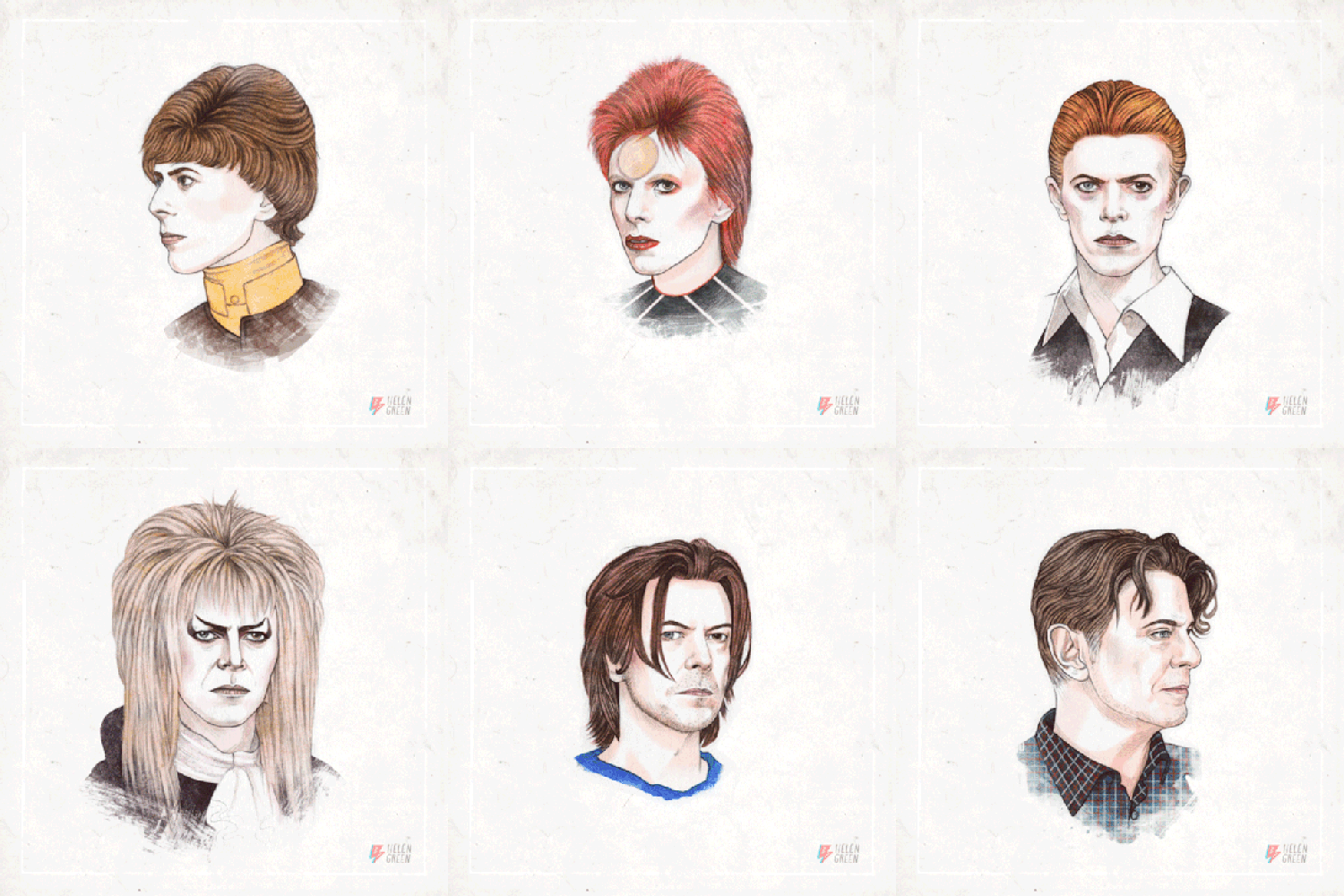
Unexpected Changes: R.I.P. David Bowie

“Time may change me…”

Personal favorites of mine, David Bowie, theater and Space Oddity:

Bowie

H/T Call Me Appetite`s Welt

Nessun dorma, ‘none shall sleep’

Italian Text

Nessun dorma! Nessun dorma!

Tu pure, o, Principessa,

nella tua fredda stanza,

guardi le stelle

che tremano d’amore

e di speranza.

Ma il mio mistero è chiuso in me,

il nome mio nessun saprà!


No, no, sulla tua bocca lo dirò

quando la luce splenderà!

Ed il mio bacio scioglierà il silenzio

che ti fa mia!

(Il nome suo nessun saprà!…

e noi dovrem, ahime, morir!)

Dilegua, o notte!

Tramontate, stelle!

Tramontate, stelle!

All’alba vincerò!

vincerò, vincerò!


English Translation

Nobody shall sleep!…

Nobody shall sleep!

Even you, o Princess,

in your cold room,

watch the stars,

that tremble with love and with hope.

But my secret is hidden within me,

my name no one shall know…

No!…No!…

On your mouth I will tell it when the light shines.

And my kiss will dissolve the silence that makes you mine!…

(No one will know his name and we must, alas, die.)

Vanish, o night!

Set, stars! Set, stars!

At dawn, I will win!


I will win! I will win!


“Nessun dorma” (Italian: [nesˈsun ˈdɔrma]; English: “None shall sleep”)is an aria from the final act of Giacomo Puccini’s frequently performed opera Turandot and is one of the best-known tenor arias in all opera. It is sung by Calaf, il principe ignoto (the unknown prince), who falls in love at first sight with the beautiful but cold Princess Turandot. However, any man who wishes to wed Turandot must first answer her three riddles; if he fails, he will be beheaded. In the aria, Calaf expresses his triumphant assurance that he will win the princess. (Blogger’s note: This contest is reminiscent of Shakespeare’s Merchant of Venice heroine Portia and her suitors having to choose the correct casket of three to win her hand.)

https://en.wikipedia.org/wiki/Nessun_dorma

Text and translation:

http://classicalmusic.about.com/od/opera/qt/nessundormatext.htm