The Advent of One Day at a Time

When have entered a dark season. Houses and yards are lit up. And, perhaps, some of the residents.

“The holidays are always bad” – Frank Martin.

American writer Raymond Carver published a story about a man trying to move from an addiction to alcohol toward sobriety. The story, set over three days, includes New Years Day. Where I’m Calling From first appeared in the New Yorker in 1982.

Written in Carver’s no-nonsense economical fashion, the story is told by a nameless Narrator who immediately draws us into the residential treatment center where he finds himself and another because of an inability to stop drinking.

“J.P and I are on the front porch at Frank Martin’s drying out facility. Like the rest of us at Frank’s Martin’s, J.P. is first and foremost a drunk. But he’s also a chimney sweep. It’s his first time here, and he’s scared. I’ve been here once before. What’s to say? I’m back.”

From the opening words we learn that alcoholism can take over one’s identity. The Narrator labels both J.P. and himself and everyone at the treatment center. But then the Narrator does go on to say that he knows J.P. as more than “a drunk”.

We also learn, from the Narrator’s “I’m back”, that the struggle with alcoholism can become a cycle of drinking and drying out. And then we find out that it can also become the ultimate wake-up call.

Let’s listen in . . .

“We’ve only been in here a couple of days. We’re not out of the woods yet. J.P. has these shakes, and every so often a nerve — maybe it isn’t a nerve, but it’s something — begins to jerk in my shoulder. Sometimes it’s at the side of my neck. When this happens, my mouth dries up. It’s an effort just to swallow then. I know something’s about to happen and I want to head it off. I want to hide from it, that’s what I want to do. Just close my eyes and let it pass by, let it take the next man. J.P. can wait a minute.

“I saw a seizure yesterday morning. . .”

A large man nicknamed Tiny had the seizure. As the Narrator tells us, Tiny was showing signs of improvement and looking forward to going home for New Year. But then Tiny collapsed at the table before all of them and was rushed to the hospital. The physical signs of alcoholism and withdrawal from it – shakes, spasms, swallowing issues and a seizure – have a major effect on the Narrator.

Loss of self-control brought the Narrator and the “drunk” others to Frank Martin’s drying out facility. And now the loss of physical control due to alcohol use disorder – the Narrator doesn’t want to countenance that. He recoils and hopes for the best – to “let it pass by” to someone else at the table.

“But what happened to Tiny is some-thing I won’t ever forget. Old Tiny flat on the floor, kicking his heels. So every time this little flitter starts up anywhere, I draw some breath and wait to find myself on my back, looking up, somebody’s fingers in my mouth.”

Reading on we get a sense of the need for company and storytelling that withdrawing from alcoholism produces. J.P. and the Narrator sit on the front porch of Frank Martin’s drying out facility. The Narrator listens to J.P.’s story.

The first thing we hear about is a childhood trauma. Twelve-year-old J.P. happened to fall into a dry well near a farm near where he grew up. It wasn’t until later that day that his dad found him and pulled him up. We find out from the Narrator the effect on J.P.:

“J.P. had wet his pants down there. He’d suffered all kinds of terror in that well, hollering for help, waiting, and then hollering some more. He hollered himself hoarse before it was over. But he told me that being at the bottom of that well had made a lasting impression.”

(So far, two lasting impressions from life-or-death situations.)

J.P. remembers looking up at the circle of blue sky from the “bottom of that well” and seeing passing clouds and birds and hearing rustling (of insects?) and the wind blow over the opening. To me this is a picture of the alcoholic at the bottom of the well (the bartending term “well” comes from one of the many names for the underneath of the bar top) and who now looks up and sees life going on without him and a “little circle of blue” that represents hope. The Narrator relates what J.P. said about that time:

“In short, everything about his life was different for him at the bottom of that well. But nothing fell on him and nothing closed off that little circle of blue. Then his dad came along with the rope, and it wasn’t long before J.P. was back in the world he’d always lived in.”

J.P. receives a lifeline. The Narrator wants to hear more.

“Keep talking, J.P. Then what?””

We learn from the Narrator that J.P. meets Roxy, a chimney sweep, at a friend’s house. J.P. says that he could “feel his heart knocking” as she looked him over.  J.P. receives a “good luck” kiss from Roxy.

“He could feel her kiss still burning on his lips, etc. At that minute J.P. couldn’t begin to sort anything out. He was filled with sensations that were carrying him every which way.”

J.P. asks to date her.

“Then what?” the Narrator says. “Don’t stop now, J.P.”

We learn that J.P. and Roxy date. To be close to Roxy, J.P. becomes a chimney sweep and begins working with her. The two later marry, have two kids, and buy a house. The Narrator relates what J.P. felt at the time and adds a comment:

“I was happy with the way things were going,” he says. “I had everything I wanted. I had a wife and kids I loved, and I was doing what I wanted to do with my life.” But for some reason — who knows why we do what we do? — his drinking picks up.

J.P.  goes on to talk about how he began to drink more and more, even taking a “thermos bottle of vodka in his lunch pail”. But then he stops talking.

The Narrator, who’s using J.P. story to help himself relax and avoid his own situation, coaxes to J.P. to continue.

J.P.’s drinking effects his relationship with Roxy. Their fights became physical – a broken nose for J.P. and a dislocated shoulder for Roxy.

“They beat on each other in front of the kids. Things got out of hand. But he kept on drinking. He couldn’t stop. And nothing could make him stop. Not even with Roxy’s dad and her brother threatening to beat hell out of him. They told Roxy she should take the kids and clear out. But Roxy said it was her problem. She got herself into it, and she’d solve it.”

Roxy fixes things by getting a boyfriend. J.P, finds out and goes berserk – like pulling off her wedding ring and cutting it in two. Things for the “drunk” J.P. go downhill – like falling off a roof and breaking a thumb and being arrested for drunk driving.

The Narrator wants us to know that he and J.P. are staying at Frank Martin’s of their own free will and that they’re trying to get their life back on track. Since it’s the Narrator’s second visit, Frank encourages him to stay longer – “The holidays are always a bad time.”

We then learn from the Narrator how J.P. arrived at the residential treatment center. Roxy’s father and brother drive J.P. to Frank Martin’s drying out facility, carry him upstairs and put him to bed. A couple of days later, J. P’s out on the porch with the Narrator telling his stories.

At one point, when the two are on the front porch, Frank Martin, who the Narrator says looks like a prize fighter and “like somebody who knows the score”, comes out to finish his cigar.

“He lets the smoke carry out of his mouth. Then he raises his chin toward the hills and says, “Jack London used to have a big place on the other side of this valley. Right over there behind that green hill you’re looking at. But alcohol killed him. Let that be a lesson. He was a better man than any of us. But he couldn’t handle the stuff, either.”

Frank then encourages them to read London’s Call of the Wild. The book is in the house, he tells them.

J.P., who wants to hide when Frank’s around, says he wishes he had a name like “Jack London” instead of his own name, Joe Penny. (Does the initial using  J. P. feel that the shame, failure, and disappointment of being a “drunk” is attached to “Joe Penny? Does he desire a new name because of his tarnished name?)

The Narrator then tells us about his two trips to Frank Martin’s. When his wife brought him here the first time, Frank said he could help. The Narrator wasn’t sure:

“But I didn’t know if they could help me or not. Part of me wanted help. But there was another part.”

The second time, the Narrator was driven to Frank Martin’s by his girlfriend. He had moved in with her after his wife told him to leave.

This second trip to the treatment center came after their drinking bouts around Christmas. The girlfriend had received horrible news in the form of a medical report. With that kind of news, they decided to start drinking and get “good and drunk”. On Christmas day they were still drunk. After a lot of Bourbon, the Narrator decides to go back for treatment. The drunk girlfriend drops him off. The Narrator is not sure if she made it home OK. They haven’t talked on the phone.

New Year’s Eve morning. The Narrator tries to contact his wife, but no answer. He recalls their last conversation. They screamed at each other. “What am I supposed to do?” he says, thinking that he can’t communicate with her anyway.

We learn that there’s a man in the group who’s in denial and says his drinking is under control. He says he doesn’t know why he’s at Frank Martin’s. But he also doesn’t remember how he got there.

New Year’s Eve. Frank made steaks for the group. But Tiny doesn’t eat. He fears another seizure. “Tiny is not the same old Tiny”.

After dinner Frank brings out a cake. In pink letters across the top: HAPPY NEW YEAR – ONE DAY AT A TIME.

Eating cake J.P. tells the Narrator that his wife is coming in the morning, the first day of the year.

The Narrator tries calling his wife collect, but there’s no answer again. He thinks about calling his girlfriend but he decides that he doesn’t’ want to deal with her. He hopes she’s OK but he doesn’t want to find out if there is something wrong with her.

In the morning, Roxy arrives. J.P. introduces his wife to the Narrator. The Narrator wants a “good luck” kiss. The Narrator can see that Roxy loves J.P. She uses “Joe” instead of “J.P.”

This scene seems to trigger something in the Narrator. Lighting a cigarette, he notices that he has the shakes. They started in the morning. He wants something to drink. Depressed, he turns his mind to something else.

The Narrator remembers a happy time with his wife in their house and the house painter that surprised him one morning. These were good vibes: “And at that minute a wave of happiness comes over me that I’m not him — that I’m me and that I’m inside this bedroom with my wife.”

Sitting outside on the front steps, the Narrator thinks about reconnecting – calling his estranged wife again and then his girlfriend. He tries to remember any of Jack London’s books he’s read. “To Build a Fire” comes to mind. It’s a life-or-death story set in the Yukon.

The Narrator thinks again about reconnecting – calling his estranged wife and wish her a “Happy New Year” and to let her know where he’s at when she asks. After that, he’d call his girlfriend hoping that her mouthy teenage son won’t pick up the phone.

~~~~~

Carver’s style has been described as “dirty realism”. Bill Buford, in Granta Magazine, Summer 1983, describes the style:

“Dirty Realism is the fiction of a new generation of American authors. They write about the belly-side of contemporary life – a deserted husband, an unwanted mother, a car thief, a pickpocket, a drug addict – but they write about it with a disturbing detachment, at times verging on comedy. Understated, ironic, sometimes savage, but insistently compassionate, these stories constitute a new voice in fiction.”

Carver’s influences include Anton Chekhov, Ernest Hemingway, Flannery O’Connor to some degree and others.

Like with Chekhov’s stories, Carver’s stories are like windows you can peer through and get a sense of the characters and what’s going on. Though indirect and conveying things without moral pronouncements, Carver’s stories suggest much with details that can say many things. Falling into a well and the mention of Jack London, for example, in the story above.

J.P.’s account of falling into a well gives us some idea of how it feels to be an alcoholic – helpless, in over your head, scared, and looking for a lifeline and a way out.

The Narrator, at the beginning, says “We’ve only been in here a couple of days. We’re not out of the woods yet” and at the end Jack London’s “To Build a Fire” comes to mind. I see his initial admission of trekking through the woods to sobriety and his later hint of his attempts toward sobriety (building a fire in the woods) as an inclusio or framing of the Narrator’s struggle with alcohol. His journey to sobriety will require a set of survival skills he doesn’t yet possess.

The setting of “To Build a Fire” is in the extreme cold of the largely uninhabited Yukon Territories. The unnamed (like the Narrator) solitary hiker is walking on a side trail in the woods toward an outpost. His self-confidence in hiking and survival skills has him disregard an old man’s advice about not traveling alone in such harsh weather.

Remember the Narrator saying this about his first arrival at Frank Martin’s?

“But I didn’t know if they could help me or not. Part of me wanted help. But there was another part.”

The hiker thinks that he can keep trekking toward the outpost without building a fire, despite it being 50 degrees below zero. His dog seems smarter than the hiker who underestimates the power of nature and the possibilities that can arise. While the hiker has some practical smarts, he lacks wisdom. A quote from the story describes the hiker:

“The trouble with him was that he was without imagination. He was quick and alert in the things of life, but only in the things, and not in the significances.”

At one point the hiker, almost frozen, finally decides to build a fire. Because it was easier to gather the wood needed, he builds his fire underneath a canopy of tree branches. The boughs above his fire are laden with snow. The jostling of his twig gathering and the heat of the fire cause the snow to fall onto the fire and quench it. The hiker tries again, this time out in the open, but he’s freezing up. His hands can’t function. He eventually resigns himself to his frozen fate.

One could see parallels between the unnamed hiker’s folly and the Narrator’s struggle with alcoholism. For one, there’s a self-reliance that paid off in the past that goes on to think it can handle all things. Maybe that’s why Frank Martin brought up Jack London:

“Jack London used to have a big place on the other side of this valley. Right over there behind that green hill you’re looking at. But alcohol killed him. Let that be a lesson. He was a better man than any of us. But he couldn’t handle the stuff, either.”

Another would be building a fire (drying out) under the pretense that you’ve got things figured out and under control. And that could end up in a cycle of a cycle of fires going out and building another fire, of drinking and drying out. Or worse.

Besides the hidden clues, discernable themes of addiction, self-destructive behaviors, addiction’s effect on others, loss of control while under the influence of alcohol, identity, loneliness, alienation, failure, vulnerability, and the need for human connection and story – they’re found in Where I’m Calling From.

~~~~~

Raymond Carver described himself as “inclined toward brevity and intensity”.

Characterized by an economy with words, Carver’s stories focus on surface description and its subject matter. Things are laid bare. No flowery words. No adverbs. Meaning is found in the raw context.

“Carver decided to explore minimalism in writing. He showed, in his text, real situations of everyday life; some of them could be crude, or complicated to understand, but still, he represented feelings that everyone could recognize: sadness, loneliness, failure, etc.”

-Maialen De Carlos,  The American Short Story and Realism: Raymond Carver (byarcadia.org)

Raymond Carver once said “I’m a paid-in-full member of the working poor.”  He wrote stories that a blue-collar reader could connect with – of unremarkable people and the seemingly insignificant details that affect them. His own life was a constant struggle with alcohol addiction.

Carver had self-destructive issues with drinking. Alcohol shattered his health, his work and his family – his first marriage ended because of it. He stopped drinking on June 2nd 1977.

The Life of Raymond Carver documentary with Rare Interview (1989):

Hailed as the American Chekhov and short-listed for a Pulitzer Prize at the time of his death, only ten years earlier Raymond Carver had been completely down and out. In this vintage program filmed just a year after he died, Carver’s second wife, Tess Gallagher, and writers Jay McInerney and Richard Ford, his close friends, explore Carver’s artistic legacy: his stories and poems about the other side of the American Dream. In addition, excerpts from two of Carver’s most famous stories are dramatized. “No one since Steinbeck had written about these people,” says McInerney, “the people whose dreams go belly-up.”

The Life of Raymond Carver documentary with Rare Interview (1989) (youtube.com)

~~~~~

Why do I read Carver?  Because he writes about people like me and my lived experience. I can relate to J.P. and the Narrator. I’ve known alienation, loneliness, shame, brokenness, failure. I’ve made bad decisions. I’ve been at the bottom of the well. And the bottom of the well has been in me.

Several years ago I had a chat with the rector of the church I was attending. It was midweek when he and I met in the church hallway. I had just dropped off some bags of groceries to be delivered to a homeless shelter in the area.

We hadn’t talked in a while and he wanted to catch up. So we sat down in a room just off the entrance to the chapel. I could tell, first off, that he was eager to convince me to share a room with another single woman during the upcoming trip to Israel that he was heading. When I let him know that I wasn’t interested, he asked me how I was doing.

I told him about work and that I was thinking about retiring at some point. Then, I don’t remember why – maybe to tell him Where I’m Calling From, I told him that there was a well of pain so deep in me that if I brought any of it up, I didn’t know what would happen.

He responded with “Hmmm.” When our conversation ended, he prayed for me.

What I like about Carver’s stories is what I like about Anton Chekov’s stories   – I don’t find sanctimony or moralizing. There is no rush to judgement. There are common shared experiences.

Where I’m Calling From, for the most part, is narrated in the present tense. If narrated in the past tense, we’d be in a position to judge. We’d be in the “I told you so” position.

But the present tense narration draws us in. We become involved. We wait and see what happens. We listen to the stories being told. We don’t judge. We understand. And we connect. As a follower of Jesus in this dark season, this is what I’m called to do.

The entire creation is groaning and that includes me.

~~~~~

Short Story Roulette (archive.org)

~~~~~
Advent: The Season of Hope (youtube.com)

The Image Locker


“But the Israelites were unfaithful in regard to the devoted things; Achan son of Karmi, the son of Zimri, the son of Zerah, of the tribe of Judah, took some of them. So the Lord’s anger burned against Israel. – Joshua 7: 1

(“devoted things” – The Hebrew term refers to the irrevocable giving over of things or persons to the Lord, often by totally destroying them; also found in verses 11, 12, 13 and 15 of Joshua 7.)  

~~~

What do you covet? What image is stored in your mind for safe-space keeping? Does your mind turn to that image and then imagine the possibilities of its actual possession? Anyone hoarding the desired ‘thing’ in their heart and mind has already taken into their possession what isn’t theirs and what wasn’t meant for them. If that is the case for you, then maybe you already know this: the desired thing — the devoted thing –is the thing you become. Whether it be gold or porn you will become a lifeless object. You have replaced the image of Living God with the image of your inanimate “precious”.

Our days are inundated with images. Images are ubiquitous. They are downloaded onto TVs, Computer screens, and Smartphones. Images are posted on walls, on trains, buses and park benches. Images are engraved into skin. One’s use of encountered images in fantasy plays a role in inordinate desires. Dwelling on fantasy, one loses grip on reality. Achan knew reality and chose fantasy.

I have no doubt that Achan knew God’s commandment, “Thou shalt not covet.” I also have no doubt that Achan knew the Garden of Eden story. I can picture the Evil One talking to him, “Did God really say you could not have those devoted things?”

I have no doubt that most Christians today know God’s commandment, “Thou shalt not covet.” I also have no doubt that most Christians know the Garden of Eden story. They also know the Gospel and the Sacrifice of Jesus which has destroyed the devoted things that once belonged to the Enemy of our souls.

Yet, modern man continues to covet what isn’t his or what wasn’t meant for him. This is particularly true of those addicted to porn. To view his “precious” in secret, the porn addict isolates himself from God and from others. He becomes a “devoted thing” person and disengaged from those around him. If you were to look into his eyes you would see a dull and almost lifeless person, a mere representation of a human.

The porn addict becomes like the images he takes in. The images are impersonal, distant, one dimensional, unreal, emptied of good, full of vulgar suggestions. The addict’s self-degradation continues biochemically through masturbation:

“When one masturbates using the porn image, Dopamine is released into your blood stream. You then feel a flicker euphoria and relief which passes away immediately leaving feeling depleted, irritable, depressed and ashamed when you realize that you became less human by desiring an image instead of the image of God in your spouse.

 “When having sex or watching porn, dopamine is released into a region of the brain responsible for emotion and learning, giving the viewer a sense of sharp focus and a sense of craving: “I have got to have this thing; this is what I need right now.” It supplies a great sense of pleasure. The next time the viewer gets the “itch” for more sexual pleasure, small packets of dopamine are released in the brain telling the user: “Remember where you got your fix last time. Go there to get it.””

Brain Chemicals and Porn Addiction: Science Shows How Porn Harms Us


Achan buried his stash of “devoted things” under his tent. Men, not unlike Achan, will bury their images under the guise of normal.  But what happens under the “tent of normal” does not stay in the “tent of the normal”. The people around you are adversely affected, just as the people around Achan were affected by his sin. The people of Israel were defeated in battle because God was angry about the sin. From Joshua chapter 7:

10 The Lord said to Joshua, “Stand up! What are you doing down on your face? 11 Israel has sinned; they have violated my covenant, which I commanded them to keep. They have taken some of the devoted things; they have stolen, they have lied, they have put them with their own possessions. 12 That is why the Israelites cannot stand against their enemies; they turn their backs and run because they have been made liable to destruction. I will not be with you anymore unless you destroy whatever among you is devoted to destruction.


How do we deal with our own Image Locker? Achan began with confession:

And Achan answered Joshua, “Of a truth I have sinned against the Lord God of Israel, and this is what I did: 21 when I saw among the spoil a beautiful mantle from Shinar, and two hundred shekels of silver, and a bar of gold weighing fifty shekels, then I coveted them, and took them; and behold, they are hidden in the earth inside my tent, with the silver underneath.” Joshua 7:20-21

Be sure, sin’s consequences follow sin, again from Joshua 7:

22 So Joshua sent messengers, and they ran to the tent, and there it was, hidden in his tent, with the silver underneath. 23 They took the things from the tent, brought them to Joshua and all the Israelites and spread them out before the Lord.

24 Then Joshua, together with all Israel, took Achan son of Zerah, the silver, the robe, the gold bar, his sons and daughters, his cattle, donkeys and sheep, his tent and all that he had, to the Valley of Achor. 25 Joshua said, “Why have you brought this trouble on us? The Lord will bring trouble on you today.”

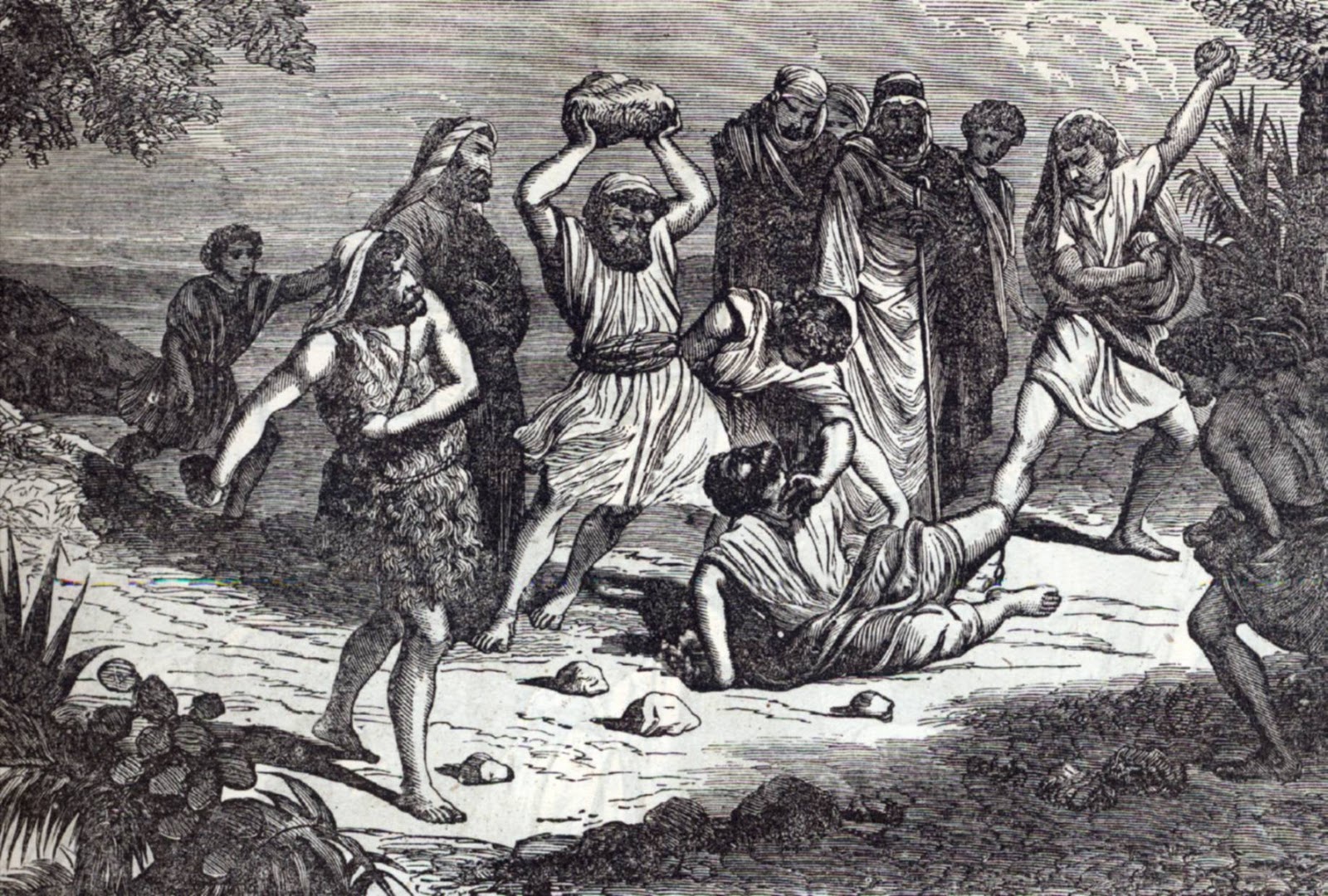
Then all Israel stoned him, and after they had stoned the rest, they burned them. 26 Over Achan they heaped up a large pile of rocks, which remains to this day. Then the Lord turned from his fierce anger. Therefore that place has been called the Valley of Achor[f] ever since.


If you are looking for trouble then the Valley of Achor is the place you will end up at. “Achor” means trouble. Continue to covet those things God meant for you to destroy. Continue to view porn. Then, as happened to Achan, you and your Image Locker will be tossed out of your family and your community. You and those around you will be burned and stoned and a huge pile of rocks will cover your charred and flattened carcass.

Or, you can confess to God and to your family about your sin. And, you take the images out of your Image Locker and burn them and then stone them and then bury them under a huge pile of rocks. This may require you to take the TV, the computer and the Smartphone and burn them, stone them and bury them.  Better these things than you. I am not kidding. This is how healing of memories begins: speaking the truth about sin and then dealing with it so as to destroy its existence. Besides, you had been warned about the heat you would incur:

“For on account of a harlot one is reduced to a loaf of bread, And an adulteress hunts for the precious life. Can a man take fire in his bosom And his clothes not be burned? Or can a man walk on hot coals And his feet not be scorched?… “  –Proverbs 6: 26-28


I know of a man who was addicted to pornography. This man traveled about 60% of the time for his job. He was alone most of the time. In his hotel room at night, he told himself that he was under a lot pressure to perform. As such, to ‘comfort’ himself, he took in images from the computer and TV. The things he took in were things which should have been destroyed. They are the Enemies’ ‘things’.

After a time, he became depressed and sensed a growing feeling of emptiness and shame. He had put himself under the pressure excuse and now he was covered with dirt and holding onto his “devoted things”. This man finally confessed his sin. He then destroyed whatever image files he had saved to his computer. He then began to use a web browser that wouldn’t allow him to see pornography. He put his TV into a bedroom closet. He took another job where he was around the same people every day. He held himself accountable. But, his response didn’t end there. He knew he had to re-image his mind.

He “put on the new self, which is being renewed in knowledge in the image of its Creator.” He began to study art. He attended life drawing classes where he learned to see and draw the human figure. He went on to become a portrait artist. He is now seeing the image of the Creator in the eyes and faces of those he paints.

Final word:  Take your Image Locker and move somewhere where you can be in nature. One could become a bird watcher or an astronomer. In other words, begin to fill your Image Locker with “things that are above” the “earthly elements”.

~~~

Here are three quotes regarding the effects of pornography:

“I believe – and research backs it – that material that children see online affects their ideas on sex. Nonetheless this is something that teaches us that we need to react before the damage is done and we need to prevent children seeing something online that might harm them or give them delusions”, explained Dagbjört Ásbjörnsdóttir, a sexologist at the Reykjavik department of Education and Youth.

Tackling the impact of porn on Iceland’s youths


“He was close with his family, but as far as friends go — he maybe had those acquaintances he communicated with every once in a while, but he pretty much isolated himself,” a source tells PEOPLE of Salling —Mark Salling’s Final Days: Glee Alum ‘Isolated Himself’ Amid Child Porn Case, Source Says


“[Anonymous] made me a more extreme version of myself,” William said. “I used to sleep badly. Now I sleep terribly. I used to be sarcastic; now I can be an a__hole.” He didn’t just “like “tormenting people; he loved it. He didn’t just “like” porn; he looked at it every day. “None of this bothers me, he added. “I don’t care about anything.” William had said in the past that he had no moral code; everything was case by case, his decisions based on gut reaction. Earnest Hemingway had said it best: “What is moral is what you feel good after, and what is immoral is what you feel bad after.”

Jake was nodding. “I have to agree with all of that, “he said. It desensitized me.”Acting out with crowds of people on the Internet had created a detachment from reality and a sense of obliviousness to certain consequences. Anonymous did bad things, but its members were not bad people, per se.” (emphasis mine) —We Are Anonymous: Inside the World of LulzSec, Anonymous, and the Global Cyber Insurgency

Added 2-10-2018:

“Research has found a correlation between pornography use and mental and physical illnesses, difficulty forming and maintaining intimate relationships, unhealthy brain development and cognitive function, and deviant, problematic or dangerous sexual behavior,” Spano said before the House Health & Human Services Committee approved the resolution on an 18-1 vote.
Florida Legislature could declare pornography a health risk

 Added 2-22-2018:
Resources for Combating porn:

Dealing with a porn addiction: Integrity Restored
Internet filter: Covenant Eyes
A book for junior high and high school level: Plunging Pornography
A book for the very young: Good Pictures Bad Pictures

Mission Probable: Self-made Victims

 “Should you decide to accept this mission to self-victimize the IMF (Inane Meme Force) will disavow any knowledge of your subsequent misbehavior if caught in the act.”

 Consider the following IMF missions of self-made victimization:

 Social media participants as victims: every moment of one’s-no depth of field life must become selfie-important.

 We may knowingly expose ourselves à la NY Rep. Anthony Weiner or as Jennifer I’ve-got-a-million-of-them Lawrence and exclaim “others have been messing with my ‘stuff.’

 After the damage is done to reputations it necessarily follows, in this day of dispositive scapegoating, that we then must present ourselves as victims even when we are victims of our own devices. Who would ever look at Jennifer Lawrence’s collection of nude pictures? I mean, the world is so….out there.

 Victims of circumstance or of circus stance on the high wire of notoriety?

 Illegal immigrants as victims: here we see bus loads of victims moving in. Yet, we must remember that these victims are the renewable energy source for Progressive votes. And this, despite the fact that any lack of border control, any lax enforcement by the Obama administration, any amnesty that adds more illegal immigrants to our country equals with other detriments more CO2, more crime, more narcotics, more narco-terrorists, more infectious disease, more gang members, more homeland terrorism and a huge drain on our national resources. But damn it, “victims” they must be for our purposes. We are America, the land of the free from taxation for half the nation and the home of the Black Panther monitored ballot box.

 Environment as victim and victimizer: Well, by now you should have come to your senses and have realized that global warming crisis is man-made. It has been manufactured by the likes of Al Gore and climate scientologists with dubious reports. These ‘scientologists’ or data shufflers dare not cross the red line of truth and lose their collegial credit card status points, their weather stations for life.

 Not only is the environment a victim but just like a Russian nesting doll you, too, can become a victim-of the environment. And, universal victim hood makes each of us eligible to be “insured” under the UN One World global warming whole life redistribution insurance plan. Benefits accrue to those who want to become wealthy off of other’s fears.

 Voter as victim: From the well-known Legal Insurrection blog, a post of Oct. 10th, 2014: “Judge tosses out Texas voter ID as U.S. Supreme Court blocks Wisconsin voter ID The ruling by the U.S. District court finds that such law…creates an unconstitutional burden on the right to vote, has an impermissible discriminatory effect against Hispanics and African-Americans.”

 This ruling by both courts is slap in the face for blacks and Hispanics. It essentially claims that blacks and Hispanics and too stupid, too inept to get an ID and to provide such ID at a polling place. To put it another way, there are millions of people who can secure a proper ID and present it at the time of voting. I am sure that Dr. Ben Carson, a self-made African-American neurosurgeon, can provide a proper ID. He would also help you figure out what to do.

Ask yourself: How do blacks and Hispanics acquire cable TV when they do not have ID?

 Note: The Texas ruling was recently reversed for the Texas Nov. elections but the matter is still in the courts

 Politically biased, blindfold taken off high courts have affirmed blacks and Hispanics as victims-a protected class of victims-so as to garner the un-ID’d ‘victim’s’ weight in votes-for the Progressive side of the scale, of course. Preferential treatment by the courts makes the rest of us truly victims of injustice. Preferential treatment by Progressive bureaucratic Lois Lerner types within our current heavily politicized government negates Democracy in favor of totalitarianism. The Tea Party non-profit groups became true victims of injustice with the administration’s silent approbation.

 The poor as victims: Here is what we are told by the supercilious politicians and Keynesian economists (NYT’s Paul Krugam, Thomas Piketty, et al) : “There are poor people because there are rich people. The global wealth pie is a one fixed-size feeds all pie.  The rich have the larger share. Redistribution is the only answer-it is socially just.”

 It doesn’t matter to the above mentioned wisdom impoverished that the rich have made personal choices that create wealth or that the poor have most often made personal choices which have made them poor and keep them poor. And, somehow, the poor find a way (trading food stamps for cash or bit coins online, for instance) to buy lottery tickets, to gamble in Vegas and to buy enormous HDTVs so they can watch “The Real Housewives of Orange County!”

Our government enables the self-victimization of the poor. Obama and slave master Progressives have created cradle to grave dependency on government.  The “Julia” website is a first hand account about a lifeless victim of gargantuan government gone wild.

 Fiscal and monetary policies-The New Deal, The Great Society, the Community Reinvestment Act (CRA), TARP, the FED’s tinkering to create artificially low interest rates, ETC.- direct money away from savings and investment, capital that would ultimately create jobs and individual wealth. 

Each one of these government ‘fixits’ creates bubbles that ultimately burst.  There should be a History Channel just for this.  First came the dot com bubble and then the housing bubble. And, most home buyers are now government subsidized. Uh-oh!

Printing money creates ever more debt and puffs up the economy with lighter than air dollars. 

Our government is creating an even greater balloon (Let’s call it the “Keynesian Economic Balloon”) that will soon go bust “Big Time”, as Peter Gabriel sang. Then your dollars will be almost worthless.  The IMF endorses such politically ‘safe’ and economically disastrous inane activity. Just don’t get caught holding USD.

That 47 MILLION people are on food stamps tells me that government enables poverty in our nation.  And there are even ‘victims’ who complain that 99 weeks of unemployment benefits isn’t enough! Use your head and your ID and vote for people with integrity, character and business sense, avoiding lethargic professorial panty waists unless, of course, you should choose the mission of self-made victimization.

 Addicts as victims: Consider this recent “addiction help” advertisement heard on the radio: “Addiction is a disease, not a character flaw.”

 Whoa! Calling an addiction a disease takes the onus off of the addicted, removing them from the light of day and placing them under the dark cloud of victim hood where the sun doesn’t shine on your addled behavior.

 And, it most certainly as advertised, places the addicted under the expensive ‘guidance’ of medical professionals who will’ ‘altruistically’ be your savior. “Victim status is where you belong, why try to fight it. Give us the money that you are now giving to pay for your addiction. Character flaws mean personal responsibility and they may not result in insurance payments to our treatment facility.”

 Homosexuals as victims: Where to begin? When acting out homosexual desires you are told that you are not responsible for your behavior. Rather, what you are dealing with is a quirk, a queerness that exists in the universe. Homosexuals do not even try to overcome your desires and use self control. You will become sexual minority stressed. God knows that you have enough to worry about when you do unnatural things to your self and to others. AIDS is our problem, not yours. You are sexual minority stressed transmitters and no more.

The Politically Correct as victims: it is not easy being totalitarian all the time but the Politically Correct, the language police, must enforce ‘safe’ societal boundaries or bubbles where nothing offensive to their delicate yet ‘diverse’ palettes enters the void. Truly they are victims of their own demands.

 One more IMF mission out of dozens of putative instances:

 Civil Rights victims: The omniscient and all powerful Oz, Eric Holder, and his Race Swami-Tsunami spiritual advisor the ‘reverend’ Al Sharpton have made sure by their appearances that the citizens of Ferguson, MO-the black citizens-received their fair share of victim status. They both spread their special mixture of racial rat poison and silent approbation, disguised as legal fertilizer, on the community lawns of Ferguson, Mo.

 Weeds of lawlessness now spring up daily in Ferguson, Mo. The encroaching and choking weeds are growing in place of flourishing businesses and a thriving community.


“Should you decide to accept this mission of self-aggrandizing self-victimization the IMF (Inane Meme Force) will disavow any knowledge of your subsequent misbehavior (unless, of course, it benefits Progressive’s talking points).”


In this age of self made victims it is impossible to balance the empathy budget. The stockpile of care is all out of love. Your self-immolation will have to go down in flames without me. In any case your actions will be disavowed by me.

 ~~~~

 There are people in this world who are hurting. And, “Shame on you” is not a strong enough indictment for those who claim victim status when they do “stupid stuff.”

 Pastor Saeed Abedini, Irani, returned to Iran to help Iranian children. He was arrested and placed in prison. He has been in an Irani prison over two years. He is in prison for being a Christian, a Christian seeking to help orphaned Irani children. Pastor Abedini doesn’t play the part of victim. The God of Israel watches over him.