Seeing in New Light
June 8, 2025 Leave a comment
“Till this moment I never knew myself.”
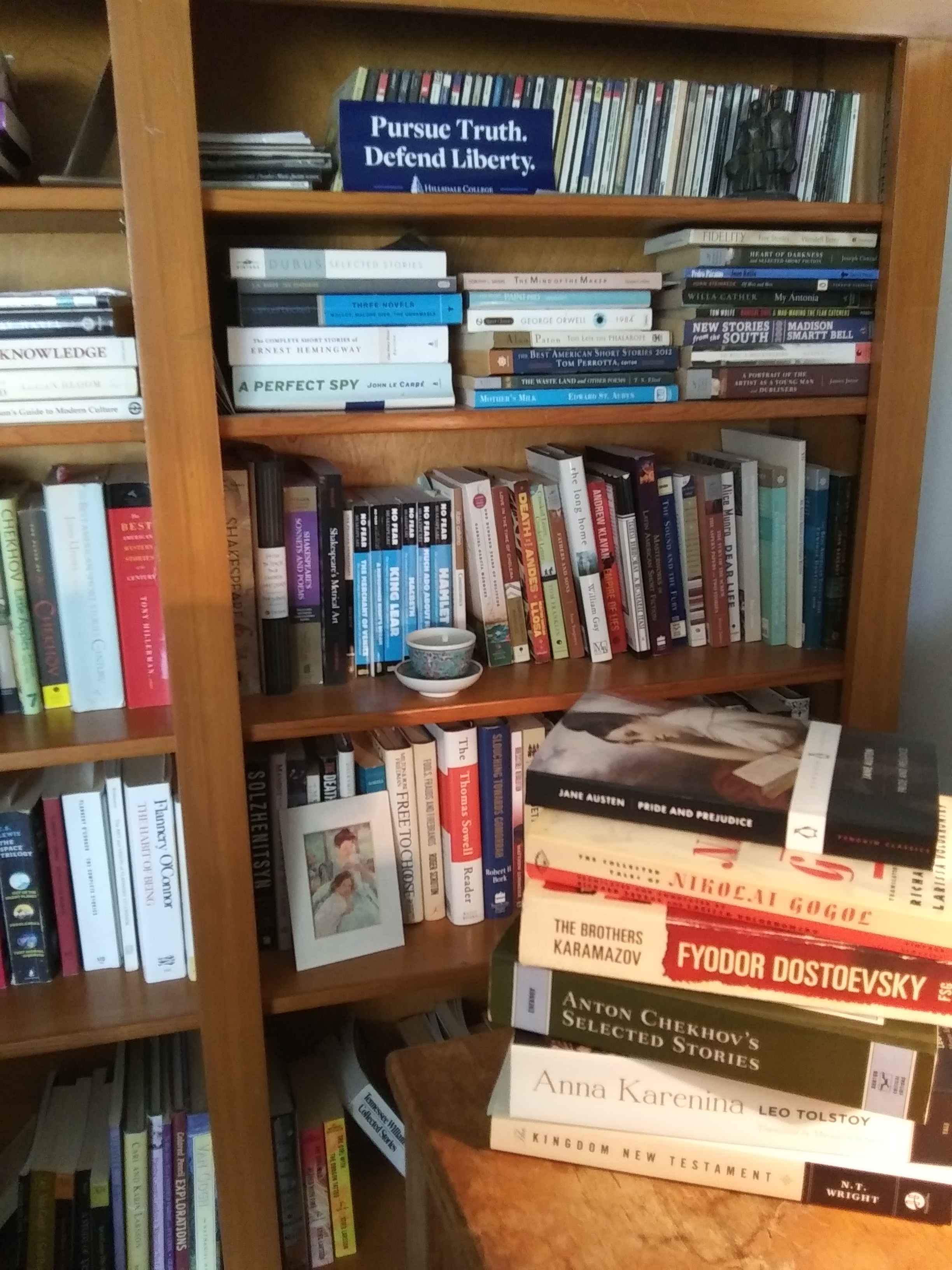
Recently, I picked up a Penguin Classics copy of Jane Austen’s Pride and Prejudice, a popular novel in the Austen canon. I read it to distance myself from the senseless present en route to WWIII and to thicken my temporal bandwidth. The reason for the latter is in my post The Lines of Others.
“To interact with people from different cultures and to gain a deeper appreciation of their values, beliefs, and customs. To become more empathetic and understanding toward others, even those who are very different from me. To gain a better understanding of the diverse world we live in and develop a more open-minded perspective.”
With Austen as guide I visited rural England at the turn of the 19th century. I found an ordered world governed by rules of etiquette. Tension between social expectations and personal feelings is often concealed behind formal politeness. Austen critiques social conventions regarding class distinctions, gender roles, and marriage through the use of irony, hyperbole, and witty rejoinders.
Her narrator’s opening lines set the viewpoint of the characters:
It is a truth universally acknowledged, that a single man in possession of a good fortune, must be in want of a wife.
However little known the feelings or views of such a man may be on his first entering a neighbourhood, this truth is so well fixed in the minds of the surrounding families, that he is considered the rightful property of some one or other of their daughters.
Enter the Bennet family with its five daughters: Jane, Elizabeth, Mary, Lydia, and Kitty.
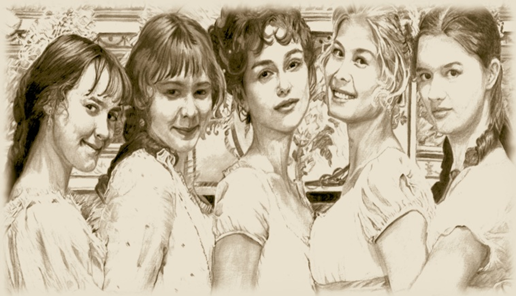
Mr. Bennet is fond of books and is known for his sarcastic wit. Along with his favorite daughter “Lizzy,” he shares a distaste for the conventional views of wealth and rank. He also enjoys criticizing and teasing his youngest daughters Kitty and Lydia.
To his wife he says that they are “uncommonly foolish” and “two of the silliest girls in the country.” But his inability to step in and correct their behavior fosters his youngest daughters’ foolishness. Lydia will eventually be involved in a scandal that disrupts the social order and brings shame upon the family.
Mrs. Bennet is obsessed with finding suitable husbands for her daughters. The opening indicated this fixation but not the reasoning behind it. It has to do with a legal restriction on inheritance – an entail.
If Mr. Bennet passed, his estate, Longbourn, is entailed (transferred) to the closest male relative – his cousin, Mr. Collins. Mrs. Bennet saw no guarantee of Mr. Collin’s charity if that happened. She, justifiably so, knowing that acceptable employment opportunities were extremely limited for women in their social class, wanted her daughters to marry advantageously or she and they will be destitute and fall into social disgrace.
Mrs. Bennet’s favorite daughter, the one with “high animal spirits” is 15-year-old Lydia. Lydia is obsessed with men, especially the officers of her militia regiment. The flirtatious Lydia will become involved in a sexual scandal with a certain Mr. Wickham.
Mrs. Bennet is characterized as “a woman of mean understanding, little information, and uncertain temper.” She becomes fretful when her plans go awry. To ally her worries, she visits neighbors and gossips.
Elizabeth would later reflect on her father’s judgmental sarcasm, the flirtations of her wild youngest sisters Kitty and Lydia, and the unwillingness of her father and mother to control their behavior.
“They were hopeless of remedy. Her father, contented with laughing at them, would never exert himself to restrain the wild giddiness of his youngest daughters; and her mother, with manners so far from right herself, was entirely insensible of the evil.”
Beside the Bennet family, there are 20 characters in the novel. Some are charming (Charles Bingley). Some are annoying (Mrs. Bennett, Mr. Collins, Lady Catherine de Bourgh). Others, self-willed and careless (Lydia), rakish (Mr. Wickham), proud and stilted (Mr. Darcy). And one starts out very sure of herself (Elizabeth).
The characters meet at various gatherings. The Bennet sisters looked forward to every ball as dancing was a very important part of the courtship ritual. There, the daughters mingle with husband prospects and impressions are formed. At one ball, Bingley takes an immediate interest in the beautiful and shy Jane and Elizabeth danced with George Wickham.
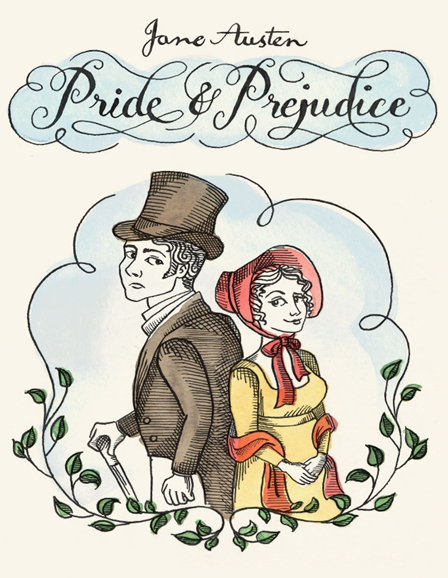
The Elizabeth and Fitzwilliam Darcy encounter is reserved but intriguing for both. Their relationship is where the pride and prejudice of the title comes in. It begins with class distinction: Elizabeth is the daughter of a country gentleman. Darcy is a rich aristocratic landowner.
Darcy, holding a common belief in the natural superiority of the wealthy landed gentry, walks around with the pride of rank and fortune and prejudice against the social inferiority of Elizabeth’s family. He comes off as distant. Elizabeth, equally aloof, wears her pride as independence of mind.
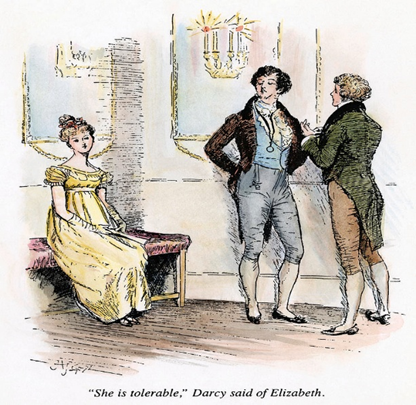
Elizabeth also noticed that Wickham and Darcy don’t get along. She begins to hold a grudge against Darcy based on his superior ways and on the self-serving words of Wickham that belittle him.
But she later sees Darcy anew when he involves himself in ‘fixing’ Lydia’s mess and restoring social order. She later sees herself anew.
~~~
Note: It is not my purpose with this post to summarize Pride and Prejudice. There are plenty of websites that do so. My purpose here is to bring to the foreground a character who learns to see differently. And to encourage everyone to thicken their personal bandwidth by reading great literature from the past. As you’ll see by reading Pride and Prejudice, wisdom and much more comes in doing so. Don’t judge a book by its cover.
~~~
The novel was more than I expected from a so-called “romance novel.” I came across personal growth in a character who humbled herself and let go of a grudge based on social pretensions and misjudgments. She was able to open her mind and her heart to new information and begin to see things differently. I came across Elizabeth Bennet and her Anagnorisis.
Anagnorisis is a literary device used in Greek tragedies and in many plots since. It is the moment of recognition. The main character, typically, transitions from ignorance to knowledge. This seeing anew is a turning point in the story, after which things concerning the main character are not viewed the same way again.
Elizabeths’ shift in perception comes after a revelatory letter from Darcy that discloses the opposite of what she had supposed about Wickham and himself. Darcy had thought it beneath him as a gentleman to speak of Wickham’s deceitful squandering behavior.
She spends time alone thinking things through. She questions her own discernment. The outcome of her interiority is summed in her words above. Elizabeth finally learns the truth about someone she accepted at face value (Wickham) and about someone that she judged harshly (Darcy). The prejudice in the title was not the latter’s but hers. She realizes she was greatly mistaken.
Elizabeth began as a rebel. She thought she was above society’s games. She’s witty but judgmental and arrogant when fixating on flaws. Her own pride mirrored that of the one she viewed as proud. But after spending time alone with the letter and hearing confirming reports, she confronts her own snobbery. Realizing how wrong she was she is humbled.
She grew absolutely ashamed of herself. Of neither Darcy nor Wickham could she think without feeling that she had been blind, partial, prejudiced, absurd.
“How despicably have I acted!” she cried; “I, who have prided myself on my discernment! I, who have valued myself on my abilities! who have often disdained the generous candour of my sister, and gratified my vanity in useless or blameable mistrust! How humiliating is this discovery! Yet, how just a humiliation! Had I been in love, I could not have been more wretchedly blind! But vanity, not love, has been my folly. Pleased with the preference of one, and offended by the neglect of the other, on the very beginning of our acquaintance, I have courted prepossession and ignorance, and driven reason away, where either were concerned. Till this moment I never knew myself.”
Pride and Prejudice. Chastened realism. Seeing anew. Wisdom born of humility. Wit and wisdom.
~~~
Evie Magazine, in 5 Women From Classic Literature Who Don’t Need A Sword To Be Strong, attributes Lizzy’s change of mind to her strength of character:
“When Darcy begins to show signs of being something more than what originally met the eye, Elizabeth is able to open her mind and her heart to him and discover the truth behind his distance and disdain. Her ability to do that — instead of holding a grudge — allows her to find, in Darcy, a true equal.”
~~~~~~
“Angry people are not always wise.”
― Jane Austen, Pride and Prejudice
“There is a stubbornness about me that never can bear to be frightened at the will of others. My courage always rises at every attempt to intimidate me.”
― Jane Austen, Pride and Prejudice
“From the very beginning— from the first moment, I may almost say— of my acquaintance with you, your manners, impressing me with the fullest belief of your arrogance, your conceit, and your selfish disdain of the feelings of others, were such as to form the groundwork of disapprobation on which succeeding events have built so immovable a dislike; and I had not known you a month before I felt that you were the last man in the world whom I could ever be prevailed on to marry.”
― Jane Austen, Pride and Prejudice
~~~~~
Simone Weil once said:
“There is something else which has the power to awaken us to the truth. It is the works of writers of genius. They give us, in the guise of fiction, something equivalent to the actual density of the real, that density which life offers us every day but which we are unable to grasp because we are amusing ourselves with lies.”
~~~~~
Rosamund Pike talks about narrating Pride & Prejudice
~~~~~
Forming the Imagination Through Literature
Joshua Villarreal, Teacher Support Lead for Hillsdale College K-12, delivers a lecture on how literature forms a student’s moral imagination.
This lecture was given at the Hoogland Center for Teacher Excellence seminar, “The Art of Teaching: Upper School Literature” in February 2025. The Hoogland Center for Teacher Excellence, an outreach of the Hillsdale College K-12 Education Office, offers educators the opportunity to deepen their content knowledge and refine their skills in the classroom.
~~~~~

If you are not content to read and need a screen, well there’s this:
Pride and Prejudice and Zombies
Five sisters in 19th century England must cope with the pressures to marry while protecting themselves from a growing population of zombies.








 Cindy Wity
Polly Want a Crisis?
April 14, 2024 Leave a comment
If only it was something that remained on the pages of a dystopian novel . . .the ways the anointed ones deal with us. But the stark reality is that the anointed ones have learned that a crisis is a terrible thing to waste and that a manufactured crisis affords the anointed the opportunity to wield total power for its own sake.
“When the anointed say that there is a crisis this means that something must be done —and it must be done simply because the anointed want it done.”
― Thomas Sowell, The Vision Of The Annointed: Self-congratulation As A Basis For Social Policy
The fourth anniversary of “15 days to slow the spread” has come and gone. But the harm inflicted upon our lives and our country during the COVID “crisis” has not. More “public health” strategies are being developed to tyrannize us into “wellness” (See the WHO treaty below.) We will be made to follow “the science” even into hell if it suits the anointed ones.
We (the remnant) somehow lived through the “something must be done” ill-treatment by means of the public health anointed: Anthony Fauci, Deborah Birx, Rochelle Walensky, Francis Collins, and others of the anointed ilk.
And somehow, we lived through the abrogation of our freedom by the anointed ones. We came out the other side of the social experiment with the knowledge that the anointed ones conceived the abuse done to us and will do it again. What we had to endure mentally at the hands of the anointed arch-COVIDians was horrible: their fearmongering, their lies, their scientism, their silencing of contrary evidence, and their absurd mandates – clearly a test of wills as common sense was not considered “the science.”
The introduction of the anointed anxiety-soothing shot – the SOMA serum – has had devastating implications on the health and livelihoods. Many have suffered the loss of loved ones with an “unexpected death”, the loss of livelihood, and the loss of health. It has only been recently reported that the anointed of the CDC intentionally HID more than a quarter of a million adverse effects reports for the COVID-19 “vaccines.”
We continue to be subjected (via the anointed one’s talking heads) to the badgering about a (non-existent) climate “crisis.” We are told to do away with gasoline-powered vehicles and natural gas ranges and with all thought of fossil fuels as an energy source. We are told to become completely dependent on weather-dependent turbines and solar panels, and on hydropower and on their “climate science” directives for the energy to power a modern industrial economy.
(See my post Earth Day – Don’t Re-Greta Green Energy | Kingdom Venturers where I wrote about the exploitation of children and poor countries to secure the minerals needed for millions of electronic products e.g., rechargeable lithium batteries, sold year after year. The anointed ones have hearts of darkness.
“. . . cobalt, mined by the Congolese (and the Uyghurs in China), is a coveted substance in man’s conquest of earth. And we find, if we dare to look, that Green Energy-based colonialism is no different than the ivory-based colonialism talked about in [Joseph Conrad’s] Heart of Darkness.”)
The anointed of the World Economic Forum (WEF) had included “Climate-related risks” as “the biggest future threat facing the world.” The WEF have since moved on to “misinformation and disinformation” as the biggest risk near-term risk (to their narratives), followed by extreme weather events, social polarization and armed conflict.
Citing soaring energy and food prices resulting in inflationary pressures and a cost-of-living crisis, social unrest, conflicts, carbon emissions and future pandemics, the anointed of the WEF have created a new word for the cascading and connected crises they envision: Polycrisis.
For, the anointed of the WEF must make alarming predictions and announce sweeping solutions to create a demand for their services. These “Teflon prophets” (Thomas Sowell) predict that there will be future social, economic, or environmental problems in the absence of their anointed intervention.
It will be noted by those with an expanded personal bandwidth (informed common sense), that the cost-of-living crisis has been caused by the massive deficit spending and reckless energy policies of the anointed ones in our government. They also know that the shutdown of our economy during COVID was caused by the public health anointed ones. Wars are caused by the anointed ones. Carbon emissions have not risen to any threatening level except in the “acceptable” papers the anointed present to the WEF and the UN.
The WEF will not let their Polycrisis go to waste. They are conspiring to centrally plan the world because “something must be done” and done “for our own good.” Did anyone ask you about wanting a Great Reset?
Public health anointed ones are setting up for the next medical “crisis”. The World Health Organization (WHO) wants complete sovereignty (To call the shots!) over our health . . . and anything it calls a “crisis”. A “crisis” would include the climate, the water supply, gun ownership, how food is produced – basically, anything they can claim is an existential threat to humanity.
For these anointed ones to have complete say and sway over us, they must make an end run around to subvert our own physical sovereignty and the sovereignty of the U.S.
Dr. Meryl Nass: ‘We’re undergoing a soft coup’
Dr. Meryl Nass explains how the WHO’s proposed pandemic treaty will enable the WHO “to take over jurisdiction of everything in the world by saying that climate change, animals, plants, water systems [and] ecosystems are all central to health”. In addition to that, it will remove human rights protections, enforce censorship and digital passports, require governments to push a single “official” narrative, and enable the WHO to declare “pandemics” on a whim.
In a nutshell, the WHO is all in for whatever it takes to promote disease-related pharmaceutical interventions, including surveillance, digital health passports, tracing, the ability to impose lockdowns, and mandating vaccines, even experimental ones like the mRNA COVID-19 shots. (Emphasis mine.)
More on this here: Short Videos – Sovereignty Coalition
“The COVID-19 mandates and resulting lockdowns taught us that, given the chance, governments worldwide will seek to control citizens if a pandemic emergency is declared. The World Health Organization (WHO) closed its negotiations on May 27 with the production of an accord consisting of two treaties that could meaningfully impinge on our sovereignty as Americans. The proposed WHO Pandemic Preparedness Treaty threatens to give unprecedented power in real or maybe even perceived “public health emergencies of international concern.” -Wendi Strauch Mahoney
The WHO Accord: Global Governance is a Real Threat to American Sovereignty | uncoverdc.com | uncoverdc.com
If only it was something that remained on the pages of a dystopian novel . . .the ways the anointed ones deal with us.
Coming May 2024!!!!!!!!!
Global Health Project – Protecting the Health & Future for All Humans – The Global Health Project
You may be clutching your pearls and saying “I don’t know what to think or do.” Does Polly want a crisis so that Polly can find out what to think and do from the anointed ones?
Take Action Now!!!!! At this link: “Not Now” on the Surrender of Our Sovereignty to the WHO | AlignAct
Listen. We can’t change the past. But we can continue to learn from it and work to prevent it from happening again, so the next “crisis” doesn’t represent the death of our Constitution, our livelihood, and our freedom.
For what has happened During COVID, we must demand answers. We must demand accountability. We must demand that those who perpetrated this be tried and, as appropriate, fined and sent to prison.
The takeover of our lives “for your own good” by the anointed ones must stop now.
I am not vaxxed and not because of some partisan influence or misinformation as the Leftist media is wont to claim. I took the time to read and understand the science from various sources and I knew my own almost seventy-year old body.
I did not comply during the COVID “crisis”. I did not come to love Big Brother. I raised my voice and held strong. (See my posts since March 2020). Unfortunately, many swallowed the slogans and were like sheep led to the mRNA slaughter.
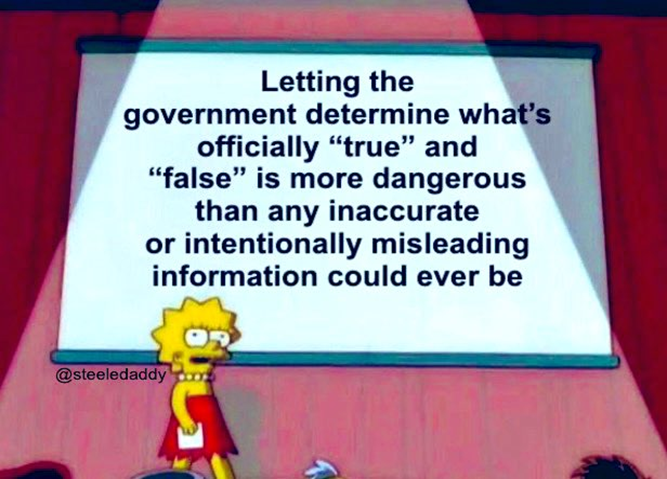
All I want from the government or any authority is information to make my own decisions. I do not want, unless authorized by me, to have decisions made for me. (One might say that a transmissible disease warrants strict compliance to “health standards” or someone might die. But there would be no evidence of such transmission, only speculation and finger pointing.)
The United States Constitution, the Bill of Rights, and the First and Second Amendments are the Supreme Law of the Land – not the WEF, not the WHO, and not a warrantless FISA.
The eclipse came and went but the tax man cometh again and again to overshadow our lives. April 15th – the day when the work of our hands is conscripted into the service of the oligarchical ruling class.
Characteristics of the anointed one’s Big Brother approach:
Increasing depression, despondency, mental illness, and suicides.
Ugliness in tone, in art and architecture – beauty is deemed subversive.
Truth, facts and language are manipulated (Newspeak).
There is a militant focus on “misinformation and disinformation” (Ministry of Truth).
History is destroyed (doublethink).
Constant surveillance.
Systematic brainwashing (Ministry of Love).
There is obsession with population control and control of population.
If only it was something that remained on the pages of a dystopian novel . . .the ways the anointed ones deal with us.
~~~~~
There are those who see themselves as morally and intellectually superior to the general public and therefore superior to Democracy and its laws created by elected representatives.
Ad hoc justice, not established rule of law, is one product of their superior ways as is remaking society with inegalitarian means to create equal outcomes. Promoting the hatred of whites to promote blacks is another product of their superior ways.
Claremont Institute Senior Fellow Angelo Codevilla had this to say about America’s Ruling Class — And the Perils of Revolution:
“This dismissal of the American people’s intellectual, spiritual, and moral substance is the very heart of what our ruling class is about. Its principal article of faith, its claim to the right to decide for others, is precisely that it knows things and operates by standards beyond others’ comprehension . . .
“Because ordinary people will pervert reason with ideology, religion, or interest, science is “science” only in the “right” hands. Consensus among the right people is the only standard of truth. Facts and logic matter only insofar as proper authority acknowledges them . . .
“That is why the ruling class is united and adamant about nothing so much as its right to pronounce definitive, “scientific” judgment on whatever it chooses . . .
“The fact that the “hockey stick” conclusion stands discredited and Mann and associates are on record manipulating peer review, the fact that science-by-secret-data is an oxymoron, the very distinction between truth and error, all matter far less to the ruling class than the distinction between itself and those they rule.”
~~~~~
Anointed ones run our cities:
The Democratic-run city of Denver, Colorado, plans to defund its police department to pay for illegal immigrants.
Denver’s police department will be hit with an $8.4 million reduction — about 1.9% of its total operating budget, the city confirmed to the Daily Caller News Foundation.
Blue City Plans To Defund Its Police Force To Pay For Illegal Immigrants | (dailycallernewsfoundation.org)
The anointed ones who run our cities into the ground want to create new hell holes:
Hamster cages for humans, the 15-minute cities, are on city planner agendas. Soy boys and girls can walk around the city and look at their screens without a worry – “the idea is that every need is fulfilled within a 15-minute walk or short bike ride.”
~~~~~
“Democracy!” is in crisis, according to the anointed ones on the Left: Trump is on the ballot and might be elected! Anointed talking heads want to tell you what to think and do about it: “Whatever you do, Don’t Think. Accept what is said about Trump and “Democracy!””
Despotism has so often been established in the name of liberty that experience should warn us to judge parties by their practices rather than their preachings.
—Raymond Aron, The Opium of the Intellectuals
(Replace “liberty” with the Left’s “crisis of Democracy!” and you will understand what they are after.)
Tucker Carlson: For the Third Time in Three Consecutive Cycles, Secretive Federal Agencies are Trying to Rig Our Presidential Election – This Is What They Call ‘Democracy’ (VIDEO) | The Gateway Pundit | by Jim Hoft
~~~~~
You won’t get the common sense found in the words and writings of Thomas Sowell from the anointed ones.
Thomas Sowell on Intellectuals and Society (youtube.com)
Sowell argues that American thought is dominated by a “prevailing vision” which seals itself off from any empirical evidence that is inconsistent with that vision.
“…the very commonness of common sense makes it unlikely to have any appeal to the anointed. How can they be wiser and nobler than everyone else while agreeing with everyone else?”
― Thomas Sowell, The Vision of the Anointed: Self-Congratulation as a Basis for Social Policy
The vision of the anointed — with Thomas Sowell (1995) | THINK TANK (youtube.com)
Thomas Sowell and a Conflict of Visions (youtube.com)
Original air date: October 12, 1995
~~~~~~
Were you assigned George Orwell’s 1984 in school? I wonder if it’s being assigned in schools today.
We are living in an age that is increasingly characterized by the eerily prophetic 1984. Authoritarianism and coercion. The censoring of speech. The mandates. The propaganda. Utopia for the brotherhood elite. Dystopia for the rest.
Nineteen Eighty-Four
Melvyn Bragg and guests discuss Orwell’s dystopian novel where the state rewrites history, war is peace, freedom is slavery, ignorance is strength – and Big Brother is watching you
BBC Radio 4 – In Our Time, Nineteen Eighty-Four
~~~
Novel Conversations: “1984” by George Orwell
1984 follows the life of Winston Smith, a low-ranking member of ‘the Party’, who is frustrated by the omnipresent eyes of the party, and its ominous ruler, Big Brother. Orwell effectively explores the themes of mass media control, government surveillance, how a dictator can manipulate and control history, thoughts, and lives in such a way that no one can escape it.
“1984” by George Orwell | Evergreen Podcasts
~~~~~~
Mike Johnson Is Fighting to Protect the Government Spy Program Used on Trump (youtube.com)
Rate this:
Filed under 2024 Current Events, 2024 Election, cultural Marxism, Economic World Forum, Health, Political Commentary, Progressivism, propaganda, social commentary, totalitarianism, WEF, WHO Tagged with 1984, Big Brother, Book Review, books, climate-related risks, Democracy, dystopian, George Orwell, misinformation, Pandemic Treaty, The Left, Thomas Sowell, totalitarianism, tyranny, World Economic Forum, World Health Organization