Visitations
November 24, 2025 Leave a comment
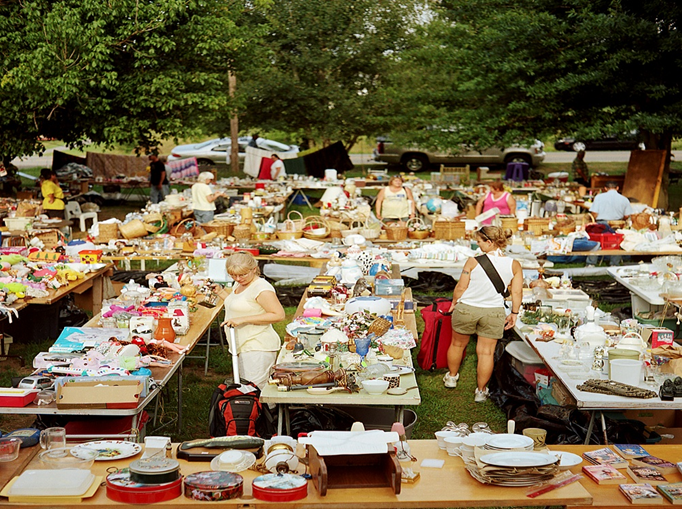
Brooke was not one to go looking for treasure among the trash, but the sight of a huge yard sale where unwanted items were offered for a second or third chance at redemption, she could not pass up. She parked her car and joined the dozen or so couples walking among the array of tables each presenting a collage of things once valued, then set aside, then remembered and revalued, and now priced for sale. The once attached were up for adoption.
Atop one table sat a black 1926 electric singer sewing machine. Beneath it, against the leg of the table leaned a B & W photograph – a coastal landscape. Brooke bent down to look at it. The seller, an eighty-something woman got up from her chair and leaned across the table.
“You see something, don’t you dearie? Hang it where you will see it every night.”
The woman went on to say that she was selling her things because her son was putting her in a home “where memories walk the halls.”
A tall man with winsome blue eyes and a half smile walked up to her side. “Mom, that’s not so.” He spoke with a voice that, for some reason, reminded Brooke of a vanilla latte.
The woman grabbed his arm. “This is my son Chet.”
Brooke was curious. “Chet? I’ve not . . .”
“My father liked Chet Baker, you know, the jazz trumpeter and vocalist.” He showed her the Chet Baker Sings and Plays LP also for sale.
“Here,” proposed Chet, “this LP and this book of poetry go with the photograph.” He placed them in front of her.
Brooke held up the framed photograph. Unable to read any signature in the lower right-hand corner, she asked the woman who the photographer was.
“My late husband. Henry took up photography after he retired. He was a romantic soul with a wanderlust about him. He loved to drive back roads to new places and take pictures. This was taken when we were along the coast in northeast England.”
“It has a certain charm to it,” Brooke remarked.
“It has charmed me for years. Looking at it, I hear his sweet husky voice. But you don’t need to know all that. See for yourself.”
This last comment seemed odd to Brooke but it did lend to the photograph a certain mystical attraction. After imagining the photo hanging in her new studio apartment in the city, Brooke paid the woman and brought the three items home.
That afternoon she measured, nailed, and hung the framed 24 X 36 framed photograph in the middle of a white wall that held nothing else. She stood back to look at it.
The shoreline divided the sea on the left and cliff terrain on the right. Above the water, clouds blotted out the sun but rays of light streaked down from their edges. On the beach stood a woman. She was not looking at the water but back toward the land. What she sees is not in view. Her shadow is stretched out before her.
Brooke’s studio apartment was on the fifth floor, above the street lights. At night, the glow of the city, manufactured moonlight, immersed the small studio and the futon where she slept.
~~~
The next weekend, Brooke’s boyfriend Alex arrived to take her to dinner. He sat down on the futon to wait for her as she finished getting ready. On the side table was a book with a worn cover. He picked it up and thumbed through it and put it down.
“You reading poetry now?”
“I got it a yard sale last weekend. I bought the photo on the wall and the woman who sold it to me gave me the book.”
Alex looked over at the photo. “It’s kinda bleak. You know they make color photos these days, don’t you? And what is that woman looking at?”
Alex picked up the book again and turned to one of the dog-eared pages.
“Let’s see what Lord Byron says . . .”
“There is a pleasure in the pathless woods,
There is a rapture on the lonely shore,
There is society where none intrudes,
By the deep Sea, and music in its roar:
“I love not Man the less, but Nature more,
From these our interviews, in which I steal
From all I may be, or have been before,
To mingle with the Universe, and feel
What I can ne’er express, yet cannot all conceal.”
“Brooke, did I tell you that I wrote limericks when I was a kid?”
No, you didn’t,” Brooke responded from the bathroom.
“There once was a man from Tijuana
Who had a pet Iguana,
He played the trumpet
And so did his pet,
But don’t ask me if I wanna.”
“Want to hear another?
“If you must.”
“There once was a man named Paul
Whose name he couldn’t recall,
When the time came to sign on the old dotted line
The old man just had to stall.”
“Brooke, did I tell you that I’m reading a novel?”
“Oh yeah, which one?” Brooke walked into the living room.
“A Tom Clancy novel.”
“I’m ready. Let’s go.”
That night they dined at Cooper’s Tap, a pub that served beer and sarnies and big screen soccer. Brooke ordered a smoked gouda and apple melt sandwich and Alex a rosemary roast beef and brie sandwich.
During their weekend outings to Cooper’s, Alex, after a few pints, would be outgoing to the point of talking to everyone at the bar. He’d slap a guy on the back and place his hand on the back of the woman next to him, as if old friends. Brooke saw something endearing about that aspect of Alex but also something needy.
The evening ended as it had the last six months of dating – at the door. Brooke was not going to make any overnight commitment until she felt something substantial to hang her heart on.
With the futon opened and the bed made, Brooke nestled in for the night. She grabbed the book from the side table and looked for a poem. She settled on A Daughter of Eve by Christina Rossetti and read it aloud.
“A fool I was to sleep at noon,
And wake when night is chilly
Beneath the comfortless cold moon;
A fool to pluck my rose too soon,
A fool to snap my lily.
“My garden-plot I have not kept;
Faded and all-forsaken,
I weep as I have never wept:
Oh it was summer when I slept,
It’s winter now I waken.
“Talk what you please of future spring
And sun-warm’d sweet to-morrow:—
Stripp’d bare of hope and everything,
No more to laugh, no more to sing,
I sit alone with sorrow.”
She put the book down and looked over at the photograph before turning out the light.
~~~
In the coming weeks her father, mother and sister would each make separate visits to see her new apartment, ask about her new job and meet Alex. Her father was the first to visit.
When Roland arrived, he stood in the middle of the 500 square foot studio apartment scratching his head over the amount of rent his daughter paid for such a small place. “You don’t even have room to have people over for a meal.”
Brooke said it was what she could afford and the apartment was just a few blocks from her job. She didn’t have a car payment.
Her father sat down on the futon and asked about her job.
“I’m an ER charge nurse now in the Level 1 trauma center. I oversee 15 nurses. We see about 35 patients a shift.”
“Do you like your job? Are you OK seeing all that gore?” her father asked.
“Well, I never ever get used to seeing someone without a face or massive amounts of hemorrhaging or exposed brain matter. Burns – especially severe ones- are gruesome. But I do what I have to do knowing that those brought in need patching up.”
“What about this Alex guy? You like him?
“He’s nice. He’s kinda like Joey, the guy I was dating in high school. He makes me laugh. But he is a bit too much, dad, so, I dunno. Maybe that will change over time change. You’ll meet him tonight.”
That evening Brooke and her father met up with Alex at Cooper’s. After a few pints and a couple games of darts, the two men wandered around the pub talking up those sitting at the bar. Alex introduced Roland to his bar-mates.
Brooke watched her father in his element. He could read a room and invite himself into it. As a sales rep, he wined and dined many clients. Tonight at Cooper’s, he was her father and someone’s sales rep and his everyman self.
It was her father’s out-of-town trips that were behind Brooke’s mother divorcing her father ten years before. That and the affair she had with Douglas while her father was not around. This, Brooke felt, left her father bitter and anxious to regain what he lost – a major customer.
When the evening ended, Brooke and her father said goodnight to Alex. On the way to the apartment Brooke asked her father what he thought about Alex.
“He’s a good egg. Fun to be around.” He paused. “Is your mother still seeing that creepy sweater-wearing guy?”
“Yes, dad.”
Brooke offered her father the futon for the night. He protested and said the air mattress he brought with would do. He spent a half-hour blowing into it, his face turning beet red. With a sheet, a pillow, and some blankets, he made his bed and settled in.
“Nite Brookes.”
“Nite dad.” Brooke turned off the light. The room took on the city’s silver glow.
“You can sleep with this garish light?”
“Garish? I’ve never heard you use that word before.”
“Janinne used it.”
“Who is Jannine?”
“I met her tonight. She’s a high school English teacher. She gave me her number.”
The next morning, Brooke awoke to find her father sitting in a chair taking antacid pills. His heartburn was bothering him again.
Brooke wanted to sleep longer as her father was up several times to the bathroom and when he was asleep he snored. But she got up to make some coffee for herself and toast for her father.
“I had a dream last night,” her father began. “I saw Janinne on the beach. She was looking for me.”
Brooke pointed to the photograph.
“Yeah, that’s what I saw.” He walked up and looked it over. “That’s what I saw. That is Janinne.”
“C’mon.”
“That’s her.”
“You only met her last night. And how could she be in a photo taken by some guy on a trip to the northern coast of England?”
“That’s her. She told me to come to her on the beach.”
Brooke smiled. “Are you taking anything else besides those antacid tablets?”
“Kismet. I’m taking kismet,” her father replied.
“Is that another word she taught you?”
“Yeah. She knows a lot of fancy words.”
That day Brooke took her father to the hospital where she worked. She introduced him to the RNs on her staff. Later they ate a sandwich at a bistro and then took in a movie her father wanted to see: “a shoot-em-up with car chases and women who liked bad boys.”
That night they returned to Cooper’s. Her father was hoping to see Janinne. He called her earlier that day but had to leave a voice mail. Father and daughter played several games of darts and went home early.
Back at the apartment, Roland sat in the chair feeding himself antacid tablets and looking at the photograph. He called Janinne’s number again and left a message again asking if everything was OK and if she had ever been to England’s northern coast.
“How about a poem dad?”
“Huh? A poem? Do I look like I need a poem?”
“This is Love Sonnet XI by Pablo Neruda.”
“Oh, boy.”
“I crave your mouth, your voice, your hair.
Silent and starving, I prowl through the streets.
Bread does not nourish me, dawn disrupts me, all day
I hunt for the liquid measure of your steps.
“I hunger for your sleek laugh,
your hands the color of a savage harvest,
hunger for the pale stones of your fingernails,
I want to eat your skin like a whole almond.
“I want to eat the sunbeam flaring in your lovely body,
the sovereign nose of your arrogant face,
I want to eat the fleeting shade of your lashes,
“and I pace around hungry, sniffing the twilight,
hunting for you, for your hot heart,
like a puma in the barrens of Quitratue.”
“That’s what Kismet does to a person. Makes their stomach ache.”
When Brook turned off the light, the cool reflected light of the city filled the room. Her father complained again about the light and then slept and snored and got up three times. In the morning, he kissed his daughter on the forehead as she lay in the bed and said goodbye.
~~~
Two months later, Brooke’s mother Shirley arrived for the weekend. Douglas stayed home.
Her mother, an interior designer, brought potted chrysanthemums and a bowl of oranges to “feng shui up” the apartment. “The flowers,” she said, “would bring positive energy and the oranges would enhance the level of energy and promote peace, luck, wealth, and prosperity.”
Looking over the studio apartment, Brooke’s mother commented that she liked the space and what her daughter had done with it. She loved the photograph. Brooke told her how she came by it.
“You can find such interesting things at yard sales,” her mother said. “That’s where I met Doug. He was looking for vintage wine glasses.”
In the evening, the pair went to the Hope and Cheese Wine Bar. Shirley talked about Doug’s palate for wine tasting, his love for pinot noir, and his recent divorce. Then she talked about her yoga classes and the clients she meets there. Brooke talked about her job.
“Is your father still belting down the beers and taking those Rolaids?”
“Yes, mom.”
Shirley swirled the wine in her glass, then picked it up and sniffed the aroma. “This wine reminds me of chocolate chip cookies baking.”
When they returned to the apartment, Brooke set up the futon for the night. Her mother would share the bed with her. Before turning out the lights, Brooke showed her mother the book of poems.
“Poems. Oh, how charming.”
“Listen to this, Annabel Lee by Edgar Allen Poe . . .
“For the moon never beams,
without bringing me dreams
of the beautiful Annabel Lee;
And the stars never rise,
but I feel the bright eyes
of the beautiful Annabel Lee;
And so, all the night-tide,
I lie down by the side of my darling — my darling —
my life and my bride,
in her sepulchre there by the sea —
in her tomb by the sounding sea.”
“Lovely dear. Please turn off the light.” Her mother turned over and Brooke turned off the light.
That night, rain pelted the large street window. Each droplet became a small rivulet that with the city lights gave the room an animated other world feel.
In the morning, Brooke awoke to find her mother sitting in the chair holding up her phone.
“Listen to this poem Doug sent me . . .
“How can I keep my soul in me, so that
it doesn’t touch your soul? How can I raise
it high enough, past you, to other things?
I would like to shelter it, among remote
lost objects, in some dark and silent place
that doesn’t resonate when your depths resound.
Yet everything that touches us, me and you,
takes us together like a violin’s bow,
which draws *one* voice out of two separate strings.
Upon what instrument are we two spanned?
And what musician holds us in his hand?
Oh sweetest song.”
“Who wrote that?”
“Ah,” she scrolled down, “Rilke. Rainer Maria Rilke.”
“I talked to Doug this morning. I told him about your apartment and the wine bar. He said he thought of me last night as he sat drinking a glass of pinot noir. He imagined me standing on a beach waiting for him. Can you believe it. I didn’t even tell him about your photograph. Isn’t that coincidence or karma or whatever they call it?
“Kismet.”
“Yeah. Kissssmet. Dougie made reservations for the two of us at Do Tell Inn. It’s right on the Do Tell Vineyard in California. We will spend the week tasting wines.”
“How nice. I was planning to go to church today. Wanna come?”
“You go to church now?
“Yeah, ever since I moved here. I . . .”
“You need a good man in your life, Brooke. And church. Isn’t that for old folks on their way out. I was hoping to go see that furniture store on fourth avenue.”
“How about we go to church together, then go to the furniture store if it is open on Sunday, then to Hope and Cheese and then later you can meet Alex and booze it up with him.
“Brooke! That’s not me!” she huffed. “Alright, I’ll go to church with you and we’ll do the rest.”
They went to church. The priest gave a sermon about the hope for new creation and hope requiring imagination to see beyond one’s immediate circumstances. He ended by reading a poem.
After the service, Brooke and her mother found the furniture store to be closed so they headed over to Hope and Cheese.
With two Chardonnays poured and a plate of cheese, Brooke asked her mother what she thought about church.
“He’s hot. I love his sweet husky voice.”
Brooke looked at her. “What? You mean the priest?”
“Yeah. Is he married? You should find out.”
“I meant about what was said.”
“Yeah, well, your father could use some of that down-to-earth stuff. Who knows what planet he’s on.”
With that Brooke decided to end that conversation and let her mom go back to talking about Doug. Later, after a nap, the two met Alex for dinner at Cooper’s.
The evening began with introductory conversation and several pints for Alex. Shirley didn’t like the house wine so she began drinking pints with Alex when he showed her how to play darts. Brooke watched Alex and her mother having a good time and couldn’t picture her father and mother ever having fun together.
Later that night back at the apartment, Brooke asked her mother about this.
“Oh yes, we had some good times, but things, things, well, you know, things change. He treated me like equal friends when we began our marriage. I loved that but after I had you and Bailey, I realized that I had different needs. I was taking care of you and your sister and pursuing my interior design business and your father needed to be on the road to sell. Then I met Doug at the 2020 Interior Design Expo and I couldn’t see myself the same way. Things change, Brooke. One day you’re a soccer mom in a van driving kids to activities and the next, kisskarma, someone sees you as a creative artist and drives you to wine tastings.”
The next morning, they got up early, hugged, and said their goodbyes. Brooke had to go to work and her mother had to catch a train.
~~~
A month later, Brooke’s younger sister Bailey arrived at the airport. Before heading to Brooke’s apartment, they drove over to Sense of Bean for coffee.
There, Bailey talked about her job as an HR manager and asked Brooke how it went seeing mom and dad.
“Ah, well, you know them. The same as always. Dad starts conversations with everyone he meets and mom finishes everyone’s conversations. It’s weird seeing them with someone else.” Brooke went on to talk about the time spent with them.
“Are you still seeing Alex?” Balley asked.
“Yeah, we still going out. But . . .”
“Why?”
“I dunno. He’s likable, but . . .”
“Have the two of you . . .?”
“No. I want to see who he is without it.”
After coffee, they walked down the street to Off the Hook clothing resale shop. Bailey bought a plaid flannel shirt and Brooke, a paisley sherpa jacket and a vintage coral bracelet. They headed to the apartment with their purchases.
Inside, Bailey gave the studio a quick look. “It’s small but you don’t need much.” She went over to the large window. “Buildings everywhere you look. And grey everywhere you look.” As she stepped back from the window, a bird glanced off the glass.
“Mom would say that is a sign,” said Bailey. “Some force in the universe is trying to get in touch with you about your future, your romantic future.”
“I think the bird took it as a sign to not fly into a solid wall of glass in the future,” replied Brooke.
Bailey turned and saw the photograph. “That photo. Is that you?” She walked up for a closer look.
“That’s . . . I bought it at a yard sale. Chet . . .”
“Chet? Who’s Chet?”
“He was at the yard sale helping his elderly mother sell her things. He offered me this book of poetry,” she held up the book, “and an LP along with the photograph.” Brooked pulled the LP out from the closet and showed Bailey.
“Is Chet the guy on the album?” Bailey asked.
“No, his father named him Chet after,” she looked at the record jacket, “Chet Baker.”
“Don’t know him or his music.”
“I have no way of playing this.” Brooke replied. “Alex doesn’t either.”
That evening Brooke and Bailey went over to Cooper’s so Bailey could meet “dentist Alex.”
Inside, pints were clinking and conversations thrummed. Alex was standing at a small table talking to someone at the next table. When Brooke and Bailey walked up, he broke off his conversation.
“This must be Bailey.”
“It is,” Brooke replied. “She’s here for the weekend.”
The bar maid walked up, handed them menus and took their drink order.
“So, you’re a dentist Alex,” Bailey asked.
“Yes, I am,” Alex replied. “I help people put their money where their mouth is.”
“How’s that working out for you?” Bailey asked.
“Good. I have a lot of word-of-mouth referrals.” Alex flashed a smile. “Brooke says you are an HR manager. Will you be doing a performance review of me tonight?”
Bailey laughed. “I didn’t bring the forms. And, anyway, before I’d hire you, I would need three references and they can’t be from your mother, your cat or your dental hygienist.”
Alex flashed another smile. “I heard that Victor Frankenstein used human resources. Is that true?”
“He found what he needed on Monster.com,” Bailey shot back.
The back and forth between Alex and Bailey went on all evening. Brooke had never seen this side of either of them before tonight.
Later that night, back at the apartment, Brooke asked Bailey what she thought of Alex.
“Well, he’s kinda nice kinda screwball.”
“Help me make up the futon bed.”
Before turning off the light, Brooke asked, “Are you ready for some poetry?”
“Bring it on,” replied Bailey.
“This is Wild Nights—Wild Nights! by Emily Dickinson
Wild Nights – Wild Nights!
Were I with thee
Wild Nights should be
Our luxury!
Futile – the winds –
To a heart in port –
Done with the compass –
Done with the chart!
Rowing in Eden –
Ah, the sea!
Might I moor – Tonight –
In thee!”
Bailey responded “Ooh la la!”
“Here is some Lord Byron . . . She Walks in Beauty:
She walks in beauty, like the night
Of cloudless climes and starry skies;
And all that’s best of dark and bright
Meet in her aspect and her eyes”
“Oh boy! He’s so dramatic!” remarked Bailey.
“That photograph, that’s you, isn’t it?”
“How so?”
“You are standing alone on a beach, a vast ocean behind you, and you are looking or waiting for someone on shore.”
“Maybe that’s why I bought it. That and . . .”
“He made an impression on you, didn’t he?
“There was something . . . “
“A book of poems, a Chet LP, and thou beside me is the vibe I’m sensing,” Bailey teased.
“He probably wanted to help his mom get rid of stuff.”
“He probably thought you walk in beauty, like the night. How does the rest of it go?”
“The rest is goodnight, Bailey.” Brooke turned off the light.
~~~
The next day, Saturday, Brooke and Baily returned to Sense of Bean for coffee and a scone. After coffee, the two headed down the street to Bound to Be Bookstore.
After browsing and finding nothing of interest, Bailey asked, “What should I read?”
“Pride and Prejudice by Jane Austen,” Brooke replied. “You’ll meet Mr. Darcy and Mr. and Mrs. Bennet, and Elizabeth and her sisters Jane, Mary, Kitty, and Lydia.
Bailey flipped through the pages. “I don’t know. Too stuffy.”
“Anna Karenina. You’ll meet Anna, Stiva, Levin, and Dolly. “
“It’s too long and those Russian names.” Bailey left the bookstore with Book Lovers by Emily Henry.
In the early evening, Brooke and Bailey went to Hope and Cheese Wine Bar. The atmosphere was chatty with cool jazz playing in the background. They sat at the counter and ordered chardonnays and a plate of cheese to share.
The wine server talked up the wine, its origin, and its flavor notes. The ladies liked the attention.
At one point, Bailey asked, “Do you know who Chet Baker is? My sister here was given an LP of his music but she doesn’t have any way to play it.”
The server, a short mustachioed man in his sixties, said, “Yes. You’re in luck.” He went behind the wine bar. Moments later, a male voice began singing in a sensual half-whispered way.
“You don’t know what love is
‘Til you’ve learned the meaning of the blues
Until you’ve loved a love you’ve had to lose
You don’t know what love is . . .”
The man returned from behind the wine bar. “That’s Chet. You’ll hear his horn in this recording, too. He was part of the West Coast cool jazz sound in the early 1950s. How is your chardonnay, ladies?
“It’s a bit too fruity, “Bailey replied. Brooke nodded.
“I’ll pour you an oak-barreled chard.” He proceeded to pour two glasses. “This has notes of vanilla and butterscotch and a buttery smoothness.”
Brooke, having watched her mother, swirled the wine in her glass, picked up the glass, held it to her nose for a few seconds, took a sip, and said “There was a picture postcard that fell out of the record jacket.” She reached into her purse, pulled it out and handed it to Bailey.
“The postcard is addressed to Chet from his parents in England.” Bailey turned the card over and read the inscription on the B & W photo, “Captain Cook Monument, Whitby.”
“Chet would like his postcard back,” teased Bailey. “It’s destiny. You should go back to the yard sale and hand it to him and find out if he is married.”
Brooke hemmed her response: “The yard sale is every Saturday May through August, but I doubt he’s still there.”
“Go to his house. You have his address. He’s waiting for you to come back. Look, you live the big city by yourself and mister smiley boyfriend – find out what love is.”
Bailey took another sip of wine. “Yum. You could ask Chet about your photograph. You could ask him about Captain Cook.”
Bailey then asked the server for another pour of wine and if he knew who Captain Cook was.
“Is this Trivia night? I . . . I couldn’t guess.”
A man sitting at the bar heard the question. “He was a British naval captain, navigator, and explorer who sailed the Pacific Ocean and expanded the horizons of the known world. How’s that for an answer?”
“You win,” replied Baily. She turned to Brooke. “Expand your horizons, girl.”
At the end of the evening, Brooke and Bailey returned to the apartment and went right to bed. It was planned that early the next morning Brooke would drive Bailey to the airport and hopefully arrive back in time for church.
~~~
On the way to the airport the next morning, Bailey talked about what her husband and two boys were up to. And she talked up Chet. Brooke listened until the last few minutes before arriving. She had hesitated to say anything to her younger sister about the traumatic nature of her job. She didn’t know what Bailey would do with the information. But in the last few moments she felt compelled to say something about her reality.
“Just the other day a woman arrived in the ER with severe burns all over her body. A verbal argument between the woman and a 45-year-old man escalated and the man poured flammable liquid on her and set her on fire. She’s in critical condition at a hospital.”
“Every day EMS brings in patients transfigured by what people do to each other and to themselves. My compassion is wearing thin. I need a life-line of my own. That is why I’m going to church. To find that.”
As the car pulled up to the curb Bailey put away her phone and pulled a plane ticket out of her purse. “Smiley not doing it for you? Call me. I’m having the family over for Thanksgiving. Bring Chet. Thanks.” She got out and headed to check-in.
Driving back from the airport, Brooke had time to reflect: managing life-or-death situations in the ER had become second nature and so did the ritual of going to places like Cooper’s or Hope and Cheese or Sense of Bean. But what was also becoming second nature was accepting that there was nothing more to this life.
If there was more than what she saw every day in the ER – the cruelty and sadness of life, the suffering, and random casualties, what was it? If there was more than what she saw every time in the diversions of city life, what was it? Her full-but-empty life was one-dimensional and lonely. Being alone in the big city didn’t bother her. Being alone in the universe did.
She wondered if the ritual of going to church and connecting with God would add depth to her life and to help her see things differently or would it become another routine. Would that connection help her deal with the impact of her job?
She reflected on the fact that this was her fourth time attending church, beside going with her mother one Sunday and attending a friend’s wedding many years before. During childhood her family never bothered to attend. On Sundays, her father wanted to be home after traveling all week and her mother was busy with friends and interior decorating clients.
Brooke made it to church that morning. She followed the printed liturgy. Someone read scripture about knowing the love of Jesus that no one could begin to fully comprehend and someone read about a shepherd looking for a lost sheep. The priest gave a sermon about the lost sheep that was once attached to the flock being found by the shepherd and brought back into the fold.
After the service, Brooke went over to the flower shop on the main floor of the hospital and bought a Golden Days Basket of fresh cut fall flowers arranged in a wicker basket. She placed the arrangement of sunflowers and asiatic lilies, red roses, gold and burgundy chrysanthemums, solidaster, and brown copper beech on the lamp table next to the futon.
Before turning off the light that night, Brooke thought about the yard sale and Chet and Thanksgiving dinner with mom and Doug and dad and whoever and Bailey and her husband and kids and whether Alex should come with her and tomorrow morning in the ER.
She remembered the insert that came with the church worship guide the day she attended with her mother. It contained a poem by Luci Shaw, The “O” in Hope. She read it.
“Hope has this lovely vowel at its throat.
Think how we cry “Oh!” as the sun’s circle
clears the ridge above us on the hill.
O is the shape of a mouth singing, and of
a cherry as it lends its sweetness
to the tongue. “Oh!” say the open eyes at
unexpected beauty and then, “Wow!”
O is endless as a wedding ring, a round
pool, the shape of a drop’s widening on
the water’s surface. O is the center of love,
and O was in the invention of the wheel.
It multiplies in the zoo, doubles in a door
that opens, grows in the heart of a green wood,
in the moon, and in the endless looping
circuit of the planets. Mood carries it,
and books and holy fools, cotton, a useful tool
and knitting wool. I love the doubled O
in good and cosmos, and how O revolves,
solves, is in itself complete, unbroken,
a circle enclosing us, holding us all together,
every thing both in center and circumference
zeroing in on the Omega that finds
its ultimate center in the name of God.”
When she turned off the light, windowlight illuminated the room. The B & W photograph stood out in relief on the white wall. And there was the woman on the beach standing alone and looking at something outside the frame. And Brooke said “Oh!”
©J.A. Johnson, Kingdom Venturers, 2025, All Rights Reserved


 Cindy Wity