America Reflagged

A short story . . .

Tom stood watching at the front room window. Moments before, his father was sitting on the couch reading the Chicago Tribune. But then his father put the paper down, got up, walked through the kitchen and down into the basement and then came back upstairs and went out the back door.

Tom put the funnies down, got up off the floor and went to the picture window. His father, in a white tank tee shirt, tan Bermuda shorts, black socks and black street shoes, was in the front yard unfurling the American flag. Then he put the flag’s pole in its holder on the front of the house and took a couple of steps back to look at the flag and at his flagstone-bordered landscaping beneath it.

Tom knew when he woke up that morning that it was Fourth of July. The Ben Franklin store, where he bought his candy, comic books, and baseball cards, had been selling snakes, snaps, and sparklers. And last night neighbors shot off fountains, rockets, and loud firecrackers. He fell asleep with a rotten egg smell coming in through the bedroom window next to his bed.

Tom wanted to see if anyone else was up on the Fourth of July. He ran outside and grabbed his banana bike from the patio. Riding up and down the street he saw no one and no other flags. No one had a flag. Not the Schroeders, not the Selders, not the Millers, not the Capellos, not the Romanos, not the Majewskis, not the Dubickis, not the Ruiz, not the Martínez, not the Clemons. Not anyone. He rode his bike home.

Tom ate the pancakes his father made for breakfast and drank some Tang. He cleared his plate, made his bed, and then raced off on his bike to find a place to watch the Fourth of July parade. He had to hurry. He saw people carrying lawn chairs and blankets.

Tom found a grassy space near a street light. Just in time. The Good Humor truck was passing by. He bought a Creamsicle with his allowance. Not long after, down the street came sirens and drums and beeping clowns in little cars. There were floats, horses, cheerleaders, military units, and marching bands. There were people as far as he could see. When the parade was over Tom rode back home with sticky hands and orange lips.

Tom folded his hands and bowed his head as his mother gave thanks for the dinner father prepared to give mom a break. He finally decided to eat the creamed chipped beef on toast, except for the peas, and one small bite of his mom’s Jello-salad that didn’t contain carrots. Mom said there was watermelon for dessert.

Tom helped his mother with the dinner dishes and then he helped his father carry lawn chairs to the car. His father then drove the family over to Commons Park for the annual Fourth of the July Fireworks Spectacle. Hundreds of people were already there.

Tom asked his father ten times when it would start. His father said, “Be patient, Tom. It needs to be darker.” When Tom asked the eleventh time, a single whistling flare shot up into the sky. Then nothing. Then KA-BOOM! Babies started crying. Tom said “Cool!”

Tom heard a swoosh-swoosh-swoosh. Then nothing. Then KA-BOOM! KA-BOOM! KA-BA-BOOM! The sky lit up with red, white and blue sparkles. Then more swooshes. One colorful burst after another filled the sky. Instant stars twinkled and fluttered down. Some stars trailed off making a loud sizzling noise as they fell to earth, some fanned out like spider legs, some like flowers, and some like waterfalls. Roman candles shot out multi-colored stars, spinners, and comets. Fountain fireworks shot off showers of sparks like a fountain of light.

Tom stared at all this with mouth and eyes wide open. Then things got quiet and Tom asked why. His father said, “I think it’s time for the finale. You’ll know when they shoot off the aerial salutes.” Tom asked about the salutes. His father said “They are shells that contain a large quantity of flash powder. They create a loud bang and a bright flash.” And that’s what happened next.

Tom felt his insides shake when the three salutes announced the finale. Babies cried. Dogs yelped and cowered. Earth and sky were filled with explosions of light and color for the next five minutes. When the Spectacle Finale ended people applauded and headed for their cars.

Tom rubbed his eyes all the way home. The fireworks display had filled them with ash. But when the car pulled into the driveway, he stopped rubbing his eyes to see the flag in the front yard. He tugged on his father’s shirt and said “Dad, we’re the only ones on the street with a flag. I guess some people like parades and the Spectacle but flags not so much.” His father said, “Should we leave the flag out tonight?” Tom replied “Yes.” “Then,” his father said, “help me shine a light on it.” And that’s what Tom did.

Tom lay in bed that night thinking that there should be more days just like this one. He soon fell asleep to the sound of the neighbor’s firecrackers and the smell of rotten eggs coming in his bedroom window.

©Lena Johnson, Kingdom Venturers, 2025, All Rights Reserved
~~~~~

Watch This Before July 4 | Office Hours, Ep. 16

~~~~~

Thirteen Novels Every Conservative Should Read

Host Scot Bertram talks with Ronald J. Pestritto, professor of politics and Charles and Lucia Shipley Chair in the American Constitution at Hillsdale College, about Hillsdale’s new online course, “The Federalist.” 

(@23:19) Christopher Scalia, senior fellow at the American Enterprise Institute, gives a defense of fiction and discusses his new book 13 Novels Conservatives Will Love (but Probably Haven’t Read).

Thirteen Novels Every Conservative Should Read

Thirteen Novels Every Conservative Should Read – The Radio Free Hillsdale Hour – Omny.fm

~~~~~

Preface (to Mark Twain’s Tom Sawyer)

Most of the adventures recorded in this book really occurred; one or two were experiences of my own, the rest those of boys who were schoolmates of mine. Huck Finn is drawn from life; Tom Sawyer also, but not from an individual⁠—he is a combination of the characteristics of three boys whom I knew, and therefore belongs to the composite order of architecture.

The odd superstitions touched upon were all prevalent among children and slaves in the West at the period of this story⁠—that is to say, thirty or forty years ago.

Although my book is intended mainly for the entertainment of boys and girls, I hope it will not be shunned by men and women on that account, for part of my plan has been to try to pleasantly remind adults of what they once were themselves, and of how they felt and thought and talked, and what queer enterprises they sometimes engaged in.

The Author.

Hartford, 1876.

~~~~~

“Who knows, he may grow up to be President someday, unless they hang him first!”
Aunt Polly about Tom Sawyer”
― Samuel Clemmons, The Adventures of Tom Sawyer

The Adventures of Tom Sawyer (Full Audiobook) by Mark Twain

One famous quote from “The Adventures of Tom Sawyer” is: “Right is right, and wrong is wrong, and a body ain’t got no business doing wrong when he ain’t ignorant and knows better.”

~~~~~

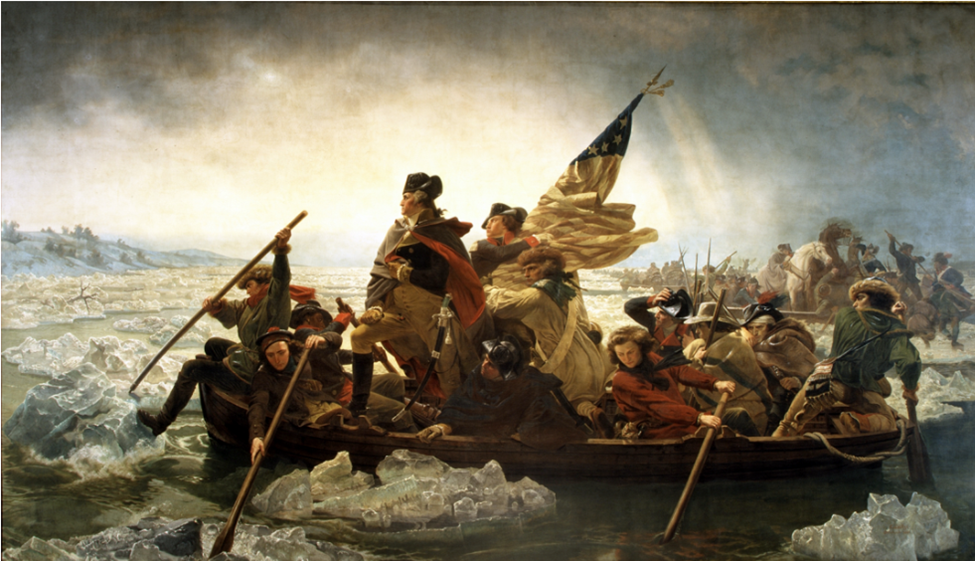
Emanuel Leutze, Washington Crossing the Delaware, 1851, Oil on canvas, The Metropolitan Museum of Art, New York

Ramparts

A few days before he would lay down his life to deal with the problem of evil, Jesus made the ascent to Jerusalem, not Rome. When he came near and saw the city, he wept over it. The city of peace would reject the Prince of Peace for the preservation of antipathy to any rule but its own.

Jesus came to his own and his own, with messianic hopes, wanted the evil in their lives – imperial Rome with its emperor worship and rule of Judea – to be dealt with. His own would also reject the testimony about him given by the prophets and John the Baptist. His own would deal with the landowner’s son to claim everything for themselves.

To acknowledge Jesus – what was said of him and what he said and did and who he claimed to be – meant acknowledging the evil within their own control. There were only two possible responses to the claims: repentance or rejection.

Jesus came to his own and found people who responded with hatred in the presence of goodness and who sought to destroy the good insofar as it was in their power to do so. They were not aware of their own evil and avoided any such awareness of it. They considered themselves above reproach and lashed out at Jesus for his reproach of them.

They were threatened by the spiritual health of those around them and refused to tolerate the sense of their own sinfulness. They would destroy others to maintain their appearance of moral-purity. They deemed others unfit, unclean, and unworthy but refused any self-examination that would reveal the evil within themselves. Pride was their rampart.

These exercised political power with man-made traditions – religious obligations and taboos – and status quo policing in order to crush and demolish any spiritual life beyond their control. They built societal barriers to keep belief in check.

Jesus confronted and named their evil antilove first hand:

Legal experts grumbled that it was blasphemous for Jesus to say “Your sins are forgiven” to a paralytic who, with help from four friends, descended from an opened celling for healing. The “experts” were ready to pounce and cripple Jesus’ ministry for acting God-like. Jesus healed the cripple showing them that he had the authority on earth to forgive sins. Mk. 2: 1-12

Legal experts from the Pharisees became offended when they saw Jesus eating with tax collectors and sinners. Jesus told them that “It is the sick who need a doctor. I came to call the bad people, not the good.” Mk 2:14-17

Like those in Jesus’ parable about a victim of a robbery, the “experts” thought “Better to be separated from that than to get involved with unclean rabble.” Rather than seek the recovery and redemption of others, they will actually destroy others in the cause of protecting their own laziness and to preserve the integrity of their sick self.

People took note when they saw that John the Baptist’s disciples and the Pharisees’ disciples were fasting. They wanted to know why Jesus’ disciples didn’t get with the fasting program. These people had been taught to judge people with religious protocols. Why weren’t the questioners fasting? Mk 2:18-20

One sabbath Jesus and his disciples were walking through a cornfield. The disciples plucked corn to eat as they went along. This really bothered the Pharisees. They confronted Jesus asking “Why are they doing something illegal on the sabbath?”

Jesus reminded them of their history: David and his men, when distressed and hungry, ate the bread of the presence which only the priest is allowed to eat. Jesus then flipped the script on them, saying “The sabbath was made for man, not man for the sabbath.”

Though the religious police tried to throw up a man-made barrier against the good, in this case grabbing food to eat in a field, Jesus pushed back with the real intent for the sabbath rest – delighting in all that is good, just as God had done after six days of giving functions to the material cosmos. Mk 2: 23-27

On another sabbath Jesus went to the synagogue. People were watching to see if Jesus would heal the man with a withered hand on the sabbath so they could frame a charge against him. Jesus called the man to the front of the room.

He then asked those in attendance “Is it lawful to do good on the sabbath or to do evil? To save life or to kill?” He waited and then asked, “If one of you has a child or an ox that falls into a well on the Sabbath day, will you not immediately pull it out?” Unable to answer they remained silent. Mk 3: 1-6

Here was the essence of antilove they had been taught to submit to and emulate by those who, with a form of godliness, put up barriers to the spiritual health of others. On this day it revealed itself as a spiritual disability – the inability to show lovingkindness.

They gave priority to sabbath rules and the sabbath police and to their own well-being and status within their community and not to extending themselves for the physical and spiritual well-being of another.

Their hardheartedness made Jesus deeply upset. He looked around at them angrily. Then he healed the man’s hand. With this, the Pharisees – feeling a slap in the face – went off and collaborated with a political group to find a way to destroy Jesus. They sought to destroy the good insofar as it was in their power to do so. Mk 3: 1-6

Crowds constantly swarmed Jesus. He and the disciples were not able to have a meal. His family heard this and said “He’s out of his mind.” They, no doubt, thought that Jesus’ behavior would cause them to incur the disapproval of religious authorities and be kicked out of their synagogue into social isolation. This, in spite of the good that he was doing throughout Galilee. Preservation of self- status and inclusion – was important to them. Mk 3: 20-21

Legal experts showed up from Jerusalem. To get things back under their control they said of Jesus “He’s possessed by Beelzebul! He casts out demons by the prince of demons!” While they took action to preserve the integrity of their sick selves with projection, Jesus was plundering the “strong man’s house” right in their neighborhood. Mk 3: 22-30

When Jesus came to his home region, he began to teach in the synagogue on the sabbath. Those in attendance – townspeople who knew his family – were amazed at what they heard and took offense at him. For, they were ready for the same o ‘ same o ‘ sabbath and not for anything that disrupted status quo. Maintaining status quo, appearances, and antipathy was more important than spiritual growth.

Jesus said “Prophets are honored everywhere except in their own country, their own family, and their own home. Mk 6: 1-4

Pharisees and legal experts circled Jesus. They had seen some of his disciples eating with unwashed hands. This was against the tradition of the elders. They questioned Jesus wanting to know what’s up with that. Jesus calls them hypocrites and reads them the riot act from Isaiah:

With their lips this people honor me,

But with their hearts they turn away from me;

All in vain they think to worship me;

All they teach is human commands.

Jesus goes on to give them a prime example of them abandoning God’s commands and replacing them with human traditions that nullify God’s word.

Practicing human traditions gave religious leaders a pretense of righteousness. It also gave them leverage over the people and provided them the means to patrol them while avoiding any self-examination that would reveal the evil within themselves. They had fortified their evil selves with human commands while invalidating God’s word. Mk 7: 1-13

One day the Pharisees came to Jesus and wanted to test him out. They demanded a sign. They couldn’t see with their two good eyes. They couldn’t hear with their two good ears. The feeding of the five thousand and the four thousand, the healings, exorcisms, resurrections and authoritative teaching were not good enough for them. Antilove is blind and deaf in the presence of goodness. Mk 8: 11-12

 When Jesus asked his disciples “Who do people say that I am?” Peter spoke up: “Messiah!”

But then Jesus told the disciples that there was big trouble up ahead – Jerusalem trouble as in “The elders, chief priests, and the scribes are going to finalize their rejection of me with death” – Peter began to scold Jesus, putting up resistance to the thought that their new-found messiah would die and not overthrow Roman rule in Judea and take his place as king. Mk 9: 31-33

Jesus had to scold Peter. His human thoughts were not Gods’ thoughts. The test had presented itself again.

A few years before his ascent to the “holy city”, it was to the pinnacle of the temple that Satan, Antilove Itself, brought Jesus to test him.

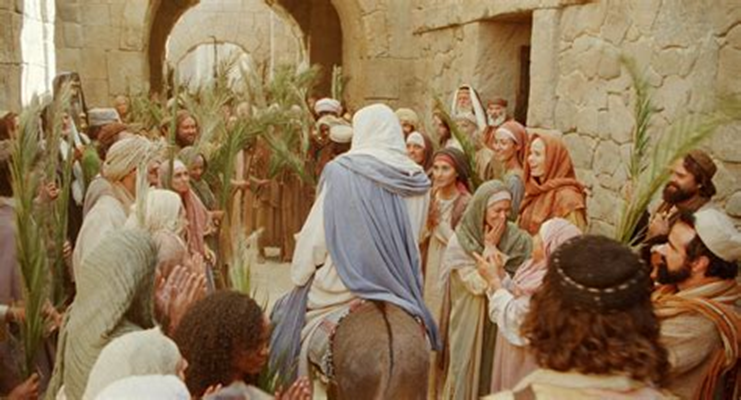
Jesus didn’t take Satan’s bait. He didn’t jump to reassure himself of His Father’s words. And though Adam, the father of humanity, failed a similar test by testing what God said, Jesus would not. Nor would he make a spectacle of himself for Satan or before a palm branch-waving crowd.

When he came near and saw the city, he wept over it and said of his own . . .

“If only you’d known on this day – even you! – what peace meant. But now it’s hidden, and you can’t see it. Yes, the days are coming upon you when your enemies will build up earthworks all around you, and encircle you, and squeeze you in every direction. They will bring you crashing to the ground, you and your children with you. They won’t leave one single stone on another, because you didn’t know the moment when God was visiting you.” Luke 19: 41-46

Antilove would reject the One that would lay down his life for his own. The ramparts of antipathy to any rule but its own would be torn down.

~~~~~

“The demand of the loveless and the self-imprisoned that they should be allowed to blackmail the universe: that till they consent to be happy (on their own terms) no one else shall taste joy: that theirs should be the final power; that Hell should be able to veto Heaven.” – George MacDonald, C.S. Lewis’ The Great Divorce

~~~~~

Brain Rot: What Our Screen Are Doing to Our Minds (3)

In the third podcast of this series, “Brain Rot: What Our Screen Are Doing to Our Minds,” host Dr. Karyne Messina, psychologist, psychoanalyst and author talked about the problems that can emerge in Erik Erikson’s Identity versus Identity Diffusion stage of development along with Dr. Harry Gill, a psychiatrist who has a PhD in neuroscience. The two mental health professionals discussed major difficulties they see in their young patients when they are exposed to too much screen time. . .

They also focused on the impact of social media on the formation of identity, a critical part of healthy personality development. Drs. Messina and Gill shared the challenges young people have navigating in the digital age, which can include exposure to people who are inauthentic on social media, role confusion, and addiction to video games. They emphasized the importance of limiting screen time, encouraging adolescents to have real-life experiences versus having mainly on-line relationships while fostering healthy habits to support brain development and overall well-being during this crucial stage of development.

Brain Rot: What Our Screen Are Doing to Our Minds (3)

Brain Rot: What Our Screen Are Doing to Our Minds (3) – New Books Network

~~~~~

Birding

Thanksgiving morning Toby woke up to noise and smells. He got out of bed and went downstairs in his PJs. The noise and smells were coming from the kitchen. His mother, aunt Susie and grandma Evans were talking and cooking. His seven-year-old sister Tilly was sitting on the counter singing one of her happy songs.

In the family room, Uncle Kevin and his father were sitting at a card table. Grandpa was sitting in the big chair reading a book. Toby went over to the card table.

“Hey Tob,” said Uncle Kevin.

“What are you doing?” Toby asked.

“We’re playing Risk,” replied his father.

“Can I play?” Toby asked.

“I think this game is a bit too hard for you,” his father replied. “We’ll play a different game later.”

Grandpa called Toby to come over and sit on his lap. Five-year old Toby did just that. He wanted to know what grandpa was looking at.

“It’s A Year-Round Guide to Indiana Bird Watching,” grandpa told him.

“Why you reading that grandpa?

 “I like birds, Tobias. Do you?”

“Uh-huh.” Toby rubbed his eyes and lifted the book to see the pictures. “What’s that?’ He pointed to the page.

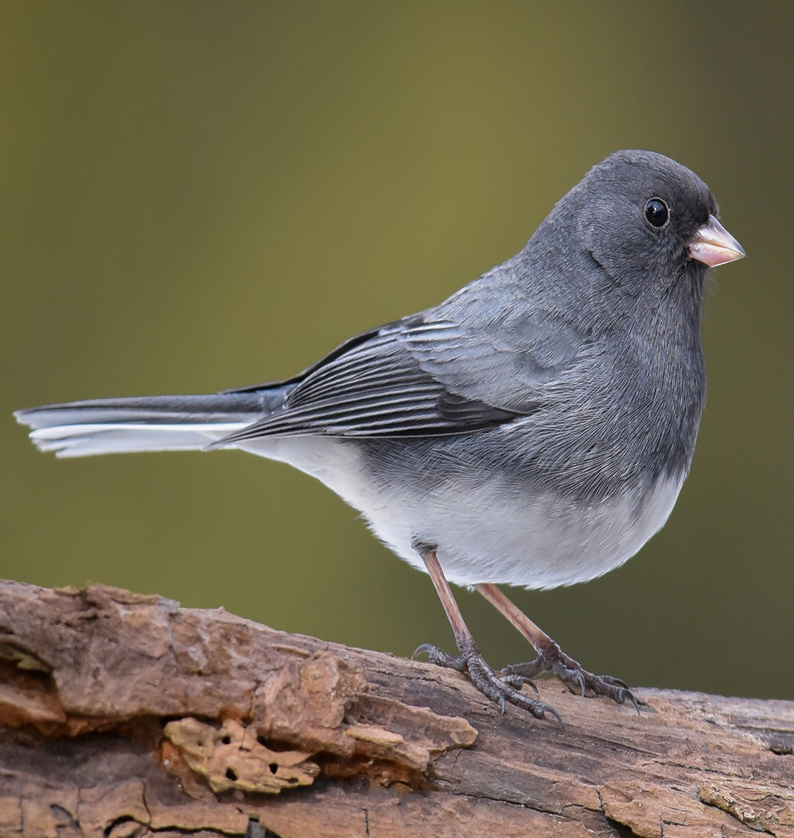
“That’s a Dark-eyed Junco,” grandpa replied. “It says here that they like to eat seeds, insects and berries.”

“Huh. His name is Junco?”

“Yes. If you were a bird, I’d call you a Blue-eyed Tobias.” Grandpa smiled.

Toby turned the page. “Why do you like birds, grandpa?”

“Birds are special creatures. They seem to be wherever we are, as if God wanted to make sure we notice them. They are free and at the same time totally dependent on God and His created order.

“And there are so many kinds of birds, Tobias.” Grandpa flipped through the pages. “They bring color and sound to our lives. Seeing them and hearing them is proof that nature is healthy. I try to spot a bird by its coloring and by its songs and calls.”

“Birds have songs?”

“They sure do. Male birds sing to attract female birds. They also sing to scare off other birds from their territory and to bond with mates and young’uns. You want to hear a Mourning Dove Song?”

“Yeah.”  

Grandpa took a deep breath, formed his mouth and went “coo-AH-oo coo-coo”. He waited and then again “coo-AH-oo coo-coo.”

“The Mourning Dove keeps repeating this song until a female is attracted. That’s how I met your grandmother.” Toby’s eyes lit up when he saw grandma smile.

“Bird experts can tell the species of a bird by just listening to its song. Each species has its own song.”

“What’s speecheese?”

“A species is a way to name animals that are alike and have babies like them. Let’s see,” he found the page. “It says here that the Dark-eyed Junco is a species of Junco, a group of small, grayish sparrows.”

“It also says that Male Dark-eyed Juncos sing a sweet, high-pitched trill that sounds similar to the songs of the Chipping Sparrow and Pine Warbler. And during the winter, Juncos come to backyard feeders for millet and bird seed. I saw one at my bird feeder this morning.”

Toby looked over at the kitchen. “Let’s see if your mother has something for you to eat.” Grandpa moved Toby to his feet, got up, and the two of them went into the kitchen.

Toby was given a yogurt by his mother. Eating it, he watched Grandpa put his finger into the cranberry sauce, taste it and pucker his lips. Then grandpa put his finger into the mashed sweet potatoes, tasted it and said “Yum!” And then he put his finger into the pumpkin pie mix, tasted it and said “mm-mmm.”

When he reached for the stuffing, Grandma, hands on her hips, said, “Shoo you two. Come back when we’re ready to eat, in about two hours.”

“Let’s go for a walk Toby,” Grandpa said. “Get dressed in warm clothes. We’re going birding.”

A voice in the next room said, “Dad, the weather man said that central Indiana is 30 degrees and cloudy.”

Before Toby left the kitchen his mother said, “Go make your bed first and then put on your corduroy pants and blue sweater and then comb your hair.”

Toby shot upstairs and came back down two minutes later. His mother looked him over and then had grandpa put on his winter coat, his gloves, and the knitted hat that grandma made for him.

Outside, grandpa went over to his car and took out a pair of binoculars. He showed Toby and said “Maybe we will see a cardinal today.”

As they walked down two blocks past houses, they saw no birds. But then Grandpa spotted a Mourning Dove on a roof. He handed Toby the binoculars after adjusting the focus. “Let’s wait here and listen.”

When the dove began its song, Toby was transfixed until the dove flew out of sight.

They walked to the end of the street and came to a T-intersection. On the other side of the crossroad was open farmland. Wind whistled through the field of corn stalk stumps. Grandpa tied the ear flaps of Toby’s knitted hat below his chin.

To their left and down the road about forty yards was a small group of trees and undergrowth. “Let’s head there,” Grandpa told Toby.

As they walked along on the farm side of the road, Toby found a corn cob. Holding the smooth kernelled end, Toby showed grandpa the half-eaten end.

Grandpa looked it over and said, “Probably some squirrel started eating it. Or may be a goose.”

As they neared the trees, grandpa stopped and brought the binoculars to his eyes. He then handed them to Toby. “What do you see in that tree?” Grandpa pointed.

Toby looked and said, “The birds keep moving so I can’t see them.”

“They might be getting ready for winter,” Grandpa replied. They’re probably in a hurry to get out of the wind and get things settled for winter.”

Then Grandpa spotted a falcon perched on top of a utility pole that was about thirty yards down the road. He adjusted the focus of the binoculars and handed them to Toby. “Look up there. Can you see that falcon, Tobias?” He pointed to the electric pole.

Toby looked and said, “That is a falcon?”

Grandpa looked again. “Yes. A falcon known as the American Kestrel. I can tell by dark gray head, the rust-colored back and tail, the white cheeks and throat and blue-black bill. It’s the smallest of falcons. Some call it a “Sparrow Hawk”.”

“They like open areas without dense cover. He’s sitting up there to view the whole area for food. He’s scanning for prey on the ground. He’ll sit and wait. He’ll only attack when he’s sure that he will succeed. When he has prey in sight, he will either catch it on the ground or in flight. 

“In the summer months he’ll hunt and eat dragonflies, cicadas, beetles, grasshoppers, butterflies and moths, scorpions, and spiders. He’ll hover and capture insects in the air.

“In winter weather, like right now, he’ll hunt small mammals like mice, voles, shrews, and bats. And he’ll hunt small birds . . . like that little sparrow that just flew into the field. He pointed to it.

Grandpa let Toby use the binoculars to observe the falcon. “Let’s see what happens,” he said. “I wonder if that falcon noticed that small bird.”

A moment later, the falcon swooped down, grabbed the bird with his claws, and flew back to his high perch.

“Did you see that grandpa?” Toby asked.

“I sure did. He’s going back to his perch to eat it. Take another look.”

“Do birds eat other birds, grandpa?”

“They sure do. Birds of prey, like this falcon, have evolved to catch diverse things like insects, small mammals, and birds.

“I just remembered something. When I was a boy, Tobias, my father took me birding. One day he said “Frankie, there are so many birds but you never see dead birds. He told me that dead birds vanish because predators and scavengers come along and eat them. That’s why most bird bodies disappear. Creatures like foxes, badgers, ants, and birds of prey scavenge dead birds. The value of the bird’s life is returned to nature. Nature, he said, provides food for itself. Live birds and dead birds contribute to the lifecycle of our ecosystem.”

The sun never came out. The icy wind blowing across the open field made Toby’s nose and cheeks red. Grandpa said it was time for them to head back.

When they arrived home and opened the door, they were met with a rush of warm air, laughter, and savory smells. They saw the dining room table was set and the food ready to come out.

“Go wash your hands you two,” mom said. “We are ready to eat.”

When everyone had found their place at the table, mom asked grandpa to pray the blessing.

We give you thanks, most gracious God, for the beauty of
earth and sky and sea; for the richness of mountains, plains,
and rivers; for the songs of birds and the loveliness of flowers.
We praise you for these good gifts, and pray that we may
safeguard them for our posterity. Grant that we may continue
to grow in our grateful enjoyment of your abundant creation.
And now we ask Your blessing on this food we are about to eat. Amen.

A loud “AMEN!” followed.

Toby’s mother then handed Toby’s father a knife and said, “Carve the bird.” Toby gulped when he heard that. He looked over at grandpa.

“Tom turkey has been well fed. Now, he feeds us. Tobias, do you know which bird is at every meal?”

“No.”

“A swallow. Do you know which birds go to church a lot?

“No.”

“Birds of prey. What do you call a mean turkey?”

“I dunno.”

“A jerk-ey. What do you give a sick bird?”

“I dunno.”

“Tweetment! Did you hear about the owl with no friends?

“No.”

“He was owl by himself.”

The adults groaned. Toby wanted more.

After plates were filled and people were busy eating, Uncle Kevin asked Toby to tell everyone what he saw birding with grandpa.

“I saw a falcon. It came down and got a bird and ate it,” Toby exclaimed.

“Ewwwww!” Tilly didn’t like the thought.

Toby forked a piece a turkey, held it up, looked at his sister and said “Now I am a falcon!” and gobbled it down.

©Lena Johnson, Kingdom Venturers, 2024, All Rights Reserved
~~~~~

American Kestrel

American Kestral – Call of the Male

Dark-eyed Junco

Dark-Eyed Junco

Dark-eyed Junco Sounds, All About Birds, Cornell Lab of Ornithology

Bird Sounds and Songs of the Dark-eyed Junco | The Old Farmer’s Almanac

Dark-eyed Junco | Audubon Field Guide

Easter Morning Central Indiana Bird Song

Easter Morning Central Indiana Bird Song

~~~~~

American Kestrel – Photo by John Mariani

Vermilion Flycatcher at Cattail Marsh in Beaumont, TX – Photo by John Mariani

Eastern Phoebe at Anahuac National Wildlife Refuge, TX – Photo by John Mariani

American Tree Sparrow, Northwest Ohio – Photo by American_Phoenix

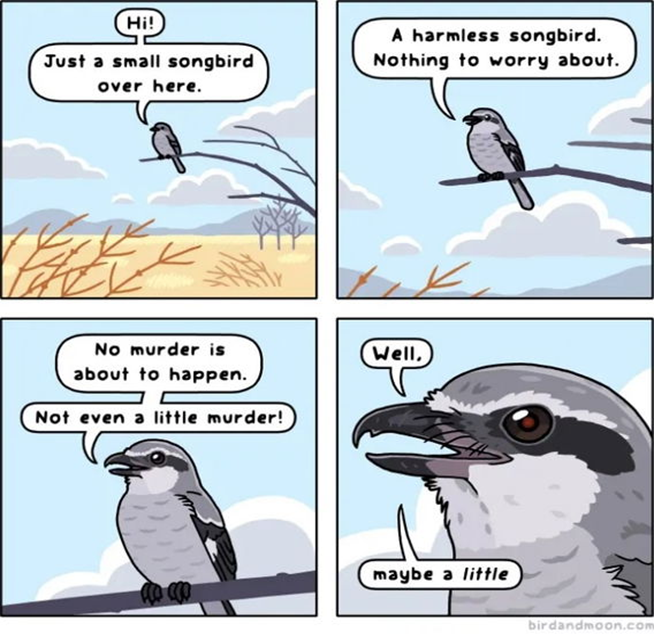
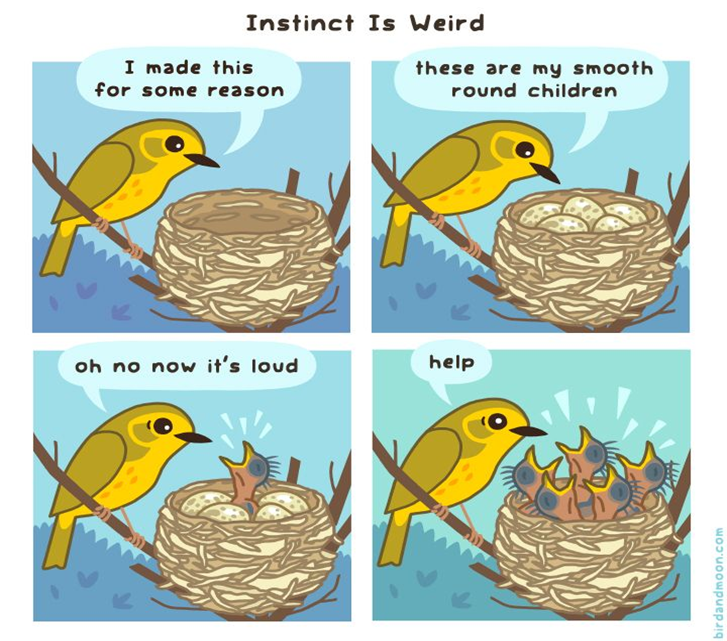
The quirky nature humor of  https://rosemarymosco.com/

Northern Shrike, new cartoon by Rosemary Mosco.

~~~~~

The presence of birds in our lives brings good health. Indeed research shows that the richer and more various the birds in a neighborhood, the higher people’s satisfaction with life. Birdsong is the natural sound linked most strongly to reducing stress and promoting restoration, particularly when it is more diverse and people are prompted to notice it. Birds bring joy.

Five curious health benefits of dark midwinter, according to science | The Independent

~~~~~

Imagination sees a parallel universe.

The Unbroken Chain of Truth in the Lives of Broken People

Our common understanding of what Peter’s betrayal of Jesus meant. Our shared history of misery and redemption. Our interrelated human experience of being guided by truth and beauty. Each of these connections are considered by a twenty-two-year-old clerical student named Ivan Velikopolsky in the very short story The Student (1894) by Anton Chekhov.

Things start out fine for hunter Ivan on Good Friday. The weather is agreeable. But when it begins to grow dark the weather turns cold and stiff winds blow. He starts to walk home.

On the path, he feels that nature itself is “ill at ease” by the change in weather and that darkness in response is falling more quickly. He senses overwhelming isolation and unusual despair surrounding him and the village three miles away where he spots the only light – a blazing fire in the widow’s garden near the river.

As he walks, he remembers what is waiting for him at home – a miserable situation that he sees as the desperation, poverty, hunger, and oppression of what people have dealt with over time and that it’s always been this way no matter the secular changes by those who come along. He doesn’t want to go home. Instead, he walks over to the campfire at the widow’s garden.

There, by the fire, are two widows – Vasilisa and her daughter Lukerya. He greets them and they talk.

Ivan relates the gospel events to the two widows. This has an acute effect on them. As he heads home, Ivan reflects on the implications of this and has an epiphany.

“At just such a fire the Apostle Peter warmed himself,” said the student, stretching out his hands to the fire, “so it must have been cold then, too. Ah, what a terrible night it must have been, granny! An utterly dismal long night!”

 . . .it was evident that what he had just been telling them about, which had happened nineteen centuries ago, had a relation to the present — to both women, to the desolate village, to himself, to all people.

He returns home with a different outlook. He sees the “same desperate poverty and hunger, the same thatched roofs with holes in them, ignorance, misery, the same desolation around, the same darkness, the same feeling of oppression” differently – with an attitude of “unknown mysterious happiness”. There’s a sense of resurrection in Ivan’s attitude as he rises out of the despondency of dark winter’s return to a new life of hope based on the human connection to enduring truth and with Easter on the horizon.

Was Ivan’s new attitude born out of the women’s reaction that signaled an age-old inherent understanding of what the betrayal of truth produces?

It seems to me that Ivan is more than just a clerical student. He’s also a student of history and cultural anthropology. And he knows scripture. He is able to see our common plight and our common redemption through the broken lives of others.

I’m not going to share any more of this gem of a very short story (2 min. read). Ivan has more to say to us from his epiphany. I recommend reading the story before listening to the audio version of it with commentary at the end.

The Student was written 130 years ago. Chekhov’s realist fiction hands to readers today one end of an unbroken chain of truth.

Will the human condition improve with Progressivism or when humans stop betraying the truth and seek what is above instead of materialism?

John Donne wrote “No man is an island entire of itself”.  Certainly, no man is a context entirely of himself.

And Thomas Dubay said

The acute experience of great beauty readily evokes a nameless yearning for something more than earth can offer. Elegant splendor reawakens our spirit’s aching need for the infinite, a hunger for more than matter can provide.

Reading Chekhov’s The Student

~~~~~

Beauty out of brokenness?

“Poetically translated to “golden joinery,” kintsugi, or Kintsukuroi, is the centuries-old Japanese art of fixing broken pottery. Rather than rejoin ceramic pieces with a camouflaged adhesive, the kintsugi technique employs a special tree sap lacquer dusted with powdered gold, silver, or platinum. Once completed, beautiful seams of gold glint in the conspicuous cracks of ceramic wares, giving a one-of-a-kind appearance to each “repaired” piece.”Kintsugi, a Centuries-Old Japanese Method of Repairing Pottery with Gold (mymodernmet.com)

“The aesthetic that embraces insufficiency in terms of physical attributes, that is the aesthetic that characterizes mended ceramics, exerts an appeal to the emotions that is more powerful than formal visual qualities, at least in the tearoom. Whether or not the story of how an object came to be mended is known, the affection in which it was held is evident in its rebirth as a mended object. What are some of the emotional resonances these objects project?

“Mended ceramics foremost convey a sense of the passage of time. The vicissitudes of existence over time, to which all humans are susceptible, could not be clearer than in the breaks, the knocks, and the shattering to which ceramic ware too is subject. This poignancy or aesthetic of existence has been known in Japan as mono no aware, a compassionate sensitivity, an empathetic compassion for, or perhaps identification with, beings outside oneself. It may be perceived in the slow inexorable work of time (sabi) or in a moment of sharp demarcation between pristine or whole and shattered. In the latter case, the notion of rupture returns but with regard to immaterial qualities, the passage of time with relation to states of being. A mirage of “before” suffuses the beauty of mended objects.”

Christy Bartlett, Flickwerk: The Aesthetics of Mended Japanese Ceramics (12/51

“What kind of a church would we become if we simply allowed broken people to gather, and did not try to “fix” them but simply to love and behold them, contemplating the shapes that broken pieces can inspire?”
― Makoto Fujimura, Art and Faith: A Theology of Making

Mending Trauma | Theology of Making (youtube.com)

Online Conversation | Art + Faith: A Theology of Making, with Makoto Fujimura | The Trinity Forum (ttf.org)

https://makotofujimura.com

~~~~~

Nothing More Than Alright

A short story . . .

My father, on the nights when my mother goes to bridge club, makes creamed chipped beef with peas on toast for supper. He told me one time that in the military it’s called “shit on a shingle” or SOS for short. He makes me eat it even though I can’t stomach peas or the dried beef or the gravy and I’m not a soldier. Tonight again, my mother is at bridge club and I’m sitting here with SOS.

After looking at my plate for a long time, I move the peas out of the gravy, off the toast and onto the plate with my knife. I’m hoping I won’t have to eat them. The kitchen phone rings and I jump to answer it. My best friend Janey wants to know if I want to go with her and her boyfriend Nick to watch West Side Story at the Sky-Hi Drive-In. I say I sure do and hang up. My father doesn’t want me on the phone during supper.

The peas are cold and clammy now and I say I they’re cold and clammy and I can’t eat them. My father tilts his head down and tells me to eat them. I want to say no but I need his okay to go to the movie. So, I stab some peas with my fork and swirl them in the flour gravy and then I eat the green-grey mush with a bite of toast. I gag. I drink some milk and wash it down. My father lifts his head and says “alright”. I clear the dishes and wash them. I’ve done what he wanted, so now I can ask him about Friday night. But I wait until he’s sitting in front of the TV.

An hour later, my father is in the basement watching TV. I sit with him and ask about his movie. He says troops have been ordered to risk their lives and retake a hill that’s not important in the battle. I ask him why. He says it shows the enemy their resolve to continue to fight if an agreement is not reached in negotiations.

A Marlboro commercial comes on and I ask him about Friday night. He wants to know about the movie. I tell him it’s a musical about people fighting, dancing and falling in love and he says “Okay. Ask your mother when she come home from playing bridge.”

My mother finally gets home and I tell her about Friday night. She says she knows the movie. “Saw it with a friend when it came out in ’61,” she says. She knows Janey and Nick and she says it’s okay with her that I go.

Saturday night Nick’s car pulls into the driveway. He honks the horn and I yell “They’re here”. My father yells from the basement “Have a good time honey. Call if there is a problem.” Mom, on the phone with someone, yells for me to come straight home after the movie. I yell back “I will.”

I get in the back seat of Nick’s Chevy and we drive off – but not in the direction of the Sky-Hi. I ask where we’re going. Janey turns to me and says that Nick asked his friend Tom to come along. He had nothing to do, Nick says. I immediately panic. I wonder if I look alright.

I have a face full of pimples and a bony nose that’s too big for my face. I wonder if I used enough concealer. The green top I’m wearing is wrinkled. It was at the bottom of my closet. And the jeans I’m wearing are worn thin. I was expecting to sit in the dark and watch a movie with Nick and Janey.

We pull up to a ranch house on the other side of town. Nick honks the horn. A skinny blonde-haired guy walks out the front door and down the front walk. “Here’s Tom,” Janey says.

Tom gets in the back seat. Janey introduces Tom. I don’t know him from school. I give him a quick smile and then give Janey a stare. She just winks back at me. She knows I don’t have a boyfriend.

Tom is neatly dressed. He’s wearing a button-down shirt, khaki pants and loafers. His boxy glasses make him look like a bookworm. In junior high school he’d be called “a climber” and Nick “a greaser.”

The Twin Theater Sky-Hi Drive In is on the west end of our town. On the way we listen to the AM radio. A Chicago station plays Born to Be Wild and I Will Always Think About You. Tom and I sit quietly in the back. I suck in my lips and look out my window. The cloudy sky looks like flour gravy.

We arrive at Sky-Hi and pay for our tickets. Nick drives over to a center spot in the East Theater. Nick and Tom say they’re going to the concession stand. They ask what we want. Janey and I ask for Cokes and popcorn. I hand Nick some money and they head off. The guys return after twenty minutes just as the coming attractions start. I roll down my window and Tom hands me the Coke and popcorn. I say thank you. He gets into the back seat on the other side of the car.

Janey’s been sitting next to Nick the whole time he’s been driving. Now Nick puts his arm around Janey’s shoulder and they snuggle together. Janey asks “are you guys okay back there?” I say I have to move over to see the screen. I look at Tom and he gives me a nod that says it’s okay. I scooch over to the middle of the back seat and put my legs to the left side of the floor hump. “That’s better,” I say.

Finally, the movie begins. There’s an overture and then the Jets sing about being a Jet and beating up other gangs. The Jets and the Sharks want to fight each other for control of the streets. But first they go to a dance. It’s a musical, so I guess it doesn’t have to make sense.

At the dance, Tony of the Jets meets Maria, Bernardo’s sister. Bernardo is the head of the Puerto Rican Shark gang. Tony and Maria fall in love at first sight. Nobody is happy about that except Tony and Maria. Tony’s half in half out about the gang stuff but he’s all in on Maria. He wants to run away with her.

Tony and Maria start singing Tonight and I stop eating popcorn. I put my hand down on the car seat so I can lean forward and hear what’s coming from the speaker. My little finger touches Tom’s little finger. He takes my hand into his. We stay this way, looking at the movie and holding hands, until the movie ends and headlights turn on.

It’s past midnight when we leave Sky-HI. Nick says he’ll drive me home first. I go back and sit behind Nick. Tom looks out his window. Everyone is quiet. Nick turns on the radio. Ain’t Nothing Like the Real Thing comes on. I suck in my lips and look out my window. On the way home I see a car with one headlight and say “perdiddle.”  Janey and Nick kiss.

At home I get out of the car and say thanks to Janey and Nick and goodnight to Tom. Tom says good night looking at Nick and Janey.

I go inside and hear the TV on in the basement. I walk down the hallway to my bedroom. My mother is sitting in her bed reading her magazines. She sees me and asks “Susan, how was it?” I poke my head into the room and tell her it was alright.

“Just alright? Nothing more?” she asks.

“Nothing more than alright” I say.

“Okay,” she says. “Now go to bed. It’s late. Tomorrow’s another day.”

As I walk away she reminds me that she has bridge club again tomorrow night. I say okay.

In my room I take the ticket stub out of my jeans pocket. I find a pen and write on the back of the stub West Side Story Tom. I pull my keepsake box out from under the bed and put the ticket stub inside along with the Valentine cards from third grade and my second-place medals from clarinet solo contests and some poems I wrote. I close the box and put it back.

I go to bed thinking about the movie and Tom and peas on my plate.

©Jennifer Ann Johnson, Kingdom Venturers, 2024, All Rights Reserved

Somewhere in the Lost World of Love

Love. Is it die-cut like the Valentine cards of grade school? Is it cliché like pop music? Is it a potion we constantly thirst for? Is it intoxication and under its influence we are not in our right minds? Is love passion? Sentimental? Carnal? Absolute? “What do any of us really know about love?” 

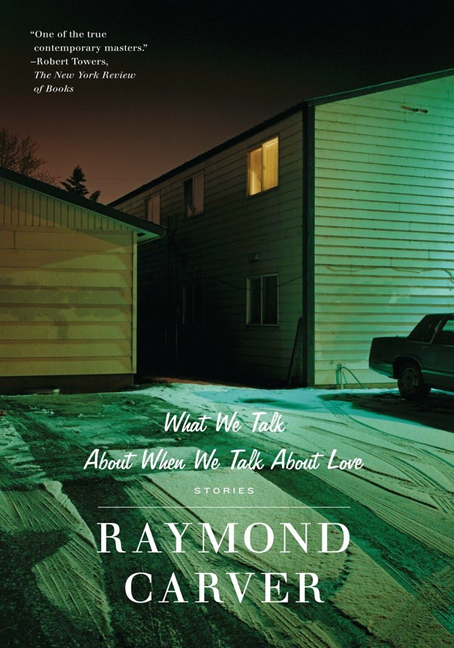
The last question is raised during a conversation between two couples. Their dialog and the juxtaposition of the couple’s ideas about love are found in Raymond Carver’s 1981 short story What We Talk About When We Talk About Love. Carver has us listen in.

We learn from narrator Nick that he and his wife Laura are spending the afternoon at Mel and Terri’s home. Both couples live in Albuquerque, but as Nick says and the ‘love’ dialog relates, they “were all from somewhere else”.

Nick tells us that Mel McGinnis is a forty-five-year-old cardiologist who, before medical school, spent five years in seminary. Terri is his second wife. We later learn that Mel was married before to Majorie and has two children. His movements are usually precise when he hasn’t been drinking. 

Terri, we learn, was previously in an abusive relationship with a guy named Ed. He would beat her and drag her around the room by her ankles, all the while professing his love for her.

Mel and Terri have been married for four years.

Nick tells us about Laura and their relationship: she’s a legal secretary who’s thirty-five and three years younger than he is. He says they’re in love, they like each other and enjoy each other’s company. “She’s easy to be with.” They’ve been married for eighteen months. 

Beside the four adults, sunlight and gin figure in the story.

As the story begins, the four are sitting around a kitchen table. Sunlight fills the room. Gin and tonic water are being passed around. The subject of love comes up.

(I get the sense that the older couple have argued a lot about what love is and now want to air it all again in front of the younger couple. It seems they have things they want to get off their chest. Is that why the cheap gin is being passed around? Are Nick and Laura in place to be the arbiters of who’s right and who’s wrong?)

The heart doctor Mel, based on “the most important years of his life” in seminary, thinks that “real love was nothing less than spiritual love”.  (This signals that love’s definition may not be solid.)

Terri believes that Ed, the man who tried to kill her, loved her. She asks “What do you do with love like that? Mel responds that Ed’s treatment could not be called love.

Terri then makes excuses for Ed’s behavior – “People are different”. She defends him – “he may have acted crazy. Okay. But he loved me.”

We begin to notice a growing tension between Mel and Terri. (There has been tension in their marriage about Ed and Marjorie before this.)

Mel relates that Ed threatened to kill him. Mel reaches for more gin and becomes antagonistic himself. He calls Terri a romantic for wanting brutal reminders of Ed’s love. Then he smiles at her hoping she won’t get mad. Terri responds to Mel, not with a rejection of his or of Ed’s behavior, but with what might have been her leave-the-door-open enabling response to Ed after one of his physical attacks: “Now he wants to make up.” Her past relationship reveals the continuous nature of Terri’s emotional deficit.

(Does Mel know how to land verbal blows on Terri like Ed did physically?)

Mel tries to soften the blow by calling Terri “honey” and by saying again that what Ed did wasn’t love. He then asks Nick and Laura what they think.

Nick says he doesn’t know the man or the situation to make a decision. Laura says the same and adds “who can judge anyone else’s situation?” Nick touches her hand and she smiles.

Nick picks up her “warm” hand, looks at the polished and manicured nails and then holds her hand. With this display of affection, Nick shows his love and respect for Laura, the opposite of the emotional and physical abuse Terri suffered at the hands of Ed.

Mel posits that his kind of love is absolute and nonviolent. (Then again, emotional abuse doesn’t kill or leave physical bruises.)

Terri and Mel describe Ed’s two attempts at suicide. Terri talks with sympathy for the guy. “Poor Ed” she says. Mel won’t have any of it: “He was dangerous.” Mel says they were constantly threatened by Ed. They lived like fugitives, he says. Mel bought a gun.

Terri stands by her illusion that Ed loved her – just not the same way that Mel loves her.

They go to relate that Ed’s first suicide attempt -drinking rat poison – was “bungled”. This puts him in the hospital. Ed recovers. The second attempt is a shot in the mouth in a hotel room. Mel and Terri fight over whether she will sit at his hospital bedside. She ends up there.

Mel reiterates that Ed was dangerous. Terri admits they were afraid of Ed. Mel wants nothing to do with Ed’s kind of love. Terri, on the other hand, reiterates that Ed loved her – in an odd way perhaps but he was willing to die for it. He does die.

Mel grabs another bottle of gin.

Laura says that she and Nick know what love is. She bumps Nick’s knee for his response. He makes a show of kissing Laura’s hand. The two bump knees under the table. Nick strokes Laura’s thigh.

Terri teases them, saying that things will be different after the honeymoon period of their relationship. Then, with a glass of gin in hand, she says “only kidding”. Mel opens a new bottle of gin and proposes a toast “to true love.”

The glow of the afternoon sun and of young love in the room makes them feel warm and playful, like kids up to something.

Matters-of-the-heart Mel wants to tell them “what real love is”. He goes on about what happens to the love between couples who break up. After all, he once loved his ex-wife, Marjorie, and Terri once loved Ed. Nick and Laura were also both married to other people before they met each other.

He pours himself more gin and wipes the “love is” slate clean with “What do any of us really know about love?” He – the gin Mel – talks about physical love, attraction, carnal love, sentimental love, and memory of past love. Terri wonders if Mel is drunk. Mel says he’s just talking. Laura tries to cheer Mel by saying she and Nick love him. Mel responds saying he loves them too. He picks up his glass of gin.

Mel now gets around to his example of love, an example that he says should shame anyone who thinks they know what they are talking about when they talk about love. Terri asks him to not talk drunk. (Is Mel, focused only on himself and his gin, becoming a slurring, stammering and cursing drunk?) He tells her to shut up.

Mel begins his story of an old couple in a major car wreck brought on by a kid. Terri looks over at Nick and Laura for their reaction. Nick thinks Terri looks anxious. Mel hands the bottle of gin around the table.

Mel was on call that night. He details the extensive wounds. The couple is barely alive. After saying that seat belts saved the lives of the couple, he then makes a joke of it. Terri responds affirmatively to Mel and they kiss.

Mel goes on about the old couple. Despite their serious injuries, he says, they had “incredible reserves” – they had a 50/50 chance of making it.

Mel wants everyone to drink up the cheap gin and then go to dinner. He talks about a place he knows. Terri says they haven’t eaten there yet. The heart doctor’s coherence dissipates with each drink.

He says he likes food and that he’d be a chef if he had to do things all over again. Then he says he wants to come back in another life as a medieval knight. Knights, he says, were safe in armor and they had their ladies. As he talks, Mel uses the word “vessels”. Terri corrects him with “vassals”. Mel dismisses her correction with some profanity and false modesty.

Nick counters the heart doctors fantasy by saying that knights could suffer a heart attack in the hot armor and they could fall of a horse and not get back up because it is heavy.  

Mel responds to Nick and Terri, acknowledging it would be terrible to be a knight, that some “vassal” would spear him in the name of love. More profanity. More gin.

Laura wants Mel to return to old couple story. The sunlight in the room is thinning. (And so is “love’s” illumination.)

Terri gets on Mel’s nerves with something she said jokingly. Mel hits on Laura saying he could easily fall in love with her if Terri and Nick weren’t in the picture. He’d carry her off knight-like. (Terri and Nick, of course, are sitting right there.)

Mel, with more vulgarity, finally returns to his anecdote. The old couple are covered head to toe in casts and bandages with little eye, nose and mouth holes. The husband is depressed, but not about his extensive injuries. He’s depressed because he cannot see his wife through his little eye holes. Mel is clearly blown away by this kind of love. He asks the other three if they see what he’s talking about. They just stare at him.

Sunlight is leaving the room. Nick acknowledges that they were all “a little drunk”.

Mel wants everyone to finish off the gin and then go eat. Terri says he’s depressed, needs a pill. Mel wants to call his kids, who live with his ex-wife and her new boyfriend.  Teri cautions Mel about taking to Marjorie – it’ll make him more depressed.

Terris says that Marjorie, because she isn’t remarried, is bankrupting them. Mel, who says he once loved Marjorie, fantasizes about Majorie dying after being stung by a swarm of bees, as she’s allergic to bees. Mel then shows with his hands on Terri’s neck how it would happen to “vicious” Marjorie.

Mel decides against phoning his children and mentions about going out to eat again. Nick is OK with eating or drinking more. Laura is hungry. Terri mentions putting out cheese and crackers put she never gets up to do this. Mel spills his glass of gin on the table – “Gin’s gone”. Terri wonders what’s next.

As the story ends, daylight (illumination) is gone from the kitchen. The four are ‘in the dark’ about what love really is. The conversation is also gone after Mel’s futile attempts to talk about love in any satisfying way and the inability of two characters to move on from the past and with two characters wondering what’s next.

The only sound Nick hears is the sound of human hearts beating (somewhere in the Lost World of Love).

~~~~

This story, though not of “Christian” genre, certainly would resonate with many readers. Do you relate to anyone in the story?

Terri understood Ed’s abusive and suicidal behavior as him being passionate about love. Mel, the heart doctor and would-be knight, showed himself idealistic and ignorant about the realities of the ‘heart’ and not loving towards Terri. Nick and Laura revealed the affection and passion of the heady first days of romance love. The old couple possessed an enduring love for each other after many years of marriage.

Why would I, as a Christian, gravitate to a ‘worldly’ author like Raymond Carver, especially when his stories are filled with alcohol? One reason is that I recognize myself in many of his stories. I see elements of myself at various stages of my life in each of the characters above. I could pretend to see myself otherwise, as I think some Christians do.

Another reason is that Carver writes about working class people. He doesn’t write down to people. His writes stories of domestic American life with its passions, fears, foibles, and fantasies. He writes with realism about human nature, revealing the old self that I must recognize in myself to put away.

I find his writing sobering, as in his story Where I’m Calling From.

~~~~~

RARE: Raymond Carver Reads “What We Talk About When We Talk About Love” (youtube.com)

~~~~~

Men need sex. And it’s their wives’ job to give it to them—unconditionally, whenever they want it, or these husbands will come under Satanic attack.

Stunningly, that’s the message contained in many Christian marriage books. Yet, research shows that instead of increasing intimacy in marriages, messages like these are promoting abuse.

In this edition of The Roys Report, featuring a talk from our recent Restore Conference, author Sheila Wray Gregoire provides eye-opening insights based on her and her team’s extensive research on evangelicalism and sex.

How Christian Teachings on Sex Enable Abuse | The Roys Report (julieroys.com)

How Christian Teachings on Sex Enable Abuse | The Roys Report

2024: “Don’t You Care?”

What do we talk about when we talk about apocalypse?

Are we talkin’ Steppenwolf and his legions of Parademons attempting to take over the Earth using the combined energies of the three Mother Boxes?

Are we talkin’ nuclear war? World War Z?

Are we talkin’ The Late Great Planet Earth?

Are we talkin’ a supposed climate change catastrophe prophesied as either a meltdown or an ice age?

In popular use, “apocalypse” tags something with the worst possible outcome usually in terms of an end-of-the-world scenario and mankind’s role in events much bigger than himself. But the Greek word apokálypsis, from which “apocalypse” is derived, means an uncovering or revelation.

In terms of scripture, “apocalypse” is a genre in which God reveals His point of view. Such are the books of Isaiah, Jeremiah, Ezekiel, Joel, Zechariah, Daniel and Revelation. The “apocalypse” as an author’s vision of the end times or the end of the age became a distinct literary genre during the Second Temple period and into the Common Era.

Apocalyptic “non-canonical” literature helped pave the way for the Jesus movement in the first century CE. Many in Israel, based on these writings and OT texts (Psalm 146:7-8, Isaiah 61: 1-2), held a belief in a Messianic Apocalypse – the anointed one, a divine messianic agent, revealed at the end time who executes justice for the oppressed, gives food to the hungry, sets prisoners free, opens the eyes of the blind, and lifts up those who are bowed down.

Within this millenarist writing context and using explicit connections to the Old Testament via quotes, and with accounts of eyewitness testimony, the four gospels record God’s revelation in Jesus Christ as the Messianic Apocalypse. And, they record the apocalyptic pronouncements of Jesus, including Matthew 24 (The Destruction of the Temple and Signs of the End Times) and in Matthew 25 (The Sheep and the Goats; Judgement). Jesus’ words and works throughout the four gospels disclose God’s POV.

Near the end of the John’s gospel account we are given the reason why John wrote to reveal Jesus:

“Jesus did many other signs in the presence of his disciples, which are not written in this book. But these are written so that you may believe that the Messiah, the son of God, is none other than Jesus; and that, with this faith, you may have life in his name.” (Jn. 20:31)

The gospel according to Mark, written from a Petrine perspective, recorded what Jesus did and said in the presence of his disciples so that with the centurion standing watch at the cross, we might say “Truly this man was God’s Son!” (Mark 15:39)

Throughout the first six chapters of the gospel according to Mark, chapters I am memorizing, I find Jesus over and over again revealing who he is to the Twelve and the group of disciples around him. Yet, they are not making the connection. They consider him a great prophet and a maybe-Messiah Apocalypse but nothing more.

When Jesus is in the synagogue teaching, the gathered are astonished by his teaching. He speaks with authority. Then a man with an unclean spirit reveals Jesus’s identity:

“What business have you got with us, Jesus of Nazareth?” he yelled. “Have you come to destroy us? I know who you are: you’re God’s Holy One!”

Jesus commands the unclean spirit to be quiet and then casts out the unclean spirit. The buzz begins.

“What’s this?” they started to say to each other. “New teaching – with real authority! He even tells the unclean spirits what to do and they do it!”

Before chapter one ends, Jesus has healed many people suffering from all kinds of diseases and cast out many demons – exactly what Psalm 146 and Isaiah 61 talk about.

I learn from Mark that Jesus won’t let the demons speak. They would reveal his identity. I understand this as Jesus wanting each person to come to grips with who he is on their own.

In chapter two, Jesus heals a paralyzed man. But first he recognizes the faith of those who bring the man to him. He tells the cripple that his sins are forgiven. Upon hearing this the legal experts in the room start grumbling “Its’ blasphemy! Who can forgive sins except God?” They are so ready to pounce that they don’t understand who is standing before them. And why would they?

Who would expect the invisible God to be incarnate, to be physically present? And who would expect a consuming fire (Deut. 4:24) to be in their midst?

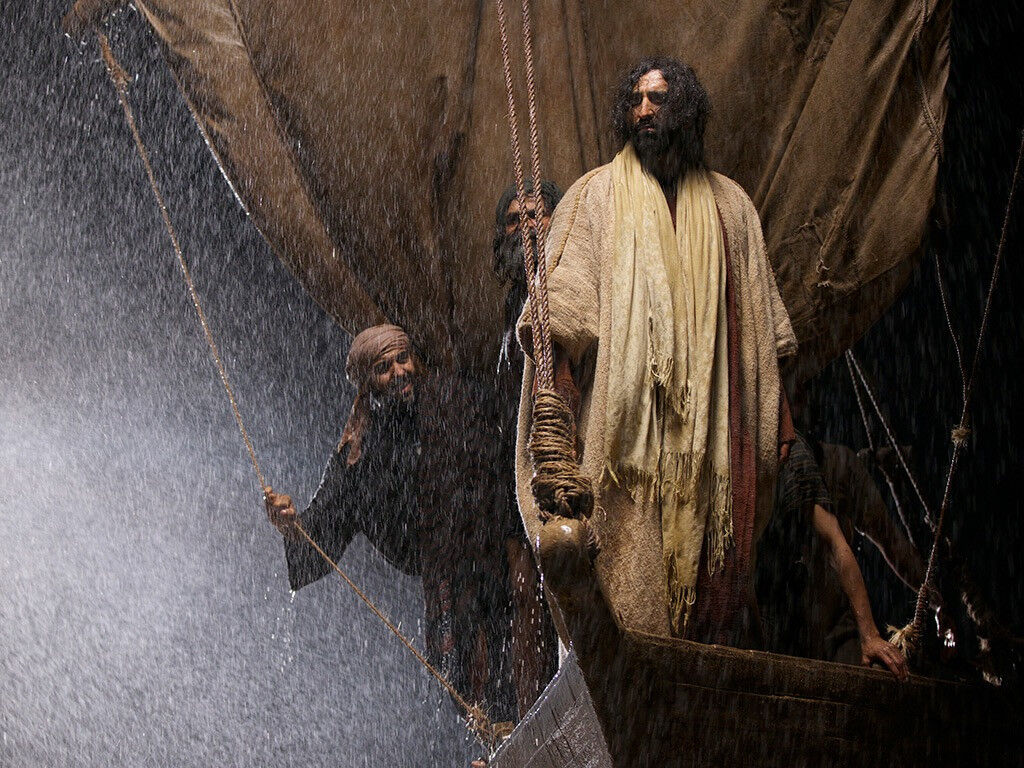
Chapter Four:  After teaching a huge crowd about the kingdom of God, Jesus and the disciples set sail across the sea. A big wind storm comes up. Waves beat against the boat and it quickly begins to fill up. Jesus, however, is asleep on a cushion in the stern. Very anxious disciples wake him up and say “We’re going down. Don’t you care?”

Now, I don’t believe that any of the disciples were thinking that Jesus would get up and end the storm. They were likely thinking that they needed another hand to bail water out of the boat (kind of like my prayers at times).

Jesus gets up. He scolds the wind and says to the sea, “Silence! Shut up!”. Nature calms down but not the sailors. They had been ‘apocalypsed’. Someone in their boat just took control of the cosmic order. Someone in their boat just revealed God-like properties.

Great fear stole over the crew (survivors in the mini-Noah’s arc). “Who is this?” they said to each other. “Even the wind and sea do what he says!”

Jesus had looked at them and said “Why are you scared?” Don’t you believe yet?” That was his response to the disciple’s “Don’t You care?”

Jesus’ response to the disciples was not to shame them. It was to reveal their unbelief in what has been revealed to them: God was walking among them; God was in the boat with them; God’s love as demonstrated would see them through.

“Don’t you care?” is the corporate expression of anxious Israel waiting for Messianic Apocalypse.

“Don’t you care?” is the corporate expression of an anxious world that, with chronic uncertainty, is focused on a coming the-ship-is-going-down apocalypse and not on the certainty of the revelation of Jesus.

What do I talk about when I talk about apocalypse? This: what’s been revealed of Jesus is greater than what could ever possibly be revealed – whether in nature or alien or made-made or imagination-made.

2024: “We’re going down. Don’t you care?”

“Don’t you believe yet?”

~~~~~

Hope in an Age of Anxiety with Curtis Chang and Curt Thompson

We are in an anxious age. By some estimates, a third of all Americans will struggle with anxiety in their lives, and nearly 20% currently suffer from an anxiety disorder. For those suffering the mental distortions of anxiety, life can be difficult, and hope elusive. And for many Christians who have tried and failed to stop their slide into fear and worry by simply “laying down their burdens,” they may feel an added sense of spiritual failure as well.

We’re joined on our podcast by psychiatrist Curt Thopmson and theologian Curtis Chang who help us explore a counterintuitive approach to understanding our anxiety:

Hope in an Age of Anxiety with Curtis Chang and Curt Thompson – the Trinity Forum

Episode 70 | Hope in an Age of Anxiety | The Trinity Forum (ttf.org)

~~~

Beauty from Darkness with Curt Thompson

How do we seek, find and share hope and healing in hard times?

Psychiatrist and author Curt Thompson and Trinity Forum President Cherie Harder discuss healing, grace, and reintegration — both for our individual and spiritual lives, and our shared life together. Together they consider how being known and believing what is true about our stories can transform our perspective and bring hope and healing:

“Shame is the antithesis and is that force that evil wants to use to undermine not only our ability to be known by one another deeply, which we were made for, we were made to be known, but we were also made to be known on the way to creating artifacts of beauty, whether those artifacts are relationships, whether they’re new pieces of music, art, businesses, and so forth.”
– Curt Thompson

Episode 45 | Beauty from Darkness with Curt Thompson | The Trinity Forum (ttf.org)

~~~~~

Must have been all those Venusian women with SUVs . . .

Her Night Before Christmas

The room is dark now except for the lights on the Christmas tree. Tired of all the pharmaceutical commercials promising smiles on users, she’s shut off the TV. There is no real hope to be found anywhere in media. She’s had it with the fake, the clichéd and the unmitigated gall of nihilism that says “life has no meaning so keep watching for the meaning we give to it”.

She’s a flesh-and-blood human. She wants real, not CGI. She wants no part in manipulated drama, no part of AI. And she wants nothing of a New World Order and its utopian nightmare. Right now, she wants signal and not noise. Past, present, and future, like specters, enter her thoughts.

She recalls losses. She recalls past sorrows. She recalls her soul’s constant groaning and lamenting and crying out for rescue arising from its well of wordlessness. Drawn from that well are her tears, tears that now blur the glowing angel atop the tree.

The present is a world that is hurting and she feels helpless. When she prays she feels like a Secret Santa and not like a hands-on saint like Mother Teresa.

Tonight, many will end the year with loss. Some have lost a loved one and some a job and some the means to continue.

Tonight, some will end the year struggling with addictions.

Tonight, some will end the year alone and alienated.

Tonight, some will end the year struggling with depression and thoughts of suicide.

Tonight, some will end the year struggling with respiratory illness or the effects of the COVID vaccination.

Tonight, some will end the year in the hospital with a debilitating illness, some with cancer.

Tonight, some will end the year estranged from their families with memory loss, Alzheimer’s, and dementia.

Tonight, some will end the year with war injuries and memories of loved ones killed in battle.

Tonight, the entire creation is groaning. The future looks as bleak.  

Is the cosmic and historical drama moving toward the ultimate reconciliation of things?

Will the evil of the human condition, our sufferings and our failures, reveal their redemptive meaning when seen from the vantage point of ultimate salvation?

She has chosen the vantage point of an Aslan Christmas and not of a Charlie Brown Christmas. She has chosen to embrace a hope that will not put her to shame – a bold noble hope, a hope that has faced lions and suffering first hand, a poured-out-love hope and not a mopey introverted “Oh, Bother” cartoonish perspective.

Will the Holy Spirit work all things together for good with those who love him and are called according to his purpose?

She has chosen to live in the realm of the Spirit. For the Searcher of Hearts knows what the Spirit is thinking. The Spirit comes alongside her – she doesn’t know how to pray as she ought – and pleads on her behalf. And that pleading is the wordlessness welling up in her tonight.

~~~~~

Scripture can become a weapon in the hands of the ultra-certain. As if every pain or suffering is part of “God’s divine plan.” So how should we understand and apply the Bible to our real lives with our real-life problems? 

NT Wright, a New Testament scholar, is a trusted expert to help us understand what truths resound across time and circumstance and which don’t. In this conversation, Kate [Bowler] and Tom [NT Wright] dig in especially on Romans 8:28 which is the Pauline version of EVERYTHING HAPPENS FOR A REASON. Is that what Paul intended to say? Is there maybe another, more life-giving way to interpret it instead?

Kate and NT Wright also discuss:

  • The importance of lament as a response to the human condition
  • Why we have such a low tolerance for uncertainty
  • Which scripture to turn to when life comes apart (and which to avoid) 
  • What our response should be to others who are in pain or experiencing tragedy 

N.T. Wright: The Mystery of God – Kate Bowler

N.T. Wright: The Mystery of God – Kate Bowler

~~~~~

The italicized words are from Leszek Kolakowski’s essay Can the Devil Be Saved as published in Modernity on Endless Trial, Leszek Kolakowski, The University of Chicago Press, 1990, 75

Romans 5 & 8 are referenced.

~~~~~

Out of the deep have I called unto thee, O Lord:
Lord, hear my voice
O let thine ears consider well: the voice of my complaint
If thou, Lord, wilt be extreme to mark what is done amiss: O Lord, who may abide it?
For there is mercy with thee: therefore shalt thou be feared
I look for the Lord; my soul doth wait for him:
In his word is my trust
My soil fleeth unto the Lord:
Before the morning watch
I say, before the morning watch
O Israel, trust in the Lord, for with the Lord there is mercy:
And with him is plentеous redemption
And he shall rеdeem Israel: from all his sins

~~~~~

The 1951 b&w A Christmas Carol with Alastair Sim is the best movie version of Dicken’s classic.

The Advent of One Day at a Time

When have entered a dark season. Houses and yards are lit up. And, perhaps, some of the residents.

“The holidays are always bad” – Frank Martin.

American writer Raymond Carver published a story about a man trying to move from an addiction to alcohol toward sobriety. The story, set over three days, includes New Years Day. Where I’m Calling From first appeared in the New Yorker in 1982.

Written in Carver’s no-nonsense economical fashion, the story is told by a nameless Narrator who immediately draws us into the residential treatment center where he finds himself and another because of an inability to stop drinking.

“J.P and I are on the front porch at Frank Martin’s drying out facility. Like the rest of us at Frank’s Martin’s, J.P. is first and foremost a drunk. But he’s also a chimney sweep. It’s his first time here, and he’s scared. I’ve been here once before. What’s to say? I’m back.”

From the opening words we learn that alcoholism can take over one’s identity. The Narrator labels both J.P. and himself and everyone at the treatment center. But then the Narrator does go on to say that he knows J.P. as more than “a drunk”.

We also learn, from the Narrator’s “I’m back”, that the struggle with alcoholism can become a cycle of drinking and drying out. And then we find out that it can also become the ultimate wake-up call.

Let’s listen in . . .

“We’ve only been in here a couple of days. We’re not out of the woods yet. J.P. has these shakes, and every so often a nerve — maybe it isn’t a nerve, but it’s something — begins to jerk in my shoulder. Sometimes it’s at the side of my neck. When this happens, my mouth dries up. It’s an effort just to swallow then. I know something’s about to happen and I want to head it off. I want to hide from it, that’s what I want to do. Just close my eyes and let it pass by, let it take the next man. J.P. can wait a minute.

“I saw a seizure yesterday morning. . .”

A large man nicknamed Tiny had the seizure. As the Narrator tells us, Tiny was showing signs of improvement and looking forward to going home for New Year. But then Tiny collapsed at the table before all of them and was rushed to the hospital. The physical signs of alcoholism and withdrawal from it – shakes, spasms, swallowing issues and a seizure – have a major effect on the Narrator.

Loss of self-control brought the Narrator and the “drunk” others to Frank Martin’s drying out facility. And now the loss of physical control due to alcohol use disorder – the Narrator doesn’t want to countenance that. He recoils and hopes for the best – to “let it pass by” to someone else at the table.

“But what happened to Tiny is some-thing I won’t ever forget. Old Tiny flat on the floor, kicking his heels. So every time this little flitter starts up anywhere, I draw some breath and wait to find myself on my back, looking up, somebody’s fingers in my mouth.”

Reading on we get a sense of the need for company and storytelling that withdrawing from alcoholism produces. J.P. and the Narrator sit on the front porch of Frank Martin’s drying out facility. The Narrator listens to J.P.’s story.

The first thing we hear about is a childhood trauma. Twelve-year-old J.P. happened to fall into a dry well near a farm near where he grew up. It wasn’t until later that day that his dad found him and pulled him up. We find out from the Narrator the effect on J.P.:

“J.P. had wet his pants down there. He’d suffered all kinds of terror in that well, hollering for help, waiting, and then hollering some more. He hollered himself hoarse before it was over. But he told me that being at the bottom of that well had made a lasting impression.”

(So far, two lasting impressions from life-or-death situations.)

J.P. remembers looking up at the circle of blue sky from the “bottom of that well” and seeing passing clouds and birds and hearing rustling (of insects?) and the wind blow over the opening. To me this is a picture of the alcoholic at the bottom of the well (the bartending term “well” comes from one of the many names for the underneath of the bar top) and who now looks up and sees life going on without him and a “little circle of blue” that represents hope. The Narrator relates what J.P. said about that time:

“In short, everything about his life was different for him at the bottom of that well. But nothing fell on him and nothing closed off that little circle of blue. Then his dad came along with the rope, and it wasn’t long before J.P. was back in the world he’d always lived in.”

J.P. receives a lifeline. The Narrator wants to hear more.

“Keep talking, J.P. Then what?””

We learn from the Narrator that J.P. meets Roxy, a chimney sweep, at a friend’s house. J.P. says that he could “feel his heart knocking” as she looked him over.  J.P. receives a “good luck” kiss from Roxy.

“He could feel her kiss still burning on his lips, etc. At that minute J.P. couldn’t begin to sort anything out. He was filled with sensations that were carrying him every which way.”

J.P. asks to date her.

“Then what?” the Narrator says. “Don’t stop now, J.P.”

We learn that J.P. and Roxy date. To be close to Roxy, J.P. becomes a chimney sweep and begins working with her. The two later marry, have two kids, and buy a house. The Narrator relates what J.P. felt at the time and adds a comment:

“I was happy with the way things were going,” he says. “I had everything I wanted. I had a wife and kids I loved, and I was doing what I wanted to do with my life.” But for some reason — who knows why we do what we do? — his drinking picks up.

J.P.  goes on to talk about how he began to drink more and more, even taking a “thermos bottle of vodka in his lunch pail”. But then he stops talking.

The Narrator, who’s using J.P. story to help himself relax and avoid his own situation, coaxes to J.P. to continue.

J.P.’s drinking effects his relationship with Roxy. Their fights became physical – a broken nose for J.P. and a dislocated shoulder for Roxy.

“They beat on each other in front of the kids. Things got out of hand. But he kept on drinking. He couldn’t stop. And nothing could make him stop. Not even with Roxy’s dad and her brother threatening to beat hell out of him. They told Roxy she should take the kids and clear out. But Roxy said it was her problem. She got herself into it, and she’d solve it.”

Roxy fixes things by getting a boyfriend. J.P, finds out and goes berserk – like pulling off her wedding ring and cutting it in two. Things for the “drunk” J.P. go downhill – like falling off a roof and breaking a thumb and being arrested for drunk driving.

The Narrator wants us to know that he and J.P. are staying at Frank Martin’s of their own free will and that they’re trying to get their life back on track. Since it’s the Narrator’s second visit, Frank encourages him to stay longer – “The holidays are always a bad time.”

We then learn from the Narrator how J.P. arrived at the residential treatment center. Roxy’s father and brother drive J.P. to Frank Martin’s drying out facility, carry him upstairs and put him to bed. A couple of days later, J. P’s out on the porch with the Narrator telling his stories.

At one point, when the two are on the front porch, Frank Martin, who the Narrator says looks like a prize fighter and “like somebody who knows the score”, comes out to finish his cigar.

“He lets the smoke carry out of his mouth. Then he raises his chin toward the hills and says, “Jack London used to have a big place on the other side of this valley. Right over there behind that green hill you’re looking at. But alcohol killed him. Let that be a lesson. He was a better man than any of us. But he couldn’t handle the stuff, either.”

Frank then encourages them to read London’s Call of the Wild. The book is in the house, he tells them.

J.P., who wants to hide when Frank’s around, says he wishes he had a name like “Jack London” instead of his own name, Joe Penny. (Does the initial using  J. P. feel that the shame, failure, and disappointment of being a “drunk” is attached to “Joe Penny? Does he desire a new name because of his tarnished name?)

The Narrator then tells us about his two trips to Frank Martin’s. When his wife brought him here the first time, Frank said he could help. The Narrator wasn’t sure:

“But I didn’t know if they could help me or not. Part of me wanted help. But there was another part.”

The second time, the Narrator was driven to Frank Martin’s by his girlfriend. He had moved in with her after his wife told him to leave.

This second trip to the treatment center came after their drinking bouts around Christmas. The girlfriend had received horrible news in the form of a medical report. With that kind of news, they decided to start drinking and get “good and drunk”. On Christmas day they were still drunk. After a lot of Bourbon, the Narrator decides to go back for treatment. The drunk girlfriend drops him off. The Narrator is not sure if she made it home OK. They haven’t talked on the phone.

New Year’s Eve morning. The Narrator tries to contact his wife, but no answer. He recalls their last conversation. They screamed at each other. “What am I supposed to do?” he says, thinking that he can’t communicate with her anyway.

We learn that there’s a man in the group who’s in denial and says his drinking is under control. He says he doesn’t know why he’s at Frank Martin’s. But he also doesn’t remember how he got there.

New Year’s Eve. Frank made steaks for the group. But Tiny doesn’t eat. He fears another seizure. “Tiny is not the same old Tiny”.

After dinner Frank brings out a cake. In pink letters across the top: HAPPY NEW YEAR – ONE DAY AT A TIME.

Eating cake J.P. tells the Narrator that his wife is coming in the morning, the first day of the year.

The Narrator tries calling his wife collect, but there’s no answer again. He thinks about calling his girlfriend but he decides that he doesn’t’ want to deal with her. He hopes she’s OK but he doesn’t want to find out if there is something wrong with her.

In the morning, Roxy arrives. J.P. introduces his wife to the Narrator. The Narrator wants a “good luck” kiss. The Narrator can see that Roxy loves J.P. She uses “Joe” instead of “J.P.”

This scene seems to trigger something in the Narrator. Lighting a cigarette, he notices that he has the shakes. They started in the morning. He wants something to drink. Depressed, he turns his mind to something else.

The Narrator remembers a happy time with his wife in their house and the house painter that surprised him one morning. These were good vibes: “And at that minute a wave of happiness comes over me that I’m not him — that I’m me and that I’m inside this bedroom with my wife.”

Sitting outside on the front steps, the Narrator thinks about reconnecting – calling his estranged wife again and then his girlfriend. He tries to remember any of Jack London’s books he’s read. “To Build a Fire” comes to mind. It’s a life-or-death story set in the Yukon.

The Narrator thinks again about reconnecting – calling his estranged wife and wish her a “Happy New Year” and to let her know where he’s at when she asks. After that, he’d call his girlfriend hoping that her mouthy teenage son won’t pick up the phone.

~~~~~

Carver’s style has been described as “dirty realism”. Bill Buford, in Granta Magazine, Summer 1983, describes the style:

“Dirty Realism is the fiction of a new generation of American authors. They write about the belly-side of contemporary life – a deserted husband, an unwanted mother, a car thief, a pickpocket, a drug addict – but they write about it with a disturbing detachment, at times verging on comedy. Understated, ironic, sometimes savage, but insistently compassionate, these stories constitute a new voice in fiction.”

Carver’s influences include Anton Chekhov, Ernest Hemingway, Flannery O’Connor to some degree and others.

Like with Chekhov’s stories, Carver’s stories are like windows you can peer through and get a sense of the characters and what’s going on. Though indirect and conveying things without moral pronouncements, Carver’s stories suggest much with details that can say many things. Falling into a well and the mention of Jack London, for example, in the story above.

J.P.’s account of falling into a well gives us some idea of how it feels to be an alcoholic – helpless, in over your head, scared, and looking for a lifeline and a way out.

The Narrator, at the beginning, says “We’ve only been in here a couple of days. We’re not out of the woods yet” and at the end Jack London’s “To Build a Fire” comes to mind. I see his initial admission of trekking through the woods to sobriety and his later hint of his attempts toward sobriety (building a fire in the woods) as an inclusio or framing of the Narrator’s struggle with alcohol. His journey to sobriety will require a set of survival skills he doesn’t yet possess.

The setting of “To Build a Fire” is in the extreme cold of the largely uninhabited Yukon Territories. The unnamed (like the Narrator) solitary hiker is walking on a side trail in the woods toward an outpost. His self-confidence in hiking and survival skills has him disregard an old man’s advice about not traveling alone in such harsh weather.

Remember the Narrator saying this about his first arrival at Frank Martin’s?

“But I didn’t know if they could help me or not. Part of me wanted help. But there was another part.”

The hiker thinks that he can keep trekking toward the outpost without building a fire, despite it being 50 degrees below zero. His dog seems smarter than the hiker who underestimates the power of nature and the possibilities that can arise. While the hiker has some practical smarts, he lacks wisdom. A quote from the story describes the hiker:

“The trouble with him was that he was without imagination. He was quick and alert in the things of life, but only in the things, and not in the significances.”

At one point the hiker, almost frozen, finally decides to build a fire. Because it was easier to gather the wood needed, he builds his fire underneath a canopy of tree branches. The boughs above his fire are laden with snow. The jostling of his twig gathering and the heat of the fire cause the snow to fall onto the fire and quench it. The hiker tries again, this time out in the open, but he’s freezing up. His hands can’t function. He eventually resigns himself to his frozen fate.

One could see parallels between the unnamed hiker’s folly and the Narrator’s struggle with alcoholism. For one, there’s a self-reliance that paid off in the past that goes on to think it can handle all things. Maybe that’s why Frank Martin brought up Jack London:

“Jack London used to have a big place on the other side of this valley. Right over there behind that green hill you’re looking at. But alcohol killed him. Let that be a lesson. He was a better man than any of us. But he couldn’t handle the stuff, either.”

Another would be building a fire (drying out) under the pretense that you’ve got things figured out and under control. And that could end up in a cycle of a cycle of fires going out and building another fire, of drinking and drying out. Or worse.

Besides the hidden clues, discernable themes of addiction, self-destructive behaviors, addiction’s effect on others, loss of control while under the influence of alcohol, identity, loneliness, alienation, failure, vulnerability, and the need for human connection and story – they’re found in Where I’m Calling From.

~~~~~

Raymond Carver described himself as “inclined toward brevity and intensity”.

Characterized by an economy with words, Carver’s stories focus on surface description and its subject matter. Things are laid bare. No flowery words. No adverbs. Meaning is found in the raw context.

“Carver decided to explore minimalism in writing. He showed, in his text, real situations of everyday life; some of them could be crude, or complicated to understand, but still, he represented feelings that everyone could recognize: sadness, loneliness, failure, etc.”

-Maialen De Carlos,  The American Short Story and Realism: Raymond Carver (byarcadia.org)

Raymond Carver once said “I’m a paid-in-full member of the working poor.”  He wrote stories that a blue-collar reader could connect with – of unremarkable people and the seemingly insignificant details that affect them. His own life was a constant struggle with alcohol addiction.

Carver had self-destructive issues with drinking. Alcohol shattered his health, his work and his family – his first marriage ended because of it. He stopped drinking on June 2nd 1977.

The Life of Raymond Carver documentary with Rare Interview (1989):

Hailed as the American Chekhov and short-listed for a Pulitzer Prize at the time of his death, only ten years earlier Raymond Carver had been completely down and out. In this vintage program filmed just a year after he died, Carver’s second wife, Tess Gallagher, and writers Jay McInerney and Richard Ford, his close friends, explore Carver’s artistic legacy: his stories and poems about the other side of the American Dream. In addition, excerpts from two of Carver’s most famous stories are dramatized. “No one since Steinbeck had written about these people,” says McInerney, “the people whose dreams go belly-up.”

The Life of Raymond Carver documentary with Rare Interview (1989) (youtube.com)

~~~~~

Why do I read Carver?  Because he writes about people like me and my lived experience. I can relate to J.P. and the Narrator. I’ve known alienation, loneliness, shame, brokenness, failure. I’ve made bad decisions. I’ve been at the bottom of the well. And the bottom of the well has been in me.

Several years ago I had a chat with the rector of the church I was attending. It was midweek when he and I met in the church hallway. I had just dropped off some bags of groceries to be delivered to a homeless shelter in the area.

We hadn’t talked in a while and he wanted to catch up. So we sat down in a room just off the entrance to the chapel. I could tell, first off, that he was eager to convince me to share a room with another single woman during the upcoming trip to Israel that he was heading. When I let him know that I wasn’t interested, he asked me how I was doing.

I told him about work and that I was thinking about retiring at some point. Then, I don’t remember why – maybe to tell him Where I’m Calling From, I told him that there was a well of pain so deep in me that if I brought any of it up, I didn’t know what would happen.

He responded with “Hmmm.” When our conversation ended, he prayed for me.

What I like about Carver’s stories is what I like about Anton Chekov’s stories   – I don’t find sanctimony or moralizing. There is no rush to judgement. There are common shared experiences.

Where I’m Calling From, for the most part, is narrated in the present tense. If narrated in the past tense, we’d be in a position to judge. We’d be in the “I told you so” position.

But the present tense narration draws us in. We become involved. We wait and see what happens. We listen to the stories being told. We don’t judge. We understand. And we connect. As a follower of Jesus in this dark season, this is what I’m called to do.

The entire creation is groaning and that includes me.

~~~~~

Short Story Roulette (archive.org)

~~~~~

Advent: The Season of Hope (youtube.com)

Choose Your Advent

We have entered a time to reflect on incarnational reality – the presence of God both with us and within us.

The Nativity by Gari Melchers

With awe we marvel at the birth of Jesus and the reversal of power. God humbly took on the appearance of man and became man’s servant.

We remember our own birth from above which opened our eyes to the reality of the kingdom of God on earth. Two realms – heaven-and-earth – together in our temple being.

We now acknowledge that new creation poured into well-worn no longer flexible ways of religion that have stretched to the limit and become brittle will be lost in the process. New wine needs new wine skins, for new wineskins are able to expand by grace as needed.

And we admit that the inappropriateness of trying to redeem things with a new unshrunk patch of legalism will cause more damage than what it attempts to fix.

We accept that new creation means the renewal of the present world rather than its abandonment and replacement by some other kind of world altogether.

We retell the course of events before Advent and the promises fulfilled.

We contemplate ultimate purposes and ultimate or final things.

We acknowledge the darkness that surrounds us and remains with us. We turn once again to the True Light that defies the darkness. We light candles and say “The Light of Christ”.

We sing “Joy to the World” with the longing and expectation of the world being put right with the return of the King as he establishes his reign of justice, mercy and peace.

But hold on. I wonder what sort of advent we’ve fallen into.

Recall this advent advert?

“The Great “Reset”, nee “Build Back Better”, is the scheduled advent of a man-made new world order and, we are told, a “better future”. Should we hope that with this advent things will be put right? Will the “The Great “Reset” bring joy to the world? Will it bring justice, mercy and peace? Will it bring relief from the burdens of life? So far, the Build Back Better Plan/Inflation Reduction Act has created more burdens.

Will the arrival of “The Great “Reset” bring peace on earth, goodwill toward men? Or will it, like critical theory and The Accuser, constantly find fault and offer no hope of forgiveness and redemption? Will it promote more ill will, division, and hate?

Will the arrival of “The Great “Reset” advance beauty and truth and goodness? Or will we recoil in horror at its manifestation? Will it be antihuman? Will it be Beastly?

With the arrival of “The Great “Reset” will the darkness that surrounds us now increase? Human forces and agencies were not able to contain the Gerasene demoniac.

What is the telos of “The Great “Reset”? Will it be like the kingdom of God on earth which turns everything upside down – power, privilege and wealth. Or, will it promote a world where the loudest, strongest, wealthiest, and most privileged people prey on the less fortunate.  Will it be the Californication of America?

Will the arrival of “The Great “Reset” be good news that will cause great joy for all the people? Or, will this advent be the start of a countdown to the collapse and the end of the world? Will human trafficking end? Will drug trafficking end? Will justice be blind? Will depression and suicides decrease? Will it be a time of depopulation?

Herod the king, in his raging,
Chargèd he hath this day
His men of might in his own sight
All young children to slay.
-Coventry Carol

Will the arrival of “The Great “Reset” mean that the meek, the mournful, and the merciful are held in contempt so the rest of the world can have the “right” to ease and comfort?

Should we hope that with the advent of the New World Order that things will be put right? Should we expect justice, mercy and peace? Or should we expect pseudo-justice, pseudo-mercy and pseudo-peace in the form of pseudo-religion? Socialist activist and communist party leader in Italy Antonio Gramsci is one of many who promoted the latter:

“Socialism is precisely the religion that must overwhelm Christianity. … In the new order, Socialism will triumph by first capturing the culture via infiltration of schools, universities, churches, and the media by transforming the consciousness of society.”

Do you want the infiltration of schools, universities, churches, and the media and the transformation of the consciousness of society in the New World Order? Have you already joined this religion? What sort of advent have you fallen into?

Maybe you should take a look at the advent of the man-made New World Order:

Here’s the best summary video I’ve seen of the advent of the NWO and what is coming for you, me, and our children and grandchildren. It begs the questions “Why was I born at this time?” and “Which advent do I choose?”

To put things right, per a globalist worldview, the UN has an 2030 goal agenda. The virtuous-sounding goals touch on and seek to monitor and control, through digital technology, every aspect of human life for a “better world”. But, DO NOT Be Fooled!

To exist in the UN’s 2030 NWO society, people will have to submit their biometrics to the digital industrial complex. Each will be assigned a digital carbon footprint identity to monitor and control their behavior. Freedom, human agency and human dignity will be a thing of the past. Religions will be replaced with materialism.

Digital socialism and communism with centralized assets and resources will ration out resources to each person deemed socially responsible. The world court, world police, and the world health organization will control everyone via digital currency and digital IDs.

UN’s 2030 agenda goals:

The oldest liturgical prayer that we know: “Come, Lord Jesus!”

This advent, you can either pray the incarnational prayer “Come, Lord Jesus!” or the Globalist prayer “Come, Klaus Schwab!”

~~~~~

A CRITICAL EXAMINATION OF TWO MYTHS THAT DRIVE CULTURE: THE AXIAL AGE AND DARK GREEN RELIGION

“Most people, I believe, do not comprehend the way in which each of us is inevitably caught up in what theologian Ched Myers has called the “war of myths” – a battle of overarching stories that claim to explain life (what it’s about, where it’s going, and what its purpose is).” – Iain Proven, retied E. Marshall Shepherd Professor of Biblical Studies (Old Testament) at Regent College.

The contemporary world has been shaped in part by two important and potent myths. Karl Jaspers’ ‘axial age’ myth as narrated by Karen Armstrong and others and the myth of the ‘dark green golden age’ as narrated by David Suzuki and others. Both myths contend that to maintain balance we must return to the idealized past. In this lecture, Iain Provan engages critically with both myths, explaining why we should not embrace them and why it matters if we do. This was recorded at the University of British Columbia Graduate and Faculty Christian Forum.

A Critical Examination of Two Myths That Drive Culture: The Axial Age | Regent Audio

Iain Provan Examines Two Cultural Mythologies | ubcgcu

A Critical Examination of Two Myths – Iain Proven

~~~~~

Tucker’s opening monologue:

“We have a ruling class in the United States defined by its hatreds. Not its loves, not its hopes, but by its hatreds. They hate all kinds of people, large groups of people: the deplorables, the bitter clingers, America’s entire blue-collar population, the unfashionable people. They’re hated by the people who run our country.

But no one is hated more by them than a man called Alex Jones.”

Tucker Carlson Drops Must-See Interview With Alex Jones (vigilantnews.com)

~~~~~

Defying the dark

Neil Oliver: ‘…this year, of all years, it matters to defy the darkness in every way you can’ 

Neil Oliver: ‘…this year, of all years, it matters to defy the darkness in every way you can’ – YouTube

~~~~~

Informed Dissent:

“I thought about safety, security, good jobs, good education — all that stuff is very important to my family and my community,” she recalled. “And when I broke down those values between Democrats and Republicans, to me it was obvious who stood up for my values.”

Why black, Latino and Asian voters are leaving Democratic Party (nypost.com)

~~~

(Nov. 19, 2023) A groundbreaking study by Drs. Denis RancourtMarine Baudin and Jérémie Mercier found 17 million people died worldwide after the Covid “vaccine” rollout.

“We calculate the toxicity of the vaccine for all ages,” explained Dr. Rancourt, “given the number of doses given worldwide to conclude that 17 million people would have been killed by this vaccine.”

Staggering 17 Million Deaths After Covid Vaccine Rollout -Drs. Denis Rancourt, Marine Baudin & Jérémie Mercier – Bright Light News

The paper is based on 17 countries in the Southern Hemisphere and equatorial region. A definite causal link is shown between many peaks in all-cause mortality and rapid vaccine rollouts. The authors quantify the fatal toxicity risk per injection, which is exceedingly large in the most elderly.

COVID-19 vaccine-associated mortality in the Southern Hemisphere – CORRELATION (correlation-canada.org)

~~~

The peer-reviewed study, published in the journal Epidemiology and Infection on Nov. 13, analyzed mask use among 3,209 individuals from Norway. Researchers followed them for 17 days, and then asked the participants about their use of masks. The team found that there was a higher incidence of testing positive for COVID-19 among people who used masks more frequently.

Higher Incidence of COVID-19 Found Among Consistent Mask-Wearers: Study | The Epoch Times

~~~

Between 2021 and 2022 when most of the now-fully vaccinated world got jabbed, cancer deaths skyrocketed, particularly among young people, according to data from the United Kingdom’s Office for National Statistics (ONS).

Government data shows young people now dying of cancer at “explosive” rates following COVID vaccine push – NaturalNews.com

~~~~~

Build Back Better’s Good News, so far: