2025. Those of us striving to maintain the good, the true, the beautiful, and our precious homeland felt a hard-to-name force displacing us from the “past, people, place, and prayer” (Kingsnorth).
That force, soon to be coupled to Deterministic AI, is moving us in the direction of History deemed as an evolutionary process called Progress, as if later was better. Paul Kingsnorth, in his book Against the Machine, calls the force “The Machine.”
This year, The Machine’s red in tooth and gear displacement process included Charlie Kirk being shot in the neck and killed in front of the whole country in daylight. Kirk, as everyone knows, was a Christian and spoke in terms of the “past, people, place, and prayer.” Since the murder, the growing response is the rejection of what The Machine did to Kirk and is doing to them – the Process of Dehumanization.
People want the values Kirk spoke about and represented. They want to invest in precious lasting values – the good, the true and the beautiful – and they no longer want a modern Machine culture that generates everything the way central banks generate money: fiat morality, fiat identity, fiat community, fiat justice, fiat politics.
It is no surprise that in 2025, people and countries, sensing a constant state of flux, uncertainty, and manipulation in the fiat USD, were buying precious metals. The go-to values of physical commodities such as gold or silver increased in 2025.
At the beginning of 2025, gold was $2,640/oz. Recently, it was $4,550. Gold will likely hit $10k/oz. in 2026.
Silver, at the beginning of 2025, was $29/oz. Now, it’s over $77/oz.
Going Forward, a Few Recommendations:
The U.S. needs to uncouple from any involvement with the corrupt money-laundering country of Ukraine. We should not provide any security agreements to Ukraine. We should walk away and let Europe deal with Europe. Ukraine can become part of the EU (money-laundering system).
The U.S. needs to uncouple from its involvement with Israel. Israel can go off and do its own thing.
There should not be one-size-fits-all federal AI regulations. Better, keep AI out of our lives.
Americans should resist all attempts in their state to build energy-hoarding data centers and more 5G (spy on us) towers.
At a minimum and no more, the U.S. should establish, by law, one day voting on paper ballots with a secure chain of custody.
Americans should resist all attempts to ID them digitally.
Americans should resist all attempts to go cashless and converting to a digital currency that will track all of purchases and decide who’s in and who’s out.
The U.S. should deport all illegal invaders. They are not refugees. They are economic and criminal opportunists. The open borders “compassion” behind “Welcoming the stranger” is exactly like a judge applying ad hoc justice to multiple offence criminals because they are minorities and because of their “circumstances.”
A Few Obvious Predictions:
Democrats will continue presenting themselves as saving the world while doing everything they can to tear it down using massive fraud, abortion, assisted suicide, anarchy, and more. The Left will continue with its Trump Derangement Syndrome (TDS). The deep-state media tells them what to think about everything.
Globalists will continue to globalize. They will continue to try to amass power over people and make them worker bees with a hive mind. Unless Kingdom Christians say “No More!”
The Islamification of the West will continue its takeover of U.S. communities and states unless Kingdom Christians say “No More!” Why repeat “Thy will be done on earth as it is on heaven” if it has no meaning here and now? Mamdani to use Quran for swearing in ceremony.
Trans-cultists, Islamists and the mentally ill will continue to kill. The media will continue to say that guns kill.
Humans will continue to lose their humanity with associations and applications of things that move them away from the good, the true, and the beautiful in the name of novelty and efficiency.
Literary life:
This year, beside the books shown on the side bar under Goodreads, I read:
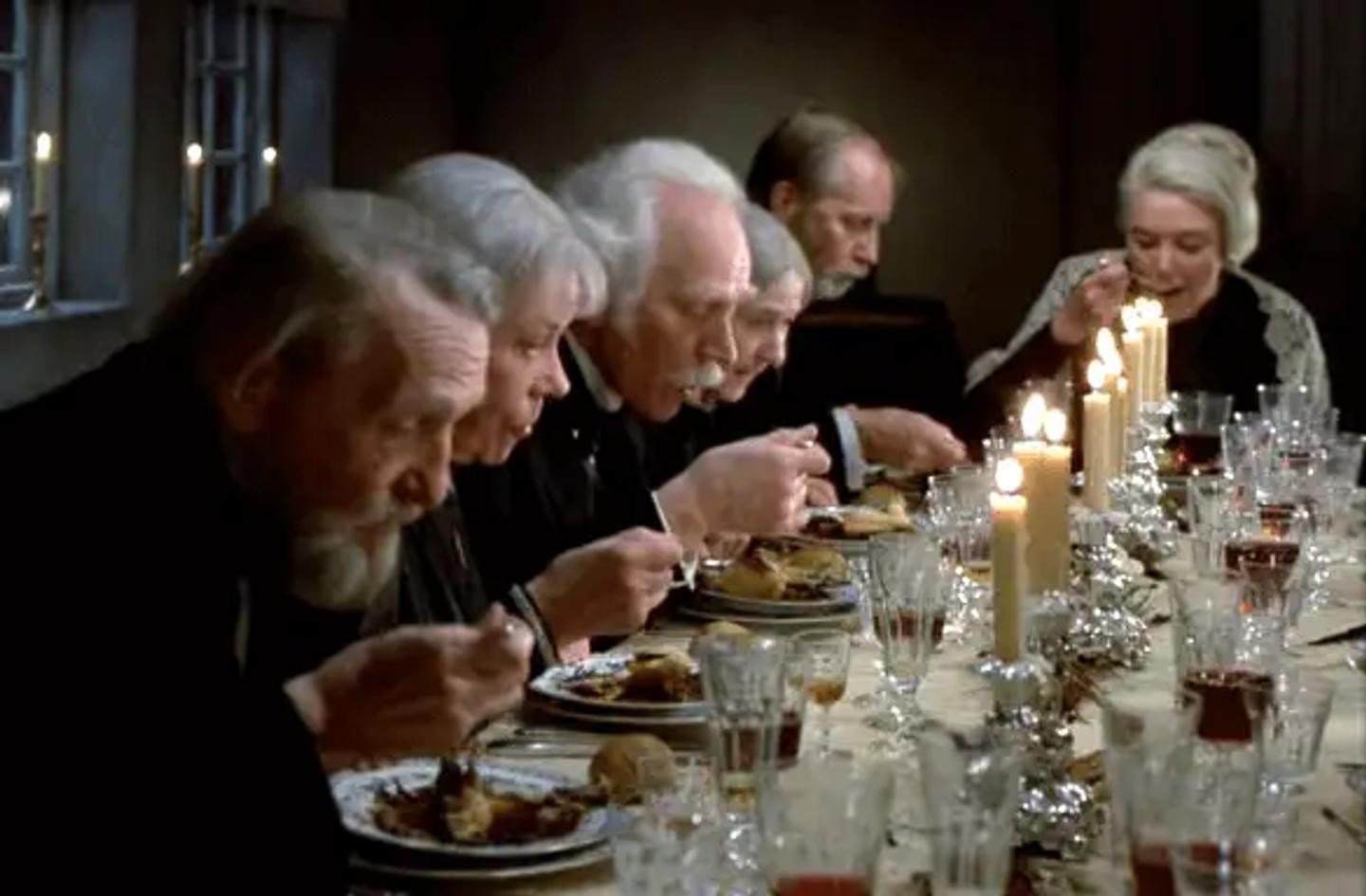
I recently purchased the Criterion Collection DVD of Babette’s Feast. I watched this last weekend. What a blessing!
Babette’s Feast, based on a Karen Blixen story, is a delightful tale of generosity in 19th century Denmark. A lavish feast evokes the transformative power of God’s grace. “Mercy and truth have kissed.”
~~~~
The Right Brain Needs Your Support
Dr Iain McGilchrist is a psychiatrist, neuroscientist, philosopher and literary scholar is the author of The Master and His Emissary and The Matter with Things. His work on the divided brain has helped millions of people find wisdom, meaning, and guidance for living in the modern world.
Iain and Demetri [Kofinas] begin their conversation exploring McGilchrist’s core thesis about the divided brain, how the left and right hemispheres attend to the world in fundamentally different ways, where we see evidence of an increased preponderance in left-brain thinking, and how this has impacted the way we conduct science, reason through problems, use our imagination, and apply wisdom to the world.
Iain believes that our civilization is caught in what some have described as a metacrisis, exacerbated by the encroachment of the left hemisphere onto more and more areas of lived experience. We see it in the procedurally abysmal manner in which modern medicine goes about formulating diagnoses, the ever-increasing obsession with process over outcomes, the commodification of writing, the rise in depression, the policing of language, and the reverence for machine-like efficiency and profit maximization at the expense of almost everything else.
The Metacrisis: Finding Reality & Meaning | Iain McGilchrist
What do we talk about when we talk about apocalypse?
Are we talkin’ Steppenwolf and his legions of Parademons attempting to take over the Earth using the combined energies of the three Mother Boxes?
Are we talkin’ nuclear war? World War Z?
Are we talkin’ The Late Great Planet Earth?
Are we talkin’ a supposed climate change catastrophe prophesied as either a meltdown or an ice age?
In popular use, “apocalypse” tags something with the worst possible outcome usually in terms of an end-of-the-world scenario and mankind’s role in events much bigger than himself. But the Greek word apokálypsis, from which “apocalypse” is derived, means an uncovering or revelation.
In terms of scripture, “apocalypse” is a genre in which God reveals His point of view. Such are the books of Isaiah, Jeremiah, Ezekiel, Joel, Zechariah, Daniel and Revelation. The “apocalypse” as an author’s vision of the end times or the end of the age became a distinct literary genre during the Second Temple period and into the Common Era.
Apocalyptic “non-canonical” literature helped pave the way for the Jesus movement in the first century CE. Many in Israel, based on these writings and OT texts (Psalm 146:7-8, Isaiah 61: 1-2), held a belief in a Messianic Apocalypse – the anointed one, a divine messianic agent, revealed at the end time who executes justice for the oppressed, gives food to the hungry, sets prisoners free, opens the eyes of the blind, and lifts up those who are bowed down.
Within this millenarist writing context and using explicit connections to the Old Testament via quotes, and with accounts of eyewitness testimony, the four gospels record God’s revelation in Jesus Christ as the Messianic Apocalypse. And, they record the apocalyptic pronouncements of Jesus, including Matthew 24 (The Destruction of the Temple and Signs of the End Times) and in Matthew 25 (The Sheep and the Goats; Judgement). Jesus’ words and works throughout the four gospels disclose God’s POV.
Near the end of the John’s gospel account we are given the reason why John wrote to reveal Jesus:
“Jesus did many other signs in the presence of his disciples, which are not written in this book. But these are written so that you may believe that the Messiah, the son of God, is none other than Jesus; and that, with this faith, you may have life in his name.” (Jn. 20:31)
The gospel according to Mark, written from a Petrine perspective, recorded what Jesus did and said in the presence of his disciples so that with the centurion standing watch at the cross, we might say “Truly this man was God’s Son!” (Mark 15:39)
Throughout the first six chapters of the gospel according to Mark, chapters I am memorizing, I find Jesus over and over again revealing who he is to the Twelve and the group of disciples around him. Yet, they are not making the connection. They consider him a great prophet and a maybe-Messiah Apocalypse but nothing more.
When Jesus is in the synagogue teaching, the gathered are astonished by his teaching. He speaks with authority. Then a man with an unclean spirit reveals Jesus’s identity:
“What business have you got with us, Jesus of Nazareth?” he yelled. “Have you come to destroy us? I know who you are: you’re God’s Holy One!”
Jesus commands the unclean spirit to be quiet and then casts out the unclean spirit. The buzz begins.
“What’s this?” they started to say to each other. “New teaching – with real authority! He even tells the unclean spirits what to do and they do it!”
Before chapter one ends, Jesus has healed many people suffering from all kinds of diseases and cast out many demons – exactly what Psalm 146 and Isaiah 61 talk about.
I learn from Mark that Jesus won’t let the demons speak. They would reveal his identity. I understand this as Jesus wanting each person to come to grips with who he is on their own.
In chapter two, Jesus heals a paralyzed man. But first he recognizes the faith of those who bring the man to him. He tells the cripple that his sins are forgiven. Upon hearing this the legal experts in the room start grumbling “Its’ blasphemy! Who can forgive sins except God?” They are so ready to pounce that they don’t understand who is standing before them. And why would they?
Who would expect the invisible God to be incarnate, to be physically present? And who would expect a consuming fire (Deut. 4:24) to be in their midst?
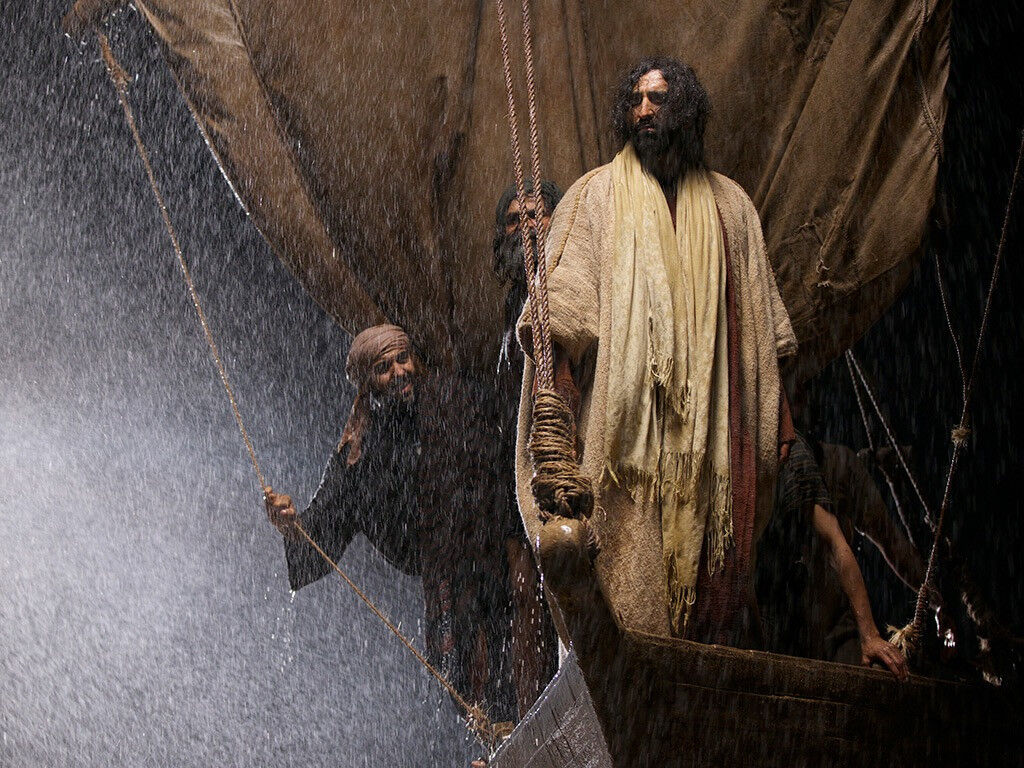
Chapter Four: After teaching a huge crowd about the kingdom of God, Jesus and the disciples set sail across the sea. A big wind storm comes up. Waves beat against the boat and it quickly begins to fill up. Jesus, however, is asleep on a cushion in the stern. Very anxious disciples wake him up and say “We’re going down. Don’t you care?”
Now, I don’t believe that any of the disciples were thinking that Jesus would get up and end the storm. They were likely thinking that they needed another hand to bail water out of the boat (kind of like my prayers at times).
Jesus gets up. He scolds the wind and says to the sea, “Silence! Shut up!”. Nature calms down but not the sailors. They had been ‘apocalypsed’. Someone in their boat just took control of the cosmic order. Someone in their boat just revealed God-like properties.
Great fear stole over the crew (survivors in the mini-Noah’s arc). “Who is this?” they said to each other. “Even the wind and sea do what he says!”
Jesus had looked at them and said “Why are you scared?” Don’t you believe yet?” That was his response to the disciple’s “Don’t You care?”
Jesus’ response to the disciples was not to shame them. It was to reveal their unbelief in what has been revealed to them: God was walking among them; God was in the boat with them; God’s love as demonstrated would see them through.
“Don’t you care?” is the corporate expression of anxious Israel waiting for Messianic Apocalypse.
“Don’t you care?” is the corporate expression of an anxious world that, with chronic uncertainty, is focused on a coming the-ship-is-going-down apocalypse and not on the certainty of the revelation of Jesus.
What do I talk about when I talk about apocalypse? This: what’s been revealed of Jesus is greater than what could ever possibly be revealed – whether in nature or alien or made-made or imagination-made.
2024: “We’re going down. Don’t you care?”
“Don’t you believe yet?”
~~~~~
Hope in an Age of Anxiety with Curtis Chang and Curt Thompson
We are in an anxious age. By some estimates, a third of all Americans will struggle with anxiety in their lives, and nearly 20% currently suffer from an anxiety disorder. For those suffering the mental distortions of anxiety, life can be difficult, and hope elusive. And for many Christians who have tried and failed to stop their slide into fear and worry by simply “laying down their burdens,” they may feel an added sense of spiritual failure as well.
We’re joined on our podcast by psychiatrist Curt Thopmson and theologian Curtis Chang who help us explore a counterintuitive approach to understanding our anxiety:
Hope in an Age of Anxiety with Curtis Chang and Curt Thompson – the Trinity Forum
How do we seek, find and share hope and healing in hard times?
Psychiatrist and author Curt Thompson and Trinity Forum President Cherie Harder discuss healing, grace, and reintegration — both for our individual and spiritual lives, and our shared life together. Together they consider how being known and believing what is true about our stories can transform our perspective and bring hope and healing:
“Shame is the antithesis and is that force that evil wants to use to undermine not only our ability to be known by one another deeply, which we were made for, we were made to be known, but we were also made to be known on the way to creating artifacts of beauty, whether those artifacts are relationships, whether they’re new pieces of music, art, businesses, and so forth.” – Curt Thompson
When have entered a dark season. Houses and yards are lit up. And, perhaps, some of the residents.
“The holidays are always bad” – Frank Martin.
American writer Raymond Carver published a story about a man trying to move from an addiction to alcohol toward sobriety. The story, set over three days, includes New Years Day. Where I’m Calling From first appeared in theNew Yorker in 1982.
Written in Carver’s no-nonsense economical fashion, the story is told by a nameless Narrator who immediately draws us into the residential treatment center where he finds himself and another because of an inability to stop drinking.
“J.P and I are on the front porch at Frank Martin’s drying out facility. Like the rest of us at Frank’s Martin’s, J.P. is first and foremost a drunk. But he’s also a chimney sweep. It’s his first time here, and he’s scared. I’ve been here once before. What’s to say? I’m back.”
From the opening words we learn that alcoholism can take over one’s identity. The Narrator labels both J.P. and himself and everyone at the treatment center. But then the Narrator does go on to say that he knows J.P. as more than “a drunk”.
We also learn, from the Narrator’s “I’m back”, that the struggle with alcoholism can become a cycle of drinking and drying out. And then we find out that it can also become the ultimate wake-up call.
Let’s listen in . . .
“We’ve only been in here a couple of days. We’re not out of the woods yet. J.P. has these shakes, and every so often a nerve — maybe it isn’t a nerve, but it’s something — begins to jerk in my shoulder. Sometimes it’s at the side of my neck. When this happens, my mouth dries up. It’s an effort just to swallow then. I know something’s about to happen and I want to head it off. I want to hide from it, that’s what I want to do. Just close my eyes and let it pass by, let it take the next man. J.P. can wait a minute.
“I saw a seizure yesterday morning. . .”
A large man nicknamed Tiny had the seizure. As the Narrator tells us, Tiny was showing signs of improvement and looking forward to going home for New Year. But then Tiny collapsed at the table before all of them and was rushed to the hospital. The physical signs of alcoholism and withdrawal from it – shakes, spasms, swallowing issues and a seizure – have a major effect on the Narrator.
Loss of self-control brought the Narrator and the “drunk” others to Frank Martin’s drying out facility. And now the loss of physical control due to alcohol use disorder – the Narrator doesn’t want to countenance that. He recoils and hopes for the best – to “let it pass by” to someone else at the table.
“But what happened to Tiny is some-thing I won’t ever forget. Old Tiny flat on the floor, kicking his heels. So every time this little flitter starts up anywhere, I draw some breath and wait to find myself on my back, looking up, somebody’s fingers in my mouth.”
Reading on we get a sense of the need for company and storytelling that withdrawing from alcoholism produces. J.P. and the Narrator sit on the front porch of Frank Martin’s drying out facility. The Narrator listens to J.P.’s story.
The first thing we hear about is a childhood trauma. Twelve-year-old J.P. happened to fall into a dry well near a farm near where he grew up. It wasn’t until later that day that his dad found him and pulled him up. We find out from the Narrator the effect on J.P.:
“J.P. had wet his pants down there. He’d suffered all kinds of terror in that well, hollering for help, waiting, and then hollering some more. He hollered himself hoarse before it was over. But he told me that being at the bottom of that well had made a lasting impression.”
(So far, two lasting impressions from life-or-death situations.)
J.P. remembers looking up at the circle of blue sky from the “bottom of that well” and seeing passing clouds and birds and hearing rustling (of insects?) and the wind blow over the opening. To me this is a picture of the alcoholic at the bottom of the well (the bartending term “well” comes from one of the many names for the underneath of the bar top) and who now looks up and sees life going on without him and a “little circle of blue” that represents hope. The Narrator relates what J.P. said about that time:
“In short, everything about his life was different for him at the bottom of that well. But nothing fell on him and nothing closed off that little circle of blue. Then his dad came along with the rope, and it wasn’t long before J.P. was back in the world he’d always lived in.”
J.P. receives a lifeline. The Narrator wants to hear more.
“Keep talking, J.P. Then what?””
We learn from the Narrator that J.P. meets Roxy, a chimney sweep, at a friend’s house. J.P. says that he could “feel his heart knocking” as she looked him over. J.P. receives a “good luck” kiss from Roxy.
“He could feel her kiss still burning on his lips, etc. At that minute J.P. couldn’t begin to sort anything out. He was filled with sensations that were carrying him every which way.”
J.P. asks to date her.
“Then what?” the Narrator says. “Don’t stop now, J.P.”
We learn that J.P. and Roxy date. To be close to Roxy, J.P. becomes a chimney sweep and begins working with her. The two later marry, have two kids, and buy a house. The Narrator relates what J.P. felt at the time and adds a comment:
“I was happy with the way things were going,” he says. “I had everything I wanted. I had a wife and kids I loved, and I was doing what I wanted to do with my life.” But for some reason — who knows why we do what we do?— his drinking picks up.
J.P. goes on to talk about how he began to drink more and more, even taking a “thermos bottle of vodka in his lunch pail”. But then he stops talking.
The Narrator, who’s using J.P. story to help himself relax and avoid his own situation, coaxes to J.P. to continue.
J.P.’s drinking effects his relationship with Roxy. Their fights became physical – a broken nose for J.P. and a dislocated shoulder for Roxy.
“They beat on each other in front of the kids. Things got out of hand. But he kept on drinking. He couldn’t stop. And nothing could make him stop. Not even with Roxy’s dad and her brother threatening to beat hell out of him. They told Roxy she should take the kids and clear out. But Roxy said it was her problem. She got herself into it, and she’d solve it.”
Roxy fixes things by getting a boyfriend. J.P, finds out and goes berserk – like pulling off her wedding ring and cutting it in two. Things for the “drunk” J.P. go downhill – like falling off a roof and breaking a thumb and being arrested for drunk driving.
The Narrator wants us to know that he and J.P. are staying at Frank Martin’s of their own free will and that they’re trying to get their life back on track. Since it’s the Narrator’s second visit, Frank encourages him to stay longer – “The holidays are always a bad time.”
We then learn from the Narrator how J.P. arrived at the residential treatment center. Roxy’s father and brother drive J.P. to Frank Martin’s drying out facility, carry him upstairs and put him to bed. A couple of days later, J. P’s out on the porch with the Narrator telling his stories.
At one point, when the two are on the front porch, Frank Martin, who the Narrator says looks like a prize fighter and “like somebody who knows the score”, comes out to finish his cigar.
“He lets the smoke carry out of his mouth. Then he raises his chin toward the hills and says, “Jack London used to have a big place on the other side of this valley. Right over there behind that green hill you’re looking at. But alcohol killed him. Let that be a lesson. He was a better man than any of us. But he couldn’t handle the stuff, either.”
Frank then encourages them to read London’s Call of the Wild. The book is in the house, he tells them.
J.P., who wants to hide when Frank’s around, says he wishes he had a name like “Jack London” instead of his own name, Joe Penny. (Does the initial using J. P. feel that the shame, failure, and disappointment of being a “drunk” is attached to “Joe Penny? Does he desire a new name because of his tarnished name?)
The Narrator then tells us about his two trips to Frank Martin’s. When his wife brought him here the first time, Frank said he could help. The Narrator wasn’t sure:
“But I didn’t know if they could help me or not. Part of me wanted help. But there was another part.”
The second time, the Narrator was driven to Frank Martin’s by his girlfriend. He had moved in with her after his wife told him to leave.
This second trip to the treatment center came after their drinking bouts around Christmas. The girlfriend had received horrible news in the form of a medical report. With that kind of news, they decided to start drinking and get “good and drunk”. On Christmas day they were still drunk. After a lot of Bourbon, the Narrator decides to go back for treatment. The drunk girlfriend drops him off. The Narrator is not sure if she made it home OK. They haven’t talked on the phone.
New Year’s Eve morning. The Narrator tries to contact his wife, but no answer. He recalls their last conversation. They screamed at each other. “What am I supposed to do?” he says, thinking that he can’t communicate with her anyway.
We learn that there’s a man in the group who’s in denial and says his drinking is under control. He says he doesn’t know why he’s at Frank Martin’s. But he also doesn’t remember how he got there.
New Year’s Eve. Frank made steaks for the group. But Tiny doesn’t eat. He fears another seizure. “Tiny is not the same old Tiny”.
After dinner Frank brings out a cake. In pink letters across the top: HAPPY NEW YEAR – ONE DAY AT A TIME.
Eating cake J.P. tells the Narrator that his wife is coming in the morning, the first day of the year.
The Narrator tries calling his wife collect, but there’s no answer again. He thinks about calling his girlfriend but he decides that he doesn’t’ want to deal with her. He hopes she’s OK but he doesn’t want to find out if there is something wrong with her.
In the morning, Roxy arrives. J.P. introduces his wife to the Narrator. The Narrator wants a “good luck” kiss. The Narrator can see that Roxy loves J.P. She uses “Joe” instead of “J.P.”
This scene seems to trigger something in the Narrator. Lighting a cigarette, he notices that he has the shakes. They started in the morning. He wants something to drink. Depressed, he turns his mind to something else.
The Narrator remembers a happy time with his wife in their house and the house painter that surprised him one morning. These were good vibes: “And at that minute a wave of happiness comes over me that I’m not him — that I’m me and that I’m inside this bedroom with my wife.”
Sitting outside on the front steps, the Narrator thinks about reconnecting – calling his estranged wife again and then his girlfriend. He tries to remember any of Jack London’s books he’s read. “To Build a Fire” comes to mind. It’s a life-or-death story set in the Yukon.
The Narrator thinks again about reconnecting – calling his estranged wife and wish her a “Happy New Year” and to let her know where he’s at when she asks. After that, he’d call his girlfriend hoping that her mouthy teenage son won’t pick up the phone.
“Dirty Realism is the fiction of a new generation of American authors. They write about the belly-side of contemporary life – a deserted husband, an unwanted mother, a car thief, a pickpocket, a drug addict – but they write about it with a disturbing detachment, at times verging on comedy. Understated, ironic, sometimes savage, but insistently compassionate, these stories constitute a new voice in fiction.”
Carver’s influences include Anton Chekhov, Ernest Hemingway, Flannery O’Connor to some degree and others.
Like with Chekhov’s stories, Carver’s stories are like windows you can peer through and get a sense of the characters and what’s going on. Though indirect and conveying things without moral pronouncements, Carver’s stories suggest much with details that can say many things. Falling into a well and the mention of Jack London, for example, in the story above.
J.P.’s account of falling into a well gives us some idea of how it feels to be an alcoholic – helpless, in over your head, scared, and looking for a lifeline and a way out.
The Narrator, at the beginning, says “We’ve only been in here a couple of days. We’re not out of the woods yet” and at the end Jack London’s “To Build a Fire” comes to mind. I see his initial admission of trekking through the woods to sobriety and his later hint of his attempts toward sobriety (building a fire in the woods) as an inclusio or framing of the Narrator’s struggle with alcohol. His journey to sobriety will require a set of survival skills he doesn’t yet possess.
The setting of “To Build a Fire” is in the extreme cold of the largely uninhabited Yukon Territories. The unnamed (like the Narrator) solitary hiker is walking on a side trail in the woods toward an outpost. His self-confidence in hiking and survival skills has him disregard an old man’s advice about not traveling alone in such harsh weather.
Remember the Narrator saying this about his first arrival at Frank Martin’s?
“But I didn’t know if they could help me or not. Part of me wanted help. But there was another part.”
The hiker thinks that he can keep trekking toward the outpost without building a fire, despite it being 50 degrees below zero. His dog seems smarter than the hiker who underestimates the power of nature and the possibilities that can arise. While the hiker has some practical smarts, he lacks wisdom. A quote from the story describes the hiker:
“The trouble with him was that he was without imagination. He was quick and alert in the things of life, but only in the things, and not in the significances.”
At one point the hiker, almost frozen, finally decides to build a fire. Because it was easier to gather the wood needed, he builds his fire underneath a canopy of tree branches. The boughs above his fire are laden with snow. The jostling of his twig gathering and the heat of the fire cause the snow to fall onto the fire and quench it. The hiker tries again, this time out in the open, but he’s freezing up. His hands can’t function. He eventually resigns himself to his frozen fate.
One could see parallels between the unnamed hiker’s folly and the Narrator’s struggle with alcoholism. For one, there’s a self-reliance that paid off in the past that goes on to think it can handle all things. Maybe that’s why Frank Martin brought up Jack London:
“Jack London used to have a big place on the other side of this valley. Right over there behind that green hill you’re looking at. But alcohol killed him. Let that be a lesson. He was a better man than any of us. But he couldn’t handle the stuff, either.”
Another would be building a fire (drying out) under the pretense that you’ve got things figured out and under control. And that could end up in a cycle of a cycle of fires going out and building another fire, of drinking and drying out. Or worse.
Besides the hidden clues, discernable themes of addiction, self-destructive behaviors, addiction’s effect on others, loss of control while under the influence of alcohol, identity, loneliness, alienation, failure, vulnerability, and the need for human connection and story – they’re found in Where I’m Calling From.
~~~~~
Raymond Carver described himself as “inclined toward brevity and intensity”.
Characterized by an economy with words, Carver’s stories focus on surface description and its subject matter. Things are laid bare. No flowery words. No adverbs. Meaning is found in the raw context.
“Carver decided to explore minimalism in writing. He showed, in his text, real situations of everyday life; some of them could be crude, or complicated to understand, but still, he represented feelings that everyone could recognize: sadness, loneliness, failure, etc.”
Raymond Carver once said “I’m a paid-in-full member of the working poor.” He wrote stories that a blue-collar reader could connect with – of unremarkable people and the seemingly insignificant details that affect them. His own life was a constant struggle with alcohol addiction.
Carver had self-destructive issues with drinking. Alcohol shattered his health, his work and his family – his first marriage ended because of it. He stopped drinking on June 2nd 1977.
The Life of Raymond Carver documentary with Rare Interview (1989):
Hailed as the American Chekhov and short-listed for a Pulitzer Prize at the time of his death, only ten years earlier Raymond Carver had been completely down and out. In this vintage program filmed just a year after he died, Carver’s second wife, Tess Gallagher, and writers Jay McInerney and Richard Ford, his close friends, explore Carver’s artistic legacy: his stories and poems about the other side of the American Dream. In addition, excerpts from two of Carver’s most famous stories are dramatized. “No one since Steinbeck had written about these people,” says McInerney, “the people whose dreams go belly-up.”
Why do I read Carver? Because he writes about people like me and my lived experience. I can relate to J.P. and the Narrator. I’ve known alienation, loneliness, shame, brokenness, failure. I’ve made bad decisions. I’ve been at the bottom of the well. And the bottom of the well has been in me.
Several years ago I had a chat with the rector of the church I was attending. It was midweek when he and I met in the church hallway. I had just dropped off some bags of groceries to be delivered to a homeless shelter in the area.
We hadn’t talked in a while and he wanted to catch up. So we sat down in a room just off the entrance to the chapel. I could tell, first off, that he was eager to convince me to share a room with another single woman during the upcoming trip to Israel that he was heading. When I let him know that I wasn’t interested, he asked me how I was doing.
I told him about work and that I was thinking about retiring at some point. Then, I don’t remember why – maybe to tell him Where I’m Calling From, I told him that there was a well of pain so deep in me that if I brought any of it up, I didn’t know what would happen.
He responded with “Hmmm.” When our conversation ended, he prayed for me.
What I like about Carver’s stories is what I like about Anton Chekov’s stories – I don’t find sanctimony or moralizing. There is no rush to judgement. There are common shared experiences.
Where I’m Calling From, for the most part, is narrated in the present tense. If narrated in the past tense, we’d be in a position to judge. We’d be in the “I told you so” position.
But the present tense narration draws us in. We become involved. We wait and see what happens. We listen to the stories being told. We don’t judge. We understand. And we connect. As a follower of Jesus in this dark season, this is what I’m called to do.
The entire creation is groaning and that includes me.
The last day of 2017 found Jake alone in the empty house. The movers had come and gone. Earlier that day Jake sent his wife Rachel off with their two kids to their new home in another state. Jake stayed behind to clean up the house for the new owners. The house belonged to them at midnight.
Rachel was Jake’s second wife. His first wife Leah divorced him after she found out about Jake’s cheating. And, so that there was no more cheating, child support for Jake’s and Leah’s six sons and daughter was deducted from his paycheck. Jake wasn’t proud of what he had done but he was a survivor.
His mother, though, who had taught Jake from his childhood to “get what is yours”, was proud of him. So was Jake’s manager Aram Fields. Aram liked Jake. Jake’s sales record chart was given pride of place in the break room – on an easel next to the water cooler. During the twenty years Jake had worked for Aram, he became Fields Pre-Driven Cars’ top salesman seven years in a row. Jake became family when he married Rachel, Aram’s daughter.
Jake could pitch like no other salesman Aram knew. And, Jake’s mark-up-the-interest-rate-2-or-3 % financing was his specialty. Jake also knew each car’s history and could promote each one as “slightly used but highly prized by its previous owner”. Jake had a way of convincing people to “get what is yours”.
Well, that night, while Jake was in the kitchen cleaning the oven, there was a knock on the front door. When Jake opened the door, there stood a man with a tool carrier.
“Hi…uh…I didn’t call you. I…what are you here for?’
“What is your name?”
“Jake.”
“I’m at the right place.”
“No, I don’t think so.”
“Yes, I am.
“No. I didn’t call anyone. This is still my house.”
“Your house?”
“Yes! Now I have to get back to work. Goodbye…” Jake tried to close the door but the man put his foot in the doorway.
“Hey! Now you are making me mad! Get out!”
“I’m here to fix what is broken.”
“What?! What is broken?”
“Are you sure you didn’t call me?”
“I would know if I called you, wouldn’t I?”
“I have the tools. Let me in.”
“I have my own tools. And, I have what it takes to fix things in my own house.”
“I don’t think so.”
“Hey you! You know what?! My manager Aram thinks I have what it takes. He pays me pretty good to make things happen.”
“You like to be rewarded for your efforts?”
“Yes, of course!”
“I am here to reward you for your efforts.”
“Huh?”
“I can fix what is broken.”
“What?! What is broken?”
“Are you sure you didn’t call me?”
“I would know if I called you, wouldn’t I?”
“I have the tools. Let me in.”
“I have my own tools. And, I’ve been fixing things all my life.”
“I don’t think so.”
“Hey! We just went through all this before. You are wasting my time.”
“I did offer to help.”
“I don’t need help. I am my own man. I’m not just another senior citizen you can manipulate. I’ve been around the block.”
“Look, you bicker with me and you bicker with others. You’re good at bickering to “get yours” and at getting other people ‘theirs’. Tell me your name again.”
“Jake! I told you!”
“I’m at the right place.”
“No, I don’t think so.”
“Yes, I am.
The back and forth between Jake and the man went on for what seemed like hours. Neither Jake or the man gave in. Jake, at last, became exasperated.
“Listen. I didn’t call anyone. This is still my house. I’m in charge”
“Your house? What time is it?
“Time for you to leave! Get outta here!” Jake pushed the door against the man’s foot.
When the man saw that Jake was not going to let him in he grabbed an envelope from the tool carrier and handed it to Jake. Then he asked, “You are Jake Houseman? You purchased 763 Peniel?”
“Yes.”
“Your new property…this is what the bank came back with. You purchased the foreclosure with cash but there is a property tax lien against it.
Jake opened it and saw the notice of notice of lien on his new property. His face wrenched.
“Hey, hold on!” Jake grabbed the man by the arm as he tried to leave. “We’ve got to work this out!”
The man said, “Let me go. I have to be on my way.”
“No way. You are staying until we get this business sorted out!”
“I will work it out. You have my word.” Jake loosened his grip and let go.
“Besides,” the man said, “you are no longer Jake Houseman. You are now Jake Newhouse.” The man winked and then turned and left.
“Hey, what’s your name?”
“I knew your father and your grandfather,” the man called back from across the yard.
The man walked past the neighbor’s house and was then out of sight.
Jake stood in the doorway. The rising sun cast his long shadow onto the floor of the empty house behind him. Jake stood there stunned and tired and hurting. After several minutes of looking at the lien and rubbing his forehead, Jake went back inside. He picked up his tools and cleaning supplies. He placed the extra set of house keys on the kitchen table, walked out the front door and then over to his car.
At the sidewalk, Jake, with his face still wrenched, turned to look back at the house.
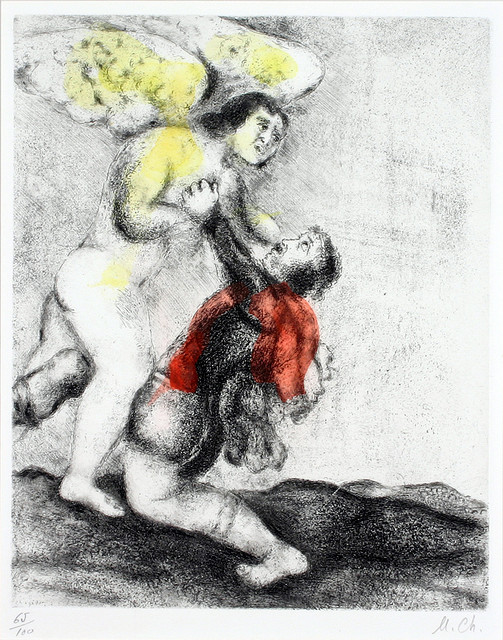
“I bought someone else’s lemon. What a ball-breaker that guy is! But, I’ll live. Lesson learned. Goodbye house on Jabbok.”
As we head into the New Year let’s take a moment to not look back…
Ah, yes.
Sentimentality is that taskmaster which keeps us longing for the leeks and garlic of Egypt, the known-knowns of past life, up to and including slavery.
Sentimentality is gate keeper to the past, fending off reality to preserve sugar-plum memories.
Sentimentality serves as wooer, policy maker and candlestick maker, ergo, The Great Society (aka “Let’s help the little people and feel good about ourselves in the process”, affirmative action (see The Great Society for further social science mishaps), education (aka job-security for union workers), amnesty (aka imported votes for Progressive Democrats) and multiculturalism (aka “We promote “Diversity” here, just stay off my lawn and don’t get near my rights, you fools.”)
Sentimentality, the emo that keeps on giving, will keep an angry woman ever angry; never forgiving. For her the past will be kept stewing, waiting for the next victim to be boiled alive.
Sentimentality will fight fires by removing the oxygen from the room: “This is the way we have always done it.”
Sentimentality is not tradition. It is more like unclaimed baggage that keeps going around on the airport turnstile day after day. You watch it to see if anyone claims it. If not it’s yours to drag around forever.
Sentimentality chooses the moldy and crusty bread of the past over the fresh gluten free, sugar-free crackers of the present ala “This white bread reminds me of mom.”
Sentimentality can be good wine turned into vinegar; old wineskins never replaced.
Sentimentality is the troll who guards the bridge to the New Year. The troll demands a toll. (Just tell the little bugger, ”I paid years ago, be off with you or I’ll call my Father Time. He’ll kick your little troll butt!”)
Sentimentality calls up past fears and dreams for advertised future benefits, benefits created at any cost to reality. See the Social Security trust fund. See the Barney Frank everyone-needs-a-house bubble machine that unleashed the Kraken upon world finances when the bubbles burst.
Sentimentality wants to relive the civil rights and war protests of the sixties and invoke the depression era bindle-bums of the thirties. OWS Millennials ‘must’ ‘re-live’, record and recreate a diorama of those events from a BA degree in Identity Politics perspective. The grapes of wrath must be re-trampled. Social justice must be served with an order of the freshest iPhones.
Sentimentality “keeps me hanging on” by a thread of delusion. “Marriage is secular, a right, a ‘love-in’.” Sentimentality says “I do” to whatever makes me feel… sentimental. And, sentimental makes me feel all gooey inside like…cable TV lovers.
Sentimentality demands that Mother Earth be saved from manmade people while avoiding fact-see leftist Pope Francis for further encyclical faldera. Does the Pope realize that the Green Movement believes that overpopulation of the world is the problem? Does the Pope realize that he is actually promoting abortion, assisted-suicide and humanist population control? (BTW: does the Pope even understand that capitalism fills the coffers of DisneyVatican?) And, forget “Seasons in the Sun”. We may be facing an Inferno or an Ice Age depending on which way the inverted dated is put up on the overhead. ALGore Rhythm has predicted inverted hockey stick apocalyptic weather conditions to occur at any second now. And this, my friends, despite the fact that CO2 makes growing things…green! We are told by dogged Gaia loving-tenure-loving-paycheck-loving scientists that CO2 is not green ‘making’ ‘stuff’ when man is involved. Mankind only creates off-green “problems,” “problems” that are only resolvable with enormous sums of green taxpayer money. And, to increase our awareness of the right uses for CO2 the greenie bible Mother Earth News reportedly reports “green is god, dude, especially when rolled and smoked.” Anyway “It’s hard to die when all the birds are singing in the sky.”
Sentimentality: a Disney movie replaying your childhood over and over. You know, the time you spent fantasizing about being princess as a young boy. Animated cels have always portrayed our deepest feelings, the best of our culture and the highest aspirations of our humanity-remember? Who needs reality when you have “Frost”?
Sentimentality is that trampoline you keep in your back yard just in case you need to jump up and down endlessly to walk away from the back and forth of everyday life.
Sentimentality gets an Enlightened Epicurean Scientism big bang out of a singular boson appearance but considers God’s silhouette passé.
“A sentimentalist“, Oscar Wilde wrote, “is one who desires to have the luxury of an emotion without paying for it”.
Use “Sentimentality” in a sentence/s: “I prefer my sentimentality over tradition, dudes. Tradition is so predictable whereas ad hoc sentimentality ushers in a new age of Progress as well as a proto-social justice that protests everything that isn’t sentimental.”
Sentimentality as cultural entrenchment, as socio-political-economic-education policy-see Spoilt Rotten: The Toxic Cult of Sentimentality (subtitle in US editions: How Britain is Ruined by Its Children) by Theodore Dalrymple. Who could resist this book with chapter titles like these: Chapter Three: “The Family Impact Statement”, Chapter Four: “The Demand for Public Emotion”, Chapter Five: “The Cult of the Victim”, Chapter Six: “Make Poverty History!”
Sentimentality-I could go on but, at this point, if I look back, I just might become sentimental. I won’t look back. Yes, there were good times but I keep those memories like a locket around my neck. And, don’t worry. Good memories have a way of making themselves known and sustaining you at the right time-that is if you create them first. (The Israelites used to create stone monuments as a place of remembrance where Jehovah had intervened. They did not carry the monument around with them. The thought that God is Infinite-Personal became a fixed place in their memory.)
Looking back, as one who was told not to look back, did not work out well for Lot’s wife. She may have very well thought that God was like her-sentimental about what someone holds dear, in this case her life in Sodom. She may have very well thought that God would not destroy a place she called home. She got it wrong.
A pillar of salt goes nowhere in life.
A pillar of the community!
~~~~~
Who needs the shallowness of sentimentality when you can have full-bodied hope! And, I’m not talking about “Hope” as found in the “Hope and Change” campaign come-on that was used to lull Millennial lemmings to follow Obama over the cliffs of insanity.
I am talking real hope. And, real hope includes distancing yourself from sentimentality and going forward with God into sublime reality, as the Apostle Paul described here in his letter to the Church at Rome (Chapter 4-5):
“…since we believe in the one who raised from the dead Jesus our Lord, who was handed over because of our trespasses and raised because of our justification.
The result is this: since we have been declared “in the right” on the basis of faith, we have peace with God through our Lord Jesus the Messiah. Through him we have been allowed to approach, by faith, into this grace in which we stand; and we celebrate the hope of the glory of God.
That’s not all. We also celebrate in our sufferings, because we know that suffering produces patience, patience produces a well-formed character, and a character like that produces hope.
Hope, in its turn, does not make us ashamed, because the love of God has been poured out in our hearts through the holy spirit who has been given to us.” (emphasis mine)
The other day I walked as usual during my lunch hour. Working in a downtown Chicago office affords many interesting paths for my walking and praying. That day I chose Millenium Park, thankful for some open space and towering blue sky.
Walking and praying are complimentary actions for me. They are complimentary in that praying to advance the Kingdom of God is coupled to my physical action of going forward, of not being static or complacent. Walking increases my heart rate, my breathing also becomes faster and deeper. As I walk every breath then becomes a prayer uttered out of the rhythm of my heart, mind, body and soul. Beyond this, walking and praying are often the only actions I can take when I am told to wait on the Lord.
That day, walking and praying, I lifted up the needs of others and my own very pressing needs. As I did so I clearly heard these words from the Holy Spirit:
“Enter in His gates with Thanksgiving
And into His courts with praise.”
In that moment I understood that God was acknowledging my intercessions and supplications. I felt a child-like pleasure in His notice of me. God was calling me into his presence.
In a sermon by C.S. Lewis written down in a book by the same name, The Weight of Glory, this moment was captured for me:
“For glory means a good report with God, acceptance by God, response, acknowledgement, and welcome into the heart of things. The door on which we have been knocking all our lives will open at last.
Perhaps it seems rather crude to describe glory as the fact of being “noticed” by God. But this is almost the language of the New Testament. St. Paul promises to those who love God not, as we should expect, that they will know Him, but that they will be known by Him. (1 Cor. 8:3).”
That day, not only was God acknowledging my words but His invitation to “Enter in His courts…” revealed that He wanted the object of His love, me, to be in His presence. My giving God praise and thanksgiving would realign my objectivity so that one day I would be in position to know the pleasure of the inferior in His words to me: “Well done thou good and faithful servant.”
“Apparently”, as C.S. Lewis also wrote in Weight, “what I had mistaken for humility had, all these years prevented me from understanding what is in fact the humblest, the most childlike, the most creaturely of pleasures-nay, the specific pleasure of the inferior: a beast before men, a child before its father, a pupil before his teacher, a creature before its Creator.”
Lewis, again in the same book, also wrote that “Glory, as Christianity teaches me to hope for it, turns out to satisfy my original desire (the specific desire of the inferior) and indeed to reveal an element in that desire which I had not noticed. By ceasing for a moment to consider my own wants I have begun to learn better what I really wanted.”
A New Year is upon us. I will cross the threshold of this New Year and “Enter in His gates with thanksgiving and into His courts with praise.” I do so as an adopted child anxious to drink joy from the fountains of joy.
“We have entered, as I see it, a spiritual limbo. Our educational institutions are no longer the bearers of high culture, and public life has been deliberately moronised. But here and there, sheltered from the noise and glare of the media, the old spiritual forces are at work” Roger Scruton
*****
“When a common culture declines, the ethical life can be sustained and renewed only by a work of the imagination.”-Roger Scruton
*****
“Jesus prayed, “This is eternal life, that they may know You . . .” (John 17:3). The real meaning of eternal life is a life that can face anything it has to face without wavering. If we will take this view, life will become one great romance— a glorious opportunity of seeing wonderful things all the time. God is disciplining us to get us into this central place of power.” Oswald Chambers
*****
“No power on earth or in hell can conquer the Spirit of God in a human spirit, it is an inner unconquerableness.” Oswald Chambers
*****
To those who have had no agony Jesus says, “I have nothing for you; stand on your own feet, square your own shoulders. I have come for the man who knows he has a bigger handful than he can cope with, who knows there are forces he cannot touch; I will do everything for him if he will let Me. Only let a man grant he needs it, and I will do it for him.” The Shadow of an Agony,Oswald Chambers
*****
“If we wish to erect new structures, we must have a definite knowledge of the old foundations.” John Calvin Coolidge
*****
Atheism is a post-Christian phenomenon.
*****
If social justice looks like your hand in someone else’s pocket then you are stealing.
*****
“In Sweden, giving to charity, absurdly, came to be considered a lack of solidarity, since it undermined the need for the welfare state.” – Roland Martinsson
*****
“…to love democracy well, it is necessary to love it moderately.” Alexis de Tocqueville
*****
Capitalism seeks to help others through a servce or product it provides. Free Market Capitalism is the most moral and fair economic system available to man. Capitalism augments personal growth, responsibility and ownership. Charity flourishes under capitalism. Charity dies under subjective “fair share” government confiscatory policies. Socialism redistributes ambivalence and greed.
*****
“We are to regard existence as a raid or great adventure; it is to be judged, therefore, not by what calamities it encounters, but by what flag it follows and what high town it assaults. The most dangerous thing in the world is to be alive; one is always in danger of one’s life. But anyone who shrinks from that is a traitor to the great scheme and experiment of being.” G.K. Chesterton
*****
Any intelligent fool can make things bigger, more complex, and more violent.
It takes a touch of genius – and a lot of courage – to move in the opposite direction. Albert Einstein
*****
“You shall know the truth and the truth shall make you odd.” Flannery O’Connor
*****
“There is but one good; that is God. Everything else is good when it looks to Him and bad when it turns from Him.” C.S. Lewis, The Great Divorce
*****
“Though He slay me, yet will I trust Him” (Job 13:15).
*****
God’s grace is not about the allowance for sin. God’s grace is about the conversation God allows regarding sin.
*****
From the book of Proverbs: We are not to favor the rich or the poor. We are to pursue justice.
*****
“Always keep in contact with those books and those people that enlarge your horizon and make it possible for you to stretch yourself mentally.” Oswald Chambers
*****
One goldfish says to another, “If there is no God who keeps changing the water?”
*****
“The truth is always there in the morning.”
From Cat On A Hot Tin Roof script – playwright Tennessee Williams
*****
God blesses those who hunger and thirst for justice, for they will be satisfied.
*****
“America’s greatness has been the greatness of a free people who shared certain moral commitments. Freedom without moral commitment is aimless and promptly self-destructive.” John W. Gardner
**
“Men of integrity, by their very existence, rekindle the belief that as a people we can live above the level of moral squalor. We need that belief; a cynical community is a corrupt community.” John W. Gardner
*****
“In the world it is called Tolerance, but in hell it is called Despair, the sin that believes in nothing, cares for nothing, seeks to know nothing, interferes with nothing, enjoys nothing, hates nothing, finds purpose in nothing, lives for nothing, and remains alive because there is nothing for which it will die.” Dorothy L. Sayers
*****
“Art, like morality, consists of drawing the line somewhere.”
G. K. Chesterton
*****
“The battle line between good and evil runs through the heart of every man.” Alexander Solzhenitsyn
*****
This is what the LORD says:
“Stand at the crossroads and look;
ask for the ancient paths,
ask where the good way is, and walk in it,
and you will find rest for your souls.
But you said, ‘We will not walk in it.’
-The prophet Jeremiah, 6:16
*****
“…our common task is not so much discovering a truth hiding among contrary viewpoints as it is coming to possess a selfhood that no longer evades and eludes the truth with which it is importunately confronted.” James McClendon, Ethics: Systematic Theology, Vol. 1
*****




















 Cindy Wity