You could read this “Danger” sign at face value, decide to heed its warning and not take your canoe over the dam. Or, you could read the sign as an inconvenience, as someone telling you what to do. You have the freedom to ignore the warning. The consequences still pay out in full.
There are signs everywhere informing our decisions. We make choices based on past experience and present warnings. We may proceed or we may stop and change course.
Signs just give us the information. And again, we may trust the sign and heed its warning. Or, we may disregard the sign and all credible evidence and choose to go forward, knowing full well that there will most likely be consequences. In this case, I would take the path most chosen… by wise people. I would go directly ashore after reading the sign.
Seeing this “Danger”sign today as I walked along the river I was reminded of several critical thinking dialogues I have engaged in. Like the river sign, there were warning signs or red flags that the discussion I was having, the canoe trip, would soon require a commitment to the truth at hand.
Often in these dialogues the person I am conversing with will begin dismissing out of hand anything I say that is contrary to their zeitgeist. My position is considered without merit, without ‘value’ in their eyes, based on their already altered life. They soon begin repeating the party line phrases they’ve heard others in their hive repeat.
As the communication between the two ships “passing in the night” nears, the “Danger” sign of truth I am quickly identified as a Kool-Aid drinker,” as too stupid and no longer human enough to understand that the sign is “more unconventional than life itself and not in keeping with what people really should think.” I am often told that the sign can not be accepted at face value since science has proved otherwise.
From being dehumanized I am then in turn objectified. Now, any human experience I could share that would quickly prove the “Danger” sign to be absolutely valid is deemed as just morally relative existentialist personal experience. Accordingly, in this person’s worldview, there can be no Absolute Truth when ‘feelings’ are on the line. To them only subjective feelings (now called ‘rights”) matter. The feelings of others may or may not matter depending on whether you are “in” or “out”.
As the conversation continues the Skull and Crossbones is raised to threaten me, to keep me at bay. The broadsides begin. I am broadsided with labels.
Labels? Why labels?
Socially, for the sake of “diversity;” paying homage for their vice to virtue.
And, labels give the ‘Socially Privileged’ the means to socially profile someone even though they supposedly “hate profiling” (i.e., SPLC).
Inordinate labels give all sorts of people ‘outs’ and disclaimers.
Drive-by labeling allows the hive-minded self-described “diverse” to avoid the truth and, more importantly, enables them to avoid bearing individual responsibility for the mal-effects of their broad brush labeling via tweets, social programs, ‘right’s agendas, discriminatory government policies and public education (reprogramming) all of which defines who is ‘in’ and who is ‘out’ under the Mad magazine-like masthead of “Diversity Means Inclusive: “What-me-Worry?””
Labeling enables moronic activism and anti-social behavior (i.e., White Privilege Conference). The ‘Labelers’ label the ‘other’ as ‘bad’ ~ he/she is not one of us ~ invoking God-like privilege.
Today, being “diverse” means that you can appear all-wise “inclusive” with your ‘peeps’ by excluding, denigrating and literally hating people based on labels.
Talk to a homosexual about their homosexuality. You can’t because you are labeled “homophobic.”
Consider this recent tweet conversation between @witycindy and @torqueflite a same-sex marriage devotee.
@WityCindy Tell you what…let's part ways. I can't continue reading all of this hateful stuff grounded in homophobia.
When all was said and done Cindy Wity @witycindy was labeled “homophobic”, a “hater”, a “Kool-Aid” drinker, a “bigot,” “a pathetic wretch”. (They labeled Christ, too. @witycindy is in Good Company.)
I believe that you can read the whole conversation for yourself on twitter. (BTW: I made screen capture pdfs of @torqueflite’s public tweets just in case they are erased.)
There are many topics where labeling is used to abort meaningful conversations. Of course politics is one of them.
You can’t disagree with Obama’s fiscal, domestic or regulatory policies, his back door fiats or his lack of coherent foreign policy without being labeled “racist.” You are considered a “racist” solely for not ‘accepting’ the half-black Obama’s total incompetence, his deception or his distaste of America carte blanche.
Labeling is meant to dehumanize the ‘other,’ creating an object of derision.
Hitler labeled the Jews “Undesirables.”
Stalin labeled those who peasants who did not want to participate in collectivism as “kulaks.”
“They often used the term to label anyone who had more property than was considered “normal,” according to subjective criteria, and personal rivalries played a part in the classification of enemies. Historian Robert Conquest argues:
The land of the landlords had been spontaneously seized by the peasantry in 1917-18. A small class of richer peasants with around fifty to eighty acres had then been expropriated by the Bolsheviks. Thereafter a Marxist conception of class struggle led to an almost totally imaginary class categorization being inflicted in the villages, where peasants with a couple of cows or five or six acres more than their neighbors were now being labeled “kulaks,” and a class war against them declared. (from Wikipedia)”
This labeling sounds a lot like a Barrack Obama’s political campaign of labeling the ‘wealthy’ as the “1%” and Christian gun owners as ”bitter clingers” ~ all sounding as if pulled from Saul Alinsky’s style book: “Ridicule is man’s most potent weapon.
Labels? Why labels?
The religion of moral relativity or ‘Diversity’ is evangelistic. With its labels and bumper stickers it preaches to us, telling us to “COEXIST” in a world where you are now ‘redirected’ to be PC, to say what you do not believe and can never question under the tyranny of moral relativism. My Lord is nothing like this.
***
If you believe in a god who accepts everything you do and denies you nothing would this god be a good parent or a Good Shepherd? In truth, such a god is a man-made idol created in keeping with a self-generated belief system, a belief system labeled as “Diversity.”
Like the “Danger-Dam”sign there are plenty of God’s Signs and Wonders pointing us away from sin and darkness and the wide path leading to destruction. Labeling others, as was shown above, is used to tear down those signs.
Labeling, again, as shown above, dismisses by verbal abuse and bullying the most important of conversations, those that involve truth: “Did God really say…” and “Truth. What is truth?” The Evil One does NOT want this conversation to happen. The Evil One would rather crucify the One with Truth.
Label me “In Christ” and willing to discourse about truth.
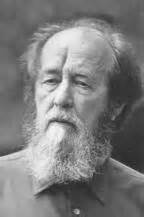
It may have been in the later 1970s that I became aware of Alexander Solzhenitsyn. I don’t recall exactly what brought him to my attention. It may have been news reports of the Soviet Union’s exiled dissident. Solzhenitsyn had been deported from the USSR and stripped of Soviet citizenship in 1974. He later came to live in the US for almost twenty years.
With the admixture of the Cold War, the horror stories coming out of the USSR, reports of Solzhenitsyn’s moral courage and my youthful desire to make a difference in the world I soon became enthralled by Russia and Solzhenitsyn.
During the 1980s I read Solzhenitsyn. I read all three volumes of The Gulag Archipelago, an eye-opening history of the Soviet police state and One Day in the Life of Ivan Denisovich, a novella. These works forever etched on my mind the Stolypin cars used to resettle passenger and livestock together; Stalin’s Cult of Personality, his purges, his deportations, his gulags and his murder of tens of millions of people.
In addition to media reports about Soviet atrocities in the 1980s I traveled to Poland for business purposes. I used a polish translator. It turned out that the translator, a Pole, was once a CIA agent who worked inside Russia. He told me about the atrocities done to the Poles by the USSR and the KGB. He hated what the Soviets had done to his people. From my perspective, except for the occasional flower stands on the streets, Warsaw and Bialystok looked gray and depleted of life from the effects of Communism.
Solzhenitsyn, an author who documented life under Stalin with short stories, novels and poems that included harsh critiques of Stalin and totalitarianism, survived prison camps – the gulags – and assassination attempts by the KGB. But, Solzhenitsyn kept writing, speaking out against the evil being done to the Russian people. This is why Solzhenitsyn is a hero to me unlike any ‘hero’ regarded today. This man suffered for the truth he did not hesitate to speak.
Born the month that Dwight D. Eisenhower was elected to the presidency, I was raised during the Cold War days (1947-1991). I recall the election of John F. Kennedy and the US ‘cold shoulder’ standoffs with the Soviet Union and the Eastern Bloc.
The two superpowers, the US and the USSR, stood diametrically opposed politically, economically and ideologically. Solzhenitsyn would speak to one of those powers when he gave his Harvard commencement address on June 8, 1978 – A World Split Apart. For some context, the speech was made the summer after Jimmy Carter was sworn in as President on January 20, 1977.
I came across the speech again yesterday. I reread it on the train last night, on my way home from work.
Though I prefer shorter posts I would like to share the power of these words with you plus some poignant commentary about Solzhenitsyn’s works and words from the book The Conservative Foundations of the Liberal Order by Daniel J. Mahoney.
First, from the book, Chapter 7, The Totalitarian Subversion of Modernity: Solzhenitsyn on the Self-deification of Man and the Origins of the Modern Crisis are some words of warning for any democratic impulse:
“The experience of totalitarianism, that “twentieth-century invention,” as Alexander Solzhenitsyn once called it, ought to have permanently discredited all facile or naïve progressivism. But as the previous chapter attests, too many in the West mistakenly identified the fall of Communism in the East-central Europe and the Soviet Union with “the overflowing triumph of an all-democratic bliss.” The writings of Solzhenitsyn (1918-2008) provide unique resources for understanding both the evils of totalitarianism and the limits of democratic euphoria.”…
Regarding Solzhenitsyn publishing of August 1914 in 1972:
“If August 1914 provided a devastating critique of the sclerotic character of the old Russian regime, of the unwillingness of its purblind bureaucrats and courtiers to adjust thoughtfully to conditions of modernity, it is also clear that Solzhenitsyn had no sympathy for those left-liberals then or in his time who flirted with nihilism, apologized for terrorism, and showed contempt for the best spiritual and cultural traditions of the Russian nation. The luminous essays by Solzhenitsyn and his collaborators in From Under the Rubble contemplate a Russian future freed from evils of ideological despotism. At the same time, its contributors warned against the slavish imitation of the worst features of contemporary Western democracy, including its scientism, subjectivism, and rejection of the classical and Christian resources of the Western tradition.” (emphasis mine)
The chapter then goes on to speak of Solzhenitsyn’s indictment of Marxism and collectivism, as well, his “Augustinian defense of freedom – but no special privileges – for religious believers.”
Under the chapter’s section The Fragility of Modern Liberty:
“Solzhenitsyn, though, remains what has always been – an eloquent and principled defender of liberty and human dignity. Yet, Solzhenitsyn is acutely aware of the fragility of the Enlightenment principles that under gird the regime of modern liberty… Solzhenitsyn’s refusal to sever freedom from an order of truth sets him apart from every radically modern articulation of human liberty and makes him suspicious in the eyes of those who identify liberty with the rejection of all natural or divine limits.” (emphasis mine)
There is way too much depth about Solzhenitsyn and the weakness of our modern democracy in The Conservative Foundations of the Liberal Order for me to relate here and now. I highly recommend the book to you.
Now to Solzhenitsyn’s words:
Intro: The Soviet and Russian novelist, dramatist, and historian during his commencement address delivered at Harvard University, June 8, 1978, without wavering, noted that the problems of the two superpowers were not the military strengths and ideological differences of each turned against each other but rather their lack of a moral center and moral courage.
Because Solzhenitsyn was addressing a western audience, an elite Western audience at Harvard, his speech was decidedly a stinging indictment of the West – its materialism and it’s almost “unlimited freedom of choice of pleasures, its self-serving, inbred media and its disavowal of its spiritual roots:
“However, in early democracies, as in the American democracy at the time of its birth, all individual human rights were granted because man is God’s creature. That is, freedom was given to the individual conditionally, in the assumption of his constant religious responsibility. Such was the heritage of the preceding thousand years. Two hundred or even fifty years ago, it would have seemed quite impossible, in America, that an individual could be granted boundless freedom simply for the satisfaction of his instincts or whims. Subsequently, however, all such limitations were discarded everywhere in the West; a total liberation occurred from the moral heritage of Christian centuries with their great reserves of mercy and sacrifice. … State systems were becoming increasingly and totally materialistic. The West ended up by truly enforcing human rights, sometimes even excessively, but man’s sense of responsibility to God and society grew dimmer and dimmer.” (emphasis mine)
And…
“If humanism were right in declaring that man is born only to be happy, he would not be born to die. Since his body is doomed to die, his task on earth evidently must be of a more spiritual nature. It cannot be unrestrained enjoyment of everyday life. It cannot be the search for the best ways to obtain material goods and then cheerfully get the most of them. It has to be the fulfillment of a permanent, earnest duty so that one’s life journey may become an experience of moral growth,so that one may leave life a better human being than one started it. It is imperative to review the table of widespread human values. Its present incorrectness is astounding. It is not possible that assessment of the President’s performance be reduced to the question how much money one makes or of unlimited availability of gasoline. Only voluntary, inspired self-restraint can raise man above the world stream of materialism.”(emphasis mine)
And…
“It would be retrogression to attach oneself today to the ossified formulas of the Enlightenment. Social dogmatism leaves us completely helpless in front of the trials of our times. Even if we are spared destruction by war, our lives will have to change if we want to save life from self-destruction. We cannot avoid revising the fundamental definitions of human life and human society. Is it true that man is above everything? Is there no Superior Spirit above him? Is it right that man’s life and society’s activities have to be determined by material expansion in the first place? Is it permissible to promote such expansion to the detriment of our spiritual integrity?” (emphasis mine)
In the speech Solzhenitsyn speaks of “…our Earth – divided against itself;” “…all of a sudden the twentieth century brought the clear realization of this society’s fragility.;” ”…the persisting blindness of superiority;” “A decline in courage may be the most striking feature that an outside observer notices in the West today.;” “…and the decline of courage, at times attaining what could be termed a lack of manhood, is ironically emphasized by the occasional outbursts and inflexibility on the part of those same functionaries when dealing with weak governments and with countries that lack support, or with doomed currents which clearly cannot offer resistance.. But they get tongue-tied and paralyzed when they deal with powerful government and threatening forces, with aggressors and international terrorists.”
Sounds familiar, doesn’t it? Even when echoed from the distance of 1978.
Take a look at what drives you and perhaps you will see why America is no longer a nation under God, no longer a nation of civil courage, of moral decency. As Solzhenitsyn points out in his address the West has become humanist anthropocentric: “the proclaimed and practiced autonomy of man from any higher force above him…with a willful denial of a “Supreme Complete Entity.”
Liberty and the rule of law is not enough to keep us right side up. “Whenever the tissue of life is woven of legalistic relationships, this creates an atmosphere of spiritual mediocrity that paralyzes man’s noblest impulses.”
And, perhaps you will now understand why people would vote for a president who uses class warfare rhetoric to promote the sands of material security as foundational to life’s happiness and not the bedrock of spiritual fortitude.
The cabin reservation was made the year before when Heinz turned in his vacation notice to his boss. Another machinist would have to run the vertical mill for the week Heinz was gone. Now it was just a matter of gathering all of the supplies he needed for the week and then head north to Rice Lake, Wisconsin. He also had to make sure he left things in their proper order.
Heinz, a tool and die maker for a small CNC machine shop on the near west side of Chicago had worked as a machinist for over thirty years. Apprenticed in Hamburg, Germany as a teenager he came to America at the age of twenty with his new wife Gertrude. He hoped to start his own machine shop with her as office manager but Gertrude contracted Polio during their voyage to America. When Gertrude died Heinz went on alone. His work became his closest partner. He accepted all the job orders given to him and often worked twelve to fourteen hours a day six days a week. The precision of his craft was his sole interest.
Over time Heinz had become the shop’s top machinist. It was said that if Heinz couldn’t form the part, no one else could. He apprenticed the younger guys but in this he didn’t have much patience or pleasure. He didn’t appreciate their cavalier attitude toward working with precise tolerances. If the drawing said + or – .001 mm then that is what was required. He didn’t accept anything less than the perfection of specific numbers measured with fine gauges. He frowned at sloppiness and shoddy workmanship.
Shaping a block of steel and the cinnamon smell of the Tap Magic lubricant were elemental to Heinz’s way of life as were exact order and a respect for the tools of his trade. So it was that every night before he locked his eight drawer wooden tool chest he wiped down each of his machinist’s tools. He carefully cleaned his micrometers, the digital veneer calipers, the inside calipers and the steel rules. He wire-brushed the metal files and zeroed the dial indicators and digital protractor. He wiped and reset the mechanic’s square to a right angle and inspected the scribe and pick. He lined up the telescope gauges, precision level, thread gauges, surface gauges and reamers each into in their drawer, carefully placing each measuring instrument in its proper place on the green felt liner.
After cleaning and inspecting his tools Heinz would brush the metal filings off of his work bench. He would then sweep up the curly cue metal shavings around his mill and beneath his work bench. He dabbed up the gritty oil at the foot of his mill and would then throw Oil Dry over it to soak up the tooling oil over night. He did this routine every day and again today at 4:15. At 4:30 pm he punched out and left for a week of vacation.
During the week prior to his vacation Heinz purchased cans of groceries enough to last him a week. He bought three bottles of Steinhäger and a bottle of Schnapps. He knew he could find some good German beer in Germantown, Wisconsin, a stop along the way.
Though he lived his life in solitude Heinz never partook of alcohol during the time he wasn’t on vacation. He never went to a tavern. Instead, he always sought to maintain the austerity and self-control he thought a man should have. Precision marked the beginning and end of each of his days.
Heinz packed his 1960 BMW 700 and left that Friday night for Rice Lake, Wisconsin. The drive north to Germantown took Heinz about two hours from his Chicago apartment. Once there he quickly found the store where he had purchased his beer last year. He purchased four 12-packs of Warsteiner Premium Verum and a few cigars. He placed six bottles of Warsteiner into a cooler along with the schnapps. The cigars were placed in the glove compartment.
Rice Lake was another six-hour drive north. Heinz didn’t stop for dinner at one of the many supper clubs advertised along the way. He chewed on some beef jerky purchased with the beer. Driving at night was all the more difficult for Heinz because of Heinz’s night blindness. He gripped the wheel at ten and two and stared straight ahead. The white lane lines were ever in his view like tolerances to be held.
He entered the city limits of Rice Lake and drove through the only intersection with a stop light. He proceeded past the town and turned onto a gravel road about four miles north. After winding along a deeply grooved dirt road through a dense opine forest he came to an opening revealed by the office’s front porch light. He pulled over and stopped the car. Virginia, the cottage owner, greeted Heinz from the enclosed porch. A remote TV weather report sounded a cold front coming out of Superior Wisconsin.
“Heinz, it’s good to see you again. I have your cabin ready.” She opened her guest register. “It’s gonna get chilly tonight. Down to 32 degrees. You’d better get that fireplace going. There’s some dry wood along…you know where it is.”
Heinz nodded with blood-shot eyes. He handed her a check for the week’s rent and looked around at the small office attached to the house. The same carved woodsman cuckoo clock hung on the wall over the same cluttered desk. Heinz looked at his digital watch. The wall clock was six minutes slow or stopped. He was too tired to care.
Above the office’s small whirring refrigerator hung the same 1975 Norman Rockwell calendar from Martin’s drugstore. Nothing had changed. Nothing was out-of-place. He felt his jaw slacken and he let out a sigh of relief. The smell of cedar somewhere in the room replaced the Tap Magic smell of his hands.
“Are you still cooking, Virginia?” Heinz asked.
“Will sauerbraten, red cabbage and spaetzle do?
“Only if you join me for dinner tomorrow night. I will bring the beer”
“It’s been a year, Heinz.”
“Yes, it’s been a year to the day and …two hours. I better get going and get that fire started.”
Heinz drove his car around to the one room cabin a quarter of a mile from the office. It was too dark to see the lake but Heinz could feel the expanse before him. A patter of rain began to fall on the cabin roof. Pine boughs swooshed around him with each gust of wind coming off the lake. Heinz unloaded the cooler and some boxes from the trunk of his car. He carried them into the cabin and set them on the floor.
Without turning a light on he found the bed where it had been the year before and lay down. The constant focus on the road and the oncoming strobes of light had given Heinz a fierce headache. His neck was stiff, his forearms were tight and his hands still seemed to be clutching the steering wheel. He closed his burning eyes.
The rain began to fall more evenly. The wind was howling plaintively outside the cabin windows as if nature was trying to get in the cabin. But with his eyes closed the monotonous lane soon appeared again. After a few minutes he let his hands release their hold on earth.
Through a part in the calico curtains, a ray of sun shot through the room, glinted off a copper spoon hanging on the wall and struck the corner of Heinz’s eye. He jerked upright wondering if he had overslept. He looked at his hands if they would tell him what he needed to do. After a couple of minutes he stood up and set the coffeepot going. As he turned on the burner he wondered if Jason, his latest apprentice, had remembered to turn on the mill’s lube pump. He bit is lip and then released the thought. Heinz had trained him well.
While Heinz stood on the porch surveying the lake the percolating coffee pot boiled over, sputtering coffee and grounds out of the pot’s spout. “Damn,” he thought. The red-hot burner below sizzled and hissed. Heinz came in and set the coffee pot on another burner. He dabbed up the watery coffee grounds with paper towels and then poured himself a cup of coffee. This action made him think of Gertrude. She would have fussed over the mess he’d made but only for a moment. Then she’d take his hand and say “You’re not at work. Go sit down. I’ll take care of it.”
He opened a can of deviled ham and spread it on a slice of pumpernickel bread. From the cooler he took out a hard-boiled egg. He ate thinking about work and the whir of the lathe. His knee bounced up and down nervously until he heard footsteps on the porch. It was Virginia. She cracked the door open.
“Hi, just came to check on you. You find everything alright?”
“Yah, I’m good here.”
“I have row-boat if you are interested in some fishing.”
“I may go out this morning to look around. The fog is lifting.”
“You know where to find me.”
“Yah, I will be over soon.”
Virginia left and Heinz returned to his breakfast. The size-on-size fit of everyday life was being replaced by nature’s uncontrolled bluntness. When he had finished breakfast Heinz fell back into his chair and let his shoulders drop. He wasn’t going to roll up his sleeves this week. The memory of Gertrude and the presence of Virginia would see to that.
Stiff from sleeping most of the night with his feet off the side of the bed Heinz ambled up to the office. He was hoping his back and legs would soon loosen up. When he got to the office Virginia handed him the key to unlock the row-boat. When she handed him the oars she joked, “OK, mate, here’s your gear.” She had packed him a lunch.
“I thank you ma’am. Have I been away a year? Does time stand still here? You haven’t changed a bit.”
“Only that old cuckoo clock stands still. I have to keep moving so the wrinkles don’t catch up.”
“Hah, you’ve done that! I’ll be back after lunch.” He headed out the door and then turned back to poke his head inside the doorway. “Virginia, tonight…?”
“Still on. I’ll be cooking this afternoon. Catch me a lake trout and I’ll cook it. You clean it and I’ll cook it.”
“It’s a deal except I already caught me a can of herring. It’s in my cabin already to go.”
“You know the way to a women’s heart ~ prepared food. See you tonight.”
With that Heinz walked down to the reedy shoreline where the row-boat was beached. He unchained the boat, grabbed the oars and his bag lunch and pushed off the shore.
Heinz rowed slowly measuring the strength in his arms against the return distance. When he had reached the middle of the lake Heinz stopped rowing and took in the familiar surroundings: a featureless grey sky domed the lake today. The water lapping around his boat rippled with each tickling of wind. Along the shoreline shoulder to shoulder pines stood in a dense lattice-work of deep blue-green. It was to this spot that Heinz returned every year. There were no tools, no work orders – only time and space in the queue. It was here that life came to him outside the defined tolerances he worked with every day. And it was here that he sat in nature’s unfinished place, a precious commodity not mined and milled into an end product.
Heinz opened his bag lunch and pulled out a slice of pumpernickel bread and some Edam cheese. He opened a beer. While he ate and drank the lake breeze blew across his unshaven face. Hah!
Late in the afternoon Heinz rowed back to the shore. He grabbed his things and headed back to the cabin. Nearby a common bathroom offered a hot shower. He decided not to shave giving his hands some freedom from their regular duties. He showered and dressed in a clean pair of slacks and pullover shirt. He grabbed the tin of herring from the box and a cold six-pack of beer and headed over to the office.
As he arrived Virginia was finishing up registering a couple for the night. Heinz overheard them talking: they were on their way home from a week canoe trip outside of Ely, Minnesota. They were hoping for a hot shower. Heinz told them to wait a bit. The hot water had been used up during his shower. He offered them a couple of beers instead for their wait. They accepted and headed off to their cabin.
“Heinz, my dear, you know how to finesse the customers.”
“That hot shower finessed me.”
‘You didn’t shave.”
“A man has got to know his limits and mine is shaving while on vacation. When it gets to long I’ll mill it off.”
“Pour me a glass will you Heinz?”
Heinz poured Virginia a tall glass of beer and set it behind her on the kitchen table.
“Put on some music. I’ve got some old records next to the couch.”
Heinz sat on the edge of the couch and looked through the collection of LPs. He chose the Warsaw Concerto by Addisnsell. Rachmaninov would be for another night.
Heinz set two places at the kitchen table and lit the candle. The flame listed every time he came in and out of the room.
Virginia grabbed the plates and spooned on red cabbage and spätzle. She added sauerbraten to the plates. Dinner was served.
Heinz sat directly across from Virginia. The familiar food, the halo of candle light and the rush of arpeggios weakened his knees. He was glad to be sitting. Virginia’s face was radiant, awash with both red and gold. The hot stove had flushed Virginia’s cheeks and the candle light gilded her features. If angels cook then he must be in heaven.
Heinz and Virginia didn’t discuss Heinz’ work when they were together. Virginia understood Heinz’s passion for precision and his irritation with sloppy work. Virginia’s husband had been a tool and die maker for many years before he died. Like Heinz he had worked with tight tolerances each and every day. Virginia knew that Heinz’s visit’s to Rice Lake became a reprieve of sorts from the exacting measures that so drove his personality.
Heinz and Virginia would dine the same way each night. Heinz would spend the day alone and the night he spent with Virginia. There would share beer, schnapps, cigars, Rachmaninov, Dvorak, Chopin and Brahms. They would play cards and near the end of the night dance to polka music. A time of remembering and a time of letting go met together each night.
After those evenings Heinz would fall into a deep sleep. In the early morning hours vivid dreams would animate his sleep. He would see himself talking to him Gertrude about their new home in America. He saw his childhood home and the curs that came to their door for biscuits. He saw his father playing the violin while his mother cooked the family dinner. He saw his childhood school and saw himself in his short pants. He saw the shop in Hamburg where he apprenticed. He saw the trolley that he brought him to school. And his dreams always included a machine shop.
He dreamt of a 5 axis vertical mill, of fixtures and of metal shavings peeling off a turning steel bar. He could smell the cinnamon scent of Tap Magic and see his hands chocking a 4140 steel bar into the spindle of the lathe. He saw himself aligning-centering-cutting-drilling-boring – sculpting steel into precision gears. He saw himself being measured by a micrometer and a dial indicator checking spindle runout – Virginia holding the gauge! He saw himself checking hardness with a Rockwell tester and then falling off into deeper asleep again
As a strobe of morning sun came through the curtains laser-like onto his closed eyes half-asleep he would imagine the stamp of a time clock and bolt upright in bed. He would then sit rubbing the sun’s imprint from his eyes. In those waking moments each night’s quickly vanishing dream passed through his mind. What appeared to him in the night seemed to enact some absurdist play where memories – real people, times and objects – donned the surreal and came together on stage to wait for someone to come along and give meaning and direction to it all.
The days Heinz spent fishing he didn’t fish at all. He never brought fishing tackle or a rod with him to Rice Lake. Both he and Virginia knew that when Heinz said that he was going “fishing” he really meant that he needed to be alone. So it was that he would take the row-boat out to the middle of the lake and sit there letting time pass over him. Time could come and go as it pleased without the date time stamp his everyday life..
In the afternoons, before Heinz made the short walk up the hill to have dinner with Virginia he would settle into his cabin for nap. From a collection of LPs leaning next to the bureau Heinz would select an album of classical music. He would choose Frederick Delius’ tone poems: Song of Summer and A Walk to Paradise Garden or Dvorak’s New World Symphony or Debussy’s Clair de Lune and Reverie or Bach’s violin concertos. Bach had a way of resetting things for Heinz, of resolving any stress he felt in his neck and his hands.
After putting the needle down on the first track he would pull Virginia’s homemade afghan off of the high back chair and bring it with him over to the rug. Lying on the floor eyes closed and covered with the afghan, just as he had done so many times before listening to his father play the violin, the music coursed through him and down into his hands where it was released.
Heinz’s father was concertmaster of the Philharmoniker Hamburg. His mother played the organ in their Lutheran church. Heinz was taught the piano and was made to practice rigorously until he began his apprenticeship. The metronome which had kept the strictest of time was exchanged for a time clock.
On the last night before Heinz returned to Chicago Virginia cooked sauerbraten. Heinz placed birch wood and kindling into the fireplace and began a fire. He lit the all candles and chose Chopin’s nocturnes for the dinner music. He set the table.
Once again there was music and laughter and the shuffling of cards. And once again when the hour grew late they sat on the porch swing. Virginia would take his hands and hold them. As if blind she would trace their outline with her fingers, her eyes reading some unseen message. His hands were calloused and leathery from use. As she looked at them tonight she saw that they were etched with fine lines of dark grease like a charcoal drawing she had seen once. These hands, like her husband’s, had held steel stock to be turned and milled and chamfered, steel to be transformed from block to bolt, from stock to shaft. On this night friendship’s annealing process, a slow working stress relieving process that had both softened and solidified his soul over time brought tears to his eyes. And when she took his hands into hers he could sense the weight of what felt like a massive headstone of grief being taken from him. The night came to an end when he kissed her deeply and held her tightly under the chromatic gauze of the northern lights.
On Sunday morning Heinz packed his car and drove up to the office. Virginia was waiting at the desk preparing checkout bills for the guests. Heinz asked for the bill and she handed it to him. Heinz paid the bill and then looking at Virginia he said, “They broke the mold when they made you.”
With a smile she replied, “Well, then you old machinist, you’ll just have to come back and take some more measurements.”
Heinz smiled, “I’ll be back next year if you can stand it.”
“I’ll be right here with this old cuckoo clock ~ me and time standing still.
“Bye, kiddo.” Heinz kissed Virginia and headed out the door.
The Sunday trip driving back top Chicago took him most of the day because all the weekenders were heading home. When he finally reached his apartment he unloaded the car and put away his things. He set the alarm clock for 5:30 am.
The next morning he clocked in at 5:52 am. At 8:30, his break time, he had handed the shop manager his vacation request for the next year ~ two weeks off the clock for recalibration.
“We have entered, as I see it, a spiritual limbo. Our educational institutions are no longer the bearers of high culture, and public life has been deliberately moronised. But here and there, sheltered from the noise and glare of the media, the old spiritual forces are at work” Roger Scruton
*****
“When a common culture declines, the ethical life can be sustained and renewed only by a work of the imagination.”-Roger Scruton
*****
“Jesus prayed, “This is eternal life, that they may know You . . .” (John 17:3). The real meaning of eternal life is a life that can face anything it has to face without wavering. If we will take this view, life will become one great romance— a glorious opportunity of seeing wonderful things all the time. God is disciplining us to get us into this central place of power.” Oswald Chambers
*****
“No power on earth or in hell can conquer the Spirit of God in a human spirit, it is an inner unconquerableness.” Oswald Chambers
*****
To those who have had no agony Jesus says, “I have nothing for you; stand on your own feet, square your own shoulders. I have come for the man who knows he has a bigger handful than he can cope with, who knows there are forces he cannot touch; I will do everything for him if he will let Me. Only let a man grant he needs it, and I will do it for him.” The Shadow of an Agony,Oswald Chambers
*****
“If we wish to erect new structures, we must have a definite knowledge of the old foundations.” John Calvin Coolidge
*****
Atheism is a post-Christian phenomenon.
*****
If social justice looks like your hand in someone else’s pocket then you are stealing.
*****
“In Sweden, giving to charity, absurdly, came to be considered a lack of solidarity, since it undermined the need for the welfare state.” – Roland Martinsson
*****
“…to love democracy well, it is necessary to love it moderately.” Alexis de Tocqueville
*****
Capitalism seeks to help others through a servce or product it provides. Free Market Capitalism is the most moral and fair economic system available to man. Capitalism augments personal growth, responsibility and ownership. Charity flourishes under capitalism. Charity dies under subjective “fair share” government confiscatory policies. Socialism redistributes ambivalence and greed.
*****
“We are to regard existence as a raid or great adventure; it is to be judged, therefore, not by what calamities it encounters, but by what flag it follows and what high town it assaults. The most dangerous thing in the world is to be alive; one is always in danger of one’s life. But anyone who shrinks from that is a traitor to the great scheme and experiment of being.” G.K. Chesterton
*****
Any intelligent fool can make things bigger, more complex, and more violent.
It takes a touch of genius – and a lot of courage – to move in the opposite direction. Albert Einstein
*****
“You shall know the truth and the truth shall make you odd.” Flannery O’Connor
*****
“There is but one good; that is God. Everything else is good when it looks to Him and bad when it turns from Him.” C.S. Lewis, The Great Divorce
*****
“Though He slay me, yet will I trust Him” (Job 13:15).
*****
God’s grace is not about the allowance for sin. God’s grace is about the conversation God allows regarding sin.
*****
From the book of Proverbs: We are not to favor the rich or the poor. We are to pursue justice.
*****
“Always keep in contact with those books and those people that enlarge your horizon and make it possible for you to stretch yourself mentally.” Oswald Chambers
*****
One goldfish says to another, “If there is no God who keeps changing the water?”
*****
“The truth is always there in the morning.”
From Cat On A Hot Tin Roof script – playwright Tennessee Williams
*****
God blesses those who hunger and thirst for justice, for they will be satisfied.
*****
“America’s greatness has been the greatness of a free people who shared certain moral commitments. Freedom without moral commitment is aimless and promptly self-destructive.” John W. Gardner
**
“Men of integrity, by their very existence, rekindle the belief that as a people we can live above the level of moral squalor. We need that belief; a cynical community is a corrupt community.” John W. Gardner
*****
“In the world it is called Tolerance, but in hell it is called Despair, the sin that believes in nothing, cares for nothing, seeks to know nothing, interferes with nothing, enjoys nothing, hates nothing, finds purpose in nothing, lives for nothing, and remains alive because there is nothing for which it will die.” Dorothy L. Sayers
*****
“Art, like morality, consists of drawing the line somewhere.”
G. K. Chesterton
*****
“The battle line between good and evil runs through the heart of every man.” Alexander Solzhenitsyn
*****
This is what the LORD says:
“Stand at the crossroads and look;
ask for the ancient paths,
ask where the good way is, and walk in it,
and you will find rest for your souls.
But you said, ‘We will not walk in it.’
-The prophet Jeremiah, 6:16
*****
“…our common task is not so much discovering a truth hiding among contrary viewpoints as it is coming to possess a selfhood that no longer evades and eludes the truth with which it is importunately confronted.” James McClendon, Ethics: Systematic Theology, Vol. 1
*****