The Hound of Hell

“The Mechanical Hound slept but did not sleep, lived but did not live in its gently humming, gently vibrating, softly illuminated kennel back in a dark corner of the firehouse.”

-Guy Montag, Fahrenheit 451 

Anyone who has read Ray Bradbury’s Fahrenheit 451 will remember the menacing Mechanical Hound.

In fireman Guy Montag’s world, firemen burn outlawed books and where people hid them. The firehouse ‘dog’, a robotic beast, is an enforcer for the state. If you do not follow society’s rules, the Hound is unleashed. It tracks down and kills book readers using stored information about individuals. The Hound catches its prey and then injects it with lethal drugs.

Though configured as man’s best friend, Montag finds out the true nature of the beast. Being “fascinated as always with the dead beast, the living beast,” he touches the muzzle of the Hound. The Hound growls and Montag recoils.

“The Hound half rose in its kennel and looked at him with green-blue neon light flickering in its suddenly activated eye bulbs. It growled again, a strange rasping combination of electric sizzle, a frying sound, a scraping of metal, a turning of cogs that seemed rusty and ancient with suspicion.”

 Not long afterward, Montag tells Captain Beatty “It doesn’t like me.” Captain Beatty tells Montag:

“Come off it. It doesn’t like or dislike. It just `functions.’ It’s like a lesson in ballistics. It has a trajectory we decide for it. It follows through. It targets itself, homes itself, and cuts off. It’s only copper wire, storage batteries, and electricity.”

The Mechanical Hound attacks what it is programmed to attack. And when Montag becomes more and more inquisitive about books and one is found in his possession, the Hound is released to track him down.

~~~

The techno-capitalist-industrialist-open borders system that goes by “Progress” or “Development” or “the Science” or “Fair-Trade” or “Commercialization” or “Globalization” or “Open Society,” is summed into a single descriptor – “the Machine” – by Paul Kingsnorth in his book Against the Machine (See side bar, previous post, and podcasts below for more information.)

In the chapter Come the Black Ships, Kingsnorth describes the process of Machine as being

“a war against all ‘closed’ things; against limits and boundaries of any kind, cultural and ecological; against historical traditions, local economies, trade unions, national economic plans, nations themselves, tribal cultures, religions . . . anything that interferes with the path of commercial expansion and its associated culture of individualist liberalism. Open is good, closed is bad. Why? Because closed things can’t be harvested, exploited or transformed in the image of the new world which the Machine is building. ‘Open’ things, on the other hand; well, they’re easy prey.”

That is our reality today. The West has colonialized itself with what it has colonized other nations – the Machine’s promise of the “open is good” gravy train. The WEF’s mission statement cloaks the Machine in good: “We bring together government, businesses and civil society to improve the state of the world” by “seiz[ing] opportunities for positive change.”

And so it is that the Machine’s process is advertised as that which benefits humanity in various ways. These include “Enhanced Customer Experience”, “Innovation”, “Diversity”, and “Advancements in Medicine, Education, Efficiency, Productivity, and “Sustainability” all while waging “a war against all ‘closed’ things” for the sake of its commercialization, monetization, and control of the process.

For the Machine to wage “war against all ‘closed’ things”, technology is employed to sniff out and snuff out the ‘closed’ – those people and their places unwilling to “be harvested, exploited or transformed in the image of the new world.” This machine I see depicted as Bradbury’s Mechanical Hound.

The Mechanical Hound represents the perversion of technology. Man’s best friend, a creature meant for companionship, aid, and protection, is turned into a technological tool of oppression. Its purpose is to impose order with terror.

With the Mechanical Hound in mind, consider digital technology which can be seen as friendly and helpful but can been programmed to avenge and punish citizens who break society’s rules. See China’s social credit system.

With the Mechanical Hound in mind, see the UK introducing digital ID cards. The UK government claims the system will simplify access to public services such as healthcare, welfare, and childcare, reduce identity fraud, ensure that only those with the right to work can be hired and is expected to minimize identity fraud by linking personal information to a secure digital format. With all these great “benefits” (for the state), what could go wrong? Say, if someone online says something that is considered “hate speech” by the UK government will the Hound be released to track that person down? That is happening today in the UK.

See a cashless society and Central Bank digital currency (CBDC) where purchases are monitored and financial accounts controlled by the government.

See the smartphone that “slept but did not sleep, lived but did not live in its gently humming, gently vibrating, softly illuminated kennel back in a dark corner of” your pocket.

Consider the digital contraptions in your home and car that, like the Hound, can track you with information gathered from 5G towers that is downloaded to data centers that consume massive amounts of energy and water and taxpayer money – to monitor your physical and societal whereabouts so it can sell you more of the Machine’s process.

In Montag’s repressed society, books, book holders, and critical thinkers are dealt with. For books hold the experience and wisdom of ‘closed’ things – history, tradition, culture and religion – and must be done away with. And, so must thinking critically. For researching and comprehending what the Machine is doing to humans and their world is a threat. (https://www.thefire.org/news/10-worst-censors-2024)

With this in mind, consider the calls for censorship on our college campuses. In Britain you can go to jail for saying the ‘wrong’ thing.

In Montag’s repressed society, wall screens and pills replace books. The wall screens produce for Montag’s wife, Mildred, her ‘family’. Their home has three wall screens. She wants a fourth wall screen. We learn how depressing life is for Mildred when she attempts to commit suicide with an overdose.

Consider that it is depressing to live in places run by Democrats: (Illinois state legislature passes assisted-suicide bill)

~~~

How did we get amenable to the Machine’s control over us and thus take on a mechanized way of seeing and relating to the world? Bradbury provides insight.

Fahrenheit 451 is about more than censorship. It is about conformity to state-imposed uniformity. Books in 451 were seen as creating discord. They had to go. For, with the advent of visual media, TV in particular, people no longer read and didn’t want to hear anything but what they heard on the screens. People wanted censorship and conformity to the screens.

As Captain Beatty tells Montag,

“’The fact is we didn’t get along well until photography came into its own. Then–motion pictures in the early twentieth century. Radio. Television. Things began to have mass.’

“Montag sat in bed, not moving.

“’And because they had mass, they became simpler,” said Beatty. “Once, books appealed to a few people, here, there, everywhere. They could afford to be different. The world was roomy. But then the world got full of eyes and elbows and mouths. Double, triple, quadruple population. Films and radios, magazines, books levelled down to a sort of paste pudding norm, do you follow me?’”

“’I think so.’”

“Beatty peered at the smoke pattern he had put out on the air. ‘Picture it. Nineteenth-century man with his horses, dogs, carts, slow motion. Then, in the twentieth century, speed up your camera. Books cut shorter. Condensations, Digests. Tabloids. Everything boils down to the gag, the snap ending.”

“’Snap ending.’ Mildred nodded.”

Captain Beatty, again:

“You must understand that our civilization is so vast that we can’t have our minorities upset and stirred. Ask yourself, What do we want in this country, above all? People want to be happy, isn’t that right? Haven’t you heard it all your life? I want to be happy, people say. Well, aren’t they? Don’t we keep them moving, don’t we give them fun? That’s all we live for, isn’t it? For pleasure, for titillation? And you must admit our culture provides plenty of these.”

“Yes.”

Beatty’s Full Speech to Montag is provided below.

~~~~~

This our reality: the Machine and the Mechanical Hound.

Paul Kingsnorth’s Against the Machine – On the Unmaking of Humanity has provided us a prophetic understanding of where we are and where we are headed. The Machine is moving us downstream, displacing us from what we value – in Kingsnorth’s words “the past, people, place, and prayer.”

Various entities participate and promote the Machine.

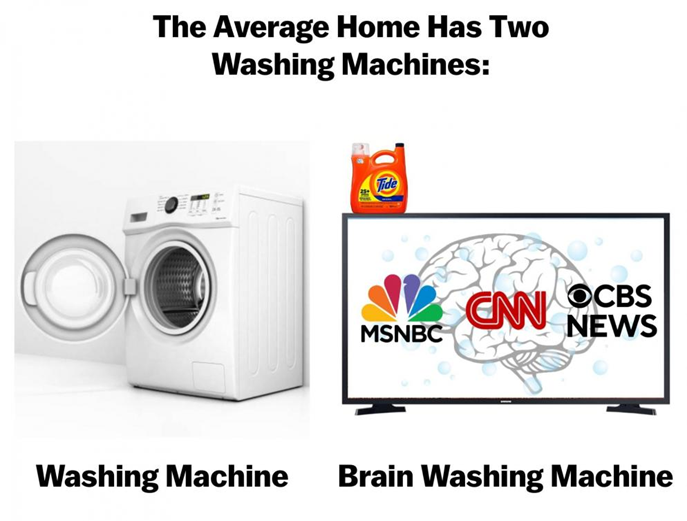
Mainstream media is run by the Machine. ABC, CBS, NBC, CNN, MSNBC, CNBC, WSJ, NYT, WaPo and other outlets are the Machine’s mouthpieces. They talk down the “closed” and proclaim the “open.”

Both political parties promote the Machine. It is “progress” (and control) after all. The biggest threat to democracy is the Machine that consumes culture and churns out cogs.

Now that Mamdani has won the NYC mayor’s race, you can be sure that the Mechanical Hound will be released in NYC to enforce socialist jihad. Neither socialism nor Jihad exists without a Mechanical Hound.

Central planners – The World Economic Forum (WEF), the World Health Organization (WHO), and the World Trade Organization – represent the Machine’s values.

It takes no stretch of the imagination to see ourselves in Montag’s society or to see technology as that which mimics the good but is easily programmed to avenge and punish citizens who break society’s rules. The Mechanical Hound can tract us down to dispose of the ‘closed’ and conform us to the “Open is good” of the Machine.

Bradbury said that with Fahrenheit 451 he wasn’t trying to predict the future but to prevent it. He wanted to protect the present.

The terror of the Hound of Hell is becoming a permanent feature of the “open” (closing up) brave new (upside down) world.

~~~~~

Read Fahrenheit 451: Beatty’s Speech to Montag

~~~~~

Against the Machine: On the Unmaking of Humanity | Paul Kingsnorth

Demetri Kofinas speaks with Paul Kingsnorth, a novelist, essayist, and former environmental activist who first came on many people’s radars during the Covid-19 pandemic with the publication of his viral three-part series “The Vaccine Moment.” His current work explores the intersection of technology, culture, and the divine. In his latest book, Against the Machine, Kingsnorth examines how our increasingly mechanized way of seeing and relating to the world—and to ourselves—has contributed to the death of Western culture, and what it would take to reclaim our humanity and save our souls.

Against the Machine: On the Unmaking of Humanity | Paul Kingsnorth

Against the Machine: On the Unmaking of Humanity | Paul Kingsnorth | Listen Notes

~~~

How We Lost Ourselves to Technology—and How We Can Come Back

Do you feel uneasy? Do you feel a level of ambient anxiety? Do you feel despair, despite the fact that we live in the most luxurious time and place in human history? 

The point is, you are not crazy. If you feel these things, you are simply attuned to reality—and it’s not a problem that’s solvable with less screen time or with meditation, red light, or sea moss.

Bari Weiss’ brilliant guest, Paul Kingsnorth, argues that the reason you feel this way is not this or that social media app or algorithm or culture war issue. That these are all superficial expressions of a thousand-year battle with what he calls “the Machine.” What exactly that means, he’ll explain tonight.

How We Lost Ourselves to Technology—and How We Can Come Back

How We Lost Ourselves to Technology—and How We Can Come Back

~~~~~

From Doug Ross’ substack:

Top 20 Chilling Insights from Yuri Bezmenov

How the KGB’s Playbook Is Destroying the West Today

Yuri Aleksandrovich Bezmenov (1939–1993), also known as Tomas David Schuman, was a Soviet journalist and KGB operative specializing in propaganda and ideological subversion.

Ideological subversion is the process of bending a society’s perception of reality so completely that it destroys itself.

The goal is to demoralize a society by undermining its moral, educational, and cultural foundations, making people unable to recognize or defend against threats.

Demoralization takes 15-20 years, the time needed to educate one generation with subversive ideas.

Read Bezmenov’s 20 key insights

~~~~~

~~~~~

From the Free Press:

Peter Thiel Says Capitalism Is Failing the Young. Is He Right?

Five years ago, Peter Thiel, the billionaire venture capitalist behind PayPal and Palantir, sent a prescient email to Facebook executives.

“When 70% of millennials say they are pro-socialist,” he wrote, “we need to do better than simply dismiss them by saying that they are stupid or entitled or brainwashed; we should try and understand why.”

The email went viral after democratic socialist Zohran Mamdani’s victory last week in the New York City mayoral race. Thiel then sat down with The Free Press’s Sean Fischer to explain what he saw in 2020 that no one else did.

Capitalism isn’t working for young people, Thiel said, citing burdensome student debt and regulations putting homeownership out of reach for many. “People assume everything still works, but objectively, it doesn’t. . . . If you proletarianize the young people, you shouldn’t be surprised if they eventually become communist. (Emphasis mine.)

Thiel, who I see as also promoting the Machine, at least sees what the Machine is doing to the young.

And, of course, socialism/communism is a horrifying Machine that revels in terror to replace humanity with ideology.

~~~~~

The Machine’s AI Alchemy

Mary Shelly’s Victor Frankenstein, obsessed with creating a human being, used alchemy and electricity and body parts to create a creature (without woman). . .

A group of Stanford University scientists . . .  used artificial intelligence to design new viruses capable of killing bacteria.

In a world where AI keeps creeping in on uniquely human territory by composing sonnets, writing songs or forging friendships, this seemed to be crossing a new Rubicon. Depending on your belief system, AI was doing what evolution, or God, or scientists working with genome-engineering tools aim to do.

“Machines are rethinking what it is to be human, what it is to be alive,” said Michael Hecht, a chemistry professor at Princeton University focused on designing novel proteins and artificial genomes. “I find this very unsettling and staggering. They are devising, coming up with novel life forms. Darwin 2.0.”

AI-designed viruses raise fears over creating life – The Washington Post

Displaced in Place

Monica Sanders, a survivor of Hurricane Katrina, wrote in her August 18, 2025, Oxford American article The Storm that Blew Us Apart recalling Twenty years after Katrina, we’re still living in the space between before and after:

 The flood took homes and heirlooms, yes. But it also took the things that don’t have price tags: your grandmother’s pew at St. Peter Claver, the second-line route your cousin danced for the first time, the rhythm of being able to walk next door to ask for a lemon and stay for a two-hour porch talk.

We became refugees in our own country . . .

Some of us never came back.

Those who did found a different city. Not just rebuilt, but rearranged. The neighborhoods we knew—Broadmoor, Gentilly, the Lower Nine—returned with new names, new residents, and new rules. People who knew about noise ordinances but not about king cakes. People who brought nonprofits but not traditions. People who wanted charm but not character. The kind who say “N’Awlins” with a wink, and don’t hear the ghost in that mispronunciation.

Displacement gave way to gentrification. What was affordable became vacation rentals. What was vibrant became boutique. Streets that once held parades now hold pop-ups. We became the entertainment, not the community.

And yet, we remain. . .

All of us carry the “before” with us. . .

We talk about resilience now, but we forget that true resilience is cultural as much as physical. It’s knowing who to call when the lights go out. It’s gathering your neighbors even when there’s no power. Its memory passed like gumbo recipes and Sunday prayers.

Mutual Aid, New Orleans, 2005. Inkjet Print on Canvas, Clarence Williams

~~~

As helicopters rush off with the most desperately ill, throngs trapped for nearly a week in New Orleans climb aboard busses at the intersection of I-10 and Causeway Blvd., Saturday, September, 3, 2005. (Staff photo by Eliot Kamentiz, The Times-Picayune)

I began with Monica’s reflection on the effects of Hurricane Katrina, for order being swallowed up by non-order, an overwhelming flood, parallels the flood of disorder working to decouple us from people, place and the past and to colonize us for its reorganizing purposes which include efficacy, profitability and efficiency.  (Order, non-order and disorder are terms coined by Dr. John Walton to describe cosmology in his Job commentary.)

That storm is blowing us apart. And as was experienced in the aftermath of Hurricane Katrina, we feel a pervasive sense of displacement, of being refugees in our own country, of living in the space before and after the imposed transformation of our culture.

The source of dysphoria about our time and place being out of joint may not be readily recognizable. As with the “frog in boiling water”, we steep in its flood waters not recognizing the stew we are in. Screens constantly distract our attention away from what is happening to our existence.  

The source: a flood of ideologically progressive technology and globalization that is wiping out our connections to people, place and the past. Its overwhelming force is our unmooring, our unmaking. Its irresistible force is displacing us in place.

I’ve been aware of the source for many years, starting when I bought a 286 computer in the 70s. The machine had an allure that had me come back to it constantly.

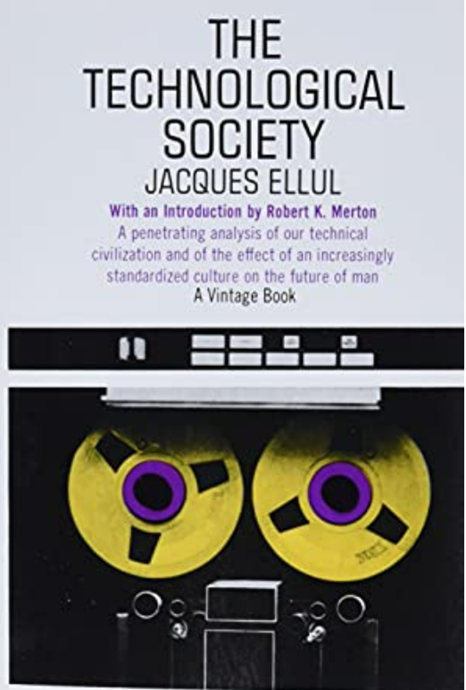
In an October 23, 2022 post Altered States, I quoted Jacques Ellul from his book The Technological Society and wrote the following:

I’m becoming a neo-Luddite of sorts. I have a particular dislike for digital technology as it modifies the means of relating to ourselves, to those around us and to our world. Its dissociative medium detaches us from reality, thereby affecting identity, memory, perception, and truth.

The flood waters are rising around us. Look at what is going on with the tech-bro push for AI and transhumanism, with concerns about rare earth minerals, with chips, chips, and more chips, with 5G towers, energy and water consuming data centers, constant surveillance, mandated digital IDs – why do we need any of it?
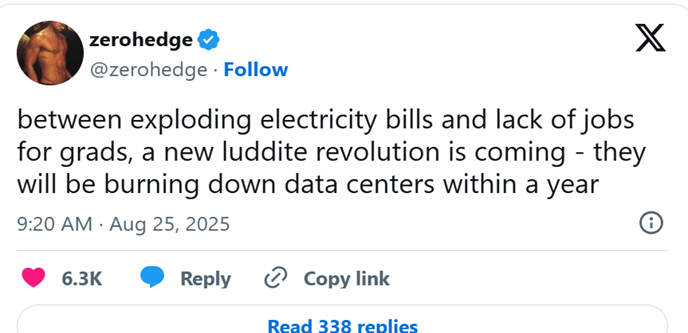
‘A Sharp Escalation’: Americans Starting To Revolt Against Data Centers | ZeroHedge

I recently came across an author that uses “the Machine” as the analogy for the inhuman forces at work to enclose all in its path for Progress. What Kingsnorth writes resonates with everything that I’ve read in dystopian novels: 1984, That Hideous Strength, Brave New World, and Darkness at Noon. Here’s Paul Kingsnorth with “Huxley and the Machine”:

Paul Kingsnorth’s, Against the Machine is “an account of the technological-cultural matrix enveloping all of us. The culmination of two decades of my writing and thinking about technology, culture, spirituality and politics, it seeks to offer an insight into how the techno-industrial culture that I call ‘the Machine’ has choked Western civilisation, is destroying the Earth itself, and is reshaping us all in its image.

From the First Industrial Revolution to the rise of artificial intelligence, this book shows how the hollowing out of humanity has been a long game—and how our very soul is now at stake.

Against the Machine is the spiritual manual for dissidents in the technological age.”

~~~~~

Per Lewis Fried, Lewis Mumford, author of The Myth of the Machine, “insisted upon the reality of the Megamachine: the convergence of science, economy, technics and political power as a unified community of interpretation rendering useless and eccentric life-enhancing values. Subversion of this authoritarian kingdom begins with that area of human contact with the world that cannot be successfully repressed – one’s feelings about one’s self. “

Mumford:

The vast material displacements the machine has made in our physical environment are perhaps in the long run less important than its spiritual contributions to our culture.

Technology, instead of introducing us to freedom, has imposed on us the slavery of the machine.

Modern Man is the victim of the very instruments he values most. Every gain in power, every mastery of natural forces, every scientific addition to knowledge, has proved potentially dangerous, because it has not been accompanied by equal gains in self-understanding and self-discipline.

A day spent without the sight or sound of beauty, the contemplation of mystery, or the search of truth or perfection is a poverty-stricken day; and a succession of such days is fatal to human life.

Our national flower is the concrete cloverleaf.

Western culture no longer represents man: it is mainly outside him, and in no small measure hostile to his whole self: he cannot take it in. He is like a patient condemned in the interests of X-ray photography to live upon a diet of barium sulphate…In the end, as Samuel Butler satirically prophesied, man may become just a machine’s contrivance for reproducing another machine.

The great gains that were made in technics during the last few centuries were largely offset by a philosophy that either denied the validity of man’s higher needs or that sought to foster only that limited set of interests which enlarged the power of science and gave scope to a power personality. At a moment when a vast surplus was available for the goods of leisure and culture, the very ideals of leisure and culture were cast into disrepute — except when they could be turned to profit. Here lies the core of the inner crisis that has afflicted our civilization for at least two centuries. In the heyday of expansionism, the middle of the nineteenth century, scarcely a single humane voice could be found to defend either the means or the ideals of a power civilization…Blake, Ruskin, Morris, Arnold, Emerson, Whitman, Thoreau, Melville, Dickens, Howells, Hugo, Zola, Mazzini, Tolstoy, Dostoyevsky, Ibsen…denounced the human results of the whole process of mechanization and physical conquest. As with one voice, they protested against the inhuman sacrifices and brutalizations, the tawdry materialisms, the crass neglect of the human personality.

~~~~~

~~~~~

The truth is, men have lost their belief in the Invisible, and believe, and hope, and work only in the Visible; or, to speak it in other words: This is not a Religious age. Only the material, the immediately practical, not the divine and spiritual, is important to us. The infinite, absolute character of Virtue has passed into a finite, conditional one; it is no longer a worship of the Beautiful and Good; but a calculation of the Profitable. Worship, indeed, in any sense, is not recognised among us, or is mechanically explained into Fear of pain, or Hope of pleasure. Our true Deity is Mechanism. It has subdued external Nature for us, and we think it will do all other things. We are Giants in physical power: in a deeper than metaphorical sense, we are Titans, that strive, by heaping mountain on mountain, to conquer Heaven also.

Thomas Carlyle, from “Signs of the Times

~~~~~

Against the machine: Digital ID Black Pill Moment? – The Burning Platform
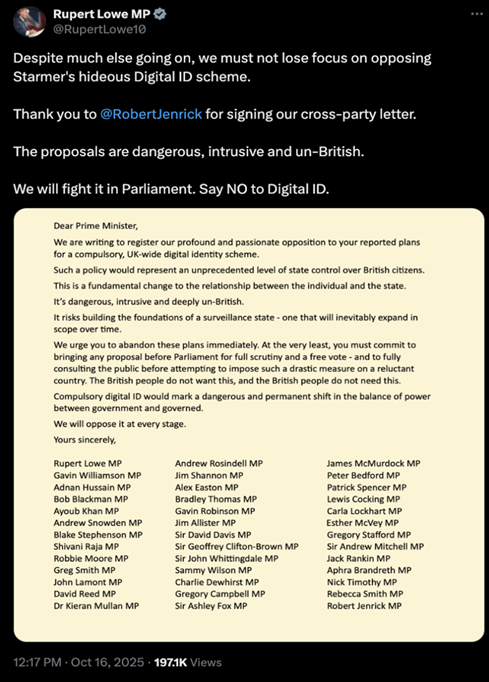
Michael Appleton/NY Daily News Archive via Getty Images

Smiley N. Pool/Houston Chronicle via Getty Images

A Bugger’s Life

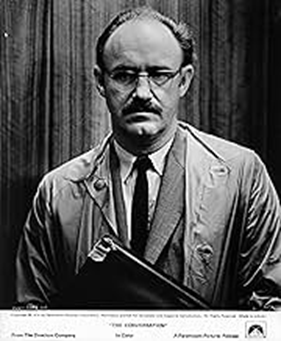
What’s bugging Harry Caul?

Harry, a professional eavesdropper, is being paid to spy on a woman having an affair. But something he overheard makes him question whether he can remain a detached listener.

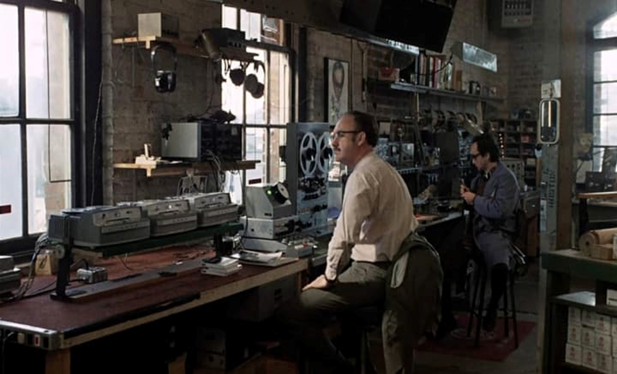
Harry and his crew use powerful microphones to record a conversation between the woman and her lover as they walk around a crowded San Francisco square. Later, after filtering out background noise on the tape, Harry replays a cryptic phrase in the recording. He imagines it to mean that the woman is being targeted to be murdered by his client.

Listening to his conscience, already replaying guilt and shame from a previous snooping assignment, Harry looks for a way out, for a way to not have blood on his hands. To offload his responsibility, he confides to a priest in a confessional, the oldest form of eavesdropping:
I’ve been involved in a job that may bring misfortune to two young people. It’s happened before. What I do has caused harm to someone. I’m afraid it will happen this time too. I’m not responsible for it. I can’t be responsible for it. 

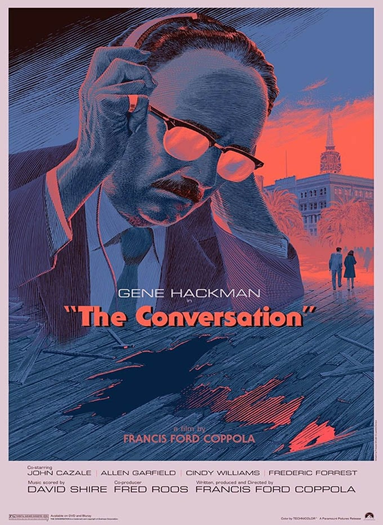
The conversation in the park and in Harry’s soul takes place in the 1974 film by Francis Ford Coppola – a tense thriller and character study titled The Conversation.

Gene Hackman (God rest his soul) plays Harry Caul, ‘the best bugger on the West Coast.’ Harry is obsessed with technology and works in a world where privacy can be bought and sold using it.

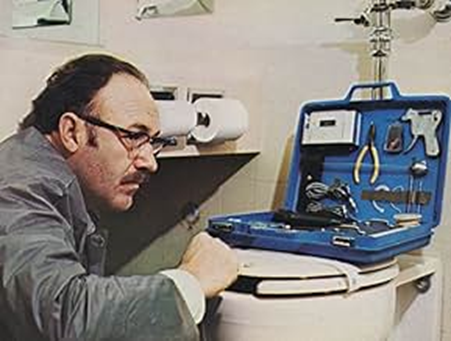
On-the-job Harry, a surveillance expert, is an invader of privacy. He gets paid to move in close, take pictures, and record private conversations with electronic devices. But Harry has a paranoid fear of anyone being up close and personal with him.

Harry guards his privacy. He lives in a sparsely furnished apartment that is secured by three locks and an alarm system. It’s his fortress. He uses a payphone to make personal calls and lies about having a home telephone. Alone, Harry spends time playing his saxophone along with jazz records. Jazz is the music of individualists and loners.

Harry looks like a regular Joe. He easily fits into crowds and isn’t noticed while snooping. But Harry isn’t public. The enigmatic Harry stays emotionally detached from others, cut him off from the rest of the world as though he’s not really a part of it yet. This suggested in his last name “Caul,” the thin membrane that surrounds a fetus until it is born. His translucent raincoat suggests the caul.

Harry’s work is intrusive, but he wants protection from the same. He avoids below-the-surface relationships with people in his industry, his coworker Stan (John Cazale), and Amy, the mistress he supports and visits at random times.

Harry records private moments between humans. But the guarded Harry can’t or won’t expose himself to another human. His involvement with Amy (Teri Garr) is not a relationship nor intimacy. Harry shows up on his birthday and Amy thinks it is a good time to get to know Harry, to know his secrets. But Harry says he has no secrets to his secret lover. Harry is distant even from the person he is physically closest to.

As with the priest, Harry off loads his conscience and distances himself from the detrimental effects of his work. When Stan wants to speculate about the meaning of the conversation between Ann and Mark on the tapes, Harry insists that it is just a job and that it is unprofessional to get too curious or assume anything. How ironic for the intensely curious Caul!

Stan: It wouldn’t hurt if you filled me in a little bit every once in awhile. Did you ever think of that?
Harry Caul: It has nothing to do with me! And even less to do with you!
Stan: It’s curiosity! Did you ever hear of that? It’s just g*ddamn human nature!
Harry Caul: Listen, if there’s one sure fire rule that I have learned in this business is I don’t know anything about human nature. I don’t know anything about curiosity. That’s not part of what I do.

The man who hires Harry is Martin Stett (Harrison Ford). Stett is the assistant to Harry’s client, the director (Robert Duvall). Initially, Stett is friendly. But when Harry refuses to hand over the tapes, he becomes intimidating and warns Harry to “be careful.” He surveils Harry at the surveillance tech convention.

After a party at his workshop, Harry spends the night with Meredith (Elizabeth MacRae), a woman he has just met. He finds out the next morning that the tapes have been stolen. Stett had Meredith steal the tapes.

Stett tells Harry that they couldn’t wait for the tapes. He then tells Harry to come to the director’s office to hand over the photographs and collect his money. There, Harry meets the director and realizes that the woman he has been spying on is the director’s wife. The taped conversation now seems to signal the worst for the woman.

After leaving the office, Harry decides to get involved. His Catholic conscience kicks in and so does his covert curiosity. He surveils the lovers in a hotel room and . . .

I’ll stop there, with the basic elements of the film. You can watch the movie, experience the intrigue, check out the enigmatic Harry Caul character, and find out what’s bugging Harry Caul.

~~~

Some questions and thoughts:

Does Harry’s method of recording reality, a cryptic conversation here, turn out to be flawed?

Does anyone who views or hears another from a distance – do they know that person? Or, do they only hear and see what they want to.

Do devices divine truth?

Does Harry compartmentalize his work-self from his conscience so as to maintain his addiction to snooping?

Does Harry become a pawn in another scheme?

Does Harry become a “partner in crime” that he so wanted to avoid?

Does the overflowing toilet scene signify the ugly truth coming to the surface?

How does super snoop Harry end up at the end of the movie? What’s his psychological state? What does his utter helplessness represent?

In the end, with what’s left intact, does Harry Caul find what is ‘bugging’ him? Does Harry come up empty?

Why would a Christian and book reader like me watch this movie? Well, for one reason, it is a great movie.

The Conversation, written, produced, and directed by Francis Ford Coppola between the Godfather movies, is a tense thriller and character study. The 1974 film is not like most of the pathetic and mindless flicks of today. There are no superheroes, no CGI, no WOKE agenda, no gratuitous sex, nudity, and violence. The violence that does occur is presented as an off-stage event like in Greek tragedies.

See the called-out elements of its PG rating here: https://www.imdb.com/title/tt0071360/parentalguide/?ref_=tt_ov_pg#certificates

The movie was shot using long lenses and camera positions on rooftops. You get the idea of watching at a distance and of surveillance cameras panning scenes.

Another reason to watch is that Gene Hackman was a great actor. The character study involving a Catholic man who is self-isolating and who hears and views others from a distance – Hackman’s Harry Caul makes the movie.

Another is to consider the consequences of hearsay or of unfounded information, of surveillance versus participation, and of perception versus reality. Can we really know someone, their thinking, and their situation from a distance, from what others would have us believe?

And, there is the matter of someone listening without our knowledge. Though made in 1974, the issues of privacy the movie presents are relevant regarding you and I being surveilled today. The analog technology shown in the film has been replaced with digital technology that gains access to our private electronic communications, as through wiretapping or the interception of e-mail or cell phone calls.

We live in the age of digital technology that includes emails, texts, smart phones, and social media. How does Harry’s addiction to technology that supports his habit of seeing and hearing others at distance and his voyeuristic predilections affect him?

~~~~~~

~~~~~

Finding God in Stories | Office Hours, Ep. 15

~~~~~

Scot Bertram talks with Clare Morell, fellow at the Ethics and Public Policy Center and director of EPPC’s Technology and Human Flourishing Project, about the long-term effects of smartphone use on children and her new book The Tech Exit: A Practical Guide to Freeing Kids and Teens from Smartphones. And Benedict Whalen, associate professor of English at Hillsdale College, continues a series on the life and work of American writer Mark Twain. This week, he discusses The Adventures of Tom Sawyer.

Clare Morell Helps to Keep Kids Free from Screens

Clare Morell Helps to Keep Kids Free from Screens – The Radio Free Hillsdale Hour – Omny.fm

~~~~~~

Have an Analog New Year

I like my hand crank pencil sharpener. It doesn’t spy on me and report on what I am doing. It doesn’t try to sell me a new pencil when one is sharpened down to the nib. It doesn’t try to hack my pencil and steal it from me. It doesn’t need electric energy, Wi-Fi, a password, and app to use it. I don’t need to buy antivirus software. My analog hand crank pencil sharpener is a simple mechanical device that is noninvasive. I use it to sharpen pencils needed for the highlighting and marginalia of the physical books I read to expand my personal bandwidth.

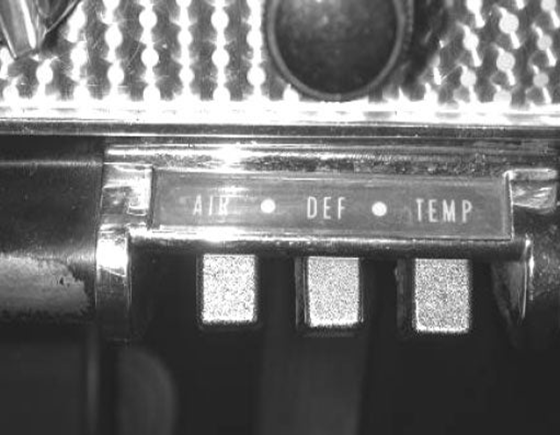
My ’64 Chevy Impala – the first car I ever owned – had hand-crank analog windows and a Delco AM Push-Button Radio (which I tuned to Chicago’s WLS-AM 890). The Impala had mirrors and no cameras, screens, and distracting bells and whistles. The car was not dependent on a semiconductor chip or software engineering.

The Impala got me from point A to point B without tracking my whereabouts and driving habits with an embedded GPS transmitter and selling that data to a third-party data broker that sold it to my insurance company so they can adjust my rate based on my driving. The Impala didn’t invade my privacy by automatically storing text and call data from my cell phone. The car was not a rolling data territory.

The corded Touch-Tone wall phone hung on the wall of my parent’s kitchen used copper wires. It didn’t pretend to be a computer. It held no apps with choice architecture programming. It wasn’t a branch of cyberspace. The phone didn’t spy on me and data grab me. When the conversation was finished, I hung up the phone and walked away from it. It wasn’t an extension of me. It wasn’t omnipresent.

Back in the ‘50s, our black and white TV used “rabbit ears” to get the best possible reception. Aluminum foil was sometimes placed on the ends of the rabbit ears to enhance reception.

The original television technology used analog signals to transmit video and audio. It wasn’t connected to a cable or Wi-Fi. The programming had commercials but it didn’t ply me with the ads I spent time looking at in the weekly newspaper insert. It was a passive non-spying device.

I listened to 45s and LPs using a turntable. The devices used in the first third of my life have been analog. I was born some twenty years before the end of the analog age (the 1970’s when signals went from waves to digital 1’s and 0’s and the use of transistors in computers).

Having lived with analog technology, I prefer it over the “convenience” of “time-saving” digital devices. My reasons, echoed as concerns in the podcasts below, include not wanting to be spied on and exploited.

I do not want to be data-colonized by devices. I do not want to be an economic zone for more products and services and a mishmash of values. And, I do not want to be a product of That Hideous Strength (C.S. Lewis; the title comes from a poetic allusion to the Tower of Babel).

If you’ve read that story based on themes from Lewis’ lectures, you know about the National Institute for Coordinated Experiments or N.I.C.E. It was run by some masterminds who thought they knew best for everyone, increasing human efficiency to the point of human dissolution.

From The Devils in Our World – Official Site | CSLewis.com we read . . . N. I. C. E.’s . . .goal was “… the scientific reconstruction of the human race in the direction of increased efficiency …” (That Hideous Strength, 258). In The Abolition of Man’s more abstract terms, it was the power of some — the conditioners — over others; it was the conquest of nature and of human nature in particular through eugenics. Ultimately, it meant the abolition of man (63-64). (Emphasis mine.)

I am no fan of the digital technology because I see that the digital technology is no fan of me, a human.

Should human life be appropriated for data collection? Should an imposed alternate reality be tolerated for convenience and to ‘save’ us from boredom? Should we allow the “properties of being” to go the way of all totalitarian systems?

What do you get from your cell phone, your HD TV or the internet? Is it truth, beauty and goodness or is it isolation, loneliness, and nihilism streamed in 0s and 1s? Is it truth, beauty and goodness or is it materialism and modification of behavior?

I agree with Alexander R. Galloway, who considers the terms digital and analog in today’s world in his article Golden Age of Analog | Critical Inquiry: Vol 48, No 2, when he says  . . .

 If anything, the golden age of analog is happening today, all around us, as evidenced by the proliferation of characteristically analog concerns: sensation, materiality, experience, affect, ethics, and aesthetics. 

Analog concerns are human concerns whereas digital concerns are about data collection and modifying consumer’s behavior with choice architecture and ‘nudges” toward a profitable end for the “conditioners.”

I feel more secure and loved with a bookshelf full of classic books than with the bits and bytes of pseudo-reality that AI/ChatGPT promises.

Humans seek their own “profitable” ends via analog concerns. Have an analog New year.

~~~~~

I’ve been asked about my take on AI. There is a lot to consider. Here are a few thoughts:

It is said that individuals who learn to harness AI tools will improve their lives. They say that new AI technologies will save us time, help us live smarter, and become super-productive unlike anything we’ve ever seen before.

They say that AI will have the potential to help out with the boring and tedious stuff in our daily lives. And, that AI will solve complex problems including the fictitious “climate change crisis,” and offer a host of other benefits to mankind including massive amounts of information to make better informed choices. (Did you know that Computers Can’t Do Math?)

The downsides of AI/ChatGPT? There will be censorship of certain information and values leading to disinformation and misinformation – a machine’s type of ‘lying’. AI is capable of false narratives.

AI/ChatGPT has no ethics or morality but there will be bias no doubt favoring DEI, ESG, CRT, political correctness, and the green new scam. We all know the acronym GIGO.

MoneyGPT: AI and the Threat to the Global Economy by Jim Rickards contains the warning

 . . . we must remain vigilant on the question of whose values will be promoted in the age of AI. As Rickards predicts, these systems will fail when we rely on them the most.

MoneyGPT shows that the danger is not that AI will malfunction, but that it will function exactly as intended. The peril is not in the algorithms, but in ourselves. And it’s up to us to intervene with old-fashioned human logic and common sense before it’s too late.

There is the possibility of AI/ChatGPT inventing fantasy or confabulation when there are missing links of data. From Confabulation in Brain Injury: Causes and Treatment:

Confabulation is a memory disorder characterized by the production of fabricated, distorted, or misinterpreted memories about oneself or the world, without the conscious intention to deceive. It’s as if the brain, in its attempt to fill gaps in memory, creates a patchwork of experiences that may or may not have actually occurred. . .

Unlike lying, confabulation occurs without any intent to mislead. The individual genuinely believes in the truth of their statements, no matter how implausible they may seem to others. This can lead to a host of complications in personal relationships, professional settings, and even legal matters.

For all the proposed massive benefits of AI/ChatGPT, there is a real physical cost.

On Oct. 10, 2023 we were told that A.I. Could Soon Need as Much Electricity as an Entire Country:

peer-reviewed analysis published Tuesday lays out some early estimates. In a middle-ground scenario, by 2027 new A.I. servers sold that year alone could use between 85 to 134 terawatt hours (Twh) annually. That’s similar to what Argentina, the Netherlands and Sweden each use in a year, and is about 0.5 percent of the world’s current electricity use.

A “green energy” grid is not able to handle charging a horde of EVs let alone power the semiconductors needed to store and process your personal data. The only good to come out of this: nuclear reactors will be built to handle base loads.

One of the “masterminds” behind “green energy”- Joe Biden – has created anti-oil and gas policies that “limit pipeline infrastructure and increased production on federal lands.” Natural gas prices have escalated because of this. Americans will suffer.

When temps drop this winter, AI/ChatGPT is not what’s needed. We need cheap and reliable energy.

Multiple Arctic outbreaks to affect more than 250 million in central, eastern US into mid-January

Going forward, I don’t see a need for AI/ChatGPT. Presumed to offer me a better self, I see AI/ChatGPT replacing thought and imagination with prescribed “answers.” We are not to think. We are to AI/ChatGPT.

Did the Greatest Story Ever Told come from AI/ChatGPT?

Will the greatest world ever known come about through AI/ChatGPT? No! That will happen when the New Jerusalem joins heaven and earth and we live in God’s immediate presence.

So, we use digital devices and AI/ChatGPT to save time. But what do we do with our saved time? Do we go back to a screen and throw away saved time? What does it mean to be “more productive”?

Digital technology and AI/ChatGPT seem to share the same ethics as Karl Marx:

“My object in life is to dethrone God and destroy capitalism.” – Karl Marx

“Keep people from their history, and they are easily controlled.” – Karl Marx

Besides the abolition of private property, Karl Marx wanted to destroy five things: the family, individuality, eternal truths, nations, and the past. All of this is possible with AI.

Will AI/CHATGPT become the opium of the masses?

“The best way to control the opposition is to lead them.” — Vladimir Lenin

And the best way to do that today is via a digital medium that includes AI/ChatGPT.

A post-human world, packaged and sold as modern conveniences and life enhancing, is being delivered by digital technology.

~~~~~

Still autonomous after all these years of data colonization? Asking for a friend.

In the present day, Big Tech is extracting resources from us, transferring and centralizing resources from people to companies. These companies are grabbing our most basic natural resources–our data–exploiting our labor and connections, and repackaging our information to control our views, track our movements, record our conversations, and discriminate against us. These companies tell us this is for our own good, to build innovation and develop new technology. But in fact, every time we unthinkingly click “Accept” on a set of Terms and Conditions, we allow our most personal information to be kept indefinitely, repackaged by companies to control and exploit us for their own profit. 

Data grab: the new colonialism

Data grab: the new colonialism of big tech and how to fight back – London School of Economics and Political Science

Data Grab: The New Colonialism of Big Tech and How to Fight Back a book by Nick Couldry and Ulises A. Mejias

~~~~

In October of 2022, I wrote “I’m becoming a neo-Luddite of sorts. I have a particular dislike for digital technology as it modifies the means of relating to ourselves, to those around us and to our world. Its dissociative medium detaches us from reality, thereby affecting identity, memory, perception, and truth.”

“The medium is the message.” -Marshall McLuhan 

With digital medium, have we transitioned from “lineal connections” to “configurations”? (McLuhan, Understanding Media, p. 12)?

For McLuhan, it was the medium itself that shaped and controlled “the scale and form of human association and action”. Taking the movie as an example, he argued that the way this medium played with conceptions of speed and time transformed “the world of sequence and connections into the world of creative configuration and structure.” Therefore, the message of the movie medium is this transition from “lineal connections” to “configurations”

Respond: Marshall McCluhan, Chapter 1: The Medium is the Message | Matthew Marchewka

Does a digital medium deskill users over time? Are “tech bros” looking to deskill more users with AI/ChatGPT and do away with human workers? Are we to become Zeros in a world of 0s and 1s? Welcome to the binary new world.

~~~~

AEI senior fellow Christine Rosen, author of The Extinction of Experience. In the technological age, we too often see basic human activities, from reading and writing, to shopping and conversing, as obstacles to efficiency that must be overcome, simplified, or replaced. And while digital technology has provided many benefits, it has also come with unintended consequences for our habits of mind and social interactions. Rosen argues that we need a “new humanism” that puts the human person front-and-center and encourages people to regularly “touch grass.” 

Keeping it Real – Law & Liberty

~~~~~

Do you know that Congress has passed a law to shut off your car?

 Vehicle monitoring software could soon use ‘kill switch’ under the guise of ‘safety’ – LifeSite (lifesitenews.com)

Do you know about another digital trend that needs to be reversed: Going Cashless.

“It’s Just Not Right”: Major Venues Now Punishing People For Using Cash Vs. Plastic | ZeroHedge

The potential benefits of central bank digital currency or CBDC are being discussed by the “masterminds” of the International Monetary Fund (IMF). We will be told that using CBDC will be more convenient, but for whom?

CBDCs create a “digital trail”, IMF’s handbook notes. Our data – transaction histories and user demographics — could be collected and stored. AND, our CBDC accounts could be restricted or blocked by the powers that be or AI as a form of a social credit system and digitally based conformity.
If instituted, say goodbye to privacy and, perhaps, your balance. Welcome to the Binary New World and the surveillance State.

Please don’t tell me it’s more convenient to use digital.

Gold and silver and even the fiat dollar are analog assets. They can’t be hacked.

~~~~~

“A September report by Mozilla News’ *Privacy Not Included team called modern cars the “worst product category we have ever reviewed for privacy.”

“The team researched 25 car brands and concluded, “Every car brand we looked at collects more personal data than necessary and uses that information for a reason other than to operate your vehicle and manage their relationship with you.

“They can collect super intimate information about you — from your medical information, your genetic information, to your ‘sex life’ (seriously), to how fast you drive, where you drive, and what songs you play in your car — in huge quantities. They then use it to invent more data about you through ‘inferences’ about things like your intelligence, abilities, and interests.”

Your Car Stores Your Text Messages – Law Enforcement Can Retrieve Them Anytime, Following Federally Rejected Lawsuit | The Gateway Pundit | by Stefanie Ladner, The Western Journal

~~~~~

The new law would change the definition of “electronic communications surveillance provider” via an amendment to vastly expand what Goitein describes as “the universe of entities that can be compelled to assist the NSA.”

Tell your representatives to vote NO on massive expansion of domestic surveillance state – U.S. businesses to be forced to serve as NSA spies – NaturalNews.com

~~~~~

For the past few years, parents, researchers, and the news media have paid closer attention to the relationship between teenagers’ phone use and their mental health. Researchers such as Jonathan Haidt and Jean Twenge have shown that various measures of student well-being began a sharp decline around 2012 throughout the West, just as smartphones and social media emerged as the attentional centerpiece of teenage life. Some have even suggested that smartphone use is so corrosive, it’s systematically reducing student achievement. I hadn’t quite believed that last argument—until now.

Are Phones Making the World’s Students Dumber? – The Atlantic

~~~~~

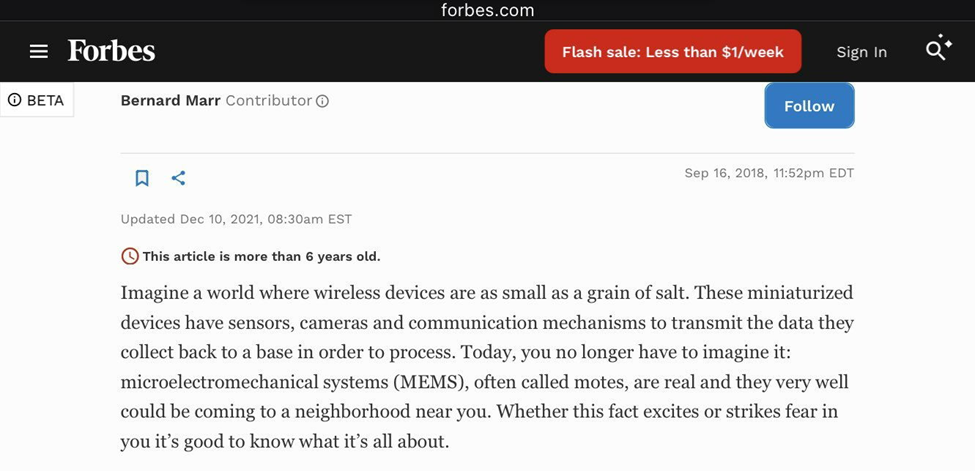
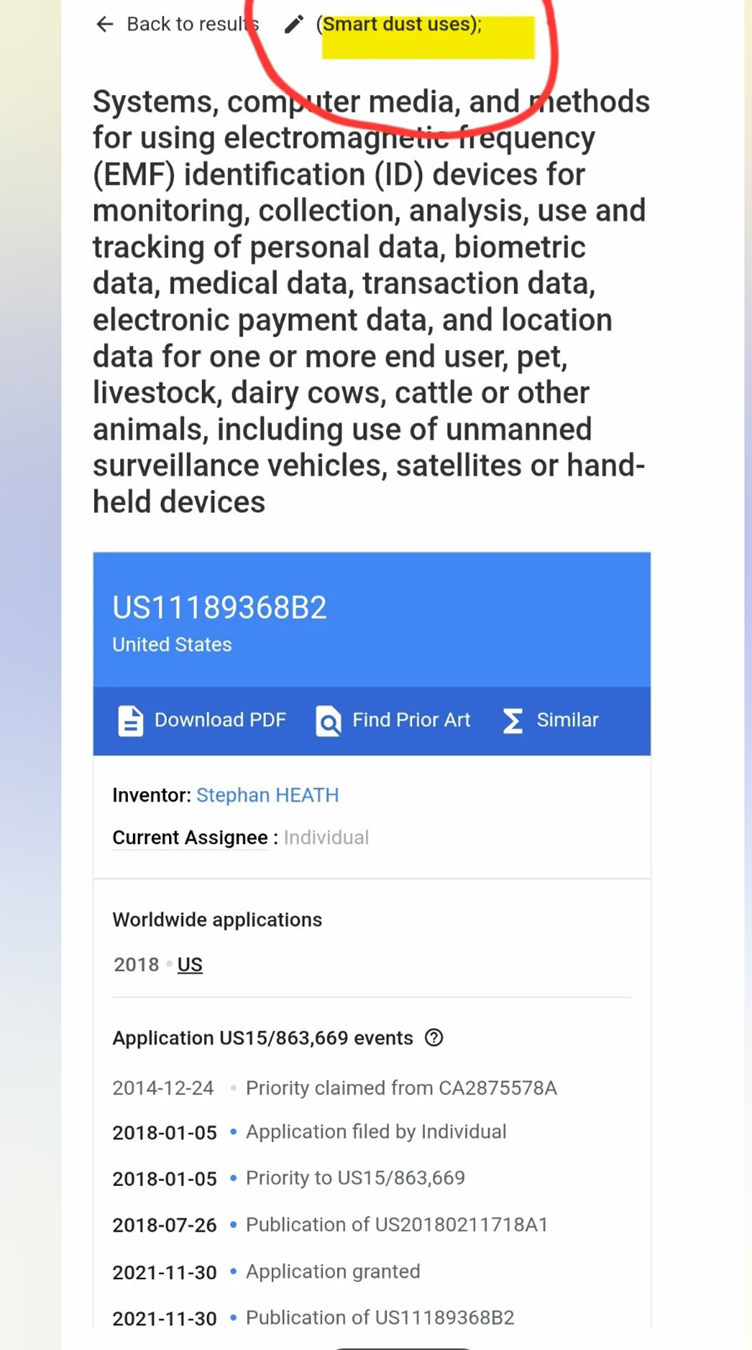
Invasive Technology – Smart Dust

Is the fog Smart Dust?

~~~~~

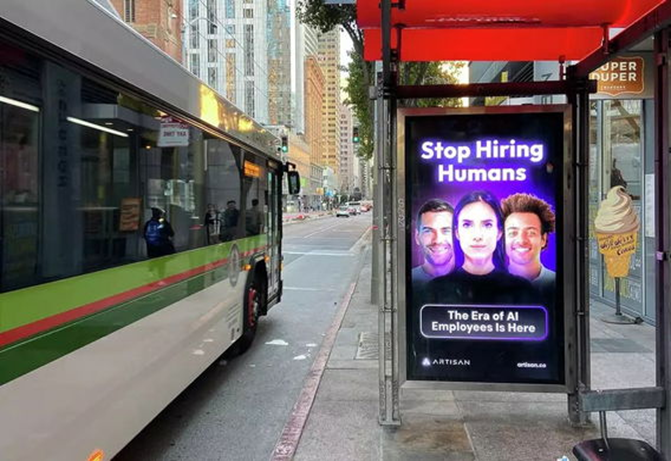
‘They hate people’: Bleak tech billboards spark angst in San Francisco

Request a Consumer Disclosure Report

Access your file and learn more about the personal information LexisNexis Risk Solutions maintains about you in accordance with the Fair Credit Reporting Act:

Home – LexisNexis Risk Solutions Consumer Disclosure

Is AI/ChatGPT “extremely dangerous to our democracy?”

Multiple local news stations say the same thing verbatim

Is AI/ChatGPT and Facebook extremely dangerous to our humanity?

Ungar-Sargon: “Of Course Mass Immigration Raises The GDP, It Makes Oligarchs Unbelievably Wealthy.”

Frankenscience

In a remote lab something is created using special occult-like knowledge and unethical scientific experiments. The creation does not emerge organically. What’s brought into existence is an intentional mutation of the natural order. Uncontrolled, the monstrous creation escapes into the public. People begin to die and the remorseless creators work to conceal their involvement.

So goes the recent account of the gain-of-function alchemy performed by a cabal of doctors -Anthony Fauci, Francis Collins, the doctors of the National Institutes of Health and of EcoHealth Alliance – in the Wuhan Lab and the ensuing lab leak of transmissible COVID-19 into the world of humans.

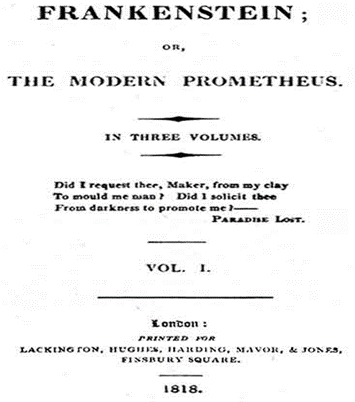
A parallel to the Wuhan horror story is an older science-off-the-rails account published in 1818. It is referenced in Jack Butler’s 2021 National Review article titled Frankenstein, the Original Lab Leak, Mary Shelley’s warning about the dangers of heedless scientific advancement takes on new relevance today.

Of Mary Shelly’s Frankenstein; or, The Modern Prometheus Butler writes:

Shelley’s gothic tale has become a byword for the view so, uh, ably expressed by Jeff Goldblum (playing Ian Malcolm) in Jurassic Park: “Your scientists were so preoccupied with whether or not they could, they didn’t stop to think if they should”.

The quest to unlock the secrets of heaven and earth and a burning desire to conquer the laws of nature are the driving forces behind Victor Frankenstein’s act-like-God creative act. And what he creates he cannot control. The same driving forces and results apply to the scientists of the Wuhan lab creation, as Butler notes:

Before the creature is made, Frankenstein delights in the possibility that a new species would bless him “as its creator and source” and that “many happy and excellent natures would owe their being” to him. If what we now quite reasonably suspect about the lab leak is true, then the Wuhan Institute of Virology can likewise claim the paternity of a new species, as well as of the many cases, deaths, and variants that have literally plagued the world since.

Before I ever came across the above article, I read Frankenstein. What had drawn me to Mary Shelly’s “ghost story” was what I had read in various science articles. These pieces discussed gain of function, the Executive Order 14081 Advancing Biotechnology and Biomanufacturing, coding genetics, the reanimation of dead cells, Neuralink – brain chip implants, human+, AI, transhumanism, transgenderism, and more. Reading about the desire and ability to tamper (or tinker) with the human body to effect change in it and wondering if technology was going to a dark place had me think of Frankenstein.

From the movies I learned that Victor Frankenstein had a lab, an assistant Igor and a bizarre desire to create something outside the natural order – a creature assembled from cadaver bits-and-pieces and strange chemicals, animated by a mysterious spark. I saw the brute, electrodes on his neck, clunking around the screen. I heard the screams of terrorized town’s people.

From the book I learned of Victor Frankenstein’s (no electrode, no Igor) description of his creation:

How can I describe my emotions at this catastrophe, or how delineate the wretch whom with such infinite pains and care I had endeavoured to form? His limbs were in proportion, and I had selected his features as beautiful. Beautiful! Great God! His yellow skin scarcely covered the work of muscles and arteries beneath; his hair was of a lustrous black, and flowing; his teeth of a pearly whiteness; but these luxuriances only formed a more horrid contrast with his watery eyes, that seemed almost of the same colour as the dun-white sockets in which they were set, his shrivelled complexion and straight black lips

From the book I also learned that the monster was not given a name. Frankenstein variously calls it “creature”, “fiend”, “spectre”, “the dæmon”, “wretch”, “devil”, “thing”, “being”, and “ogre”. The creation says to Victor “I Ought to Be thy Adam; but I am rather the fallen angel”. The book, I soon realized, had more to offer than depicted in the silly horror movies.

The book’s subtitle – The Modern Prometheus references Mary Shelly’s Gothic tale to Greek mythology’s interpretation of creation. Prometheus was the Greek Titan who fashioned humans out of clay and gave them fire. While Zeus was away, he stole fire from his hearth and gave it to humanity in the form of science knowledge. He taught humans the use of fire and how to trick the gods. 

Victor Frankenstein, in his unchecked pursuit of the secrets of heaven and earth, “creates life and thereby challenges God (instead of Zeus) and is punished by having his creation kill a number of his close relatives and friends, including his bride on their wedding night”, writes Stephen Kearn.

Victor doesn’t get burnt, even though he plays with fire taken from God (There is no mention of God in the novel. Perhaps Mary Shelly was a deist who thought of God as away and uninvolved with humans). But unlike Prometheus, Victor doesn’t receive eternal punishment for defying God.

We do read that Victor constantly (every other page practically) regrets what he’s done. But he never acknowledges his creation or its murderous ways to anyone, except later to his father who thinks Victor is delusional. Victor remains silent when he should have spoken up at a trial to defend the innocent. Victor’s self-indulgent ruing does not lead to repentance. By remaining silent he covers up his madness. I wonder about the attitude of Anthony Fauci and Francis Collins’ after they learned of the deadly effects of their horrid creation.

Throughout, Victor receives constant support from family and a close friend, none of whom know what he’s been up to. But Victor, to hide the works of his hands, goes it alone.

Victor is a self-absorbed monster. He’s a loner in his own dark world. No one is allowed to enter it, not even his best friend Henry Clerval who then ultimately encounters the product of Victor’s solitude when he is murdered by the beast. The novel would have us ask, “Who is the monster? The creator or the creation?”

Another aspect of Shelly’s tale is the Faustian nature of Victor Frankenstein. As a student, Victor is dissatisfied with the limits of the natural philosophy he studies. He seeks to penetrate the secrets of nature and find where the spark of creation comes from.

“It was the secrets of heaven and earth that I desired to learn; and whether it was the outward substance of things or the inner spirit of nature and the mysterious soul of man that occupied me, still my inquiries were directed to the metaphysical, or in its highest sense, the physical secrets of the world.”

With such a grandiose desire, Victor trades the integrity of his soul for the capacity to tap into the forbidden knowledge. He studies alchemy and the occult. And like the damned Faust, he pays a tremendous price for his newfound ability. He eventually loses his brother and wife to the effects of his own creation.

There are many aspects of the novel that are never broached in the movies. Isolation, loneliness, the need for companionship, Paradise Lost, Adam and Eve, the garden of Eden, even Rousseauism. Mary Shelly, daughter of political philosopher William Godwin and her mother the philosopher and women’s rights advocate Mary Wollstonecraft, was well aware of the pedagogical and political philosophy of Jean-Jacques Rousseau.

The monster begins his existence as Rousseau’s natural man. He lives according to his basic needs and is content. When people come into the picture he learns virtue and develops vice.

The hideous creature, hiding in the woods from the volatile rejection of townspeople, comes across a cottage and its inhabitants – a blind grandfather, a boy and a girl. He watches them interact day after day through a crack in the wall. He sees how well they get along and love each other.

They play music and read out loud at night. Milton’s Paradise Lost is one of the volumes read. That is how, over time, the creature, ‘born’ sentient and tabula rasa, learns about humanity and how to speak. But the creature is ultimately rejected by them because of his horrid appearance. So, the once-innocent creature with growing malice turns to evil.

I am malicious because I am miserable. Am I not shunned and hated by all mankind? You, my creator, would tear me to pieces and triumph; remember that, and tell me why I should pity man more than he pities me?

Rousseau: “Man is born free, and everywhere he is in chains”. The creature: I am the way I am because of how people treat me”. (There are many creatures like this running around today.)

The monster, isolated and lonely, demands that Victor produce a female creature. In a contest of wills, it says “You are my creator but I am your master – obey!” If the monster gets what he wants he promises to go far away with his companion and won’t terrorize him anymore. Victor balks at the idea of another such creation.

Even if they were to leave Europe and inhabit the deserts of the new world, yet one of the first results of those sympathies for which the dæmon thirsted would be children, and a race of devils would be propagated upon the earth who might make the very existence of the species of man a condition precarious and full of terror. Had I right, for my own benefit, to inflict this curse upon everlasting generations? I had before been moved by the sophisms of the being I had created; I had been struck senseless by his fiendish threats; but now, for the first time, the wickedness of my promise burst upon me; I shuddered to think that future ages might curse me as their pest, whose selfishness had not hesitated to buy its own peace at the price, perhaps, of the existence of the whole human race.

That last line makes me think about all the tinkerers whose ability to engineer and tailor organisms – from transgenderism to mRNA vaccines to brain implants – could affect the existence of the whole human race. There is much of the implausible nature of Shelly’s novel that seems plausible today in the hands of Frankenscience. “Be careful what you wish for” I hear Shelly prophetically say.

Shelley’s novel doesn’t present scientific and technological advancements as purely monstrous. Rather, it is the callousness of the creator, who cannot or will not anticipate the dangers of their invention, who is truly monstrous. Throughout the novel, the reader is invited to bear witness to this ironic parallel.

-Helena Richardson, The modern Prometheus: the relevance of Frankenstein 200 years on

The Project Gutenberg eBook of Frankenstein, by Mary Wollstonecraft Shelley

Podcast>>>> “Frankenstein” by Mary Shelley | Evergreen Podcasts

~~~~~

In his Substack article, Sacrificing for Science, How Science is Carrying on a Very Old Practice, Lewis Ungit connects modern science practices to the practice of dark arts:

What do these people harvesting full term babies (like the witches poses as midwives did in older days) and collecting hundreds of samples (also like the witches poses as midwives) hope to do with these bodies of babies? The reasons are remarkably similar to the reasons a witch would have given. Witches used the body parts to gain knowledge and power (to heal or curse). And Francis Collins (Director of the NIH) gave similar reasons for the Pitt funding. . ..

“But Collins, Biden’s NIH, and the University of Pittsburg are hardly the first to practice such dark arts.

“Since the 1960s, aborted babies have been used to develop vaccines . . ..

In times of old, parts of the babies were used to advance the magic of the witches, to gain dark knowledge, or as an ingredient in a potent brew. And today, baby parts are collected to gain scientific knowledge and to provide good ingredients to medicines and food. And while moderns view the distinction between science and magic as significant, are they really so different?” (Emphasis mine.)

~~~~~

“The power to kill could be just as satisfying as the power to create.” – Brandon Shaw in Alfred Hitchcock’s Rope.

Rope (1948) – Murder is a privilege for the few – YouTube

~~~~~

More Frankenscience . . . What could go wrong?

Air Vax Could ‘Radically Change’ How People Are Vaccinated

“Yale University researchers have developed a new airborne method for delivering mRNA right to your lungs. The team has also used the method to vaccinate mice intranasally, opening the door for human testing in the near future.

“While scientists are hailing the creation as an easy way to vaccinate the masses, critics wonder if the development of an airborne vaccine could be used for nefarious purposes, including covert bioenhancements, which have already been recommended in academic literature.3

. . .

“Aside from the concerns of airborne delivery, mRNA COVID-19 shots are associated with significant risks — no matter how you’re exposed. People ages 65 and older who received Pfizer’s updated (bivalent) COVID-19 booster shot may be at increased risk of stroke, according to an announcement made by the U.S. Centers for Disease Control and Prevention and the Food and Drug Administration.

“Further, a large study from Israel revealed that Pfizer’s COVID-19 mRNA jab is associated with a threefold increased risk of myocarditis, leading to the condition at a rate of 1 to 5 events per 100,000 persons. Other elevated risks were also identified following the COVID jab, including lymphadenopathy (swollen lymph nodes), appendicitis and herpes zoster infection. (Emphasis mine.)

Air Vax — The Latest mRNA Delivered Into Lungs – LewRockwell

Polymer nanoparticles deliver mRNA to the lung for mucosal vaccination | Science Translational Medicine

Compulsory and Covert:

RESEARCHERS CREATE AEROSOLIZED MRNA “VACCINE” (rumble.com)

New ‘air vax’ delivers mRNA right to your lungs, raising serious bioethical concerns – LifeSite (lifesitenews.com)

~~~~~

Frankenscience . . . Augmented humanity; the rise of a techno-religion; transhumanist vision of the future; technology confers power:

AI: Transhumanism and Playing God (rumble.com)

~~~~~

Be Aware!

5G FEMA & FCC Plan Nationwide Emergency Alert Test for October 4, 2023

The national test will consist of two portions, testing WEA and EAS capabilities. Both tests are approximately 2:20 p.m. ET on Wednesday, Oct. 4. The WEA test will be directed to all consumer cell phones.

~~~~~

Marching Toward a Technological Tyranny – In The Tank #416 – The Heartland Institute

~~~~~

Informed Dissent:

With the advent of technology, particularly the internet – the ability of many different factions to use propaganda has only grown.

Propaganda and The US Government: (substack.com)

FDA commissioner, Investment fund manager, Pfizer Board of Director member, CIA advisor and Corporate Media Shill

Scott Gottlieb’s Role in Creating a New Intelligence Office (substack.com)

WORDS MATTER – THERE IS NO MENINGITIS VACCINE.

Shining a light on meningitis  – STAND FOR HEALTH FREEDOM

“The most important change to make is cutting out industrially processed seed oils, which are misleadingly labeled as vegetable oils. Examples of seed oils high in LA, which will radically increase oxidative free radicals and cause mitochondrial dysfunction,17 include soybean, cottonseed, sunflower, rapeseed (canola), corn and safflower.”

Link Between Insulin Resistance and Disease Acceleration (mercola.com)

We must protect our food supply from transgenic edible plant vaccines:

Call your rep to stop research from happening, stop its funding in the farm bill.

US House REpresentative Thomas massie on food transparency – STAND FOR HEALTH FREEDOM

mRNA Vaccines in Farm animals – Pork, Beef, Shrimp – self-amplifying mRNA vaccines for livestock – cattle & swine outbreaks “anticipated”, Australia building mRNA capacity, 9 articles reviewed (substack.com)

10 Things to Know About DNA and RNA Vaccines for Livestock (mercola.com)

The Beef Initiative – Championing localized food supply

Study: With each Covid vaccination, healthcare workers get sicker – applying for progressively more leave and taking more analgesic medication after each dose (eugyppius.com)

Summit For Truth

Technocracy: ‘Sustainable’ Is The New Code Word For Genocide – David Icke

No farmers, No Food! Klaus Schwab should be forced to eat shit (rumble.com)

No Farmers No Food

~~~~~

The perversion of science:

Altered States

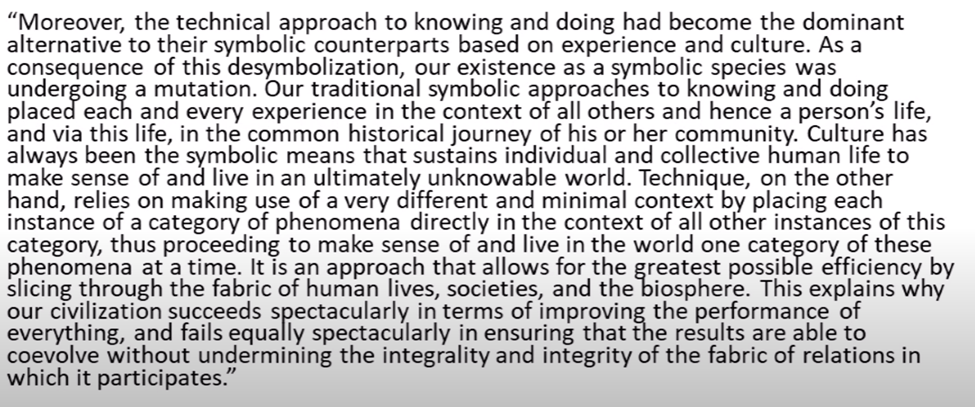
“Technique has penetrated the deepest recesses of the human being. The machine tends not only to create a new human environment, but also to modify man’s very essence. The milieu in which he lives is no longer his. He must adapt himself, as though the world were new, to a universe for which he was not created. He was made to go six kilometers an hour, and he goes a thousand. He was made to eat when he was hungry and to sleep when he was sleepy; instead, he obeys a clock. He was made to have contact with living things, and he lives in a world of stone. He was created with a certain essential unity, and he is fragmented by all the forces of the modern world.”
― Jacques EllulThe Technological Society

The term technique, as I use it, does not mean machines, technology, or this or that procedure for attaining an end. In our technological society, technique is the totality of methods rationally arrived at and having absolute efficiency (for a given stage of development) in every field of human activity. Its characteristics are new; the technique of the present has no common measure with that of the past.

― Jacques EllulThe Technological Society

In his Substack post What did Jacques Ellul mean by Technique? , Samuel Eastlund adds a fourth foundational element to the three mentioned in Ellul’s “technique” definition above:

“Technique is one of the spiritual powers (Col. 1:16, Eph. 6:12) which controls the modern world, which people give their allegiance to and which keeps them in bondage.”

Eastlund continues . . . “As David Gill puts it in his comparison between Ellul and Francis Schaeffer, ‘What is significant and ominous today is that technique itself (rationality, artificiality, efficiency) has become universal, autonomous, and self-automated’. One of the gods of the modern world is efficiency; it is a presupposition of the way we do things that the more efficient something is, the better it is. This becomes obvious when engaging in a discussion about Technique with those not already opposed to it.”

*David W. Gill, Jacques Ellul and Francis Schaeffer: Two Views of Western Civilisation, p. 11

I’m becoming a neo-Luddite of sorts. I have a particular dislike for digital technology as it modifies the means of relating to ourselves, to those around us and to our world. Its dissociative medium detaches us from reality, thereby affecting identity, memory, perception, and truth.

Born into analog times, I enjoyed a continuous stream of organic information that fostered a holistic perspective. During childhood in the 50s and into the 60s, I received information, or better, life in continuously variable physical quantities. I stayed outdoors until it was dark. I rode my bike everywhere. I played with kids – German, Italian, Mexican, Polish and others – on my block. I walked to the library to look up things. With my allowance in hand, I ran to the Five and Dime to see what I could buy. I read the Sunday comics on the front room floor. I watched Howdy Doody, Captain Kangaroo and Lassie on a B&W rabbit-eared tube-filled box. I played 45s on a turntable in my bedroom. I played table games with friends from school and the neighborhood. I attended church. I listened to AM radio on a transistor radio. I learned to play the trumpet.

In high school I played my horn in the band, orchestra and church. I ran cross country and track. I studied French for four years and got into the NHS my senior year. During the summers I worked and took summer school courses. I wasn’t a spectator.

My analog life was harmonized within the perceived analog universe of light, color, sound, force, wind, rain, and seasons. And like a camera and cassette recorder, my analog brain captured a continuous stream of organic information from the real world. I was my own screen saver . . . and social media and Google search.

Those were times before “technique” “penetrated”, “modified”, and atomized life into efficient bits and bytes. Technology didn’t dominate. Like the phone on the wall and the record player, objects were just another thing among many other things. Objects were there to serve, not dominate. I could dial down interest in a thing, walk away, and move on to the more interesting organic things.

In contrast to 0’s and 1’s trying to emulate analog life and the annoying apps with their prompts, pop-ups, and passwords, analog times seemed natural, unintrusive, and rather hassle-free. Digital technology, as it relates to human interface, comes across as contrived and as pushy as a foot-in-the-door salesman and damn frustrating in its effort to achieve maximum efficiency. Add dismissive of your concerns.

In contrast to the soulless 0’s and 1’s programmed to contain life like the characterless pre-fab concrete industrial buildings that contain employees, my childhood was a multi-dimensional free-range human life. I lived life at the speed of life and not at the speed of sound.

Come to think of it, I never swore until I started dealing with computers, hand-held and otherwise, and software. And, even with growing up with talk of a U.S. and Russia nuclear war, I was never alarmed about my times and my country until the rise of That Hideous Strength the technocratic state. The spirit of the age could be felt in the analog times, but now I sense that the spirit of the age is oppressive through technological means.

Consider that technology may have “penetrated the deepest recesses of the human being”. The signs of spiritual oppression include

  • a fixation on depression
  • confusion
  • fear, anxiety
  • isolation
  • compulsive thoughts, feeling and behavior
  • abnormal medical problems

*****

You live as long as I have (70 yrs.) and you see how technology has modified human existence. Human interaction, for instance.

Every morning I work out at the fitness center in the complex where I live. I arrive 5:30 AM. I am usually the only one there at that time.

As is her habit, a young woman comes into the fitness center about an hour later. She walks over to the treadmill looking at her phone the whole time. She has not once looked up and looked over at me to acknowledge me. She’s in a world of her own.

*****

To be sure, I am not a technophobe. I have worked as an engineer for most of my life. I am currently working on improving substation communications for a large utility. I see good uses of technology every day including the recent NASA test: diverting of an asteroid. Technology has its place as a servant of mankind and not as its master.

*****

Well, I’ve given my thoughts. What’s your relationship with digital technology? Has it penetrated and modified your life and to what limit?

Does technology – 4K UHD TV, autonomous vehicles, 5G, esc. – deliver organic value to you? Do the bells and whistles of new technology make life more meaningful?

Are you OK spending time on passwords and renewing passwords and renewing passwords and two-step authentication and One-Time Passcodes. Are you OK paying for cyber security and renewing cyber security and VPNs and renewing VPN software and updates and updates and updates?

Are you worried about being hacked?

Are you worried about your livelihood being held for ransom?

As I am writing this, I received a text message alert from my employer: Cyberattack Impacting Critical Infrastructure. IT Security team received numerous ransomware alerts. The system that hosts the virtual servers in our environment was compromised. It was apparent someone had actively taken over the system and changed the credentials to block access.  All systems were shut down at headquarters and offices with data centers.

Of course, normal business is affected. Production has slowed to almost a halt. The “fix” will be expensive. Modern technology with its propensity for “technical efficiency and systemization” can also be used for disruption, chaos and loss of income.

How do you find interfacing with machines? Does an App give you a sense of control, of power, when you punch in inputs and the device ‘replies’ with a programmed message to your commands?

Are you OK inputting to an algorithm and receiving a canned response?

Do you get the sense using a digital device that you are being programmed and used by it?

Are you OK giving out your digital ID and having your data mined and surveilled by Big Tech, Big Brother, and China?

Are you OK with software tracking your online patterns and then using the data to manipulate and increase your engagement with a product or service?

Are you OK being monitored online night and day? Have you watched The Lives of Others?

Are you wondering if you said something ‘wrong’ online and the FBI will show up at your door?

Are you OK with digital cops? Researchers experimenting with concept of a ‘digital cop’ (wnd.com)

Are you OK with Facebook, Twitter, YouTube, etc. censoring your speech based on a politically-biased algorithm?

Do you find interfacing with machines to be off-putting, alienating, impersonal?

Are you OK spending most of your day interfacing with a device? Looking at a screen?

Do you prefer dealing with devices instead of people?

Are you OK dealing with Chat Bots when you have questions?

Can’t get enough of CGI?

Will you accept becoming an AI product of an algorithm in the post-human world of transhumanism?

Would you be OK with an implanted microchip vaccine passport?

Would you be OK with transhumanists replacing eternal “life in the ages to come” with digital immortality?

Will you be OK with digital currency and the monitoring and control of your finances?

Are you OK with a global technocracy that monitors your behavior and arbitrates your social credit score?

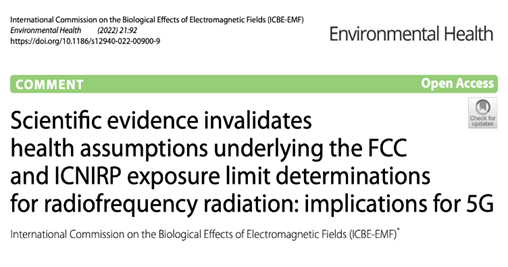
Are you OK with RFR (Radiofrequency Radiation) affecting your body, your brain?

Check this out: Well Being: Dangers of 5G – by Robert W Malone MD, MS (substack.com)

Adverse effects observed at exposures below the assumed threshold SAR include non-thermal induction of reactive oxygen species, DNA damage, cardiomyopathy, carcinogenicity, sperm damage, and neurological effects, including electromagnetic hypersensitivity. Also, multiple human studies have found statistically significant associations between RFR exposure and increased brain and thyroid cancer risk. Yet, in 2020, and in light of the body of evidence reviewed in this article, the FCC and ICNIRP reaffirmed the same limits that were established in the 1990s.

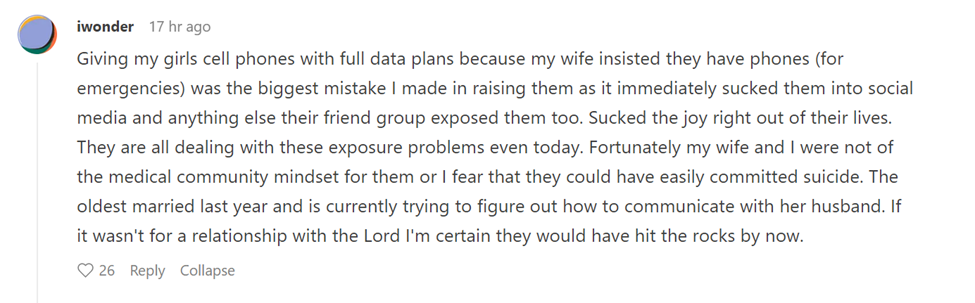
Are you OK with technology reconditioning your children?

Here is one parent commenting on Decade at Bernie’s – by Chris Bray – Tell Me How This Ends (substack.com)

Who is Jacques Ellul?

What do you think of the following quote (a screen capture from the video):

-Willem H. Vanderburg: “The Life and Work of Jacques Ellul” (2012)

“If I find in myself desires which nothing in this world can satisfy, the only logical explanation is that I was made for another world.”
― C.S. Lewis, Mere Christianity

Informed dissent:

EXCLUSIVE INTERVIEW: EcoHealth Whistleblower Dr. Andrew Huff: They Created the COVID-19 Virus Using Gain of Function in a Number of Laboratories and They Covered It Up (VIDEO) (thegatewaypundit.com)

The Calm COVID Truth of Dr. Joe Ladapo (substack.com)

EXCLUSIVE: Archbishop Carlo Maria Vigano’s Message to Catholic Church Urging Leadership to Revisit Their Stance on COVID-19 Vaccines (thegatewaypundit.com)

Video: Moderna CEO Admits COVID Is Like Seasonal Flu, Only Vulnerable Need Jabs – Summit News

How to Use Ivermectin to Protect Against the Covid Vaccines – Brightwork Research & Analysis

“The Boundary is Children” – by Robert W Malone MD, MS (substack.com)

Safe States for Children: Here’s a List of Republican Governors Who Won’t Comply with CDC Mandates to Force COVID-19 Vaccination on Kids for School (thegatewaypundit.com)

Homeschooling Options and State Exemptions for Childhood Vaccines (substack.com)

Two top cardiologists implicate COVID vax in all unexplained heart attacks since 2021 (substack.com)

Dr. Robert Malone: The CDC Voted Unanimously To Recommend The Covid-19 Vaccine For Children As Young As 5 AND the CDC will provide ‘sneaky’ liability protection for Big Pharma vaccines. The CDV won’t protect you, it will protect itself and its cohorts.

Road map to Control:

In 2016, domains for government vaccine passport websites were registered by the same person. Some of these are in current use now.

Well, isn’t that special:

The CDC will vote Thursday to permanently shield Pfizer and Moderna from COVID vaccine injury liability (substack.com)

Video: Bill Gates Says European Energy Crisis Is “Good” – Summit News

Musk’s Dangerous Vision for Twitter (substack.com)

Uniformed Consent:

An in-depth look into the Covid 19 narrative, who’s controlling it, and how it’s being used to inject an untested, new technology into almost every person on the planet. It’s not about the virus. It’s about the vaccine. Problem reaction solution. Slogans slogans slogans.

Ch-ch-ch Changes Not:

Angelina Jolie’s Daughter Shiloh Once Thought She Was A Boy And Asked To Be Called John, But She Outgrew It | Evie Magazine

The way of the wicked:

Disturbing video from Texas drag show for kids… – CITIZEN FREE PRESS

Take down the WEF:

What is the World Economic Forum? (takedownthewef.com)

REVEALED: The ‘Public Figures’ Attending the 2022 World Economic Forum in Davos. (thenationalpulse.com) Note: A pdf of the full list of attendees is located at this link.

Malthusiasts:

Thomas Malthus believed that so-called “positive checks” (such as plagues and starvation) and “preventive checks” (such as birth control measures and delayed marriage), worked to keep population growth and food growth in balance.

The Left, as prompted by the Davos/WEF elites, are similarly concerned about population growth. That is why they promote the “positive” checks of pandemics and the “preventive checks” of abortion, homosexuality, and mutilating children in the name of affirmation.

In An Essay on the Principle of Population, neo-Malthusians [the authors] tells us what they think is required to make their anti-growth philosophy work:

“organized evasive action: population control, limitation of material consumption, redistribution of wealth, transitions to technologies that are environmentally and socially less disruptive than today’s, and movement toward some kind of world government”

– Paul Ehrlich, Anne Ehrlich, and John Holdren, Ecoscience: Population, Resources, and Environment (San Francisco: W. H. Freeman and Company, 1977), p. 5.

Two-time loser Stacy Abrams is a neo-Malthusian. She holds the view that misery or vice are necessary equalizers between growing population and the means of subsistence:

Childless Stacey Abrams Says Killing Your Baby Is Best Way To Fix Democrat-Created Recession: “Having children is why you’re worried about your price for gas” [VIDEO] (thegatewaypundit.com)

How WEF of her!

The Miracle Workers – Engineers


 “Go and tell John [the Baptist], replied Jesus, “what you’ve seen and heard.  Blind people are seeing! Lame people are walking! People with virulent diseases are being cleansed! Deaf people can hear again! The dead are being raised to life!  And – the poor are hearing the good news!  And God bless you if you’re not upset by what I am doing.”  From Matthew’s Gospel account 11 v. 5


The Lord will work out his plans for my life—for your loving-kindness, Lord, continues forever. Don’t abandon me—for you made me.”  Psalm 138 v. 8


>>>

I’ve worked as an engineer for most of my life.  I work in a field where I don’t get to hear directly from those who benefit from my work.  Yet, I take pleasure in doing good work, knowing that my detailed designs bring about a better life for hundreds of thousands even though they most likely take no account of where the benefit derived.

In a world of chronic whining, ingratitude and deconstructionism, I am grateful when I hear and see things which are constructive and about those miracles that change things for the better.

Now, one might suppose from reading the Scripture that miracles are instantaneous.  Point your finger and BAM!  Life is changed for the better.  But the greater reality is that most miracles take time and use human input.  See below.

There is great joy to be found in the noble engineering work of others. I think you will see what I mean after watching these videos.


I’ve saved the adorable for last: