Empire of Lies – Andrew Klaven
December 17, 2014 Leave a comment
Walking around on Resurrection ground
April 6, 2012 Leave a comment
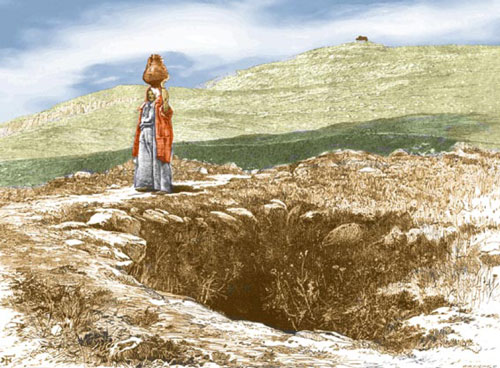
“I am thirsty.” These words spoken just before Jesus gave up His spirit on the cross reveal the need for life’s most basic requirement: life-sustaining water for the body and the soul.
The crucifixion’s slow and agonizing death with its depletion of bodily fluids would cause a human body to dehydrate to the point of suffocation. The blood pouring from the Lord’s hands and feet and from His lash wounds would deprive His body of its normal blood flow, blood flow which carried necessary oxygen to all of the body’s organs. Water was desperately needed. Instead, Jesus was mockingly offered a sponge soaked with wine which had turned. After tasting it he rejected the old wine and its numbing effects.
“I am thirsty” indicates the Lord’s need for water but more importantly these words also reveal that the Living Water, God the Holy Spirit, was also leaving the Lord at this point in time. Because Jesus bore the sins of the world He could not have fellowship with His Father and the Holy Spirit until His work of atonement was complete. Until then The Trinitarian Well of eternal fellowship was cut off from the Son of God. In place of this Well, Jesus chose to drink from the bitter cup of God’s will.
King David prophesied about the relational and physical torment that the Messiah was to suffer on the cross. From Psalm 22:
My God, my God, why have you forsaken me?
Why are you so far from saving me,
so far from my cries of anguish?
My God, I cry out by day, but you do not answer,
by night, but I find no rest….
I am poured out like water,
and all my bones are out of joint.
My heart has turned to wax;
it has melted within me.
My mouth is dried up like a potsherd,
and my tongue sticks to the roof of my mouth;
you lay me in the dust of death.
In this act of substitutionary atonement the Lord’s body bore all the sin of all men for all time. On the cross Jesus rapidly became depleted from loss of fluid and, as Psalm 22 tells us, from the loss of Living Water – Jesus was forsaken by the Father and the Spirit. “Because he poured out Himself to death” Jesus became as a barren desert, a desolate place with no water. He was made sin for us.
John’s Gospel account offers the Creator’s context for the words “I am thirsty.”
In the gospel narrative the apostle John relates the true story of Jesus meeting a woman of Samaria at Jacob’s well.
The well and the field surrounding it were gifts from Jacob to Joseph. And you will remember Joseph. He is the one who received good gifts from his father (the coat) and bad treatment from his brothers. I have no doubt that the well was, well, well-known to many who traveled though the area. I’m sure it was on the map of those seeking to quench their thirst, thirst brought about by the day’s relentless heat. John’s account tells us that as Jesus was traveling from one place to another he became tired and thirsty. He stopped outside the town of Sychar at the well to rest.
As Jesus sat down near the edge of the well he told his disciples to go and get some food in the nearby town. It is midday. The sun is directly overhead and the heat is stifling. Jesus had no means of retrieving the water from the well. You can imagine someone being thirstier when they know that water is just out of reach.
As Jesus sits resting a woman from the town of Sychar approaches the well carrying her clay jar (I am assuming some things here.). The woman comes to the well in the middle of the day because, I believe, no one else will be there during the hottest part of the day. She has her reasons for not wanting to be around the other women of the town: she sleeps around.
Jesus, thirsty, asks the woman for a drink: “Will you give me a drink?”
The woman was at a loss as to what to think:
The Samaritan woman said to him, “You are a Jew and I am a Samaritan woman. How can you ask me for a drink?” (For Jews do not associate with Samaritans.)
From the gospel account:
Jesus answered her, “If you knew the gift of God and who it is that asks you for a drink, you would have asked him and he would have given you living water.”
“Sir,” the woman said, “you have nothing to draw with and the well is deep. Where can you get this living water? Are you greater than our father Jacob, who gave us the well and drank from it himself, as did also his sons and his livestock?”
Jesus answered, “Everyone who drinks this water will be thirsty again, but whoever drinks the water I give them will never thirst. Indeed, the water I give them will become in them a spring of water welling up to eternal life.” (emphasis mine)
The woman said to him, “Sir, give me this water so that I won’t get thirsty and have to keep coming here to draw water.”
He told her, “Go, call your husband and come back.”
“I have no husband,” she replied.
Jesus said to her, “You are right when you say you have no husband. The fact is, you have had five husbands, and the man you now have is not your husband. What you have just said is quite true.”
“Sir,” the woman said, “I can see that you are a prophet. Our ancestors worshiped on this mountain, but you Jews claim that the place where we must worship is in Jerusalem.”
(Note: The woman, like most of us, wanted to deflect the accounting of her sinful life. Becoming polemical the woman quickly changed the subject and pressed Jesus about a heated religious and geopolitical issue of the day.)
Jesus, having already gotten the woman’s attention by recounting intimate details of her life, responded to her question about true and valid worship as the Source, the well-spring of Truth.
“Woman,” Jesus replied, “believe me, a time is coming when you will worship the Father neither on this mountain nor in Jerusalem. You Samaritans worship what you do not know; we worship what we do know, for salvation is from the Jews. Yet a time is coming and has now come when the true worshipers will worship the Father in the Spirit and in truth, for they are the kind of worshipers the Father seeks. God is spirit, and his worshipers must worship in the Spirit and in truth.”
The woman said, “I know that Messiah” (called Christ) “is coming. When he comes, he will explain everything to us.”
Then Jesus declared, “I, the one speaking to you—I am he.”
Water flows through John’s gospel. John the Baptist baptized “with water so that He (Jesus) might be revealed by Israel. In the above passage we learn about Jesus chatting with a woman as he sits next to a well. There He talks about the everlasting living water which wells up inside you if you accept it. In a previous passage John recorded Jesus’s first sign: turning water into wine at a wedding in Cana. In the passage after the Jacob’s well story John tells us about a lame man who had been trying for thirty years to enter the healing pool in Bethesda. The water of the pool would bubble up with curative power whenever the Spirit stirred it. But the man had his excuses for not being well. In a later passage John recounts Jesus walking on the water to meet the disciples in the middle of a lake.
Then one time …
On the last and greatest day of the festival, Jesus stood and said in a loud voice, “Let anyone who is thirsty come to me and drink. Whoever believes in me, as Scripture has said, rivers of living water will flow from within them.” By this he meant the Spirit, whom those who believed in him were later to receive. Up to that time the Spirit had not been given, since Jesus had not yet been glorified. (emphasis mine)
Are you thirsty? Are you trying to quench your deepest thirst with the things of this world, things that quickly run ‘dry’ from everyday use? Do more clothes, more electronic gadgets, more Facebook friends, more entertainments, more tattoos, more tipping points, more of anything this world has to offer satisfy your deepest thirst?
The woman at the well had her life of men. She had her connections. She also had her water bucket. She brought this bucket to the well everyday to get the water she needed to survive. The woman could argue religion and politics with the best of them but she was thirsting for something more. She may have wondered “is that all there is?” Is that all that life has to offer someone like me, a woman of Samaria marginalized by my own community and holding on to an unsure belief in an object of worship others are telling me to believe in.
Unknowingly, it was of the True Well of Life that she made her request: “Sir, give me this water so that I won’t get thirsty and have to keep coming here to draw water.” Jesus responded: If you knew the gift of God and who it is that asks you for a drink, you would have asked him and he would have given you living water.”
We know that drinking water is necessary for life. We listen closely to health programs that tell us to drink several glasses of water a day to sustain our bodies, to help them function properly and to replenish the oxygen our systems need. As you would imagine the quality of water that you drink is critical. Undoubtedly, water that contains filth would do more harm than good. Is the well water you are drinking clean and pure, refreshing and restorative? Or, is it filthy with parasites making you weak and sick?
The water that Jesus offers to you and me is greater and purer than the most abundant compound found on earth: H2O. It is the Living Water of the Holy Spirit. This water teems with Abundant Life, the very oxygen of heaven. Once received its Spirit-life effervescence bubbles up within a person. It then overflows your spirit and converges with the rivers of Living Water that have never stopped flowing throughout all of eternity except for that dark hour when the Gift of God Himself was poured out as a drink offering and He cried, “I am thirsty.”
*****
September 27, 2011 Leave a comment

I have often returned to the eyewitness account of Jesus walking on the water and of Peter’s eager attempt to do the same. I do so especially when I am not sure about my next step.
It is an unusual account not only because the rules of physics were usurped but also because Jesus is meeting the men in the midst of their daily work.
Peter and the others made their living as fisherman. Everything they needed depended on the day’s catch. The families of these men and the markets were waiting at home. So come hell or high water they would go out on the Sea of Galilee trawling for fish.
One night hell and high water came –a fierce storm suddenly arose. Their small fishing boat was buffeted by the wind and the waves. The sail was useless and rowing had become impossible. Their whole effort was used to keep an even keel so as not to capsize and lose their nets in the process.
In the rain-swept darkness there suddenly walked a figure – a man walking on the water towards them. Perhaps, they thought, it is a ghost. No one in their right mind would be out in this weather and certainly not for a stroll on the sea. This did not bode well for superstitious fishermen.
During a streak of lightning, perhaps, Peter thinks he recognizes the profile of Jesus. At this point Peter might have said to himself, “Jesus! Jesus is not safe. He’s way out on the deep end. Walking on water just might be another one of those “Jesus things’ that keep you guessing. But, my gut tells me to go with it for now.”
Out of the gale comes a voice, “Take courage! It is I.Don’t be afraid.”
So Peter yells, “Lord, if it is you, tell me to come to you on the water.” And Jesus said “Come!”
Peter stood up in the small boat almost tipping it over. Unsteady, heart racing, he grabbed the hull with one hand and lifted his right leg out of the boat. He put his right foot down on the water. His foot made no hole in the water. He slowly shifted his balance and brought his left leg out of the boat. Peter stood on the substance of things not seen. He straightened up and looked over at Jesus. The storm was still raging behind the apparition-turned-Apotheosis.
Yet, in an instant the full weight of Peter’s reason, creating a confluence of fear, opened the sea below him like a watery trap door. He sank down into water over his head.
Treading in the choppy waters as best he could, Peter cried for help, “Lord, save me!”
Jesus caught hold of Peter’s hand and pulled him up. While holding Peter’s hand and looking Peter square in the eye (I can only imagine.) Jesus said, “You of little faith, why did you doubt?”
“And when they climbed into the boat, the wind died down. Then those who were in the boat worshiped him, saying, “Truly you are the Son of God.” “
Hoisting the sail, Peter and the crew got back to the business at hand – making a living from being gut sure of what they hoped for and being more certain of what they did not see – fishing.
The eyewitness account that relates Peter’s story is recorded in Matthew’s Gospel (14:22-33)
April 16, 2011 Leave a comment
Vanity Fair, May 2011 issue, under the heading Five Things the Lamestream Media Won’t Tell You About the Constitution:
“2. The phrase “separation of church and state” appears nowhere in the Constitution. It was coined in 1975 by William Ayers.”
*****
Here’s something to ponder: a golf game is more important to Obama (who learned about compartmentalization while being around Ayers) than attending church with his family.
Obama has no problem deciding whether to play golf. The economy, Lybia and…? These issues don’t require faith or prayer or even a decision. For Obama, these things require golf (and campaigning for 2012).
2012: send Obama back to wherever he came from. Somewhere there is a community that needs his golf experience!
*****
In stark contrast to the morally filibustering Obama is the integrity and forthrightness of Wisconsin Rep. Paul Ryan:
On the opposite side of the fence (or state border) from Obama is Wisconsin’s Rep. Paul Ryan. In the Sunday, April 17th, 2011 Chicago Tribune there is an article about Ryan titled Wisconsin’s Ryan is thrust into spotlight: Conservative’s plans put him at odds with Obama.” The article discusses some of the details of Ryan’s The Path to Prosperity budget plan. There is also this quote:
“Republican Wisconsin Governor Scott Walker, in the news for his own budget battles, is an ally (of Ryan). “There are two types of people in politics, people who want to be somebody great or people who want to do something great,” he said Paul is among the latter.””
And in the article:
“House Republican Peter Roskam (a Christian), of Wheaton (Illlinois), called him (Ryan) well-prepared and said, “He doesn’t overstate or oversell and he’s clear – that’s a gift in this town.”
And:
“”He’s very devoted to his family. He flies back for parent-teacher conferences,” said Janesville attorney George Steil Jr. who practiced with Ryan’s father.”
At the end of the article:
“Joe Van Rooy, who teaches government at Janesville’s Parker High School…takes his students to Washington every year and they meet with Ryan. He said the congressman, now in his seventh term, knows their families and remembers their names. Ryan lectures them about political civility.”
“He noticed, though, that one year Ryan was fingering prayer beads while taking student’s questions. The teacher asked why.
“He said, ‘I am so stressed out about the country.’”
(emphasis mine)
*****
It appears that for Obama, faith is just another tool to leverage himself and his constant campaign. He is more interested in power than in principle.
June 28, 2009 Leave a comment
Faith…
Inopportune
Scary
Tried and true
Worthy
Foolish
Without finite
Favorite
Generous
Gone to the Wind
Apocalyptic and
Analgesic
By faith…
“Come”
“Walk”
“See”
“Move”
“You feed them”
“Go”
“Tell…
It is finished.”
***
Faith:
My father, my mother
My brothers, my sister.
My faith.
***
Without faith it is impossible
to please
Him.
© Sally Paradise, 2010, All Rights Reserved