No Country for Old Men Without Borders
June 1, 2026 Leave a comment
“All the time you spend tryin to get back what’s been took from you there’s more goin out the door. After a while you just try and get a tourniquet on it.”
― Cormac McCarthy, No Country for Old Men
No Country for Old Men refers to a world that has become increasingly violent and chaotic, where traditional values and the moral compass of older generations are no longer effective or relevant. The title reflects the struggles of the aging sheriff, Ed Tom Bell, as he confronts the senseless violence and lawlessness that he feels ill-equipped to handle . . .
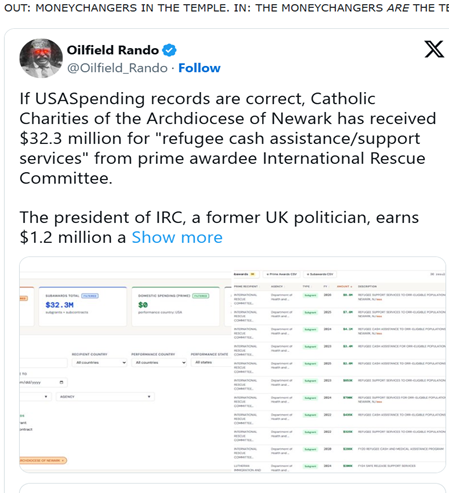
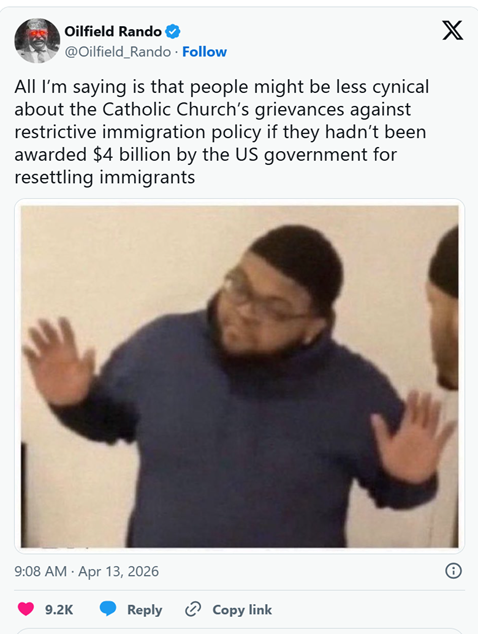
In the past six months I’ve come across two pastoral letters imploring Christians to think kindly toward the millions of foreign invaders who have illegally crossed our borders to appropriate our country’s resources and thereby impacting the future of our neighbors and the country.
The first (AI generated?) letter was posted “By A Country Pastor.” (Quaint, eh?) The second, from a Hispanic Anglican bishop out of California. (Surprise, surprise!). The document below is the latest missive. Like with my response to the first letter, I do not consider the current pastoral letter authoritative.
It’s not that an Anglican bishop doesn’t have authority to speak about such things. It’s just that there is nothing in the letter that compels me to change my understanding or my actions. I seek to love my neighbor as myself, I ascribe image-of-God dignity to all humans, and I hold myself and others accountable for what is done.
~~~
Here’s the letter’s opening and my comments:
“As bishop of the Diocese of San Joaquin within the Anglican Church in North America, I write pastorally to address the subject of refugees and immigration. I recognize that immigration is a complex matter involving legal, social, and economic concerns. Yet for the Church, it is first and foremost a biblical and pastoral issue, shaped by our allegiance to Christ and our calling to make disciples of all nations (Philippians 3:20; Matthew 28:19–20).”
What brought about the need “to address the subject of refugees and immigration?”
Did narrative-edited videos on CNN and MS NOW showing ICE rounding up the bishop’s would-be disciples provoke clerical stole clutching? Was it something preachy Morning Joe Scarbourough said?
Was it some attribution of unchristian behavior onto the millions of legal citizens never wanting their neighborhoods and their country overrun with and terrorized by the worst of worst criminal aliens, international criminal gangs, drugs, and scammers?
Was it Progressivism’s predatory foray into the church? (See video below.)
“After years of global elites lecturing us about compassion, diversity, open borders, asylum, labor flows, and all the buzzwords they love to force-feed us, The Economist is suddenly admitting that voters are right to think the system has been gamed to screw us over.”
The Economist suddenly changes its immigration tune…
Is it because “The globalist machine is sputtering and losing speed. And they can hear the America First engine coming up fast right behind them”?
Was it concern that Federal grant money to NGOs was drying up?
Was it Trump derangement syndrome?
Is it because Democrats need to keep their animus toward America, its Constitution and laws, always before us, so deportation resistance has to be revved up again?
What brought about the need “to address the subject of refugees and immigration?”
After giving lip service to the complex matters immigration invokes “involving legal, social, and economic concerns” – matters established by our country’s founders for the common good that include the principle of subsidiarity, protections both physical and civil, fiscal soundness, and a legitimate process for the integration and assimilation of legal immigrants leading to citizenship – the bishop, without saying any more about the very real down-to-earth “legal, social, and economic concerns” of not dealing with the complex matters that (illegal) immigration brings down upon our families, our neighbors, our communities and our nation, goes on to place the matter of (illegal) immigration into his safe space – his otherworld jurisdiction.
The bishop, you see, has a “first and foremost” trump card: entitlement of citizenship for (illegal) immigrants – citizenship in heaven – that overrides legal citizenship status and subjugates the concerns of legal citizens to a ‘scriptural’ utility of making disciples.
I wonder. Does the bishop assume that illegal immigrants will want to assimilate and willingly accept being discipled because of compassion extended toward them? Do Islamists assimilate and become disciples of Jesus? Do gang members assimilate and become disciples of Jesus? Will the Chinese from the CCP? Will the Somalians? If a comfortable living situation is the basis for entering illegally, the immigrant will be discipled by Democrats willing to give them all kinds comfortable living on welfare in exchange for their vote.
How convenient that the San Joaquin valley is inundated with Hispanic illegal immigrants! Now they can easily be colonized as citizens of heaven and as low-cost farm workers!
You tell me. Have you read anywhere in the gospels that before Jesus ascended into heaven, he said “Go. Open your borders. Let everyone in, even your enemies. This will facilitate making disciples.”?
The two letters are the same in their “pastoral” plea to be welcoming and hospitable to the invaders, the opportunists violating the law for access to another’s property and wealth. (See The Dark Side of the Immigration Debate and The Ungrateful Immigrant below.)
The letter goes on . . .
“Holy Scripture teaches that every human being is created in the image of God (Genesis 1:26). Therefore, all people—regardless of legal status, nationality, or ethnicity—possess inherent dignity. The Bible repeatedly calls God’s people to welcome the stranger, care for the vulnerable, and extend hospitality to those in need (Leviticus 19:33–34; Matthew 25:35; Hebrews 13:2). Our Lord Himself knew the life of a refugee when the Holy Family fled to Egypt (Matthew 2:13–23).”
Here, the bishop pulls out all the “social justice” stops. His words are coded in Biblical jargon to supply the naïve reader justification for open borders. We are to trade the real-world deleterious effects of illegal immigration for a high-minded other-world compassion that unleashes chaos with the senseless violence and lawlessness that we are ill-equipped to handle.
My understanding of image-of-God “inherent dignity” involves personal accountability and responsibility for one’s human agency. It’s not a badge we put on someone to give them a ‘social justice’ pass.
Tell me. When Jesus said “The thief comes only to steal and kill and destroy” (John 10:10) did he point out the inherent dignity of the thief so that we would take a compassionate view of him and his ways? Did he do this with the Pharisees or the woman caught in adultery? No. Jesus spoke of what they did against their image-of-God “inherent dignity.”
The application of “dignity,” like with applying “love,” can be used to Ok of all kinds of inordinate things, such as same-sex marriages: [IN Senator Todd} Young Op-Ed: Marriage Bill Ensures Dignity and Respect for All Hoosiers. S.J. James Martin uses “inherent dignity” to justify all kinds of unholy things
Both pastoral letters imply that foreign invaders should be treated as possessing human dignity. But do the illegal immigrants respect the inherent dignity of the ICE officers and their lawful task?
ICE has its hands full with those who resist – you know, the “strangers” who crossed the border illegally and are now putting up a fight with law enforcement. And with those “strangers” financed and deployed by Democrat NGOs to put up violent resistance. Where’s the dignity in that?
Why doesn’t the bishop publicly denounce and admonish the ICE protestors and the chaos they bring? His higher law says to speak the truth in love. Maybe he agrees with the NYT’s op-ed columnist David Brooks who says “It’s time for a comprehensive national civic uprising.”
“I’ll kill your whole f-cking family! Your whole f-cking family is dead!” the agitator yawped. “Your children, your wife—all dead!”
Acting AG Blanche: Anti-ICE Agitator Will Be Arrested for Threatening Agent During NJ Riot
At some point, ordinary, law-abiding people are going to get sick of the disorder protected and excused by their degenerate liberal governing elites. I will continue to ask the question “Where are the adults?”
Saying that Jesus was a refugee – is that said to invoke empathy for the refugee? How so? Mary, Joseph, and the baby traveled to Egypt under God’s protection and direction. They also remigrated home under God’s protection and direction. The Illegal immigrants can do the same.
The letter goes on . . .
“At the same time, Scripture affirms the legitimacy of nations and civil authority (Romans 13:1). A faithful Christian response must therefore hold together two truths: the responsibility of governments to uphold the rule of law and protect their borders, and the obligation to treat immigrants and refugees with justice, mercy, and compassion, in accordance with God’s law (Matthew 22:21).”
Let’s be clear. U.S. immigration laws are not unwelcoming or imposing hate. They are not anti-human anti-dignity. They, in fact, affirm human dignity by holding the people who placed themselves in the lawless positions accountable.
“Justice, mercy, and compassion” have been extended toward illegal immigrants and “refugees”:
USCIS Supports “Project Homecoming” Self-Deportation:
If you are here illegally and you want to go home, the Department of Homeland Security now offers use of the CBP Home Mobile App so that you can voluntarily self-deport. Through the CBP Home Mobile App, you receive a complimentary plane ticket home, receive a $2,600 exit bonus upon your return, and will have any unpaid fines for failing to timely depart forgiven.
But the opposite is portrayed by left-wing media. Such have a financial and political stake in promoting open borders. The opposite is also portrayed by church leadership that has accepted the media’s lies.
I agree. We are to treat all people with “justice, mercy, and compassion” in accordance with God’s will. That would include our neighbors who are having to deal with the invasion of millions of illegal aliens. There is nothing merciful, just or compassionate about an invasion of millions of foreigners into our communities.
The letter goes on . . .
“In my episcopal ordination vows, I pledged to be “gentle and merciful for Christ’s sake, to poor and needy people and to all strangers destitute of help” (BCP 2019, p. 504). Guided by that promise, I call the Church to bear faithful witness by loving our neighbors, advocating for the vulnerable, speaking the truth in love, and offering practical care to those entrusted to us (Luke 10:25–37; Matthew 5:13–16).
Who are the vulnerable? Children. Trafficked children. Exposed children.
“These children are vulnerable; they’re actually the ones who need the help,” Rivera said. “They’re brought against their will, and they have no say in where they’re going, whether it’s mom or dad, aunt or uncle, or some stranger getting something out of it.”
Open borders have been a gateway for the exploitation and oppression of human trafficking.
Open borders have been a gateway for the child trafficking.
Open borders have been a gateway to make billions:
Our children are now exposed to the flood of unvetted pedophiles entering the country during Biden’s (and the bishop’s watch). Arrested: Worst of the Worst
Our children are exposed to the flood of sickness entering the country during Biden’s (and the bishop’s) watch.
New York City’s health commissioner announced last week that the influx of migrants from the southern border — more than 50,000 to New York City alone in the past year — is delivering contagious diseases, including tuberculosis and polio, to our neighborhoods.
Per the CDC: While still abroad, immigrants, refugees, and others who apply for admission to live permanently in the United States must undergo a medical examination.
Did this happen during the Biden open borders invasion? No.
Biden’s open borders are bringing contagious diseases to your neighborhood
The letter goes on . . .
“ Our Anglican tradition has long affirmed the Church’s responsibility to care for refugees and immigrants while engaging society with moral clarity and charity. Respect for civil law must always be informed and corrected by God’s higher law, which calls us to justice, dignity, and mercy.”
Again, I wonder what brought about this letter? Who is NOT engaging society with moral clarity and charity? Who is NOT “informed and corrected by God’s higher law, which calls us to justice, dignity, and mercy?” “Is it the “basket of deplorables”?
I view the deportation of the millions of foreign invaders as respect for civil law, as respect for my neighbors, as respect for “God’s higher law.”
I understand God’s higher law as that which holds people accountable with “justice, dignity, and mercy.”
The letter ends . . .
“I encourage the faithful of this diocese to live into these convictions: welcoming the stranger, discipling those within our care, and assisting immigrants and refugees to live responsibly and faithfully within our communities. I pledge to engage our diocesan leadership and civil authorities with these biblical values, and I pray for the nations of Canada, Mexico, and the United States, that we may act justly, love mercy, and walk humbly with our God.
Signed,
The Rt. Rev. Dr. Eric Vawter Menees, SSC”
If I see a stranger in my neighborhood, I say “Hi.” I try to connect.
I will continue to insist that all illegal “immigrants and refugees” be deported or remigrate home and then apply to come into the country legally.
Otherwise, our land becomes increasingly violent and chaotic, where traditional values and the moral compass of older generations are no longer effective or relevant. We will be confronted by senseless violence and lawlessness that we are ill-equipped to handle . . .
~~~
Some Thoughts
-During COVID there was a lot of Karen-like shaming going on. Not wearing a mask, not social distancing, and not vaxxing meant ridicule for not submitting to “We’re all in this together.” I get the same “get with the program” vibe from the two pastoral letters.
-There are those who think they know all about me even though they never write, call or visit. They “know” me from a distance, from what the media and church leaders present about people “like” me, as in CT’s Russel Moore (See below.) I get the same vibe from the two pastoral letters.
-That we should help the “vulnerable among us” sets up understanding illegal immigration in terms of the “oppressed” and the “oppressors.” Stay away from Marxist narratives.
-Out of context verses can be used to endorse all kinds of unscriptural church policies – from saying women should not be pastors/teachers to open borders to anything goes sexuality. Out of context, out of bounds.
-Much of what comes out of the church today about Jesus, comes from the TV. That is how some came to see Jesus as the docile, friendly, welcoming, and unwaveringly accepting Mr. Rogers. Being nice his emotional landscape and children’s. Do these same people think that ICE should take off their LE gear, put on a sweater, and say “Won’t you be my neighbor?” I will continue to ask the question “Where are the adults?”
-I once knew a female assistant rector. She saw herself as the PBS version of a female rector in an Anglican church in England – as the Vicar of Dibley. It came across in her PBS-like sermons.
-One cannot read the gospels and come away with Jesus being docile or unwaveringly accepting. Jesus didn’t accept whatever people did with their “inherent dignity” or “love.” He held people accountable. The gospel according to Progressivism doesn’t hold people accountable except for those who don’t go along with their narratives. See letter above.
Very reliable social media sources tell me that Jesus was a Progressive: he helped the vulnerable, the oppressed, and the foreigner. Why, they say that Jesus was down with socialism, abortion, LGBT-ism, social justice, DEI. Jesus was down with anything man came up with in the last five minutes to make the world a fairer and more equitable place, i.e. to make the world less God-saturated and more man-saturated.
Higher Law Bigotry
Two Judean religious leaders see a half-dead man lying on the side of the road as they walk along. A Judean had been beaten and robbed. But the two principled men stay away from “lesser” concerns to stay true to a higher law.
Someone the two religious leaders consider of low estate, as without their higher-law pedigree, comes along and helps their assaulted neighbor.
Turns out that the neighbor in Jesus’ parable is the one who sees what is going on around him and helps his neighbor. It is not the high-minded principled. And so it is with Christian leaders who ignore broken boundaries and their broken neighbors so as to observe a higher law.
~~~
https://www.dioceseofsanjoaquin.net/news–events
https://www.imdb.com/title/tt33324911
~~~
“I live on a farm beside a rural avenue in central California, the fifth generation to reside in the same house. And after years of thefts, home break-ins, and dangerous encounters, I have concluded that it is no longer safe to live where I was born. I stay because I am sixty-five years old and either too old to move or too worried about selling the final family parcel of what was homesteaded in the 1870s.”
The Diversity of Illegal Immigration
~~~
From my post Two Visions Three Questions:
What hard evidence do you have that an open borders policy is a good decision? Your feelings? Your empathy? Any talk about “welcoming the stranger” in the abstract is not hard evidence in support of an open borders policy. Is the evidence your need for cheap labor? Democrats Once Again Concerned About Who Will Pick Their Crops
And . . .
Lest anyone think that I am an “ignorant hillbilly” and can be known by my smell (Peter Strzok), lest anyone think that I am a rube and an uncaring Christian xenophobe nativist, and lest anyone think that I haven’t traveled outside my shire and am not cosmopolitan, know that I have traveled to many parts of the world and have met and worked with many different people during my 70+ years. I am not a misanthrope.
My travel, mostly for engineering work, included a trip to Seoul South Korea and within five miles of the DMZ, to Dhahran and Jubail Saudi Arabia and the oil fields worked by Saudi Aramco, to Warsaw and Bialystok Poland, to England during the Queen’s silver jubilee, to Rio De Janeiro, to Mexico – Tuxpan and Tampico, Mexico City, and Sonora state, to many of the provinces of Canada, including Saskatchewan when it was 40 degrees below zero, and to most of the U.S.
I did love coming home to the U.S. after each trip to some distant place.
~~~
Podcasts:
“American Citizenship and Its Decline: Illegal Immigration and the Loss of National Sovereignty” from The Hillsdale College Online Courses Podcast by The Hillsdale College Online Courses Podcast.
Citizenship is rare in human history but essential to free government. Today, the constitutional rule of citizens in America is threatened by a new form of government, unaccountable to the people, in which power is held by a ruling class that seeks to transform our society. In this eight-lecture course, students will examine the origins and history of citizenship in the West and the grave challenges American citizenship faces today.
America’s founding principle of equality created an opportunity for people from all over the world—regardless of race or birth—to immigrate to the United States and become full citizens. This led to a system of immigration that proceeded according to established laws and required a willingness and ability to assimilate into American society. These criteria have been abandoned in favor of a system of widespread illegal immigration that erodes the rights of citizens. (Emphasis mine.)
https://podcast.hillsdale.edu/american-citizenship-and-its-decline-introduction
~~
Influence Campaigns Inside Evangelical Institutions Podcast:
https://cis.org/Parsing-Immigration-Policy/Influence-Campaigns-Inside-Evangelical-Institutions
~~~
Eric Metaxas: Christianity Today Had an Easter Message: We’re Just … Better Than You
“Lord, I Thank Thee That I Am Not Like These Deplorables”
[CT’s Russel] Moore quotes the evangelical sociologist James Davison Hunter, who in a previous patronizing essay made the case that it is the begrudging resentment of groups who once had power that fuels our societal woes. Hunter doesn’t actually say “working-class white Christians” so much as dog-whistle it. Everything such knuckle-dragging relics do is actually only so that they might cling to what power they still have — or mebbe to yank it back from them’s what took it. . .
Cheap Amateur Psychoanalysis
Moore explains, for example, the real reason that some people want secure borders:
“In Hunter’s view, a ressentiment posture is heightened when the group holds a sense of entitlement — to greater respect, to greater power, to a place of majority status. This posture, he warned, is a political psychology that expresses itself with “’the condemnation and denigration of enemies in the effort to subjugate and dominate those who are culpable.’”
Here Moore might very well die in the irony mines, as he condemns and denigrates his own cultural enemies for … condemning and denigrating their cultural enemies. Because the rules are apparently different for the right sort of people. . .
Damn the Kulaks, Full Speed Ahead!
But buckle thy seatbelts, pilgrims, for the condescension will soar yet higher. Moore continues:
“Often, the most contentious aspects of American life center on the question ‘Who is trying to take America away from us?’— whether that be immigrant caravans overwhelming the border, the concept of American elites developing a global pandemic to control the population with vaccines, or the rhetoric of Satan-worshiping pedophile rings at the highest levels of government.”
Moore confidently assures that his critics are driven by sheer resentment — pardon me, ressentiment — and are clinging to some America in which they were top-dogs. But the positively Himalayan irony is that it is Moore and his friends in subsidized, institutional Christianity who are losing cultural power. So they’re lashing out, in essays such as this.
~~~
Christian leaders shouldn’t be more concerned about protecting illegal aliens from ICE than protecting the religious freedom of their congregants.
~~~
Here’s what the media does to people: James Woods: On Memorial Day, a veteran dies from being beaten to death for the way he voted – in America… – Revolver News
Where are the pastoral statements about this murder? None I suspect. This is a lesser concern and not the business of following the “higher law.”
~~~
We are to be the Welcome Mat:
Texas state representative James Talarico compared the nation’s southern border to a “front porch,” saying it should function like a “giant welcome mat.”
~~~
J.B. Shurk, writing at American Thinker:
Globalism Seeks to Kill the Nation-State: International government threatens the whole planet.
People are beginning to understand that those who rule in their name have long been working to eliminate the nation-state….
. . .That’s another part of internationalism’s linguistic magic trick: The same global corporate news machine that has spent the last eighty-plus years conditioning people to understand the word “nationalism” as something evil, militant, and barbaric has simultaneously conditioned the world to see anything “international” as inherently good, peaceful, and progressive. The “national / international” dichotomy didn’t happen by accident; it’s been shoved down our throats all our lives. But once again, if a rational person takes a moment to consider the semantic manipulation, it is quite absurd.
. . . internationalism’s true intent: Internationalists are building a global empire. This empire is authoritarian (because it demands global compliance at the expense of personal freedom) and totalitarian (because it requires complete subservience to a centralized and dictatorial global government). There is nothing “democratic” or “representative” about this international system of governance. It has no interest in protecting an individual’s rights and freedoms. It has no interest in respecting a nation’s sovereignty. It will permit both individuals and nations to be raped in the name of “global peace.”
Therefore, it makes perfect sense why the United Nations encourages mass illegal immigration into the United States and Europe. When you are in the business of destroying nations, you do not care if murderers and rapists destroy local families. You do not care if Islamic terrorists burn down Christian churches. You do not care if the “newcomers” to Europe and America have pledged to conquer the West. (Emphasis mine.)
~~~
E. Jeffrey Ludwig, writing at American Thinker:
Illegal Is Legal, Immoral Is Moral – American Thinker
[American society is] also are contending with millions of foreign nationals who were admitted illegally during President Joe Biden’s administration, whom Democrats defend against being rounded up and deported. This expulsion of illegals is an affirmation of our legal system, which has set up rules for legal entry into the USA. The rules were approved by our legislative system, but now and for the four years of the previous administration, those laws are being denied and repudiated by one of our two major parties. The Democrats are doing what they can to defund the offices of government responsible for rounding up those illegals. They are encouraging illegal behavior yet do not believe that a stigma is attached to that intention.
They are sentimentalizing immigration laws as though our already generous laws were overly strict and against the pro-immigration traditions of the USA. Illegal entry by “huddled masses yearning to breathe free” is being propagandized as being more “moral” than obedience to the legitimately passed laws. (Emphasis mine.)
Suicidal Empathy is Killing the West
In the new book Suicidal Empathy, evolutionary behavioral scientist and professor Gad Saad makes the case that the West’s most celebrated virtue has been weaponized, mis calibrated, and taken to a place that is actively destroying the societies it claims to protect.
“ . . . the “West’s elitist progressive political class is infected by a mind parasite that causes its empathy module to misfire in every conceivable manner. Many of the policy decisions that are wreaking havoc in the West stem from this poor calibration of empathy, resulting in a society that is galloping toward the abyss of infinite lunacy.”
The Road To Hell Is Being Paved With Suicidal Empathy
~~~
This Is NOT what Jesus would do:
New York City shouldn’t be flooded with filthy water, garbage, or aggressive illegal foreigners.
“When you first watch the video, you’d think this was some filthy, chaotic scene from Bangladesh.
“But sadly, this isn’t Bangladesh.
“It’s Canal Street in New York City.
“Yep, the Big Apple looks downright rotten, folks. And the kicker is that this is basically a no-go zone for Americans.
“And before the “refugee welcome” crowd starts screaming about how America was a nation shaped by immigrants. We know about the olden days. But the Ellis Island era worked because there was an expectation of assimilation. People came here, brought parts of their culture with them, and still understood they were joining something that already existed.
“That’s not what this clip looks like.
“This looks like a city that has stopped enforcing any American standards whatsoever. It looks like an illegal street economy operating out in the open, and it also looks like counterfeit goods, sidewalk chaos, territorial vendor control, illegals, foreigners, and Americans citizens being chased away from streets in their own country.” (Emphasis mine.)
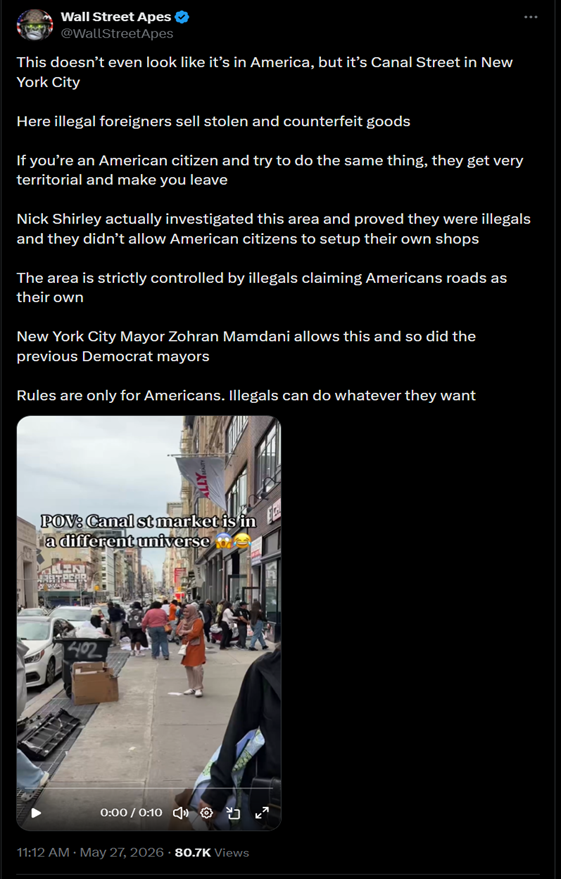
Look at this horrific street in a popular US city. American citizens aren’t welcome… – Revolver News
~~~
The wolves – Globalism and Progressivism – have snuck into the church dressed in sheep’s clothing.
When Progressivism snuck into the Anglican church I was attending in Illinois via a female Wheaton college professor who became an assistant rector, I left. I knew the woke virus was already overtaking the congregation.
Progressive Christians believe “God is bigger than our borders, bigger than our language, bigger than our certainty.”
Megan Basham: How Progressivism Creeped into Evangelical Churches
Megan Basham: When Progressive Foundations Fund Evangelism
The political projects men like Christianity Today editor Russell Moore and New York Times columnist David French undertake involve a contradiction. While lamenting how partisan American Christianity has become (frequentlyaccusing other evangelicals of shilling for “Christian Nationalism”), they continue to launch and participate in programs designed, albeit covertly, to inject progressive politics into the church. (Emphasis mine.)
Progressive Powerbrokers & Corruption in the American Church | with Megan Basham
How Naivety Is Allowing Unbiblical Progressivism Into Evangelical Churches
~~~


























When Trust Goes Bust
August 24, 2026 Leave a comment
Public trust. Is it engendered or eroded when elites, experts, and egos generate and double down on “dead right” narratives that distort and even deny reality leading to deception, disorder, dysfunction, and even destruction of life and do so for dubious and decidedly power-hungry and vainglorious ends?
You know the answer but here are few recent examples that answer this question:
Public trust in higher education eroded when Claudine Gay, the first black woman to become a (DEI-hire) president of Harvard, was forced out over plagiarism allegations after only seven months in the post.
And again, public trust in higher education eroded when elites at Cambridge University failed to do its due diligence and DEI-hired the youngest Black professor in the university’s history and described the plagiarist as a “respected scholar.”
Public trust in the Supreme Court eroded when the Joe Biden-nominated and DEI-hired Ketanji Brown “black girl magic” Jackson, a woman who would not define what a woman is and does not understand the First Amendment of the U.S. Constitution, was seated on the highest court in the land.
Public trust in the Supreme Court eroded when the Barack Obama-nominated Sonia “wise Latina” Sotomayor, a vocal political partisan and a woman who “gruesomely compared babies in the womb to being brain dead during oral arguments,” was seated on the highest court in the land.
Public trust in major institutions and professions, and especially the legal profession meant to support the rule of law, erodes as female participation increases and feminine patterns of behavior are applied: “prioritizing the feminine over the masculine: empathy over rationality, safety over risk, cohesion over competition.”
Public trust in a brand eroded when a company’s female marketing executive ignored customers and partnered with a trans-activist to suit a woke agenda and almost single-handedly destroyed the brand.
Public trust in a brand eroded when a company’s female CEO ignored customers and redesigned the company’s logo to suit a woke agenda causing shares of the company’s stock to drop like a rock as customers vowed to never step foot in the store again.
Public trust in the church and church leadership eroded when Sarah Mullally, another preachy Progressive who is a self-declared feminist and supporter of LGBTQ+ rights and activism and who has strongly backed asylum and migration, was elected Archbishop of Canterbury on January 28, 2026.
Public trust in the church and church leadership and the transcendent eroded when The Church of England covered the interior of the oldest cathedral in England in graffiti in order to represent the world to the world.
Public trust in climate experts eroded with the climate alarmism claims of Al Gore and with the scientific consensus predictions of climate doomsdays that never happened.
Public trust in the media and journalism eroded with the fawning over the DEI picks Claudine Gay, Ketanji Brown Jackson, and fabulist Jason Arday, and with the whack-a-doodle nonsense of climate experts.
Public trust in the MSM erodes every day with its talking heads calling people “election deniers,” (nee “COVID science deniers” and “climate science deniers”) for questioning the integrity of the 2020 election – “the most secure election in history” – and for questioning anything that comes out of their mouth.
Public trust in scientific authority has gone bust with the exposure of a public health official with a God complex – the man, the myth, and the legend who calls himself “the science” . . . the vainglorious Anthony Fauci.
~~~
The misanthropic handling of COVID by public health “experts” caused public trust to go BUST . . .
When medical freedom was ignored. . .
When Americans weren’t fully informed about natural immunity. . .
When Americans weren’t allowed fully informed consent about the COVID vaccine. . .
When Americans weren’t fully informed about adverse events from COVID vaccinations from each of the three vaccines— Pfizer-BioNTech, Moderna, and Johnson & Johnson. . .
When siblings who had received the COVID jab to keep their jobs now have serious physical issues and the siblings who hadn’t received the jab have none. . .
When pregnant women weren’t fully informed about the possibility of a miscarriages following the COVID vaccination. . .
When Americans weren’t informed about the prophylactic benefits of hydroxychloroquine and Ivermectin so that an mRNA vaccine with a spike protein could be rolled out and tested on the public . . .
When the FDA and the media ridiculed the use of Ivermectin for treating COVID by saying “You are not a horse” . . .
When the unvaccinated were made social pariahs and scapegoats and their livelihoods threatened for not taking the mRNA vaccine for a flu-like virus that has over a 98% survival rate . . .
When service members in all branches of the military who refused the vaccine were discharged and lost pensions, military housing and medical benefits for their families. . .
When, during lockdowns, Black Lives Matter was OK’d to gather and march for a political social justice cause but churches could not gather. . .
When anyone – especially Jennifer Nuzzo, a Johns Hopkins epidemiologist – thought that a mass protest would bring an end to “systemic racism” . . .
When schools, businesses, and churches closed but not liquor stores and cannabis shops during the 14 days “to flatten the curve” . . .
When “two weeks to flatten the curve” extended into months during the spring of 2020, and schools remained closed for the following year and most students had to endure virtual learning as teachers’ unions demanded that schools remain closed . . . (See PDF below.)
When children, who have a 99%+ COVID survival rate, were made to take the untested vaccine . . .
When the “science was settled” and science shapeshifter “Fauci routinely replaced one narrative with another, contradicting what he had previously insisted was true” . . . (See PDF below.)
When the highfalutin Anthony Fauci “became the “’infallible leader’ whose words could never be questioned and whose lies were turned into a functioning reality” . . . (See PDF below.)
When a man so full of himself – a Mao of a man with a diary instead of a Little Red Book – was given totalitarian authority over science and public health . . .
When Mao’s mass murder legacy based on “political power grows out of the barrel of a gun” became Fauci’s gain-of-function mass murder legacy based on “personal power grows out of the needle of a syringe.”
“There is danger from all men. The only maxim of a free government ought to be to trust no man living with power to endanger the public liberty.” – John Adams
~~~
If I had one-trillionth the ego of Princess-Diaries Anthony Fauci and one-trillionth the gall of the talking heads of legacy media and of the politicians and celebrities who worshipped Fauci and themselves worshipping him, I would say “I told you so” about that pompous ass. But I’ll let the record speak for itself.
In a December 29, 2020 post My Unmasked Hero, I wrote
“Are you angry yet?
“Why is Anthony Fauci, a media hog, goal post mover, and dangerous buffoon, telling us how we should live our lives?
“Why are hydroxychloroquine and alternative COVID19 treatments blacklisted? Do you think Big Pharma and Big Tech oligarchs and their foundations have something to do with that?
“Did you know that “the country’s lockdowns were meant to emulate those carried out by the Chinese Communist Party – modeled to strip civil liberties and exert authoritarian control over citizens?
“Why are all deaths reclassified as COVID-19 deaths?
“Why are healthy people being masked and locked down?
“No more studies are required. I am angry (and mask less)!”
My Unmasked Hero does not refer to Anthony Fauci.
My Unmasked Hero refers to a woman who stands her ground in a CVS store when being confronted by an employee and customer about being maskless. The woman adamantly declares that she is “done” with being a sheep and blindly following COVID-19 orders that restrict her freedom:
“I am a healthy person. I am not crazy.”
“I’m not saying COVID’s not real. I’m just saying, I’m not sick. I’m not sick and asymptomatic spread has been shown to be a myth, so why am I going to be treated like a sick person?
“Do you know that there have been fewer deaths in [2020] than in [2019]? All they’ve done is recategorize all the deaths. This is not what they’re telling us it is. It’s a lie. This is a lie, I’m telling you.
“It’s a lie and everyone’s buying it. And it will go on, and on, and on as long as they feed us this lie and we comply with it, and I am done. Tonight, I’ve reached a breaking point, I’m done. I know I’m not reaching any of you in here, I don’t care.”
~~~
Thousands of people from all over the world read my posts during COVID. With dozens of posts I warned readers about the fiendish Dr. Faustus Fauci and about his scientism sorcery.
I warned readers in dozens of posts and short stories about the authoritarian ways people were being dealt with under Fauci’s flip-flopping-keep-the public-on-the hook public health decrees.
I warned readers about the effects of lockdowns, mask mandates, social distancing, and about vaccination requirements that included vaccine passports and a possible roll out of a digital social credit system to control the public.
In my April 11, 2021 post Are We to Be Their Playthings? I noted the disdain for the unvaccinated in a NYT article (White Evangelical Resistance Is Obstacle in Vaccination Effort): “Distrust of scientists has become part of cultural identity, of what it means to be white and evangelical in America.”
And, I asked
“So, we are to trust Anthony Fauci, who with Francis Collins of the NIH, was behind the gain of function experiments gone awry in Wuhan China? Are we to trust scientism – scientific claims devoid of empirical evidence and debate and derived from ideology?”
I warned readers in an October 17, 2021 post about the adverse effects of the COVID vaccine. Here’s an updated summary: (UPDATED) Exclusive Summary: Covid-19 Vaccine Concerns | Sharyl Attkisson
In my September 26, 2020 post Tales from the Lockdown Crypt I warned about the increase of suicides and opioid overdoses due to COVID lockdown policies. And I posted The Great Barrington Declaration:
“As infectious disease epidemiologists and public health scientists we have grave concerns about the damaging physical and mental health impacts of the prevailing COVID-19 policies, and recommend an approach we call Focused Protection.”
I warned readers about good people being canceled on social media and in MSM for speaking out.
I warned readers about the CDC-planned quarantine camps (for a flu-like virus!).
I warned readers about the NIH’s devious Dr. Francis Collins colluding with Fauci to create the gain-of-function virus and to hide its Wuhan lab origins.
I warned readers about the untested COVID vaccine and the suppression of any talk of natural immunity by public health officials under the back-room direction of the self-enamored Fauci. We now know that lockdowns were enforced and any talk about natural immunity was delayed so that the vaccine might be rolled out.
I wasn’t alone in my warnings about the dangerous effects of the untested vaccine:
Fauci Privately Said Covid Shot Could Be Associated With Miscarriage Before Publicly Claiming “No Red Flags” | Evie Magazine
Fauci Privately Flagged Miscarriage Risk Before Telling Pregnant Women There Were ‘No Red Flags’ | ZeroHedge
Fauci privately raised miscarriage risk from mRNA vaccine dose two | Fox News
‘Error in Judgment’: Former CDC Director Says it Was ‘Mistake’ to Recommend Covid Vaccine to Pregnant Women
On November 7, 2021 I provided a document which says . . .
We conclude that the claims made using these data on the safety of exposure of women in early pregnancy to mRNA-based vaccines to prevent COVID-19 are unwarranted and recommend that those policy decisions be revisited.
In my January 2, 2022 post Mysteries of the Known Knowns I asked
“Why are we being used as lab rats?
“How is it that government entities demand our accountability about all things COVID BUT the manufacturers of the vaccines are NOT held accountable for what they dispense? If the risks are not discussed, how can there be informed consent?”
And
“If it can’t be questioned, is it science?
Bureaucrat overlord Anthony Fauci has effectively declared “I am the Way, the Science and the Life. No one comes to COVID freedom except by me.””
And
“Is COVID Absolutism behind the Current Psychic Epidemic?
“How is it that countries with the majority of their populations vaccinated are in panic mode? Why are there calls for more panic, lockdowns, passports, and mandates? Is science, logic or even altruism behind this? OR, is the desire to create a new social order under totalitarian control behind creating a fear-based populism?
“Why are people going along with the manufactured panic? Why do “the masses whole-heartedly accept everything that Dr. Fauci or other national and global health officials proclaim”?
“Why the collective psychosis?”
~~~
On March 5, 2023 I posted this video:
In a May 19, 2024 post I wrote:
“As we saw during COVID, the collusion of science and state powers forms a dangerous mix. We were told and made to “trust the science” about masks, lockdowns, social distancing, and the COVID vaccine for a flu virus that was 99.9 % survivable for healthy adults who were not very elderly.
“The elites of public health central planning lied to us about immunity so that the vaccine could be pushed by the medical-industrial complex. They told us lies about hydroxychloroquine and Ivermectin so that the vaccine could be pushed by the medical-industrial complex. They told us lies about the origins of COVID to protect the medical-industrial complex that created a gain-of function virus.”
~~~
I warned readers about scientism – the deadly admixture of science and politics to produce the transfer of power into the hands of a few elites. And now that Anthony Fauci’s diaries and emails and texts have been exposed, COVID scientism can be described as the deadly witches’ brew of science and egotism.
Anthony Fauci epitomizes what the elites and experts of the Ruling Class, of Progressivism, of socialism and communism are capable of: draconian measures to ensure compliance to massive egos
Long time readers will know that I have warned against the totalitarian impulse so prevalent in misanthropic group above. For, they deem the public as eggs for their glorious omelets.
As a reminder, the nature of totalitarian ideologies include
Simple, Irrefutable Beliefs (the “science is settled”)
Promise of Utopia (“two weeks to fatten the curve” & “vaccinations will stop COVID”)
Blame and Persecution (“the unvaccinated are the cause of increased cases and the need for continued lockdowns”)
Concentration of Power (Fauci: “I am the science.”)
The Means Displace the Ends (the Big Pharma-sponsored Pravda media censoring opposing voices and posting daily death counts to produce mass fear and compliance with COVID scientism)
The Illusion of Perfecting Humanity (“We’re all in this together.”)
The above is taken from Totalitarian Ideologies 101: We need to start teaching students to recognize totalitarianism so they can resist it. (See PDF below.)
With this post and the many I’ve written, I am pointing out that there is information that the Pravda media (MS NOW, CNN, NYT, etc.) never gave the public, information that would have engendered public trust and saved lives.
History and current events reveal that anything can be rationalized when politics is everything and power its ultimate goal. Public trust erodes when elites, experts, and egos generate and double down on “dead right” narratives that distort and even deny reality leading to deception, disorder, dysfunction, and even destruction of life and do so for dubious and decidedly power-hungry and vainglorious ends.
“All persons possessing any portion of power ought to be strongly and awfully impressed with an idea that they act in trust, and that they are to account for their conduct in that trust to the one great Master, Author, and Founder of society.” – Edmund Burke
~~~
Claremont Institute Senior Fellow Angelo Codevilla had this to say about America’s Ruling Class — And the Perils of Revolution:
“This dismissal of the American people’s intellectual, spiritual, and moral substance is the very heart of what our ruling class is about. Its principal article of faith, its claim to the right to decide for others, is precisely that it knows things and operates by standards beyond others’ comprehension . . .
“Because ordinary people will pervert reason with ideology, religion, or interest, science is “science” only in the “right” hands. Consensus among the right people is the only standard of truth. Facts and logic matter only insofar as proper authority acknowledges them . . .
“That is why the ruling class is united and adamant about nothing so much as its right to pronounce definitive, “scientific” judgment on whatever it chooses . . .
“The fact that the “hockey stick” conclusion stands discredited and Mann and associates are on record manipulating peer review, the fact that science-by-secret-data is an oxymoron, the very distinction between truth and error, all matter far less to the ruling class than the distinction between itself and those they rule.”
https://spectator.org/americas-ruling-class
~~~
“When the anointed say that there is a crisis this means that something must be done —and it must be done simply because the anointed want it done.”
― Thomas Sowell, The Vision Of The Annointed: Self-congratulation As A Basis For Social Policy
~~~
“Despotism has so often been established in the name of liberty that experience should warn us to judge parties by their practices rather than their preachings.”
—Raymond Aron, The Opium of the Intellectuals
(Replace “liberty” with the Left’s “crisis of Democracy!” and you will understand what they are after.)
~~~
/
Doc>>> Totalitarian Ideologies 101
~~~
I Read 1000 pages of Fauci Diaries. It’s Bad. | Dr. Vinay Prasad
In late July, Senator Rand Paul publicly released over 1,000 pages of notes that Fauci had kept—on a government server—during his time as Covid-19 czar, between 2019 and 2022. Shortly thereafter, Fauci was forced to testify before the Senate, on July 29. Then in early August, Paul and fellow Republican senator Ron Johnson released a set of texts, obtained from Fauci’s government-issued cell phone, between him and other health officials. In the following weeks, the “Fauci Diaries” sparked a new debate over Dr. Fauci’s legacy.
The pages, as well as Fauci’s testimony and subsequently released text messages, revealed an alarming gap between what Fauci told the public and what he told others privately and admitted to himself—about the virus’s possible origins, concerns over vaccine safety for pregnant women, the effectiveness of boosters, the efficacy of school closures, and more.
Dr. Vinay Prasad is a hematologist-oncologist who broke early with conventional wisdom on how to handle the pandemic and later became the FDA’s top vaccine regulator. He has also read the Fauci diaries in full, and he’s here to break down every revelation.
I Read 1000 pages of Fauci Diaries. It’s Bad. | Dr. Vinay Prasad – YouTube
COVID: The Cover-Up & Crimes Against Humanity with Sen. Ron Johnson
~~~
Nothing to hide . . . but the truth.
Damning clip of Fauci that makes Swiss cheese of his ‘Fifth Amendment’ scheme… – Revolver News
Chaos Agent: Anthony Fauci Represents A System That Needs To Be Cleansed | ZeroHedge
Tim Robbins tells Joe Rogan — ‘Ivermectin cured me during Covid.’
Anthony Fauci’s Fifth Amendment Strategy May Not End the Investigation | The American Spectator | USA News and Politics
The Princess Diaries of Anthony Fauci – The American Conservative
~~~
Jeffrey Tucker interviews Dr. Naomi Wolf, author and early public intellectual who first raised the alarm in May 2021 about COVID injections and severe menstrual disruptions in women. They discuss her rapid cancellation, the Missouri v. Biden discovery showing CDC and Biden administration officials circulating her tweet as an example to suppress, the FDA’s attempt to seal Pfizer documents for 75 years, and the crowdsourced work of 3,500+ doctors and scientists through Daily Clout that uncovered high miscarriage rates, ovarian and placental damage, and drops in sperm counts buried in those documents. (Emphasis mine.)
Sounding the Alarm on Women’s Health: Naomi Wolf on the COVID Shots & Cancellation
~~~
Republicans make their first move against Fauci… – Revolver News
~~~
Flattening the Fauci Ego Curve:
Legal Experts Explain How States Can Hold Fauci Accountable
Anthony Fauci and the Collapse of Scientific Authority
Fauci’s Personal Diary Just Got Released and It’s Brutal – Self-Absorbed, Fame-Seeking, Celeb Worshiping, Power Mad Liar
Anthony Fauci Celebrated ‘Flattering’ Press Stories in Diary
Check out some of these Fauci quotes, incredible.
Rand Paul has everything organized here, including Dr. Baric.
This entire diary thread is wild.
BOOM: Ugly truth about Jake Tapper just revealed, thanks to Fauci’s private diary entries… – Revolver News
Journalists Are Still Defending Fauci Because They Spent Years Dehumanizing Covid Dissidents Based On His Lies
Fauci’s Diary-Uh: ‘Science’s’ Biggest COVID-Era Lies Thus Far – PJ Media
Vinay Prasad: Anthony Fauci’s Vaccine Deceptions
Watters: Fauci knew he BLEW IT
BREAKING: Dr. Anthony Fauci pleads the Fifth Amendment in Senate hearing bombshell…
The Rise and Fall of Anthony Fauci › American Greatness
Watch: Fauci shakes uncontrollably while reading his opening statement…
Dr. Anthony Fauci testifies at Senate hearing on COVID-19 origins…
Rand warns Fauci he’s playing with fire…
The Ivermectin Question Heard ‘Round The World…
Fauci told on himself…
Never forget what this man did…
Revolvers 5-year-old investigation on Fauci still holds today…
The Ivermectin Question Heard ‘Round The World…
Never forget what this man did…
Mike Benz explains why Fauci pleaded the Fifth and how it can’t save him…
These Newly Released Texts Prove What a Monster Fauci Really Is – PJ Media
A Romp through the Fauci Diaries: Fame Turns to Shame
Top 27 Revelations in the Fauci Diaries | The Epoch Times
Fauci In Hiding As ABC Censorship Bombshell Explodes | ZeroHedge
Ex-ABC News Reporter: Fauci Whined and Killed Our COVID Story
An unanswered first-order question from the COVID-19 pandemic is this: Why was America’s pandemic doctrine in 2020 apparently so lacking after nearly forty years under Dr. Anthony Fauci’s leadership and after spending more than $60 billion preparing for the next inevitable outbreak? (Emphasis mine.)
Fauci And The Pandemic Playbook That Wasn’t – American Thinker
In May 2021, Janet Woodcock, the Acting Commissioner of the Food and Drug Administration (FDA), sent an email to Dr. Anthony Fauci, then director of the National Institute of Allergy and Infectious Diseases (NIAID), and Dr. Francis Collins, then director of the National Institutes of Health (NIH) Director, expressing concern about the large number of adverse events she was hearing about following COVID vaccinations. . .
Woodcock said she had personally received reports from people, including many healthcare professionals, experiencing hard to classify adverse events that were not being captured by existing surveillance systems like VAERS.
She said all three of the vaccines— Pfizer-BioNTech, Moderna, and Johnson & Johnson—were resulting in these injuries. (Emphasis mine.)
In May 2021, Acting FDA Commissioner Emailed Fauci With Concerns About COVID Vaccine Injuries, Said ‘No One Takes Them Seriously’ › American Greatness
[David] Morens and his co-conspirators also used his Gmail account to share nonpublic information from the NIH about COVID-19 and “back-channel” information to an unidentified senior NIAID official, who appears to be Anthony Fauci, the institute’s former director, according to court filings.
David Morens, former NIAID adviser, pleads guilty in COVID-19 records scheme – CBS News
Fauci diaries, released by Sen. Rand Paul, touch on COVID origins and tense relationship with Trump – CBS News
~~~
“That’s the difference between governments and individuals. Governments don’t care, individuals do.”
-Mark Twain, A Tramp Abroad
“The mania for giving the Government power to meddle with the private affairs of cities or citizens is likely to cause endless trouble, through the rivalry of schools and creeds that are anxious to obtain official recognition, and there is great danger that our people will lose our independence of thought and action which is the cause of much of our greatness, and sink into the helplessness of the Frenchman or German who expects his government to feed him when hungry, clothe him when naked, to prescribe when his child may be born and when he may die, and, in fine, to regulate every act of humanity from the cradle to the tomb, including the manner in which he may seek future admission to paradise.”
-Mark Twain, Official Physic
Day of Reckoning
We do not need more intellectual power; we need more moral power. We do not need more knowledge; we need more character. We do not need more government; we need more culture. We do not need more law; we need more religion. We do not need more of the things that are seen, we need more of the things that are unseen. . .. If the foundation be firm, the superstructure will stand.
Calvin Coolidge, Vice presidential address at Wheaton College, Norton, Massachusetts, June 19, 1923
~~~
What the Lindsay Clancy mass psychosis tells us about where our society is today…is pretty dark.
Check Out Spencer Pratt’s Brutal Takedown of the Left’s Defense of Lindsay Clancy – PJ Media
Added 8-30-2026: Elites and Experts talking Climate Catastrophe
Rate this:
Filed under 2026 Current Events, COVID-19, Culture, Political Commentary, Politics, Progressivism, Public Health, totalitarianism Tagged with Anthony Fauci, COVID, COVID-19, culture, health, politics, progressivism, Public Health, Ruling Class, Science, totalitarianism