Now Cracks a Noble Heart

Ten years ago, a priest took me aside and asked how I was doing. After sharing general things, I confided that I have a deep well of pain inside me and that if any of it was brought to the surface, I don’t know what would happen. A recent reading of Shakespeare’s The Tragedy of Hamlet, Prince of Denmark has me thinking that this was true for Hamlet.

My drama has not been one of ghosts, murder mystery, revenge, poison, war, love, suicide, pirates, and fencing. Not exactly. Yet, like Hamlet, I have dealt with the unresolved past, the uncertain present, the Machiavellian within and without, and loss (Shakespeare’s eleven-year-old son Hamnet died a few years before Hamlet was published.). Dueling deliberations about how to proceed with matters of heaven and earth had my disposition of two minds.

Working through internal and external out-of-whack things, I reacted variously: deliberative, antic, witty, acerbic, warmly caring and steely cold. And the back-and-forth between guilt, perception, and reality had my sick soul grappling with the weight of my actions and their repercussions. Foiled attempts at living a serious and noble life resulted in a profound source of pain.

“Life is pain, highness. Anyone who says differently is selling something.” from William Goldman’s The Princess Bride.

Hamlet, constantly monitored, was deemed uncontrollable and too dangerous to be around. The king tried to exile him. Likewise, there are those who watch me from a distance and keep me at a distance as too unsettling to be around, exiled to their version of purgatory. But after reading Hamlet, I take comfort in this: Man is too complex for any final judgement here on earth.

Below, notes made while reading Hamlet a second and third time and retelling the tragedy in my own words. It’s been my experience that rereading previous works as you get older provides new insights thereby expanding temporal bandwidth. Rereading Hamlet reset my Christian imagination.

This personal exercise, in no wise exhaustive of the depths of Hamlet, was done to understand the prince, the play and the “Who’s there?” persona of my own drama.

Though there is plenty of wit, there are no snappy answers to the existential issues raised in the play. In fact, there is a lot of ambiguity and a lot questions, layers of them. The word “question” is used fifteen times. Hamlet himself is a question mark.

Anyway, that is my prologue to Hamlet.

~~~

You’re a serious young man in your late twenties. You are intellectually curious. You love a good drama. You love to act. You think you’ve got a handle on things. You’re in a good place. But then the order of things is radically altered and you enter uncharted territory. You soon find yourself in a black hole of “to-be-or-not-to-be” despair. You have a lot to come to terms with as heir to the throne of Denmark.

Hamlet, a student of religious and philosophical inquiry at the University of Wittenberg, had to grapple with the major religious reform of medieval Catholic theology. October of 1517, a professor of moral theology at the university posted 95 Theses on a local church. Martin Luther challenged papal policy and stressed the inward nature of the Christian faith over the overt money-laundering indulgences that fed the rich papacy in Rome.

Indulgences were based on a belief in purgatory, a prison of souls in the next life where one could supposedly continue to cancel the accumulated debt of one’s sins. Dante’s 14th century poem “Purgatorio” pictured purgatory as a place of unresolved sin, spiritual anguish, and the quest for redemption. Then, in the late Middle Ages, thinking about the after-life was radically altered. English Protestants rejected the Catholic notion of purgatory.

Beyond theology, the Catholic Church’s traditional geocentric model of the universe was also being rejected for a heliocentric cosmological model. Wittenberg was the center for Copernican cosmology. (See the article below regarding Hamlet as an allegory for the competition between the cosmological models.)

Back in Denmark, potential war with Norway was on the horizon. The Norwegian crown prince’s father was killed in a duel by Hamlet’s father, King Hamlet. Fortinbras was determined to avenge his slain father.

In this setting, Hamlet returns to Denmark for the funeral of his father, King Hamlet. In court he wears black to mourn. His demeanor is somber.

So much for backstory. The unresolved takes over from here.

The Tragedy of Hamlet, Prince of Denmark opens on the cold and windy ramparts of the royal palace located in the coastal city of Elsinore. As sentinels keep all-night watch for an approaching army, a ghost appears instead. The apparition has shown up a couple of times at the same time of night – the changing of the guard. Two sentinels invite Hamlet’s Wittenberg school buddy, Horatio, to see for himself. He had questioned their report.

The ghost looks like Hamlet’s dead warrior father. The figure seems to only want to speak to his son. So, Horatio decides to bring Hamlet to the ramparts to check it out. But first, Hamlet heads to court.

~~

A1S2: King Claudius, Hamlet’s uncle, sends two courtiers to Norway hoping to persuade Fortinbras from attacking Denmark. He then addresses Laertes, the son of the Lord Chamberlain Polonius, and his desire to return to school in France. The king then turns to the gloomy Hamlet: “How is it that the clouds still hang over you?”

Gertrude, Hamlet’s mother, now married to Claudius, chides Hamlet. She wants him to get rid of the black clothes and to get on with life, saying that death is an everyday event. She wants to know why death “seems” so important to Hamlet.

Hamlet rejects his mother’s understanding of his grief. He wants her to know that the magnitude of his internal grief is greater than what his black clothes and brooding attitude portray.

Claudius, cold and conniving, chimes in. He downplays death as just what happens in the family tree. He then scolds his nephew by saying that he is overdoing his grief and is not acting manly that way. He wants Hamlet to see him as his new father.

Hamlet gets a sense of the dysfunction, of how out of whack things are, in Denmark. He sees that Claudius and his mother are quite a warped pair! He wants to return to an emotionally healthy place -Wittenberg. The King and Queen encourage him to stay in Denmark. At his mother’s request, Hamlet agrees to do so.

(Another level of abnormal, though never mentioned: Claudius has usurped the throne; Hamlet is the rightful heir.)

Claudius and Gertrude leave court. Hamlet sticks around to lament out loud to himself those feelings of anguish that Claudius and Gertrude could not or would not fathom. His return to Denmark has brought him to a place of suicidal despair:

Regarding the moral bankruptcy of his mother – she was quick to marry Claudius after her husband’s death – he says “Frailty, thy name is woman!”

Two sentinels and Horatio enter. They describe what they saw on the ramparts: an apparition that looked very much like Hamlet’s dead father in full armor. Hamlet agrees to go see the ghost that night with him. Hamlet, alone, says to himself

~~

A1S3: Elsewhere, Laertes, before heading off to France, counsels his sister Ophelia not to fall in love with Hamlet, to consider his prime devotion to his royal responsibilities and his hot bloodedness.

Polonius, their father, enters the scene. He gives fatherly advice to Laertesabout how to conduct himself while at school in France. Educated but not a deep thinker, Polonius repeats common proverbs he learned by rote. These include ‘don’t say what you are thinking, don’t be quick to act, be friendly but don’t overdo it, don’t pick fights’ and “Neither a borrower nor a lender be.”

Laertes takes off. Polonius turns to his daughter Ophelia to give her fatherly advice about Hamlet. He cautions her to not believe his vows of love and to guard her affections. This instruction, in political terms, seems odd to me. Hamlet is the rightful heir to the Danish throne. Ophelia could marry Hamlet and Polonius would be in a good position.

~~

A1S4: That night Hamlet waits with Horatio and Marcellus for the ghost to appear. When it does, it motions for Hamlet to come with it. Both the sentinel Marcellus and Horatio are concerned about the harrowing encounter – Hamlet going off with the ghost to hear what it says. Hamlet considers it his destiny to follow the ghost and resolves to do so.
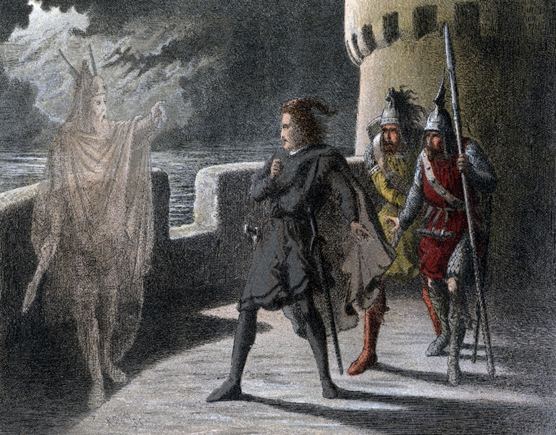
Horatio is uneasy about the appearance of the Ghost and the omen it might represent. Marcellus, a sentinel trained at keeping watch on the castle battlements, senses that something is off. He says, “Something is rotten in the state of Denmark.” A supposed ghost of the late king doesn’t just appear if all is right in the kingdom. Horatio responds to Marcellus, “Heaven will direct it.” They follow Hamlet.

~~

A1S5: The ghost-father, saying he will soon return to purgatory, charges Hamlet to wreak vengeance on his uncle, the one who murdered him before he was able to repent of his sins and receive last rites. He describes how Claudius murdered him and how he seduced Gertrude, Hamlet’s mother, with words and gifts. He tells Hamlet to spare his mother Gertrude, to leave her to God to judge. Should Hamlet also do this with Claudius and not get involved in murder?

Hamlet vows to remember his father. The high-minded and contemplative Hamlet is directed to get his hands dirty. Will the unresolved past and the rottenness in Denmark taint his thinking, his morality, his actions?

Horatio and Marcellus come up and want to know what transpired with the ghost. Hamlet gives an oblique answer. Horatio presses and Hamlet won’t say what he was told. Instead, he asks his these two to swear to not say anything about what they saw or heard. The ghost, moving around behind the scenes, shouts “Swear!” four times to Horatio and Marcellus as Hamlet tells them to not to disclose what has happened and to not react not matter how strangely he reacts in the future.

Hamlet then tells the ghost to rest. No one will talk. And tells Marcellus and Horatio to shush up when the three go back to court. And then he gives his perspective on the whole mess and having to deal with it:

~~~

A2S1: Elsewhere, Polonius sends his servant with money for his son Laertes who is studying music in France. He tells Reynaldo to check around in a back-handed way (to spy) to get impressions of his son. Is Laertes studying or is he sowing wild oats?

Ophelia shows up in a frazzled state. She tells her father that Hamlet came to her behaving strangely. Polonius attributes Hamlet’s behavior to love madness. He asks Ophelia if she has led him on or pushed him away. She says she has refused his entreaties. Polonius, who loves to give advice, wants to advise Claudius of Hamlet’s craziness.

~~

A2S2: Rosencrantz and Guildenstern, school chums of Hamlet, arrive in court. Claudius and Gertrude want both of them to hang around (spy on) Hamlet to find out what’s behind his crazy behavior and perhaps, cheer him up. When they leave court to find Hamlet, Polonius enters court. He wants to tell the king his theory of Hamlet’s madness, but first he wants the king to listen to the report of the Norwegian ambassadors who just arrived. He goes to retrieve the Norwegians.

While gone, Claudius comments to Gertrude that he is eager to hear Polonius’ proposed theory. Gertrude responds by saying Hamlet’s madness is not doubt tied to his father’s death and their quick marriage.

The two ambassadors enter and explain to Claudius that their king has deterred Fortinbras from attacking Denmark. They leave court.

Then the wordy Polonius gets on with his report about Hamlet’s craziness in a long-winded and redundant fashion. Gertrude can’t handle his bloviating and tells him to get to the point: “More matter, with less art.”

Polonius presents Hamlet’s love letter to his daughter Ophelia. He claims that this shows that Hamlet is madly in love and that Ophelia’s rejection of him has made him melancholy and lose his mind.

Claudius wants to know if this is true. Polonius says they can discover whether Hamlet really has gone mad from when he is set up to be alone with Ophelia. He and king will hide and see what happens. Claudius agrees to go along with the scheme.

Hamlet arrives. Polonius tells the king and queen to leave so he can deal with him. The verbose Polonius engages Hamlet in a conversation. Hamlet, in feigned-madness mode, responds to Polonius with witty nonsense. When Hamlet answers off-subject but with wise insights, Polonius takes note and says, “There is a method to his madness.”

Two of Hamlet’s friends from Wittenberg. Rosencrantz and Guildenstern, arrive and Polonius takes off. Hamlet is pleased to see his friends. The two share some bawdy banter with their friend Hamlet. And then Hamlet waxes philosophical. He wants to know why the two of them are back in Denmark which he calls a prison. They disagree with his assessment. Hamlet replies “Why, then, tis none to you, for there is nothing either good or bad, but thinking makes it so. To me it is a prison.”

The two friends ascribe Hamlet’s melancholy as disappointed ambition that wants more. Hamlet ascribes it to bad dreams. He then wants know why they showed up. After some coaxing, they admit they were sent for.

Hamlet explains their being summoned is to cheer him up. But he says that he’s not interested in anything. The world holds nothing for him. But then Rosencrantz wonders if Hamlet would be interested in the drama company coming to entertain him.

Hamlet wants to know all about the troupe, the one that he so enjoyed, and the state of the theater. Trumpets blow announcing the arrival of the actors.  Hamlet welcomes them and tells them that his “uncle-father and aunt-mother” have the wrong idea about his madness- it comes and goes at will.

Polonius enters and the players follow him into the room. Hamlet welcomes them and asks one of them to give him a speech about avenging a father’s death. He recites some of the lines himself and then has a player take over. The verbose Polonius comments that the speech is too long and Hamlet replies him with mocking wit.

Hamlet is impressed by the actor’s emotionally charged speech. He tells Polonoius to take them to their rooms and treat them well. As the players leave, he asks if they can perform The Murder of Gonzago the next night. The answer is yes. Hamlet tells them that he will write some additional lines into the play.

Polonius, the actors, and Rosencrantz and Guildenstern leave. Hamlet is alone with his thoughts.

Having just seen the raw emotion of an actor reciting lines about people who are of no consequence to him, Hamlet belittles himself for not being able to generate any passion to avenge his own father. He scolds himself as one who mopes around and is cowardly. He calls himself an ass. He has been given motive to act and avenge the death of his father and he does not have his act together. But this reflection gives him an idea.

Having just experienced the effect of the actor’s intensity on his own conscience, he knows of others, too, who have had their conscience pricked when art imitates life. Having the acting troupe produce a play that mirrors the murder of his father may just reveal Claudius’s guilt and his own catharsis.

 Hamlet, who may have studied Aristotle’s Poetics while at Wittenberg, comes across like a self-styled critic and dramatist of the theater. He knows how he wants the actors to perform and edits and adds to the script, for . . .

~~~

A3S1: Claudius, Gertrude, Polonius, Ophelia, and Rosencrantz and Guildenstern enter court. Claudius questions Hamlet’s two friends about Hamlet’s disposition. They say he’s responsive but difficult to read. They also say that he is excited about a play being put on by a recently arrived troupe. Hamlet wants the king and queen to attend. Polonius, unaware of Hamlet’s Mousetrap, agrees with this invitation. He has a trap of his own.

Polonius, along with Claudius, wants to find out if unrequited love is the reason Hamlet is beside himself. Ophelia, Hamlet’s love interest, is instructed by her father Polonius to walk around with a prayer book, look spiritual, and wait for Hamlet. He adds that people often do this – act devoted to God – to mask their bad deeds. Claudius hears this. To himself, he admits that these words have produced a sharp pang of guilt within.

When they hear Hamlet coming, Claudius and Polonius hide to spy on him. Hamlet enters and begins to speak only to himself of things that make his life, this mortal coil, tedious, irritating, and unbearable. His aversion to being contemplates relieving himself of the messiness of life by suicide:

Hamlet ponders the well-known tribulations of life and then counters that with the “undiscovered country from whose bourn no travel returns.” From the later he reckons that fear of the unknowns of death, which would include purgatory, makes us all cowards. And too much back-and-forth thinking, he decides, makes one less daring and of no use when things need to get done.

Hamlet then comes across Ophelia reading her prayer book. He greets her and then goes on to speak to her in a cold-hearted way. Has he, because of the moral bankruptcy of his mother, decided to not put any trust in a woman?

He tells her that he never loved her. He bitterly denounces humankind, marriage, and the deceitfulness of beauty and women. He tells her to go to a convent. When he leaves, Ophelia laments the change that has come over the once noble Hamlet.

His intense words with Ophelia suggest that Hamlet has turned from acting mad to acting with madness.

Claudius and Polonius come out of hiding. Claudius is now aware that Hamlet’s behavior is not related to Ophelia but is likely related to something more out-of-control dangerous. He wants to send Hamlet to England (exile him) in hopes of changing his disposition. Is England to be Hamlet’s purgatory?

~~

A3S2: Later, Hamlet is with the actors, advising them how to speak their parts in the play that night. When Polonius, Rosencrantz and Guildenstern show up Hamlet confirms that the king and queen will be attending. They confirm this and leave to help the actors prepare. Horatio enters.

Hamlet expresses his high regard for Horatio and praises Horatio’s self-control. He then asks him to watch his uncle carefully during the play. Claudius’ response will determine whether the ghost was speaking the truth or just being a damned ghost. Hamlet will keep an eye on Claudius too.

Trumpets announce Claudius, Gertrude, Polonius, Ophelia, Rosencrantz and Guildenstern. As they take their seats, Hamlet responds with nonsense to Claudius and Polonius. He chooses not to seat next to his mother. He sits with Ophelia and speaks to her in a mischievous way. Ophelia comments that Hamlet seems to be in a good mood tonight.

Hamlet retorts that God is the best comic. And, revealing with spite what truly galls him, he says why shouldn’t he be happy when his mother is so happy just a short time after his father has died. He should get rid of his black clothes and get some new snappy outfit.

Trumpets play and the pantomime show begins as a summary of the spoken drama to follow. The players mime the murder of the king by the same means as Hamlet’s father was murdered and then the queen accepting the murder’s advances.

Ophelia wants to know what it means. Hamlet impishly tells Ophelia “It means mischief.”.

The Prologue speaker enters to introduce the play. Puckish Hamlet tells Ophelia that this guy will explain everything as actors can’t keep things to themselves.

The Prologue actor speaks only three short lines, entreating the audience to watch the tragedy.

Hamlet asks whether that was the prologue or the inscription on a wedding ring? Ophelia replies “Tis brief, my lord.” And Hamlet comes back “As a woman’s love.”

The play begins with actors playing king and queen. They reenact the Murder of Gonzago. The play closely parallels the circumstances of the murder of Hamlet’s father, the king, as told by the ghost and the aftermath of the queen marrying the murderer. In this play the nephew, not the uncle, is the murderer.

The play begins with the king, who is nearing death, recounting his thirty years of marriage to the queen. He says that after he is gone, perhaps she will remarry. The queen protests and speaks of her undying love for him even after his death. If she did remarry, she vows, all of life should turn against her.

Hamlet to Ophelia: “If she should break it now!” – a pointed reference directed at Hamlet’s mother for her being so quick to marry Claudius after the king’s death.

The player king replies from many years of wisdom that things change, that love is unreliable. “Our wills and fates do contrary run.” The king, now tired, falls asleep. The player queen leaves.

On the side, Hamlet throws in clever comments to Gertrude and Claudius that smack of trying to get under the skin of the king and queen. Claudius wants to know what the play is called. Hamlet responds The Mousetrap. He adds that it is a play about a murder in Vienna and no big deal and that it would only bother the guilty.

The player of the king’s nephew enters. Hamlet tells Ophelia who it is Lucianus. Ophelia says that Hamlet is a good commenter. Hamlet, feeling frisky, continues with sarcasm and sexual inuendo.

Lucianus pours poison into the sleeping player king’s ears. Hamlet remarks that he poisoned him to get the kingdom and the king’s wife all to himself. Claudius stands up. He wants the play to stop. He wants to leave. Everyone except Hamlet and Horatio leave.

Hamlet mocks the departure with a few poetic lines and jokes that perhaps he could be an actor if everything else failed. Horatio agrees. And Horatio also agrees that that Claudius did react to the poison scene. Hamlet knows now that the ghost was telling the truth.

Rosencrantz and Guildenstern show up and say that the king is angry and queen is upset. Hamlet’s replies in glib fashion. His two friends want to know what’s up with him. They tell Hamlet that the queen wants to see him.

When the players enter with recorders, Hamlet grabs one and asks if Guildenstern can play it. He says no. Hamlet then calls out his friends – he and Rosencrantz are trying to play him and can’t even play a simple recorder.

Polonius comes around and tells Hamlet that his mother wants to see him right away. Hamlet replies with bits of nonsense and Polonius goes along. Hamlet says he will go see her – soon. By himself he says, it’s the witching hour when really hellish things go on. He could behave like that with his mother but he puts thoughts in check: “I will speak daggers to her and use none.”

~~

A3S3: Claudius, speaking to Rosencrantz and Guildenstern, says Hamlet is getting crazier by the hour. He doesn’t feel safe. So, he’s going to send them both with Hamlet to England on diplomatic business. They agree to go, with Rosencrantz saying that whatever happens to the king happens to everyone. They leave and Polonius enters.

He tells Claudius that Hamlet is on his way to his mother’s chamber and that he will hide in there and listen to her scolding Hamlet. He leaves.

Claudius, alone in his chamber, admits his crime:

His Cain-like murder of his own brother comes with God’s curse. He’s finding it hard to pray. He’s not ruing what happened. He’s wondering if he can even repent of it, be pardoned of his sin and continue to live with all the gains (the kingdom and queen). He falls to his knees. What is not said is Claudius’ desire to murder again – this time Hamlet is in his sights.

Hamlet enters, intending to kill Claudius. He sees Claudius on his knees and thinks that if that guy dies while praying, he will receive grace, go to heaven, and be forgiven of his sins. Whereas his murdered father, King Hamlet, had no time to repent of his sins. He doesn’t consider it revenge by killing him now and sending him to heaven. Claudius must suffer the same purgatory  

Hamlet, who knows that his mother is waiting for him, leaves the room. He says that he’ll wait to kill Claudius when Claudius acts up again in some ungodly way.

Claudius, getting up from his knees, considers his prayers useless.

What is not said is Claudius’ desire to bring about murder again – this time of Hamlet in England. Hamlet missed his chance for revenge.

~~~

Prior to the Mousetrap play, Hamlet was a mess. Things in his world looked absurd and bleak. He had just returned home from studying in Wittenberg to a dark and vexing situation – something rotten in Denmark.

A ghost, looking like his dead father, appears from somewhere. Hamlet learns from the specter that it had been murdered by his uncle Claudius and that his mother quickly married him.  The ghost orders Hamlet to avenge his death and go easy on his mother.

But should Hamlet, a theology and philosophy student, listen to the ghost from somewhere and do something irrevocable – kill Claudius – and end up in purgatory or hell? Is he required to deal with the unresolved past? These questions weigh on him.

In addition to the complex matter handed him, Hamlet, who was in line to be king when his father died, now wonders if those around him in Denmark can be trusted. And, a foreign prince seeking revenge is marching against the Danish kingdom. There’s a lot of vectors to think about.

It’s a situation so messed up that he thought about suicide.

Prior to the Mousetrap play, Hamlet was also very disappointed with himself for not being a man of action, of thinking too much. But with confirmation of Claudius’ guilt via the play, something has stirred in Hamlet. He’s ready, driven with revenge madness, to dispose of Claudius.

Claudius had taken action – murdered King Hamlet – without regard to a common understanding Rosencrantz had stated in obeying Claudius’ own protection order: whatever happens to the king happens to everyone. And now, Claudius is ready to dispose of the rightful heir to the throne to protect himself.

~~~

The Tragedy of Hamlet, Prince of Denmark operates in a God-ordered moral universe with heaven, hell, sin, punishment. The undead figure, aware of this, goads Hamlet to commit murder to avenge his death and to also leave Gertrude, Hamlet’s mother, to God’s judgement. The undead figure’s goading ultimately leads to many deaths including Hamlet’s.

The opening “Who’s there?” seems to also ask of the living – Hamlet – what kind of actor he is given the ultimate issues he faces. Pushed to the limits, will the center hold?

~~

A3S4: Getrude and Polonius are in the queen’s chamber waiting for Hamlet. Polonius wants Gertude to lay into Hamlet for the trouble he’s caused. When they hear Hamlet approach, Polonius hides behind a tapestry to listen in.

Hamlet, impatient, wants to know what his mother wants. She says that he’s insulted his (step-) father. Hamlet fires back saying that she’s insulted his father. Though he vented privately before, Hamlet is no holding back.

His mother, shocked, wonders if Hamlet has forgotten who she is. Hamlet’s response is pointed:

Hearing Hamlet’s denunciation, his mother now wants to bring others in. Hamlet tells her to sit down and not move. For, he wants to expose her true nature. She fears Hamlet will kill her with the sword in his hand. She cries for help. Polonius, from behind the curtain, also cries for help.

Hamlet smells a rat or rather, Claudius. He lunges and stabs the curtain with his weapon. His mother cries, “O me, what hast thou done?”

Hamlet:

Hamlet pulls back the curtain and discovers Polonius, dead. He has nothing good to say about the busybody Polonius who, Hamlet deems, got his just deserts.  Hamlet turns to his mother, for her just deserts – wring her heart with words of judgement.

She wants to know what’s she’s done to be treated so badly. Hamlet is ready to tell her – a deed so heinous that its judgement day on earth. She again wants to know what the deed is.

Hamlet then compares her former husband, his noble father to the scum that she hooked up with. He wonders how anyone, even impaired, could make such a decision. Reason has been a slave to desire, he says. She wants him to stop exposing her sin.

But Hamlet continues.

He rails against her going to bed with her villainous husband, a ragtag man who is but a small fraction of his father’s worth and who stole the crown.

The ghost enters. Hamlet sees the ghost. Gertrude does not. When Hamlet speaks to the ghost, Gertrude thinks he’s gone mad.

The ghost spurs Hamlet to back on the revenge track. He also cautions Hamlet not to overdo it with his mother, the weaker sex. The ghost leaves. Gertrude has not heard or seen anything of the ghost. She thinks Hamlet’s madness has him imaging all this.

 But Hamlet protests, saying he is of sound mind. He then counsels her to not look at his madness but to look at her heart, to confess her sins, and repent. Her conscience is pricked by his words. Hamlet continues:

Hamlet, who started out virtuous and is now heading to the dark side, wants his mother to be prudent and temperate. He wants her to at least pretend to be virtuous and by this, develop good habits. And that would mean her not having sex with Claudius and letting him deceive her in anyway about her son.

Hamlet then says good night to his mother and sorry about what happened to the dead guy, Polonius. He considers it God’s punishment for himself and Polonius. He

He reminds his mother that he’s off to England with two snakes in the grass, Rosencrantz and Guildenstern. He’s expecting to see the plan Claudius has in place blow up in his face.

As he leaves, Hamlet drags Polonius body out of the room. He comments that the stiff was babbling politician who has finally shut up.

~~~

A4S1: Claudius enters and wants to know why Gertrude is so upset. She tells him about Hamlet’s “lawless fit” of madness that killed “a rat, a rat.” Polonius was dead. Claudius blames himself for not doing enough to stop the “mad young man.” He tells her that he’ll ship Hamlet off to England and work his magic to explain and excuse what happened.

Gertrude says that Hamlet had dragged the body off somewhere and that she sees a glimmer of good in the mad Hamlet – he weeps for what he has done.

Claudius summons Rosencrantz and Guildenstern and tells them to go look for Hamlet and recover the body. He tells Gertrude that he hopes they can come out of this scandal in good shape.

~~

A4S2: Rosencrantz and Guildenstern come across Hamlet and ask about the body. Hamlet gives no direct answer. He accuses Rosencrantz of being a “sponge” (spy) for Claudius and says “The body is with the king, but the king is not with the body. The king is the thing . . .” This last seems to be a riff on “the plays the thing.” Both lines, in Hamlet’s mind, refer to bringing the guilty party to justice.

Guildenstern doesn’t understand. So, Hamlet says the king is of no importance. (The crime is.) He wants to see the king and off they go.

~~

A4S3: Claudius, in the meantime, to his attendants:

Claudius talks to them of being judicious on how Hamlet is handled. He is loved by the people so a fair-minded punishment must be seen by them and not the crime (which might expose more than Claudius wants known). His being sent away to England will look carefully considered. He ends by saying that a cancerous disease must be dealt with in extracting ways.

Rosencrantz enters and tells Claudius that Hamlet has not told him where the body is. Guildenstern brings Hamlet into the room. Claudius presses Hamlet for the location of the body. Hamlet responds with flippant riddles before revealing where the body is. The attendants go and look.

Claudius tells Hamlet that he will leave for England right away – for his own protection. Hamlet is happy about this. Before he leaves, Hamlet calls Claudius his mother – a jab based on Claudius being married – one flesh – with his mother.

Claudius sends Rosencrantz and Guildenstern to follow Hamlet to make sure he gets on the boat. Alone, he speaks of his hope that the king of England will obey the sealed orders sent with Rosencrantz and Guildenstern. The orders call for Hamlet to be put to death when he arrives.

~~

A4S4: Fortinbras, the Norwegian prince, arrives in Denmark at the head of his army. He sends his captain to the king of Denmark to ask for permission to cross the land on his way to attacking Poland. On his way the captain runs into Hamlet and Rosencrantz and Guildenstern, who are on their way to the boat headed for England.

Hamlet asks the captain why Norwegian troops are in Denmark, who’s leading them and what are they after – the heart of Poland or just a outlying region. The captain explain that Fortinbras is leading the army to seize a small scrap of land that has no value to anyone.

Hamlet wonders if the Poles would defend such a target and the captain replies that they will. Before he thanks the captain for the information and says good bye to him, Hamlet stops to think about what he just heard.

He remarks that men are so driven that they will go to war at great cost of blood and treasure for pointless gain.

Rosencrantz wants Hamlet to get a move on. Hamlet says for them to go ahead and he’ll catch up. Hamlet wants some time alone to reflect on his own inaction.

Based on the resoluteness of a foreign prince risking life and limb by attacking something pointless, he realizes that thinking too much about whether to act is more cowardice than wisdom. He likens his inertia to that of being an animal that only eats and sleeps. Yet, he tells himself, he has more motive than Fortinbras – to mete out revenge for the murder of his father, King Hamlet. He determines right then and there:

~~

A4S5: Gertrude enters the next scene telling a gentleman of the court that she doesn’t want bother with Ophelia’s loopy behavior. But Ophelia insists on being heard, the gentleman tells her. She’s saying all kinds of things related to the death of her father Polonius and conspiracy things that seem to implicate Gertrude. Horatio thinks she should speak to her. Gertrude, to herself, says that because of her nature everything looks like a disaster waiting to happen to expose her:

Ophelia enters and it is evident that the death of her father has affected her sanity (Just as the loss of Hamlet’s father affected his.). She sings nonsense songs and Gertude can’t get her to stop. Claudius enters and asks Ophelia how she is doing. She responds with nonsense that hints at her father’s death. When she leaves the room, Claudius says

Claudius tells Gertrude that bad things are piling on. Polonius was killed, Hamlet has sent away for being dangerous, people are spreading rumors of the hasty funeral which looks like a cover up, and Ophelia has lost her mind. And now Laertes has returned from France and wants to the settle score. Claudius tells Gertrude that all this feels like be being murdered over and over again.

Laertes arrives with a raucous crowd shouting “Laertes will be king!” Doors are smashed open and they enter. Laertes wants to know where his father is. Gertrude clings to Laertes, holding him back from attacking Claudius. Laertes wants to know how his father was murdered. Claudius wants to prove to Laertes that he didn’t do it.

Ophelia enters and Laertes witnesses her madness. He vows revenge for the hellish suffering and torment brought upon his sister.

Claudius, to settle things in Laertes’ mind, says that he should bring his trusted friends and listen to the case he makes of his innocence. Laertes agrees and demands to know why his father was buried secretly and ignobly. Claudius says he has a right to know and

~~

A4S6: Horatio, elsewhere in the castle, receives two sailors who have a letter from Hamlet. Horatio reads the letter out loud and learns that Hamlet’s ship to England was overtaken by pirates. Hamlet ended a prisoner on the pirate ship.

The pirates want a favor from the King of Denmark. The request is contained in letters the two sailors are holding. Hamlet asks Horatio to bring the sailors to king and then and come to him. He has a lot to tell Horatio about events and about Rosencrantz and Guildenstern. The sailors will show Horatio the way to where he’s holed up.

~~

A4S7:  While this happens, Claudius talks with Laertes. Claudius thinks Laertes should be satisfied with his explanation of his father’s death – by the same man who is trying to kil him. Laertes wants to know why the king didn’t act right away to bring the murderer to justice.

Claudius states that he held back because his mother and the people so love Hamlet. If he acted his wife and the people would turn against him.

Just then a messenger arrives with the sailor’s letters – one for Claudius and one for Gertrude. Claudius reads the letter out loud for Laertes to hear. Hamlet, it says, will return tomorrow and explain his return. Though not mentioned but what must have been on Claudius’s mind – his failed scheme to be rid of Hamlet via the king of England.

Laertes is happy about Hamlet’s return. Now he can face him man to man and avenge his father’s murder. Claudius agrees that Hamlet’s should be disposed of – he’s a threat to his kingdom. He tells Laertes to let him devise a way to do away with Hamlet that will appease even his mother. Laertes agrees to Claudius’s scheme only if it means Hamlet’s demise by his own hand.

Claudius gins up a scheme that involves a duel between Laertes and Hamlet. To set up this scenario, Claudius tells Laertes of a certain Frenchman’s high regard of Laertes’ fencing ability. He adds that Hamlet overheard the compliment and, out of jealousy, wanted to fence Laertes to see who was the better dueler. Is the devious Claudius lying?

 After Claudius confirms that Laertes is with him in plan, that Laertes won’t lose the impulse to kill Hamlet, he tells Laertes that he’ll get the people to promote the competition, that there will be bets placed and that Laertes can chose a sharpened sword beforehand to do the deed.

Laertes says he’s gotten ahold of poison oil to put on the tip of his sword. And Claudius speaks of a backup plan: get Hamlet thirsty and he’ll give him a poison drink.

Gertrude enters with terrible news: Laertes’ sister Ophelia has drowned. Gertrude softens the blow for Laertes by implying it was an accident and using imagery of her female connection with nature. (She did not treat her grieving son Hamlet with compassion.)

How did she know the details? Perhaps she witnessed it from a castle window or? Anyway, Laertes is crushed – both father and sister are dead. Claudius, worried that the upset Laertes is beyond his control, follows him with Gertrude.

~~~

A5S1:

So says one gravedigger to another in the graveyard of the church. They are excavating a burial plot for Ophelia and exchange thoughts about whether she should receive a Christian burial. It seems to them that she committed suicide, though the coroner called it self-defense. One gravedigger remarked that it is more like self-offense and goes on to say that the wealthy, who end their lives in unchristian ways, get their way in the end.

As they work, the first gravedigger poses a riddle to the second gravedigger: “What is he that builds stronger than either the mason, the shipwright, or the carpenter?”  The second gravedigger answers that it must be the gallows-maker, “for his frame outlasts a thousand tenants.”

The first gravedigger agrees that the gallows have a purpose, but then says

The second gravedigger goes off and the first shovels and sings.

Hamlet and Horatio arrive at the graveyard at a distance from Ophelia’s plot. We don’t know why Hamlet decided to go to the graveyard. Perhaps, to contemplate his own life and death. He’s been away and does not know that Ophelia is dead.

They hear the gravedigger singing while digging a grave. Hamlet notices the dissonance and a skull that the gravedigger throws up from the pit.

Does what follows relate to the opening Who’s there? Hamlet suggests to Horatio whose skull it might be – Cain’s, a courtier, or Lord So-and-So – and says it’s now the property of Lady Worm and quite a reversal of fortune.  

The gravedigger, still digging and singing, throws up another skull out of the pit. As before, Hamlet proposes to Horatio whose skull it belongs to – a lawyer or a landowner. For both, their abilities and property are no longer of use to them. They no longer have a share in what is done under the sun.

Hamlet turns from contemplating death and human remains to the gravedigger. He wants to know whose grave he is digging. This begins the jaunty gravedigger’s wordplay in answer to each of Hamlet’s direct questions. Finally, the gravedigger says

Hamlet asks: How long hast thou been a grave-maker? The gravedigger, not knowing who he is talking to, answers that it has been so since Hamlet’s father defeated Fortinbras. Hamlet: How long ago was that? He answers the day that Hamlet, the one who went crazy and was sent to England, was born. He goes on to say that he was sent to England because no one will care: There the men are as mad as he.

The conversation briefly turns to how long a body will live in a grave before it rots. Then the gravedigger pulls up a skull that has been buried for twenty-three years. Turns out that it is the skull of Yorick, the king’s jester. He hands it to Hamlet.

Hamlet reminisces for moment about the goods time he had with Yorick when he was a young boy. Then he turns to Horatio and wonders if Alexander the Great and the emperor Caesar looked like this after they were buried. These great men, he muses on another reversal of fortune, became dust and could be used as mud to plug up holes.

A funeral procession enters the churchyard following a coffin: Claudius, Gertrude, Laertes, and mourning courtiers. Hamlet wonders who’s in the coffin. He remarks that it’s not much of a procession; someone in a rich family must have taken their own life. He watches the proceedings.

Laertes asks the priest what other rites he can give the girl and the priest answers that he has done as much he could for someone with a suspicious death. Laertes is incensed and lays into the priest about his sister. Hamlet finds out that Ophelia is being buried.

Gertrude throws flowers onto the coffin while ruing that the flowers were not for Hamlet’s wedding to Ophelia.

Laertes curses the man who made her go mad. He jumps into the grave to hold Ophelia once more.

Just moments ago, Hamlet was fondly remembering Yorick. Now he is confronted by the death of Ophelia. He is overwhelmed:

Not to be outdone by Laertes’ grief, Hamlet also jumps into the grave. Laertes tells him to go to hell. The two begin to grapple. Hamlet says that even though he is not quick to anger, he has something dangerous inside him that Laertes should take into account. What could that be?

Claudius and Gertrude have the attendants pull them apart.

Then Hamlet, in his agony, expresses his great love for Ophelia – a love greater than her brother’s affections. He quantifies his ardor in absurd ways. And the King and Queen think he’s insane.

When Hamlet storms off, Claudius tells Gertrude to have the guards keep an eye on him. He tells Laertes to be cool. Hamlet, the problem, will be dealt with soon.

~~

A5S2: Hamlet and Horatio are now alone. Hamlet has walked off his momentary madness and wants to discuss with Horatio his recent journey. He casts the decisions he’s made in terms of a struggle that kept him from sleep.

He then praises impulsiveness as the means to getting things done when one is slow to act. This, he says, shows that God is a work even when our plans are messed up:

This harkens back to Hamlet’s agency in his line The time is out of joint. O cursèd spite That ever I was born to set it right! But is Hamlet trying to force God’s hand with rash actions?

Hamlet goes on to tell Horatio, that while on the ship to England, he found Claudius’ letter to the King of England. It was to be delivered by Hamlet’s close friends Rosencrantz and Guildenstern. The letter contained the usual political courtesies AND a request to cut off Hamlet’s head with a dull axe! Hamlet shows Horatio the document, as he can’t believe it.

 Hamlet then reveals that he penned a new letter in the proper script and sealed it with his father’s signet ring still in his possession. The new letter addressed the king of England as if in Claudius’s own words. It requested that the two men who delivered the letter would be put to death at once without time to confess to a priest.

Horatio says that those two are really in for it. Hamlet says he’s not sorry at all for they involved themselves in matters between two worthy opponents. Then he proclaims his moral right to do away with Claudius. He lays out the charges against him:

Horatio remarks that Claudius will soon find out what happened to Rosencrantz and Guildenstern. Hamlet agrees the time is short but says that in the meantime he has time to work his plan. He then regrets losing control with Laertes – they both grieve the loss of Ophelia, they both want to avenge the death of a loved one. He says he will treat him well from now on.

Hamlet apologizes to Horatio for his over-the-top behavior but not to Laertes. He also blames Laertes for his actions – it was Laertes’ overwhelming show of grief that set him off. And Hamlet never confesses or repents of his cruel behavior with Ophelia, behavior that played a role in her despair and suicide. Has Hamlet stopped listening to his conscience?

With hat in hand, Osric, a young courtier, arrives. He has a message from the king for Hamlet. Hamlet makes snide comments about him to Horatio and toys with Osric about his hat and the weather. You get the idea that Hamlet will not suffer fools. Osric is a toady who agrees with Hamlet about everything including opposites that Hamlet harries him with. The conversation is a duel between a wit and a twit.

Osric goes on blustering about how wonderful Laertes is. Hamlet, not sure where Osric is going with all this, adds his own praise about Laertes and asks why he is being talked about. Horatio also hopes to get the reason Osric is there.

When Osric finally gets to the point, he says that Laertes is unrivaled at fencing and that the king has placed a large bet on a fencing contest between Hamlet and Laertes. Laertes, the better fencer, is given a handicap of three hits to win. He wants to know if Hamlet agrees to the duel. Hamlet says OK.

After Osric leaves to notify the king, Hamlet and Horatio comment on Osric one more time saying, in effect, that he’s a frivolous person and full of hot air.

 A lord arrives. He asks if Hamlet is ready to duel or wait till later. Hamlet says he’s ready to duel. The lord says that the queen wants Hamlet to speak to Laertes before the duel in a civil manner. The lord leaves.

Horatio advises Hamlet against dueling – he will lose. Hamlet brushes this off saying that he has been practicing fencing while Laertes has been in France. He thinks he will win and yet something inside tells him it will go the other way. Horatio tells him to trust that feeling. Hamlet brushes off the advice as superstitious and then launches into a “Let be” to-be-or-not-to-be fatalistic take of the situation.

Claudius, Gertrude, Laertes, Osric, attendants, and lords enter with fanfare. Fencing foils and flasks of wine are brought in with them. Claudius has Hamlet shake Laertes’ hand as a civil gesture.

Hamlet offers an apology to Laertes for his unseemly behavior. But the apology is an insanity defense. Hamlet claims that he was not in his right mind, as everyone knew, and that he was not responsible for any premeditated action against Laertes.

Laertes accepts Hamlet’s show of love but can’t accept forgive him. For him, the death of father and sister warrant further insight as to how honor would avenge them. Laertes, of course, already knows what will happen in the next minutes.

Hamlet and Laertes pick their foils and get ready to fence.

Claudius, the schemer, shows bogus support for Hamlet as he wants Hamlet to not hold back – until his death. If Hamlet strikes first, Claudius will order military salutes. He’ll drink to Hamlet’s health and then drop a very expensive pearl into the glass for Hamlet to drink. What he drops in the glass, of course, is poison. Trumpets sound and the duel begins.

Hamlet and Laertes engage their blades. Hamlet makes the first hit. Drums and trumpets sound, and so does a cannon. Claudius drops a pearl into a goblet and says it’s for Hamlet. He wants him to drink it. Hamlet wants to finish the round first. They continue fencing.

Claudius and Gertrude exchange words about her son Hamlet. Then Gertrude picks up the pearl/poison-laced goblet and drinks to Hamlet’s health. Claudius tells her not to drink it and she does anyway, in an act of defiance toward Claudius. Claudius knows it’s only a matter of time for Gertrude’s demise.

Hamlet defers again from drinking the wine. Gertrude wants to wipe his brow. Hamlet wants Laertes to fence like he means it. They go back at it. This time, Laertes wounds Hamlet and in the scuffle that follows they end up with each other’s sword. Hamlet wounds Laertes.

Gertrude, the poison haven taken hold, falls to the floor. Both fencers are wounded and bleeding. Osric asks Laertes how he feels and he responds that he is like one caught in his own trap: I am justly killed with mine own treachery.

Hamlet asks about his mother. Claudius says she fainted at the sight of blood. Gerturde speaks one last time:

Gertrude dies. Hamlet reacts:

Laertes, dying, tells Hamlet that his sword had a poison tip and that his plan to kill him backfired. He can blame the king for poisoning his mother.

Hamlet takes the poison-tipped sword and wounds Claudius. The court yells “Treason!” Then Hamlet forces Claudius to drink from the poison-laced goblet, saying

Claudius drinks and dies. Hamlet achieves his father’s vengeance after seeing his mother poisoned by Claudius’ scheme to do him in.

With his last breath, Laertes tells Hamlet that Claudius deserved what he got – the poisoner poisoned himself. Then, laying all the blame on Claudius, he wants to clear the slate with Hamlet before he dies:

Hamlet, dying, replies that heaven will not hold Laertes responsible for his death. He then bids adieu to the Wretched queen and tells those who were watching in horror that, if he had time, he could explain things. He tells Horatio to report what happened. Horatio balks at the suggestion and wants to end his life like an ancient Roman with the remainder of the poisoned drink. Is everyone, as said of Ophelia, seeking their own salvation?

Hamlet says no and takes the cup away from Horatio. Horatio must live to tell Hamlet’s story.

As he is saying this, Hamlet hears the sound of a military march. He asks about it. Osric says that young Fortinbras, returning from his conquest in Poland, is approaching. Hamlet says that prince Fortinbras will likely be chosen for the Danish throne. Hamlet gives his approval and tells Horatio to explain to him what happened. The unresolved recent past can’t stay that way. The rest is silence as Hamlet dies.

Horatio:

Fortinbras and the English Ambassador enter. They look around at the gruesome scene wondering what happened. The English Ambassador says that his king carried out the Danish king’s order – Rosencrantz and Guildenstern are dead. He wants to know who will thank the king.

Horatio, pointing to Claudius’ corpse, replies that it won’t be this guy. He never ordered their death. He then requests that these bodies be displayed and that he is given the opportunity to tell

Fortinbras is eager for himself and other noble people to hear what Horatio has to say. He speaks of his opportunity and right to claim the Danish throne. Horatio tells him that Hamlet talked about this. He will tell Fortinbras more later. But first things first.

Fortinbras orders four captains to carry Hamlet and place him on a stage and to give him military honors. He would have been a great king, he says.

Looking at the bodies strewn in the court, he says it’s something one would see on a battlefield but here, something went terribly wrong. (More rottenness in Denmark?)

Fortinbras orders guns and cannons to be fired to honor Hamlet as a great soldier. (Was he a great soldier in the battle of life?)

Afterthoughts

Hamlet starts out as a virtuous young man operating with a deep sense of morality within a Christian cosmology. But grief, the revenge demand placed on him by a supernatural being, betrayal, and existential despair changes him. Listening to a dis-embodied spirit, he ends up a dis-embodied spirit.

What if Hamlet didn’t listen to the ghost? And, what if Hamlet didn’t listen to his pride and end up in a fencing duel with the son of the man he murdered hosted by the man who murdered his father? Did he see it as a way to choose his own salvation?

With the Mousetrap play, Hamlet verified what the ghost said – that Claudius poisoned his father. But Hamlet didn’t act when he heard Claudius confessing his guilt in his chamber. He thought there would be a more opportune, as in no chance for Claudius go to heaven, moment. He dithered and many lives thereafter received a violent death, a death without confession of sins. Death count since: Polonius, Ophelia, Rosencrantz, Guildenstern,Laertes, Gertrude, Claudius, and Hamlet.

~~~

Will the two gravediggers reprise their humorous banter while digging the grave of the newly dead? Will they speak of the deceased as they spoke of Ophelia:

 Is she to be buried in Christian burial,

when she willfully seeks her own salvation?

Will they ponder the reversal of fortunes as did Hamlet?

~~~

As it was common for royal marriages to create alliances, was Queen Gertrude, Hamlet’s mother, a foreigner? Was she perhaps German and the link to Wittenberg?

~~~

There are more ghosts at the end than at the beginning.

~~~~~

The Play’s the Thing 

You’ll find excellent discussions on all five acts of Hamlet and a Q&A session podcast at the link below.

Tim McIntosh: https://www.timteachesshakespeare.com/about

Heidi White: https://circeinstitute.org/blog/jet-popup/read-more-about-heidis-class/

Andrew Kern: https://circeinstitute.org/staff-and-board/

It’s finally time to discuss the grandaddy of all of Shakespeare’s plays! That’s right, it’s time for Hamlet and Tim, Heidi, and special guest Andrew Kern are ready to dig deep. In this episode they discuss why this play matters so much, the initial structure of the play, the themes and problems Act I introduces, and much more.

Hamlet: Act I – The Play’s the Thing

Hamlet: Act I (rerun) – The Play’s the Thing | Acast

Note: To begin reading Hamlet in plain English, start with Hamlet: No Fear Shakespeare.

~~~~~

Interesting Background:

-Claudius to Hamlet, A1S2 (emphasis mine.)

A paper read today at the American Astronomical Society meeting in Toronto, Canada, offers a new interpretation of Shakespeare’s play Hamlet.

The paper, by Peter D. Usher, professor of astronomy and astrophysics at Penn State, presents evidence that Hamlet is “an allegory for the competition between the cosmological models of Thomas Digges of England and Tycho Brahe of Denmark.”

ABSTRACT

A New Reading of Shakespeare’s Hamlet

I argue that Hamlet is an allegory for the competition between the cosmological models of Thomas Digges (1546-1595) of England and Tycho Brahe (1546-1601) of Denmark. Through his acquaintance with Digges, Shakespeare would have known of the essence of the revolutionary model of Nicholas Copernicus (1473-1543) of Poland, and of Digges’ extension of it. Shakespeare knew of Brahe, and named Rosencrantz and Guildenstern for his forebears. I suggest that Claudius is named for Claudius Ptolemy (fl. 140 A.D.) who perfected the geocentric model. It has been suggested that Polonius is named for a Brunian character Pollinio, an Aristotelian pedant and a suitable attendant to Claudius. Hamlet is a student at Wittenberg, a center for Copernican learning, which Brahe attended too. I suggest that the slaying of Rosencrantz and Guildenstern is the Bard’s way of killing the Tychonic model, while the death of Claudius signals the end of geocentricism. But the climax of the play is not the death of any of the chief protagonists; it is Fortinbras’ triumphal return from Poland and his salute to the ambassadors from England. Here Shakespeare praises the merits of the Copernican model and its Diggesian extension. Thereby he defines poetically the new universal order and humankind’s position in it. In the talk I present both historical and literary evidence in support of the present interpretation. If it is essentially correct, this reading suggests that Hamlet evinces a scientific cosmology no less magnificent than its literary and philosophical counterparts. While the last year of the sixteenth century saw the martyrdom of Bruno, the first year of the seventeenth century sees the Bard’s magnificent poetic affirmation of the infinite universe of stars.

Peter D. Usher, Penn State

https://science.psu.edu/news/astrophysicist-finds-new-scientific-meaning-hamlet

~~~~~
Seeing in New Light

“Till this moment I never knew myself.”

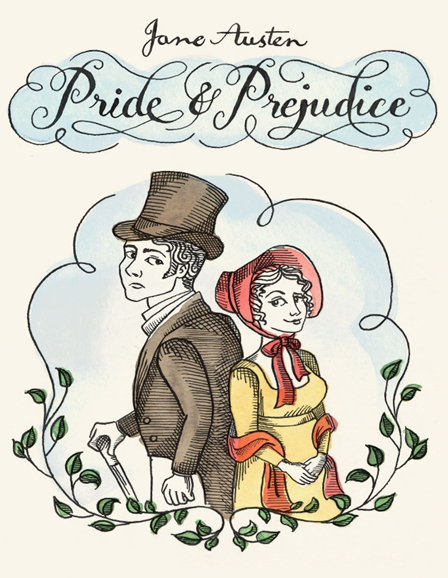
Recently, I picked up a Penguin Classics copy of Jane Austen’s Pride and Prejudice, a popular novel in the Austen canon. I read it to distance myself from the senseless present en route to WWIII and to thicken my temporal bandwidth. The reason for the latter is in my post The Lines of Others.

“To interact with people from different cultures and to gain a deeper appreciation of their values, beliefs, and customs. To become more empathetic and understanding toward others, even those who are very different from me. To gain a better understanding of the diverse world we live in and develop a more open-minded perspective.”

With Austen as guide I visited rural England at the turn of the 19th century. I found an ordered world governed by rules of etiquette. Tension between social expectations and personal feelings is often concealed behind formal politeness. Austen critiques social conventions regarding class distinctions, gender roles, and marriage through the use of irony, hyperbole, and witty rejoinders.

Her narrator’s opening lines set the viewpoint of the characters:

It is a truth universally acknowledged, that a single man in possession of a good fortune, must be in want of a wife.

However little known the feelings or views of such a man may be on his first entering a neighbourhood, this truth is so well fixed in the minds of the surrounding families, that he is considered the rightful property of some one or other of their daughters.

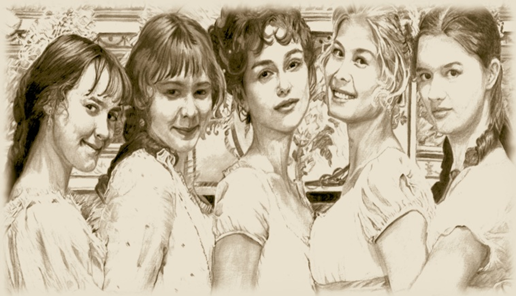
Enter the Bennet family with its five daughters: Jane, Elizabeth, Mary, Lydia, and Kitty.

Mr. Bennet is fond of books and is known for his sarcastic wit. Along with his favorite daughter “Lizzy,” he shares a distaste for the conventional views of wealth and rank. He also enjoys criticizing and teasing his youngest daughters Kitty and Lydia.

To his wife he says that they are “uncommonly foolish” and “two of the silliest girls in the country.” But his inability to step in and correct their behavior fosters his youngest daughters’ foolishness. Lydia will eventually be involved in a scandal that disrupts the social order and brings shame upon the family.

Mrs. Bennet is obsessed with finding suitable husbands for her daughters. The opening indicated this fixation but not the reasoning behind it. It has to do with a legal restriction on inheritance – an entail.

If Mr. Bennet passed, his estate, Longbourn, is entailed (transferred) to the closest male relative – his cousin, Mr. Collins. Mrs. Bennet saw no guarantee of Mr. Collin’s charity if that happened. She, justifiably so, knowing that acceptable employment opportunities were extremely limited for women in their social class, wanted her daughters to marry advantageously or she and they will be destitute and fall into social disgrace.

Mrs. Bennet’s favorite daughter, the one with “high animal spirits” is 15-year-old Lydia. Lydia is obsessed with men, especially the officers of her militia regiment. The flirtatious Lydia will become involved in a sexual scandal with a certain Mr. Wickham.

Mrs. Bennet is characterized as “a woman of mean understanding, little information, and uncertain temper.” She becomes fretful when her plans go awry. To ally her worries, she visits neighbors and gossips.

Elizabeth would later reflect on her father’s judgmental sarcasm, the flirtations of her wild youngest sisters Kitty and Lydia, and the unwillingness of her father and mother to control their behavior.

“They were hopeless of remedy. Her father, contented with laughing at them, would never exert himself to restrain the wild giddiness of his youngest daughters; and her mother, with manners so far from right herself, was entirely insensible of the evil.”

Beside the Bennet family, there are 20 characters in the novel. Some are charming (Charles Bingley). Some are annoying (Mrs. Bennett, Mr. Collins, Lady Catherine de Bourgh). Others, self-willed and careless (Lydia), rakish (Mr. Wickham), proud and stilted (Mr. Darcy). And one starts out very sure of herself (Elizabeth).

The characters meet at various gatherings. The Bennet sisters looked forward to every ball as dancing was a very important part of the courtship ritual. There, the daughters mingle with husband prospects and impressions are formed. At one ball, Bingley takes an immediate interest in the beautiful and shy Jane and Elizabeth danced with George Wickham.

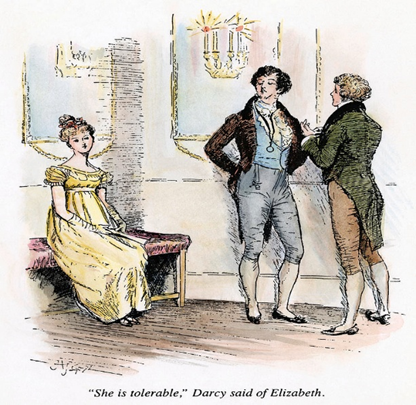
The Elizabeth and Fitzwilliam Darcy encounter is reserved but intriguing for both. Their relationship is where the pride and prejudice of the title comes in. It begins with class distinction: Elizabeth is the daughter of a country gentleman. Darcy is a rich aristocratic landowner. 

Darcy, holding a common belief in the natural superiority of the wealthy landed gentry, walks around with the pride of rank and fortune and prejudice against the social inferiority of Elizabeth’s family. He comes off as distant. Elizabeth, equally aloof, wears her pride as independence of mind.

Elizabeth also noticed that Wickham and Darcy don’t get along. She begins to hold a grudge against Darcy based on his superior ways and on the self-serving words of Wickham that belittle him.

But she later sees Darcy anew when he involves himself in ‘fixing’ Lydia’s mess and restoring social order. She later sees herself anew.

~~~

Note: It is not my purpose with this post to summarize Pride and Prejudice. There are plenty of websites that do so. My purpose here is to bring to the foreground a character who learns to see differently. And to encourage everyone to thicken their personal bandwidth by reading great literature from the past. As you’ll see by reading Pride and Prejudice, wisdom and much more comes in doing so. Don’t judge a book by its cover.

~~~

The novel was more than I expected from a so-called “romance novel.” I came across personal growth in a character who humbled herself and let go of a grudge based on social pretensions and misjudgments. She was able to open her mind and her heart to new information and begin to see things differently. I came across Elizabeth Bennet and her Anagnorisis.

Anagnorisis is a literary device used in Greek tragedies and in many plots since. It is the moment of recognition. The main character, typically, transitions from ignorance to knowledge. This seeing anew is a turning point in the story, after which things concerning the main character are not viewed the same way again. 

Elizabeths’ shift in perception comes after a revelatory letter from Darcy that discloses the opposite of what she had supposed about Wickham and himself. Darcy had thought it beneath him as a gentleman to speak of Wickham’s deceitful squandering behavior.

She spends time alone thinking things through. She questions her own discernment. The outcome of her interiority is summed in her words above. Elizabeth finally learns the truth about someone she accepted at face value (Wickham) and about someone that she judged harshly (Darcy). The prejudice in the title was not the latter’s but hers. She realizes she was greatly mistaken.

Elizabeth began as a rebel. She thought she was above society’s games. She’s witty but judgmental and arrogant when fixating on flaws. Her own pride mirrored that of the one she viewed as proud. But after spending time alone with the letter and hearing confirming reports, she confronts her own snobbery. Realizing how wrong she was she is humbled.

She grew absolutely ashamed of herself. Of neither Darcy nor Wickham could she think without feeling that she had been blind, partial, prejudiced, absurd.

“How despicably have I acted!” she cried; “I, who have prided myself on my discernment! I, who have valued myself on my abilities! who have often disdained the generous candour of my sister, and gratified my vanity in useless or blameable mistrust! How humiliating is this discovery! Yet, how just a humiliation! Had I been in love, I could not have been more wretchedly blind! But vanity, not love, has been my folly. Pleased with the preference of one, and offended by the neglect of the other, on the very beginning of our acquaintance, I have courted prepossession and ignorance, and driven reason away, where either were concerned. Till this moment I never knew myself.”

Pride and Prejudice. Chastened realism. Seeing anew. Wisdom born of humility. Wit and wisdom.

~~~

Evie Magazine, in 5 Women From Classic Literature Who Don’t Need A Sword To Be Strong, attributes Lizzy’s change of mind to her strength of character:

“When Darcy begins to show signs of being something more than what originally met the eye, Elizabeth is able to open her mind and her heart to him and discover the truth behind his distance and disdain. Her ability to do that — instead of holding a grudge — allows her to find, in Darcy, a true equal.”

~~~~~~

“Angry people are not always wise.”
― Jane Austen, Pride and Prejudice

“There is a stubbornness about me that never can bear to be frightened at the will of others. My courage always rises at every attempt to intimidate me.”
― Jane Austen, Pride and Prejudice

“From the very beginning— from the first moment, I may almost say— of my acquaintance with you, your manners, impressing me with the fullest belief of your arrogance, your conceit, and your selfish disdain of the feelings of others, were such as to form the groundwork of disapprobation on which succeeding events have built so immovable a dislike; and I had not known you a month before I felt that you were the last man in the world whom I could ever be prevailed on to marry.”
― Jane Austen, Pride and Prejudice

~~~~~

Simone Weil once said:

“There is something else which has the power to awaken us to the truth. It is the works of writers of genius. They give us, in the guise of fiction, something equivalent to the actual density of the real, that density which life offers us every day but which we are unable to grasp because we are amusing ourselves with lies.”

~~~~~

Rosamund Pike talks about narrating Pride & Prejudice

~~~~~

Forming the Imagination Through Literature

Joshua Villarreal, Teacher Support Lead for Hillsdale College K-12, delivers a lecture on how literature forms a student’s moral imagination.

This lecture was given at the Hoogland Center for Teacher Excellence seminar, “The Art of Teaching: Upper School Literature” in February 2025. The Hoogland Center for Teacher Excellence, an outreach of the Hillsdale College K-12 Education Office, offers educators the opportunity to deepen their content knowledge and refine their skills in the classroom.

Forming the Imagination Through Literature

Forming the Imagination Through Literature – Hillsdale College K-12 Classical Education Podcast – Omny.fm

~~~~~

If you are not content to read and need a screen, well there’s this:

Pride and Prejudice and Zombies

Five sisters in 19th century England must cope with the pressures to marry while protecting themselves from a growing population of zombies.

Learning to See

He took the blind man by the hand and led him out of the village, and when he had put saliva on his eyes and laid his hands on him, he asked him, “Can you see anything?” And the man looked up and said, “I can see people, but they look like trees, walking.” Then Jesus laid his hands on his eyes again, and he looked intently, and his sight was restored, and he saw everything clearly. -The gospel of Mark, 8: 23-25

In the account above, Jesus amplified the blind man’s ability to see so that he could view physical reality with clarity. Now seeing, the man could function in the world. He no longer had to sit under the shade of a tree begging for assistance.

After Jesus announced the arrival of the kingdom of God on earth, he sought to increase the depth perception of his followers. He wanted them to be able to observe and perceive what that kingdom was about so that they could, with new insight, function in the kingdom.

Jesus acted and spoke for those with “eyes that see, ears that hear.” Others, conditioned by the world, would not see and hear what was going on. They remained blind and begging.

To amplify understanding, Jesus used allegorical short stories to create vivid pictures of reality as he saw it. He used parables when he taught and when he was tested.

When teaching on the cultivation of the kingdom of God he used the parable of the Sower.

When tested by an expert of religious law, he used the parable of the Good Samaritan. This encounter is recorded in Luke’s gospel account:

A religion scholar stood up with a question to test Jesus.

“Teacher, what do I need to do to get eternal life?”

Jesus responded with a question: “What’s written in God’s Law? How do you interpret it?”

The scholar gave a Torah answer: “Love the Lord your God with all your heart and with all your soul and with all your strength and with all your mind and love your neighbor as yourself.”

“Good answer!” said Jesus. “Do it and you’ll live.”

Looking for a loophole, the scholar then asked “And just how would you define ‘neighbor’?”

Jesus answered by telling the story of the Good Samaritan. He then asked, “What do you think? Which of the three – the priest, the Levite or the Samaritan – became a neighbor to the man attacked by robbers?”

“The one who treated him kindly,” the religion scholar responded.

Jesus said, “Go and do the same.”

In response to the initial test question, Jesus uses the Socratic method. He asked the scholar to give his own response to the eternal life question. Jesus acknowledges the scholar’s correct answer.

But then the scholar wished to justify his “neighbor” position in front of the crowd.

(You don’t do this, of course, unless you hold a well-known exclusionary stance such as associating with fellow Jews but not associating with Samaritans (viewed by Jews as a mixed race who practiced an impure, half-pagan religion), Romans, and other foreigners.)

The scholar’s question revealed what Jewish religious leaders, like those named in Jesus’ parable, thought about those who didn’t see the world like they did – ‘others’ should be excluded from their concern and left to die. This way of ‘seeing’ would lead to Jesus being (so they thought) permanently excluded, i.e., crucified.

Jesus doesn’t answer the scholar’s “neighbor” question. Instead, he exposes the insular blindness of the questioner with a short story.

Jesus shows, not tells, his answer so that the scholar and those listening may experience the answer through actions, words, subtext, thoughts, senses, and feelings rather than through exposition, summarization, and description. Jesus puts the scholar in the room, so to speak, with the Samaritan.

With the parable, Jesus wanted the scholar to see the world as he sees it, that of “God so loves the world” and not just a chosen few.

Note that in his response to the question “Who became a neighbor? the scholar refuses to name the ’other.’ He refuses to say “Samaritan.” He protected his standing in the community and his insular blindness.

Going on his way, the religious scholar now had an image to reflect on. He could see himself like the priest and the Levite and mind his own business and walk off, ignoring the one who is of no value to him. He could abandon the ‘other’ before any claim is made on him.

Or he could see beyond himself and exclusion and be a Samaritan and love his neighbor like himself. That would be kingdom ‘seeing.’

~~~~~

Man’s ability to see is in decline. Those who nowadays concern themselves with culture and education will experience this fact again and again. We do not mean here, of course, the phys­iological sensitivity of the human eye. We mean the spiritual capacity to perceive the visible reality as it truly is.

To be sure, no human being has ever really seen everything that lies visibly in front of his eyes. The world, including its tangible side, is unfathomable. Who would ever have perfectly per­ceived the countless shapes and shades of just one wave swelling and ebbing in the ocean! And yet, there are degrees of perception. Going below a certain bottom line quite obviously will endanger the integrity of man as a spiritual being. It seems that nowadays we have arrived at this bottom line. (Emphasis mine.)
—Josef Pieper, Only the Lover Sings, “Learning How to See Again”

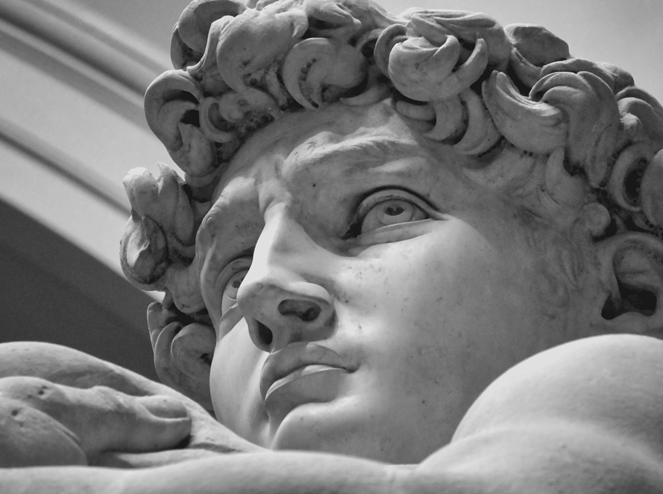
The concept of contemplation also contains this special intensified way of seeing. A twofold meaning is hereby intended: the gift of retaining and preserving in one’s own memory whatever has been visually perceived. How meticulously, how intensively—with the heart, as it were—must a sculptor have gazed on a human face before being able, as is our friend here, to render a portrait, as if by magic, entirely from memory! And this is our second point: to see in contemplation, moreover, is not limited only to the tangible surface of reality; it certainly perceives more than mere appearances. Art flowing from contemplation does not so much attempt to copy reality as rather to capture the archetypes of all that is. Such art does not want to depict what everybody already sees but to make visible what not everybody sees. (Emphasis mine.)
—Josef Pieper, Only the Lover Sings, “Three Talks in a Sculptor’s Studio: Vita Contemplativa”

I first came across the writings of Josef Pieper, a 20th century Catholic German philosopher, reading The Four Cardinal Virtues: Human Agency, Intellectual Traditions, and Responsible Knowledge. About the Author:

“Josef Pieper (1904-1997) was a distinguished twentieth-century Thomist philosopher. Schooled in the Greek classics and in the writings of St. Thomas Aquinas, he studied philosophy, law, and sociology, and taught for many years at the University of Münster, Germany.”

Donald DeMarco writes in Josef Pieper… Truth And Timeliness that

Pieper is most noted for his many books on virtue. In fact, he is commonly known as the “Philosopher of Virtue.” Virtue for Pieper, following Aristotle and Aquinas, is perfective of the person. But the person is real and has an identifiable and intelligible nature. Wherever this nature is denied, totalitarianism gains a foothold. For, if there is no human nature, then there can be no crimes against it.

Pieper wrote while drafted into Germany’s army during World War II and is credited for translating C.S Lewis’s Problem of Pain into German. Because he criticized the Nazis regime, his works were not published until later.

It is said that “While many philosophers in his time focused on politics, Pieper was concerned with the great tradition of Western Culture. He spent his entire life reflecting on the value of culture in modern society and the necessity of the creative arts for the nourishment of the human soul.”

Josef Pieper’s short essay Learning How to See Again begins: “Man’s ability to see is in decline.” Even in the 1950s when he wrote the essay, he suggested that there was too much to see. How much more are we distracted today by screens.

Pieper recommended an artistic vision – visual, musical or literary – as a conduit for the contemplative life. He proposed participating in the arts as a remedy for seeing anew, to see reality as it truly is.

We must learn to see again.

~~~~~

Teaching ‘Tales From Shakespeare’

Benedict Whalen, associate professor of English at Hillsdale College, delivers a lecture on how to teach Tales From Shakespeare by Charles and Mary Lamb to young children. 

This lecture was given at the Hoogland Center for Teacher Excellence seminar, “The Art of Teaching: Children’s Literature” in September 2024. The Hoogland Center for Teacher Excellence, an outreach of the Hillsdale College K-12 Education Office, offers educators the opportunity to deepen their content knowledge and refine their skills in the classroom.

Teaching ‘Tales From Shakespeare’

Teaching ‘Tales From Shakespeare’ – Hillsdale College K-12 Classical Education Podcast – Omny.fm

~~~~~

What Remains?

Watching protesting students align themselves with the terrorist group Hamas and their Palestinian pawns, one wonders what legacy they are building for themselves. Are they – the combine of victim-oppressor social justice warriors – really acting for the greater good with their pro-Hamas and antisemitic chants? Whose interests are they serving? Will they later regret their actions and associations, or will their self-deception and moral distortion continue on the rest of their lives?

Looking back over one’s life work, one’s ruling passion, and reconciling that with what one’s dedicated service contributed to forms the basis of two of Kazuo Ishiguro’s novels: An Artist of the Floating World and The Remains of the Day.

Two men – a Japanese artist in the first novel and an English butler in the second – aspired to reach the highest level in their professions. Both men were attuned to honor and dignity. Both men wanted to attach themselves to a greater worldly-good. But their singular focus, their self-constrained temporal bandwidth, shut out all else until later in life (the time period in the novels). They come to see that what they gave their singleness of mind and efforts to turned out to be not just heartbreaking and reputation damaging but devastating to the greater good.

Both men come across as guarded in their retelling of events and observations in diary-like fashion, as if they didn’t want to be too harsh on themselves. By their unreliable narration we wonder if there’s more under the surface. As things come to the fore, we learn there is a tension between how each saw the world and how the world really was. And this becomes cause for a conflicted life and one of guilt, deflection, and regret about past myopia and former associations.

Each man talks as if “you” were like them – as someone living in the same neighborhood in post-war Japan and as a butler in England. The world doesn’t extend beyond their interests. There are those – daughters, an old friend, a journalist, a housemaid, local towns folk -who try to draw them out.

The artist Masuji Ono’s narration occurs after the end of WWII in 1945 (Oct. 1948 June 1950), when Japan is rebuilding her cities after defeat. We learn that Ono is a retired printmaker who lost his wife Michiko and son Kenji during the war. His beautiful home was seriously damaged by the war as was his reputation.

The elderly Ono spends his time gardening, working on the house, with his visiting daughters and his grandson and going out at night to drink in a quiet lantern-lit bar, a remnant of the pleasure district – the “floating world” of pleasure, entertainment and drink that had at one time given him much pleasure. It’s where he escapes from his dark past.

Ono recalls his early printmaking days and his rise to be a master printmaker surrounded by adoring students in the bar. We learn of his desire to go beyond just making beautiful art. He wanted to serve a higher purpose. We come to learn of Ono’s dark past – his direct involvement in Imperialist Japan’s military rise and his work as a government propagandist.

Ono reassesses events from his past throughout the novel. He reconsiders his role in those events and his guilt. His reputation proceeds him as he enters into marriage negotiations for his daughter Noriko. He also assesses how Japan is changing since the war. He questions some of the change:

“Something has changed in the character of the younger generation in a way I do not fully understand, and certain aspects of this change are undeniably disturbing.”

“Democracy is a fine thing. But that doesn’t mean citizens have a right to run riot whenever they disagree with something.”

Does Ono admit he was wrong to be a propagandist in the deadliest military conflict in history? Does he come to terms with the mistakes he made in the course of his life? Does he attain satisfaction and dignity when all is said and done?

~~

Mr. Stevens’ narration occurs during a six-day road trip in the summer of 1956. He goes to visit Mrs. Benn, nee Kenton, in the sea-side town of Weymouth, England. During this time, he reminisces about his days as head butler at Darlington Hall after WWI and leading up to WWII.

Mr. Stevens is a prim and proper Jeeves-like butler who speaks in a measured and precise way. He values professionalism and dignity above all else.

“The great butlers are great by virtue of their ability to inhabit their professional role and inhabit it to the utmost . . . They wear their professionalism as a decent gentleman will wear his suit. . . It is, as I say, a matter of “dignity.”

Mr. Stevens’ devotion and dedicated service is focused on a man he holds in high esteem: Lord Darlington. “A gentleman through and through” and “I for one will never doubt that a desire to see “justice in this world” lay at the heart of all his actions” and “All those years I served him, I trusted I was doing something worthwhile” says Stevens.

High level meetings are held at Darlington Hall after WWI. Lord Darlington lobbies leaders from England, France and America to go financially easy on Germany.

Lord Darlington, an old-fashioned English gentleman, is much like Mr. Stevens. He can’t imagine a world different from his own. He never understands the true agenda of the Nazis even as the fascists he invites to Darlington Hall seek to turn him against the Jews. Lord Darlington, “A gentleman through and through”, becomes an appeaser and Nazi sympathizer in the name of honor, fairness, friendship, and gentlemanly conduct.

The devoted Stevens views Lord Darlington as a man who had good intentions but was led astray by manipulative diplomats. “I for one will never doubt that a desire to see ‘justice in this world’ lay at the heart of all his actions.”

The devoted Stevens goes with the flow:

“How can one possibly be held to blame in any sense because, say, the passage of time has shown that Lord Darlington’s efforts were misguided, even foolish? Throughout the years I served him, it was he and he alone who weighed up evidence and judged it best to proceed in the way he did, while I simply confined myself, quite properly, to affairs within my own professional realm. And as far as I am concerned, I carried out my duties to the best of my abilities, indeed to a standard which many may consider ‘first rate’.”

The devoted Stevens extrapolates his efforts:

“A ‘great’ butler can only be, surely, one who can point to his years of service and say that he has applied his talents to serving a great gentleman – and through the latter, to serving humanity.”

Miss Kenton, the lead housemaid at Darlington Hall, is like Stevens. She takes great pride in her work. But unlike Stevens, she has emotional latitude and an independent streak. She is intelligent, headstrong, and stubborn. She disagrees not only with Stevens at time but also with the decisions made by Lord Darlington. 

Though she finds Mr. Steven infuriating – “Why, Mr. Stevens, why, why, why do you always have to pretend?” – it gradually becomes clear that Miss Kenton is in love with him. But after many years, she leaves Darlington Hall. Frustrated at Mr. Stevens’ buttoned up emotional state and lack of response Miss Kenton goes off with Mr. Benn, a footman of the house.

Years later, Stevens receives a letter from Miss Kenton. He reads it over and over believing that she might return to her post at Darlington Hall under a new owner. The letter indicates that her marriage to Mr. Benn might not be working out. Stevens’ hopes are up but well-regulated.

His new employer, a wealthy American named Mr. Farraday, tells Stevens to take some time off. He offers Stevens his car for a road trip. And off Stevens goes to see Miss Kenton.

On his way, Stevens comes into contact with several working-class characters. They challenge Stevens’ ideas about dignity. One man opines that dignity is about democracy and standing up for one’s beliefs – in other words, being attentive to what’s going on in the world and being outspoken. This, of course, is in contrast to Stevens’ conception of dignity as being about suppressing one’s own feelings in pursuit of professionalism.

What happens when Stevens reaches Weymouth and meets Mrs. Benn?

What does hindsight look like to Stevens? Does it look like not worrying oneself too much about what one could or could not have done to control the course one’s life took? Does it look like a simple butler trying to make a small contribution count for something true and worthy and sacrificing much in life in order to pursue such aspirations, that in itself, whatever the outcome, is cause for pride and contentment?

Does Stevens, as he reflects on things at the end of the day, realize the mistake he made in his lockstep devotion to Lord Darlington? Does he take the blinders off? And, does he understand the effects of his obsessive devotion to professionalism and dignity on his personal life?

Stevens gives his thoughts on the latter to a man sitting next to him on the pier as they watch the sun going down and the pier lights come on:

“The fact is, of course,’ I said after a while, ‘I gave my best to Lord Darlington. I gave him the very best I had to give, and now – well – I find I do not have a great deal more left to give.”

I return to my opening questions. Whose interests were they serving? Will they later regret their actions and associations or does willful blindness and self-deception remain?

“There was surely nothing to indicate at the time that such evidently small incidents would render whole dreams forever irredeemable.”
― Kazuo Ishiguro, The Remains of the Day

~~~~~

This post wasn’t meant to provide a complete summary of Kazuo Ishiguro’s two novels. There is a whole lot going on in each that I haven’t touched on. They are very well written human-interest stories. The Remains of the Day won The Booker Prize.

Rather, I saw parallels between the decisions youth are making today, with all ardor, for deadly causes and the experiences and feelings of the artist Masuji Ono and the butler Stevens.

I’ve read both novels. I saw the Remains of the Day before reading the book. This Merchant Ivory film is one of my favorites (There is no murder and mayhem, no car chases, no heavy breathing, no queer theory or CRT, and no Disney twaddle.)

The cast is top-notch. I recommend reading the book before viewing the movie and listening to the podcast below (spoiler alert!).

The movie, of course, is edited way down to try and give the essence of Ishiguro’s novel. But reading the text first will provide the depth and richness of the characters and much more detail of their situations.

The Booker at the Oscars: The Remains of the Day from The Booker Prize Podcast | Podcast Episode on Podbay

The Lines of Others

“There is something else which has the power to awaken us to the truth. It is the works of writers of genius. They give us, in the guise of fiction, something equivalent to the actual density of the real, that density which life offers us every day but which we are unable to grasp because we are amusing ourselves with lies.”

Simone Weil

Last year I spent several months with the Oblonskys, the Shcherbatskys, the Karenins, the Vronskys, the Levins, and a host of others. I did this, not as a foreign exchange student living in Russia, but as a mind traveler using the “guise of fiction” by a writer of genius.

Reading the 742 pages of Tolstoy’s Anna Karenina (1878) was a way for me to experience humanity in another time and place.

In community with them, I saw how they lived. I saw what they saw. I heard what they said and thought. I learned what transpired from what they had said, thought and done. During my time with them, I became aware of the inner personality of each person and recognized matters of love and of good and evil that are timeless.

I watched Anna change from a warm and appealing person at the beginning of my stay into a small, spiteful, and self-absorbed woman at the end – all because of her vain imaginings about love and about how the world and those around her were thought to be. With ongoing self-deception, she came to think in terms of extremes and therefore made herself believe she understood everything and everyone in totality: it’s all the same and life was a Darwinian struggle for survival.

Looking back at my time with Anna, I see her narcissism, a personality disorder impacting many today, as a shrunken one-size-fits-me “temporal bandwidth” (see below). I learned a lesson from her toxic attitude: life is not about me.

Stiva, Anna’s hedonist brother, was consistently evil in an absence-of-good way. He forgets, neglects, and fails to act. He’s put his own household into chaos. He lives entirely in the present without regard for the effect he has on his family and future generations.

Dolly, Stivas’s wife, was a consistently good woman who showed self-giving love. She raised children married to such a husband.

Konstantin Dmitrievich Levin, over time, matured. He came to understand love as he watched his wife Kitty. And I witnessed Levin’s spiritual journey to faith in God.

A similar mind traveler experience occurred when I spent months in Russia with The Brothers Karamazov – Dmitri, Ivan and Alexei and their father Fyodor Pavlovich and his illegitimate son, Pavel Fyodorovich Smerdyakov. Agrafena Alexandrovna Svetlova, Katerina Ivanovna Verkhovtseva, Ilyusha, and Father Zosima, the Elder also lived nearby. Quite a cast of characters when you get to know them and quite a legacy of behavior and thought they provide.

In Chekhov’s world of short stories, I shared in the experiences of many. I laughed, cried and saw myself in the everydayness of those I met along the way.

Why read 1800s novels Anna Karenina and The Brothers Karamazov and learn about people with weird names when I could have spent that time watching Yellowstone and taking in a C&W vibe?  Why did I read Love in the Time of Cholera when I could have watched another car chase scene or another mindless comedy? Why did I read Death in the Andes when I could have watched a detective series. Why did I read My Antonia or Heart of Darkness or King Lear, for that matter, when I could have been on social media amusing myself? Why did I read anything outside my context as a Christian? Isn’t there some self-help personal growth book that will give a perspective on the world so I don’t have to venture out of a theological “safe space”?

 I’ll give an answer a foreign exchange student would give for wanting an out-of-context experience:

“To interact with people from different cultures and to gain a deeper appreciation of their values, beliefs, and customs. To become more empathetic and understanding toward others, even those who are very different from me. To gain a better understanding of the diverse world we live in and develop a more open-minded perspective.”

Why read great literature from the past?

To rewire my brain from a competitive judgmental either/or reactionary mindset to a more deliberative way of thinking. To train my brain to think before leaping to conclusions. To employ such reading as a dopamine-hit buffer.

To gain the wisdom of those before me.

To grow faith and love. Imagination is required for faith. Imagination is cultivated by reading the unknown. Reading requires attentiveness. Love is attentiveness

To keep in mind that the prodigal son went looking for the Now thinking that anything could be better than what came before. He found the Now and it affirmed him to be a hungry desperate slave who longed to be fed what he fed the pigs (Luke 15:11-32).

To see another point of view and how it was arrived at.

To be a humanities archeologist. Everything came before Now. And up until broadcast media came around, all we had were the lines of others – words, music, and art.

To not be a reed in the wind. To cultivate “Temporal bandwidth” – temporal bandwidth is “the width of your present, your now … The more you dwell in the past and future, the thicker your bandwidth, the more solid your persona. But the narrower your sense of Now, the more tenuous you are.”” – Alan Jacobs, To survive our high-speed society, cultivate ‘temporal bandwidth’

To not live as a presentist, as someone whose temporal bandwidth has narrowed to the instant something is posted on social media.

To imagine the future using what I learned from the past. For example, I read Solzhenitsyn to understand what it’s like to live under communism.

(If your temporal bandwidth is expanded even somewhat and you are not “amusing yourself with lies”, you see what was plotted before happening now. Joe Biden, along with abetting Globalist Progressives, is implementing the Cloward-Piven Strategy first developed in 1966. That strategy seeks to hasten the fall of capitalism by swarming the country with mass migration, overloading the government bureaucracy, creating a crushing national debt, have chaos ensue, take control in the chaos, and implement Socialism and Communism through Government Force.

To wit, beside the ongoing invasion of the U.S., our nation is incurring massive debt. There is the ongoing silencing of dissent by the DOJ, FBI, and social media cohorts. There is a push to impose digital IDs and digital currency along with WHO oversight to control us. The misanthropic handling of our lives should be a clarion signal to you that communist totalitarianism is coming!)

Books are safe spaces. But if you believe that words are violence (Toni Morrison in her Nobel prize address: “Oppressive language does more than represent violence. It is violence”) then you’ll stay in your “safe place” and refuse to be “breaking bread with the dead” (or listen to opposing views) where one can be an interlocuter and ask why and not just assume things and express rage.

I see going to a “safe space” as the closing in of one’s “temporal bandwidth” much like what Anna Karenina did. It has the exact opposite of a fortifying effect as one is made tenuous, anxious, and very susceptible to narcissism and Groupthink. (Ironically, that is also the effect of DEI.)

Here are two quotes from someone who championed the idea of Great Books, Allan Bloom that apply to what’s been said:

The most successful tyranny is not the one that uses force to assure uniformity but the one that removes the awareness of other possibilities, that makes it seem inconceivable that other ways are viable, that removes the sense that there is an outside.

The failure to read good books both enfeebles the vision and strengthens our most fatal tendency – the belief that the here and now is all there is.


Why read the realist fiction of writers such as Solzhenitsyn, Dostoyevsky, Tolstoy, Chekhov, and others? To break bread with the dead and step out of my context into the lines of others.

Alan Jacobs, the Distinguished Professor of Humanities in the Honors Program at Baylor University and Senior Fellow at the Institute for Advanced Studies in Culture encourages what I call “mind travel” to the past in his book Breaking Bread with the Dead: A Readers Guide for a More Tranquil Mind.

What the book’s publisher said:

W. H. Auden once wrote that “art is our chief means of breaking bread with the dead.” In his brilliant and compulsively readable new treatise, Breaking Bread with the Dead, Alan Jacobs shows us that engaging with the strange and wonderful writings of the past might help us live less anxiously in the present—and increase what Thomas Pynchon once called our “personal density.”

Today we are battling too much information in a society changing at lightning speed, with algorithms aimed at shaping our every thought—plus a sense that history offers no resources, only impediments to overcome or ignore. The modern solution to our problems is to surround ourselves only with what we know and what brings us instant comfort. Jacobs’s answer is the opposite: to be in conversation with, and challenged by, those from the past who can tell us what we never thought we needed to know.

 . . .

By hearing the voices of the past, we can expand our consciousness, our sympathies, and our wisdom far beyond what our present moment can offer.

In his web article To survive our high-speed society, cultivate ‘temporal bandwidth’, Alan Jacobs writes with regard to bolstering “personal density” (as derived in Mondaugen’s Law, Thomas Pynchon’s 1973 novel Gravity’s Rainbow):

. . . benefit of reflecting on the past is awareness of the ways that actions in one moment reverberate into the future. You see that some decisions that seemed trivial when they were made proved immensely important, while others which seemed world-transforming quickly sank into insignificance. The “tenuous” self, sensitive only to the needs of This Instant, always believes – often incorrectly – that the present is infinitely consequential.

The title of this post is a reference to the 2006 movie The Lives of Others. The plot involves the 1984 monitoring of East Berlin residents by Stasi agents of the East German Democratic Republic (GDR).

Stasi Captain Gerd Wiesler is told to conduct surveillance on playwright George Dreyman and his girlfriend, actress Christa-Maria Sieland. As Wiesler listens in from his attic post, he finds himself becoming increasingly absorbed by their lives. You’ll have to watch the movie to see if he is changed by listening to the lives and lines of others and becomes a “good man”.

~~~~~

Of course, the lines of others must include classical music, a rich and diverse soundscape. The soundscape of Now is constant noise.

Fauré: Elegy (Benjamin Zander – Interpretation Class) – YouTube

~~~~~

Reading for a More Tranquil Mind

Cherie Harder speaks with Alan Jacobs about the benefits of reading old books. Jacobs makes the compelling claim–using a phrase from Thomas Pynchon’s Gravity’s Rainbow–that spending our time and attention on writers from the past can increase our “personal density.”

Reading for a More Tranquil Mind

Episode 36 | Reading for a More Tranquil Mind | The Trinity Forum (ttf.org)

~~~

What if we viewed reading as not just a personal hobby or a pleasurable indulgence but as a spiritual practice that deepens our faith?

Reading as a Spiritual Practice (youtube.com)

Episode 75 | Reading as a Spiritual Practice with Jessica Hooten Wilson | The Trinity Forum (ttf.org)

~~~~~

Gary Saul Morson, a Dostoyevsky scholar, writes in a Plough article about Fyodor Dostoevsky and introduces a graphic novel adaptation of “The Grand Inquisitor” from The Brothers Karamazov.

Here is an excerpt:

In Dostoyevsky’s time, numerous schools of thought, ranging from English utilitarianism to Russian populism and socialism, maintained that they had discovered the indubitable solution to moral and social questions.

This way of thinking appalled Dostoyevsky. With his profound grasp of psychology, he regarded the materialists’ view of human nature as hopelessly simplistic. Deeply suspicious of what intellectuals would do if they ever gained the power they sought, he described in greater detail than any other nineteenth-century thinker what we have come to call totalitarianism. Even in its less terrifying forms, rule by supposedly benevolent experts was, he thought, more dangerous than people understood.

 . . .

For Dostoyevsky, the Christian view of life, which most intellectuals regarded as primitive, offered a far more sophisticated understanding than materialist alternatives. . .. he regarded it as a profound mistake to rely only on technological solutions to social problems, a perspective that, if anything, needs to be challenged all the more strongly today. Man does not live by iPhone alone.

For more on The Brothers Karamazov see Jacob Howland’s article in The New Criterion: A realist in the higher sense | The New Criterion

~~~~~

Screen Captured or The Negative Effects of Social Media

JON HAIDT  AND ZACH RAUSCH answer the question . . .

Why does it feel like everything has been going haywire since the early 2010s, and what role does digital technology play in causing this social and epistemic chaos?

 . . . with their article What we’ve learned about Gen Z’s mental health crisis (afterbabel.com) and the included research-based articles:

Social Media is a Major Cause of the Mental Illness Epidemic. Here’s the Evidence. By Jon Haidt

Here are 13 Other Explanations for the Adolescent Mental Health Crisis. None of them Work. By Jean Twenge 

The Teen Mental Illness Epidemic is International, Part 1: The Anglosphere. By Zach Rausch and Jon Haidt

Why the Mental Health of Liberal Girls Sank First and Fastest. By Jon Haidt

Why I am Increasingly Worried About Boys, Too. By Jon Haidt

Play Deprivation is a Major Cause of the Teen Mental Health Crisis. By Peter Gray

Algorithms Hijacked My Generation. I Fear for Gen Alpha. By Freya India, and see also Do You Know Where Your Kids Go Every Day? By Rikki Schlott.

The Case for Phone-Free Schools. By Jon Haidt

Why Antisemitism Sprouted So Quickly on Campus. By Jon Haidt

A recommendation: NO smartphones for your children until at least 16 years of age. They can use a simple flip phone till then.

New book:

The Anxious Generation: HOW THE GREAT REWIRING OF CHILDHOOD IS CAUSING AN EPIDEMIC OF MENTAL ILLNESS by Jonathan HaidtHOW THE GREAT REWIRING OF CHILDHOOD IS CAUSING AN EPIDEMIC OF MENTAL ILLNESS

By Jonathan Haidt

The Anxious Generation: How the Great Rewiring of Childhood Is Causing an Epidemic of Mental Illness: Haidt, Jonathan: 9780593655030: Amazon.com: Books

~~~~~

Not Wanting to Look Away – A Life of War Zone Witness and Writing

The first time I heard about novelist, war correspondent, activist, pacifist, letter writer, and third wife of Ernest Hemingway, Martha Gellhorn, was during a documentary about Hemingway. I became intrigued by the pluck of this woman, as I am about Maria Agnesi and Rose E. Livingston.

1944. To witness the D-Day landings on the beaches of Normandy during World War II, Gellhorn stowed away on a hospital ship (locked herself in a bathroom) and masqueraded as a medic. She impersonated a stretcher bearer.

All night she labored, with blisters on her hands, her mind and heart seared with images of pain and death she would never forget. Later she would learn that every one of the hundreds of credentialed journalists, including her husband, sat poised behind her in the Channel with binoculars, never making it to shore. Hemingway’s story soon appeared in Collier’s alongside hers, with top billing and more dazzle, but the truth had already been written on the sand. There were 160,000 men on that beach and one woman. Gellhorn.

– PAULA MCLAIN writing about The Extraordinary Life of Martha Gellhorn, the Woman Ernest Hemingway Tried to Erase ~A maverick war correspondent, Hemingway’s third wife was the only woman at D-Day and saw the liberation of Dachau. Her husband wanted her home in his bed.

Gellhorn’s reporting from the front lines of every major international conflict in six decades distinguishes her as one of the great war correspondents of the 20th century. Her war coverage spanned from the Spanish Civil War in the 1930s to the Vietnam War.

Martha would go to great lengths to get a good story. During the Second World War she rode with British pilots on night raids over Germany.  She was one of the first journalists to report on Dachau once it was liberated by the Allies. She paid her own way to go to Viet Nam and cover the war.  

I followed the war wherever I could reach it. I had been sent to Europe to do my job, which was not to report the rear areas or the woman’s angle. –  Martha Gellhorn

From Martha Gellhorn: ‘A Twentieth Century Life’ : NPR:

Caroline Moorehead, author of Gellhorn: A Twentieth Century Life, says Gellhorn remained undaunted for most of her 90 years. “I think she was fearless but she knew what it was like to be frightened,” a toughness she got from her upbringing, Moorehead says.

Gellhorn covered wars in a different way than other journalists. “She didn’t write about battles and she didn’t know about military tactics,” Moorehead says. “What she was really interested in was describing what war does to civilians, does to ordinary people.”

Background

Gellhorn was born in Missouri in 1908. Her independent and determined nature along with the desire to champion the cause of the oppressed was formed in her by the examples of her father and mother. George Gellhorn, a German-born Jew, was a reputable gynecologist and social reformer in St. Louis. Edna Fischel Gellhorn championed women’s suffrage, child welfare laws, and free health clinics. Both parents were reformers, advocating for the disenfranchised.

Gellhorn was an activist early on. At age 7, she participated in “The Golden Lane,” a rally for women’s suffrage at the Democratic Party’s 1916 national convention in St. Louis. (Source)

She later attended Bryn Mawr College, a women’s liberal arts school. Her first published articles appeared in The New Republic. “In 1930, determined to become a foreign correspondent, she went to France for two years, where she worked at the United Press bureau in Paris, but was fired after she reported sexual harassment by a man connected with the agency.” (Source)

 In the fall of 1934 Martha would go on to work for FERA (Federal Emergency Relief Administration). There, she documented the lives of the unemployed, the hungry, and the homeless during the Great Depression, alongside photographer Dorothea Lange. Gellhorn became close to Eleanor Roosevelt during that time.

Gellhorn’s began her journalist career during the Spanish Civil War. She arrived in Madrid in 1937 to cover the conflict for Collier’s Weekly. There she met Ernest Hemingway, also in Spain as a correspondent. They married in 1940. The marriage lasted five years. Gellhorn left Hemingway. The breakup was due to Hemingway’s unhappiness about Gellhorn’s’ absence when she was on assignment and his drinking and infidelity.

From Paula McLain, author of a biographical novel about Martha Gellhorn titled Love and Ruin :

She saw herself as a champion of ordinary people in extraordinary circumstances, and worked hard, all her life, to give voice to the voiceless. She never wanted to be famous, and was enraged to know that the larger world knew her mostly through her marriage to Ernest Hemingway, which lasted from 1940-1945. “Why should I be a footnote to someone else’s life,” she noted ruefully in an interview, pointing out that she’d been her own woman and writer before meeting him, and would go on being just that. She in fact went on to publish for nearly fifty years after leaving him, writing a total of five novels, fourteen novellas, two short story collections and three books of essays.

While many consider Hemingway a better fiction writer, many consider Gellhorn a better journalist. Two of Gellhorn’s writings – an article and a letter – show how she analyzed what she witnessed in terms of what man is capable of doing to man. Her writing, biting and eye-opening, reveals her conscience.

Given the evil of ordinary, rather bland, bureaucrats and judges and the globalist tyranny that would make slaves of us all and the toxic air of nihilism, Gellhorn’s writing should serve as a warning to us all.

The Article

Martha Gellhorn was present at the Trial of Adolf Eichmann in Jerusalem, as was Hannah Arendt, who wrote the 1963 book Eichmann in Jerusalem: A Report on the Banality of Evil.

Gellhorn, in a February 1962 The Atlantic article titled Eichmann and the Private Conscience, writes “on some of the facts and some of the lessons to be learned from this Trial, which is unique in the history of the world”. The following quotes about Eichmann are from that article:

This is a sane man, and a sane man is capable of unrepentant, unlimited, planned evil. He was the genius bureaucrat, he was the powerful frozen mind which directed a gigantic organization; he is the perfect model of inhumanness; but he was not alone. Eager thousands obeyed him. Everyone could not have his special talents; many people were needed to smash a baby’s head against the pavement before the mother’s eyes, to urge a sick old man to rest and shoot him in the back of the head; there was endless work for willing hands. How many more like these exist everywhere? What produced them — all sane, all inhuman?

We consider this man, and everything he stands for, with justified fear. We belong to the same species. Is the human race able — at any time, anywhere — to spew up others like him? Why not? Adolf Eichmann is the most dire warning to us all. He is a warning to guard our souls; to refuse utterly and forever to give allegiance without question, to obey orders silently, to scream slogans. He is a warning that the private conscience is the last and only protection of the civilized world.
(Emphasis mine.)

In a single sentence, Eichmann divided the world into the powers of light and darkness. He chose the doctrine of darkness, as did the majority of his countrymen, as did thousands throughout Europe — men with slave minds, pig-greedy for power: the Vichy police, the Iron Guard, big and little Quislings everywhere. He stated their creed in one line: “The question of conscience is a matter for the head of the state, the sovereign.”

Gellhorn’s Letter Writing

“She wrote several a day, often describing the same episodes to different people, sending letters by boat, sometimes adding to them over days until they stretched to 50 pages. Letters were, as her friend Bill Buford put it in his introduction to Gellhorn’s book, Travels With Myself and Another, her main form of social life. . ..  Gellhorn’s friend George Brennan once suggested to her that letters were her ‘real genre, and it is where you yourself come through most genuinely and convincingly’.” (Source) (We have lost touch with hand-written humanness – our own and others – with email and texting.)

While Gellhorn’s wartime dispatches rank among the best of the century, her personal letters are their equal: as vivid and fascinating as anything she ever published.

Gellhorn’s correspondence from 1930 to 1996–chronicling friendships with figures as diverse as Eleanor Roosevelt, Leonard Bernstein, and H. G. Wells, as well as her tempestuous marriage to Ernest Hemingway–paint a vivid picture of the twentieth century as she lived it. (Source)

Gellhorn’s connection to Leonard Bernstein:

“While traveling in Israel in 1949, Gellhorn met Leonard Bernstein by chance in a “scruffy bar” in Tel Aviv. A few months later, Bernstein turned up unannounced (with a grand piano in tow, no less!), in Cuernavaca, Mexico, where she was living and proposed he move in with her for a while. She convinced him to rent a house up the road instead. One night, he persuaded her to try marijuana with him for the first time, having heard from local musicians that it “helped the music flow.” They were both sick all night, with “appalling nightmares.” While never romantic, the two remained close friends and confidants for decades.” (Source)

Gellhorn’s wrote to Bernstein after viewing West Side Story. She was affected by Cool, the most disturbing number (relentless unresolved tritones) of the musical.

“But what stays in my mind, as the very picture of terror, is the scene in the drug store, when the Jets sing a song called “Keep Cool, Man.” I think I have never heard or seen anything more frightening. (It goes without saying that I think the music so brilliant I have no words to use for it.) I found that a sort of indicator of madness: the mad obsession with nothing, the nerves insanely and constantly stretched–with no way to rest, no place to go; the emptiness of the undirected minds, whose only occupation could be violence and a terrible macabre play-acting. If a man can be nothing, he can pretend to be a hoodlum and feel like a somebody. I couldn’t breathe, watching and hearing that; it looks to me like doom, as much as these repeated H-bomb tests, with the atmosphere of the world steadily more and more irrevocably poisoned. I think that drug store and the H-bomb tests are of the same family.

“What now baffles me is that all the reviews, and everyone who has seen the show, has not talked of this and this only: the mirror held up to nature, and what nature. I do not feel anything to be exaggerated or falsified; we accept that art renders beautiful, and refines the shapeless raw material of life. The music and the dancing, the plan, the allegory of the story do that; but nature is there, in strength; and surely this musical tragedy is a warning. . ..” (Emphasis mine.)

The complete letter is here: Notes and Letters — West Side Story

Though I’ve not read of any religious practice in Gellhorn’s life and though her hard-drinking way of life is not something I would recommend – New York Times writer Rick Lyman described Gellhorn as “a cocky, raspy-voiced, chain-smoking maverick”; Gellhorn was a self-made woman who took cyanide to end her life at 90 – still, there is much to commend about Martha Gellhorn: her devotion to humanity and the eyewitness conscience-driven writing of her dauntless war zone life.

Gellhorn, who had a distrust of politicians, documented what the politicians’ war did to civilians. “I followed the war wherever I could reach it,” said Gellhorn. Hers was the Samaritan’s attitude of not wanting to look away. “I wrote very fast, as I had to,” she says, “afraid that I would forget the exact sound, smell, words, gestures, which were special to this moment and this place.” 

Paula McLain, Gellhorn’s biographer, writes that Gellhorn saw herself as a champion of ordinary people in extraordinary circumstances, and worked hard, all her life, to give voice to the voiceless

Gellhorn said of herself “The only way I can pay back for what fate and society have handed me is to try, in minor totally useless ways, to make an angry sound against injustice.”

Gellhorn’s reporting was widely influential at the time and cleared a path for women.

There is a hard, shining, almost cruel honesty to Gellhorn’s work that brings back shellshocked Barcelona, Helsinki, Canton and Bastogne – the prelude and crashing symphony of World War II – with almost unbearable vividness.

The Guardian, reviewing Gellhorn’s book The Face of War

In a journalism career that spanned 60 years, Gellhorn’s particular brand of nerve was rare as radium. Fear seemed to activate rather than suppress her, and it taught her courage in the face of injustice instead of despair. Sharpened by rage and wielded in the service of others, her voice became a sword. I’m not sure I have encountered its equal, even today. We could use an army of such voices, in fact. And precisely now.Paula McLain (Emphasis mine.)

~~~~~

Martha Gellhorn Quotes:

“Americans did not acquire their fear neurosis as the result of a traumatic experience – war devasting their country, pestilence sweeping the land, famine wiping out helpless millions. Americans had to be taught to hate and fear an unseen enemy. The teachers were men in official positions, in government, men whom Americans normally trust without question.”

“I do not see myself as a footnote to someone else’s life.” (Regarding her marriage to Hemingway.)

“Stop spying on the lawful citizenry. Democracy and dossiers go ill together. It is all right for God but all wrong for the State to keep its eye on sparrows.”

“From the earliest wars of men to our last heart-breaking worldwide effort, all we could do was kill ourselves. Now we are able to kill the future.”

“In more than half the nations of our world, torture certifies that the form of government is tyranny. Only tyranny, no matter how camouflaged, needs and employs torturers. Torture has no ideology.”

“The only way I can pay back for what fate and society have handed me is to try, in minor totally useless ways, to make an angry sound against injustice.”

“War happens to people, one by one. That is really all I have to say and it seems to me I have been saying it forever. Unless they are immediate victims, the majority of mankind behaves as if war was an act of God which could not be prevented; or they behave as if war elsewhere was none of their business. It would be a bitter cosmic joke if we destroy ourselves due to atrophy of the imagination.”

“Gradually I came to realize that people will more readily swallow lies than truth, as if the taste of lies was homey, appetizing: a habit.”

“On the night of New Year’s Day, I thought of a wonderful New Year’s resolution for the men who run the world: get to know the people who only live in it.”

“Here one has the perfect example of justice: the men have kept their women enslaved…stupid and limited and apart, for their male vanity and power; result: the dull women bore the daylights out of the men.”

“Democracy is dying. It’s a disease called cowardice.” (From a 1938 letter.)

~~~~~

Janet Somerville, author of Yours, for Probably Always, talks about novelist, war correspondent, activist, and iconoclast Martha Gellhorn.

Janet Somerville on Martha Gellhorn | The Hemingway Society

Janet Somerville on Martha Gellhorn | The Hemingway Society

~~~~~

A different war, a different correspondent:

Exposing abuse and corruption can be a thankless job. Powerful figures doing wrong often deny and attack those exposing them. And their supporters often join suit—attacking the messenger, rather than holding their leader accountable. . . why continue reporting, advocating, and shining a light when doing so comes at such a high personal cost?

Why Not Quit – Julie Roys

Why Not Quit? | The Roys Report (julieroys.com)

~~~~~

More on Martha:

1981, Martha Gellhorn Unedited Interview, War correspondent, Ernest Hemingway, Spanish Civil War (youtube.com)

Martha Gellhorn. ‘Face to Face’ interview with Jeremy Isaacs. 1995. – YouTube

The Face Of War: Gellhorn, Martha: 9780871132116: Books – Amazon.ca

Married to Her Writing | The National Endowment for the Humanities (neh.gov)

Get to Know Martha Gellhorn – Paula McLain

Gellhorn at war | Books | The Guardian

Martha Gellhorn (Hemingway) | EH@JFK | JFK Library

Martha Gellhorn: Writer, Warrior, Witness (historynet.com)

Martha Gellhorn: The World’s Greatest War Correspondent (youtube.com)

Martha Gellhorn’s Career as a War Correspondent and Marriage to Ernest Hemingway (townandcountrymag.com)

Martha Gellhorn, War Correspondent, Novelist, & Memoirist (literaryladiesguide.com)

Great Lives – Martha Gellhorn – BBC Sounds

Martha Gellhorn: Eyewitness to War | The National WWII Museum | New Orleans (nationalww2museum.org)

A Line from Linda: Martha Gellhorn’s “Eichmann and the Private Conscience”

Leonard Bernstein Asked About Hemingway, So Martha Gellhorn Set the Record Straight (thedailybeast.com)

Somewhere in the Lost World of Love

Love. Is it die-cut like the Valentine cards of grade school? Is it cliché like pop music? Is it a potion we constantly thirst for? Is it intoxication and under its influence we are not in our right minds? Is love passion? Sentimental? Carnal? Absolute? “What do any of us really know about love?” 

The last question is raised during a conversation between two couples. Their dialog and the juxtaposition of the couple’s ideas about love are found in Raymond Carver’s 1981 short story What We Talk About When We Talk About Love. Carver has us listen in.

We learn from narrator Nick that he and his wife Laura are spending the afternoon at Mel and Terri’s home. Both couples live in Albuquerque, but as Nick says and the ‘love’ dialog relates, they “were all from somewhere else”.

Nick tells us that Mel McGinnis is a forty-five-year-old cardiologist who, before medical school, spent five years in seminary. Terri is his second wife. We later learn that Mel was married before to Majorie and has two children. His movements are usually precise when he hasn’t been drinking. 

Terri, we learn, was previously in an abusive relationship with a guy named Ed. He would beat her and drag her around the room by her ankles, all the while professing his love for her.

Mel and Terri have been married for four years.

Nick tells us about Laura and their relationship: she’s a legal secretary who’s thirty-five and three years younger than he is. He says they’re in love, they like each other and enjoy each other’s company. “She’s easy to be with.” They’ve been married for eighteen months. 

Beside the four adults, sunlight and gin figure in the story.

As the story begins, the four are sitting around a kitchen table. Sunlight fills the room. Gin and tonic water are being passed around. The subject of love comes up.

(I get the sense that the older couple have argued a lot about what love is and now want to air it all again in front of the younger couple. It seems they have things they want to get off their chest. Is that why the cheap gin is being passed around? Are Nick and Laura in place to be the arbiters of who’s right and who’s wrong?)

The heart doctor Mel, based on “the most important years of his life” in seminary, thinks that “real love was nothing less than spiritual love”.  (This signals that love’s definition may not be solid.)

Terri believes that Ed, the man who tried to kill her, loved her. She asks “What do you do with love like that? Mel responds that Ed’s treatment could not be called love.

Terri then makes excuses for Ed’s behavior – “People are different”. She defends him – “he may have acted crazy. Okay. But he loved me.”

We begin to notice a growing tension between Mel and Terri. (There has been tension in their marriage about Ed and Marjorie before this.)

Mel relates that Ed threatened to kill him. Mel reaches for more gin and becomes antagonistic himself. He calls Terri a romantic for wanting brutal reminders of Ed’s love. Then he smiles at her hoping she won’t get mad. Terri responds to Mel, not with a rejection of his or of Ed’s behavior, but with what might have been her leave-the-door-open enabling response to Ed after one of his physical attacks: “Now he wants to make up.” Her past relationship reveals the continuous nature of Terri’s emotional deficit.

(Does Mel know how to land verbal blows on Terri like Ed did physically?)

Mel tries to soften the blow by calling Terri “honey” and by saying again that what Ed did wasn’t love. He then asks Nick and Laura what they think.

Nick says he doesn’t know the man or the situation to make a decision. Laura says the same and adds “who can judge anyone else’s situation?” Nick touches her hand and she smiles.

Nick picks up her “warm” hand, looks at the polished and manicured nails and then holds her hand. With this display of affection, Nick shows his love and respect for Laura, the opposite of the emotional and physical abuse Terri suffered at the hands of Ed.

Mel posits that his kind of love is absolute and nonviolent. (Then again, emotional abuse doesn’t kill or leave physical bruises.)

Terri and Mel describe Ed’s two attempts at suicide. Terri talks with sympathy for the guy. “Poor Ed” she says. Mel won’t have any of it: “He was dangerous.” Mel says they were constantly threatened by Ed. They lived like fugitives, he says. Mel bought a gun.

Terri stands by her illusion that Ed loved her – just not the same way that Mel loves her.

They go to relate that Ed’s first suicide attempt -drinking rat poison – was “bungled”. This puts him in the hospital. Ed recovers. The second attempt is a shot in the mouth in a hotel room. Mel and Terri fight over whether she will sit at his hospital bedside. She ends up there.

Mel reiterates that Ed was dangerous. Terri admits they were afraid of Ed. Mel wants nothing to do with Ed’s kind of love. Terri, on the other hand, reiterates that Ed loved her – in an odd way perhaps but he was willing to die for it. He does die.

Mel grabs another bottle of gin.

Laura says that she and Nick know what love is. She bumps Nick’s knee for his response. He makes a show of kissing Laura’s hand. The two bump knees under the table. Nick strokes Laura’s thigh.

Terri teases them, saying that things will be different after the honeymoon period of their relationship. Then, with a glass of gin in hand, she says “only kidding”. Mel opens a new bottle of gin and proposes a toast “to true love.”

The glow of the afternoon sun and of young love in the room makes them feel warm and playful, like kids up to something.

Matters-of-the-heart Mel wants to tell them “what real love is”. He goes on about what happens to the love between couples who break up. After all, he once loved his ex-wife, Marjorie, and Terri once loved Ed. Nick and Laura were also both married to other people before they met each other.

He pours himself more gin and wipes the “love is” slate clean with “What do any of us really know about love?” He – the gin Mel – talks about physical love, attraction, carnal love, sentimental love, and memory of past love. Terri wonders if Mel is drunk. Mel says he’s just talking. Laura tries to cheer Mel by saying she and Nick love him. Mel responds saying he loves them too. He picks up his glass of gin.

Mel now gets around to his example of love, an example that he says should shame anyone who thinks they know what they are talking about when they talk about love. Terri asks him to not talk drunk. (Is Mel, focused only on himself and his gin, becoming a slurring, stammering and cursing drunk?) He tells her to shut up.

Mel begins his story of an old couple in a major car wreck brought on by a kid. Terri looks over at Nick and Laura for their reaction. Nick thinks Terri looks anxious. Mel hands the bottle of gin around the table.

Mel was on call that night. He details the extensive wounds. The couple is barely alive. After saying that seat belts saved the lives of the couple, he then makes a joke of it. Terri responds affirmatively to Mel and they kiss.

Mel goes on about the old couple. Despite their serious injuries, he says, they had “incredible reserves” – they had a 50/50 chance of making it.

Mel wants everyone to drink up the cheap gin and then go to dinner. He talks about a place he knows. Terri says they haven’t eaten there yet. The heart doctor’s coherence dissipates with each drink.

He says he likes food and that he’d be a chef if he had to do things all over again. Then he says he wants to come back in another life as a medieval knight. Knights, he says, were safe in armor and they had their ladies. As he talks, Mel uses the word “vessels”. Terri corrects him with “vassals”. Mel dismisses her correction with some profanity and false modesty.

Nick counters the heart doctors fantasy by saying that knights could suffer a heart attack in the hot armor and they could fall of a horse and not get back up because it is heavy.  

Mel responds to Nick and Terri, acknowledging it would be terrible to be a knight, that some “vassal” would spear him in the name of love. More profanity. More gin.

Laura wants Mel to return to old couple story. The sunlight in the room is thinning. (And so is “love’s” illumination.)

Terri gets on Mel’s nerves with something she said jokingly. Mel hits on Laura saying he could easily fall in love with her if Terri and Nick weren’t in the picture. He’d carry her off knight-like. (Terri and Nick, of course, are sitting right there.)

Mel, with more vulgarity, finally returns to his anecdote. The old couple are covered head to toe in casts and bandages with little eye, nose and mouth holes. The husband is depressed, but not about his extensive injuries. He’s depressed because he cannot see his wife through his little eye holes. Mel is clearly blown away by this kind of love. He asks the other three if they see what he’s talking about. They just stare at him.

Sunlight is leaving the room. Nick acknowledges that they were all “a little drunk”.

Mel wants everyone to finish off the gin and then go eat. Terri says he’s depressed, needs a pill. Mel wants to call his kids, who live with his ex-wife and her new boyfriend.  Teri cautions Mel about taking to Marjorie – it’ll make him more depressed.

Terris says that Marjorie, because she isn’t remarried, is bankrupting them. Mel, who says he once loved Marjorie, fantasizes about Majorie dying after being stung by a swarm of bees, as she’s allergic to bees. Mel then shows with his hands on Terri’s neck how it would happen to “vicious” Marjorie.

Mel decides against phoning his children and mentions about going out to eat again. Nick is OK with eating or drinking more. Laura is hungry. Terri mentions putting out cheese and crackers put she never gets up to do this. Mel spills his glass of gin on the table – “Gin’s gone”. Terri wonders what’s next.

As the story ends, daylight (illumination) is gone from the kitchen. The four are ‘in the dark’ about what love really is. The conversation is also gone after Mel’s futile attempts to talk about love in any satisfying way and the inability of two characters to move on from the past and with two characters wondering what’s next.

The only sound Nick hears is the sound of human hearts beating (somewhere in the Lost World of Love).

~~~~

This story, though not of “Christian” genre, certainly would resonate with many readers. Do you relate to anyone in the story?

Terri understood Ed’s abusive and suicidal behavior as him being passionate about love. Mel, the heart doctor and would-be knight, showed himself idealistic and ignorant about the realities of the ‘heart’ and not loving towards Terri. Nick and Laura revealed the affection and passion of the heady first days of romance love. The old couple possessed an enduring love for each other after many years of marriage.

Why would I, as a Christian, gravitate to a ‘worldly’ author like Raymond Carver, especially when his stories are filled with alcohol? One reason is that I recognize myself in many of his stories. I see elements of myself at various stages of my life in each of the characters above. I could pretend to see myself otherwise, as I think some Christians do.

Another reason is that Carver writes about working class people. He doesn’t write down to people. His writes stories of domestic American life with its passions, fears, foibles, and fantasies. He writes with realism about human nature, revealing the old self that I must recognize in myself to put away.

I find his writing sobering, as in his story Where I’m Calling From.

~~~~~

RARE: Raymond Carver Reads “What We Talk About When We Talk About Love” (youtube.com)

~~~~~

Men need sex. And it’s their wives’ job to give it to them—unconditionally, whenever they want it, or these husbands will come under Satanic attack.

Stunningly, that’s the message contained in many Christian marriage books. Yet, research shows that instead of increasing intimacy in marriages, messages like these are promoting abuse.

In this edition of The Roys Report, featuring a talk from our recent Restore Conference, author Sheila Wray Gregoire provides eye-opening insights based on her and her team’s extensive research on evangelicalism and sex.

How Christian Teachings on Sex Enable Abuse | The Roys Report (julieroys.com)

How Christian Teachings on Sex Enable Abuse | The Roys Report

The Advent of One Day at a Time

When have entered a dark season. Houses and yards are lit up. And, perhaps, some of the residents.

“The holidays are always bad” – Frank Martin.

American writer Raymond Carver published a story about a man trying to move from an addiction to alcohol toward sobriety. The story, set over three days, includes New Years Day. Where I’m Calling From first appeared in the New Yorker in 1982.

Written in Carver’s no-nonsense economical fashion, the story is told by a nameless Narrator who immediately draws us into the residential treatment center where he finds himself and another because of an inability to stop drinking.

“J.P and I are on the front porch at Frank Martin’s drying out facility. Like the rest of us at Frank’s Martin’s, J.P. is first and foremost a drunk. But he’s also a chimney sweep. It’s his first time here, and he’s scared. I’ve been here once before. What’s to say? I’m back.”

From the opening words we learn that alcoholism can take over one’s identity. The Narrator labels both J.P. and himself and everyone at the treatment center. But then the Narrator does go on to say that he knows J.P. as more than “a drunk”.

We also learn, from the Narrator’s “I’m back”, that the struggle with alcoholism can become a cycle of drinking and drying out. And then we find out that it can also become the ultimate wake-up call.

Let’s listen in . . .

“We’ve only been in here a couple of days. We’re not out of the woods yet. J.P. has these shakes, and every so often a nerve — maybe it isn’t a nerve, but it’s something — begins to jerk in my shoulder. Sometimes it’s at the side of my neck. When this happens, my mouth dries up. It’s an effort just to swallow then. I know something’s about to happen and I want to head it off. I want to hide from it, that’s what I want to do. Just close my eyes and let it pass by, let it take the next man. J.P. can wait a minute.

“I saw a seizure yesterday morning. . .”

A large man nicknamed Tiny had the seizure. As the Narrator tells us, Tiny was showing signs of improvement and looking forward to going home for New Year. But then Tiny collapsed at the table before all of them and was rushed to the hospital. The physical signs of alcoholism and withdrawal from it – shakes, spasms, swallowing issues and a seizure – have a major effect on the Narrator.

Loss of self-control brought the Narrator and the “drunk” others to Frank Martin’s drying out facility. And now the loss of physical control due to alcohol use disorder – the Narrator doesn’t want to countenance that. He recoils and hopes for the best – to “let it pass by” to someone else at the table.

“But what happened to Tiny is some-thing I won’t ever forget. Old Tiny flat on the floor, kicking his heels. So every time this little flitter starts up anywhere, I draw some breath and wait to find myself on my back, looking up, somebody’s fingers in my mouth.”

Reading on we get a sense of the need for company and storytelling that withdrawing from alcoholism produces. J.P. and the Narrator sit on the front porch of Frank Martin’s drying out facility. The Narrator listens to J.P.’s story.

The first thing we hear about is a childhood trauma. Twelve-year-old J.P. happened to fall into a dry well near a farm near where he grew up. It wasn’t until later that day that his dad found him and pulled him up. We find out from the Narrator the effect on J.P.:

“J.P. had wet his pants down there. He’d suffered all kinds of terror in that well, hollering for help, waiting, and then hollering some more. He hollered himself hoarse before it was over. But he told me that being at the bottom of that well had made a lasting impression.”

(So far, two lasting impressions from life-or-death situations.)

J.P. remembers looking up at the circle of blue sky from the “bottom of that well” and seeing passing clouds and birds and hearing rustling (of insects?) and the wind blow over the opening. To me this is a picture of the alcoholic at the bottom of the well (the bartending term “well” comes from one of the many names for the underneath of the bar top) and who now looks up and sees life going on without him and a “little circle of blue” that represents hope. The Narrator relates what J.P. said about that time:

“In short, everything about his life was different for him at the bottom of that well. But nothing fell on him and nothing closed off that little circle of blue. Then his dad came along with the rope, and it wasn’t long before J.P. was back in the world he’d always lived in.”

J.P. receives a lifeline. The Narrator wants to hear more.

“Keep talking, J.P. Then what?””

We learn from the Narrator that J.P. meets Roxy, a chimney sweep, at a friend’s house. J.P. says that he could “feel his heart knocking” as she looked him over.  J.P. receives a “good luck” kiss from Roxy.

“He could feel her kiss still burning on his lips, etc. At that minute J.P. couldn’t begin to sort anything out. He was filled with sensations that were carrying him every which way.”

J.P. asks to date her.

“Then what?” the Narrator says. “Don’t stop now, J.P.”

We learn that J.P. and Roxy date. To be close to Roxy, J.P. becomes a chimney sweep and begins working with her. The two later marry, have two kids, and buy a house. The Narrator relates what J.P. felt at the time and adds a comment:

“I was happy with the way things were going,” he says. “I had everything I wanted. I had a wife and kids I loved, and I was doing what I wanted to do with my life.” But for some reason — who knows why we do what we do? — his drinking picks up.

J.P.  goes on to talk about how he began to drink more and more, even taking a “thermos bottle of vodka in his lunch pail”. But then he stops talking.

The Narrator, who’s using J.P. story to help himself relax and avoid his own situation, coaxes to J.P. to continue.

J.P.’s drinking effects his relationship with Roxy. Their fights became physical – a broken nose for J.P. and a dislocated shoulder for Roxy.

“They beat on each other in front of the kids. Things got out of hand. But he kept on drinking. He couldn’t stop. And nothing could make him stop. Not even with Roxy’s dad and her brother threatening to beat hell out of him. They told Roxy she should take the kids and clear out. But Roxy said it was her problem. She got herself into it, and she’d solve it.”

Roxy fixes things by getting a boyfriend. J.P, finds out and goes berserk – like pulling off her wedding ring and cutting it in two. Things for the “drunk” J.P. go downhill – like falling off a roof and breaking a thumb and being arrested for drunk driving.

The Narrator wants us to know that he and J.P. are staying at Frank Martin’s of their own free will and that they’re trying to get their life back on track. Since it’s the Narrator’s second visit, Frank encourages him to stay longer – “The holidays are always a bad time.”

We then learn from the Narrator how J.P. arrived at the residential treatment center. Roxy’s father and brother drive J.P. to Frank Martin’s drying out facility, carry him upstairs and put him to bed. A couple of days later, J. P’s out on the porch with the Narrator telling his stories.

At one point, when the two are on the front porch, Frank Martin, who the Narrator says looks like a prize fighter and “like somebody who knows the score”, comes out to finish his cigar.

“He lets the smoke carry out of his mouth. Then he raises his chin toward the hills and says, “Jack London used to have a big place on the other side of this valley. Right over there behind that green hill you’re looking at. But alcohol killed him. Let that be a lesson. He was a better man than any of us. But he couldn’t handle the stuff, either.”

Frank then encourages them to read London’s Call of the Wild. The book is in the house, he tells them.

J.P., who wants to hide when Frank’s around, says he wishes he had a name like “Jack London” instead of his own name, Joe Penny. (Does the initial using  J. P. feel that the shame, failure, and disappointment of being a “drunk” is attached to “Joe Penny? Does he desire a new name because of his tarnished name?)

The Narrator then tells us about his two trips to Frank Martin’s. When his wife brought him here the first time, Frank said he could help. The Narrator wasn’t sure:

“But I didn’t know if they could help me or not. Part of me wanted help. But there was another part.”

The second time, the Narrator was driven to Frank Martin’s by his girlfriend. He had moved in with her after his wife told him to leave.

This second trip to the treatment center came after their drinking bouts around Christmas. The girlfriend had received horrible news in the form of a medical report. With that kind of news, they decided to start drinking and get “good and drunk”. On Christmas day they were still drunk. After a lot of Bourbon, the Narrator decides to go back for treatment. The drunk girlfriend drops him off. The Narrator is not sure if she made it home OK. They haven’t talked on the phone.

New Year’s Eve morning. The Narrator tries to contact his wife, but no answer. He recalls their last conversation. They screamed at each other. “What am I supposed to do?” he says, thinking that he can’t communicate with her anyway.

We learn that there’s a man in the group who’s in denial and says his drinking is under control. He says he doesn’t know why he’s at Frank Martin’s. But he also doesn’t remember how he got there.

New Year’s Eve. Frank made steaks for the group. But Tiny doesn’t eat. He fears another seizure. “Tiny is not the same old Tiny”.

After dinner Frank brings out a cake. In pink letters across the top: HAPPY NEW YEAR – ONE DAY AT A TIME.

Eating cake J.P. tells the Narrator that his wife is coming in the morning, the first day of the year.

The Narrator tries calling his wife collect, but there’s no answer again. He thinks about calling his girlfriend but he decides that he doesn’t’ want to deal with her. He hopes she’s OK but he doesn’t want to find out if there is something wrong with her.

In the morning, Roxy arrives. J.P. introduces his wife to the Narrator. The Narrator wants a “good luck” kiss. The Narrator can see that Roxy loves J.P. She uses “Joe” instead of “J.P.”

This scene seems to trigger something in the Narrator. Lighting a cigarette, he notices that he has the shakes. They started in the morning. He wants something to drink. Depressed, he turns his mind to something else.

The Narrator remembers a happy time with his wife in their house and the house painter that surprised him one morning. These were good vibes: “And at that minute a wave of happiness comes over me that I’m not him — that I’m me and that I’m inside this bedroom with my wife.”

Sitting outside on the front steps, the Narrator thinks about reconnecting – calling his estranged wife again and then his girlfriend. He tries to remember any of Jack London’s books he’s read. “To Build a Fire” comes to mind. It’s a life-or-death story set in the Yukon.

The Narrator thinks again about reconnecting – calling his estranged wife and wish her a “Happy New Year” and to let her know where he’s at when she asks. After that, he’d call his girlfriend hoping that her mouthy teenage son won’t pick up the phone.

~~~~~

Carver’s style has been described as “dirty realism”. Bill Buford, in Granta Magazine, Summer 1983, describes the style:

“Dirty Realism is the fiction of a new generation of American authors. They write about the belly-side of contemporary life – a deserted husband, an unwanted mother, a car thief, a pickpocket, a drug addict – but they write about it with a disturbing detachment, at times verging on comedy. Understated, ironic, sometimes savage, but insistently compassionate, these stories constitute a new voice in fiction.”

Carver’s influences include Anton Chekhov, Ernest Hemingway, Flannery O’Connor to some degree and others.

Like with Chekhov’s stories, Carver’s stories are like windows you can peer through and get a sense of the characters and what’s going on. Though indirect and conveying things without moral pronouncements, Carver’s stories suggest much with details that can say many things. Falling into a well and the mention of Jack London, for example, in the story above.

J.P.’s account of falling into a well gives us some idea of how it feels to be an alcoholic – helpless, in over your head, scared, and looking for a lifeline and a way out.

The Narrator, at the beginning, says “We’ve only been in here a couple of days. We’re not out of the woods yet” and at the end Jack London’s “To Build a Fire” comes to mind. I see his initial admission of trekking through the woods to sobriety and his later hint of his attempts toward sobriety (building a fire in the woods) as an inclusio or framing of the Narrator’s struggle with alcohol. His journey to sobriety will require a set of survival skills he doesn’t yet possess.

The setting of “To Build a Fire” is in the extreme cold of the largely uninhabited Yukon Territories. The unnamed (like the Narrator) solitary hiker is walking on a side trail in the woods toward an outpost. His self-confidence in hiking and survival skills has him disregard an old man’s advice about not traveling alone in such harsh weather.

Remember the Narrator saying this about his first arrival at Frank Martin’s?

“But I didn’t know if they could help me or not. Part of me wanted help. But there was another part.”

The hiker thinks that he can keep trekking toward the outpost without building a fire, despite it being 50 degrees below zero. His dog seems smarter than the hiker who underestimates the power of nature and the possibilities that can arise. While the hiker has some practical smarts, he lacks wisdom. A quote from the story describes the hiker:

“The trouble with him was that he was without imagination. He was quick and alert in the things of life, but only in the things, and not in the significances.”

At one point the hiker, almost frozen, finally decides to build a fire. Because it was easier to gather the wood needed, he builds his fire underneath a canopy of tree branches. The boughs above his fire are laden with snow. The jostling of his twig gathering and the heat of the fire cause the snow to fall onto the fire and quench it. The hiker tries again, this time out in the open, but he’s freezing up. His hands can’t function. He eventually resigns himself to his frozen fate.

One could see parallels between the unnamed hiker’s folly and the Narrator’s struggle with alcoholism. For one, there’s a self-reliance that paid off in the past that goes on to think it can handle all things. Maybe that’s why Frank Martin brought up Jack London:

“Jack London used to have a big place on the other side of this valley. Right over there behind that green hill you’re looking at. But alcohol killed him. Let that be a lesson. He was a better man than any of us. But he couldn’t handle the stuff, either.”

Another would be building a fire (drying out) under the pretense that you’ve got things figured out and under control. And that could end up in a cycle of a cycle of fires going out and building another fire, of drinking and drying out. Or worse.

Besides the hidden clues, discernable themes of addiction, self-destructive behaviors, addiction’s effect on others, loss of control while under the influence of alcohol, identity, loneliness, alienation, failure, vulnerability, and the need for human connection and story – they’re found in Where I’m Calling From.

~~~~~

Raymond Carver described himself as “inclined toward brevity and intensity”.

Characterized by an economy with words, Carver’s stories focus on surface description and its subject matter. Things are laid bare. No flowery words. No adverbs. Meaning is found in the raw context.

“Carver decided to explore minimalism in writing. He showed, in his text, real situations of everyday life; some of them could be crude, or complicated to understand, but still, he represented feelings that everyone could recognize: sadness, loneliness, failure, etc.”

-Maialen De Carlos,  The American Short Story and Realism: Raymond Carver (byarcadia.org)

Raymond Carver once said “I’m a paid-in-full member of the working poor.”  He wrote stories that a blue-collar reader could connect with – of unremarkable people and the seemingly insignificant details that affect them. His own life was a constant struggle with alcohol addiction.

Carver had self-destructive issues with drinking. Alcohol shattered his health, his work and his family – his first marriage ended because of it. He stopped drinking on June 2nd 1977.

The Life of Raymond Carver documentary with Rare Interview (1989):

Hailed as the American Chekhov and short-listed for a Pulitzer Prize at the time of his death, only ten years earlier Raymond Carver had been completely down and out. In this vintage program filmed just a year after he died, Carver’s second wife, Tess Gallagher, and writers Jay McInerney and Richard Ford, his close friends, explore Carver’s artistic legacy: his stories and poems about the other side of the American Dream. In addition, excerpts from two of Carver’s most famous stories are dramatized. “No one since Steinbeck had written about these people,” says McInerney, “the people whose dreams go belly-up.”

The Life of Raymond Carver documentary with Rare Interview (1989) (youtube.com)

~~~~~

Why do I read Carver?  Because he writes about people like me and my lived experience. I can relate to J.P. and the Narrator. I’ve known alienation, loneliness, shame, brokenness, failure. I’ve made bad decisions. I’ve been at the bottom of the well. And the bottom of the well has been in me.

Several years ago I had a chat with the rector of the church I was attending. It was midweek when he and I met in the church hallway. I had just dropped off some bags of groceries to be delivered to a homeless shelter in the area.

We hadn’t talked in a while and he wanted to catch up. So we sat down in a room just off the entrance to the chapel. I could tell, first off, that he was eager to convince me to share a room with another single woman during the upcoming trip to Israel that he was heading. When I let him know that I wasn’t interested, he asked me how I was doing.

I told him about work and that I was thinking about retiring at some point. Then, I don’t remember why – maybe to tell him Where I’m Calling From, I told him that there was a well of pain so deep in me that if I brought any of it up, I didn’t know what would happen.

He responded with “Hmmm.” When our conversation ended, he prayed for me.

What I like about Carver’s stories is what I like about Anton Chekov’s stories   – I don’t find sanctimony or moralizing. There is no rush to judgement. There are common shared experiences.

Where I’m Calling From, for the most part, is narrated in the present tense. If narrated in the past tense, we’d be in a position to judge. We’d be in the “I told you so” position.

But the present tense narration draws us in. We become involved. We wait and see what happens. We listen to the stories being told. We don’t judge. We understand. And we connect. As a follower of Jesus in this dark season, this is what I’m called to do.

The entire creation is groaning and that includes me.

~~~~~

Short Story Roulette (archive.org)

~~~~~

Advent: The Season of Hope (youtube.com)

Truth Beyond the Binary

“The Gleaners” (1857), by Jean-François Millet, depicts women picking up loose grain in the field. Without words it relates the hardships and the dignity of everyday workers. The painting connects us to our own human story. We recognize something of ourselves in this glimpse of reality. We understand a day’s slog and strain. We empathize with the workers.

The painting’s aesthetic realism, its naturalism and unromanticized imagery draw us in. We like that it rejects idealization and artificiality. “The Gleaners” portrays ’us’ as we are. And the subject’s universality – women doing manual labor – is a catalyst for imaginative truth.

We empathize with the subjects as we project ourselves into their perspective. We imagine what it must be like working in a field under the hot sun. We imagine constantly bending over to pick up left-over scraps of the grain harvest so that poor women and children could live on them. We imagine ourselves in 1857.

We find ourselves stepping out of our world and connecting with history – mankind has been doing manual labor since the beginning of time. We find ourselves connecting not just with the women, but with all of humanity, a humanity that shares the work, burdens, and cares of life. And, our imagination wants to know more of the wordless ‘story’.

We cannot see the women’s faces. Are the women young or old? Are they talking to pass the time? Singing? Are they married? Have children? Do they work from sun up to sun down? How do their backs feel at the end of the day? Are their hands dried out and cracked from handling the grain?

~~~~~

Anton Chekhov’s stories are noted for their ‘naturalness’ – the ability to show ‘exactly what a little piece of life’ is like. Like with Millet’s realistic painting, his prose provides down-to-earth characters, details and a setting that, though with Russian aspects, is universal in its close-to-home familiarity.

Russian-American novelist Vladimir Nabokov, in his Lectures on Russian Literature, described Chekhov as writing “the way one person relates to another the most important things in his life, slowly and yet without a break, in a slightly subdued voice”.

Chekhov, a practicing doctor, observed everyday life and ordinary people as he made house calls and treated patients. He wrote with a concentration on the daily lives of individuals using natural detail. We connect with the subjects in terms of shared experiences, emotions, and challenges that are common to all human beings.

You won’t find sanctimony or moralizing or happy endings in his stories nor heroes in the conventional sense. Chekhov had nothing to prove, no ideology or politics to promote, and he created all his characters equal.

And though Chekhov’s stories seem to go nowhere, his ‘close to home’ imagery mirrors our own situations. Life often goes on unchanged or less than we had hoped for. Life often goes on without resolution. And that is the case in a touching story by Anton Chekhov – “On Easter Eve” (1886).

A brief introduction: “The narrator describes his moving experience of attending an early-morning celebration of Easter Eve in the countryside after crossing a river in flood in the middle of a very starry night, admiring the fireworks and listening to the boatman’s account of the sudden demise of the church deacon while composing Easter hymns.”

The ferryman, a novice monk, grieves the loss of a brother. Nikolai, a sensitive soul enraptured by words, was skilled at writing Akathists. (Akathist or “unseated hymn” is a type of hymn usually recited by Eastern Orthodox or Eastern Catholic Christians. It may be dedicated to a saint, holy event, or one of the persons of the Holy Trinity.)

The passenger (narrator) listens to the ferryman recount the death of his best friend Nikolai and about the gift Nikolai had for writing hymns of praise. “And Nikolai was writing akathists! Akathists! Not mere sermons or histories.” The passenger then asks “Are they so hard to write then? The ferryman responds “Ever so hard” and goes on to describe what’s involved, including the following:

Everything must be harmonious, brief and complete. There must be in every line softness, graciousness and tenderness; not one word should be harsh or rough or unsuitable. It must be written so that the worshipper may rejoice at heart and weep, while his mind is stirred and he is thrown into a tremor.

Just one more quote to invite you to be with the narrator and ferryman “On Easter Eve”.

Here the narrator describes Easter Eve at the Russian Orthodox Church, reminding me of the swollen river he had just crossed:

One was tempted to see the same unrest and sleeplessness in all nature, from the night darkness to the iron slabs, the crosses on the tombs and the trees under which the people were moving to and fro. But nowhere was the excitement and restlessness so marked as in the church. An unceasing struggle was going on in the entrance between the inflowing stream and the outflowing stream. Some were going in, others going out and soon coming back again to stand still for a little and begin moving again. People were scurrying from place to place, lounging about as though they were looking for something. The stream flowed from the entrance all round the church, disturbing even the front rows, where persons of weight and dignity were standing. There could be no thought of concentrated prayer. There were no prayers at all, but a sort of continuous, childishly irresponsible joy, seeking a pretext to break out and vent itself in some movement, even in senseless jostling and shoving.

Juxtaposed “On Easter Eve”: great sadness and great celebration, life and death, light and dark. Chekhov captures common shared experiences. There is nothing lofty, sarcastic, or judgmental in the story. There’s just a truthful and loving portrait – a ‘gleaning’ – of humanity at its most authentic moments.

Enjoy this heart-tug of a story.

~~~~~

“French painter Jean-François Millet, whose humble manner of living stands in stark contrast to the impact his work had on many artists who succeeded him, saw Godliness and virtue in physical labor. Best known for his paintings of peasants toiling in rural landscapes, and the religious sub-texts that often accompanied them, he turned his back on the academic style of his early artistic education and co-founded the Barbizon school near Fontainbleau in Normandy, France with fellow artist Théodore Rousseau.” Millet Paintings, Bio, Ideas | TheArtStory

~~~~~

Margarita Mooney Suarez shares about beauty and the liberal arts. (We need more women like her.)

Beauty and the Liberal Arts, with Margarita Mooney Suarez

Beauty and the Liberal Arts, with Margarita Mooney Suarez – Teaching in Higher Ed

Not All Roads Lead Home

In truth, all through the haunted forest there could be nothing more frightful than the figure of Goodman Brown.

Before the Technicolor fairy tale of a quartet of troubled characters trekking through a foreboding forest hoping to gain what they lack from the “great and powerful” Self-Gnosis (The Wizard of OZ), there is a tale of a young man taking a similar journey. And though there is no fear of “lions and tigers and bears” in this tale, there is “What if the devil himself should be at my very elbow!”.

It seems to me that both tales are about journeys into the dark side – the nocturnal forest – to look for an esoteric mystical experience that would supply what is missing. But unlike the “There’s no place like home” heartening ending of the OZ tale, we find in the second tale that those who covenant to journey into the forest and the deepest darkest part of it, come home disillusioned and faithless.

Often, especially in our youth, we begin to question the religious beliefs and worldviews of our families, of our mentors and of those around us. We see hypocrisy around us and despise it and yet become two-faced in our own sought out experiences wrought in the dark. We then begin to take on ambivalence about evil, giving ourselves the ‘grace’ to operate in both good and evil ways. Moral relativism is that form of grace.

We tell ourselves that there are people who are restrictive, conservative and Puritanical – “They don’t know me.”. We tell ourselves that we have become too worldly-wise to be like them: “I have Jesus. I’m above all that narrow-minded out-of-date conventionalism. I’m the progressive sort.” So, we journey into the dark forest, into the deepest darkest part of the forest, and think ourselves to be impervious to whatever lurks there. With each step we tell ourselves “I am only seeking understanding”.

We give ourselves permission to investigate the dark side. We say to ourselves “I will do it just one time. Why be left out?  Why not join the “communion of our race””? Thus, we journey into the night and encounter evil. And like Goodman Brown, in Nathaniel Hawthorne’s 1835 short story by the same name, we come home disillusioned, our faith destroyed.

Young Goodman Brown sets out one night to gain existential insight into good and evil. The story, set in 17th century Puritan New England, operates within the Puritan context of sin, grace and unconditional salvific election. I consider the tale an allegory, as it employs symbols starting with the names Goodman and Faith.

In the tale before us, Goodman Brown leaves his saintly wife Faith at the threshold of their home. She is wearing a pink ribbon on her cap. The pink ribbon, mentioned throughout, I read as a symbol of the admixture of purity (white) and sin (red). The color speaks to Goodman Brown’s spiritual understanding based on his Puritan beliefs and also to his rose-colored romance-based naiveté about the nature of evil.

“Poor little Faith!” thought he, for his heart smote him. “What a wretch am I to leave her on such an errand! She talks of dreams, too. Methought as she spoke there was trouble in her face, as if a dream had warned her what work is to be done tonight. But no, no; ‘t would kill her to think it. Well, she’s a blessed angel on earth; and after this one night I’ll cling to her skirts and follow her to heaven.”

With this excellent resolve for the future, Goodman Brown felt himself justified in making more haste on his present evil purpose. He had taken a dreary road, darkened by all the gloomiest trees of the forest, which barely stood aside to let the narrow path creep through, and closed immediately behind. It was all as lonely as could be; and there is this peculiarity in such a solitude, that the traveller knows not who may be concealed by the innumerable trunks and the thick boughs overhead; so that with lonely footsteps he may yet be passing through an unseen multitude.

As Goodman sets out, he does so under the cover of night and the cover of assumption: as a Puritan, Goodman Brown considers himself one of the elect. He carries with him a Puritan/Calvinist ‘good hands’ insurance card – the doctrine of predestination. He doesn’t leave home without it. And, as you read above, Goodman assumes that his association with the right people – his wife Faith in particular and the town’s good church folk in general – that he will follow them to the heavenly home. Goodman Brown goes out into the portentous night feeling safe and secure from all alarms. But his predetermined confidence quickly melts away as soon as he steps into the mysterious dark woods.

He had taken a dreary road, darkened by all the gloomiest trees of the forest, which barely stood aside to let the narrow path creep through, and closed immediately behind. It was all as lonely as could be; and there is this peculiarity in such a solitude, that the traveller knows not who may be concealed by the innumerable trunks and the thick boughs overhead; so that with lonely footsteps he may yet be passing through an unseen multitude.

Goodman’s first encounter in the woods is an old man who reminds him of his goodly grandfather. The old man appears to be waiting for Goodman. He says, “You are late, Goodman Brown.” Goodman replies “Faith kept me back awhile”.

Though the old man appears similar to Brown in many pedestrian ways the old man also appears to have “an indescribable air of one who knew the world”. And there’s something else Goodman notices and tries to explain away.

But the only thing about him that could be fixed upon as remarkable was his staff, which bore the likeness of a great black snake, so curiously wrought that it might almost be seen to twist and wriggle itself like a living serpent. This, of course, must have been an ocular deception, assisted by the uncertain light.

It is clear to the reader that the old man is the devil who is supported by the serpent staff, He does his best to entice Goodman Brown down the road to what is later called “the communion of your race” where he will learn of the “secret deeds” of his fellow townsfolk and see hypocrisy countenanced.

Goodman balks, claiming to be one of a breed of men who is above the riff-raff.

“Too far! too far!” exclaimed the goodman, unconsciously resuming his walk. “My father never went into the woods on such an errand, nor his father before him. We have been a race of honest men and good Christians since the days of the martyrs; and shall I be the first of the name of Brown that ever took this path and kept—”

Goodman’s journey away from faith is stop and go as wrestles with the temptation of going on. He encounters something he initially resists and uses the honor of his good name and of those before him as a reason to rethink things before giving on to going on. But, he doesn’t use his faith as a shield and so bends in to temptation. He continues his journey with the old man’s urging.

The old man tries to persuade Goodman to get up and continue. He does so by using Goodman’s own argument. The old man conjures up a kinship with men like Goodman. He lies about having personal knowledge and acquaintance of Goodman’s family. He then speaks of townsfolk – deacons and those in power – as personal references. He cajoles Goodman to continue their ‘association’ by journeying on.

Goodman Brown once considered himself impervious to all the devil’s wiles. After all he was one of the elect and associated with the right people. But each step he took in the wrong direction away from faith weakened his resolve. His compromises were reinforced by his inordinate curiosity. He continues his journey into the deepest darkest part of the forest and sees what the “communion of our race” so desires, “that the good shrank not from the wicked, nor were sinners abashed”.

There are several interpretations and critiques of the story. Some will say that Hawthorne is pointing out the hypocrisy of a society that prides itself on its high moral and civic standing and makes outcasts of those who do not live up to its standards. Other interpreters go out on a dark forest limb with their construal:

Modern critics have interpreted “Young Goodman Brown” in many ways. The story as a critique of society stands out to some. To psychologically inclined readers, Brown journeys into the psyche. The village represents the superego, whereas the forest and darkness become equivalents of the Freudian id. The entire story becomes a portrait of one human mind that discovers the usually suppressed and disquieting reality of animal instinct

The story’s symbols lend its meaning to a wide audience and to many interpretations. As you read it you will have your own takeaway. I consider it an allegory or parable about assumptions, hypocrisy and the lure of evil to pull one away from one’s home base of faith toward the “reality of animal instincts”.

The story doesn’t tell us Brown’s motives other than “present evil purpose” Conjecture would lead us to think that young Goodman Brown had become questioning about evil and the devil even though he lived surrounded by strict warnings against both in Puritan village. One gets the sense that Brown goes out by himself to just stick his nose in on evil for the sake of understanding the world he lives in and perhaps the fear of evil inculcated in him by his upbringing.

I have provided some of my take on Young Goodman Brown and some excerpts from the story with the hope that you will read the short story (it should take about fifteen minutes). I invite you to consider what road you are taking when you want to stick your nose in on evil. Consider where it leads and what you will encounter. And, where it will lead you. This road does not lead home.

We are told in Scripture to “test the spirits” so that we may know what is good and true and from God. That is not what is going on in Young Goodman Brown. Rather, this a young man who leaves faith behind and takes a walk on the wild side and ends up at a satanic ritual. His road did not lead back home to faith. It led to nihilism and despair and the resolve to no longer exist.

In truth, all through the haunted forest there could be nothing more frightful than the figure of Goodman Brown. On he flew among the black pines, brandishing his staff with frenzied gestures, now giving vent to an inspiration of horrid blasphemy, and now shouting forth such laughter as set all the echoes of the forest laughing like demons around him. The fiend in his own shape is less hideous than when he rages in the breast of man. Thus sped the demoniac on his course, until…

Well, you’ll just have to read the story: