“It is funny how mortals always picture us as putting things into their minds: in reality our best work is done by keeping things out.”
-Screwtape, a senior demon, writing to his nephew Wormwood, also his apprentice. From C.S. Lewis’ “The Screwtape Letters”
~~~
Foods for thought?
The package of corn chips found in the health foods aisle noted how not un-good the contents were to eat: “No Artificial Ingredients” “No Artificial Flavors” “No Preservatives” “Certified Gluten Free” “NON GMO Verified”.
The package of drama found on the cable channel noted how not inhuman the program was: “For Mature Audience” “Adult themes” “Adult Language” ….
~~~
“Fantasy covets the gross, the explicit, the no-holds barred display of the unobtainable; and in crisis of the display the unobtainable is vicariously obtained.
Hard-core pornography provides another instance. Indeed, modern society abounds in fantasy objects, since the realistic image, in photograph, cinema and the TV screen, offers surrogate fulfillment to all our forbidden desires, thereby permitting them…The ideal fantasy is perfectly realized, and perfectly unreal – an imaginary object which leaves nothing to the imagination.” – from Fantasy, Imagination and the Salesman, Roger Scruton’s “Intelligent Person’s Guide to Modern Culture”
~~~
The fantasy objects removing the sacred from our view? A short list:
Movies and cable TV programs showing ‘snuff films’, violence, mutilation, slaughter, wanton sex, promiscuous sex, misogyny, the profane.
Video games engaging you in violence, mutilation, slaughter, wanton sex, promiscuous sex, misogyny, the profane.
Movies which employ special effects to convey a larger than life experience titillation while offering nothing of value for real life.
Social media – each media element readily offered and responded to, and obtained remotely, removing one from true community towards self-isolation
Animation – the shadowland of phantom cels
Marriage as a secular convention to secure benefit from another up to and including the commodification of the partner’s wealth, insurance, emotional dependency and sexual organs.
Socialism as Utopia
The Social Justice Narrative of “Diversity” and it cognates, wrought by the iron fist of “equality”
Homosexuality, the phallic and misogynistic, and its associated bacchanalia (e.g., Gay pride parades)
~~~
Imagination gathers up the hard-won gold of reality, submits it to the refiner’s fire, allows it to be molded and then offers the higher karatage gold as sincere praise to God.
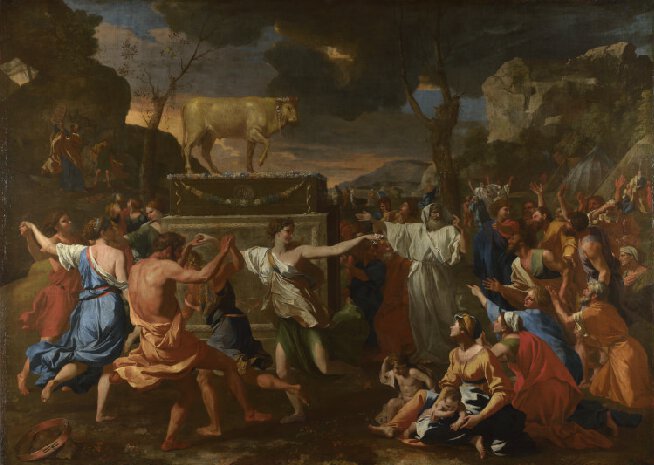
Fantasy gathers up the hard-won gold of reality for smelting and casting into the golden calf of ephemerality, of likeness, of certainty…
~~~
“The contrast here is between the active work of the imagination, which points to a God beyond the sensory world, and the passive force of fantasy, which creates its own god out of sensory desires…”
– from Fantasy, Imagination and the Salesman, Roger Scruton’s “Intelligent Person’s Guide to Modern Culture”
~~~
The Adoration of the Golden Calf 1633-4, Nicolas Poussin
~~~
One wonders: does the left brain seek certainty and see fantasy as that certainty while the right brain is dismissed as flaccid and unreliable?
Psalms 130. De profundis. OUT of the deep have I called unto thee, O LORD; Lord, hear my voice. O let thine ears consider well the voice of my complaint. If thou, LORD, wilt be extreme to mark what is done amiss, O Lord, who may abide it? For there is mercy with thee; therefore shalt thou be feared. I look for the LORD; my soul doth wait for him; in his word is my trust. My soul fleeth unto the Lord before the morning watch; I say, before the morning watch. O Israel, trust in the LORD; for with the LORD there is mercy, and with him is plenteous redemption. And he shall redeem Israel from all his sins.
Patria o muerte! [Homeland or death] Che Guevara, December 11, 1964, 19th General Assembly of the United Nations in New York.
“Executions?” Guevara told the UN General Assembly in 1964. “We execute! And we will continue executing as long as it is necessary.”
“Guevara was a man whose interest in justice is best summed up in his own words, as quoted by Fontova: “To send men to the firing squad, judicial proof is unnecessary. These procedures are an archaic bourgeois detail. This is a revolution. And a revolutionary must become a cold killing machine motivated by pure hate.” –The bitter truth about Che Guevara
Che Guevara: “Judicial evidence is an archaic bourgeois detail. We execute from revolutionary conviction.”
Fidel Castro: “Legal proof is impossible to obtain against war criminals so we sentence them based on moral conviction.”
Castro's legacy after 57 years. You can see that a civilization was there once, as in Machu Picchu or Angkor Wat. Marxism laid waste to it. pic.twitter.com/QBYeqpHGbU
“The terrible damage that Castro has done will long outlive him and his regime. Untold billions of capital will be needed to restore Havana; legal problems about ownership and rights of residence will be costly, bitter, and interminable; and the need to balance commercial, social, and aesthetic considerations in the reconstruction of Cuba will require the highest regulatory wisdom. In the meantime, Havana stands as a dreadful warning to the world—if one were any longer needed—against the dangers of monomaniacs who believe themselves to be in possession of a theory that explains everything, including the future.”
“So don’t worry away with your ‘What’ll we eat?’ and “What’ll we drink?’ and ‘What’ll we wear?’ Those are all the things the Gentiles fuss about, and your heavenly father knows you need them all. Instead, make your top priority God’s kingdom and his way of life, and all these things will be given to you as well. So don’t worry about tomorrow…” – Jesus as recorded in Matthew’s gospel 6: 31-34
“Yes, the gospels affirm Jesus’s divine identity. Yes, they affirm his death on the cross as the climax of God’s age-old plan of salvation. But the purpose of God coming incognito in and as Jesus and the purpose of this Jesus dying on the cross was – so the gospels are telling us – in order to establish God’s kingdom, his justice, on earth as in heaven.” – from N.T. Wright’s “How God Became King”
righteousness and justice are the foundation of his throne.
Fire goes before him,
and consumes his adversaries on every side.
His lightnings light up the world;
the earth sees and trembles.
The mountains melt like wax before the Lord,
before the Lord of all the earth.
The heavens proclaim his righteousness;
and all the peoples behold his glory.
All worshippers of images are put to shame,
those who make their boast in worthless idols;
all gods bow down before him. Zion hears and is glad,
and the towns of Judah rejoice,
because of your judgements, O God.
For you, O Lord, are most high over all the earth;
you are exalted far above all gods.
The Lord loves those who hate evil;
he guards the lives of his faithful;
he rescues them from the hand of the wicked.
Light dawns for the righteous,
and joy for the upright in heart.
Rejoice in the Lord, O you righteous,
and give thanks to his holy name!
~~~~~
The Day The Revolution began…
“The modern world has displaced the Christian narrative; it isn’t just that most of our contemporaries profess not to believe in God or Jesus, but that they have in their heads a world narrative in which world history arrived at its redemptive moment in the eighteenth century with the rise of science and technology and banishing of God to a distant realm, to be visited by the pious few like a kind family calling on an elderly relative every Sunday. The western churches have regularly colluded with this absurd diminishment of the Bible and the gospel. But the cross, told as the climax of all four gospels and particularly John’s on which I have focused this evening, leaves us no choice. ‘Now is the judgement of this world; now is the ruler of the world cast out; and if I am lifted up from the earth I will draw all people to myself.’ This is what it means that the Messiah died for our sins in accordance with the scriptures.”
The early Christian creeds – the Apostle’s Creed and the Nicene creed – donot speak of the most important elements of why Christ came to earth. It’s as if the creeds were written for man’s purposes and not for God’s purposes.
The kingdom life of Jesus, between his birth and crucifixion, is missing from the creeds. And, as recorded in the gospels, Jesus came to inaugurate his kingdom on earth as in heaven and not to impart the four spiritual laws and get off earth as soon as possible.
So, then, this is the gospel:
That now at the name of Jesus
every knee within heaven shall bow-
On earth, too, and under the earth;
And every tongue shall confess
That Jesus, Messiah, is Lord,
To the glory of God, the father.
The Lord is King, Let the Earth Rejoice This Thanksgiving!
On January 17th, 2017, the world will witness a peaceful transition of power in the United States of America. And though our country is deeply divided by partisan conflicts there will be not be a violent overthrow of the government or a military takeover such as a coup d’etat. There will not be a slaughter of the innocents by those who embody the Satan. At least, that has been my experience.
~~~
Just over 2000 years ago there was another peaceful transition of power and one not brought about by a popular vote of Jews, Greeks or Romans. Instead, the “electoral college” of Father, Son and Holy Spirit decided that a king would be born. The Creator Word would become a flesh tabernacle and dwell among his creation for some thirty years to inaugurate his Kingdom – a kingdom where heaven and earth would be forever co-joined.
Like the workings of dominions and powers throughout history, much of politics today is about gaining power and control over others and then maintaining power and control over others.
But how did the King of the Glory display his power and control?
In this day of the ubiquitous media’s hyperbolic promotion of self-promoting individuals and ego polishing and reality TV narcissism and take-it-to-the-streets identity politics there is One who has transitioned from power and glory… to washing the feet of others.
No one, especially the Jews in Jesus’ time expected a foot washer Messiah. They expected a takeover guy who would abolish Roman rule by force. That was what Judas the revolutionary wanted and thought he “had” in Jesus. But instead, Jesus washed Judas’ feet along with the other disciples. That act was certainly not the macho response expected by angry unsettled Jews like Judas.
Jesus, as a witness of all that his father is and does, revealed to the world God’s “definition” of power and of love and of truth. In a peaceful transition of power, the holy and invisible Creator God became visible in Christ by emptying himself of his glory and power. Jesus submitted himself to the father and to his creation by taking on the form of a servant. This transition is not something anyone on earth expected to happen. Consider this:
Remember what God said to Moses: “Do not come any closer,” God said. “Take off your sandals, for the place where you are standing is holy ground.” -Pentateuch, Exodus 3:5
Fast Forward: “Jesus knew that the Father had given everything into his hands, and that he had come from God and was going to God. So, he got up from the supper-table, took off his clothes, and wrapped a towel around himself. Then he poured water into a bowl and began to wash the disciples’ feet and to wipe them with the towel he was wrapped in.” -The Gospel of John 13
~~~
Followers of the Way:
“This is how you should think among yourselves – with the mind that you have because you belong to the Messiah, Jesus:
Who, though in God’s form, did not
Regard his equality with God
As something he ought to exploit.
Instead, he emptied himself,
And received the form of a slave,
Being born in the likeness of humans.
And then, having human appearance,
He humbled himself, and became
Obedient to death,
Yes, even the death of the cross.
And so God has greatly exalted him,
And to him in his favor has given
The name which is over all names:
That now at the name of Jesus
Ever knee within heaven shall bow –
On earth, too, and under heaven;
And every tongue confess
That Jesus, Messiah, is Lord,
To the glory of God, the father.”
Ancient church hymn as recorded in the Apostle Paul’s letter to the Philippian church, chapter 2
The Anglican church I attend will be celebrating one-hundred and fifty years of Kingdom Life in 2018. Preparations are being made by the rectors and vestry to tell the narrative of this faith community. A cloud of witnesses will oversee the events.
Reflecting on the Kingdom of God several years ago I came to the understanding, with the help of the writings of Pauline Scholar N.T. Wright, that the Kingdom of God on earth is here and now. The Kingdom was inaugurated by Jesus when he walked this earth. Why mention this?
As I walk around on Resurrection ground I am reminded that I walk on the same earth as all the saints from all nations who have gone on before me. Their lives and their faith in God’s covenant faithfulness have made it possible for me to have faith in 2016. The organism of their faith now lives in me.
Now, I could consider myself an Enlightened person who needs nothing and no one but reason and self but then I would shrink myself into a private rather than a public form of consciousness – a community of one, isolated and where the sacred is eschewed and nihilism offers nothing. Rather, I chose this continuum of faith and have identified myself with it. This continuum has, in turn, given me an identity, through baptism. I placed myself in the waters of the Kingdom Continuum.
Our faith community’s coming together to participate in ages old ritual is with the knowledge that we are under judgement. We must recite what we know to be true about God and about ourselves.
We come together in the liturgy. The Celebrant starts…
“Blessed be God, Father, Son and Holy Spirit…Almighty God, unto all hearts are open…Hear what the Lord Jesus Christ said: Thou shalt love the Lord thy God with all thy heart, and with all thy soul, and with all thy mind…Thou shalt love thy neighbor as thyself.
Our Kingdom community, in worship of the One True God, recites The Gloria. Together we hear sacred texts read. Together we recite the ancient Nicene Creed. Together we participate in the Prayers of the People. Together we kneel accepting judgement. Together we confess – say the same thing about our sin as God does – and then hear the words of absolution. We rise to extend God’s Kingdom peace through a handshake or an embrace of the other.
The Eucharist – the Feast of Thanksgiving – is a rite commanded by The One who said “Do this…” and “I’m telling you a solemn truth. If you don’t eat the flesh of the son of man, and drink his blood, you have no life in yourselves. Anyone who feasts upon my flesh and drinks my blood has the life of God’s coming age, and I will raise them up on the last day. My flesh is true drink and my blood true drink. Anyone who eats my flesh and drinks my blood remains in me, and I remain in him. Just as the living father sent me, and I live because of the father, so the one who eats me will live because of me. This is the bread which came down from heaven; it isn’t like bread which the ancestors ate, and died. The one who eats this bread will share the life of God’s new age.” The Word became flesh and the Kingdom Continuum becomes sustainable.
We come together knowing that we stand under judgement but also knowing that there is One of us whose sacrificial death pronounces us restored. This inversion, our Lord’s sacrifice into sacrament, is a gift that reminds us that we are redeemed: from fallen to restored. The judgement of many has been answered by the One Death. And like a Greek tragedy, this our tragedy is reenacted over and over in the hearts and souls and minds of the one-hundred and fifty-year-old faith community that is built on Resurrection ground.
The five-day conference, “Alethea Lit Conference – Form without Substance? brought Irene to town. She was to lead the symposium O Still Voice of Calm on day three.
On Sunday evening Irene checked into room 351 and got settled. Pulling back the drapes she could see a terrace and beyond that the wooded campus of Indiana U. The late evening August sun etched the campuses’ limestone buildings with long sepia shadows; the heat of the day was receding.
After unpacking Irene went down for dinner. She returned an hour later anxious to kick off her shoes and put her feet up. Before retiring Irene was in the habit of reading. She chose Paul’s letter to the Romans for this week. But soon the day’s travel caught up to Irene and she fell asleep in the armchair. She awoke later with a terrible kink in her neck. She moved to the bed for the rest of the night.
Irene woke at the sound of her alarm clock, at 5:30. She showered, dried her hair and put on a jersey tank, an A-line skirt and a pair of flats. She was to meet her publisher Mark for breakfast. She gathered her loose belongings into her suitcase, left her open Bible on the desk and headed downstairs.
Antonia knocked. When she heard no answer she entered 351 and began her routine. Hotel housekeeping began at 7:30 during the week with the previous day’s laundry to clean. When finished, Antonia would then clean rooms until 2:00.
As was her habit Antonia turned on the TV when she cleaned a room. She switched the station to her favorite talk show. “Today, two couples each recount the loss of their child,” announced the host. Antonia’s turned up the volume and headed into the bathroom to grab the wet towels.
While dusting, Antonia saw the open Bible and moved it to the bed to wipe the desk top. She then changed the bed sheets after replacing the Bible.
“My son was eighteen when his car flipped over and he was killed,” the mother of one of the couples related. The police found nothing to cause the accident. There was no rain, no alcohol, no other car – nothing! It just happened!”
Antonia watched the husband put his arm around his wife as she began to wipe her eyes. Tears welled in Antonia’s eyes.
Antonia adjusted the sheers and then went in to finish the bathroom. Seeing the makeup kit on the sink reminded her of what had happened the other day.
After work last Tuesday Antonia headed to her car. She grabbed her car keys from her purse loaded her soiled uniforms into the back seat and then drove off, leaving her bag sitting on the pavement. When she got home she couldn’t find her glasses and suddenly realized what she had done. She raced back to the parking spot and found that the bag was gone. Now she was frantic. The bag contained her wallet. The wallet held her ID, 40 dollars in cash, her credit cards and her hotel pass card.
Not finding the bag in the parking lot, Antonia went to the front desk to see if her bag had been turned in. It had. With that she breathed a huge sigh of relief, but then made sure everything was still there. It was. Antonia shuddered at the memory. Finished, she grabbed her cart, turned off the room lights and headed to room 353.
Tuesday morning Irene woke with her alarm at 5:30. She washed her face and then slipped on a pale blue dress and a pair of flats. After making a cup of coffee she sat with her Bible. This morning she would meet author Janice Fillmore for breakfast. Seeing it was 6:30 Irene placed her open Bible on the desk, gathered her loose belongings into her suitcase and headed down to breakfast.
Antonia knocked. When she heard no answer she entered 351 and began her routine. She turned on the TV and found she didn’t have to change the channel. After turning up the volume she proceeded to vacuum the floor.
“Today we have Chance Parlance, Senior Pastor of Broadway Church here to talk to us about his new book, “The Power of You. Before we talk about your book, our viewers would like to know…You are asking each of your 200,000 followers to donate $300.00 so that you can purchase a luxury jet?”
“Yes. We want to safely and swiftly share the Good news of the Gospel worldwide…I declared it and God will do it!”
Antonia moved the Bible from the desk to the bed and began to dust. As she gathered the garbage she noticed a brochure in the desk trash bin. She lifted it out and read the title out loud. “Alethea Lit Conference – Form without Substance? Monday – Birthing The New Creation in Christian Lit.”
Looking at the time, Antonia put the leaflet into her apron and finished her cleaning. She had been given several more rooms to clean today. She turned out the lights and headed to the next room.
Wednesday morning Irene awoke before her alarm. She showered, dried her hair and carefully applied her makeup. This morning she would lead a symposium before three hundred people. She put on a gray suit while coffee streamed into a cup.
Irene sat down with the coffee, her Bible and her notes. She had chosen her topic, O Still Voice of Calm, after spending several years practicing listening prayer. It had become her habit to sit in silence and to let God speak to her. She expected God to speak to her; God was constantly streaming His words to her. And Irene had come to realize that her creativity, her art, was born out of such times. Today she would introduce authors and publishers to listening prayer. At 6:30 she gathered her things and headed down to breakfast.
Antonia knocked. When she heard no answer she entered 351 and began her routine. She turned on the TV and found she didn’t have to change the channel. The volume was the same so she turned it down. But she didn’t feel much like listening today. Monday’s program had left her unsettled, like she had lost something she couldn’t afford to lose. She even discussed the show with her best friend Lily, a biology major at IU, the day before.
Lily’s dogmatic reply came out of nowhere: “Now, how could any god permit the death of any child? You saw the pain those families had to deal with! And there is so much injustice in the world. My god, it’s like the gods are off somewhere uninvolved and angry and just waiting to jump all over us with patriarchal oppression. The god nonsense is a placebo for the weak. These things happen, you know. Just live, laugh and party on if you can before you leave. Make the most of your time. And who knows, maybe when you die you will be reincarnated as a god and you can do some good in the world. And don’t forget about me, your best friend.”
That conversation had left Antonia more unsettled.
Antonia moved the open Bible from the desk to the bed and began to dust. As she gathered the garbage from the bins she noticed another brochure in the desk trash bin. She read the title out loud. “Alethea Lit Conference – Form without Substance? Tuesday– Uncommon Grace: The Life of Flannery O’Connor, a documentary film and discussion
Looking at the time, Antonia put the leaflet into her apron and finished her cleaning. She then turned out the lights and headed to the next room. Her work for this week ended at 2:00. She would start work again on Sunday morning.
Bonita knocked. When she heard no one answer she entered 351 and called out “Housekeeping!” No answer. She began her routine. Bonita would clean the hotel rooms until 2:00. Then, her kids would need to be picked up from her mother’s house. Little Alphonso and his older sister Lupe would be anxiously awaiting mom.
Bonita had worked for six years as a hotel housekeeper. The housekeeping hours allowed her to work while her kids were in school and then be home for them in the afternoon. During the spring and summer months Bonita’s husband, Alonzo, a landscaper, was gone from six in the morning until eight at night. During those times Bonita would bring her two kids to her mother’s house.
While dusting, Bonita saw the open Bible. She carefully lifted the Bible and read out loud, “In the same way, too, the spirit comes alongside and helps us in our weakness. We don’t know what to pray for as we ought to; but that same spirit pleads on our behalf, with groaning too deep for words.”
Bonita set the Bible down on the bed. She wiped the desk top. She then changed the bed sheets after replacing the Bible. She turned her attention to the bathroom.
On the bathroom ledge was a makeup kit. Bonita cringed. It was twelve years ago, in Sonora Mexico, that Bonita lost her first child Esperanza. The child died from pneumonia six months after her baptism. For the funeral the mortuary had applied rouge to the Esperanza’ cheeks. Bonita’s eyes welled with tears as she cleaned the sink.
After Esperanza’s death, Bonita grieved for many months. After coming to live in Indiana she decided to remember Esperanza in a painting. Bonita had become a watercolorist after leaving Mexico. She had seen many art fairs in her new home town. It was the water color portraits that had so moved her.
Bonita painted Esperanza in a white Easter dress, purchased in Mexico. Bonita applied a faint Cadmium red to Esperanza’s cheeks.
Bonita dried her eyes with a towel, gathered the towels, tossed them into her cart and sighed.
Being at home with two kids every day, Bonita appreciated the room’s silence. It felt like she was in the presence of something much more than herself.
Bonita turned out the lights and headed to the next room.
Friday morning Irene awoke before her alarm. She showered, dried her hair and carefully applied her makeup. She would participate in a final symposium this morning and then head out. While coffee streamed into a cup Irene put on a jersey tank, an A-line skirt and a pair of flats. She gathered her belongings into her suitcase. When she reached for her Bible she noticed what looked to be a watermark on one of the pages. She closed the Bible, placed it into her suitcase, took one last look around, shut off the lights and went down to breakfast.
This past week I encountered atheists on Twitter. I noticed one atheist’s snarky scorn of Christians and I responded.
As you’ll see, I engaged him and one other for just a few rounds (please forgive my typos and some bad grammar, I was busy making a living at the same time). The atheists immediately stop tweeting after dismissing me out of hand: “One more logical fallacy and we’re done.” Their arguments must have fallen off the edge of the earth, the black hole of unbelief having sucked them away.
The exchange reminded me of a post I put together when Christopher Hitchens’s passed. (This is a long but hopefully informative post. So, grab some coffee and hold the scotch.)
The Bible was written by people who thought they'd fall over the horizon, so why believe they'd know about the creation of the universe?!
As you will see and hear in the video below, Christopher Hitchens’ (Hitch’s) arguments for atheism (exclusively an argument against theism), after many dead-end asides, were centered on his aversion to having anyone telling anyone what to do. His followers readily know that over the years Hitch has repeatedly taken umbrage on paper or in one-upmanship debates against totalitarianism and against any authoritarian person or religion having a say in his life or in the lives of others. For the record, William Lane Craig (marker 13:59) noted that Hitch despised and hated religion.
Hitch was certainly OK, though, with authoritarian imposition upon others if he felt the cause justified removing other authoritarian figures from the lives of those he thought were oppressed. He, to the horror of the liberal elitists, aligned himself philosophically with G.W. Bush regarding the Iraq war and the war on terror against radical Islamists.
The February 2012 issue of Vanity Fair includes Salman Rushdie’s “In Memoriam”, Christopher Hitchens: 1949-2011.” Rushdie wrote about Hitch’s return to the left:
“Paradoxically, it was God who saved Christopher Hitchens from the right. Nobody who detested God as viscerally, intelligently, originally, and comically as C. Hitchens could stay in the pocket of god-bothered American conservatism for long. When he bared his fangs and went for God’s jugular, just as he had previously fanged Henry Kissinger, Mother Teresa, and Bill Clinton, the resulting book, God is not great, carried Hitch away from the American right and back toward his natural, liberal, ungodly constituency.”
As a way of life Hitch sought to stand juxtaposed to the universal rule of law (his own conscience) in an antinomian position while at the same time declaring moral diatribes against religious and political authorities he considered too overarching in their imposition. A true Epicurean in his ways, Hitch also liked to keep his conscience well inebriated and his roving moralist eye ever looking elsewhere – looking outside and not within – denial and pretense being typical liberal traits.
With atheistic cowardice and hubris, Hitch attacked Mother Teresa, a little old lady. He apparently wanted to feed his prurient desire to neutralize any authority figure (overt or implied) by trying to bring her down several notches in people’s eyes. Why? He claimed she was pushing her authoritarian teachings onto the helpless. He accused her of hypocrisy in her dealings (an easy, self-serving claim for an atheist to make against any Christian). He may have felt threatened by her devotion to an unseen God and her ability to make things happen for others and doing so as a little old lady.
Why would a grown man verbally attack a helpless woman who indeed went about helping others who themselves were under the totalitarianism of poverty and squalor? Maybe Hitch thought she wasn’t helpless. Maybe it was a direct attack against God. It certainly was an act of unmatched intelligential cowardice. To be sure Mother Teresa fought the unseen authorities of this world (the “powers of darkness”) by physically helping the outcast, the hungry and the hurting with an agape-powered love and not verbal hubris.
Hitch, on the other hand, fought the very public “seen” authorities of this world by aligning rhetorically with causes which he felt were important for him. He should have noted that he and Mother Teresa were fighting the same issue – human suffering at the hands of others (whether a dictator or a false religion) -from two different sides. Yet, he chose to denigrate Mother Teresa. I believe he did this because he felt threatened by her belief in the unseen God.
Hitch postures that Christians, especially Christian missionaries like Mother Teresa, are hypocrites who say things they know to be true and good but live disconnected lives apart from such truth – their deeds not matching match their words. This argument (?) against God was replayed in his use the La Rochefoucauld quote “hypocrisy is a tribute vice pays to virtue.” Yet, this hypocrisy argument folds in on itself if one were to hold any moral standard at all. Perhaps Hitch, a polymath, saw moral laws as “many a quaint and curious volume of forgotten lore.” (The Raven, Edgar Allen Poe)
Clearly Hitch’s excessive lifestyle (his immoderate drinking, smoking, etc. have been noted elsewhere) made his salacious attacks against God all the more the more forthcoming and lubricious. His lifestyle had also proved his belief in nihilism – life is nothing if not suffering. So he apparently used a “get it while you can” justification to medicate the blows between verbal jousting contests.
His liquid lifestyle also spoke to the fact of Hitch’s drive for “freedom” from any limitation imposed on his person including by his own person – his physiology. He chose against himself again and again. He did this while throwing the world a bone now and then, choosing willy-nilly causes to deflect away any personal soul-searching which might lead to accountability to any higher authority. (see marker 25: 5, If god does not exist then objective moral standards don’t exist – a self-satisfying argument.)
Hitch detested dictatorships of all kinds and he did so while as a potentate of his own world. He would not bend the knee to anyone or to anything. He would fight, as Salmon Rushdie recalled in the same Vanity Fair article remembering his friend, for anyone who was made to do so. Hitch’s rebellion was against dictatorial authority of any kind and not just in the political and religious realm. And he certainly rebelled against authority stated as codified truth – the Bible and the recorded history of the resurrection of Jesus. His moral relativism, stated above, is characteristic of most atheists (and the “ungodly constituency”) since they affirm that no moral standard exists outside one’s self.
In the video Hitch asks the universal question posed to theism: why would a God who was all powerful and good allow suffering? My answer: suffering comes out of created man’s free-will choices in a fallen world. God has allowed it for a time but not forever. Justice will be meted out and suffering will end.
He continues his disbelief: “Why would God spend eons of time in creating a world that he could set up in a blink of an eye?” He went on to say that Christians are now co-opting evolution theory in accordance with the Creation argument, evolution being a position long held by atheists. He “christens” this “tactic” or “style” of argument as “retrospective evidentialism” or as a “second thought.” (marker 37:40)
As a Christian theist I see no conflict whatsoever with science and creation. I believe in theistic evolution-a finely tuned theistic universe, a personal cause of the universe and a theistic objective morality. As scientific evidence becomes available it should be used and not discarded. Beyond scientific proofs, my own belief in God is vindicated every day because I, a rational human being, know that God exists. I continue to pursue Him actively and I submit to His authority. Hitch, on the other hand, fled from any such authority outside of himself and employed his own existentialist belief system where he felt safe from intrusion.
Also in the video, Hitch uses the Creationist argument of a literal seven days to say that we as Christians are basically lunatics to believe such things. Again, I see no conflict with a Creationist’s position of a literal seven days and the theory of relativity which could make thousands of millennia appear as seven literal days. But as I mentioned above, I accept theistic evolution, so the point is mute in my case.
Hitch takes another jab at Christian theism by invoking his own god-like view point when questioning why God would do what Christian theists believe He did. He balks at the idea (and I’ll paraphrase): “…the eons of time that God has created-evolved – that all of this fine tuning, mass extinction and randomness is the will of a Creator God (marker 40:21) and that all of this happened so that one very imperfect race of evolved primates might become Christian – all of this was “with us in view” is a curious kind of solipsism, a curious kind of self-centeredness.”
Hitch jests that he thought Christians were modest and humble, not self-centered with certain arrogance to the assumption that this “was all about us.” And, “The tremendous wastefulness of it, the tremendous cruelty of it, the tremendous caprice of it, the tremendous tinkering and incompetence of it, never mind, at least we’re here and we can be people of faith.” This projection from one who, with his own free will, spoke from a self-centered and solipsistic core throughout his entire life!
The Gospel of Jesus Christ, the Creator, was always meant to bypass the wise of this earth: “For the wisdom of this world is foolishness to God. As the Scriptures say, “He traps the wise in the snare of their own cleverness.”” (Apostle Paul’s letter to the Corinthian church). A priori rebellion coded as cleverness is found in the Mitochondrial DNA of man.
Apart from Hitch’s free-wheeling self-directed solipsism, there is a bounty of sound arguments for theism and William Lane Craig (WLC) highlights them artfully: “No good argument that atheism is true, there are good arguments that theism is true – not via social questions or ethics (marker 16:00).
WLC philosophical arguments in quick notation:
Cosmological argument: things exist, not nothing; the universe began to exist not infinite, not eternal – Big Bang Beginning, ex-nihilo, a cause by an UnCause beyond space and time; David Hillburg – The infinite; there must be a cause of creation. This Being must be uncaused, timeless, space unfathomable & personal and not abstract thought or object; The universe has begun to exist and is not infinite, not eternal (astrophysics concur); Past event are real, there must be Personal creator of the universe, transcendent intelligent mind
Teological argument: (marker 20:00) finely tuned universe – mathematically constants (e.g., gravity) not determined by the laws of nature & the arbitrary conditions (entropy, balance between matter and antimatter); any change in these would be the end of life itself (the atomic weak force being altered)
Chance? Odds are incomprehensibly great, life prohibiting universes are more probable
It follows logically by Design – intelligent argument, intelligent designer
Moral argument (marker 25: 15): if god does not exist then objective moral standards don’t exist; if God exists then valid and binding; the morality that has emerged proves that god exists – via moral experience; we understand that there are things that are really wrong.
Historical fact (marker 27:40): The resurrection of Jesus a historical fact not just a belief; tomb discovered empty eyewitnesses; individuals and groups saw Jesus, appearances to believers and unbelievers; the original disciples believed in the resurrection and Jewish religion believed otherwise about when resurrection occurs; Christian die for the truth of the resurrection (marker 30:26)
Experiential knowledge: The experience of God or claim to know that God exists – properly basic beliefs part of a system of beliefs including the belief of an external world; context of physical objects; grounded in our experience of God; God immediate reality
Hitch responds (marker 33:16): “arguments the same across religions – belief in God but differences; presuppositionalists (by faith) and the evidentialists a distinction without a difference.”
As you will note Hitch’s arguments are all basically dismissive of Christian supporting arguments for belief and are not evidentiary in favor of atheism; note his “rather sweet” dismissal of those who believe – that those of faith should have evidence. (Hitch once again conveniently dismisses the facts of the resurrection and the improbability of causation by chance.)
Hitch: “We argue that is no plausible or convincing reason, certainly no evidential one to believe that there is such an entity…all observable phenomena is explicable (marker 42:00); I don’t believe that following the appropriate rituals…
“Even if this deity did exist it doesn’t prove that he cared about us…cared who we had sex with …care whether we lived or died… (marker 42:32)
“Miracles suspend the natural order – Christians want it both ways (“promiscuous”) (marker 44:00); The natural order – “It is miraculous without a doubt”
“I have to say that I appear as a skeptic, I doubt these things.” (marker 46:16)
“The theist says it must be true…” Extraordinary claims require extraordinary evidence.”;
“Too early in the study of biology…to make these claims.”
Hitch, the verbal grappler, was as a sound and fury professional wrestler who was agile at avoiding a real match-up with Truth. But now, the fight has ended, the match is over. All that’s left in the empty corner is Hitch’s book “God is Not Great” and an empty bottle of Scotch.
Utopia comes from the Greek: οὐ (“not”) and τόπος (“place”) and means “no-place“, a non-existent place.
…..
And now a few clarion words from Claremont Institute Senior Fellow Angelo M. Codevilla:
“This dismissal of the American people’s intellectual, spiritual, and moral substance is the very heart of what our ruling class is about. Its principal article of faith, its claim to the right to decide for others, is precisely that it knows things and operates by standards beyond others’ comprehension.
While the unenlightened ones believe that man is created in the image and likeness of God and that we are subject to His and to His nature’s laws, the enlightened ones know that we are products of evolution, driven by chance, the environment, and the will to primacy. While the un-enlightened are stuck with the antiquated notion that ordinary human minds can reach objective judgments about good and evil, better and worse through reason, the enlightened ones know that all such judgments are subjective and that ordinary people can no more be trusted with reason than they can with guns.Because ordinary people will pervert reason with ideology, religion, or interest, science is “science” only in the “right” hands. Consensus among the right people is the only standard of truth. Facts and logic matter only insofar as proper authority acknowledges them.
That is why the ruling class is united and adamant about nothing so much as its right to pronounce definitive, “scientific” judgment on whatever it chooses. When the government declares, and its associated press echoes that “scientists say” this or that, ordinary people — or for that matter scientists who “don’t say,” or are not part of the ruling class — lose any right to see the information that went into what “scientists say.” Thus when Virginia’s attorney general subpoenaed the data by which Professor Michael Mann had concluded, while paid by the state of Virginia, that the earth’s temperatures are rising “like a hockey stick” from millennial stability — a conclusion on which billions of dollars’ worth of decisions were made — to investigate the possibility of fraud, the University of Virginia’s faculty senate condemned any inquiry into “scientific endeavor that has satisfied peer review standards” claiming that demands for data “send a chilling message to scientists…and indeed scholars in any discipline.” The Washington Post editorialized that the attorney general’s demands for data amounted to “an assault on reason.” The fact that the “hockey stick” conclusion stands discredited and Mann and associates are on record manipulating peer review, the fact that science-by-secret-data is an oxymoron, the very distinction between truth and error, all matter far less to the ruling class than the distinction between itself and those they rule.
By identifying science and reason with themselves, our rulers delegitimize opposition. Though they cannot prevent Americans from worshiping God, they can make it as socially disabling as smoking — to be done furtively and with a bad social conscience. Though they cannot make Americans wish they were Europeans, they continue to press upon this nation of refugees from the rest of the world the notion that Americans ought to live by “world standards.” Each day, the ruling class produces new “studies” that show that one or another of Americans’ habits is in need of reform, and that those Americans most resistant to reform are pitiably, perhaps criminally, wrong. Thus does it go about disaggregating and dispiriting the ruled.” (emphasis added)
Beyond the excerpt: I commend Codevilla’s entire article to you. In fact, I urge you to click on the link and print out the article. Sit and read it and be forever changed by its content. I pray that the article opens your eyes and that moral courage arises in your heart.
Now, perhaps, you know these culprits, the Unconstrained Visionaries, by their characteristics: snobbish, name-calling bullies; cliquish; desiring kinship w/other like-minded people; seeking power by government association; demanding rule by ‘right’; believing themselves morally and intellectually right; saying “You must obey us because we know better”; blinded to their ‘well-intentioned’ actions leading to horrible unintended consequences; believing they know better than you; applying a “living constitution” template to every legal decision; using science as leverage without any depth of scientific knowledge; posturing “settled science” to quash dissent; believing they “have the one true faith”; deeming that intentions and not results matter most; obtaining snobbery wielding government power;… combining attitude with government power, coercive.
…
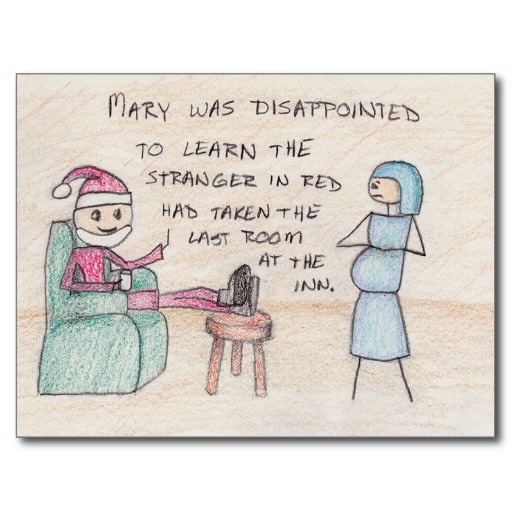
Utopia Has No Room for You (and Swaddled Truth) in the Inn.
Us Christians, we abide in Christ wherever we are. We’ll leave the Light on.
…
Background on the Constrained and Unconstrained Visions, the intuitive assumptions that shape our worldview:
“We have entered, as I see it, a spiritual limbo. Our educational institutions are no longer the bearers of high culture, and public life has been deliberately moronised. But here and there, sheltered from the noise and glare of the media, the old spiritual forces are at work” Roger Scruton
*****
“When a common culture declines, the ethical life can be sustained and renewed only by a work of the imagination.”-Roger Scruton
*****
“Jesus prayed, “This is eternal life, that they may know You . . .” (John 17:3). The real meaning of eternal life is a life that can face anything it has to face without wavering. If we will take this view, life will become one great romance— a glorious opportunity of seeing wonderful things all the time. God is disciplining us to get us into this central place of power.” Oswald Chambers
*****
“No power on earth or in hell can conquer the Spirit of God in a human spirit, it is an inner unconquerableness.” Oswald Chambers
*****
To those who have had no agony Jesus says, “I have nothing for you; stand on your own feet, square your own shoulders. I have come for the man who knows he has a bigger handful than he can cope with, who knows there are forces he cannot touch; I will do everything for him if he will let Me. Only let a man grant he needs it, and I will do it for him.” The Shadow of an Agony,Oswald Chambers
*****
“If we wish to erect new structures, we must have a definite knowledge of the old foundations.” John Calvin Coolidge
*****
Atheism is a post-Christian phenomenon.
*****
If social justice looks like your hand in someone else’s pocket then you are stealing.
*****
“In Sweden, giving to charity, absurdly, came to be considered a lack of solidarity, since it undermined the need for the welfare state.” – Roland Martinsson
*****
“…to love democracy well, it is necessary to love it moderately.” Alexis de Tocqueville
*****
Capitalism seeks to help others through a servce or product it provides. Free Market Capitalism is the most moral and fair economic system available to man. Capitalism augments personal growth, responsibility and ownership. Charity flourishes under capitalism. Charity dies under subjective “fair share” government confiscatory policies. Socialism redistributes ambivalence and greed.
*****
“We are to regard existence as a raid or great adventure; it is to be judged, therefore, not by what calamities it encounters, but by what flag it follows and what high town it assaults. The most dangerous thing in the world is to be alive; one is always in danger of one’s life. But anyone who shrinks from that is a traitor to the great scheme and experiment of being.” G.K. Chesterton
*****
Any intelligent fool can make things bigger, more complex, and more violent.
It takes a touch of genius – and a lot of courage – to move in the opposite direction. Albert Einstein
*****
“You shall know the truth and the truth shall make you odd.” Flannery O’Connor
*****
“There is but one good; that is God. Everything else is good when it looks to Him and bad when it turns from Him.” C.S. Lewis, The Great Divorce
*****
“Though He slay me, yet will I trust Him” (Job 13:15).
*****
God’s grace is not about the allowance for sin. God’s grace is about the conversation God allows regarding sin.
*****
From the book of Proverbs: We are not to favor the rich or the poor. We are to pursue justice.
*****
“Always keep in contact with those books and those people that enlarge your horizon and make it possible for you to stretch yourself mentally.” Oswald Chambers
*****
One goldfish says to another, “If there is no God who keeps changing the water?”
*****
“The truth is always there in the morning.”
From Cat On A Hot Tin Roof script – playwright Tennessee Williams
*****
God blesses those who hunger and thirst for justice, for they will be satisfied.
*****
“America’s greatness has been the greatness of a free people who shared certain moral commitments. Freedom without moral commitment is aimless and promptly self-destructive.” John W. Gardner
**
“Men of integrity, by their very existence, rekindle the belief that as a people we can live above the level of moral squalor. We need that belief; a cynical community is a corrupt community.” John W. Gardner
*****
“In the world it is called Tolerance, but in hell it is called Despair, the sin that believes in nothing, cares for nothing, seeks to know nothing, interferes with nothing, enjoys nothing, hates nothing, finds purpose in nothing, lives for nothing, and remains alive because there is nothing for which it will die.” Dorothy L. Sayers
*****
“Art, like morality, consists of drawing the line somewhere.”
G. K. Chesterton
*****
“The battle line between good and evil runs through the heart of every man.” Alexander Solzhenitsyn
*****
This is what the LORD says:
“Stand at the crossroads and look;
ask for the ancient paths,
ask where the good way is, and walk in it,
and you will find rest for your souls.
But you said, ‘We will not walk in it.’
-The prophet Jeremiah, 6:16
*****
“…our common task is not so much discovering a truth hiding among contrary viewpoints as it is coming to possess a selfhood that no longer evades and eludes the truth with which it is importunately confronted.” James McClendon, Ethics: Systematic Theology, Vol. 1
*****






 Cindy Wity