“The Mechanical Hound slept but did not sleep, lived but did not live in its gently humming, gently vibrating, softly illuminated kennel back in a dark corner of the firehouse.”
-Guy Montag, Fahrenheit 451
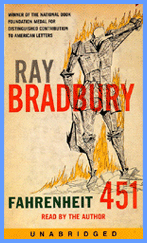
Anyone who has read Ray Bradbury’s Fahrenheit 451 will remember the menacing Mechanical Hound.
In fireman Guy Montag’s world, firemen burn outlawed books and where people hid them. The firehouse ‘dog’, a robotic beast, is an enforcer for the state. If you do not follow society’s rules, the Hound is unleashed. It tracks down and kills book readers using stored information about individuals. The Hound catches its prey and then injects it with lethal drugs.
Though configured as man’s best friend, Montag finds out the true nature of the beast. Being “fascinated as always with the dead beast, the living beast,” he touches the muzzle of the Hound. The Hound growls and Montag recoils.
“The Hound half rose in its kennel and looked at him with green-blue neon light flickering in its suddenly activated eye bulbs. It growled again, a strange rasping combination of electric sizzle, a frying sound, a scraping of metal, a turning of cogs that seemed rusty and ancient with suspicion.”
Not long afterward, Montag tells Captain Beatty “It doesn’t like me.” Captain Beatty tells Montag:
“Come off it. It doesn’t like or dislike. It just `functions.’ It’s like a lesson in ballistics. It has a trajectory we decide for it. It follows through. It targets itself, homes itself, and cuts off. It’s only copper wire, storage batteries, and electricity.”
The Mechanical Hound attacks what it is programmed to attack. And when Montag becomes more and more inquisitive about books and one is found in his possession, the Hound is released to track him down.
~~~
The techno-capitalist-industrialist-open borders system that goes by “Progress” or “Development” or “the Science” or “Fair-Trade” or “Commercialization” or “Globalization” or “Open Society,” is summed into a single descriptor – “the Machine” – by Paul Kingsnorth in his book Against the Machine (See side bar, previous post, and podcasts below for more information.)
In the chapter Come the Black Ships, Kingsnorth describes the process of Machine as being
“a war against all ‘closed’ things; against limits and boundaries of any kind, cultural and ecological; against historical traditions, local economies, trade unions, national economic plans, nations themselves, tribal cultures, religions . . . anything that interferes with the path of commercial expansion and its associated culture of individualist liberalism. Open is good, closed is bad. Why? Because closed things can’t be harvested, exploited or transformed in the image of the new world which the Machine is building. ‘Open’ things, on the other hand; well, they’re easy prey.”
That is our reality today. The West has colonialized itself with what it has colonized other nations – the Machine’s promise of the “open is good” gravy train. The WEF’s mission statement cloaks the Machine in good: “We bring together government, businesses and civil society to improve the state of the world” by “seiz[ing] opportunities for positive change.”
And so it is that the Machine’s process is advertised as that which benefits humanity in various ways. These include “Enhanced Customer Experience”, “Innovation”, “Diversity”, and “Advancements in Medicine, Education, Efficiency, Productivity, and “Sustainability” all while waging “a war against all ‘closed’ things” for the sake of its commercialization, monetization, and control of the process.
For the Machine to wage “war against all ‘closed’ things”, technology is employed to sniff out and snuff out the ‘closed’ – those people and their places unwilling to “be harvested, exploited or transformed in the image of the new world.” This machine I see depicted as Bradbury’s Mechanical Hound.
The Mechanical Hound represents the perversion of technology. Man’s best friend, a creature meant for companionship, aid, and protection, is turned into a technological tool of oppression. Its purpose is to impose order with terror.
With the Mechanical Hound in mind, consider digital technology which can be seen as friendly and helpful but can been programmed to avenge and punish citizens who break society’s rules. See China’s social credit system.
With the Mechanical Hound in mind, see the UK introducing digital ID cards. The UK government claims the system will simplify access to public services such as healthcare, welfare, and childcare, reduce identity fraud, ensure that only those with the right to work can be hired and is expected to minimize identity fraud by linking personal information to a secure digital format. With all these great “benefits” (for the state), what could go wrong? Say, if someone online says something that is considered “hate speech” by the UK government will the Hound be released to track that person down? That is happening today in the UK.
See a cashless society and Central Bank digital currency (CBDC) where purchases are monitored and financial accounts controlled by the government.
See the smartphone that “slept but did not sleep, lived but did not live in its gently humming, gently vibrating, softly illuminated kennel back in a dark corner of” your pocket.
Consider the digital contraptions in your home and car that, like the Hound, can track you with information gathered from 5G towers that is downloaded to data centers that consume massive amounts of energy and water and taxpayer money – to monitor your physical and societal whereabouts so it can sell you more of the Machine’s process.
In Montag’s repressed society, books, book holders, and critical thinkers are dealt with. For books hold the experience and wisdom of ‘closed’ things – history, tradition, culture and religion – and must be done away with. And, so must thinking critically. For researching and comprehending what the Machine is doing to humans and their world is a threat. (https://www.thefire.org/news/10-worst-censors-2024)
With this in mind, consider the calls for censorship on our college campuses. In Britain you can go to jail for saying the ‘wrong’ thing.
In Montag’s repressed society, wall screens and pills replace books. The wall screens produce for Montag’s wife, Mildred, her ‘family’. Their home has three wall screens. She wants a fourth wall screen. We learn how depressing life is for Mildred when she attempts to commit suicide with an overdose.
How did we get amenable to the Machine’s control over us and thus take on a mechanized way of seeing and relating to the world? Bradbury provides insight.
Fahrenheit 451 is about more than censorship. It is about conformity to state-imposed uniformity. Books in 451 were seen as creating discord. They had to go. For, with the advent of visual media, TV in particular, people no longer read and didn’t want to hear anything but what they heard on the screens. People wanted censorship and conformity to the screens.
As Captain Beatty tells Montag,
“’The fact is we didn’t get along well until photography came into its own. Then–motion pictures in the early twentieth century. Radio. Television. Things began to have mass.’
“Montag sat in bed, not moving.
“’And because they had mass, they became simpler,” said Beatty. “Once, books appealed to a few people, here, there, everywhere. They could afford to be different. The world was roomy. But then the world got full of eyes and elbows and mouths. Double, triple, quadruple population. Films and radios, magazines, books levelled down to a sort of paste pudding norm, do you follow me?’”
“’I think so.’”
“Beatty peered at the smoke pattern he had put out on the air. ‘Picture it. Nineteenth-century man with his horses, dogs, carts, slow motion. Then, in the twentieth century, speed up your camera. Books cut shorter. Condensations, Digests. Tabloids. Everything boils down to the gag, the snap ending.”
“’Snap ending.’ Mildred nodded.”
Captain Beatty, again:
“You must understand that our civilization is so vast that we can’t have our minorities upset and stirred. Ask yourself, What do we want in this country, above all? People want to be happy, isn’t that right? Haven’t you heard it all your life? I want to be happy, people say. Well, aren’t they? Don’t we keep them moving, don’t we give them fun? That’s all we live for, isn’t it? For pleasure, for titillation? And you must admit our culture provides plenty of these.”
“Yes.”
Beatty’s Full Speech to Montag is provided below.
~~~~~
This our reality: the Machine and the Mechanical Hound.
Paul Kingsnorth’s Against the Machine– On the Unmaking of Humanity has provided us a prophetic understanding of where we are and where we are headed. The Machine is moving us downstream, displacing us from what we value – in Kingsnorth’s words “the past, people, place, and prayer.”
Various entities participate and promote the Machine.
Mainstream media is run by the Machine. ABC, CBS, NBC, CNN, MSNBC, CNBC, WSJ, NYT, WaPo and other outlets are the Machine’s mouthpieces. They talk down the “closed” and proclaim the “open.”
Both political parties promote the Machine. It is “progress” (and control) after all. The biggest threat to democracy is the Machine that consumes culture and churns out cogs.
Now that Mamdani has won the NYC mayor’s race, you can be sure that the Mechanical Hound will be released in NYC to enforce socialist jihad. Neither socialism nor Jihad exists without a Mechanical Hound.
Central planners – The World Economic Forum (WEF), the World Health Organization (WHO), and the World Trade Organization – represent the Machine’s values.
It takes no stretch of the imagination to see ourselves in Montag’s society or to see technology as that which mimics the good but is easily programmed to avenge and punish citizens who break society’s rules. The Mechanical Hound can tract us down to dispose of the ‘closed’ and conform us to the “Open is good” of the Machine.
Bradbury said that with Fahrenheit 451 he wasn’t trying to predict the future but to prevent it. He wanted to protect the present.
The terror of the Hound of Hell is becoming a permanent feature of the “open” (closing up) brave new (upside down) world.
Against the Machine: On the Unmaking of Humanity | Paul Kingsnorth
Demetri Kofinas speaks with Paul Kingsnorth, a novelist, essayist, and former environmental activist who first came on many people’s radars during the Covid-19 pandemic with the publication of his viral three-part series “The Vaccine Moment.” His current work explores the intersection of technology, culture, and the divine. In his latest book, Against the Machine, Kingsnorth examines how our increasingly mechanized way of seeing and relating to the world—and to ourselves—has contributed to the death of Western culture, and what it would take to reclaim our humanity and save our souls.
Against the Machine: On the Unmaking of Humanity | Paul Kingsnorth
How We Lost Ourselves to Technology—and How We Can Come Back
Do you feel uneasy? Do you feel a level of ambient anxiety? Do you feel despair, despite the fact that we live in the most luxurious time and place in human history?
The point is, you are not crazy. If you feel these things, you are simply attuned to reality—and it’s not a problem that’s solvable with less screen time or with meditation, red light, or sea moss.
Bari Weiss’ brilliant guest, Paul Kingsnorth, argues that the reason you feel this way is not this or that social media app or algorithm or culture war issue. That these are all superficial expressions of a thousand-year battle with what he calls “the Machine.” What exactly that means, he’ll explain tonight.
How the KGB’s Playbook Is Destroying the West Today
Yuri Aleksandrovich Bezmenov (1939–1993), also known as Tomas David Schuman, was a Soviet journalist and KGB operative specializing in propaganda and ideological subversion.
Ideological subversion is the process of bending a society’s perception of reality so completely that it destroys itself.
The goal is to demoralize a society by undermining its moral, educational, and cultural foundations, making people unable to recognize or defend against threats.
Demoralization takes 15-20 years, the time needed to educate one generation with subversive ideas.
Five years ago, Peter Thiel, the billionaire venture capitalist behind PayPal and Palantir, sent a prescient email to Facebook executives.
“When 70% of millennials say they are pro-socialist,” he wrote, “we need to do better than simply dismiss them by saying that they are stupid or entitled or brainwashed; we should try and understand why.”
The email went viral after democratic socialist Zohran Mamdani’s victory last week in the New York City mayoral race. Thiel then sat down with The Free Press’s Sean Fischer to explain what he saw in 2020 that no one else did.
Capitalism isn’t working for young people, Thiel said, citing burdensome student debt and regulations putting homeownership out of reach for many. “People assume everything still works, but objectively, it doesn’t. . . . If you proletarianize the young people, you shouldn’t be surprised if they eventually become communist.” (Emphasis mine.)
Thiel, who I see as also promoting the Machine, at least sees what the Machine is doing to the young.
And, of course, socialism/communism is a horrifying Machine that revels in terror to replace humanity with ideology.
~~~~~
The Machine’s AI Alchemy
Mary Shelly’s Victor Frankenstein, obsessed with creating a human being, used alchemy and electricity and body parts to create a creature (without woman). . .
A group of Stanford University scientists . . . used artificial intelligence to design new viruses capable of killing bacteria.
In a world where AI keeps creeping in on uniquely human territory by composing sonnets, writing songs or forging friendships, this seemed to be crossing a new Rubicon. Depending on your belief system, AI was doing what evolution, or God, or scientists working with genome-engineering tools aim to do.
“Machines are rethinking what it is to be human, what it is to be alive,” said Michael Hecht, a chemistry professor at Princeton University focused on designing novel proteins and artificial genomes. “I find this very unsettling and staggering. They are devising, coming up with novel life forms. Darwin 2.0.”
“Dover Beach”, Matthew Arnold’s lyric poem, describes the shore at the narrowest part of the English Channel. Dover, on the southeast coast of England in the county of Kent, is famous for its white cliffs and its popular ferry port. The ferry crosses the Strait of Dover to Calais, France. Dover Beach is where Arnold honeymooned. His poem reveals that he also thought about life in the mid 1800’s.
“Dover Beach”, with imagery of the restless sea and allusions to Ancient Greek Figures, is a metaphor for the ebbing of Christian faith and the surge of the industrial age sensed by Arnold. Mankind is moving away from the community and the collective experience which fosters faith and finds itself left behind “as on a darkling plain” without solace. The poem was written around 1850.
Further Context: T.S. Eliot’s The Waste Land, also filled with allusions to the collective past, was published in 1922. Eliot is considered the first true modernist in English literature. Eliot’s spiritual quest ended when he embraced the Anglican Church.
(On the right-hand side bar is the sound file where you can listen to Thomas Hampson, world-renowned baritone, sing Dover Beach.)
Dover Beach
The sea is calm to-night.
The tide is full, the moon lies fair
Upon the straits; – on the French coast the light
Gleams and is gone; the cliffs of England stand,
Glimmering and vast, out in the tranquil bay.
Come to the window, sweet is the night-air!
Only, from the long line of spray
Where the sea meets the moon-blanch’d land,
Listen! you hear the grating roar
Of pebbles which the waves draw back,and fling,
At their return, up the high strand,
Begin, and cease, and then again begin,
With tremulous cadence slow, and bring
The eternal note of sadness in.
Sophocles long ago
Heard it on the Aegean, and it brought
Into his mind the turbid ebb and flow
Of human misery; we
Find also in the sound a thought,
Hearing it by this distant northern sea.
The Sea of Faith
Was once, too, at the full, and round earth’s shore
Lay like the folds of a bright girdle furl’d
But now I only hear
Its melancholy, long, withdrawing roar,
Retreating, to the breath
Of the night-wind, down the vast edges drear
And naked shingles of the world.
Ah, love, let us be true
To one another! for the world, which seems
To lie before us like a land of dreams,
So various, so beautiful, so new,
Hath really neither joy, nor love, nor light,
Nor certitude, nor peace, nor help for pain;
And we are here as on a darkling plain
Swept with confused alarms of struggle and flight,
Where ignorant armies clash by night.
~~~
A world of “neither joy, nor love, nor light” …
The character Montag, in the novel Fahrenheit 451, reads the last two stanzas of Arnold’s poem to Mildred, his wife, and her female friends. He attempts to expose their shallow nature. Mildred cautions him not to do so:
Mildred: “Montag, hold on, don’t …”
Montag: “Did you hear them, did you hear these monsters talking about monsters? Oh God, the way they jabber about people and their own children and themselves and the way they talk about their husbands and the way they talk about war, dammit, I stand here and I can’t believe it!”
After much resistance, Montag goes on to read the last two stanzas, finishing with
And we are here as on a darkling plain
Swept with confused alarms of struggle and flight,
Where ignorant armies clash by night.
Mrs. Phelps was crying.
~~~
To those who have ears to hear…
Fahrenheit 451 (1966), at 58 minutes, Montag quotes another book’s passage out loud to the unwilling (and yes, the acting is atrocious):
As a high school student in the 1960s I was required to read several of Ray Bradbury’s works. Included were his novels Fahrenheit 451 andSomething Wicked This Way Comes and a short story The Wonderful Ice Cream Suit.
Bradbury’s writings were my introduction to the world of science fiction and fantasy. Written at the right psychic temperature, his writings set the kindling of my imagination aflame, burning holes in my scripted life prior to graduation.
It was during this time in high school that my off and on desire to write became an imperative. And with it came the urgency to feed those necessary flames with countless books. Logocentric, I was enthralled with the written and spoken word and their power to create, inform and inspire. Since those days I continue to fan those flames as I am ever fireside.
In honor of Ray Bradbury, below are plentiful excerpts from a June 8th, 2012 article by Bruce Walker of the American Thinker website titled “The Conservative Legacy of Ray Bradbury.”
Ray Bradbury is dead. His literary career spanned an incredible 73 years, and his influence was felt across the broad spectrum of American thought. Bradbury was very conscious of the fact that he grew up in almost a pre-technological society; “[w]hen I was born in 1920,” he told The New York Times Magazine in 2000, “the auto was only 20 years old. Radio didn’t exist. TV didn’t exist. I was born at just the right time to write about all of these things.
Although he eschewed squabbling over the political issues of the day, Bradbury embraced the idea that there are grand and common themes to the human condition — and nowhere more piercingly than in his Fahrenheit 451.
Fahrenheit 451 focuses on a single, salient aspect of human life: the written word. Bradbury’s dystopia is fantastically simple. Firemen exist to burn books: the final immolation of all the collected writings of men will liberate us from our past and from the long heritage of civilization. Mass communication and particularly mass amusement have replaced the solitary acts of reading and of writing. What Bradbury saw, of course, is the world we live in today, and what he was defending was, in the purest sense of the word, conservatism. (emphasis mine)
It is a fact of modern history that conservatism is inextricably connected with the written word. The Torah and the Christian Bible, preserved so deliberately by believers over many centuries, are touchstones to conservatism. Documents like our Declaration of Independence and the Constitution prescribe the purposes and limits of government and void the ambitions of power-hungry leftists.
The solemn beauty of Chambers’ Witness or Koestler’s Darkness at Noon or Solzhenitsyn’s Gulag Archipelago lay open the ghastliness of souls sold to Marx’s nightmare. The flawless spiritual rhetoric of C.S. Lewis’ Mere Christianity, the brilliant theories in Hayek’s Road to Serfdom and Thomas Sowell’s Vision of the Anointed, and the passionate indictment of collectivism in Ayn Rand’s Atlas Shrugged use simple words to make truth clear.
… The left lives on emotions and images. There is no leftist counterpart to Thomas Sowell or C.S. Lewis or Ayn Rand or Alexander Solzhenitsyn. Bradbury grasped the unique vitality of the written word. Bradbury once said, “Libraries raised me. I don’t believe in colleges and universities. (emphasis mine)
Ray Bradbury:
Libraries raised me. I don’t believe in colleges and universities. I believe in libraries because most students don’t have any money. When I graduated from high school, it was during the Depression and we had no money. I couldn’t go to college, so I went to the library three days a week for 10 years. (emphasis mine)
Bradbury on Bradbury:
In writing the short novel Fahrenheit 451 I thought I was describing a world that might evolve in four or five decades. But only a few weeks ago, in Beverly Hills one night, a husband and wife passed me, walking their dog. I stood staring after them, absolutely stunned. The woman held in one hand a small cigarette-package-sized radio, its antenna quivering. From this sprang tiny copper wires which ended in a dainty cone plugged into her right ear. There she was, oblivious to man and dog, listening to far winds and whispers and soap opera cries, sleep walking, helped up and down curbs by a husband who might just as well not have been there. This was not fiction.
Bradbury was a strong supporter of public library systems, and helped to raise money to prevent the closure of several in California due to budgetary cuts. He iterated from his past that “libraries raised me”, and shunned colleges and universities, comparing his own lack of funds during the Depression with poor contemporary students. He exhibited skepticism with regard to modern technology by resisting the conversion of his work into e-books and stating that “We have too many cellphones. We’ve got too many internets. We have got to get rid of those machines. We have too many machines now.” (emphasis mine)
Ray, I agree. And thanks for igniting our imaginations.
“We have entered, as I see it, a spiritual limbo. Our educational institutions are no longer the bearers of high culture, and public life has been deliberately moronised. But here and there, sheltered from the noise and glare of the media, the old spiritual forces are at work” Roger Scruton
*****
“When a common culture declines, the ethical life can be sustained and renewed only by a work of the imagination.”-Roger Scruton
*****
“Jesus prayed, “This is eternal life, that they may know You . . .” (John 17:3). The real meaning of eternal life is a life that can face anything it has to face without wavering. If we will take this view, life will become one great romance— a glorious opportunity of seeing wonderful things all the time. God is disciplining us to get us into this central place of power.” Oswald Chambers
*****
“No power on earth or in hell can conquer the Spirit of God in a human spirit, it is an inner unconquerableness.” Oswald Chambers
*****
To those who have had no agony Jesus says, “I have nothing for you; stand on your own feet, square your own shoulders. I have come for the man who knows he has a bigger handful than he can cope with, who knows there are forces he cannot touch; I will do everything for him if he will let Me. Only let a man grant he needs it, and I will do it for him.” The Shadow of an Agony,Oswald Chambers
*****
“If we wish to erect new structures, we must have a definite knowledge of the old foundations.” John Calvin Coolidge
*****
Atheism is a post-Christian phenomenon.
*****
If social justice looks like your hand in someone else’s pocket then you are stealing.
*****
“In Sweden, giving to charity, absurdly, came to be considered a lack of solidarity, since it undermined the need for the welfare state.” – Roland Martinsson
*****
“…to love democracy well, it is necessary to love it moderately.” Alexis de Tocqueville
*****
Capitalism seeks to help others through a servce or product it provides. Free Market Capitalism is the most moral and fair economic system available to man. Capitalism augments personal growth, responsibility and ownership. Charity flourishes under capitalism. Charity dies under subjective “fair share” government confiscatory policies. Socialism redistributes ambivalence and greed.
*****
“We are to regard existence as a raid or great adventure; it is to be judged, therefore, not by what calamities it encounters, but by what flag it follows and what high town it assaults. The most dangerous thing in the world is to be alive; one is always in danger of one’s life. But anyone who shrinks from that is a traitor to the great scheme and experiment of being.” G.K. Chesterton
*****
Any intelligent fool can make things bigger, more complex, and more violent.
It takes a touch of genius – and a lot of courage – to move in the opposite direction. Albert Einstein
*****
“You shall know the truth and the truth shall make you odd.” Flannery O’Connor
*****
“There is but one good; that is God. Everything else is good when it looks to Him and bad when it turns from Him.” C.S. Lewis, The Great Divorce
*****
“Though He slay me, yet will I trust Him” (Job 13:15).
*****
God’s grace is not about the allowance for sin. God’s grace is about the conversation God allows regarding sin.
*****
From the book of Proverbs: We are not to favor the rich or the poor. We are to pursue justice.
*****
“Always keep in contact with those books and those people that enlarge your horizon and make it possible for you to stretch yourself mentally.” Oswald Chambers
*****
One goldfish says to another, “If there is no God who keeps changing the water?”
*****
“The truth is always there in the morning.”
From Cat On A Hot Tin Roof script – playwright Tennessee Williams
*****
God blesses those who hunger and thirst for justice, for they will be satisfied.
*****
“America’s greatness has been the greatness of a free people who shared certain moral commitments. Freedom without moral commitment is aimless and promptly self-destructive.” John W. Gardner
**
“Men of integrity, by their very existence, rekindle the belief that as a people we can live above the level of moral squalor. We need that belief; a cynical community is a corrupt community.” John W. Gardner
*****
“In the world it is called Tolerance, but in hell it is called Despair, the sin that believes in nothing, cares for nothing, seeks to know nothing, interferes with nothing, enjoys nothing, hates nothing, finds purpose in nothing, lives for nothing, and remains alive because there is nothing for which it will die.” Dorothy L. Sayers
*****
“Art, like morality, consists of drawing the line somewhere.”
G. K. Chesterton
*****
“The battle line between good and evil runs through the heart of every man.” Alexander Solzhenitsyn
*****
This is what the LORD says:
“Stand at the crossroads and look;
ask for the ancient paths,
ask where the good way is, and walk in it,
and you will find rest for your souls.
But you said, ‘We will not walk in it.’
-The prophet Jeremiah, 6:16
*****
“…our common task is not so much discovering a truth hiding among contrary viewpoints as it is coming to possess a selfhood that no longer evades and eludes the truth with which it is importunately confronted.” James McClendon, Ethics: Systematic Theology, Vol. 1
*****




 Cindy Wity
The Hound of Hell
November 9, 2025 Leave a comment
“The Mechanical Hound slept but did not sleep, lived but did not live in its gently humming, gently vibrating, softly illuminated kennel back in a dark corner of the firehouse.”
-Guy Montag, Fahrenheit 451
Anyone who has read Ray Bradbury’s Fahrenheit 451 will remember the menacing Mechanical Hound.
In fireman Guy Montag’s world, firemen burn outlawed books and where people hid them. The firehouse ‘dog’, a robotic beast, is an enforcer for the state. If you do not follow society’s rules, the Hound is unleashed. It tracks down and kills book readers using stored information about individuals. The Hound catches its prey and then injects it with lethal drugs.
Though configured as man’s best friend, Montag finds out the true nature of the beast. Being “fascinated as always with the dead beast, the living beast,” he touches the muzzle of the Hound. The Hound growls and Montag recoils.
“The Hound half rose in its kennel and looked at him with green-blue neon light flickering in its suddenly activated eye bulbs. It growled again, a strange rasping combination of electric sizzle, a frying sound, a scraping of metal, a turning of cogs that seemed rusty and ancient with suspicion.”
Not long afterward, Montag tells Captain Beatty “It doesn’t like me.” Captain Beatty tells Montag:
“Come off it. It doesn’t like or dislike. It just `functions.’ It’s like a lesson in ballistics. It has a trajectory we decide for it. It follows through. It targets itself, homes itself, and cuts off. It’s only copper wire, storage batteries, and electricity.”
The Mechanical Hound attacks what it is programmed to attack. And when Montag becomes more and more inquisitive about books and one is found in his possession, the Hound is released to track him down.
~~~
The techno-capitalist-industrialist-open borders system that goes by “Progress” or “Development” or “the Science” or “Fair-Trade” or “Commercialization” or “Globalization” or “Open Society,” is summed into a single descriptor – “the Machine” – by Paul Kingsnorth in his book Against the Machine (See side bar, previous post, and podcasts below for more information.)
In the chapter Come the Black Ships, Kingsnorth describes the process of Machine as being
“a war against all ‘closed’ things; against limits and boundaries of any kind, cultural and ecological; against historical traditions, local economies, trade unions, national economic plans, nations themselves, tribal cultures, religions . . . anything that interferes with the path of commercial expansion and its associated culture of individualist liberalism. Open is good, closed is bad. Why? Because closed things can’t be harvested, exploited or transformed in the image of the new world which the Machine is building. ‘Open’ things, on the other hand; well, they’re easy prey.”
That is our reality today. The West has colonialized itself with what it has colonized other nations – the Machine’s promise of the “open is good” gravy train. The WEF’s mission statement cloaks the Machine in good: “We bring together government, businesses and civil society to improve the state of the world” by “seiz[ing] opportunities for positive change.”
And so it is that the Machine’s process is advertised as that which benefits humanity in various ways. These include “Enhanced Customer Experience”, “Innovation”, “Diversity”, and “Advancements in Medicine, Education, Efficiency, Productivity, and “Sustainability” all while waging “a war against all ‘closed’ things” for the sake of its commercialization, monetization, and control of the process.
For the Machine to wage “war against all ‘closed’ things”, technology is employed to sniff out and snuff out the ‘closed’ – those people and their places unwilling to “be harvested, exploited or transformed in the image of the new world.” This machine I see depicted as Bradbury’s Mechanical Hound.
The Mechanical Hound represents the perversion of technology. Man’s best friend, a creature meant for companionship, aid, and protection, is turned into a technological tool of oppression. Its purpose is to impose order with terror.
With the Mechanical Hound in mind, consider digital technology which can be seen as friendly and helpful but can been programmed to avenge and punish citizens who break society’s rules. See China’s social credit system.
With the Mechanical Hound in mind, see the UK introducing digital ID cards. The UK government claims the system will simplify access to public services such as healthcare, welfare, and childcare, reduce identity fraud, ensure that only those with the right to work can be hired and is expected to minimize identity fraud by linking personal information to a secure digital format. With all these great “benefits” (for the state), what could go wrong? Say, if someone online says something that is considered “hate speech” by the UK government will the Hound be released to track that person down? That is happening today in the UK.
See a cashless society and Central Bank digital currency (CBDC) where purchases are monitored and financial accounts controlled by the government.
See the smartphone that “slept but did not sleep, lived but did not live in its gently humming, gently vibrating, softly illuminated kennel back in a dark corner of” your pocket.
Consider the digital contraptions in your home and car that, like the Hound, can track you with information gathered from 5G towers that is downloaded to data centers that consume massive amounts of energy and water and taxpayer money – to monitor your physical and societal whereabouts so it can sell you more of the Machine’s process.
In Montag’s repressed society, books, book holders, and critical thinkers are dealt with. For books hold the experience and wisdom of ‘closed’ things – history, tradition, culture and religion – and must be done away with. And, so must thinking critically. For researching and comprehending what the Machine is doing to humans and their world is a threat. (https://www.thefire.org/news/10-worst-censors-2024)
With this in mind, consider the calls for censorship on our college campuses. In Britain you can go to jail for saying the ‘wrong’ thing.
In Montag’s repressed society, wall screens and pills replace books. The wall screens produce for Montag’s wife, Mildred, her ‘family’. Their home has three wall screens. She wants a fourth wall screen. We learn how depressing life is for Mildred when she attempts to commit suicide with an overdose.
Consider that it is depressing to live in places run by Democrats: (Illinois state legislature passes assisted-suicide bill)
~~~
How did we get amenable to the Machine’s control over us and thus take on a mechanized way of seeing and relating to the world? Bradbury provides insight.
Fahrenheit 451 is about more than censorship. It is about conformity to state-imposed uniformity. Books in 451 were seen as creating discord. They had to go. For, with the advent of visual media, TV in particular, people no longer read and didn’t want to hear anything but what they heard on the screens. People wanted censorship and conformity to the screens.
As Captain Beatty tells Montag,
“’The fact is we didn’t get along well until photography came into its own. Then–motion pictures in the early twentieth century. Radio. Television. Things began to have mass.’
“Montag sat in bed, not moving.
“’And because they had mass, they became simpler,” said Beatty. “Once, books appealed to a few people, here, there, everywhere. They could afford to be different. The world was roomy. But then the world got full of eyes and elbows and mouths. Double, triple, quadruple population. Films and radios, magazines, books levelled down to a sort of paste pudding norm, do you follow me?’”
“’I think so.’”
“Beatty peered at the smoke pattern he had put out on the air. ‘Picture it. Nineteenth-century man with his horses, dogs, carts, slow motion. Then, in the twentieth century, speed up your camera. Books cut shorter. Condensations, Digests. Tabloids. Everything boils down to the gag, the snap ending.”
“’Snap ending.’ Mildred nodded.”
Captain Beatty, again:
“You must understand that our civilization is so vast that we can’t have our minorities upset and stirred. Ask yourself, What do we want in this country, above all? People want to be happy, isn’t that right? Haven’t you heard it all your life? I want to be happy, people say. Well, aren’t they? Don’t we keep them moving, don’t we give them fun? That’s all we live for, isn’t it? For pleasure, for titillation? And you must admit our culture provides plenty of these.”
“Yes.”
Beatty’s Full Speech to Montag is provided below.
~~~~~
This our reality: the Machine and the Mechanical Hound.
Paul Kingsnorth’s Against the Machine – On the Unmaking of Humanity has provided us a prophetic understanding of where we are and where we are headed. The Machine is moving us downstream, displacing us from what we value – in Kingsnorth’s words “the past, people, place, and prayer.”
Various entities participate and promote the Machine.
Mainstream media is run by the Machine. ABC, CBS, NBC, CNN, MSNBC, CNBC, WSJ, NYT, WaPo and other outlets are the Machine’s mouthpieces. They talk down the “closed” and proclaim the “open.”
Both political parties promote the Machine. It is “progress” (and control) after all. The biggest threat to democracy is the Machine that consumes culture and churns out cogs.
Now that Mamdani has won the NYC mayor’s race, you can be sure that the Mechanical Hound will be released in NYC to enforce socialist jihad. Neither socialism nor Jihad exists without a Mechanical Hound.
Central planners – The World Economic Forum (WEF), the World Health Organization (WHO), and the World Trade Organization – represent the Machine’s values.
It takes no stretch of the imagination to see ourselves in Montag’s society or to see technology as that which mimics the good but is easily programmed to avenge and punish citizens who break society’s rules. The Mechanical Hound can tract us down to dispose of the ‘closed’ and conform us to the “Open is good” of the Machine.
Bradbury said that with Fahrenheit 451 he wasn’t trying to predict the future but to prevent it. He wanted to protect the present.
The terror of the Hound of Hell is becoming a permanent feature of the “open” (closing up) brave new (upside down) world.
~~~~~
Read Fahrenheit 451: Beatty’s Speech to Montag
~~~~~
Against the Machine: On the Unmaking of Humanity | Paul Kingsnorth
Demetri Kofinas speaks with Paul Kingsnorth, a novelist, essayist, and former environmental activist who first came on many people’s radars during the Covid-19 pandemic with the publication of his viral three-part series “The Vaccine Moment.” His current work explores the intersection of technology, culture, and the divine. In his latest book, Against the Machine, Kingsnorth examines how our increasingly mechanized way of seeing and relating to the world—and to ourselves—has contributed to the death of Western culture, and what it would take to reclaim our humanity and save our souls.
Against the Machine: On the Unmaking of Humanity | Paul Kingsnorth | Listen Notes
~~~
How We Lost Ourselves to Technology—and How We Can Come Back
Do you feel uneasy? Do you feel a level of ambient anxiety? Do you feel despair, despite the fact that we live in the most luxurious time and place in human history?
The point is, you are not crazy. If you feel these things, you are simply attuned to reality—and it’s not a problem that’s solvable with less screen time or with meditation, red light, or sea moss.
Bari Weiss’ brilliant guest, Paul Kingsnorth, argues that the reason you feel this way is not this or that social media app or algorithm or culture war issue. That these are all superficial expressions of a thousand-year battle with what he calls “the Machine.” What exactly that means, he’ll explain tonight.
How We Lost Ourselves to Technology—and How We Can Come Back
~~~~~
From Doug Ross’ substack:
Top 20 Chilling Insights from Yuri Bezmenov
How the KGB’s Playbook Is Destroying the West Today
Yuri Aleksandrovich Bezmenov (1939–1993), also known as Tomas David Schuman, was a Soviet journalist and KGB operative specializing in propaganda and ideological subversion.
Ideological subversion is the process of bending a society’s perception of reality so completely that it destroys itself.
The goal is to demoralize a society by undermining its moral, educational, and cultural foundations, making people unable to recognize or defend against threats.
Demoralization takes 15-20 years, the time needed to educate one generation with subversive ideas.
Read Bezmenov’s 20 key insights
~~~~~
~~~~~
From the Free Press:
Peter Thiel Says Capitalism Is Failing the Young. Is He Right?
Five years ago, Peter Thiel, the billionaire venture capitalist behind PayPal and Palantir, sent a prescient email to Facebook executives.
“When 70% of millennials say they are pro-socialist,” he wrote, “we need to do better than simply dismiss them by saying that they are stupid or entitled or brainwashed; we should try and understand why.”
The email went viral after democratic socialist Zohran Mamdani’s victory last week in the New York City mayoral race. Thiel then sat down with The Free Press’s Sean Fischer to explain what he saw in 2020 that no one else did.
Capitalism isn’t working for young people, Thiel said, citing burdensome student debt and regulations putting homeownership out of reach for many. “People assume everything still works, but objectively, it doesn’t. . . . If you proletarianize the young people, you shouldn’t be surprised if they eventually become communist.” (Emphasis mine.)
Thiel, who I see as also promoting the Machine, at least sees what the Machine is doing to the young.
And, of course, socialism/communism is a horrifying Machine that revels in terror to replace humanity with ideology.
~~~~~
The Machine’s AI Alchemy
Mary Shelly’s Victor Frankenstein, obsessed with creating a human being, used alchemy and electricity and body parts to create a creature (without woman). . .
A group of Stanford University scientists . . . used artificial intelligence to design new viruses capable of killing bacteria.
In a world where AI keeps creeping in on uniquely human territory by composing sonnets, writing songs or forging friendships, this seemed to be crossing a new Rubicon. Depending on your belief system, AI was doing what evolution, or God, or scientists working with genome-engineering tools aim to do.
“Machines are rethinking what it is to be human, what it is to be alive,” said Michael Hecht, a chemistry professor at Princeton University focused on designing novel proteins and artificial genomes. “I find this very unsettling and staggering. They are devising, coming up with novel life forms. Darwin 2.0.”
AI-designed viruses raise fears over creating life – The Washington Post
Rate this:
Filed under 2025 Current Events, AI, central planning, Economic World Forum, Globalism, Political Commentary, Progressivism, social commentary, Technocracy, technology, totalitarianism, WEF, World Economic Forum Tagged with Against the Machine, AI, artificial intelligence, censorship, central planning, Fahrenheit 451, Globalism, progressivism, technology, totalitarianism