2024: “Don’t You Care?”
December 31, 2023 Leave a comment
What do we talk about when we talk about apocalypse?
Are we talkin’ Steppenwolf and his legions of Parademons attempting to take over the Earth using the combined energies of the three Mother Boxes?
Are we talkin’ nuclear war? World War Z?
Are we talkin’ The Late Great Planet Earth?
Are we talkin’ a supposed climate change catastrophe prophesied as either a meltdown or an ice age?
In popular use, “apocalypse” tags something with the worst possible outcome usually in terms of an end-of-the-world scenario and mankind’s role in events much bigger than himself. But the Greek word apokálypsis, from which “apocalypse” is derived, means an uncovering or revelation.
In terms of scripture, “apocalypse” is a genre in which God reveals His point of view. Such are the books of Isaiah, Jeremiah, Ezekiel, Joel, Zechariah, Daniel and Revelation. The “apocalypse” as an author’s vision of the end times or the end of the age became a distinct literary genre during the Second Temple period and into the Common Era.
Apocalyptic “non-canonical” literature helped pave the way for the Jesus movement in the first century CE. Many in Israel, based on these writings and OT texts (Psalm 146:7-8, Isaiah 61: 1-2), held a belief in a Messianic Apocalypse – the anointed one, a divine messianic agent, revealed at the end time who executes justice for the oppressed, gives food to the hungry, sets prisoners free, opens the eyes of the blind, and lifts up those who are bowed down.
Within this millenarist writing context and using explicit connections to the Old Testament via quotes, and with accounts of eyewitness testimony, the four gospels record God’s revelation in Jesus Christ as the Messianic Apocalypse. And, they record the apocalyptic pronouncements of Jesus, including Matthew 24 (The Destruction of the Temple and Signs of the End Times) and in Matthew 25 (The Sheep and the Goats; Judgement). Jesus’ words and works throughout the four gospels disclose God’s POV.
Near the end of the John’s gospel account we are given the reason why John wrote to reveal Jesus:
“Jesus did many other signs in the presence of his disciples, which are not written in this book. But these are written so that you may believe that the Messiah, the son of God, is none other than Jesus; and that, with this faith, you may have life in his name.” (Jn. 20:31)
The gospel according to Mark, written from a Petrine perspective, recorded what Jesus did and said in the presence of his disciples so that with the centurion standing watch at the cross, we might say “Truly this man was God’s Son!” (Mark 15:39)
Throughout the first six chapters of the gospel according to Mark, chapters I am memorizing, I find Jesus over and over again revealing who he is to the Twelve and the group of disciples around him. Yet, they are not making the connection. They consider him a great prophet and a maybe-Messiah Apocalypse but nothing more.
When Jesus is in the synagogue teaching, the gathered are astonished by his teaching. He speaks with authority. Then a man with an unclean spirit reveals Jesus’s identity:
“What business have you got with us, Jesus of Nazareth?” he yelled. “Have you come to destroy us? I know who you are: you’re God’s Holy One!”
Jesus commands the unclean spirit to be quiet and then casts out the unclean spirit. The buzz begins.
“What’s this?” they started to say to each other. “New teaching – with real authority! He even tells the unclean spirits what to do and they do it!”
Before chapter one ends, Jesus has healed many people suffering from all kinds of diseases and cast out many demons – exactly what Psalm 146 and Isaiah 61 talk about.
I learn from Mark that Jesus won’t let the demons speak. They would reveal his identity. I understand this as Jesus wanting each person to come to grips with who he is on their own.
In chapter two, Jesus heals a paralyzed man. But first he recognizes the faith of those who bring the man to him. He tells the cripple that his sins are forgiven. Upon hearing this the legal experts in the room start grumbling “Its’ blasphemy! Who can forgive sins except God?” They are so ready to pounce that they don’t understand who is standing before them. And why would they?
Who would expect the invisible God to be incarnate, to be physically present? And who would expect a consuming fire (Deut. 4:24) to be in their midst?
Chapter Four: After teaching a huge crowd about the kingdom of God, Jesus and the disciples set sail across the sea. A big wind storm comes up. Waves beat against the boat and it quickly begins to fill up. Jesus, however, is asleep on a cushion in the stern. Very anxious disciples wake him up and say “We’re going down. Don’t you care?”
Now, I don’t believe that any of the disciples were thinking that Jesus would get up and end the storm. They were likely thinking that they needed another hand to bail water out of the boat (kind of like my prayers at times).
Jesus gets up. He scolds the wind and says to the sea, “Silence! Shut up!”. Nature calms down but not the sailors. They had been ‘apocalypsed’. Someone in their boat just took control of the cosmic order. Someone in their boat just revealed God-like properties.
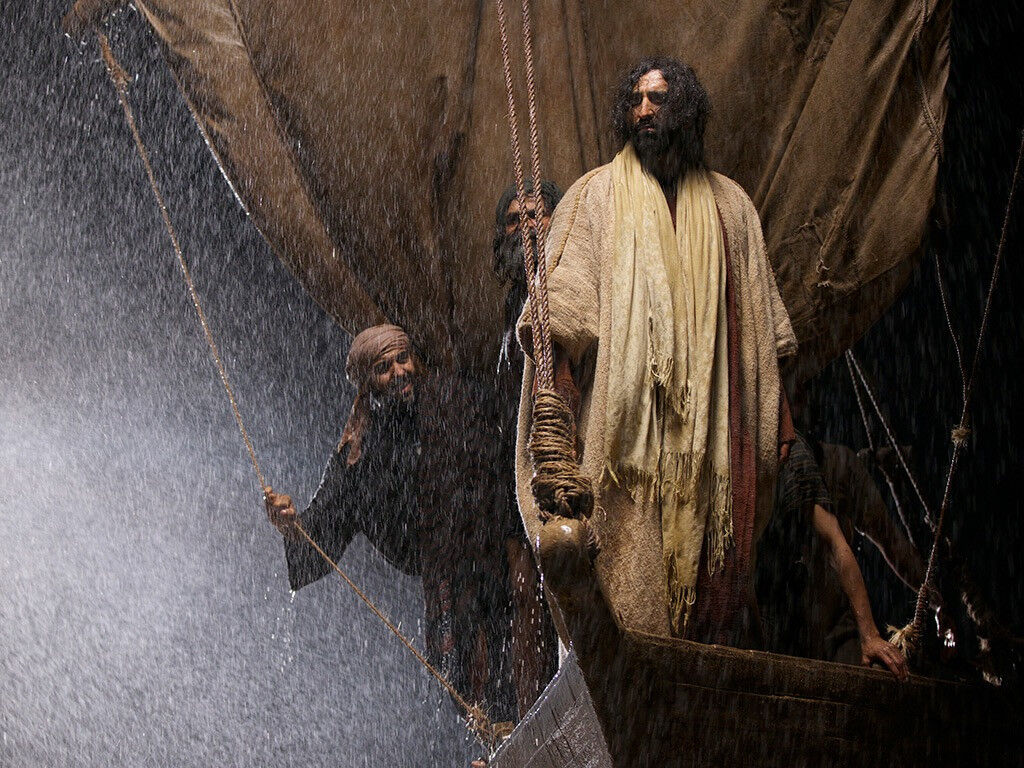
Great fear stole over the crew (survivors in the mini-Noah’s arc). “Who is this?” they said to each other. “Even the wind and sea do what he says!”
Jesus had looked at them and said “Why are you scared?” Don’t you believe yet?” That was his response to the disciple’s “Don’t You care?”
Jesus’ response to the disciples was not to shame them. It was to reveal their unbelief in what has been revealed to them: God was walking among them; God was in the boat with them; God’s love as demonstrated would see them through.
“Don’t you care?” is the corporate expression of anxious Israel waiting for Messianic Apocalypse.
“Don’t you care?” is the corporate expression of an anxious world that, with chronic uncertainty, is focused on a coming the-ship-is-going-down apocalypse and not on the certainty of the revelation of Jesus.
What do I talk about when I talk about apocalypse? This: what’s been revealed of Jesus is greater than what could ever possibly be revealed – whether in nature or alien or made-made or imagination-made.
2024: “We’re going down. Don’t you care?”
“Don’t you believe yet?”
~~~~~
Hope in an Age of Anxiety with Curtis Chang and Curt Thompson
We are in an anxious age. By some estimates, a third of all Americans will struggle with anxiety in their lives, and nearly 20% currently suffer from an anxiety disorder. For those suffering the mental distortions of anxiety, life can be difficult, and hope elusive. And for many Christians who have tried and failed to stop their slide into fear and worry by simply “laying down their burdens,” they may feel an added sense of spiritual failure as well.
We’re joined on our podcast by psychiatrist Curt Thopmson and theologian Curtis Chang who help us explore a counterintuitive approach to understanding our anxiety:
Episode 70 | Hope in an Age of Anxiety | The Trinity Forum (ttf.org)
~~~
Beauty from Darkness with Curt Thompson
How do we seek, find and share hope and healing in hard times?
Psychiatrist and author Curt Thompson and Trinity Forum President Cherie Harder discuss healing, grace, and reintegration — both for our individual and spiritual lives, and our shared life together. Together they consider how being known and believing what is true about our stories can transform our perspective and bring hope and healing:
“Shame is the antithesis and is that force that evil wants to use to undermine not only our ability to be known by one another deeply, which we were made for, we were made to be known, but we were also made to be known on the way to creating artifacts of beauty, whether those artifacts are relationships, whether they’re new pieces of music, art, businesses, and so forth.”
– Curt Thompson
Episode 45 | Beauty from Darkness with Curt Thompson | The Trinity Forum (ttf.org)
~~~~~
Must have been all those Venusian women with SUVs . . .







 Cindy Wity
You and Euaggélion
November 26, 2023 Leave a comment
We are entering a season of celebrating Good News. But hold on. There are some, the same some since before 2016, who are now heralding a disastrous 2024.
Today, at the top of media’s Richter scale of catastrophic “Oh Nos!” and bumping “climate crisis” to number TWO is word of a disastrous new year as speculated in The Economist magazine article Donald Trump poses the biggest danger to the world in 2024 !!!!
To add to the hysteria known as Trump Derangement Syndrome, unhinged Joe Scarborough of MSNBC’s Morning Joe said that Trump “will end democracy as we know it.” Wow!!! What a power calculus!!
Joe, hyperbolizing on a New York Times Op-Ed [“Trump’s Dire Words Raise New Fears About His Authoritarian Bent”] went beyond calling Trump an authoritarian. He implied that Trump’s a murderous fascist: “he will imprison” “he will execute” enemies if reelected. Scarborough knows this because of “his past”. (I’d like to see those press clippings. Anyone?)
N.B.: MSNBC is where people go to completely lose all touch with reality because Orange Man Bad.
Here’s Mika man:
Trump Acquitted of Inciting Insurrection, Even as Bipartisan Majority Votes ‘Guilty’ – The New York Times (nytimes.com)
And there’s more from the ‘sound and fury, signifying nothing’ MSNBC:
“Former Trump White House aide Cassidy Hutchinson said Tuesday on MSNBC’s “Inside” that “everybody should vote for” President Joe Biden if they wanted democracy to survive.” Wow!!! Again!!!
Before we exit the land of the unhinged, there’s another unbalanced MSNBC political contributor who weighs in on Trump: former Democrat U.S. Senator of Missouri, the very rich Claire McCaskill.
McCaskill claims that Donald Trump is “even more dangerous” than dictators Benito Mussolini and Adolf Hitler!!! In the process of loathing Trump, McCaskill also has to mock MAGA supporters. You should know that the schtick of MSNBC contributors – our hoity-toity betters – is making their viewers feel superior to the deplorable hoi polloi.
The above insanity should tell you that the Left – Wokes, LGBTQ+ mafia, Antifa, the climate overwrought, BLM, race hustlers and all – are terrified of Trump. And they want you to be terrified of him, too. They see their world, supported by the vast administrative State that sustains their power and control over America, as threatened by Trump. For, in Trump’s next term, he will begin to pull apart the leviathan deep state apparatus that destroys Democracy and America itself.
That and the Left’s constant lawfare against Trump is an indicator to me that Trump is the right man for the job. He’s about saving what’s left of our Republic – namely, the Constitution, free speech, the right to bear arms, religious freedom, and due process which prohibits the states from depriving “any person of life, liberty, or property, without due process of law.” (14th Amendment).
The Left, on the other hand, want to abandon all that. The Left wants to seize life, liberty, and property and create a system of producing and distributing collectively owned goods via a centralized government that plans and controls the economy. The left’s economic reforms increase centralized state control to the extent that private ownership becomes virtually impossible.
See Mao’s Great Leap Forward for one example of the effects of collectivization. A Progressive’s collective communist State means that all labor, money, and production go to the State and the State determines who benefits and who must go without based on political loyalty.
And see North Korea for the Left’s brand of “Democracy!” which the braying MSNBC crew says is under threat and not because of their dictatorial ways but because of the guy who wants to keep them from their dictatorial ways.
Trump has also shown that he wants to ensure our country’s sovereignty. And that means a closed border with legal immigration. He also wants to safeguard America from another war. The Left, under the Biden regime, has shown us that open borders with constant war and anarchy are its will.
Another indicator that Trump is right for the WH job is that there are those, not just domestically but internationally, who want Trump and those around them out of the picture, e.g., Iran-linked hitmen. Trump is bothering all the right (evil) people.
Going forward, I sure don’t want someone representing me in the WH who folds or capitulates under pressure. I sure don’t want appeasers and accommodationists like members of Congress. I sure don’t want someone who, at one time in Indiana, looked the part of a respectable Christian leader but turned out to be a squish: Don’t Ever Forget That Mike Pence Threw Religious Liberty Under the Bus | National Review
Results, not presentation, earn my respect.
And though New Yorker Trump could always pick out better words and phrasing to explain his thoughts and his frustrations with the stolen 2020 election, he wasn’t chosen to be president in 2016 and 2020 and once again in 2024 because he’s a poet laureate or a pastor or a prefab politician. Trump’s a producer for the American people.
The firing-on-all cylinders low-inflation economy (before the subterfuge of COVID) and the strong dollar Trump delivered – both are being destroyed by the Biden administration’s willful neglect of the American people as are the times of peace Trump fostered.
But MSNBC stands by their man Biden . . .
Since President Biden took office in January 2021, Americans have faced increasingly higher prices for food, gasoline, and other common household items. And while prices have been going up, wages have been going down, placing additional stress on family finances. This, per The Biden Inflation Tracker. This per Full-Time Nurse and Mother Breaks Down as She Discusses Tough Financial Struggles Under Bidenomics — Family Living ‘Paycheck-to-Paycheck’ Despite Decent Income (VIDEO) | The Gateway Pundit | by Jim Hᴏft
Since Biden took office Home sales fell to a 13-year low in October as prices rose (cnbc.com),
Since the illegitimate President took office in January 2021, our southern border has been invaded. Biden-Mayorkas have allowed in (6 million +) all kinds of illegal immigrants including narco-terrorists, gangs, CCP migrants, Hamas terrorists, and more unsavory types along with fentanyl and disease. 2024 will be disastrous as the effects of the open border hit home.
Under the corrupt, compromised, incompetent, and incorrigible Joe Biden, Americans now risk getting pulled into wars on three major fronts: Europe, the Asia Pacific and the Middle East. That didn’t happen under Trump.
But MSNBC stands by their man Biden . . .
Unlike those who are “ashamed” or “embarrassed” by Trump and want to condemn his unrefined ways as being beneath them, my working life was spent in the real world outside the cloisters of academia, religious organizations, and armchair punditry. I learned which people get things done and what needs to get done.
As a business partner in a multi-million-dollar manufacturing enterprise for many years, I found out who was needed and what was needed to bring success to both employees and the bottom line. The things that Trump got done during his first term allowed me to get things done in the Kingdom of God.
N.B.: There are imperfect people like Trump and tax-collector Matthew in the kingdom of heaven. (Mk. 2:15-17). So, it is best for the offended and the ‘high-minded’ to stick with the gospels and to stay away from tea leaves.
Consider a Trump economy. With a thriving economy, I am able to support myself and give to help others in need in a closely tied relationship. But under a Leftist Joe Biden economy, disposable personal income shrinks. Financial survival kicks in. And worse.
You should be aware that Leftists are intent on neutralizing Christianity and its charity. As mentioned above, the Left wants everything to be funneled through the State and the State to be the only effect on society. This is what Progressives do. They make everyone and everything dependent on ruling class ‘good will’. And that is the substance of State media’s MSNBC and their ilk.
So, while the prophets of Baal, enflamed with Trump Derangement Syndrome, shout louder and slash themselves with swords and spears in the hope that viewers will pay attention to their frantic prophesying and let their fire rain down on Trump, let’s turn to the Good News that has already come down from the heavens with its fire poured out through the Holy Spirit.
The beginning of Mark’s Gospel (εὐαγγέλιον or euaggélion – literally, “God’s good news.”):
This is where the good news starts – the good news of Jesus the Anointed King, God’s son.
Everything in Scripture (and specifically Isaiah 40-55) up to this time pointed to the Kingdom of God on earth. Mark writes (vs.14-15):
After John’s arrest, Jesus came into Galilee, announcing God’s good news.
“The time is fulfilled!” he said; “God Kingdom is arriving! Turn back and believe the good news!”
“Turn back”? When Jesus launched the long-promised kingdom of God on earth, allegiances and lifestyles began to change direction, as he began to talk about and show what that meant.
Jesus spoke of kingdom of God in parables and directly, as in Matthew 5-7. He showed what the kingdom of God meant – unclean spirits are cast out (Mk. 1:39), people are healed (Mt. 4:23), there is restoration (Lk. 15) and resurrection (Jn. 11:38-44). And, that the kingdom of God on earth was a fulfillment of the Law and Prophets (Mt. 5:17-18).
When he taught his disciples how to pray, he prayed
May your kingdom come,
May your will be done
As in heaven, so on earth
I wonder. Is that prayer being realized? Instead of allegiance to King Jesus the ultimate restorer and to the kingdom of God on earth, have the followers of Jesus become accommodationists of the world to fit in and find ease?
Have the followers of Jesus understood what the good news is? Have they reduced the gospel (euaggélion) to the formulaic four spiritual laws and an escape from the world into heaven?
Below are two podcasts that offer an understanding of the Good News and the kingdom of God on earth. Download and listen as you enter the season of celebrating the birth of a King who brought us good news and a kingdom.
But the holy ones of the Most High shall receive the kingdom and possess the kingdom forever—forever and ever. Daniel 7:18
We, the King’s holy ones, are to herald the good news of God’s Kingdom with a new way of life to a world that sees answers in profoundly short-sighted ways rather than in the Way of King Jesus. And then . . .
Then the seventh angel blew his trumpet, and there were loud voices in heaven, saying,
“The kingdom of the world has become the kingdom of our Lord
and of his Messiah,
and he will reign forever and ever.” Rev 11:15
~~~~~
On Earth as it is in Heaven
Anglican Bishop, and New Testament scholar, N.T. Wright makes clear, Jesus’ good news wasn’t about giving advice, or founding a new religion, or even where a soul goes when the body dies. Jesus was inviting his hearers into a new way of understanding Israel’s ancient story and the cosmic significance of its sudden fulfillment.
Reading Scripture with N.T. Wright
Trinity Forum Conversations | Reading Scripture with N.T. Wright (transistor.fm)
~~~~~
Jesus and the Kingdom of God
Jesus bringing the Kingdom of God to the world looks much different than what his friends, family members, and Jewish community thought.
Jesus & the Kingdom of God (bibleproject.com)
~~~~~
Informed Dissent:
A year of determination, the help of world-renowned doctors, and this mother’s research exposed the world to the known toxins in the Covid-19 vaccines that nearly killed her son.
“In 2021, after my then 21-year-old son went from running miles a day to walking with a cane, diagnosed with a rare, catastrophic blood disorder, this mom knows it is time for vaccine injury victims & families to ignite an intelligent, rational conversation about what the mRNA vaccines put into our bodies. We don’t buy food or health products without reading the labels and knowing the ingredients, and it’s time we do the same with the vaccines for our children.”
The Shot Heard Around The World – A Mother’s Anthem (substack.com)
Livestock raised in confined animal feeding operations (CAFOs) are routinely given a range of veterinary drugs to prevent disease, and some of those drugs could potentially impact the health of those who eat their meat.
Common Drug Used by Pork Industry Has Human Cancer Risk (mercola.com)
Thousands of vials of biological substances — including some labeled “HIV” — and a freezer marked “Ebola” were found inside a secret Chinese-owned biolab in California which the Centers for Disease Control and Prevention and FBI initially refused to investigate, according to a House committee report released Wednesday.
Pathogens labeled ‘HIV’ and ‘Ebola’ found inside illegal Chinese-owned biolab in California (nypost.com)
“This is really a massive cover-up. And I suspect it’s because there’s many more links to the funding, and there was probably discussion of the funding,” says Sen. Rand Paul (R-Ky).
HHS and NIH More Secretive Than CIA on COVID Origin Documents: Sen. Rand Paul | EpochTV (theepochtimes.com)
~~~~~
Brace Yourself For What’s Coming in 2024 – Victor Davis Hanson – YouTube
Victor Davis Hanson Warns America: ‘Brace Yourself for What’s Coming in 2024’ (VIDEO) | The Gateway Pundit | by Mike LaChance
Rate this:
Filed under 2023 current events, 2024 Election, Christianity, cultural Marxism, Gospel of Mark, Gospels, Kingdom of God, media, Political Commentary, Politics, Progressivism, social commentary Tagged with democrats, Jesus, Joe Biden, media, MSNBC, politics, progressives, the Gospel, The Kingdom of God, Trump