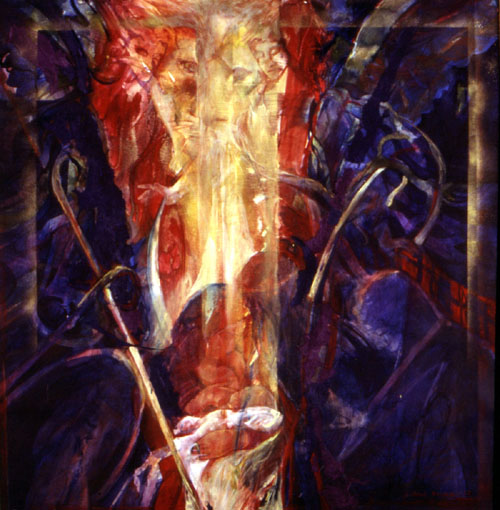
Haman and Hate (and Hamas by Proxy?) meet the Hangman, Conclusion

Part One: A Feast for the Eyes

Part Two: Persia Meets Reality and Esther

Part Three: Haman and A Star is Worn
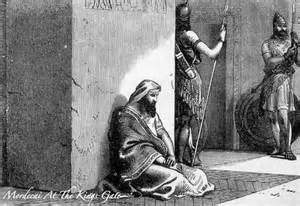
 

Mordecai sitting at the King's Gate-all ears and eyes

Mordecai sitting at the King’s Gate-all ears and eyes


Haman is booked

Haman is booked


Part Four, Conclusion: Who Remains Silent in Times Like These?

 “The entire story of Israel, on one level at least, is the story of how Israel’s God is taking on the arrogant tyrants of the world, overthrowing their power, and rescuing his people from under its cruel weight.” N.T. Wright, “How God Became King”

 As we have learned so far, Persian King Xerxes and his right hand man Haman have issued decrees, edicts and proclamations. At the urging of Haman a death warrant for the Jews was sent throughout Xerxes’ vast kingdom.

 The edict, that genocide of the Jews was to occur on a certain day, is shouted from the citadel in the capital city of Susa. The targeted Jew’s days are numbered: on the thirteenth day of the twelfth month, the month of Adar the Jews are to be annihilated, their property plundered.

 This horrifying declaration is soon answered by the Jewish population. The people mourn and fast. They put on sackcloth and ashes as signs of their distress. Xerxes and Haman, on the other hand, party on.

 But then banqueting tables are turned and the Jew’s great sadness is turned to rejoicing. Moving quickly though the events we’ll see how.

 Before we go on you should know this Resurrection Day that…The days of evil are numbered and the Day of Final Deliverance from Death is at hand. The empty tomb is the proclamation of our deliverance from both evil and death, on a certain future day. The Purim celebration would become a foretaste of deliverance. Resurrection day is the foretaste of the Day of Deliverance.

 From Chapter One of The Book of Esther: King Xerxes, in response to Queen Vashti’s no-show at the royal bacchanalia deposes Queen Vasti and sends out a decree to everyone in his kingdom, a decree proclaiming that every man should be ruler over his own household.

From Chapter Two: Esther is fast-tracked by the head eunuch to become Xerxes new queen. The king then gives a great banquet, “Esther’s Banquet” to show off his queen to all his nobles and officials. Xerxes proclaims a holiday throughout the provinces and distributed gifts with liberality. Mordecai’s salvation of Xerxes from an assignation attempt is recorded in the king’s record books.

 From Chapter Three: Xerxes honors Haman, making him his right-hand man. Haman is paraded about and is honored by all except a particular Jew-Mordecai. Haman’s ego is crushed. His anger turns to hate. Haman chooses to become anti-Semitic. Haman complains to Xerxes about a “certain people”.

 Xerxes to Haman regarding the Jews, “do with the people as you please.” A genocidal Death Warrant is issued after the king’s authority via his signet ring is handed over to Haman. A copy of the text of the edict is to be issued as law in every province and made known to the people of every nationality so they would be ready for that day.  …couriers went out, spurred on by the king’s command, and the edict was issued.”

Chapter 4: Mordecai, Esther’s uncle, hears about the edit. It is shouted from the citadel in the capital city of Susa. Mordecai is stunned. With sackcloth and ashes Mordecai let’s the world know, and more importantly, let’s God ‘know’ that he is mourning the loss of his family and his people the Jews. (Notice how Mordecai’s protest (like Job’s) is personal and self-effacing and not riotous, vulgar, angry and destructive like today’s demonstrations?)

Important to our understanding of The Book of Esther wherein there is no mention of God is the fact that God had promised Abraham in a covenant (see Genesis 15) that “a) Abraham’s seed would become as numerous as the stars of heaven, b) his family would be exiles in a foreign land and eventually be brought out, and c) his family would inherit the land of Canaan.” (N.T. Wright, “Justification”.)

Mordecai’s great distress is based, I believe, on his understanding of God’s promises to Abraham and his understanding of God righteousness–God keeping his promises-and the declared challenge to God’s faithfulness by an earthly tyrant. Sackcloth and ashes are man’s quiet submission to God: man is dust and will return to dust and that salvation alone comes from God. Let’s see what happens next.

Esther quickly learned about Mordecai’s distress. She sends him new clothes to put on, to comfort him. She did not know about the edict.

Mordecai responds to the eunuch sent by Esther. He hands him the edict to give to Esther. Mordecai tells the eunuch that Esther must approach the king and get him to rescind this edict. Esther receives the news with great dread. She replies to Mordecai that people who just show up at court uninvited are put to death. And, “…thirty days have passed since I was called to go to the king.”

When Esther’s words were reported to Mordecai, he sent back this answer: “Do not think that because you are in the king’s house you alone of all the Jews will escape. For if you remain silent at this time, relief and deliverance for the Jews will arise from another place, but you and your father’s family will perish. And who knows but that you have come to your royal position for such a time as this?”(emphasis mine)

 Then Esther sent this reply to Mordecai:  “Go, gather together all the Jews who are in Susa, and fast for me. Do not eat or drink for three days, night or day. I and my attendants will fast as you do. When this is done, I will go to the king, even though it is against the law. And if I perish, I perish.”

So Mordecai went and carried out all of Esther’s instructions. The Jews in every corner of the kingdom fasted for three days.

Submission takes the high road.

Maybe you have noticed by now that submission plays a big role in this and other Biblical narratives. Putting on sackcloth and ashes and fasting are forms of submission. Replying, “If I perish, I perish” is another. Recall Mary’s submission to the angel regarding her being impregnated by the Holy Spirit? “I am the Lord’s servant,” Mary answered, May it be to me as you have said.” And, we must recall our Lord’s submission to the Father’s divine purpose: “Father, if you are willing, take this cup from me; yet not my will, but yours be done.”

 The act of submission to a sovereign God even when God’s presence and His direct intervention are not evident is described for us in a ‘genealogy of faith found in Hebrews chapter 11. There we read of the “By faith…” accounts of individuals who submitted themselves to God. That submission is faith in the righteousness of God. It is saying God keeps His promises and that He does so no matter what men do to affect them, even up annihilation of those promises personified in God’s people the Jews.

 Submission to a scepter

After three days of fasting Esther puts on her royal robes and presents herself to the King. She appears in the hallway within direct view of the king. She anxiously awaits his invitation. Xerxes scepter is offered to her. Esther touches the tip of scepter showing respect and submission to his authority.
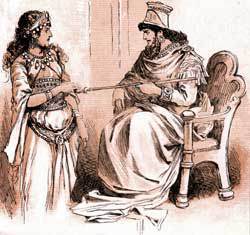
Civil disobedience and submission

Civil disobedience and submission

 Now imagine for a moment being Queen Esther. Xerxes, the King of his household had, had by proxy decree allowed for the annihilation of her people the Jews without giving it second thought. Queen Esther no doubt felt that her life hung in the balance, one side of the scale weighted against her. But then the finger God was upholding her.

 The king asked Esther “What is your request? Even up to half the kingdom, it will be given you.”

Esther’s response is not direct. She invites Xerxes and Haman to a banquet that same day. The banquet happens, the wine is poured and again the king asks Esther what her petition is. And again, Esther, faltering in courage, suggests another banquet the next day and “Then I will answer the king’s question.” On to banquet number two and a swelling ego.

 With banquet number one under his belt and banquet number two written into his day planner Haman is pretty impressed with himself. He brags to his wife and friends that it was only the King and himself who were invitees to the Queens banquets. Haman boasts of his great connections and vast wealth. Yet, there was something sticking in his craw-that Mordecai who is mourning everyday at the gate in sack cloth and ashes.

 Haman’s wife, knowing that Mordecai was the decreed king of his household offered a solution to Haman’s hangdog demeanor.

“Have a gallows built, seventy-five feet high, and ask the king in the morning to have Mordecai hanged on it. Then go with the king to the dinner and be happy.” In other words, “Don’t Worry. Be Happy!” Haman liked the idea and had the gallows built. Problem solved.

 Sleepless in Susa

That same night the king couldn’t sleep. This was due to too much wine at the banquet or perhaps God’s purpose was the pea under the mattress. Whatever the reason the king ordered his favorite book to be brought in-the king’s chronicles. These books were records all of the king’s doings, perfect for nights like these.

The king ordered his favorite book to brought in-the king’s chronicles. These books were records all of the king’s doings, perfect for nights like these.

 Lo and behold, what was long ago forgotten was still in black and white on the parchment- Mordecai had saved the king by exposing an assassination plot. The king then asked his attendants what had been done for Mordecai. Such an act of respect for the king’s life should be honored. His attendants answered, “nada” (I don’t know Persian for “nothing.”) The king wanted to settle up with Mordecai immediately so he asked his servants, “Who is in the court?”

 Lo and behold, Haman, the proud, is, at that very moment, standing in the outer court hoping to get permission from the king to have Mordecai hanged. Haman, too, wanted to settle up quickly as possible.

 Haman enters the king’s presence and immediately the king asks Haman “What should be done for the man the king delights to honor?”

 Haman, already full of Haman, thinks the king is, of course, talking about whom else but Haman. Haman, with great flare, then details a litany of delights that the king should lavish on such a man.

 The king commands Haman, “Go at once.” “Get the robe and horse and do just as you have suggested for Mordecai the Jew, who sits at the king’s gate. Do not neglect anything you have recommended.” Oh, the irony.

 Haman did as the king commanded. He paraded Mordecai through the city streets proclaiming as he went, “This is what is to be done for the man the king delights to honor!”
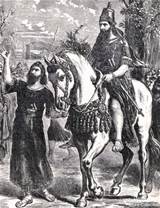
Carpe the irony:  Haman is leading Mordecai through Susa

Carpe the irony: Haman is leading Mordecai through Susa

 Afterward Mordecai returned to the king’s gate (nothing had changed; a curious ride through the city on horseback does not a decree rescind). Haman returned to his wife and friends and gave them the low down.

 Zeresh, Haman’s wife, taking the reins away from Haman decides, like many others had in recorded history, that it is time to stop messing with the Jewish people. In her mind the Jews’ God defends them. He is real. Enough already, Haman, your pride is plaguing us. Be done with this man and his people.

 While she is talking Haman is whisked away to banquet Number Two

 No Fear (well maybe some)

 King Xerxes and Haman, knees knocking I’m guessing, dine with Queen Esther a second time. And, a second time the king asks Esther, “What is your request? Even up to half the kingdom, it will be given you.”

 “Then Queen Esther answered, “If I have found favor with you, O king, and if it pleases your majesty, grant me my life-this is my petition. And spare my people-this is my request. For I and my people have been sold for destruction and slaughter and annihilation.”

 Well, king Xerxes is greatly troubled by such a statement. He wonders out loud who would do such a thing “Who is he?” ”Where is the man who would dare do such a thing?”

 “Esther said, “The adversary and enemy is this vile Haman.” 
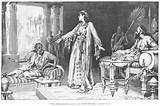
Esther points out the evil.

Esther points out the evil.

In a rage, knowing that he had been used by Haman, Xerxes got up from the dinner and went into the palace garden. In the mean time, Haman knowing that his life is over throws himself at Esther’s feet and begs for his life. The king returns and finds Haman now clawing at Esther. His rage grows.

As it is written, one of the eunuchs attending the king, Harbona, pointed in the direction of Haman’s house. He told the king that Haman had erected a seventy-five foot high gallows on which to hang Mordecai, “the same Mordecai who helped my lord.”

 The king didn’t ponder this at all. “Hang Haman on that same gallows”. Then his fury subsided. Problem solved. Seventy-five feet: my how the mighty have fallen! 
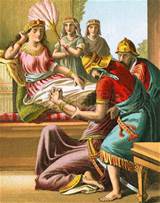
Evil begs for mercy and finds none.

Evil begs for mercy and finds none.

The tables are turned

 That same day King Xerxes gave Queen Esther the estate of Haman. Esther told the King of her uncle and how he adopted her after her parents had died. The king took off his signet ring and put it on Mordecai’s finger. Mordecai was appointed the head of Haman’s vast estate by Esther. But, a decree was still out there and could not be rescinded. Something had to be done before the day of annihilation.

 Déjà vu all over again but this time Sovereignty steps in.

 Esther once again approached the king weeping and pleading for the life of her people. She asked for a counter decree to be issued. King Xerxes answered both Esther and Mordecai, “Write another decree in the king’s name in behalf of the Jews as seems best to you.”

 So, all the same secretaries who were summoned once before to write out the Jew’s death warrant were summoned again. Mordecai’s counter decree would allow the Jews to defend themselves from all enemies and to take their plunder. The edict was dispatched via multiple couriers to the 127 provinces of king Xerxes.

 “The couriers, riding the royal horses, raced out, spurred on by the king’s command. And the edict was also issued in the citadel of Susa.” The response is celebration in each Jewish community.

 “In every province and in every city, where ever the edict of the king went, there was joy and gladness among the Jews, with feasting and celebrating. And many people of other nationalities became Jews because fear of the Jews had seized them.”(emphasis mine)

 Hate has its day in the People’s Court

Haman’s day of holocaust, the thirteenth day of the twelfth month of Adar, finally arrived. But the Jews had prepared to defend themselves. Mordecai’s edict gave them the power to stand against their enemies and take their plunder. And so the attempt at genocide began throughout the kingdom.

 It is written about the Jews, “No one could stand against them, because the people of all other nationalities were afraid of them. And all nobles of the provinces, the satraps, the governors and the king’s administrators helped the Jews because fear of Mordecai had seized them….The Jews struck down all their enemies with the sword, killing and destroying them, and they did what they pleased to those who hated them…But they did not lay hands on the plunder.”

 In summary, the last two Chapters of The Book of Esther detail the extent of the Jews self-defense against hatred. Various numbers of deaths occur in different places within the 127 provinces. In one verse (16 of Chapter 9) it is written that seventy-five thousand enemies of the Jews were killed. That is seventy-five times one thousand deaths or one thousand deaths for each foot of height of the “Haman Gallows”

 Speaking of justice by extrapolation, Haman’s ten sons, the ten acorns that don’t fall far from the tree are hanged on their father’s gallows. The Jews understood that evil is passed down from generation to generation. The sins of the father, in this case anti-Semitism, would continue to manifest its ugly hatred if not nipped in the neck. 
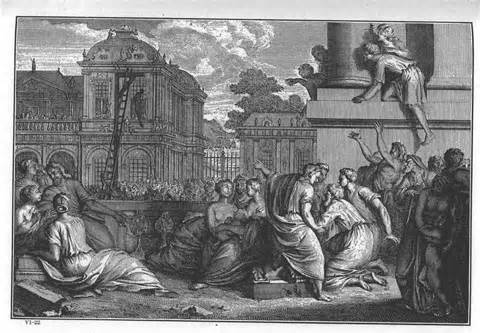
Haman meets the end of his rope.

Haman meets the end of his rope.

After all of the fighting had stopped and the Jews enemies vanquished, Mordecai sent letters to all the Jews in every province of King Xerxes. He declared these days of Adar to become an annual celebration, “as the time when the Jews got relief from their enemies, and as the month when their sorrow was turned to joy.” These days would become known as The Feast of Purim, “For Haman son of Hammedatha, the Agagite, the enemy of all the Jews, had plotted against the Jews to destroy them and had cast pur (that is, the lot) for their ruin and destruction.”

 The balance of The Book of Esther tells us that all of the prior events were recorded for posterity in the king’s books. Mordecai was held in high esteem by all who knew his name.


 Something to think about this Resurrection Day

You may cast your lot with those who hate the Jews but the outcome will be the same as those enemies of the Jews in the Kingdom of the Media and Persia. This historically proven pronouncement includes Hamas, the anti-Semitic Boycott-Divest & Sanction (BDS) groups, Iran-The Islamic Republic, ISIS, anti-Semitic Europeans and all those who hate the Jews. So all such, you are forewarned. And, nuclear bombs are no threat to the God who created the vast universe, the infinitesimal atom, a particle’s chirality and also allowed man to find quantum mechanics among the mysteries of life. God knows the number hairs on your head. Did you think that he doesn’t notice the hatred raging in your head?

If you cast your faith on God’s sovereignty you will find that God is faithful to his covenant promises. Make a stand with God and you find God standing with you (read about Shadrach, Meshach, and Abednego in the book of Daniel). Esther’s life is an exemplary illustration of submission to God’s sovereignty.

 Esther, in an act of civil disobedience came before King Xerxes and spoke truth to power. It took Esther a couple of banquets to ramp up the courage but Esther made a stand for herself and for the people of God.

Esther is also an example of one life given as a ransom for many (see the Gospel of mark, chapter 10, vs. 45 regarding these words spoken about Jeshua, Jesus).

 It has been said that the degree of anti-Semitism in a society is an indicator of its health. Look at Europe to see where the U.S. is heading.

 Finally, Orthodox Christian theologian Charles Malik who was also a Lebanese diplomat, political theorist, philosopher and president (1958) of the U.N.’s General Assembly wrote a book titled “Christ and Crisis” (1962).

 Malik’s definition of crisis: “the crisis is simply the fact that Jesus Christ is the Lord and is judging.”

 Malik warned that “The greatest weakness of Western strategy is its relative neglect of the intellectual and spiritual dimension.”(emphasis mine)

 When facing a crisis at any level, in any context we must confront it with courage and the cross.

 In 1962 Malik wrote,

“There are three unpardonable sins today, to be flippant or superficial in the analysis of the world situation, to live and act as though halfhearted measures would avail; and to lack the moral courage to rise to the historic occasion.”

 Esther understood “crisis” and acted with sober courage to avert a holocaust that was decreed with hatred within the shadow of a gallows. (See also the life of Dietrich Bonheoffer.) 

Who Remains Silent in Times Like These? 

***

For current information regarding the increasing anti-Semitism in our world bookmark this website: LegalInsurrection

 Here is a sample post: Vienna, “Free, Free Palestine” chant becomes “Kill, Kill the Jews”
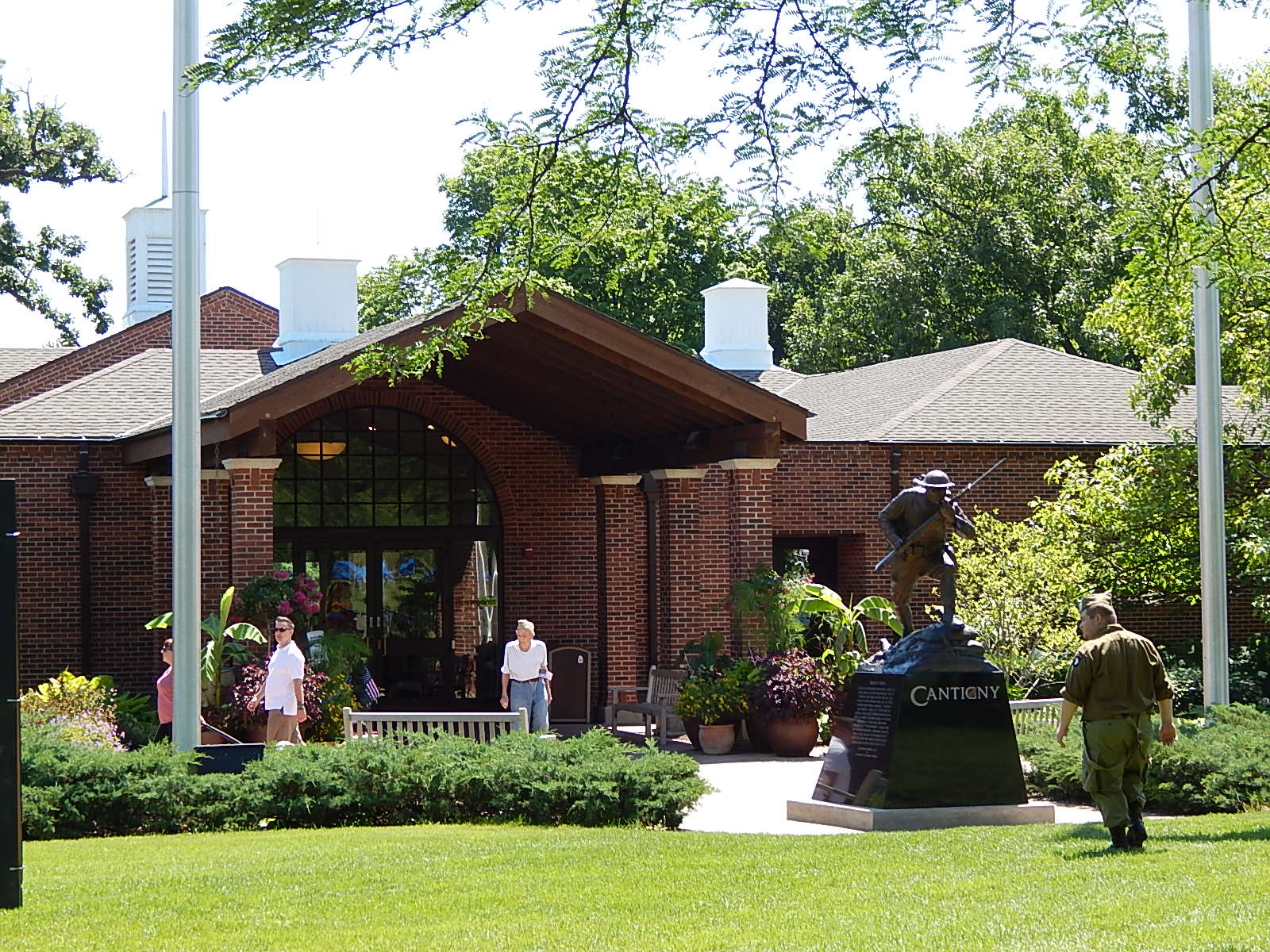


Fourth of July at Cantigny Park – 2014

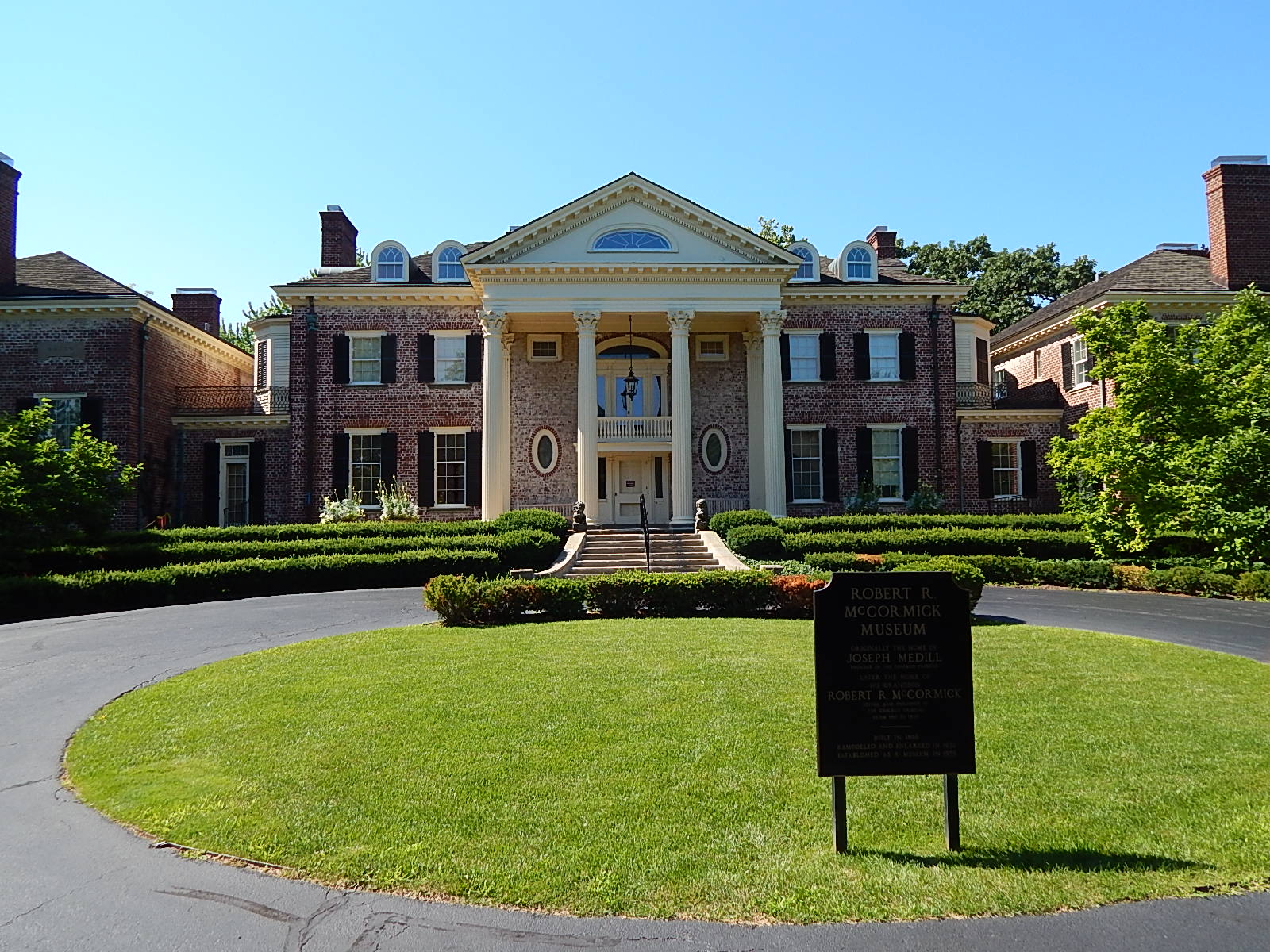
Cantigny Entrance 7-4-2014


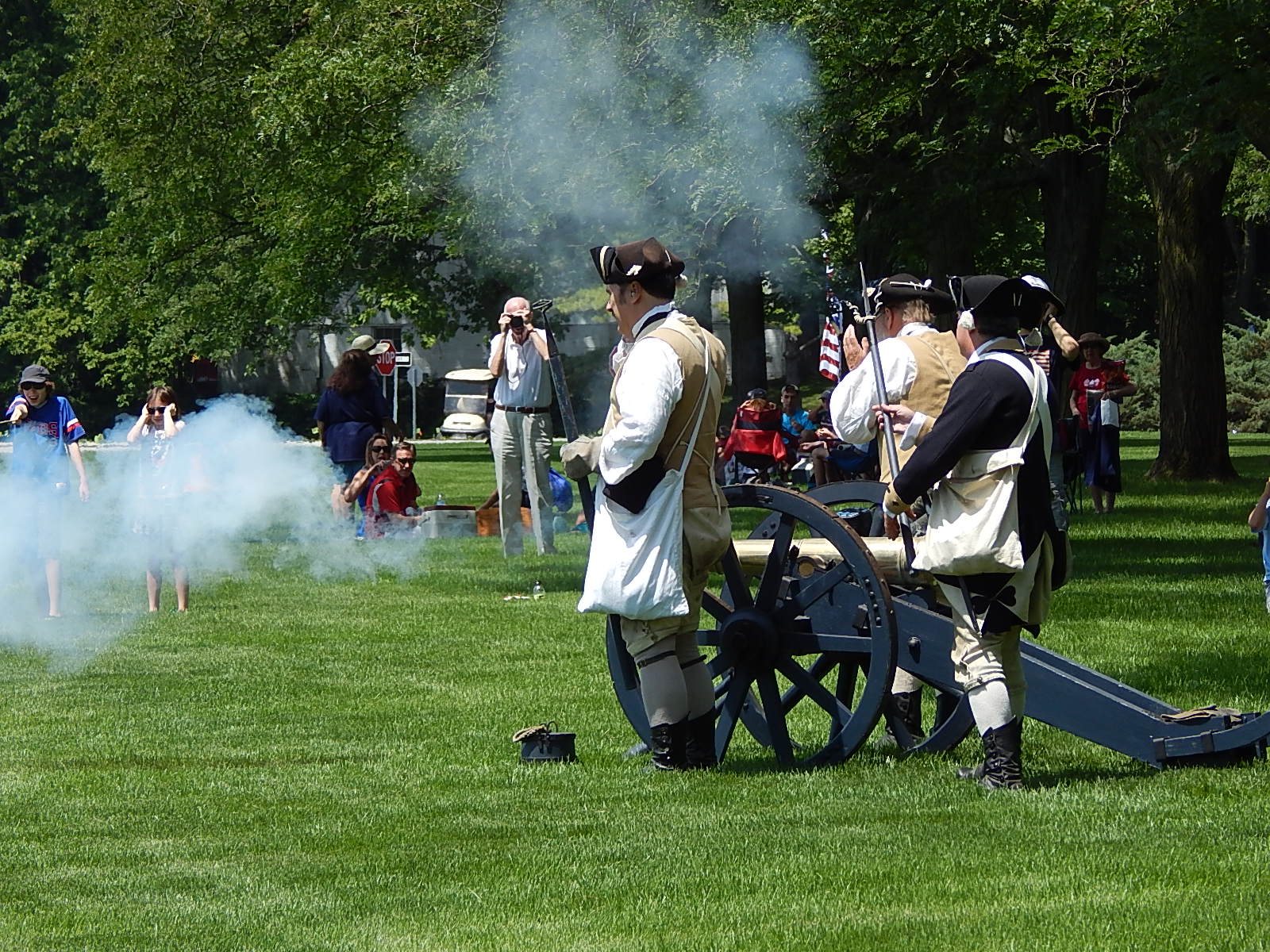
Fourth of July at Cantigny Park has become an annual event for me. You will see why.

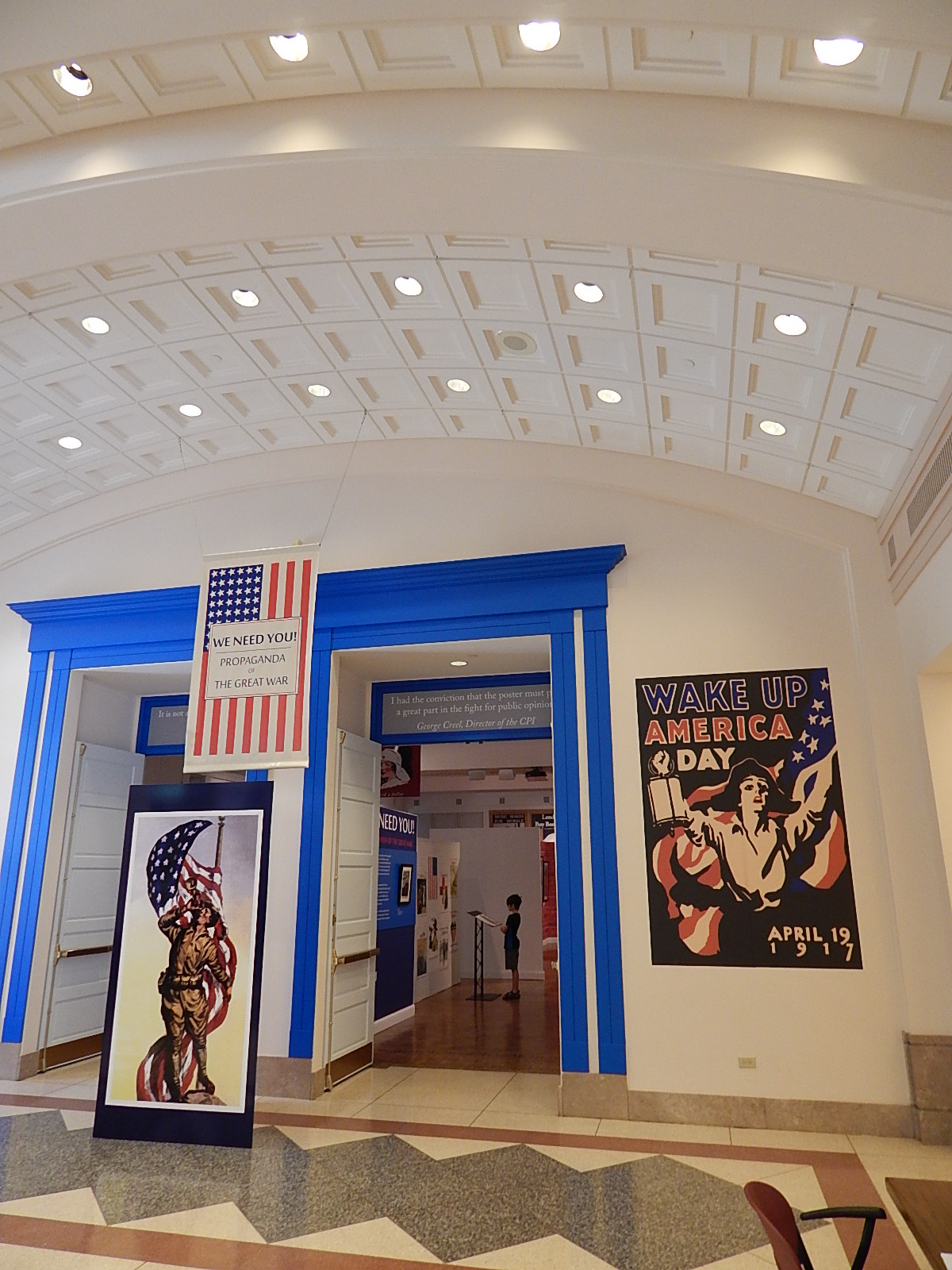
 Cantigny Park is the setting for Col. Robert R. McCormick Museum (the Colonel’s former residence), the First Division Museum of military history and 30 acres of gardens.

 Regarding Col. Robert R. McCormick’s military career, Wikipedia says:

Returning to the United States in 1915, he joined the Illinois National Guard on June 21, 1916, and, being an expert horseman, became a major in its 1st Cavalry Regiment. Two days earlier, President Woodrow Wilson had called the Illinois National Guard into Federal Service, along with those of several other states, to patrol the Mexican border during General John J. Pershing’s Punitive Expedition McCormick accompanied his regiment to the Mexican border.

Soon after the United States entered the war, McCormick again became part of the U.S. Army on June 13, 1917, when the entire Illinois National Guard was mobilized for Federal service in Europe. He was sent to France as an intelligence officer on the staff of General Pershing. Seeking more active service, he was assigned to an artillery school. By June 17, 1918, McCormick became a lieutenant colonel, and by September 5, 1918 had become a full colonel in the field artillery, in which capacities he saw action. He took part in the capture of Cantigny, after which he named his farm estate in Wheaton Illinois, and in the battles of Soissons Saint-Mihiel, and the second phase of the Argonne. He served in the 1st Battery, 5th field Artillery Regiment, with the 1st Infantry Division. His service ended on December 31, 1918, though he remained a part of the Officers Reserve Corps from October 8, 1919 to September 30, 1929. Cited for prompt action in battle, he received the Distinguished Service Medal. Thereafter, he was always referred to as “Colonel McCormick.”

Crusading publisher

McCormick returned from the war and took control of the Tribune in the 1920s. Given the lack of schools of journalism in the Midwestern United States at the time, McCormick and Patterson sponsored a school named for their grandfather, the Joseph Medill School of Journalism. It was announced by Walter Dill Scott in November 1920, and began classes in 1921.

As publisher of the Tribune, McCormick was involved in a number of legal disputes regarding freedom of the press that were handled by McCormick’s longtime lawyer Weymouth Kirkland. The most famous of these cases is Near v. Minnesota, 283 U.S. 697 (1931), a case championed by McCormick in his role as chairman of the American Newspaper Publisher Association’s Committee on Free Speech.

Tribune Tower Chicago

A conservative Republican, McCormick was an opponent of President Franklin D. Roosevelt and compared the New Deal to Communism. For a period in 1935, he protested Rhode Island’s Democratic Judiciary by displaying a 47 star flag outside the tribune Building, with the 13th star (representing Rhode Island) removed; he relented after he was advised that alteration of the American flag was unlawful. He was also an America First isolationist who strongly opposed entering World War II to rescue the British Empire. As a publisher he was very innovative. McCormick was a 25 percent owner of the Tribune’s 50,000 watt radio station, which was purchased in 1924; he named it WGN, the initials of the Tribune’s modest motto, the “World’s Greatest Newspaper”.…

McCormick carried on crusades against gangsters and racketeers, prohibition and prohibitionists, local, state, and national politicians, Wall Street, the East and Easterners, Democrats, the New Deal and the Fair deal, liberal Republicans, the League of Nations, the World Court, the United Nations, British imperialism, socialism, and communism. …

The New York Times said:

He did consider himself an aristocrat, and his imposing stature6 feet 4 inches tall, with a muscular body weighing over 200 pounds, his erect soldierly bearing, his reserved manner and his distinguished appearance—made it easy for him to play that role. But if he was one, he was an aristocrat, according to his friends, in the best sense of the word, despising the idle rich and having no use for parasites, dilettantes or mere pleasure-seekers, whose company, clubs and amusements he avoided. With an extraordinary capacity for hard work, he often put in seven long days a week at his job even when elderly, keeping fit through polo and later horseback riding. In his seventies, he could still get into the war uniform of his thirties. (emphasis mine)


Maybe now you can see why I would visit Cantigny every July Fourth. We need men like Col. McCormick today.

Long before the (Harry-Reid-demonized) philanthropic Koch Brothers, Col. McCormick’s Foundation has contributed more than a billion U.S. Dollars for journalism, early childhood education, civic health, social and economic services, arts and culture and citizenship.

Now, some of the photos I shot on July 4th, 2014 at Cantigny Park, starting with the McCormick mansion:

 McComick Mansion 7-4-2014

reflection pool McCormick mansion 7-4-2014

above, a reflection pool facing south of the mansion; below, a pool facing east of the mansion

Reflection pool facing east

The mansion’s South entrance, below:

south entrance McCormick Mansion

gardens, guns and gallantry:

Idea garden 1

garden path Cantigny

arbor Cantigny

pond Cantigny

La Fleur Cantigny

flowers Cantigny

Illinois in living color:

Illinois in living color

 A day at Cantigny with dog tags, wild turkeys, cannons, Chevys and all:

dog tags, program

wild turkey

water lily

Foutains in the Rose Garden facing the Idea Garden

fountains facing idea Garden

garden path

tank

tank

military museum

her boy - military museum


The wilting photog on a hot 4th:

the photographer

cannon fire

Chevy

There too many pics to download for this post.  Here are pics from last year:

July 4th, 2013 – Cantigny Park


The Rectitude of Silence

The Memorial Day weekend and the recent retirement of my boss, a Vietnam veteran, tugged at some heart-strings drawing me back home…

 At 6:00 am dad nudged me out of a dream where I had been standing over Grandma Johnson’s gravesite.  Half awake I got out of bed and dressed being sure not to wake the rest of the family.  When I reached the kitchen I could see from the window that dad was already in the car waiting for me.  The car was running.  I walked quietly back to my bedroom, grabbed my trumpet case and walked out the door.

In the car I sat silently as Dad drove us to the nearby Village Hall. There the Memorial Day ceremony would take place on the front lawn.  Earlier in the year of ‘69 my father had become the village’s mayor. He was now to deliver the Annual Memorial Day Speech during this service of remembrance.

 As we drove up a podium with a microphone was placed on the lawn outside the entrance to the village hall.  All around us dozens of people were streaming out of their cars and joining the semi-circle facing the podium.  Behind the podium there stood several men from the local VFW. 

These veterans were decked out in their dress uniforms. Several of the uniforms bore chevrons and gold braids with medals festooning their chests.   Thin ribbon bars, their colors revealing the military campaigns, the theaters of battle, they had been involved with.  Bronze and silver stars and medals of commendation glinted in the morning sun light. An aged vet who had served in WWI sat in a wheel chair. There were many there who had served in WWII.  And there were some, home from their first tour in Viet Nam, who looked like teenagers compared to the older vets.

I watched as front and center on the grass a detail of vets, each representative of a different branch of the armed services, practiced presenting the colors, recalling a formation they had learned years ago.

To one side of the podium my father talked about the order of the service with the speakers and presenters.  A pastor would pray for the men and women in the military. A Marine captain would present the colors. A Navy ensign would recall Guadalcanal. An army vet would speak about things he held dear such as duty, honor, sacrifice and friendship.  He would choke up as he spoke about comrades lost in battle.

At fifteen years old it was not lost on me that guys at the age of seventeen were going off to war and some were not coming back.  The specter of going to war loomed ever larger for me, especially as horrific scenes of the Viet Nam war were shown on almost every nightly newscast.  There seemed to be no end to the conflict in sight. 

  I knew guys just two years older than me who were being drafted.  I knew that I could possibly be drafted and sent to off to Vietnam.  I knew that would have to register with the selective service when I turned seventeen.  The possibility sent chills down my spine.  I picked up my horn out of its case and began nervously pumping the valves.  Buzzing my lips against the mouthpiece I blew warm air through my trumpet. I wondered if I was good enough horn player to play with the U.S. Army Band.

 At 7 am my dad moved to the podium and spoke a welcome to all who had “come out on this beautiful Memorial Day morning.”  He acknowledged the members of the VFW and each Village trustee who had attended.  To open the service he asked a pastor to come forward and lead the service with a prayer.

 Before my father gave the pastor the microphone he asked that there would be a moment of silence in memory of those who had fallen. We bowed our heads. 

Before me stood a WWII vet, head uncovered, head bowed.  Overhearing him earlier talking to another vet I understood that he knew full well the horrors of war better than any acid-eyed tie-dyed peace protestor. This veteran had paid a significant price for any protestor’s right and the rights of Europeans and Asians to live free from tyranny’s aggression. 

American men and women were able to assemble and protest because of the sacrifices men like this soldier made on their behalf. The strength of our republic lay in our individual resistance to evil where ever it threatens us – at home or abroad. And, here at home, an evil grew which was just as insidious as foreign aggression– licentiousness.

 Carl Sr., a Presbyterian minister and the father of one of my close friends, prayed a blessing on the cherished memory of the fallen and their families.  He prayed for those in the midst of battle that very day in Southeast Asia.  He sought comfort and succor for those who live on with injuries received in battle, both physical and mental.  He prayed for all those friends and families who had grieved the loss of loved ones.  He then prayed for our nation, a nation openly riddled with discord and godlessness, submitting our country “to the Supreme Judge of the world for the rectitude of our intentions.”  

 After the prayer my father spoke. Dad’s words honored those who had gone to battle to protect our liberties and the liberties of our allies. He spoke of their commitment to freedom, to a higher purpose. He spoke of their courage not often found among men and women of this age.  He spoke of their ultimate sacrifice:  “greater love has no man than this that he lay down his life for his friend.”  In closing, he hallowed their memory, echoing Abraham Lincoln’s words, saying, “…that these dead shall not have died in vain.”

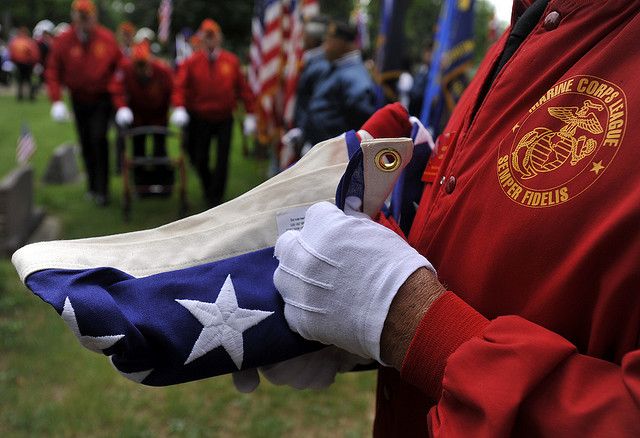
 The flag ceremony began.  White gloved hands unfolded the American flag. Two vets held the corners of the flag, keeping it from ever touching the ground.  Unfolded the flag was hoisted to the top of the nearby flag pole. My father, placing his hand over his heart, began:  “I pledge allegiance to the flag…” I could see that the Stars and Stripes, at ease on this serene morning, moved the veteran’s hearts to their throats, pushing tears into their eyes.  There were no placards of “Make Love Not War” here this morning.  The bearers of those signs must have been sleeping in, secure in their beds.

 After the pledge of allegiance a high school senior came to the microphone and led the singing of our national anthem.  There were more tears and more memories halting reverent shaky voices. 

I sang the anthem thinking about the year before:  while young men and women were fighting in the steamy death-laden jungles of Southeast Asia east coast hippies gathered at the Fillmore East in New York City to hear Grace Slick sing about a White Rabbit.

 Even at fifteen I knew that the peace-loving hippies had ceased fighting against the tyranny of drugs and the unbridled desires that come with it. They thought that all they needed was “Love.” And while “Peace” and “Love” became the mantras of their drug-infused songs, some of the protesters became aggressive and violent in their anti-war protests.

Bill Ayers the co-founder of the Weather Underground, a communist revolutionary group, began bombing public buildings as a sign of contempt over theU.S.involvement in the Viet Nam War. The contradiction, violent murderous aggression to obtain peaceful ends, didn’t make sense to me and it surely didn’t respect the freedom they clearly enjoyed, freedom paid for with the lives of decent peace-loving men and women.

 “Now we will have the presenting of colors”, the loud-speaker sputtered dad’s words.

 The honor guard, waiting in the background, marched to the front of the assembly.  The commander led them through the drill.  Once the men were in formation the American flag was presented and the other flags were lowered. The vets came to attention and saluted the flag.

 Commands were given to the small rifle squad.  Rifle barrels were inspected and loaded.  The vets were then commanded to raise their rifles. “Ha-Ready,” “H-Aim,” “Fire!”  The crack of twenty-one bombastic gun shots sent shock waves to my ear drums.  The air began to fill with the smell of sulfur, chalk and burnt paper – gun powder. Smoke, in small billows rose above the rifles, seeming to carry the memory of fallen soldiers up into heaven.

 After the twenty-first shot there was a long silent pause, lasting five minutes.  Then my father nodded over at me. I stood outside the assembly with two other trumpeters, the three of us standing at fifty yard intervals within a cluster of cottonwood trees. Taking a long deep breath I began to play Taps.  The second horn echoed a response after the first phrase and then the third trumpet echoed the second horn. From the corner of my eyes I could see the vets with their hands on hearts, their caps off and their heads bowed in solemn reverence:   the fallen are remembered.  Honor.  Chivalry.  Courage.  Sacrifice. The fallen are remembered.  Not forsaken. Never forsaken.

 Day is done, gone the sun
From the lakes, from the hills, from the sky
All is well, safely rest
God is near.
Fading light dims the sight
And a star gems the sky, gleaming bright
From afar, drawing near
Falls the night.
Thanks and praise for our days
Neath the sun, neath the stars, neath the sky
As we go, this we know
God is near.

 A gust of wind lifted the branches above me as the third trumpet’s final echo fell silent in the distance.  The leaves shuddered and then the wind seemed to hold its breath, as if muted by grace.  In that ethereal silence with ears already deafened by the sound of a twenty-one gun salute I was reminded of love’s supreme sacrifice, of a mother’s prayers rising up, of songs tearfully sung at gravesites and of sacred words commemorating lives offered in the line of duty.  Though war will always be near because of mankind’s ungodliness God is always nearer.

That Memorial day I mournfully sounded the last trumpet call “Day is done” as a prayer of eternal rest for those men and women in the United States military who made the ultimate sacrifice.  And since that day, as I’ve grown more silent, my soul again hears that last trumpet call.  It is calling me to live a life worthy of the lives laid down for me, a life near to God.

© Sally Paradise, 2012, All Rights Reserved

No Way But Up

What’s at the core of America’s problems today? Is it partisan politics or is there a greater rift in the American people?

 Alexander Solzhenitsyn, Soviet and Russian novelist, dramatist, and historian during his commencement address delivered at Harvard University, June 8, 1978, gave us his diagnosis.  His speech is a stinging indictment of the West –  its materialism, its enabling of the abuse of individual freedom, its self-serving inbred media and its disavowal of its spiritual roots:

 However, in early democracies, as in the American democracy at the time of its birth, all individual human rights were granted because man is God’s creature. That is, freedom was given to the individual conditionally, in the assumption of his constant religious responsibility. Such was the heritage of the preceding thousand years. Two hundred or even fifty years ago, it would have seemed quite impossible, in America, that an individual could be granted boundless freedom simply for the satisfaction of his instincts or whims. Subsequently, however, all such limitations were discarded everywhere in the West; a total liberation occurred from the moral heritage of Christian centuries with their great reserves of mercy and sacrifice. … State systems were becoming increasingly and totally materialistic. The West ended up by truly enforcing human rights, sometimes even excessively, but man’s sense of responsibility to God and society grew dimmer and dimmer.

 And…

“If humanism were right in declaring that man is born only to be happy, he would not be born to die. Since his body is doomed to die, his task on earth evidently must be of a more spiritual nature. It cannot be unrestrained enjoyment of everyday life. It cannot be the search for the best ways to obtain material goods and then cheerfully get the most of them. It has to be the fulfillment of a permanent, earnest duty so that one’s life journey may become an experience of moral growth, so that one may leave life a better human being than one started it. It is imperative to review the table of widespread human values. Its present incorrectness is astounding. It is not possible that assessment of the President’s performance be reduced to the question how much money one makes or of unlimited availability of gasoline. Only voluntary, inspired self-restraint can raise man above the world stream of materialism.” (emphasis mine)

And…

“It would be retrogression to attach oneself today to the ossified formulas of the Enlightenment. Social dogmatism leaves us completely helpless in front of the trials of our times. Even if we are spared destruction by war, our lives will have to change if we want to save life from self-destruction. We cannot avoid revising the fundamental definitions of human life and human society. Is it true that man is above everything? Is there no Superior Spirit above him? Is it right that man’s life and society’s activities have to be determined by material expansion in the first place? Is it permissible to promote such expansion to the detriment of our spiritual integrity?”

Take a look at what drives you and perhaps you will see why America is no longer a nation under God, no longer a nation of civil courage, of moral decency.  Perhaps you will see why people would vote for a president who uses class warfare rhetoric to promote the sands of material security as foundational to life and not the rock of spiritual fortitude.

The Truth Needs A Hearing

You can decide for yourself the difference between a man like Rep. Allen West and the likes of Jesse Jackson Jr., Al Sharpton, Jeremiah Wright, Cornel West and their ilk.

http://www.youtube.com/watch?v=rXJ-9QyJtEg&feature=player_embedded#!

History as Cynicism

Imagine a popular American history book that never mentions Christianity or conservatism. Pull the lever and out comes the pellet –  Howard Zinn’s  A People’s History of the United States, 1492-Present.

Here is a passage from Michael Kazin’s article in Dissent Magazine, talking about this cynically myopic book:

“(Howard Zinn’s) failure is grounded in a premise better suited to a conspiracy-monger’s Web site than to a work of scholarship. According to Zinn, “99 percent” of Americans share a “commonality” that is profoundly at odds with the interests of their rulers. And knowledge of that awesome fact is “exactly what the governments of the United States, and the wealthy elite allied to them-from the Founding Fathers to now-have tried their best to prevent.”

History for Zinn is thus a painful narrative about ordinary folks who keep struggling to achieve equality, democracy, and a tolerant society, yet somehow are always defeated by a tiny band of rulers whose wiles match their greed. He describes the American Revolution as a clever device to defeat “potential rebellions and create a consensus of popular support for the rule of a new, privileged leadership.” His Civil War was another elaborate confidence game. Soldiers who fought to preserve the Union got duped by “an aura of moral crusade” against slavery that “worked effectively to dim class resentments against the rich and powerful, and turn much of the anger against ‘the enemy.'”

Nothing of consequence, in his view, changed during the industrial era, notwithstanding the growth of cities, railroads, and mass communications. Zinn views the tens of millions of Europeans and Asians who crossed oceans at the turn of the past century as little more than a mass of surplus labor. He details their miserable jobs in factories and mines and their desperate, often violent strikes at the end of the nineteenth century-most of which failed. The doleful narrative makes one wonder why anyone but the wealthy came to the United States at all and, after working for a spell, why anyone wished to stay.”

Dietrich Bonhoeffer & Religion-less Christianity

The True Myth of Friendship: Part Two Cont’d.

Continued from Part Two…

Part Two: Billy the Kid, Bill the Buddy, continued…

The 1960s and 1970s. I clearly remember arriving at my fifth grade class on a chilly Friday, November 22, 1963 and seeing my teacher Mrs. Rhoades standing at the front of the classroom, weeping. I soon learned that President Kennedy had been assassinated.

Our class was sent home that morning. Our school was closed for several days the next week. The death of our president, his stately funeral procession and the swearing in ceremony of Lyndon Baines Johnson became the national focus. During this time we as children looked to our parents for meaning and for security. We looked to our friends for a sense of community. Billy and I were close friends throughout the distrssing times we lived through.

At home with my family, I watched as the TV networks replayed Abraham Zepruder’s 8mm film of Kennedy’s assassination. I also saw Lee Harvey Oswald and Jack Ruby. The black and white images of our TV set seemed to add to the grief we were feeling. I began to sense that there was evil in the world. With curious apprehension I wondered what would happen next. I would sit with my father and watch the news every night.

The international tension of the Cold War was brought home daily via the nightly news. The ongoing events of this stand-off war between the U.S. and the USSR were presented by newscasters Walter Cronkite and Chet Huntley and David Brinkley. Their reports detailed the U.S.’s escalating involvement in the War. The U.S. sought to contain the encroaching U.S.S.R. Communists moving into Vietnam, Laos and Cambodia. This escalation began in the early 1960s. U.S. combat troops would be deployed in 1965.

At this time Billy and I were in seventh grade. And though I had no thought at this time that I could later be drafted, I did see that my father took a special interest in the newscasts. As we sat on the couch together his right leg would shake up and down nervously, the motion reminding me of my mom’s sewing machine stitching my pants.

When Billy and I entered high school, we veered off into different directions. Billy, a technology kind of guy, was involved early on with an automotive internship work program. This program allowed him to leave school early and go to a local auto shop and learn about cars. Although Billy, now called Bill, was somewhat lethargic about school studies and strongly opposed to sports, when Bill did focus on something he would put all of his thought, energy and money into that project. He would become a stream of consciousness, in any direction, that nobody could interrupt. One day his mother once told me, as Bill flew out the door on another self-directed mission, that Billy “was like the wind”. I knew what she meant.

High school for me, on the other hand, was about music and sports. I auditioned for the concert band during the summer before our freshman year and I won a seat in the first trumpet section. I also joined the cross country team and began running that same summer. I liked the new friendships these activities brought with them.

Though Bill and I were separated during school hours our social lives were entwined with our church’s teen’s group. It was in this group that we thrived emotionally. We could flirt with the opposite sex and spend endless hours in Bill’s car, just driving around so that we could just hold hands with someone sitting next to us. On the weekends, if were weren’t in church or in Bill’s car we would be at John’s Pizzeria drinking Cokes and gobbling large amounts of salty, greasy pizza.

The tables at John’s Pizzeria each had a flip chart jukebox. On the music menu were songs by groups like the Monkees, the Beatles, the Turtles, the Buckinghams, the Beach Boys, the Rolling Stones, the Association and the Platters. Of course, everyone had their favorites. Bill would play Bachman Turner Overdrive’s “Taking Care of Business and the Monkees, Last Train to Clarksville.” I would play the Turtles “Happy Together”, the Association’s “Cherish” and the Moody Blues “Nights in White Satin.”

Our church’s teen’s group met at John’s Pizzeria after every Sunday evening service. It was a time and place like no other – a teenage haven. While the rest of the world was splintering into factions and the words of the Beatle’s “Revolution” blared from our table speakers, we met and talked about the things that mattered to us: who we liked, about our church, our parents, and our part-time jobs and about our school. Bill and I felt safe inside this circle of church friends.

Outside our close-knit world, momentous events marked our high school days: Martin Luther King was assassinated, April 4, 1968; Robert Kennedy was shot and killed on June 5, 1968; the first humans landed on Earth’s moon, July 20, 1969; Woodstock took place on Max Yasgur’s farm, August 18, 1969. And, the secularist album “Jesus Christ Superstar” would soon be released.

In 1969 I was informed by mail that I had to register for the draft. I was seventeen. Apparently, the Vietnam War needed more blood to fill its ranks. Bill, because of his school/work program, was not asked to register. After filling out the Selective Service card, I handed it to my mother. She worked at the counter of our local Post Office. As I walked away from her, I began to feel the draw of the world pulling me into its many conflicts. This unsettling feeling hid itself behind a mask of false bravado that I wore only briefly. I soon realized, though the television news didn’t show it, what being drafted could mean for anyone drafted– body bags, missing arms and legs, scars and tremendous loss. A fear grew inside me. A fear I had never known before. A fear of someone waiting to kill me; I could be chosen to step in front of a bullet.

On December 1, 1969, I nervously watched the televised draft lottery with my father. This draft lottery would determine who would be sent to Vietnam. Birthdates were given numbers from 1 to 366. These numbers, put into plastic capsules, were mixed in a large glass jar. A hand would reach in and select a capsule and then someone would read the number to the watching audience. The first number/birth date pulled would be the first persons to serve in the military; the next number would be the second wave of inductees and so on. The drawing would go on until 195 numbers were fished from the bowl. My father and I waited and waited, talking about anything except Vietnam. When the seemingly unending process finally concluded, my number would not be one of the 195 chosen to serve. I breathed a great sigh of relief. My father relaxed back into the couch, his knee finally still.

In 1971 Bill and I would graduate from high school. Bill was planning to go off to a technical school to learn about electronics technology. I would go off to Moody Bible Institute for a teaching and music career. But before we took off for more schooling, Bill and I would travel out west to Yellowstone National Park and the Rocky Mountains. In doing so, we would leave behind the volatile ‘60s and our umbilical youth. In it’s place: a “Lean-On-Me” friendship. This friendship would become the fuel for an exhausting road trip.

(If you wonder why a girl like me hung out with Bill, doing all that we did together, I can only tell you that the story is unfolding out before you. Before Sally there was…)

Part Two: Billy the Kid, Bill the Buddy, to be continued…

The True Myth of Friendship: Part Two

Continued from Part One…

Part Two: Billy the Kid, Bill the Buddy

1960. The move from the city brought our family thirty miles west of Chicago to a small suburban village. Our new subdivision housed Germans, Italians, Czechs, Mexicans and one family from the backwoods of Kentucky. The families on our street lived only on the northern half of the block. The southern half was paved but no homes had been built yet. Our ranch home was across the street from a German family and an Italian family. Billy’s house, across the street also, stood two houses north of the German family. It was during the first morning in our new location when I met Billy. But first, I caught sight of his dog Blackie.

On that bright summer morning I went out to our front yard to scope out the neighborhood. Our front yard, unfinished, lay before me as an uneven mass of sun baked dirt impressed with bulldozer tracks. As I was scouting the neighborhood I noticed that across the street someone opened a door of their cape cod. Immediately, a black dog bolted out between the woman’s legs, running as if it was escaping perdition. I watched the dog race down the driveway heading towards the open prairie at the end of our street.

Billy’s mom, standing on the stoop, called into the house yelling loudly, “Billy go out and catch your dog.” It took almost a minute for Billy to come stumbling out of their house. By now the dog was at the end of the block. Billy ran to the sidewalk and called down the street for Blackie. The dog, for whatever reason, was deaf to sound of him. I then saw Billy go down the street after the dog, just barely running. It appeared that physical exertion was something he did as a last straw measure.

I joined in the chase soon after when I saw Billy four houses down, bent over, huffing and puffing. This would be no problem. I had sprinter legs. I could out run any boy. I wanted Billy to know this so I chased after Blackie.

Once the dog was in tall grass, Blackie seemed to regain his perspective and turned back, having had his fill of doggie wanderlust. I walked up to Blackie, petted his beautiful black coat and slipped my hand under his dog collar. Billy then shuffled up and said, “Thanks.” I introduced myself. So did Billy. As we walked back to our houses, we talked about our new lives out in the middle of what we thought was nowhere. Billy’s family had moved to the neighborhood a year before.

Slightly plump, Billy instantly reminded me of Sluggo Smith from the Nancy comic strip. Billy would regularly wear blue jeans and a dirty white tee shirt that would never cover his belly button. Over time he stopped trying to pull his tee shirt down. And, over time I learned about his family.

Billy’s parents were German. His father was a security guard for an armored truck company. I would see him would come home and get out of his Cadillac wearing his Brink’s uniform, a gun at his side. When I was at Billy’s house, as I often was, I would see Billy’s dad come in the door and kiss his wife as she stood there waiting for him. She would then hand him a cold beer – a Schiltz. Taking the beer he would then go upstairs and change out of the uniform. After ten minutes or so Billy’s dad would come down stairs and go directly to his easy chair in their living room. This scenario was played out at 3:35 in the afternoon, five days a week. Billy’s mother, Millie, a housewife with two kids and an untamed dog, made sure that things went smoothly when Billy’s dad was home. But, between Billy and Dicky (Dicky was Billy’s brother) and Blackie dog, this was an impossible task. Billy’s mom had an easy going personality but the rest of the household each commanded a stream of consciousness narrative that would play out over and over again, turning the household mood into inevitable chaos.

I would soon learn that Billy’s father had an ugly disposition after a few beers. You certainly didn’t want to be around him any more than you had too. Avoiding him wasn’t hard, though. Most days after work, Billy’s dad was affixed in his easy chair, drinking his Schiltz, smoking his Camels and staring blankly at the TV. For supper, his wife would bring him food on a TV tray. The two of them would eat together in the living room. Then, after eating, Billy’s dad would often fall asleep in his chair. At ten o’clock the news came on. Then, after a few minutes of watching the news, he would finally go up to bed.

Whenever Billy and I wanted to play Pong and Billy’s dad was in his easy chair, us kids would walk quietly sneak up stairs to Billy’s room and close the door behind us. Billy and I kept our distance, safe in Billy’s world – his room.

Blackie dog didn’t know better. The dog often grabbed uneaten food from the TV tray while Billy’s dad slept. Aroused from sleep by the slobbering dog, the old man would let a string curses resound throughout the neighborhood. Hair would stand up and children would cower.

Billy’s room. Bill was the first techie I knew of. His room was decorated with ‘60s electronics: Eight track players, wall size woofers and tweeters, lava lamps, a commodore computer, an Atari game player, a color TV set and black lights.

Billy loved electronics: Radio Shack bags were all over his room as were subscription copies of Popular Mechanics and circuit diagrams. Under his bed were trays of resistors, rectifiers, Zener diodes, LEDs, capacitors, PC boards and a solder gun with solder. It was a mini low voltage electronics lab.

Billy would spend hours devising small electronic doodads: AM radios, beepers, BCD counting displays and countless other devices. He once devised an entrance alarm for their home’s doors. He wanted to know when his mother or father came home. I knew why.

It made sense, later, when Billy graduated from high school that he attended DeVry Institute of Technology. He would receive a Bachelors degree in Electronics Technology. One of his positions later in life: a QC manager in a prominent electronics firm. Billy was a hands-on techie with logical know-how. But, there was no science versus romantic conflict in him. He was also an ebullient romantic at heart. He nourished his romantic side with a constant stream of music.

Billy owned a large stack of LPs. And, as LPs were being replaced with eight track tapes Billy began another collection, but this time for his car. Billy bought music almost daily. A small sampling of his music would include the following: “Takin’ Care of Business” by Bachman Turner (BTO), “Saturday Night Fever” by the by Bee Gees, the whole Woodstock album, “Fanfare for the Common Man” by Emerson Lake and Palmer, The Carpenters album, “Last Train to Clarksville” by the Monkees, The White Album by the Beatles and Rolling Stones’ albums. Billy especially liked the Fifth Dimension song “Bill”. He played this one almost every day. I had to listen.

When Billy played his music, the earth moved. The reverb would fill every inch of his house. Billy’s mother would yell and Billy’s father would yell but Billy would just shut the door to his room and crank the volume even more. For Billy, music was the ‘potential’ he needed in order for his ‘circuits’ to function well.

As I mentioned, Billy was a hands-on kind of guy. He worked on his car and sometimes on his parent’s car. He changed the oil, the filters, the tires, the air freshener – he wanted to work on it all and he did. One summer he took the engine out of his car. For Billy taking the engine out wasn’t a big problem. Putting it back in and making it work was a whole other situation. It didn’t go well. The car was finally towed to a mechanic who was able to restore the engine to its working order. Billy learned a lot about cars from working on them and I watched or helped as I could. If Billy was a book the title would be Zen and The Art Of Do-It-Yourself Mechanics.

Billy and I were best friends. I played with the other kids on the block but I spent most of my time with Billy. Because we were close I invited Billy to our church.

I wanted Billy to know about Jesus. I soon found out that Billy’s dad wanted nothing to do with the church. I could tell that this mom was interested in the Lord but she stayed home with Billy’s father. Billy attended the weekly boys club. During one summer we both attended the Vacation Bible School. We had fun together making crafts with popsicle sticks, listening to Bible stories and drinking gallons of Kool-Aid.

It was during this VBS week that the pastor held a chapel service for all of the kids. He asked if anyone wanted to follow Jesus. Billy and I both raised our hands. After a prayer we both went up front to talk with somebody about our decision. We were then given new Bibles. And, on a Sunday night not long after this Billy and I were both baptized. We gave our testimonies and were then immersed in the Baptist tradition. Billy unabashedly gave his testimony while standing in the baptismal tank.

Speaking with a newly found smile, I could tell that Billy was thrilled to be a part of something, something bigger than him, something that he could bump up against and know that it would not yell back at him. He felt accepted and loved. His words that day became words of thanksgiving for being accepted by Jesus and by his church family. I will never forget the day my best friend Billy decided to follow Jesus.

Above the choir loft, next to the baptismal tank, a wooden sign hung with a single line of text: “The Lord is in His Holy temple. Let all the earth keep silent. Habakkuk 2:20”.  During the 1960s and 1970s, the earth was not about to keep silent, especially not for Billy and me.

**************

Part Two: Billy the Kid, Bill the Buddy, …continued here.

Myth Born as Fact

“The heart of Christianity is a myth which is also a fact. The old myth of the Dying God, without ceasing to be myth, comes down from the heaven of legend and imagination to the earth of history. It happens — at a particular date, in a particular place, followed by definable historical consequences. We pass from a Balder or an Osiris, dying nobody knows when or where, to a historical Person crucified (it is all in order) under Pontius Pilate. By becoming fact it does not cease to be myth: that is the miracle.”

From:

Myth became fact, essay published in God in the Dock: Essays on Theology and Ethics, C. S. Lewis

*******

Art by Carol Bomer

 UNTIL SHILOH COMES (36″ X 36″ giclee on canvas)

 http://www.carolbomer.com/