At ten o’clock on a dark September evening six-year-old Andrey, the only son of Dr. Kirilov, a Zemstvo physician, died from diphtheria. The doctor’s wife had just thrown herself upon her knees at the bedside of her dead child, and was giving way to the first ecstasy of despair, when the hall-doorbell rang loudly.
The death of a child is one of the most difficult and traumatic events a husband and wife can experience. Coping and getting on with life after the loss of a child seems almost impossible. The death of a spouse is also tragic.
Anton Chekhov, in his short story Enemies, brings together both tragedies and their effects on the two main characters.
The epigraph is the opening to the story. Husband and wife are devasted by the loss of their only son. Reeling from the loss of his son, Dr. Kirilov can barely function:
. . . in this moment he had no intentions, no wishes, thought of nothing; and probably had even forgotten that in the anteroom a stranger was waiting. The twilight and silence of the hall apparently intensified his stupor. Walking from the hall into his study, he raised his right leg high, and sought with his hands the doorpost. All his figure showed a strange uncertainty, as if he were in another’s house, or for the first time in life were intoxicated, and were surrendering himself questioningly to the new sensation.
The narrator describes the deathplace:
In the bedroom reigned the silence of the grave. All, to the smallest trifle, spoke eloquently of a struggle just lived through, of exhaustion, and of final rest. A candle standing on the stool among phials, boxes, and jars, and a large lamp upon the dressing-table lighted the room. On the bed beside the window lay a boy with open eyes and an expression of surprise upon his face. He did not move, but his eyes, it seemed, every second grew darker and darker, and vanished into his skull.
But in the anteroom a stranger was waiting. Dr. Kirilov’s deathplace is soon invaded by another’s cry for help.
Can one’s all-consuming grief cross over into emotional conflict and animus? Can the egoism of the unhappy shut down dialog and be the alibi for the poison of resentment? The story ends with another loss, another tragedy.
Before reading further, please take a few minutes to read the short story. As you do, see how Chekhov mirrors inner turmoil with nature, as at the beginning (above) and at the end:
It was dark, much darker than it had been an hour before. The red half-moon had sunk behind the hill and the clouds that had been guarding it lay in dark patches near the stars.
What draws me to the writers of Russian realism (Tolstoy, Dostoevsky, Turgenev, Solzhenitsyn, Chekhov) is how they reveal human nature in everyday situations and under the relentless oppression of totalitarian regimes. You can hear a thousand sermons about human nature in theologically abstract terms but in a story like “Enemies,” the characters are straightforward you-and-me.
Chekhov, a doctor, had many opportunities to observe human nature. His description of the effects of a tragic loss is true to life. (I experienced the death of a step-son – his car crashed. That was 25 years ago. And though life goes on, his deathplace remains in my heart.)
Chekhov’s description of using one’s suffering, unhappiness, and perceived victimhood as an alibi for treating others unjustly as justice is also accurate.
Once Abogin, the one who was knocking on Dr. Krilov’s door At ten o’clock on a dark September evening, finds out the trick played on him by his wife, he tells Dr. Krililov, who was rushed to Abogin’s house to revive his wife. Reeling in his emotions from his own loss, Abogin, tells the doctor that he is “deeply unhappy” about the loss of his wife.
The miserable Dr. Krilov cannot relate at all to Abogin’s unhappiness.
While Abogin spoke, the insulted doctor changed. The indifference and surprise on his face gave way little by little to an expression of bitter offence, indignation, and wrath. His features became sharper, harder, and more disagreeable.
Dr. Krilov, in the midst of his own grief, feels insulted and extremely put out by the well-to-do Abogin. “Be so good as to tell me … where is the patient?”
Soon after, Dr. Krilov says Am I a lackey who will bear insults without retaliation?
The narrator:
The two men stood face to face, and in their anger flung insults at one another. It is certain that never in their lives had they uttered so many unjust, inhuman, and ridiculous words. In each was fully expressed the egoism of the unfortunate. And men who are unfortunate, egoistical, angry, unjust, and heartless are even less than stupid men capable of understanding one another. For misfortune does not unite, but severs; and those who should be bound by community of sorrow are much more unjust and heartless than the happy and contented.
A tragedy of poisonous resentment plays out one night between the two men, each with a tragedy of their own.
Egotism that says “Your loss and your grief are nothing compared to mine. I’m the victim here” can lead to resentment, revenge, misplaced anger, exclusion and not embrace.
~~~~
Professor Gary Saul Morson cites Chekhov’s Enemies story in Wonder Confront Certainty, Russian Writers on the Timeless Questions and Why Their Answers Matter. (See my previous post for information regarding Morson and his book.) He does so in Chapter 8 of Part Three Who is not to Blame? The Search for an Alibi, in the subsection titled The Consolation of Suffering.
Morson writes[i] “The Russian experience demonstrates the danger of ideologically based alibis.”
“The appeal of moral dualism represents a still greater danger for those who class themselves as belonging to the good group of oppressed people endowed with the right to attack their oppressors. Victim psychology, indeed, constitutes another of the great themes of Russian literature.”
The moral dualism he refers to is that which divides the world into two groups: the good belong to one group and evil in another. This, he says, “absolves people of individual responsibility. It also offers the heady feeling of moral superiority.”
Morson again: “Here then is another reason Dostoevsky, and Dostoevsky alone, foresaw in detail what we have come to call totalitarianism. He detected in intelligentsia ideology a systemization of victimhood psychology which licenses unlimited harm and provides a preface alibi for those who inflict it.”
While “lying on rotting straw in prison,” Solzhenitsyn “realized the moral truth that precludes spurious alibis: “Gradually it was disclosed to me that the line separating good from evil passes not through states, nor between classes, nor between political parties either – but right through every human heart – and through all human hearts.”
~~~~~
Can our suffering, real or imagined, turn into hostility and then murder? Can a devastating loss and the ensuing grief make us both egotistical and cruel, incapable of understanding another’s suffering? Can legitimate suffering lead to crossing the line of good and evil in the human heart?
Jesus: “You’re familiar with the command to the ancients, ‘Do not murder.’ I’m telling you that anyone who is so much as angry with a brother or sister is guilty of murder. Carelessly call a brother ‘idiot!’ and you just might find yourself hauled into court. Thoughtlessly yell ‘stupid!’ at a sister and you are on the brink of hellfire. The simple moral fact is that words kill. –Mt. 5:21-22
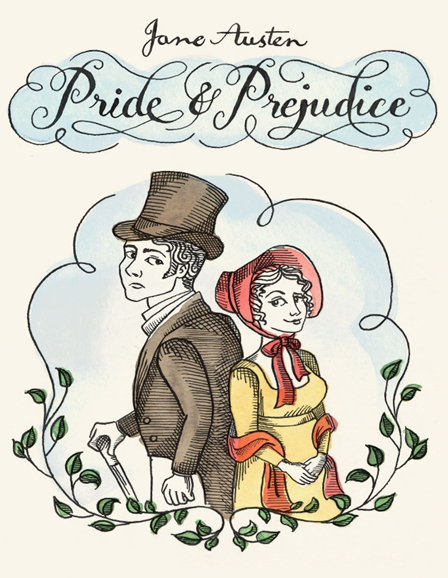
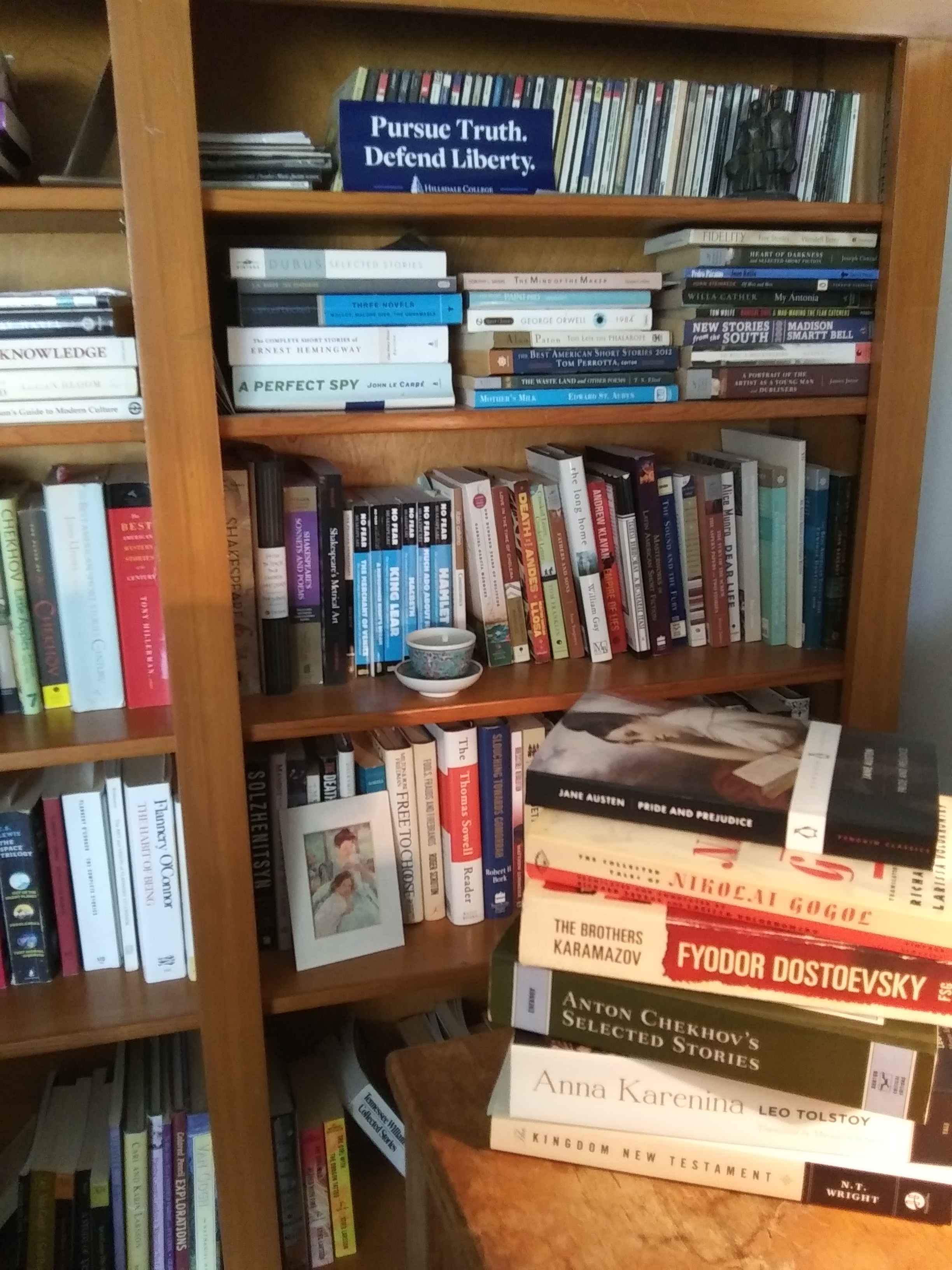
Recently, I picked up a Penguin Classics copy of Jane Austen’s Pride and Prejudice, a popular novel in the Austen canon. I read it to distance myself from the senseless present en route to WWIII and to thicken my temporal bandwidth. The reason for the latter is in my post The Lines of Others.
“To interact with people from different cultures and to gain a deeper appreciation of their values, beliefs, and customs. To become more empathetic and understanding toward others, even those who are very different from me. To gain a better understanding of the diverse world we live in and develop a more open-minded perspective.”
With Austen as guide I visited rural England at the turn of the 19th century. I found an ordered world governed by rules of etiquette. Tension between social expectations and personal feelings is often concealed behind formal politeness. Austen critiques social conventions regarding class distinctions, gender roles, and marriage through the use of irony, hyperbole, and witty rejoinders.
Her narrator’s opening lines set the viewpoint of the characters:
It is a truth universally acknowledged, that a single man in possession of a good fortune, must be in want of a wife.
However little known the feelings or views of such a man may be on his first entering a neighbourhood, this truth is so well fixed in the minds of the surrounding families, that he is considered the rightful property of some one or other of their daughters.
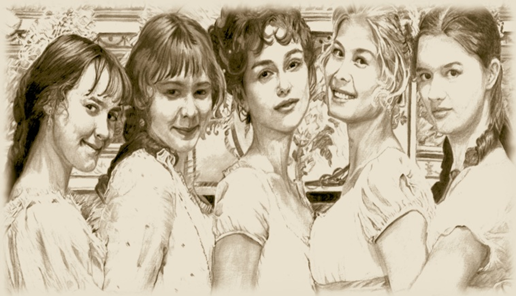
Enter the Bennet family with its five daughters: Jane, Elizabeth, Mary, Lydia, and Kitty.
Mr. Bennet is fond of books and is known for his sarcastic wit. Along with his favorite daughter “Lizzy,” he shares a distaste for the conventional views of wealth and rank. He also enjoys criticizing and teasing his youngest daughters Kitty and Lydia.
To his wife he says that they are “uncommonly foolish” and “two of the silliest girls in the country.” But his inability to step in and correct their behavior fosters his youngest daughters’ foolishness. Lydia will eventually be involved in a scandal that disrupts the social order and brings shame upon the family.
Mrs. Bennet is obsessed with finding suitable husbands for her daughters. The opening indicated this fixation but not the reasoning behind it. It has to do with a legal restriction on inheritance – an entail.
If Mr. Bennet passed, his estate, Longbourn, is entailed (transferred) to the closest male relative – his cousin, Mr. Collins. Mrs. Bennet saw no guarantee of Mr. Collin’s charity if that happened. She, justifiably so, knowing that acceptable employment opportunities were extremely limited for women in their social class, wanted her daughters to marry advantageously or she and they will be destitute and fall into social disgrace.
Mrs. Bennet’s favorite daughter, the one with “high animal spirits” is 15-year-old Lydia. Lydia is obsessed with men, especially the officers of her militia regiment. The flirtatious Lydia will become involved in a sexual scandal with a certain Mr. Wickham.
Mrs. Bennet is characterized as “a woman of mean understanding, little information, and uncertain temper.” She becomes fretful when her plans go awry. To ally her worries, she visits neighbors and gossips.
Elizabeth would later reflect on her father’s judgmental sarcasm, the flirtations of her wild youngest sisters Kitty and Lydia, and the unwillingness of her father and mother to control their behavior.
“They were hopeless of remedy. Her father, contented with laughing at them, would never exert himself to restrain the wild giddiness of his youngest daughters; and her mother, with manners so far from right herself, was entirely insensible of the evil.”
Beside the Bennet family, there are 20 characters in the novel. Some are charming (Charles Bingley). Some are annoying (Mrs. Bennett, Mr. Collins, Lady Catherine de Bourgh). Others, self-willed and careless (Lydia), rakish (Mr. Wickham), proud and stilted (Mr. Darcy). And one starts out very sure of herself (Elizabeth).
The characters meet at various gatherings. The Bennet sisters looked forward to every ball as dancing was a very important part of the courtship ritual. There, the daughters mingle with husband prospects and impressions are formed. At one ball, Bingley takes an immediate interest in the beautiful and shy Jane and Elizabeth danced with George Wickham.
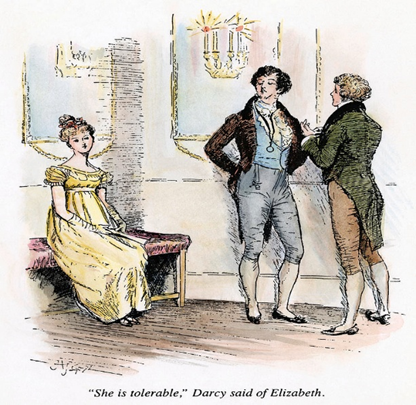
The Elizabeth and Fitzwilliam Darcy encounter is reserved but intriguing for both. Their relationship is where the pride and prejudice of the title comes in. It begins with class distinction: Elizabeth is the daughter of a country gentleman. Darcy is a rich aristocratic landowner.
Darcy, holding a common belief in the natural superiority of the wealthy landed gentry, walks around with the pride of rank and fortune and prejudice against the social inferiority of Elizabeth’s family. He comes off as distant. Elizabeth, equally aloof, wears her pride as independence of mind.
Elizabeth also noticed that Wickham and Darcy don’t get along. She begins to hold a grudge against Darcy based on his superior ways and on the self-serving words of Wickham that belittle him.
But she later sees Darcy anew when he involves himself in ‘fixing’ Lydia’s mess and restoring social order. She later sees herself anew.
~~~
Note: It is not my purpose with this post to summarize Pride and Prejudice. There are plenty of websites that do so. My purpose here is to bring to the foreground a character who learns to see differently. And to encourage everyone to thicken their personal bandwidth by reading great literature from the past. As you’ll see by reading Pride and Prejudice, wisdom and much more comes in doing so. Don’t judge a book by its cover.
~~~
The novel was more than I expected from a so-called “romance novel.” I came across personal growth in a character who humbled herself and let go of a grudge based on social pretensions and misjudgments. She was able to open her mind and her heart to new information and begin to see things differently. I came across Elizabeth Bennet and her Anagnorisis.
Anagnorisis is a literary device used in Greek tragedies and in many plots since. It is the moment of recognition. The main character, typically, transitions from ignorance to knowledge. This seeing anew is a turning point in the story, after which things concerning the main character are not viewed the same way again.
Elizabeths’ shift in perception comes after a revelatory letter from Darcy that discloses the opposite of what she had supposed about Wickham and himself. Darcy had thought it beneath him as a gentleman to speak of Wickham’s deceitful squandering behavior.
She spends time alone thinking things through. She questions her own discernment. The outcome of her interiority is summed in her words above. Elizabeth finally learns the truth about someone she accepted at face value (Wickham) and about someone that she judged harshly (Darcy). The prejudice in the title was not the latter’s but hers. She realizes she was greatly mistaken.
Elizabeth began as a rebel. She thought she was above society’s games. She’s witty but judgmental and arrogant when fixating on flaws. Her own pride mirrored that of the one she viewed as proud. But after spending time alone with the letter and hearing confirming reports, she confronts her own snobbery. Realizing how wrong she was she is humbled.
She grew absolutely ashamed of herself. Of neither Darcy nor Wickham could she think without feeling that she had been blind, partial, prejudiced, absurd.
“How despicably have I acted!” she cried; “I, who have prided myself on my discernment! I, who have valued myself on my abilities! who have often disdained the generous candour of my sister, and gratified my vanity in useless or blameable mistrust! How humiliating is this discovery! Yet, how just a humiliation! Had I been in love, I could not have been more wretchedly blind! But vanity, not love, has been my folly. Pleased with the preference of one, and offended by the neglect of the other, on the very beginning of our acquaintance, I have courted prepossession and ignorance, and driven reason away, where either were concerned. Till this moment I never knew myself.”
Pride and Prejudice. Chastened realism. Seeing anew. Wisdom born of humility. Wit and wisdom.
“When Darcy begins to show signs of being something more than what originally met the eye, Elizabeth is able to open her mind and her heart to him and discover the truth behind his distance and disdain. Her ability to do that — instead of holding a grudge — allows her to find, in Darcy, a true equal.”
~~~~~~
“Angry people are not always wise.” ― Jane Austen, Pride and Prejudice
“There is a stubbornness about me that never can bear to be frightened at the will of others. My courage always rises at every attempt to intimidate me.” ― Jane Austen, Pride and Prejudice
“From the very beginning— from the first moment, I may almost say— of my acquaintance with you, your manners, impressing me with the fullest belief of your arrogance, your conceit, and your selfish disdain of the feelings of others, were such as to form the groundwork of disapprobation on which succeeding events have built so immovable a dislike; and I had not known you a month before I felt that you were the last man in the world whom I could ever be prevailed on to marry.” ― Jane Austen, Pride and Prejudice
~~~~~
Simone Weil once said:
“There is something else which has the power to awaken us to the truth. It is the works of writers of genius. They give us, in the guise of fiction, something equivalent to the actual density of the real, that density which life offers us every day but which we are unable to grasp because we are amusing ourselves with lies.”
~~~~~
Rosamund Pike talks about narrating Pride & Prejudice
~~~~~
Forming the Imagination Through Literature
Joshua Villarreal, Teacher Support Lead for Hillsdale College K-12, delivers a lecture on how literature forms a student’s moral imagination.
This lecture was given at the Hoogland Center for Teacher Excellence seminar, “The Art of Teaching: Upper School Literature” in February 2025. The Hoogland Center for Teacher Excellence, an outreach of the Hillsdale College K-12 Education Office, offers educators the opportunity to deepen their content knowledge and refine their skills in the classroom.
He took the blind man by the hand and led him out of the village, and when he had put saliva on his eyes and laid his hands on him, he asked him, “Can you see anything?” And the man looked up and said, “I can see people, but they look like trees, walking.” Then Jesus laid his hands on his eyes again, and he looked intently, and his sight was restored, and he saw everything clearly. -The gospel of Mark, 8: 23-25
In the account above, Jesus amplified the blind man’s ability to see so that he could view physical reality with clarity. Now seeing, the man could function in the world. He no longer had to sit under the shade of a tree begging for assistance.
After Jesus announced the arrival of the kingdom of God on earth, he sought to increase the depth perception of his followers. He wanted them to be able to observe and perceive what that kingdom was about so that they could, with new insight, function in the kingdom.
Jesus acted and spoke for those with “eyes that see, ears that hear.” Others, conditioned by the world, would not see and hear what was going on. They remained blind and begging.
To amplify understanding, Jesus used allegorical short stories to create vivid pictures of reality as he saw it. He used parables when he taught and when he was tested.
When teaching on the cultivation of the kingdom of God he used the parable of the Sower.
When tested by an expert of religious law, he used the parable of the Good Samaritan. This encounter is recorded in Luke’s gospel account:
A religion scholar stood up with a question to test Jesus.
“Teacher, what do I need to do to get eternal life?”
Jesus responded with a question: “What’s written in God’s Law? How do you interpret it?”
The scholar gave a Torah answer: “Love the Lord your God with all your heart and with all your soul and with all your strength and with all your mind and love your neighbor as yourself.”
“Good answer!” said Jesus. “Do it and you’ll live.”
Looking for a loophole, the scholar then asked “And just how would you define ‘neighbor’?”
Jesus answered by telling the story of the Good Samaritan. He then asked, “What do you think? Which of the three – the priest, the Levite or the Samaritan – became a neighbor to the man attacked by robbers?”
“The one who treated him kindly,” the religion scholar responded.
Jesus said, “Go and do the same.”
In response to the initial test question, Jesus uses the Socratic method. He asked the scholar to give his own response to the eternal life question. Jesus acknowledges the scholar’s correct answer.
But then the scholar wished to justify his “neighbor” position in front of the crowd.
(You don’t do this, of course, unless you hold a well-known exclusionary stance such as associating with fellow Jews but not associating with Samaritans (viewed by Jews as a mixed race who practiced an impure, half-pagan religion), Romans, and other foreigners.)
The scholar’s question revealed what Jewish religious leaders, like those named in Jesus’ parable, thought about those who didn’t see the world like they did – ‘others’ should be excluded from their concern and left to die. This way of ‘seeing’ would lead to Jesus being (so they thought) permanently excluded, i.e., crucified.
Jesus doesn’t answer the scholar’s “neighbor” question. Instead, he exposes the insular blindness of the questioner with a short story.
Jesus shows, not tells, his answer so that the scholar and those listening may experience the answer through actions, words, subtext, thoughts, senses, and feelings rather than through exposition, summarization, and description. Jesus puts the scholar in the room, so to speak, with the Samaritan.
With the parable, Jesus wanted the scholar to see the world as he sees it, that of “God so loves the world” and not just a chosen few.
Note that in his response to the question “Who became a neighbor? the scholar refuses to name the ’other.’ He refuses to say “Samaritan.” He protected his standing in the community and his insular blindness.
Going on his way, the religious scholar now had an image to reflect on. He could see himself like the priest and the Levite and mind his own business and walk off, ignoring the one who is of no value to him. He could abandon the ‘other’ before any claim is made on him.
Or he could see beyond himself and exclusion and be a Samaritan and love his neighbor like himself. That would be kingdom ‘seeing.’
~~~~~
Man’s ability to see is in decline. Those who nowadays concern themselves with culture and education will experience this fact again and again. We do not mean here, of course, the physiological sensitivity of the human eye. We mean the spiritual capacity to perceive the visible reality as it truly is.
To be sure, no human being has ever really seen everything that lies visibly in front of his eyes. The world, including its tangible side, is unfathomable. Who would ever have perfectly perceived the countless shapes and shades of just one wave swelling and ebbing in the ocean! And yet, there are degrees of perception. Going below a certain bottom line quite obviously will endanger the integrity of man as a spiritual being. It seems that nowadays we have arrived at this bottom line. (Emphasis mine.) —Josef Pieper, Only the Lover Sings, “Learning How to See Again”
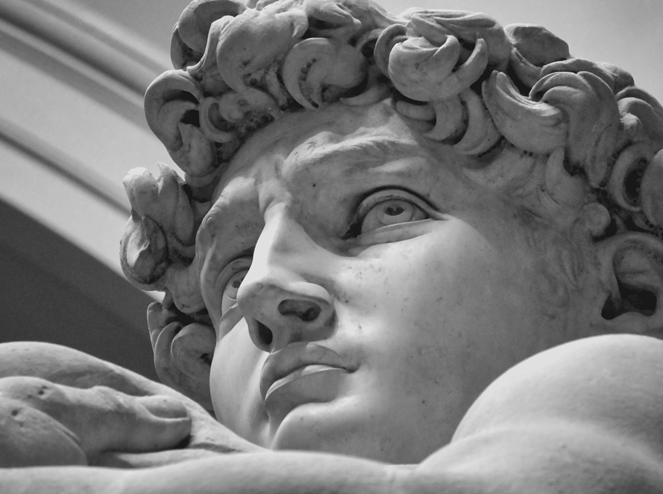
The concept of contemplation also contains this special intensified way of seeing. A twofold meaning is hereby intended: the gift of retaining and preserving in one’s own memory whatever has been visually perceived. How meticulously, how intensively—with the heart, as it were—must a sculptor have gazed on a human face before being able, as is our friend here, to render a portrait, as if by magic, entirely from memory! And this is our second point: to see in contemplation, moreover, is not limited only to the tangible surface of reality; it certainly perceives more than mere appearances. Art flowing from contemplation does not so much attempt to copy reality as rather to capture the archetypes of all that is. Such art does not want to depict what everybody already sees but to make visible what not everybody sees. (Emphasis mine.) —Josef Pieper, Only the Lover Sings, “Three Talks in a Sculptor’s Studio: Vita Contemplativa”
“Josef Pieper (1904-1997) was a distinguished twentieth-century Thomist philosopher. Schooled in the Greek classics and in the writings of St. Thomas Aquinas, he studied philosophy, law, and sociology, and taught for many years at the University of Münster, Germany.”
Pieper is most noted for his many books on virtue. In fact, he is commonly known as the “Philosopher of Virtue.” Virtue for Pieper, following Aristotle and Aquinas, is perfective of the person. But the person is real and has an identifiable and intelligible nature. Wherever this nature is denied, totalitarianism gains a foothold. For, if there is no human nature, then there can be no crimes against it.
Pieper wrote while drafted into Germany’s army during World War II and is credited for translating C.S Lewis’s Problem of Pain into German. Because he criticized the Nazis regime, his works were not published until later.
It is said that “While many philosophers in his time focused on politics, Pieper was concerned with the great tradition of Western Culture. He spent his entire life reflecting on the value of culture in modern society and the necessity of the creative arts for the nourishment of the human soul.”
Josef Pieper’s short essay Learning How to See Again begins: “Man’s ability to see is in decline.” Even in the 1950s when he wrote the essay, he suggested that there was too much to see. How much more are we distracted today by screens.
Pieper recommended an artistic vision – visual, musical or literary – as a conduit for the contemplative life. He proposed participating in the arts as a remedy for seeing anew, to see reality as it truly is.
Benedict Whalen, associate professor of English at Hillsdale College, delivers a lecture on how to teach Tales From Shakespeare by Charles and Mary Lamb to young children.
This lecture was given at the Hoogland Center for Teacher Excellence seminar, “The Art of Teaching: Children’s Literature” in September 2024. The Hoogland Center for Teacher Excellence, an outreach of the Hillsdale College K-12 Education Office, offers educators the opportunity to deepen their content knowledge and refine their skills in the classroom.
Watching protesting students align themselves with the terrorist group Hamas and their Palestinian pawns, one wonders what legacy they are building for themselves. Are they – the combine of victim-oppressor social justice warriors – really acting for the greater good with their pro-Hamas and antisemitic chants? Whose interests are they serving? Will they later regret their actions and associations, or will their self-deception and moral distortion continue on the rest of their lives?
Looking back over one’s life work, one’s ruling passion, and reconciling that with what one’s dedicated service contributed to forms the basis of two of Kazuo Ishiguro’s novels: An Artist of the Floating World and The Remains of the Day.
Two men – a Japanese artist in the first novel and an English butler in the second – aspired to reach the highest level in their professions. Both men were attuned to honor and dignity. Both men wanted to attach themselves to a greater worldly-good. But their singular focus, their self-constrained temporal bandwidth, shut out all else until later in life (the time period in the novels). They come to see that what they gave their singleness of mind and efforts to turned out to be not just heartbreaking and reputation damaging but devastating to the greater good.
Both men come across as guarded in their retelling of events and observations in diary-like fashion, as if they didn’t want to be too harsh on themselves. By their unreliable narration we wonder if there’s more under the surface. As things come to the fore, we learn there is a tension between how each saw the world and how the world really was. And this becomes cause for a conflicted life and one of guilt, deflection, and regret about past myopia and former associations.
Each man talks as if “you” were like them – as someone living in the same neighborhood in post-war Japan and as a butler in England. The world doesn’t extend beyond their interests. There are those – daughters, an old friend, a journalist, a housemaid, local towns folk -who try to draw them out.
The artist Masuji Ono’s narration occurs after the end of WWII in 1945 (Oct. 1948 June 1950), when Japan is rebuilding her cities after defeat. We learn that Ono is a retired printmaker who lost his wife Michiko and son Kenji during the war. His beautiful home was seriously damaged by the war as was his reputation.
The elderly Ono spends his time gardening, working on the house, with his visiting daughters and his grandson and going out at night to drink in a quiet lantern-lit bar, a remnant of the pleasure district – the “floating world” of pleasure, entertainment and drink that had at one time given him much pleasure. It’s where he escapes from his dark past.
Ono recalls his early printmaking days and his rise to be a master printmaker surrounded by adoring students in the bar. We learn of his desire to go beyond just making beautiful art. He wanted to serve a higher purpose. We come to learn of Ono’s dark past – his direct involvement in Imperialist Japan’s military rise and his work as a government propagandist.
Ono reassesses events from his past throughout the novel. He reconsiders his role in those events and his guilt. His reputation proceeds him as he enters into marriage negotiations for his daughter Noriko. He also assesses how Japan is changing since the war. He questions some of the change:
“Something has changed in the character of the younger generation in a way I do not fully understand, and certain aspects of this change are undeniably disturbing.”
“Democracy is a fine thing. But that doesn’t mean citizens have a right to run riot whenever they disagree with something.”
Does Ono admit he was wrong to be a propagandist in the deadliest military conflict in history? Does he come to terms with the mistakes he made in the course of his life? Does he attain satisfaction and dignity when all is said and done?
~~
Mr. Stevens’ narration occurs during a six-day road trip in the summer of 1956. He goes to visit Mrs. Benn, nee Kenton, in the sea-side town of Weymouth, England. During this time, he reminisces about his days as head butler at Darlington Hall after WWI and leading up to WWII.
Mr. Stevens is a prim and proper Jeeves-like butler who speaks in a measured and precise way. He values professionalism and dignity above all else.
“The great butlers are great by virtue of their ability to inhabit their professional role and inhabit it to the utmost . . . They wear their professionalism as a decent gentleman will wear his suit. . . It is, as I say, a matter of “dignity.”
Mr. Stevens’ devotion and dedicated service is focused on a man he holds in high esteem: Lord Darlington. “A gentleman through and through” and “I for one will never doubt that a desire to see “justice in this world” lay at the heart of all his actions” and “All those years I served him, I trusted I was doing something worthwhile” says Stevens.
High level meetings are held at Darlington Hall after WWI. Lord Darlington lobbies leaders from England, France and America to go financially easy on Germany.
Lord Darlington, an old-fashioned English gentleman, is much like Mr. Stevens. He can’t imagine a world different from his own. He never understands the true agenda of the Nazis even as the fascists he invites to Darlington Hall seek to turn him against the Jews. Lord Darlington, “A gentleman through and through”, becomes an appeaser and Nazi sympathizer in the name of honor, fairness, friendship, and gentlemanly conduct.
The devoted Stevens views Lord Darlington as a man who had good intentions but was led astray by manipulative diplomats. “I for one will never doubt that a desire to see ‘justice in this world’ lay at the heart of all his actions.”
The devoted Stevens goes with the flow:
“How can one possibly be held to blame in any sense because, say, the passage of time has shown that Lord Darlington’s efforts were misguided, even foolish? Throughout the years I served him, it was he and he alone who weighed up evidence and judged it best to proceed in the way he did, while I simply confined myself, quite properly, to affairs within my own professional realm. And as far as I am concerned, I carried out my duties to the best of my abilities, indeed to a standard which many may consider ‘first rate’.”
The devoted Stevens extrapolates his efforts:
“A ‘great’ butler can only be, surely, one who can point to his years of service and say that he has applied his talents to serving a great gentleman – and through the latter, to serving humanity.”
Miss Kenton, the lead housemaid at Darlington Hall, is like Stevens. She takes great pride in her work. But unlike Stevens, she has emotional latitude and an independent streak. She is intelligent, headstrong, and stubborn. She disagrees not only with Stevens at time but also with the decisions made by Lord Darlington.
Though she finds Mr. Steven infuriating – “Why, Mr. Stevens, why, why, why do you always have to pretend?” – it gradually becomes clear that Miss Kenton is in love with him. But after many years, she leaves Darlington Hall. Frustrated at Mr. Stevens’ buttoned up emotional state and lack of response Miss Kenton goes off with Mr. Benn, a footman of the house.
Years later, Stevens receives a letter from Miss Kenton. He reads it over and over believing that she might return to her post at Darlington Hall under a new owner. The letter indicates that her marriage to Mr. Benn might not be working out. Stevens’ hopes are up but well-regulated.
His new employer, a wealthy American named Mr. Farraday, tells Stevens to take some time off. He offers Stevens his car for a road trip. And off Stevens goes to see Miss Kenton.
On his way, Stevens comes into contact with several working-class characters. They challenge Stevens’ ideas about dignity. One man opines that dignity is about democracy and standing up for one’s beliefs – in other words, being attentive to what’s going on in the world and being outspoken. This, of course, is in contrast to Stevens’ conception of dignity as being about suppressing one’s own feelings in pursuit of professionalism.
What happens when Stevens reaches Weymouth and meets Mrs. Benn?
What does hindsight look like to Stevens? Does it look like not worrying oneself too much about what one could or could not have done to control the course one’s life took? Does it look like a simple butler trying to make a small contribution count for something true and worthy and sacrificing much in life in order to pursue such aspirations, that in itself, whatever the outcome, is cause for pride and contentment?
Does Stevens, as he reflects on things at the end of the day, realize the mistake he made in his lockstep devotion to Lord Darlington? Does he take the blinders off? And, does he understand the effects of his obsessive devotion to professionalism and dignity on his personal life?
Stevens gives his thoughts on the latter to a man sitting next to him on the pier as they watch the sun going down and the pier lights come on:
“The fact is, of course,’ I said after a while, ‘I gave my best to Lord Darlington. I gave him the very best I had to give, and now – well – I find I do not have a great deal more left to give.”
I return to my opening questions. Whose interests were they serving? Will they later regret their actions and associations or does willful blindness and self-deception remain?
“There was surely nothing to indicate at the time that such evidently small incidents would render whole dreams forever irredeemable.” ― Kazuo Ishiguro, The Remains of the Day
~~~~~
This post wasn’t meant to provide a complete summary of Kazuo Ishiguro’s two novels. There is a whole lot going on in each that I haven’t touched on. They are very well written human-interest stories. The Remains of the Day won The Booker Prize.
Rather, I saw parallels between the decisions youth are making today, with all ardor, for deadly causes and the experiences and feelings of the artist Masuji Ono and the butler Stevens.
I’ve read both novels. I saw the Remains of the Day before reading the book. This Merchant Ivory film is one of my favorites (There is no murder and mayhem, no car chases, no heavy breathing, no queer theory or CRT, and no Disney twaddle.)
The cast is top-notch. I recommend reading the book before viewing the movie and listening to the podcast below (spoiler alert!).
The movie, of course, is edited way down to try and give the essence of Ishiguro’s novel. But reading the text first will provide the depth and richness of the characters and much more detail of their situations.
Luke Ripley, the focal character of A Father’s Story by Andre Dubus, begins his narration with what he calls “my life” – the life people in northeastern Massachusetts know about. He then goes on to detail his personal “real life.” And later, we hear about his life without peace after an incident involving his daughter. After all is said and done, I wonder what you would think about this self-reliant guy who is comfortable with his contradictions and who refuses to sacrifice his daughter. And, who is he really protecting when all is said and done?
Luke’s publicly recognized “my life” is that of a stable owner. He boards and rents out thirty horses and provides riding lessons. The “my life” that people would see if they looked in his front room window at night is a solitary “big-gutted grey-haired guy, drinking tea and smoking cigarettes, staring out at the dark woods across the road, listening to a grieving soprano.”
Luke’s “real life” – the one nobody talks about anymore, except Father Paul LeBoeuf”- is revealed to us before the accident in the first three-quarters of the story. What do we learn?
Luke Ripley is a divorced Catholic and an empty nester with three sons and a daughter off somewhere else. His solitary existence is lived out in routine. We learn of Luke’s morning habit of prayer while making his bed and then going to feed his horses. He talks to God because there’s nobody else around.
His morning habit also includes seeing his best friend – Father Paul Leboeuf, the priest at a local Catholic church. Most mornings Luke rides one of his horses over to church where Father Paul’s officiates. There Luke hears the Mass and receives the Eucharist. During the week the two men get together for a dinner meal. With Father LeBeoeuf present and a can of beer in hand Luke verbally grieves his despair over losing his wife and his family.
At one point Luke tell us about the importance of ritual, having already told us that he is basically lazy person:
Do not think of me as a spiritual man whose every thought during those twenty-five minutes is at one with the words of the mass. Each morning I try, each morning I fail, and I know that always I will be a creature who, looking at Father Paul and the altar, and uttering prayers, will be distracted by scrambled eggs, horses, the weather, and memories and daydreams that have nothing to do with the sacrament I am about to receive. I can receive, though: the Eucharist, and also, at Mass and at other times, moments and even minutes of contemplation. But I cannot achieve contemplation, as some can; and so, having to face and forgive my own failures, I have learned from them both the necessity and wonder of ritual. For ritual allows those who cannot will themselves out of the secular to perform the spiritual, as dancing allows the tongue-tied man a ceremony of love.
The life that Luke tells the reader about is one filled with a variety of contradictions: He is a devout Catholic but divorced; he attends Mass regularly but does not always listen; he enjoys talking to his priest but casually, preferably over a few beers, and what they discuss is mostly small talk; he is a self-described lazy man who dislikes waking up early but does so each morning to pray, not because he feels obligated to do so but because he knows he has the choice not to do so. Luke Ripley is a man who lives with contradictions and accepts them.
Luke wants us to know that he lived through difficult days after the divorce and what he believed ritual could have done for his marriage:
It is not hard to live through a day, if you can live through a moment. What creates despair is the imagination, which pretends there is a future, and insists on predicting millions of moments, thousands of days, and so drains you that you cannot live the moment at hand. That is what Father Paul told me in those first two years, on some bad nights when I believed I could not bear what I had to: the most painful loss was my children, then the loss of Gloria, whom I still loved despite or maybe because of our long periods of sadness that rendered us helpless, so neither of us could break out of it to give a hand to the other. Twelve years later I believe ritual would have healed us more quickly than the repetitious talks we had, perhaps even kept us healed. Marriages have lost that, and I wish I had known then what I what I know now, and we had performed certain acts together every day, no matter how we felt, and perhaps then we could have subordinated feeling to action, for surely that is the essence of love. I know this from my distractions during Mass, and during everything else I do, so that my actions and my feelings are seldom one. It does happen every day, but in proportion to everything else in the day, it is rare, like joy.
The loss of his wife Gloria and her leaving the church and the loss of his children figured large in Luke’s life. But the “third most painful loss, which became second and sometimes first as months passed, was the knowledge that I could never marry again, and so dared not even keep company with a woman.”
Luke lets Father Paul know that he is bitter about this. And, that when he was with Gloria he wasn’t happy with the “actual physical and spiritual plan of practicing rhythm: nights of striking the mattress with a fist…”
Early in the narration we learn Luke’s thoughts about his friend Father Paul, the Catholic church, and tithing – “I don’t feel right about giving money for buildings, places.”
We later hear his reflections on Jennifer, his only daughter, becoming a woman: “It is Jennifer’s womanhood that renders me awkward.”
He relates how her growing up affected the ‘ritual’ of memories he kept of her as his sheltered little girl at home. Jennifer became an on-her-own twenty-one-year-old girl with a purse full of adult symbols including a driver’s license. Luke says that he wants to know what she is up to and he doesn’t want to know what she is up to.
And then one night, Jennifer involves her father in a life-altering incident. Luke, to manage the situation, sticks with ritual as if nothing had happened. Ritual, we learned, might have saved his marriage to Gloria. So, Luke returns to default ritual to “save” the only other woman in his life. He wasn’t about to give her up, not even to Father Paul. Luke continues his rituals but does not confess to Father Paul.
The story ends with Luke telling the reader how he justifies himself to God, in Job-like fashion each morning, for what he did: the love a father has for a daughter is different than he has for a son and he loves his daughter more than truth.
Luke’s OK with a guy being hit by the car and but not a woman. Men, like Charles Bronson and Clint Eastwood, are supposed to take the bang ups and arrests and prison time.
In the end, however, Luke must answer to God for what he does to protect Jennifer. Self-serving ritual will not save him.
I’ve read this story twice. The first time, several years ago, I felt I knew the protagonist. He was like a former father-in-law: a divorced Catholic man in his fifties who wore Old Spice, hid Playboys, had daughters, and who thought himself manly in a Hemingwayesque sense. So, it was easy to have a sentimental attachment to Luke. I could empathize with his grief about losing a spouse and children and with his ritual-managed loneliness. And especially so as he acted instinctively to protect his daughter.
After a second reading this past week, I saw Luke differently – beneath the surface, so to speak. And, I had some questions:
When all is said and done by Luke, is he really protecting himself, his “real life”, his ritualized sources of comfort, when he protects his daughter from being taken away?
Did Luke really just act out of laziness (laziness being the opposite of love) in order to maintain ritual and continue life as he knew it?
Was Luke’s manhood tied to his comfort from women?
Wasn’t it cruel, unjust, and devastating to the other family and father involved for Jennifer and Luke to leave the scene of the crime and to let things just go on without answers?
As a parent, what would I do in this situation?
A Father’s Story was first published in the Spring 1983 issue of Black Warrior Review.
Our common understanding of what Peter’s betrayal of Jesus meant. Our shared history of misery and redemption. Our interrelated human experience of being guided by truth and beauty. Each of these connections are considered by a twenty-two-year-old clerical student named Ivan Velikopolsky in the very short story The Student (1894) by Anton Chekhov.
Things start out fine for hunter Ivan on Good Friday. The weather is agreeable. But when it begins to grow dark the weather turns cold and stiff winds blow. He starts to walk home.
On the path, he feels that nature itself is “ill at ease” by the change in weather and that darkness in response is falling more quickly. He senses overwhelming isolation and unusual despair surrounding him and the village three miles away where he spots the only light – a blazing fire in the widow’s garden near the river.
As he walks, he remembers what is waiting for him at home – a miserable situation that he sees as the desperation, poverty, hunger, and oppression of what people have dealt with over time and that it’s always been this way no matter the secular changes by those who come along. He doesn’t want to go home. Instead, he walks over to the campfire at the widow’s garden.
There, by the fire, are two widows – Vasilisa and her daughter Lukerya. He greets them and they talk.
Ivan relates the gospel events to the two widows. This has an acute effect on them. As he heads home, Ivan reflects on the implications of this and has an epiphany.
“At just such a fire the Apostle Peter warmed himself,” said the student, stretching out his hands to the fire, “so it must have been cold then, too. Ah, what a terrible night it must have been, granny! An utterly dismal long night!”
. . .it was evident that what he had just been telling them about, which had happened nineteen centuries ago, had a relation to the present — to both women, to the desolate village, to himself, to all people.
He returns home with a different outlook. He sees the “same desperate poverty and hunger, the same thatched roofs with holes in them, ignorance, misery, the same desolation around, the same darkness, the same feeling of oppression” differently – with an attitude of “unknown mysterious happiness”. There’s a sense of resurrection in Ivan’s attitude as he rises out of the despondency of dark winter’s return to a new life of hope based on the human connection to enduring truth and with Easter on the horizon.
Was Ivan’s new attitude born out of the women’s reaction that signaled an age-old inherent understanding of what the betrayal of truth produces?
It seems to me that Ivan is more than just a clerical student. He’s also a student of history and cultural anthropology. And he knows scripture. He is able to see our common plight and our common redemption through the broken lives of others.
I’m not going to share any more of this gem of a very short story (2 min. read). Ivan has more to say to us from his epiphany. I recommend reading the story before listening to the audio version of it with commentary at the end.
The Student was written 130 years ago. Chekhov’s realist fiction hands to readers today one end of an unbroken chain of truth.
Will the human condition improve with Progressivism or when humans stop betraying the truth and seek what is above instead of materialism?
John Donne wrote “No man is an island entire of itself”. Certainly, no man is a context entirely of himself.
And Thomas Dubay said
The acute experience of great beauty readily evokes a nameless yearning for something more than earth can offer. Elegant splendor reawakens our spirit’s aching need for the infinite, a hunger for more than matter can provide.
“Poetically translated to “golden joinery,” kintsugi, or Kintsukuroi, is the centuries-old Japanese art of fixing broken pottery. Rather than rejoin ceramic pieces with a camouflaged adhesive, the kintsugi technique employs a special tree sap lacquer dusted with powdered gold, silver, or platinum. Once completed, beautiful seams of gold glint in the conspicuous cracks of ceramic wares, giving a one-of-a-kind appearance to each “repaired” piece.”Kintsugi, a Centuries-Old Japanese Method of Repairing Pottery with Gold (mymodernmet.com)
“The aesthetic that embraces insufficiency in terms of physical attributes, that is the aesthetic that characterizes mended ceramics, exerts an appeal to the emotions that is more powerful than formal visual qualities, at least in the tearoom. Whether or not the story of how an object came to be mended is known, the affection in which it was held is evident in its rebirth as a mended object. What are some of the emotional resonances these objects project?
“Mended ceramics foremost convey a sense of the passage of time. The vicissitudes of existence over time, to which all humans are susceptible, could not be clearer than in the breaks, the knocks, and the shattering to which ceramic ware too is subject. This poignancy or aesthetic of existence has been known in Japan as mono no aware, a compassionate sensitivity, an empathetic compassion for, or perhaps identification with, beings outside oneself. It may be perceived in the slow inexorable work of time (sabi) or in a moment of sharp demarcation between pristine or whole and shattered. In the latter case, the notion of rupture returns but with regard to immaterial qualities, the passage of time with relation to states of being. A mirage of “before” suffuses the beauty of mended objects.”
“What kind of a church would we become if we simply allowed broken people to gather, and did not try to “fix” them but simply to love and behold them, contemplating the shapes that broken pieces can inspire?” ― Makoto Fujimura, Art and Faith: A Theology of Making
“There is something else which has the power to awaken us to the truth. It is the works of writers of genius. They give us, in the guise of fiction, something equivalent to the actual density of the real, that density which life offers us every day but which we are unable to grasp because we are amusing ourselves with lies.”
Simone Weil
Last year I spent several months with the Oblonskys, the Shcherbatskys, the Karenins, the Vronskys, the Levins, and a host of others. I did this, not as a foreign exchange student living in Russia, but as a mind traveler using the “guise of fiction” by a writer of genius.
Reading the 742 pages of Tolstoy’s Anna Karenina (1878) was a way for me to experience humanity in another time and place.
In community with them, I saw how they lived. I saw what they saw. I heard what they said and thought. I learned what transpired from what they had said, thought and done. During my time with them, I became aware of the inner personality of each person and recognized matters of love and of good and evil that are timeless.
I watched Anna change from a warm and appealing person at the beginning of my stay into a small, spiteful, and self-absorbed woman at the end – all because of her vain imaginings about love and about how the world and those around her were thought to be. With ongoing self-deception, she came to think in terms of extremes and therefore made herself believe she understood everything and everyone in totality: it’s all the same and life was a Darwinian struggle for survival.
Looking back at my time with Anna, I see her narcissism, a personality disorder impacting many today, as a shrunken one-size-fits-me “temporal bandwidth” (see below). I learned a lesson from her toxic attitude: life is not about me.
Stiva, Anna’s hedonist brother, was consistently evil in an absence-of-good way. He forgets, neglects, and fails to act. He’s put his own household into chaos. He lives entirely in the present without regard for the effect he has on his family and future generations.
Dolly, Stivas’s wife, was a consistently good woman who showed self-giving love. She raised children married to such a husband.
Konstantin Dmitrievich Levin, over time, matured. He came to understand love as he watched his wife Kitty. And I witnessed Levin’s spiritual journey to faith in God.
A similar mind traveler experience occurred when I spent months in Russia with The Brothers Karamazov – Dmitri, Ivan and Alexei and their father Fyodor Pavlovich and his illegitimate son, Pavel Fyodorovich Smerdyakov. Agrafena Alexandrovna Svetlova, Katerina Ivanovna Verkhovtseva, Ilyusha, and Father Zosima, the Elder also lived nearby. Quite a cast of characters when you get to know them and quite a legacy of behavior and thought they provide.
In Chekhov’s world of short stories, I shared in the experiences of many. I laughed, cried and saw myself in the everydayness of those I met along the way.
Why read 1800s novels Anna Karenina and The Brothers Karamazovand learn about people with weird names when I could have spent that time watching Yellowstone and taking in a C&W vibe? Why did I read Love in the Time of Cholera when I could have watchedanother car chase scene or another mindless comedy? Why did I read Death in the Andes when I could have watched a detective series. Why did I read My Antonia or Heart of Darkness or King Lear, for that matter, when I could have been on social media amusing myself? Why did I read anything outside my context as a Christian? Isn’t there some self-help personal growth book that will give a perspective on the world so I don’t have to venture out of a theological “safe space”?
I’ll give an answer a foreign exchange student would give for wanting an out-of-context experience:
“To interact with people from different cultures and to gain a deeper appreciation of their values, beliefs, and customs. To become more empathetic and understanding toward others, even those who are very different from me. To gain a better understanding of the diverse world we live in and develop a more open-minded perspective.”
Why read great literature from the past?
To rewire my brain from a competitive judgmental either/or reactionary mindset to a more deliberative way of thinking. To train my brain to think before leaping to conclusions. To employ such reading as a dopamine-hit buffer.
To gain the wisdom of those before me.
To grow faith and love. Imagination is required for faith. Imagination is cultivated by reading the unknown. Reading requires attentiveness. Love is attentiveness
To keep in mind that the prodigal son went looking for the Now thinking that anything could be better than what came before. He found the Now and it affirmed him to be a hungry desperate slave who longed to be fed what he fed the pigs (Luke 15:11-32).
To see another point of view and how it was arrived at.
To be a humanities archeologist. Everything came before Now. And up until broadcast media came around, all we had were the lines of others – words, music, and art.
To not be a reed in the wind. To cultivate “Temporal bandwidth” – “temporal bandwidth is “the width of your present, your now … The more you dwell in the past and future, the thicker your bandwidth, the more solid your persona. But the narrower your sense of Now, the more tenuous you are.”” – Alan Jacobs, To survive our high-speed society, cultivate ‘temporal bandwidth’
To not live as a presentist, as someone whose temporal bandwidth has narrowed to the instant something is posted on social media.
To imagine the future using what I learned from the past. For example, I read Solzhenitsyn to understand what it’s like to live under communism.
(If your temporal bandwidth is expanded even somewhat and you are not “amusing yourself with lies”, you see what was plotted before happening now. Joe Biden, along with abetting Globalist Progressives, is implementing the Cloward-Piven Strategy first developed in 1966. That strategy seeks to hasten the fall of capitalism by swarming the country with mass migration, overloading the government bureaucracy, creating a crushing national debt, have chaos ensue, take control in the chaos, and implement Socialism and Communism through Government Force.
To wit, beside the ongoing invasion of the U.S., our nation is incurring massive debt. There is the ongoing silencing of dissent by the DOJ, FBI, and social media cohorts. There is a push to impose digital IDs and digital currency along with WHO oversight to control us. The misanthropic handling of our lives should be a clarion signal to you that communist totalitarianism is coming!)
Books are safe spaces. But if you believe that words are violence (Toni Morrison in her Nobel prize address: “Oppressive language does more than represent violence. It is violence”) then you’ll stay in your “safe place” and refuse to be “breaking bread with the dead” (or listen to opposing views) where one can be an interlocuter and ask why and not just assume things and express rage.
I see going to a “safe space” as the closing in of one’s “temporal bandwidth” much like what Anna Karenina did. It has the exact opposite of a fortifying effect as one is made tenuous, anxious, and very susceptible to narcissism and Groupthink. (Ironically, that is also the effect of DEI.)
Here are two quotes from someone who championed the idea of Great Books, Allan Bloom that apply to what’s been said:
The most successful tyranny is not the one that uses force to assure uniformity but the one that removes the awareness of other possibilities, that makes it seem inconceivable that other ways are viable, that removes the sense that there is an outside.
The failure to read good books both enfeebles the vision and strengthens our most fatal tendency – the belief that the here and now is all there is.
Why read the realist fiction of writers such as Solzhenitsyn, Dostoyevsky, Tolstoy, Chekhov, and others? To break bread with the dead and step out of my context into the lines of others.
Alan Jacobs, the Distinguished Professor of Humanities in the Honors Program at Baylor University and Senior Fellow at the Institute for Advanced Studies in Culture encourages what I call “mind travel” to the past in his book Breaking Bread with the Dead: A Readers Guide for a More Tranquil Mind.
W. H. Auden once wrote that “art is our chief means of breaking bread with the dead.” In his brilliant and compulsively readable new treatise, Breaking Bread with the Dead, Alan Jacobs shows us that engaging with the strange and wonderful writings of the past might help us live less anxiously in the present—and increase what Thomas Pynchon once called our “personal density.”
Today we are battling too much information in a society changing at lightning speed, with algorithms aimed at shaping our every thought—plus a sense that history offers no resources, only impediments to overcome or ignore. The modern solution to our problems is to surround ourselves only with what we know and what brings us instant comfort. Jacobs’s answer is the opposite: to be in conversation with, and challenged by, those from the past who can tell us what we never thought we needed to know.
. . .
By hearing the voices of the past, we can expand our consciousness, our sympathies, and our wisdom far beyond what our present moment can offer.
. . . benefit of reflecting on the past is awareness of the ways that actions in one moment reverberate into the future. You see that some decisions that seemed trivial when they were made proved immensely important, while others which seemed world-transforming quickly sank into insignificance. The “tenuous” self, sensitive only to the needs of This Instant, always believes – often incorrectly – that the present is infinitely consequential.
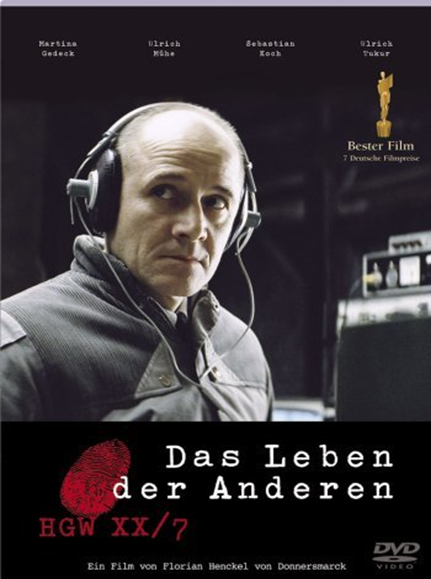
The title of this post is a reference to the 2006 movie The Lives of Others. The plot involves the 1984 monitoring of East Berlin residents by Stasi agents of the East German Democratic Republic (GDR).
Stasi Captain Gerd Wiesler is told to conduct surveillance on playwright George Dreyman and his girlfriend, actress Christa-Maria Sieland. As Wiesler listens in from his attic post, he finds himself becoming increasingly absorbed by their lives. You’ll have to watch the movie to see if he is changed by listening to the lives and lines of others and becomes a “good man”.
~~~~~
Of course, the lines of others must include classical music, a rich and diverse soundscape. The soundscape of Now is constant noise.
Cherie Harder speaks with Alan Jacobs about the benefits of reading old books. Jacobs makes the compelling claim–using a phrase from Thomas Pynchon’s Gravity’s Rainbow–that spending our time and attention on writers from the past can increase our “personal density.”
Gary Saul Morson, a Dostoyevsky scholar, writes in a Plough article about Fyodor Dostoevsky and introduces a graphic novel adaptation of “The Grand Inquisitor” from The Brothers Karamazov.
Here is an excerpt:
In Dostoyevsky’s time, numerous schools of thought, ranging from English utilitarianism to Russian populism and socialism, maintained that they had discovered the indubitable solution to moral and social questions.
This way of thinking appalled Dostoyevsky. With his profound grasp of psychology, he regarded the materialists’ view of human nature as hopelessly simplistic. Deeply suspicious of what intellectuals would do if they ever gained the power they sought, he described in greater detail than any other nineteenth-century thinker what we have come to call totalitarianism. Even in its less terrifying forms, rule by supposedly benevolent experts was, he thought, more dangerous than people understood.
. . .
For Dostoyevsky, the Christian view of life, which most intellectuals regarded as primitive, offered a far more sophisticated understanding than materialist alternatives. . .. he regarded it as a profound mistake to rely only on technological solutions to social problems, a perspective that, if anything, needs to be challenged all the more strongly today. Man does not live by iPhone alone.
Why does it feel like everything has been going haywire since the early 2010s, and what role does digital technology play in causing this social and epistemic chaos?
A recommendation: NO smartphones for your children until at least 16 years of age. They can use a simple flip phone till then.
New book:
The Anxious Generation: HOW THE GREAT REWIRING OF CHILDHOOD IS CAUSING AN EPIDEMIC OF MENTAL ILLNESS by Jonathan HaidtHOW THE GREAT REWIRING OF CHILDHOOD IS CAUSING AN EPIDEMIC OF MENTAL ILLNESS
Love. Is it die-cut like the Valentine cards of grade school? Is it cliché like pop music? Is it a potion we constantly thirst for? Is it intoxication and under its influence we are not in our right minds? Is love passion? Sentimental? Carnal? Absolute? “What do any of us really know about love?”
The last question is raised during a conversation between two couples. Their dialog and the juxtaposition of the couple’s ideas about love are found in Raymond Carver’s 1981 short story What We Talk About When We Talk About Love. Carver has us listen in.
We learn from narrator Nick that he and his wife Laura are spending the afternoon at Mel and Terri’s home. Both couples live in Albuquerque, but as Nick says and the ‘love’ dialog relates, they “were all from somewhere else”.
Nick tells us that Mel McGinnis is a forty-five-year-old cardiologist who, before medical school, spent five years in seminary. Terri is his second wife. We later learn that Mel was married before to Majorie and has two children. His movements are usually precise when he hasn’t been drinking.
Terri, we learn, was previously in an abusive relationship with a guy named Ed. He would beat her and drag her around the room by her ankles, all the while professing his love for her.
Mel and Terri have been married for four years.
Nick tells us about Laura and their relationship: she’s a legal secretary who’s thirty-five and three years younger than he is. He says they’re in love, they like each other and enjoy each other’s company. “She’s easy to be with.” They’ve been married for eighteen months.
Beside the four adults, sunlight and gin figure in the story.
As the story begins, the four are sitting around a kitchen table. Sunlight fills the room. Gin and tonic water are being passed around. The subject of love comes up.
(I get the sense that the older couple have argued a lot about what love is and now want to air it all again in front of the younger couple. It seems they have things they want to get off their chest. Is that why the cheap gin is being passed around? Are Nick and Laura in place to be the arbiters of who’s right and who’s wrong?)
The heart doctor Mel, based on “the most important years of his life” in seminary, thinks that “real love was nothing less than spiritual love”. (This signals that love’s definition may not be solid.)
Terri believes that Ed, the man who tried to kill her, loved her. She asks “What do you do with love like that? Mel responds that Ed’s treatment could not be called love.
Terri then makes excuses for Ed’s behavior – “People are different”. She defends him – “he may have acted crazy. Okay. But he loved me.”
We begin to notice a growing tension between Mel and Terri. (There has been tension in their marriage about Ed and Marjorie before this.)
Mel relates that Ed threatened to kill him. Mel reaches for more gin and becomes antagonistic himself. He calls Terri a romantic for wanting brutal reminders of Ed’s love. Then he smiles at her hoping she won’t get mad. Terri responds to Mel, not with a rejection of his or of Ed’s behavior, but with what might have been her leave-the-door-open enabling response to Ed after one of his physical attacks: “Now he wants to make up.” Her past relationship reveals the continuous nature of Terri’s emotional deficit.
(Does Mel know how to land verbal blows on Terri like Ed did physically?)
Mel tries to soften the blow by calling Terri “honey” and by saying again that what Ed did wasn’t love. He then asks Nick and Laura what they think.
Nick says he doesn’t know the man or the situation to make a decision. Laura says the same and adds “who can judge anyone else’s situation?” Nick touches her hand and she smiles.
Nick picks up her “warm” hand, looks at the polished and manicured nails and then holds her hand. With this display of affection, Nick shows his love and respect for Laura, the opposite of the emotional and physical abuse Terri suffered at the hands of Ed.
Mel posits that his kind of love is absolute and nonviolent. (Then again, emotional abuse doesn’t kill or leave physical bruises.)
Terri and Mel describe Ed’s two attempts at suicide. Terri talks with sympathy for the guy. “Poor Ed” she says. Mel won’t have any of it: “He was dangerous.” Mel says they were constantly threatened by Ed. They lived like fugitives, he says. Mel bought a gun.
Terri stands by her illusion that Ed loved her – just not the same way that Mel loves her.
They go to relate that Ed’s first suicide attempt -drinking rat poison – was “bungled”. This puts him in the hospital. Ed recovers. The second attempt is a shot in the mouth in a hotel room. Mel and Terri fight over whether she will sit at his hospital bedside. She ends up there.
Mel reiterates that Ed was dangerous. Terri admits they were afraid of Ed. Mel wants nothing to do with Ed’s kind of love. Terri, on the other hand, reiterates that Ed loved her – in an odd way perhaps but he was willing to die for it. He does die.
Mel grabs another bottle of gin.
Laura says that she and Nick know what love is. She bumps Nick’s knee for his response. He makes a show of kissing Laura’s hand. The two bump knees under the table. Nick strokes Laura’s thigh.
Terri teases them, saying that things will be different after the honeymoon period of their relationship. Then, with a glass of gin in hand, she says “only kidding”. Mel opens a new bottle of gin and proposes a toast “to true love.”
The glow of the afternoon sun and of young love in the room makes them feel warm and playful, like kids up to something.
Matters-of-the-heart Mel wants to tell them “what real love is”. He goes on about what happens to the love between couples who break up. After all, he once loved his ex-wife, Marjorie, and Terri once loved Ed. Nick and Laura were also both married to other people before they met each other.
He pours himself more gin and wipes the “love is” slate clean with “What do any of us really know about love?” He – the gin Mel – talks about physical love, attraction, carnal love, sentimental love, and memory of past love. Terri wonders if Mel is drunk. Mel says he’s just talking. Laura tries to cheer Mel by saying she and Nick love him. Mel responds saying he loves them too. He picks up his glass of gin.
Mel now gets around to his example of love, an example that he says should shame anyone who thinks they know what they are talking about when they talk about love. Terri asks him to not talk drunk. (Is Mel, focused only on himself and his gin, becoming a slurring, stammering and cursing drunk?) He tells her to shut up.
Mel begins his story of an old couple in a major car wreck brought on by a kid. Terri looks over at Nick and Laura for their reaction. Nick thinks Terri looks anxious. Mel hands the bottle of gin around the table.
Mel was on call that night. He details the extensive wounds. The couple is barely alive. After saying that seat belts saved the lives of the couple, he then makes a joke of it. Terri responds affirmatively to Mel and they kiss.
Mel goes on about the old couple. Despite their serious injuries, he says, they had “incredible reserves” – they had a 50/50 chance of making it.
Mel wants everyone to drink up the cheap gin and then go to dinner. He talks about a place he knows. Terri says they haven’t eaten there yet. The heart doctor’s coherence dissipates with each drink.
He says he likes food and that he’d be a chef if he had to do things all over again. Then he says he wants to come back in another life as a medieval knight. Knights, he says, were safe in armor and they had their ladies. As he talks, Mel uses the word “vessels”. Terri corrects him with “vassals”. Mel dismisses her correction with some profanity and false modesty.
Nick counters the heart doctors fantasy by saying that knights could suffer a heart attack in the hot armor and they could fall of a horse and not get back up because it is heavy.
Mel responds to Nick and Terri, acknowledging it would be terrible to be a knight, that some “vassal” would spear him in the name of love. More profanity. More gin.
Laura wants Mel to return to old couple story. The sunlight in the room is thinning. (And so is “love’s” illumination.)
Terri gets on Mel’s nerves with something she said jokingly. Mel hits on Laura saying he could easily fall in love with her if Terri and Nick weren’t in the picture. He’d carry her off knight-like. (Terri and Nick, of course, are sitting right there.)
Mel, with more vulgarity, finally returns to his anecdote. The old couple are covered head to toe in casts and bandages with little eye, nose and mouth holes. The husband is depressed, but not about his extensive injuries. He’s depressed because he cannot see his wife through his little eye holes. Mel is clearly blown away by this kind of love. He asks the other three if they see what he’s talking about. They just stare at him.
Sunlight is leaving the room. Nick acknowledges that they were all “a little drunk”.
Mel wants everyone to finish off the gin and then go eat. Terri says he’s depressed, needs a pill. Mel wants to call his kids, who live with his ex-wife and her new boyfriend. Teri cautions Mel about taking to Marjorie – it’ll make him more depressed.
Terris says that Marjorie, because she isn’t remarried, is bankrupting them. Mel, who says he once loved Marjorie, fantasizes about Majorie dying after being stung by a swarm of bees, as she’s allergic to bees. Mel then shows with his hands on Terri’s neck how it would happen to “vicious” Marjorie.
Mel decides against phoning his children and mentions about going out to eat again. Nick is OK with eating or drinking more. Laura is hungry. Terri mentions putting out cheese and crackers put she never gets up to do this. Mel spills his glass of gin on the table – “Gin’s gone”. Terri wonders what’s next.
As the story ends, daylight (illumination) is gone from the kitchen. The four are ‘in the dark’ about what love really is. The conversation is also gone after Mel’s futile attempts to talk about love in any satisfying way and the inability of two characters to move on from the past and with two characters wondering what’s next.
The only sound Nick hears is the sound of human hearts beating (somewhere in the Lost World of Love).
~~~~
This story, though not of “Christian” genre, certainly would resonate with many readers. Do you relate to anyone in the story?
Terri understood Ed’s abusive and suicidal behavior as him being passionate about love. Mel, the heart doctor and would-be knight, showed himself idealistic and ignorant about the realities of the ‘heart’ and not loving towards Terri. Nick and Laura revealed the affection and passion of the heady first days of romance love. The old couple possessed an enduring love for each other after many years of marriage.
Why would I, as a Christian, gravitate to a ‘worldly’ author like Raymond Carver, especially when his stories are filled with alcohol? One reason is that I recognize myself in many of his stories. I see elements of myself at various stages of my life in each of the characters above. I could pretend to see myself otherwise, as I think some Christians do.
Another reason is that Carver writes about working class people. He doesn’t write down to people. His writes stories of domestic American life with its passions, fears, foibles, and fantasies. He writes with realism about human nature, revealing the old self that I must recognize in myself to put away.
Men need sex. And it’s their wives’ job to give it to them—unconditionally, whenever they want it, or these husbands will come under Satanic attack.
Stunningly, that’s the message contained in many Christian marriage books. Yet, research shows that instead of increasing intimacy in marriages, messages like these are promoting abuse.
In this edition of The Roys Report, featuring a talk from our recent Restore Conference, author Sheila Wray Gregoire provides eye-opening insights based on her and her team’s extensive research on evangelicalism and sex.
When have entered a dark season. Houses and yards are lit up. And, perhaps, some of the residents.
“The holidays are always bad” – Frank Martin.
American writer Raymond Carver published a story about a man trying to move from an addiction to alcohol toward sobriety. The story, set over three days, includes New Years Day. Where I’m Calling From first appeared in theNew Yorker in 1982.
Written in Carver’s no-nonsense economical fashion, the story is told by a nameless Narrator who immediately draws us into the residential treatment center where he finds himself and another because of an inability to stop drinking.
“J.P and I are on the front porch at Frank Martin’s drying out facility. Like the rest of us at Frank’s Martin’s, J.P. is first and foremost a drunk. But he’s also a chimney sweep. It’s his first time here, and he’s scared. I’ve been here once before. What’s to say? I’m back.”
From the opening words we learn that alcoholism can take over one’s identity. The Narrator labels both J.P. and himself and everyone at the treatment center. But then the Narrator does go on to say that he knows J.P. as more than “a drunk”.
We also learn, from the Narrator’s “I’m back”, that the struggle with alcoholism can become a cycle of drinking and drying out. And then we find out that it can also become the ultimate wake-up call.
Let’s listen in . . .
“We’ve only been in here a couple of days. We’re not out of the woods yet. J.P. has these shakes, and every so often a nerve — maybe it isn’t a nerve, but it’s something — begins to jerk in my shoulder. Sometimes it’s at the side of my neck. When this happens, my mouth dries up. It’s an effort just to swallow then. I know something’s about to happen and I want to head it off. I want to hide from it, that’s what I want to do. Just close my eyes and let it pass by, let it take the next man. J.P. can wait a minute.
“I saw a seizure yesterday morning. . .”
A large man nicknamed Tiny had the seizure. As the Narrator tells us, Tiny was showing signs of improvement and looking forward to going home for New Year. But then Tiny collapsed at the table before all of them and was rushed to the hospital. The physical signs of alcoholism and withdrawal from it – shakes, spasms, swallowing issues and a seizure – have a major effect on the Narrator.
Loss of self-control brought the Narrator and the “drunk” others to Frank Martin’s drying out facility. And now the loss of physical control due to alcohol use disorder – the Narrator doesn’t want to countenance that. He recoils and hopes for the best – to “let it pass by” to someone else at the table.
“But what happened to Tiny is some-thing I won’t ever forget. Old Tiny flat on the floor, kicking his heels. So every time this little flitter starts up anywhere, I draw some breath and wait to find myself on my back, looking up, somebody’s fingers in my mouth.”
Reading on we get a sense of the need for company and storytelling that withdrawing from alcoholism produces. J.P. and the Narrator sit on the front porch of Frank Martin’s drying out facility. The Narrator listens to J.P.’s story.
The first thing we hear about is a childhood trauma. Twelve-year-old J.P. happened to fall into a dry well near a farm near where he grew up. It wasn’t until later that day that his dad found him and pulled him up. We find out from the Narrator the effect on J.P.:
“J.P. had wet his pants down there. He’d suffered all kinds of terror in that well, hollering for help, waiting, and then hollering some more. He hollered himself hoarse before it was over. But he told me that being at the bottom of that well had made a lasting impression.”
(So far, two lasting impressions from life-or-death situations.)
J.P. remembers looking up at the circle of blue sky from the “bottom of that well” and seeing passing clouds and birds and hearing rustling (of insects?) and the wind blow over the opening. To me this is a picture of the alcoholic at the bottom of the well (the bartending term “well” comes from one of the many names for the underneath of the bar top) and who now looks up and sees life going on without him and a “little circle of blue” that represents hope. The Narrator relates what J.P. said about that time:
“In short, everything about his life was different for him at the bottom of that well. But nothing fell on him and nothing closed off that little circle of blue. Then his dad came along with the rope, and it wasn’t long before J.P. was back in the world he’d always lived in.”
J.P. receives a lifeline. The Narrator wants to hear more.
“Keep talking, J.P. Then what?””
We learn from the Narrator that J.P. meets Roxy, a chimney sweep, at a friend’s house. J.P. says that he could “feel his heart knocking” as she looked him over. J.P. receives a “good luck” kiss from Roxy.
“He could feel her kiss still burning on his lips, etc. At that minute J.P. couldn’t begin to sort anything out. He was filled with sensations that were carrying him every which way.”
J.P. asks to date her.
“Then what?” the Narrator says. “Don’t stop now, J.P.”
We learn that J.P. and Roxy date. To be close to Roxy, J.P. becomes a chimney sweep and begins working with her. The two later marry, have two kids, and buy a house. The Narrator relates what J.P. felt at the time and adds a comment:
“I was happy with the way things were going,” he says. “I had everything I wanted. I had a wife and kids I loved, and I was doing what I wanted to do with my life.” But for some reason — who knows why we do what we do?— his drinking picks up.
J.P. goes on to talk about how he began to drink more and more, even taking a “thermos bottle of vodka in his lunch pail”. But then he stops talking.
The Narrator, who’s using J.P. story to help himself relax and avoid his own situation, coaxes to J.P. to continue.
J.P.’s drinking effects his relationship with Roxy. Their fights became physical – a broken nose for J.P. and a dislocated shoulder for Roxy.
“They beat on each other in front of the kids. Things got out of hand. But he kept on drinking. He couldn’t stop. And nothing could make him stop. Not even with Roxy’s dad and her brother threatening to beat hell out of him. They told Roxy she should take the kids and clear out. But Roxy said it was her problem. She got herself into it, and she’d solve it.”
Roxy fixes things by getting a boyfriend. J.P, finds out and goes berserk – like pulling off her wedding ring and cutting it in two. Things for the “drunk” J.P. go downhill – like falling off a roof and breaking a thumb and being arrested for drunk driving.
The Narrator wants us to know that he and J.P. are staying at Frank Martin’s of their own free will and that they’re trying to get their life back on track. Since it’s the Narrator’s second visit, Frank encourages him to stay longer – “The holidays are always a bad time.”
We then learn from the Narrator how J.P. arrived at the residential treatment center. Roxy’s father and brother drive J.P. to Frank Martin’s drying out facility, carry him upstairs and put him to bed. A couple of days later, J. P’s out on the porch with the Narrator telling his stories.
At one point, when the two are on the front porch, Frank Martin, who the Narrator says looks like a prize fighter and “like somebody who knows the score”, comes out to finish his cigar.
“He lets the smoke carry out of his mouth. Then he raises his chin toward the hills and says, “Jack London used to have a big place on the other side of this valley. Right over there behind that green hill you’re looking at. But alcohol killed him. Let that be a lesson. He was a better man than any of us. But he couldn’t handle the stuff, either.”
Frank then encourages them to read London’s Call of the Wild. The book is in the house, he tells them.
J.P., who wants to hide when Frank’s around, says he wishes he had a name like “Jack London” instead of his own name, Joe Penny. (Does the initial using J. P. feel that the shame, failure, and disappointment of being a “drunk” is attached to “Joe Penny? Does he desire a new name because of his tarnished name?)
The Narrator then tells us about his two trips to Frank Martin’s. When his wife brought him here the first time, Frank said he could help. The Narrator wasn’t sure:
“But I didn’t know if they could help me or not. Part of me wanted help. But there was another part.”
The second time, the Narrator was driven to Frank Martin’s by his girlfriend. He had moved in with her after his wife told him to leave.
This second trip to the treatment center came after their drinking bouts around Christmas. The girlfriend had received horrible news in the form of a medical report. With that kind of news, they decided to start drinking and get “good and drunk”. On Christmas day they were still drunk. After a lot of Bourbon, the Narrator decides to go back for treatment. The drunk girlfriend drops him off. The Narrator is not sure if she made it home OK. They haven’t talked on the phone.
New Year’s Eve morning. The Narrator tries to contact his wife, but no answer. He recalls their last conversation. They screamed at each other. “What am I supposed to do?” he says, thinking that he can’t communicate with her anyway.
We learn that there’s a man in the group who’s in denial and says his drinking is under control. He says he doesn’t know why he’s at Frank Martin’s. But he also doesn’t remember how he got there.
New Year’s Eve. Frank made steaks for the group. But Tiny doesn’t eat. He fears another seizure. “Tiny is not the same old Tiny”.
After dinner Frank brings out a cake. In pink letters across the top: HAPPY NEW YEAR – ONE DAY AT A TIME.
Eating cake J.P. tells the Narrator that his wife is coming in the morning, the first day of the year.
The Narrator tries calling his wife collect, but there’s no answer again. He thinks about calling his girlfriend but he decides that he doesn’t’ want to deal with her. He hopes she’s OK but he doesn’t want to find out if there is something wrong with her.
In the morning, Roxy arrives. J.P. introduces his wife to the Narrator. The Narrator wants a “good luck” kiss. The Narrator can see that Roxy loves J.P. She uses “Joe” instead of “J.P.”
This scene seems to trigger something in the Narrator. Lighting a cigarette, he notices that he has the shakes. They started in the morning. He wants something to drink. Depressed, he turns his mind to something else.
The Narrator remembers a happy time with his wife in their house and the house painter that surprised him one morning. These were good vibes: “And at that minute a wave of happiness comes over me that I’m not him — that I’m me and that I’m inside this bedroom with my wife.”
Sitting outside on the front steps, the Narrator thinks about reconnecting – calling his estranged wife again and then his girlfriend. He tries to remember any of Jack London’s books he’s read. “To Build a Fire” comes to mind. It’s a life-or-death story set in the Yukon.
The Narrator thinks again about reconnecting – calling his estranged wife and wish her a “Happy New Year” and to let her know where he’s at when she asks. After that, he’d call his girlfriend hoping that her mouthy teenage son won’t pick up the phone.
“Dirty Realism is the fiction of a new generation of American authors. They write about the belly-side of contemporary life – a deserted husband, an unwanted mother, a car thief, a pickpocket, a drug addict – but they write about it with a disturbing detachment, at times verging on comedy. Understated, ironic, sometimes savage, but insistently compassionate, these stories constitute a new voice in fiction.”
Carver’s influences include Anton Chekhov, Ernest Hemingway, Flannery O’Connor to some degree and others.
Like with Chekhov’s stories, Carver’s stories are like windows you can peer through and get a sense of the characters and what’s going on. Though indirect and conveying things without moral pronouncements, Carver’s stories suggest much with details that can say many things. Falling into a well and the mention of Jack London, for example, in the story above.
J.P.’s account of falling into a well gives us some idea of how it feels to be an alcoholic – helpless, in over your head, scared, and looking for a lifeline and a way out.
The Narrator, at the beginning, says “We’ve only been in here a couple of days. We’re not out of the woods yet” and at the end Jack London’s “To Build a Fire” comes to mind. I see his initial admission of trekking through the woods to sobriety and his later hint of his attempts toward sobriety (building a fire in the woods) as an inclusio or framing of the Narrator’s struggle with alcohol. His journey to sobriety will require a set of survival skills he doesn’t yet possess.
The setting of “To Build a Fire” is in the extreme cold of the largely uninhabited Yukon Territories. The unnamed (like the Narrator) solitary hiker is walking on a side trail in the woods toward an outpost. His self-confidence in hiking and survival skills has him disregard an old man’s advice about not traveling alone in such harsh weather.
Remember the Narrator saying this about his first arrival at Frank Martin’s?
“But I didn’t know if they could help me or not. Part of me wanted help. But there was another part.”
The hiker thinks that he can keep trekking toward the outpost without building a fire, despite it being 50 degrees below zero. His dog seems smarter than the hiker who underestimates the power of nature and the possibilities that can arise. While the hiker has some practical smarts, he lacks wisdom. A quote from the story describes the hiker:
“The trouble with him was that he was without imagination. He was quick and alert in the things of life, but only in the things, and not in the significances.”
At one point the hiker, almost frozen, finally decides to build a fire. Because it was easier to gather the wood needed, he builds his fire underneath a canopy of tree branches. The boughs above his fire are laden with snow. The jostling of his twig gathering and the heat of the fire cause the snow to fall onto the fire and quench it. The hiker tries again, this time out in the open, but he’s freezing up. His hands can’t function. He eventually resigns himself to his frozen fate.
One could see parallels between the unnamed hiker’s folly and the Narrator’s struggle with alcoholism. For one, there’s a self-reliance that paid off in the past that goes on to think it can handle all things. Maybe that’s why Frank Martin brought up Jack London:
“Jack London used to have a big place on the other side of this valley. Right over there behind that green hill you’re looking at. But alcohol killed him. Let that be a lesson. He was a better man than any of us. But he couldn’t handle the stuff, either.”
Another would be building a fire (drying out) under the pretense that you’ve got things figured out and under control. And that could end up in a cycle of a cycle of fires going out and building another fire, of drinking and drying out. Or worse.
Besides the hidden clues, discernable themes of addiction, self-destructive behaviors, addiction’s effect on others, loss of control while under the influence of alcohol, identity, loneliness, alienation, failure, vulnerability, and the need for human connection and story – they’re found in Where I’m Calling From.
~~~~~
Raymond Carver described himself as “inclined toward brevity and intensity”.
Characterized by an economy with words, Carver’s stories focus on surface description and its subject matter. Things are laid bare. No flowery words. No adverbs. Meaning is found in the raw context.
“Carver decided to explore minimalism in writing. He showed, in his text, real situations of everyday life; some of them could be crude, or complicated to understand, but still, he represented feelings that everyone could recognize: sadness, loneliness, failure, etc.”
Raymond Carver once said “I’m a paid-in-full member of the working poor.” He wrote stories that a blue-collar reader could connect with – of unremarkable people and the seemingly insignificant details that affect them. His own life was a constant struggle with alcohol addiction.
Carver had self-destructive issues with drinking. Alcohol shattered his health, his work and his family – his first marriage ended because of it. He stopped drinking on June 2nd 1977.
The Life of Raymond Carver documentary with Rare Interview (1989):
Hailed as the American Chekhov and short-listed for a Pulitzer Prize at the time of his death, only ten years earlier Raymond Carver had been completely down and out. In this vintage program filmed just a year after he died, Carver’s second wife, Tess Gallagher, and writers Jay McInerney and Richard Ford, his close friends, explore Carver’s artistic legacy: his stories and poems about the other side of the American Dream. In addition, excerpts from two of Carver’s most famous stories are dramatized. “No one since Steinbeck had written about these people,” says McInerney, “the people whose dreams go belly-up.”
Why do I read Carver? Because he writes about people like me and my lived experience. I can relate to J.P. and the Narrator. I’ve known alienation, loneliness, shame, brokenness, failure. I’ve made bad decisions. I’ve been at the bottom of the well. And the bottom of the well has been in me.
Several years ago I had a chat with the rector of the church I was attending. It was midweek when he and I met in the church hallway. I had just dropped off some bags of groceries to be delivered to a homeless shelter in the area.
We hadn’t talked in a while and he wanted to catch up. So we sat down in a room just off the entrance to the chapel. I could tell, first off, that he was eager to convince me to share a room with another single woman during the upcoming trip to Israel that he was heading. When I let him know that I wasn’t interested, he asked me how I was doing.
I told him about work and that I was thinking about retiring at some point. Then, I don’t remember why – maybe to tell him Where I’m Calling From, I told him that there was a well of pain so deep in me that if I brought any of it up, I didn’t know what would happen.
He responded with “Hmmm.” When our conversation ended, he prayed for me.
What I like about Carver’s stories is what I like about Anton Chekov’s stories – I don’t find sanctimony or moralizing. There is no rush to judgement. There are common shared experiences.
Where I’m Calling From, for the most part, is narrated in the present tense. If narrated in the past tense, we’d be in a position to judge. We’d be in the “I told you so” position.
But the present tense narration draws us in. We become involved. We wait and see what happens. We listen to the stories being told. We don’t judge. We understand. And we connect. As a follower of Jesus in this dark season, this is what I’m called to do.
The entire creation is groaning and that includes me.
Know this: the issue, whether abortion, gender, sexuality, racism, capitalism, equality, colonialism, Jews or some other oppressor/oppressed power struggle– the issue is never the issue. The revolution is the issue. The key question of any revolution is who holds power, as Lenin wrote.
Many of the revolution’s WOKE reactionaries are blinded by the mythic romance of revolution. Pursuit of revolution itself is seen as something valuable, as taking part in something stylishly ‘Che Guevarean’ and adventurous and something to be passionate about. It may be a religion for some.
The revolution’s WOKE reactionaries are OK with creating suffering and totalitarianism as long as the rhetoric is about total transformation, whatever that entails.
The revolution of the hour: for the destruction of the Western world; we are to be the causalities and they, the martyrs in their romantic myth.
I’ve learned how true revolution takes place. It’s not through mad passions but through everyday empathy and love and the tiny alterations of the heart and mind that move us in that direction . . .
~~~
Literary critic Joseph Epstein, with the title of his book-length essay, asks The Novel, Who Needs It? Turns out, I do, as it offers “truth of an important kind unavailable elsewhere in literature or anywhere else.”
So, I’ve made it a point to read the realist fiction of Russian writers – Solzhenitsyn, Dostoyevsky, Tolstoy, and others along with Chekhov’s short stories.
With a sense of moral urgency, fiction-writing has always been serious business for Russians. The great writers were the truth-tellers, the prophets, the voice of the voiceless, and the conscience of a nation— “a second government,” as Alexander Solzhenitsyn once put it.
Why read great novels and Russian literature today? Gary Saul Morson provides his reasoning:
Like realism in painting, the realism in Russian fiction captures life with an accurate, detailed, unembellished depiction of life. It rejects flowery idealization, fantasy, and supernatural elements, and presents close observation of the human experience which can lead to personal discovery.
Life’s most important questions are explored in Russian fiction. The open-endedness of the writing leaves one to ponder the choices one is making. Literary realism can be grounding.
Ultimately about ideas, superior fiction shows how ideas -ideology and love for two examples – are played out in the lives of the characters. Over time, with tiny alterations, they change their minds –- and you see their conversion. Character development in literary realism is important.
“A single novel can touch on the wildest adventure but also dwell on the most private personal psychology,” writes Epstein. He gives the example of Moby Dick. I went with Tolstoy’s Anna Karenina for the latter.
Anna Karenina (1878), a novel about love and the family, explores the lives of its characters. Some pursue romantic love and others develop mature love. There are heroes and villains in Tolstoy’s most pro-family story.
The consequences of infidelity and the compromises made for forbidden love begin to add up for both Anna and Stiva. In contrast are those well-married and living a rather prosaic life – Kitty and Levin. Over time and with many intimate conversations to understand each other, they have matured from romance to love and found contentment.
Tolstoy at 68 years of age, had just finished Anna Karenina. It has been said by some that as he wrote Anna, Tolstoy was going through a spiritual crisis. He perhaps goes through a very similar spiritual conversion as does Levin.
Tolstoy had been as baptized and raised according to the principles of the Orthodox Christian Church. But later, at eighteen, he said “I no longer believed in anything I had been taught.” I see that as a typical eighteen-year-old response to what feels confining and irrational.
But Tolstoy moves from staunch atheist to a firmly spiritual person. He believed that God was the answer to the type of carnal excess and groundless passions found in the Anna and Vronsky relationship.
Were Levin’s thought processes and his spiritual journey, his tiny alterations of consciousness, also Tolstoy’s spiritual journey? We get a sense of spiritual crisis, of spiritual revolution, and of spiritual maturation in the following four excerpts.
Tolstoy narrates the birth of Levin’s son almost entirely from the new father’s point of view. The birth of his son sparks a spiritual breakthrough in Levin.
Anna Karenina, Part 7, Chapter 13
One night, Kitty awakens Levin with news that her labor has begun. Levin is beside himself, aware only of her suffering and the need to alleviate it. Kitty sends Levin to fetch the midwife and the doctor and to get a prescription from the pharmacist. As he heads for the door, Levin hears a pitiful moan.
“Yes, that’s her,” he told himself, and clutching his head, he ran downstairs.
“Lord have mercy! Forgive us, help us! He repeated the words that suddenly came to his lips out of nowhere, and he, a nonbeliever repeated these words not only with his lips. Now, at this moment, he knew that neither all his doubts nor the impossibility of believing with his reason, which he had known in himself, in any way prevented him from turning to God. Now all that flew from his soul like dust. Who else was he to turn to if not to the One in whose hands he felt himself, his soul, his love?”
“His reason suspended out of intense empathy, Levin, an unbeliever on rational grounds, finds himself praying, and not “only with his lips” (738). Why he, an atheist, prays sincerely at this moment becomes for him a riddle touching on life’s essential meaning. Desperate to do something but with nothing to do, Levin simply has to endure, a state that (as we shall see with Karenin) provokes the soul torn from its habitual responses to experience the sublime.”
Anna Karenina, Part 7, Chapter 14
Levin is floored, angry that the pharmacist preparing the opium and the doctor drinking his coffee are so laid back – taking their time – about the approach of the birth. He’s in such a state he can’t think straight. For them, the birth was an ordinary event. But for landowner Levin, who had been primarily concerned with farming and agricultural and was writing a theory book about it, there was no place to catalog the event.
Levin has no way to analyze what is happening. “All the usual conditions of life without which it is impossible to form a conception of anything ceased to exist for Levin. He had lost the sense of time.”
When Levin hears Kitty’s first scream, Levin is nonplussed. He has so bonded to Kitty over time that, in empathy, he suffers intense agony. He had experienced the same intense feelings and helplessness as his brother was dying.
“He knew and felt only that what was transpiring was similar to that which had transpired a year before in the provincial town hotel at his brother Nikolai’s deathbed. But that had been grief – and this was joy. Still, both that grief and this joy were identically outside all of life’s ordinary conditions; they were like an opening in that ordinary life through which something sublime appeared. What was transpiring had come about with identical difficulty and agony; and with identical incomprehensibility, the soul, when it did contemplate this sublime something, rose to a height as it had never risen before, where reason could not keep up.
“Lord, forgive and help us,” he repeated to himself incessantly, feeling, in spite of such a long and seemingly total estrangement, that he was addressing God just as trustingly and simply as during his childhood and first youth.”
Anna Karenina, Part 7, Chapter 15
Watching his brother die, Levin thinks that death is a cruel joke – you live, suffer, struggle and suddenly cease to exist. Now seeing his wife in such a painful state and thinking she is dying, he is beside himself: he “had long since given up wanting the child. He now hated the child. He didn’t even wish for her life now, he only wanted a cessation to these horrible sufferings.” New life brings new suffering.
But with the birth of his son and being anchored to life by his new family, Levin then understands that death is merely part of life. He maturely concludes that if one lives “for one’s soul” rather than for illusory self-gratification, the end of life is no longer a cruel trick, but a further revelation of life’s truths.
“If Levin had been told before that Kitty was dead, and that he had died with her, and that their children were angels, and that God was standing before him, he would have been surprised at nothing. But now, coming back to the world of reality, he had to make great mental efforts to take in that she was alive and well, and that the being howling so desperately was his son. Kitty was alive, her suffering was over. And he was inexpressively happy. This he understood and it made him completely happy. But the child? Where had he come from, and why, and who was he? He simply could not understand, could not get used to the idea. It seemed to him something superfluous, something extra, which he could not get used to for a long time.
Anna Karenina, Part 7, Chapter 16
A changed man.
“At ten o’clock the old prince, Sergey Ivanovitch, and Stepan Arkadyevitch were sitting at Levin’s. Having inquired after Kitty, they had dropped into conversation upon other subjects. Levin listened to them and during these conversations could not keep from recalling what had come to pass, what had happened prior to this morning, recalled himself as he had been yesterday, before all this. It was as if a hundred years had passed since then. He felt as if he were on some in accessible height from which he was making an effort to descend in order not to insult the people he was speaking to. He spoke and thought incessantly about his wife, the details of her present condition, and his son, to the idea of whose existence he was trying to accustom himself. The entire feminine world, which had taken on for him a new, previously unknown significance since he had been married, now in his mind had risen so high that his mind could not grasp it. He listened to the conversation about dinner yesterday at the club and thought, “What is happening with her now? Has she fallen asleep? How is she feeling? What is she thinking? Is my son Dimitri crying? And in the middle of the conversation, in the middle of a sentence, he jumped up and left the room.”
. . .
“Her gaze, bright in any case, shone even more brightly the closer he came. On her face was that same alteration from earthly to unearthly that one sees on the face of the dead; but there it is farewell, here a welcome. Again agitation similar to what he had experienced at the moment of the birth overwhelmed his heart. She took his hand and asked him whether he had slept. He couldn’t answer and turned away, convinced of his own weakness.
~~~
These four excerpts offer an opening into the ordinary life of Levin and Kitty. Other characters, the novel’s headliners Anna and Vronsky, go through significant turmoil over their decisions. Dolly, whose husband Stiva was unfaithful, stands out. But not for bad decisions or for the number of mentions, but for her care and love. She simply does what is needed and shows Christian love.
“In this novel, Christian love produces monstrosity, and real saintliness, if the term can be so used, is inconspicuous. It does not sound a trumpet.
Any doctrine that defies human nature and everyday practices will, if backed by sufficient force, create much greater suffering than it sets out to alleviate. A movement that is truly “revolutionary” – that, like Bolshevism, sets out to change human nature entirely – will create evil on a scale not seen before the twentieth century. Tolstoy saw Christian love, revolutionism, and all other utopian ways of thinking as related errors. If so, they are errors of our time, and perhaps prosaic goodness offers the best hope of correction.”
I would correct the above with “Tolstoy saw insincere Christian love . . .”
~~~~~
The Abiding Truths of Russian Literature – A Conversation with Gary Saul Morson
2017 marks the centenary of the Bolshevik Revolution, an event that tragically reshaped Russian and Western history. How such an extraordinary event, and the ghastly regime it produced, could ever have happened depended not only on a great war, and the theoretical arcana of Karl Marx but, perhaps even more, on the outlook of the Russian intelligentsia and its assumptions about its social role. These same psychological and ideological predispositions continue to be found among intellectuals today. Hence, understanding the cultural setting of the Russian Revolution also helps us understand some of the more dangerous currents in contemporary intellectual life.
“We have entered, as I see it, a spiritual limbo. Our educational institutions are no longer the bearers of high culture, and public life has been deliberately moronised. But here and there, sheltered from the noise and glare of the media, the old spiritual forces are at work” Roger Scruton
*****
“When a common culture declines, the ethical life can be sustained and renewed only by a work of the imagination.”-Roger Scruton
*****
“Jesus prayed, “This is eternal life, that they may know You . . .” (John 17:3). The real meaning of eternal life is a life that can face anything it has to face without wavering. If we will take this view, life will become one great romance— a glorious opportunity of seeing wonderful things all the time. God is disciplining us to get us into this central place of power.” Oswald Chambers
*****
“No power on earth or in hell can conquer the Spirit of God in a human spirit, it is an inner unconquerableness.” Oswald Chambers
*****
To those who have had no agony Jesus says, “I have nothing for you; stand on your own feet, square your own shoulders. I have come for the man who knows he has a bigger handful than he can cope with, who knows there are forces he cannot touch; I will do everything for him if he will let Me. Only let a man grant he needs it, and I will do it for him.” The Shadow of an Agony,Oswald Chambers
*****
“If we wish to erect new structures, we must have a definite knowledge of the old foundations.” John Calvin Coolidge
*****
Atheism is a post-Christian phenomenon.
*****
If social justice looks like your hand in someone else’s pocket then you are stealing.
*****
“In Sweden, giving to charity, absurdly, came to be considered a lack of solidarity, since it undermined the need for the welfare state.” – Roland Martinsson
*****
“…to love democracy well, it is necessary to love it moderately.” Alexis de Tocqueville
*****
Capitalism seeks to help others through a servce or product it provides. Free Market Capitalism is the most moral and fair economic system available to man. Capitalism augments personal growth, responsibility and ownership. Charity flourishes under capitalism. Charity dies under subjective “fair share” government confiscatory policies. Socialism redistributes ambivalence and greed.
*****
“We are to regard existence as a raid or great adventure; it is to be judged, therefore, not by what calamities it encounters, but by what flag it follows and what high town it assaults. The most dangerous thing in the world is to be alive; one is always in danger of one’s life. But anyone who shrinks from that is a traitor to the great scheme and experiment of being.” G.K. Chesterton
*****
Any intelligent fool can make things bigger, more complex, and more violent.
It takes a touch of genius – and a lot of courage – to move in the opposite direction. Albert Einstein
*****
“You shall know the truth and the truth shall make you odd.” Flannery O’Connor
*****
“There is but one good; that is God. Everything else is good when it looks to Him and bad when it turns from Him.” C.S. Lewis, The Great Divorce
*****
“Though He slay me, yet will I trust Him” (Job 13:15).
*****
God’s grace is not about the allowance for sin. God’s grace is about the conversation God allows regarding sin.
*****
From the book of Proverbs: We are not to favor the rich or the poor. We are to pursue justice.
*****
“Always keep in contact with those books and those people that enlarge your horizon and make it possible for you to stretch yourself mentally.” Oswald Chambers
*****
One goldfish says to another, “If there is no God who keeps changing the water?”
*****
“The truth is always there in the morning.”
From Cat On A Hot Tin Roof script – playwright Tennessee Williams
*****
God blesses those who hunger and thirst for justice, for they will be satisfied.
*****
“America’s greatness has been the greatness of a free people who shared certain moral commitments. Freedom without moral commitment is aimless and promptly self-destructive.” John W. Gardner
**
“Men of integrity, by their very existence, rekindle the belief that as a people we can live above the level of moral squalor. We need that belief; a cynical community is a corrupt community.” John W. Gardner
*****
“In the world it is called Tolerance, but in hell it is called Despair, the sin that believes in nothing, cares for nothing, seeks to know nothing, interferes with nothing, enjoys nothing, hates nothing, finds purpose in nothing, lives for nothing, and remains alive because there is nothing for which it will die.” Dorothy L. Sayers
*****
“Art, like morality, consists of drawing the line somewhere.”
G. K. Chesterton
*****
“The battle line between good and evil runs through the heart of every man.” Alexander Solzhenitsyn
*****
This is what the LORD says:
“Stand at the crossroads and look;
ask for the ancient paths,
ask where the good way is, and walk in it,
and you will find rest for your souls.
But you said, ‘We will not walk in it.’
-The prophet Jeremiah, 6:16
*****
“…our common task is not so much discovering a truth hiding among contrary viewpoints as it is coming to possess a selfhood that no longer evades and eludes the truth with which it is importunately confronted.” James McClendon, Ethics: Systematic Theology, Vol. 1
*****