Truth Beyond the Binary

“The Gleaners” (1857), by Jean-François Millet, depicts women picking up loose grain in the field. Without words it relates the hardships and the dignity of everyday workers. The painting connects us to our own human story. We recognize something of ourselves in this glimpse of reality. We understand a day’s slog and strain. We empathize with the workers.

The painting’s aesthetic realism, its naturalism and unromanticized imagery draw us in. We like that it rejects idealization and artificiality. “The Gleaners” portrays ’us’ as we are. And the subject’s universality – women doing manual labor – is a catalyst for imaginative truth.

We empathize with the subjects as we project ourselves into their perspective. We imagine what it must be like working in a field under the hot sun. We imagine constantly bending over to pick up left-over scraps of the grain harvest so that poor women and children could live on them. We imagine ourselves in 1857.

We find ourselves stepping out of our world and connecting with history – mankind has been doing manual labor since the beginning of time. We find ourselves connecting not just with the women, but with all of humanity, a humanity that shares the work, burdens, and cares of life. And, our imagination wants to know more of the wordless ‘story’.

We cannot see the women’s faces. Are the women young or old? Are they talking to pass the time? Singing? Are they married? Have children? Do they work from sun up to sun down? How do their backs feel at the end of the day? Are their hands dried out and cracked from handling the grain?

~~~~~

Anton Chekhov’s stories are noted for their ‘naturalness’ – the ability to show ‘exactly what a little piece of life’ is like. Like with Millet’s realistic painting, his prose provides down-to-earth characters, details and a setting that, though with Russian aspects, is universal in its close-to-home familiarity.

Russian-American novelist Vladimir Nabokov, in his Lectures on Russian Literature, described Chekhov as writing “the way one person relates to another the most important things in his life, slowly and yet without a break, in a slightly subdued voice”.

Chekhov, a practicing doctor, observed everyday life and ordinary people as he made house calls and treated patients. He wrote with a concentration on the daily lives of individuals using natural detail. We connect with the subjects in terms of shared experiences, emotions, and challenges that are common to all human beings.

You won’t find sanctimony or moralizing or happy endings in his stories nor heroes in the conventional sense. Chekhov had nothing to prove, no ideology or politics to promote, and he created all his characters equal.

And though Chekhov’s stories seem to go nowhere, his ‘close to home’ imagery mirrors our own situations. Life often goes on unchanged or less than we had hoped for. Life often goes on without resolution. And that is the case in a touching story by Anton Chekhov – “On Easter Eve” (1886).

A brief introduction: “The narrator describes his moving experience of attending an early-morning celebration of Easter Eve in the countryside after crossing a river in flood in the middle of a very starry night, admiring the fireworks and listening to the boatman’s account of the sudden demise of the church deacon while composing Easter hymns.”

The ferryman, a novice monk, grieves the loss of a brother. Nikolai, a sensitive soul enraptured by words, was skilled at writing Akathists. (Akathist or “unseated hymn” is a type of hymn usually recited by Eastern Orthodox or Eastern Catholic Christians. It may be dedicated to a saint, holy event, or one of the persons of the Holy Trinity.)

The passenger (narrator) listens to the ferryman recount the death of his best friend Nikolai and about the gift Nikolai had for writing hymns of praise. “And Nikolai was writing akathists! Akathists! Not mere sermons or histories.” The passenger then asks “Are they so hard to write then? The ferryman responds “Ever so hard” and goes on to describe what’s involved, including the following:

Everything must be harmonious, brief and complete. There must be in every line softness, graciousness and tenderness; not one word should be harsh or rough or unsuitable. It must be written so that the worshipper may rejoice at heart and weep, while his mind is stirred and he is thrown into a tremor.

Just one more quote to invite you to be with the narrator and ferryman “On Easter Eve”.

Here the narrator describes Easter Eve at the Russian Orthodox Church, reminding me of the swollen river he had just crossed:

One was tempted to see the same unrest and sleeplessness in all nature, from the night darkness to the iron slabs, the crosses on the tombs and the trees under which the people were moving to and fro. But nowhere was the excitement and restlessness so marked as in the church. An unceasing struggle was going on in the entrance between the inflowing stream and the outflowing stream. Some were going in, others going out and soon coming back again to stand still for a little and begin moving again. People were scurrying from place to place, lounging about as though they were looking for something. The stream flowed from the entrance all round the church, disturbing even the front rows, where persons of weight and dignity were standing. There could be no thought of concentrated prayer. There were no prayers at all, but a sort of continuous, childishly irresponsible joy, seeking a pretext to break out and vent itself in some movement, even in senseless jostling and shoving.

Juxtaposed “On Easter Eve”: great sadness and great celebration, life and death, light and dark. Chekhov captures common shared experiences. There is nothing lofty, sarcastic, or judgmental in the story. There’s just a truthful and loving portrait – a ‘gleaning’ – of humanity at its most authentic moments.

Enjoy this heart-tug of a story.

~~~~~

“French painter Jean-François Millet, whose humble manner of living stands in stark contrast to the impact his work had on many artists who succeeded him, saw Godliness and virtue in physical labor. Best known for his paintings of peasants toiling in rural landscapes, and the religious sub-texts that often accompanied them, he turned his back on the academic style of his early artistic education and co-founded the Barbizon school near Fontainbleau in Normandy, France with fellow artist Théodore Rousseau.” Millet Paintings, Bio, Ideas | TheArtStory

~~~~~

Margarita Mooney Suarez shares about beauty and the liberal arts. (We need more women like her.)

Beauty and the Liberal Arts, with Margarita Mooney Suarez

Beauty and the Liberal Arts, with Margarita Mooney Suarez – Teaching in Higher Ed

Frankenscience

In a remote lab something is created using special occult-like knowledge and unethical scientific experiments. The creation does not emerge organically. What’s brought into existence is an intentional mutation of the natural order. Uncontrolled, the monstrous creation escapes into the public. People begin to die and the remorseless creators work to conceal their involvement.

So goes the recent account of the gain-of-function alchemy performed by a cabal of doctors -Anthony Fauci, Francis Collins, the doctors of the National Institutes of Health and of EcoHealth Alliance – in the Wuhan Lab and the ensuing lab leak of transmissible COVID-19 into the world of humans.

A parallel to the Wuhan horror story is an older science-off-the-rails account published in 1818. It is referenced in Jack Butler’s 2021 National Review article titled Frankenstein, the Original Lab Leak, Mary Shelley’s warning about the dangers of heedless scientific advancement takes on new relevance today.

Of Mary Shelly’s Frankenstein; or, The Modern Prometheus Butler writes:

Shelley’s gothic tale has become a byword for the view so, uh, ably expressed by Jeff Goldblum (playing Ian Malcolm) in Jurassic Park: “Your scientists were so preoccupied with whether or not they could, they didn’t stop to think if they should”.

The quest to unlock the secrets of heaven and earth and a burning desire to conquer the laws of nature are the driving forces behind Victor Frankenstein’s act-like-God creative act. And what he creates he cannot control. The same driving forces and results apply to the scientists of the Wuhan lab creation, as Butler notes:

Before the creature is made, Frankenstein delights in the possibility that a new species would bless him “as its creator and source” and that “many happy and excellent natures would owe their being” to him. If what we now quite reasonably suspect about the lab leak is true, then the Wuhan Institute of Virology can likewise claim the paternity of a new species, as well as of the many cases, deaths, and variants that have literally plagued the world since.

Before I ever came across the above article, I read Frankenstein. What had drawn me to Mary Shelly’s “ghost story” was what I had read in various science articles. These pieces discussed gain of function, the Executive Order 14081 Advancing Biotechnology and Biomanufacturing, coding genetics, the reanimation of dead cells, Neuralink – brain chip implants, human+, AI, transhumanism, transgenderism, and more. Reading about the desire and ability to tamper (or tinker) with the human body to effect change in it and wondering if technology was going to a dark place had me think of Frankenstein.

From the movies I learned that Victor Frankenstein had a lab, an assistant Igor and a bizarre desire to create something outside the natural order – a creature assembled from cadaver bits-and-pieces and strange chemicals, animated by a mysterious spark. I saw the brute, electrodes on his neck, clunking around the screen. I heard the screams of terrorized town’s people.

From the book I learned of Victor Frankenstein’s (no electrode, no Igor) description of his creation:

How can I describe my emotions at this catastrophe, or how delineate the wretch whom with such infinite pains and care I had endeavoured to form? His limbs were in proportion, and I had selected his features as beautiful. Beautiful! Great God! His yellow skin scarcely covered the work of muscles and arteries beneath; his hair was of a lustrous black, and flowing; his teeth of a pearly whiteness; but these luxuriances only formed a more horrid contrast with his watery eyes, that seemed almost of the same colour as the dun-white sockets in which they were set, his shrivelled complexion and straight black lips

From the book I also learned that the monster was not given a name. Frankenstein variously calls it “creature”, “fiend”, “spectre”, “the dæmon”, “wretch”, “devil”, “thing”, “being”, and “ogre”. The creation says to Victor “I Ought to Be thy Adam; but I am rather the fallen angel”. The book, I soon realized, had more to offer than depicted in the silly horror movies.

The book’s subtitle – The Modern Prometheus references Mary Shelly’s Gothic tale to Greek mythology’s interpretation of creation. Prometheus was the Greek Titan who fashioned humans out of clay and gave them fire. While Zeus was away, he stole fire from his hearth and gave it to humanity in the form of science knowledge. He taught humans the use of fire and how to trick the gods. 

Victor Frankenstein, in his unchecked pursuit of the secrets of heaven and earth, “creates life and thereby challenges God (instead of Zeus) and is punished by having his creation kill a number of his close relatives and friends, including his bride on their wedding night”, writes Stephen Kearn.

Victor doesn’t get burnt, even though he plays with fire taken from God (There is no mention of God in the novel. Perhaps Mary Shelly was a deist who thought of God as away and uninvolved with humans). But unlike Prometheus, Victor doesn’t receive eternal punishment for defying God.

We do read that Victor constantly (every other page practically) regrets what he’s done. But he never acknowledges his creation or its murderous ways to anyone, except later to his father who thinks Victor is delusional. Victor remains silent when he should have spoken up at a trial to defend the innocent. Victor’s self-indulgent ruing does not lead to repentance. By remaining silent he covers up his madness. I wonder about the attitude of Anthony Fauci and Francis Collins’ after they learned of the deadly effects of their horrid creation.

Throughout, Victor receives constant support from family and a close friend, none of whom know what he’s been up to. But Victor, to hide the works of his hands, goes it alone.

Victor is a self-absorbed monster. He’s a loner in his own dark world. No one is allowed to enter it, not even his best friend Henry Clerval who then ultimately encounters the product of Victor’s solitude when he is murdered by the beast. The novel would have us ask, “Who is the monster? The creator or the creation?”

Another aspect of Shelly’s tale is the Faustian nature of Victor Frankenstein. As a student, Victor is dissatisfied with the limits of the natural philosophy he studies. He seeks to penetrate the secrets of nature and find where the spark of creation comes from.

“It was the secrets of heaven and earth that I desired to learn; and whether it was the outward substance of things or the inner spirit of nature and the mysterious soul of man that occupied me, still my inquiries were directed to the metaphysical, or in its highest sense, the physical secrets of the world.”

With such a grandiose desire, Victor trades the integrity of his soul for the capacity to tap into the forbidden knowledge. He studies alchemy and the occult. And like the damned Faust, he pays a tremendous price for his newfound ability. He eventually loses his brother and wife to the effects of his own creation.

There are many aspects of the novel that are never broached in the movies. Isolation, loneliness, the need for companionship, Paradise Lost, Adam and Eve, the garden of Eden, even Rousseauism. Mary Shelly, daughter of political philosopher William Godwin and her mother the philosopher and women’s rights advocate Mary Wollstonecraft, was well aware of the pedagogical and political philosophy of Jean-Jacques Rousseau.

The monster begins his existence as Rousseau’s natural man. He lives according to his basic needs and is content. When people come into the picture he learns virtue and develops vice.

The hideous creature, hiding in the woods from the volatile rejection of townspeople, comes across a cottage and its inhabitants – a blind grandfather, a boy and a girl. He watches them interact day after day through a crack in the wall. He sees how well they get along and love each other.

They play music and read out loud at night. Milton’s Paradise Lost is one of the volumes read. That is how, over time, the creature, ‘born’ sentient and tabula rasa, learns about humanity and how to speak. But the creature is ultimately rejected by them because of his horrid appearance. So, the once-innocent creature with growing malice turns to evil.

I am malicious because I am miserable. Am I not shunned and hated by all mankind? You, my creator, would tear me to pieces and triumph; remember that, and tell me why I should pity man more than he pities me?

Rousseau: “Man is born free, and everywhere he is in chains”. The creature: I am the way I am because of how people treat me”. (There are many creatures like this running around today.)

The monster, isolated and lonely, demands that Victor produce a female creature. In a contest of wills, it says “You are my creator but I am your master – obey!” If the monster gets what he wants he promises to go far away with his companion and won’t terrorize him anymore. Victor balks at the idea of another such creation.

Even if they were to leave Europe and inhabit the deserts of the new world, yet one of the first results of those sympathies for which the dæmon thirsted would be children, and a race of devils would be propagated upon the earth who might make the very existence of the species of man a condition precarious and full of terror. Had I right, for my own benefit, to inflict this curse upon everlasting generations? I had before been moved by the sophisms of the being I had created; I had been struck senseless by his fiendish threats; but now, for the first time, the wickedness of my promise burst upon me; I shuddered to think that future ages might curse me as their pest, whose selfishness had not hesitated to buy its own peace at the price, perhaps, of the existence of the whole human race.

That last line makes me think about all the tinkerers whose ability to engineer and tailor organisms – from transgenderism to mRNA vaccines to brain implants – could affect the existence of the whole human race. There is much of the implausible nature of Shelly’s novel that seems plausible today in the hands of Frankenscience. “Be careful what you wish for” I hear Shelly prophetically say.

Shelley’s novel doesn’t present scientific and technological advancements as purely monstrous. Rather, it is the callousness of the creator, who cannot or will not anticipate the dangers of their invention, who is truly monstrous. Throughout the novel, the reader is invited to bear witness to this ironic parallel.

-Helena Richardson, The modern Prometheus: the relevance of Frankenstein 200 years on

The Project Gutenberg eBook of Frankenstein, by Mary Wollstonecraft Shelley

Podcast>>>> “Frankenstein” by Mary Shelley | Evergreen Podcasts

~~~~~

In his Substack article, Sacrificing for Science, How Science is Carrying on a Very Old Practice, Lewis Ungit connects modern science practices to the practice of dark arts:

What do these people harvesting full term babies (like the witches poses as midwives did in older days) and collecting hundreds of samples (also like the witches poses as midwives) hope to do with these bodies of babies? The reasons are remarkably similar to the reasons a witch would have given. Witches used the body parts to gain knowledge and power (to heal or curse). And Francis Collins (Director of the NIH) gave similar reasons for the Pitt funding. . ..

“But Collins, Biden’s NIH, and the University of Pittsburg are hardly the first to practice such dark arts.

“Since the 1960s, aborted babies have been used to develop vaccines . . ..

In times of old, parts of the babies were used to advance the magic of the witches, to gain dark knowledge, or as an ingredient in a potent brew. And today, baby parts are collected to gain scientific knowledge and to provide good ingredients to medicines and food. And while moderns view the distinction between science and magic as significant, are they really so different?” (Emphasis mine.)

~~~~~

“The power to kill could be just as satisfying as the power to create.” – Brandon Shaw in Alfred Hitchcock’s Rope.

Rope (1948) – Murder is a privilege for the few – YouTube

~~~~~

More Frankenscience . . . What could go wrong?

Air Vax Could ‘Radically Change’ How People Are Vaccinated

“Yale University researchers have developed a new airborne method for delivering mRNA right to your lungs. The team has also used the method to vaccinate mice intranasally, opening the door for human testing in the near future.

“While scientists are hailing the creation as an easy way to vaccinate the masses, critics wonder if the development of an airborne vaccine could be used for nefarious purposes, including covert bioenhancements, which have already been recommended in academic literature.3

. . .

“Aside from the concerns of airborne delivery, mRNA COVID-19 shots are associated with significant risks — no matter how you’re exposed. People ages 65 and older who received Pfizer’s updated (bivalent) COVID-19 booster shot may be at increased risk of stroke, according to an announcement made by the U.S. Centers for Disease Control and Prevention and the Food and Drug Administration.

“Further, a large study from Israel revealed that Pfizer’s COVID-19 mRNA jab is associated with a threefold increased risk of myocarditis, leading to the condition at a rate of 1 to 5 events per 100,000 persons. Other elevated risks were also identified following the COVID jab, including lymphadenopathy (swollen lymph nodes), appendicitis and herpes zoster infection. (Emphasis mine.)

Air Vax — The Latest mRNA Delivered Into Lungs – LewRockwell

Polymer nanoparticles deliver mRNA to the lung for mucosal vaccination | Science Translational Medicine

Compulsory and Covert:

RESEARCHERS CREATE AEROSOLIZED MRNA “VACCINE” (rumble.com)

New ‘air vax’ delivers mRNA right to your lungs, raising serious bioethical concerns – LifeSite (lifesitenews.com)

~~~~~

Frankenscience . . . Augmented humanity; the rise of a techno-religion; transhumanist vision of the future; technology confers power:

AI: Transhumanism and Playing God (rumble.com)

~~~~~

Be Aware!

5G FEMA & FCC Plan Nationwide Emergency Alert Test for October 4, 2023

The national test will consist of two portions, testing WEA and EAS capabilities. Both tests are approximately 2:20 p.m. ET on Wednesday, Oct. 4. The WEA test will be directed to all consumer cell phones.

~~~~~

Marching Toward a Technological Tyranny – In The Tank #416 – The Heartland Institute

~~~~~

Informed Dissent:

With the advent of technology, particularly the internet – the ability of many different factions to use propaganda has only grown.

Propaganda and The US Government: (substack.com)

FDA commissioner, Investment fund manager, Pfizer Board of Director member, CIA advisor and Corporate Media Shill

Scott Gottlieb’s Role in Creating a New Intelligence Office (substack.com)

WORDS MATTER – THERE IS NO MENINGITIS VACCINE.

Shining a light on meningitis  – STAND FOR HEALTH FREEDOM

“The most important change to make is cutting out industrially processed seed oils, which are misleadingly labeled as vegetable oils. Examples of seed oils high in LA, which will radically increase oxidative free radicals and cause mitochondrial dysfunction,17 include soybean, cottonseed, sunflower, rapeseed (canola), corn and safflower.”

Link Between Insulin Resistance and Disease Acceleration (mercola.com)

We must protect our food supply from transgenic edible plant vaccines:

Call your rep to stop research from happening, stop its funding in the farm bill.

US House REpresentative Thomas massie on food transparency – STAND FOR HEALTH FREEDOM

mRNA Vaccines in Farm animals – Pork, Beef, Shrimp – self-amplifying mRNA vaccines for livestock – cattle & swine outbreaks “anticipated”, Australia building mRNA capacity, 9 articles reviewed (substack.com)

10 Things to Know About DNA and RNA Vaccines for Livestock (mercola.com)

The Beef Initiative – Championing localized food supply

Study: With each Covid vaccination, healthcare workers get sicker – applying for progressively more leave and taking more analgesic medication after each dose (eugyppius.com)

Summit For Truth

Technocracy: ‘Sustainable’ Is The New Code Word For Genocide – David Icke

No farmers, No Food! Klaus Schwab should be forced to eat shit (rumble.com)

No Farmers No Food

~~~~~

The perversion of science:

Daylight on the Garden of Good and Evil

In the early chapters of Tolstoy’s Anna Karenina, we are introduced to the winsome character Stiva Oblonsky. With a smile and self-possessed mannerisms, he draws the attention and affections of many. He comes across as likeable, amiable and nothing out of the ordinary – as one of us. Yet, the first thing we read is that Stiva has thrown his household into chaos.

We immediately learn that he has been unfaithful to his wife, Dolly. He’s had an affair with their children’s former governess. We go on to learn that Stiva is remorseful of the exposure of the affair but has not one iota of remorse about what he has done: “He repented only that he had not done a better job of concealing this fact from his wife.”

When confronted by a note exposing his adultery, Stiva worried more about his response than about the hurt he caused his wife. The narrator gives us insight into that moment:

“Instead of taking offense, disavowing it, justifying himself, begging forgiveness, even feigning indifference – anything would have been better than what he did do! – his face, quite involuntarily (“the reflexes of the brain,” thought Stepan Arkadyevich, who was fond of physiology), suddenly, and quite involuntarily, broke into his usual good-nature, and thus foolish, smile.”

Stiva passes the blame for the mess he’s in: “That foolish smile of mine is to blame for everything”. It is his smile that first endeared him to Dolly. And now, as a response that appears to mock remorse, the smile allows Dolly to begin to see what lies behind Stiva’s beguiling demeanor.

Stiva’s evil is not the blatant action-taking evil. History has a record of such people. Rather, it is the absence of good. Stiva forgets, neglects, and fails to act. We get a sense of this in Part III, chap. 7:

“No matter how hard Stepan Arkadyevich (Stiva) tried to be a concerned father and husband, he never could remember that he had a wife and children.”

Remembering is unresolved grief. It’s not for a committed hedonist such as Stiva. He would never embrace suffering. And remembering brings guilt and guilt is suffering, so he is willing to tolerate a sense of sin to get on with life. Life’s unpleasantries are a bother. His forgetfulness is achieved with a smile and social acceptance. Stiva “was the familiar friend of everyone with whom he took a glass of champagne, and he took a glass of champagne with everyone”.

Behind Stiva’s good-natured smile is what Tolstoy described as “the liberalism of the blood”.  Stiva fostered an easy-going liberal mindset:

“Stepan Arkadyevitch took and read a liberal newspaper, not a radical one, but one advocating the viewpoint maintained by the majority. And even though neither science, nor art or politics held any particular interest for him, he firmly maintained the same views on all these subjects that were maintained by the majority and by his paper, and he changed them only when the majority changed them, or, better put, he did not change them at all; they imperceptibly changed within him . . .

“And so liberalism had become a habit of Stepan Arkadyevitch’s, and he liked his newspaper, as he did his cigar after dinner, for the slight fog it diffused in his brain.”

Reading further, we find Tolstoy contrasting the ordinariness of self-giving love, as expressed by Dolly, with the ordinariness of Stiva’s self-satisfying evil, expressed without ill-will or bitterness. Making waves would disrupt his complacency and the slight fog diffused in his brain.

For many years I’ve enjoyed reading Russian literature. Russian history has veered toward extremes – totalitarianism and atheism produced by the intelligentsia aka politically connected radical socialist atheists. Russian literature offers a window into the life and times of Russia, its people, and the thinking that led to so much suffering.

Realism abounds in the works of Solzhenitsyn, Chekhov, Dostoevsky, and Tolstoy. Ultimate questions and meaning of life issues are openly dealt with. No AI. No BLM, CRT, LGBTQ, pandering, no Wokey-dokey or playing with pronouns. Just serious adult things.

With Anna Karenina Tolstoy portrays prosaic good and evil, self-deception, and the nature of love – the seemingly fate-occurring dramatic love of romance vs. the committed non-trumpeting prosaic love that does good, i.e., cares for the family. With more than a dozen major characters and around 800 pages, the novel fleshes out the first line: “All happy families resemble one another; each unhappy family is unhappy in its own way.”

Once you read Anna, I think you’ll find that Tolstoy’s characters, including the absence-of-good Stiva, are not unique. You may find yourself in their stories and perhaps the impetus for change.

*****

Consider that Stiva is the first transhumanist. Look at his utter acquiescence to whatever is printed and accepted by the majority. And look at his attitude– cooly dispassionate and compliant. He’s a non-entity with a pasted-on smile.

*****

I coined the term “pornservatives” to describe the type of person who on paper or in person looks like a good old-fashioned red-state conservative, but in practice is living a morally dubious lifestyle antithetical to anything that resembles “conservatism” or “trad” values.

Hicklibs on Parade – The American Mind

*****

Tell me, where is the wisdom when you promote experimental COVID vaccines and refuse to promote safe, effective, and cheap repurposed drugs? (REPORT) US heath officials hid urgent recommendation to use ivermectin for Covid | Sharyl Attkisson

“So [the effect of the COVID vaccine] is negative, and that continues. The magnitude of that negativity increases over time. What does that mean, folks? It literally means that the people who received that vaccine were more likely to contract COVID-19 after seven months than the people who did not. That is a fact, has the CDC or FDA ever said a word about that? No.”

“I’m Not Sure Anyone Should Be Taking Them” – Florida Surgeon General Declares mRNA COVID-19 Vaccines Have a “Terrible Safety Profile” (VIDEO) | The Gateway Pundit

Tell me, where is the wisdom of financially befitting – with tax-payer dollars –  NGOs like Catholic Charities who are doing the bidding of godless globalists under the pretense of Christian charity? Such groups aid and abet illegal border crossings which undoubtedly involve the trafficking of children, of criminals and of fentanyl? Such involvement serves to dilute and weaken the U.S. with an America hating Progressive/Globalist agenda.

Tell me, where is the wisdom when you employ out-of-control spending and money printing that leads to expected out-of-control consequences such as inflation and devaluation of the dollar?

Modern Monetary Theory (MMT) has been embraced by progressives, like Rep. Alexandria Ocasio-Cortez, who see MMT as the means for increased government spending that could help finance initiatives such as the Green New Deal policy on climate change and, of course, buy votes.

MMT says that a government can basically blow as much money as it wants to boost its economy as long as that government borrows in its own currency because it can always just print more money. This allows the government plenty of room for free spending without forcing it to raise taxes. It also means it would be impossible for that government to default on its debts.

“The central idea of MMT is that governments with a fiat currency system under their control can and should print (or create with a few keystrokes in today’s digital age) as much money as they need to spend because they cannot go broke or be insolvent unless a political decision to do so is taken.”Modern Monetary Theory (MMT): Definition, History, and Principles (investopedia.com)

“According to MMT, the only limit that the government has when it comes to spending is the availability of real resources, like workers, construction supplies, etc. When government spending is too great with respect to the resources available, inflation can surge if decision-makers are not careful. (Emphasis mine)

The Failure of MMT Is Now Evident (noqreport.com)

And so it is the political decision of Democrats and Globalists to leave the southern border wide open for the infusion into the economy of low-cost workers to help finance MMT spending for such progressive legislation as universal healthcare and other public programs for which governments claim to not have enough money to fund:

During the past 25 years, low interest rates and highly expansionary monetary policy with little apparent inflation have created the illusion that a government can simply print money to fund exorbitant deficit spending with no repercussions. This core tenet of so-called “modern monetary theory” ignores the fact that deficit spending is constrained in the long run by a government’s ability to satisfy creditors. (Emphasis mine)

MMT and Government Finance: You Can’t Always Get What You Want | Richmond Fed

*****

Informed Dissent:

“I Was Severely Injured by the Moderna Vaccine” – Former Pussycat Dolls Member Shares Her Vaccine Injury Story (VIDEO) | The Gateway Pundit

UPDATE: Contracts Released For CDC Purchasing Of Phone Data To Track Americans’ Compliance With COVID Lockdowns | The Gateway Pundit

Too many doctors and nurses to count in recent months have told me about the alarming rise in sudden cancers in young people since the introduction of the experimental COVID vaccines.

“Turbo Cancer” Comes For The Vaccinated (substack.com)

(REPORT) US heath officials hid urgent recommendation to use ivermectin for Covid | Sharyl Attkisson

TRAGIC: 37-Year-Old Italian Swimmer Reportedly Took His Own Life After a Long Period of Suffering Due to COVID Vaccine Reaction | The Gateway Pundit

Chicago:

Indiana:

We need your help to protect parental rights in Indiana! HB1407 is the bill we emailed you about a few weeks ago that protects parents’ rights to direct the care and upbringing, education, health care, and mental health of their minor children. The bill passed through the House at the end of February, but with concerns held by a few judges. The bill’s author, Rep. Dale DeVon, advocated hard for the bill on the House floor and thankfully, the bill passed through to the Senate.

Sadly, several groups are trying to kill this important piece of legislation, despite Rep. DeVon’s assurances that the judges who have reservations would be able to testify in the Senate committee, as well as his vow to work with them on amendments that would resolve their concerns.

HB1407 is a parental rights bill that protects parents’ rights to direct the care and upbringing, education, health care, and mental health of their minor children. The bill passed through the House at the end of February, but with concerns held by a few judges. The question is whether the Senate will hear and pass the bill despite the judges’ concerns.

Take action here to support HB1407>>>>

INDIANA: Parental rights bill in danger | Stand for Health Freedom

Health Freedom Advocacy Center | Stand For Health Freedom

Under the guise of “health education” the grant focused on coercing those in poorer communities to get vaccinated against COVID-19.

Florida’s Collier County rejects CDC/NIH grant, logging an important win for health freedom | Stand for Health Freedom

Canada:

Where are other pastors like Pastor Derek Reimer? Are they hiding behind Romans 13?

Read this for background on above >>>>

Breaking: Calgary pastor arrested protesting new law limiting anti-drag show demonstrations – Rebel News

J6 FedSurection:

HE HAS THE PROOF: DC Gulag Political Prisoner and Decorated Army Special Forces Soldier Jeffrey McKellop Reveals Extent of Government Agents at J6 Capitol Protest – IT WAS A COMPLETE SET-UP! (Audio) | The Gateway Pundit

DOJ Claims Trump Tweet Started Jan 6, but Bodycam Suggests Tear Gas Sparked Crowd – Valiant News

J6 Political Prisoner Matthew Webler: The FBI Raided His Home After He Walked into the US Capitol with a Flag – Then Feds Came Back and Took His Son | The Gateway Pundit

Ugh! Mike Pence:

Mike Pence Pandering To D.C. Media Is Pathetic And Disqualifying (thefederalist.com)

In caving to corporate and elite pressure to “fix” Indiana’s Religious Freedom Restoration Act, Gov. Mike Pence and the rest of the state’s laughingstock Republican leadership have ironically bungled into amending it in a way that now makes Indiana the most hostile state in the country to the conscience rights the original law was designed to protect.

Indiana Is Now The Most Hostile State To Religious Freedom (thefederalist.com)

Professor: Indiana RFRA ‘Fix’ Could Send Christians to Jail (breitbart.com)

The Netherlands:

The strength of green feeling here, both for and against, is a bellwether for the struggle to come in other countries and farming economies. But BBB [the Farmer Citizen Movement (BoerBurgerBeweging] should not be dismissed as ‘anti-green’; rather farmers are more of a lime green versus the dark green of the eco activists, both of whom claim they want to protect the land. 

Dutch farmers’ party secures landslide victory – The Post (unherd.com)

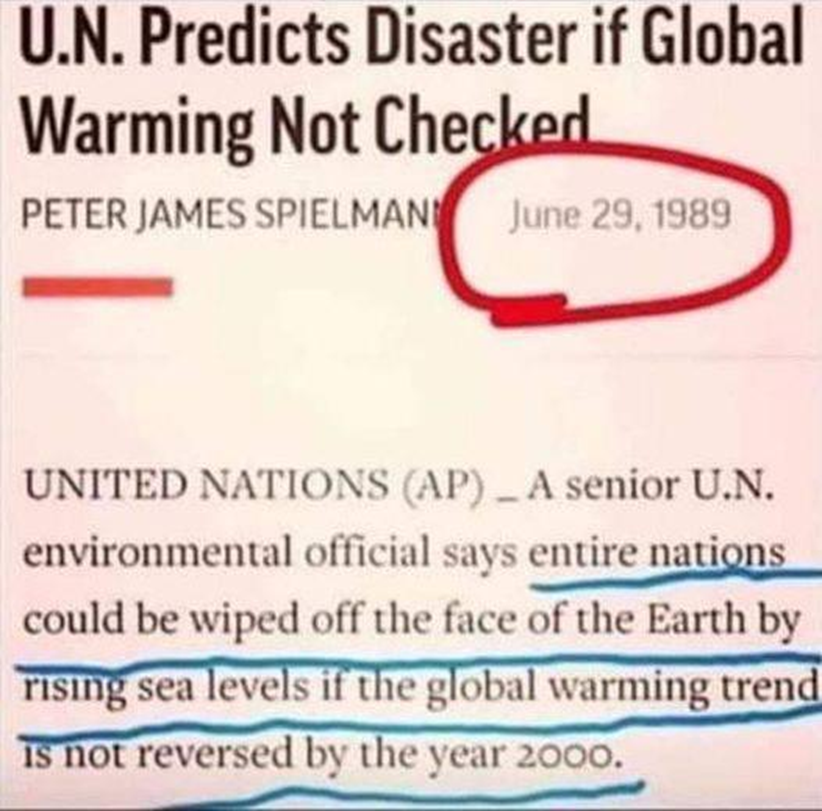
Unchanged Climate Change:

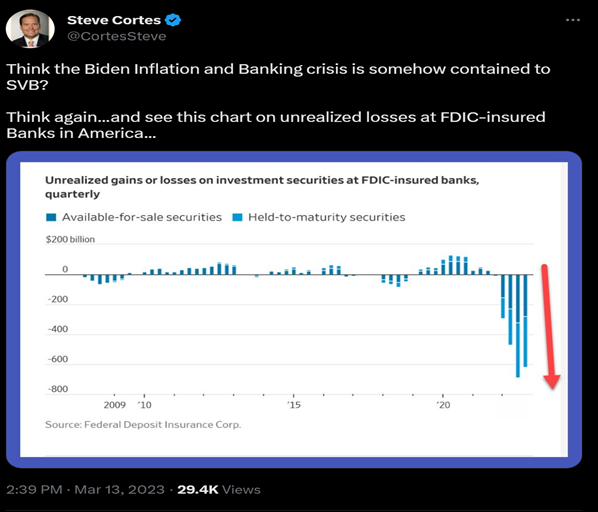
Banking Climate Change:

WSJ oped discusses why Silicon Valley Bank failed (unusualwhales.com)

Woke Silicon Valley Bank Gave Over $73 Million to Black Lives Matter Movement | The Gateway Pundit

Congress Takes Brief Pause From Sending All Your Tax Dollars To Ukraine To Send Them To Silicon Valley Bank | Babylon Bee

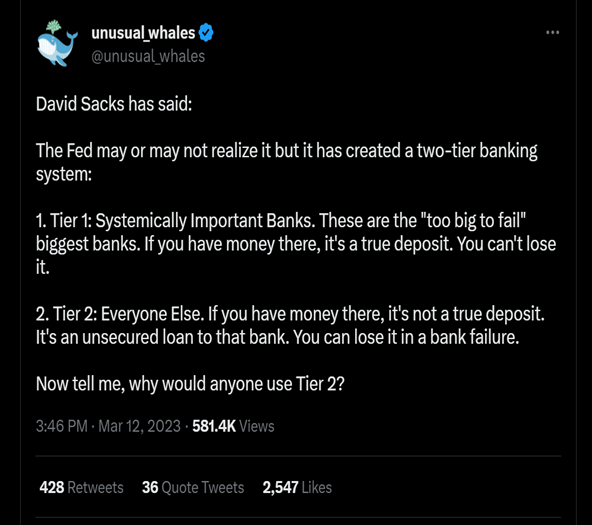
Why would anyone use a Tier 2 Bank… – CITIZEN FREE PRESS

“It doesn’t matter what you call it, it’s still privatizing the gains and socializing the losses.

So is your $250,000 bank guarantee you currently enjoy.

You have to have a deposit guarantee.”

“Biden’s Spending, Leads to the Biden Inflation, That Leads to the Biden Bonds, that Leads to the Biden Banks” – Steve Bannon Puts Entire Blame for Massive Financial Crisis We Are In Today on Biden | The Gateway Pundit

*****

Not All Roads Lead Home

In truth, all through the haunted forest there could be nothing more frightful than the figure of Goodman Brown.

Before the Technicolor fairy tale of a quartet of troubled characters trekking through a foreboding forest hoping to gain what they lack from the “great and powerful” Self-Gnosis (The Wizard of OZ), there is a tale of a young man taking a similar journey. And though there is no fear of “lions and tigers and bears” in this tale, there is “What if the devil himself should be at my very elbow!”.

It seems to me that both tales are about journeys into the dark side – the nocturnal forest – to look for an esoteric mystical experience that would supply what is missing. But unlike the “There’s no place like home” heartening ending of the OZ tale, we find in the second tale that those who covenant to journey into the forest and the deepest darkest part of it, come home disillusioned and faithless.

Often, especially in our youth, we begin to question the religious beliefs and worldviews of our families, of our mentors and of those around us. We see hypocrisy around us and despise it and yet become two-faced in our own sought out experiences wrought in the dark. We then begin to take on ambivalence about evil, giving ourselves the ‘grace’ to operate in both good and evil ways. Moral relativism is that form of grace.

We tell ourselves that there are people who are restrictive, conservative and Puritanical – “They don’t know me.”. We tell ourselves that we have become too worldly-wise to be like them: “I have Jesus. I’m above all that narrow-minded out-of-date conventionalism. I’m the progressive sort.” So, we journey into the dark forest, into the deepest darkest part of the forest, and think ourselves to be impervious to whatever lurks there. With each step we tell ourselves “I am only seeking understanding”.

We give ourselves permission to investigate the dark side. We say to ourselves “I will do it just one time. Why be left out?  Why not join the “communion of our race””? Thus, we journey into the night and encounter evil. And like Goodman Brown, in Nathaniel Hawthorne’s 1835 short story by the same name, we come home disillusioned, our faith destroyed.

Young Goodman Brown sets out one night to gain existential insight into good and evil. The story, set in 17th century Puritan New England, operates within the Puritan context of sin, grace and unconditional salvific election. I consider the tale an allegory, as it employs symbols starting with the names Goodman and Faith.

In the tale before us, Goodman Brown leaves his saintly wife Faith at the threshold of their home. She is wearing a pink ribbon on her cap. The pink ribbon, mentioned throughout, I read as a symbol of the admixture of purity (white) and sin (red). The color speaks to Goodman Brown’s spiritual understanding based on his Puritan beliefs and also to his rose-colored romance-based naiveté about the nature of evil.

“Poor little Faith!” thought he, for his heart smote him. “What a wretch am I to leave her on such an errand! She talks of dreams, too. Methought as she spoke there was trouble in her face, as if a dream had warned her what work is to be done tonight. But no, no; ‘t would kill her to think it. Well, she’s a blessed angel on earth; and after this one night I’ll cling to her skirts and follow her to heaven.”

With this excellent resolve for the future, Goodman Brown felt himself justified in making more haste on his present evil purpose. He had taken a dreary road, darkened by all the gloomiest trees of the forest, which barely stood aside to let the narrow path creep through, and closed immediately behind. It was all as lonely as could be; and there is this peculiarity in such a solitude, that the traveller knows not who may be concealed by the innumerable trunks and the thick boughs overhead; so that with lonely footsteps he may yet be passing through an unseen multitude.

As Goodman sets out, he does so under the cover of night and the cover of assumption: as a Puritan, Goodman Brown considers himself one of the elect. He carries with him a Puritan/Calvinist ‘good hands’ insurance card – the doctrine of predestination. He doesn’t leave home without it. And, as you read above, Goodman assumes that his association with the right people – his wife Faith in particular and the town’s good church folk in general – that he will follow them to the heavenly home. Goodman Brown goes out into the portentous night feeling safe and secure from all alarms. But his predetermined confidence quickly melts away as soon as he steps into the mysterious dark woods.

He had taken a dreary road, darkened by all the gloomiest trees of the forest, which barely stood aside to let the narrow path creep through, and closed immediately behind. It was all as lonely as could be; and there is this peculiarity in such a solitude, that the traveller knows not who may be concealed by the innumerable trunks and the thick boughs overhead; so that with lonely footsteps he may yet be passing through an unseen multitude.

Goodman’s first encounter in the woods is an old man who reminds him of his goodly grandfather. The old man appears to be waiting for Goodman. He says, “You are late, Goodman Brown.” Goodman replies “Faith kept me back awhile”.

Though the old man appears similar to Brown in many pedestrian ways the old man also appears to have “an indescribable air of one who knew the world”. And there’s something else Goodman notices and tries to explain away.

But the only thing about him that could be fixed upon as remarkable was his staff, which bore the likeness of a great black snake, so curiously wrought that it might almost be seen to twist and wriggle itself like a living serpent. This, of course, must have been an ocular deception, assisted by the uncertain light.

It is clear to the reader that the old man is the devil who is supported by the serpent staff, He does his best to entice Goodman Brown down the road to what is later called “the communion of your race” where he will learn of the “secret deeds” of his fellow townsfolk and see hypocrisy countenanced.

Goodman balks, claiming to be one of a breed of men who is above the riff-raff.

“Too far! too far!” exclaimed the goodman, unconsciously resuming his walk. “My father never went into the woods on such an errand, nor his father before him. We have been a race of honest men and good Christians since the days of the martyrs; and shall I be the first of the name of Brown that ever took this path and kept—”

Goodman’s journey away from faith is stop and go as wrestles with the temptation of going on. He encounters something he initially resists and uses the honor of his good name and of those before him as a reason to rethink things before giving on to going on. But, he doesn’t use his faith as a shield and so bends in to temptation. He continues his journey with the old man’s urging.

The old man tries to persuade Goodman to get up and continue. He does so by using Goodman’s own argument. The old man conjures up a kinship with men like Goodman. He lies about having personal knowledge and acquaintance of Goodman’s family. He then speaks of townsfolk – deacons and those in power – as personal references. He cajoles Goodman to continue their ‘association’ by journeying on.

Goodman Brown once considered himself impervious to all the devil’s wiles. After all he was one of the elect and associated with the right people. But each step he took in the wrong direction away from faith weakened his resolve. His compromises were reinforced by his inordinate curiosity. He continues his journey into the deepest darkest part of the forest and sees what the “communion of our race” so desires, “that the good shrank not from the wicked, nor were sinners abashed”.

There are several interpretations and critiques of the story. Some will say that Hawthorne is pointing out the hypocrisy of a society that prides itself on its high moral and civic standing and makes outcasts of those who do not live up to its standards. Other interpreters go out on a dark forest limb with their construal:

Modern critics have interpreted “Young Goodman Brown” in many ways. The story as a critique of society stands out to some. To psychologically inclined readers, Brown journeys into the psyche. The village represents the superego, whereas the forest and darkness become equivalents of the Freudian id. The entire story becomes a portrait of one human mind that discovers the usually suppressed and disquieting reality of animal instinct

The story’s symbols lend its meaning to a wide audience and to many interpretations. As you read it you will have your own takeaway. I consider it an allegory or parable about assumptions, hypocrisy and the lure of evil to pull one away from one’s home base of faith toward the “reality of animal instincts”.

The story doesn’t tell us Brown’s motives other than “present evil purpose” Conjecture would lead us to think that young Goodman Brown had become questioning about evil and the devil even though he lived surrounded by strict warnings against both in Puritan village. One gets the sense that Brown goes out by himself to just stick his nose in on evil for the sake of understanding the world he lives in and perhaps the fear of evil inculcated in him by his upbringing.

I have provided some of my take on Young Goodman Brown and some excerpts from the story with the hope that you will read the short story (it should take about fifteen minutes). I invite you to consider what road you are taking when you want to stick your nose in on evil. Consider where it leads and what you will encounter. And, where it will lead you. This road does not lead home.

We are told in Scripture to “test the spirits” so that we may know what is good and true and from God. That is not what is going on in Young Goodman Brown. Rather, this a young man who leaves faith behind and takes a walk on the wild side and ends up at a satanic ritual. His road did not lead back home to faith. It led to nihilism and despair and the resolve to no longer exist.

In truth, all through the haunted forest there could be nothing more frightful than the figure of Goodman Brown. On he flew among the black pines, brandishing his staff with frenzied gestures, now giving vent to an inspiration of horrid blasphemy, and now shouting forth such laughter as set all the echoes of the forest laughing like demons around him. The fiend in his own shape is less hideous than when he rages in the breast of man. Thus sped the demoniac on his course, until…

Well, you’ll just have to read the story:

Not All Roads Lead Home


In truth, all through the haunted forest there could be nothing more frightful than the figure of Goodman Brown.

Before the Technicolor fairy tale of a quartet of troubled characters trekking through a foreboding forest hoping to gain what they lack from the “great and powerful” Self-Gnosis (The Wizard of OZ), there is a tale of a young man taking a similar journey. And though there is no fear of “lions and tigers and bears” in this tale, there is “What if the devil himself should be at my very elbow!”.

It seems to me that both tales are about journeys into the dark side – the nocturnal forest – to look for an esoteric mystical experience that would supply what is missing. But unlike the “There’s no place like home” heartening ending of the OZ tale, we find in the second tale that those who covenant to journey into the forest and the deepest darkest part of it, come home disillusioned and faithless.

Often, especially in our youth, we begin to question the religious beliefs and worldviews of our families, of our mentors and of those around us. We see hypocrisy around us and despise it and yet become two-faced in our own sought out experiences wrought in the dark. We then begin to take on ambivalence about evil, giving ourselves the ‘grace’ to operate in both good and evil ways. Moral relativism is that form of grace.

We tell ourselves that there are people who are restrictive, conservative and Puritanical – “They don’t know me.”. We tell ourselves that we have become too worldly-wise to be like them: “I have Jesus. I’m above all that narrow-minded out-of-date conventionalism. I’m the progressive sort.” So, we journey into the dark forest, into the deepest darkest part of the forest, and think ourselves to be impervious to whatever lurks there. With each step we tell ourselves “I am only seeking understanding”.

We give ourselves permission to investigate the dark side. We say to ourselves “I will do it just one time. Why be left out?  Why not join the “communion of our race””? Thus, we journey into the night and encounter evil. And like Goodman Brown, in Nathaniel Hawthorne’s 1835 short story by the same name, we come home disillusioned, our faith destroyed.

Young Goodman Brown sets out one night to gain existential insight into good and evil. The story, set in 17th century Puritan New England, operates within the Puritan context of sin, grace and unconditional salvific election. I consider the tale an allegory, as it employs symbols starting with the names Goodman and Faith.

In the tale before us, Goodman Brown leaves his saintly wife Faith at the threshold of their home. She is wearing a pink ribbon on her cap. The pink ribbon, mentioned throughout, I read as a symbol of the admixture of purity (white) and sin (red). The color speaks to Goodman Brown’s spiritual understanding based on his Puritan beliefs and also to his rose-colored romance-based naiveté about the nature of evil.

“Poor little Faith!” thought he, for his heart smote him. “What a wretch am I to leave her on such an errand! She talks of dreams, too. Methought as she spoke there was trouble in her face, as if a dream had warned her what work is to be done tonight. But no, no; ‘t would kill her to think it. Well, she’s a blessed angel on earth; and after this one night I’ll cling to her skirts and follow her to heaven.”

With this excellent resolve for the future, Goodman Brown felt himself justified in making more haste on his present evil purpose. He had taken a dreary road, darkened by all the gloomiest trees of the forest, which barely stood aside to let the narrow path creep through, and closed immediately behind. It was all as lonely as could be; and there is this peculiarity in such a solitude, that the traveller knows not who may be concealed by the innumerable trunks and the thick boughs overhead; so that with lonely footsteps he may yet be passing through an unseen multitude.

As Goodman sets out, he does so under the cover of night and the cover of assumption: as a Puritan, Goodman Brown considers himself one of the elect. He carries with him a Puritan/Calvinist ‘good hands’ insurance card – the doctrine of predestination. He doesn’t leave home without it. And, as you read above, Goodman assumes that his association with the right people – his wife Faith in particular and the town’s good church folk in general – that he will follow them to the heavenly home. Goodman Brown goes out into the portentous night feeling safe and secure from all alarms. But his predetermined confidence quickly melts away as soon as he steps into the mysterious dark woods.

He had taken a dreary road, darkened by all the gloomiest trees of the forest, which barely stood aside to let the narrow path creep through, and closed immediately behind. It was all as lonely as could be; and there is this peculiarity in such a solitude, that the traveller knows not who may be concealed by the innumerable trunks and the thick boughs overhead; so that with lonely footsteps he may yet be passing through an unseen multitude.

Goodman’s first encounter in the woods is an old man who reminds him of his goodly grandfather. The old man appears to be waiting for Goodman. He says, “You are late, Goodman Brown.” Goodman replies “Faith kept me back awhile”.

Though the old man appears similar to Brown in many pedestrian ways the old man also appears to have “an indescribable air of one who knew the world”. And there’s something else Goodman notices and tries to explain away.

But the only thing about him that could be fixed upon as remarkable was his staff, which bore the likeness of a great black snake, so curiously wrought that it might almost be seen to twist and wriggle itself like a living serpent. This, of course, must have been an ocular deception, assisted by the uncertain light.

It is clear to the reader that the old man is the devil who is supported by the serpent staff, He does his best to entice Goodman Brown down the road to what is later called “the communion of your race” where he will learn of the “secret deeds” of his fellow townsfolk and see hypocrisy countenanced.

Goodman balks, claiming to be one of a breed of men who is above the riff-raff.

“Too far! too far!” exclaimed the goodman, unconsciously resuming his walk. “My father never went into the woods on such an errand, nor his father before him. We have been a race of honest men and good Christians since the days of the martyrs; and shall I be the first of the name of Brown that ever took this path and kept—”

Goodman’s journey away from faith is stop and go as wrestles with the temptation of going on. He encounters something he initially resists and uses the honor of his good name and of those before him as a reason to rethink things before giving on to going on. But, he doesn’t use his faith as a shield and so bends in to temptation. He continues his journey with the old man’s urging.

The old man tries to persuade Goodman to get up and continue. He does so by using Goodman’s own argument. The old man conjures up a kinship with men like Goodman. He lies about having personal knowledge and acquaintance of Goodman’s family. He then speaks of townsfolk – deacons and those in power – as personal references. He cajoles Goodman to continue their ‘association’ by journeying on.

Goodman Brown once considered himself impervious to all the devil’s wiles. After all he was one of the elect and associated with the right people. But each step he took in the wrong direction away from faith weakened his resolve. His compromises were reinforced by his inordinate curiosity. He continues his journey into the deepest darkest part of the forest and sees what the “communion of our race” so desires, “that the good shrank not from the wicked, nor were sinners abashed”.


There are several interpretations and critiques of the story. Some will say that Hawthorne is pointing out the hypocrisy of a society that prides itself on its high moral and civic standing and makes outcasts of those who do not live up to its standards. Other interpreters go out on a dark forest limb with their construal:

Modern critics have interpreted “Young Goodman Brown” in many ways. The story as a critique of society stands out to some. To psychologically inclined readers, Brown journeys into the psyche. The village represents the superego, whereas the forest and darkness become equivalents of the Freudian id. The entire story becomes a portrait of one human mind that discovers the usually suppressed and disquieting reality of animal instinct

The story’s symbols lend its meaning to a wide audience and to many interpretations. As you read it you will have your own takeaway. I consider it an allegory or parable about assumptions, hypocrisy and the lure of evil to pull one away from one’s home base of faith toward the “reality of animal instincts”.

The story doesn’t tell us Brown’s motives other than “present evil purpose” Conjecture would lead us to think that young Goodman Brown had become questioning about evil and the devil even though he lived surrounded by strict warnings against both in Puritan village. One gets the sense that Brown goes out by himself to just stick his nose in on evil for the sake of understanding the world he lives in and perhaps the fear of evil inculcated in him by his upbringing.


I have provided some of my take on Young Goodman Brown and some excerpts from the story with the hope that you will read the short story (it should take about fifteen minutes). I invite you to consider what road you are taking when you want to stick your nose in on evil. Consider where it leads and what you will encounter. And, where it will lead you. This road does not lead home.

We are told in Scripture to “test the spirits” so that we may know what is good and true and from God. That is not what is going on in Young Goodman Brown. Rather, this a young man who leaves faith behind and takes a walk on the wild side and ends up at a satanic ritual. His road did not lead back home to faith. It led to nihilism and despair and the resolve to no longer exist.

In truth, all through the haunted forest there could be nothing more frightful than the figure of Goodman Brown. On he flew among the black pines, brandishing his staff with frenzied gestures, now giving vent to an inspiration of horrid blasphemy, and now shouting forth such laughter as set all the echoes of the forest laughing like demons around him. The fiend in his own shape is less hideous than when he rages in the breast of man. Thus sped the demoniac on his course, until…


Well, you’ll just have to read the story:

One is Not the Loneliest Number When Divided by Two


“When so many are lonely as seem to be lonely, it would be inexcusably selfish to be lonely alone.” Tennessee Williams


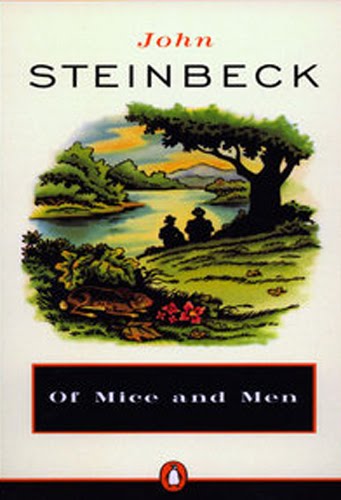
“…guys like us, that work on ranches are the loneliest guys in the world. They got no family. They don’t belong to no place”-George Milton, John Steinbeck’s Of Mice and Men


“Social dislocation can easily breed a reactionary form of nostalgia.” ― Robert D. Putnam, Bowling Alone


“The greatest thing you’ll ever learn is just to love and be loved in return.” ~David Bowie


~~~

If the recent movies Revenant and Martian are any indication, the topic of man alone requires your attention. Such red-in-tooth-and-claw-and-planet-solo-man left-behind-against-tremendous-odds loneliness reminds me of each New Year’s social landscape just ahead of me.

I have encountered bouts of loneliness during my many years. These bouts have occurred during extended business trips across the globe and even at home within relationships. During such times and now as I live alone, I find myself talking to myself, interrupting solitude with human voice accompaniment. (Sorry Henry the parrolet, your tiny voice doesn’t supply the needed effect.)  Henry the Parrolet

Loneliness, like the universal force of gravity, pulls down on our demeanor and our hopes. This has been so since first man Adam.  God spoke to the condition: “It is not good for man to be alone.” And modern man is no different. He wants to be “Liked” on Facebook. Our frowning loneliness beckons for someone to put a smile on our Facebook.

Accompanied by your imagination, written fiction I believe captures loneliness better than any in-your-face movie could ever do. So take a brief look with me at John Steinbeck’s Of Mice and Men.

The drifters of John Steinbeck’s Of Mice and Men depict the loneliness of the dispossessed. Using a backdrop of the Depression era 1930s, jobless migrants, lonely people, as Steinbeck’s short novel reveals, find ways to deal with their loneliness. Most will try to find comfort in their situation. Lonely bindle bums carry their dreams with them from relationship to relationship.

of-mice-and-menLoneliness’ antidote, camaraderie, is also conveyed in the story Of Mice and Men. Steinbeck had a special appreciation for friendships. His empathy toward others and a life shared comes through in his writings as you will see if you should read this short novel.

Lonely people’s lives often intersect with others who are lonely, whether it is with a fellow laborer or a passing stranger. Several characters in the novella depict loneliness. Let’s look at two briefly: George Milton, a migrant farm worker, and Crooks, a stable hand.

The nagging loneliness George Milton deals with is due in large part, as he relates, to his constant travel in search of work. His relationships are subsequently transitory, except for one. Along the way George gains a travel companion, Lennie. But the caretaker relationship George has with his traveling partner also isolates George. Lennie is a mentally feeble adult who is unable to have an adult relationship with George. Lennie’s nature, as described elsewhere by Steinbeck (The Pastures of Heaven), is “one of those whom God has not quite finished.”

Loneliness makes strange bunk mates. In the beginning of chapter 3, Slim and George, both hired ranch hands, sit down in the bunk house. Slim, the ranch’s top skinner, notices the oddity of two men traveling together:

“Funny how you an’ him string along together.” It was Slim’s calm invitation to confidence.

“What’s funny about it?” George demanded defensively.

Oh, I dunno. Hardly none of the guys ever travel together. I hardly never seen two guys travel together. You know how the hands are, they just come in and get their bunk and work a month, and then quit and go out alone. Never seem to give a damn about nobody. It jus’ seems kinda funny a cuckoo like him and a smart guy like you traveling together.”

“He ain’t no cuckoo, said George…”

At this point George doesn’t go into Lennie’s recent troubled past which prompted both of them to run away from the “bad things” done in Weed. But while playing solitaire George does tell Slim his reason for his relationship with Lennie:

“I ain’t got no people. I seen the guys that go around on the ranches alone. That ain’t no good. They don’t have no fun. After a long time they get mean. They get wantin’ to fight all the time. . . ‘Course Lennie’s a God damn nuisance most of the time, but you get used to goin’ around with a guy an’ you can’t get rid of him”  

For George, Lennie is a make shift friend. Lennie, both a bane and blessing to George, is coming along for the ride. For now George’s dreams of a normal life are put on hold until he makes some cash. But his desire for friendship is not on hold.

~~~  OMAM

Let’s turn to Crooks. Crooks the African-American stable hand could be described as the loneliest man in this story. Though surrounded by fellow ranch hands he remains an outsider. Shunned by the rest of the ranch crew because of the color of his skin Crooks is told by them in no uncertain terms that he doesn’t belong with them. Because of this exile from the others Crooks is not able to establish a relationship with anyone.

Along comes trouble in a skirt. The bosses’ son Curly has a wife, who is also lonely. She, the jealous type, barges into Crooks’ private space looking for her husband. Crooks tells her she has no right to come into his private space. She then retorts her hostile insecurities toward Crooks. “Well keep your place then, Nigger. I could get you strung up on a tree so easy it ain’t even funny.” Her words are meant to put him in his ‘place’, a place of social isolation.

220px-Mice_men_movieposter

Crooks, named for his crooked back, had been physically disjointed from the rest of the ranch hands. As an African-American Crooks is forced to bunk by himself. This isolation accounts for Crook’s consequent loneliness, bitterness and insecurities. As does Curly’s wife, Crooks directs his hostilities towards others and at someone in particular, someone who is even more isolated than him – Lennie.

Loneliness can bring out the worst in us. Crooks plays a mean joke on the dim witted Lennie by telling him that George is not coming back. But Crooks finally relents from his cruelness when he sees the pain he has caused Lennie.

The sense of the loneliness could become overwhelming for someone locked up in a prison or an asylum and exiled from one’s peers. In this story, Crooks returns to his books each night for companionship. One time he spoke of his deep loneliness to Lennie:

“S’pose you didn’t have nobody. S’pose you couldn’t go into the bunk house and play rummy ’cause you was black. How’d you like that? S’pose you had to sit out here an’ read books. Sure you could play horseshoes till it got dark, but then you got to read books. Books ain’t no good. A guy needs somebody-to be near him. A guy goes nuts if he ain’t got nobody. Don’t make no difference who the guy is, long’s he’s with you. I tell ya, I tell ya a guy gets too lonely an’ he gets sick.”

~~~of_mice_and_men

Each of the main characters in Of Mice and Men displays loneliness to some degree. Each carries with them a dream of some better life. Loneliness and dreams. They are everywhere present in Steinbeck’s Depression era story.

The storied relationships are shown to be transitory as with the “bindle bum” George or as non–existing as in the case of Crooks or as simply remembered.

Whit, a ranch hand, wonders if Slim remembers a friend who used to work together with them and whose letter was now posted in a recent magazine. “Do you remember Bill Tenner. He worked here three years ago?” This prompting by Whit shows that men in these situations don’t usually develop lasting relationships. As such they remain lonely, just remembering the past as a form of present comfort.

Steinbeck’s short novel conveys the sense of loneliness that can overtake any of us. In each of us there is that longing for companionship and a need to be known by someone and to know them. Overcoming loneliness and dreaming both require looking outside ourselves to what could be.

George and Crooks both expressed their negative feelings about loneliness. And, when they had a chance, they shared their tale of woe with someone or took comfort in some extraneity. As the story illustrates lonely people may seek solace in wine, women, playing cards, dreams, reading books and by petting live rabbits or dead mice or a satin dress. Our put-on-hold dreams are better shared, one could infer from the story.

The bindle bums and the vagabonds, the drifters, the isolated and the wishful – all of us – want to assuage our loneliness. One way or the other we will find a way to do this or, as Crooks reminds us, go nuts trying.

~~~

But little Mouse, you are not alone… the best laid plans of Mars and Men/Often go awry.

Where Have All the Bookstores Gone…?

With the closing of the Borders book stores I am fearful that others will follow. I need my tactile book-in-hand fix.  Amazon doesn’t do it for me and neither do the one-dimensional Nooks or E-books. I need the book cover to flirt with me, the inside jacket to draw me in and the inky scent of words to intoxicate me. I always give a book a once-over during the courting process.

For many years now I have regularly shopped for books at my local Barnes & Noble. When I enter the store at 9:00 am every Saturday morning I love to see all the books before me waiting like a massive orchestra for its conductor. I greet each section and then the libretto starts.

On these days you would find me browsing, investigating, brooding and dilly-dallying to my heart’s content. I like the fact that there is nothing ‘E’ about my visit. It is up front and personal.  Mano y mano. I need to wrestle with the pages.

 My Barnes & Noble store stocks DVDs and Music CDs as well as a large assortment of books to choose from. If they shut this store I may need to go on life support due to a binding withdrawal.

http://www.wttw.com/chicagotonight/video/TVss9Rp4wAN0Gy7wtrOnEmDmT4JKKusY/

Nobel Prize in Literature 2010: Mario Vargas Llosa

“We would be worse than we are without the good books we read, more conformist, not as restless, more submissive, and the critical spirit, the engine of progress, would not even exist.  Like writing, reading is a protest against the insufficiencies of life.  When we look in fiction for what is missing in life, we are saying, with no need to say it or even to know it, that life as it is does not satisfy our thirst for the absolute – the foundation of the human condition – and should be better.  We invent fictions in order to live somehow the many lives we would like to lead when we barely have one at our disposal.” [emphasis mine]

Quote from:

Mario Vargas Llosa’s Nobel Lecture, given December 7th, 2010.

The Dragon Lady: Lisbeth Salander

I don’t normally read popular fiction. I’m usually affixed to books that contain older and more weathered fiction like Chekov, O’Connor, Hemingway, etc. or to science books such as “The Best American Science Writing of 2010”, “Once Upon Einstein” or” Calculus for Dummies”.

While reading “The Best American Science Writing of 2010” a fellow passenger on a daily commute suggested strongly that I read the Steig Larsson books: “The Girl With The Dragon Tattoo”. “The Girl Who Played With Fire” and “The Girl Who Kicked the Hornet’s Nest”. I could tell that this gentleman was deeply engrossed in the books as were other passengers. The book covers showed up everywhere I looked. So, I decided to take a departure from my everyday route and read the books.

In short, I found the books story-telling engrossing.  Larsson is a good at weaving a multiplicity of detailed character threads to fashion an intriguing tale about a young woman, Lisbeth Salander, the story’s protagonist. The story basically tells how a diminutive tech savvy girl deals with overwhelming evil. Sadly, though, the story is not redemptive for any one, not for Lisbeth or the reader. 

The three books which make up  the Millennium Trilogy deal with evil using a cast of horrendous characters: unfeeling, misogynistic and murderous white men. This diabolical group includes Lisbeth’s monster of a father, her ‘Super-Race’ machine of a brother (literally unfeeling), an even more monstrous uncle and nephew, a state imposed guardian, an evil system hidden within the government and a horde of eastern European sex traders. Lisbeth, the super-hacker, is able to outsmart, outwit and out punch her opponents until she is free to live her life. That’s the best she can hope for in this story.

The Lisbeth character is a ‘modern’ woman in charge of her body. She has multiple piercings in a hardened outer shell. Her anti-social demeanor,possibly Asperger syndrome her former guardian speculates, keeps her aloof and people guessing as to what she is up to. She is a mysterious force to reckon with. A mystifying dragon lady with all odds stacked against her.

Yet, Lisbeth has feelings. There is a hard-drive of detached emotions operating under the cover of a hook-up sexuality. This dragon lady woman acts out with women because, we are lead to suppose, men have treated her so badly. We are led to feel sympathy for her ‘situation’ and to accept her choices whenever she beds down with women. Near the end of story, after she has dealt serious blows to the white men who have abused her she casually and discriminately hooks up with a married man who’s staying in the same hotel as she is. They have meaningless sex over several nights. Apparently, she has now taken charge of her sex life after the brutal rapes that incurred in her past. We learn of her excessive drinking and her own unchaste behavior to mollify her pain. She uses men like they have used her. This is not feminism. Rather it is unresolved anger, returning evil for evil. She is a woman disconnected from herself and her pain. Shes operates out of an existential ethic, creating her own values and meaning to life as she goes along.

How the books deal with evil shows the out working of the postmodern mind: intelligence wins the day; knowing how to ‘hack’ the system can be your salvation; evil is to be redirected any way it can; learn to outsmart evil and you’ll come out on top; don’t even bring God into the picture; we can save ourselves if we are smart enough, if we stay one step ahead of evil. (Think of the presumptive Wikileakers and Wikihackers.)

We also see a synthesis of good and evil in these books. The ends justify the means. The ‘good’ victim girl, Lisbeth, uses evil to deal with the evil doers. I won’t describe the details here.

Throughout the Millennium Trilogy there is a baseline desire to get to the bottom of the evil that has occurred and to expose it. Henrik Vanger, a retired industrialist begins the process. I do like the fact that along with a journalist and friend of Lisbeth, Mikael Bloomkist Henrik sought to ‘out’ the evil that’s been done to Lisbeth. That is a necessary step in dealing with evil. In our world during a recent televised newscast it is told that in the trial of Elizabeth Smart’s kidnapper and rapist, Elizabeth Smart takes the stand, faces her accuser and speaks out the evil that has been done to her. This confronting of evil is an absolute necessity for the victim, for the perpetrator and for those who have become aware of this horrible crime. It is absolutely necessary to bring to justice all of the evil doers. These acts, granted by God in the present, of bringing those to justice who have perpetrated evil are a precursor to the Final Judgement awaiting evil. Without giving away too much of the story, in the case of Lisbeth there is a trial where she faces those who have acted unjustly towards her. The truth about the crimes done to Lisbeth is revealed. Outing the information is not enough, though, for any type of redemptive closure. It is a good beginning, though.

The revelation of evil as perpetrated, in and of iteslf, is not enough to deal with the systemic evil that is inherent in man and man’s societies since Adam’s Fall. Neither is sheer will power, as Nietzsche would have us believe is necessary for survival. Evil has been dealt a death blow by the cross of Jesus Christ. Because of the cross, man can confront evil, name it for what it is, forgive the perpetrators and seek reconciliation and restoration. There is no mention of the cross in these books. One only sees man’s attempt to do battle with it in his own terms.

For the person who embraces the cross there is hope, whereas, the person who continues to battle evil with wile and strength may become stronger but, it will certainly bring them to the breaking point and to despair. In Lisbeth’s case, a large amount of money she had stolen from a ‘bad guys’ account became the restoration and succor for the evil that’s been done to her. In reality, though, money does not destroy the effects of evil. Money can become another master that controls us, perhaps to the point of doing evil. There is no solution to the problem of evil with a redistribution of wealth, despite what these books convey.

The art of story telling is excellent in Larsson’s books. But the story’s worldview is only worth the price of admission to view the postmodern mind trying to deal with evil using its form of “higher morality”.

Nietzsche: “That which does not kill me makes me stronger.” Lisbeth’s confrontation with evil throughout the books is met with her ever more wily approach to evil. Sadly, at the end of the story there is no message of hope or redemption. Evil is not overcome by good. There only remains the ‘inked’ vestige of a dragon – the Biblical symbol of the evil one.

(A note about the movies based on these books: The stories are based in Sweden. The movies are in Swedish. You can watch them with sub-titles. Also, the movies fast forward through the book. You would have to read the books to understand the myriad details supporting the story to make sense of it all. Finally, the story repeatedly deals with elements of evil:  brutal violence, rape, perverse sexuality and more.)

******

“To triumph fully, evil needs two victories, not one. The first victory happens when an evil deed is perpetrated; the second victory, when evil is returned. After the first victory, evil would die if the second victory did not infuse it with new life.”

– Miroslav Volf
The End of Memory, Remembering Rightly In A Violent World

 *****

Romans 12:21: “Do not be overcome by evil, but overcome evil with good.”

*****

“The only way to overcome evil is to let it run itself to a standstill because it does not find the resistance it is looking for. Resistance merely creates further evil and adds fuel to the flames. But when evil meets no opposition and encounters no obstacle but only patient endurance, its sting is drawn, and at last it meets an opponent which is more than its match.”

–Dietrich Bonhoeffer, The Cost of Discipleship

A Landscape With Dragons; Harry Potter and the Paganization of Culture

Adjunct to a recent post about the education system reprogramming our children is Michael O’Brien’s book A Landscape With Dragons With the current culture shift toward paganism, O’Brien discusses how modern children’s literature and cinema re-symbolizes good and evil. The long-standing symbolism of dragons as personifications of evil are now shown to be docile creatures (one example,  Disney’s Pete’s Dragon) or as helpful creatures. This creates confusion for the child and, more dangerously, a synthesis of both good and evil is generated in the name  of ‘helping’ the story’s protagonist. In his book O’Brien says:

“A powerful falsehood is implanted in the young boy by heroes who are given knowledge of good and evil, given power over good and evil, who play with evil but are never corrupted by it.”

The book provides tools for parents to discern what is good and what is bad about children’s literature from a Christian perspective.  The last third of the book contains a list of good, nourishing literature for our children to read.


Landscape With Dragons was published before the Harry Potter series. O’Brien has since published a new book (May 2010) which takes on the occult world of Harry Potter: Harry Potter and the Paganization of Culture .

In the Preface to Harry Potter and the Paganization of Culture, O’Brien describes the spiritual nausea he experienced as began reading the Harry Potter books. He also describes his nightmares:

“…from the day I opened the first page and began to read, a cloud of darkness and dread descended, which was held at bay only by increased prayer. I also experienced nightmares of a kind I had never before experienced in my life. This is totally out of character for me since I am not prone to bad dreams, and usually years go by without me having one. I have had some frightening experiences in my life (far worse than reading a few questionable books) and never suffered a bad dream from it. But from the moment I began my little part in the resistance, I suffered from nightmares of unprecedented power.”