Palm Sunday and the Problem of Evil

Just a few centuries before the first Palm Sunday, Greek philosopher Epicurus (341-270 B.C.) promoted to his followers the notions of another ancient Greek philosopher, Demetrius (c. 460 – c. 370 B.C.). Demetrius’ had proposed the theory of Atomism to account for nature.

The theory in brief: the universe is a material system governed by the laws of matter. The fundamental elements of matter are atoms. Random, unguided ‘atoms’ smash into each other, thereby creating the world and life as we know it. Epicurus went on to tweak Demetrius’ theory by saying that atoms do not always go in straight lines but can “swerve, avoiding atomism’s inherent determinism and allowing for free will – just like the gods.

Per Epicurus, the gods were off somewhere happily doing their thing unconcerned about anything. They existed without needs, were invulnerable to any harm, and were generally living an enviable life, not anxious about anything. As such, they exemplified what Epicurus’s followers should seek to attain in their limited human nature.

For Epicurus, the purpose of philosophy was to attain the happy, tranquil life, characterized by aponia, the absence of pain and fear, and by living a self-sufficient life surrounded by friends. He taught that pleasure and pain are the measures of what is good and bad, that death is the end of the body and the soul and should therefore not be feared, that the gods do not reward or punish humans, that the universe is infinite and eternal, and that events in the world are ultimately based on the motions and interactions of atoms moving in empty space.The Epicurus Reader

Epicurus also taught that nothing should be believed except for that which was tested through direct observation and logical deduction – believed via the sensate and reason. Based on such thinking along with having the viewpoint that the gods were distant and uninvolved and therefore unrelated to ‘thinking’ and ‘sensing’ man’s life, man had to make do with the atoms he had been dealt. Don’t look to a personal God for help.

What was most important in Epicurus’ philosophy of nature was the overall conviction that our life on this earth comes with no strings attached; that there is no Maker whose puppets we are; that there is no script for us to follow and be constrained by; that it is up to us to discover the real constraints which our own nature imposes on us.The Epicurus Reader

As Epicurus evaluated the Greek and Roman gods of his time and man’s attempt to please and cajole the gods to obtain favors, it would make sense for him and his followers to deduce that “there is no Maker whose puppets we are”. And, for Epicurus to further reason the problem of evil paradox:

“The gods can either take away evil from the world and will not, or, being willing to do so cannot; or they neither can nor will, or lastly, they are able and willing. If they have the will to remove evil and cannot, then they are not omnipotent. If they can but will not, then they are not benevolent. If they are neither able nor willing, they are neither omnipotent nor benevolent. Lastly, if they are both able and willing to annihilate evil, why does it exist?” ― Epicurus

 The Epicurean paradox was answered with another paradox: What is mankind that you are mindful of them, human beings that you care for them? Psalm 8:4

In the fullness of time, including Epicurean times, the Lord of the universe put on human flesh – dust fashioned from the created elements including about 18% carbon – to deal with the problem of evil. There was nothing ambiguous or theoretical or abstract about the appearance of God’s own son Jesus. There was direct observation -seeing, hearing, and touching – by his followers.

Philosophers and atheists, before and after Epicurus, pronounced judgement on God for all the evil in the world.

The demand of the loveless and the self-imprisoned that they should be allowed to blackmail the universe: that till they consent to be happy (on their own terms) no one else shall taste joy: that theirs should be the final power; that Hell should be able to veto Heaven. – George MacDonald, C.S. Lewis’ The Great Divorce

To address evil, Jesus announced the kingdom of God on earth. What was begun in Genesis – the ordering of material creation to build God’s temple on earth so that God would dwell with man – was reinstated by Jesus. This blueprint or worldview was on the books long before Epicurus arrived on the scene. And so is the record of God’s faithfulness. God, as revealed in Jesus, puts things to right.

Jesus entered space and time flesh and blood to pronounce judgement on evil. He did so without equivocation. Jesus did not succumb to pleasure seeking to avoid pain. He did not succumb to Satan’s temptations to find happiness. Evil unclean spirits were cast out. Hypocrites were denounced and death itself was overturned. Jesus suffered the full force of evil on the cross – an act of redemption from evil’s ransom.

The King of Glory wept over Jerusalem and his chosen people. The Israelites had so often rejected their reveal-to-the-world-the-one-true-God vocation. They had not been faithful stewards of God’s vineyard. Did Epicurus see no difference in their God and the Greek and Roman gods?

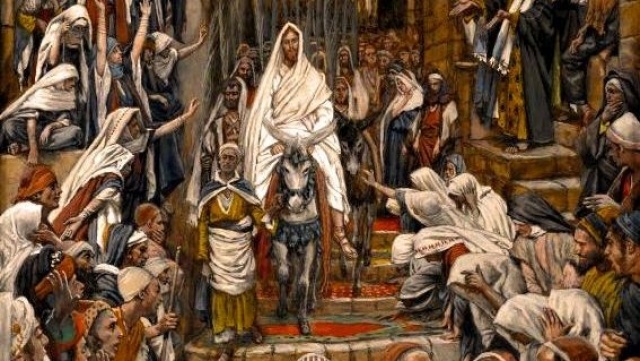
On that first Palm Sunday, just a few centuries after Epicurus taught that there was no personally involved God, the King of Glory, emptied of his glory, rides a donkey into Jerusalem to meet evil head on and to put the world right. The “Epicurean Paradox” would be addressed and soundly answered.

What will you do with the knowledge that the infinite-personal God, embodied in human form, speaks to the very human concerns behind Epicurean philosophy?

Are You Witnesses of All This?


Over the last several posts I’ve written about philosophers (Epicurus in particular and Protagoras) and philosophies (Epicureanism and Stoicism). Taken together they state, among other things I described earlier, that this life is all there is. There would be no hereafter in that way of thinking. During the first century the Apostle Paul, the “the apostle of the Gentiles”, encountered those worldviews on the streets where he sold his tents and in the early churches where he taught.

Writing to those in the Corinthian church whose Gentile members denied a resurrection of the dead, Paul responded in a rather taunting manner to their philosophical take on death as final. The gospel he proclaimed – Jesus is Lord, forgiveness of sins, new creation, the kingdom of God on earth has been launched – all hinged on the resurrection of Jesus.

And if the Messiah wasn’t raised, your faith is pointless, and you are still in your sins. 1 Cor. 15:7

After addressing and closing the dead are raised issue with an eye witness defense (1 Cor. 15: 3-8), Paul responds to the heart of the Corinthian objection to resurrection: the nature of future bodies. He mocks their materialist objections using an analogy from nature:

But someone is now going to say, “How are the dead raised? What sort of body will they have when they come back? Stupid! What you sow doesn’t come back to life unless it dies. 1 Cor. 15: 35

No doubt, Paul also heard that Jesus responded in a similar fashion when he rebuked the Sadducees who denied the resurrection (as recorded in Luke 20:38 and below, in Mark 12:

“Where you are going wrong,” replied Jesus, “is that you don’t know the scriptures, or God’s power. When people rise from the dead, they don’t marry, nor do people give them in marriage. They are like angels in heaven.

However, to show that the dead are indeed raised, surely you’ve read in the book of Moses, in the passage about the bush, what God says to Moses? ‘I am Abraham’s God, Isaac’s God, and Jacob’s God’? He isn’t the God of the dead, but of the living. You are completely mistaken.”

In the same letter (1 Cor.15:19), agitated Paul, in talking about people’s motivations in light of their position on the resurrection, recommends Epicurean self-pity if the dead are not raised.

If it’s only in this present life that we have hope in the Messiah, we are the most pitiable members of the human race.

He later quotes a popular Epicurean saying that embraces self-pity and self-indulgence in light off…

…If the dead are not raised,

“Let us eat and drink,

for tomorrow we die.”

1 Cor. 15:32

What was Paul’s background that offered him insight into Greek philosophies? We learn from Acts 21: 37 -39 as he defends himself against highly agitated Jews who clamored for his arrest.  He is brought before a Roman tribune:

“Am I allowed to say something to you??” he asked.

“Well!” replied the tribune. “So you know some Greek, do you? Aren’t you the Egyptian who raised a revolt some while back and led those four thousand ‘assassins’ into the desert?”

“Actually, replied Paul. “I am a Jew! I am from Tarsus in Cilica. That’s not an insignificant place to be a citizen of. Please let me speak to the people.”

Inferring his Roman citizenship, Paul goes on to defend his Jewish background in the face of his Jewish accusers:

“I am a Jew, he continued, “and born in Tarsus in Cilicia. I received my education here in this city, and I studied at the feet of Gamaliel. I was trained in the strictest interpretations of our ancestral laws and became zealous for God, just as all of you today.”

Paul had significant first-hand knowledge of Greek, Roman and Jewish worldviews. Paul was more than able to respond to the Epicurean context of the Gentiles. Paul was more than able to present the gospel in the context of the Jewish worldview, a worldview of monotheism, the Temple, eschatology and …resurrection.

The narrative of the resurrection and an eschatology of the age to come took on great import during the Second Temple Judaism. Other than the words of Moses and some metaphorical allusions to resurrection by Isaiah (Isaiah 26:19) and Ezekiel (37), there isn’t mention of the resurrection in the Old Testament. Those allusions were applied during the Babylonian exile. They refer to the restoration of Israel as a nation and the reoccurring theme of exodus from bondage. The scribe Daniel is the first to mention the resurrection in non-metaphorical terms when he describes the “wise”, the Jewish resistance to Antiochus, not dying in vain (Daniel 11).

It was during the intertestamental period that scribes began writing about the resurrection of the dead, among many other topics of concern during late Second Temple Judaism. The Qumran community kept these writings in clay jars within caves in case the community was taken out by the Romans.

The Jewish religious leaders in Jesus’ time knew these writings, e.g., The Epistle of Enoch and 2 Maccabees. The disciples knew them. Paul knew them. The writings were talked about in the synagogues and on the streets. These writings offered a Messianic hope for the coming day when God would put things right. In the meantime, they stoked courage against the looming threat of Roman authority. It is very likely that Mary and Martha would have known about these writing as well. It appears that Martha had an understanding of them when she confronts Jesus after her brother Lazarus dies.

When Martha heard that Jesus had arrived, she went to meet him. Mary, meanwhile stayed sitting at home.

“Master,” said Martha to Jesus, “if only you’d been here! Then my brother wouldn’t have died! But even now I know that God will give you whatever you ask him for.”

“Your brother will rise again,” replied Jesus.

“I know he will rise on the last day.”

(Notice the role reversals from the previous Mary and Martha encounter with Jesus in their home? Martha, the fussbudget homebody, is now interested to hear what Jesus has to say. She goes to meet him. Mary, who doted on Jesus at his feet, stays at home where she grieves and perhaps sulks that Jesus wasn’t there for her brother. She was given another chance at Jesus’ feet.)

Jesus responded to Martha.

“I am the resurrection and the life,” replied Jesus. “Anyone who believes in me will live, even if they die. And anyone who lives and believes in me will never, ever die. Do you believe this?”

“Yes, master,” she said. “This is what I’ve come to believe: that you are the Messiah, the son of God, the one who was to come into the world.”

Jesus responded to Martha’s eschatological understanding with, in effect, “I am revising your understanding with personal present tense knowledge of me”. Jesus then asks for Mary. Proximity to Jesus matters and not only for Mary and Martha’s sake but also for Jesus’ sake. He wants to see for himself the loss, the grief and the pain we feel. He would carry our griefs and sorrows to the cross and then remove the sting of death with his (and then our) resurrection.

When Mary came to where Jesus was, she saw him and fell down at his feet.

“Master!” she said, “If only you’d been here, my brother wouldn’t have died!”

When Jesus saw her crying, and the Judeans who had come with her crying, he was deeply stirred in his spirit, and very troubled…”

Mary and Martha witnessed the resurrection of their brother Lazarus. The three of them would learn of and perhaps be among the over five-hundred brothers and sisters who saw Jesus alive after his resurrection (1 Cor. 15: 5). All of them were witnesses of the things that came to pass. And what came to pass was not a doctrine or a philosophy or an apparition – a ghost. It was bodily resurrection.

No mere manmade philosophy, ancient or otherwise, could ever revive the dead or comfort the living in their loss with “Let us eat and drink, for tomorrow we die.” No amount of pleasure reduces the pain we feel. No amount of materialism and its cheerleading proponent Progressivism – a political pandering to self-pity – will provide hope for today. Those philosophical positions are about nursing wounds. Those philosophical positions are ephemera compared to the reality of the bodily Resurrection of Jesus and the new life offered to those who believe.

Only the Resurrection and the Life can reverse the downward spiral of mankind and provide hope that doesn’t pass away with a meal. Live in the present tense Resurrection and Life as Mary and Martha and hundreds of early followers of Jesus did.

Are you witnesses of all this? Of the resurrection? Or, are you witnesses of the Easter bunny? I think that’s what Paul had in mind when he mocked the Corinthians.

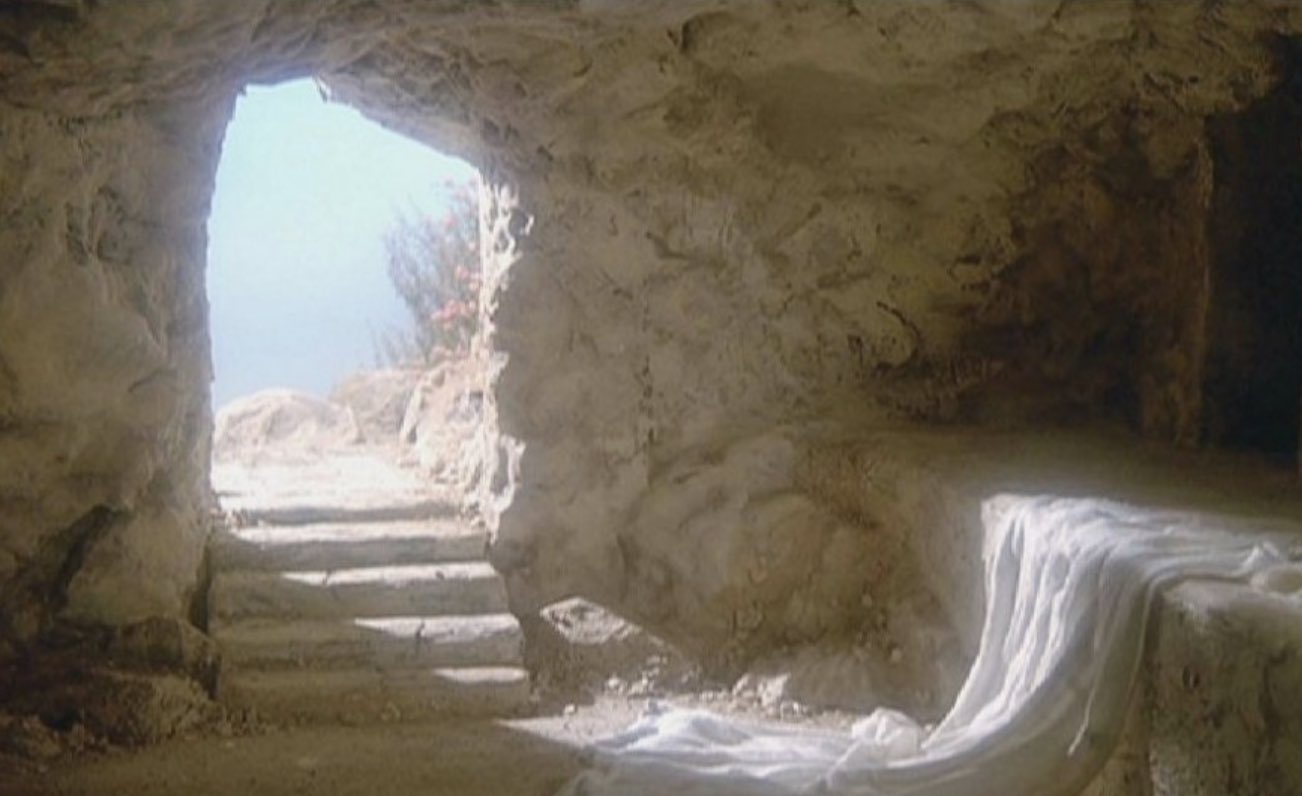
Empty tomb

~~~~~~~~~~~~~~~~~~~~~~~~~~~


The Resurrection is the central theme in every Christian sermon reported in the Acts. The Resurrection, and its consequences were the “gospel” or good news which the Christians brought: what we call the “gospels,” the narratives of Our Lord’s life and death, were composed later for the benefit of those who had already accepted the gospel. They were in no sense the basis of Christianity: they were written for those already converted. The miracle of the Resurrection, and the theology of that miracle, comes first: the biography comes later as a comment on it. Nothing could be more unhistorical than to pick out selected sayings of Christ from the gospels and to regard those as the datum and the rest of the New Testament as a construction upon it. The first fact in the history of Christendom is a number of people who say they have seen the Resurrection.

Miracles, C.S. Lewis

Six Other Degrees of Separation


Six blind men live in Metropolis, Illinois. They were born in the eighties and have been blind from birth.  

These six men consider the earth to be round. They came to this understanding during their grade school education which included handling of the classroom globe. Their day-to-day experience told them that the world was flat and with many sharp corners.

From Mrs. Foley, their high school physical science teacher, these six men learned about Ptolemy and Copernicus. They learned that the sun and not the earth is at the center of our universe. Their day-to-day experience taught them that their universe was a big as the darkness in which they lived.

One day in August, as they listened to the news on the radio, these six men heard about a total solar eclipse. To their delight the path of totality, the announcer said, would be through Carbondale, Illinois.

When the morning of the total eclipse came, the six men took a bus to Carbondale. When they arrived the men soon became separated by the rush and noise of the crowds. While sitting on the bus the men had agreed to return on the 6:30pm bus to Metropolis.

One blind man found his way to a corner where there was talk of a shuttle bus to the viewing site. He got on.

The second blind man asked for the directions to where everyone would be for the event. A young couple said, “Follow us”. The blind man held onto the woman’s arm.

The third blind man heard a man with a loud speaker say that people should park “over there and walk to the university.” So, he found his way to the university.

The fourth blind man was hungry. So, he asked anyone who could hear if there was food nearby. An old man stopped and said, “there’s a hot dog stand around the next corner”. The blind said, “Thank you” and found his way to the hot dog stand.

The fifth blind man was tired. The noise and confusion made him tired. He found a bench and sat down. Soon he fell asleep.

The sixth blind man heard some street vendors hawking tee shirts and eclipse glasses. He followed the footsteps.


By late afternoon the six men had arrived at the bus station. At 6:10 pm they boarded the bus. The bus headed back to Metropolis at 6:30 pm.

As they rode along the six blind men began to talk about the day’s event.

The first blind man spoke. “The eclipse is of great spiritual value. I heard street people everywhere as I walked. They were offering remembrances and spiritual items like incense candles, crystals, and, and, special glasses to see it with. One kind man told me that no one should look at the great phenomenon without special glasses. But since I am blind, I bought a tee shirt instead. They told me it says, “I survived the 2017 Total Eclipse”.

The second blind man spoke. “No. How can it have any spiritual meaning? It is just a novelty, something unique-‘a Magic Shadow-show’. It only happens once every so many years. People should go to the carnival, have some food and entertainment, enjoy themselves. The eclipse is good times.”

The third blind spoke. “The eclipse is inclusive. It brings people together. I heard a woman say that she heard that all her friends were coming to view the eclipse. So, she had to come to. ‘Everyone was doing it,’ she said.”

“What?” The fourth blind man jumped in. “Not everyone is doing it. Someone told me that the older Navajos will not look at it when it is happening. They fear bad things can happen if you look during the eclipse, like health issues. The eclipse is taboo.”

The fifth blind man spoke. “All I know is that the eclipse is eerie. When I heard the people around me say “It’s happening,” it was like the earth stood still. I suddenly felt a chill like the sun had been unplugged. And the birds even stopped tweeting. The eclipse is scary.”

The last blind man spoke. “It’s worse than you can imagine. Someone next to me said “This is super cool. I’ve never seen anything like this before in my life.” I looked up for a long time but of course I saw nothing. But now, my eyes burn so much I want to tear them out. The eclipse is a deep burning darkness.”


© J. Ann Johnson, 2017, All Rights Reserved


~~~


August 21, 2017 – 1:21p.m. CDT

Palm Sunday and the “Epicurean Paradox” is Solved


“The gods can either take away evil from the world and will not, or, being willing to do so cannot; or they neither can nor will, or lastly, they are able and willing. If they have the will to remove evil and cannot, then they are not omnipotent. If they can but will not, then they are not benevolent. If they are neither able nor willing, they are neither omnipotent nor benevolent. Lastly, if they are both able and willing to annihilate evil, why does it exist?” ― Epicurus


Just a few centuries before the first Palm Sunday, Greek philosopher Epicurus (341-270 B.C.) promoted to his followers the notions of another ancient Greek philosopher, Demetrius (c. 460 – c. 370 B.C.). Demetrius’ had proposed the theory of Atomism to account for the change he saw around him.

The theory in brief: random, unguided ‘atoms’ (as he called them) smash into each other, thereby creating the world and life as we know it. Such a hypothesis turned philosophy by Epicurus gave Epicurus the ‘means’ to do away with a personally involved god and remove human accountability. He went on to tweak Demetrius’ theory. He said that atoms do not always go in straight lives but can “swerve”. As such, his philosophy was then able to avoid atomism’s inherent determinism and to allow for man’s free will.

“What was most important in Epicurus’ philosophy of nature was the overall conviction that our life on this earth comes with no strings attached; that there is no Maker whose puppets we are; that there is no script for us to follow and be constrained by; that it is up to us to discover the real constraints which our own nature imposes on us.” ― Epicurus, The Epicurus Reader

Epicurus also taught that nothing should be believed, except for that which was tested through direct observation and logical deduction – believed via the sensate and reason. Hence, the beginning of the fact/value split so prevalent in man’s thinking today. Epicurus formed this dichotomy when he decided that he had to fend for himself.

He taught that the ‘gods’ were off angry somewhere upstairs. The Roman and Greek ‘gods’ were distant and uninvolved and therefore unrelated to ‘thinking’ and ‘sensing’ man’s life. Man had to make do with the atoms he had. So, too, Deism, began to take root.

“It is folly for a man to pray to the gods for that which he has the power to obtain by himself.” –Epicurus


Palm Sunday. Enter Jesus. Divine glory is riding on a donkey weeping over Jerusalem and the people who rejected their vocation. He is riding on a donkey to meet evil head on and to put the world right. The “Epicurean Paradox” had been addressed and solved. On Palm Sunday, every theory about God had been proven false. Jesus would be everything you need to know about God.

Epicurus didn’t see this “swerve” coming, but the prophet Zechariah did.


 Rejoice greatly, Daughter Zion!

   Shout, Daughter Jerusalem!

See, your king comes to you,

   righteous and victorious,

lowly and riding on a donkey,

    on a colt, the foal of a donkey.

I will take away the chariots from Ephraim

    and the warhorses from Jerusalem,

    and the battle bow will be broken.

He will proclaim peace to the nations.

  His rule will extend from sea to sea

   and from the River to the ends of the earth.

As for you, because of the blood of my covenant with you,

   I will free your prisoners from the waterless pit.

Return to your fortress, you prisoners of hope;

   even now I announce that I will restore twice as much to you.

Zechariah 9: 9-12


Coincidental fact:

“Epicurus’ school, which was based in the garden of his house and thus called “The Garden”, had a small but devoted following in his lifetime.”


More about Epicurus:  Aren’t You a Bit Epicurious?

On the Brink


On the Brink


“Why?” the child asks.

“Who says?” the youth asks.

“When can I?” the teenager asks.

“Why not?” the twenty-year old asks.

“Who are you?” the thirty-year old asks.

“Where are you?” the forty-year old asks.

“Who am I?” the fifty-year old asks.

“When can I?” the sixty-year old asks.

“What did you say?” the seventy-year old asks.

“Whatever.” the eighty-year old says.


©Ann Johnson, Kingdom Venturers

Leszek Kolakowski-The Sacred and Profound

“We learn history not in order to know how to behave or how to succeed, but to know who we are.”

– Leszek Kołakowski, Polish philosopher and historian of ideas

HOW to COMMENCE: “Fail Big; Be Grateful, Seek Wisdom, Get On Your Knees…”

Denzel Washington’s remarkable commencement speech points these graduates forward and away from, hopefully, the dead-end route of Marxist black liberation theology.

Denzel speaks of God-given human desire, of aspirations beyond one’s self, of failing big, of seeking wisdom from above out of a heart of gratefulness and a daily dependence on God. All of these characteristics, he concludes, culminate in a life that makes a difference for the good toward the graduate and to the others he or she may encounter.

Here is something else to ruminate on:

“Today, many people, especially academics, assume that intellectual work takes places in the objective world of the hard sciences, and that the more you move in the direction of the so-called arts, especially things like metaphysics and theology, the more you are simply talking nonsense about nothing. This is the function of Epicurean assumptions, not of the hard sciences themselves; many periods and cultures have developed sophisticated scientific work without assuming that you had to split off from other kinds of knowledge.

Nevertheless, many leading scientists today were brought up on the split-world viewpoint. Some have even, with unintended irony, made it an article of faith that one should not allow articles of faith into the classroom or laboratory….the mistake… of confusing science with scientism, of placing the proper and wise investigation of the natural world within the worldview of Epicureanism, which itself is unproved and indeed unprovable.

So, what’s the alternative? Here, perhaps to the surprise of some, the Christian worldview has a great deal to offer, when you trace it back to its beginnings in ancient Israel, then to Jesus and the writings of the first two or three Christian centuries. The category that emerges again and again in the scriptures and the great teachers of the faith is wisdom, sophia in Greek, Chokma in Hebrew….Wisdom (being) what you need, according to scripture, to become genuinely, fully human. And genuine, fully rounded humanity is what our culture, with its pretense of religion and its variety of unnamed but powerful gods, has been remarkably short of.” (emphasis mine) N.T. Wright, “Surprised by Scripture.”

Our ability to imagine, to intuit and to be wise has been greatly damaged by education that presupposes a fact/value split.

“What renders man an imaginative and moral being is that in society he gives new aims to his life which could not have existed in solitude: the aims of friendship, religion, science, and art.” George Santayana

Regarding “Epicurean assumptions” see my previous posts:

Aren’t You A Bit Epicurious?

Aren’t You a Bit Solipsistic?

Epicurus “High-Horse” Mal-Ware v. 2.015

One Nation Under Epicurus?

***

This post is dedicated to my nephew Joseph (Joe) who has just graduated from high school. The open house is next Saturday. Congrats Joe!

Joe, I know that you already have God-given desires in your heart. May God grant you the desires of your heart. And don’t forget. Enjoy the ride and “Every girl’s crazy about a sharp dressed” grad.

College Trigger Warnings-Nothing New Under the Hard Sun

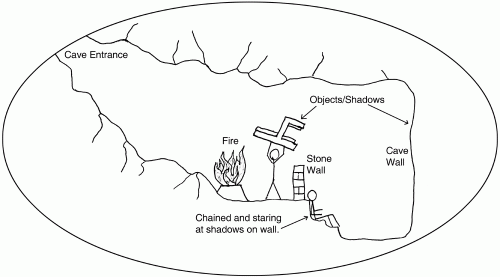
So one day, as Plato conveyed to me over a glass of ruby-red Greek wine, he goes back into the claustrophobic cave where he once had the courage to flee. He excitedly tells his former neighbors-the self-shackled cave dwellers-that there is brilliant light outside. Everything can be seen clearly. Truth and beauty await them outside the cave.

He tells them that the large fire at the back of the cave is casting the shadowy flickering images on the walls of their cave. This is what is scaring them. He tells them that their understanding of life, their vision is veiled and distorted. “Come and see”, he tells them.

Most of the cave dwellers respond apathetically. Some had tried to read the shapes on the wall and to discern their meaning but to no avail. (The images are the cave dwellers themselves as distorted silhouettes projected onto the walls by the firelight. They cannot figure this out. Besides, they tell themselves, “Truth is what our cave dwelling friends let us get away with saying.”)

After Plato’s pleading the cave dwellers tell him that they do want anyone to stop the picture show. They know what to expect day after day. They look forward to the same known foggy reality.

Plato, my friend, was then denounced as part of a lunatic fringe element for his Ideas. He was ridiculed and banished from the cave. If the cave dwellers had been not shackled they would have killed the ‘prophet’ of a new and illuminated world. Instead they invented trigger warnings to fend off intruders.

The end.

Plato's Cave

Plato’s Cave

The video link at the bottom of this post sheds some light on the scary shadow developed skepticism of many people hunkered down in their trigger warning guarded thought caves.

Tim Keller, introduced in the video, is also a contributor to the Christian-based theistic evolution science blog Biologos.org.

After Keller’s presentation, about 44 minutes into the video, there is a question and answer period.

Several students question Keller including two philosophy students who ramble on trying to form a question that Keller can answer. It is an interesting discourse, to be sure. Kant is brought out and dusted off.

It was Kant and the thinkers of Enlightenment that brought out and dusted off the “Upper” and “Lower” storybooks stashed away on the shelves of philosophy for centuries – basically, the ‘atomistic’ philosophy promoted by the Greek philosopher Epicurus.

Once Darwin came on the scene the thought-value split quickly became the Western mindset. Man, we were told, had evolved out of his unenlightened cave to live in his new cave of Scientism. Religion was dismissed as only flickering sentimental shadows of the past. Truth had been divided into Continental and Analytical thinking, with no middle ground between.

Once I built an ivory tower

so I could worship from above

when I climb down to be set free

she took me in again

from “Hard Sun”, written by Gordon Peterson

Francis Schaeffer, the founder of L’Abri Fellowship in Switzerland, used the following diagram to describe modern man’s dualistic thinking to those who studied at L’Abri.

The Two-Story Concept of Truth

Values

Private, subjective, relative

Facts

Public, objective, universal


This dichotomy has grown so pervasive that most people do not even recognize they hold it. It has become part of the cultural air we breathe. Consider two prominent examples:

Martin Luther King Jr.: “Science deals mainly with facts; religion deals with mainly values.”

Albert Einstein: “Science yields facts but not “value judgments”; religion expresses values but cannot “speak of facts.”


Modern man, hiding behind easily tripped trigger warnings inside his cave, shackled to soulless hand-held materialism denies the existence of the whole outside world, a world brightly illuminated. It was a medievalist poet, Gerard Manley Hopkins, who understood the magnitude of the illuminated whole: “The world is charged with the grandeur of God.”

Once out of the cave, reality for man is the Hard Sun. Yet, Man will see and then, if willing, embrace both Continental and Analytical thinking. He can embrace both nature and grace, both facts and values, both Truth and Beauty.

And Man can also walk in the eternal light of God’s Son, for he said, “I am the light of the world. Whoever follows me will never walk in darkness, but will have the light of life.”

The Veritas Forum: Belief in an Age of Skepticism?

Added:

If you are skeptical about the reality of the resurrection of Jesus then I have some light for you:  Jesus and the Eyewitnesses: The Gospels as Eyewitness Testimony by Richard Bauckham

Epicurus Wins Greek Election or Pain Must Be Shared to Be Fully Enjoyed

My last two posts took you for a ride in the “Wayback Machine”. The ride, with no cost to you and minimal effort on your part, took you back to the time of Epicurus, the Greek philosopher. Then I forwarded the machine to our present time, the age of the Angry Atheists. Today’s post will take you for a ride in the “Lean Forward” Machine.

 The “Lean Forward” Machine is not like the “Wayback Machine”. Whereas the “Wayback Machine” records and regards history in its travels as an annotated time line worthy of informing present decision-making regarding morals, social concerns, spirituality, politics and economics the “Lean Forward” Machine says “phooey with all of that”:

 “Let’s go full steam ahead to the future. “We have the omniscient and omnipresent being-‘perfected’-as-we-speak-with-your-tax-dollars Government (of Titanic proportions mind you) to pilot us (in ad hoc fashion mind you) to the Elysian Fields of the Brave New World.”

 At this point you should know that the “Lean Forward” Machine is regarded by some as a religious temple. Some even call it by the sacred name of its goddess-“Progress”.

 But, before we “Lean Forward” into unreality let us take at quick look at Epicurus’ homeland today to get a reality check on effects of his philosophy:


Epicurus' party pic

Epicurus’ party pic

Left-Wing Syriza Party Wins Big as Greece Rejects Austerity

ATHENS — Greece’s left-wing Syriza appeared on course to trounce the ruling conservatives in Sunday’s snap election and could win the absolute majority it wants to fight international creditors’ insistence on painful austerity measures.

Tsipras’ campaign slogan “Hope is coming!” resonated with voters, weary of austerity after six years of constant crisis that has sent unemployment over 25 percent and threatened millions with poverty.

“Hope is coming!” Wait! Where have I heard that before?

 Anyway, Greece, the land of the ancient philosopher Epicurus, has rejected austerity and forsaken posterity!: “My friends, let us make Epicurean lifestyle the epicenter of things! Eat, drink and be merry with impunity! Run up the tab! The gods don’t care. Why should we?”

 There you have it my friends. Sorry to say but it appears that the ticket for the “Lean Forward” Machine return trip would cost you everything. And, if you did go, you would not see your children and grandchildren flourishing. Rather, you would not find them at all, having vanquished in the Farmworkers’ Grape Pickers Camp; having been cast into the great winepress of the wrath of Progress.


I’m not going with you to look for my future in the “Lean Forward” Machine. I have not lost the Spirit or my faith in God. I have the Kingdom of God here on earth to tend to whether or not my belly is full. The Kingdom of God is my vocation, my calling, my camp.


“Instead, make your top priority God’s kingdom and his way of life, and all these things will be given to you as well.” Matthew’s Gospel 6, verse 33

God Saw That It Was Good and So Do I

This past week I read an engaging book by scientist Francis S. Collins:  The Language of God: A Scientist Presents Evidence for Belief.  As someone who works in the engineering field and as a believer in God the book’s discussion of science and faith being compatible piqued my interest.

 Before reading this book I did have the innate understanding that science and faith were compatible and that each discipline reinforced the other with their respective insights and revelations but prior to reading this book I hadn’t seen much credible literature discussing this premise.  Currently there appears to be plenty of antipathy between the church and science. So as one might imagine I was excited to purchase the book and evaluate a scientist’s take on the connection. I was not disappointed.

Francis S. Collins, as the back cover bio reads, headed the Human Genome Project and is one of the world’s leading scientists. “He works at the cutting edge of the study of DNA, the code of life.  Yet he is also a man of unshakable faith in God and Scripture.

Dr. Collins believes that faith in God and faith in science can coexist within a person and be harmonious. In The Language of God he makes his case for God and Science.”

 Of special interest to me is the fact that Collins (as I do) accepts theistic evolution.  In Chapter Ten he writes: 

 “This view is entirely compatible with everything that science teaches us about the natural world.  It is also entirely compatible with the great monotheistic religions of the world.  The theistic evolution perspective cannot, of course, prove that God is real, as no logical argument can fully achieve that. Belief in God will always require a leap in faith.”

 The book lays out for the reader in very accessible terms how Collins who was not raised in a Christian home came to his belief in God as a budding scientist in his twenties.  The book goes on to discuss why Collins fully accepts theistic evolution as opposed to literal Creationism and Intelligent Design.  Based on his own research Collins says the evidence is overwhelming in favor of natural evolution as God’s creative methodology.  I would agree. 

 He then further encourages the church to endorse scientific research as a resource for understanding God’s creation, therefore offering a better understanding of God.  In concert with his plea I believe every church leader should purchase this book and read its message.  There is, sadly, too much bad information being preached and taught by the Christian Evangelical church regarding creation.  This bad information makes the church look rather foolish.  Remember Galileo’s row with the church? Being raised an Evangelical I was taught that the earth was created about 6-8000 years ago and that the seven days described in Genesis Chapter One were literal days:  Poof, we just showed up on the scene.

 As an adult, though, I became skeptical of the Creationist theology but I clung to it because I had heard of no other plausible evidence to the contrary.  Evolution was routinely discounted in the Evangelical church.  In fact everything I had heard in church told me that evolution was the atheist’s version of the Christian creation. Evolution was also described as a slippery slope which would carry people away from God toward unbelief.  And worse, the church seemed opposed to science and science was something I truly enjoyed being involved with.  I would later look into Intelligent Design (ID) and had wondered if ID might be the catch-all for my belief in God’s creative act. But I was to learn that ID was flawed theory that did not take into account the nature of God.

 My change in thinking occurred a few years ago when I came across the writings of Christian philosopher Alvin Plantinga from the University of Notre Dame.  Spending two and a half hours on a train five days a week over the course of several years I had been able to read and research many different science and philosophy topics. And I did this precisely because I wanted to know more about God, the nature of His being and the world around me.  This excited me no end.  I don’t read romance novels.  I find my excitement by romancing the truth.

  Through reading Plantinga’s papers, though sometimes written in difficult philosophical terms, the door of my understanding was opened wide and I accepted theistic evolution as a valid creation methodology.  I would encourage anyone to read Plantinga’s papers.

 The basics of theistic evolution are clearly delineated in Francis Collins’ book and on the Biologos website.  Biologos is the name given to theistic evolution by scientist Collins.  Here are the Biologos premises/beliefs from that website:

 We believe that God created the universe, the earth, and all life over billions of years. God continues to providentially sustain the natural world, and the cosmos continues to declare the glory of God.

  • We believe that all people have sinned against God and are in need of salvation.
  • We believe in the historical incarnation of Jesus Christ as fully God and fully man. We believe in the historical death and resurrection of Jesus Christ, by which we are saved and reconciled to God.
  • We believe that God continues to be directly involved in human history in acts of salvation, personal transformation, and answers to prayer.
  • We believe the Bible is the inspired and authoritative word of God. By the Holy Spirit it is the “living and active” means though which God speaks to the church today, bearing witness to God’s Son, Jesus, as the divine Logos, or Word of God.
  • We believe that God also reveals himself in and through the natural world he created, which displays his glory, eternal power, and divine nature. Properly interpreted, scripture and nature are complementary and faithful witnesses to their common Author.
  • We believe that the methods of science are an important and reliable means to investigate and describe the world God has made. In this, we stand with a long tradition of Christians for whom Christian faith and science are mutually hospitable.
  • We believe that the diversity and interrelation of all life on earth are best explained by the God-ordained process of evolution and common descent. Thus, evolution is not in opposition to God, but a means by which God providentially achieves his purposes.
  • We believe that God created humans in biological continuity with all life on earth, but also as spiritual beings. God established a unique relationship with humanity by endowing us with his image and calling us to an elevated position within the created order.
  • We believe that conversations among Christians about controversial issues of science and faith can and must be conducted with humility, grace, honesty, and compassion as a visible sign of the Spirit’s presence in Christ’s body, the Church.
  • We reject ideologies such as Deism that claim the universe is self-sustaining, that God is no longer active in the natural world, or that God is not active in human history.
  • We reject ideologies such as Darwinism and Evolutionism that claim that evolution is a purposeless process or that evolution replaces God.
  • We reject ideologies such as Materialism and Scientism that claim science is the sole source of knowledge and truth, that science has debunked God and religion, or that the physical world constitutes the whole of reality.

 As a follower of Christ and as someone who seeks to bring people to faith in Him I see it as imperative that Evangelical church leaders (John Paul II accepted theistic evolution) come to grips with science (natural science, quantum physics, genetics, etc.) and to avail themselves of all empirical data and evidences coming out of science research.  As I see it the church and science are completely compatible.  Therefore, the church must not seek to restrain the hand of God, an evolved-incarnated hand that was once nailed to a tree, a resurrected hand that now reaches out to all of us.

 For more information about theism and theistic evolution:

 http://biologos.org/

Philosopher Sticks up for God

Alvin Plantinga

*****

Recommended Books about science and faith:

The Language of Faith:  Straight Answers to Genuine Questions by Karl Giberson and Francis Collins, Intervarsity Press, 2011

The Wonder of the Universe:  Hints of God in Our Fine-Tuned World by Karl W. Giberson, Intervarsity Press, 2012