Scaffolding
November 5, 2023 Leave a comment
I sat down with a close friend the other day. I asked him about his early church experience, as I am interested in church dynamics.
Here’s what Dan (not his real name) said during the interview:
“My parents attended a Baptist church in Chicago before moving to the suburbs. I was a kid and just remember old buildings with a fusty smell and pictures to color. After the move, we started attending a Bible church. I was eight years old.
“I don’t remember a single sermon. But I do remember the church sanctuary. I sat there Sunday mornings and evenings for maybe twenty years.
“There was a plaque on the back wall above the choir loft. It said “God is in His holy temple. Let all the earth keep silent. Hab. 2:20.
“Front and center was a large wing pulpit. Three large minister chairs were behind it along the choir loft. A piano on the left and an organ on the right flanked the platform.
“On the main floor in front of the pulpit was the oak communion table. “This Do In Remembrance of Me” was carved on the front. The table held the offering plates and a flower arrangement.
“To the right of the platform and behind a large rectangular hole in the wall was the baptistry. A landscape was painted on the walls surrounding the water tank.
“Opposite the platform, sixteen rows back, was the entrance to the sanctuary. A clock was centered above the double doors to let the minister know when to end the service.
“Rows of blond wood pews filled the space between the front and back with an aisle down the center and along each end.
“The side walls were painted-beige cinder block. Each wall had three windows of tinted-amber bubble glass. Forest green curtains bordered two sides of each window.
“The walls around the windows were bare except for a wooden rack near the organ. It held the numbers in attendance at the service and at Sunday school the week before. An usher counted attendance every Sunday.
“That’s a twenty-five-year snapshot. I don’t recall that room ever changing.”
I asked him about the service.
“Prelude. Hymns. Lots of choruses about leaving earth and flying away. Sermon. Calls for salvation and rededication of your life. Postlude. Every Sunday.”
I asked him about memories that stick out.
“Let’s see. There was the leader of the boy’s club. He let us run around and be crazy one night each week. One time he took us to a construction site to show us what he was working on. He was a carpenter.
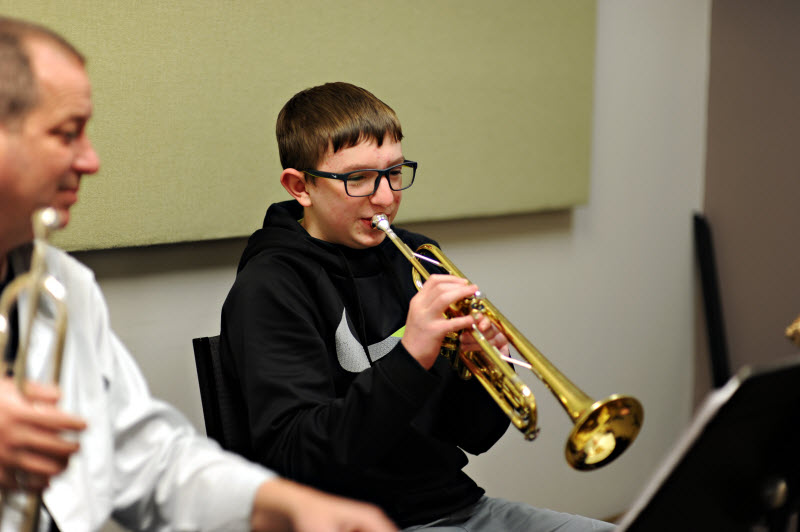
“There was an adult Sunday School teacher who visited a nursing home once a month. He had me come with him on those Saturdays. I’d play a hymn with my trumpet. Afterward he would give a short devotional.
“And there was this interim minister – there were lots of them – who got me my first job as a clerk in a Camera/Photo store. One time – I was twelve or thirteen – he had me come with him downtown to Pacific Garden Mission. I played my trumpet and he spoke to those who had come off the streets of Chicago.”
I told Dan that he only mentioned certain men as memories that stick out. Then I asked if anyone had mentored him.
“No one from church. Only my trumpet teachers did.”
I asked him to explain.
“I started playing the trumpet in third grade. My uncle gave me a beat-up Conn trumpet that he longer wanted to play. In the Junior High School, the band director wasn’t crazy about the look or the sound of my horn. So, he switched me to French horn for two years. But my heart was with the trumpet. I asked my parents for private lessons.
“Before I started lessons – this was during eighth grade – my father and I went to an instrument store. He bought me a brand-new Bach Stradivarius b-flat trumpet. The horn was a beautiful and expensive gift. I felt affirmed.
“My first trumpet teacher was a high school principal who also played trumpet in big bands. The first question he asked me: What trumpet players did I listen to? I told him Herb Albert. He just shook his head.
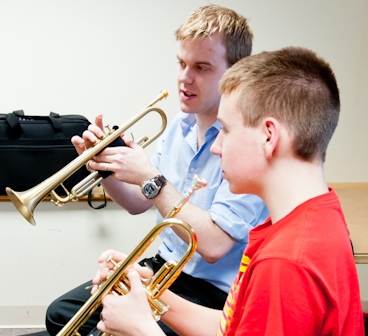
“He told me who I should listen to and to what pieces of music. He began giving me exercises to practice. Major and minor scales. Tonguing exercises. I’d have to play them for him the following week.
“The summer before high school I took what he taught me and practiced like crazy. The high school concert band director had sent out the requirements for entering the band. Those included playing major and minor scales and site reading.
“A month before my freshman year began, I was called in to audition for the band director. I played all the scales and sight read what he put in front of me. He was pleased. I was in the concert band – first trumpet section right behind the first chair trumpet, a sophomore.
“My junior year of high school the band director Mr. Gies became my second trumpet teacher. He also played the trumpet semi-professionally.
“What happened was this: the guy who sat first chair was a stellar trumpeter but he needed to be replaced. During the summer the first chair French horn player became pregnant. Both would soon be leaving the school. So, the band director began one-on-one time with me.
“Over several months Mr. Gies and I met in the school auditorium during an open period for both of us. Playing the trumpet in that auditorium, that sanctuary, was like no other experience. With those unstifled acoustics I could open up and project a nice broad sound.
“Mr. Gies asked me how I practiced. I shared with him the Carmine Caruso method for building chops. I learned the method from my first trumpet teacher, Mr. Lichti.
“I told him that the method involves interval training, articulation, range and produces endurance. With it, I had developed an extensive range -double high C to over an octave below the treble staff. The method had formed my sound to that point.
“Sitting together offstage, Mr. Gies and I worked through the Caruso method along with the Clarks – Clark Technical Studies – which are exercises used for the development of fingering technique.
“I cherished that time alone with the band director. In between playing an exercise we talked about anything and everything. And sometimes we were silent and it felt comfortable.
“We practiced together the rest of my junior year. I was ready for the first chair trumpet position when the other guy left.
“My third trumpet teacher was at a Bible school. After high school I entered a Christian Ed/Music program. The Christian Ed program was a bust but the music program was a blessing.
“I took private lessons from the concert band director, Mr. Edmonds. Unlike the other teachers, he was an established pianist with perfect pitch. He had a different take, a different sound in mind, for my horn – a precise centered pitch. He was also a composer. He adapted classical music for our concert band to play.
“In between playing my practiced exercises and being critiqued, the director and I would talk about anything. I shared with him the challenges I was facing. My practice time was limited because of my studies and the time spent listening to classical music for music appreciation class. And I had a part time job. He prayed for me at the end of each lesson.
“Like back in high school, I sat first trumpet second seat behind a sophomore in the concert band. But at an outdoor band concert, Mr. Edmonds had me solo the opening trumpet lines of Rimsky-Korsakov’s “Procession of the Nobles”. And when The Gaither Trio – Bill, Gloria, and Danny – came to town for a couple of concerts and needed some horns for the finales, Mr. Edmonds offered his two first chair trumpet players. The private lessons and my practice gave me opportunities to play.
“Looking back . . . sitting next to a trumpet teacher week after week, I learned from those who knew what to listen for and who to listen to. Mr. Lichti, for example, helped me realize that I had “deaf spots” in my listening. To develop my “ear”, I began to listen to Adolph “Bud” Herseth, principal trumpet in the Chicago Symphony Orchestra. I wanted to emulate his bel canto sound and his musical acumen.
“To accomplish this, I had to take a risk. You see, with one-on-one instruction you cannot hide, you can’t fake or pretend. You play your horn and the truth comes out. Sloppy practicing is immediately revealed and so is the need for discipline. You need another’s knowledgeable perspective to grow as a musician. Words or notes alone are not enough.
“The three trumpet teachers I mentioned invited me into their musical realm, which was both affirming and daunting, as I was made me accountable to them. In the role of apprentice, they imparted to me trumpet knowledge, technical ability, and a love for the craft.
“And now that I think about it, I take it back. The man who took me and others to his construction site and the man who took me with him to the rest home and the man who took me with to the Chicago mission and got me my first job were mentors. They influenced me just like the trumpet teachers advanced the formation of my horn playing.
“You asked about my early church experience. I’d say that there was lots of scaffolding but no formation. For me, there was really nothing life changing about going to church and sitting in silence listening to someone standing behind a pulpit. But there was with people I spent time with.”
End of interview.
~~~~~
Church culture: “Tragically, in recent years, Christians have gotten used to revelations of abuses of many kinds in our most respected churches–from Willow Creek to Harvest, from Southern Baptist pastors to Sovereign Grace churches. Respected author and theologian Scot McKnight and former Willow Creek member Laura Barringer wrote this book to paint a pathway forward for the church.”
In this podcast, theologian Scot McKnight and his daughter, Laura Barringer, join Julie Roys to discuss their latest book, A Church Called Tov: Forming a Goodness Culture That Resists Abuses of Power and Promotes Healing.
While their first book explained the characteristics of a “tov,” or good, culture, their latest book tackles the next challenge—transforming ingrained toxic cultures into tov ones.
Pivoting Your Church From Toxic to Healthy | The Roys Report (julieroys.com)
~~~~~
Bud Herseth’s Final Concert on NPR – YouTube
Adolph Herseth Interview – YouTube
~~~~~






























Binary Beckons for More from You
October 15, 2023 Leave a comment
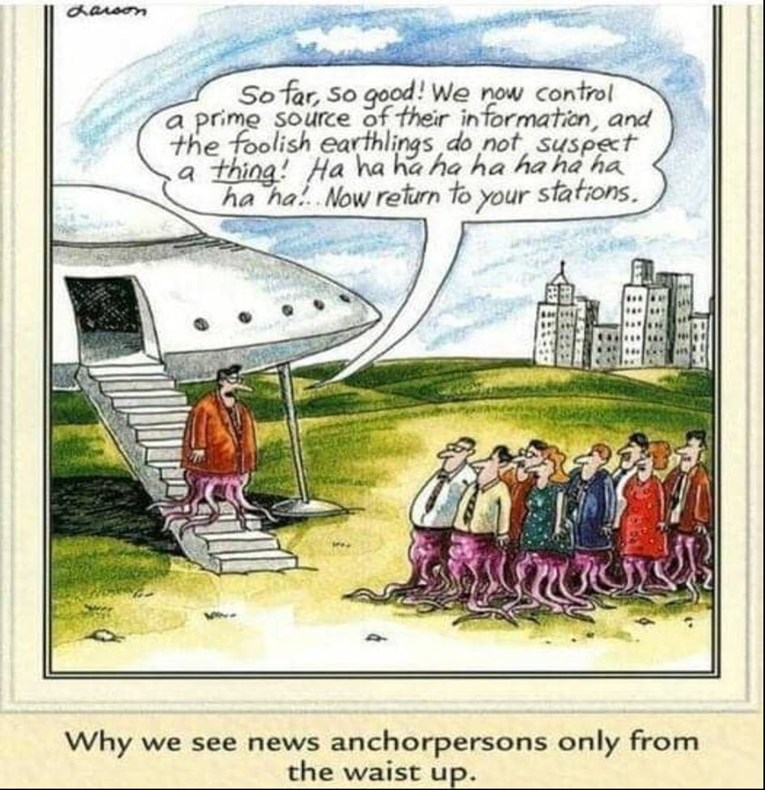
Two options guided my early incorrigible years: “Either you do what I say or your father will deal with you when he comes home” “Either you clean you room or lose your allowance” “Either you are home by 9 or you will be grounded.” The church, too, presented two stark choices: “Either you get saved and go to heaven or you go to hell”; “Either walk the straight and narrow or walk the wide way of the world.”
The either/or binaries of my early childhood were meant to prepare me for life. I learned that if I wandered off into “or” territory there was sure to be consequences. My parents guided my behavior from their own experience of walking within binary guard rails.
They had learned that from the simplest safety issues to the most important issues in life, honest straightforward either/or choices are required. My late mother shared one such either/or choice.
My father, having grown up in the Dutch Reformed church where smoking was the norm for men, was given a choice by my mother when she was dating my father: “Either you stop smoking or that’s it.” Thankfully, my father didn’t “or” the situation. I wouldn’t be here if he did.
With knowledge of their own either/or choices and exposing me to the either/or choices of the book of Proverbs, my parents either/or’d my youth. Binary guard rails were set in place for my time in Jr. High and High school.
When I attended Moody Bible Institute after high school (early 70s), the binary thinking infused in me by the church came into question.
A first-year class called “Personal Evangelism” was taught by Mr. Winslett. During that semester Mr. W described different religions. As he did so he labeled the churches of the Seventh Day Adventists, Mormons, Jehovah’s Witness and others as cults. When he came to the Catholic church, he said it was a cult because Catholics worshipped Mary, had a pope, and put tradition ahead of scripture. I remember hearing this and thinking that we’re better than all of them. But something felt off.
(Per Article I of The Chicago Statement on Biblical Inerrancy found on the Moody Bible Institute website, the Bible, not tradition, is the authoritative Word of God.)
The highly partisan Mr. W, a representative of MBI, had sallied Catholicism: MBI represented real Christianity and Catholicism, a “cult”, did not; either you are with us in Bible first thinking or you are not one of us. (Mr. W was the only teacher I met a MBI like this. But there are many who preach and teach the same binary “us and them” thing.)
I was raised Protestant. Differences of Protestantism and Catholicism were minimally noted in my church. But I had read about Luther, the Ninety-five Theses, and the Reformation. I knew about the abuses and corruption of the Catholic church. Those include Johann Tetzel selling indulgences.
But faith in God and his salvation coupled to Mary, the pope and tradition were not Christianity deal breakers for me. For without faith it is impossible to please God, because anyone who approaches Him must believe that He exists and that He rewards those who earnestly seek Him.
Instead of imposing exclusionary theology, abide by the words of the old hymn: “God moves in a mysterious way His wonders to perform . . . God is his own interpreter, and he will make it plain.”
Years later I came across the same “us and them” attack. I brought my daughter to an Awana program going on at a Baptist church. On the night that she and I were to race the Pinewood Derby Car we had crafted together, the speaker bad-mouthed the Catholic church during a promotion for the Baptist church we were standing in.
He said something to the effect that their Baptist church wasn’t like the unsound Catholic church. I was shocked. There were members of that Baptist church and other churches in attendance. What did they walk away with that night?
I’ve seen this attitude surface so many times by haughty either/or Protestants. I’ve also seen it in either/or Catholics. Both groups interpret Church teaching in a narrow way, then argue that whoever disagrees with their tightly wound interpretation must—by the fact of that disagreement—be in opposition to Church teaching. The Either-Or fallacy used by both Protestants and Catholics: “I can’t be in error therefore YOU must be!”
Another anecdote of the “us and them” attitude: One night I was sitting in a donors meeting listening to a presentation. The Episcopal church I attended wanted to annex and refurbish the house next store and make it ministry usable. At front and center of the room that night was a picture board showing the proposed design. The crossway from the existing church building to the house showed a cross in relief in the arc above the passageway. One woman remarked that we should get rid of the cross because “we’re not Baptists.”
Look. Our family and church backgrounds teach us to think in opposites – basically in terms of good and bad. We are presented with two options and they appear as your only options and mutually exclusive. We then bring unmediated polar extremes into adulthood.
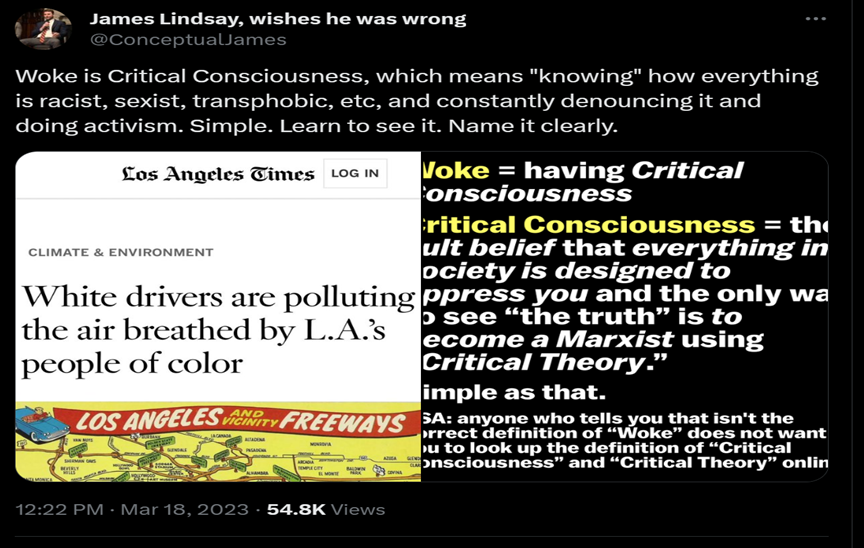
Either/or thinking integrated into our lives and then reinforced by our respective cultures can produce a worldview in stringent binary terms: as a one or zero. Black-and-white thinking is used to reduce the world to something we can handle which then provides a sense of certainty and security. But “a one or zero” thinking can be adversarial, dividing people into “us vs. them.” A few examples:
“I am right and you are wrong.” (How does that work out in marriage? With our neighbors?)
“If you’re not with me, you’re against me. I have friends and enemies but not acquaintances.”
“Either I win or I lose in this situation.”
It can also produce all-or-nothing false dilemma fallacies which are really manipulative setups:
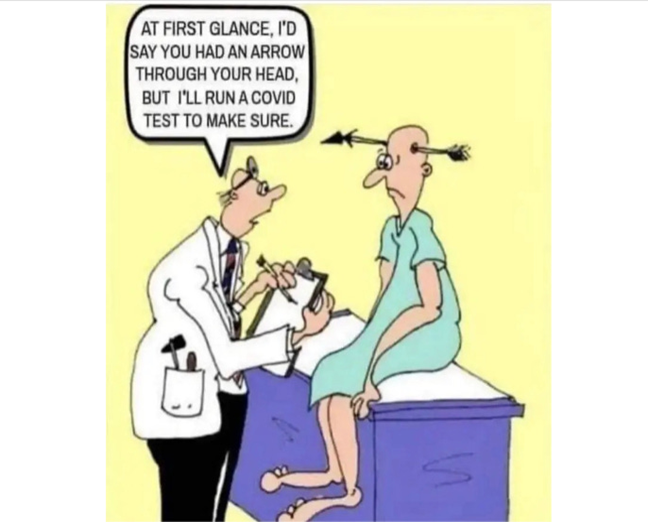
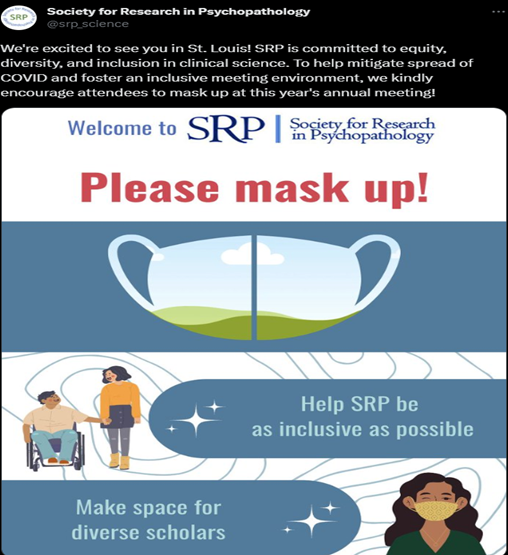
“If you care about your neighbor, you will get vaccinated” and “Putting others first will get us through he pandemic” “Getting vaccinated is loving your neighbor as yourself.”
“Social solidarity is the most precious tenet of our democracy.”
“You’re either pro-choice or anti-woman. There’s no other moral stance.”
“If you’re not part of the solution, you’re part of the problem.”
“Either you let your child change their gender or they will commit suicide.”
“You are either racist (by not agreeing with me) or you are anti-racist (by agreeing with me).”
“If you are against LGBTQ books in the library you are a book banner.”
“If you question what is being taught in public schools, you are a domestic terrorist.”
“If you question the 2020 election you are a MAGA extremist.”
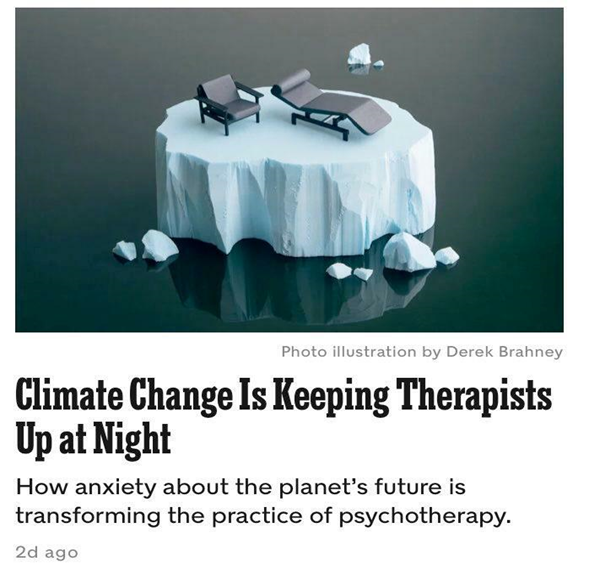
“If you don’t accept the climate science consensus (or COVID science consensus), then you are a science denier.”
Either/or “us and them” thinking tends toward exclusion and not embrace. It tends toward absolutism, authoritarianism, fundamentalism and judgement. We see it in Hamas’ attack on Israel. We see it in climate activism. We see it in cancel culture. We see it in the murderous history of totalitarian regimes. We see it in church teaching and we sing it: “Onward, Christian soldiers, marching as to war.”
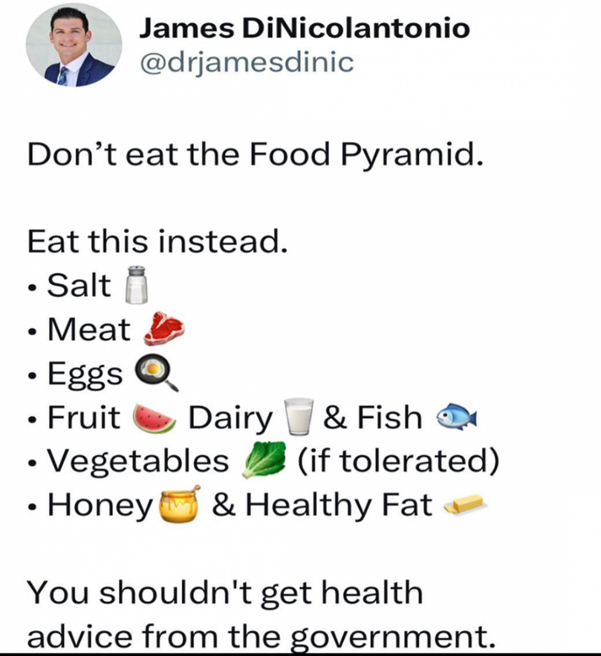
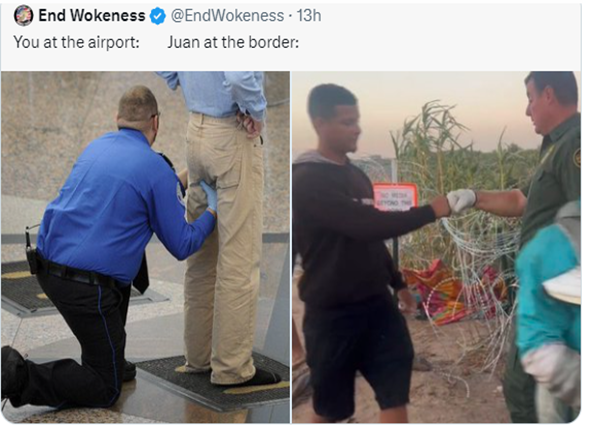
We see it in the teachings and practice of Christians, Muslims, and the Progressive Left which would have us believe that they are the opposite of conservative either/or thinking while mandating their own anything-goes version of it. Theology, ideology and government policies are marketed with the dichotomy of good and bad.
It seems that many have retained their childhood’s unyielding binary worldview. It is used as a defense mechanism, as a means of protection from the “hazards and vicissitudes of life”. (From the statement made by FDR when he signed the Social Security Act.)
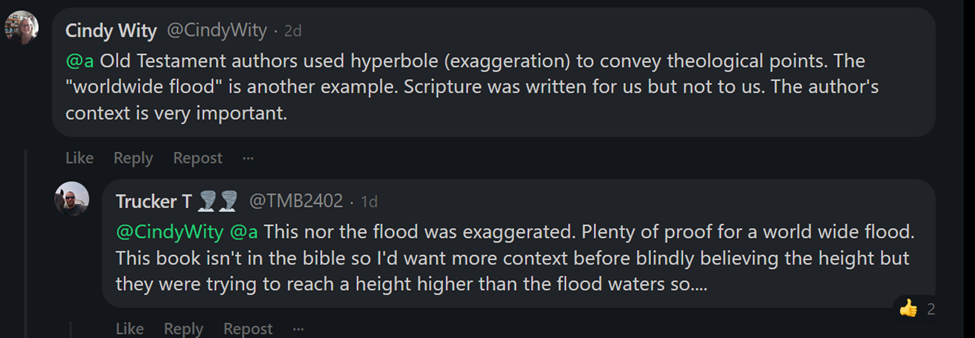
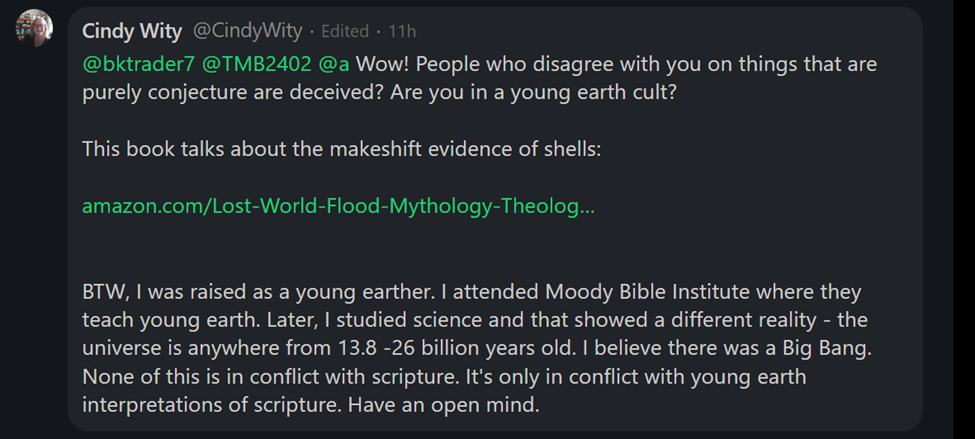
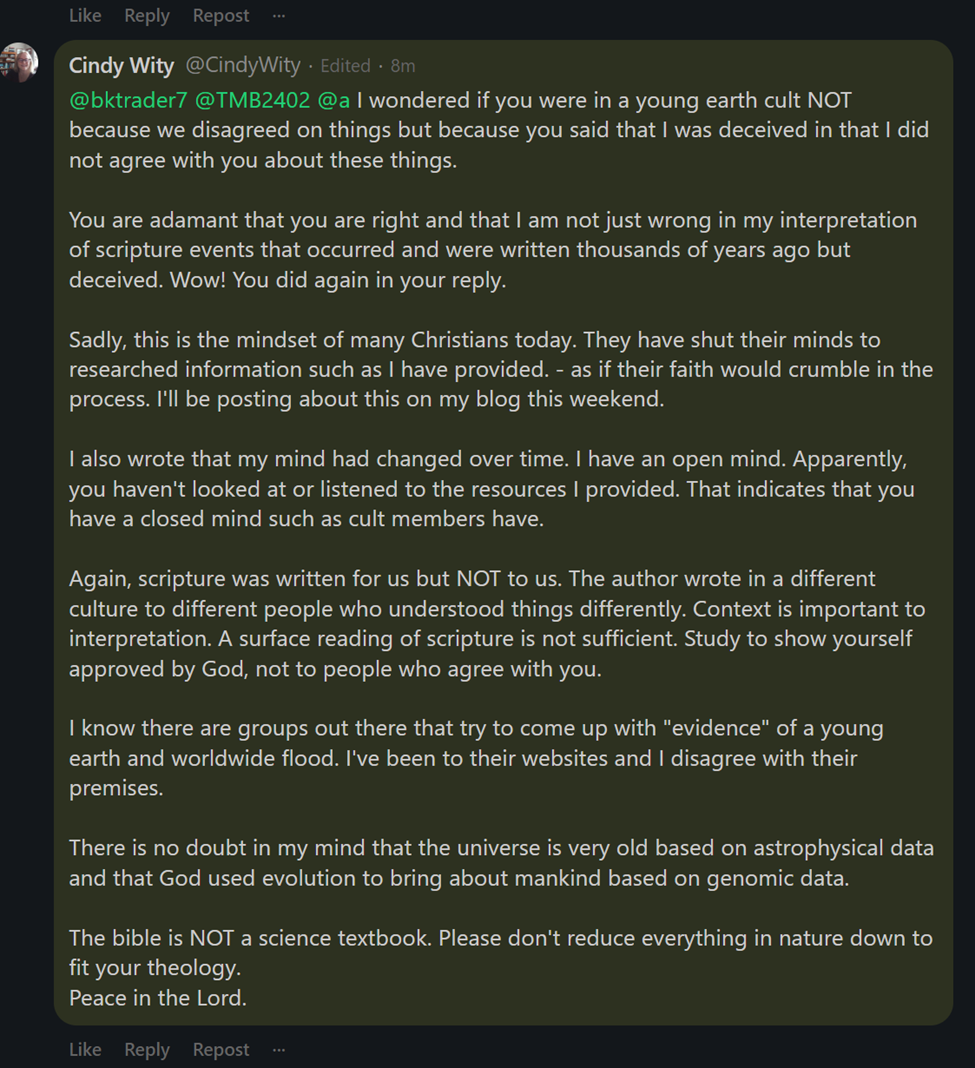
I’ve seen the binary thinking defense mechanism employed by Christians. Though it comes across as holding fast to the faith and Sola Scriptura, faith vs. science messaging reduces the supposed conflict to “us vs. them” binary thinking which allows no quarter for God’s revelation in nature as revealed by science. Yet, God has revealed himself in both scripture and nature. Science is a tool for understanding God’s revelation of Himself in the physical world.
When I told my eighty-nine-year-old Godly mother that, based on research, I believed the universe to be billions of years old and that God used evolution, she didn’t reply “That’s interesting. Tell me more.” She said “That’s heresy!” Her defense mechanism alarm bell went off. She was reacting from what she had been taught and how she had been taught to think about what she was taught.
Becoming emotionally invested in extremes may lead to the exclusion of people, as “Heresy!” suggests. Such binary thinking can produce unrealistic portrayals of others and it can become used, as mentioned above, as a weaponized defense against others.
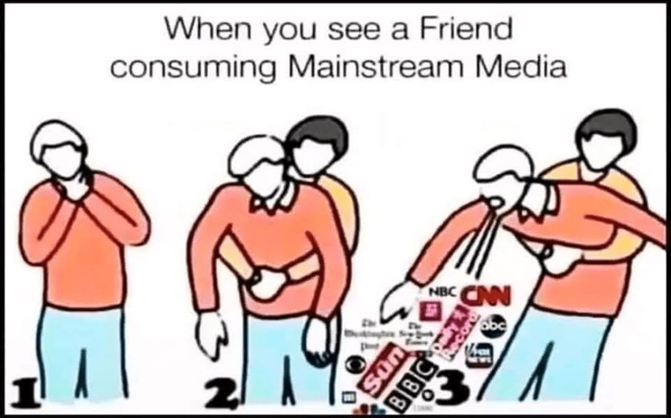
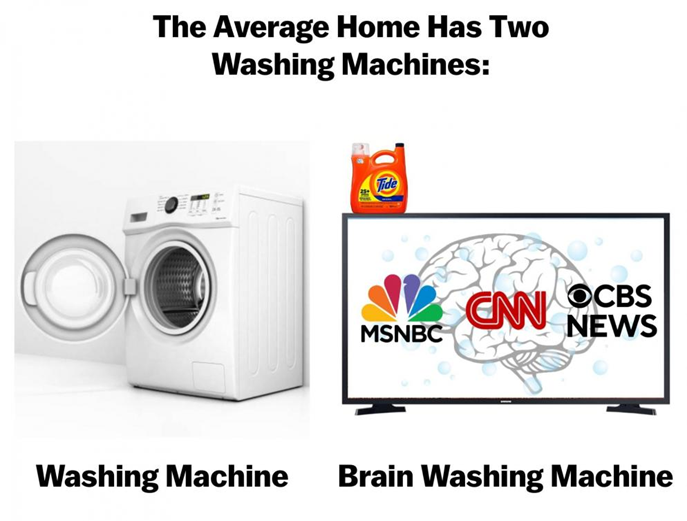
Certainly, there are people who watch news commentators because they relish the mocking and “owning” of the opposition. Certainly, there are people who go to church for the same reasons. But there is nothing mature about participation in bad mouthing others. I see nothing of this in Jesus.
I come across Jesus-whipping-the-money-changers-in-the-temple memes on social media. These are extrapolated as Jesus is “destroying” his enemies, so we can do the same. Horrible nonsense.
Relying solely on binary thinking is intellectual and spiritual laziness. An open both/and questioning mind is not a slippery slope and it’s not anything-goes Progressivism. Seek truth and not the comfort of tribal consensus.
Consider that no one has all the information – not your pastor nor MBI nor Anthony Fauci nor climate scientists. It’s OK. Consider that not everything is black and white. Knowing the difference and knowing when to introduce AND with “perhaps” is wisdom.
The Creator of the universe is not a small-minded Person. He holds a universe of disparate thought, theories, and faith in his hands. He is not threatened by any of it. A follower of the Creator of the universe lets God hold the messiness and uncertainty of life in His hands and does not feel threatened.
Finally, a reductionist’s worldview makes it incredibly difficult to hold space for the uncertainty and messiness of others. But there is a better way, a much better way: love and maturity.
Love is great-hearted; love is kind,
Knows no jealousy, makes no fuss,
Is not puffed up, no shameless way,
Doesn’t force its rightful claim,
Doesn’t rage or bear a grudge,
Doesn’t cheer at other’s harm,
Rejoices, rather, in truth.
Love bears all things, believes all things;
Love hopes all things, endures all things.
As a child I spoke, and thought, and reasoned like a child; When I grew up, I threw off childish ways.
I Cor. 13:4-7, 11
~~~~~
(Note: I’ve summed up a lot so as to make this post accessible. I was involved in the Jesus People movement during high school. Along with those in the movement I questioned a lot of the binary thinking of the church. I’ll share that story in another post.)
~~~~~
Science and Faith
In this episode, we focus on the apparent tension between science and faith.
“Many people believe that science and religious faith are bitter enemies with conflicting views of the universe. One the one hand there is the scientific account of the origins of life and then there is the story of universal origins told by the bible. But is this tension real, or is it based on a deep misunderstanding of what the Bible is and how it communicates?
. . .
“Consider this a crash course in reading the Bible as an ancient cross-cultural experience.”
Science & Faith (bibleproject.com)
~~~~~~
Kate Boyd | Science and the Messy Middle
Kate Boyd has been learning to live out her faith in the messy middle in a culture that rewards picking a side. While her journey didn’t begin with a conflict between science and religion, her story explores the complexities of understanding the Bible in today’s context and anyone who has struggled with issues of science and faith will resonate with this conversation.
149. Kate Boyd | Science and the Messy Middle | Language of God (biologos.org)
~~~~~
I’ve been told that I’m either naive or stupid.
I’m not sure which side I’m moron.
Rate this:
Filed under Christianity, Psychology, Science, social commentary, totalitarianism Tagged with absolutism, Authoritarianism, binary thinking, Catholicism, Christianity, either/or, fundamentalism, Protestantism, psychology, Science, totalitarianism