Displaced in Place
October 19, 2025 Leave a comment
Monica Sanders, a survivor of Hurricane Katrina, wrote in her August 18, 2025, Oxford American article The Storm that Blew Us Apart recalling Twenty years after Katrina, we’re still living in the space between before and after:
The flood took homes and heirlooms, yes. But it also took the things that don’t have price tags: your grandmother’s pew at St. Peter Claver, the second-line route your cousin danced for the first time, the rhythm of being able to walk next door to ask for a lemon and stay for a two-hour porch talk.
We became refugees in our own country . . .
Some of us never came back.
Those who did found a different city. Not just rebuilt, but rearranged. The neighborhoods we knew—Broadmoor, Gentilly, the Lower Nine—returned with new names, new residents, and new rules. People who knew about noise ordinances but not about king cakes. People who brought nonprofits but not traditions. People who wanted charm but not character. The kind who say “N’Awlins” with a wink, and don’t hear the ghost in that mispronunciation.
Displacement gave way to gentrification. What was affordable became vacation rentals. What was vibrant became boutique. Streets that once held parades now hold pop-ups. We became the entertainment, not the community.
And yet, we remain. . .
All of us carry the “before” with us. . .
We talk about resilience now, but we forget that true resilience is cultural as much as physical. It’s knowing who to call when the lights go out. It’s gathering your neighbors even when there’s no power. Its memory passed like gumbo recipes and Sunday prayers.

~~~
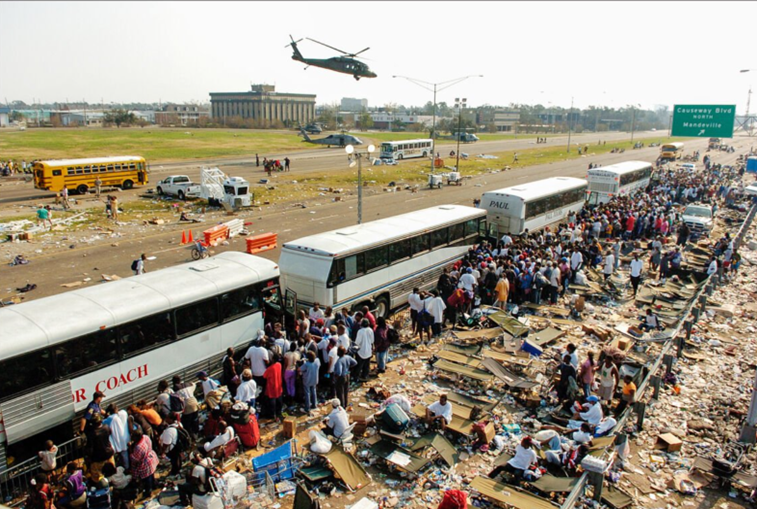
I began with Monica’s reflection on the effects of Hurricane Katrina, for order being swallowed up by non-order, an overwhelming flood, parallels the flood of disorder working to decouple us from people, place and the past and to colonize us for its reorganizing purposes which include efficacy, profitability and efficiency. (Order, non-order and disorder are terms coined by Dr. John Walton to describe cosmology in his Job commentary.)
That storm is blowing us apart. And as was experienced in the aftermath of Hurricane Katrina, we feel a pervasive sense of displacement, of being refugees in our own country, of living in the space before and after the imposed transformation of our culture.
The source of dysphoria about our time and place being out of joint may not be readily recognizable. As with the “frog in boiling water”, we steep in its flood waters not recognizing the stew we are in. Screens constantly distract our attention away from what is happening to our existence.
The source: a flood of ideologically progressive technology and globalization that is wiping out our connections to people, place and the past. Its overwhelming force is our unmooring, our unmaking. Its irresistible force is displacing us in place.
I’ve been aware of the source for many years, starting when I bought a 286 computer in the 70s. The machine had an allure that had me come back to it constantly.
In an October 23, 2022 post Altered States, I quoted Jacques Ellul from his book The Technological Society and wrote the following:
I’m becoming a neo-Luddite of sorts. I have a particular dislike for digital technology as it modifies the means of relating to ourselves, to those around us and to our world. Its dissociative medium detaches us from reality, thereby affecting identity, memory, perception, and truth.
The flood waters are rising around us. Look at what is going on with the tech-bro push for AI and transhumanism, with concerns about rare earth minerals, with chips, chips, and more chips, with 5G towers, energy and water consuming data centers, constant surveillance, mandated digital IDs – why do we need any of it?
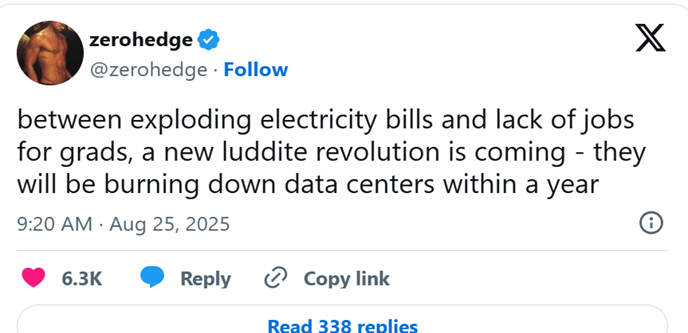
‘A Sharp Escalation’: Americans Starting To Revolt Against Data Centers | ZeroHedge
I recently came across an author that uses “the Machine” as the analogy for the inhuman forces at work to enclose all in its path for Progress. What Kingsnorth writes resonates with everything that I’ve read in dystopian novels: 1984, That Hideous Strength, Brave New World, and Darkness at Noon. Here’s Paul Kingsnorth with “Huxley and the Machine”:
Paul Kingsnorth’s, Against the Machine is “an account of the technological-cultural matrix enveloping all of us. The culmination of two decades of my writing and thinking about technology, culture, spirituality and politics, it seeks to offer an insight into how the techno-industrial culture that I call ‘the Machine’ has choked Western civilisation, is destroying the Earth itself, and is reshaping us all in its image.
From the First Industrial Revolution to the rise of artificial intelligence, this book shows how the hollowing out of humanity has been a long game—and how our very soul is now at stake.
Against the Machine is the spiritual manual for dissidents in the technological age.”
~~~~~
Per Lewis Fried, Lewis Mumford, author of The Myth of the Machine, “insisted upon the reality of the Megamachine: the convergence of science, economy, technics and political power as a unified community of interpretation rendering useless and eccentric life-enhancing values. Subversion of this authoritarian kingdom begins with that area of human contact with the world that cannot be successfully repressed – one’s feelings about one’s self. “
Mumford:
The vast material displacements the machine has made in our physical environment are perhaps in the long run less important than its spiritual contributions to our culture.
Technology, instead of introducing us to freedom, has imposed on us the slavery of the machine.
Modern Man is the victim of the very instruments he values most. Every gain in power, every mastery of natural forces, every scientific addition to knowledge, has proved potentially dangerous, because it has not been accompanied by equal gains in self-understanding and self-discipline.
A day spent without the sight or sound of beauty, the contemplation of mystery, or the search of truth or perfection is a poverty-stricken day; and a succession of such days is fatal to human life.
Our national flower is the concrete cloverleaf.
Western culture no longer represents man: it is mainly outside him, and in no small measure hostile to his whole self: he cannot take it in. He is like a patient condemned in the interests of X-ray photography to live upon a diet of barium sulphate…In the end, as Samuel Butler satirically prophesied, man may become just a machine’s contrivance for reproducing another machine.
The great gains that were made in technics during the last few centuries were largely offset by a philosophy that either denied the validity of man’s higher needs or that sought to foster only that limited set of interests which enlarged the power of science and gave scope to a power personality. At a moment when a vast surplus was available for the goods of leisure and culture, the very ideals of leisure and culture were cast into disrepute — except when they could be turned to profit. Here lies the core of the inner crisis that has afflicted our civilization for at least two centuries. In the heyday of expansionism, the middle of the nineteenth century, scarcely a single humane voice could be found to defend either the means or the ideals of a power civilization…Blake, Ruskin, Morris, Arnold, Emerson, Whitman, Thoreau, Melville, Dickens, Howells, Hugo, Zola, Mazzini, Tolstoy, Dostoyevsky, Ibsen…denounced the human results of the whole process of mechanization and physical conquest. As with one voice, they protested against the inhuman sacrifices and brutalizations, the tawdry materialisms, the crass neglect of the human personality.
~~~~~
~~~~~
The truth is, men have lost their belief in the Invisible, and believe, and hope, and work only in the Visible; or, to speak it in other words: This is not a Religious age. Only the material, the immediately practical, not the divine and spiritual, is important to us. The infinite, absolute character of Virtue has passed into a finite, conditional one; it is no longer a worship of the Beautiful and Good; but a calculation of the Profitable. Worship, indeed, in any sense, is not recognised among us, or is mechanically explained into Fear of pain, or Hope of pleasure. Our true Deity is Mechanism. It has subdued external Nature for us, and we think it will do all other things. We are Giants in physical power: in a deeper than metaphorical sense, we are Titans, that strive, by heaping mountain on mountain, to conquer Heaven also.
Thomas Carlyle, from “Signs of the Times“
~~~~~
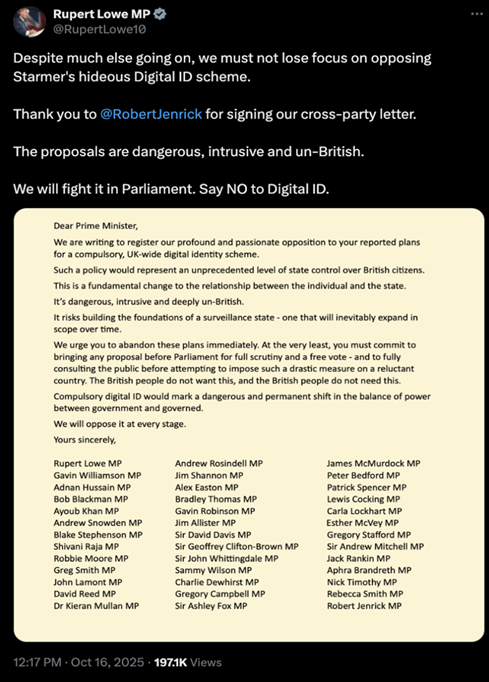
Against the machine: Digital ID Black Pill Moment? – The Burning Platform










 Cindy Wity
The Hound of Hell
November 9, 2025 Leave a comment
“The Mechanical Hound slept but did not sleep, lived but did not live in its gently humming, gently vibrating, softly illuminated kennel back in a dark corner of the firehouse.”
-Guy Montag, Fahrenheit 451
Anyone who has read Ray Bradbury’s Fahrenheit 451 will remember the menacing Mechanical Hound.
In fireman Guy Montag’s world, firemen burn outlawed books and where people hid them. The firehouse ‘dog’, a robotic beast, is an enforcer for the state. If you do not follow society’s rules, the Hound is unleashed. It tracks down and kills book readers using stored information about individuals. The Hound catches its prey and then injects it with lethal drugs.
Though configured as man’s best friend, Montag finds out the true nature of the beast. Being “fascinated as always with the dead beast, the living beast,” he touches the muzzle of the Hound. The Hound growls and Montag recoils.
“The Hound half rose in its kennel and looked at him with green-blue neon light flickering in its suddenly activated eye bulbs. It growled again, a strange rasping combination of electric sizzle, a frying sound, a scraping of metal, a turning of cogs that seemed rusty and ancient with suspicion.”
Not long afterward, Montag tells Captain Beatty “It doesn’t like me.” Captain Beatty tells Montag:
“Come off it. It doesn’t like or dislike. It just `functions.’ It’s like a lesson in ballistics. It has a trajectory we decide for it. It follows through. It targets itself, homes itself, and cuts off. It’s only copper wire, storage batteries, and electricity.”
The Mechanical Hound attacks what it is programmed to attack. And when Montag becomes more and more inquisitive about books and one is found in his possession, the Hound is released to track him down.
~~~
The techno-capitalist-industrialist-open borders system that goes by “Progress” or “Development” or “the Science” or “Fair-Trade” or “Commercialization” or “Globalization” or “Open Society,” is summed into a single descriptor – “the Machine” – by Paul Kingsnorth in his book Against the Machine (See side bar, previous post, and podcasts below for more information.)
In the chapter Come the Black Ships, Kingsnorth describes the process of Machine as being
“a war against all ‘closed’ things; against limits and boundaries of any kind, cultural and ecological; against historical traditions, local economies, trade unions, national economic plans, nations themselves, tribal cultures, religions . . . anything that interferes with the path of commercial expansion and its associated culture of individualist liberalism. Open is good, closed is bad. Why? Because closed things can’t be harvested, exploited or transformed in the image of the new world which the Machine is building. ‘Open’ things, on the other hand; well, they’re easy prey.”
That is our reality today. The West has colonialized itself with what it has colonized other nations – the Machine’s promise of the “open is good” gravy train. The WEF’s mission statement cloaks the Machine in good: “We bring together government, businesses and civil society to improve the state of the world” by “seiz[ing] opportunities for positive change.”
And so it is that the Machine’s process is advertised as that which benefits humanity in various ways. These include “Enhanced Customer Experience”, “Innovation”, “Diversity”, and “Advancements in Medicine, Education, Efficiency, Productivity, and “Sustainability” all while waging “a war against all ‘closed’ things” for the sake of its commercialization, monetization, and control of the process.
For the Machine to wage “war against all ‘closed’ things”, technology is employed to sniff out and snuff out the ‘closed’ – those people and their places unwilling to “be harvested, exploited or transformed in the image of the new world.” This machine I see depicted as Bradbury’s Mechanical Hound.
The Mechanical Hound represents the perversion of technology. Man’s best friend, a creature meant for companionship, aid, and protection, is turned into a technological tool of oppression. Its purpose is to impose order with terror.
With the Mechanical Hound in mind, consider digital technology which can be seen as friendly and helpful but can been programmed to avenge and punish citizens who break society’s rules. See China’s social credit system.
With the Mechanical Hound in mind, see the UK introducing digital ID cards. The UK government claims the system will simplify access to public services such as healthcare, welfare, and childcare, reduce identity fraud, ensure that only those with the right to work can be hired and is expected to minimize identity fraud by linking personal information to a secure digital format. With all these great “benefits” (for the state), what could go wrong? Say, if someone online says something that is considered “hate speech” by the UK government will the Hound be released to track that person down? That is happening today in the UK.
See a cashless society and Central Bank digital currency (CBDC) where purchases are monitored and financial accounts controlled by the government.
See the smartphone that “slept but did not sleep, lived but did not live in its gently humming, gently vibrating, softly illuminated kennel back in a dark corner of” your pocket.
Consider the digital contraptions in your home and car that, like the Hound, can track you with information gathered from 5G towers that is downloaded to data centers that consume massive amounts of energy and water and taxpayer money – to monitor your physical and societal whereabouts so it can sell you more of the Machine’s process.
In Montag’s repressed society, books, book holders, and critical thinkers are dealt with. For books hold the experience and wisdom of ‘closed’ things – history, tradition, culture and religion – and must be done away with. And, so must thinking critically. For researching and comprehending what the Machine is doing to humans and their world is a threat. (https://www.thefire.org/news/10-worst-censors-2024)
With this in mind, consider the calls for censorship on our college campuses. In Britain you can go to jail for saying the ‘wrong’ thing.
In Montag’s repressed society, wall screens and pills replace books. The wall screens produce for Montag’s wife, Mildred, her ‘family’. Their home has three wall screens. She wants a fourth wall screen. We learn how depressing life is for Mildred when she attempts to commit suicide with an overdose.
Consider that it is depressing to live in places run by Democrats: (Illinois state legislature passes assisted-suicide bill)
~~~
How did we get amenable to the Machine’s control over us and thus take on a mechanized way of seeing and relating to the world? Bradbury provides insight.
Fahrenheit 451 is about more than censorship. It is about conformity to state-imposed uniformity. Books in 451 were seen as creating discord. They had to go. For, with the advent of visual media, TV in particular, people no longer read and didn’t want to hear anything but what they heard on the screens. People wanted censorship and conformity to the screens.
As Captain Beatty tells Montag,
“’The fact is we didn’t get along well until photography came into its own. Then–motion pictures in the early twentieth century. Radio. Television. Things began to have mass.’
“Montag sat in bed, not moving.
“’And because they had mass, they became simpler,” said Beatty. “Once, books appealed to a few people, here, there, everywhere. They could afford to be different. The world was roomy. But then the world got full of eyes and elbows and mouths. Double, triple, quadruple population. Films and radios, magazines, books levelled down to a sort of paste pudding norm, do you follow me?’”
“’I think so.’”
“Beatty peered at the smoke pattern he had put out on the air. ‘Picture it. Nineteenth-century man with his horses, dogs, carts, slow motion. Then, in the twentieth century, speed up your camera. Books cut shorter. Condensations, Digests. Tabloids. Everything boils down to the gag, the snap ending.”
“’Snap ending.’ Mildred nodded.”
Captain Beatty, again:
“You must understand that our civilization is so vast that we can’t have our minorities upset and stirred. Ask yourself, What do we want in this country, above all? People want to be happy, isn’t that right? Haven’t you heard it all your life? I want to be happy, people say. Well, aren’t they? Don’t we keep them moving, don’t we give them fun? That’s all we live for, isn’t it? For pleasure, for titillation? And you must admit our culture provides plenty of these.”
“Yes.”
Beatty’s Full Speech to Montag is provided below.
~~~~~
This our reality: the Machine and the Mechanical Hound.
Paul Kingsnorth’s Against the Machine – On the Unmaking of Humanity has provided us a prophetic understanding of where we are and where we are headed. The Machine is moving us downstream, displacing us from what we value – in Kingsnorth’s words “the past, people, place, and prayer.”
Various entities participate and promote the Machine.
Mainstream media is run by the Machine. ABC, CBS, NBC, CNN, MSNBC, CNBC, WSJ, NYT, WaPo and other outlets are the Machine’s mouthpieces. They talk down the “closed” and proclaim the “open.”
Both political parties promote the Machine. It is “progress” (and control) after all. The biggest threat to democracy is the Machine that consumes culture and churns out cogs.
Now that Mamdani has won the NYC mayor’s race, you can be sure that the Mechanical Hound will be released in NYC to enforce socialist jihad. Neither socialism nor Jihad exists without a Mechanical Hound.
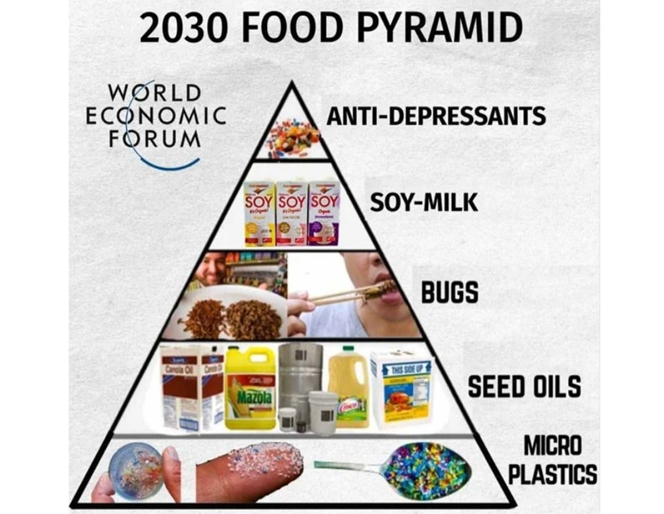
Central planners – The World Economic Forum (WEF), the World Health Organization (WHO), and the World Trade Organization – represent the Machine’s values.
It takes no stretch of the imagination to see ourselves in Montag’s society or to see technology as that which mimics the good but is easily programmed to avenge and punish citizens who break society’s rules. The Mechanical Hound can tract us down to dispose of the ‘closed’ and conform us to the “Open is good” of the Machine.
Bradbury said that with Fahrenheit 451 he wasn’t trying to predict the future but to prevent it. He wanted to protect the present.
The terror of the Hound of Hell is becoming a permanent feature of the “open” (closing up) brave new (upside down) world.
~~~~~
Read Fahrenheit 451: Beatty’s Speech to Montag
~~~~~
Against the Machine: On the Unmaking of Humanity | Paul Kingsnorth
Demetri Kofinas speaks with Paul Kingsnorth, a novelist, essayist, and former environmental activist who first came on many people’s radars during the Covid-19 pandemic with the publication of his viral three-part series “The Vaccine Moment.” His current work explores the intersection of technology, culture, and the divine. In his latest book, Against the Machine, Kingsnorth examines how our increasingly mechanized way of seeing and relating to the world—and to ourselves—has contributed to the death of Western culture, and what it would take to reclaim our humanity and save our souls.
Against the Machine: On the Unmaking of Humanity | Paul Kingsnorth | Listen Notes
~~~
How We Lost Ourselves to Technology—and How We Can Come Back
Do you feel uneasy? Do you feel a level of ambient anxiety? Do you feel despair, despite the fact that we live in the most luxurious time and place in human history?
The point is, you are not crazy. If you feel these things, you are simply attuned to reality—and it’s not a problem that’s solvable with less screen time or with meditation, red light, or sea moss.
Bari Weiss’ brilliant guest, Paul Kingsnorth, argues that the reason you feel this way is not this or that social media app or algorithm or culture war issue. That these are all superficial expressions of a thousand-year battle with what he calls “the Machine.” What exactly that means, he’ll explain tonight.
How We Lost Ourselves to Technology—and How We Can Come Back
~~~~~
From Doug Ross’ substack:
Top 20 Chilling Insights from Yuri Bezmenov
How the KGB’s Playbook Is Destroying the West Today
Yuri Aleksandrovich Bezmenov (1939–1993), also known as Tomas David Schuman, was a Soviet journalist and KGB operative specializing in propaganda and ideological subversion.
Ideological subversion is the process of bending a society’s perception of reality so completely that it destroys itself.
The goal is to demoralize a society by undermining its moral, educational, and cultural foundations, making people unable to recognize or defend against threats.
Demoralization takes 15-20 years, the time needed to educate one generation with subversive ideas.
Read Bezmenov’s 20 key insights
~~~~~
~~~~~
From the Free Press:
Peter Thiel Says Capitalism Is Failing the Young. Is He Right?
Five years ago, Peter Thiel, the billionaire venture capitalist behind PayPal and Palantir, sent a prescient email to Facebook executives.
“When 70% of millennials say they are pro-socialist,” he wrote, “we need to do better than simply dismiss them by saying that they are stupid or entitled or brainwashed; we should try and understand why.”
The email went viral after democratic socialist Zohran Mamdani’s victory last week in the New York City mayoral race. Thiel then sat down with The Free Press’s Sean Fischer to explain what he saw in 2020 that no one else did.
Capitalism isn’t working for young people, Thiel said, citing burdensome student debt and regulations putting homeownership out of reach for many. “People assume everything still works, but objectively, it doesn’t. . . . If you proletarianize the young people, you shouldn’t be surprised if they eventually become communist.” (Emphasis mine.)
Thiel, who I see as also promoting the Machine, at least sees what the Machine is doing to the young.
And, of course, socialism/communism is a horrifying Machine that revels in terror to replace humanity with ideology.
~~~~~
The Machine’s AI Alchemy
Mary Shelly’s Victor Frankenstein, obsessed with creating a human being, used alchemy and electricity and body parts to create a creature (without woman). . .
A group of Stanford University scientists . . . used artificial intelligence to design new viruses capable of killing bacteria.
In a world where AI keeps creeping in on uniquely human territory by composing sonnets, writing songs or forging friendships, this seemed to be crossing a new Rubicon. Depending on your belief system, AI was doing what evolution, or God, or scientists working with genome-engineering tools aim to do.
“Machines are rethinking what it is to be human, what it is to be alive,” said Michael Hecht, a chemistry professor at Princeton University focused on designing novel proteins and artificial genomes. “I find this very unsettling and staggering. They are devising, coming up with novel life forms. Darwin 2.0.”
AI-designed viruses raise fears over creating life – The Washington Post
Rate this:
Filed under 2025 Current Events, AI, central planning, Economic World Forum, Globalism, Political Commentary, Progressivism, social commentary, Technocracy, technology, totalitarianism, WEF, World Economic Forum Tagged with Against the Machine, AI, artificial intelligence, censorship, central planning, Fahrenheit 451, Globalism, progressivism, technology, totalitarianism