The Fowler’s Snare Chronicles

There is no way back but there is a way through.

The day that brothers Bryce and Blake returned to campus after a fencing tournament they were immediately escorted to the IU auditorium where the first session of the Ex Novo Institute in Basic Life Process had already started. It seemed to them that the whole student body was in attendance. They stood at the back of the balcony with the others who came in late.

Up front, a large screen projected a woman’s face. Her owlish eyes darted back and forth behind the circular frames of her glasses. The small, and yet imposing woman, had cropped black hair and was dressed in something like a military uniform. She was speaking from a podium off to the left of the screen.

“There will no longer be any recognition of the past. Clear your mind of all that came before. You are students of today. Your mindset is today. Your thoughts are today’s thoughts. When you complete the Basic Life Process course, you will become stewards of the New Way Forward and not of the dug-up past.”

Bryce and Blake gave each other a puzzled look.

“You will no longer be weighed down with the obligations of tradition and faith. Tradition and faith brought you guilt and prejudice and racism and greed and violence. You are to rid yourself of such baggage. Your motivations and direction will come from Central Screen. Central Screen will be your personal Event Horizon.”

A logo appeared on the large screen. Beneath the words “Central Screen” was what looked like graph paper curved into a cone pointing down. At the edge of the taper was “Event Horizon”. The cone’s tip was labeled “Singularity.”

“You will be given a new set of values from Central Screen. All that is good will come from Central Screen. There is no such thing as a morality that stands outside human society. Morality is subordinated to the General Will as shown on Central Screen.

“You will no longer have to worry about what is good and the right thing to. You won’t need religion. The Central Screen software will make particular ethical perceptions clearer by demonstrating how they exemplify more general rules based in scientific certainty. The software will provide a systematic accounting of reality that our intuitive moral perceptions and judgements can only hint at.”

When the first session had concluded, a student approached the speaker, Director Argans. She scanned the student’s face with her CenSoid App. “Yes, Alistair?”

“Director Argans, I am currently in the humanities doctoral program here at IU. My doctoral thesis is on Dante, Botticelli, and the Florentine Renaissance. I rushed back from Italy for this required course. Am I to understand, what you’re saying is, that the independent study of the humanities, the study of all languages and literatures, the arts, history, and philosophy is no more? Everything is to be found on Central Screen?

“Alistair, as you will learn on Day Three, anything that holds a bellicose inspiration from the past is a danger to the organization of peace. You will learn what unites us as world citizens. You want to live free from oppressive and pugnacious attachments to the past, don’t you Alistair? To see what can be, unburdened by what has been.

“It was pope Francis, Alistair, who said “a conservative is one who clings to something and does not want to see beyond that.” He also said that it was a “suicidal attitude because one thing is to take tradition into account, to consider situations from the past, but quite another is to be closed up inside a dogmatic box.

“And, wasn’t it Rousseau who said that people in their natural state are basically good. But this natural innocence, however, is corrupted by the evils of society? We are in the process of creating a new society using simple rational principles provided through Central Screen.”

“Well, Miss Argans, I never thought of art as bellicose or of being in a dogmatic box.”

“Alistair, you will after session three. Humanities stirs the emotions and emotions cloud reason. You will be given a new set of “realistic” or “rational” values to work with. In our workshops you will learn a new way forward with Central Screen AI. What will it profit you, Alistair, if you gained that doctorate and lose yourself with a suicidal attitude in the process?”

Another student broke in and Alistair wasn’t able to ask another question. He walked away stunned by what he had heard.

~~~~

“That was ten years ago this month.”

Comet got up from his chair and looked out the attic window of the Victorian house on Jefferson St. in Martinsville, Indiana. Seeing no threat, he sat back down and faced Scribe who was typing.

“That Ex Novo session was ten years ago this month. Make sure to note the dates in this chronicle. And listen, sis,” Comet emphasized, “no real names go into this eyewitness account. If these chronicles get into the wrong hands we’d be done for and so would mother and father and Grace downstairs. We are recording the diabolical acts of the Save Democracy party as Comet and Scribe. Let’s call this next chronicle Surface.”

“Surface?” asked Scribe.

“The Save Democracy party wants nothing to do with the past. Many in our world read and study history to know how to proceed. Practical wisdom is case based. But the Party studies the future, rewrites the past and proceeds with abstract theoretical reasoning or surface knowledge.

The party leadership operates like a ship’s captain heading out to sea and who ignores the traditional knowledge passed down through generations used by navigators to read the stars, winds, and currents.

“The Save Democracy party leadership ignores the guidance of the vast ocean underneath and the vast night sky above, the enduring connection to the space and time we all travel in. It ignores charts and says “I know my way around. I know where I want to go. I know the way forward just by looking at the surface” and “I know how to use a rudder.”

“The ship will move and be tossed about because the ocean surface is never still. Wind-driven waves and currents will steer the boat this way and that. It may take on water and go all Titanic. If not, it will end up lost at sea without a way back to port. Scribe, we have escaped. But most have been forced into steerage aboard the Surface ship of fools!”

“Got it, said Scribe. “I think.” She inserted another sheet of paper into the typewriter. “Did you finish what happened during that first Ex Novo Institute?”

“Ah, no. After the first session I came up and questioned Miss Argans about my law classes and finishing them up. She told me the same thing she said to the guy in front of me. When I left her, I noticed that I was being followed. I went to the second session – we all had to. It was the same lecture as the day before: tear it all down and start over. That time many of the students were clapping. Maybe out of fear or maybe because the words resonated with what they had been taught over the years.

“During the third session I saw the same people who had been following me. They were removing people from the auditorium. I snuck out. I went into hiding. We’ve been hiding ever since.”

Comet got up and took another look out the attic window. He remembered the day he saw the Rooms for Rent sign in the front yard. The widow Grace was happy to have them around to help keep things up and to keep her company. She also needed the money. The socialist economy had created hyperinflation. She let them rent two rooms.

Comet and Scribe arrived together. Their parents, who didn’t want either of them to grow up in the Save Democracy system, thought it best if they stayed out of sight together.

The house was a good location for Comet, a former astronomy student at IU. He spent many nights at IU’s Goethe Link Observatory just eleven miles north of Martinsville. He felt safe there in the middle of the night.

~~~~~

The street was quiet. What Comet thought unsettling was the Save Democracy party headquarters in the Morgan County Courthouse a few blocks away and the massive 5G tower standing next to it monitoring all digital communications and transactions.

“So, you were going to tell me what happened before all this Ex Novo business.” Scribe put another sheet of paper in the portable Smith-Corona typewriter.

Seeing no threat on the street Comet began pacing to give his account.  “Let’s call this next chronicle The Surface Comes to Power.”  Scribe began typing.

“Four years before the first Ex Novo days, a November election was held. But the man elected was not allowed into the White House. The Save Democracy party and a few others in the House of Representatives passed a resolution saying that the man was an “insurrectionist” and therefore disqualified under Section 3 of 14th Amendment “insurrection” clause. With Secret Service agents counting the electoral votes, together they refused to certify the election on January 6, 2025.  

“The Counting and Certification of Electoral Votes in Washington, DC, had been designated a National Special Security Event by the Secretary of Homeland Security. The military received an amended directive allowing for their direct involvement in civilian law enforcement operations under emergency conditions, including situations where there is an imminent threat. The military was used by the Save Democracy to facilitate a coup, a coup set in motion four years before on January sixth. An “insurrection” setup scenario had been initiated by the Save Democracy party in concert with the FBI, “deep state” actors, and later with a show trial.

“Right after the election, the twenty-fifth amendment was used to depose the current feeble-minded president. He was replaced by a puppet, the feeble-minded Vice president. The elected Vice President was given an office but no access to the White House or policy.  

“The Save Democracy party, over time, having taken control of both the house and senate with the votes of non-citizens, absentee votes counted after the election, and massive voter fraud, then removed the conservative members of the Supreme court with expulsions based on made-up ethics violations.

“The court was then reconstituted to hold fifteen members of the Save Democracy party. All challenges to the constitutionality of such sweeping changes failed because the plaintiffs were told they had no standing. No subsequent challenges were brought before the court after the Save Democracy party Speaker of the House tore up the U.S. Constitution during a State of the Union speech.

“It was then declared that the electoral college would be abolished and all future elections would have the oversight of the new Elections Council.

“Using the military “under emergency conditions” to keep the peace, Save Democracy members were quickly installed throughout state and local governments and the courts where there hadn’t been support for the Save Democracy party. The newly installed were given a mandate to defend One People, One Equality, One Equity, the motto of the Save Democracy party. The ensuing reign of terror went well beyond the atrocities of the French Revolution.”

Scribe stopped typing. “French Revolution? I don’t know what that is. Will the readers know?”

Comet sat down and faced her. “You were only six years old when the Save Democracy party took over the country. The party didn’t want anyone to learn history as it would expose them and their ways. You weren’t given a chance to learn history. I’ll explain the French Revolution later. You are an autodidact. You’ve learned a lot on your own already. I better go on. Have you got everything so far?”

“Yeah, go a little slower. I’m not used to typing on this thing” Scribe added another sheet of paper to the typewriter.

“OK. The Save Democracy party members immediately enacted permanent martial law. The Party media said that martial law had been imposed because of the civil unrest due to “perverse and macabre” political foes – those who didn’t accept what had happened to their country. Martial law allowed the Save Democracy party members to keep in check “extremist elements”, to control the drug trade for profit, and to exploit terrorism for its own ends.

“The operation of new penal codes was entrusted, not to legal authorities, but to local oversight committees. They hunted down those thought to be a threat to the community. Anyone could be accused of being disloyal to the Save Democracy party even based on hearsay. Anyone – father, mother, grandmother, grandfather, and child – could be imprisoned, tortured or executed for allegedly being critical of the Save Democracy party. Many were arrested on fabricated charges just to keep people living in fear of the local Save Democracy party.

“A favorite form of torture in many towns was the “Underneath pit.” An arrestee was thrown into a ten-foot-deep hole in the ground. The hole was exposed to the elements. The width of the pit was barely bigger than the person thrown in. He or she would not be able to bend or change their position. The hole was the prisoner’s latrine. After many days the person would become a sliver of flesh with only the feeling of anger keeping them alive. These tortures are still going on today.

“With the new power they had been given, local Save Democracy party members kept up the perpetual and brutal oppression of citizens. They loved to dehumanize. For them it was a game. They found new ways of doing so and posted them on Central Screen. Limitless coercion and terror were essential to the Save Democracy party’s New Way Forward.

“Random terror was meant to convey the constant and unyielding force of the Party’s control over humanity. It emphasized a future devoid of freedom and individuality. The end product was to create mindless and unfeeling oxen for the party.

“Out of fear of being sent home and losing benefits – a threat made on Party media – fifteen million illegal migrants voted for Party candidates every election.

“Once the Save Democracy party had full control, it was decided that vast numbers of the population had to be culled, as the welfare system, hospitals, schools, and prisons were overwhelmed. Some in the party just wanted to lower the population numbers out of climate concerns. So, a gain-of-function virus was released from a bioweapons lab in California. Millions of people suffered and died from the higher levels of spike protein in the One Health self-amplifying mRNA vaccine.

“The Committee of Public Singularity was established out of fear of a viral outbreak of past knowledge. The Committee created the Ex Novo-Institute in Basic Life Process to deal with the Underneath, a mindset that had been banned as extremist.

“The idea behind the institute was to make a clean sweep of human nature. At the compulsory meetings people were told that the Save Democracy party was building from scratch a new ideal society on the concepts of humanitarianism, social science, and collectivism using Central Screen programming. The analog past was to be replaced with a digital future controlled by Central Screen AI.

“What I learned during the Ex Novo sessions was that voiding the past and human attachments were required by the New Way Forward. Old thoughts, old habits, old culture, and old customs had to be destroyed. No one was to experience any connection with family, friends, children or about anything, past or present. They were to die to all that. All of life was to come from the Party’s Central Screen. All of life was to come from the Surface.”

~~~~

“You staying with me, Scribe?”

“Yeah. This stuff you’re telling me is nasty. I don’t like thinking about it.” Scribe shivered.

“Yeah, it is. That’s why we are making a record of it. People need to know what happened. Right now, the Save Democracy party is erasing anything connected to the past. Let’s keep going.”

Once again, Comet got up and looked out the window. The neighborhood was quiet.

During the first days at the house, Grace talked about Martinsville. The first settlers, she said, arrived in Morgan County in 1822. Large numbers of Quakers migrated here from the south because of their opposition to slavery. 

She also said Martinsville was nicknamed the City of Mineral Water. Oil workers discovered the foul-smelling mineral water while drilling. Mineral water was thought to have healing properties. It was used in the Martinsville Sanitarium which operated as a health resort until about 1957. But now, she said, the Sanitarium was being used by the Party for optogenetic experiments on citizens.

That’s what her last renters, neuroscience students, told her. The Party is controlling subjects with the presence of light to alter cell behavior with regard to reward, motivation, fear, and sensory processing.

Seeing nothing on the street that concerned him, Comet continued dictating while pacing.

“In tandem with the Ex Novo-Institute, there was an even more invasive program: ReCognify Conditioning. The Save Democracy party, along with the social programmers of the World Economic Forum, claimed that human nature is no different to that of a programmable machine.

“Transhumanist scientists began implanting vast numbers of the population with synthetic memories using brain chips to create a new ideal human. The ReCognify program had been initially tested on criminals. According to one unauthorized release of Party documents, customized AI-generated content converted visual information into codes delivered directly to the brain and stored in DNA and RNA, forever altering the subject.

“Prisoners were implanted with synthetic memories of their crimes – but from the perspective of their victim or victims. The embedded artificial memories prompted reactions like remorse, empathy, and understanding.

“The ReCognify program then began to be used on the general population to wipe away past memories and to make people docile and pliable to the Party’s party authority. The Ex Novo Institute was the means to bring in those subjects the Party thought would be troublemakers. But not everyone would submit to ReCognify and the “forced forgetting” process.”

“Hold it,” said Scribe. “The ink is beginning to wear thin. I need another ribbon. I wonder if . . .”

“We’ll ask Grace if she has more,” Comet said. “C’mon. We need a break.”

~~~~

“We know that the son of God has come and given us understanding so that we know the truth. And we are in the truth, in his son Jesus the Messiah. This is the true God; this is the life of the age to come.”

Father Denny stopped reciting 1 John from memory when the barn door creaked opened. Everyone drew quiet. Bryce and Blake and their wives appeared at the door. Father Denny waved them in. The couples greeted him and six others of the Underneath community.

The group met to support each other in a barn on a southern Indiana farm. They had been living on the farm, hiding from the Save Democracy for the past ten years. The refuge was Father Denny’s idea.

Anglican priest Father Mason Denny, a gaunt bewhiskered marathoner, left his Indy parish and moved to the sweeping 80-acre working farm to help his friend Tom and his wife Sally. The Binghams were in their seventies and working the farm had become too much for them. They had no idea what happened to their children. They hoped the Save Democracy party hadn’t taken them.

Seeing the possibilities and after much prayer, Father Denny knew that he had to create a refuge to help those of the Underneath escape the “fowler’s snare,” as he called the Save Democracy party’s operations. A portion of the farm land was already being used as a short-term RV campsite. Using all of his retirement funds, he converted the campsite into a mobile home park and began rescuing students.

When the Ex Novo Institute staff began pulling students out of the audience for the ReCognify program, Father Denny brought several students to the farm. The students knew Father Denny and trusted him. He had been a chaplain on campus, providing spiritual services in the Beck chapel on the IU campus. This was before the Save Democracy party banned all such meetings as subversive.

The rescued students lived in the mobile homes and worked the farm. From their organic garden they harvested green onions, Italian greens, tomatoes, asparagus, spinach, strawberries, green beans, heirloom tomatoes, summer squash, blackberries, melons, and herbs. From the field, they gathered sweet corn.

They grew an array of flowers – zinnias, gladiolus, dahlias, and sunflowers – and tended goats, rabbits, and chickens.

Every Saturday they held a farmer’s market to sell produce, goat cheese, pastured eggs, and pies and to barter with locals for butter, flour, meat, and diesel fuel.

Father Denny found a way to sustain the Underneath, a mindset that had been banned. But it had come at a personal cost.

~~~~

Comet and Scribe sat at the farmhouse kitchen table with Tom, Sally, Father Denny, and Skippy, Tom and Sally’s three-legged Airedale.

Comet and Scribe had recently found their way to the refuge. Grace, the woman they were staying with, gave them directions to the farm after local Party authorities came around one day looking for them. One of her neighbors, who had received a ReCognify implant, had given them away.

Comet asked Scribe to read the transcript of what Grace related about her husband.

“Bill was a mechanic in a manufacturing company. He told me that every day in the lunch room there were news reports on the TV saying that inflation was transitory and that the economy was doing great and that wages rose again for the fourteenth quarter in the row. Bill began posting his pay stubs on his tool box to show that it wasn’t true. His foreman came along and told him to take it down or face dismissal. Bill didn’t take it down and he was dismissed. The Party wouldn’t allow him to work again.”

Comet described how he and Scribe were recording what took place the last fifteen years. He explained his use of “Surface” to describe the operation of the Save Democracy party.” Father Denny agreed with his analogy.

Comet and Scribe were eager to hear Father Denny’s story. They said they would record the story and use false names and places.

“Scribe, you don’t have to keep lugging that portable typewriter around.” Tom offered. “We can hide it under a floorboard in the other room. No one will find it there.”

Scribe nodded and smiled in relief.

“Are we ready Scribe?” Father Denny asked. 

“Ready, sir,” Scribe replied. Father Denny began.

“During my twentieth year as rector of an Indy church, I lost my wife Ellen to the effects of the mandated vaccine. Despite my protestations and my own refusal to take the mRNA vaccine, she thought it a Christian thing to do to obey the authorities, especially as the Party had mandated “No vaccine. No church gathering.”

“After Ellen’s passing, I came to realize that the authorities had more in mind than a vaccine mandate. I was faced with a choice.

“You see. Churches not obeying Save Democracy party directives were closed. The churches with what I call “cultural Christians” – those that obeyed mandates and focused on . . .” he paused and looked over at Comet, “. . . Surface issues pushed by Central Screen Apps, issues such as social justice, equity, race, gender, sexuality, and creation care – remained open.

The Party knew that the fate of its project of atheistic secularization was tied to the religious feelings people had. The Party saw that it couldn’t convert the religious with ideology. But it could use religion to further its ideology and fill the void of absence of spirituality.

“I saw that the spiritual way of life was to be replaced with the Surface way of life. Religious symbols were to be replaced with secular symbols. The church and the gospel were being replaced with Assemblies of the General Will and the “well done” of social credit scores. The Party worked to fill the ideological and spiritual absence of religion.

“As a way to reorient churches, ministers were forced to sign a social contract acknowledging that Man is born free, and everywhere he is in chains and that all people should unite with the General Will of the people to bring about the common good of the New Way Forward.

“The General Will, as dictated by the Central Screen app, meant the total subordination of citizens. All rights, all property and all religion would be subject to the General Will. Freedom would be associated with obedience. As such, the General Will directive provided Party members a defense for oppressing and destroying those who did not obey including those of the Underneath.

“The deeper-than-surface Christianity that I call the “Underneath” was an ideological, political and spiritual problem for the Save Democracy party. The “error correction” of “the science” didn’t work on the Underneath. Its underlying history, tradition, and transcendent gospel had to be rooted out and destroyed.

“The Save Democracy party understood that those like myself and those here on the farm and elsewhere – disciples of Jesus – are not directed by Central Screen. We are directed by the Lord of heaven and earth. We don’t compromise and hold back a reserve of ourselves to maintain the status quo and avoid trouble. We speak to the fiction and lies around us and that has brought suffering.

“The cultural Christians of Central Screen desire the good feelings of social justice activism but none of the adversity attached to proclaiming the gospel message. They portray themselves as being and doing right with social justice standards. Jesus quoted Isaiah to the Pharisees and legal experts when a dispute arose about a manmade imperative:

‘These people make a big show of saying the right thing,
    but their heart isn’t in it.
They act like they are worshiping me,
    but they don’t mean it.
They just use me as a cover
    for teaching whatever suits their fancy,
Ditching God’s command
    and taking up the latest fads.’

“Compromised, they live within the lie. They perpetuate and legitimize the ideological fiction of the Party. They become oppressed and the oppressor, persecuting critics of Central Screen activism.

“The party also knew that it couldn’t convert those of the Underneath with what they called the “Reformation” – the ideological work of scientific atheism through the Ex Novo Institute. They saw those of the Underneath as tenacious holdouts.

“Ex Novo programming was meant to show that The General Will is the purpose of life. Faith in The General Will was to become an inner conviction. Then, they assumed, all illusions about heaven and the afterlife and the kingdom of God fade away and disappear. The Surface was to be one’s spiritual refuge.

“When the vestry came to me one day and said “we need to show pronoun hospitality” I told them that I would retire. I could see that many in the congregation did not believe the lies of Central Screen, but they felt, as Vaclav Havel wrote in his essay The Power of the Powerless, that they must behave as though they did, or they must at least tolerate them in silence, or get along well with those who did.

“Havel went on to say that “They need not accept the lie. It is enough for them to have accepted their life with it and in it. For by this very fact, individuals confirm the system, fulfill the system, make the system, are the system.”

“Seeing this mindset in the congregation, I told the vestry I would leave and go on the road and see the country. I ended up here on Tom and Sally’s farm in southern Indiana. I expected my son to join me here at the farm when he returned from his doctoral research trip to Italy. But that didn’t happen.

“I lost contact with him son after he returned to the states. I was frantic and looked for him all over campus. Those I asked said that the last time they saw Alistair was at the end of the first session of the Ex Novo Institute. They said he was asking questions.”

“I was there. I was behind him in line,” Comet jumped in.

Father Denny felt a sinking sensation in his stomach.  “I know Alistair. I knew that he would question things and exercise his point of view. But I also knew that the Save Democracy party accepted no challengers. So, I imagine the worst and pray for his safe return.”

Father Denny sighed heavily. “That was ten years ago and I haven’t heard a word about my son since.”

~~~~

The rescue from the third Ex Novo Institute session that December day happened quickly. The students were not able to inform their families. Telling them their whereabouts would put their families at serious risk. When the students didn’t sign in for the next Ex Novo Institute session, their families would be contacted and would be forced to take Truth Test Serum to tell the Party’s enforcement squad where they were. Having no knowledge of where the students were, they would be released. Father Denny later found a way to tell them that “they were safe and not to worry.”

Refugees Erin and Joseph were fourth-year neuroscience students. Jeremy studied computer science. Quinn had been a biotechnology major and worked part time at the Ray Bradbury Center at the IU Indy campus. Steven and Melanie were pre-med students.

Bryce was working on a Masters in epidemiology when he met Bryn, who was studying Environmental Health. Blake was working on his master’s degree in Business Analytics when he met Alice who was studying Business Admin Medicine. Father Mason Denny married the two couples in a ceremony held on the farm.

Mobile homes housed the former students. Each couple had a mobile home. Erin, Quinn, and Melanie shared a mobile home, as did Joseph, Jeremy and Steven. Father Mason Denny had a room in the farmhouse. Comet and Scribe had rooms in the farmhouse.

The members of the Underneath brought with them as many books as they could when they escaped Ex Novo and ReCognify. Father Denny brought his library to the farm. No other books would be available.

The Save Democracy party had dictated that books and education created inequality and unhappiness and were therefore banned. Libraries no longer contained books. Libraries were converted into ReCognify centers. The outside world had been cut off from knowledge that wasn’t Central Screen provided.

There were no electronics – phones, computers, TVs, radios, GPS devices – and no Central Screen app on the farm grounds. This was done to secure the location. Father Denny told the group that “The farm isn’t off the grid. We are hiding in the open and keep a low profile.”

Isolated from their families, members of the Underneath farm refuge supported each other. Weekdays were filled with farm work. At night the group ate together and then gathered in the barn or at the fire pit behind a thicket. They read texts out loud and recited memorized scripture. Each had committed entire Scripture texts to memory.

Father Denny had told them that “memorization is a means to internalize information of sacred nature, a transmutation of the metaphysical into flesh and blood and marrow.” It was also, he said, a means to create a memory palace – a mental sanctuary of information tied to farm scenes so that they can recall what was memorized. This, he said, would sustain them if captured by the Party.

On Sundays, the farm’s Underneath community came together for a liturgical service. They sang, prayed, and recited scripture. Father Denny administered to the group and administered the Eucharist.

Comet and Scribe set all this down under the heading “Rescue, Refuge, and New Reality.”

~~~~

The nights of the Underneath community were filled with readings and recitations, music and drama.

One night, Alice read Wise Blood by Flannery O’Connor. Over several nights, Father Denny read Vaclav Havel’s essay The Power of the Powerless. Other nights he read Father Brown stories. Over several nights, Jeremy read Robinson Caruso and Comet read Treasure Island. Quinn recited the poem ‘Dover Beach’ by Matthew Arnold.

Alister talked about his trip to Italy, and about the Italian Renaissance, Dante, and Botticelli.

Sally played the piano, Melanie played the flute, Jeremy the guitar, and Father Denny played some of his Big Band LPs for dancing.

One night they acted out Hamlet. Bryce and Blake played Hamlet and Laertes and fenced during the last Act. The brothers had, at one time, been in the U.S. Olympic fencing team.

One fire-pit night Alice quipped that women make the best archeologists because they are good at digging up the past. And Bryn said the smarted person in the Bible was Abraham: “He knew a Lot.”

One night they came together to listen to Quinn read Fahrenheit 451.

When Quinn finished reading the first chapter, Jeremy said “Read the part again, the part where fire chief Captain Beatty explains to Montag about how books had lost their value.”

Quinn turned back a few pages and read.

“Surely you remember the boy in your own school class who was exceptionally ’bright’, did most of the reciting and answering while others sat like so many leaden idols, hating him. And wasn’t it this bright boy you selected for beatings and torture after hours? Of course it was. We must all be alike. Not everyone born free and equal, as the constitution says, but everyone made equal. Each man the image of every other; then all are happy, for there are no mountains to make them cower, to judge themselves against. So! A book is a loaded gun in the house next door. Burn it. Take the shot from the weapon. Breach man’s mind. Who knows who might be the target of the well-read man?’

“Wow!” Said Jeremy. “That’s what the Party was pushing during Ex Novo. Exactly that!”

Father Denny added, “Polish poet Czesław Miłosz once said that “In a room where people unanimously maintain a conspiracy of silence, one word of truth sounds like a pistol shot.””

Comet and Scribe took notes.

~~~~

Comet brought his refractor telescope with him to the farm. One late night the group headed outside to explore the night sky. The area around the farm had little light pollution, so the evening sky sparkled with illumination.

The moon was full that night and the entire earth-facing surface was clear to see. Comet pointed the telescope at the lunar surface. Everyone took a turn viewing.

Scribe, waiting her turn, caught sight of something coming from the road. The moonlight-etched figure walked and weaved toward them like one of the disoriented ReCognits. The figure stumbled down, got up and tried to wave but fell down again and stayed down.

The group moved closer. Bryce turned the man over and lifted the soiled hair from his face.

“It’s Alister! he shouted. “Help me get him up.”

~~~~

Alister opened one eye and saw his father sitting in a chair. He was asleep.

“Dad,” Alister whispered.

Father Denny jolted up from the chair. “I just had a dream that you came home.”

“I had the same dream,” Alister replied. “I guess we’re on the same wavelength.”

Father Denny felt Alister’s head. “You have a fever. Here, drink this water.” He propped up Alister and helped him drink. “How do you feel?”

“I feel weak. I have a headache and a stiff neck. I ache all over.”

“Can you talk about what happened?’

“Maybe later today.” With that Alister closed his eyes and fell asleep.

That evening Sally came downstairs and told father Denny that Alister was awake and his fever was down. Father Denny, Tom, Comet and Scribe went up to see Alister. He was sitting up in bed with Skippy on his lap. He smiled when they entered the room

Father Denny, seeing that Alister’s face was no longer pale, put the back of his hand on his forehead. “You’ve cooled down, thank God.”

“I’m ready to tell you what happened.” Alister took a long drink of water. The four took their place around the bed.

“After that first Ex Novo Institute session, I went up to Director Argans to ask about continuing my doctoral program. I won’t go into all she said right now, but I left with the understanding that the Party had put the kibosh on everything pertaining to cultural memory and intellectual diversity. Everything was to be the General Will of the people.

“When I left the auditorium, I went to my room and packed. I was going to come here. But then two Save Democracy party goons came in and took me to their headquarters on campus. There, over many days I was subjected to constant Central Screen videos. I was deprived of food and sleep. People I knew came in and tried to coax me into signing my allegiance to the Party. I wouldn’t.

“They must have seen that they needed to break me even more so I was placed in solitary confinement.  They put a sign above the cell. It read “The Divine Comedy.”

“I don’t know how long I was in there. What sustained me was my faith in God and what I had learned.

“Sometime, after a lifetime in that cell, I was brought outside. The fresh air in my lungs revived me. But then they dropped me into a deep hole in the ground. They said that if I wanted to be part of the Underneath that I would be put underneath.

“The hole was so tight that I could not move side to side or up and down. And it was so deep that I could not climb out. I was left there, day and night, in all kinds of weather and with bugs. I was in there maybe twenty days. Then one night I felt a rope on my face. I looked up and saw no one.

“I pulled on the rope and it was secure. I tried to climb it but I was too weak. But then a voice said “Hold on.” So, I did.

“I was pulled out to the surface and onto the ground. When I looked, there was no one around. No one.”

The group looked at each other.

“I found my way here.”

~~~~

When Alister had fully regained his strength, the Underneath community held a Eucharistic service in thanksgiving for his rescue and homecoming.

The first reading, Jeremiah 51:45-48, was read by Bryce:

“Get out of this place while you can,
    this place torched by God’s raging anger.
Don’t lose hope. Don’t ever give up
    when the rumors pour in hot and heavy.
One year it’s this, the next year it’s that—
    rumors of violence, rumors of war.
Trust me, the time is coming
    when I’ll put the no-gods of Babylon in their place.
I’ll show up the whole country as a sickening fraud,
    with dead bodies strewn all over the place.
Heaven and earth, angels and people,
    will throw a victory party over Babylon
When the avenging armies from the north
    descend on her.” God’s Decree!”

Alister read from Psalm 124: 6-8:

“Oh, blessed be God!
    He didn’t go off and leave us.
He didn’t abandon us defenseless,
    helpless as a rabbit in a pack of snarling dogs.

We’ve flown free from their fangs,
    free of their traps, free as a bird.
Their grip is broken;
    we’re free as a bird in flight.

God’s strong name is our help,
    the same God who made heaven and earth.”

Blake read the epistle, 2 Corinthians 6:16-18:

“Don’t become partners with those who reject God. How can you make a partnership out of right and wrong? That’s not partnership; that’s war. Is light best friends with dark? Does Christ go strolling with the Devil? Do trust and mistrust hold hands? Who would think of setting up pagan idols in God’s holy Temple? But that is exactly what we are, each of us a temple in whom God lives. God himself put it this way:

“I’ll live in them, move into them;
    I’ll be their God and they’ll be my people.
So leave the corruption and compromise;
    leave it for good,” says God.
“Don’t link up with those who will pollute you.
    I want you all for myself.
I’ll be a Father to you;
    you’ll be sons and daughters to me.”
The Word of the Master, God.

Father Denny read the gospel, Luke 21:11-19:

“Jesus went on, “Nation will fight nation and ruler fight ruler, over and over. Huge earthquakes will occur in various places. There will be famines. You’ll think at times that the very sky is falling.

“But before any of this happens, they’ll arrest you, hunt you down, and drag you to court and jail. It will go from bad to worse, dog-eat-dog, everyone at your throat because you carry my name. You’ll end up on the witness stand, called to testify. Make up your mind right now not to worry about it. I’ll give you the words and wisdom that will reduce all your accusers to stammers and stutters.

 “You’ll even be turned in by parents, brothers, relatives, and friends. Some of you will be killed. There’s no telling who will hate you because of me. Even so, every detail of your body and soul—even the hairs of your head!—is in my care; nothing of you will be lost. Staying with it—that’s what is required. Stay with it to the end. You won’t be sorry; you’ll be saved.””

Using the Jeremiah text, Father Denny spoke on “Come out of her, my people! The world, Babylon, would have you come out as its own creation but we have come out as sons and daughters of the Father.”

He then read Revelation 18:4-5:

“Get out, my people, as fast as you can,
    so you don’t get mixed up in her sins,
    so you don’t get caught in her doom.
Her sins stink to high Heaven;
    God has remembered every evil she’s done.
Give her back what she’s given,
    double what she’s doubled in her works,
    double the recipe in the cup she mixed;
Bring her flaunting and wild ways
    to torment and tears.
Because she gloated, “I’m queen over all,
    and no widow, never a tear on my face,”
In one day, disasters will crush her—
    death, heartbreak, and famine—
Then she’ll be burned by fire, because God,
    the Strong God who judges her,
    has had enough.

The Eucharistic Feast followed.

~~~~

On the following Saturday, at 9 AM, two tables were set up along the roadside. They were covered with fresh produce, flowers, eggs, goat cheese, and a cooler with rabbit and chicken meat. Local people began to come along and exchange goods.

Bryce thought that everything was going well that beautiful August morning. But then he noticed something and whispered to Blake, “Don’t look. I think that’s Director Argans getting out of that car on the right. She has white pointy hair now.”

Blake, conversing with customers, saw her approach the table. When the farm stand customers saw a uniform, they got in their cars and drove off.

“Where is your sign?” It was Director Argans.

“I’m sorry ma’am. What sign?” Blake looked puzzled.

“The “People of The General Will Unite” sign!” She crossed her arms and waited for an answer.

“Ma’am, here is our sign.” Blake grabbed the grease board from the table, erased “THANK YOU FOR COMING OUT,” and wrote something on it. He read it out loud: “We are compliant and obedient and there is no need to worry about us.”

Director Argans looked it over, huffed, and then her black eye brows shot up above the frames of her round glasses and her jaw dropped. She was looking between Bryce and Blake. Alister had come up to the table. Director Argens grabbed an apple from the basket on the table and headed back to her car.

Bryce breathed a sigh of relief. He looked over at Blake and said “Good one! She doesn’t know who we are compliant and obedient to.” And together, they said “There is no need to worry about us!”

~~~~

Comet and Scribe created a circular letter to send to other Underneath communities in hiding.

It began . . . “These chronicles have been written with eyewitness accounts so that you may know the history and extent of evil in the land. There are many other evil acts of the “Save Democracy” party which are not recorded here.

“These Fowler’s Snare chronicles have been written so that you may share in our faithful witness:

We have escaped like a bird

from the snare of the fowlers;

the snare is broken,

and we have escaped.

Our help is in the name of the Lord,

who made heaven and earth.”

©Lena Johnson, Kingdom Venturers, 2024, All Rights Reserved

In Deep

One day, Peter sat down with Mark and told him about the challenges of being a disciple of Jesus and what he witnessed.

“Jesus called the twelve of us together, gave us instructions, and sent us out in pairs to several areas in Galilee. We announced that the kingdom of God had arrived, and that people should repent. We cast out unclean spirits. And we anointed many sick people with oil and cured them. We were doing what he had been doing.

“When we returned from our mission, we were anxious to share with him all that we had done and taught. We must have looked tired and hungry. He said we all needed a break. People were constantly coming and going around us. So much so that we didn’t have time to eat.

“We got in the boat and sailed to a deserted spot. But the crowd saw us going, realized what was happening and arrived there first. When Jesus got out of the boat and saw the huge crowd, I could tell that he felt deeply sorry for them. He said they were like a flock without a shepherd. So, he began to teach them many things.

“There was nothing to eat at that deserted place and it was getting late in the day. We wanted the Teacher to send the crowd away so they could buy food in the countryside or in the villages. But then he said “We don’t need to send them away. Why don’t you give them something.”
“We looked at each other wondering what in the world he was suggesting. Was he serious? Philip said “It would take more than half a year’s wages to buy enough bread for each one to have a bite!”

“Then he said “Well, how many loaves have you got? Go and see.”

“My brother Andrew found a boy with five small barley loaves and two small fish. But we were standing in front of thousands of people.

“Jesus had us sit everyone down, group by group, on the green grass. So, we made everyone sit in companies of hundreds and fifties. Then Jesus took the five loves and the two fish, looked up to heaven, and blessed the bread. He broke it and gave it to us to give to the crowd. Then he broke the fish into pieces and handed to it to us to give to the crowd. Everyone ate and had their fill including me and the others of our group. Over five thousand people were fed.

“We gathered up the leftovers and there were twelve baskets of broken pieces and of the fish. Everyone was full and tired.

“And then, just like that, Jesus told us to get into the boat and sail toward the opposite shore. He dismissed the crowd and then went off up the mountain to pray.

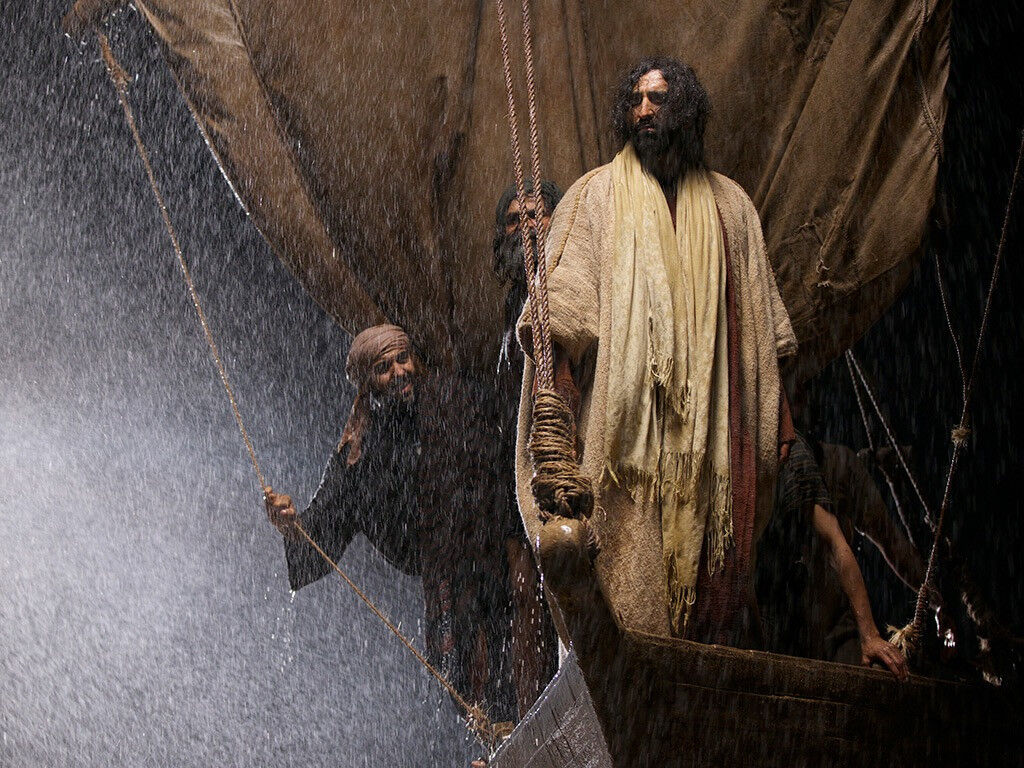
“Mark, you won’t believe what happened. We had rowed about three or four miles and were in the middle of the sea. It had been hard rowing all night. A stiff wind coming down from the mountains on the eastern shore of the lake was working against us.

“Then, in the dead of night, we all thought we saw a ghost walking on the water. It was about to go past our boat. We were scared out of our wits. We were yelling “Who goes there?!” And then, just like that, we hear “Cheer up! It’s me. Don’t be afraid.” When the figure came closer, we could see that it was Jesus. He was walking on the water!

“I said “if it’s really you, Master, then give me the word and I’ll come to you on the water.” And he said “Come along, then.”

“So, I got out of the boat, and would you believe it Mark, I walked on the water. But then I saw the wind chopping the waves and the chaos at my feet and I began to sink just like that. I called out to the Teacher. He put his hand out and caught me before I went under. He looked at me and said “A fine lot of faith you’ve got! Why did you doubt?” I was shivering and feeling pretty low, so I said nothing as we walked to the boat and climbed in.

“As soon as we got in the boat the wind stopped blowing just like that. And just like that we reached the shore. And just like that we went from being scared out of our minds to being thunderstruck by what had taken place, just like before.

“I told you, Mark, about the last storm we faced on the Sea of Galilee. It came up suddenly from the West. Waves beat against the boat and it quickly began to fill with water. That time Jesus was with us. He was asleep and we woke him up to help us bale out water. He got up, scolded the wind, and said to the sea “Silence! Shut up!” Things went to a dead calm, just like that. Then he said “Why are you scared? Don’t you believe yet?”

We were terrified when we saw this. We looked at each other and said “Who is this? Even the wind and the sea do what he says.”

This time we fell down and worshipped Jesus saying, “You are really God’s son!”

“We made landfall at Gennesaret and tied the boat up. As soon as we landed people recognized Jesus. They began to bring sick people on stretchers to where they heard he was.

“And Mark, wherever Jesus went, in the villages, towns or open country, people brought their sick to the marketplace and begged him to let them touch the edge of his cloak. And whoever touched the hem became well. The healed were getting up from their stretchers and were running around praising God. You should have seen it.”

(The above is an imagined retelling of Mark chapter 6 referencing Matthew chapter 14, Luke chapter 9, and John chapter 6)

~~~

Did Jesus have Peter and the other apostles wade into waters over their heads to remove the scales from their eyes? Did he put them through the wringer to squeeze out unbelief? It would seem so.

The Twelve – fishermen, a tax collector, and other regular guys – are sent to districts of Galilee on a kingdom of God mission well outside the range of their experience. This while earthly kingdoms get word of their kingdom message and of the power at work in them. And this while there is news of the arrest and beheading of John the Baptist by Herod.

When the Twelve return to Jesus, he has the group sail to a deserted area for a break away from the constant flow of people. But upon arriving they are met by an enormous crowd that had figured out where they were going. Then the Twelve are asked to provide food for the thousands listening to Jesus.

Having no resources other than a meager five loaves and two fish, the Twelve are assigned by Jesus to have everyone sit down in groups, to pass out the baskets of bread and fish that he hands them, and to collect the leftovers. Menial labor after a lofty mission and no rest for the Twelve.

That evening, Jesus sends the Twelve rowing across a sea that was known for its challenges. (Nature is no respecter of persons except for Jesus.) And on that sea, in the early morning hours, they encounter a ghost-like figure that scares the beJesus into them.

We don’t always get the inner perspective of the disciple’s thoughts and feelings in the gospel of Mark. But in at least two accounts we learn that the Twelve were “terrified” (Mk. 4:41) and “astounded” (Mk. 6:51) by the Who of “Who is this?” and “Who goes there?”

It is one thing to hear about divine revelation in the synagogue, to hear the words He made known his ways to Moses, his deeds to the people of Israel (Ps. 103:7). It is quite another to encounter God’s ways and deeds in person. And what the “terrified” and “astounded” Twelve experienced was God’s favor, care, and protection for those he chose to be with.

Peter, a fisherman who spent most of his time on the water in a boat, walked on the water with the Son of God right there urging him to do so and ready to catch him. For, faith is more than floating along on what you think you know.

The Twelve, schooled by each unsettling situation the Teacher had them face – strong winds and a sudden storm at sea, a scary specter, a supply shortage, and steady streams of the sick and sheep without a shepherd – discovered God’s power, His presence, His plenty, and His pity.

To their uncertainty, their fears, their inadequacy, and their helplessness, God’s presence was revealed.

“Who is this?” “Who goes there? “

“Cheer up! It is I AM.

~~~

Isaac, Joseph, Moses, Joshua, Gideon, Saul, David, Solomon, Jeroboam, Asa, Jehoshaphat, and Jeremiah were promised the presence of God. The Presence was promised to Jacob:

“Know that I am with you and will keep you wherever you go, and will bring you back to this land; for I will not leave you until I have done what I have promised you.” (Genesis 28:15) (Emphasis mine.)

Jesus made the same promise to his followers before he ascended into heaven:

I am with you, every single day, to the very end of the age.” (Matt. 28:20)

And beyond . . .

And I heard a loud voice from the throne saying, “Look! God’s dwelling place is now among the people, and he will dwell with them. They will be his people, and God himself will be with them and be their God. (Rev. 21:3) (Emphasis mine.)

The Real Presence is with you in the Holy Eucharist. Jesus is literally and wholly present—body and blood, and divinity—in the elements of bread and wine. 

The age-to-age continuum of God’s promise of presence with us, expressing His covenant faithfulness, is the premise of our faith. He will not abandon us. The praxis of knowing that – living by faith – operates within The Presence continuum.

~~~

The time the Twelve spent with Jesus was eye-opening – but not always mind’s eye opening.

After Mark tells us that the apostles were overwhelmed with astonishment (having just watched Jesus walking on the water) he adds a comment (Mk. 6:52): they didn’t understand what Jesus had done with the fishes and loaves – their hearts were hardened.

Mark doesn’t explain this last note. Maybe, when presented with the existential reality of what took place that afternoon, the Twelve chose to ignore it or had no place in their imagination for it. Or maybe, their hearts were hardened by God.

Recall that during the Ten Plagues of Egypt, Pharoah’s heart was hardened by God and remained that way even after Pharoah’s magicians threw in the towel when they couldn’t fabricate further “miracles”:

The magicians said to Pharaoh, “This is God’s doing.” But Pharaoh was stubborn and wouldn’t listen. Just as God had said

Exodus 9:15-16 gives us the reason why Pharoah’s heart was hardened. God tells Moses to confront Pharaoh and tell him the following:

You know that by now I could have struck you and your people with deadly disease and there would be nothing left of you, not a trace. But for one reason only I’ve kept you on your feet: To make you recognize my power so that my reputation spreads in all the Earth. You are still building yourself up at my people’s expense. (Emphasis mine.)

We don’t know why the Twelve couldn’t take in what had happened that afternoon. But I wonder: did they later recollect that experience and understand the multiplication of loaves and fishes in the context of the Exodus? God fed thousands in the wilderness.

Did they later recollect their experiences (walking on water, Jesus intending to pass by the boat, disclosure of God’s presence with them, a healing hem) and understand them in context of the Exodus?

God controlled nature (the Red Sea) so that Israel can walk through/on it.

God passing by Moses (Ex. 33:22)

God revealed Himself to Moses as “I Am” in a physical phenomenon (a burning bush).

Israelites were healed by a physical object – by looking at a snake made of fiery copper (Num.21-4-9),

With the events described by Peter in Mark’s gospel and the events of Israel’s history, Jesus’ kingdom mission for the world is equated with the Exodus mission of rescue and redemption for Israel.

~~~~~

Podcast: Three books by O.T. scholar Iain Proven

The Old Testament is often maligned as an outmoded and even dangerous text. Best-selling authors like Richard Dawkins, Karen Armstrong, and Derrick Jensen are prime examples of those who find the Old Testament to be problematic to modern sensibilities. In his new book Seriously Dangerous Religion: What the Old Testament Really Says and Why It Matters (Baylor UP, 2014), Iain W. Provan counters that such easy and popular readings misunderstand the Old Testament

Discussed in this podcast are three books authored by OT scholar Iain Proven:

A Biblical History of Israel, Second Edition

Convenient Myths: The Axial Age, Dark Green Religion, and the World that Never Was

Seriously Dangerous Religion: What the Old Testament Really Says and Why It Matters

I’ve read Convenient Myths and Seriously Dangerous Religion. I recommend both books.

Iain W. Provan, “Seriously Dangerous Religion

Iain W. Provan, “Seriously Dangerous Religion: What the Old Testament Really Says and Why It Matters” (Baylor UP, 2014) – New Books Network

~~~~~

The Life of Ripley

Luke Ripley, the focal character of A Father’s Story by Andre Dubus, begins his narration with what he calls “my life” – the life people in northeastern Massachusetts know about. He then goes on to detail his personal “real life.” And later, we hear about his life without peace after an incident involving his daughter. After all is said and done, I wonder what you would think about this self-reliant guy who is comfortable with his contradictions and who refuses to sacrifice his daughter. And, who is he really protecting when all is said and done?

Luke’s publicly recognized “my life” is that of a stable owner. He boards and rents out thirty horses and provides riding lessons. The “my life” that people would see if they looked in his front room window at night is a solitary “big-gutted grey-haired guy, drinking tea and smoking cigarettes, staring out at the dark woods across the road, listening to a grieving soprano.”

Luke’s “real life” – the one nobody talks about anymore, except Father Paul LeBoeuf”- is revealed to us before the accident in the first three-quarters of the story. What do we learn?

Luke Ripley is a divorced Catholic and an empty nester with three sons and a daughter off somewhere else. His solitary existence is lived out in routine. We learn of Luke’s morning habit of prayer while making his bed and then going to feed his horses. He talks to God because there’s nobody else around.

His morning habit also includes seeing his best friend – Father Paul Leboeuf, the priest at a local Catholic church. Most mornings Luke rides one of his horses over to church where Father Paul’s officiates. There Luke hears the Mass and receives the Eucharist.  During the week the two men get together for a dinner meal.  With Father LeBeoeuf present and a can of beer in hand Luke verbally grieves his despair over losing his wife and his family.

At one point Luke tell us about the importance of ritual, having already told us that he is basically lazy person:

Do not think of me as a spiritual man whose every thought during those twenty-five minutes is at one with the words of the mass. Each morning I try, each morning I fail, and I know that always I will be a creature who, looking at Father Paul and the altar, and uttering prayers, will be distracted by scrambled eggs, horses, the weather, and memories and daydreams that have nothing to do with the sacrament I am about to receive. I can receive, though: the Eucharist, and also, at Mass and at other times, moments and even minutes of contemplation. But I cannot achieve contemplation, as some can; and so, having to face and forgive my own failures, I have learned from them both the necessity and wonder of ritual.  For ritual allows those who cannot will themselves out of the secular to perform the spiritual, as dancing allows the tongue-tied man a ceremony of love.

Nasrullah Mambrol offers this perspective:

The life that Luke tells the reader about is one filled with a variety of contradictions: He is a devout Catholic but divorced; he attends Mass regularly but does not always listen; he enjoys talking to his priest but casually, preferably over a few beers, and what they discuss is mostly small talk; he is a self-described lazy man who dislikes waking up early but does so each morning to pray, not because he feels obligated to do so but because he knows he has the choice not to do so. Luke Ripley is a man who lives with contradictions and accepts them.

Luke wants us to know that he lived through difficult days after the divorce and what he believed ritual could have done for his marriage:

It is not hard to live through a day, if you can live through a moment. What creates despair is the imagination, which pretends there is a future, and insists on predicting millions of moments, thousands of days, and so drains you that you cannot live the moment at hand.  That is what Father Paul told me in those first two years, on some bad nights when I believed I could not bear what I had to:  the most painful loss was my children, then the loss of Gloria, whom I still loved despite or maybe because of our long periods of sadness that rendered us helpless, so neither of us could break out of it to give a hand to the other. Twelve years later I believe ritual would have healed us more quickly than the repetitious talks we had, perhaps even kept us healed. Marriages have lost that, and I wish I had known then what I what I know now, and we had performed certain acts together every day, no matter how we felt, and perhaps then we could have subordinated feeling to action, for surely that is the essence of love. I know this from my distractions during Mass, and during everything else I do, so that my actions and my feelings are seldom one. It does happen every day, but in proportion to everything else in the day, it is rare, like joy.

The loss of his wife Gloria and her leaving the church and the loss of his children figured large in Luke’s life. But the “third most painful loss, which became second and sometimes first as months passed, was the knowledge that I could never marry again, and so dared not even keep company with a woman.”

Luke lets Father Paul know that he is bitter about this. And, that when he was with Gloria he wasn’t happy with the “actual physical and spiritual plan of practicing rhythm: nights of striking the mattress with a fist…”

Early in the narration we learn Luke’s thoughts about his friend Father Paul, the Catholic church, and tithing – “I don’t feel right about giving money for buildings, places.”

We later hear his reflections on Jennifer, his only daughter, becoming a woman: “It is Jennifer’s womanhood that renders me awkward.”

He relates how her growing up affected the ‘ritual’ of memories he kept of her as his sheltered little girl at home. Jennifer became an on-her-own twenty-one-year-old girl with a purse full of adult symbols including a driver’s license. Luke says that he wants to know what she is up to and he doesn’t want to know what she is up to.

And then one night, Jennifer involves her father in a life-altering incident. Luke, to manage the situation, sticks with ritual as if nothing had happened. Ritual, we learned, might have saved his marriage to Gloria. So, Luke returns to default ritual to “save” the only other woman in his life. He wasn’t about to give her up, not even to Father Paul. Luke continues his rituals but does not confess to Father Paul.

The story ends with Luke telling the reader how he justifies himself to God, in Job-like fashion each morning, for what he did: the love a father has for a daughter is different than he has for a son and he loves his daughter more than truth.

Luke’s OK with a guy being hit by the car and but not a woman. Men, like Charles Bronson and Clint Eastwood, are supposed to take the bang ups and arrests and prison time.

In the end, however, Luke must answer to God for what he does to protect Jennifer. Self-serving ritual will not save him.

I’ve read this story twice. The first time, several years ago, I felt I knew the protagonist. He was like a former father-in-law: a divorced Catholic man in his fifties who wore Old Spice, hid Playboys, had daughters, and who thought himself manly in a Hemingwayesque sense. So, it was easy to have a sentimental attachment to Luke. I could empathize with his grief about losing a spouse and children and with his ritual-managed loneliness. And especially so as he acted instinctively to protect his daughter.

After a second reading this past week, I saw Luke differently – beneath the surface, so to speak. And, I had some questions:

When all is said and done by Luke, is he really protecting himself, his “real life”, his ritualized sources of comfort, when he protects his daughter from being taken away?

Did Luke really just act out of laziness (laziness being the opposite of love) in order to maintain ritual and continue life as he knew it?

Was Luke’s manhood tied to his comfort from women?

Wasn’t it cruel, unjust, and devastating to the other family and father involved for Jennifer and Luke to leave the scene of the crime and to let things just go on without answers?

As a parent, what would I do in this situation?

A Father’s Story was first published in the Spring 1983 issue of Black Warrior Review

Profile: Andre Dubus (youtube.com)

Andre Dubus: Father and Son – YouTube

Dubus (youtube.com)

It’s Time for Some Pruning – Bishop Barron’s Sunday Sermon (youtube.com)

The Unbroken Chain of Truth in the Lives of Broken People

Our common understanding of what Peter’s betrayal of Jesus meant. Our shared history of misery and redemption. Our interrelated human experience of being guided by truth and beauty. Each of these connections are considered by a twenty-two-year-old clerical student named Ivan Velikopolsky in the very short story The Student (1894) by Anton Chekhov.

Things start out fine for hunter Ivan on Good Friday. The weather is agreeable. But when it begins to grow dark the weather turns cold and stiff winds blow. He starts to walk home.

On the path, he feels that nature itself is “ill at ease” by the change in weather and that darkness in response is falling more quickly. He senses overwhelming isolation and unusual despair surrounding him and the village three miles away where he spots the only light – a blazing fire in the widow’s garden near the river.

As he walks, he remembers what is waiting for him at home – a miserable situation that he sees as the desperation, poverty, hunger, and oppression of what people have dealt with over time and that it’s always been this way no matter the secular changes by those who come along. He doesn’t want to go home. Instead, he walks over to the campfire at the widow’s garden.

There, by the fire, are two widows – Vasilisa and her daughter Lukerya. He greets them and they talk.

Ivan relates the gospel events to the two widows. This has an acute effect on them. As he heads home, Ivan reflects on the implications of this and has an epiphany.

“At just such a fire the Apostle Peter warmed himself,” said the student, stretching out his hands to the fire, “so it must have been cold then, too. Ah, what a terrible night it must have been, granny! An utterly dismal long night!”

 . . .it was evident that what he had just been telling them about, which had happened nineteen centuries ago, had a relation to the present — to both women, to the desolate village, to himself, to all people.

He returns home with a different outlook. He sees the “same desperate poverty and hunger, the same thatched roofs with holes in them, ignorance, misery, the same desolation around, the same darkness, the same feeling of oppression” differently – with an attitude of “unknown mysterious happiness”. There’s a sense of resurrection in Ivan’s attitude as he rises out of the despondency of dark winter’s return to a new life of hope based on the human connection to enduring truth and with Easter on the horizon.

Was Ivan’s new attitude born out of the women’s reaction that signaled an age-old inherent understanding of what the betrayal of truth produces?

It seems to me that Ivan is more than just a clerical student. He’s also a student of history and cultural anthropology. And he knows scripture. He is able to see our common plight and our common redemption through the broken lives of others.

I’m not going to share any more of this gem of a very short story (2 min. read). Ivan has more to say to us from his epiphany. I recommend reading the story before listening to the audio version of it with commentary at the end.

The Student was written 130 years ago. Chekhov’s realist fiction hands to readers today one end of an unbroken chain of truth.

Will the human condition improve with Progressivism or when humans stop betraying the truth and seek what is above instead of materialism?

John Donne wrote “No man is an island entire of itself”.  Certainly, no man is a context entirely of himself.

And Thomas Dubay said

The acute experience of great beauty readily evokes a nameless yearning for something more than earth can offer. Elegant splendor reawakens our spirit’s aching need for the infinite, a hunger for more than matter can provide.

Reading Chekhov’s The Student

~~~~~

Beauty out of brokenness?

“Poetically translated to “golden joinery,” kintsugi, or Kintsukuroi, is the centuries-old Japanese art of fixing broken pottery. Rather than rejoin ceramic pieces with a camouflaged adhesive, the kintsugi technique employs a special tree sap lacquer dusted with powdered gold, silver, or platinum. Once completed, beautiful seams of gold glint in the conspicuous cracks of ceramic wares, giving a one-of-a-kind appearance to each “repaired” piece.”Kintsugi, a Centuries-Old Japanese Method of Repairing Pottery with Gold (mymodernmet.com)

“The aesthetic that embraces insufficiency in terms of physical attributes, that is the aesthetic that characterizes mended ceramics, exerts an appeal to the emotions that is more powerful than formal visual qualities, at least in the tearoom. Whether or not the story of how an object came to be mended is known, the affection in which it was held is evident in its rebirth as a mended object. What are some of the emotional resonances these objects project?

“Mended ceramics foremost convey a sense of the passage of time. The vicissitudes of existence over time, to which all humans are susceptible, could not be clearer than in the breaks, the knocks, and the shattering to which ceramic ware too is subject. This poignancy or aesthetic of existence has been known in Japan as mono no aware, a compassionate sensitivity, an empathetic compassion for, or perhaps identification with, beings outside oneself. It may be perceived in the slow inexorable work of time (sabi) or in a moment of sharp demarcation between pristine or whole and shattered. In the latter case, the notion of rupture returns but with regard to immaterial qualities, the passage of time with relation to states of being. A mirage of “before” suffuses the beauty of mended objects.”

Christy Bartlett, Flickwerk: The Aesthetics of Mended Japanese Ceramics (12/51

“What kind of a church would we become if we simply allowed broken people to gather, and did not try to “fix” them but simply to love and behold them, contemplating the shapes that broken pieces can inspire?”
― Makoto Fujimura, Art and Faith: A Theology of Making

Mending Trauma | Theology of Making (youtube.com)

Online Conversation | Art + Faith: A Theology of Making, with Makoto Fujimura | The Trinity Forum (ttf.org)

https://makotofujimura.com

~~~~~

Your Best Lent Now

“Be All You Can Be” is not just the Army’s recruiting slogan. It is the appeal of self-help books, magazines, videos, seminars, and podcasts. It is the allure of prosperity gospel and the appeal of bucket lists. It is also the speculative assurance of transhumanism, the technological heir of evolutionary progressivism. There are plenty of gurus, gimmicks, and gizmos ready to give you Your Best Life Now.

We can live at full potential by taking seven steps. We can name-it-and-claim-it wealth, health, and total victory over circumstances. We can choose to have incredible experiences and to do incredible things before we die. And we can, one day, live with boosted cognition and become a radically enhanced superhuman. Why, we can conquer the whole universe by human will and consciousness and with a little help from my “Be All You Can Be” friends.

Certainly, such offerings have purchase. People want to be healthy, financially secure and control outcomes. And people want to “feel” alive.

Just as certain, “Be All You Can Be” taps into a fear of missing out on Your Best Life Now before you kick the bucket. “You Only Live Once” is the high-octane fuel in the motivator engine – get busy and live full throttle. The FOMO messaging comes from all corners, including from the expected self-help speakers both secular and Christian and from celebrities.

“Go for it now. The future is promised to no one.”

Wayne Dyer, self-help author and a motivational speaker.

“A life of adventure is ours for the taking, whether we’re seven or seventy. Life for the most part is what me make it. We have been given a responsibility to live it fully, joyfully, completely, and richly, in whatever span of time God grants us on this earth.

Luci Swindoll, author and speaker with Women of Faith

Dream as if you’ll live forever. Live as if you’ll die today.

James Dean

The possibility of “A New You” born out of the intensity of experiences and the dramatic are oft portrayed as producing “real” life, while the prosaic life of simple acts of truth, goodness, and beauty are deemed ho-hum and therefore not worth exploring and exploiting. (The dramatic life vs. the prosaic life is found in a close reading of Tolstoy’s Anna Karenina.)

The self-improvement racket has spawned cottage industries such as “biblical manhood” and “biblical womanhood”. Such topics, that get at our core identities and callings, are prone to scams, as Karen Swallow Prior writes in her Opinion: The ‘Biblical Manhood’ Industry Is A Scam:

In my recent book, “The Evangelical Imagination,” I devote an entire chapter to the notion of “improvement,” showing how this early modern concept contributed to the rise of the self-help movement in the 19th century and has spilled over into Christian thinking and practice today.

Many of the publications centered on “biblical manhood” and “biblical womanhood” are just a continuation of this Victorian (and secular) movement.

As you reflect on how to be within the time you have, do you envision having a multiplicity and intensity of experiences – 101 Incredible Things to Do Before You Die? Do you hear yourself speaking the “it” you want and believing you will receive “it” and “it” will come to pass? Do you see yourself embracing a you-can-have-it-all “Be All You Can Be” life? Is the bucket list of your now filled to the brim with FOMO activity?

Does submission to digital technology effect how to be within the time you have?

An interesting concept, noted in the context of the digital revolution suddenly increasing
“the rate and scale of change in almost everyone’s lives,” is presented by the Lionel Trilling Professor in the Humanities Edward Mendelson in his essay “In the Depths of the Digital Age”:

In Thomas Pynchon’s Gravity’s Rainbow (1973), an engineer named Kurt Mondaugen enunciates a law of human existence: “Personal density … is directly proportional to temporal bandwidth.” The narrator explains:

“Temporal bandwidth” is the width of your present, your now…. The more you dwell in the past and future, the thicker your bandwidth, the more solid your persona. But the narrower your [bandwidth] sense of Now, the more tenuous you are.

The genius of Mondaugen’s Law is its understanding that the unmeasurable moral aspects of life are as subject to necessity as are the measurable physical ones; that unmeasurable necessity, in Wittgenstein’s phrase about ethics, is “a condition of the world, like logic.” You cannot reduce your engagement with the past and future without diminishing yourself, without becoming “more tenuous.”

As I read this: if you’re just constantly in the moment rushing from one thing to the next without the context of the past and future, your personal density becomes diffuse and unsupportable.

Alan Jacobs, the Distinguished Professor of Humanities in the Honors Program at Baylor University, provides his insight into Mondaugen’s Law, in his web article To survive our high-speed society, cultivate ‘temporal bandwidth’. He writes that a . . .

. . . benefit of reflecting on the past is awareness of the ways that actions in one moment reverberate into the future. You see that some decisions that seemed trivial when they were made proved immensely important, while others which seemed world-transforming quickly sank into insignificance. The “tenuous” self, sensitive only to the needs of This Instant, always believes – often incorrectly – that the present is infinitely consequential.

It seems to me, and your own experience will bear this out, that This Instant is the impetus of Your Best Life Now and that self-help schemes produce the thinness and self-deception of a tenuous now.

(The wicked thrive in the tenuous now. The wicked want nothing to do with the past or the future. The narcissistic now is all the wicked care about.)

Is there a better way to address our frailty, finitude, imperfection, and self-esteem and produce a thicker bandwidth?

As a follower of Jesus, I look to him for affirmation and not from the world’s gurus, gimmicks, and gizmos.

As a follower of Jesus, I’ve seen that for the world, the drive to succeed is paramount and can be all-consuming. But I’ve come to understand that I can’t have it all and be it all in my mortal life. I am content with that. I have no fear of missing out. The Lord knows the desires of my heart and what I need. (See Psalm 37 & Matt. 6:32)

As a follower of Jesus, I’ve come to understand that the density of my “Temporal bandwidth” does not consist in an abundance of possessions (Luke 12:15) nor in the abundance of experiences (Luke 10: 20).

As a follower of Jesus, I’ve learned from Job to not be deceived into thinking of life in terms of “what’s in it for me”. Nor will I be incentivized by a Retribution Principle that has God prospering the “righteous” with material gain and health while inflicting suffering on the wicked.

As a follower of Jesus, I understand, contrary to the world’s notion of acquiring power, that I am a sheep cared for by the Good Shepherd. (See Psalm 23 & John 10: 1-30) My Temporal bandwidth is within his care. My personal density is being thickened; my persona becoming more solid. Seven decades into life and I know this to be true.

And, there’s the realization that unmeasurable moral aspects of life are as subject to necessity as are the measurable physical ones. They’re a condition of the world, like logic.

Ash Wednesday: “Remember that you are dust, and to dust you shall return.” With these words and the ash-cross marked on our foreheads we are engaged with our past and our future.

Ash Wednesday and Lent, the 40-day season of prayer, fasting and of giving up things, addresses our frailty, finitude, imperfection, and self-esteem. This Lent Be All You Can’t Be before the Lord and He will lift you up.

~~~~~

The Blessing of Imperfect Days with Kate Bowler – February 21, 2023

In this conversation, Kate shares about her work detailing the Prosperity Gospel movement from an academic standpoint, and how her own setbacks and health catastrophe in a cancer diagnosis both deepened her sense of being loved by God and softened her toward those desperate for a miracle.

Kate and Cherie’s conversation goes through deep waters, but does so with much humor and heart. We hope you’ll listen and share it with your friends and loved ones.

The Blessing of Imperfect Days with Kate Bowler

Episode 56 | Blessings for Imperfect Days with Kate Bowler | The Trinity Forum (ttf.org)

Blessings for Imperfect Days – YouTube

I WAS ON THE TODAY SHOW (youtube.com)

Kate Bowler, in her dissertation and later book Blessed: A History of the American Prosperity Gospel argues that these diverse of Christian faith-fueled abundance can be understood as a movement, for they stem from a cohesive set of shared understandings. First, the movement centered on Faith. It conceived of faith as an “activator,” a power given to believers that bound and loosed spiritual forces and turned the spoken word into reality. Second and third respectively, the movement depicted faith as palpably demonstrated in wealth and health. It could be measured in both in the wallet–one’s personal wealth–and in the body–one’s personal health–making material reality the measure of the success of immaterial faith. Last, the movement expected faith to be marked by victory. Believers trusted that culture held no political, social, or economic impediment to faith, and no circumstance could stop believers from living in total victory here on earth.

~~~~~

Escaping the Prosperity Gospel

In this episode Mikel Del Rosario and Costi Hinn discuss the prosperity gospel, focusing on Hinn’s spiritual journey out of the religious movement. This interview was recorded before March 2020.

Escaping the Prosperity Gospel – The Hendricks Center (dts.edu)

~~~~~

For those committed to human flourishing, absorbing that transhumanism is a scientific nonstarter would be a major boon. But a singular focus on information is not limited to this arena. It increasingly pervades our day-to-day existences, in terms of how we proceed in our professional and social lives, as well as when others decide what counts about us (or even who we “are”), often without our awareness. Prospects for societal improvement depend, in part, on our becoming more conscious of this informational frame, especially where it is a mismatch with the nonlinear and richly contextual nature of what matters most to us as human beings.

Why transhumanism is fundamentally wrong. (slate.com)

~~~~~

2024: “Don’t You Care?”

What do we talk about when we talk about apocalypse?

Are we talkin’ Steppenwolf and his legions of Parademons attempting to take over the Earth using the combined energies of the three Mother Boxes?

Are we talkin’ nuclear war? World War Z?

Are we talkin’ The Late Great Planet Earth?

Are we talkin’ a supposed climate change catastrophe prophesied as either a meltdown or an ice age?

In popular use, “apocalypse” tags something with the worst possible outcome usually in terms of an end-of-the-world scenario and mankind’s role in events much bigger than himself. But the Greek word apokálypsis, from which “apocalypse” is derived, means an uncovering or revelation.

In terms of scripture, “apocalypse” is a genre in which God reveals His point of view. Such are the books of Isaiah, Jeremiah, Ezekiel, Joel, Zechariah, Daniel and Revelation. The “apocalypse” as an author’s vision of the end times or the end of the age became a distinct literary genre during the Second Temple period and into the Common Era.

Apocalyptic “non-canonical” literature helped pave the way for the Jesus movement in the first century CE. Many in Israel, based on these writings and OT texts (Psalm 146:7-8, Isaiah 61: 1-2), held a belief in a Messianic Apocalypse – the anointed one, a divine messianic agent, revealed at the end time who executes justice for the oppressed, gives food to the hungry, sets prisoners free, opens the eyes of the blind, and lifts up those who are bowed down.

Within this millenarist writing context and using explicit connections to the Old Testament via quotes, and with accounts of eyewitness testimony, the four gospels record God’s revelation in Jesus Christ as the Messianic Apocalypse. And, they record the apocalyptic pronouncements of Jesus, including Matthew 24 (The Destruction of the Temple and Signs of the End Times) and in Matthew 25 (The Sheep and the Goats; Judgement). Jesus’ words and works throughout the four gospels disclose God’s POV.

Near the end of the John’s gospel account we are given the reason why John wrote to reveal Jesus:

“Jesus did many other signs in the presence of his disciples, which are not written in this book. But these are written so that you may believe that the Messiah, the son of God, is none other than Jesus; and that, with this faith, you may have life in his name.” (Jn. 20:31)

The gospel according to Mark, written from a Petrine perspective, recorded what Jesus did and said in the presence of his disciples so that with the centurion standing watch at the cross, we might say “Truly this man was God’s Son!” (Mark 15:39)

Throughout the first six chapters of the gospel according to Mark, chapters I am memorizing, I find Jesus over and over again revealing who he is to the Twelve and the group of disciples around him. Yet, they are not making the connection. They consider him a great prophet and a maybe-Messiah Apocalypse but nothing more.

When Jesus is in the synagogue teaching, the gathered are astonished by his teaching. He speaks with authority. Then a man with an unclean spirit reveals Jesus’s identity:

“What business have you got with us, Jesus of Nazareth?” he yelled. “Have you come to destroy us? I know who you are: you’re God’s Holy One!”

Jesus commands the unclean spirit to be quiet and then casts out the unclean spirit. The buzz begins.

“What’s this?” they started to say to each other. “New teaching – with real authority! He even tells the unclean spirits what to do and they do it!”

Before chapter one ends, Jesus has healed many people suffering from all kinds of diseases and cast out many demons – exactly what Psalm 146 and Isaiah 61 talk about.

I learn from Mark that Jesus won’t let the demons speak. They would reveal his identity. I understand this as Jesus wanting each person to come to grips with who he is on their own.

In chapter two, Jesus heals a paralyzed man. But first he recognizes the faith of those who bring the man to him. He tells the cripple that his sins are forgiven. Upon hearing this the legal experts in the room start grumbling “Its’ blasphemy! Who can forgive sins except God?” They are so ready to pounce that they don’t understand who is standing before them. And why would they?

Who would expect the invisible God to be incarnate, to be physically present? And who would expect a consuming fire (Deut. 4:24) to be in their midst?

Chapter Four:  After teaching a huge crowd about the kingdom of God, Jesus and the disciples set sail across the sea. A big wind storm comes up. Waves beat against the boat and it quickly begins to fill up. Jesus, however, is asleep on a cushion in the stern. Very anxious disciples wake him up and say “We’re going down. Don’t you care?”

Now, I don’t believe that any of the disciples were thinking that Jesus would get up and end the storm. They were likely thinking that they needed another hand to bail water out of the boat (kind of like my prayers at times).

Jesus gets up. He scolds the wind and says to the sea, “Silence! Shut up!”. Nature calms down but not the sailors. They had been ‘apocalypsed’. Someone in their boat just took control of the cosmic order. Someone in their boat just revealed God-like properties.

Great fear stole over the crew (survivors in the mini-Noah’s arc). “Who is this?” they said to each other. “Even the wind and sea do what he says!”

Jesus had looked at them and said “Why are you scared?” Don’t you believe yet?” That was his response to the disciple’s “Don’t You care?”

Jesus’ response to the disciples was not to shame them. It was to reveal their unbelief in what has been revealed to them: God was walking among them; God was in the boat with them; God’s love as demonstrated would see them through.

“Don’t you care?” is the corporate expression of anxious Israel waiting for Messianic Apocalypse.

“Don’t you care?” is the corporate expression of an anxious world that, with chronic uncertainty, is focused on a coming the-ship-is-going-down apocalypse and not on the certainty of the revelation of Jesus.

What do I talk about when I talk about apocalypse? This: what’s been revealed of Jesus is greater than what could ever possibly be revealed – whether in nature or alien or made-made or imagination-made.

2024: “We’re going down. Don’t you care?”

“Don’t you believe yet?”

~~~~~

Hope in an Age of Anxiety with Curtis Chang and Curt Thompson

We are in an anxious age. By some estimates, a third of all Americans will struggle with anxiety in their lives, and nearly 20% currently suffer from an anxiety disorder. For those suffering the mental distortions of anxiety, life can be difficult, and hope elusive. And for many Christians who have tried and failed to stop their slide into fear and worry by simply “laying down their burdens,” they may feel an added sense of spiritual failure as well.

We’re joined on our podcast by psychiatrist Curt Thopmson and theologian Curtis Chang who help us explore a counterintuitive approach to understanding our anxiety:

Hope in an Age of Anxiety with Curtis Chang and Curt Thompson – the Trinity Forum

Episode 70 | Hope in an Age of Anxiety | The Trinity Forum (ttf.org)

~~~

Beauty from Darkness with Curt Thompson

How do we seek, find and share hope and healing in hard times?

Psychiatrist and author Curt Thompson and Trinity Forum President Cherie Harder discuss healing, grace, and reintegration — both for our individual and spiritual lives, and our shared life together. Together they consider how being known and believing what is true about our stories can transform our perspective and bring hope and healing:

“Shame is the antithesis and is that force that evil wants to use to undermine not only our ability to be known by one another deeply, which we were made for, we were made to be known, but we were also made to be known on the way to creating artifacts of beauty, whether those artifacts are relationships, whether they’re new pieces of music, art, businesses, and so forth.”
– Curt Thompson

Episode 45 | Beauty from Darkness with Curt Thompson | The Trinity Forum (ttf.org)

~~~~~

Must have been all those Venusian women with SUVs . . .

Faith in Dialog with Einstein

Can’t see the forest from the trees? Can’t see anything but a thicket of theology? Maybe it’s time for stepping back, reassessing, and gaining a broader perspective . . . for the future of your faith.

In 1944 Robert Thornton, a young African American philosopher of science, wrote to Albert Einstein. Thorton had just finished his Ph.D. and was about to begin a new job teaching physics at the University of Puerto Rico, Mayaguez. Thornton wanted to introduce “as much of the philosophy of science as possible” [the “forest”] into the modern physics course that he was to teach the following spring. He was hoping for support. Einstein offered this reply:

“I fully agree with you about the significance and educational value of methodology as well as history and philosophy of science. So many people today—and even professional scientists—seem to me like somebody who has seen thousands of trees but has never seen a forest. A knowledge of the historic and philosophical background gives that kind of independence from prejudices of his generation from which most scientists are suffering. This independence created by philosophical insight is—in my opinion—the mark of distinction between a mere artisan or specialist and a real seeker after truth. “(Einstein to Thornton, 7 December 1944, EA 61–574)[i] (Emphasis mine.)

Writing in A Theory of Everything (That Matters): A Short Guide to Einstein, Relativity and the Future of Faith,[ii] the former atheist and currently Oxford’s Emeritus Professor of Science and Religion Alister McGrath[iii] writes that “For Einstein, it was important to develop a unified Weltbild – a coherent and comprehensive way of seeing our world – that would allow individual trees to be seen and appreciated for what they were while at the same time seeing them as part of something greater.[iv](p93).

“A coherent and comprehensive way of seeing our world” is the point of a Theory of Everything (That Matters):

“One of the central themes of this volume is the need to reflect on Einstein’s belief that it was possible to hold together – if not weave together into a coherent unity – his views on science, ethics, politics and religion.”[v] (p89)

Einstein sought a unified theory of everything. That makes him an “excellent dialogue partner”[vi], per McGrath. Without naming a contentious issue but implying a context of Christianity vs. science, the professor asks “What might a Christian learn from Einstein? How does Einstein inform and engage with a Christian ‘big picture’ of the world?”

To help us understand Einstein’s way of thinking, the “short guide’ places Einstein in history (WWI, WWII, a Jew in Nazi Germany, Atomic weapons) and in line with a science great- Issac Newton.

Newton had published (in 1687) his Principia “which set out his three laws of motion, the modern concepts of force and mass, and the new and deeply counterintuitive concept of universal gravitation.” (p31) Newton had a hand in developing differential and integral calculus and discovered that white light is made up of colored rays. From one genius to the next.

1905, Albert Einstein worked as a clerk in a Swiss patent office. His job was not challenging so he began thinking about physics problems posed in physics journals!

We learn about the Einstein’s brilliant theoretical account of the photelectric effect and the nature of light which challenged the classical notions of the nature of light.

“Although Einstein went on to gain worldwide fame after the end of the Great war for his general theory of relativity, a Nobel prize in 1921 for his explanation of the photoelectric effect, the roots of that latter fame lay in a series of four groundbreaking articles in he published in the leading journal Annel der Physik (Annals of Physics) in 1905.”[vii] (33)

McGrath provides simplified explanations of Einsetin’s revolutionary theories, including the photoelectric effect, Brownian motion, special relativity (developed using thought experiments), the equivalence of matter and energy (e=mc²), and the general theory of relativity (converting gravitational physics into the geometry of space-time, space-time being an elastic structure which is deformed by the presence, in its midst, of mass-energy).

Beside noting Einstein’s outside-the-box scientific achievements, McGrath also has the reader see that Einstein cared about greater issues. Here, McGrath quotes Einstein:

“By painful experience we have learnt that rational thinking does not suffice to solve problems of our social life. Penetrating research and keen scientific work have often had tragic implications for mankind, producing, on the one hand, inventions which liberated man from exhausting physical labor . . .  but on the other hand . . . creating the means for his own mass destruction.”[viii]

Einstein, as McGrath explains, was not a religious man in the sense of religious ritual. He was aware of Jewish texts but he was not a practicing Jew. And though Einstein did not believe in a personal God, he did not shut out a belief in a ‘superior mind’ behind the universe. This belief came out the awe and wonder he experienced in discerning the complexity and coherence of the universe.

McGrath remarks that “Einstein’s approach was to treat science and religion as two distinct aspects of our attitude to our universe. . ..

“His core aim was to consider the relationship of two different realms or modalities of human thought: science (facts) and religion (values).”[ix] (P123) He quotes Einstein: “Science can only ascertain what is, but not what should be.”[x] (p125) McGrath goes on to say . . .

“Tensions arise, Einstein suggests, when religion intervenes ‘into the sphere of science’ – for example, in treating the Bible as a scientific text – or when science attempts to establish human ‘values and ends’.”[xi]

Professor McGrath, with A Theory of Everything (That Matters), would have us consider that there are Two Books revealing “Divinity”- Christianity’s scripture and natural sciences. The “Two Books” metaphor, as McGrath notes[xii], emerged during the Renaissance when the natural sciences took off, with the aid of telescopes and microscopes and experimentation, and replaced the church-controlled narrative about nature.

Encouraging a dialog with Einstein’s coherent and comprehensive way of seeing our world, Professor McGrath would have us, I believe, begin to think beyond what we think we know and what we swear to and use to accuse others of being deceived (see below).

We live in a scientific universe, not just a theological universe. With that in mind, I hope that you will read this book. I recommend the book for homeschoolers. The science is written for laymen. A thinking-outside-the-box philosophy of science like Einstein’s is good for one’s education and faith. Thinking that includes both scripture and natural science will enrich your faith. And who knows what you may discover as you venture beyond the thicket!

And why was the tree stumped?  Because it couldn’t get to the root of the problem.

I hope you will listen to the podcast.

Alister McGrath – Journey of Science Journey of Faith

This podcast discusses two of Alister McGrath’s s more recent books: A Theory of Everything (that Matters) and Narrative Apologetics. The conversation ranges from talking about Einstein’s religious beliefs and how they open a door for exploring the relationship between science and theology, to the importance of storytelling for Christian Apologetics.

28. Alister McGrath | Journey of Science, Story of Faith | Language of God (biologos.org)

~~~~~

During the podcast, Alister mentions that he had received a microscope as a child.

When I was about ten-years-old, my father gave me a microscope for a Christmas present. I was delighted. All my other childhood gifts had been, shall I say, for kids. The microscope came with specimen slides, so I could start my discoveries that day.

Except for that one wonderous time, I was not raised to think about science. And nature, where I had spent a lot of time as a child, was not something you thought about except for the weather. It was just there.

I was raised to think of everything in terms of scripture. Nature was taught and preached as Psalm 19, six literal days of material creation, a worldwide flood, and as a place to escape and be raptured from, as in “this world is not my home I’m just a-passing through . . .”  This became for me a fragmentary view of things, especially as I engaged others with my scripted view of the universe. To be honest, most of my church experience has been intellectually stifling.

So, I began to read books about physics, astrophysics, genomics, and other science texts. I took an interest in astronomy and ornithology, the study of birds. (Astronomers stay up very late and bird song seems to happen early in the morning, so I have to change my ways.)

I also read and researched the contexts of OT and NT scripture using the works of scholars like John Walton, Richard Bauckham, N.T. Wright and others. I wanted to grow intellectually and engage my imagination. And that is why I found McGrath’s book so interesting. I wanted to know more than what had been handed to me.

I also starting memorizing whole passages of scripture, as memorizing individual verses is taking them out of context. You see the latter often mis-used on social media. Memorizing whole passages of scripture – I’ve memorized four Psalms and five-and-a-half chapters of the Gospel of Mark – puts me into the context. With the Psalms, I am the one reflecting and reminding myself of God’s sovereignty and of His loving care for creation. With the Gospel according to Mark, I feel like I am there. In Mark 6:37, for example, when Jesus says to me, “You give them something to eat” what do I do?

I thought that there was only thing I had in common with a genius like Einstein – what Einstein stated about himself: “I have no special talents. I am only passionately curious.” Then I read A Theory of Everything (That Matters): A Short Guide to Einstein, Relativity and the Future of Faith.

Each of us is born into a passed-down way of understanding the world that later informs our judgements. Einstein’s cultivation of a philosophical habit of mind, his questioning attitude, provided his independence of judgement. That is something I share with Einstein.

Speaking of in terms of scientific advancement, Einstein writes about challenging a handed-down way of thinking in his “1916 memorial note for Ernst Mach, a physicist and philosopher to whom Einstein owed a special debt”:

Concepts that have proven useful in ordering things easily achieve such an authority over us that we forget their earthly origins and accept them as unalterable givens. Thus they come to be stamped as “necessities of thought,” “a priori givens,” etc. The path of scientific advance is often made impassable for a long time through such errors. For that reason, it is by no means an idle game if we become practiced in analyzing the long commonplace concepts and exhibiting those circumstances upon which their justification and usefulness depend, how they have grown up, individually, out of the givens of experience. By this means, their all-too-great authority will be broken. They will be removed if they cannot be properly legitimated, corrected if their correlation with given things be far too superfluous, replaced by others if a new system can be established that we prefer for whatever reason. (Einstein 1916, 102”)[xiii] (Emphasis mine.)

“What might a Christian learn from Einstein? How does Einstein inform and engage with a Christian ‘big picture’ of the world?”

~~~~~

“Abandon the urge to simplify everything, to look for formulas and easy answers, and to begin to think multidimensionally, to glory in the mystery and paradoxes of life, not to be dismayed by the multitude of causes and consequences that are inherent in each experience — to appreciate the fact that life is complex.”
― M. Scott Peck, (1936–2005), American psychiatrist and best-selling author


[i] Letter to Robert Thornton, dated 7 December 1944. Einstein Archive, Reel 6-574

[ii] A Theory of Everything (That Matters): A Short Guide to Einstein, Relativity and the Future of Faith,

[iii] Professor Alister McGrath | Faculty of Theology and Religion (ox.ac.uk)

[iv] Ibid 93

[v] Ibid 89

[vi] Ibid 135

[vii] Ibid 33

[viii] Ibid 63

[ix]  Ibid 123

[x] Ibid 125

[xi] Ibid 124

[xii] Ibid 141

[xiii] Einstein’s Philosophy of Science (Stanford Encyclopedia of Philosophy)

~~~~~

As I finished reading the book and started writing this post, I became engaged in a conversation on social media. My intent was to propose a different perspective than what I would call a locked-in “fundamentalist literal” perspective. Below are the screen captures.

Andrew Torba, CEO of GAB, posted the initial comment of the Tower of Babel below. Note the number “likes” for what he posted. Some of the replies were from those who thought it more Christian nonsense. I stepped in with my comment and then someone began commenting back. Here’s the dialog:

Links I provided:

The Genesis Flood Through Ancient Eyes: An Interview with John Walton and Tremper Longman – Article – BioLogos

John Walton – “Lost World of the Flood” – YouTube

John Walton: The Meaning of the Tower of Babel

Bible Podcast Studying Christian Theology (bibleproject.com)

Masters of the Future, Masters of Faith

Klaus Schwab, the creepy front man for the World Economic Forum, opened the annual confab of the global cabal in Davos, Switzerland with a call to “master the future.”

“We couldn’t meet at a more challenging time. We are confronted with so many crises simultaneously. What does it mean to master the future?”

“I think, to have a platform where all stakeholders of global society are engaged. Governments, businesses, civil society, the young generation—and I could go on. I think is the first step to meet all the challenges.”

Challenges? Stakeholders? Resolutions?

The WEF Declares 2023 the Year of “Polycrisis”:

Regarding the “polycrisis,” the WEF assembled an extensive matrix of threats facing the world. The top five short-term risks were the “cost-of-living crisis, natural disasters and extreme weather, geo-economic confrontation, failure to mitigate climate change, and erosion of social cohesion and societal polarization. . . “the top four most severe risks over the next 10 years are all environmental.”

Note: except for Natural disasters and extreme weather (force majeure) the “unprecedented multiple crises” or “Polycrisis” mentioned above have all been manufactured by stakeholders to produce a certain outcome.

The extensive matrix of threats facing the world are media hyped. Fear mongering using disaster scenarios and the urgency to act – without a second thought – is found in media narratives. If it doesn’t bleed a crisis narrative, it doesn’t lead.

Natural disaster and calamity are given to us to remind mankind of its powerlessness, and to turn us aside from our arrogance. But that doesn’t deter the proud.

Here in America, inflation and the cost-of living crisis is a crisis the Biden regime created with its socialist green new deal along with the ruinous overspending by Congress (see the recent $1.7 trillion Omnibus Bill). Geo-economic confrontation (wars and rumors of wars?) occurs because greedy and pompous leaders see themselves as masters of the future. The climate change catastrophe is a manufactured crisis as was the COVID pandemic. Erosion of social cohesion and societal polarization –Marxists erode social cohesion; the WEF supports race relations antagonism and the fragmentation of society.

The WEF future peddlers and predators view all of the world as one that can be controlled – reset – and mastered. They plan to do all this by 2030.

“Under the theme of ‘Cooperation in a Fragmented World’, we’ll look at how we can tackle the numerous and interlinked challenges the world is facing and find solutions through public-private cooperation.” –Davos 2023 Day 1: What to expect | World Economic Forum (weforum.org).

So, many of the same people who created the havoc and hell on earth with the COVID planned-demic and talked “Build Back Better” will be the same people “cooperating” in a public-private way to “fix’ things for the future.

Here, in three short videos, is International independent journalist Noor Bin Ladin reporting from Davos about the WEF’s “mastering the future” agenda:

“If no one power can enforce order, our world will suffer from a global order deficit.” 

-Klaus Schwab

Davos 2023: Major institutions, corporations, billionaires and governments, along with the media, are actively consolidating forces to produce a “one power” world. To wit, the FBI has been “cooperating” with big tech to purge dissenting Americans the DOJ has labeled “conspiracy theory-driven domestic extremists” from public discourse. The following should scare the heck out of you:

One writer says that we should fear the Globalist American Empire more than the bond-villain-like Klaus Schwab. I agree. The GAE are more manipulative. Another writer says that All NWO Roads Lead to Israel. I also agree. And, this would comport with the what’s written in the Revelation of John. I would have no doubt that many godless and Christ-rejecting Jews are behind “mastering the future” programs. They will chose lesser gods.

If you have listened to or read any of the WEF’s grandiose word-salad propaganda, you never come across a mention of God. The WEF, you see, is a humanist and materialist anti-Christ organization. It is not aligned with “Thy kingdom come, Thy will be done, on earth as it is in heaven”. Rather, it is aligned with” My kingdom come, My will be done, on across the earth as it is in my stake holdings.”

The Globalist Lord’s Prayer is a prayer for more wealth transfer. To wit, per Anthony Blinken, Secretary of State “a significant new security assistance package to help Ukraine” is in the works.

This package, which totals $2.5 billion, will bring total U.S. military assistance for Ukraine to an unprecedented approximately $27.5 billion since the beginning of the Administration. (Emphasis mine)

(Ukraine is not a U.S. ally. It’s a money laundering country. Ukraine’s border problem is Europe’s issue. Let Europe pay for guns and supplies. U.S., DO NOT escalate this fight. Nuclear war is on the table!)

“The theme of our meeting in Davos is cooperation in a fragmented world,” Klaus stated. In what the WEF calls the “Year of the Polycrisis,” Klaus declared that “economic, environmental, social, and geopolitical crises are converging and conflating, creating an extremely versatile and uncertain future.

The resolution of uncertainties is a very human concern. For the WEF and its Globalist cabal, resolution of uncertainties entails wealth transfers, complete digitization of life, monitoring every move, purchase, and association. We will eat and live as we are told. This will be our Orwellian future under the “masters of the future” unless we say “NO!” to their every incursion into our lives.

*****

Perspective:

I cannot know individual motives. I can only base my opinion on messaging and methods and the obvious.

Let’s start here. The WEF has an underlying set of beliefs concerning the cause, nature, and purpose of the universe. The WEF has a “global order” moral code to govern the conduct of human affairs. As you will learn, globalist morality will be compulsory.

Any institutionalized system that practices, with ardor and faith, a cause, principle, or system of beliefs and creates disciples is a religion. The WEF has obvious characteristics of a religion. (Even the godless have to believe in and worship something.)

The Global Order religion views the world through a materialist lens. Its practitioners employ a faith in means – the means to an end, as in seizing the means of production. Such is their communistic bent. They will take control of businesses for “the greater good”.

What we are witnessing now, via the WEF, is a “cooperative” takeover of businesses. But once the New World Order is fully established, those who think that they will remain in control of their businesses will find out that another, perhaps a DEI candidate, will be in charge. NWO party commissars will be in charge to teach party principles and party loyalty.

The Global Order religion will use everything in their stakeholder power to force a New World Order in our “hyper partisan, hyper polarized time”.

The Global Order religion is not a new way of thinking about and managing mankind and civilization. “Man is born free and everywhere he is in chains” is the opening sentence of Swiss philosopher Jean-Jacques Rousseau’s (1712–1778) essay The Social Contract.

Rousseau, like many since, assumed that man by nature is a free and innocent being. Man, he insisted, was born with the potential for goodness but civilization, with its envy, self-consciousness, and competition has made men bad. 

Fellow philosopher Voltaire charged Rousseau with primitivism, accusing him of wanting to make people go back and walk on all fours. One will find similar noble savage myths in the environmental movement’s talk of the Axial Age and the Dark Green religion (see Iain Proven’s Convenient Myths: The Axial Age, Dark Green Religion, and the World That Never Was)

When institutions are fixed, Rousseau believed, mankind will respond in positive social ways.

Today we hear of “systemic racism” and the need for “change we can believe in”,  “fundamental transformation” and a “Great Reset”. As more and more American institutions become aligned with the globalist collective, it will be out with the old and in with the new Global Order religion.

And with each transition we see the perverse irony in the WEF’s “rules-based order” and the consensus implied in The Social Contract of Rousseau:  man who is “born free”, is to take on the “chains” imposed by the institutions of the globalist collective for a better “future”. With each transition we see that globalist utopia means global dystopia.

For the Christian, the materialist view of the world is way too small and incomplete. Christians view the world through a much broader lens. The wide-angle lens includes both the physical world and, by the operation of faith, “the things that can’t be seen. After all, the things you can see are here today and gone tomorrow; but the things you can’t see are everlasting.”  (2 Cor. 4:18).

It is a down-to-earth view that includes man, not as an innocent being, but man as corrupted by sinful choices and yet redeemable because of Christ. It is a view that sees that the whole of creation is groaning as it waits for redemption. It is a elevated view that sees the Kingdom of God and the restoration of the cosmic order.

The Christian views the material world relation to the transcendent. For one example, read the poem God’s Grandeur by Gerard Manley Hopkins.

Faith, as described in Hebrews 1: 1-3, is the means to bolster our confidence about things we can’t see or see as puzzling reflections in glass (1 Cor. 13: 12). Faith is the means to see past, present and future in the hands of the One who is the same yesterday, today and forever.

With confidence bolstered we can move out from a dark cave-dwelling existence of disturbing shadows – the Shadowlands – and look ahead into the broad daylight and Reality. We faith it out as did Abraham:

“Off he went, not knowing where is going.” . . .  “He was looking ahead, you see, “to the city which has its foundations, the city of which God is the designer and builder”. (Heb. 11:8, 10).

Did Abraham really imagine a city such as that? We don’t know. We do know that tent-dweller Abraham who lived under a starry canopy had been promised descendants as many as the stars . . .. “the designer and builder” of all that is above would make sure of it.

Challenges? Stakeholders? Resolutions?

Christians deal with challenges not by making others do want we want as the WEF is proposing. We face challenges head on by faith. Read Hebrews 11. There, we read of people whose faith transcended the threat of pain and death by political mercenaries.

Christians are stakeholders in both the seen and unseen. We seek resolutions to a disordered cosmos. And so, we pray, we faith, we work. We pray, we faith, we work.  We pray, we faith, and we work every day.

Who holds the future? Not those called to “master the future” by the World Economic Forum. Masters of faith know Who holds the future and act accordingly.

Why were you and I born in this space and time? It was to know the grace and love of God in our times and to hold the world, the flesh and devil in check.

“God leads us step by step, from event to event. Only afterward, as we look back over the way we have come and reconsider certain important moments in our lives in the light of all that has followed them, or when we survey the whole progress of our lives, do we experience the feeling of having been led without knowing it, the feeling that God has mysteriously guided us.” -Paul Tournier

And this is one of the most crucial definitions for the whole of Christianity; that the opposite of sin is not virtue but faith. – Søren Kierkegaard

*****

The imagination plays an important part in faith. It should be no surprise to a Christian that the media militates against imagination leading to faith. The media images and sounds are from a world moving in the direction of the NWO. The media constantly lies, telling us to deny what know to be true. The media is paid to do so.

Protestants have banished images from their religious practice. And yet they fill their lives with media images. Huh. How can faith take hold without a holy imagination?

More on this in another post.

*****

Wise words from Fr. Chad Ripperger on the State of Evil in the World, Jan. 5th, 2023.

“The demons know their time is coming.” He speaks of a remnant. “God made man for rightly ordered worship.”

*****

The Men Who Made Klaus Schwab and The World Economic Forum – The Expose (expose-news.com)

The WEF Is A Cult Wrapped In A Grift Wrapped In An Enigma – Climate Change Dispatch

Elite Attend Davos In Private Jets, Tout ‘Carbon Footprint’ Trackers For Plebs – Climate Change Dispatch

Former UK Prime Minister Calls for “National Digital Infrastructure” to Track People’s Vaccination Status in the Event of Pandemic (VIDEO) (thegatewaypundit.com)

WEF: U.S. Will Soon Make Hate Speech Illegal, Says EU Commissioner (breitbart.com)

*****

The Controlled Opposition: Daily Wire, Ben Shapiro, Matt Walsh, Dennis Prager

Has Moody Bible Institute become controlled opposition?

The Disturbing Origins of Ben Shapiro and the Rest of Conservative Incorporated | The Red Elephants (gab.com)

Comedian Tyler Fischer does hilarious impressions of Ben Shapiro, Jordan Petersen, and other “influencers” and their online drama… – Revolver News

*****

Informed Dissent:

Let’s start with fear porn . . .

Hmmmm:

Vax used for population control . . .

EXCLUSIVE: Pfizer’s secret guide for how to make a vaccine “safe and effective” (substack.com)

Even more proof: Masks don’t work (substack.com)

Opinion | How to stop overcounting covid deaths and hospitalizations – The Washington Post (archive.is)

“BBC is the Virus” – At Least 6 BBC Buildings Across UK Covered with Photos of People Who Died from COVID Vaccine (VIDEO) (thegatewaypundit.com)

Sudden “Coincidental” Deaths:

25-Year-Old Doctor of Pharmacy Who Ran Multiple “Vaccine” Clinics Dies Suddenly ⋆ 🔔 The Liberty Daily

Former American Idol Contestant Dies Suddenly at 31 After Suffering ‘Apparent Heart Attack’ (thegatewaypundit.com)

2-Year-Old Child Dies Suddenly One Day After Receiving Both the COVID Vaccine and Annual Flu Vaccine (thegatewaypundit.com)

Dr. Harriet Hall, Staunch Critic of Anti-vaxxers and Alternative Medicine, Dies in Her Sleep (thegatewaypundit.com)

UPitt Pharm Student Lindsay Heck Dies Suddenly At 25 Years Old | Dauphin Daily Voice

MUST SEE: Ultra MAGA Combines Blatant Lies by Fauci and DC Elites with TGP TRUTHS… “No Question – It’s Mass Homicide” -EPIC VIDEO (thegatewaypundit.com)

Our Representatives:

Congressional Democrat Moves to End Free Speech for White People – National File

Indiana’s Todd Young voted for respect for Marriage Act

“gays just want to get married” – Isn’t that what many conservatives have no problem with.

Todd Young, Indiana’s senator, you replied to my message speaking against the “Respect for Marriage” Act saying that you voted for the Act to give married gays “dignity’. I replied that you don’t know the LGBTQ community. Gays discharge dignity to live their lifestyle. You virtue signaling fool!

According to a copy of the 17-count indictment Townhall has obtained, the adoptive dads allegedly performed oral sex on both boys, forced the children to perform oral sex on them, and anally raped their sons. . . .

William admitted to forcing his 11-year-old adopted son to perform an act of sodomy, a.k.a. “oral copulation,” on him “with the intent to satisfy his own…sexual desire,” reads a sworn affidavit filed in support of William’s overnight arrest back on July 27. . . .

An updated criminal affidavit says the child sexual abuse was filmed by William’s husband Zachary, “with whom he routinely engaged in sexually abusive acts” on the boy. Zachary, the household’s breadwinner, confessed to being the cameraman, and authorities allegedly found a folder on his cell phone—labeled “US”—that contained videos of William sexually abusing the child.

UPDATE: Gruesome Details Released in Gay Activist Couple’s Crimes on Their Adopted Sons (Warning on Content) (thegatewaypundit.com)

Investigation Uncovers an LGBTQ Pedo-Ring Using Adopted Kids For Sex and Porn Videos (bitchute.com)

Not All Roads Lead Home

In truth, all through the haunted forest there could be nothing more frightful than the figure of Goodman Brown.

Before the Technicolor fairy tale of a quartet of troubled characters trekking through a foreboding forest hoping to gain what they lack from the “great and powerful” Self-Gnosis (The Wizard of OZ), there is a tale of a young man taking a similar journey. And though there is no fear of “lions and tigers and bears” in this tale, there is “What if the devil himself should be at my very elbow!”.

It seems to me that both tales are about journeys into the dark side – the nocturnal forest – to look for an esoteric mystical experience that would supply what is missing. But unlike the “There’s no place like home” heartening ending of the OZ tale, we find in the second tale that those who covenant to journey into the forest and the deepest darkest part of it, come home disillusioned and faithless.

Often, especially in our youth, we begin to question the religious beliefs and worldviews of our families, of our mentors and of those around us. We see hypocrisy around us and despise it and yet become two-faced in our own sought out experiences wrought in the dark. We then begin to take on ambivalence about evil, giving ourselves the ‘grace’ to operate in both good and evil ways. Moral relativism is that form of grace.

We tell ourselves that there are people who are restrictive, conservative and Puritanical – “They don’t know me.”. We tell ourselves that we have become too worldly-wise to be like them: “I have Jesus. I’m above all that narrow-minded out-of-date conventionalism. I’m the progressive sort.” So, we journey into the dark forest, into the deepest darkest part of the forest, and think ourselves to be impervious to whatever lurks there. With each step we tell ourselves “I am only seeking understanding”.

We give ourselves permission to investigate the dark side. We say to ourselves “I will do it just one time. Why be left out?  Why not join the “communion of our race””? Thus, we journey into the night and encounter evil. And like Goodman Brown, in Nathaniel Hawthorne’s 1835 short story by the same name, we come home disillusioned, our faith destroyed.

Young Goodman Brown sets out one night to gain existential insight into good and evil. The story, set in 17th century Puritan New England, operates within the Puritan context of sin, grace and unconditional salvific election. I consider the tale an allegory, as it employs symbols starting with the names Goodman and Faith.

In the tale before us, Goodman Brown leaves his saintly wife Faith at the threshold of their home. She is wearing a pink ribbon on her cap. The pink ribbon, mentioned throughout, I read as a symbol of the admixture of purity (white) and sin (red). The color speaks to Goodman Brown’s spiritual understanding based on his Puritan beliefs and also to his rose-colored romance-based naiveté about the nature of evil.

“Poor little Faith!” thought he, for his heart smote him. “What a wretch am I to leave her on such an errand! She talks of dreams, too. Methought as she spoke there was trouble in her face, as if a dream had warned her what work is to be done tonight. But no, no; ‘t would kill her to think it. Well, she’s a blessed angel on earth; and after this one night I’ll cling to her skirts and follow her to heaven.”

With this excellent resolve for the future, Goodman Brown felt himself justified in making more haste on his present evil purpose. He had taken a dreary road, darkened by all the gloomiest trees of the forest, which barely stood aside to let the narrow path creep through, and closed immediately behind. It was all as lonely as could be; and there is this peculiarity in such a solitude, that the traveller knows not who may be concealed by the innumerable trunks and the thick boughs overhead; so that with lonely footsteps he may yet be passing through an unseen multitude.

As Goodman sets out, he does so under the cover of night and the cover of assumption: as a Puritan, Goodman Brown considers himself one of the elect. He carries with him a Puritan/Calvinist ‘good hands’ insurance card – the doctrine of predestination. He doesn’t leave home without it. And, as you read above, Goodman assumes that his association with the right people – his wife Faith in particular and the town’s good church folk in general – that he will follow them to the heavenly home. Goodman Brown goes out into the portentous night feeling safe and secure from all alarms. But his predetermined confidence quickly melts away as soon as he steps into the mysterious dark woods.

He had taken a dreary road, darkened by all the gloomiest trees of the forest, which barely stood aside to let the narrow path creep through, and closed immediately behind. It was all as lonely as could be; and there is this peculiarity in such a solitude, that the traveller knows not who may be concealed by the innumerable trunks and the thick boughs overhead; so that with lonely footsteps he may yet be passing through an unseen multitude.

Goodman’s first encounter in the woods is an old man who reminds him of his goodly grandfather. The old man appears to be waiting for Goodman. He says, “You are late, Goodman Brown.” Goodman replies “Faith kept me back awhile”.

Though the old man appears similar to Brown in many pedestrian ways the old man also appears to have “an indescribable air of one who knew the world”. And there’s something else Goodman notices and tries to explain away.

But the only thing about him that could be fixed upon as remarkable was his staff, which bore the likeness of a great black snake, so curiously wrought that it might almost be seen to twist and wriggle itself like a living serpent. This, of course, must have been an ocular deception, assisted by the uncertain light.

It is clear to the reader that the old man is the devil who is supported by the serpent staff, He does his best to entice Goodman Brown down the road to what is later called “the communion of your race” where he will learn of the “secret deeds” of his fellow townsfolk and see hypocrisy countenanced.

Goodman balks, claiming to be one of a breed of men who is above the riff-raff.

“Too far! too far!” exclaimed the goodman, unconsciously resuming his walk. “My father never went into the woods on such an errand, nor his father before him. We have been a race of honest men and good Christians since the days of the martyrs; and shall I be the first of the name of Brown that ever took this path and kept—”

Goodman’s journey away from faith is stop and go as wrestles with the temptation of going on. He encounters something he initially resists and uses the honor of his good name and of those before him as a reason to rethink things before giving on to going on. But, he doesn’t use his faith as a shield and so bends in to temptation. He continues his journey with the old man’s urging.

The old man tries to persuade Goodman to get up and continue. He does so by using Goodman’s own argument. The old man conjures up a kinship with men like Goodman. He lies about having personal knowledge and acquaintance of Goodman’s family. He then speaks of townsfolk – deacons and those in power – as personal references. He cajoles Goodman to continue their ‘association’ by journeying on.

Goodman Brown once considered himself impervious to all the devil’s wiles. After all he was one of the elect and associated with the right people. But each step he took in the wrong direction away from faith weakened his resolve. His compromises were reinforced by his inordinate curiosity. He continues his journey into the deepest darkest part of the forest and sees what the “communion of our race” so desires, “that the good shrank not from the wicked, nor were sinners abashed”.

There are several interpretations and critiques of the story. Some will say that Hawthorne is pointing out the hypocrisy of a society that prides itself on its high moral and civic standing and makes outcasts of those who do not live up to its standards. Other interpreters go out on a dark forest limb with their construal:

Modern critics have interpreted “Young Goodman Brown” in many ways. The story as a critique of society stands out to some. To psychologically inclined readers, Brown journeys into the psyche. The village represents the superego, whereas the forest and darkness become equivalents of the Freudian id. The entire story becomes a portrait of one human mind that discovers the usually suppressed and disquieting reality of animal instinct

The story’s symbols lend its meaning to a wide audience and to many interpretations. As you read it you will have your own takeaway. I consider it an allegory or parable about assumptions, hypocrisy and the lure of evil to pull one away from one’s home base of faith toward the “reality of animal instincts”.

The story doesn’t tell us Brown’s motives other than “present evil purpose” Conjecture would lead us to think that young Goodman Brown had become questioning about evil and the devil even though he lived surrounded by strict warnings against both in Puritan village. One gets the sense that Brown goes out by himself to just stick his nose in on evil for the sake of understanding the world he lives in and perhaps the fear of evil inculcated in him by his upbringing.

I have provided some of my take on Young Goodman Brown and some excerpts from the story with the hope that you will read the short story (it should take about fifteen minutes). I invite you to consider what road you are taking when you want to stick your nose in on evil. Consider where it leads and what you will encounter. And, where it will lead you. This road does not lead home.

We are told in Scripture to “test the spirits” so that we may know what is good and true and from God. That is not what is going on in Young Goodman Brown. Rather, this a young man who leaves faith behind and takes a walk on the wild side and ends up at a satanic ritual. His road did not lead back home to faith. It led to nihilism and despair and the resolve to no longer exist.

In truth, all through the haunted forest there could be nothing more frightful than the figure of Goodman Brown. On he flew among the black pines, brandishing his staff with frenzied gestures, now giving vent to an inspiration of horrid blasphemy, and now shouting forth such laughter as set all the echoes of the forest laughing like demons around him. The fiend in his own shape is less hideous than when he rages in the breast of man. Thus sped the demoniac on his course, until…

Well, you’ll just have to read the story:

All Things Held Together in Two Books

A college physics course experiment was an eye-opener. The purpose of the experiment was to measure the earth’s gravitational acceleration from an object in free fall. (See PDF below for an example). But that day in the physics lab the experiment took on greater significance. I found out that God has two books – scripture and science – and the books go hand in hand.

As I see it, scripture provides the origin and context for all understanding. From the ancient cosmology starting point In the beginning God created the heavens and earth to John the Elder introducing us to the incarnation of that cosmology – Jesus, the way, the truth and life.

 In the beginning was the Word, and the Word was with God, and the Word was God. He was with God in the beginning. Through him all things were made; without him nothing was made that has been made. (John 1:1–3) 

Science can explain the material world, the mechanisms of creation and the forces (gravity, tension, spring, etc.) at work on earth in sublime mathematical terms. In fact, four fundamental forces make it possible for humans (and scripture) to exist in the habitable zone called earth.

****

I grew up in a Sola Scriptura universe. I attended Baptist and Bible churches for the first half of my life. I attended Moody Bible Institute after high school. These institutions posited the trinity of scripture, right living, and evangelism. These mattered most in that constrained cosmology. The material world seemed immaterial to those who preached and taught, except for tithing and the payment of room and board.

In that context, gospel songs seemed to promote a disdain for the physical world:

This world is not my home, I’m just a-passing through,
My treasures are laid up somewhere beyond the blue;
The angels beckon me from heaven’s open door,
And I can’t feel at home in this world anymore.

This world is not my home? Hmmm. Why did God create the material heavens and earth? And why did God bother giving material creation order and function to fashion a temple where He could dwell with man, as described in Genesis 1 and 2? Why bother setting up a temple garden? Are we meant to look down on creation from some heavenly perch?

During those times of sermons and studies, I heard nothing about the material nature of things or of science. By its avoidance it implied, for me at least, that the material world was linked with “the natural man” and the world, the flesh, and the devil. As such, the material world needed to be done away with the parts of me that were sinful (Col. 3:5). There was also the highly popular but errant end-time teaching and best-selling books describing a rapture that would whisk believers away from corrupted earth.

But that day in the lab as I calculated the acceleration due to gravity, I understood that a force acted to keep me on the earth. I also realized that I had come across a companion book to scripture. Scripture says Jesus holds all things together (Col. 1:17). Science says that gravity is the force the holds everything in the universe together. That day I realized that the Lord was increasing the magnitude of my cosmology with a down-to-earth experiment.

Science offered me new insight into God the Creator. Matter matters to God. Holding things together matters to God. Jesus offering his body and blood as true food and drink in the material elements of bread and wine took on new meaning.

Why study the mechanical nature of things? Why study science? For several reasons: Everything in the natural world is a sign, a trace, an echo, an image and a sacrament of the triune God. The goodness of God is diffused into His good creation. As such, everything in creation has been given a profound relationality with a space to be and a sense of particularity so that it is encountered and not just used.

Why study the science of things? Because God made them to be studied. God made the unpredictability of quantum physics for us to puzzle over, to reflect on and then to uncover its mysteries, e.g., light as both particle and wave. The contemplative exercise is necessary for science. And, it what’s required for our theology of the mysterious three-in-one Trinity.

Why study the science of things? Because nothing is stamped on the bottom, “made by God.” That’s for us to find out. We were created to look into mysteries and to be scientists.

Of course, there are people who are terrified of looking at information that doesn’t align with what they have been told for so many years. When I told my mother that I accepted the thinking that the universe came into existence with the Big Bang some 13.7 billion years ago and the theory of evolutionary creationism, she told me “That’s heresy! I have no doubt that she prayed for my soul after that call. Mom is now with the Lord. Her concerns have been allayed.

I have read and been wowed by many science texts including books about genomics, quantum physics, astrophysics, and the periodic table. I’ve learned that God creates in particular and yet everything created is related. Electrons are relational to protons and neutrons. The periodic table reveals that relationality.

As I recorded data that remarkable day in the physics lab, I said “This is soooooo cool!” I felt an incredible sense of awe and wonder. I had found the relationality of scripture and science.

And he is ahead, prior to all else,

And in him all things hold together

The Letter of Paul to the Colossians 1: 17

****

An approaching moving day and what it involves prompted this post. As with every previous move, I need to sort through things to see what stays behind and what goes forward. The same process of sorting out of what makes sense to keep applies to one’s reasoning and faith, to one’s understanding of science and scripture, and to achieving maturity.

****

Denis Alexander

****

Links:

The Faraday Institute for Science and Religion (cam.ac.uk)

BioLogos – God’s Word. God’s World. – BioLogos

****

****

Episode_1839 – The Revolt Of America’s Moms A Mother’s Day Special”. Released: 2022.

Episode_1840 The Revolt Of America’s Moms A Mother’s Day Special Cont.”. Released: 2022.