Of One or Two Mindsets?
March 8, 2026 Leave a comment
A 7th century BCE proverb, attributed to Greek poet Archilochus, speaks of two ways of perceiving the world:

“The fox knows many truths, but the hedgehog knows one big thing.”
The fragment on which this metaphor was found doesn’t include what the poet meant or to whom he was referring to. But amplified versions of the two contrasting ways of thinking have come along.
Basically, hedgehog types, it is said, ignore many things available to them and relate everything to a single organizing idea – one big thing – that guides how they understand, think and feel.
Fox types, on the other hand, take in the big picture. They pursue many ends and draw upon many experiences and perspectives, some of which may be self-contradictory. They are pluralistic and know many things and approach issues from diverse perspectives.
In his 1953 essay “The Hedgehog and the Fox,” Sir Isaiah Berlin (1909-1997), a Russian-British social and political theorist, philosopher, and historian of ideas explored these two different approaches to perceiving reality – diversity or unity in thought; breadth or depth in intellectual pursuit.
Berlin saw hedgehog types as possessing a singular, unifying vision that guides their understanding of the world. To get to an essential monistic worldview, hedgehog thinkers simplify the complex and may even accept easy explanations. They hold strict beliefs and are not likely to consider alternatives. As such, they are idealists who are not likely to waver from their purpose. They have a singular focus.
Berlin saw Fox types as being curious and wanting to explore, as knowing many things. They draw upon diversity and complexity. With new perspectives, they adapt. They are practical and not ideological. Foxes see the world in all its intricacy and interconnectedness.
Robert McCrum, writing in The Guardian about Berlin’s essay: “the division of humanity into hedgehogs and foxes had become not only a witty means of classification, but also an existential way of confronting reality. Foxes, for instance, will come to understand that they know many things, that a coherent worldview is probably beyond them and that they must be reconciled to the limits of what they know . . .
“Berlin’s hedgehog, by contrast, never makes peace with the world and remains unreconciled. His or her purpose is to know one thing and” quoting Isaiah Berlin’s biographer’s words, “strive without ceasing to give reality a unifying shape. Foxes settle for what they know and may live happy lives. Hedgehogs will not settle and their lives may not be happy.”
The subtitle of Berlin’s essay: An Essay on Tolstoy’s View of History. The Greek poet’s saying had Berlin seeking to classify Lev Tolstoy as a either a fox or a hedgehog based on Tolstoy’s philosophy of history as expressed in his novel War and Peace. Both War and Peace and Anna Karenina are written with an overarching moral order and with life’s intimate details. And, there are characters in each novel that exhibit the two different mindsets.
Asking whether Tolstoy’s “vision is of one or of many, whether he is of single substance or compounded of heterogenous elements,” Berlin decided, “there is no clear or immediate answer.” Berlin thought that Tolstoy embodied both the fox and the hedgehog types of thinking.
Berlin did categorize well-known thinkers and artists.
Those with profound central visions, were systematic and held rigid ideas about life he considered hedgehogs. He included Plato, Dante, Pascal, and Dostoevsky in this category.
Those who took in and thrived on a wide range of multi-layered experiences were the foxlike. He included pluralist thinkers Aristotle, Shakespeare, Goethe, and Joyce in that category.
~~~
The above is a brief summary of a school of thought that summarizes mindsets into two groups. You can read more about the Fox and Hedgehog Theory and how the two ways of thinking have been compared and how each mode is thought to apply at What is the fox and the hedgehog theory? where this table is found:
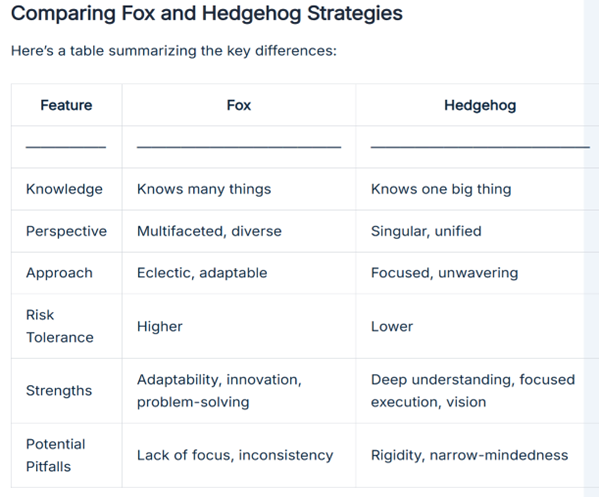
Using the supposed traits of each mindset, some have extrapolated how each mindset operates in terms of business and politics and in problem-solving and leadership skills.
Some may compare the two ways of thinking as a Fixed or Growth mindset.
Of course, Berlin’s interpretation is not supported by the Archilochus fragment. And there are those like myself who see the project as oversimplifying the multifaceted way we think and do so in diverse contexts.
Consider, for one example, the single-minded focus of a violinist who, in private, rehearses Paganini Caprice no. 5 and then at the time of performance, tunes her instrument to A440 and then plays focusing on the bowing and her performance.
Think of an orchestra conductor who sees the scoring of all the instruments and hears the sound of the whole ensemble. He directs the musician’s phrasing, tempo and sound according to his interpretation of what the composer had in mind.
Both solo violinist and conductor are focused on their “one big thing” and both are aware of the setting and the acoustics. They each listen to what comes forth and adapt as needed to enrich the performance for the listener.
Introduction to Berlin’s Division – Hedgehogs and Foxes
https://www.bookey.app/audiobook/hedgehog-%26-the-fox
~~~
Northwestern professor Gary Saul Morson refers to the fox and hedgehog saying and to Berlin’s essay in the conclusion of his magnum opus on classic Russian literature: Wonder Confronts Certainty: Russian Writers on the Timeless Questions and Why Their Answers Matter.
Throughout the book, Morson provides examples of how certainty and wonder played against each other in the writings during the Soviet era.
The nineteenth-century Russian intelligentsia and its Bolshevik successors embodied Certainty. The intelligentsia or “party-minded” related everything to a single central vision – a scientific-materialist-atheistic worldview – and did so with dogmatic certainty. Everything, everyone, and reality itself had to conform to the iron-grip of ideology. Violence made sure.
Russian realist prose, with questions posed, evoked Wonder. Realist authors drew upon the complexity in the world, its many human experiences and perspectives. They wrote about the world and the human condition in realist terms – as it was and not as it was end-of-history supposed. They knew life had contingencies and that there was no one single way to go about things
You can read more about this in my previous posts A Mind is a Terrible Thing to Hand Over and Reentry.
Implicit throughout Wonder Confronts Certainty is the contrast of the fox and hedgehog mindsets in Russian writers. Only in Conclusion: Into the World Symposium does professor Morson refer to the fox and hedgehog saying and to Berlin’s essay. He does so to make the point about “true dialog.” He writes:
Life is eternal dialogue, a world symposium that never ends. In Bakhtin’s notebooks we discover his core belief:
The dialogic nature of human consciousness. The dialogic nature of human life itself. The single adequate form for verbally expressing authentic human life is the open-ended dialogue. Life by its very nature is dialogic. To live means to participate in dialogue: to ask questions, to heed, to respond, to agree, and so forth. In this dialogue a person participates wholly and throughout his whole life: with his eyes, lips, hands, soul, spirit, and his whole body and deeds. He invests his entire life in discourse, and his discourse enters into the dialogic fabric of human life, into the world symposium.[i]
Further on, under the subheading The Fox Knows Many Things, Morson writes:
Given human difference and the plurality of viewpoints, wisdom consists in learning to see the world from the perspectives of others. By intellectual as well as emotional empathy, we can bring discrete positions into open ended-dialog. When we do, we enrich both ourselves and the world.[ii]
~~~
I don’t see a need to classify myself as a fox or hedgehog. There are benefits of both mindsets. I can hold two different things in my mind at the same time, and I am able to adapt to new situations.
I don’t have a degree in any area. As an autodidact, I have an open-ended humanities attitude toward life.
I am by nature a fox that takes in the big picture and I am also a hedgehog that focuses. I see the whole and wonder. I then drill down to explore my wonder. The game is afoot. A reader of my blog over time will notice this. I touch on various topics and often drill down to explore meaning. I do this so that I may understand what I think and to send it out in a post and have it come back to me as wisdom I can use.
I avoid binary, black or white, either/or, left-brain oriented thinking. The “dialogic nature of human life,” if invested in, can make a person knowledgeable and wise. And so can Michael Polanyi’s concept of knowing: ‘from-to’ subsidiary-focal-integration. See the video below.
~~~~~
How Can We Know Anything? Artful Knowing with Esther Meek
Philosopher Esther Lightcap Meek to explore how our understanding of knowledge shapes everything, from faith to creativity to everyday life. Esther challenges the modernist assumption that knowledge is merely information gathering, arguing instead for a view of knowing that is personal, participatory, and artful.
“Polanyi will argue that apart from personal epistemology as he describes it, not even knowledge is possible, let alone realism. Positively, he will view realism as integral to personal knowledge and vice versa” Esther Lightcap Meek
Discussed:
How the “knowledge as information” paradigm cuts us off from reality
Michael Polanyi’s concept of subsidiary-focal integration
Why imagination is essential to all knowing (including science!)
The relationship between attention, love, and knowledge
How artful knowing can help us navigate crises of faith
The doctrine of creation and wonder in the ordinary
Re-enchantment vs. the “lively real”
Comparing Esther’s work with Iain McGilchrist’s brain hemisphere research
https://www.estherlightcapmeek.com/
~~~~~
Hedgehog Mindset?
Monologue – Death at the President’s Lodging by Michael Innes
We are clerks, medieval clerks leading this mental life that is natural and healthy only to men serving a transcendental idea. But have we that now? And what then does all this thinking, poring, analyzing, arguing become – what but so much agony of pent-up and thwarted action? The ceaseless driving of natural physiological energy into narrow channels of mentation and intellection… (p. 80)
Hedgehog TDS:
In a January 2026 media article in The New Criterion – A range of derangement: On the persistence of Trump hatred – James Bowman notes a Wall Street Journal article Is Trump Derangement Syndrome Real?
We now have it on the authority of a licensed psychotherapist that “Trump Derangement Syndrome” (tds) is clinically real—though it’s probably not destined to have its own entry in the Diagnostic and Statistical Manual of Mental Disorders of the American Psychiatric Association any time soon. Writing in The Wall Street Journal, Jonathan Alpert claims that he finds a mental illness worthy of the name in his Manhattan-based practice,
where the presentation aligns with anxiety and obsessive-compulsive disorders: persistent intrusive thoughts, emotional dysregulation and impaired functioning. Patients describe sleepless nights, compulsive news checking and physical agitation. Many confess they can’t stop thinking about Donald Trump even when they try. They interpret his every move as a threat to democracy and to their own safety and control. Call it “obsessive political preoccupation”—an obsessive-compulsive spectrum presentation in which a political figure becomes the focal point for intrusive thoughts, heightened arousal and compulsive monitoring. (Emphasis mine.)
~~~
Speaking of hedgehog TDS:
Responses to a squishy feminized elite:
Late Friday, New York Times columnist David French snarkily referred to Secretary of War Pete Hegseth as a “walking MAGA caricature” on X.
Four hours later, Hegseth’s troops were pounding Iran in an intricate series of strikes that left its evil regime reeling.
The response to French — who has not withdrawn his sneer — was unsympathetic.
My favorite: “Let’s have a contest . . . you and Pete show up at Fort Bragg, see who the troops respect more.”
Is Hegseth a caricature?
To French and his ilk, maybe; but to many others, he’s a guy who gets results.
Presumably a 1945 David French would have considered Gen. George S. Patton a caricature, too . . .
As commentator William Wolf observed on X, “The fact that a billionaire real estate playboy who liked to slap his name on steaks and wine has proven to be a better diplomat and military strategist than every other politician and foreign policy expert over the last 30 years is such a damning indictment of the DC establishment I honestly don’t know how they recover.” Emphasis mine.)
Glenn Harlan Reynolds is a professor of law at the University of Tennessee and founder of the InstaPundit.com blog.
Why Trump and Hegseth’s swagger leaves the ‘elite’ seething
Fox Mindset?
Time for climate education:
Dr. Willie Soon Reveals the Real Driver of Climate Change in New Video – PJ Media
~~~~~

[i] Morson, Gary Saul. “Conclusion: Into the World Symposium.” In Wonder Confronts Certainty: Russian Writers on the Timeless Questions and Why Their Answers Matter, 384. Harvard University Press, 2023. https://doi.org/10.2307/jj.1791936.16.
[ii] Morson, Gary Saul. “Conclusion: Into the World Symposium.” In Wonder Confronts Certainty: Russian Writers on the Timeless Questions and Why Their Answers Matter, 388. Harvard University Press, 2023. https://doi.org/10.2307/jj.1791936.16.







 Cindy Wity
Binary Beckons for More from You
October 15, 2023 Leave a comment
Two options guided my early incorrigible years: “Either you do what I say or your father will deal with you when he comes home” “Either you clean you room or lose your allowance” “Either you are home by 9 or you will be grounded.” The church, too, presented two stark choices: “Either you get saved and go to heaven or you go to hell”; “Either walk the straight and narrow or walk the wide way of the world.”
The either/or binaries of my early childhood were meant to prepare me for life. I learned that if I wandered off into “or” territory there was sure to be consequences. My parents guided my behavior from their own experience of walking within binary guard rails.
They had learned that from the simplest safety issues to the most important issues in life, honest straightforward either/or choices are required. My late mother shared one such either/or choice.
My father, having grown up in the Dutch Reformed church where smoking was the norm for men, was given a choice by my mother when she was dating my father: “Either you stop smoking or that’s it.” Thankfully, my father didn’t “or” the situation. I wouldn’t be here if he did.
With knowledge of their own either/or choices and exposing me to the either/or choices of the book of Proverbs, my parents either/or’d my youth. Binary guard rails were set in place for my time in Jr. High and High school.
When I attended Moody Bible Institute after high school (early 70s), the binary thinking infused in me by the church came into question.
A first-year class called “Personal Evangelism” was taught by Mr. Winslett. During that semester Mr. W described different religions. As he did so he labeled the churches of the Seventh Day Adventists, Mormons, Jehovah’s Witness and others as cults. When he came to the Catholic church, he said it was a cult because Catholics worshipped Mary, had a pope, and put tradition ahead of scripture. I remember hearing this and thinking that we’re better than all of them. But something felt off.
(Per Article I of The Chicago Statement on Biblical Inerrancy found on the Moody Bible Institute website, the Bible, not tradition, is the authoritative Word of God.)
The highly partisan Mr. W, a representative of MBI, had sallied Catholicism: MBI represented real Christianity and Catholicism, a “cult”, did not; either you are with us in Bible first thinking or you are not one of us. (Mr. W was the only teacher I met a MBI like this. But there are many who preach and teach the same binary “us and them” thing.)
I was raised Protestant. Differences of Protestantism and Catholicism were minimally noted in my church. But I had read about Luther, the Ninety-five Theses, and the Reformation. I knew about the abuses and corruption of the Catholic church. Those include Johann Tetzel selling indulgences.
But faith in God and his salvation coupled to Mary, the pope and tradition were not Christianity deal breakers for me. For without faith it is impossible to please God, because anyone who approaches Him must believe that He exists and that He rewards those who earnestly seek Him.
Instead of imposing exclusionary theology, abide by the words of the old hymn: “God moves in a mysterious way His wonders to perform . . . God is his own interpreter, and he will make it plain.”
Years later I came across the same “us and them” attack. I brought my daughter to an Awana program going on at a Baptist church. On the night that she and I were to race the Pinewood Derby Car we had crafted together, the speaker bad-mouthed the Catholic church during a promotion for the Baptist church we were standing in.
He said something to the effect that their Baptist church wasn’t like the unsound Catholic church. I was shocked. There were members of that Baptist church and other churches in attendance. What did they walk away with that night?
I’ve seen this attitude surface so many times by haughty either/or Protestants. I’ve also seen it in either/or Catholics. Both groups interpret Church teaching in a narrow way, then argue that whoever disagrees with their tightly wound interpretation must—by the fact of that disagreement—be in opposition to Church teaching. The Either-Or fallacy used by both Protestants and Catholics: “I can’t be in error therefore YOU must be!”
Another anecdote of the “us and them” attitude: One night I was sitting in a donors meeting listening to a presentation. The Episcopal church I attended wanted to annex and refurbish the house next store and make it ministry usable. At front and center of the room that night was a picture board showing the proposed design. The crossway from the existing church building to the house showed a cross in relief in the arc above the passageway. One woman remarked that we should get rid of the cross because “we’re not Baptists.”
Look. Our family and church backgrounds teach us to think in opposites – basically in terms of good and bad. We are presented with two options and they appear as your only options and mutually exclusive. We then bring unmediated polar extremes into adulthood.
Either/or thinking integrated into our lives and then reinforced by our respective cultures can produce a worldview in stringent binary terms: as a one or zero. Black-and-white thinking is used to reduce the world to something we can handle which then provides a sense of certainty and security. But “a one or zero” thinking can be adversarial, dividing people into “us vs. them.” A few examples:
“I am right and you are wrong.” (How does that work out in marriage? With our neighbors?)
“If you’re not with me, you’re against me. I have friends and enemies but not acquaintances.”
“Either I win or I lose in this situation.”
It can also produce all-or-nothing false dilemma fallacies which are really manipulative setups:
“If you care about your neighbor, you will get vaccinated” and “Putting others first will get us through he pandemic” “Getting vaccinated is loving your neighbor as yourself.”
“Social solidarity is the most precious tenet of our democracy.”
“You’re either pro-choice or anti-woman. There’s no other moral stance.”
“If you’re not part of the solution, you’re part of the problem.”
“Either you let your child change their gender or they will commit suicide.”
“You are either racist (by not agreeing with me) or you are anti-racist (by agreeing with me).”
“If you are against LGBTQ books in the library you are a book banner.”
“If you question what is being taught in public schools, you are a domestic terrorist.”
“If you question the 2020 election you are a MAGA extremist.”
“If you don’t accept the climate science consensus (or COVID science consensus), then you are a science denier.”
Either/or “us and them” thinking tends toward exclusion and not embrace. It tends toward absolutism, authoritarianism, fundamentalism and judgement. We see it in Hamas’ attack on Israel. We see it in climate activism. We see it in cancel culture. We see it in the murderous history of totalitarian regimes. We see it in church teaching and we sing it: “Onward, Christian soldiers, marching as to war.”
We see it in the teachings and practice of Christians, Muslims, and the Progressive Left which would have us believe that they are the opposite of conservative either/or thinking while mandating their own anything-goes version of it. Theology, ideology and government policies are marketed with the dichotomy of good and bad.
It seems that many have retained their childhood’s unyielding binary worldview. It is used as a defense mechanism, as a means of protection from the “hazards and vicissitudes of life”. (From the statement made by FDR when he signed the Social Security Act.)
I’ve seen the binary thinking defense mechanism employed by Christians. Though it comes across as holding fast to the faith and Sola Scriptura, faith vs. science messaging reduces the supposed conflict to “us vs. them” binary thinking which allows no quarter for God’s revelation in nature as revealed by science. Yet, God has revealed himself in both scripture and nature. Science is a tool for understanding God’s revelation of Himself in the physical world.
When I told my eighty-nine-year-old Godly mother that, based on research, I believed the universe to be billions of years old and that God used evolution, she didn’t reply “That’s interesting. Tell me more.” She said “That’s heresy!” Her defense mechanism alarm bell went off. She was reacting from what she had been taught and how she had been taught to think about what she was taught.
Becoming emotionally invested in extremes may lead to the exclusion of people, as “Heresy!” suggests. Such binary thinking can produce unrealistic portrayals of others and it can become used, as mentioned above, as a weaponized defense against others.
Certainly, there are people who watch news commentators because they relish the mocking and “owning” of the opposition. Certainly, there are people who go to church for the same reasons. But there is nothing mature about participation in bad mouthing others. I see nothing of this in Jesus.
I come across Jesus-whipping-the-money-changers-in-the-temple memes on social media. These are extrapolated as Jesus is “destroying” his enemies, so we can do the same. Horrible nonsense.
Relying solely on binary thinking is intellectual and spiritual laziness. An open both/and questioning mind is not a slippery slope and it’s not anything-goes Progressivism. Seek truth and not the comfort of tribal consensus.
Consider that no one has all the information – not your pastor nor MBI nor Anthony Fauci nor climate scientists. It’s OK. Consider that not everything is black and white. Knowing the difference and knowing when to introduce AND with “perhaps” is wisdom.
The Creator of the universe is not a small-minded Person. He holds a universe of disparate thought, theories, and faith in his hands. He is not threatened by any of it. A follower of the Creator of the universe lets God hold the messiness and uncertainty of life in His hands and does not feel threatened.
Finally, a reductionist’s worldview makes it incredibly difficult to hold space for the uncertainty and messiness of others. But there is a better way, a much better way: love and maturity.
Love is great-hearted; love is kind,
Knows no jealousy, makes no fuss,
Is not puffed up, no shameless way,
Doesn’t force its rightful claim,
Doesn’t rage or bear a grudge,
Doesn’t cheer at other’s harm,
Rejoices, rather, in truth.
Love bears all things, believes all things;
Love hopes all things, endures all things.
As a child I spoke, and thought, and reasoned like a child; When I grew up, I threw off childish ways.
I Cor. 13:4-7, 11
~~~~~
(Note: I’ve summed up a lot so as to make this post accessible. I was involved in the Jesus People movement during high school. Along with those in the movement I questioned a lot of the binary thinking of the church. I’ll share that story in another post.)
~~~~~
Science and Faith
In this episode, we focus on the apparent tension between science and faith.
“Many people believe that science and religious faith are bitter enemies with conflicting views of the universe. One the one hand there is the scientific account of the origins of life and then there is the story of universal origins told by the bible. But is this tension real, or is it based on a deep misunderstanding of what the Bible is and how it communicates?
. . .
“Consider this a crash course in reading the Bible as an ancient cross-cultural experience.”
Science & Faith (bibleproject.com)
~~~~~~
Kate Boyd | Science and the Messy Middle
Kate Boyd has been learning to live out her faith in the messy middle in a culture that rewards picking a side. While her journey didn’t begin with a conflict between science and religion, her story explores the complexities of understanding the Bible in today’s context and anyone who has struggled with issues of science and faith will resonate with this conversation.
149. Kate Boyd | Science and the Messy Middle | Language of God (biologos.org)
~~~~~
I’ve been told that I’m either naive or stupid.
I’m not sure which side I’m moron.
Rate this:
Filed under Christianity, Psychology, Science, social commentary, totalitarianism Tagged with absolutism, Authoritarianism, binary thinking, Catholicism, Christianity, either/or, fundamentalism, Protestantism, psychology, Science, totalitarianism