In Deep
July 28, 2024 Leave a comment
One day, Peter sat down with Mark and told him about the challenges of being a disciple of Jesus and what he witnessed.
“Jesus called the twelve of us together, gave us instructions, and sent us out in pairs to several areas in Galilee. We announced that the kingdom of God had arrived, and that people should repent. We cast out unclean spirits. And we anointed many sick people with oil and cured them. We were doing what he had been doing.
“When we returned from our mission, we were anxious to share with him all that we had done and taught. We must have looked tired and hungry. He said we all needed a break. People were constantly coming and going around us. So much so that we didn’t have time to eat.
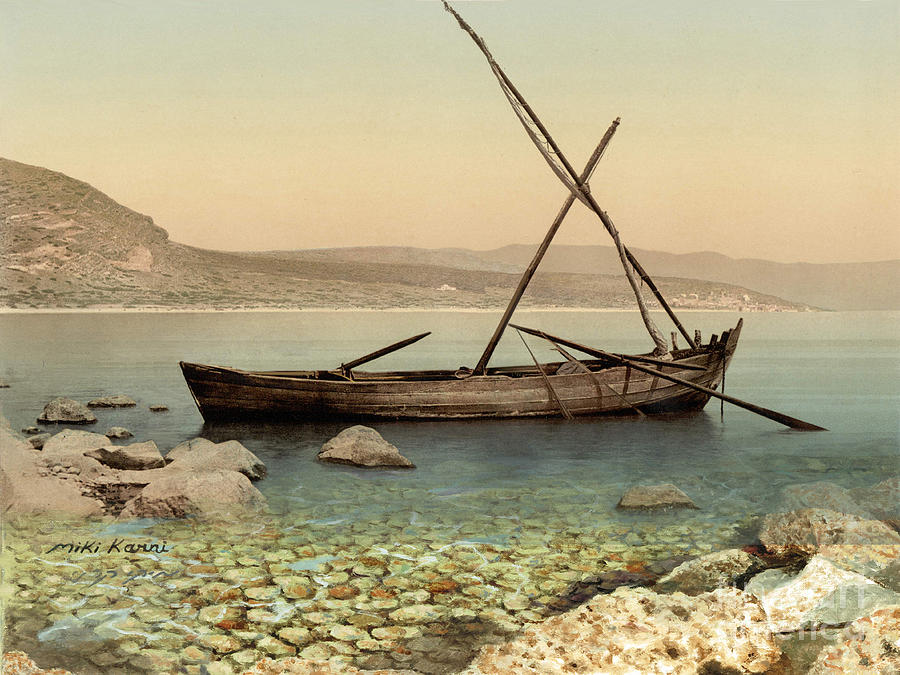
“We got in the boat and sailed to a deserted spot. But the crowd saw us going, realized what was happening and arrived there first. When Jesus got out of the boat and saw the huge crowd, I could tell that he felt deeply sorry for them. He said they were like a flock without a shepherd. So, he began to teach them many things.
“There was nothing to eat at that deserted place and it was getting late in the day. We wanted the Teacher to send the crowd away so they could buy food in the countryside or in the villages. But then he said “We don’t need to send them away. Why don’t you give them something.”
“We looked at each other wondering what in the world he was suggesting. Was he serious? Philip said “It would take more than half a year’s wages to buy enough bread for each one to have a bite!”
“Then he said “Well, how many loaves have you got? Go and see.”
“My brother Andrew found a boy with five small barley loaves and two small fish. But we were standing in front of thousands of people.
“Jesus had us sit everyone down, group by group, on the green grass. So, we made everyone sit in companies of hundreds and fifties. Then Jesus took the five loves and the two fish, looked up to heaven, and blessed the bread. He broke it and gave it to us to give to the crowd. Then he broke the fish into pieces and handed to it to us to give to the crowd. Everyone ate and had their fill including me and the others of our group. Over five thousand people were fed.
“We gathered up the leftovers and there were twelve baskets of broken pieces and of the fish. Everyone was full and tired.
“And then, just like that, Jesus told us to get into the boat and sail toward the opposite shore. He dismissed the crowd and then went off up the mountain to pray.
“Mark, you won’t believe what happened. We had rowed about three or four miles and were in the middle of the sea. It had been hard rowing all night. A stiff wind coming down from the mountains on the eastern shore of the lake was working against us.

“Then, in the dead of night, we all thought we saw a ghost walking on the water. It was about to go past our boat. We were scared out of our wits. We were yelling “Who goes there?!” And then, just like that, we hear “Cheer up! It’s me. Don’t be afraid.” When the figure came closer, we could see that it was Jesus. He was walking on the water!
“I said “if it’s really you, Master, then give me the word and I’ll come to you on the water.” And he said “Come along, then.”
“So, I got out of the boat, and would you believe it Mark, I walked on the water. But then I saw the wind chopping the waves and the chaos at my feet and I began to sink just like that. I called out to the Teacher. He put his hand out and caught me before I went under. He looked at me and said “A fine lot of faith you’ve got! Why did you doubt?” I was shivering and feeling pretty low, so I said nothing as we walked to the boat and climbed in.

“As soon as we got in the boat the wind stopped blowing just like that. And just like that we reached the shore. And just like that we went from being scared out of our minds to being thunderstruck by what had taken place, just like before.
“I told you, Mark, about the last storm we faced on the Sea of Galilee. It came up suddenly from the West. Waves beat against the boat and it quickly began to fill with water. That time Jesus was with us. He was asleep and we woke him up to help us bale out water. He got up, scolded the wind, and said to the sea “Silence! Shut up!” Things went to a dead calm, just like that. Then he said “Why are you scared? Don’t you believe yet?”
We were terrified when we saw this. We looked at each other and said “Who is this? Even the wind and the sea do what he says.”
This time we fell down and worshipped Jesus saying, “You are really God’s son!”
“We made landfall at Gennesaret and tied the boat up. As soon as we landed people recognized Jesus. They began to bring sick people on stretchers to where they heard he was.
“And Mark, wherever Jesus went, in the villages, towns or open country, people brought their sick to the marketplace and begged him to let them touch the edge of his cloak. And whoever touched the hem became well. The healed were getting up from their stretchers and were running around praising God. You should have seen it.”
(The above is an imagined retelling of Mark chapter 6 referencing Matthew chapter 14, Luke chapter 9, and John chapter 6)
~~~
Did Jesus have Peter and the other apostles wade into waters over their heads to remove the scales from their eyes? Did he put them through the wringer to squeeze out unbelief? It would seem so.
The Twelve – fishermen, a tax collector, and other regular guys – are sent to districts of Galilee on a kingdom of God mission well outside the range of their experience. This while earthly kingdoms get word of their kingdom message and of the power at work in them. And this while there is news of the arrest and beheading of John the Baptist by Herod.
When the Twelve return to Jesus, he has the group sail to a deserted area for a break away from the constant flow of people. But upon arriving they are met by an enormous crowd that had figured out where they were going. Then the Twelve are asked to provide food for the thousands listening to Jesus.

Having no resources other than a meager five loaves and two fish, the Twelve are assigned by Jesus to have everyone sit down in groups, to pass out the baskets of bread and fish that he hands them, and to collect the leftovers. Menial labor after a lofty mission and no rest for the Twelve.
That evening, Jesus sends the Twelve rowing across a sea that was known for its challenges. (Nature is no respecter of persons except for Jesus.) And on that sea, in the early morning hours, they encounter a ghost-like figure that scares the beJesus into them.
We don’t always get the inner perspective of the disciple’s thoughts and feelings in the gospel of Mark. But in at least two accounts we learn that the Twelve were “terrified” (Mk. 4:41) and “astounded” (Mk. 6:51) by the Who of “Who is this?” and “Who goes there?”
It is one thing to hear about divine revelation in the synagogue, to hear the words He made known his ways to Moses, his deeds to the people of Israel (Ps. 103:7). It is quite another to encounter God’s ways and deeds in person. And what the “terrified” and “astounded” Twelve experienced was God’s favor, care, and protection for those he chose to be with.
Peter, a fisherman who spent most of his time on the water in a boat, walked on the water with the Son of God right there urging him to do so and ready to catch him. For, faith is more than floating along on what you think you know.
The Twelve, schooled by each unsettling situation the Teacher had them face – strong winds and a sudden storm at sea, a scary specter, a supply shortage, and steady streams of the sick and sheep without a shepherd – discovered God’s power, His presence, His plenty, and His pity.
To their uncertainty, their fears, their inadequacy, and their helplessness, God’s presence was revealed.
“Who is this?” “Who goes there? “
“Cheer up! It is I AM.
~~~
Isaac, Joseph, Moses, Joshua, Gideon, Saul, David, Solomon, Jeroboam, Asa, Jehoshaphat, and Jeremiah were promised the presence of God. The Presence was promised to Jacob:
“Know that I am with you and will keep you wherever you go, and will bring you back to this land; for I will not leave you until I have done what I have promised you.” (Genesis 28:15) (Emphasis mine.)
Jesus made the same promise to his followers before he ascended into heaven:
“I am with you, every single day, to the very end of the age.” (Matt. 28:20)
And beyond . . .
And I heard a loud voice from the throne saying, “Look! God’s dwelling place is now among the people, and he will dwell with them. They will be his people, and God himself will be with them and be their God. (Rev. 21:3) (Emphasis mine.)
The Real Presence is with you in the Holy Eucharist. Jesus is literally and wholly present—body and blood, and divinity—in the elements of bread and wine.
The age-to-age continuum of God’s promise of presence with us, expressing His covenant faithfulness, is the premise of our faith. He will not abandon us. The praxis of knowing that – living by faith – operates within The Presence continuum.
~~~
The time the Twelve spent with Jesus was eye-opening – but not always mind’s eye opening.
After Mark tells us that the apostles were overwhelmed with astonishment (having just watched Jesus walking on the water) he adds a comment (Mk. 6:52): they didn’t understand what Jesus had done with the fishes and loaves – their hearts were hardened.
Mark doesn’t explain this last note. Maybe, when presented with the existential reality of what took place that afternoon, the Twelve chose to ignore it or had no place in their imagination for it. Or maybe, their hearts were hardened by God.
Recall that during the Ten Plagues of Egypt, Pharoah’s heart was hardened by God and remained that way even after Pharoah’s magicians threw in the towel when they couldn’t fabricate further “miracles”:
The magicians said to Pharaoh, “This is God’s doing.” But Pharaoh was stubborn and wouldn’t listen. Just as God had said
Exodus 9:15-16 gives us the reason why Pharoah’s heart was hardened. God tells Moses to confront Pharaoh and tell him the following:
You know that by now I could have struck you and your people with deadly disease and there would be nothing left of you, not a trace. But for one reason only I’ve kept you on your feet: To make you recognize my power so that my reputation spreads in all the Earth. You are still building yourself up at my people’s expense. (Emphasis mine.)
We don’t know why the Twelve couldn’t take in what had happened that afternoon. But I wonder: did they later recollect that experience and understand the multiplication of loaves and fishes in the context of the Exodus? God fed thousands in the wilderness.
Did they later recollect their experiences (walking on water, Jesus intending to pass by the boat, disclosure of God’s presence with them, a healing hem) and understand them in context of the Exodus?
God controlled nature (the Red Sea) so that Israel can walk through/on it.
God passing by Moses (Ex. 33:22)
God revealed Himself to Moses as “I Am” in a physical phenomenon (a burning bush).
Israelites were healed by a physical object – by looking at a snake made of fiery copper (Num.21-4-9),
With the events described by Peter in Mark’s gospel and the events of Israel’s history, Jesus’ kingdom mission for the world is equated with the Exodus mission of rescue and redemption for Israel.
~~~~~
Podcast: Three books by O.T. scholar Iain Proven
The Old Testament is often maligned as an outmoded and even dangerous text. Best-selling authors like Richard Dawkins, Karen Armstrong, and Derrick Jensen are prime examples of those who find the Old Testament to be problematic to modern sensibilities. In his new book Seriously Dangerous Religion: What the Old Testament Really Says and Why It Matters (Baylor UP, 2014), Iain W. Provan counters that such easy and popular readings misunderstand the Old Testament
Discussed in this podcast are three books authored by OT scholar Iain Proven:
A Biblical History of Israel, Second Edition
Convenient Myths: The Axial Age, Dark Green Religion, and the World that Never Was
Seriously Dangerous Religion: What the Old Testament Really Says and Why It Matters
I’ve read Convenient Myths and Seriously Dangerous Religion. I recommend both books.
~~~~~

















 Cindy Wity
“Come to Me”
April 24, 2022 Leave a comment
in the Christ shall all be made alive -1 Cor. 15: 22
Many years ago, an interim pastor at the church I was attending asked me to go with him to Pacific Garden Mission in downtown Chicago. This pastor was involved PGM’s Unshackled radio broadcasts. On this occasion, he and I ministered to those who came in off the street. I played a couple hymns on my trumpet. He gave a simple gospel message. Those attending received a hot meal after our brief service.
During my student days at Moody Bible Institute, I visited other Chicago rescue missions. I would play my trumpet and, with others in our group, give a brief witness to my faith in the Lord. Telling the forlorn and broken sitting before me that I was raised in a Christian home and received Jesus as my savior at eleven years old – I was coming from a place nowhere near where these folks had been.
But the gospel has a way of speaking into memories and of stirring folks to reflect on their life. Some wept upon hearing childhood accounts of home. From recollections, whether good or bad, the gospel points people in the direction of rescue from a life gone prodigal.
On each occasion, as I walked into the meeting room of the rescue mission, I encountered the smell of alcohol, urine and of unwashed bodies and clothes. My eyes met with a scene of loss – each figure a shell of their former self.
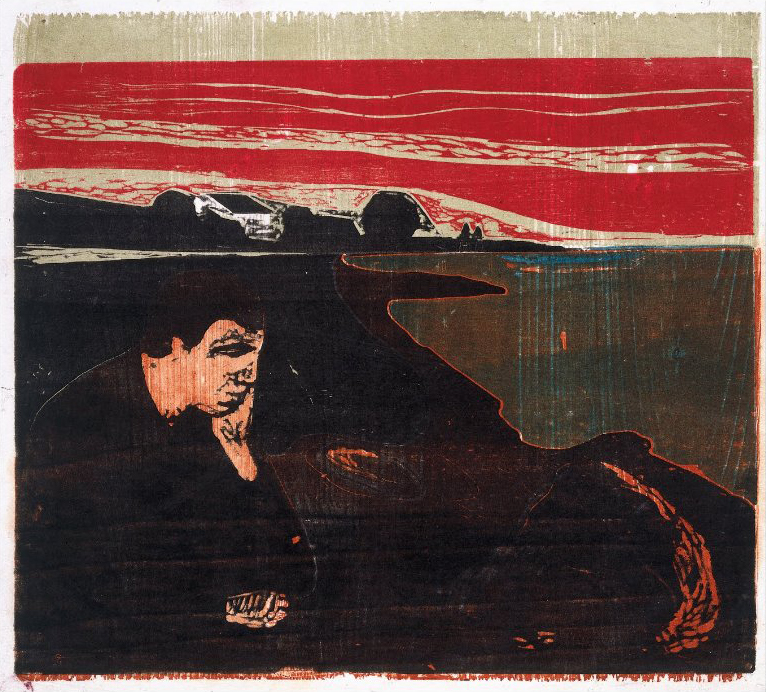
The homeless – alcoholics, the drug dependent, the bankrupt, the mentally ill, the despairing, the dis-owned by family and friends – sat scattered among the rows of chairs. Some folks were asleep sitting up. Some were laying across chairs asleep. Some were mumbling things unintelligible. And some sat up looking despondently at the floor. The body language: “I’m adrift, aching and alone.” The sign out front: “JESUS SAVES”.
*****
Are you having a real struggle? Come to me! Are you carrying a big load on your back? Come to me! – I’ll give you a rest! Jesus invites his listeners to put on his yoke and take lessons in humility from him. Arrogance is a heavy burden to carry and to defend (Matt 11: 28-30).
It’s the sick people who need the doctor, not the healthy ones. I came to call the bad people, not the good ones. Jesus responds to the grumbling legal experts when they see him eating with tax-collectors and sinners (Mk. 2: 17).
You see, the son of man came to seek and to save the lost. Jesus responds to the grumbling observers of the faith-based salvation of chief tax-collector Zacchaeus (Lk. 19: 1-10).
After all, God didn’t send the son into the world to condemn the world, but so that the world could be saved by him. Jesus is reconfiguring the Pharisee Nicodemus’ notion of salvation (Jn. 3: 17). Jesus says that he will be lifted up just as Moses lifted up the snake in the desert. This, Jesus explains, is how much God loved the world. And so, everyone who believes in him should not be lost but may share in the life of God’s new age.
****
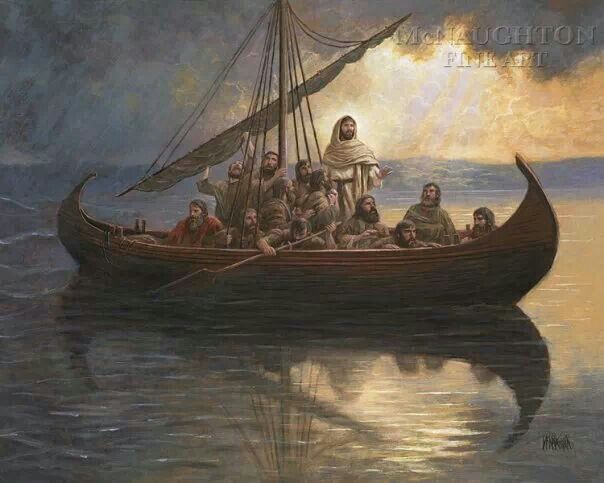
The Gospel According to Mark chapter 4 records the rescue of a small fleet of fishing boats crossing the sea. A big windstorm came up and began filling the boats with water. Life and livelihood were in jeopardy. The fishermen were freaking out. Jesus, however, was sleeping soundly on a cushion in the stern in one of the boats. They woke him up.
Jesus got up, silenced the wind, and told the raucous sea “Shut Up!”. Things calmed down at once. The rescued, whose alarm at the tempest shifted to awe-struck terror of the rescuer, said to each other “Who is this? Even the wind and the sea do what he says!” Their crossing continued over to the land of the Gerasenes without further incident.
Chapter 5 of Mark’s gospel account records three rescues. The narrative begins with Jesus and the small fleet of fishing boats arriving on the shore of the land of the Garasenes. They are suddenly confronted by a man with an unclean spirit. He emerged from a graveyard which is where he lived.
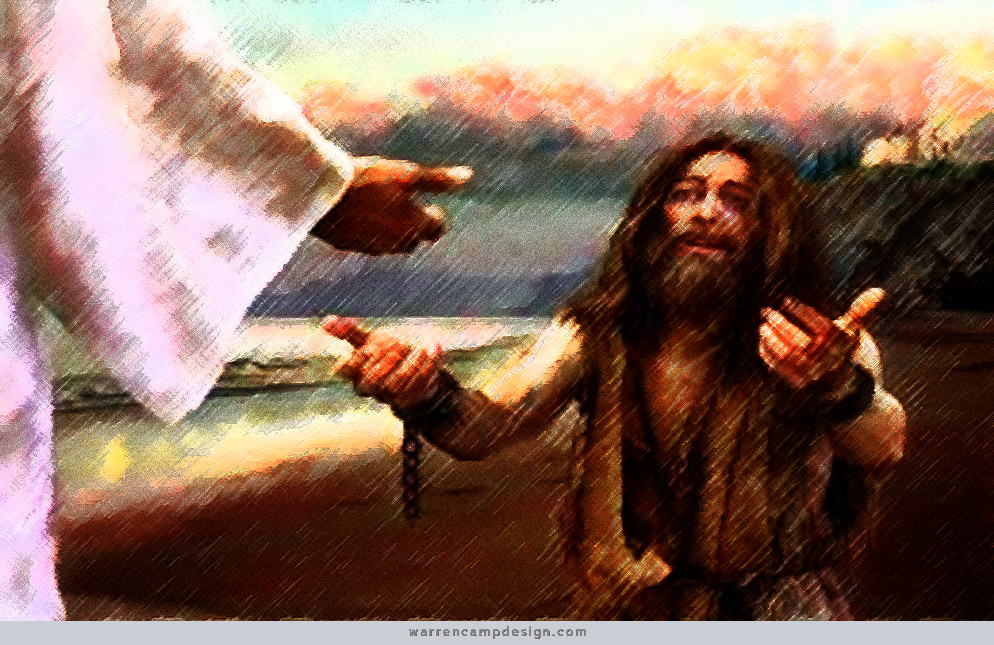
The man is wild. No one can physically restrain him, not even with shackles and chains. But the wild man’s attention is captured. He runs up to Jesus and falls down before him.
Jesus questions the man and hears that that man is possessed by a hoard of demons calling themselves “Legion”. The demons, knowing that Jesus will deal with them, want to be rescued in their own way. They beg Jesus to not send them out of the country. They want to be sent into a nearby herd of pigs. Jesus lets it happen and the pigs rush down into the sea and drown.
The herdsmen’s reaction, not unlike the fishermen’s reaction earlier, was of utter terror. They began telling everyone about what had happened. People came to Jesus. They saw the man who had once terrorized the countryside. He was seated, clothed and in his right mind. When eyewitnesses told the crowd what had happened to the man and to the pigs, the people were afraid. They begged Jesus to leave their district. The man who had been rescued, however, asked to go with Jesus. Jesus wouldn’t let him.
Go back home. Go to your people and tell them what the Lord has done for you. Tell them how he had pity on you.
The rescued man goes out and tells what Jesus had done for him. Everyone is astonished.
The next two rescue accounts in Mark’s gospel account involves two people of different social and economic status: a named man – Jairus, a synagogue president – and an unnamed woman. Mark intertwines these accounts.
Jesus, having crossed back over the sea, is quickly surrounded by a large crowd on the seashore. Jairus arrives. When he sees Jesus, he falls down at his feet and begins pleading.
My daughter’s going to die! My daughter’s going to die! Please come – lay your hands on her – rescue her and let her live!
Jesus goes off with the man. And a large crowd follows pressing in in him. Enter the unnamed woman.
Mark tells us . . .
A woman who’d had internal bleeding for twelve years heard about Jesus. (She’d had a rough time at the hands of one doctor after another; she spent all she had on treatment and had gotten worse instead of better.) She came up in the crowd behind him and touched his clothes. “If I can just touch his clothes,” she said to herself,” I’ll be rescued.” At once her flow of blood dried up. She knew, in her body, that her illness is cured.
Jesus knew at once that power had flowed out of him. He asked who it was that touched him. The woman of low estate, trembling, made herself known to Jesus.
My daughter, your faith has rescued you. Go in peace. Be healed from your illness.
(I am reminded of another close encounter rescue: four men carried a paralytic on a stretcher, bringing him to see Jesus. The crowd was so thick around Jesus they couldn’t get near enough to ask for the man’s healing. So, they opened up the roof and lowered the stretcher with ropes. They placed the man right in front of Jesus. Jesus noticed their threads of faith and said to the paralytic Child, your sins are forgiven! (Mk. 2: 3-5))
As Jesus was speaking to the woman, some very sad people arrived from the synagogue president’s house.
Your daughter’s dead. Why bother the teacher anymore?
But that didn’t stop Jesus from rescuing the girl.
Don’t be afraid! Just believe!
Jesus said no to the crowd following him (Too much commotion already?) and went to the synagogue president’s house with only Peter, James and John. When they arrived, there was all kinds of weeping and wailing going on.
Why are you making such a fuss? Why all this weeping? The child isn’t dead; she’s asleep.
Mark tells us that they laughed at him and then. . .
Jesus put them all out. Then he took the child’s father and mother, and his companions, and they went in to where the child was. He took hold of her hand and said to her, “Talitha koum,” which means, “Time to get up, little girl!” At once the girl got up and walked about. (She was twelve years old.) they were astonished out of their wits. Then he commanded them over and over not to let anyone know about it, and told them to give her something to eat.
****
The demoniac was cut off from himself and society because of what possessed him. Jesus ‘hog-ties’ the “Legion” and plunders the “strong man” domain (cf. Mk 3: 23-27). Jesus expels the unclean spirits and liberates the man from his living death. The image of God is restored. The man wants to go with Jesus but Jesus won’t let him. Jesus sends the unshackled man away so that people will see and hear from the rescued man himself: “Go to your people and tell what the Lord has done for you. Tell them how he had pity on you.”
The woman with the continual hemorrhaging was cut off from just about everything and all the time due to her ritual impurity (Lev. 15:25). She had exhausted her resources to find a cure. Then, by faith, she reached out and touched Jesus, God’s holy one. He rescues the woman from her living death – the constant loss of blood from her womb. She is restored to holiness, purity, and wholeness.
Death, the ultimate separation and defilement, tore the twelve-year old girl from her family. Because of her father’s pleading Jesus comes to her bedside, takes hold of her hand and restores the life that had flowed out of her. She is rescued, reconnected to her family, and is no longer a defilement.
(Note: It is interesting that in Mark’s account of the woman and the girl (5: 21-43), touching and being touched is mentioned six times. Ritual purity – maintaining holiness – was a daily and vital concern for a Jew. Physical contact would trigger any Jew who followed Scripture’s instructions regarding purity.
Jesus didn’t ignore the ritual purity laws in the process of rescue. Instead, he neutralized the effect of the law by restoring the woman and child. By stopping the flow of blood and making her clean, Jesus ‘neutralized’ the ritual impurity of her touching him. By raising the girl to life, Jesus ‘neutralized’ the ritual impurity of touching the dead (Num. 5:1-4; 19:11-22; 31:19-24))
When Jesus announced “The time is fulfilled. God’s kingdom is arriving! Turn back and believe the good news (Mk. 1: 15) he began to show the world what the kingdom of God on earth means: God would reclaim creation – his temple – and rescue his image-bearing humans.
In these rescue accounts and so many others, Jesus is not asking about the salvation status of the individual. He is not asking them if they want to go to heaven when they die. He is not rescuing people to have them later sent off to become a disembodied spirit in some heavenly realm somewhere over the rainbow. No. Jesus wants those in his kingdom to do what he has done. Death is a short interlude. As with the twelve-year old girl, Jesus will take you by the hand, get you up and get you back at it. Death is not a retirement home.
The four gospels (and the epistles) tell us that Jesus interfaced with his creation – as heaven and earth – for its salvation. (Think of heaven as God’s space.) We read that the kingdom of God on earth, as Jesus taught and lived, is about rescue, rebirth, healing, faith and not fear, touching and being touched, making all things new, new creation, new wine skins, wholeness, sound minds, and about the Genesis to Revelation project – God dwelling with man (Rev. 21: 2-4).
The world’s salvation, epitomized in another Tower of Babel campaign – Build Back Better – is another take on rebuilding systems and institutions and on redesigning people and society to save the planet and to benefit the elites.
Much of today’s social justice activists work to force their salvation onto you. They want society to work in certain way. Hence, pseudo-moral campaigns like Diversity, Equity and Inclusion (DEI), Environmental, Social, and Governance (ESG), and the coming social credit scoring.
As I see it, Jesus didn’t do social justice – changing systems and institutions to save people. Jesus has a human connection with people and so much so that he went to the cross for their salvation. You won’t see one politician going out of their way to sacrifice anything. And, what do social justice activists sacrifice?
Jesus spoke against the self-righteousness that’s behind much of today’s social justice activism. And, he didn’t coerce anyone to be rescued. He didn’t force salvation onto anyone. People came to him with their faith and open hands. He responded to their need.
The difference between the world’s salvation and Jesus Saves is the difference between putting yourself into the hands of a bureaucracy and some ism and putting yourself into the hands of the Infinite-personal God in Jesus.
*****
Rate this:
Filed under Christianity, Culture, Gospel of Mark, Kingdom of God, social commentary, The Gospel of Mark Tagged with Build Back Better, Christianity, Kingdom of God, Pacific Garden Mission, social justice, The Gospel of Mark