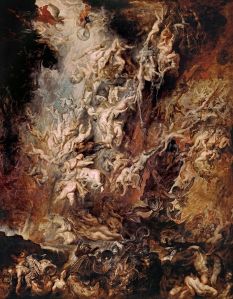
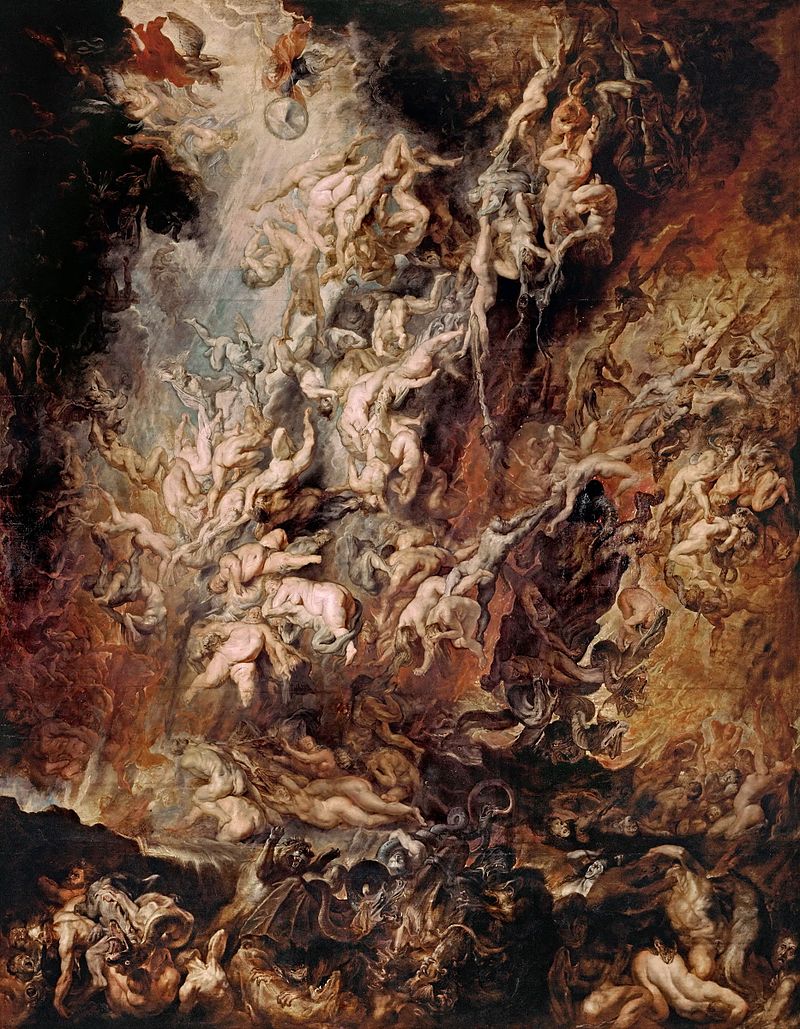
The Fall of the Damned, Peter Paul Rubens
Spiritual reality surrounds us. This fact is attested to at the very least by the numerous TV programs about the paranormal. Shown are ‘investigations’ of the dead, and of ghosts and of supposed haunting spirits. But what are those fascinated and even obsessed about the spirit world connecting with? What do we know about the unclean spirits, the ones Jesus cast out of humans (See my previous post Deliver Us from Evil)?
Genesis opens with God and His temple building creation of earth. We learn of light and darkness. And we soon learn of the spiritual forces of darkness that want control of the temple where God is to dwell with man.
Right from the start of man’s existence another voice interprets God’s word for its own purposes: “Did God really say you couldn’t?”; “You will not certainly die if you do eat the fruit.”; “God has held back nothing from you but the fruit of this tree. Eat it and know what He knows.” Humans fall into sin by willfully accepting the Serpent’s interpretation of becoming like God. Adam and Eve took the bait (an apple leading to God-like knowledge) into their hands. The enmity between humans and the serpent begins.
Prior to the fall of man, the Satan had a falling out with God. What happened is explained in detail in Ezekiel 28. A description of ascendant pride, whether of the Satan or of man’s, is recorded in Isaiah 14. The fallout of enmity between God and the red dragon, an emblem of the Satan, is described in Daniel 8 and here, in Revelation 12: 3-4:
Then another sign appeared in heaven: an enormous red dragon with seven heads and ten horns and seven crowns on its heads. Its tail swept a third of the stars out of the sky and flung them to the earth.
Proverbs 16:18 sums the result of pride and opposition to God: “Pride goes before destruction, a haughty spirit before a fall”.
The fallen angels were booted from Heaven and were no longer able to return. Where did the fallen angels go after being kicked out of heaven? Genesis 6: 1-7 tells us indirectly.
When human beings began to increase in number on the earth and daughters were born to them, the sons of God saw that the daughters of humans were beautiful, and they married any of them they chose.
Then the LORD said, “My Spirit will not contend with humans forever, for they are mortal; their days will be a hundred and twenty years.”
The Nephilim were on the earth in those days—and also afterward—when the sons of God went to the daughters of humans and had children by them. They were the heroes of old, men of renown.
The LORD saw how great the wickedness of the human race had become on the earth, and that every inclination of the thoughts of the human heart was only evil all the time.
The LORD regretted that he had made human beings on the earth, and his heart was deeply troubled.
So the LORD said, “I will wipe from the face of the earth the human race I have created—and with them the animals, the birds and the creatures that move along the ground—for I regret that I have made them.”
In Scripture the “sons of God” typically refer to angels. Above are fallen angels. This passage infers that the first incarnation and sacrilege took place – fallen angels impregnated humans. They had illicit intercourse with women thereby creating a super race of warriors. Then, as now, the fallen angels mean to deface the image of God in humans. They seek to undo what God has created and to ‘create’ a race of Un-men*.
The cast-out angels did what they apprenticed to do by their father, the serpent or the “Bent One” as so described in C.S. Lewis’ Space Trilogy. They came to down earth to create chaos and to gain the power and favor they lost. As agents of evil they come under the description of evil as provided in N.T. Wright’s book Evil and the Justice of God:
Evil is the force of anti-creation, anti-life, the force which opposes and seeks to deface and destroy God’s good world of space, time and matter, and above all God’s image-bearing human creatures.
As we read above, the fallen angels deface Gods’ image bearing humans in the temple of their bodies. Using human sexuality and man’s willful acceptance they debase that image. Does any of this collusion with evil leading to self-imposed temple defilement look familiar today?
Fallen angels multiplied what happened in the garden of Eden. Mankind’s wickedness grew with the earth’s population. Until the flood. Then, except for Noah and his family and selected animals, the human race was wiped from the face of the earth along with the Nephilim (“giants” in the Septuagint), the offspring of the intercourse of fallen angels with women. It may be assumed that with the decimating flood the hosts of the unclean spirits died and the unclean spirits were released into, for a lack of a better word, the ether.
Intertestamental Jewish writings provide the context of Jesus’ ministry including the existence of unclean spirits. These writing fill in roughly four-hundred years of information about Jewish thought and theology between the Old and New Testament. Topics include angels, demons, the messiah, the resurrection and the law of Moses. Each of these topics, which were on the minds of the Jews, is addressed in the gospels. Jesus responds to each topic, each question, and each confrontation with authority.
Adding to the context of Jesus’ day, synagogues, mentioned in the gospels but not mentioned in the Pentateuch, likely originated in exile and in Babylonia. The opening chapter of Mark’s gospel finds Jesus in a synagogue casting out an unclean spirit.
What about written context beyond Genesis chapter 6? Other than the reference in Genesis, there is nothing written about fallen angels/unclean spirits until the intertestamental books. The topic of demons in these books may have been due to Babylonian interest in lesser gods and demons and their writing about them. Here is a passage from the Book of the Watchers (15: 6-12), written around 300 BCE:
And though ye were holy, spiritual, living the eternal life, you have defiled yourselves with the blood of women, and have begotten (children) with the blood of flesh, and, as the children of men, have lusted after flesh and blood as those also do who die and perish. Therefore have I given them wives also that they might impregnate them, and beget children by them, that thus nothing might be wanting to them on earth. But you were formerly spiritual, living the eternal life, and immortal for all generations of the world. And therefore I have not appointed wives for you; for as for the spiritual ones of the heaven, in heaven is their dwelling.
And now, the giants, who are produced from the spirits and flesh, shall be called evil spirits upon
the earth, and on the earth shall be their dwelling. Evil spirits have proceeded from their bodies; because they are born from men and from the holy Watchers is their beginning and primal origin; they shall be evil spirits on earth, and evil spirits shall they be called. [As for the spirits of heaven, in heaven shall be their dwelling, but as for the spirits of the earth which were born upon the earth, on the earth shall be their dwelling.]
And the spirits of the giants afflict, oppress, destroy, attack, do battle, and work destruction on the earth, and cause trouble: they take no food, but nevertheless hunger and thirst, and cause offences. And these spirits shall rise up against the children of men and against the women, because they have proceeded from them.
The “Watchers” designation tells us that these spirits are restless and never sleep. These disembodied spirits are able to dwell in humans and animals. We learn that they cause havoc: “the spirits of the giants afflict, oppress, destroy, attack, do battle, and work destruction on the earth, and cause trouble”. They are the ones Jesus casts out (again and again) as he begins His kingdom on earth.
In a previous post, See Him as He Is, I posited that followers of Jesus must see Jesus as He is as recorded in all of Scripture’s narrative and as revealed to them by the Holy Spirit. They are not to view him through a tainted by evil rose-colored glass worldview. Absolute clarity requires the Lord’s followers to remove their hands from their eyes and their fingers from their ears and to take in the reality of Jesus and the world around us. In my last post I noted that the unclean spirit in Mark chapter one knew exactly who Jesus is. The unclean spirit saw with absolute clarity. And, like Jesus, we are to see enemy as he is and then cast him out.
Now, the Evil One and his apprentices don’t care about your politics. They don’t care if you are Republican or Democrat. They don’t care about the color of your skin or about the colors of your flag. They don’t care if you are rich or poor or male or female. Here is what they care about: to “afflict, oppress, destroy, attack, do battle, and work destruction on the earth, and cause trouble”. The Evil One’s apprentices seek to deface creation and the image of God in each human. Throughout cultures and nations and throughout time, the apprentices entice, lie and pervert humans, turning them into beasts which live to satisfy animal urges.
In C.S. Lewis’ The Screwtape Letters, Screwtape (the Evil One), apprentices Wormwood. In the quote below note Screwtape’s frustration with how things were created by God and how that which has been created must be perverted:
”He [God] has a bourgeois mind. He has filled His world full of pleasures. There are things for humans to do all day long without His minding in the least – sleeping, washing, eating, drinking, making love, playing, praying, working. Everything has to be twisted before it’s any use to us. We fight under cruel disadvantages. Nothing is naturally on our side.”
Don’t let twisted pleasure and appetites define you. Abhor evil. Cling to good. Don’t become an apprentice of the Evil One. Don’t give the enemy advantage. Don’t toy with evil. Stay away from mediums, Tarot cards, Ouija Boards, astrology, séances, pornography, drugs and …entertainment, the devil’s playground.
Disney’s Fantasia is one example of how entertainment downplays the forces of darkness. Consider the animated short wherein Mickey Mouse portrays a sorcerer’s apprentice. The popular cartoon character plays with magic and conjures up all kinds of out-of-control havoc. The ‘approving’ adult background music is Paul Dukas’ The Sorcerer’s Apprentice. Watching this, a child is lured into relating to and empathizing with evil’s apprentice, an endearing cutesy child-like character in a wizard hat who experiments with magic and gets into ‘innocent’ trouble. On the surface, the animated short comes across as cautionary tale against disobeying the rules. But it actually encourages a child to try again and to avoid the consequences next time.
The twaddle of Harry Potter books and movies is meant to entertain and to make a huge profit for its creator and producers. Yet, the fantasy series has nothing good to offer the partaker. The series is just diversion, a distraction from reality. And worse. Like Disney’s Sorcerer’s Apprentice, its main characters engage with magic arts. Entertainment, like all temptations including the ones posed to the Lord, are, in essence, about denying reality and obtaining power to control reality. Once your child partakes of this ‘amusement’, he or she is hooked. See your enemy as he is. He wants your child to experiment with evil to obtain power. If you think I am kidding, look around at the pagan invasion of children’s culture. (A book I highly recommend: A Landscape with Dragons: The Battle for Your Child’s Mind by Michael O’Brien)

Unclean spirits promote fantasy. Their temptations come in the form of fantasy. Just as in the Garden they want you to entertain notions of unrestricted freedom and narcissistic god-like power (e.g., R. Kelly’s “I Believe I Can Fly”). The temptation to convert fantasy into reality – more money and notoriety – is behind the Jussie Smollett hoax. There is a vast difference between a healthy imagination in which good and evil and outcomes are considered and fantasy which projects into reality.
“… we need to make a distinction between fantasy and imagination. Both fantasy and imagination concern unrealities; but while the unrealities of fantasy penetrate and pollute the world, those of the imagination exist in a world of their own, in which we wander freely and in full knowledge of the really real…Fantasy covets the gross, the explicit, the no-holds-barred display of the unobtainable; and in the crisis of display the unobtainable is vicariously obtained.”
-Roger Scruton, Chapter 6, Fantasy, Imagination and the Salesman, An Intelligent Person’s Guide to Modern Culture
Spiritual reality surrounds us. This fact is substantially attested to by the influences of the perverse paranormal on humans. Look around at the effects of unclean spirits on humans. You find cynicism and sentimentality promoted. You find projection and scapegoating. You find a culture embracing victimhood instead of personal responsibility. You find unexplained mental illness and depression. You read reports of suicide. Evil, promoted day and night, afflicts, oppresses, and destroys the good.
Turn on the radio and you will hear music from the bowels of hell. Art and architecture are increasingly de-humanized. As you sit in front of any media outlet you come across daily headlines and a continuous stream of entertainment filled with accounts of murder, violence, sex abuse, revenge, racism, and all manner of evil. The dark web is a “malignant outgrowth of evil – a sub-culture collective of hive-minded individuals wreaking havoc today, even now as you read your computer screen”. The spirit of lawlessness surrounds us and encounters us everywhere we are, even in our beds.
This world, until Jesus returns to reign on earth, is under attack by the agents, apprentices, and accusers of the Evil One. These spiritual entities will do all they can with your permission to diminish the glory of God in the temples where the image of God dwells. And, just as unclean spirits impregnated women, these same unclean spirits want to impregnate and defile your temple – your body, mind and spirit – with inordinate desires with and for the proliferation of pornography obsession, homosexuality, promiscuity, pedophilia and all manner of sexual perversion.

We are told in Scripture to test the spirits. Test the spirits in your church. If you are hearing spiritual platitudes or prosperity gospel or that “God made you that way” or social justice and rights and political power promotions but you are not hearing evil being addressed and cast out and “Jesus is Lord” every Sunday then there is something very, very wrong. The apprentices have done their work by creating the “Holy Church of Christ Without Christ” (Wise Blood, Flannery O’Connor) with the blessing of those in the pews.
Just as in the coliseum of Rome, Christians today are surrounded by roaring lions that seek to devour us. Some of us will be martyred. Others will deny or ignore or even try to placate the lions with compromise and then be consumed by them when a comprise is reached. Some will deny the Lord. Others of us will stand our ground and use the word of God to fell them.
Stay in control of yourselves; stay awake. Your enemy, the devil, is stalking around like a roaring lion, looking for someone to devour. Resist him, staying resolute in your faith, and knowing that other family members in the rest of the world are facing identical sufferings. Then, after you have suffered a little while, the God of all grace, who called you in the Messiah Jesus to the glory of his new age, will himself put you in good order, and will establish and strengthen you and set you on firm foundations. To him be the power forever. Amen. 1 Peter 5: 8-11
What are those fascinated with and even obsessed about the spirt world connecting with? They are connecting with the unclean spirits that left the bodies of giants during the Flood and the spirits that left the bodies of pigs when they rushed into the water and all of the unclean demonic host cast out of heaven and unable to return. We must heed the Apostle Paul. Paul saw the enemy as he is. So, he warned the church at Ephesus, a church surrounded by sex cults and idolatry and inundated with unclean spirits, (Eph. 6:12):
The warfare we’re engaged in, you see, isn’t against flesh and blood. It’s against the leaders, against the authorities, against the powers that rule the world in this dark age, against the wicked spiritual elements in the heavenly places.
See your enemy as he is. Your enemy sees you as you are – the image-bearing creation of the One who cast them out of His Presence.
And though this world, with devils filled,
should threaten to undo us,
we will not fear, for God hath willed
his truth to triumph through us.
The Prince of Darkness grim,
we tremble not for him;
his rage we can endure,
for lo, his doom is sure;
one little word shall fell him.
– “A Mighty Fortress is our God” by Martin Luther
Lord, the whole of your creation, including me, groans waiting for your return to put things right, to finally cast out the red dragon and his apprentices, the unclean spirits. Help me as I wait to see the enemy as It is and to cast It out. Give me discernment from your Holy Spirit to be able to test the spirits in your church. If You are not declared Lord in the church we attend then help us, by your Spirit, to test the spirits of that church and to put things right.
Help me to overcome my resistance to being different than the Dark World. I am born of you, the Light of the world. That is why I find no pleasure in the media or the politics of power. I want to dwell in your Light all of my days and in the age to come.
Father, your beloved and begotten son Jesus is Lord of the Universe. Amen.
~~~
Lord willing, I’ll have a future post about dealing with evil.
(*) In C.S. Lewis’ Space Trilogy novel Perelandra, Ransom the protagonist names Weston, the evil antagonist, the Un-man. Weston becomes less human and more evil as the story progresses.














‘Tis the Season to Rethink Equal Outcomes
November 10, 2018 Leave a comment
The Progressive’s notion of equal outcomes: “income equality” realized through redistribution; test results based on tests revised so that certain people could pass the test; participation-trophy type merit; laws that ‘fix’ opportunity for certain people; verdicts and sentencing of activist judges who rule based on a defendant’s social circumstances rather than by the crime committed upon another; homosexual ‘marriage’ as marriage equality; “equal pay for equal work” which dismisses the resultant quality of what each worker produces; a state in which people have approximately the same material wealth and achieve equal levels of income; equating equal opportunities with equal results…
Economist Thomas Sowell gives us some insight into Progressive thinking:
Equal opportunity does not mean equal results, despite how many laws and policies proceed as if it does, or how much fashionable rhetoric equates the two.
An example of that rhetoric was the title of a recent New York Times column: “A Ticket to Bias.” That column recalled bitterly the experience of a woman in a wheelchair who bought a $300 ticket to a rock concert but was unable to see when other people around her stood up. This was equated with “bias” on the part of those who ran the arena.
The woman in the wheel chair declared, “true equality remains a dream out of reach.” Apparently only equality of results is “true’ equality….
…Confusion between equal opportunity and equal results is a dangerous confusion behind many kinds of spoiled brat politics. -Thomas Sowell from Spoiled Brat Politics, The Thomas Sowell Reader
To put us in the proper reflective mood for the Season to Rethink Equal Outcomes, below are three accounts from Scripture which reveal to us God’s concept of equal outcomes.
But the king replied to Araunah, “No, I insist on paying you for it. I will not sacrifice to the LORD my God burnt offerings that cost me nothing.” So David bought the threshing floor and the oxen and paid fifty shekels of silver for them. 2 Samuel 24:24
The first thing I notice about the above account is that forms of capitalism have been around for a long time. That is, capitalism, simply defined, as an economic and social system in which property, business, and industry are privately owned and directed towards making the greatest possible profits for successful organizations and people, especially as contrasted to cooperatively or state-owned means of wealth.
In the above account there was a cooperative exchange of private property between two individuals. Both were satisfied with the outcome. And, apparently God was satisfied with the outcome. David’s desire was to not give God the impression that he was doing something good for God, a.k.a. virtue signal or tokenism, but to pay proper respect and attribute worth to God through his offering.
David built an altar to the LORD there and sacrificed burnt offerings and fellowship offerings. Then the LORD answered his prayer in behalf of the land, and the plague on Israel was stopped. 2 Samuel 24:25
The second thing I notice is restraint. Though Araunah offered his property freely to king David (2 Sam. 24:23) the king did not accept it without paying Araunah its worth to Araunah and perhaps more. That cost David. The king could have just taken the property to begin with. Beastly kings and rulers throughout history have seized property for themselves and for “the masses”. David was not about to disrespect his neighbor Araunuh or his God by stiffing either. The king did not exploit Araunuh for righteous ends.
Worth had to be accounted for with regard to Araunah’s property and with regard to a show of respect to God. “I will not sacrifice to the LORD my God burnt offerings that cost me nothing.” That is what David said and that is what the widow thought.
Then Jesus sat down opposite the offering box, and watched the crowd putting coins into it. Many rich people were throwing in large amounts. And a poor widow came and put in two small copper coins, worth less than a penny. He called his disciples and said to them, “I tell you the truth, this poor widow has put more into the offering box than all the others. For they all gave out of their wealth. But she, out of her poverty, put in what she had to live on, everything she had.” Mark 12:41-44
The first thing we notice in this account is the virtue signaling and tokenism of cha-ching-ers who want to appear to profit God while incurring little or no cost to themselves. In kingdom contrast, the unassuming widow, like king David, gave an offering that cost her appreciably and was God’s Temple worthy. The widow gave her financial security. The Lord was pleased to acknowledge her gift acknowledging the God Who is Faithful (Psalm 146: 8). She loved God more than life itself. Now, did you notice in these two stories that taking into account the worth of each party and their property creates equal outcomes – both parties being satisfied and even pleased with what is exchanged? This method of accounting, making sure the ‘other’ is considered and is valued as at least equal with ourselves, can be applied to all interactions.
In a previous post I wrote:
We are told by Jesus to “love your neighbors as yourself”. To do this we must consider our own self-interest and then apply the same measure of self-interest toward our neighbors. This parity of accounting is not unlike the Lord’s accounting of forgiveness: “forgive us our trespasses as we forgive others their trespasses.” […,] the resentment worldview has a perverted accounting system: the self is to be credited and others must be debited for there to be parity in their world. If the word “fairness” is ever to be applied socially and economically to our culture then these two commands of our Lord define its limited and personal application.
As shown from Scripture, God endorsed equal outcomes are marriages of opportunities with offerings. The outcomes are not forced or determined by a higher power or the state. The individuals involved come to an agreement about the outcome. A marriage of a man and woman is the archetype of this union of opportunity and offering.
The man and woman exchange vows and rings and, over time, their lives. The opportunity: they met and each determined that an exchange of their life for the other would make both happy. The offering: they give themselves which costs everything. They do so freely. The exchange is not coerced as in a shot-gun wedding or when those in power decide to take your property by force. When things are forced and a person is acted upon without it being offered it is called rape. It is called stealing when a person’s property is forcibly taken.
The equal outcome of marriage is that the two become one. The transaction creates a greater good (including little ones) and both parties equally, with God’s help, continue to be satisfied with the outcome.
One more illustration from Scripture regarding the marriage of opportunity and offering. Remember this woman?
While Jesus was at Bethany, in the house of Simon (known as “the Leper’), a woman came to him who had an alabaster vase of extremely valuable ointment. She poured it on his head as he was reclining at the table.
When the disciples saw it, they were furious.
“What’s the point of all this waste?” they said. “This could have been sold for a fortune, and the money could have been given to the poor!”
Jesus knew what they were thinking.
“Why make life difficult for the woman?” he said. “It’s a lovely thing, what she’s done for me. You always have the poor with you, don’t you? But you won’t always have me. When she poured this ointment on my body, you see, she did it to prepare me for burial. “I’m telling you the truth: where this gospel is announced in all the world, what she has done will be told, and people will remember her.”
Matthew 26: 6-13
What do we learn about opportunity and offering from this account of a woman pouring a very expensive offering onto Jesus’ head? We learn that the Progressives around Jesus were highly offended when they couldn’t control the outcome of the “alabaster vase of extremely valuable ointment”. We also learn from Jesus about the opportunity that brought them together: “… you won’t always have me”. The woman’s offering was what she could have lavished on herself. Maybe she applied David’s words to her head: “I will not sacrifice to the LORD my God burnt offerings that cost me nothing.”
The extravagant and expensive offering given freely was freely accepted by Jesus in preparation for his burial. In fact, he tells us that the equally shared outcome of what she had done was worth proclaiming: the marriage of opportunity and sacrificial offering as an act of love.
Rate this:
Filed under Christianity, Culture, Economics, Political Commentary, Politics, Progressivism, socialism Tagged with Christianity, culture, Economics, equal outcomes, politics, progressivism, Scripture