Juxtaposed! News ™ Hot Off the Wire – Climate Control
June 26, 2016 Leave a comment
News Anchor: “Good evening. I am Mary Summers and this is Juxtaposed! News ™ Hot Off the Wire.
We start tonight’s broadcast with a look at climate change. Dudley Waters has our report from DC.” 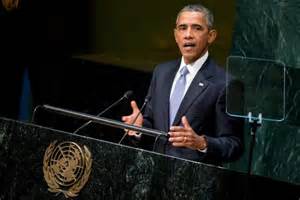
Live Cam w/reporter: “The Senate approved a $1.1 billion Zika virus spending bill. The Obama administration then directed that a half a billion dollars from the fund Congress set aside to deal with international infectious diseases be used to help fund a UN agency recently founded to fight climate change. Here is Senator James Lankford to talk about the spending bill.”
Senator Lankford: “Last week, the Senate passed legislation to address and prevent the spread of the Zika virus. However, the Senate failed to pay for it, and instead approved a $1.1 billion “emergency” spending supplemental bill that is not subject to the budgetary caps that were agreed to last year.
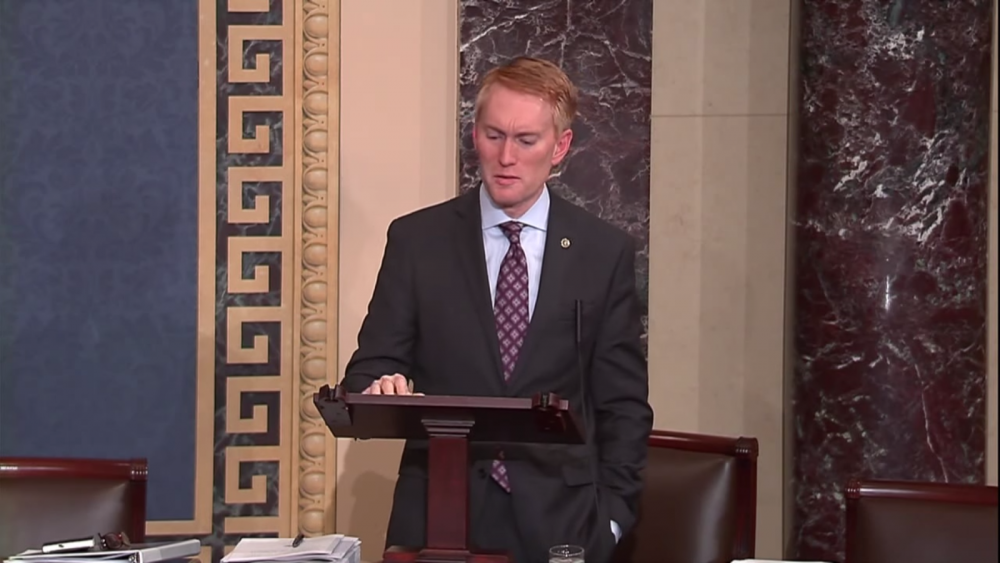 While congressional inattention to the budget crisis is inexcusable, it is even more disturbing that the Obama administration already has the authority to pay for a Zika response from existing agency budgets, but chose not to.
I’ve said several times on the Senate floor, over the last two weeks, that the Zika virus is a serious threat and should be dealt with responsibly by funding immediate vaccine research and aggressive mosquito population control.
The threat to adults from Zika is relatively small, but the threat to pre-born children is very high. Our national priority rightly focuses on protecting the life of these young children in the womb, since each child has value, no matter their age or size.”
Live Cam w/reporter: “Thank you Senator. For more on climate change, here is Patsy Loggins.
Live Cam w/reporter: “Thanks Dudley Waters. I am here in Jakarta where Secretary of State John Kerry just wrapped up his speech on climate change. Here are some of his remarks.
Video: “When I think about the array of global climate – of global threats – think about this: terrorism, epidemics, poverty, the proliferation of weapons of mass destruction – all challenges that know no borders – the reality is that climate change ranks right up there with every single one of them. This is not opinion. This is about facts. This is about science. The science is unequivocal. And those who refuse to believe it are simply burying their heads in the sand.”
Kerry went a step further with his assaults on climate change deniers, likening them to members of the Flat Earth Society, adding that “we should not allow a tiny minority of shoddy scientists and science and extreme ideologues to compete with scientific fact.”
“And let there be no doubt in anybody’s mind that the science is absolutely certain,” said Kerry. “It’s something that we understand with absolute assurance of the veracity of that science.”
Live Cam w/reporter: “Kerry’s speech took on an alarming tone regarding Indonesia, which he called “one of the most vulnerable countries on Earth. Listen in.”
Video: “But I wanted to start right here, in Jakarta, because this city – this country – this region – is really on the front lines of climate change,” said Kerry. “It’s not an exaggeration to say to you that the entire way of life that you live and love is at risk.”
Live Cam w/reporter: “Back to you, Mary.”
News Anchor: “Thanks Patsy. After the break, an eyewitness account of one man calming the seas.
…
News Anchor: “Welcome back. We turn now to a Juxtaposed! News exclusive: an eyewitness account of rising seas calmed by…we are ready to go to Shirley Goodness at the Sea of Galilee.
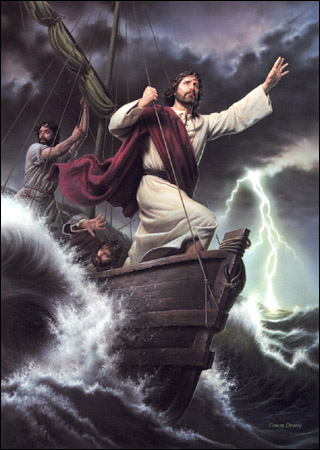 Live Cam w/reporter: “Thanks Mary. I am by the Sea of Galilee waiting for Simon Peter. Hold on he’s coming now. Simon…catch your breath first. Now Simon tell us what happened out there.
Simon Peter: “Yeah, well, I have this fishing business called UTrawl. Get the camera over here. My boat, she is a beauty!
Live Cam w/reporter: “Simon, can you tell our audience what happened last night?”
Simon Peter: “Sure, I…just wanted to…well, what happened was that we, I mean me and my buddies, spent the day listening to Jesus talk about his kingdom. Jesus would say stuff like, “This is what God’s kingdom was like,” and then he would go on and tell a …what did you call it John, a meta..?”
John: (Leaning in to the camera) “A metaphor.”
Simon Peter: “That’s John. Can they see my boat?”
Live Cam w/reporter: “Yes Simon, what happened last night?”
Simon Peter: “Well, in the evening we were all kind of tired and Jesus said, “Let’s get in your boat, Peter,” -that’s the one right over there – and let’s go to the other side. Jesus was exhausted so he lay down on a boat cushion and fell asleep.
While he was sleeping me and the guys talked about what he had said that day. You know, we never heard anyone talk like that before. I’ve heard a lot of fish tales in my time but this guy – I think he wrote the book about truth.
Anyway, I love being on the water at night, the air is so clean and my boat glides along in the breeze. But then last night, Whew! a big windstorm came up just like that! Bam! The waves were breaking in on us and my boat quickly began to fill with water. Jesus was sleeping so soundly that he didn’t notice the water soaking his clothes. We finally woke him up. We were…they were…a little frightened. You know, the others were going, “Teacher, we’re going to drown Don’t you care?” I just let them.”
Live Cam w/reporter: “Simon, weren’t you scared that you would lose everything, your business?
Simon: “I was scared for my business, of course. But, I’ve seen so many storms in my time. This storm, this one, this one was a doozy! I was starting to have a Jonah moment.”
Live Cam w/reporter: “What’s a Jonah moment?”
Simon: “A Jonah moment? I’m sure your viewers have heard about the prophet Jonah. No? Well, Jonah is on a boat and a storm comes up and the crew are praying to God for mercy. They want to throw “Jonah the jinx” overboard to settle with God. So Jonah is thrown overboard and the seas calm down just like that. Snap!”
Live Cam w/reporter: “Did they throw you overboard last night?”
Simon: “NO! But I saw them looking at me so I got Jesus up. And after Jesus got up, he rubbed his eyes and then looked at the storm and shouted, “Silence! Shut up!” Now, I have said some choice words to the weather in my time but what happened next…the wind died down just like that! Bam! And there was flat calm. What happened was no meta…
John: (Leaning in to the camera) “Metaphor.”
Simon: “Yes, John, move back so they can see my boat. Then Jesus turns to us and says, “Why are you scared? Don’t you believe yet? I think Jesus was calling us “deniers.”
I heard the other guys talking. They were saying stuff like, “Who is this?” and “Even the wind and the sea do what he says!”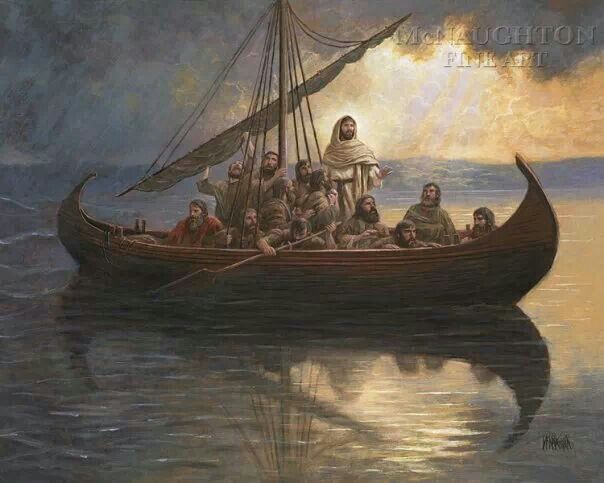
Live Cam w/reporter: “Wow! That is amazing! You must be happy to be alive!”
Simon: “I know the guys are. I am just happy that my baby didn’t sink in that storm.”
Live Cam w/reporter: “Anything you want to say before we go, Simon?”
Simon: “You don’t see this kind of thing every day but I saw this with my own eyes. Maybe someday I’ll … John is calling what happened a “sign.” I call it “all in a day’s work for …what did Jesus call us John?”
John: (Leaning in to the camera) “Fishers of men.”
Live Cam w/reporter: “Back to you Mary.”
News Anchor: “Thanks Shirley. When we return we’ll hear about the possibility of Attorney General Loretta Lynch and the DOJ pursuing civil action against so-called climate change deniers.”
………………..
Here are Your Juxtaposed! News™ Top Stories:
Obama Spent Money on Climate Change Over Zika Emergency
Obama Raided $500M for Zika to Finance UN’s Green Climate Fund
John Kerry Mocks Climate Change Deniers
AG Lynch: DOJ Has Discussed Whether to Pursue Civil Action Against Climate Change Deniers










Just Juxtaposing! 5-24-2016
May 24, 2016 Leave a comment
“Good evening. From our National News Desk, our top story tonight…”
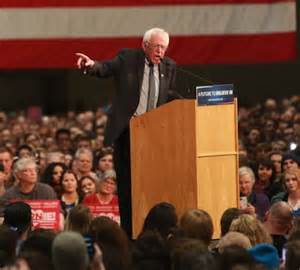
“The Bernieverse: Democratic Socialist Bernie Sanders’ presidential campaign:”
Video w/voiceover: “. On Sunday night the chant from thousands in the stands was certainly loud, clear and heartfelt: “Bernie, Bernie, Bernie!””
Sanders: “Real freedom includes economic security. That was Roosevelt’s vision 70 years ago. It is my vision today. It is a vision that we have not yet achieved, and it is time we that we did.”
Video w/voiceover: “Sanders went on to speak of Medicare for all, tuition-free public college, a $15 minimum wage – a host of ideas intended to help America’s poor and middle class. Ideas that define his vision of socialism, a vision he says that will require top down centralized government with him as president to produce the desired outcomes.”
Sanders: “The only way we bring about real change is to create a political revolution where millions of people stand together and say loudly and clearly that this country belongs to all of us.”
“And in international news…”
“Venezuelan President Nicolas Maduro has placed Venezuela under a “State of Exception and Economic Emergency.”
“Maduro, also president of The United Socialist Party of Venezuela, has blamed capitalism for speculation that is driving high rates of inflation and creating widespread shortages of staples. He has often said that he was fighting an “economic war”, calling newly enacted economic measures “economic offensives” against political opponents that he and loyalists state are behind an international economic conspiracy.
Video w/voiceover: On Tuesday, a state-funded news service reported Maduro’s threat to dissolve the national legislature, which the opposition party won in a landslide election last December. “The National Assembly has lost political validity,” Maduro told reporters. “It’s a matter of time before it disappears.”
But Maduro is probably beyond saving. At this point, only 15 percent of his fellow citizens approve of his government. Political protests roil the streets, and normally law-abiding citizens have resorted to looting to get their hands on basic necessities. The government has responded with force.
Venezuela’s hospitals lack not only medicine but even soap, and cannot keep patients — especially at-risk infants — alive amid constant blackouts. Infant mortality rose by a hundredfold in 2015 from its 2012 levels, and five times as many women now die in childbirth. When his political opponents passed a law allowing foreign aid to prop up Venezuela’s hospital system, Maduro blocked it, calling Venezuela’s healthcare system the envy of the world.
Government agencies are now open only two days a week, as a cost-saving measure. The economy is in collapse, in the midst of its second straight year of double-digit contraction. Everyday items, including food, have long been difficult to buy in Venezuela, but they are now becoming impossible to find. Government-imposed price controls, combined with an astounding 700 percent inflation rate, have made toilet paper so scarce that it’s more valuable by the square inch than the Venezuelan currency one must use to buy it.
“Venezuela has been ranked as the top spot globally with the highest misery index score in 2013, 2014 and 2015. In 2014, Venezuela’s economy entered a recession.”
“After the commercial break, we take a look at this country whose future you won’t believe.”
Supermarket staff work next to partially empty shelves of toilet paper in Caracas May 16, 2013. Supplies of food and other basic products have been patchy in recent months, with long queues forming at supermarkets and rushes occurring when there is news of a new stock arrival. The situation has spawned jokes among Venezuelans, particularly over the lack of toilet paper. The government announced this week it was importing 50 million rolls to compensate for “over-demand due to nervous buying.” REUTERS/Jorge Silva (VENEZUELA – Tags: POLITICS BUSINESS) – RTXZPIP
Video w/Voiceover: “Venezuela Reaches the Final Stage of Socialism: No Toilet Paper””
“And at ten o’clock, our special report “Soda-less Socialism.””
Video w/Voiceover: “Sugar shortage forces Venezuela to stop producing Coca Cola as country struggles to fight crippling recession. Venezuelans struggle to get food, toilet paper, medicines.”
…
Your Security News Headlines:
Bernie-mania spreads to Texas as Sanders’ speech draws crowd of 5,000
Venezuela is ‘democratic socialism’ in action
Venezuela Reaches the Final Stage of Socialism: No Toilet Paper
Now Coca Cola! Sugar shortage forces Venezuela to stop producing soda as country struggles to fight crippling recession
Europe’s unemployment crisis is much worse than you thought
Breaking – Small Democratic Socialist town in middle of nowhere 8th most expensive to raise family
Rate this:
Filed under Culture, Current Events 2016, Economics, Political Commentary, Politics Tagged with #FeelTheBern, Bernie Sanders, Democratic Socialism, Ithaca New York, Venezuela