Learning to See

He took the blind man by the hand and led him out of the village, and when he had put saliva on his eyes and laid his hands on him, he asked him, “Can you see anything?” And the man looked up and said, “I can see people, but they look like trees, walking.” Then Jesus laid his hands on his eyes again, and he looked intently, and his sight was restored, and he saw everything clearly. -The gospel of Mark, 8: 23-25

In the account above, Jesus amplified the blind man’s ability to see so that he could view physical reality with clarity. Now seeing, the man could function in the world. He no longer had to sit under the shade of a tree begging for assistance.

After Jesus announced the arrival of the kingdom of God on earth, he sought to increase the depth perception of his followers. He wanted them to be able to observe and perceive what that kingdom was about so that they could, with new insight, function in the kingdom.

Jesus acted and spoke for those with “eyes that see, ears that hear.” Others, conditioned by the world, would not see and hear what was going on. They remained blind and begging.

To amplify understanding, Jesus used allegorical short stories to create vivid pictures of reality as he saw it. He used parables when he taught and when he was tested.

When teaching on the cultivation of the kingdom of God he used the parable of the Sower.

When tested by an expert of religious law, he used the parable of the Good Samaritan. This encounter is recorded in Luke’s gospel account:

A religion scholar stood up with a question to test Jesus.

“Teacher, what do I need to do to get eternal life?”

Jesus responded with a question: “What’s written in God’s Law? How do you interpret it?”

The scholar gave a Torah answer: “Love the Lord your God with all your heart and with all your soul and with all your strength and with all your mind and love your neighbor as yourself.”

“Good answer!” said Jesus. “Do it and you’ll live.”

Looking for a loophole, the scholar then asked “And just how would you define ‘neighbor’?”

Jesus answered by telling the story of the Good Samaritan. He then asked, “What do you think? Which of the three – the priest, the Levite or the Samaritan – became a neighbor to the man attacked by robbers?”

“The one who treated him kindly,” the religion scholar responded.

Jesus said, “Go and do the same.”

In response to the initial test question, Jesus uses the Socratic method. He asked the scholar to give his own response to the eternal life question. Jesus acknowledges the scholar’s correct answer.

But then the scholar wished to justify his “neighbor” position in front of the crowd.

(You don’t do this, of course, unless you hold a well-known exclusionary stance such as associating with fellow Jews but not associating with Samaritans (viewed by Jews as a mixed race who practiced an impure, half-pagan religion), Romans, and other foreigners.)

The scholar’s question revealed what Jewish religious leaders, like those named in Jesus’ parable, thought about those who didn’t see the world like they did – ‘others’ should be excluded from their concern and left to die. This way of ‘seeing’ would lead to Jesus being (so they thought) permanently excluded, i.e., crucified.

Jesus doesn’t answer the scholar’s “neighbor” question. Instead, he exposes the insular blindness of the questioner with a short story.

Jesus shows, not tells, his answer so that the scholar and those listening may experience the answer through actions, words, subtext, thoughts, senses, and feelings rather than through exposition, summarization, and description. Jesus puts the scholar in the room, so to speak, with the Samaritan.

With the parable, Jesus wanted the scholar to see the world as he sees it, that of “God so loves the world” and not just a chosen few.

Note that in his response to the question “Who became a neighbor? the scholar refuses to name the ’other.’ He refuses to say “Samaritan.” He protected his standing in the community and his insular blindness.

Going on his way, the religious scholar now had an image to reflect on. He could see himself like the priest and the Levite and mind his own business and walk off, ignoring the one who is of no value to him. He could abandon the ‘other’ before any claim is made on him.

Or he could see beyond himself and exclusion and be a Samaritan and love his neighbor like himself. That would be kingdom ‘seeing.’

~~~~~

Man’s ability to see is in decline. Those who nowadays concern themselves with culture and education will experience this fact again and again. We do not mean here, of course, the phys­iological sensitivity of the human eye. We mean the spiritual capacity to perceive the visible reality as it truly is.

To be sure, no human being has ever really seen everything that lies visibly in front of his eyes. The world, including its tangible side, is unfathomable. Who would ever have perfectly per­ceived the countless shapes and shades of just one wave swelling and ebbing in the ocean! And yet, there are degrees of perception. Going below a certain bottom line quite obviously will endanger the integrity of man as a spiritual being. It seems that nowadays we have arrived at this bottom line. (Emphasis mine.)
—Josef Pieper, Only the Lover Sings, “Learning How to See Again”

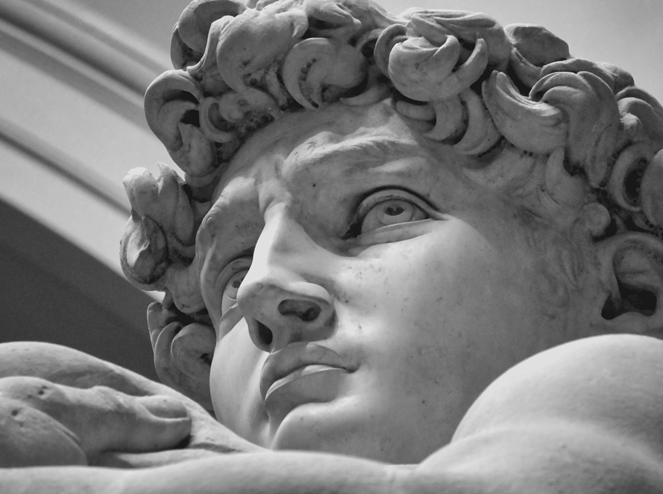
The concept of contemplation also contains this special intensified way of seeing. A twofold meaning is hereby intended: the gift of retaining and preserving in one’s own memory whatever has been visually perceived. How meticulously, how intensively—with the heart, as it were—must a sculptor have gazed on a human face before being able, as is our friend here, to render a portrait, as if by magic, entirely from memory! And this is our second point: to see in contemplation, moreover, is not limited only to the tangible surface of reality; it certainly perceives more than mere appearances. Art flowing from contemplation does not so much attempt to copy reality as rather to capture the archetypes of all that is. Such art does not want to depict what everybody already sees but to make visible what not everybody sees. (Emphasis mine.)
—Josef Pieper, Only the Lover Sings, “Three Talks in a Sculptor’s Studio: Vita Contemplativa”

I first came across the writings of Josef Pieper, a 20th century Catholic German philosopher, reading The Four Cardinal Virtues: Human Agency, Intellectual Traditions, and Responsible Knowledge. About the Author:

“Josef Pieper (1904-1997) was a distinguished twentieth-century Thomist philosopher. Schooled in the Greek classics and in the writings of St. Thomas Aquinas, he studied philosophy, law, and sociology, and taught for many years at the University of Münster, Germany.”

Donald DeMarco writes in Josef Pieper… Truth And Timeliness that

Pieper is most noted for his many books on virtue. In fact, he is commonly known as the “Philosopher of Virtue.” Virtue for Pieper, following Aristotle and Aquinas, is perfective of the person. But the person is real and has an identifiable and intelligible nature. Wherever this nature is denied, totalitarianism gains a foothold. For, if there is no human nature, then there can be no crimes against it.

Pieper wrote while drafted into Germany’s army during World War II and is credited for translating C.S Lewis’s Problem of Pain into German. Because he criticized the Nazis regime, his works were not published until later.

It is said that “While many philosophers in his time focused on politics, Pieper was concerned with the great tradition of Western Culture. He spent his entire life reflecting on the value of culture in modern society and the necessity of the creative arts for the nourishment of the human soul.”

Josef Pieper’s short essay Learning How to See Again begins: “Man’s ability to see is in decline.” Even in the 1950s when he wrote the essay, he suggested that there was too much to see. How much more are we distracted today by screens.

Pieper recommended an artistic vision – visual, musical or literary – as a conduit for the contemplative life. He proposed participating in the arts as a remedy for seeing anew, to see reality as it truly is.

We must learn to see again.

~~~~~

Teaching ‘Tales From Shakespeare’

Benedict Whalen, associate professor of English at Hillsdale College, delivers a lecture on how to teach Tales From Shakespeare by Charles and Mary Lamb to young children. 

This lecture was given at the Hoogland Center for Teacher Excellence seminar, “The Art of Teaching: Children’s Literature” in September 2024. The Hoogland Center for Teacher Excellence, an outreach of the Hillsdale College K-12 Education Office, offers educators the opportunity to deepen their content knowledge and refine their skills in the classroom.

Teaching ‘Tales From Shakespeare’

Teaching ‘Tales From Shakespeare’ – Hillsdale College K-12 Classical Education Podcast – Omny.fm

~~~~~

Evil’s Last Grasp

“Dog Bites Man.” Not news. Madness – “Man Bites Dog” – is a headline! And so is nauseating “ultra-violence” (a term used in the disturbing A Clockwork Orange, Stanley Kubrick’s film version of Anthony Burgesses’ book).  To wit, a small sample of recent “ultra-violence” revelations in the headlines:

Cops identify NJ woman as mystery straphanger torched to death in horrific NYC subway attack

A homeless woman in the NYC subway was set on fire by an illegal immigrant who fanned the flames and then calmly watched her burn to death from a bench on the platform.

And, A mob attack at Edina Southdale YMCA leaves teen with brain injury

And, Metro-North rider stabbed in chest after complaining about loud music on passenger’s phone

And, NYC postal worker stabbed to death over food.

And, Transgender Teen Charged with Plotting Valentine’s Day School Massacre.

And, with taxpayer money, USAID funded Boko Haram slaughter of Christians in Nigeria – LeoHohmann.com

And, 70 Christians beheaded in church by Muslims.

To keep “ultra-violence” going Biden admin released 11 Yemeni detainees with suspected al Qaeda ties from Guantanamo Bay — including two alleged former bin Laden bodyguards

And, 158 DEMOCRATS VOTED AGAINST DEPORTING SEX OFFENDERS

Day after day headlines reveal man-made horrors beyond our comprehension and of absurdities that become received wisdom. Two more recent headlines:

Warrant executed for ‘child pornography’ at Texas Modern Art Museum’s LGBTQ exhibit… – Revolver News

Fauci approved $240 million for sexual mutilation (transgender) experiments on animals.

Shocking and bizarre evil permeates the moral order of the universe. And it is not ideological ordinariness, as seen by Hannah Arendt in her Eichmann in Jerusalem: A Report on the Banality of Evil:

Perhaps our age does not like the idea of evil or does not know what to make of it. And yet if there is one thing that we ought to be able to do, it is to identify true evil—the profundity of evil—when we see it. In our own day, it is put on display for all to see by death-cults like Hamas.“The profundity of evil,” by Douglas Murray

‘Pure Evil’: Hamas Hands Over Remains of Dead Israeli Mother, Toddler & Infant

Hamas holds public celebration to hand over murdered babies in coffins.

Along with the use of extreme force to hurt or kill people, evil in the form of disorder, lies, chaos, corruption, grift, and utter perversion is in the news.

Here in America, the Progressive Blue Beast, allied with the primeval source of all opposition to God, refuses to give up its hold on its imperial capital. With the aid of the imperial cult propaganda machine – the main stream media – it whines, panders for sympathy and looks for ways to claw back power to continue its rule of tyranny.

It wasn’t long ago when the same propaganda machine told us to “trust (worship) the science.” We were told to pay homage to the idol the Blue Beast had created with masking, social distancing, and vaxxing the COVID mRNA spike protein vaccine into our bloodstream.

(Did you know? Yale Scientists Confirm Covid ‘Vaccines’ Cause VAIDS – Slay News  VAIDS = vaccine-acquired immunodeficiency syndrome. One has to wonder if the COVID vax was used for population control. Was it used to keep the population weak, sick, and controlled? To create complete dependency on Big Pharma’s “science?”)

Remember, the Blue Beast told us to believe in the Russian collusion hoax and in many other lies that came from its mouth.

The last four years of the Biden regime and the eight years of Obama have given us a eye-opening look at the direction and speed with which evil can overtake aspects of our lives. The evil processes of the Blue Beast from those days have become so entrenched that activist federal judges are blocking the eradication of it from government. (Be aware that programs like discriminatory DEI, like all of evil’s deceptive programs, is the moral opposite of (social) justice. See Solzhenitsyn quote below.)

The Blue Beast worships power and itself and tolerates no rivals. Evil in all of it various forms (serpent, dragon, and human) and devices, and throughout time, worships power and itself. Evil tolerates no rivals, and certainly not the Risen and Conquering Christ that the prophecy of Revelation testifies about.

~~~

First century Christians, without newspapers and headlines, saw and heard about violence, oppression, and idolatries in the Roman Empire. Their world, like ours and Job’s, seemed arbitrarily mean, capricious and unfair.

These early Christians knew the enemies of God in terms of satanic forces invested in polytheism, the Roman empire’s tyranny, the imperial cult propaganda and the pressure to submit to it. And, there were those preaching another gospel other than the one they received from the apostles. The power of evil was all around them and they were looking for a divine rescue.

They were also likely aware of gospel accounts of Jesus exorcizing unclean spirits and plundering the strong man’s house (Mk 3:27). For them, awaiting Christ’s imminent return, these accounts prefigured a final victory over evil and the final realization of the kingdom of God on earth. Into that context at the end of the first century, seven struggling churches in a Roman province in Asia received a wake-up call, the letter of Revelation.

The letter begins by addressing issues in each church through a prophetic word. There’s critique of a church’s waywardness, its false teaching, its lethargy and compromises. And there are warnings to get each church on track to be victorious. The letter effectively summons each church to get involved in the divine war against evil and to conquer, conquer, conquer, conquer, conquer, conquer, conquer (Rev. 2:7; 2:11; 2:17; 2:28; 3:5; 3:12; 3:21).

How they are to conquer and what victory means is described in the rest of the letter. (Hint: conquering in Revelation has nothing to do with how the world conquers. And victory? There’s a promise that comes at the end of the letter referring to what was promised at the beginning of the letter to each church that conquers (Rev. 21:7).

You will want to read the whole of Revelation in one sitting to find out about Evil’s Last Grasp (cf. Gen. 3:15) and whether the three petitions of the Lord’s prayer are fulfilled. Is God’s name hallowed? Does his Kingdom come? Is God’s will done on earth as it is in heaven?

What would be the Final Headline and will you be one of those who were victorious over the beast? (Rev. 15:2)

~~~~~

The Big Reveal

Everyone who does evil hates the light; people like that don’t come to the light, in case their deeds get shown up and reproved. -The Gospel According to John 3:20

2025: The most transparent administration in American history is following the money . . .

The recent incursion of DOGE into the labyrinth of government has made headlines. As DOGE sheds light on what lurks there, deep state denizens are scurrying to use measures to hide their dark ways:

Eruption In “BleachBit,” “Wipe Hard Drive,” “Offshore Bank” Searches In DC Suggest Deep State Panic Mode | ZeroHedge

DC Internet Searches For “Criminal Defense Lawyer” & “RICO Law” Erupt As DOGE Drains Swamp

Martha Bueno on X: “These Senators voted AGAINST cutting the federal budget $1.5 trillion dollars. They say they want accountability but vote against it. Which one is the biggest hypocrite here? https://t.co/E8GhjljHZ2” / X

~~~~~

As in A Clockwork Orange, where a government agency works to rehabilitate the violent criminal Alex with an experimental aversion therapy, the World has had ongoing attempts at manipulating humans with mind control programs. Such are the CIA psyops, MSM propaganda, AI, brain chips, transhumanism, and more.

How Did Communism Get into the Corporations

~~~~~

Podcast:

Andrew Klaven with Megan Basham discuss her book, Shepherds for Sale.

Churches are being infiltrated – Megan Basham with Andrew Klaven

~~~~~

The evil that State media doesn’t report: Democrats illegally allowed into our country over 12,000,000 unvetted (and unvaccinated) aliens. The migrants were brought in for Democrat’s purposes: to consolidate Democrat power with votes and to support Democrat’s billionaire benefactors with low-cost workers. The illegals are to become serfs serving their welfare state lords.

The open borders madness was aided by Progressives in pulpits and by USAID-funded NGOs who participated and became rich (nonprofit Catholic Relief Services received $4.6 billion, cf. Rev. 3:14–22 ) helping the ‘poor little foreigner’ based on some misconstrued scripture.

It is certainly costs nothing to be ‘magnanimous’ and free with other people’s taxed money, property, freedom, safety, and our vulnerable children when sitting in your safe neighborhood virtue signaling the ‘goodness’ of open borders and ‘helping’ the ‘poor little foreigner’ in a social media text or a sermon.

You will hear from the creepy SJ James Martin on ‘X’ that “Caring for migrants and refugees Is not optional.” This kind of debauched out-of-context and Christian-sounding mumbo-jumbo for the ‘other’, directed toward the gullible – SJWs, suburban women, soy boys, and the like – is used by Martin to justify open borders, not just of our country but also for all kinds of sexual perversion in the church. Have you heard of the Lavender Mafia?

U.S. Catholic Church Spends $5 billion on 16,276 Clergy Sex Abuse Allegations in 20 Years

Four in five victims were male and one-fifth of the victims were female, the survey recorded, confirming reports by The Stream and other experts of a “lavender mafia” dominating the Latin-rite Roman Catholic priesthood.

Beware These 3 Lavender Mafias Outside the Church| National Catholic Register

 Myopic, naïve, unwise, illegal, and compromised ‘compassion’ does more harm than good. Self-righteous compassion under the guise of “social justice” has become more important than the greater good.

Of course, if you speak out against open borders you are called “mean”, “racist”, a “xenophobe”, “unscriptural’, and more.

Apparently, ‘compassionately’ aiding and abetting foreigners in breaking U.S. law and thereby importing violence, narco-terrorism, fentanyl deaths, criminal gangs, drugs, felons, pedos, all kinds of disease, and economic migrants who flee their own country for a better ‘opportunity’ is OK as long as you help the “vulnerable” plunder and gut America and disregard the fact that our neighbors are made vulnerable to the above and to the chaos, disorder, disease, and cost that open borders causes.

Democrats have “invited every microbe on the planet onto our soil. And, now we are facing the consequences.”

Deporting Illegals Is A Good First Step, But Unfortunately The Microbes They Brought With Them Will Stay

The Immorality of Illegal Immigration – Victor Davis Hanson

Todd Bensman Discusses the Costs of Illegal Immigration

Interview with Archbishop Carlo Maria Viganò: The Pope’s Accusations Against the Trump Government are False and Delusional

More plundering of America enabled by the wicked. Activist federal judge is blocking deportation. His wife is “appears to be the former Vice President of National Immigration Forum, a pro-open borders advocacy group.”

“George Soros’s Open Society Foundation is also reportedly the group’s largest donor.”

~~~~~

“To do evil a human being must first of all believe that what he’s doing is good, or else that it’s a well-considered act in conformity with natural law. Fortunately, it is in the nature of the human being to seek a justification for his actions…
Ideology—that is what gives the evildoing its long-sought justification and gives the evildoer the necessary steadfastness and determination.”

― Aleksandr Solzhenitsyn, The Gulag Archipelago 1918–1956

That Summer

A short story . . .

I couldn’t pedal any faster. Heart and legs pumped and pumped and pumped until I threw my bike down in the front yard and heard “Wash your hands, Dennis. It’s time for supper.”

Summer, like a best friend ready to pal around, came around again before my freshman year in high school. I was ready that summer to go and do a lot of things, except for one. Did I tell you this story? After sixty years, some memories, like which stories I may have told, become muddled and others remain clear as the day they happened.

Before the start of my freshman year in the fall of ’67, I received a letter from the high school that detailed all the programs the school offered. The two that interested me were sports and band.

That summer I began cross country training under Coach Howard. I was a runner. The kids on my block called me Flash. I was always chosen first for street football and sandlot baseball. But that hot and sweaty five-and-ten-mile practice summer I found out that I was not a long-distance runner. I had only enough wind for sprints and to play the trumpet.

To play in the concert band, I had to tryout that summer. I auditioned with the band director Mr. Gilles. He had me play all the major and minor scales and sight-read several pieces. I learned a week later that I was accepted into the band. This was huge. I had played the French horn in the Junior High band.

My stint with the French horn came about when the Junior High band director Mr. Palmero decided that he didn’t like the sound coming out of my beat-up Conn trumpet. The horn was a gift from an uncle who used it, from its appearance, for anything but playing. Mr. Palmero had me switch to a rental French horn. This lasted two years.

That summer – the summer before high school – my father, bless his soul, bought me a brand-new Bach b-flat trumpet. The new horn and lots of practice paid off. And that part of my Junior High experience was behind me. But how could I forget those two years?

Junior High School had a social system of Greasers and Climbers. You were lumped into one or the other based on your appearance. Greasers, like my colorful friend Juan, wore a black leather jacket, black pants, black socks and shoes and a white tee shirt. The absence of color except for the tee was Juan’s Greaser uniform.

Climbers, like most of my friends, sometimes wore paisley shirts with white collars, bell bottoms and white socks, but mostly dressed in color. I wore simple button-down shirts and sometimes a paisley shirt with bell-bottoms and black socks. I walked around with a French horn case. I wasn’t sure of the privileges accrued to either group other than being liked for what you weren’t.

I remember Juan pestering me to become a Greaser. He even had his girlfriend Lucille tell me that she would doing anything for me if I would become a Greaser. This conversation took place one morning in one of my eighth-grade classes. Lucille, who sat in front of me, turned around and offered herself on the altar of Greaserdom. I declined the invitation. I had more than I could handle. Three girls wanted my attention – in the hallways and in the band. All three played an instrument.

Diane, who I sat next to, was first chair French horn. Mary K. was a flutist and Mary E. played the clarinet. In the social scheme of things, we were considered Climbers because we played in the band and dressed in more than black and white.

I liked the attention of Diane, Mary, and Mary, but I didn’t want to go “steady” as was their intention. I put “going steady” in the same category as having to choose to be either a Greaser or a Climber. I was an independent sort. I was wary of anyone pressuring me to do something I wasn’t inclined to do, as when I was told to play the French horn. I continued on the horn because it kept me playing music. But I should return to telling you about that summer before high school.

Several days a week I had cross country practice. I also practiced my trumpet every day and I worked a part time job at a photo store. At church, I was moved up into the Senior High Youth group.

Our teens group met on Sunday mornings and after church on Sunday nights. Those evening times included going out for pizza or ice cream. During these outings I noticed that the older girls in the group were cliquish and something of a mystery. I wondered what they were saying when they whispered to each other. They weren’t like the junior high girls. They weren’t passing me notes telling me what they were thinking. But that secretiveness, as I recall, made those times wait-and-see fun.

One of the first weekday outings for our group that summer was a picnic at a local park. When we gathered in the parking lot of the Bible church there was a lot of discussion about who was riding with whom. There were only a couple of drivers and cars. I was a freshman. I had no driver’s license or car yet. Neither did my best friend Bill, also a freshman.

A ‘63 convertible T-bird, radio blasting, pulled into the lot. The guy driving was Ken. I’d seen him in the Sunday meetings. He had said that he transferred from another area high school and would be a senior in the new high school. He asked Bill and I if we wanted a ride to the park. We agreed. I remember thinking that going my own way, in James Dean fashion, would be noticed by the girls.

After several group outings, Ken started calling me and asking me to come over. He said that he had a Triumph TR3 that he was rebuilding and that he needed some help. I told him I didn’t know anything about cars. It didn’t matter to him. He begged me to come over. I finally accepted his invitation one hot, boring summer afternoon. I thought why not learn about cars. I would be driving soon enough.

That afternoon I rode my bike across town to his parent’s house. I found the garage door open with Ken standing inside. He was holding an oily car part in his hand. The TR3 was parked in the garage with the hood up. I asked about his parents. He explained that his mother worked in a clothing store and that his father worked at the local country club in the men’s locker room. ‘They’re never home during the day’ he told me. I remember hearing this and feeling a bit uneasy not knowing the neighborhood or Ken that well. It must have shown. He immediately began talking about what he was trying to do.

As best as I can recall, he said something to the effect that the Triumph had a stock positive earth electrical system and he was trying to connect a radio. Positive earth and negative earth connections had me at a loss. I knew about magnets. They had positive and negative poles and that opposites attract and like polarities repel.

I remember becoming interested in seeing the sporty little car repaired when Ken said that he might let me drive it. To help him make the polarity conversion, I read aloud the steps in the Triumph manual as he made the changes. The first step, as I recall, was to disconnect and remove the battery.

After the polarity conversion was completed, Ken invited me inside. We washed up and Ken offered me something to drink. He handed me a glass of lemonade and we sat in the kitchen. We talked for a while and then I went home. And that is how things went the next two times I came over to work on the car. We cleaned the carburetor, worked on the engine, and talked afterward.

I learned that Ken liked golf, Edgar Rice Burroughs books, and Edgar Cayce books. All three of his likes were not in my universe. I told him about cross country practice, summer band practice, and my job. I didn’t have any time to read that summer.

When I was invited over a fourth time, we worked on the brakes. After we finished, he invited me in again for a drink. This time he offered me a Coke and some rum to put in it. I said no. Then he asked me if I wanted to play cards. I told him I didn’t know how to play cards. He said he’d show me. I thought that here was something else that I could learn, so I agreed.

Ken left the room and came back with a deck of cards. He began to tell me the different hands and their value and the rules of the five-card stud, his favorite game. He dealt the cards and I gathered them up, holding them fanned out in my hand just like in a TV western.

I quickly lost every hand I played but Ken convinced me to keep trying. After winning one hand he asked me if I wanted to bet on the next hand. I told him I don’t bet. He said it would only be for candy. So, I continued to play. When my pile of M&Ms disappeared, I said I had to get home for supper. I got on my bike and headed back across town toward home.

I should remind you that while I was meeting with Ken on free afternoons, I was still doing all the things I mentioned before.

Ken called again the following week. I came over and we worked on replacing the radiator. When that was done, we cleaned up and sat down for a couple Cokes. Again, Ken wanted to play cards. And again, we played several hands. After I won a few hands, Ken wanted to know if I wanted to play for stakes. I told him that I just like playing.

But Ken persisted, asking me if I wanted to “up the ante.” I told him no. After several more hands he asked me again and I said “what are you talking about.” He said that if I were to lose the next hand that I would have to do whatever he wanted and that if he was to lose that he would do whatever I wanted. The “stakes” as he called them sounded weird to me. But at the same time, I knew that I always had the power to say no, so I played along thinking that friends don’t mess with friends. What could he ask me to do? Buy him a Coke or an ice cream the next time the teens group went out?

I lost the next hand. He then told me that he wanted me to clean the house – sweep, vacuum, everything. I looked at him like he was crazy. He then said that I had agreed to the stakes and had lost and must do what he wanted. I told Ken that I wouldn’t clean his house.

He came back and said that I had to because I gave my word and because I am a Christian. He then left the room and came back to the kitchen with a small men’s Speedo swimsuit. He told me that he wanted me to wear the Speedo while I cleaned the house. I had no idea that Ken would impose that on me. I remember a feeling of revulsion and saying “No way!”

I would not do what he wanted. I’d pay the bet some other way. Rattled, I got up and headed for the door. I promised to come back another day and help him with the TR3. That was the best I could offer. I got on my bike and sped off toward home.

Some weeks passed. At the start of August, twenty days before school started, I got a phone call from Ken. He wanted me to come over. He said the Triumph was ready to roll. I agreed to come over, thinking that this would be a harmless way to honor my bet and be done with the whole business. And maybe I’d have the chance to drive the car, as he had said.

I headed over to his house and found the Triumph parked on the street. Ken walked out of the garage and asked me if I was ready for a ride. We got in the sports car and Ken started the engine. He shifted into first and then turned on the newly installed radio. He drove the TR3 out of the neighborhood and headed for the nearby highway. The convertible sports car responded quickly, moving effortlessly through five gears. But since I hadn’t learned to drive stick shift, he wouldn’t let me drive the car.

We returned to his house an hour later. Ken parked the car in the garage and we went in for a Coke. He asked about playing cards again. I said I wouldn’t. Then he said that he had a roulette game in his room. Ken wanted to show me. I went with him to his bedroom thinking that I would see this thing he was so interested in and then head home.

When we got to his bedroom, Ken uncovered the roulette game from a box that was stored under a bunk bed. He spun its center wheel, showing me how it worked. He handed it to me and I sat down on his bed to hold the wheel on my lap. I spun the wheel to see where the ball would land. As I did, Ken sat down next to me. I quickly moved over to make room for him. Ken then moved closer, put his arms around me, and started wrestling me down to the bed.

At this point in the story, a reader might view me as naïve or even stupid for hanging around Ken after the Speedo incident. I was both and wound up tight. In church, Ken acted one way and with me he acted so weird. I do remember feeling mortified at being attached to what happened and for not picking up what Ken was doing.

I never told my parents about Ken. I had thought that I was on my own and what would they understand anyway. And I remembered the sting of humiliation I felt once before.

My mother had asked me to do something – maybe wash the supper dishes. I said that I wouldn’t. I was being defiant. She got my father involved. He had me go into my bedroom and pull my pants and underpants down in front of my mother. Then he smacked me hard with a wooden stick.

No twelve-year old boy wants to pull down their pants. Not in the Junior High locker room. Not ever in front of their mother. I deserved the punishment but not the process. But I digress.

I would remind the reader that I was fourteen years old that summer and about to enter high school. And it was the sixties. There was no internet, no social media. I had to figure things out myself with the information that came from an eighth-grade sex education class and a birds-and-bees sit-down with my parents.

The Sex-Ed talk, the graphic charts, the film strips and the short movies made the class squirm and giggle. I squirmed again when my parents took me aside to talk about sex.

They showed me a series of prenatal pictures from the 1965 April issue of Life magazine. On the cover was a photograph called Foetus 18 Weeks and the words “Drama of Life Before Birth.”

My father talked about how a woman becomes pregnant. He talked about waiting until marriage to have sex. He told me about nocturnal emissions. He said that I should masturbate if I can’t contain myself. He told me how. And then he ended our talk saying that I should never ever let a man put his penis in my mouth. I had never had such a thought and it wasn’t mentioned in the sex ed classes. This sounded like Drama of Life After Birth and something bizarre.

Things were changing rapidly in my life and in the world. Like any teenager, I wanted to fit in and be accepted. I thought the acceptance of an older friend would be a good thing. I believed in friendship. Hanging around with Bill, my best friend, I learned to value friendship as the most important and most freeing of relationships. And I still do today. I can’t tell you why being free is so important to me. I can tell you that friendship is not suffocating.

Trying to be a friend to Ken kept me coming back one more time. But as I found out, he wanted to be a predator and not a friend. I should return to what happened that afternoon.

Ken, taller than me, leveraged himself on top of me on the bed. He used his feet against the footboard of the bed and his tall frame as a lever to pin me face down. I kept thrashing about, trying to push myself out. I was telling him to stop. He grabbed one of my legs and pulled it up onto the bed. I tried to roll out sideways but couldn’t. He kept forcing my shoulder back down. Then I saw him grab a rope from the wall side of the bed. He must have hidden the rope for a time like this.

Ken tried to loop my neck and hands to the bunk bed post. I fought to keep the rope off of my neck. Then, with his full weight on top of me, I felt Ken’s pelvis thrusting back and forth on my backside. In that moment, with Ken rubbing himself on me and me thinking that my life might end, I felt a huge surge of adrenaline.

I pushed myself straight up from the bed with all of my strength. Still face down, I put one leg on the floor and then the other. I had to forcefully wrench my head out the headlock he put on me. When I finally pulled myself free from the rope and his grip, I ran out of the room, headed straight for my bike, and fled. That summer.

How do these things I’ve told you not mess with someone’s head? If I told you that this story is true and you know me, then you know it is true.

© Lena Johnson, 2024, All Rights Reserved

~~~~~

“I’ve learned a lot in these last four years. Most importantly, I’ve learned that I’m not alone. One in six men have an abusive sexual experience before they turn 18. Secrecy, shame and fear are the tools of abuse, and it is only by breaking the stigma of childhood sexual abuse that we can heal, change attitudes, and create safer environments for our children.”

–Anthony Edwards Writes about Sexual Molestation at Hand of Gary GoddardAnthony Edwards Writes About Sexual Molestation At Hand Of Gary Goddard (deadline.com)

Truth Beyond the Binary

“The Gleaners” (1857), by Jean-François Millet, depicts women picking up loose grain in the field. Without words it relates the hardships and the dignity of everyday workers. The painting connects us to our own human story. We recognize something of ourselves in this glimpse of reality. We understand a day’s slog and strain. We empathize with the workers.

The painting’s aesthetic realism, its naturalism and unromanticized imagery draw us in. We like that it rejects idealization and artificiality. “The Gleaners” portrays ’us’ as we are. And the subject’s universality – women doing manual labor – is a catalyst for imaginative truth.

We empathize with the subjects as we project ourselves into their perspective. We imagine what it must be like working in a field under the hot sun. We imagine constantly bending over to pick up left-over scraps of the grain harvest so that poor women and children could live on them. We imagine ourselves in 1857.

We find ourselves stepping out of our world and connecting with history – mankind has been doing manual labor since the beginning of time. We find ourselves connecting not just with the women, but with all of humanity, a humanity that shares the work, burdens, and cares of life. And, our imagination wants to know more of the wordless ‘story’.

We cannot see the women’s faces. Are the women young or old? Are they talking to pass the time? Singing? Are they married? Have children? Do they work from sun up to sun down? How do their backs feel at the end of the day? Are their hands dried out and cracked from handling the grain?

~~~~~

Anton Chekhov’s stories are noted for their ‘naturalness’ – the ability to show ‘exactly what a little piece of life’ is like. Like with Millet’s realistic painting, his prose provides down-to-earth characters, details and a setting that, though with Russian aspects, is universal in its close-to-home familiarity.

Russian-American novelist Vladimir Nabokov, in his Lectures on Russian Literature, described Chekhov as writing “the way one person relates to another the most important things in his life, slowly and yet without a break, in a slightly subdued voice”.

Chekhov, a practicing doctor, observed everyday life and ordinary people as he made house calls and treated patients. He wrote with a concentration on the daily lives of individuals using natural detail. We connect with the subjects in terms of shared experiences, emotions, and challenges that are common to all human beings.

You won’t find sanctimony or moralizing or happy endings in his stories nor heroes in the conventional sense. Chekhov had nothing to prove, no ideology or politics to promote, and he created all his characters equal.

And though Chekhov’s stories seem to go nowhere, his ‘close to home’ imagery mirrors our own situations. Life often goes on unchanged or less than we had hoped for. Life often goes on without resolution. And that is the case in a touching story by Anton Chekhov – “On Easter Eve” (1886).

A brief introduction: “The narrator describes his moving experience of attending an early-morning celebration of Easter Eve in the countryside after crossing a river in flood in the middle of a very starry night, admiring the fireworks and listening to the boatman’s account of the sudden demise of the church deacon while composing Easter hymns.”

The ferryman, a novice monk, grieves the loss of a brother. Nikolai, a sensitive soul enraptured by words, was skilled at writing Akathists. (Akathist or “unseated hymn” is a type of hymn usually recited by Eastern Orthodox or Eastern Catholic Christians. It may be dedicated to a saint, holy event, or one of the persons of the Holy Trinity.)

The passenger (narrator) listens to the ferryman recount the death of his best friend Nikolai and about the gift Nikolai had for writing hymns of praise. “And Nikolai was writing akathists! Akathists! Not mere sermons or histories.” The passenger then asks “Are they so hard to write then? The ferryman responds “Ever so hard” and goes on to describe what’s involved, including the following:

Everything must be harmonious, brief and complete. There must be in every line softness, graciousness and tenderness; not one word should be harsh or rough or unsuitable. It must be written so that the worshipper may rejoice at heart and weep, while his mind is stirred and he is thrown into a tremor.

Just one more quote to invite you to be with the narrator and ferryman “On Easter Eve”.

Here the narrator describes Easter Eve at the Russian Orthodox Church, reminding me of the swollen river he had just crossed:

One was tempted to see the same unrest and sleeplessness in all nature, from the night darkness to the iron slabs, the crosses on the tombs and the trees under which the people were moving to and fro. But nowhere was the excitement and restlessness so marked as in the church. An unceasing struggle was going on in the entrance between the inflowing stream and the outflowing stream. Some were going in, others going out and soon coming back again to stand still for a little and begin moving again. People were scurrying from place to place, lounging about as though they were looking for something. The stream flowed from the entrance all round the church, disturbing even the front rows, where persons of weight and dignity were standing. There could be no thought of concentrated prayer. There were no prayers at all, but a sort of continuous, childishly irresponsible joy, seeking a pretext to break out and vent itself in some movement, even in senseless jostling and shoving.

Juxtaposed “On Easter Eve”: great sadness and great celebration, life and death, light and dark. Chekhov captures common shared experiences. There is nothing lofty, sarcastic, or judgmental in the story. There’s just a truthful and loving portrait – a ‘gleaning’ – of humanity at its most authentic moments.

Enjoy this heart-tug of a story.

~~~~~

“French painter Jean-François Millet, whose humble manner of living stands in stark contrast to the impact his work had on many artists who succeeded him, saw Godliness and virtue in physical labor. Best known for his paintings of peasants toiling in rural landscapes, and the religious sub-texts that often accompanied them, he turned his back on the academic style of his early artistic education and co-founded the Barbizon school near Fontainbleau in Normandy, France with fellow artist Théodore Rousseau.” Millet Paintings, Bio, Ideas | TheArtStory

~~~~~

Margarita Mooney Suarez shares about beauty and the liberal arts. (We need more women like her.)

Beauty and the Liberal Arts, with Margarita Mooney Suarez

Beauty and the Liberal Arts, with Margarita Mooney Suarez – Teaching in Higher Ed

Restoring Moral Equilibrium


 “In the face of sorrow, imperfection, and the fleetingness of our affections and joys, we ask ourselves “Why”? We need reassurance. We look to art for the proof that life in this world is meaningful and that suffering is not the pointless thing it so often appears to be, but the necessary part of a larger and redeeming whole.

Tragedies show us the triumph of dignity over destruction and compassion over despair.”

-Sir Roger Scruton, philosopher and writer

~~~

“In art, beauty has to be won and the work is harder as the surrounding idiocy grows. But the task is worth it.”

Little Boat – Albert G. A. Edelfelt (21 Jul 1854 – 18 Aug 1905) was a Finnish painter

Gulpture in the Park


“… Abstraction came about through the ever-narrowing focus of aesthetic gaze.

The post-modern offshoots of abstract art may seem to be engaged in the same artistic project; but the appearance is, it seems to me, deceptive. Post-modern abstraction is really construction, in which abstract elements are combined ab initio, and without reference to the natural forms and perceptions which might have endowed them with meaning…. Their purpose is to glorify the sovereign role of the artist, who shifts and arranges them as would a child playing with colored blocks…The result has been a sudden narrowing of the artistic intention, and a launching of post-modern art towards bombast and doodling by turns.”

-Roger Scruton, An Intelligent Persons’ Guide to Modern Culture, Chapter Eight

~~~

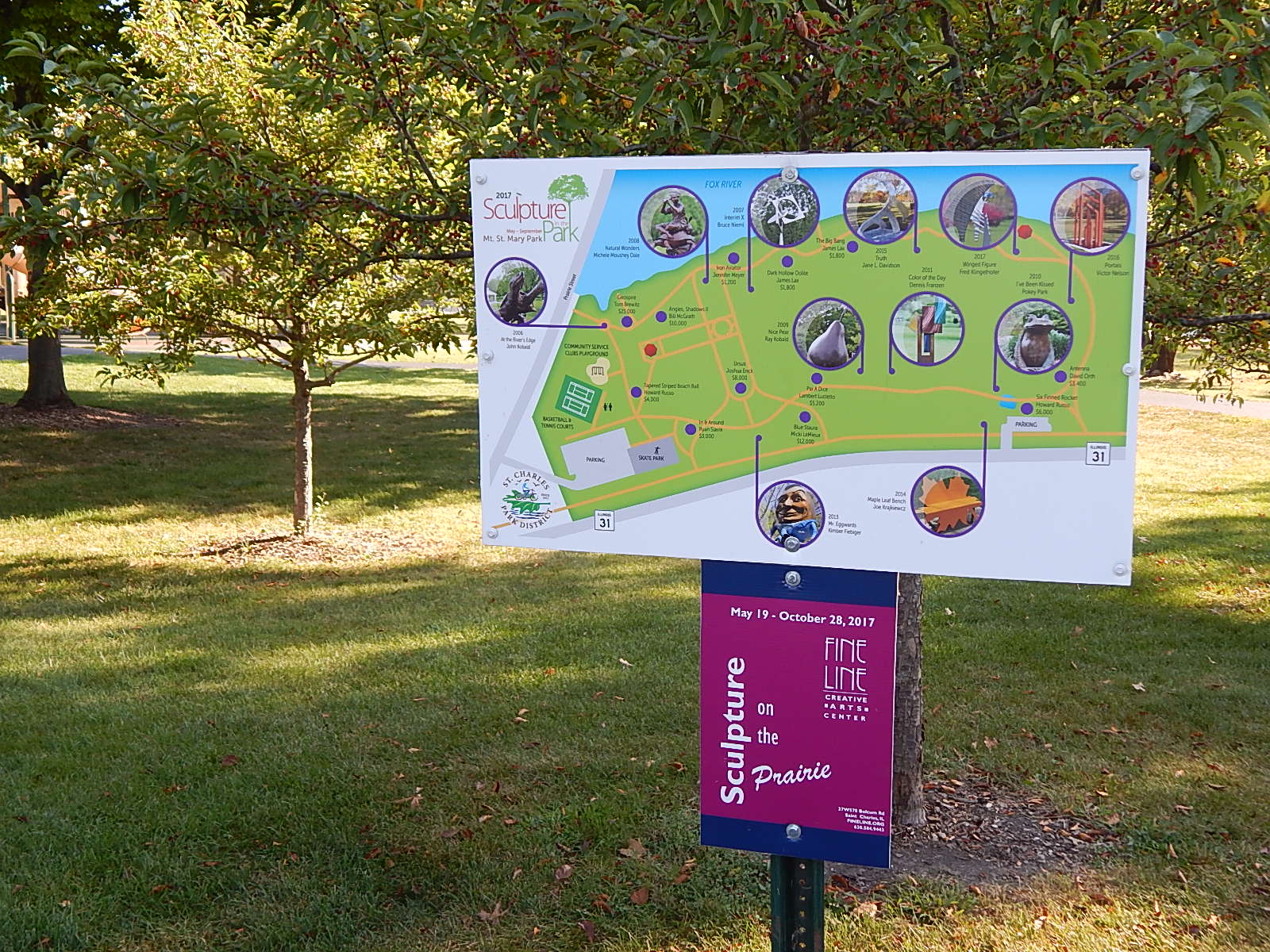
Over many months now, during my morning contemplative walks in a local park, I have encountered objets d’déclin. Mother Earth needed tattoos to be in vogue.

A gaggle of local apparatchiks of post-modern persuasion decided at some point that nature’s exhilarating beauty-a body of narrative to be read over and to reflect on-should be forever ‘inked’ with the flippant constructionism of various ‘artists’.

The local approvers and inciters of inhuman aesthetics have ‘carnivalized’ a local nature preserve, a park and a paradise infused with wildflowers along a river, where, along such “springs in the valleys” (Psalm 104) “The birds of the sky nest by the waters; they sing among the branches.” No matter, though. By so doing, the self-appointed culture-mongers can connote their relevance and earn self-aggrandizement brownie points with the community.

Pictures at an Exhibition:

Entrance to St. Mary’s Park

PM Art vs. Tree Planted in Memoriam

Nature’s Way

Nature Sculpts


Nature Revealed in Sculpture

And, “Do Not Feed Post-Modern Artists”

The last photo, a #LGBT advert, fits the theme: the ‘carnivalizing’ of nature and nature’s compliment, Scripture. More about this in the next post.

Saving Leonardo and Modern Man From Himself

dual mindHave you read Saving Leonardo: A Call to Resist the Secular Assault on Mind, Morals & Meaning by Nancy Pearcey, B & H Publishing Group, Copyright 2010?  

It has been a while, 2010 actually, since I read this Christian-perspective-of-culture concordance. A certain blog post triggered a memory redux of Saving Leonardo.

The Christian author Nancy Pearcey writes about the dualism behind modern man’s worldview.  Her book informs us as to how secularism emerged to be a prominent worldview. She also tells us how she sees that worldview affecting us, destroying our culture.  Her desire in writing this book is to make every Christian knowledgeable and aware, prepared to take on the current secular worldview:

“A worldview approach enables Christians to move beyond merely denouncing social ills such as abortion, which can sound harsh, angry and judgmental.  And, it equips them to demonstrate positively that biblical wisdom leads to a just and humane society.  Protests and placards are not enough.  To be strategically effective in protecting human dignity, we need to get behind the slogans and uncover the secular worldviews that shape people’s thinking.”

For starters there is this curious quote at the front of the book and the only reference to book’s title reference, Leonard da Vinci, that I could find aside from a section titled “Da Vinici versus Degas” (regrettably, there is no index at the back of the book):

Leonardo da Vinci

Hence the anguish and the innermost tragedy of this universal man, divided between his irreconcilable worlds.

(Giovanni Gentile, Leonardo’s Thought)

I’m not sure why Pearcey chose Giovanni Gentile’s quote to provide the “Forward” for her book about modern man’s dualistic thinking.  Giovanni Gentile was known at one time as the official philosopher of Fascism in Italy.  His theories contained rejection of individualism, acceptance of collectivism, with the state as the ultimate location of authority and loyalty to which the individual found in the conception of individuality no meaning outside the state (which in turn justified totalitarianism). Wow! In essence Giovanni Gentile didn’t believe a person could have a thought of his own apart from the state. 

In any case, as a student of art, music, literature and science as well as some philosophy and a good bit of theology and being something of a Leonardo da Vinci/Sherlock Holmes type that I am, this book, found on a table in a local book store, caught my eye.

Nancy Pearcey studied under Francis Schaeffer at L’Abri Fellowship in Switzerland. She begins her book by referring to a simile Schaeffer used to describe modern manShe writes:

“Using the metaphor of a building, he (Schaeffer) warned that truth had been split into two stories.  The lower story consists of scientific facts, which are held to be empirically testable and universally valid. The upper story includes things like morality, theology, and aesthetics, which are now regarded as subjective and culturally relative. Essentially the upper story became a convenient dumping ground for anything that the empiricist world view did not recognize as real.  Schaeffer used a simple graphic, which we can adapt like this:

The two-story concept of truth

Values

Private, subjective, relative

Facts

Public, objective, universal

This dichotomy has grown so pervasive that most people do not even recognize they hold it.  It has become part of the cultural air we breathe. Consider two prominent examples:

Martin Luther King Jr. ~ “Science deal mainly with facts; religion deals with mainly values.”

Albert Einstein ~ “Science yields facts but not “value judgments”; religion expresses values but cannot “speak of facts.””

As you are well aware by the verbal sparks flying everywhere around us, the dichotomy within our own honed thinking as it engages with others with their hardened dichotomy is like steel striking a flint rock. Truly, the fact/value split has inflicted great damage to our culture.  It clearly affects the worlds of politics, education, religion and societal norms such as marriage.  Saving Leonardo is a good place to begin your research into how we as a culture came to be this way.

Saving Leonardo gives the reader an overview of the history behind modern man’s fact/value split (shown above as the “lower story” and the “upper story.”).  The book presents the two basic worldviews that are prevalent today: Continental and Analytic. These two streams are manifested throughout today’s culture via art, music, literature, movies, politics, education, law, sexual mores, societal institutions and pop culture.

Pearcey uses the following descriptive dichotomies to describe our evolved mindsets:

Facts/Values
Box of Things/ box of the mind
Machine/ghost (Descartes)
Nature/Freedom (Kant)
Formalism/expressionism
Mind (autonomous self)/body (biochemical machine) or in toto, the Liberal view of the human being
Imaginative truth (art)/rational truth (deterministic world of science)

In discussing the Continental worldview Pearcey notes that there are the schools of idealism, Marxism, phenomenology, existentialism, postmodernism and deconstructionism.

The Analytic worldview stream, she says, holds empiricism, rationalism, materialism, naturalism, logical positivism and linguistic analysis.

In comparing the two worldviews John Stuart Mill is quoted: “the antagonism already separating the two traditions: The lower story, with its materialism, “is accused of making men beasts” while the upper story, with its irrationalism, is accused of making men lunatics.”

Pearcey notes that culture has reflected the dueling mindsets since their inception during the age of Enlightenment. Artists, composers, writers, dramatists and producers have portrayed the philosophies of their day through their art. Saving Leonardo gives prominent examples of those creative forces that have either mirrored the prevailing thought or who have worked to oppose it.

In brief, you will encounter Hemingway, London, Huxley, Hegel, Duchamp, Picasso, Kandinsky, Darwin, Nihilism, Abstract expressionism, Christian realism, John Cage and a host of others – philosophers, painters, composers and writers who influenced culture from where they stood in the house: the upper story or the lower story.

As an example of the constant interplay between dueling mindsets, the split in thinking, as shown below, shows how those of the Romantic period tried to view their ‘art’ as separate and above the newly arrived scientific fact proposed by Darwinism:

The Romantics’ two-story of truth

Imaginative truth

Creative World (Art)

Rational truth

Deterministic world (Science)

Within a Christian worldview there is no need whatsoever to divide man’s thinking into separate spheres such as spiritual fact versus science or materialism.  A Christian man or woman who is whole is a romantic-rationalist.  One very good example of such a person would be the Christian apologist and fantasy writer C.S. Lewis. Lewis, as revealed by his writing and talks, had integrated the upper and lower stories.

 Pearcey, in the section C.S. Lewis: We Can’t All Be Right, quotes Lewis:

“The Christian and the Materialist hold different views about the universe.  They can’t be both right.  The one who is wrong will act in a way which simply doesn’t fit the real universe.”

(Little wonder that homosexuality is given credence in our culture.)

Saving Leonardo is good starting point for further research.  It will certainly pique your interest when the dots start to connect to form our deformed culture right before your eyes.

End thoughts:  Unlike Pearcey I do not have an issue with modern music or with modern art.  I find them both to be revealing and stimulating each in their own way. 

Jazz is not mentioned in this book, as best I can recall.  This is a shame. I hear jazz as a very human and creative outlet within our world. I find it rather strange that the author never mentions the spontaneity, sonority and musical improvisation of jazz. I love Bach and Shostakovich and Henryk Górecki. But I also listen to Dizzy Gillespie and Thelonious Monk and Wynton Marsalis.

I also listen to the Blues:  Robert Johnson, Muddy Waters, B.B. King, et al. My tastes in music, art and literature run eclectic.

I certainly don’t agree with the author that art has to have unifying narrative to be of value.  One of the earliest painters I connected with was Jackson Pollack.  I remember seeing a painting of his in a Life magazine article and then later at the Art Institute in Chicago. This was a time back in my junior high school days. 

Jackson’s drip paintings reminded me of a brain’s neural network being charged with emotion. Perhaps, his paintings are a one-nanosecond glimpse of a much larger narrative. In any case, art is something you can take or leave as you see fit based on your own life narrative.

There will be places in the book where you will take issue with her opinions, just I did (see below).  This is good.  Find out why you agree or disagree with her. I urge you to become knowledgeable about the current world view encircling you by reading this book. Form your own Christian-romantic-rationalist worldview to withstand secularism’s pressures.

Nancy Peacey pushes for there to be narrative and a teleological basis to paintings, music and literature.  Again, I disagree about the need for narratives.

There will be times of narrative and Newtonian Classical Physics and Bach and Norman Rockwell and Shakespeare and Charlotte Brontë where cause and effect and resolution are clearly known.  There will also be times of seeming disarray and unknowns and lack of resolution as in Quantum Physics and the music of György Ligeti, John Cage and Schoenberg and the paintings of Picasso and Jackson Pollock and the poems of Jack Kerouac.  We need both. As creators, though, we are all teleologically dependent whether we like it or not.  Intelligent design is baked into the pottery.

Jackson Pollock No 28

Jackson Pollock – No.28, 1950. Enamel on canvas

 In the final words of the book Pearcey encourages parents to not push their kids into being conservative (keeping things as they are).  Rather, she encourages parents to push for “revolutionary” children.

Like the “Forward” quote source I find this curious. From my reading of Saving Leonardo, there seems to be no direct context given for defining her word “revolutionary”.  Perhaps she means being an ‘out-side-the-box’ artist, composer or writer.  Apparently she hasn’t read Flannery O’Connor’s Wise Blood.

 *******

Point of contention with the book:

The book is divided into two main parts: The Threat of Global Secularism and Two Paths to Secularism. As a side note I became particularly interested in Chapter Three of the book’s Part One. The title of Chapter Three: Sex, Lies and Secularism.

In this section of Chapter Three “Hooking up, Feeling Down” Pearcey begins “Let’s move to the most contentious sexual issues of our day such as homosexuality, transgenderism and the hook-up culture.” She then goes on to say that having an understanding of the two-story dualism of modern thinking will help the Christian in providing a holistic biblical alternative.

Because of her shotgun approach of scoping transgenderism in the same sights as homosexuality, Pearcey does, I believe, relegate transgenderism to be on par morally with acting out homosexually and one-night stand sexuality. I would state emphatically here that transgenderism by definition is not about acting out sexually. Transgenderism is not equal to homosexuality whether as a sexual issue or a gender issue. It IS about gender identity/gender dysphoria and seeking to become a whole person ~ a romantic rationalist.  Or, to describe it using her term, it’s being “revolutionary.”

Further information about transgenderism:

 The Transgender Moment

A ‘Naturalized’ Woman

The Church and Gender

Other ‘related’ dichotomies: Robert Pirsig’s “Zen and the Art of Motorcycle Maintenance.” Pirsig’s distinction between the “classical” and the “romantic” view is conceptually analogous to Thomas Sowell’s distinction between the constrained and unconstrained visions in “A Conflict of Visions”

Abandoment Issued

Recently, I purchased a Brad Pogatetz photograph.  Brad, a local artist, presented his work in a local art fair.  I was nonplussed by the volume and the character of his work.  Brad’s photography reverently records the haunted dilapidation enshrined in the abandonment of man’s creations. (OK, I wrote this after two beers and a shot of 100 Anos tequila.)

In any case, I am impressed. 

http://bradpogatetz.com/

http://www.lakevieweastfestivalofthearts.com/

Who Does She Think She Is?

http://www.whodoesshethinksheis.net/