Displaced in Place

Monica Sanders, a survivor of Hurricane Katrina, wrote in her August 18, 2025, Oxford American article The Storm that Blew Us Apart recalling Twenty years after Katrina, we’re still living in the space between before and after:

 The flood took homes and heirlooms, yes. But it also took the things that don’t have price tags: your grandmother’s pew at St. Peter Claver, the second-line route your cousin danced for the first time, the rhythm of being able to walk next door to ask for a lemon and stay for a two-hour porch talk.

We became refugees in our own country . . .

Some of us never came back.

Those who did found a different city. Not just rebuilt, but rearranged. The neighborhoods we knew—Broadmoor, Gentilly, the Lower Nine—returned with new names, new residents, and new rules. People who knew about noise ordinances but not about king cakes. People who brought nonprofits but not traditions. People who wanted charm but not character. The kind who say “N’Awlins” with a wink, and don’t hear the ghost in that mispronunciation.

Displacement gave way to gentrification. What was affordable became vacation rentals. What was vibrant became boutique. Streets that once held parades now hold pop-ups. We became the entertainment, not the community.

And yet, we remain. . .

All of us carry the “before” with us. . .

We talk about resilience now, but we forget that true resilience is cultural as much as physical. It’s knowing who to call when the lights go out. It’s gathering your neighbors even when there’s no power. Its memory passed like gumbo recipes and Sunday prayers.

Mutual Aid, New Orleans, 2005. Inkjet Print on Canvas, Clarence Williams

~~~

As helicopters rush off with the most desperately ill, throngs trapped for nearly a week in New Orleans climb aboard busses at the intersection of I-10 and Causeway Blvd., Saturday, September, 3, 2005. (Staff photo by Eliot Kamentiz, The Times-Picayune)

I began with Monica’s reflection on the effects of Hurricane Katrina, for order being swallowed up by non-order, an overwhelming flood, parallels the flood of disorder working to decouple us from people, place and the past and to colonize us for its reorganizing purposes which include efficacy, profitability and efficiency.  (Order, non-order and disorder are terms coined by Dr. John Walton to describe cosmology in his Job commentary.)

That storm is blowing us apart. And as was experienced in the aftermath of Hurricane Katrina, we feel a pervasive sense of displacement, of being refugees in our own country, of living in the space before and after the imposed transformation of our culture.

The source of dysphoria about our time and place being out of joint may not be readily recognizable. As with the “frog in boiling water”, we steep in its flood waters not recognizing the stew we are in. Screens constantly distract our attention away from what is happening to our existence.  

The source: a flood of ideologically progressive technology and globalization that is wiping out our connections to people, place and the past. Its overwhelming force is our unmooring, our unmaking. Its irresistible force is displacing us in place.

I’ve been aware of the source for many years, starting when I bought a 286 computer in the 70s. The machine had an allure that had me come back to it constantly.

In an October 23, 2022 post Altered States, I quoted Jacques Ellul from his book The Technological Society and wrote the following:

I’m becoming a neo-Luddite of sorts. I have a particular dislike for digital technology as it modifies the means of relating to ourselves, to those around us and to our world. Its dissociative medium detaches us from reality, thereby affecting identity, memory, perception, and truth.

The flood waters are rising around us. Look at what is going on with the tech-bro push for AI and transhumanism, with concerns about rare earth minerals, with chips, chips, and more chips, with 5G towers, energy and water consuming data centers, constant surveillance, mandated digital IDs – why do we need any of it?

‘A Sharp Escalation’: Americans Starting To Revolt Against Data Centers | ZeroHedge

I recently came across an author that uses “the Machine” as the analogy for the inhuman forces at work to enclose all in its path for Progress. What Kingsnorth writes resonates with everything that I’ve read in dystopian novels: 1984, That Hideous Strength, Brave New World, and Darkness at Noon. Here’s Paul Kingsnorth with “Huxley and the Machine”:

Paul Kingsnorth’s, Against the Machine is “an account of the technological-cultural matrix enveloping all of us. The culmination of two decades of my writing and thinking about technology, culture, spirituality and politics, it seeks to offer an insight into how the techno-industrial culture that I call ‘the Machine’ has choked Western civilisation, is destroying the Earth itself, and is reshaping us all in its image.

From the First Industrial Revolution to the rise of artificial intelligence, this book shows how the hollowing out of humanity has been a long game—and how our very soul is now at stake.

Against the Machine is the spiritual manual for dissidents in the technological age.”

~~~~~

Per Lewis Fried, Lewis Mumford, author of The Myth of the Machine, “insisted upon the reality of the Megamachine: the convergence of science, economy, technics and political power as a unified community of interpretation rendering useless and eccentric life-enhancing values. Subversion of this authoritarian kingdom begins with that area of human contact with the world that cannot be successfully repressed – one’s feelings about one’s self. “

Mumford:

The vast material displacements the machine has made in our physical environment are perhaps in the long run less important than its spiritual contributions to our culture.

Technology, instead of introducing us to freedom, has imposed on us the slavery of the machine.

Modern Man is the victim of the very instruments he values most. Every gain in power, every mastery of natural forces, every scientific addition to knowledge, has proved potentially dangerous, because it has not been accompanied by equal gains in self-understanding and self-discipline.

A day spent without the sight or sound of beauty, the contemplation of mystery, or the search of truth or perfection is a poverty-stricken day; and a succession of such days is fatal to human life.

Our national flower is the concrete cloverleaf.

Western culture no longer represents man: it is mainly outside him, and in no small measure hostile to his whole self: he cannot take it in. He is like a patient condemned in the interests of X-ray photography to live upon a diet of barium sulphate…In the end, as Samuel Butler satirically prophesied, man may become just a machine’s contrivance for reproducing another machine.

The great gains that were made in technics during the last few centuries were largely offset by a philosophy that either denied the validity of man’s higher needs or that sought to foster only that limited set of interests which enlarged the power of science and gave scope to a power personality. At a moment when a vast surplus was available for the goods of leisure and culture, the very ideals of leisure and culture were cast into disrepute — except when they could be turned to profit. Here lies the core of the inner crisis that has afflicted our civilization for at least two centuries. In the heyday of expansionism, the middle of the nineteenth century, scarcely a single humane voice could be found to defend either the means or the ideals of a power civilization…Blake, Ruskin, Morris, Arnold, Emerson, Whitman, Thoreau, Melville, Dickens, Howells, Hugo, Zola, Mazzini, Tolstoy, Dostoyevsky, Ibsen…denounced the human results of the whole process of mechanization and physical conquest. As with one voice, they protested against the inhuman sacrifices and brutalizations, the tawdry materialisms, the crass neglect of the human personality.

~~~~~

~~~~~

The truth is, men have lost their belief in the Invisible, and believe, and hope, and work only in the Visible; or, to speak it in other words: This is not a Religious age. Only the material, the immediately practical, not the divine and spiritual, is important to us. The infinite, absolute character of Virtue has passed into a finite, conditional one; it is no longer a worship of the Beautiful and Good; but a calculation of the Profitable. Worship, indeed, in any sense, is not recognised among us, or is mechanically explained into Fear of pain, or Hope of pleasure. Our true Deity is Mechanism. It has subdued external Nature for us, and we think it will do all other things. We are Giants in physical power: in a deeper than metaphorical sense, we are Titans, that strive, by heaping mountain on mountain, to conquer Heaven also.

Thomas Carlyle, from “Signs of the Times

~~~~~

Against the machine: Digital ID Black Pill Moment? – The Burning Platform

Michael Appleton/NY Daily News Archive via Getty Images

Smiley N. Pool/Houston Chronicle via Getty Images

The Disconnected Ones

From parents pampering their progeny (Indulging “I-Me-Mine”) to priests and pastors preaching Progressivism (‘Inspired’ “I-Me-Mine”) to professors promulgating political propaganda (Ideological “I-Me-Mine” & Illiteracy) to the phenomenon of ‘political correctness’ (Ideological Conformity & Indulgent Illiberalism) to policies promoting pseudo pronouns (Indulgent Illusions of “I-Me-Mine”) to protestors pronouncing “Death to Israel” and “Death to America” (Indulgent Intifada), the Left’s Long Maoist/Marxist/ Marcusean March through institutions has left a trail strewn with social pathologies and pogroms. Ptooey!

The humorless Left, a product of its own Polarizing and Infantilizing Process, is self-absorbed but not self-examining. The Left refuses to learn from anything outside itself including history to account for its own dysfunctional and belligerent ways. If it did, it would turn from its deceptions – the filtering mindsets of victim-oppressor and of passion as morality – and it wouldn’t continue the Long March, inchoate, with those who have been patently processed like themselves to destroy whatever is in its path including “Democracy!”

Today’s products of the Polarizing and Infantilizing Process, disconnected from history and reality and preoccupied with self, are working diligently to take down Western civilization and its Judeo-Christian foundation. In its place they want to build sand castles, imagined communist and Islamic utopias, from the river to the sea.

Yet, as history has recorded as happening under all preceding totalitarian impulses, the season of indulging one’s passions and the rush to violence will soon pass. The revolutionary impulse inevitably turns inward, as the “I-Me-Mine” of the leaders begins to indulgently purge all dissent including thought crimes in order to impose mindless uniformity. Thus, the season of torture, torment, and tedium begins for the disconnected ones.

~~~~~

Retired prison psychiatrist Theodore Dalrymple (pen name for Anthony Daniels) speaks and writes with keen insight gathered from his experience of the human condition and of its surrounding culture.

Having read several of his books, I recommend two books to start with:

Life at the Bottom: The Worldview That Makes the Underclass (Start with this book. It will change how you look at the world.)

Admirable Evasions: How Psychology Undermines Morality

Here’s Theodore Dalrymple’s address at the London National Conservatism Conference on May 15, 2023.

Theodore Dalrymple | Historiography and the State of the Western Mind | NatCon UK (youtube.com)

~~~

The New Criterion’s Roger Kimball takes the audience through a history of America’s cultural revolution of the 1960’s and its effects on American politics and culture today.

The Long March: How the Cultural Revolution of the 1960’s Changed America by Roger Kimball (youtube.com)

~~~

Per Italian communist Antonio [ Gramsci] “If the Left truly wanted to win, it needed to first seize the “cultural means of production”: the culture-forming institutions such as the media and universities and even churches. He saw societal transformation coming about by a “march through the institutions.” …

“Gramsci insisted that leftist intellectuals needed to question everything, including moral absolutes and the Judeo-Christian basis of Western civilization. They needed to frame seemingly benign conventions as systematic injustices that must be exposed. This is where we got professors fulminating against everything from “the patriarchy” to “white imperialism” to “transphobia.””

Marx at 200: Cultural Marxism’s Long Happy March Through the Institutions

Expand your temporal bandwidth . . .

“The failure to read good books both enfeebles the vision and strengthens our most fatal tendency — the belief that the here and now is all there is.”
― Allan Bloom, The Closing of the American Mind

. . . because . . .

“We live in an age of full spectrum deception.” — Edward Dowd

Why I read novels . . .

“The stupidity of people comes from having an answer for everything. The wisdom of the novel comes from having a question for everything. When Don Quixote went out into the world, that world turned into a mystery before his eyes. That is the legacy of the first European novel to the entire subsequent history of the novel. The novelist teaches the reader to comprehend the world as a question. There is wisdom and tolerance in that attitude. In a world built on sacrosanct certainties the novel is dead. The totalitarian world, whether founded on Marx, Islam, or anything else, is a world of answers rather than questions. There, the novel has no place.”
― Milan Kundera, The Book of Laughter and Forgetting

~~~~~

The Way I Heard It, Mike Rowe podcast:

382: Individualism Rightly Understood with Scott Mann 1:19:03

The former U.S. Army Green Beret, NYT bestselling author, leadership consultant, and perennial storyteller talks about the division and tribal behavior that permeates our country now, the death of honor, shame, and consequence, and why Alexis de Tocqueville was right when he observed that America succeeds because she puts the individual ahead of the collective. You can preorder Scott’s newest book here.

Individualism Rightly Understood Mike Rowe with Scott Mann

Podcast – Mike Rowe

LAST OUT (lastoutplay.com)

~~~~~

Controlled Opposition

The growing list of the controlled opposition’s shaming screeds promoted on MSNBC to influence voters by making them feel morally superior if they don’t vote for Trump:

Tim Alberta and The Kingdom, the Power, and the Glory: American Evangelicals in an Age of Extremism, published December 5, 2023

Tom Schaller and Paul Waldman with White Rural Rage: The Threat to American Democracy published on February 27, 2024

Jim Wallis: The False White Gospel: Rejecting Christian Nationalism, Reclaiming True Faith, and Refounding Democracy, published April 2, 2024

Apparently, the only way to be a Christian is to be a Democrat like the author/s and to vote for all of the things that your faith disagrees with and for the continued destruction of our country. Got it.

“Teacher,” said John, “we saw someone driving out demons in your name and we told him to stop, because he was not one of us.”

“Do not stop him,” Jesus said. “For no one who does a miracle in my name can in the next moment say anything bad about me, for whoever is not against us is for us. Truly I tell you, anyone who gives you a cup of water in my name because you belong to the Messiah will certainly not lose their reward.

Mark 9:38-41

Apparently, there are people who are very ‘concerned’ about Trump being associated with Jesus because Trump “was not one of us.”

~~~~~

You realize, don’t you, that what’s going on in our country is the collapse not just of an empire, or an economy, but a comprehensive paradigm of human progress. The hallmark of post-war life in Western Civ was supposed to be a return to sanity after the mid-twentieth century fugue of mass psychotic violence. The wish for just and rational order was not entirely pretense. But that was then. Now that we are going medieval on ourselves, the not-so-ironic result will be our literally going medieval, sinking back into a pre-modern existence of darkness, superstition, and penury, grubbing for a mere subsistence in the shadow of scuffling hobgoblins, our achievements lost and forgotten. . .

The source of anguish in all that is the struggle to understand why they [the “governing apparatus”] would want that to happen. What debauched sense of history would drive anyone to such lunatic desperation? It’s a cliché now to say that the Democratic Party has turned its traditional moral scaffold upside down and inside out. It acts against the kitchen table interests of the working and middle classes. It’s against civil liberties. It demands mental obedience to patently insane policy. It’s avid for war, no matter how cruelly pointless. It’s deliberately stirring up racial hatred. It despises personal privacy. It feeds a rogue bureaucracy that has become a veritable Moloch, an all-devouring malevolent deity. And now, rather suddenly, it aligns itself with a faction that seeks to exterminate the Jews.

James Howard Kunstler at https://kunstler.com/clusterfuck-nation/pep-talk-on-a-dark-day/

~~~~~

As of 5-5-2024, we are 22 days away (May 27th) from the WHO approving One Health One World control of countries and of our health and freedom.

Find out more and how to act>>>

Exit the WHO, Take 2! – STAND FOR HEALTH FREEDOM

WHO and global health update – STAND FOR HEALTH FREEDOM

49 Republican Senators REJECT Pandemic Treaty From WHO | WLT Report

~~~~~

Citizen Free Press on X: “Babylon Bee presents Woke Jesus. This is really well done. https://t.co/RWA5KYMp5o” / X (twitter.com)

Palm Sunday and the Problem of Evil

Just a few centuries before the first Palm Sunday, Greek philosopher Epicurus (341-270 B.C.) promoted to his followers the notions of another ancient Greek philosopher, Demetrius (c. 460 – c. 370 B.C.). Demetrius’ had proposed the theory of Atomism to account for nature.

The theory in brief: the universe is a material system governed by the laws of matter. The fundamental elements of matter are atoms. Random, unguided ‘atoms’ smash into each other, thereby creating the world and life as we know it. Epicurus went on to tweak Demetrius’ theory by saying that atoms do not always go in straight lines but can “swerve, avoiding atomism’s inherent determinism and allowing for free will – just like the gods.

Per Epicurus, the gods were off somewhere happily doing their thing unconcerned about anything. They existed without needs, were invulnerable to any harm, and were generally living an enviable life, not anxious about anything. As such, they exemplified what Epicurus’s followers should seek to attain in their limited human nature.

For Epicurus, the purpose of philosophy was to attain the happy, tranquil life, characterized by aponia, the absence of pain and fear, and by living a self-sufficient life surrounded by friends. He taught that pleasure and pain are the measures of what is good and bad, that death is the end of the body and the soul and should therefore not be feared, that the gods do not reward or punish humans, that the universe is infinite and eternal, and that events in the world are ultimately based on the motions and interactions of atoms moving in empty space.The Epicurus Reader

Epicurus also taught that nothing should be believed except for that which was tested through direct observation and logical deduction – believed via the sensate and reason. Based on such thinking along with having the viewpoint that the gods were distant and uninvolved and therefore unrelated to ‘thinking’ and ‘sensing’ man’s life, man had to make do with the atoms he had been dealt. Don’t look to a personal God for help.

What was most important in Epicurus’ philosophy of nature was the overall conviction that our life on this earth comes with no strings attached; that there is no Maker whose puppets we are; that there is no script for us to follow and be constrained by; that it is up to us to discover the real constraints which our own nature imposes on us.The Epicurus Reader

As Epicurus evaluated the Greek and Roman gods of his time and man’s attempt to please and cajole the gods to obtain favors, it would make sense for him and his followers to deduce that “there is no Maker whose puppets we are”. And, for Epicurus to further reason the problem of evil paradox:

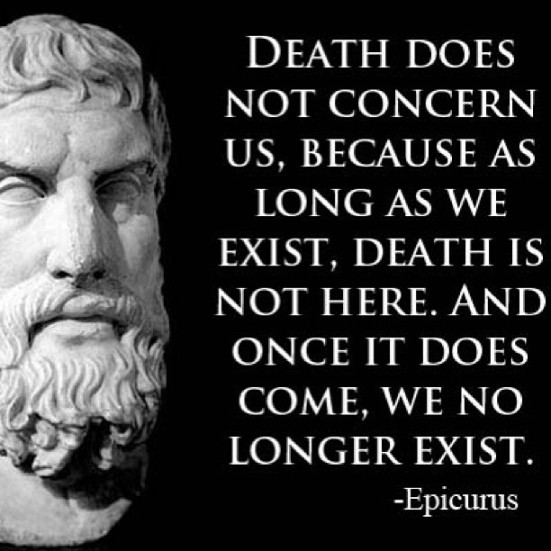
“The gods can either take away evil from the world and will not, or, being willing to do so cannot; or they neither can nor will, or lastly, they are able and willing. If they have the will to remove evil and cannot, then they are not omnipotent. If they can but will not, then they are not benevolent. If they are neither able nor willing, they are neither omnipotent nor benevolent. Lastly, if they are both able and willing to annihilate evil, why does it exist?” ― Epicurus

 The Epicurean paradox was answered with another paradox: What is mankind that you are mindful of them, human beings that you care for them? Psalm 8:4

In the fullness of time, including Epicurean times, the Lord of the universe put on human flesh – dust fashioned from the created elements including about 18% carbon – to deal with the problem of evil. There was nothing ambiguous or theoretical or abstract about the appearance of God’s own son Jesus. There was direct observation -seeing, hearing, and touching – by his followers.

Philosophers and atheists, before and after Epicurus, pronounced judgement on God for all the evil in the world.

The demand of the loveless and the self-imprisoned that they should be allowed to blackmail the universe: that till they consent to be happy (on their own terms) no one else shall taste joy: that theirs should be the final power; that Hell should be able to veto Heaven. – George MacDonald, C.S. Lewis’ The Great Divorce

To address evil, Jesus announced the kingdom of God on earth. What was begun in Genesis – the ordering of material creation to build God’s temple on earth so that God would dwell with man – was reinstated by Jesus. This blueprint or worldview was on the books long before Epicurus arrived on the scene. And so is the record of God’s faithfulness. God, as revealed in Jesus, puts things to right.

Jesus entered space and time flesh and blood to pronounce judgement on evil. He did so without equivocation. Jesus did not succumb to pleasure seeking to avoid pain. He did not succumb to Satan’s temptations to find happiness. Evil unclean spirits were cast out. Hypocrites were denounced and death itself was overturned. Jesus suffered the full force of evil on the cross – an act of redemption from evil’s ransom.

The King of Glory wept over Jerusalem and his chosen people. The Israelites had so often rejected their reveal-to-the-world-the-one-true-God vocation. They had not been faithful stewards of God’s vineyard. Did Epicurus see no difference in their God and the Greek and Roman gods?

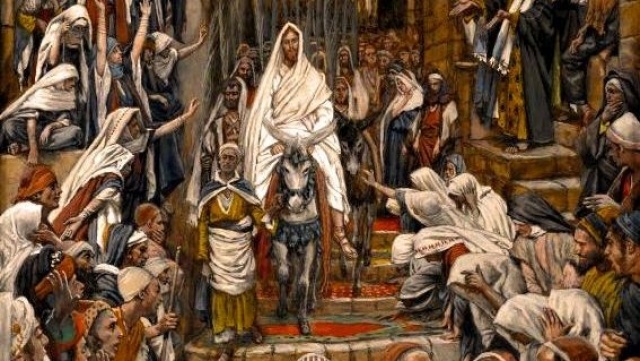
On that first Palm Sunday, just a few centuries after Epicurus taught that there was no personally involved God, the King of Glory, emptied of his glory, rides a donkey into Jerusalem to meet evil head on and to put the world right. The “Epicurean Paradox” would be addressed and soundly answered.

What will you do with the knowledge that the infinite-personal God, embodied in human form, speaks to the very human concerns behind Epicurean philosophy?

Are You Witnesses of All This?


Over the last several posts I’ve written about philosophers (Epicurus in particular and Protagoras) and philosophies (Epicureanism and Stoicism). Taken together they state, among other things I described earlier, that this life is all there is. There would be no hereafter in that way of thinking. During the first century the Apostle Paul, the “the apostle of the Gentiles”, encountered those worldviews on the streets where he sold his tents and in the early churches where he taught.

Writing to those in the Corinthian church whose Gentile members denied a resurrection of the dead, Paul responded in a rather taunting manner to their philosophical take on death as final. The gospel he proclaimed – Jesus is Lord, forgiveness of sins, new creation, the kingdom of God on earth has been launched – all hinged on the resurrection of Jesus.

And if the Messiah wasn’t raised, your faith is pointless, and you are still in your sins. 1 Cor. 15:7

After addressing and closing the dead are raised issue with an eye witness defense (1 Cor. 15: 3-8), Paul responds to the heart of the Corinthian objection to resurrection: the nature of future bodies. He mocks their materialist objections using an analogy from nature:

But someone is now going to say, “How are the dead raised? What sort of body will they have when they come back? Stupid! What you sow doesn’t come back to life unless it dies. 1 Cor. 15: 35

No doubt, Paul also heard that Jesus responded in a similar fashion when he rebuked the Sadducees who denied the resurrection (as recorded in Luke 20:38 and below, in Mark 12:

“Where you are going wrong,” replied Jesus, “is that you don’t know the scriptures, or God’s power. When people rise from the dead, they don’t marry, nor do people give them in marriage. They are like angels in heaven.

However, to show that the dead are indeed raised, surely you’ve read in the book of Moses, in the passage about the bush, what God says to Moses? ‘I am Abraham’s God, Isaac’s God, and Jacob’s God’? He isn’t the God of the dead, but of the living. You are completely mistaken.”

In the same letter (1 Cor.15:19), agitated Paul, in talking about people’s motivations in light of their position on the resurrection, recommends Epicurean self-pity if the dead are not raised.

If it’s only in this present life that we have hope in the Messiah, we are the most pitiable members of the human race.

He later quotes a popular Epicurean saying that embraces self-pity and self-indulgence in light off…

…If the dead are not raised,

“Let us eat and drink,

for tomorrow we die.”

1 Cor. 15:32

What was Paul’s background that offered him insight into Greek philosophies? We learn from Acts 21: 37 -39 as he defends himself against highly agitated Jews who clamored for his arrest.  He is brought before a Roman tribune:

“Am I allowed to say something to you??” he asked.

“Well!” replied the tribune. “So you know some Greek, do you? Aren’t you the Egyptian who raised a revolt some while back and led those four thousand ‘assassins’ into the desert?”

“Actually, replied Paul. “I am a Jew! I am from Tarsus in Cilica. That’s not an insignificant place to be a citizen of. Please let me speak to the people.”

Inferring his Roman citizenship, Paul goes on to defend his Jewish background in the face of his Jewish accusers:

“I am a Jew, he continued, “and born in Tarsus in Cilicia. I received my education here in this city, and I studied at the feet of Gamaliel. I was trained in the strictest interpretations of our ancestral laws and became zealous for God, just as all of you today.”

Paul had significant first-hand knowledge of Greek, Roman and Jewish worldviews. Paul was more than able to respond to the Epicurean context of the Gentiles. Paul was more than able to present the gospel in the context of the Jewish worldview, a worldview of monotheism, the Temple, eschatology and …resurrection.

The narrative of the resurrection and an eschatology of the age to come took on great import during the Second Temple Judaism. Other than the words of Moses and some metaphorical allusions to resurrection by Isaiah (Isaiah 26:19) and Ezekiel (37), there isn’t mention of the resurrection in the Old Testament. Those allusions were applied during the Babylonian exile. They refer to the restoration of Israel as a nation and the reoccurring theme of exodus from bondage. The scribe Daniel is the first to mention the resurrection in non-metaphorical terms when he describes the “wise”, the Jewish resistance to Antiochus, not dying in vain (Daniel 11).

It was during the intertestamental period that scribes began writing about the resurrection of the dead, among many other topics of concern during late Second Temple Judaism. The Qumran community kept these writings in clay jars within caves in case the community was taken out by the Romans.

The Jewish religious leaders in Jesus’ time knew these writings, e.g., The Epistle of Enoch and 2 Maccabees. The disciples knew them. Paul knew them. The writings were talked about in the synagogues and on the streets. These writings offered a Messianic hope for the coming day when God would put things right. In the meantime, they stoked courage against the looming threat of Roman authority. It is very likely that Mary and Martha would have known about these writing as well. It appears that Martha had an understanding of them when she confronts Jesus after her brother Lazarus dies.

When Martha heard that Jesus had arrived, she went to meet him. Mary, meanwhile stayed sitting at home.

“Master,” said Martha to Jesus, “if only you’d been here! Then my brother wouldn’t have died! But even now I know that God will give you whatever you ask him for.”

“Your brother will rise again,” replied Jesus.

“I know he will rise on the last day.”

(Notice the role reversals from the previous Mary and Martha encounter with Jesus in their home? Martha, the fussbudget homebody, is now interested to hear what Jesus has to say. She goes to meet him. Mary, who doted on Jesus at his feet, stays at home where she grieves and perhaps sulks that Jesus wasn’t there for her brother. She was given another chance at Jesus’ feet.)

Jesus responded to Martha.

“I am the resurrection and the life,” replied Jesus. “Anyone who believes in me will live, even if they die. And anyone who lives and believes in me will never, ever die. Do you believe this?”

“Yes, master,” she said. “This is what I’ve come to believe: that you are the Messiah, the son of God, the one who was to come into the world.”

Jesus responded to Martha’s eschatological understanding with, in effect, “I am revising your understanding with personal present tense knowledge of me”. Jesus then asks for Mary. Proximity to Jesus matters and not only for Mary and Martha’s sake but also for Jesus’ sake. He wants to see for himself the loss, the grief and the pain we feel. He would carry our griefs and sorrows to the cross and then remove the sting of death with his (and then our) resurrection.

When Mary came to where Jesus was, she saw him and fell down at his feet.

“Master!” she said, “If only you’d been here, my brother wouldn’t have died!”

When Jesus saw her crying, and the Judeans who had come with her crying, he was deeply stirred in his spirit, and very troubled…”

Mary and Martha witnessed the resurrection of their brother Lazarus. The three of them would learn of and perhaps be among the over five-hundred brothers and sisters who saw Jesus alive after his resurrection (1 Cor. 15: 5). All of them were witnesses of the things that came to pass. And what came to pass was not a doctrine or a philosophy or an apparition – a ghost. It was bodily resurrection.

No mere manmade philosophy, ancient or otherwise, could ever revive the dead or comfort the living in their loss with “Let us eat and drink, for tomorrow we die.” No amount of pleasure reduces the pain we feel. No amount of materialism and its cheerleading proponent Progressivism – a political pandering to self-pity – will provide hope for today. Those philosophical positions are about nursing wounds. Those philosophical positions are ephemera compared to the reality of the bodily Resurrection of Jesus and the new life offered to those who believe.

Only the Resurrection and the Life can reverse the downward spiral of mankind and provide hope that doesn’t pass away with a meal. Live in the present tense Resurrection and Life as Mary and Martha and hundreds of early followers of Jesus did.

Are you witnesses of all this? Of the resurrection? Or, are you witnesses of the Easter bunny? I think that’s what Paul had in mind when he mocked the Corinthians.

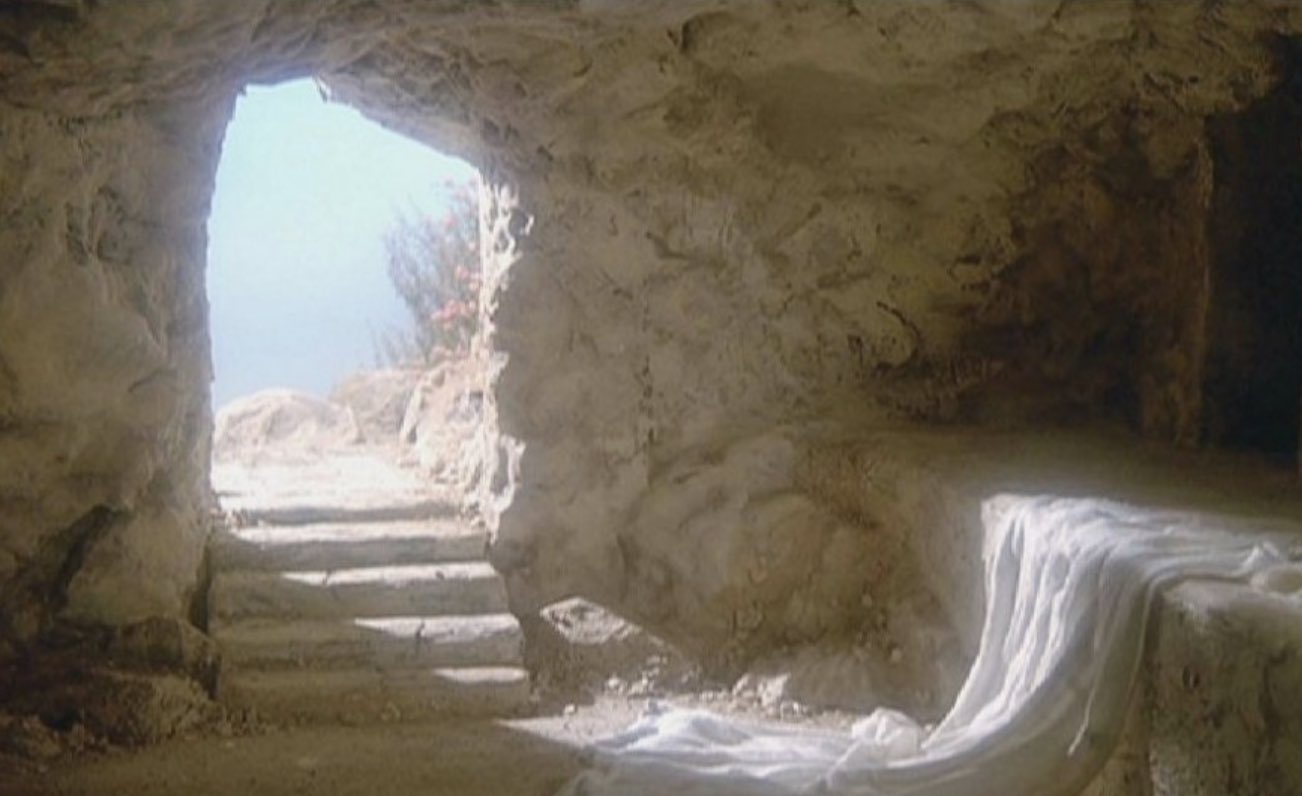
Empty tomb

~~~~~~~~~~~~~~~~~~~~~~~~~~~


The Resurrection is the central theme in every Christian sermon reported in the Acts. The Resurrection, and its consequences were the “gospel” or good news which the Christians brought: what we call the “gospels,” the narratives of Our Lord’s life and death, were composed later for the benefit of those who had already accepted the gospel. They were in no sense the basis of Christianity: they were written for those already converted. The miracle of the Resurrection, and the theology of that miracle, comes first: the biography comes later as a comment on it. Nothing could be more unhistorical than to pick out selected sayings of Christ from the gospels and to regard those as the datum and the rest of the New Testament as a construction upon it. The first fact in the history of Christendom is a number of people who say they have seen the Resurrection.

Miracles, C.S. Lewis

Genealogies of Straw?


…If the dead are not raised,

“Let us eat and drink,

for tomorrow we die.”

1 Cor. 15:32


People delight in looking into their genealogy to tell them where they came from and their ancestral background. But, what about the genealogy of our thoughts and our beliefs that are passed down? Continuing with the theme of my previous post, man as logos and centerpiece of the universe, man considers himself left to his own devices and to fend for himself. The “dead are not raised” has been passed down to us. Also passed down, la dolce vita, the Epicurean worldview prevalent today.

The originator of Epicureanism, the Greek philosopher Epicurus, and many others since, decided that God was not good at being God so man must take his place. In terms of the evil man encounters, this thinking is restated in the Epicurean paradox.

Per the Oxford Dictionary, Epicurus (341-270 B.C) was a “Greek philosopher, founder of Epicureanism. His physics is based on Democritus’ theory of a materialist universe composed of indestructible atoms moving in a void, unregulated by divine providence”.

According to several accounts, Epicurus lived and taught a philosophy of the unnoticed good life. He posited that man, a collection of particles he called atoms, would return to the earth when he died. From atoms to atoms you shall return, he postulated. When you are dead you are dead and while you are alive, as Epicurus advocated, seek pleasure and avoid pain.

Epicurus was not a political nor a spiritual man. He was more of a homebody given to a small circle of friends. Per Epicurus, everything to be trusted and believed came through the senses. And so, he deemed that God was remote if at all. And friends were real and to be trusted.

Epicurus also taught that nothing should be believed, except for that which was tested through direct observation and logical deduction – believed via the sensate and reason. Hence, the beginning of the fact/value split so prevalent in man’s thinking today. It is likely that Epicurus formed this worldview when he decided that God was uninvolved and impersonal at best and that he had to fend for himself.

Epicurean thought was embraced by some and passed down through the centuries. The Roman poet Lucretius, a disciple of Epicurus’s teachings and someone who lived about 70 years before Jesus, promoted the “god is angry” meme along with the theory of atomism formulated by Demetrius (460-370 B.C.), who died 29 years before the birth of Epicurus.

The atomic theory of the cosmos in brief: random, unguided ‘atoms’ smash into each other, thereby create the world and life as we know it. Such a hypothesis turned philosophy by Epicurus offered the ‘means’ to do away with a personally involved god and remove human accountability to God. Lucretius went on to tweak Demetrius’ theory.

Demetrius said that atoms do not always go in straight lives but can “swerve”. As such, his philosophy was then able to avoid atomism’s inherent determinism and to allow for man’s free will.

“What was most important in Epicurus’ philosophy of nature was the overall conviction that our life on this earth comes with no strings attached; that there is no Maker whose puppets we are; that there is no script for us to follow and be constrained by; that it is up to us to discover the real constraints which our own nature imposes on us.” ― Epicurus, The Epicurus Reader

Unlike the innocuous passing-on-sex Epicurus, the Romans took Epicureanism to new lows. The name of the Roman Emperor Caligula is associated today with unbridled decadence. Licentiousness continues today as the justification for the avoid-pain-seek-pleasure self.

The Enlightenment furthered Epicurean acceptance. As many began to claim science as the explainer for things being as they are and man as the interpreter of things as they are, the Enlightenment augmented the fact/value split. With science being claimed as the only arbiter of truth and reality, the transcendent was eschewed, as being unreasonable to ponder. Materialism and utilitarian atomism replaced the transcendent and facilitated the self-made man as the imago homo. An honest look around today would reveal that the worldview from the days of Epicurus down through the Enlightenment has been passed down to us.

“It is folly for a man to pray to the gods for that which he has the power to obtain by himself.” –Epicurus

As I see it, underlying cultural Marxism, secular humanism, Progressivism and the American Dream is the philosophy of Epicurus: extreme preoccupation with and indulgence of one’s feelings, desires, etc.; egoistic self-absorption, aka, solipsism. It is the worldview of safe spaces. It is the philosophy behind the Progressive’s push for acceptance of multiculturalism whereby all cultures are deemed equal including the dehumanizing ones so that individual culture has a larger safe space to operate in. The philosophy promotes universal healthcare as another safe space in the form of insurance against financial suffering as paid for by others so one can live an Epicurean lifestyle without pain. It is the worldview of the virtue-signaling relativist social justice warriors – I want a safe space for me to live my life as I see fit so I will serve up my self-justifying, self-righteous viewpoint of high-sounding humanitarianism. Epicureanism is the doctrine of the Religion of Humanity and the paean to mind and matter as savior.

Epicureanism underlies identity politics and individual rights. It promotes a circling of the wagons around your ersatz ‘friends’, your tribe, to protect your values and your territory for further self-satisfaction. It promotes dehumanization with its message that life has no meaning other than what you give it; life is only material and sensate. So, grab yours while you are alive. Out of this dehumanizing process comes the art, music, literature, media and architecture which degrade human existence and the imago dei in humans. But. Modern man, left to his own Epicurean devices, comes up short.

The narrator in C.S. Lewis’ Space Trilogy novel That Hideous Strength tells us about one of the central characters Mark Studdock. He is a young academic, a sociologist, and a member of the Progressive Element at Bracton College. He is an ambitious, self-centered and shallow intellectual who has come into the service of the National Institute of Coordinated Sciences (NICE). He believes NICE will serve the best interest of humanity through progress at any cost. Once he stopped hemming and hawing about joining the organization he is welcomed into the inner circle. But he soon finds that he has committed himself to a hellish organization which plans to re-do humanity by force so that only the best humans (in NICE’s view) remain. He is made aware that the tentacles of the organization are growing.

Studdock is told in no uncertain terms that the organization wants his wife Jane to join him. He is ordered to bring her in. With no moral depth and no moral base outside himself to guide him, Mark is perplexed and now in great fear for his life. Pain and death are the only things that are real for him.

It must be remembered that in Mark’s mind hardly one rag of noble thought, either Christian or Pagan, had a secure lodging. His education had been neither scientific or classical – merely “Modern”. The seventies both of abstraction and of high human tradition had passed him by: and he had neither peasant shrewdness nor aristocratic honor to help him. He was a man of straw, a glib examinee in subjects that require no exact knowledge (he had always done well on Essays and General Papers) and the first hint of a real threat to his bodily life knocked him sprawling. And his head ached so terribly and he felt sick. Luckily he now kept a bottle of whisky in his room. A stiff one enabled him to shave and dress.

What is your genealogy of thought and belief? Is it a genealogy of strawmen?

~~~~~~~~~

The opening quote is from the Apostle Paul’s letter to the Corinthian church. He is countering the embedded Epicureanism active in the church in Corinth. He does so with the resurrection.

To be continued.

Six Other Degrees of Separation


Six blind men live in Metropolis, Illinois. They were born in the eighties and have been blind from birth.  

These six men consider the earth to be round. They came to this understanding during their grade school education which included handling of the classroom globe. Their day-to-day experience told them that the world was flat and with many sharp corners.

From Mrs. Foley, their high school physical science teacher, these six men learned about Ptolemy and Copernicus. They learned that the sun and not the earth is at the center of our universe. Their day-to-day experience taught them that their universe was a big as the darkness in which they lived.

One day in August, as they listened to the news on the radio, these six men heard about a total solar eclipse. To their delight the path of totality, the announcer said, would be through Carbondale, Illinois.

When the morning of the total eclipse came, the six men took a bus to Carbondale. When they arrived the men soon became separated by the rush and noise of the crowds. While sitting on the bus the men had agreed to return on the 6:30pm bus to Metropolis.

One blind man found his way to a corner where there was talk of a shuttle bus to the viewing site. He got on.

The second blind man asked for the directions to where everyone would be for the event. A young couple said, “Follow us”. The blind man held onto the woman’s arm.

The third blind man heard a man with a loud speaker say that people should park “over there and walk to the university.” So, he found his way to the university.

The fourth blind man was hungry. So, he asked anyone who could hear if there was food nearby. An old man stopped and said, “there’s a hot dog stand around the next corner”. The blind said, “Thank you” and found his way to the hot dog stand.

The fifth blind man was tired. The noise and confusion made him tired. He found a bench and sat down. Soon he fell asleep.

The sixth blind man heard some street vendors hawking tee shirts and eclipse glasses. He followed the footsteps.


By late afternoon the six men had arrived at the bus station. At 6:10 pm they boarded the bus. The bus headed back to Metropolis at 6:30 pm.

As they rode along the six blind men began to talk about the day’s event.

The first blind man spoke. “The eclipse is of great spiritual value. I heard street people everywhere as I walked. They were offering remembrances and spiritual items like incense candles, crystals, and, and, special glasses to see it with. One kind man told me that no one should look at the great phenomenon without special glasses. But since I am blind, I bought a tee shirt instead. They told me it says, “I survived the 2017 Total Eclipse”.

The second blind man spoke. “No. How can it have any spiritual meaning? It is just a novelty, something unique-‘a Magic Shadow-show’. It only happens once every so many years. People should go to the carnival, have some food and entertainment, enjoy themselves. The eclipse is good times.”

The third blind spoke. “The eclipse is inclusive. It brings people together. I heard a woman say that she heard that all her friends were coming to view the eclipse. So, she had to come to. ‘Everyone was doing it,’ she said.”

“What?” The fourth blind man jumped in. “Not everyone is doing it. Someone told me that the older Navajos will not look at it when it is happening. They fear bad things can happen if you look during the eclipse, like health issues. The eclipse is taboo.”

The fifth blind man spoke. “All I know is that the eclipse is eerie. When I heard the people around me say “It’s happening,” it was like the earth stood still. I suddenly felt a chill like the sun had been unplugged. And the birds even stopped tweeting. The eclipse is scary.”

The last blind man spoke. “It’s worse than you can imagine. Someone next to me said “This is super cool. I’ve never seen anything like this before in my life.” I looked up for a long time but of course I saw nothing. But now, my eyes burn so much I want to tear them out. The eclipse is a deep burning darkness.”


© J. Ann Johnson, 2017, All Rights Reserved


~~~


August 21, 2017 – 1:21p.m. CDT

Palm Sunday and the “Epicurean Paradox” is Solved


“The gods can either take away evil from the world and will not, or, being willing to do so cannot; or they neither can nor will, or lastly, they are able and willing. If they have the will to remove evil and cannot, then they are not omnipotent. If they can but will not, then they are not benevolent. If they are neither able nor willing, they are neither omnipotent nor benevolent. Lastly, if they are both able and willing to annihilate evil, why does it exist?” ― Epicurus


Just a few centuries before the first Palm Sunday, Greek philosopher Epicurus (341-270 B.C.) promoted to his followers the notions of another ancient Greek philosopher, Demetrius (c. 460 – c. 370 B.C.). Demetrius’ had proposed the theory of Atomism to account for the change he saw around him.

The theory in brief: random, unguided ‘atoms’ (as he called them) smash into each other, thereby creating the world and life as we know it. Such a hypothesis turned philosophy by Epicurus gave Epicurus the ‘means’ to do away with a personally involved god and remove human accountability. He went on to tweak Demetrius’ theory. He said that atoms do not always go in straight lives but can “swerve”. As such, his philosophy was then able to avoid atomism’s inherent determinism and to allow for man’s free will.

“What was most important in Epicurus’ philosophy of nature was the overall conviction that our life on this earth comes with no strings attached; that there is no Maker whose puppets we are; that there is no script for us to follow and be constrained by; that it is up to us to discover the real constraints which our own nature imposes on us.” ― Epicurus, The Epicurus Reader

Epicurus also taught that nothing should be believed, except for that which was tested through direct observation and logical deduction – believed via the sensate and reason. Hence, the beginning of the fact/value split so prevalent in man’s thinking today. Epicurus formed this dichotomy when he decided that he had to fend for himself.

He taught that the ‘gods’ were off angry somewhere upstairs. The Roman and Greek ‘gods’ were distant and uninvolved and therefore unrelated to ‘thinking’ and ‘sensing’ man’s life. Man had to make do with the atoms he had. So, too, Deism, began to take root.

“It is folly for a man to pray to the gods for that which he has the power to obtain by himself.” –Epicurus


Palm Sunday. Enter Jesus. Divine glory is riding on a donkey weeping over Jerusalem and the people who rejected their vocation. He is riding on a donkey to meet evil head on and to put the world right. The “Epicurean Paradox” had been addressed and solved. On Palm Sunday, every theory about God had been proven false. Jesus would be everything you need to know about God.

Epicurus didn’t see this “swerve” coming, but the prophet Zechariah did.


 Rejoice greatly, Daughter Zion!

   Shout, Daughter Jerusalem!

See, your king comes to you,

   righteous and victorious,

lowly and riding on a donkey,

    on a colt, the foal of a donkey.

I will take away the chariots from Ephraim

    and the warhorses from Jerusalem,

    and the battle bow will be broken.

He will proclaim peace to the nations.

  His rule will extend from sea to sea

   and from the River to the ends of the earth.

As for you, because of the blood of my covenant with you,

   I will free your prisoners from the waterless pit.

Return to your fortress, you prisoners of hope;

   even now I announce that I will restore twice as much to you.

Zechariah 9: 9-12


Coincidental fact:

“Epicurus’ school, which was based in the garden of his house and thus called “The Garden”, had a small but devoted following in his lifetime.”


More about Epicurus:  Aren’t You a Bit Epicurious?

I Spy Meaning


“As you get older, ideas go and come. Questions, answers, loss of the answer again and more questions, and this is what really interests me. Yes, the cinema and the people in my life and my family are most important, but ultimately as you get older, there’s got to be more. Much, much more.

The very nature of secularism right now is really fascinating to me, but at the same time do you wipe away what could be more enriching in your life, which is an appreciation or some sort of search for that which is spiritual and transcends? That’s one of the reasons why I made the George Harrison documentary. Silence is just something that I’m drawn to in that way. It’s been an obsession, it has to be done… it’s a strong, wonderful true story, a thriller in a way, but it deals with those questions.” silence-poster-700x1092

Martin Scorsese

~~~~

The above recent quote of director Martin Scorsese regarding his passion project the film Silence underscores the human need for meaning. Pre-Enlightenment, that meaning had been intuited in a common culture taking in the aesthetic. Contemplation of nature and high culture pointed us away from ourselves and our situation to that which transcends and to the sacred. Fine art, classical music, drama, architecture and classical literature prodded our imagination, our consciousness. Value and virtue could be envisioned and then acted out and gained. Meaning so derived offered a way to rise above our daily existence and provided hope. But today, in the days of the Post-Enlightenment’s reductionism of everything to science-truth and of deconstructionism’s relentless push to zero out meaning and the never-ending consumption that offers only temporary fulfillment in its quest, we are left with that which does not relate to the subjective within us: fake art, pop art, pop music, the desecration of the sacred, fantasy, cynicism, sentimentality and secularism’s clichés. We take in rubber chicken soup for our souls.

Instead of seeking meaning which transcends, many find comfort and community with others in a complicit collaborative deception – the lies of the secular and the fake that are “inviting us into a realm where we deceive each other into thinking that we are thinking when we are not.” -philosopher Roger Scruton (on recognizing fake philosophy)

~~~~

More from philosopher Scruton:

“People need beauty. They need the sense of being at home in their world, and being in communication with other souls,” – philosopher Roger Scruton.

“In so many areas of modern life – in pop music, in television and cinema, in language and literature – beauty is being displaced by raucous and attention-grabbing clichés,” laments Scruton. “We are being torn out of ourselves by the loud and insolent gestures of people who want to seize our attention but to give nothing in return for it.” Roger Scruton On Beauty

“Music is a wonderful example of something that’s in this world but not of this world. Great works of music speak to us from another realm even though they speak to us in ordinary physical sounds.” ― Roger Scruton, The Soul of the World

~~~

Once in a blue moon a movie offers the public something of value. Last night I watched The Lives of Othersthe-lives-of-others-1

Here is what the back of the DVD says:

“This critically acclaimed, Oscar-winning film (Best Foreign Language Film, 2006) is the erotic, emotionally-charged experience…

Before the collapse of the Berlin Wall, East Germany’s population was closely monitored by the State Secret Police or Stasi. Only a few citizens above suspicion, like renowned pro-Socialist playwright Georg Dreyman, were permitted to lead private lives. But when a corrupt government official falls for Georg’s stunning actress-girlfriend, Christa, an ambitious Stasi policeman is ordered to bug the writer’s apartment to gain incriminating evidence against the rival. Now, what the officer discovers is about to dramatically change their lives – as well as his – in this seductive political thriller…”

the-lives-of-others

This write-up is sensationalist-weird (“erotic”; “seductive”) and does not do the film justice. Having watched this film several times in the past, and again last night, I came to see, within the historical-political-power-over-others context, that Stasi Captain Gerd Wiesler was in desperate need of meaning in his drab German Democratic Republic (GDR) socialist life. Wiesler becomes obsessed with playwright Georg Dreyman’s life, a life which included drama, literature, music and the art on the walls of his apartment. Dreyman found meaning in aesthetics and in his close relationships. That’s all I am going to say about that, so you can watch the film. Note: the movie is rated R “For some sexuality/nudity”. I did not find the “sexuality/nudity” gratuitous. Rather, the brief sexuality/nudity scenes were in keeping with the story.

The story takes place in 1984. The fall of the Berlin Wall began November 1989.

Footnote:

Born during the days of the Harry S. Truman presidency, I have seen a lot of history in the making, including the collapse of socialist states such as the GDR. History matters when making new decisions. History matters in your quest for meaning. Fill your life with high culture music, art, literature, drama as provided by the lives of others throughout history. Do your own surveillance on meaning.

On the Brink


On the Brink


“Why?” the child asks.

“Who says?” the youth asks.

“When can I?” the teenager asks.

“Why not?” the twenty-year old asks.

“Who are you?” the thirty-year old asks.

“Where are you?” the forty-year old asks.

“Who am I?” the fifty-year old asks.

“When can I?” the sixty-year old asks.

“What did you say?” the seventy-year old asks.

“Whatever.” the eighty-year old says.


©Ann Johnson, Kingdom Venturers

Leszek Kolakowski-The Sacred and Profound

“We learn history not in order to know how to behave or how to succeed, but to know who we are.”

– Leszek Kołakowski, Polish philosopher and historian of ideas