Held
October 26, 2011 Leave a comment
Walking around on Resurrection ground
October 4, 2011 Leave a comment

Below are some excerpts from a brief article about education, books vs. TV, imagination, home schooling and preserving what’s good in a civilization. The article provides a great prescription for a child’s education. Two of my children were home schooled for several years, so I know from experience the author’s point of view.
The article begins with the author asking “Are you ever afraid that home schooling your kids will make them, um, oddballs?” As parents we asked ourselves the same question and we found the answer to be a resounding “No.”
I have heard people tell me that children who are home schooled lack social interaction. That is absolute nonsense. What you do as a home schooler is to find other parents who are doing the same thing and then just let the kids relate. You go on field trips and do a lot of fun learning activities which include science, music, sports and drama. And, there is plenty of support out there for anyone who wants to home school their child.
From Touchstone Magazine:
Mark T. Mitchell on the Oddity of Giving Children a Moral Imagination
Will your kids be raised primarily on books or on television? To put it another way: Will your children be educated in a logocentric environment, where the written and spoken word is the primary conveyer of meaning, or will they ingest most of their information through electronically generated images?
Now, of course, emphasizing books over television is not the entire story, for books vary in quality and there are plenty of books that cultivate misshapen virtues and a cynical view of life. But I think it is safe to say that parents who make the effort to emphasize books as a way of life will generally be those who have been powerfully moved by books themselves. They have experienced the wonder and joy and goodness of certain books and will introduce these to their children even as one introduces a family member to a much-loved friend.
But setting the content of the books aside (for only a moment), those whose minds are shaped by an ongoing encounter with language will develop mental habits that include patience, perseverance, the ability to think abstractly, and an imagination that does not require the constant stimulation of external images. The imagination of the reader (guided by the author) creates the images, whereas the child raised on television merely imbibes what has already been fully rendered by the camera.
More than Rules
There are two facets to educating a child well. The first is to recognize that education is not merely the accumulation of facts, but that it has an unavoidably moral aspect. A suitable education must do more, therefore, than simply teach facts, even moral facts. Education must seek to cultivate the moral imagination of the child, for reducing moral education to a list of rules is bound to fail…
But if our children are raised primarily on visual images, if they do not cultivate the mental disciplines necessary to access truth via language, then the Holy Scriptures will remain opaque, the creeds and confessions of faith will be meaningless recitations, and hymn lyrics will be merely pleasant-sounding rhymes to accompany occasionally pleasant-sounding music.
While the ultimate aim of education is to cultivate the souls of children toward godly virtue, a secondary but related end is the preservation of civilization…
stewards of our civilization must possess well-cultivated language faculties capable of grasping complex and abstract ideas and concepts.
Normal Children Needed
If a proper education is to accomplish or at least to seek to accomplish these tasks, then a normal child is one whose moral imagination is well formed, whose soul is oriented toward a love of logos and the Logos, and who knows and loves the best of his own civilization. Such a child will, perhaps unwittingly, become a steward of the good, the true, and the beautiful. In a world where normal is considered odd, such children are desperately needed.
Mark T. Mitchell teaches political theory at Patrick Henry College in Virginia. He is the co-founder of Front Porch Republic.
Read more: http://www.touchstonemag.com/archives/article.php?id=22-07-014-v#ixzz1ZpTpK4sP
September 27, 2011 Leave a comment

I have often returned to the eyewitness account of Jesus walking on the water and of Peter’s eager attempt to do the same. I do so especially when I am not sure about my next step.
It is an unusual account not only because the rules of physics were usurped but also because Jesus is meeting the men in the midst of their daily work.
Peter and the others made their living as fisherman. Everything they needed depended on the day’s catch. The families of these men and the markets were waiting at home. So come hell or high water they would go out on the Sea of Galilee trawling for fish.
One night hell and high water came –a fierce storm suddenly arose. Their small fishing boat was buffeted by the wind and the waves. The sail was useless and rowing had become impossible. Their whole effort was used to keep an even keel so as not to capsize and lose their nets in the process.
In the rain-swept darkness there suddenly walked a figure – a man walking on the water towards them. Perhaps, they thought, it is a ghost. No one in their right mind would be out in this weather and certainly not for a stroll on the sea. This did not bode well for superstitious fishermen.
During a streak of lightning, perhaps, Peter thinks he recognizes the profile of Jesus. At this point Peter might have said to himself, “Jesus! Jesus is not safe. He’s way out on the deep end. Walking on water just might be another one of those “Jesus things’ that keep you guessing. But, my gut tells me to go with it for now.”
Out of the gale comes a voice, “Take courage! It is I.Don’t be afraid.”
So Peter yells, “Lord, if it is you, tell me to come to you on the water.” And Jesus said “Come!”
Peter stood up in the small boat almost tipping it over. Unsteady, heart racing, he grabbed the hull with one hand and lifted his right leg out of the boat. He put his right foot down on the water. His foot made no hole in the water. He slowly shifted his balance and brought his left leg out of the boat. Peter stood on the substance of things not seen. He straightened up and looked over at Jesus. The storm was still raging behind the apparition-turned-Apotheosis.
Yet, in an instant the full weight of Peter’s reason, creating a confluence of fear, opened the sea below him like a watery trap door. He sank down into water over his head.
Treading in the choppy waters as best he could, Peter cried for help, “Lord, save me!”
Jesus caught hold of Peter’s hand and pulled him up. While holding Peter’s hand and looking Peter square in the eye (I can only imagine.) Jesus said, “You of little faith, why did you doubt?”
“And when they climbed into the boat, the wind died down. Then those who were in the boat worshiped him, saying, “Truly you are the Son of God.” “
Hoisting the sail, Peter and the crew got back to the business at hand – making a living from being gut sure of what they hoped for and being more certain of what they did not see – fishing.
The eyewitness account that relates Peter’s story is recorded in Matthew’s Gospel (14:22-33)
September 17, 2011 Leave a comment
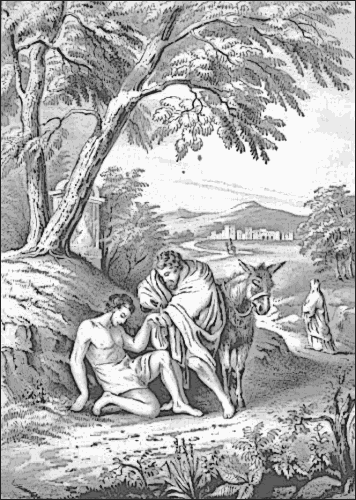
The answer to poverty in our lifetime is not government. It is not voting for someone who will make us feel better about the situation. It is not the vicarious experience of giving offered by paying a little more taxes. This type of arm’s length indifference is much like the behaviors of the priest and the Levite who had each passed a man lying on the road.
This man, a Samaritan, had been accosted by robbers, leaving him penniless. Both priest and Levite were well versed in the rules and regulations that governed their lives. They both acted out of those rules and regulations and not out of love. They both gave at the office.
Progressives like to think of themselves as Good Samaritans and yet they vote like how the priest and Levite responded – this problem is beyond me, the system should fix this.
Giving is meant to be a one-on-one intimacy – the poor are to be helped directly. The answer is personal involvement. In doing so, both parties benefit and, more importantly, God, not government, is honored.
We are told in Scripture that we are to do our giving in secret. The right hand should not know what the left hand is doing. Yet, we have politicians on the Left (hand) and social gospel gurus who publicly demand that government be the arbiter of who is poor and the benefactor to the poor. They take great pride in their social justice message. It is their platform.
It is common among progressive voters to look for deep pockets and then to vote in politicians who will enact laws and regulations which will divest those pockets of wealth in order to provide for the poor (basically, everyone not rich). This is wealth redistribution and it is at the heart of ‘been-there-done-that’ socialism.
Many college kids (taking worthless courses) and liberal college professors (those unable to find real jobs) voted for Obama because of his campaign rhetoric calling for wealth redistribution. Class warfare has become a war cry of the progressive voter – pitting one group against another. This is not Christ. This is not being a Good Samaritan. This behavior is more akin to Pharisee-ism than anything else. Pretense veils the eyes of many in this group of voters.
Common sense should tell you that with less government there is less need for tax money. And, with less tax money being taken out of your pocket there is more money left for you to give to the poor. But, undoubtedly, it is human nature to submit to the group thinking of socialism rather than to act individually. It is also human nature to want someone else to be responsible for a problem and for us to look good applying ourselves to that end. In other words, we, like the Levite in the Good Samaritan story, tend to be Pharisaic by staying away from the problem, letting others become involved directly.
If you want to help the poor then look around you. Get involved with your neighbors. Get off your ass (see the Good Samaritan parable for more detail), stop texting ‘socialisms’ to your buddies and do the best thing for the poor – give of yourself.
*****
Liberalism is a parlor game, where one, for a small stipend, is allowed to think he is aiding starving children in X or exploited workers in Y, when he is merely, in the capitalist tradition, paying a premium, tacked on to his goods, or subtracted from his income, for the illusion that he is behaving laudably (cf. bottled water).
David Mamet from his book The Secret Knowledge: On Dismantiling of American Culture
September 8, 2011 Leave a comment
Looking over the strata of my life, I can see very clearly now that growing up I had an Old Testament (OT) view of life. Early on I began to indoctrinate myself with lists of things which were not right for a person to do. If I erred, which I often did, then subsequently I would receive in my conscience the requisite judgment and punishment. Basically, I saw myself as a sinner in the hands of an angry God. My life was abundant with shame and lacked mercy toward myself or others. My thoughts on the rightness of capital punishment fell in line with this uncompromising understanding of my sinful self and the judgment I deserved. I thought, “An eye for an eye? So be it. It is just.” But now, though I continue to be politically and socially conservative, I have since changed my view on this life and death matter.
A lot of my early misconceptions about God and the balance sheet I thought that he kept came from my own projections onto God, my father’s own upbringing being infused in me and from the churches we attended.
My father was raised in a strict Dutch Christian Reformed home. He knew even more shame and punishment under his father’s iron rule of their home. My dad’s family dutifully attended a Dutch Christian Reformed Church (CRC) situated at the end of their street. The church’s moral code was much like River City, Iowa’s morally proper society as portrayed in the musical The Music Man. Movies, dancing, pool halls were all considered taboo. Sunday was considered the Sabbath and no work was to be performed on that day. Unlike River City, Iowa though, drinking, smoking pipes, cigars and cigarettes were openly enjoyed right after the church service.
In his twenties my father broke away from the Dutch Christian Reformed Church and started attending a Baptist church in the Andersonville area in Chicago. He soon met my mother at this church. They married and later attended the Moody Bible Institute together. I was born while they were students.
Over the years our family attended a Baptist/Bible church. There were still OT rules and regulations but the boisterousness of the Baptist church (as compared to the almost absolute silence of the Reformed church service) sounded merciful and more accepting of one’s sins and foibles. To redeem yourself from destruction, there were the constant pleas from the pulpit to walk the aisle and to repent of your sins or to come forward and rededicate your life to Christ or to come forward and vow to become a missionary. Those were the options I remember. Dealing with personal shame and guilt, the inner man, never seemed to be on the agenda. But, knowing your Bible in and out and cover to cover was on the program. And, in those days, talking about the Holy Spirit was almost taboo. Everything still had to be done decently and in order, every jot and tittle of your life was parsed against the black and white of the Scriptures.
I am thankful that my dad walked away from the Dutch CRC and not from the Lord. I am thankful for the grace and mercy he has shown to me. My father never acted in anger or in harsh judgment of me.
I am thankful for some of the time I spent in the Baptist church and for my immersion in the Scriptures. It was in the Baptist church as an eleven year old that I believed and called Jesus my Lord. I was baptized not long afterward. But I too would later walk away from what I had been brought up in to look for more grace and mercy, to look for the REAL and not the pretentious. In my case, a load of sinfulness and a sense of reckoning ever mounted. Walking down the aisle of a church was fruitless exercise. Over time, though, I found these two paramours, grace and mercy, in a close relationship with the Lord. And, I found my REAL self by taking the Eucharist every week.
My intimate relationship with Jesus was born out of a lot of personal suffering. Some of the pain came out of my own sin and folly and some of it came Job-like out of the blue. I have incurred some major crippling losses in my life including the death of a child. I realize now that some of those hard times were acts of mercy – losing what was precious to me at the time but not losing everything as I rightly deserved. These and other losses helped me to see that mercy and grace were always there with me. And because the weight of what I was dealing with was so enormous I could finally feel God’s hand beneath me. With this safety net underneath I began to cast out my fear. I was able to give up my sin, my shame and my anger. I began to have mercy on my self and toward others. All of this past reflection brings me to my current view of capital punishment: no capital punishment, no death penalty.
Without going into balance sheet retribution or what’s owed to society or to the victim’s rights or into capital punishment as a crime deterrent or into the enormous cost of operating the penal system I simply believe that every person should be shown mercy, whether they are in the womb (the most innocent) or on death row (the most guilty).
Mercy is not the absence or negation of justice. Mercy is the outcome of justice which acknowledges the wrong-doing before both parties (the perpetrator and the victim) and demands retribution. But instead of giving the criminal what he fully deserves mercy, instead, hands the perpetrator the noose of time.
“Surely goodness and mercy shall follow me all the days of my life.” I believe these OT words from Psalm 23 accord with a New Testament (NT) response to man’s violence against his brother: a perpetrator of a crime and the victim may both find goodness and mercy if they turn to God’s Truth – Jesus Christ. The eye for eye retributive justice of the Old Testament has been replaced by a NT call to a relationship with Jesus Christ: goodness and mercy incarnate.
The Sacrifice of Jesus on the cross showed God’s solidarity with victims throughout all time. Through His sacrifice the power of violence was renounced and the power of love and truth were advocated. But not only has the self-giving God shown solidarity with the victims but He invites the perpetrators into the same divine circle of love with the victim. He does not abandon the godless to their evil. “Christ died for the ungodly, the Just for the unjust.” He has loved our enemies when we could not. In a divine relationship with Him we are able to show mercy, repeated mercy and mercy again.
A life sentence should be given for a heinous crime such as murder. Life in prison would be a just sentence. It would allow for the possible redemption of the murderer. We don’t know whether a murderer will repent when he is given a life sentence but we do know from Scripture that the same goodness and mercy which follows you and me all the days of our lives also follows him all the days of his incarceration. Giving a murderer a life sentence is merciful. Time is mercy for the condemned. I now see capital punishment as being opposed to the Cross and the act of mercy
Two thousand years ago, two thieves, one on each side of Jesus, received capital punishment for their crimes. One repented. One did not. The onlookers and the victims and accusers of the thieves had also been followed by the same goodness and mercy as were the thieves. And like the thieves they would also have to decide where they stood in relation to the Cross of Christ. So would Barabbas. Time as mercy would tell.
*****
The ‘new’ “Eye for an eye” justice:
“For you will be treated as you treat others. The standard you use in judging is the standard by which you will be judged.”
Jesus as recorded Matthew’s gospel (7:2)
“So what makes us think we can escape if we ignore this great salvation that was first announced by the Lord Jesus himself and then delivered to us by those who heard him speak?”
The writer of Hebrews (2:3)
The quality of mercy is not strain’d,
It droppeth as the gentle rain from heaven
Upon the place beneath. It is twice blest:
It blesseth him that gives and him that takes.
Portia in The Merchant of Venice
Shakespeare
August 20, 2011 Leave a comment
You might think from the recent spate of atheist best-sellers that belief in God has become intellectually indefensible for thinking people today. But a look at these books by Richard Dawkins, Sam Harris, and Christopher Hitchens, among others, quickly reveals that the so-called New Atheism lacks intellectual muscle. It is blissfully ignorant of the revolution that has taken place in Anglo-American philosophy. It reflects the scientism of a bygone generation rather than the contemporary intellectual scene.
That generation’s cultural high point came on April 8, 1966, when Time magazine carried a lead story for which the cover was completely black except for three words emblazoned in bright red letters: “Is God Dead?” The story described the “death of God” movement, then current in American theology.
But to paraphrase Mark Twain, the news of God’s demise was premature. For at the same time theologians were writing God’s obituary, a new generation of young philosophers was rediscovering his vitality.
The complete article here:http://www.christianitytoday.com/ct/2008/july/13.22.html?paging=off
For more information: http://www.reasonablefaith.org/site/PageServer
August 14, 2011 Leave a comment
In his book People of the Lie: The Hope for Healing Human Evil, Dr. M. Scott Peck writes in the chapter The Encounter with Evil in Everyday Life that
“The issue of naming (evil) is a theme of this work. It has already been touched on in diverse instances: science has failed to name evil as a subject for scrutiny; the name evil does not appear in the psychiatric lexicon; we have been reluctant to label specific individuals with the name evil; in their presence, therefore, we may experience a nameless dread or revulsion; yet the naming of evil is not without danger.
To name something correctly gives us a certain amount of power over it. Through its name we identify it. We are powerless over a disease until we can accurately name it…The treatment begins with its diagnosis. But is evil an illness? Many would not consider it so. There are a number of reasons why one might be reluctant to classify evil as a disease. Some are emotional. For instance, we are accustomed to feel pity and sympathy for those who are ill, but the emotions that evil invoke in us are anger and disgust, if not actual hate…
Beyond our emotional reactions, there are three rational reasons that make us hesitate to regard evil as an illness…I shall nonetheless take the position that evil should indeed be regarded as a mental illness.”
Dr. Peck goes on to discuss the three reasons. I will use summary quotes.
“The first holds that people should not be considered ill unless they are suffering pain or disability – that there is no such thing as an illness without suffering….it is characteristic of the evil that, in their narcissism, they believe that there is nothing wrong with them, that they are psychologically perfect human specimens…For we realize that their inability to define themselves as ill in the face of overwhelming evidence to the contrary is actually part of the illness itself…The use of the concept of emotional suffering to define disease is also faulty in several other respects. As I noted in The Road Less Traveled, it is often the most spiritually healthy and advanced among us who are called on to suffer in ways more agonizing than anything experienced by the more ordinary. Great leaders, when wise and well, are likely to endure degrees of anguish unknown to the common man. Conversely, it is the unwillingness to suffer emotional pain that usually lies at the root of emotional illness. Those who fully experience depression, doubt, confusion and despair may be infinitely more healthy than those who are generally certain, complacent and self satisfied. The denial of suffering is, in fact, a better definition of illness than its acceptance.
The evil deny the suffering of their guilt – the painful awareness of their sin, inadequacy and imperfection – by casting their pain onto others through projection and scapegoating. They themselves may not suffer, but those around them do. They cause suffering. The evil create for those under their dominion a miniature sick society.”…
Finally, who is to say what the evil suffer? It is consistently true that the evil do not appear to suffer deeply. Because they cannot admit to weakness or imperfection in themselves, they must appear this way. They must appear to themselves to be continually on top of things, continually in command. Their narcissism demands it…
Think of the psychic energy required for the continued maintenance of the pretense so characteristic of the evil!…”
“I said that there are two other reasons one might hesitate to label evil as an illness…One is the notion that someone who is ill must be a victim….One way or another, to some extent, all these people (the evil) and a host of others victimize themselves. Their motives, failures and choices are deeply and intimately involved in the creation of their injuries and diseases….
The final argument against labeling evil an illness is the belief that evil is a seemingly untreatable condition…It is the central proposition of this book that evil can and should be subjected to scientific scrutiny…It would, I believe, be quite appropriate to classify evil people as constituting a specific variant of the narcissistic personality disorder.”
Dr. Peck goes on to describe this variant of personality disorder:
“In addition to the abrogation of responsibility that characterizes all personality disorders, this one would specifically be distinguished by:
(a) consistent destructive, scapegoating behavior, which may often be quite subtle.
(b) excessive, albeit usually covert, intolerance to criticism and other forms of narcissistic injury.
(c) Pronounced concern with a public injury and self-image of respectability, contributing to a stability of life-style but also to pretentiousness and denial of hateful feelings or vengeful motives.
(d) Intellectual deviousness, with an increased likelihood of a mild schizophrenic-like disturbance of thinking at time of stress.
…
But there is another vital reason to correctly name evil: the healing of its victims.”
*****************
I have encountered some distinctly evil people during my life. The common characteristic of their personality is the veneer of pretense with which they surround their lives. They see themselves in a role, a grandiose, high-minded role. There is nothing within themselves or outside themselves that will keep them from holding that image up before themselves or others. They will deny, blame and ignore what every one else can clearly see. Their motivation, as Dr. Peck describes in the above chapter, is fear.
Jesus said, “If the light in you is darkness how great is that darkness.”
Jesus’ perfect love can cast out fear…and evil.
July 22, 2011 2 Comments
Don’t hold grudges. I’ve known several people, mostly women, who’ve held a grudge against someone for years. They never relinquish their anger, they never forgive, they never reconcile. They just hold on to their anger because it feels safe and powerful to be angry. But, if you have ever prayed the Lord’s Prayer then you are asking to be forgiven in the same way that you have forgiven (or not forgiven) others. Don’t hold grudges because grudges hold you hostage and they keep others out of your ever shrinking world.
Learn to say, “I’m sorry.” Admit you were wrong. “I’m sorry. Forgive me. I was wrong.” Don’t ever apologize with a blaming apology: “I’m sorry but I did it because you…” I don’t know how many times someone has done this to me. I realize that it is not a true apology but the person’s pride which is speaking. A true apology requires humility. Don’t blame others in your apology. Make your apology by stating what you did wrong. Ask for forgiveness and then shut up.
Face your fears. What’s bugging you? What’s gnawing at your insides causing you to bite your fingernails, drink excessively, spend compulsively and complain incessantly? What are you afraid of? Spell it out on paper. Tell yourself the worst that could happen and prepare for that. Then, get on with your life knowing that the worst that can happen will be dealt with at that time. Keeping your fears alive might make you feel alive but your body, your wife and your friends will bear the brunt of your worry. Face your fears and decide what you will do proactively to address them.
Learn to adapt. Life is hard. Life will throw curve balls at you. Find ways to adapt to change. Expect change and see it as a challenge given to you by God to grow thereby. Sometimes you need new soil to make growth happen. Don’t be afraid. Get on with your life, welcome the opportunity and grow. Change makes goals and desires all the more defined and dearer. I’ve learned, duh, that God knows the beginning from the end. He is already where I am going. He knows my desires. He knows what I want without saying a word. He’s making things happen for my benefit.
Be open-minded. The fact that you are only human should be enough notice to you that you don’t have all the facts. You are not omniscient. Be ready to receive new information, ask questions and listen to others. This will help you discern whether you believe in only half-truths. You want the whole truth. You should be seeking the whole truth in every situation and not something which only fits your politic. Be teachable. Jesus said The meek shall inherit the earth.
Don’t complain. I know someone who has worked for a company for over twenty years. This guy complains about his boss and how his boss handles things. This guy believes that he knows better than his boss how to run things. Every night he comes home to his wife angry and spiteful. He complains to her and to every one he’s in a relationship with. He’s miserable and he wants every one to feel his misery. My guess is that everyone around him is sick and tired of his whining. They wish that he would quit that job and do something with his life other than complain. But, he likes to recycle his misery. It gives him some measure of pleasure. So, his complaining continues. Don’t complain – just shut up.
Be thankful. You don’t deserve anything except to be physically and emotionally safe from harm. Be grateful and not full of grating discontent.
Be courteous. These days more and more people are becoming uncaring, thoughtless and just plain rude. The “rights” revolution is the effect of people becoming more self-absorbed. It has given people a sense that they can do whatever they want whenever they want. Don’t be like them. Be responsible and kind. Be aware of people around you. Turn off the cell phone and the loud music. Be polite and gracious. Be a light in the darkened wasteland of self.
Choose good friends. I don’t have to tell you that bad friends will bring you down. Good friends will be there when things change for the worse or for the better. You don’t need Job’s friends so it might be better to be alone than to have bad friends. I am a lone and waiting for good friends. Mark Twain said, “Be good and you will be lonesome.” Sad, but often true!
Get married when you are young. Marriage is good. For a woman, having children and being a wife and a homemaker is much more fulfilling than having a career. Don’t waste your time trying to become something in the business world. This kind of nonsense is just rotten leftovers from the feminist movement. Many people including parents have bought into this notion. This movement thought that if you were equal with men in the workplace and careers you would be complete as a woman and be a success Well, your body, your heart and your soul know differently. If you have a high school sweetheart and you are both in love and committed to having sex only after marriage I say then, marry right after high school. If you wait and marry someone at, say, 28 or 30 by then habits, mainly bad ones from living a single lifestyle, are already ingrained and are very, very difficult to work with. Marry early and grow together. Each of you will change over time and become different people. This is a fact of life. But this won’t matter if you choose love and commitment over self-interest, if you choose adaption and not abortion of your love.
Love is learned. Love doesn’t just happen. Love takes a lot of trial and error and lot’s of hard work. Love is kind, gentle and patient. The hottest fires of passion happen when you have acted in love toward your wife or husband. Love offers itself without asking for anything in return. Love does what is best for the other person. It is not selfish. It doesn’t seek its own way. This is the opposite of what the world tells you. Be aware of this.
Sex is good. Sexual relations between a man and a woman in a committed relationship is wonderful. Outside of this boundary sex becomes an animal reflex and diminishes your sense of self, your humanity. It becomes a cheap thrill.
Give. Give freely. Don’t hold back. This pleases your Father in heaven.
God is not going to do what you can do already. You can ask God for wisdom but if God has given you wisdom already then don’t ask again hoping to get a different answer. You can ask for courage to do what you know. God will bring you through circumstances that will either produce courage/character in our lives or it will produce a stubborn rebellion. It’s your choice. Just know that God has given you liberty to decide what response you will have. Be ready to accept the consequences of your bad response.
Life is short, choose wisdom. Your body, your bank account and your buddies will be thankful you did.
We are family, blood, and we take care of each other. ‘nuf said.
Ask dad. In any situation, when you don’t know which way to go, ask your father. He’s come a long way and he knows the territory.
“When I was a boy of fourteen, my father was so ignorant I could hardly stand to have the old man around. But when I got to be twenty-one, I was astonished at how much the old man had learned in seven years.” (often attributed to Mark Twain)
“It is a wise child that knows its own father, and an unusual one that unreservedly approves of him.” Mark Twain
Trust God with all your heart. He knew you before you were born.
Pray. Let your every breath and every heartbeat become a prayer.
July 18, 2011 Leave a comment
“Given the trials that beset our nation and world, from the global economic downturn to natural disasters, the lingering danger of terrorism and continued debasement of our culture, I believe it is time to convene the leaders from each of our United States in a day of prayer and fasting, like that described in the book of Joel,” Gov. Perry said. “I urge all Americans of faith to pray on that day for the healing of our country, the rebuilding of our communities and the restoration of enduring values as our guiding force.”
Governor Rick Perry



 Cindy Wity
tête-à-tête
October 8, 2011 Leave a comment
Though I am a political and social conservative with a strong libertarian streak I often read the opposition’s pabulum in order to discern whether I am holding on to what is good. This deliberate questioning of my conservatism has helped me to further understand my own ideology and has helped put into contrast the false thinking that is prevalent today, most notably found in liberalism, progressivism and atheism.
It should be noted here that I came to my understanding of my conservatism/libertarianism through my own reading (early on, Milton and Rose Friedman’s book Free to Choose) and by listening to programs such as Firing Line with the likes of William F. Buckley Jr.. My conservative ideology, as I told my attorney recently, is not the result of my viewership of FOX news. FOX News only highlights what I already know to be true and false.
An aside: My attorney who is a Democrat once told me how he picks jurors for his accident injury trials: The attorney asks perspective jurors if they watch FOX News or listen to Rush Limbaugh to determine if they are Republicans or Democrats. He pejoratively calls such Republicans “Rush Limbaugh Republicans”. The reason for his disdain of these Republicans: he said that most Republicans believe in torte reform and ridding the courts of frivolous lawsuits. My attorney won’t pick them to be a juror. They would likely vote against a substantial injury award. Ergo, my attorney wouldn’t win enough money for his client or himself (usually 40% take of the award compensation)
My attorney didn’t describe the Democrat jurors. He left me to believe that they were the opposite of Republicans with regard to willingness to make someone pay out. Many attorneys are liberal Democrats (including their well-known lobbyists Obama, Eric Holder, Rahm Emmanuel, etc.). Many of these attorneys use frivolous lawsuits to make a living. They are called the “ambulance chasers” (or, in Obama’s and Emmanuel’s case, the “crisis chasers”).
I let my attorney know that I did watch Fox News but that I didn’t listen to Rush Limbaugh, Jon Stewart or to Bill Maher. I told him I was my own conservative: I related to him that I was a William F. Buckley Jr.-Milton Friedman-Neal Cavuto-Christian conservative. I wasn’t bought by what money I could weasel out of someone’s pocket. (BTW, as a Conservative I am not against accident lawsuits, only injustice.)
That aside, beyond my own research into political ideology, economics and morality, in school I also studied economics, finances, accounting and business among other related courses. These studies helped me see that free market enterprise and capitalism creates the most opportunities and the most wealth for everyone. And, that charity is both what you have to give (maybe a widow’s mite) and the desire to give.
My belief in God came through my reading of the Bible and, specifically, the eyewitness accounts recorded therein. The historically factual account of Jesus’ life, death and resurrection as recorded in the Gospels was sufficient proof for me.
I am currently reading two books: essays by Christopher Hitchens in a book titled Arguably, copyright 2011, and The Thomas Sowell Reader, copyright 2011.
Christopher Hitchens is a well-known left-winger and atheist, born in England and living in America. He became an American citizen in 2007. He is a contributing editor to Vanity Fair, Slate and The Atlantic. His books include, among many, Thomas Jefferson: Author of America and God is not Great: How Religion Poisons Everything.
I am reading Hitchens’ book even though I do not agree with his positions on most issues and most decidedly his atheism. His pronouncements against the fascism of Islam I do agree with. I do like his breadth of knowledge in literature and his love of the English language. I enjoy his way of writing and his way of stating things. And, as I read I do make marginal notes wherever I disagree with his thinking. As a writer I continue to learn a lot about the art of essay writing from Hitchens.
Here is a blurb about Hitchens’ book, ARGUABLY, from the Richard Dawkins Foundation website:
Regarding this blurb, while I would certainly disagree with the relevance of Karl Marx as an answer to anything I would agree with what is said about Hitchens’ art. It is a product of one of the greatest living essayists in the English language.
About Christopher Hitchen’s athesim, I believe that those who are most adamantly opposed to knowledge of God are often those who are the closest to the Truth, as was the case of another profound English writer and apologist, C.S. Lewis. Lewis was an atheist turned agnostic turned believer. Lewis’s writings are characterized by a lightly carried erudition, critical thinking, psychological insight, humor and sympathy.
It is my prayer that Christopher Hitchens will someday soon come “kicking and screaming into the Kingdom of God” just as Lewis, a reluctant convert. (Update: Hitchens died recently.)
Christopher Hitchens currently has throat cancer. He has difficulty speaking and certainly cannot lecture. From a lover of the English language perspective, this throat business must give him great pain and a deep sense of loss. Pray for him.
Turning to Thomas Sowell’s The Thomas Sowell Reader I find a treasure trove of wonderful essays and articles written by a well read economist, social theorist, political philosopher and conservative Black American. Sowell uses easy to understand commonsense language in his writings. Most would find this book accessible and informative. It is this simplicity which more than anything defines truth and true conservatism. Liberalism, much like in Hitchens’ writing, seeks to overwhelm the reader with its own great knowledge and pompous profundity. Not so with Thomas Sowell. His plain spoken and humble writing speaks louder than any hubris.
Here are some excerpts from a chapter titled The Survival of the Left, from The Thomas Sowell Reader:
I have to get back to my reading… Here’s Christopher Hitchens and William F. Buckley Jr. in conversation.
Rate this:
Filed under C.S. Lewis, Christian character, Christianity, Conservatism, conservative, Culture, Current Events 2011, Education, Human Interest, Liberalism, Life As I See It, Political Commentary, Politics Tagged with academia, Arguably, atheism, Christianity, Christopher Hitchens, conservatism, Left Wing, Liberalism, politics, professors, sociology, The Thomas Sowell Reader, Thomas Sowell