Held
October 26, 2011 Leave a comment
Walking around on Resurrection ground
October 16, 2011 Leave a comment
Jesus, after responding to the Pharisees and teachers of the law regarding a sign of his authority said this:
“When an impure spirit comes out of a person, it goes through arid places seeking rest and does not find it. Then it says, ‘I will return to the house I left.’ When it arrives, it finds the house unoccupied, swept clean and put in order. Then it goes and takes with it seven other spirits more wicked than itself, and they go in and live there. And the final condition of that person is worse than the first. That is how it will be with this wicked generation.” The Gospel of Matthew chapter 12 vs. 43-45
Notice here that everything is “swept clean and put in order”. There is a sense that everything is OK because everything looks so good. In fact, things appear normal. Yet, the home is vacant, not being used for its purpose. It is a shell of a place waiting for life.
The homeowner is not home. Maybe the owner is out living wildly, living the high life. Maybe, he is out being busy helping others or the environment or …
It doesn’t matter where the homeowner is. If the homeowner doesn’t come home, if he doesn’t even look inside he won’t see what is going on inside, he won’t see who or what is living in his home.
You should know that the whole purpose of the Evil One and His minions is to keep you occupied ‘outside’ of yourself so that you never realize what is going on inside. He doesn’t want any meaningful introspection or self-examination. This might lead to a person to seeing their need for Christ. And, without the homeowner’s honest self-reflection the pretense of a normal well-polished life goes on uninterrupted.
While a homeowner is narcissistically occupied with how he looks on the outside instead of reflecting on what is happening on the inside his home is an easy target for vagrants that move in unnoticed. Unbridled chaos is sure to ensue in the home without the homeowner present. This type of “non-resident” homeowner will operate under the guise of a well-controlled “normalcy” and will even use lies and scapegoating to protect that veneer of normalcy.
Martin Buber, a noted philosopher, has said that the malignantly narcissistic insist upon “affirmation independent of all findings.” In other words, they want you to tell them that their house is looking good and that things are normal but don’t dare tell them the rest. These people, these “homeowners”, do not want you to name the problems that you see going on inside. To name it would mean that there is a problem, a defect within the home. Denial by these “homeowners” keeps them at a safe distance away from the problem. And while they are away they chose to be occupied full-time with attention-getting measures well apart from their true unexamined self. This leaves the house “unoccupied, swept-clean and in order”.
Reinforcing the homeowner’s self-valuation of his “property” is the world community with a culture promoting narcissism. Keeping up with the Joneses means more and more external fixes and less and less real home inspections.
Add to that the newest electronic gadgetry which is endlessly sought in order to pacify the mind and to fill our time with endless chatter and noise – anything but to face the drip, drip, drip of our conscience.
The homeowner’s absence can often be accounted for by a prodigal’s lust for secularism and/or atheism and/or a playful agnosticism – anything to keep from being at home alone with the truth.
Consequently, our lives and our country have become vacuums for whatever is “out there” waiting to come in. and, it is the Evil One Who wants to come in to your “home” and put his feet up. He knows that the empty and disillusioned will be out busy doing his bidding seeking to hold it all together, seeking to make the world a better place through pagan ideologies, to rise above the fray of imperfection. He knows that these same people will seek social policies and reforms to dress up the neighborhood, increasing the value of his own “home”
Postmodern man while looking through the windows of his empty clean house searches for something to fill its void. He spots man made rainbows with their promises for self-fulfillment, brotherhood, world peace, etc. He then scurries out to grab hold of those colorful ribbons. But they are empty promises, condensation which evaporates in his hand when he returns home and stands at the threshold of his empty home.
Postmodern man fancies himself as an intellectual above and beyond the simple wisdom and knowledge of the Creator Christ and His Good News of Atonement, the Gospel. Countless verbose posts blather on in confused pagan ideological nonsense. And, pretentious rapid-fire Tweets pretend to be “so knowing” in 140 characters or less. The words come from empty places, filling the space and time given us by the Creator with constant noise and endless chatter. This din blocks out the voice of God. He is calling us home.
In his swept and clean house, modern man often feeds his self-pity with promiscuous self-serving behavior. He papers the walls of his empty house with tattoos – banners testifying to the past demons that have lived there. He is lord of his manor or is he?
Turning to main point of this post, sadly, many Christians are standing outside their homes. They are compromised. And, many churches teach about a kind and compassionate Jesus but not about the fire and the sword Lord Jesus Christ. Many people, Christian and non-Christian “homeowners”, want the Jesus who welcomes them home but not the Jesus who will cast out the demons who are living there.
Because of soft-selling doctrines and the preaching of partial truths via synthetic gospels the person in the pew begins to feel that he, too, can compromise his Christian doctrine-ethics at every turn. He will tell himself (compassionately, of course) that he is only trying to survive and at the same time trying to be socially concerned and accepting about others. These same “followers” of Christ are never told that lukewarm Christians will be spewed out of the mouth of the Lord Jesus Christ and that sexual fornicators do not enter the kingdom of heaven.
As I see it, much of the American church, has lost the touchstone of the Early Christian church creeds and Truth. Many have left behind doctrine in search of Holy Grail social and political reforms hoping to fill the vacancies of our empty “homes”.
Dorothy Sayers, author of the Peter Wimsey mystery novels and Christian apologist would say that we as Christians have a choice: Creed or Chaos? She would say that we must know what the creeds are and what they rightly stand for before we go to battle with the pagan world. She notes that we as Christians are in a war of dogmas. Only, the pagan side’s dogma is termed “ideology”.
I am praying for a revival in this country. Revival will begin when the early Christian church creeds and dogmas are held to be true by today’s Christian, when the Christian is present to them and to himself. It will happen when Christians pour the foundations of their own homes with the concrete truth of those creeds and the Christian puts his whole weight on those creeds. It will happen when the abundant life brought by the Holy Spirit indwells the homeowner as he stands in his home. Then, from out of this place, as Dorothy Sayers wrote in Creed or Chaos, the Christian may speak to his neighbor about God, man, sin, judgment, matter, work and society.
A swept-clean house is great but of what value is it if no one comes home and is present. And, what else could be living in this empty old house?
October 8, 2011 Leave a comment
Though I am a political and social conservative with a strong libertarian streak I often read the opposition’s pabulum in order to discern whether I am holding on to what is good. This deliberate questioning of my conservatism has helped me to further understand my own ideology and has helped put into contrast the false thinking that is prevalent today, most notably found in liberalism, progressivism and atheism.
It should be noted here that I came to my understanding of my conservatism/libertarianism through my own reading (early on, Milton and Rose Friedman’s book Free to Choose) and by listening to programs such as Firing Line with the likes of William F. Buckley Jr.. My conservative ideology, as I told my attorney recently, is not the result of my viewership of FOX news. FOX News only highlights what I already know to be true and false.
An aside: My attorney who is a Democrat once told me how he picks jurors for his accident injury trials: The attorney asks perspective jurors if they watch FOX News or listen to Rush Limbaugh to determine if they are Republicans or Democrats. He pejoratively calls such Republicans “Rush Limbaugh Republicans”. The reason for his disdain of these Republicans: he said that most Republicans believe in torte reform and ridding the courts of frivolous lawsuits. My attorney won’t pick them to be a juror. They would likely vote against a substantial injury award. Ergo, my attorney wouldn’t win enough money for his client or himself (usually 40% take of the award compensation)
My attorney didn’t describe the Democrat jurors. He left me to believe that they were the opposite of Republicans with regard to willingness to make someone pay out. Many attorneys are liberal Democrats (including their well-known lobbyists Obama, Eric Holder, Rahm Emmanuel, etc.). Many of these attorneys use frivolous lawsuits to make a living. They are called the “ambulance chasers” (or, in Obama’s and Emmanuel’s case, the “crisis chasers”).
I let my attorney know that I did watch Fox News but that I didn’t listen to Rush Limbaugh, Jon Stewart or to Bill Maher. I told him I was my own conservative: I related to him that I was a William F. Buckley Jr.-Milton Friedman-Neal Cavuto-Christian conservative. I wasn’t bought by what money I could weasel out of someone’s pocket. (BTW, as a Conservative I am not against accident lawsuits, only injustice.)
That aside, beyond my own research into political ideology, economics and morality, in school I also studied economics, finances, accounting and business among other related courses. These studies helped me see that free market enterprise and capitalism creates the most opportunities and the most wealth for everyone. And, that charity is both what you have to give (maybe a widow’s mite) and the desire to give.
My belief in God came through my reading of the Bible and, specifically, the eyewitness accounts recorded therein. The historically factual account of Jesus’ life, death and resurrection as recorded in the Gospels was sufficient proof for me.
I am currently reading two books: essays by Christopher Hitchens in a book titled Arguably, copyright 2011, and The Thomas Sowell Reader, copyright 2011.
Christopher Hitchens is a well-known left-winger and atheist, born in England and living in America. He became an American citizen in 2007. He is a contributing editor to Vanity Fair, Slate and The Atlantic. His books include, among many, Thomas Jefferson: Author of America and God is not Great: How Religion Poisons Everything.
I am reading Hitchens’ book even though I do not agree with his positions on most issues and most decidedly his atheism. His pronouncements against the fascism of Islam I do agree with. I do like his breadth of knowledge in literature and his love of the English language. I enjoy his way of writing and his way of stating things. And, as I read I do make marginal notes wherever I disagree with his thinking. As a writer I continue to learn a lot about the art of essay writing from Hitchens.
Here is a blurb about Hitchens’ book, ARGUABLY, from the Richard Dawkins Foundation website:
The first new book of essays by Christopher Hitchens since 2004, ARGUABLY offers an indispensable key to understanding the passionate and skeptical spirit of one of our most dazzling writers, widely admired for the clarity of his style, a result of his disciplined and candid thinking. Topics range from ruminations on why Charles Dickens was among the best of writers and the worst of men to the haunting science fiction of J.G. Ballard; from the enduring legacies of Thomas Jefferson and George Orwell to the persistent agonies of anti-Semitism and jihad. Hitchens even looks at the recent financial crisis and argues for the enduring relevance of Karl Marx. The book forms a bridge between the two parallel enterprises of culture and politics. It reveals how politics justifies itself by culture, and how the latter prompts the former. In this fashion, ARGUABLY burnishes Christopher Hitchens’ credentials as-to quote Christopher Buckley-our “greatest living essayist in the English language.” (emphasis mine)
Regarding this blurb, while I would certainly disagree with the relevance of Karl Marx as an answer to anything I would agree with what is said about Hitchens’ art. It is a product of one of the greatest living essayists in the English language.
About Christopher Hitchen’s athesim, I believe that those who are most adamantly opposed to knowledge of God are often those who are the closest to the Truth, as was the case of another profound English writer and apologist, C.S. Lewis. Lewis was an atheist turned agnostic turned believer. Lewis’s writings are characterized by a lightly carried erudition, critical thinking, psychological insight, humor and sympathy.
It is my prayer that Christopher Hitchens will someday soon come “kicking and screaming into the Kingdom of God” just as Lewis, a reluctant convert. (Update: Hitchens died recently.)
Christopher Hitchens currently has throat cancer. He has difficulty speaking and certainly cannot lecture. From a lover of the English language perspective, this throat business must give him great pain and a deep sense of loss. Pray for him.
Turning to Thomas Sowell’s The Thomas Sowell Reader I find a treasure trove of wonderful essays and articles written by a well read economist, social theorist, political philosopher and conservative Black American. Sowell uses easy to understand commonsense language in his writings. Most would find this book accessible and informative. It is this simplicity which more than anything defines truth and true conservatism. Liberalism, much like in Hitchens’ writing, seeks to overwhelm the reader with its own great knowledge and pompous profundity. Not so with Thomas Sowell. His plain spoken and humble writing speaks louder than any hubris.
Here are some excerpts from a chapter titled The Survival of the Left, from The Thomas Sowell Reader:
Biologists explain how organisms adapt to their physical environment, but ideologues also adapt to their social environment. The most fundamental fact about the ideas of the political left is that they do not work. Therefore we should not be surprised to find the left concentrated in institutions where ideas do not have to work in order to survive.
The academic world is the natural habitat of half-baked ideas, except for those fields I which there are decisive tests, such as science, mathematics, engineering, medicine—and athletics. In all these fields, in their differing ways, there comes a time when you must either put up or shut up. It should not be surprising that all other fields are notable exceptions to the complete domination of the left on campuses across the country…
You might think that the collapse of communism throughout Eastern Europe would be considered a decisive failure for Marxism, but academic Marxists in America are utterly undaunted. Their paychecks and their tenure are unaffected. Their theories continue to flourish in the classrooms and their journals continue to litter the library shelves.
Socialism in general has a record of failure so blatant that only an intellectual could ignore or evade it..
Nor is economic failure the worst of it. The millions slaughtered by Stalin, Mao and Pol Pot for political reasons are an even grimmer reality…
Academia is only one of the places where totally subjective criteria rule—and where leftists dominate.
Sowell goes on to list these “places”: foundations, museums, cultural institutions such as the Smithsonian, the National Endowment for the Arts and the Humanities and taxpayer supported “public” TV and radio.
These endowed and insulated institutions, often full of contempt for the values of American society and Western civilization, are not the only bastions of the left counter-culture. So are Hollywood and Broadway. Although show biz faces the financial need to get an audience, the truth of what they portray is hardly crucial. If they can make it punchy and sexy, then those who complain about historical inaccuracies and ideological bias can be dismissed as irrelevant pedants.
Why are leftists able to crowd out other kinds of people from these places? Because those who are willing to subject themselves to the test of reality, whether as a businessman in the marketplace or as surgeon in an operating room, have many other places to work and live.They do not need special sheltered niches in which to hide and to cherish their precious notions.
Darwinian adaptation to environment applies not only to nature but also to society. Just as you don’t find eagles living in the ocean or fish living on mountain tops, so you don’t find leftists concentrated where ideas have to stand the test of performance. (emphasis mine)
I have to get back to my reading… Here’s Christopher Hitchens and William F. Buckley Jr. in conversation.
October 4, 2011 Leave a comment

Below are some excerpts from a brief article about education, books vs. TV, imagination, home schooling and preserving what’s good in a civilization. The article provides a great prescription for a child’s education. Two of my children were home schooled for several years, so I know from experience the author’s point of view.
The article begins with the author asking “Are you ever afraid that home schooling your kids will make them, um, oddballs?” As parents we asked ourselves the same question and we found the answer to be a resounding “No.”
I have heard people tell me that children who are home schooled lack social interaction. That is absolute nonsense. What you do as a home schooler is to find other parents who are doing the same thing and then just let the kids relate. You go on field trips and do a lot of fun learning activities which include science, music, sports and drama. And, there is plenty of support out there for anyone who wants to home school their child.
From Touchstone Magazine:
Mark T. Mitchell on the Oddity of Giving Children a Moral Imagination
Will your kids be raised primarily on books or on television? To put it another way: Will your children be educated in a logocentric environment, where the written and spoken word is the primary conveyer of meaning, or will they ingest most of their information through electronically generated images?
Now, of course, emphasizing books over television is not the entire story, for books vary in quality and there are plenty of books that cultivate misshapen virtues and a cynical view of life. But I think it is safe to say that parents who make the effort to emphasize books as a way of life will generally be those who have been powerfully moved by books themselves. They have experienced the wonder and joy and goodness of certain books and will introduce these to their children even as one introduces a family member to a much-loved friend.
But setting the content of the books aside (for only a moment), those whose minds are shaped by an ongoing encounter with language will develop mental habits that include patience, perseverance, the ability to think abstractly, and an imagination that does not require the constant stimulation of external images. The imagination of the reader (guided by the author) creates the images, whereas the child raised on television merely imbibes what has already been fully rendered by the camera.
More than Rules
There are two facets to educating a child well. The first is to recognize that education is not merely the accumulation of facts, but that it has an unavoidably moral aspect. A suitable education must do more, therefore, than simply teach facts, even moral facts. Education must seek to cultivate the moral imagination of the child, for reducing moral education to a list of rules is bound to fail…
But if our children are raised primarily on visual images, if they do not cultivate the mental disciplines necessary to access truth via language, then the Holy Scriptures will remain opaque, the creeds and confessions of faith will be meaningless recitations, and hymn lyrics will be merely pleasant-sounding rhymes to accompany occasionally pleasant-sounding music.
While the ultimate aim of education is to cultivate the souls of children toward godly virtue, a secondary but related end is the preservation of civilization…
stewards of our civilization must possess well-cultivated language faculties capable of grasping complex and abstract ideas and concepts.
Normal Children Needed
If a proper education is to accomplish or at least to seek to accomplish these tasks, then a normal child is one whose moral imagination is well formed, whose soul is oriented toward a love of logos and the Logos, and who knows and loves the best of his own civilization. Such a child will, perhaps unwittingly, become a steward of the good, the true, and the beautiful. In a world where normal is considered odd, such children are desperately needed.
Mark T. Mitchell teaches political theory at Patrick Henry College in Virginia. He is the co-founder of Front Porch Republic.
Read more: http://www.touchstonemag.com/archives/article.php?id=22-07-014-v#ixzz1ZpTpK4sP
September 27, 2011 Leave a comment

I have often returned to the eyewitness account of Jesus walking on the water and of Peter’s eager attempt to do the same. I do so especially when I am not sure about my next step.
It is an unusual account not only because the rules of physics were usurped but also because Jesus is meeting the men in the midst of their daily work.
Peter and the others made their living as fisherman. Everything they needed depended on the day’s catch. The families of these men and the markets were waiting at home. So come hell or high water they would go out on the Sea of Galilee trawling for fish.
One night hell and high water came –a fierce storm suddenly arose. Their small fishing boat was buffeted by the wind and the waves. The sail was useless and rowing had become impossible. Their whole effort was used to keep an even keel so as not to capsize and lose their nets in the process.
In the rain-swept darkness there suddenly walked a figure – a man walking on the water towards them. Perhaps, they thought, it is a ghost. No one in their right mind would be out in this weather and certainly not for a stroll on the sea. This did not bode well for superstitious fishermen.
During a streak of lightning, perhaps, Peter thinks he recognizes the profile of Jesus. At this point Peter might have said to himself, “Jesus! Jesus is not safe. He’s way out on the deep end. Walking on water just might be another one of those “Jesus things’ that keep you guessing. But, my gut tells me to go with it for now.”
Out of the gale comes a voice, “Take courage! It is I.Don’t be afraid.”
So Peter yells, “Lord, if it is you, tell me to come to you on the water.” And Jesus said “Come!”
Peter stood up in the small boat almost tipping it over. Unsteady, heart racing, he grabbed the hull with one hand and lifted his right leg out of the boat. He put his right foot down on the water. His foot made no hole in the water. He slowly shifted his balance and brought his left leg out of the boat. Peter stood on the substance of things not seen. He straightened up and looked over at Jesus. The storm was still raging behind the apparition-turned-Apotheosis.
Yet, in an instant the full weight of Peter’s reason, creating a confluence of fear, opened the sea below him like a watery trap door. He sank down into water over his head.
Treading in the choppy waters as best he could, Peter cried for help, “Lord, save me!”
Jesus caught hold of Peter’s hand and pulled him up. While holding Peter’s hand and looking Peter square in the eye (I can only imagine.) Jesus said, “You of little faith, why did you doubt?”
“And when they climbed into the boat, the wind died down. Then those who were in the boat worshiped him, saying, “Truly you are the Son of God.” “
Hoisting the sail, Peter and the crew got back to the business at hand – making a living from being gut sure of what they hoped for and being more certain of what they did not see – fishing.
The eyewitness account that relates Peter’s story is recorded in Matthew’s Gospel (14:22-33)
September 17, 2011 Leave a comment
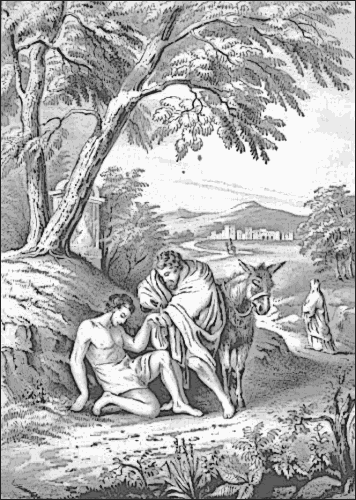
The answer to poverty in our lifetime is not government. It is not voting for someone who will make us feel better about the situation. It is not the vicarious experience of giving offered by paying a little more taxes. This type of arm’s length indifference is much like the behaviors of the priest and the Levite who had each passed a man lying on the road.
This man, a Samaritan, had been accosted by robbers, leaving him penniless. Both priest and Levite were well versed in the rules and regulations that governed their lives. They both acted out of those rules and regulations and not out of love. They both gave at the office.
Progressives like to think of themselves as Good Samaritans and yet they vote like how the priest and Levite responded – this problem is beyond me, the system should fix this.
Giving is meant to be a one-on-one intimacy – the poor are to be helped directly. The answer is personal involvement. In doing so, both parties benefit and, more importantly, God, not government, is honored.
We are told in Scripture that we are to do our giving in secret. The right hand should not know what the left hand is doing. Yet, we have politicians on the Left (hand) and social gospel gurus who publicly demand that government be the arbiter of who is poor and the benefactor to the poor. They take great pride in their social justice message. It is their platform.
It is common among progressive voters to look for deep pockets and then to vote in politicians who will enact laws and regulations which will divest those pockets of wealth in order to provide for the poor (basically, everyone not rich). This is wealth redistribution and it is at the heart of ‘been-there-done-that’ socialism.
Many college kids (taking worthless courses) and liberal college professors (those unable to find real jobs) voted for Obama because of his campaign rhetoric calling for wealth redistribution. Class warfare has become a war cry of the progressive voter – pitting one group against another. This is not Christ. This is not being a Good Samaritan. This behavior is more akin to Pharisee-ism than anything else. Pretense veils the eyes of many in this group of voters.
Common sense should tell you that with less government there is less need for tax money. And, with less tax money being taken out of your pocket there is more money left for you to give to the poor. But, undoubtedly, it is human nature to submit to the group thinking of socialism rather than to act individually. It is also human nature to want someone else to be responsible for a problem and for us to look good applying ourselves to that end. In other words, we, like the Levite in the Good Samaritan story, tend to be Pharisaic by staying away from the problem, letting others become involved directly.
If you want to help the poor then look around you. Get involved with your neighbors. Get off your ass (see the Good Samaritan parable for more detail), stop texting ‘socialisms’ to your buddies and do the best thing for the poor – give of yourself.
*****
Liberalism is a parlor game, where one, for a small stipend, is allowed to think he is aiding starving children in X or exploited workers in Y, when he is merely, in the capitalist tradition, paying a premium, tacked on to his goods, or subtracted from his income, for the illusion that he is behaving laudably (cf. bottled water).
David Mamet from his book The Secret Knowledge: On Dismantiling of American Culture



Where Do You Start?
November 11, 2011 Leave a comment
A Tale of Two Foot Races
Race Number One:
Eight men enter a race. They are roughly about the same height and weight but come from very different backgrounds. The eight men enter the race knowing that there will only be one winner. It was for this outcome that they had prepared themselves with rigorous discipline during the past four years.
Months prior to the track meet the eight men are told of the rules: A runner must run in qualifying heats. If the runner is successful in those heats the runner will then be allowed to compete in the final race with the other qualifying runners; a runner who jumps the gun twice at the starting line will be disqualified as having a “false start”; the commands “Ready”, “Set” and a gun shot will be used by a track official to start the race fairly; each runner must stay in his lane or he will be disqualified; runners will be timed and the first runner to cross the finish line will be the winner of the race.
The runners all agree and sign off on the rules before the race.
On the day of the race, after running in the heats, the eight qualifying runners come to the starting line. They know that they must run straight ahead in their own lane to reach the one-hundred meter line. They know that if they jump the gun twice they will be disqualified from running. They know that they must sprint as hard as they can to cross the finish line first. They are knowingly competing for first place. The race before them has now become the culmination of years of exhausting training and dedication to finishing the race and receiving first prize.
When the race is announced the runners shed their sweats and come to the starting line. They will then position their legs into the starting blocks and place their hands stretched just hugging the starting line. Seeing the runners in place behind the line the track official then says, “Ready”. Then after a moment he says “Set”. The runners then come up to a set position waiting for the starting pistol to go off. When it does the eight men jolt from their starting blocks and run down the track as fast as their feet will carry them.
At the finish line the winner is the one who breaks the tape. There is also a second, a third and fourth place finisher. The runners-up congratulate the winner for his speed and, implicitly, for his fidelity to the rules and his commitment to the sport of racing.
The first three finishers receive medals, adulation and wreaths of honor from the thousands who have come to watch a fair race between those who have so vigorously prepared themselves. The experience of the race has bolstered each runner’s self-esteem. The cheering crowd is also moved by each runner’s self-sacrifice, dedication and self-discipline. This spectacle has confirmed the crowd’s understanding of playing by the rules and aspiring to excel within those rules. Everyone who witnessed the race that day is stirred to motion – a motion to go home and try harder.
All eight men later return home. They are now more dedicated than ever to prepare for another day of racing and to receiving the crown of victory.
Race Number Two:
Eight men enter a race. They are roughly about the same height, weight but come from very different backgrounds. The eight men entered the race knowing that everyone will be a winner. It was for this outcome that they saw no need to prepare themselves with rigorous discipline during the past four years. They just had to show up.
Months prior to the race the eight men are told the rules. They are told the rules are subject to change at the time of the race based on the current ad hoc articulated reasoning of one superior intellectual with unquestionable virtue. A runner must run in qualifying heats but this will not be a constraint. Whether or not a runner is successful in those heats he will also be allowed to compete in the final race with other qualifying runners; a runner who jumps the gun twice at the starting line will not be disqualified from running. Instead he will be given another chance; the commands “Ready” and “Set” and a gun shot will be used by a track official to start the race fairly, though any sincere attempt to cooperate with the official will be accepted; each runner must stay in his lane or he will be disqualified unless, of course, their background is such that they have never stayed within the lines; runners will not be timed because such keeping of minutes would be discrimination against slower runners. The first runner to cross the finish line will wait at the finish line so that everyone will be considered a winner of the race. This must be done at any personal cost to the first one crossing the finish line.
The runners agree and sign off on the rules before the race.
On the day of the race all of the runners come to the starting line. They know that they should sincerely try running down to the finish line. There will be prizes and the appreciation of well-wishers to look forward to. They are knowingly going to try for this reason. This race is now the culmination of years of knowing that the battle is just showing up.
When all the runners are in their starting blocks and their hands are behind the starting line the track official then says, “Ready”. After a long moment of reasoned judgment the official says “Set”. The runners come up to set position. When the race official shoots the starting gun the eight men come out of their starting blocks and run down the track as fast as their preparation has trained them.
At the finish line everyone becomes a finisher, even those who left the race due to being out of breath. There are congratulations all around for having showed up to such an event.
At the awards ceremony all the runners receive medals and kudos from the thousands who have come to watch a race between people who have showed up for a race where the outcome was predetermined to be fair – fair as defined by a few judges of superior intellect and of unquestioned virtue.
Later, all the runners returned home and rested from another day of showing up.
*****
A Tale of Two Foot Races: Equal Opportunities vs. Equal Outcomes by Sally Paradise © Sally Paradise, 2011, All Rights Reserved
Rate this:
Filed under capitalism, Christianity, conservative, Culture, Economics, Education, essay, Human Interest, Life As I See It, Life Lessons, Political Commentary, Politics, Progressivism, social commentary, Wisdom, Writing Tagged with conservatives, constrained vision, equal outcome education, liberals, progressives, unconstrained vision