Now the whole world had one language and a common speech. As people moved eastward, they found a plain in Shinar and settled there.
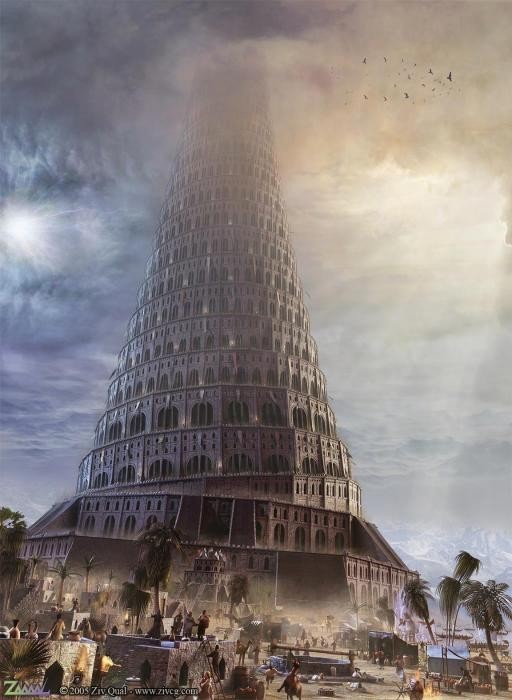
They said to each other, “Come, let’s make bricks and bake them thoroughly.” They used brick instead of stone, and tar for mortar. Then they said, “Come, let us build ourselves a city, with a tower that reaches to the heavens, so that we may make a name for ourselves; otherwise we will be scattered over the face of the whole earth.”
But the Lord came down to see… Genesis 11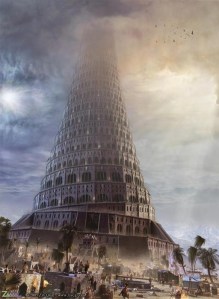
To counter the threat of disintegration and to triumph over insignificance, they build a city and a tower “with its top to the heavens. A single “place”, a single “tongue”, and a single “tower” will provide the pillars for a centralized political, economic, and religious system with universal pretensions. Humanity will be securely unified and great. -Miroslav Volf, Exclusion and Embrace
On the plain of Shinar the whole world acted out of fear. The whole world feared loss of group identity through scattering. They feared the differences that would evolve once “scattering” began. Out of fear the whole world decided that they needed to build a towering edifice as a symbol of their identity and intransience. Out of fear, the whole world acted like the woman who believed that having a child would solidify her identity and her relationship with a guy.
For their One World Project it could be assumed that the people living on the plain of Shinar used clay and straw for their bricks. The plain had stones but they were likely smooth river stones. Shinar translated literally is “country of two rivers”, the two rivers being the Tigris and Euphrates. River stones were not going to work for a towering monument to themselves and for their socialized labor effort. Besides, to achieve structural integrity for both the tower and a One World society, the bricks and the people had to be uniform or be tossed onto the rubbish pile.
We learn from Genesis 10:8-10 that the Land of Shinar was the site of the kingdoms founded by Nimrod. We also learn that the name-making business had already started with Nimrod:
Cush became the father of Nimrod, who was the first on earth to become a powerful man. He was a powerful animal-killer in the eyes of the Lord. So, it is said, “Like Nimrod, a powerful animal-killer in the eyes of the Lord.” The beginning of his nation was Babel, Erech, Accad, and Calneh, in the land of Shinar.
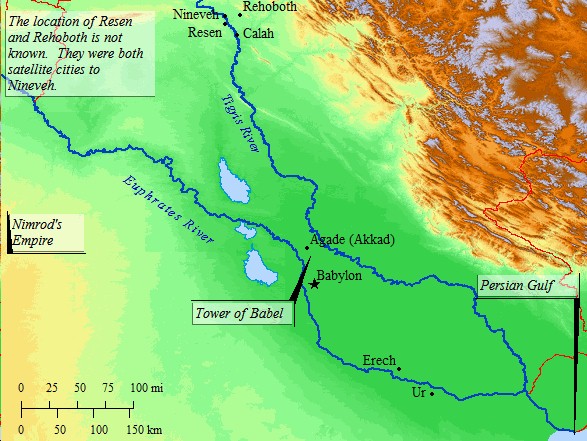
The tower was meant to create a unifying One World name for the people. We never hear of a name later on. Maybe the tower would have been named Nimrod Tower to honor a mighty hunter and self-made man.
The narrator, with tongue-in-cheek, relates “But the Lord came down to see” the finger in His face. In that same narration (Genesis 11:5-9) we learn of a God who is “us”.
Come, let Us go down and mix up their language so they will not understand what each other says.” So the Lord sent them everywhere over the whole earth.
Why would God mix up their language and then scatter the Shinar plain’s people? Well, God earlier had commanded their forefathers (and remnants of the flood judgment) differently:
Then God blessed Noah and his sons, saying to them, “Be fruitful and increase in number and fill the earth. The fear and dread of you will fall on all the beasts of the earth, and on all the birds in the sky, on every creature that moves along the ground, and on all the fish in the sea; they are given into your hands. Everything that lives and moves about will be food for you. Just as I gave you the green plants, I now give you everything. – Genesis 9:1-3
In response to a centralized obstinate hunkering down in disobedience tower building people, God confounds their language. The people are scattered, fear and all.
Scattering (and moving people out of their comfort zones) happens throughout Scripture. In the next chapter of Genesis (12), we read of the beginning of God’s people:
The LORD had said to Abram, “Go from your country, your people and your father’s household to the land I will show you.
Like the remnant theme, the scattering theme is repeated throughout Scripture. The people of God are scattered into exile when they choose other gods and the ways of the world.
When men or a nation hunkers down as an immovable force and starts going vertical with pride and not horizontal in obedience, God scatters. Read Daniel 2. Daniel reveals the king’s dream. The dream portrays the knocking down of the towering kingdoms man has built up and affixed their name to. God scatters the remains.
To be sure, God doesn’t scatter for the sake of scattering. God is good. Listen to the what the prophet Jeremiah wrote (Jeremiah 29) to God’s exiled (scattered) people:
This is the text of the letter that the prophet Jeremiah sent from Jerusalem to the surviving elders among the exiles and to the priests, the prophets and all the other people Nebuchadnezzar had carried into exile from Jerusalem to Babylon.
This is what the Lord Almighty, the God of Israel, says to all those I carried into exile from Jerusalem to Babylon:…
This is what the Lord says: “When seventy years are completed for Babylon, I will come to you and fulfill my good promise to bring you back to this place. For I know the plans I have for you,” declares the Lord, “plans to prosper you and not to harm you, plans to give you hope and a future. Then you will call on me and come and pray to me, and I will listen to you. You will seek me and find me when you seek me with all your heart. I will be found by you,” declares the Lord, “and will bring you back from captivity. I will gather you from all the nations and places where I have banished you,” declares the Lord, “and will bring you back to the place from which I carried you into exile.”
“I will be found by you.” Consider how God, by sending his Spirit, communicates (without towers) the gospel at Pentecost to those who had been scattered. From Acts 2:
There were devout Jews from every nation under heaven staying in Jerusalem at that time. When they heard the noise, they came together in a crowd. They were deeply puzzled, because every single one of them could hear them speaking in his or her own native tongue. They were astonished and amazed
“These men who are doing the speaking are all Galileans, aren’t they? they said. “So how is it that each of us can hear them in our own mother tongues? There are Parthians here, and Medians, Elamites, people from Mesopotamia (the land of Shinar!), Judea, Cappadocia, Pontus, Asia, Phrygia and Pamphylia, Egypt, and parts of Libya that belong to Cyrene; there are people from Rome, proselytes as well as Jews; there are Cretans and Arabs. We can hear them telling us about the powerful things God has done—in our own languages!”
Scattered people come together in Jerusalem for the festival of Pentecost. They hear the Apostles speak in their own native tongue. They hear about “the powerful things God has done” (and not about the powerful hunting of Nimrod). They return home to announce the Gospel – “Jesus is Lord” – in their own tongue. They were filling the earth with the knowledge of God.
Notice in Genesis 9 (above) that the fear of going without has been lifted off of mankind. Mankind has to choose to live in fear. Yet, when we live in fear and act out of fear we make terrible decisions. We become codependent in relationships. We become sexually involved. We overeat. We make monetary demands of others for socialized this and that. We shun others who are not the same as us. We lie. We steal. We kill. We take revenge. We isolate. We hoard. We surround ourselves with the like-minded. We build mega-churches to make a name for ourselves. We become territorial. We become ultra-nationalistic. We spend our days making bricks of straw and clay for a tower that will symbolize our efforts to secure our brick and straw identity.
By scattering and filling the earth with the knowledge of God, God desires to drive out fear from the whole world as each embrace his perfect love for us. And, God makes an endearing name for the scattered – adopted sons and daughters.
By scattering and filling the earth with the knowledge of God, God desires to prosper us as we seek first His Kingdom and not the kingdom of the clay tower. Man’s vertical projects are always redirected into God’s horizontal filling the earth with the knowledge of God.
God knows that our being scattered, redirected and moved out of our comfort zones involves risks of the unknown. But, God is there. Like Abraham, I want to go into the unknown and follow God to where God is working and communicating. Don’t you? That is the only way for us to experience God’s character and His presence. You won’t gain that experience with your head in the clouds at the top of Nimrod Tower.
As people are “fruitful and increase in number and fill the earth” they will find the earth full of God’s love. As the Psalmist wrote (Ps. 33:4-5):
For the word of the Lord is right and true;
he is faithful in all he does.
The Lord loves righteousness and justice;
the earth is full of his unfailing love.
~~~~~
Remember:
“We are to regard existence as a raid or great adventure; it is to be judged, therefore, not by what calamities it encounters, but by what flag it follows and what high town it assaults. The most dangerous thing in the world is to be alive; one is always in danger of one’s life. But anyone who shrinks from that is a traitor to the great scheme and experiment of being.” G.K. Chesterton
~~~~
Scattering appears to be consistent with God’s character. Consider the creation of the universe. The Big Bang unleashed atomic particles which later formed into mass. The universe continued to expand and so did the evolution of species. Pentecost reminded me of another Big Bang, a Kingdom Big Bang.
Consistent with man’s character: tower building with the accumulating and hoarding of mass.
Because the human heart remains the same throughout millennia there is a current political ideology of “a centralized political, economic, and religious system with universal pretensions.” Progressivism is its name and it is based on fear. It is also based on the fear of scattering.
God’s command mankind to “fill the earth” is certainly not a directive for a One World centralized tower top down collectivism.
For Progressivism to be about “Hope and Change” it must first invoke fear: fear of going hungry, fear of medical bills, fear of going bankrupt, fear of having to pay for one’s college tuition, fear of not being accepted, fear of having to care for an unborn child, the fear of being insecure, and fear of an unapproved of group, to mention just a few of the promoted social insecurities. Progressivism’s answer to fear is to centralize, homogenize and to be given totalitarian authority.
For Progressivism to be about hope and change it must reach the heavens. So, it uses the words of a well-being gospel Jesus (aka, a prosperity gospel). When it invokes Jesus, Progressivism can then justify its means to an end. The means can be socialized medicine, socialized income, and socialized well-being all done under totalitarian control.
The ends are to remove differences in income, differences in thought, and differences in morality. Progressivism suppresses differences that do not fit their narrative. Progressivism seeks to homogenize, repress and to pull suckers into its social tar, the mortar holding the clay bricks together. To build their tower of hope the bricks are to be handmade – formed by all the same to be all the same. The bricks are to laid, one on top of another, until they reach the pinnacle of Tower Utopia.
“With this pledge taken, I assume unhesitatingly the leadership of this great army of our people dedicated to a disciplined attack upon our common problems.” – from FDR’s First Inaugural Address
~~~~
The Tower of Babel…
…reminds me of top down centralized government.
…reminds of the high places mentioned in the OT. They were places where false gods were worshipped.
…reminds me of the Eye of Sauron.
Added 8/21/2018, fixating on a problem:
The belief that everything is getting worse paints a distorted picture of what we can do, and makes us more fearful. But while getting the facts wrong – or willfully misrepresenting them – often results in misguided policies, fact-based recognition of what humanity has achieved encourages policies that can achieve the most good. – Bjørn Lomborg “A Better World is Here“








The Case of Mistaken Identity
June 9, 2019 Leave a comment
Recently, I went to my state’s DMV to obtain a Real ID. Starting Oct. 1, 2020, this ID will be required for all domestic commercial flights and to enter Federal facilities requiring identification to enter, such as military bases or nuclear power facilities. The REAL ID Act passed in 2005 establishes minimum security standards for state-issued driver’s licenses and ID cards. The Act refers to federal anti-terrorism laws and regulations that control access. To obtain the Real ID I had to submit several documents that verified my identity and my relationship to the state and federal government and my address.
As important as it is to our federal authority to know who you are to identify any threats to its citizenry, it is vastly more important for us to know who we are in space and time. It is to which authority we submit to that matters with regard to the verification of our identity and to the rights granted to us by that authority. Therein lies the case for mistaken identity.
Modern man has placed himself at the center of the universe as the anthropic cause and reason for existence. Modern man sees himself as the final authority. As such, his identity as self-creator becomes the reference point for all matters of life. What came before, what has been handed down through millennia is of no concern to modern man. Religion, science, family – nothing is as important to modern man as his present tense self-created identity. Enter Identity Politics.
Identity Politics and its, as philosopher Roger Scruton has described it, “culture of repudiation”, are at the forefront of modern man’s renunciation of the past – inherited values, cultural identifications and namesakes. As modern man shakes off the past and its ties to his identity, the need to belong remains.
Here is an excerpt from Scruton’s address, How identity politics destroys freedom, during the Acton Institute’s “Crisis of Liberty in the West” conference :
…we have a craving for membership, which is a deep adaptation of the species, and which presses us always towards the group and the conformity that will protect us. Many young people, under the impulse of this feeling, search for a “conformity in defiance,” a belonging which is also a rejection, that will provide a new identity in place of the old.
As a result, the pursuit of freedom has taken on an entirely new character. The new activist on behalf of freedom does not stop at affirming the right to choose a course of action or a way of life. He or she builds around this right a rival identity, an identity that defies the one that was traditionally on offer. This search for identity claims a space in the public world, and claims it from and against the unspoken conventions that have, over the years, made our free society possible. In this way, the pursuit of individual freedom, detached from inherited obedience, leads to a new denial of freedom.
It is worth examining how this comes about. Every freedom creates a difference – the difference between those who exercise it and those who do not. When you use this freedom to define your identity, you are in a certain measure differentiating yourself from those who receive their identity by inheritance. It is then a small move to the claim that the inherited forms of membership discriminate against the new identities, since they exert an unfair pressure to conform. There arises a new and virulent condemnation of our old identity and an attempt to suppress it.
The culture wars confirm the last statement. Social media accounts are silenced and suppressed when any voice counters the identity politics narrative. Swarms of cultural repudiators descend on anyone who doesn’t affirm their chosen reality bombarding them with vitriol. At a minimum the voices of cultural avowal are upbraided by SJWs who, appropriating the words of Jesus, condemn the voices for “judging” and “not loving”. But often, the cultural war is taken to a heightened level.
“Attack and destroy!” is the battle cry against anyone who veers from the political narrative sanctioned by their political overlords. And so, there is character assassination and doxing and worse meant to hamstring, cripple and harm the ‘enemies’ of the “culture of repudiation” warriors. The self-created with self-endowed authority demand that you affirm their creation and their authority. There is a price to pay if you don’t.
What is not taken into account by the cultural repudiators is that the human race has been paying another price, an enormous price, for its descent into self-creation and self-affirmation. Identity Politics, in the form of the Serpent, was right there at the beginning of the human race. The offer on the table: if you eat this you can be like God and own your identity; you can be your own person and not be tied to some outside authority; you can become self-logos. Once the ‘apple’ of self-realization was taken from the hand of the Identity Politics purveyor, problems and misery began for mankind. Self-creation and self-authority would go on to create vulnerability, isolation, and a denigration of the image of God. The quest for power and the search for group identity and dignity also began in the Garden. The product of Garden-variety Identity Politics can be seen today in the Pride Parade – the in-your-face anti-God perpetuated rite of cultural repudiation.
Since the Garden, Identity Politics went on to crawl its way down through the centuries to affirm all takers in their narcissism and to get them to crawl on their bellies for affirmation and fostering a brood of snakes. These snakes offered mistaken identities in the form of self-realization.
Consider this passage from Polish philosopher and historian Leszek Kolakowski’s essay On the So-Called Crisis of Christianity:
Christianity is thus the awareness of our weakness and misery, and it useless to argue that there exists or could exist a “Promethean Christianity,” that is that Christian faith could be reconciled with hope for self-salvation. Two great ideas of the nineteenth century which, despite all that separates them, perfectly embodied this Promethean expectation –those of Marx and of Nietzsche – were anti-Christian in their roots, and not as a result of accidental historic circumstance. Nietzsche’s’ hatred of Christianity and of Jesus was a natural consequence of his belief in the unlimited possibility of mankind’s self-creation. Nietzsche knew that Christianity is the awareness of our weakness, and he was right. Marx knew this too, and from the Hegelians, he took over and transformed the philosophy (more Fictean than Hegelian) of self-creation and futuristic orientation. He came to believe that the collective Prometheus of the future would reach a state which his thought and action would be indistinguishable and in which even “atheism” would lose its reason for existence, since people’s self-affirmation would be entirely “positive”, not negatively dependent on the negation of God.
The Progressive Element, those with Promethean Expectation, do not embrace God. The Democrat party, its enabler, booed God at the 2016 convention. Together they embrace the ideologies espoused by Nietzsche and Marx. The words of Jesus are used by the Progressive Element as a tagline for behaviors they want justified for someone they deem marginalized.
Man, as the principle cause and logos of the universe, creates his own values. Thus, the religion of humanity. Secular humanitarianism is the tie that binds the Progressive Element: atheists, agnostics, deists, social Darwinists and those who buy into sentimental Christianity for the sake of progress. The creation of man-as-logos values produces a querulous society of competing values, hence the culture wars. Amorphous and relativistic values are promoted under the high-sounding and ambiguous rubric of “social justice”. Individualism is turned inward toward self-centered anodyne interest to be protected by “rights”. Progressivism inverts The Second Commandment: “love me as you love yourself”. Lost in Self-Logos
The Progressive Element promotes another authority: the self as authorized, ID’d and dispensed by them. It is dedicated to the proposition that all behaviors are equal, that the ends justify the means, and that power is truth. It lambasts authoritarianism while acting in full authoritarian manner against anyone who wants to see the ring of power destroyed under their all-seeing eye.
If you want to read about the nefarious characteristics of the Progressive Element, I recommend reading C.S. Lewis’ Space Trilogy. The antagonist Weston (representing Western Civilization?) is a rationalist, scientist and secular humanist, who rejects God and any other form of knowledge outside science. He plots to create a Nietzschean-type super man race. His machinations turn him into a beast. Later, as becomes ever more possessed by the devil, he is identified in the story as the “Un-Man”. The Progressive Element aligned with dark forces is That Hideous Strength.
Or, for a historical take of the Progressive Element’s characteristics, one could read the Book of Daniel. The scribe Daniel records accounts of beastly kingdoms that were opposed to God and to His authority. The rulers self-ID’d as gods.
Or, you can watch the Pride Parade and witness the “dignity” of degeneracy and dehumanization of those making the case of mistaken identity. God does not ID his created beings as homosexual, perverse creatures. God IDs them – all of us – in His own image.
As with obtaining a Real ID, one has to submit their identity to a higher authority to obtain the rights and privileges the authority grants. Submitting a false ID is against the law. And, one could not submit their documented identification to the federal and state government and claim to feel like someone else. Emotional identity is not who you are. It is only a part of who of you are. One’s identity is a composite of the whole person and affirmed by an outside reference point. But the world rejects outside reference points as authoritarian and God-like. The Progressive Element has a significant problem with authority.
My identity is referenced or ‘sync’d’ with my relationship to the Highest Authority and with my relationships of those who also submit to the Highest Authority. I was reminded of this again today, Pentecost Sunday. The Holy Spirt was sent to indwell all believers of all nations, stamping their IDs “in Christ” and “located in the Kingdom of God”. The Holy Spirit was and is given as a pledge or seal (Eph. 1:14) of an inheritance – another reminder of my ID in as a child of God. Those in the world want to stamp their IDs with “self-appointed authority”.
Because of the coming inheritance I want to make sure all my documents are in order.
Rate this:
Filed under Christianity, cultural Marxism, Culture, Political Commentary, Politics, Progressivism Tagged with Christianity, cultural Marxism, culture, identity politics, politics, progressivism