Now Cracks a Noble Heart

Ten years ago, a priest took me aside and asked how I was doing. After sharing general things, I confided that I have a deep well of pain inside me and that if any of it was brought to the surface, I don’t know what would happen. A recent reading of Shakespeare’s The Tragedy of Hamlet, Prince of Denmark has me thinking that this was true for Hamlet.

My drama has not been one of ghosts, murder mystery, revenge, poison, war, love, suicide, pirates, and fencing. Not exactly. Yet, like Hamlet, I have dealt with the unresolved past, the uncertain present, the Machiavellian within and without, and loss (Shakespeare’s eleven-year-old son Hamnet died a few years before Hamlet was published.). Dueling deliberations about how to proceed with matters of heaven and earth had my disposition of two minds.

Working through internal and external out-of-whack things, I reacted variously: deliberative, antic, witty, acerbic, warmly caring and steely cold. And the back-and-forth between guilt, perception, and reality had my sick soul grappling with the weight of my actions and their repercussions. Foiled attempts at living a serious and noble life resulted in a profound source of pain.

“Life is pain, highness. Anyone who says differently is selling something.” from William Goldman’s The Princess Bride.

Hamlet, constantly monitored, was deemed uncontrollable and too dangerous to be around. The king tried to exile him. Likewise, there are those who watch me from a distance and keep me at a distance as too unsettling to be around, exiled to their version of purgatory. But after reading Hamlet, I take comfort in this: Man is too complex for any final judgement here on earth.

Below, notes made while reading Hamlet a second and third time and retelling the tragedy in my own words. It’s been my experience that rereading previous works as you get older provides new insights thereby expanding temporal bandwidth. Rereading Hamlet reset my Christian imagination.

This personal exercise, in no wise exhaustive of the depths of Hamlet, was done to understand the prince, the play and the “Who’s there?” persona of my own drama.

Though there is plenty of wit, there are no snappy answers to the existential issues raised in the play. In fact, there is a lot of ambiguity and a lot questions, layers of them. The word “question” is used fifteen times. Hamlet himself is a question mark.

Anyway, that is my prologue to Hamlet.

~~~

You’re a serious young man in your late twenties. You are intellectually curious. You love a good drama. You love to act. You think you’ve got a handle on things. You’re in a good place. But then the order of things is radically altered and you enter uncharted territory. You soon find yourself in a black hole of “to-be-or-not-to-be” despair. You have a lot to come to terms with as heir to the throne of Denmark.

Hamlet, a student of religious and philosophical inquiry at the University of Wittenberg, had to grapple with the major religious reform of medieval Catholic theology. October of 1517, a professor of moral theology at the university posted 95 Theses on a local church. Martin Luther challenged papal policy and stressed the inward nature of the Christian faith over the overt money-laundering indulgences that fed the rich papacy in Rome.

Indulgences were based on a belief in purgatory, a prison of souls in the next life where one could supposedly continue to cancel the accumulated debt of one’s sins. Dante’s 14th century poem “Purgatorio” pictured purgatory as a place of unresolved sin, spiritual anguish, and the quest for redemption. Then, in the late Middle Ages, thinking about the after-life was radically altered. English Protestants rejected the Catholic notion of purgatory.

Beyond theology, the Catholic Church’s traditional geocentric model of the universe was also being rejected for a heliocentric cosmological model. Wittenberg was the center for Copernican cosmology. (See the article below regarding Hamlet as an allegory for the competition between the cosmological models.)

Back in Denmark, potential war with Norway was on the horizon. The Norwegian crown prince’s father was killed in a duel by Hamlet’s father, King Hamlet. Fortinbras was determined to avenge his slain father.

In this setting, Hamlet returns to Denmark for the funeral of his father, King Hamlet. In court he wears black to mourn. His demeanor is somber.

So much for backstory. The unresolved takes over from here.

The Tragedy of Hamlet, Prince of Denmark opens on the cold and windy ramparts of the royal palace located in the coastal city of Elsinore. As sentinels keep all-night watch for an approaching army, a ghost appears instead. The apparition has shown up a couple of times at the same time of night – the changing of the guard. Two sentinels invite Hamlet’s Wittenberg school buddy, Horatio, to see for himself. He had questioned their report.

The ghost looks like Hamlet’s dead warrior father. The figure seems to only want to speak to his son. So, Horatio decides to bring Hamlet to the ramparts to check it out. But first, Hamlet heads to court.

~~

A1S2: King Claudius, Hamlet’s uncle, sends two courtiers to Norway hoping to persuade Fortinbras from attacking Denmark. He then addresses Laertes, the son of the Lord Chamberlain Polonius, and his desire to return to school in France. The king then turns to the gloomy Hamlet: “How is it that the clouds still hang over you?”

Gertrude, Hamlet’s mother, now married to Claudius, chides Hamlet. She wants him to get rid of the black clothes and to get on with life, saying that death is an everyday event. She wants to know why death “seems” so important to Hamlet.

Hamlet rejects his mother’s understanding of his grief. He wants her to know that the magnitude of his internal grief is greater than what his black clothes and brooding attitude portray.

Claudius, cold and conniving, chimes in. He downplays death as just what happens in the family tree. He then scolds his nephew by saying that he is overdoing his grief and is not acting manly that way. He wants Hamlet to see him as his new father.

Hamlet gets a sense of the dysfunction, of how out of whack things are, in Denmark. He sees that Claudius and his mother are quite a warped pair! He wants to return to an emotionally healthy place -Wittenberg. The King and Queen encourage him to stay in Denmark. At his mother’s request, Hamlet agrees to do so.

(Another level of abnormal, though never mentioned: Claudius has usurped the throne; Hamlet is the rightful heir.)

Claudius and Gertrude leave court. Hamlet sticks around to lament out loud to himself those feelings of anguish that Claudius and Gertrude could not or would not fathom. His return to Denmark has brought him to a place of suicidal despair:

Regarding the moral bankruptcy of his mother – she was quick to marry Claudius after her husband’s death – he says “Frailty, thy name is woman!”

Two sentinels and Horatio enter. They describe what they saw on the ramparts: an apparition that looked very much like Hamlet’s dead father in full armor. Hamlet agrees to go see the ghost that night with him. Hamlet, alone, says to himself

~~

A1S3: Elsewhere, Laertes, before heading off to France, counsels his sister Ophelia not to fall in love with Hamlet, to consider his prime devotion to his royal responsibilities and his hot bloodedness.

Polonius, their father, enters the scene. He gives fatherly advice to Laertesabout how to conduct himself while at school in France. Educated but not a deep thinker, Polonius repeats common proverbs he learned by rote. These include ‘don’t say what you are thinking, don’t be quick to act, be friendly but don’t overdo it, don’t pick fights’ and “Neither a borrower nor a lender be.”

Laertes takes off. Polonius turns to his daughter Ophelia to give her fatherly advice about Hamlet. He cautions her to not believe his vows of love and to guard her affections. This instruction, in political terms, seems odd to me. Hamlet is the rightful heir to the Danish throne. Ophelia could marry Hamlet and Polonius would be in a good position.

~~

A1S4: That night Hamlet waits with Horatio and Marcellus for the ghost to appear. When it does, it motions for Hamlet to come with it. Both the sentinel Marcellus and Horatio are concerned about the harrowing encounter – Hamlet going off with the ghost to hear what it says. Hamlet considers it his destiny to follow the ghost and resolves to do so.
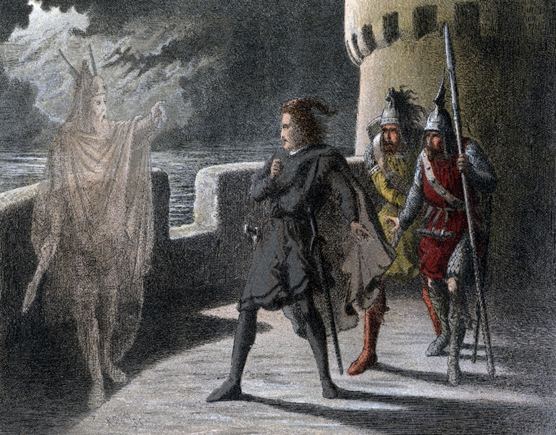
Horatio is uneasy about the appearance of the Ghost and the omen it might represent. Marcellus, a sentinel trained at keeping watch on the castle battlements, senses that something is off. He says, “Something is rotten in the state of Denmark.” A supposed ghost of the late king doesn’t just appear if all is right in the kingdom. Horatio responds to Marcellus, “Heaven will direct it.” They follow Hamlet.

~~

A1S5: The ghost-father, saying he will soon return to purgatory, charges Hamlet to wreak vengeance on his uncle, the one who murdered him before he was able to repent of his sins and receive last rites. He describes how Claudius murdered him and how he seduced Gertrude, Hamlet’s mother, with words and gifts. He tells Hamlet to spare his mother Gertrude, to leave her to God to judge. Should Hamlet also do this with Claudius and not get involved in murder?

Hamlet vows to remember his father. The high-minded and contemplative Hamlet is directed to get his hands dirty. Will the unresolved past and the rottenness in Denmark taint his thinking, his morality, his actions?

Horatio and Marcellus come up and want to know what transpired with the ghost. Hamlet gives an oblique answer. Horatio presses and Hamlet won’t say what he was told. Instead, he asks his these two to swear to not say anything about what they saw or heard. The ghost, moving around behind the scenes, shouts “Swear!” four times to Horatio and Marcellus as Hamlet tells them to not to disclose what has happened and to not react not matter how strangely he reacts in the future.

Hamlet then tells the ghost to rest. No one will talk. And tells Marcellus and Horatio to shush up when the three go back to court. And then he gives his perspective on the whole mess and having to deal with it:

~~~

A2S1: Elsewhere, Polonius sends his servant with money for his son Laertes who is studying music in France. He tells Reynaldo to check around in a back-handed way (to spy) to get impressions of his son. Is Laertes studying or is he sowing wild oats?

Ophelia shows up in a frazzled state. She tells her father that Hamlet came to her behaving strangely. Polonius attributes Hamlet’s behavior to love madness. He asks Ophelia if she has led him on or pushed him away. She says she has refused his entreaties. Polonius, who loves to give advice, wants to advise Claudius of Hamlet’s craziness.

~~

A2S2: Rosencrantz and Guildenstern, school chums of Hamlet, arrive in court. Claudius and Gertrude want both of them to hang around (spy on) Hamlet to find out what’s behind his crazy behavior and perhaps, cheer him up. When they leave court to find Hamlet, Polonius enters court. He wants to tell the king his theory of Hamlet’s madness, but first he wants the king to listen to the report of the Norwegian ambassadors who just arrived. He goes to retrieve the Norwegians.

While gone, Claudius comments to Gertrude that he is eager to hear Polonius’ proposed theory. Gertrude responds by saying Hamlet’s madness is not doubt tied to his father’s death and their quick marriage.

The two ambassadors enter and explain to Claudius that their king has deterred Fortinbras from attacking Denmark. They leave court.

Then the wordy Polonius gets on with his report about Hamlet’s craziness in a long-winded and redundant fashion. Gertrude can’t handle his bloviating and tells him to get to the point: “More matter, with less art.”

Polonius presents Hamlet’s love letter to his daughter Ophelia. He claims that this shows that Hamlet is madly in love and that Ophelia’s rejection of him has made him melancholy and lose his mind.

Claudius wants to know if this is true. Polonius says they can discover whether Hamlet really has gone mad from when he is set up to be alone with Ophelia. He and king will hide and see what happens. Claudius agrees to go along with the scheme.

Hamlet arrives. Polonius tells the king and queen to leave so he can deal with him. The verbose Polonius engages Hamlet in a conversation. Hamlet, in feigned-madness mode, responds to Polonius with witty nonsense. When Hamlet answers off-subject but with wise insights, Polonius takes note and says, “There is a method to his madness.”

Two of Hamlet’s friends from Wittenberg. Rosencrantz and Guildenstern, arrive and Polonius takes off. Hamlet is pleased to see his friends. The two share some bawdy banter with their friend Hamlet. And then Hamlet waxes philosophical. He wants to know why the two of them are back in Denmark which he calls a prison. They disagree with his assessment. Hamlet replies “Why, then, tis none to you, for there is nothing either good or bad, but thinking makes it so. To me it is a prison.”

The two friends ascribe Hamlet’s melancholy as disappointed ambition that wants more. Hamlet ascribes it to bad dreams. He then wants know why they showed up. After some coaxing, they admit they were sent for.

Hamlet explains their being summoned is to cheer him up. But he says that he’s not interested in anything. The world holds nothing for him. But then Rosencrantz wonders if Hamlet would be interested in the drama company coming to entertain him.

Hamlet wants to know all about the troupe, the one that he so enjoyed, and the state of the theater. Trumpets blow announcing the arrival of the actors.  Hamlet welcomes them and tells them that his “uncle-father and aunt-mother” have the wrong idea about his madness- it comes and goes at will.

Polonius enters and the players follow him into the room. Hamlet welcomes them and asks one of them to give him a speech about avenging a father’s death. He recites some of the lines himself and then has a player take over. The verbose Polonius comments that the speech is too long and Hamlet replies him with mocking wit.

Hamlet is impressed by the actor’s emotionally charged speech. He tells Polonoius to take them to their rooms and treat them well. As the players leave, he asks if they can perform The Murder of Gonzago the next night. The answer is yes. Hamlet tells them that he will write some additional lines into the play.

Polonius, the actors, and Rosencrantz and Guildenstern leave. Hamlet is alone with his thoughts.

Having just seen the raw emotion of an actor reciting lines about people who are of no consequence to him, Hamlet belittles himself for not being able to generate any passion to avenge his own father. He scolds himself as one who mopes around and is cowardly. He calls himself an ass. He has been given motive to act and avenge the death of his father and he does not have his act together. But this reflection gives him an idea.

Having just experienced the effect of the actor’s intensity on his own conscience, he knows of others, too, who have had their conscience pricked when art imitates life. Having the acting troupe produce a play that mirrors the murder of his father may just reveal Claudius’s guilt and his own catharsis.

 Hamlet, who may have studied Aristotle’s Poetics while at Wittenberg, comes across like a self-styled critic and dramatist of the theater. He knows how he wants the actors to perform and edits and adds to the script, for . . .

~~~

A3S1: Claudius, Gertrude, Polonius, Ophelia, and Rosencrantz and Guildenstern enter court. Claudius questions Hamlet’s two friends about Hamlet’s disposition. They say he’s responsive but difficult to read. They also say that he is excited about a play being put on by a recently arrived troupe. Hamlet wants the king and queen to attend. Polonius, unaware of Hamlet’s Mousetrap, agrees with this invitation. He has a trap of his own.

Polonius, along with Claudius, wants to find out if unrequited love is the reason Hamlet is beside himself. Ophelia, Hamlet’s love interest, is instructed by her father Polonius to walk around with a prayer book, look spiritual, and wait for Hamlet. He adds that people often do this – act devoted to God – to mask their bad deeds. Claudius hears this. To himself, he admits that these words have produced a sharp pang of guilt within.

When they hear Hamlet coming, Claudius and Polonius hide to spy on him. Hamlet enters and begins to speak only to himself of things that make his life, this mortal coil, tedious, irritating, and unbearable. His aversion to being contemplates relieving himself of the messiness of life by suicide:

Hamlet ponders the well-known tribulations of life and then counters that with the “undiscovered country from whose bourn no travel returns.” From the later he reckons that fear of the unknowns of death, which would include purgatory, makes us all cowards. And too much back-and-forth thinking, he decides, makes one less daring and of no use when things need to get done.

Hamlet then comes across Ophelia reading her prayer book. He greets her and then goes on to speak to her in a cold-hearted way. Has he, because of the moral bankruptcy of his mother, decided to not put any trust in a woman?

He tells her that he never loved her. He bitterly denounces humankind, marriage, and the deceitfulness of beauty and women. He tells her to go to a convent. When he leaves, Ophelia laments the change that has come over the once noble Hamlet.

His intense words with Ophelia suggest that Hamlet has turned from acting mad to acting with madness.

Claudius and Polonius come out of hiding. Claudius is now aware that Hamlet’s behavior is not related to Ophelia but is likely related to something more out-of-control dangerous. He wants to send Hamlet to England (exile him) in hopes of changing his disposition. Is England to be Hamlet’s purgatory?

~~

A3S2: Later, Hamlet is with the actors, advising them how to speak their parts in the play that night. When Polonius, Rosencrantz and Guildenstern show up Hamlet confirms that the king and queen will be attending. They confirm this and leave to help the actors prepare. Horatio enters.

Hamlet expresses his high regard for Horatio and praises Horatio’s self-control. He then asks him to watch his uncle carefully during the play. Claudius’ response will determine whether the ghost was speaking the truth or just being a damned ghost. Hamlet will keep an eye on Claudius too.

Trumpets announce Claudius, Gertrude, Polonius, Ophelia, Rosencrantz and Guildenstern. As they take their seats, Hamlet responds with nonsense to Claudius and Polonius. He chooses not to seat next to his mother. He sits with Ophelia and speaks to her in a mischievous way. Ophelia comments that Hamlet seems to be in a good mood tonight.

Hamlet retorts that God is the best comic. And, revealing with spite what truly galls him, he says why shouldn’t he be happy when his mother is so happy just a short time after his father has died. He should get rid of his black clothes and get some new snappy outfit.

Trumpets play and the pantomime show begins as a summary of the spoken drama to follow. The players mime the murder of the king by the same means as Hamlet’s father was murdered and then the queen accepting the murder’s advances.

Ophelia wants to know what it means. Hamlet impishly tells Ophelia “It means mischief.”.

The Prologue speaker enters to introduce the play. Puckish Hamlet tells Ophelia that this guy will explain everything as actors can’t keep things to themselves.

The Prologue actor speaks only three short lines, entreating the audience to watch the tragedy.

Hamlet asks whether that was the prologue or the inscription on a wedding ring? Ophelia replies “Tis brief, my lord.” And Hamlet comes back “As a woman’s love.”

The play begins with actors playing king and queen. They reenact the Murder of Gonzago. The play closely parallels the circumstances of the murder of Hamlet’s father, the king, as told by the ghost and the aftermath of the queen marrying the murderer. In this play the nephew, not the uncle, is the murderer.

The play begins with the king, who is nearing death, recounting his thirty years of marriage to the queen. He says that after he is gone, perhaps she will remarry. The queen protests and speaks of her undying love for him even after his death. If she did remarry, she vows, all of life should turn against her.

Hamlet to Ophelia: “If she should break it now!” – a pointed reference directed at Hamlet’s mother for her being so quick to marry Claudius after the king’s death.

The player king replies from many years of wisdom that things change, that love is unreliable. “Our wills and fates do contrary run.” The king, now tired, falls asleep. The player queen leaves.

On the side, Hamlet throws in clever comments to Gertrude and Claudius that smack of trying to get under the skin of the king and queen. Claudius wants to know what the play is called. Hamlet responds The Mousetrap. He adds that it is a play about a murder in Vienna and no big deal and that it would only bother the guilty.

The player of the king’s nephew enters. Hamlet tells Ophelia who it is Lucianus. Ophelia says that Hamlet is a good commenter. Hamlet, feeling frisky, continues with sarcasm and sexual inuendo.

Lucianus pours poison into the sleeping player king’s ears. Hamlet remarks that he poisoned him to get the kingdom and the king’s wife all to himself. Claudius stands up. He wants the play to stop. He wants to leave. Everyone except Hamlet and Horatio leave.

Hamlet mocks the departure with a few poetic lines and jokes that perhaps he could be an actor if everything else failed. Horatio agrees. And Horatio also agrees that that Claudius did react to the poison scene. Hamlet knows now that the ghost was telling the truth.

Rosencrantz and Guildenstern show up and say that the king is angry and queen is upset. Hamlet’s replies in glib fashion. His two friends want to know what’s up with him. They tell Hamlet that the queen wants to see him.

When the players enter with recorders, Hamlet grabs one and asks if Guildenstern can play it. He says no. Hamlet then calls out his friends – he and Rosencrantz are trying to play him and can’t even play a simple recorder.

Polonius comes around and tells Hamlet that his mother wants to see him right away. Hamlet replies with bits of nonsense and Polonius goes along. Hamlet says he will go see her – soon. By himself he says, it’s the witching hour when really hellish things go on. He could behave like that with his mother but he puts thoughts in check: “I will speak daggers to her and use none.”

~~

A3S3: Claudius, speaking to Rosencrantz and Guildenstern, says Hamlet is getting crazier by the hour. He doesn’t feel safe. So, he’s going to send them both with Hamlet to England on diplomatic business. They agree to go, with Rosencrantz saying that whatever happens to the king happens to everyone. They leave and Polonius enters.

He tells Claudius that Hamlet is on his way to his mother’s chamber and that he will hide in there and listen to her scolding Hamlet. He leaves.

Claudius, alone in his chamber, admits his crime:

His Cain-like murder of his own brother comes with God’s curse. He’s finding it hard to pray. He’s not ruing what happened. He’s wondering if he can even repent of it, be pardoned of his sin and continue to live with all the gains (the kingdom and queen). He falls to his knees. What is not said is Claudius’ desire to murder again – this time Hamlet is in his sights.

Hamlet enters, intending to kill Claudius. He sees Claudius on his knees and thinks that if that guy dies while praying, he will receive grace, go to heaven, and be forgiven of his sins. Whereas his murdered father, King Hamlet, had no time to repent of his sins. He doesn’t consider it revenge by killing him now and sending him to heaven. Claudius must suffer the same purgatory  

Hamlet, who knows that his mother is waiting for him, leaves the room. He says that he’ll wait to kill Claudius when Claudius acts up again in some ungodly way.

Claudius, getting up from his knees, considers his prayers useless.

What is not said is Claudius’ desire to bring about murder again – this time of Hamlet in England. Hamlet missed his chance for revenge.

~~~

Prior to the Mousetrap play, Hamlet was a mess. Things in his world looked absurd and bleak. He had just returned home from studying in Wittenberg to a dark and vexing situation – something rotten in Denmark.

A ghost, looking like his dead father, appears from somewhere. Hamlet learns from the specter that it had been murdered by his uncle Claudius and that his mother quickly married him.  The ghost orders Hamlet to avenge his death and go easy on his mother.

But should Hamlet, a theology and philosophy student, listen to the ghost from somewhere and do something irrevocable – kill Claudius – and end up in purgatory or hell? Is he required to deal with the unresolved past? These questions weigh on him.

In addition to the complex matter handed him, Hamlet, who was in line to be king when his father died, now wonders if those around him in Denmark can be trusted. And, a foreign prince seeking revenge is marching against the Danish kingdom. There’s a lot of vectors to think about.

It’s a situation so messed up that he thought about suicide.

Prior to the Mousetrap play, Hamlet was also very disappointed with himself for not being a man of action, of thinking too much. But with confirmation of Claudius’ guilt via the play, something has stirred in Hamlet. He’s ready, driven with revenge madness, to dispose of Claudius.

Claudius had taken action – murdered King Hamlet – without regard to a common understanding Rosencrantz had stated in obeying Claudius’ own protection order: whatever happens to the king happens to everyone. And now, Claudius is ready to dispose of the rightful heir to the throne to protect himself.

~~~

The Tragedy of Hamlet, Prince of Denmark operates in a God-ordered moral universe with heaven, hell, sin, punishment. The undead figure, aware of this, goads Hamlet to commit murder to avenge his death and to also leave Gertrude, Hamlet’s mother, to God’s judgement. The undead figure’s goading ultimately leads to many deaths including Hamlet’s.

The opening “Who’s there?” seems to also ask of the living – Hamlet – what kind of actor he is given the ultimate issues he faces. Pushed to the limits, will the center hold?

~~

A3S4: Getrude and Polonius are in the queen’s chamber waiting for Hamlet. Polonius wants Gertude to lay into Hamlet for the trouble he’s caused. When they hear Hamlet approach, Polonius hides behind a tapestry to listen in.

Hamlet, impatient, wants to know what his mother wants. She says that he’s insulted his (step-) father. Hamlet fires back saying that she’s insulted his father. Though he vented privately before, Hamlet is no holding back.

His mother, shocked, wonders if Hamlet has forgotten who she is. Hamlet’s response is pointed:

Hearing Hamlet’s denunciation, his mother now wants to bring others in. Hamlet tells her to sit down and not move. For, he wants to expose her true nature. She fears Hamlet will kill her with the sword in his hand. She cries for help. Polonius, from behind the curtain, also cries for help.

Hamlet smells a rat or rather, Claudius. He lunges and stabs the curtain with his weapon. His mother cries, “O me, what hast thou done?”

Hamlet:

Hamlet pulls back the curtain and discovers Polonius, dead. He has nothing good to say about the busybody Polonius who, Hamlet deems, got his just deserts.  Hamlet turns to his mother, for her just deserts – wring her heart with words of judgement.

She wants to know what’s she’s done to be treated so badly. Hamlet is ready to tell her – a deed so heinous that its judgement day on earth. She again wants to know what the deed is.

Hamlet then compares her former husband, his noble father to the scum that she hooked up with. He wonders how anyone, even impaired, could make such a decision. Reason has been a slave to desire, he says. She wants him to stop exposing her sin.

But Hamlet continues.

He rails against her going to bed with her villainous husband, a ragtag man who is but a small fraction of his father’s worth and who stole the crown.

The ghost enters. Hamlet sees the ghost. Gertrude does not. When Hamlet speaks to the ghost, Gertrude thinks he’s gone mad.

The ghost spurs Hamlet to back on the revenge track. He also cautions Hamlet not to overdo it with his mother, the weaker sex. The ghost leaves. Gertrude has not heard or seen anything of the ghost. She thinks Hamlet’s madness has him imaging all this.

 But Hamlet protests, saying he is of sound mind. He then counsels her to not look at his madness but to look at her heart, to confess her sins, and repent. Her conscience is pricked by his words. Hamlet continues:

Hamlet, who started out virtuous and is now heading to the dark side, wants his mother to be prudent and temperate. He wants her to at least pretend to be virtuous and by this, develop good habits. And that would mean her not having sex with Claudius and letting him deceive her in anyway about her son.

Hamlet then says good night to his mother and sorry about what happened to the dead guy, Polonius. He considers it God’s punishment for himself and Polonius. He

He reminds his mother that he’s off to England with two snakes in the grass, Rosencrantz and Guildenstern. He’s expecting to see the plan Claudius has in place blow up in his face.

As he leaves, Hamlet drags Polonius body out of the room. He comments that the stiff was babbling politician who has finally shut up.

~~~

A4S1: Claudius enters and wants to know why Gertrude is so upset. She tells him about Hamlet’s “lawless fit” of madness that killed “a rat, a rat.” Polonius was dead. Claudius blames himself for not doing enough to stop the “mad young man.” He tells her that he’ll ship Hamlet off to England and work his magic to explain and excuse what happened.

Gertrude says that Hamlet had dragged the body off somewhere and that she sees a glimmer of good in the mad Hamlet – he weeps for what he has done.

Claudius summons Rosencrantz and Guildenstern and tells them to go look for Hamlet and recover the body. He tells Gertrude that he hopes they can come out of this scandal in good shape.

~~

A4S2: Rosencrantz and Guildenstern come across Hamlet and ask about the body. Hamlet gives no direct answer. He accuses Rosencrantz of being a “sponge” (spy) for Claudius and says “The body is with the king, but the king is not with the body. The king is the thing . . .” This last seems to be a riff on “the plays the thing.” Both lines, in Hamlet’s mind, refer to bringing the guilty party to justice.

Guildenstern doesn’t understand. So, Hamlet says the king is of no importance. (The crime is.) He wants to see the king and off they go.

~~

A4S3: Claudius, in the meantime, to his attendants:

Claudius talks to them of being judicious on how Hamlet is handled. He is loved by the people so a fair-minded punishment must be seen by them and not the crime (which might expose more than Claudius wants known). His being sent away to England will look carefully considered. He ends by saying that a cancerous disease must be dealt with in extracting ways.

Rosencrantz enters and tells Claudius that Hamlet has not told him where the body is. Guildenstern brings Hamlet into the room. Claudius presses Hamlet for the location of the body. Hamlet responds with flippant riddles before revealing where the body is. The attendants go and look.

Claudius tells Hamlet that he will leave for England right away – for his own protection. Hamlet is happy about this. Before he leaves, Hamlet calls Claudius his mother – a jab based on Claudius being married – one flesh – with his mother.

Claudius sends Rosencrantz and Guildenstern to follow Hamlet to make sure he gets on the boat. Alone, he speaks of his hope that the king of England will obey the sealed orders sent with Rosencrantz and Guildenstern. The orders call for Hamlet to be put to death when he arrives.

~~

A4S4: Fortinbras, the Norwegian prince, arrives in Denmark at the head of his army. He sends his captain to the king of Denmark to ask for permission to cross the land on his way to attacking Poland. On his way the captain runs into Hamlet and Rosencrantz and Guildenstern, who are on their way to the boat headed for England.

Hamlet asks the captain why Norwegian troops are in Denmark, who’s leading them and what are they after – the heart of Poland or just a outlying region. The captain explain that Fortinbras is leading the army to seize a small scrap of land that has no value to anyone.

Hamlet wonders if the Poles would defend such a target and the captain replies that they will. Before he thanks the captain for the information and says good bye to him, Hamlet stops to think about what he just heard.

He remarks that men are so driven that they will go to war at great cost of blood and treasure for pointless gain.

Rosencrantz wants Hamlet to get a move on. Hamlet says for them to go ahead and he’ll catch up. Hamlet wants some time alone to reflect on his own inaction.

Based on the resoluteness of a foreign prince risking life and limb by attacking something pointless, he realizes that thinking too much about whether to act is more cowardice than wisdom. He likens his inertia to that of being an animal that only eats and sleeps. Yet, he tells himself, he has more motive than Fortinbras – to mete out revenge for the murder of his father, King Hamlet. He determines right then and there:

~~

A4S5: Gertrude enters the next scene telling a gentleman of the court that she doesn’t want bother with Ophelia’s loopy behavior. But Ophelia insists on being heard, the gentleman tells her. She’s saying all kinds of things related to the death of her father Polonius and conspiracy things that seem to implicate Gertrude. Horatio thinks she should speak to her. Gertrude, to herself, says that because of her nature everything looks like a disaster waiting to happen to expose her:

Ophelia enters and it is evident that the death of her father has affected her sanity (Just as the loss of Hamlet’s father affected his.). She sings nonsense songs and Gertude can’t get her to stop. Claudius enters and asks Ophelia how she is doing. She responds with nonsense that hints at her father’s death. When she leaves the room, Claudius says

Claudius tells Gertrude that bad things are piling on. Polonius was killed, Hamlet has sent away for being dangerous, people are spreading rumors of the hasty funeral which looks like a cover up, and Ophelia has lost her mind. And now Laertes has returned from France and wants to the settle score. Claudius tells Gertrude that all this feels like be being murdered over and over again.

Laertes arrives with a raucous crowd shouting “Laertes will be king!” Doors are smashed open and they enter. Laertes wants to know where his father is. Gertrude clings to Laertes, holding him back from attacking Claudius. Laertes wants to know how his father was murdered. Claudius wants to prove to Laertes that he didn’t do it.

Ophelia enters and Laertes witnesses her madness. He vows revenge for the hellish suffering and torment brought upon his sister.

Claudius, to settle things in Laertes’ mind, says that he should bring his trusted friends and listen to the case he makes of his innocence. Laertes agrees and demands to know why his father was buried secretly and ignobly. Claudius says he has a right to know and

~~

A4S6: Horatio, elsewhere in the castle, receives two sailors who have a letter from Hamlet. Horatio reads the letter out loud and learns that Hamlet’s ship to England was overtaken by pirates. Hamlet ended a prisoner on the pirate ship.

The pirates want a favor from the King of Denmark. The request is contained in letters the two sailors are holding. Hamlet asks Horatio to bring the sailors to king and then and come to him. He has a lot to tell Horatio about events and about Rosencrantz and Guildenstern. The sailors will show Horatio the way to where he’s holed up.

~~

A4S7:  While this happens, Claudius talks with Laertes. Claudius thinks Laertes should be satisfied with his explanation of his father’s death – by the same man who is trying to kil him. Laertes wants to know why the king didn’t act right away to bring the murderer to justice.

Claudius states that he held back because his mother and the people so love Hamlet. If he acted his wife and the people would turn against him.

Just then a messenger arrives with the sailor’s letters – one for Claudius and one for Gertrude. Claudius reads the letter out loud for Laertes to hear. Hamlet, it says, will return tomorrow and explain his return. Though not mentioned but what must have been on Claudius’s mind – his failed scheme to be rid of Hamlet via the king of England.

Laertes is happy about Hamlet’s return. Now he can face him man to man and avenge his father’s murder. Claudius agrees that Hamlet’s should be disposed of – he’s a threat to his kingdom. He tells Laertes to let him devise a way to do away with Hamlet that will appease even his mother. Laertes agrees to Claudius’s scheme only if it means Hamlet’s demise by his own hand.

Claudius gins up a scheme that involves a duel between Laertes and Hamlet. To set up this scenario, Claudius tells Laertes of a certain Frenchman’s high regard of Laertes’ fencing ability. He adds that Hamlet overheard the compliment and, out of jealousy, wanted to fence Laertes to see who was the better dueler. Is the devious Claudius lying?

 After Claudius confirms that Laertes is with him in plan, that Laertes won’t lose the impulse to kill Hamlet, he tells Laertes that he’ll get the people to promote the competition, that there will be bets placed and that Laertes can chose a sharpened sword beforehand to do the deed.

Laertes says he’s gotten ahold of poison oil to put on the tip of his sword. And Claudius speaks of a backup plan: get Hamlet thirsty and he’ll give him a poison drink.

Gertrude enters with terrible news: Laertes’ sister Ophelia has drowned. Gertrude softens the blow for Laertes by implying it was an accident and using imagery of her female connection with nature. (She did not treat her grieving son Hamlet with compassion.)

How did she know the details? Perhaps she witnessed it from a castle window or? Anyway, Laertes is crushed – both father and sister are dead. Claudius, worried that the upset Laertes is beyond his control, follows him with Gertrude.

~~~

A5S1:

So says one gravedigger to another in the graveyard of the church. They are excavating a burial plot for Ophelia and exchange thoughts about whether she should receive a Christian burial. It seems to them that she committed suicide, though the coroner called it self-defense. One gravedigger remarked that it is more like self-offense and goes on to say that the wealthy, who end their lives in unchristian ways, get their way in the end.

As they work, the first gravedigger poses a riddle to the second gravedigger: “What is he that builds stronger than either the mason, the shipwright, or the carpenter?”  The second gravedigger answers that it must be the gallows-maker, “for his frame outlasts a thousand tenants.”

The first gravedigger agrees that the gallows have a purpose, but then says

The second gravedigger goes off and the first shovels and sings.

Hamlet and Horatio arrive at the graveyard at a distance from Ophelia’s plot. We don’t know why Hamlet decided to go to the graveyard. Perhaps, to contemplate his own life and death. He’s been away and does not know that Ophelia is dead.

They hear the gravedigger singing while digging a grave. Hamlet notices the dissonance and a skull that the gravedigger throws up from the pit.

Does what follows relate to the opening Who’s there? Hamlet suggests to Horatio whose skull it might be – Cain’s, a courtier, or Lord So-and-So – and says it’s now the property of Lady Worm and quite a reversal of fortune.  

The gravedigger, still digging and singing, throws up another skull out of the pit. As before, Hamlet proposes to Horatio whose skull it belongs to – a lawyer or a landowner. For both, their abilities and property are no longer of use to them. They no longer have a share in what is done under the sun.

Hamlet turns from contemplating death and human remains to the gravedigger. He wants to know whose grave he is digging. This begins the jaunty gravedigger’s wordplay in answer to each of Hamlet’s direct questions. Finally, the gravedigger says

Hamlet asks: How long hast thou been a grave-maker? The gravedigger, not knowing who he is talking to, answers that it has been so since Hamlet’s father defeated Fortinbras. Hamlet: How long ago was that? He answers the day that Hamlet, the one who went crazy and was sent to England, was born. He goes on to say that he was sent to England because no one will care: There the men are as mad as he.

The conversation briefly turns to how long a body will live in a grave before it rots. Then the gravedigger pulls up a skull that has been buried for twenty-three years. Turns out that it is the skull of Yorick, the king’s jester. He hands it to Hamlet.

Hamlet reminisces for moment about the goods time he had with Yorick when he was a young boy. Then he turns to Horatio and wonders if Alexander the Great and the emperor Caesar looked like this after they were buried. These great men, he muses on another reversal of fortune, became dust and could be used as mud to plug up holes.

A funeral procession enters the churchyard following a coffin: Claudius, Gertrude, Laertes, and mourning courtiers. Hamlet wonders who’s in the coffin. He remarks that it’s not much of a procession; someone in a rich family must have taken their own life. He watches the proceedings.

Laertes asks the priest what other rites he can give the girl and the priest answers that he has done as much he could for someone with a suspicious death. Laertes is incensed and lays into the priest about his sister. Hamlet finds out that Ophelia is being buried.

Gertrude throws flowers onto the coffin while ruing that the flowers were not for Hamlet’s wedding to Ophelia.

Laertes curses the man who made her go mad. He jumps into the grave to hold Ophelia once more.

Just moments ago, Hamlet was fondly remembering Yorick. Now he is confronted by the death of Ophelia. He is overwhelmed:

Not to be outdone by Laertes’ grief, Hamlet also jumps into the grave. Laertes tells him to go to hell. The two begin to grapple. Hamlet says that even though he is not quick to anger, he has something dangerous inside him that Laertes should take into account. What could that be?

Claudius and Gertrude have the attendants pull them apart.

Then Hamlet, in his agony, expresses his great love for Ophelia – a love greater than her brother’s affections. He quantifies his ardor in absurd ways. And the King and Queen think he’s insane.

When Hamlet storms off, Claudius tells Gertrude to have the guards keep an eye on him. He tells Laertes to be cool. Hamlet, the problem, will be dealt with soon.

~~

A5S2: Hamlet and Horatio are now alone. Hamlet has walked off his momentary madness and wants to discuss with Horatio his recent journey. He casts the decisions he’s made in terms of a struggle that kept him from sleep.

He then praises impulsiveness as the means to getting things done when one is slow to act. This, he says, shows that God is a work even when our plans are messed up:

This harkens back to Hamlet’s agency in his line The time is out of joint. O cursèd spite That ever I was born to set it right! But is Hamlet trying to force God’s hand with rash actions?

Hamlet goes on to tell Horatio, that while on the ship to England, he found Claudius’ letter to the King of England. It was to be delivered by Hamlet’s close friends Rosencrantz and Guildenstern. The letter contained the usual political courtesies AND a request to cut off Hamlet’s head with a dull axe! Hamlet shows Horatio the document, as he can’t believe it.

 Hamlet then reveals that he penned a new letter in the proper script and sealed it with his father’s signet ring still in his possession. The new letter addressed the king of England as if in Claudius’s own words. It requested that the two men who delivered the letter would be put to death at once without time to confess to a priest.

Horatio says that those two are really in for it. Hamlet says he’s not sorry at all for they involved themselves in matters between two worthy opponents. Then he proclaims his moral right to do away with Claudius. He lays out the charges against him:

Horatio remarks that Claudius will soon find out what happened to Rosencrantz and Guildenstern. Hamlet agrees the time is short but says that in the meantime he has time to work his plan. He then regrets losing control with Laertes – they both grieve the loss of Ophelia, they both want to avenge the death of a loved one. He says he will treat him well from now on.

Hamlet apologizes to Horatio for his over-the-top behavior but not to Laertes. He also blames Laertes for his actions – it was Laertes’ overwhelming show of grief that set him off. And Hamlet never confesses or repents of his cruel behavior with Ophelia, behavior that played a role in her despair and suicide. Has Hamlet stopped listening to his conscience?

With hat in hand, Osric, a young courtier, arrives. He has a message from the king for Hamlet. Hamlet makes snide comments about him to Horatio and toys with Osric about his hat and the weather. You get the idea that Hamlet will not suffer fools. Osric is a toady who agrees with Hamlet about everything including opposites that Hamlet harries him with. The conversation is a duel between a wit and a twit.

Osric goes on blustering about how wonderful Laertes is. Hamlet, not sure where Osric is going with all this, adds his own praise about Laertes and asks why he is being talked about. Horatio also hopes to get the reason Osric is there.

When Osric finally gets to the point, he says that Laertes is unrivaled at fencing and that the king has placed a large bet on a fencing contest between Hamlet and Laertes. Laertes, the better fencer, is given a handicap of three hits to win. He wants to know if Hamlet agrees to the duel. Hamlet says OK.

After Osric leaves to notify the king, Hamlet and Horatio comment on Osric one more time saying, in effect, that he’s a frivolous person and full of hot air.

 A lord arrives. He asks if Hamlet is ready to duel or wait till later. Hamlet says he’s ready to duel. The lord says that the queen wants Hamlet to speak to Laertes before the duel in a civil manner. The lord leaves.

Horatio advises Hamlet against dueling – he will lose. Hamlet brushes this off saying that he has been practicing fencing while Laertes has been in France. He thinks he will win and yet something inside tells him it will go the other way. Horatio tells him to trust that feeling. Hamlet brushes off the advice as superstitious and then launches into a “Let be” to-be-or-not-to-be fatalistic take of the situation.

Claudius, Gertrude, Laertes, Osric, attendants, and lords enter with fanfare. Fencing foils and flasks of wine are brought in with them. Claudius has Hamlet shake Laertes’ hand as a civil gesture.

Hamlet offers an apology to Laertes for his unseemly behavior. But the apology is an insanity defense. Hamlet claims that he was not in his right mind, as everyone knew, and that he was not responsible for any premeditated action against Laertes.

Laertes accepts Hamlet’s show of love but can’t accept forgive him. For him, the death of father and sister warrant further insight as to how honor would avenge them. Laertes, of course, already knows what will happen in the next minutes.

Hamlet and Laertes pick their foils and get ready to fence.

Claudius, the schemer, shows bogus support for Hamlet as he wants Hamlet to not hold back – until his death. If Hamlet strikes first, Claudius will order military salutes. He’ll drink to Hamlet’s health and then drop a very expensive pearl into the glass for Hamlet to drink. What he drops in the glass, of course, is poison. Trumpets sound and the duel begins.

Hamlet and Laertes engage their blades. Hamlet makes the first hit. Drums and trumpets sound, and so does a cannon. Claudius drops a pearl into a goblet and says it’s for Hamlet. He wants him to drink it. Hamlet wants to finish the round first. They continue fencing.

Claudius and Gertrude exchange words about her son Hamlet. Then Gertrude picks up the pearl/poison-laced goblet and drinks to Hamlet’s health. Claudius tells her not to drink it and she does anyway, in an act of defiance toward Claudius. Claudius knows it’s only a matter of time for Gertrude’s demise.

Hamlet defers again from drinking the wine. Gertrude wants to wipe his brow. Hamlet wants Laertes to fence like he means it. They go back at it. This time, Laertes wounds Hamlet and in the scuffle that follows they end up with each other’s sword. Hamlet wounds Laertes.

Gertrude, the poison haven taken hold, falls to the floor. Both fencers are wounded and bleeding. Osric asks Laertes how he feels and he responds that he is like one caught in his own trap: I am justly killed with mine own treachery.

Hamlet asks about his mother. Claudius says she fainted at the sight of blood. Gerturde speaks one last time:

Gertrude dies. Hamlet reacts:

Laertes, dying, tells Hamlet that his sword had a poison tip and that his plan to kill him backfired. He can blame the king for poisoning his mother.

Hamlet takes the poison-tipped sword and wounds Claudius. The court yells “Treason!” Then Hamlet forces Claudius to drink from the poison-laced goblet, saying

Claudius drinks and dies. Hamlet achieves his father’s vengeance after seeing his mother poisoned by Claudius’ scheme to do him in.

With his last breath, Laertes tells Hamlet that Claudius deserved what he got – the poisoner poisoned himself. Then, laying all the blame on Claudius, he wants to clear the slate with Hamlet before he dies:

Hamlet, dying, replies that heaven will not hold Laertes responsible for his death. He then bids adieu to the Wretched queen and tells those who were watching in horror that, if he had time, he could explain things. He tells Horatio to report what happened. Horatio balks at the suggestion and wants to end his life like an ancient Roman with the remainder of the poisoned drink. Is everyone, as said of Ophelia, seeking their own salvation?

Hamlet says no and takes the cup away from Horatio. Horatio must live to tell Hamlet’s story.

As he is saying this, Hamlet hears the sound of a military march. He asks about it. Osric says that young Fortinbras, returning from his conquest in Poland, is approaching. Hamlet says that prince Fortinbras will likely be chosen for the Danish throne. Hamlet gives his approval and tells Horatio to explain to him what happened. The unresolved recent past can’t stay that way. The rest is silence as Hamlet dies.

Horatio:

Fortinbras and the English Ambassador enter. They look around at the gruesome scene wondering what happened. The English Ambassador says that his king carried out the Danish king’s order – Rosencrantz and Guildenstern are dead. He wants to know who will thank the king.

Horatio, pointing to Claudius’ corpse, replies that it won’t be this guy. He never ordered their death. He then requests that these bodies be displayed and that he is given the opportunity to tell

Fortinbras is eager for himself and other noble people to hear what Horatio has to say. He speaks of his opportunity and right to claim the Danish throne. Horatio tells him that Hamlet talked about this. He will tell Fortinbras more later. But first things first.

Fortinbras orders four captains to carry Hamlet and place him on a stage and to give him military honors. He would have been a great king, he says.

Looking at the bodies strewn in the court, he says it’s something one would see on a battlefield but here, something went terribly wrong. (More rottenness in Denmark?)

Fortinbras orders guns and cannons to be fired to honor Hamlet as a great soldier. (Was he a great soldier in the battle of life?)

Afterthoughts

Hamlet starts out as a virtuous young man operating with a deep sense of morality within a Christian cosmology. But grief, the revenge demand placed on him by a supernatural being, betrayal, and existential despair changes him. Listening to a dis-embodied spirit, he ends up a dis-embodied spirit.

What if Hamlet didn’t listen to the ghost? And, what if Hamlet didn’t listen to his pride and end up in a fencing duel with the son of the man he murdered hosted by the man who murdered his father? Did he see it as a way to choose his own salvation?

With the Mousetrap play, Hamlet verified what the ghost said – that Claudius poisoned his father. But Hamlet didn’t act when he heard Claudius confessing his guilt in his chamber. He thought there would be a more opportune, as in no chance for Claudius go to heaven, moment. He dithered and many lives thereafter received a violent death, a death without confession of sins. Death count since: Polonius, Ophelia, Rosencrantz, Guildenstern,Laertes, Gertrude, Claudius, and Hamlet.

~~~

Will the two gravediggers reprise their humorous banter while digging the grave of the newly dead? Will they speak of the deceased as they spoke of Ophelia:

 Is she to be buried in Christian burial,

when she willfully seeks her own salvation?

Will they ponder the reversal of fortunes as did Hamlet?

~~~

As it was common for royal marriages to create alliances, was Queen Gertrude, Hamlet’s mother, a foreigner? Was she perhaps German and the link to Wittenberg?

~~~

There are more ghosts at the end than at the beginning.

~~~~~

The Play’s the Thing 

You’ll find excellent discussions on all five acts of Hamlet and a Q&A session podcast at the link below.

Tim McIntosh: https://www.timteachesshakespeare.com/about

Heidi White: https://circeinstitute.org/blog/jet-popup/read-more-about-heidis-class/

Andrew Kern: https://circeinstitute.org/staff-and-board/

It’s finally time to discuss the grandaddy of all of Shakespeare’s plays! That’s right, it’s time for Hamlet and Tim, Heidi, and special guest Andrew Kern are ready to dig deep. In this episode they discuss why this play matters so much, the initial structure of the play, the themes and problems Act I introduces, and much more.

Hamlet: Act I – The Play’s the Thing

Hamlet: Act I (rerun) – The Play’s the Thing | Acast

Note: To begin reading Hamlet in plain English, start with Hamlet: No Fear Shakespeare.

~~~~~

Interesting Background:

-Claudius to Hamlet, A1S2 (emphasis mine.)

A paper read today at the American Astronomical Society meeting in Toronto, Canada, offers a new interpretation of Shakespeare’s play Hamlet.

The paper, by Peter D. Usher, professor of astronomy and astrophysics at Penn State, presents evidence that Hamlet is “an allegory for the competition between the cosmological models of Thomas Digges of England and Tycho Brahe of Denmark.”

ABSTRACT

A New Reading of Shakespeare’s Hamlet

I argue that Hamlet is an allegory for the competition between the cosmological models of Thomas Digges (1546-1595) of England and Tycho Brahe (1546-1601) of Denmark. Through his acquaintance with Digges, Shakespeare would have known of the essence of the revolutionary model of Nicholas Copernicus (1473-1543) of Poland, and of Digges’ extension of it. Shakespeare knew of Brahe, and named Rosencrantz and Guildenstern for his forebears. I suggest that Claudius is named for Claudius Ptolemy (fl. 140 A.D.) who perfected the geocentric model. It has been suggested that Polonius is named for a Brunian character Pollinio, an Aristotelian pedant and a suitable attendant to Claudius. Hamlet is a student at Wittenberg, a center for Copernican learning, which Brahe attended too. I suggest that the slaying of Rosencrantz and Guildenstern is the Bard’s way of killing the Tychonic model, while the death of Claudius signals the end of geocentricism. But the climax of the play is not the death of any of the chief protagonists; it is Fortinbras’ triumphal return from Poland and his salute to the ambassadors from England. Here Shakespeare praises the merits of the Copernican model and its Diggesian extension. Thereby he defines poetically the new universal order and humankind’s position in it. In the talk I present both historical and literary evidence in support of the present interpretation. If it is essentially correct, this reading suggests that Hamlet evinces a scientific cosmology no less magnificent than its literary and philosophical counterparts. While the last year of the sixteenth century saw the martyrdom of Bruno, the first year of the seventeenth century sees the Bard’s magnificent poetic affirmation of the infinite universe of stars.

Peter D. Usher, Penn State

https://science.psu.edu/news/astrophysicist-finds-new-scientific-meaning-hamlet

~~~~~

The Treachery Comes Out

“The Russia Hoax was a lie that was knowingly created by the Obama Administration to undermine the legitimacy and power of the duly elected President of the United States, Donald Trump.” DNI Tulsi Gabbard

Ruse Rollout

A July 24, 2025 report from revolver:

Tulsi Gabbard just dropped a nuclear truth bomb, and it might go down as one of the most important six-minute press conferences in US political history.

In this presser, Tulsi doesn’t speculate or theorize. She’s got actual receipts.

She explains that the intel presented to Obama and his top brass in 2016 made it painfully clear:

-Putin was NOT backing Trump.

-He was convinced Hillary would win.

-He was holding “blackmail-level” dirt on her for when she took office.

-Including the explosive revelation that Hillary Clinton appeared to be a bipolar mess, drugged up on tranquilizers.

We’re not talking about some run-of-the-mill dirty politics game. This appears to be a criminal conspiracy that ran straight through the heart of the Obama regime. (Emphasis mine.)

Read the Russia collusion memos President Trump declassified and Kash Patel gave to Congress

DNI Tulsi Gabbard breaks it all down for us:

🧵 New evidence has emerged of the most egregious weaponization and politicization of intelligence in American history. Per President @realDonaldTrump’s directive, I have declassified a @HouseIntel oversight majority staff report that exposes how the Obama Administration manufactured the January 2017 Intelligence Community Assessment that they knew was false, promoting the LIE that Vladimir Putin and the Russian government helped President Trump win the 2016 election.

In doing so, they conspired to subvert the will of the American people, working with their partners in the media to promote the lie, in order to undermine the legitimacy of President Trump, essentially enacting a years-long coup against him.

Here are the top Obama Russia Hoax lies debunked by today’s release:

dni.gov/files/ODNI/doc…

Together, the @ODNIgov records released on Friday, the @TheJusticeDept’s June 2018 report known as the “Clinton annex” released earlier this week, and the @HouseIntel oversight report we released today confirm what many Americans have known: The Russia Hoax was a lie that was knowingly created by the Obama Administration to undermine the legitimacy and power of the duly elected President of the United States, Donald Trump.

Update — Tulsi Gabbard releases new files on Obamagate.

20 CIA and FBI agents CONFIRM Obama was behind Russia Hoax and reveal his hiding place…

In a Racket News article Russiagate Explained: The Sins of the 2017 Intelligence Community Assessment   Greg Collard notes notable problems regarding the Intelligence Community Assessment (ICA) at the heart of the lie:

Citing intelligence findings that don’t exist

The ICA report says, “We assess that Russian leaders never entirely abandoned hope for a defeat of Secretary Clinton.” However, the intelligences the ICA cites to make that conclusion report does not say that. The raw intelligence, the HPSCI report says:

Does not state— not does it infer—that Russian leaders “never abandoned hope” for defeating Clinton, nor does it even use the word “hope” or similar phrasing.

Does not in any way describe the aspirations, plans or intentions of Putin or other Russian leaders.

Does not describe Putin’s “aspiration to help Trump’s chances of victory” nor does it propose contrasting Clinton unfavorably to Trump.

Margot Cleveland and Mollie Hemingway of The Federalist in their report EXCLUSIVE: ‘This Should NOT Be Included’ — Read Intel Officials’ Objections To ‘Extremely Sketchy’ Steele Dossier:

Senior intelligence officials strenuously fought the demands of former FBI Director James Comey and other Obama intelligence chiefs to include the false and unverified Steele dossier in an official assessment of Russian activities ordered by President Barack Obama in the closing weeks of his presidency, records reviewed exclusively by The Federalist show. The records, which are related to ongoing criminal investigations into Comey and other top intelligence officials for their roles in launching the Russia collusion hoax, provide damning evidence of Obama intelligence chiefs’ malfeasance beyond the explosive information released Wednesday by Director of National Intelligence Tulsi Gabbard. . .

With their complicity in peddling the Russia-collusion hoax, no wonder then that the legacy media refuse to report on the recent revelations concerning the manipulation of the ICA. (Emphasis mine.)

Garth Kant, Senior Press Secretary of the Ohio Senate Majority Caucus, in his November 1, 2024 article GANG THAT INVENTED THE RUSSIA HOAX IS BEHIND ISSUE 1: Fact-checking the Democrats’ Plan to Gut the Ohio Constitution  states that

Marc Elias invented the hoax that President Trump colluded with Russia.

As lawyer for the Hillary Clinton presidential campaign in 2016, Elias hired Fusion GPS to collect the phony opposition research on Trump that became known as the Russia dossier. It was debunked by the Mueller report.

~~~

Ruse Revealed

Durham Docs Reveal Soros Operatives Knew About Clinton’s Russiagate Plot 4 Days Before FBI Launched Probe—So Did Obama, Brennan, and Comey…

Smoking Gun: Declassified Durham Appendix Confirms Hillary Clinton Plan To Smear Trump, Use FBI ‘To Put More Oil On The Fire’

Soros’ alleged ties to Russiagate exposed in declassified annex of Durham report…

~~~

Running from the Ruse

The Treacherous and Slanderous Run from AccountabilityThe Deep State starts ‘lawyering up’…

Those who committed treason against our democracy and all Americans now dismiss, deny, deflect, and desperately try to cover their tracks:

Tulsi Gabbard Refers Obama For Criminal Charges After Debunking Top ‘Russia Hoax Lies’

Barack Obama’s team is in full damage control mode after Director of National Intelligence Tulsi Gabbard declassified and released evidence that Obama and his top officials in his administration knowingly fabricated intelligence to push the false narrative that Trump was compromised by Russia—an operation designed to delegitimize his election and kneecap his ability to govern. . .

The walls are closing in on Obama’s deep state operatives—finally! 

Obama tries to extract himself from Russiagate, but documents put him at the heart of it

Tulsi Is About To Drop More Evidence Against Barack Obama

Trump-foe Adam Schiff dismisses Tulsi Gabbard’s declassified Russia collusion intelligence as ‘dishonest’

Ex-CIA chief John Brennan may have opened himself up to perjury charges over Trump-Russia hoax

John Solomon Slams CNN’s Hypocrisy—Defended Fake Dossier, Now ‘Clutching Pearls’ Over Real DOJ Action…

How the ICA Politicization Removes Criminal Defenses of Clinton, Comey, and Brennan

Clapper, Brennan go public to defend themselves against suspicions of ‘treasonous conspiracy’…

~~~

Ruse Repeated

The MSM perpetuated the lie like the intelligentsia operating under Vladimir Lenin: ‘A lie told often enough becomes the truth.’

Remember Joe Biden’s “Democracy!” election interference speech?

Remember this misdirection projection psyop put on by local news meant to keep eyes away from what Obama and his henchmen were doing?

From John Fleetwood.com:

U.S. National Intelligence Director Confirms Media PSYOP ‘Operation Mockingbird’ Still Targeting Americans (Video)

DNI Tulsi Gabbard says intel agencies are using media to subvert Trump and manipulate public opinion.

The question isn’t whether the government is manipulating Americans, but how they’re doing it right now—through intelligence leaks, media collusion, psychological tactics, and taxpayer-funded propaganda.

Today’s propaganda apparatus now includes:

-Leaked narratives from intel to legacy media

-AI-powered censorship tools on social platforms

-CDC-funded influencer campaigns targeting youth

-Federal surveillance partnerships with tech giants

-Coerced public health compliance through fear psychology

So, it’s not surprising that the majority of deluded Dems still believe the Russia collusion hoax was real. Democrats live for lies and the liars who promote them (COVID origination and mitigation, Anthony Fauci and Francis Collins, Hydroxychloroquine and Ivermectin efficacy, Climate Crisis hoax, Democratic Socialism, Obama, James Comey, John Brennan, James Clapper et al).

And Never Trumpers, full of themselves, refuse to learn.

The Russia Hoax and the Hunter Laptop as Russia Disinformation Hoax supported the Big Lie.

The Big Lie – “Trump is a threat to Democracy” – was and is repeated over and over again in the media. It is told so that people will not see that Democracy is threatened by the corrupt Democrat party, deep state operatives, and Never Trumpers like self-described Christian conservative David French and others of his ilk.

To wit: NYT Columnist and self-described Christian conservative David Brooks wrote an opinion column openly and explicitly calling for a mass uprising alluding to a Communist revolution. Along with the MSM, David is “extremely dangerous to our democracy.”

There is nothing of Jesus in the words of David French or David Brooks. They both use Jesus like a lawyer who will back up what they say.

Ruse Ruination

Desperate to despoil Democracy for the sake of amassing sole power, Obama and senior members of his administration contrived a coordinated, multi-agency coup attempt against Donald Trump.

Obama and deep state intel that included James Comey, John Brennan, and James Clapper, treasonously conspired to manipulate election results with a Trump-Russia collusion lie. In doing so they showed contempt for democracy and the American people.

With the release of information regarding the Russian-Hoax and the Hunter Laptop Hoax and new information it is very plausible to see the assassination of JFK as a coup and Watergate and the removal of Nixon as a coup and the stolen 2020 election that let in the unfit Biden and his “extremist” denunciation of half the country and 20+ million illegal migrants as a coup.

The Russian Hoax was an attempted coup and so was Gen. Mark Milley’s attempted military coup while Trump was in office.

There are many families like my own, destroyed completely by the Democrats’ illegal zeal to Get Trump at any cost. During Russiagate and the subsequent hoaxes, I screamed at the top of my lungs on television several times each week as my wife and daughters lived in fear in our Buffalo-area home. . .

All of us [Russia hoax Remnants] agree the original Russiagate conspiracy continues even today. The Russia hoax was created by Hillary Clinton aide Jake Sullivan, who carries on with his lies today as President Joe Biden’s national security advisor. Christopher Steele, the British spy hired by Clinton to create the dodgy dossier, and his Fusion GPS co-conspirator Glenn Simpson are still doing the same work for similar clients. Andrew Weissmann, Peter Strzok, John Brennan, and more still peddle their lies. Elements of the original conspiracy were woven into Ukrainian meddling in the 2016 American election, then bogus Trump impeachments, January 6th prosecutions, anti-Trump lawfare, and Special Counsel Jack Smith’s Mar-a-lago raid. (Emphasis mine.)

Russiagate Remnants – by Michael R. Caputo – Racket News

~~~

Tulsi Gabbard Exposes the Russia Hoax | Victor Davis Hanson

Victor Davis Hanson: New Evidence Suggests Trump-Russia Collusion Was an Obama Setup

~~~

People are OK with this so as to not be “Islamophobic,” but fret about so-called Chrisitan Nationalism in the U.S.

Summer by Frank Weston Benson (1862-1951)

Victims of Vestment Veneer

“The vulnerable have not been adequately protected and this has brought harm to many and offense to the Church at large.”

That indictment is from The Bishops’ Presentment in the Matter of Stewart E. Ruch III, Bishop of the Diocese of the Upper Midwest.

A 10-person board of inquiryfound grounds to try Ruch for violation of his ordination vows and for “conduct giving just cause for scandal or offense, including the abuse of ecclesiastical power” and for “disobedience, or willful contravention” of the denominational or diocesan bylaws.”

Ruch framed his own mishandling of the matter as “regrettable errors,” as I noted in my September 10, 2023 post What Say You. (There, you will find many links and background to the sordid matter.)

Kathryn Post writes:

Ruch has admitted to making “regrettable errors” in the case. After learning of the allegations in 2019, Ruch took two years to initiate an investigation or even share the news with members of his diocese. By that time, at least nine others had told abuse survivor’s advocates that they had been abused and groomed by Mark Rivera, a lay leader at Christ Our Light Anglican Church in Big Rock, Illinois, who had previously been a volunteer leader at Church of the Resurrection in Wheaton, Illinois, which is the diocesan headquarters. . .

The presentment lists more than 10 cases where lay or clergy leaders in Ruch’s diocese were “credibly accused of misconduct” and claims Ruch “habitually neglected” to appropriately handle abuse allegations. (Emphasis mine.)

You can download and read the Presentment’s charges and the extensive allegations of misconduct below.

Pictured From left: Chris Lapeyre, Mark Rivera, Stewart Ruch, Rand York

From the Anglican Church in North America website, News and Updates on The Ecclesiastical trial of Bishop Stewart Ruch III:

In December 2022, Mark Rivera, a former Lay Catechist in an Illinois church affiliated with the Anglican Church in North America (ACNA), was convicted of multiple counts of child sexual abuse.  The alleged mishandling of the disclosure of this abuse led to scrutiny of the ACNA’s Diocese of the Upper Midwest, the ecclesiastical entity primarily responsible for overseeing the parish where Rivera volunteered. Other accusations of misconduct and canonical violations by leaders of the Diocese were also made and investigated. 

Mark Rivera, convicted of felony child sexual abuse and assault, was sentenced on March 6, 2023 to 15 years in the department of corrections. On April 12 Rivera also pled guilty to one count of felony criminal sexual assault in connection to rape allegations made against him by his former neighbor and was sentenced to 6 years in the department of corrections.

More information at these links:

Former Anglican Lay Pastor Mark Rivera Sentenced to 15 Years in Prison

Mark Rivera Pleads Guilty to Felony Sexual Assault, Sentenced to 6 More Years

Now, six years after a 9-year-old child came forward with sexual abuse allegations against a lay minister in an Illinois church, an ecclesiastical trial is finally taking place. The Living Church reports:

The ecclesiastical trial of the Rt. Rev. Stewart Ruch III, bishop of the Anglican Church in North America’s Diocese of the Upper Midwest, is slated to begin July 14 [2025]. The second bishop to be tried in the ACNA’s Court for the Trial of a Bishop since the denomination’s founding in 2009, Bishop Ruch will face charges involving alleged mishandling of sexual abuse disclosures, and alleged habitual promotion of abusive ministers in his diocese and at his cathedral, Church of the Resurrection in Wheaton, Illinois.

~~~

My Perspective

I am familiar with Church of the Resurrection or “Rez” and with Stewart Ruch and Rand York. I am familiar with an early portion of Rez’s history – meeting at Glenbard West High School. I had been attending a large Baptist church in Wheaton when I heard about Rez. This was during the 90s.

What drew me to the church was the Anglican liturgy, the common book of prayer and, more than anything, the weekly Real Presence Eucharist which the Baptist church did not provide.

There was a charismatic element to Rez. Many of its members were tied in with Leanne Payne’s Pastoral Care Ministry. The ministry dealt with the healing of broken sexuality and addictions. Payne held annual week-long Healing Prayer seminars (PCMs) at Edman Chapel on the campus of Wheaton College.

Many who attended the PCMs attended Rez and so did many Wheaton College students. The students were bused from the campus to GWHS every Sunday. This was the milieu in which Stewart Ruch, Mark Rivera, Rand York, and Rez operated. This environment should have been a cautionary heads-up about who was placed in lay positions.

Stewart Ruch, his wife Kathryn, and their children lived around the corner from my house. I helped them move in.

I had been in a small group with Randy York and his wife Kay. This was before Randy became a priest and overseer of Christ Our Light Anglican Church in Big Rock, Illinois – the place where Mark Rivera served as a lay leader and a 9-year-old child came forward with sexual abuse allegations against him. (See my 2023 post What Say You.)

I was surprised to find that Randy York, a Former Director of Human Resources, failed to act quickly on allegations against a lay minister under his authority and before that, lay out ground rules for reporting abuse.

When Stewart Ruch became rector of Rez I was disappointed. Stewart was unqualified to hold any leadership position. He was young, inexperienced, and suffered panic attacks. I believe he was chosen because he was personable and charismatic and could gin up audience interest. But not mine. His sermons never spoke to me. There was nothing there. There was something hyperactive and distant about Stewart that came across as charismatic.

When I later learned that Ruch was made a bishop (consecrated for the Diocese of the Upper Midwest by Archbishop Robert Duncan (Pittsburgh) in 2013), I thought that a lot of people had been fooled by Ruch’s charisma.

I left Rez when Stewart became rector of the church. I found a local Episcopal church that had resisted financial ties to the Chicago diocese and its leadership that promoted LGBTism.

I left the small group too – I never felt part of the group as the three other couples were all grads of Wheaton College. They wanted me to share personal stuff about my life but they were never forthcoming about themselves in that way. They came across as surface people like Stewart, another Wheaton grad.

Stewart, as I learned through the excellent reporting of Kathryn Post of RNS, decided to go on leave from Rez when he could no longer could ignore the situation – his mishandling of the abuse allegations.

 In July of 2021 Ruch wrote a letter to the Diocese with the veneer of being a responsible person:

Significant concerns have been raised about my response to allegations of abuse in our former diocesan congregation, Christ Our Light of Big Rock, Illinois. I understand that my leadership and my handling of these allegations have been called into question.

I want you to be able to trust me as your bishop and pastor. I feel like the best way to walk in integrity now is to step aside as this process moves forward and as efforts are made to serve any survivors of abuse. 

But Ruch later announced his return to Rez by framing his reckless self as a victim:

“Both my diocese and the ACNA got hit this summer by a vicious spiritual attack of the enemy,” Ruch wrote to the denomination’s top official, Archbishop Foley Beach, on Jan. 14. “I believe this is the case because both entities are doing robust Gospel work, and Satan hates us.”

“I have decided to come off of my voluntary and temporary leave of absence effective March 7, 2022,” Ruch announced to Beach. “I believe my calling as a bishop who is responsible for leading and pastoring my diocese requires me to return to my work of service, preaching and oversight.”

Ruch dismissed the ongoing investigative process, saying it was neither “canonical or, more importantly, biblical.”

Kathryn Post reports ACNA Bishop, Alleging ‘Spiritual Attack,’ Makes Appeal for His Return.

Interesting asides: Leanne Payne broke off her association with Rez when she found out that Stewart made public what she had said in a confessional way to him. Stewart confessed his breach of the seal of Payne’s confession from the pulpit. It appeared to me that Stewart had disregarded his priestly office and thought that telling people what he knew about Leane Payne would elevate him in the eyes of the congregation.

And, I heard Leanne Payne say something to the effect that Randy York has a big heart but lacked discernment. That appears to be the case for Randy and for many Christians today who practice mis-directed empathy toward wrong-doers, e.g., illegal immigrants.

It is written “If one member suffers, all suffer together with it” – yet both Ruch and York, detached from members of the body suffering from sexual abuse, kept things close to the vestment and away from the members. The two were in their own vestment veneer worlds.

What is it called when after you find out that a lay leader under your authority is grooming children to sexual ends and you wait two years to say something? Cowardice? Corruption? Callousness?

I can only guess as to why Stewart Ruch and Randy York held back when abuse allegations were made known: they each wanted to protect their vestment veneer of charisma-won status. Consider that it took Ruch “two years to initiate an investigation or even share the news with members of his diocese” of the sexual abuse allegations and he almost immediately shared publicly what he learned in private from Leanne Payne.

Coverup, downplaying, denial, pretense, projection. How much of that is going on in the church to protect reputations -vestment veneers – and building programs?

What was needed at Rez: A Tom Homan Border Czar enforcer and not Saint Stewart.

We know what Jesus said about those who corrupt children (whether directly or indirectly):

“If anyone causes one of these little ones—those who believe in me—to stumble, it would be better for them if a large millstone were hung around their neck and they were thrown into the sea. -Mark 9:42

ACNA Protection Policies & Additional Resources – Safeguarding In Our Church

~~~~

Two Visions Three Questions

Next year is America’s 250th anniversary. By then I will have lived 70+ years of America’s independence history. Born of the USA I now say that the American experiment has been successful.

I’ve experienced the independence, responsibility, adaptations, and hard work required to flourish in America. I have benefitted from the good that others before me have established and I am grateful.

My 70+ years as an American have not made me an optimist nor a pessimist nor an end of-history utopian. I am an American realist. I see things as they are and work from there. I don’t whine and complain and blame others and demand change (except for positions held by representatives in the political realm) to make my life better in some way.

Two Visions in America

I have viewed life with a “constrained” vision – one of two basic visions defined by Thomas Sowell in his book A Conflict of Visions: Ideological Origins of Political Struggles.

The “constrained” vision and the “unconstrained” vision of the “self-anointed” discussed in the book are summarized here. (Along with my Christian understanding of man’s sinful nature, this book aided my understanding of what fosters the political divide in our country.)

As an American realist I decry the “unconstrained” vision of Progressivism and all its hideous tyrannical ‘solutions’ working to fashion new people with its socialist ideology, top-down programs, control of information, and now with AI.

If you view America with an “unconstrained vision” you likely don’t think the American experiment is a success. You’ll likely be dissatisfied with things and think the whole ‘thing’ has to come crashing down and be rebuilt with state institutions that dole out equity, i.e., a communist system of government.

Here are a few quotes from A Conflict of Visions:

“There are no solutions. There are only trade-offs.”

“While believers in the unconstrained vision seek the special causes of war, poverty, and crime, believers in the constrained vision seek the special causes of peace, wealth, or a law-abiding society.”

“The greatest danger of the concept of social justice, according to Hayek, is that it undermines and ultimately destroys the concept of a rule of law, in order to supersede merely “formal” justice, as a process governed by rules, with “real” or “social” justice as a set of results to be produced by expanding the power of government to make discretionary determinations in domains once exempt from its power.”

“In the constrained vision, each new generation born is in effect an invasion of civilization by little barbarians, who must be civilized before it is too late. Their prospects of growing up as decent, productive people depends on the whole elaborate set of largely unarticulated practices which engender moral values, self-discipline, and consideration for others. Those individuals on whom this process does not “take”—whether because its application was insufficient in quantity or quality or because the individual was especially resistant—are the sources of antisocial behavior, of which crime is only one form.”

“In short, attempts to equalize economic results lead to greater—and more dangerous—inequality in political power.”

“Whenever A can get B to do what A wishes, then A has “power” over B, according to the results-oriented definition of the unconstrained vision… But if B is in a process in which he has at least as many options as he had before A came along, then A has not “restricted” B’s choices, and so has no “power” over him, by the process definition… characteristic of the constrained vision.”

Three Questions the American Experiment Requires

Thomas Sowell (born June 30, 1930) is an American economist, economic historian, social philosopher and political commentator. A onetime Marxist turned conservative economist and commentator, Sowell has argued that most causes of the left can be dismantled with three simple questions.

As nothing happens in a vacuum, context is important in understanding the outcomes you desire and perhaps voted for. Promoting any issue or candidate should be evaluated by the answers to these three questions:

1. Compared to what?
2. At what cost?
3. What hard evidence do you have?

One Example:

The Biden regime, the globalist left, and the “welcoming the stranger” Christian orgs didn’t ask Sowell’s three questions regarding an open border policy that let in 20-30+ illegal immigrants.

Open borders policy compared to what alternatives? Compared to controlled legal immigration with background checks and that promotes assimilation of American values. Societal integrity. Safety. Sanity. Sovereignty.

Open borders policy at what cost? The cost of more crime. More disease. More fentanyl and drugs. More gangs. More death. More chaos and dysfunction. More missing and trafficked children. More government. More taxes. Serving the interests of the Democratic party and their wealthy donors who need cheap labor. Overwhelming the healthcare system. (Cheap lettuce is not worth overpriced healthcare.) “Fundamentally transforming” the country into a third world country ripe for globalist dominance.

Victor Davis Hanson writes about The Immorality of Illegal Immigration and The Labyrinth of Illegal Immigration, where the truth is always more complex — and can reveal self-interested as well as idealistic parties.

Employers have long sought to undercut the wages of the American underclass by preference for cheaper imported labor. The upper-middle classes have developed aristocratic ideas of hiring inexpensive “help” to relieve them of domestic chores.

Listen, if a Christian pontificates that love does not consider the cost, understand that the “no cost” part is the individual’s cost of discipleship, and not your family’s, your neighbor’s, your community’s or your country’s.

Immigration laws are for the benefit of the American people — not for the benefit of people in other countries who want to come here. And sabotaging those laws to benefit your need to do something with your empathy or for crops or for domestic help or for anything else is illegal.

What hard evidence do you have that an open borders policy is a good decision? Your feelings? Your empathy? Any talk about “welcoming the stranger” in the abstract is not hard evidence in support of an open borders policy. Is the evidence your need for cheap labor? Democrats Once Again Concerned About Who Will Pick Their Crops

No cities announce that they will provide “sanctuary,” so that American shoplifters, or even jay-walkers, will be protected from the law. But, in some places, illegal immigrants are treated almost as if they were in a witness protection program. – Thomas Sowell, Immigration Sophistry

Sowell notes that times have changed: “When I was growing up, we were taught the stories of people whose inventions and scientific discoveries had expanded the lives of millions of other people. Today, students are being taught to admire those who complain, denounce, and demand.”

The three simple questions the left poses today:

Compared to yesterday, what can I complain and protest about today?

What can I denounce and destroy today without costing me anything?

Will you show me evidence of your affirmation of my “unconstrained” ways . . . or else?

~~~~~

“When the anointed say that there is a crisis this means that something must be done —and it must be done simply because the anointed want it done.”
― Thomas Sowell, The Vision Of The Annointed: Self-congratulation As A Basis For Social Policy

Mike Rowe: Salena Zito was four feet from President Trump when the shots rang out in Butler, PA, nearly one year ago. She was immediately thrown to the ground by security and caught up in the ensuing chaos. I was watching on TV when it happened and recognized the lady face down on the ground by her signature boots, as did many others.

The Fight For America’s Heartland | Salena Zito #442 | The Way I Heard It

~~~~~

Lest anyone think that I am an “ignorant hillbilly” and can be known by my smell (Peter Strzok), lest anyone think that I am a rube and an uncaring Christian xenophobe nativist, and lest anyone think that I haven’t traveled outside my shire and am not cosmopolitan, know that I have traveled to many parts of the world and have met and worked with many different people during my 70+ years. I am not a misanthrope.

My travel, mostly for engineering work, included a trip to Seoul South Korea and within five miles of the DMZ, to Dhahran and Jubail Saudi Arabia and the oil fields worked by Saudi Aramco, to Warsaw and Bialystok Poland, to England during the Queen’s silver jubilee, to Rio De Janeiro, to Mexico  – Tuxpan and Tampico, Mexico City, and Sonora state, to many of the provinces of Canada, including Saskatchewan when it was 40 degrees below zero, and to most of the U.S.

I did love coming home to the U.S. after each trip to some distant place.

America Reflagged

A short story . . .

Tom stood watching at the front room window. Moments before, his father was sitting on the couch reading the Chicago Tribune. But then his father put the paper down, got up, walked through the kitchen and down into the basement and then came back upstairs and went out the back door.

Tom put the funnies down, got up off the floor and went to the picture window. His father, in a white tank tee shirt, tan Bermuda shorts, black socks and black street shoes, was in the front yard unfurling the American flag. Then he put the flag’s pole in its holder on the front of the house and took a couple of steps back to look at the flag and at his flagstone-bordered landscaping beneath it.

Tom knew when he woke up that morning that it was Fourth of July. The Ben Franklin store, where he bought his candy, comic books, and baseball cards, had been selling snakes, snaps, and sparklers. And last night neighbors shot off fountains, rockets, and loud firecrackers. He fell asleep with a rotten egg smell coming in through the bedroom window next to his bed.

Tom wanted to see if anyone else was up on the Fourth of July. He ran outside and grabbed his banana bike from the patio. Riding up and down the street he saw no one and no other flags. No one had a flag. Not the Schroeders, not the Selders, not the Millers, not the Capellos, not the Romanos, not the Majewskis, not the Dubickis, not the Ruiz, not the Martínez, not the Clemons. Not anyone. He rode his bike home.

Tom ate the pancakes his father made for breakfast and drank some Tang. He cleared his plate, made his bed, and then raced off on his bike to find a place to watch the Fourth of July parade. He had to hurry. He saw people carrying lawn chairs and blankets.

Tom found a grassy space near a street light. Just in time. The Good Humor truck was passing by. He bought a Creamsicle with his allowance. Not long after, down the street came sirens and drums and beeping clowns in little cars. There were floats, horses, cheerleaders, military units, and marching bands. There were people as far as he could see. When the parade was over Tom rode back home with sticky hands and orange lips.

Tom folded his hands and bowed his head as his mother gave thanks for the dinner father prepared to give mom a break. He finally decided to eat the creamed chipped beef on toast, except for the peas, and one small bite of his mom’s Jello-salad that didn’t contain carrots. Mom said there was watermelon for dessert.

Tom helped his mother with the dinner dishes and then he helped his father carry lawn chairs to the car. His father then drove the family over to Commons Park for the annual Fourth of the July Fireworks Spectacle. Hundreds of people were already there.

Tom asked his father ten times when it would start. His father said, “Be patient, Tom. It needs to be darker.” When Tom asked the eleventh time, a single whistling flare shot up into the sky. Then nothing. Then KA-BOOM! Babies started crying. Tom said “Cool!”

Tom heard a swoosh-swoosh-swoosh. Then nothing. Then KA-BOOM! KA-BOOM! KA-BA-BOOM! The sky lit up with red, white and blue sparkles. Then more swooshes. One colorful burst after another filled the sky. Instant stars twinkled and fluttered down. Some stars trailed off making a loud sizzling noise as they fell to earth, some fanned out like spider legs, some like flowers, and some like waterfalls. Roman candles shot out multi-colored stars, spinners, and comets. Fountain fireworks shot off showers of sparks like a fountain of light.

Tom stared at all this with mouth and eyes wide open. Then things got quiet and Tom asked why. His father said, “I think it’s time for the finale. You’ll know when they shoot off the aerial salutes.” Tom asked about the salutes. His father said “They are shells that contain a large quantity of flash powder. They create a loud bang and a bright flash.” And that’s what happened next.

Tom felt his insides shake when the three salutes announced the finale. Babies cried. Dogs yelped and cowered. Earth and sky were filled with explosions of light and color for the next five minutes. When the Spectacle Finale ended people applauded and headed for their cars.

Tom rubbed his eyes all the way home. The fireworks display had filled them with ash. But when the car pulled into the driveway, he stopped rubbing his eyes to see the flag in the front yard. He tugged on his father’s shirt and said “Dad, we’re the only ones on the street with a flag. I guess some people like parades and the Spectacle but flags not so much.” His father said, “Should we leave the flag out tonight?” Tom replied “Yes.” “Then,” his father said, “help me shine a light on it.” And that’s what Tom did.

Tom lay in bed that night thinking that there should be more days just like this one. He soon fell asleep to the sound of the neighbor’s firecrackers and the smell of rotten eggs coming in his bedroom window.

©Lena Johnson, Kingdom Venturers, 2025, All Rights Reserved

~~~~~

Watch This Before July 4 | Office Hours, Ep. 16

~~~~~

Thirteen Novels Every Conservative Should Read

Host Scot Bertram talks with Ronald J. Pestritto, professor of politics and Charles and Lucia Shipley Chair in the American Constitution at Hillsdale College, about Hillsdale’s new online course, “The Federalist.” 

(@23:19) Christopher Scalia, senior fellow at the American Enterprise Institute, gives a defense of fiction and discusses his new book 13 Novels Conservatives Will Love (but Probably Haven’t Read).

Thirteen Novels Every Conservative Should Read

Thirteen Novels Every Conservative Should Read – The Radio Free Hillsdale Hour – Omny.fm

~~~~~

Preface (to Mark Twain’s Tom Sawyer)

Most of the adventures recorded in this book really occurred; one or two were experiences of my own, the rest those of boys who were schoolmates of mine. Huck Finn is drawn from life; Tom Sawyer also, but not from an individual⁠—he is a combination of the characteristics of three boys whom I knew, and therefore belongs to the composite order of architecture.

The odd superstitions touched upon were all prevalent among children and slaves in the West at the period of this story⁠—that is to say, thirty or forty years ago.

Although my book is intended mainly for the entertainment of boys and girls, I hope it will not be shunned by men and women on that account, for part of my plan has been to try to pleasantly remind adults of what they once were themselves, and of how they felt and thought and talked, and what queer enterprises they sometimes engaged in.

The Author.

Hartford, 1876.

~~~~~

“Who knows, he may grow up to be President someday, unless they hang him first!”
Aunt Polly about Tom Sawyer”
― Samuel Clemmons, The Adventures of Tom Sawyer

The Adventures of Tom Sawyer (Full Audiobook) by Mark Twain

One famous quote from “The Adventures of Tom Sawyer” is: “Right is right, and wrong is wrong, and a body ain’t got no business doing wrong when he ain’t ignorant and knows better.”

~~~~~

Emanuel Leutze, Washington Crossing the Delaware, 1851, Oil on canvas, The Metropolitan Museum of Art, New York

Juxtaposed! News ™ NYC and Nigeria

24 years post 9/11, New York City welcomes Jihad

New York City, home to about one million Jews, voted in the Democratic mayoral primary for a Shia Muslim deeply critical of Israel.

Zohran Mamdani wants to “globalize the intifada” – a slogan used by pro-Palestinian activists that calls for worldwide support for Palestinian resistance against Israel and Jews involving violence. Mamdani does this with the handwashing tact of standing up for Palestinian human rights.

Mamdani supports the Boycott, Divestment and Sanctions movement.

The hook for NYC’s wealthy champagne socialists who need to virtue signal eyes away from their wealth and for the young and restless urbanites who can’t afford rent in NYC: Mamdani is a 33-year-old member of the Democratic Socialists of America.

Andrew Cuomo dominated the voting among those making under $50K, but Mamdani beat Cuomo by 20 points among voters earning more than $100,000 a year.

Why did New Yorkers vote this way? Sean Ring at https://www.rudeawakening.info/ had this to say:

Mamdani’s campaign was a symbolic war against the status quo. Today’s left doesn’t organize labor. It organizes narratives.

And that’s why wealthy, well-fed urbanites feel perfectly comfortable voting for a candidate whose policies might, in theory, hurt their pocketbooks.

Because in 2025, feeling good beats doing good. . .

Welcome to the revolution, brought to you by people who can afford it

See also Karl Marx Moving Into Gracie Mansion and

Zohran Mamdani Admits He Hates Capitalism… Allied With Socialist Operative Linked To Marxist Terror Group:

Americans were stunned last week when foreign-born, self-proclaimed socialist Zohran Mamdani used CNN as a platform to denounce capitalism—the very system that transformed this country from frontier towns into a global superpower. Capitalism has lifted hundreds of millions out of poverty, built a middle class, and fueled rapid technological innovation—outcomes impossible under socialist regimes, as evidenced by an imploding Europe adopting welfare-state models or failed communist states like Cuba. 

Like all communist organizers (cf. Obama), the 33-year-old progressive democratic socialist promises an anticapitalism world (with no rising seas or costs) if you just give up all common sense and any understanding of free-market economics (I, Pencil provides understanding) and vote (and pay dearly later) for the revolution. (It’s no secret that capitalism’s profits pay for socialism’s follies.)

Mandani, in order to control costs (read seize the means of production and central planning), says that he wants to freeze rents and provide free transportation and universal childcare, create city-owned grocery stores and construct 200,00 affordable housing units.

He also wants to raise New York City’s minimum wage to $30 by 2030, thereby pricing people out of jobs.

How will Mandani fill the coffers of socialism? With racism:  NYC’s Mamdani Wants Higher Taxes for ‘Whiter Neighborhoods.’

“Shift the tax burden from overtaxed homeowners in the outer boroughs to more expensive homes in richer and whiter neighborhoods.” – Zohran for New York City policy memo.

Mamdani, using the narrative of the left, wants to defund the NYPD and abolish prisons.

NYC’s new Marxist messiah wants to empty the jails and crown criminals as victims…

He promises to work against U.S. laws to continue Welcoming the Stranger/Fellow Traveler from other failed socialist countries. He will double down on sanctuary city protections for illegals and end cooperation with Immigration and Customs Enforcement (ICE). Welcome to the revolution.

Like fellow travelers Tim Waltz and Kamala Harris, Mamdani defended the Black Lives Matter riots in Minneapolis, Minnesota, in 2020. He described the violence (read intifada struggle) as necessary and grounded in racial justice solidarity.

Not only will Mamdani work against U.S. laws, he will also work against nature itself. He’s Pledging $65 Million for Trans Health Care.

Did NYC Democrats not see the destruction of the palisades and LA by the incompetent leadership of California’s Governor Gavin Newsom and inclusion’s DEI hire Mayor Karen Bass? With this recent vote, do NYC Democrats also approve of the wholesale destruction of their blue city?

Do Democrats in NYC not remember Gavin Newsom eating without mask or social distancing at the French Laundry during the COVID lockdowns? With this recent vote, do NYC Democrats also approve of the hypocrisy of a society that claims to promote equality while allowing a ruling class to dominate?

Mamdani was born in Uganda and briefly lived in South Africa. He became a U.S. citizen in 2018. He earned a bachelor’s degree in Africana studies from Bowdoin College. 

No doubt the 33-year-old has been steeped in the anti-American anti-Capitalism rhetoric and Islamic Jihad teaching. It appears that he knows nothing of American history or of Communism’s deadly and destructive track record.

“Progress, far from consisting in change, depends on retentiveness. When change is absolute there remains no being to improve and no direction is set for possible improvement: and when experience is not retained, as among savages, infancy is perpetual. Those who cannot remember the past are condemned to repeat it.” -George Santayana

Welcome to the revolution. Welcome To Crazy Town – New York Commits Political Suicide

Welcome to Jihad.

From Welcoming Jihad in NYC to Globalized Intifada – The Holy War Against Christians in Nigeria

I’m sure you’ve heard the following reported in the main stream media.

But then again, the reactionary MSM is busy defending the globalist Jihad of the “Welcoming the Stranger” open borders narrative and dissing the law-and-order activity of the Trump administration done to secure the integrity of the United States and the wellbeing of its citizens.

(No doubt some, including some Christians, believe that the morally relativistic “social justice” is a permissive that allows them moral authority to break laws created by representatives of our Republic’s Democracy to maintain order and the common good.)

What’s happening and been happening in Nigeria is Jihad. But it’s not the ghetto-uprising kind of a NYC socialist Jihadist. Here are five articles describing the horrors of Islamist Jihad:

Beneath the silence of the Western press, a genocide is unfolding — one that has claimed the lives of over 3,100 Christians in Nigeria this year alone. And yet, for all the blood spilled, for all the churches burned and children slain, one would be hard-pressed to find even a whisper of coverage from CNN, the BBC, or The New York Times. The slaughter of Christians, it seems, is not newsworthy in today’s media economy. (Emphasis mine.)

Western Media Silent As Slaughter of Christians Intensifies in Nigeria

In a horrifying escalation of violence, between 100 and 200 Christians were murdered by Fulani jihadist herdsmen in Nigeria’s Benue State, according to multiple sources. (Emphasis mine.)

Jihadis butcher 200 Nigerian Christians in fresh massacre

Jihadist violence continues to escalate in Nigeria, and Christians are particularly at risk from targeted attacks by Islamist militants, including Fulani fighters, Boko Haram and ISWAP (Islamic State West Africa Province). These increased under the rule of former president Muhammadu Buhari, putting Nigeria at the epicentre of targeted violence against the church. The government’s failure to protect Christians and punish perpetrators has only strengthened the militants’ influence. (Emphasis mine.)

Nigeria  · Serving Persecuted Christians Worldwide

Nigeria, the most populated country in Africa, faces a harsh reality for its Christian population. Since the early 2000s, over 62,000 Christians have lost their lives to violence driven by extremist groups like Boko Haram, Islamic State West Africa Province (ISWAP), and Fulani militias. (Emphasis mine.)

The Silent Slaughter: Christian Persecution in Nigeria and Central Africa

[Bishop Wilfred Anagbe] added that for his people, their experience today “can be summed up as that of a Church under Islamist extermination.” (Emphasis mine.)

‘This is genocide,’ charity says as ‘barbaric massacres’ target Christians in Nigeria

Nigerian martyrs cry out in a loud voice, “Holy and true Master! How much longer are you going to put off giving judgement, and avenging our blood on the earth-dwellers?” -Revelation 6:10

~~~

No more word games. How are we to understand intifada and jihad? As merely a personal struggle against, say, cigarette smoking? As a struggle against an oppressor? As a non-violent ghetto uprising involving work stoppages, boycotts and demonstrations that might involve small weapons such as rocks or Molotov cocktails, and on some occasions firearms or grenades?

Are we to understand intifada as the October 7th attack on Israel when Gaza militants fired thousands of rockets towards Israeli towns killing more than 1,400 people, including civilians and soldiers, and took up to 150 hostages.

Some, like Daniel Lefkowitz, consider “intifada and genocide” in the same sentence to be “an unreasonable stretch.” But looking at what happened on October 7th and at what has been happening in Nigeria, is it a stretch?

“Globalize the intifada” is a call for a Muslim holy war or spiritual struggle for the propagation or defense of Islam that involves genocide and now wants to employ the unholy terror of Communism.

The New York mayoral Democratic primary candidate defends “Globalize the intifada.”

(I don’t hear pro-Israel war hawk “Tel Aviv Levin” decrying the violence done to Christians in Nigeria by Jihadists.)

~~~~~

AI – Act Now Before the Bill Passes!

Email your senators and ask them to remove a 10-year moratorium on enforcing state and local artificial intelligence laws from the GOP’s megabill. The moratorium infringes on states’ rights.

Removing the 10-year moratorium on enforcing state and local artificial intelligence laws

-will protect citizens from the harm the technology could cause, and the lack of “thoughtful” public debate over the measure.

-will protect our citizens from the misuse of artificial intelligence.

17 republican governors tell Thune to cancel AI rule

~~~~~

Now Playing:

Takemitsu_ Paths (In Memoriam Witold Lutoslawski)

Toru Takemitsu (1931-1996) was a self-taught Japanese composer who combined elements of Eastern and Western music and philosophy to create a unique sound world. 

(I played the trumpet for many years. My ears perked up when I heard Paths.)

Witold Roman Lutosławski was a Polish composer and conductor. He was one of the major composers of 20th-century classical music.

~~~~~

Iran Abandoned, and Blue Cities, Too

A Bugger’s Life

What’s bugging Harry Caul?

Harry, a professional eavesdropper, is being paid to spy on a woman having an affair. But something he overheard makes him question whether he can remain a detached listener.

Harry and his crew use powerful microphones to record a conversation between the woman and her lover as they walk around a crowded San Francisco square. Later, after filtering out background noise on the tape, Harry replays a cryptic phrase in the recording. He imagines it to mean that the woman is being targeted to be murdered by his client.

Listening to his conscience, already replaying guilt and shame from a previous snooping assignment, Harry looks for a way out, for a way to not have blood on his hands. To offload his responsibility, he confides to a priest in a confessional, the oldest form of eavesdropping:

I’ve been involved in a job that may bring misfortune to two young people. It’s happened before. What I do has caused harm to someone. I’m afraid it will happen this time too. I’m not responsible for it. I can’t be responsible for it. 

The conversation in the park and in Harry’s soul takes place in the 1974 film by Francis Ford Coppola – a tense thriller and character study titled The Conversation.

Gene Hackman (God rest his soul) plays Harry Caul, ‘the best bugger on the West Coast.’ Harry is obsessed with technology and works in a world where privacy can be bought and sold using it.

On-the-job Harry, a surveillance expert, is an invader of privacy. He gets paid to move in close, take pictures, and record private conversations with electronic devices. But Harry has a paranoid fear of anyone being up close and personal with him.

Harry guards his privacy. He lives in a sparsely furnished apartment that is secured by three locks and an alarm system. It’s his fortress. He uses a payphone to make personal calls and lies about having a home telephone. Alone, Harry spends time playing his saxophone along with jazz records. Jazz is the music of individualists and loners.

Harry looks like a regular Joe. He easily fits into crowds and isn’t noticed while snooping. But Harry isn’t public. The enigmatic Harry stays emotionally detached from others, cut him off from the rest of the world as though he’s not really a part of it yet. This suggested in his last name “Caul,” the thin membrane that surrounds a fetus until it is born. His translucent raincoat suggests the caul.

Harry’s work is intrusive, but he wants protection from the same. He avoids below-the-surface relationships with people in his industry, his coworker Stan (John Cazale), and Amy, the mistress he supports and visits at random times.

Harry records private moments between humans. But the guarded Harry can’t or won’t expose himself to another human. His involvement with Amy (Teri Garr) is not a relationship nor intimacy. Harry shows up on his birthday and Amy thinks it is a good time to get to know Harry, to know his secrets. But Harry says he has no secrets to his secret lover. Harry is distant even from the person he is physically closest to.

As with the priest, Harry off loads his conscience and distances himself from the detrimental effects of his work. When Stan wants to speculate about the meaning of the conversation between Ann and Mark on the tapes, Harry insists that it is just a job and that it is unprofessional to get too curious or assume anything. How ironic for the intensely curious Caul!

Stan: It wouldn’t hurt if you filled me in a little bit every once in awhile. Did you ever think of that?
Harry Caul: It has nothing to do with me! And even less to do with you!
Stan: It’s curiosity! Did you ever hear of that? It’s just g*ddamn human nature!
Harry Caul: Listen, if there’s one sure fire rule that I have learned in this business is I don’t know anything about human nature. I don’t know anything about curiosity. That’s not part of what I do.

The man who hires Harry is Martin Stett (Harrison Ford). Stett is the assistant to Harry’s client, the director (Robert Duvall). Initially, Stett is friendly. But when Harry refuses to hand over the tapes, he becomes intimidating and warns Harry to “be careful.” He surveils Harry at the surveillance tech convention.

After a party at his workshop, Harry spends the night with Meredith (Elizabeth MacRae), a woman he has just met. He finds out the next morning that the tapes have been stolen. Stett had Meredith steal the tapes.

Stett tells Harry that they couldn’t wait for the tapes. He then tells Harry to come to the director’s office to hand over the photographs and collect his money. There, Harry meets the director and realizes that the woman he has been spying on is the director’s wife. The taped conversation now seems to signal the worst for the woman.

After leaving the office, Harry decides to get involved. His Catholic conscience kicks in and so does his covert curiosity. He surveils the lovers in a hotel room and . . .

I’ll stop there, with the basic elements of the film. You can watch the movie, experience the intrigue, check out the enigmatic Harry Caul character, and find out what’s bugging Harry Caul.

~~~

Some questions and thoughts:

Does Harry’s method of recording reality, a cryptic conversation here, turn out to be flawed?

Does anyone who views or hears another from a distance – do they know that person? Or, do they only hear and see what they want to.

Do devices divine truth?

Does Harry compartmentalize his work-self from his conscience so as to maintain his addiction to snooping?

Does Harry become a pawn in another scheme?

Does Harry become a “partner in crime” that he so wanted to avoid?

Does the overflowing toilet scene signify the ugly truth coming to the surface?

How does super snoop Harry end up at the end of the movie? What’s his psychological state? What does his utter helplessness represent?

In the end, with what’s left intact, does Harry Caul find what is ‘bugging’ him? Does Harry come up empty?

Why would a Christian and book reader like me watch this movie? Well, for one reason, it is a great movie.

The Conversation, written, produced, and directed by Francis Ford Coppola between the Godfather movies, is a tense thriller and character study. The 1974 film is not like most of the pathetic and mindless flicks of today. There are no superheroes, no CGI, no WOKE agenda, no gratuitous sex, nudity, and violence. The violence that does occur is presented as an off-stage event like in Greek tragedies.

See the called-out elements of its PG rating here: https://www.imdb.com/title/tt0071360/parentalguide/?ref_=tt_ov_pg#certificates

The movie was shot using long lenses and camera positions on rooftops. You get the idea of watching at a distance and of surveillance cameras panning scenes.

Another reason to watch is that Gene Hackman was a great actor. The character study involving a Catholic man who is self-isolating and who hears and views others from a distance – Hackman’s Harry Caul makes the movie.

Another is to consider the consequences of hearsay or of unfounded information, of surveillance versus participation, and of perception versus reality. Can we really know someone, their thinking, and their situation from a distance, from what others would have us believe?

And, there is the matter of someone listening without our knowledge. Though made in 1974, the issues of privacy the movie presents are relevant regarding you and I being surveilled today. The analog technology shown in the film has been replaced with digital technology that gains access to our private electronic communications, as through wiretapping or the interception of e-mail or cell phone calls.

We live in the age of digital technology that includes emails, texts, smart phones, and social media. How does Harry’s addiction to technology that supports his habit of seeing and hearing others at distance and his voyeuristic predilections affect him?

~~~~~~

~~~~~

Finding God in Stories | Office Hours, Ep. 15

~~~~~

Scot Bertram talks with Clare Morell, fellow at the Ethics and Public Policy Center and director of EPPC’s Technology and Human Flourishing Project, about the long-term effects of smartphone use on children and her new book The Tech Exit: A Practical Guide to Freeing Kids and Teens from Smartphones. And Benedict Whalen, associate professor of English at Hillsdale College, continues a series on the life and work of American writer Mark Twain. This week, he discusses The Adventures of Tom Sawyer.

Clare Morell Helps to Keep Kids Free from Screens

Clare Morell Helps to Keep Kids Free from Screens – The Radio Free Hillsdale Hour – Omny.fm

~~~~~~

See That Again

“2020 Summer of Love” chaos. Premeditated chaos. Coordinated chaos.

But don’t believe your eyes. Believe what the media tells you . . .

ABC7 Los Angeles anchor Jory Rand described anti-ICE riots as “just a bunch of people having fun watching cars burn,” minimizing the widespread violence and destruction in the city.

Another on-the-scene reporter, Tim Caputo, pushed back on the term “riot” and blamed police presence for provoking violence. Demonstrators set cars on fire, hurled objects from a freeway overpass, and smashed LAPD headquarters windows.

Even with images of burning vehicles and protesters brawling with law enforcement, the media downplayed violent anti-ICE riots in Los Angeles calling them “fun” and “relatively peaceful.” The media is worse than distraction. The media is disinformation chaos.

See that again with Sean Ring of The Rude Awakening in his article Los Chaos: Trump Brings the Heat,

“What we witnessed in Los Angeles over the weekend wasn’t some organic outcry over injustice. It was premeditated, coordinated chaos—triggered by long-overdue ICE enforcement operations, and escalated by radical agitators, cartel-aligned elements, and a feckless local government unwilling or unable to defend its city. . .

“And yet, LA city leadership and activists immediately painted these moves as “racial targeting” and “unconstitutional overreach.” By Saturday night, the city was predictably on fire. Downtown intersections were barricaded. Masked agitators torched Waymo self-driving vehicles. LAPD officers were pelted with bricks, fireworks, and frozen water bottles.”

Sanctuary city chaos. Sanctioned chaos.

Don’t believe your eyes. Believe what Democrat leaders tell you . . .

While LA county burns (again) California Governor Gavin Newsom and DEI LA Mayor Karen Bass condemned Trump’s federal law-and-order response as “escalatory” and “provocative,” hoping to rally Democrats against Trump.

And so, media-programmed Democrats scream “authoritarianism,” “insurrection,” and “constitutional overreach,” and “We have no King!” 

Democrats, who cheered open-border policies and virtue-signaled about being a “welcoming city,” are now left with the ungodly results – civil collapse. They propose no solution to the chaos they promote. They blame others. That’s what Democrats do.

See that again:

Premeditated chaos. Promoted chaos. Coordinated chaos.

Trump won the popular vote in the 2024 election. Trump flipped Arizona, Georgia, Michigan, Nevada, Pennsylvania, and Wisconsin to win the Electoral College votes.

Voters, including blacks and Hispanics, wanted what Trump said he would do as president: bring about law and order, mass deportations and bring jobs to Americans.

A majority of likely U.S. voters say they approve of President Donald Trump’s job performance, according to Rasmussen poll results.

But don’t believe your eyes. Believe what elites tell you . . .

Premeditated chaos: What’s Happening Is Not Normal. America Needs an Uprising That Is Not Normal.

About two months ago, on April 17, 2025, columnist David Brooks wrote the above NYT column where he appears to allude to a type of Mao-Communist People’s War uprising:

It’s time for a comprehensive national civic uprising. It’s time for Americans in universities, law, business, nonprofits and the scientific community, and civil servants and beyond to form one coordinated mass movement. Trump is about power. The only way he’s going to be stopped is if he’s confronted by some movement that possesses rival power.

See that again. June, 2025, . . .

“An avowedly Communist revolutionary group with ties to a China-linked Marxist funding network has been at the forefront of organizing nationwide protests opposing illegal immigration crackdowns by U.S. Immigration and Customs Enforcement (ICE) — including protests which spiraled into violent riots in parts of Los Angeles.

The Party for Socialism and Liberation (PSL) — which openly calls for revolution to bring down the current American system and which publicly sympathizes with murderous Communist regimes — has been a leader in organizing and fueling anti-ICE demonstrations in LA as well as in other cities nationwide.”

Anti-ICE protests fueled in part by CCP-linked Communist revolutionary org and a tech millionaire

Renowned attorney Larry Klayman predicted months ago that there would be full-blown legal civil war happening in the court system. He warns that what is happening in LA is dire,

” We knew this was coming.  This is more than an insurrection, this is a Bolshevik style revolution.  It’s not just Bolsheviks, but it’s every conceivable leftist radical group.  This is financed, undoubtedly, by people like George Soros. . . This will be a flash point to carry forth this Bolshevik revolution.  They want to take this county down to ground zero.  This is what they are trying to do.  They want to destabilize the country and bring these radicals out.”

Klayman goes on to say, “There is, undoubtedly, foreign money involved probably from communist China, Iran and North Korea…”

Progressivism’s controlled-opposition David Brooks, self-described moderate and Christian, like others of his ilk – the David French-Russel Moore-Never Trump types – publishes hoity-toity prescriptions for how we should live, think, and vote. He tells us that Trump will destroy democracy and America. But how is the content of Brook’s screed any different than the Left’s by any means necessary and the ends justify the means?

As I wrote in my April 21, 2025 post We See You David,

“The Left will grab power by any means necessary including stealing elections, creating hoaxes about political opponents and J6, and lawfare. David Brooks, in this NYT op-ed, is seeking to aggregate “rival power” to overthrow the current government (so as to return to the “normal” chaos and destruction the Left is known for, e.g., keeping MS-13 gang members in the U.S.).”

Brandon Smith writes in And So It Begins: Leftist Monkey Wrenching Is Leading To Civil War,

If you thought that the leftist delusions of grandeur had finally hit their peak you are about to be unpleasantly surprised. There are no limits to the insanity that progressives will embrace in their pursuit of power, and they continue to adhere to the fantasy that they are the “good guys” despite the fact that most of the world has been telling them for the past several years that their ideology is repugnant.

David Brook’s days of anarchy are here, and they are repugnant.

Bottom Line:

The drooling despot Joe Biden along with Mayorkas and Democrat governors and mayors and the auto-pen allowed 12,000,000+ illegal invaders into this country who do not consider themselves Americans, do not want to become Americans, and think they have every right to simply occupy and seize the sovereign territory of these United States. Biden’s would-be successor, the babbling Kamala Harris, would have done the same.

It is no surprise then that chaos and death followed, including nearly 48,500 Americans dying from synthetic opioid overdoses, mostly fentanyl, in 2024 alone.

It is no surprise then that children have been endangered:

The loss of even one child is a tragedy. The loss of over 7,000, some potentially to sex traffickers, due to Joe Biden’s immigration policies, is a national shame.

The Challenge of Finding the More Than 7,000 Children Biden Lost – The American Conservative

Like petulant willful children who demand their way, the Left (a fused group of Progressive Democrats along with antifa, BLM, the PSL, the MSM, trans-activists, pro-Hamas agitators, radical dark money NGOs, and Never-Trumpers) have attempted Trump’s assassination twice, have used rogue judges for non-stop lawfare attempting to jail and bankrupt Trump, have used rogue judges in non-stop lawfare to stop and delay his EOs, have continued to harangue him, and is now in full violent revolt against him and the Americans who voted for him and America itself.

Government of the elites, by the elites, for the elites. Hence, the urgent calls for civil war and Color Revolution by the likes of David Brooks. Hence the encouragement of dark woke and talk that nods and winks at people taking matters into their own hands! Hence, the fused groups of paid agitators – the fraternité-terreur – and pro-illegal immigrant riots and ultra-Bolshevism.

Call to Action:

See that again. Lawless Mexicans, who left the narco-state of Mexico, are running around Southern California with Mexican flags, burning ICE vehicles and detention centers.

All American fathers must fight for America and against the terror, chaos, and lies of the Left. Defend our country and constitution. Don’t be distracted by the calls for U.S. sons and daughters to be involved in forever wars. Don’t be distracted by what’s going on in Ukraine and the Middle East. We are at war at home.

All illegal invaders must go back home now.

. . . the Center for Immigration Studies, has conservatively estimated there are about 15.4 million illegal aliens in the United States, a 50% increase over the four tumultuous years of the Biden administration. 

Nearly 1 million illegal immigrants have ‘self deported’ under Trump, which has led to higher wages

All illegal invader remittances back to their homeland via wire transfer services must be taxed at least 50%.

All federal district court judges who have acted with rulings against Article Two of the United States Constitution which established the executive branch of the federal government which is responsible for enforcing federal laws need to be stopped by the Supreme Court now and/or be impeached and/or have their funding cut off by congress now.

If Judges Can Stymie the Will of the People, We Don’t Have a Democracy Anymore – The American Conservative

Links about the Left’s coordinated chaos:

2020

Progressive group busted instructing pro-Hamas students to recreate 2020 “Summer of Love”… – Revolver News

Kamala Harris’s Support of Bail Fund for Summer of Love Rioters Comes Back to Haunt Her Once Again…

New film tells the truth about George Floyd and the summer of love…

2024

The New York Times runs through several scenarios to “neutralize” the so-called Trump threat, finally landing on their fifth and most desperate option—which just so happens to be the one we’re likely facing right now. This last-ditch scenario should scare the living daylights out of any sane American. This is the “color revolution” or “civil war” option. (Emphasis mine.)

Red alert: Liberal elites plan ‘Color Revolution’ if Trump wins… – Revolver News

2025

Dems Launch Summer Riots 2.0.

Dark-Money Network Funneled Millions Into ‘No Kings’ Nationwide Color Revolution Operation | ZeroHedge

Soviet Communist flag appears at Democrat riots — These are the worst people in America, dregs of society.

The latest on the Democratic Party’s color revolution operation against Trump, supported and funded by rogue NGOs: FBI’s Patel Probes Far-Left NGOs Funding Anti-ICE Riots  | ZeroHedge:

Los Angeles Warzone: “Insurrectionist Mobs” Attack Cops, Set Fires, Block 101 Freeway

Riots Erupt At LA ICE Facility As Mexican BLM Clone Unleashes Color Revolution Operation

Rogue NGOs Prepare For Nationwide Color Revolution; Walmart Heiress Calls For “Mobilization”

Newsom Sues Trump Over National Guard Deployment As Media Calls LA Riots ‘Peaceful’ | ZeroHedge

What you don’t know about Karen Bass and her Cuban Communist past.

Far-left Illinois Governor J.B. Pritzker (D) is calling for mass demonstrations and mobilization with the intention to “punish” Republicans. The extreme language is being seen by some as a return to the violent political rhetoric that resulted in two assassination attempts on President Donald J. Trump last year.

Dem Governor Urges Mass, Extreme Protests Against Trump and GOP.

‘No Kings’ Terror? Fake Cop Assassinates Minnesota Democrat Who Blocked Health Care for Illegals

Call Them Jacobins Or Communists – These Protests Are About Rage And Violence And Revolution – Update

Tension in Chicago as police scuffle with anti-ICE protesters

Pro-Illegal Immigrant Rioters Cause Havoc in Chicago.

Disturbing video from Chicago.

~~~~~

“Progress, far from consisting in change, depends on retentiveness. When change is absolute there remains no being to improve and no direction is set for possible improvement: and when experience is not retained, as among savages, infancy is perpetual. Those who cannot remember the past are condemned to repeat it.” -George Santayana

~~~~~

American Citizenship and Its Decline: Illegal Immigration and the Loss of National Sovereignty

“On this episode of The Hillsdale College Online Courses Podcast, Jeremiah and Juan discuss Juan’s journey to citizenship before introducing Victor Davis Hanson. (Recorded 8 months ago during the Biden regime.)

“Citizenship is rare in human history but essential to free government. Today, the constitutional rule of citizens in America is threatened by a new form of government, unaccountable to the people, in which power is held by a ruling class that seeks to transform our society. In this eight-lecture course, students will examine the origins and history of citizenship in the West and the grave challenges American citizenship faces today.”

American Citizenship and Its Decline: Illegal Immigration and the Loss of National Sovereignty

American Citizenship and Its Decline: Illegal Immigration and the Loss of National Sovereignty – Hillsdale College Podcast Network

~~~~~

Seeing in New Light

“Till this moment I never knew myself.”

Recently, I picked up a Penguin Classics copy of Jane Austen’s Pride and Prejudice, a popular novel in the Austen canon. I read it to distance myself from the senseless present en route to WWIII and to thicken my temporal bandwidth. The reason for the latter is in my post The Lines of Others.

“To interact with people from different cultures and to gain a deeper appreciation of their values, beliefs, and customs. To become more empathetic and understanding toward others, even those who are very different from me. To gain a better understanding of the diverse world we live in and develop a more open-minded perspective.”

With Austen as guide I visited rural England at the turn of the 19th century. I found an ordered world governed by rules of etiquette. Tension between social expectations and personal feelings is often concealed behind formal politeness. Austen critiques social conventions regarding class distinctions, gender roles, and marriage through the use of irony, hyperbole, and witty rejoinders.

Her narrator’s opening lines set the viewpoint of the characters:

It is a truth universally acknowledged, that a single man in possession of a good fortune, must be in want of a wife.

However little known the feelings or views of such a man may be on his first entering a neighbourhood, this truth is so well fixed in the minds of the surrounding families, that he is considered the rightful property of some one or other of their daughters.

Enter the Bennet family with its five daughters: Jane, Elizabeth, Mary, Lydia, and Kitty.

Mr. Bennet is fond of books and is known for his sarcastic wit. Along with his favorite daughter “Lizzy,” he shares a distaste for the conventional views of wealth and rank. He also enjoys criticizing and teasing his youngest daughters Kitty and Lydia.

To his wife he says that they are “uncommonly foolish” and “two of the silliest girls in the country.” But his inability to step in and correct their behavior fosters his youngest daughters’ foolishness. Lydia will eventually be involved in a scandal that disrupts the social order and brings shame upon the family.

Mrs. Bennet is obsessed with finding suitable husbands for her daughters. The opening indicated this fixation but not the reasoning behind it. It has to do with a legal restriction on inheritance – an entail.

If Mr. Bennet passed, his estate, Longbourn, is entailed (transferred) to the closest male relative – his cousin, Mr. Collins. Mrs. Bennet saw no guarantee of Mr. Collin’s charity if that happened. She, justifiably so, knowing that acceptable employment opportunities were extremely limited for women in their social class, wanted her daughters to marry advantageously or she and they will be destitute and fall into social disgrace.

Mrs. Bennet’s favorite daughter, the one with “high animal spirits” is 15-year-old Lydia. Lydia is obsessed with men, especially the officers of her militia regiment. The flirtatious Lydia will become involved in a sexual scandal with a certain Mr. Wickham.

Mrs. Bennet is characterized as “a woman of mean understanding, little information, and uncertain temper.” She becomes fretful when her plans go awry. To ally her worries, she visits neighbors and gossips.

Elizabeth would later reflect on her father’s judgmental sarcasm, the flirtations of her wild youngest sisters Kitty and Lydia, and the unwillingness of her father and mother to control their behavior.

“They were hopeless of remedy. Her father, contented with laughing at them, would never exert himself to restrain the wild giddiness of his youngest daughters; and her mother, with manners so far from right herself, was entirely insensible of the evil.”

Beside the Bennet family, there are 20 characters in the novel. Some are charming (Charles Bingley). Some are annoying (Mrs. Bennett, Mr. Collins, Lady Catherine de Bourgh). Others, self-willed and careless (Lydia), rakish (Mr. Wickham), proud and stilted (Mr. Darcy). And one starts out very sure of herself (Elizabeth).

The characters meet at various gatherings. The Bennet sisters looked forward to every ball as dancing was a very important part of the courtship ritual. There, the daughters mingle with husband prospects and impressions are formed. At one ball, Bingley takes an immediate interest in the beautiful and shy Jane and Elizabeth danced with George Wickham.

The Elizabeth and Fitzwilliam Darcy encounter is reserved but intriguing for both. Their relationship is where the pride and prejudice of the title comes in. It begins with class distinction: Elizabeth is the daughter of a country gentleman. Darcy is a rich aristocratic landowner. 

Darcy, holding a common belief in the natural superiority of the wealthy landed gentry, walks around with the pride of rank and fortune and prejudice against the social inferiority of Elizabeth’s family. He comes off as distant. Elizabeth, equally aloof, wears her pride as independence of mind.

Elizabeth also noticed that Wickham and Darcy don’t get along. She begins to hold a grudge against Darcy based on his superior ways and on the self-serving words of Wickham that belittle him.

But she later sees Darcy anew when he involves himself in ‘fixing’ Lydia’s mess and restoring social order. She later sees herself anew.

~~~

Note: It is not my purpose with this post to summarize Pride and Prejudice. There are plenty of websites that do so. My purpose here is to bring to the foreground a character who learns to see differently. And to encourage everyone to thicken their personal bandwidth by reading great literature from the past. As you’ll see by reading Pride and Prejudice, wisdom and much more comes in doing so. Don’t judge a book by its cover.

~~~

The novel was more than I expected from a so-called “romance novel.” I came across personal growth in a character who humbled herself and let go of a grudge based on social pretensions and misjudgments. She was able to open her mind and her heart to new information and begin to see things differently. I came across Elizabeth Bennet and her Anagnorisis.

Anagnorisis is a literary device used in Greek tragedies and in many plots since. It is the moment of recognition. The main character, typically, transitions from ignorance to knowledge. This seeing anew is a turning point in the story, after which things concerning the main character are not viewed the same way again. 

Elizabeths’ shift in perception comes after a revelatory letter from Darcy that discloses the opposite of what she had supposed about Wickham and himself. Darcy had thought it beneath him as a gentleman to speak of Wickham’s deceitful squandering behavior.

She spends time alone thinking things through. She questions her own discernment. The outcome of her interiority is summed in her words above. Elizabeth finally learns the truth about someone she accepted at face value (Wickham) and about someone that she judged harshly (Darcy). The prejudice in the title was not the latter’s but hers. She realizes she was greatly mistaken.

Elizabeth began as a rebel. She thought she was above society’s games. She’s witty but judgmental and arrogant when fixating on flaws. Her own pride mirrored that of the one she viewed as proud. But after spending time alone with the letter and hearing confirming reports, she confronts her own snobbery. Realizing how wrong she was she is humbled.

She grew absolutely ashamed of herself. Of neither Darcy nor Wickham could she think without feeling that she had been blind, partial, prejudiced, absurd.

“How despicably have I acted!” she cried; “I, who have prided myself on my discernment! I, who have valued myself on my abilities! who have often disdained the generous candour of my sister, and gratified my vanity in useless or blameable mistrust! How humiliating is this discovery! Yet, how just a humiliation! Had I been in love, I could not have been more wretchedly blind! But vanity, not love, has been my folly. Pleased with the preference of one, and offended by the neglect of the other, on the very beginning of our acquaintance, I have courted prepossession and ignorance, and driven reason away, where either were concerned. Till this moment I never knew myself.”

Pride and Prejudice. Chastened realism. Seeing anew. Wisdom born of humility. Wit and wisdom.

~~~

Evie Magazine, in 5 Women From Classic Literature Who Don’t Need A Sword To Be Strong, attributes Lizzy’s change of mind to her strength of character:

“When Darcy begins to show signs of being something more than what originally met the eye, Elizabeth is able to open her mind and her heart to him and discover the truth behind his distance and disdain. Her ability to do that — instead of holding a grudge — allows her to find, in Darcy, a true equal.”

~~~~~~

“Angry people are not always wise.”
― Jane Austen, Pride and Prejudice

“There is a stubbornness about me that never can bear to be frightened at the will of others. My courage always rises at every attempt to intimidate me.”
― Jane Austen, Pride and Prejudice

“From the very beginning— from the first moment, I may almost say— of my acquaintance with you, your manners, impressing me with the fullest belief of your arrogance, your conceit, and your selfish disdain of the feelings of others, were such as to form the groundwork of disapprobation on which succeeding events have built so immovable a dislike; and I had not known you a month before I felt that you were the last man in the world whom I could ever be prevailed on to marry.”
― Jane Austen, Pride and Prejudice

~~~~~

Simone Weil once said:

“There is something else which has the power to awaken us to the truth. It is the works of writers of genius. They give us, in the guise of fiction, something equivalent to the actual density of the real, that density which life offers us every day but which we are unable to grasp because we are amusing ourselves with lies.”

~~~~~

Rosamund Pike talks about narrating Pride & Prejudice

~~~~~

Forming the Imagination Through Literature

Joshua Villarreal, Teacher Support Lead for Hillsdale College K-12, delivers a lecture on how literature forms a student’s moral imagination.

This lecture was given at the Hoogland Center for Teacher Excellence seminar, “The Art of Teaching: Upper School Literature” in February 2025. The Hoogland Center for Teacher Excellence, an outreach of the Hillsdale College K-12 Education Office, offers educators the opportunity to deepen their content knowledge and refine their skills in the classroom.

Forming the Imagination Through Literature

Forming the Imagination Through Literature – Hillsdale College K-12 Classical Education Podcast – Omny.fm

~~~~~

If you are not content to read and need a screen, well there’s this:

Pride and Prejudice and Zombies

Five sisters in 19th century England must cope with the pressures to marry while protecting themselves from a growing population of zombies.

Learning to See

He took the blind man by the hand and led him out of the village, and when he had put saliva on his eyes and laid his hands on him, he asked him, “Can you see anything?” And the man looked up and said, “I can see people, but they look like trees, walking.” Then Jesus laid his hands on his eyes again, and he looked intently, and his sight was restored, and he saw everything clearly. -The gospel of Mark, 8: 23-25

In the account above, Jesus amplified the blind man’s ability to see so that he could view physical reality with clarity. Now seeing, the man could function in the world. He no longer had to sit under the shade of a tree begging for assistance.

After Jesus announced the arrival of the kingdom of God on earth, he sought to increase the depth perception of his followers. He wanted them to be able to observe and perceive what that kingdom was about so that they could, with new insight, function in the kingdom.

Jesus acted and spoke for those with “eyes that see, ears that hear.” Others, conditioned by the world, would not see and hear what was going on. They remained blind and begging.

To amplify understanding, Jesus used allegorical short stories to create vivid pictures of reality as he saw it. He used parables when he taught and when he was tested.

When teaching on the cultivation of the kingdom of God he used the parable of the Sower.

When tested by an expert of religious law, he used the parable of the Good Samaritan. This encounter is recorded in Luke’s gospel account:

A religion scholar stood up with a question to test Jesus.

“Teacher, what do I need to do to get eternal life?”

Jesus responded with a question: “What’s written in God’s Law? How do you interpret it?”

The scholar gave a Torah answer: “Love the Lord your God with all your heart and with all your soul and with all your strength and with all your mind and love your neighbor as yourself.”

“Good answer!” said Jesus. “Do it and you’ll live.”

Looking for a loophole, the scholar then asked “And just how would you define ‘neighbor’?”

Jesus answered by telling the story of the Good Samaritan. He then asked, “What do you think? Which of the three – the priest, the Levite or the Samaritan – became a neighbor to the man attacked by robbers?”

“The one who treated him kindly,” the religion scholar responded.

Jesus said, “Go and do the same.”

In response to the initial test question, Jesus uses the Socratic method. He asked the scholar to give his own response to the eternal life question. Jesus acknowledges the scholar’s correct answer.

But then the scholar wished to justify his “neighbor” position in front of the crowd.

(You don’t do this, of course, unless you hold a well-known exclusionary stance such as associating with fellow Jews but not associating with Samaritans (viewed by Jews as a mixed race who practiced an impure, half-pagan religion), Romans, and other foreigners.)

The scholar’s question revealed what Jewish religious leaders, like those named in Jesus’ parable, thought about those who didn’t see the world like they did – ‘others’ should be excluded from their concern and left to die. This way of ‘seeing’ would lead to Jesus being (so they thought) permanently excluded, i.e., crucified.

Jesus doesn’t answer the scholar’s “neighbor” question. Instead, he exposes the insular blindness of the questioner with a short story.

Jesus shows, not tells, his answer so that the scholar and those listening may experience the answer through actions, words, subtext, thoughts, senses, and feelings rather than through exposition, summarization, and description. Jesus puts the scholar in the room, so to speak, with the Samaritan.

With the parable, Jesus wanted the scholar to see the world as he sees it, that of “God so loves the world” and not just a chosen few.

Note that in his response to the question “Who became a neighbor? the scholar refuses to name the ’other.’ He refuses to say “Samaritan.” He protected his standing in the community and his insular blindness.

Going on his way, the religious scholar now had an image to reflect on. He could see himself like the priest and the Levite and mind his own business and walk off, ignoring the one who is of no value to him. He could abandon the ‘other’ before any claim is made on him.

Or he could see beyond himself and exclusion and be a Samaritan and love his neighbor like himself. That would be kingdom ‘seeing.’

~~~~~

Man’s ability to see is in decline. Those who nowadays concern themselves with culture and education will experience this fact again and again. We do not mean here, of course, the phys­iological sensitivity of the human eye. We mean the spiritual capacity to perceive the visible reality as it truly is.

To be sure, no human being has ever really seen everything that lies visibly in front of his eyes. The world, including its tangible side, is unfathomable. Who would ever have perfectly per­ceived the countless shapes and shades of just one wave swelling and ebbing in the ocean! And yet, there are degrees of perception. Going below a certain bottom line quite obviously will endanger the integrity of man as a spiritual being. It seems that nowadays we have arrived at this bottom line. (Emphasis mine.)
—Josef Pieper, Only the Lover Sings, “Learning How to See Again”

The concept of contemplation also contains this special intensified way of seeing. A twofold meaning is hereby intended: the gift of retaining and preserving in one’s own memory whatever has been visually perceived. How meticulously, how intensively—with the heart, as it were—must a sculptor have gazed on a human face before being able, as is our friend here, to render a portrait, as if by magic, entirely from memory! And this is our second point: to see in contemplation, moreover, is not limited only to the tangible surface of reality; it certainly perceives more than mere appearances. Art flowing from contemplation does not so much attempt to copy reality as rather to capture the archetypes of all that is. Such art does not want to depict what everybody already sees but to make visible what not everybody sees. (Emphasis mine.)
—Josef Pieper, Only the Lover Sings, “Three Talks in a Sculptor’s Studio: Vita Contemplativa”

I first came across the writings of Josef Pieper, a 20th century Catholic German philosopher, reading The Four Cardinal Virtues: Human Agency, Intellectual Traditions, and Responsible Knowledge. About the Author:

“Josef Pieper (1904-1997) was a distinguished twentieth-century Thomist philosopher. Schooled in the Greek classics and in the writings of St. Thomas Aquinas, he studied philosophy, law, and sociology, and taught for many years at the University of Münster, Germany.”

Donald DeMarco writes in Josef Pieper… Truth And Timeliness that

Pieper is most noted for his many books on virtue. In fact, he is commonly known as the “Philosopher of Virtue.” Virtue for Pieper, following Aristotle and Aquinas, is perfective of the person. But the person is real and has an identifiable and intelligible nature. Wherever this nature is denied, totalitarianism gains a foothold. For, if there is no human nature, then there can be no crimes against it.

Pieper wrote while drafted into Germany’s army during World War II and is credited for translating C.S Lewis’s Problem of Pain into German. Because he criticized the Nazis regime, his works were not published until later.

It is said that “While many philosophers in his time focused on politics, Pieper was concerned with the great tradition of Western Culture. He spent his entire life reflecting on the value of culture in modern society and the necessity of the creative arts for the nourishment of the human soul.”

Josef Pieper’s short essay Learning How to See Again begins: “Man’s ability to see is in decline.” Even in the 1950s when he wrote the essay, he suggested that there was too much to see. How much more are we distracted today by screens.

Pieper recommended an artistic vision – visual, musical or literary – as a conduit for the contemplative life. He proposed participating in the arts as a remedy for seeing anew, to see reality as it truly is.

We must learn to see again.

~~~~~

Teaching ‘Tales From Shakespeare’

Benedict Whalen, associate professor of English at Hillsdale College, delivers a lecture on how to teach Tales From Shakespeare by Charles and Mary Lamb to young children. 

This lecture was given at the Hoogland Center for Teacher Excellence seminar, “The Art of Teaching: Children’s Literature” in September 2024. The Hoogland Center for Teacher Excellence, an outreach of the Hillsdale College K-12 Education Office, offers educators the opportunity to deepen their content knowledge and refine their skills in the classroom.

Teaching ‘Tales From Shakespeare’

Teaching ‘Tales From Shakespeare’ – Hillsdale College K-12 Classical Education Podcast – Omny.fm

~~~~~